
Last Updated May 9, 2026
Socialism, planning, and the mixed economy belong together because they address one of the oldest questions in political economy: how much of economic life should be organized through markets, how much through public authority, and for what purposes. Socialism refers broadly to traditions of thought and institutional arrangements that seek to subordinate production, ownership, and distribution more clearly to social need rather than private profit alone. Planning refers to the deliberate coordination of investment, production, infrastructure, and distribution through public or collective institutions rather than relying entirely on decentralized price signals. The mixed economy refers to the practical reality that many modern societies combine markets, private firms, public institutions, social rights, and strategic state action in different proportions rather than conforming fully to any single model.
These concepts matter because no advanced society has ever relied on pure market coordination alone, and few have operated through comprehensive planning without significant tensions, limits, or hybrid forms. Public education, infrastructure, industrial policy, health systems, central banking, welfare institutions, utilities, public procurement, and strategic regulation all reflect choices to organize at least part of economic life through collective means. At the same time, markets continue to play major roles in pricing, innovation, consumer allocation, entrepreneurship, and decentralized adaptation. The real question is therefore rarely market versus state in absolute terms. It is how they are combined, what they are expected to do, and whose interests the resulting system serves most effectively.
Socialism is especially important because it expands the field of economic analysis beyond efficiency and profit toward questions of ownership, democratic control, need, equality, and the social purpose of production. Planning is important because some goods and challenges—energy systems, housing, infrastructure, wartime mobilization, climate transition, public health, care systems, and long-run development—often require forms of coordination that markets alone do not reliably provide. The mixed economy is important because it describes the world more accurately than ideological absolutes do. Most real economies combine private initiative with public planning, competition with regulation, and market allocation with social protection and collective investment.
Main Library
Publications
Article Map
Economic Systems
Related Topic
Sustainable Development
Related Topic
Institutions & Governance
Related Topic
Risk & Resilience
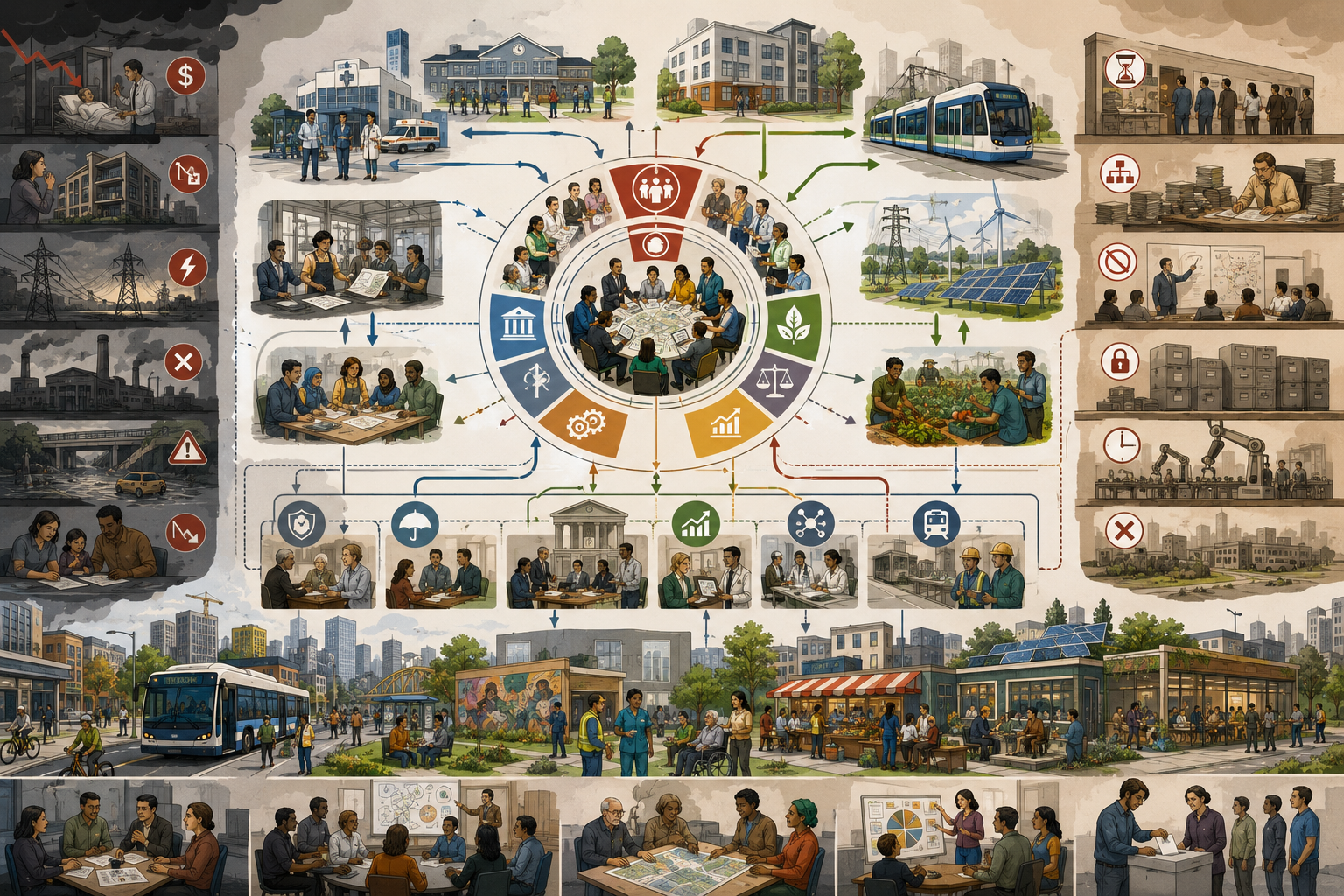
Within a sustainable systems framework, socialism, planning, and the mixed economy should be examined not only in terms of growth or ideology, but in terms of resilience, legitimacy, equality, capability, democratic accountability, and long-horizon coordination. A society may rely heavily on markets and still depend on planning when crisis, infrastructure, ecological transition, or social breakdown demand more deliberate direction. Conversely, a society may expand public ownership or planning yet still require decentralized knowledge, local initiative, feedback, and flexible adaptation. The deeper question is how economic systems can organize collective life in ways that preserve dynamism while aligning production more credibly with social need, public purpose, and shared security.
Why This Topic Matters
Modern economies are always more organized than market rhetoric sometimes suggests. Energy grids, public health, transport systems, monetary arrangements, food safety, schooling, housing regulation, strategic infrastructure, central banking, public research, and crisis response all involve forms of collective coordination. Even strongly market-oriented societies rely on extensive public institutions to stabilize demand, absorb shocks, regulate risk, define property rights, and produce goods that private markets either underprovide or provide unevenly.
At the same time, planning is never simple. Prices convey information, private actors adapt quickly to changing conditions, and decentralized initiative often produces forms of experimentation that centralized systems struggle to replicate. The challenge is not merely to choose between planning and markets as abstract principles. It is to understand where each coordinates well, where each fails, and how institutional combinations can reduce those failures without creating new ones.
Socialism enters the discussion because it asks a deeper question than efficiency alone. It asks who owns productive wealth, who controls investment, what counts as economic success, and whether meeting social need should take precedence over maximizing private returns. Those questions remain live wherever housing, health, care, energy, transport, communication, or ecological systems cannot be governed adequately through profit signals alone.
For that reason, socialism, planning, and the mixed economy belong near the center of political economy. They concern how societies decide what should be publicly guaranteed, what should be market-mediated, and how collective life should be coordinated when private incentives and public needs do not align automatically.
They also remind us that real economies are built through institutions, not slogans. Most societies are already mixtures; the question is what kind of mixture they have created and how well it serves long-term social purposes.
This matters especially under conditions of climate risk, public-health vulnerability, housing stress, energy transition, geopolitical instability, and technological disruption. These are not problems that can be solved only through individual choice or short-horizon price signals.
The key issue is therefore institutional fit: which domains require markets, which require planning, which require public ownership, which require social rights, and which require hybrid forms capable of learning over time.
What Socialism Is
Socialism is a broad family of ideas and institutional projects centered on the belief that economic life should be organized more directly around social need, collective provision, and democratic or public control over major productive resources. It has taken many forms, from revolutionary projects of common ownership to democratic socialist programs of expanded public provision, labor power, and social rights within constitutional systems.
What unites these forms is not one institutional formula, but a common dissatisfaction with economies organized primarily around private ownership and profit. Socialism questions whether essential goods, strategic sectors, and the commanding heights of investment should be governed chiefly through private accumulation rather than through collective decision-making, social rights, democratic control, or public purpose.
This does not mean every socialist position rejects markets entirely. Some socialist traditions envision market exchange within broader systems of public ownership, cooperative control, or socialized investment. Others seek more comprehensive planning. Still others focus on decommodifying key goods such as housing, healthcare, care, education, energy, and transport while leaving other sectors more decentralized.
A serious account therefore treats socialism not as one rigid blueprint, but as a contested tradition concerned with ownership, power, equality, and the social purpose of production.
Its core question is whether economic life should be governed chiefly by profitability or by some more explicit account of public need and collective obligation.
Socialism is also a critique of private economic power. It asks whether democracy can be meaningful when major investment, workplace authority, housing access, and technological development are governed largely by private owners and financial claims.
For economic systems analysis, socialism is most useful when treated not as a caricature, but as a family of institutional questions: who owns, who plans, who benefits, who decides, and what counts as a successful economy?
What Planning Is
Planning refers to the deliberate coordination of economic activity through public, collective, or organizational decision-making rather than leaving outcomes to decentralized exchange alone. It can range from broad macroeconomic guidance and infrastructure strategy to detailed sectoral targets, industrial policy, public budgeting, investment coordination, and in some cases comprehensive central allocation.
Planning exists on a spectrum. A government that directs energy transition, builds transport networks, funds research, manages public health capacity, coordinates housing investment, and stabilizes employment is already engaged in planning even if most consumer goods remain market-allocated. Large corporations also plan internally, often in quite detailed ways, even within market systems.
The question is therefore not whether planning exists, but what kind of planning is being used, at what scale, with what instruments, and toward what ends. Planning can be democratic or technocratic, flexible or rigid, strategic or comprehensive, public or quasi-public, inclusive or highly centralized.
A serious framework therefore treats planning as an indispensable category of economic coordination rather than as an exotic alternative to markets.
Modern societies plan constantly; the deeper issue is what they choose to plan, who makes those decisions, and whose interests are served by them.
Planning also requires feedback. A planning system without measurement, local knowledge, accountability, and correction can become rigid or blind. A market system without planning can become short-horizon, fragmented, and unable to coordinate public goods.
The serious question is therefore not planning versus no planning. It is how planning can be made intelligent, democratic, adaptive, and aligned with public purpose.
What the Mixed Economy Is
The mixed economy refers to systems in which markets, private firms, public institutions, regulation, public ownership, social rights, and strategic planning coexist. Rather than treating public and private coordination as mutually exclusive, the mixed economy recognizes that most real societies organize economic life through layered combinations of both.
This concept is useful because it describes the practical structure of many advanced economies more accurately than ideological extremes do. Public healthcare may coexist with private industry. Private housing markets may coexist with public planning and tenant protection. Market finance may coexist with central banking, deposit insurance, and public rescue during crisis. Welfare states, industrial policy, and regulatory agencies all point toward mixed forms rather than pure types.
The mixed economy also reflects political settlement. It often emerges from conflict and compromise among labor, capital, social movements, public institutions, and electoral coalitions. As a result, it is not a neutral midpoint between opposites, but a historically specific arrangement of power and responsibility.
A serious account therefore treats the mixed economy as a real institutional order rather than a vague moderation.
Its central question is how markets and public authority are combined, and whether that combination produces stability, equity, and long-term capacity or merely a more complicated version of existing inequalities.
Mixed economies can lean in very different directions. A mixed economy can be market-led with residual social supports, or it can be publicly robust with strong social rights and strategic coordination. Calling a system mixed does not tell us whether it is just, resilient, or democratic.
The task is therefore to evaluate the content of the mixture: which goods are rights, which sectors are publicly governed, how planning operates, how markets are regulated, and whether the whole system serves public purpose.
Markets, Planning, and the Problem of Coordination
Markets and planning are both coordination mechanisms, but they coordinate differently. Markets rely on prices, profit expectations, decentralized decisions, and competitive adjustment. Planning relies on targets, priorities, institutions, budgets, public goals, and direct organizational decision-making.
Markets often perform well where preferences are diverse, change is rapid, and decentralized adaptation matters. Planning becomes more important where long time horizons, public goods, network infrastructure, natural monopoly, externalities, or strategic interdependence make decentralized competition insufficient or unstable. Energy grids, climate mitigation, public health, transport, water systems, and war mobilization all illustrate cases where planning cannot be avoided.
The real issue is not abstract superiority. It is the fit between mechanism and problem. Markets may allocate consumer variety efficiently while underproviding long-run resilience. Planning may coordinate investment in strategic systems while struggling with local adaptation if it becomes too rigid or too detached from feedback.
A serious framework therefore sees coordination as a practical question of institutional design.
The challenge is to determine where price signals are useful, where public direction is necessary, and how the two can be combined without confusing one for the other.
Coordination problems are also political. A market does not simply reveal neutral preferences; it amplifies purchasing power. A plan does not simply reveal public need; it reflects institutional authority and political priorities.
For this reason, the design of coordination must include accountability. The relevant question is not only whether a mechanism is efficient, but who it empowers, whose needs it recognizes, and how it corrects failure.
Ownership, Public Purpose, and the Organization of Production
Ownership shapes economic purpose. Private ownership gives decision-making authority primarily to owners, shareholders, and those accountable to them. Public, cooperative, municipal, nonprofit, or social ownership can potentially align production more directly with collective goals, though outcomes depend greatly on governance quality and institutional design.
This matters because ownership is not only a legal question. It affects what counts as success. A privately owned utility may prioritize returns and pricing discipline. A publicly owned one may be expected to deliver universal access, long-term investment, and territorial equity. A cooperative enterprise may balance viability with worker voice and community stability in ways neither pure private nor bureaucratic forms achieve easily.
The debate is therefore not only about formal title. It is about which forms of ownership best fit different sectors, risks, and public purposes. Some goods may be compatible with competitive private provision. Others may generate chronic underinvestment, exclusion, or instability when left primarily to profit-seeking actors.
A serious account therefore places ownership near the center of economic analysis rather than treating it as a secondary legal detail.
The form of ownership influences how production is governed, what horizons are privileged, and how social obligations are interpreted when they conflict with private returns.
Ownership also shapes accountability. Private ownership can discipline performance through competition or capital markets, but it may neglect social obligations. Public ownership can align production with public purpose, but it requires democratic oversight, competent administration, and protection against capture.
The serious question is not whether one ownership form is always superior. It is which ownership form best fits the sector, the public need, the risk structure, and the democratic obligations involved.
The Socialist Critique of Capitalism
Socialist critiques of capitalism have taken many forms, but several themes recur. First, capitalism organizes production around profit rather than need, which can produce abundance in some domains while leaving essential goods underprovided or distributed unequally. Second, private ownership of productive assets gives some groups structural power over work, investment, and livelihood. Third, labor is often subordinated to managerial authority and market pressure in ways that narrow economic democracy. Fourth, capitalist competition and accumulation can generate recurrent crisis, inequality, ecological pressure, and instability.
These critiques do not all lead to the same institutional conclusion. Some emphasize worker ownership. Others emphasize public planning, welfare rights, industrial democracy, cooperative structures, municipal ownership, socialized investment, or strong regulation of capital. Some focus on class power, others on decommodification, democratic control, anti-colonial development, or ecological limits.
What they share is the claim that a system driven chiefly by private accumulation will not reliably align production with public purpose on its own. Essential needs, long-term resilience, and democratic equality therefore require institutions that limit, redirect, democratize, or partially replace purely profit-driven coordination.
A serious account of socialism should therefore engage its critique as an analysis of power and coordination, not merely as a moral objection to inequality.
It asks whether capitalism’s core incentives are sufficient for a good society or whether they must be subordinated to wider social aims through deeper institutional change.
The critique is strongest in sectors where private profit and social need diverge sharply: housing, healthcare, energy, care, water, transport, and ecological transition. In those domains, the question is not only efficiency, but whether basic conditions of life should be governed as commodities.
Socialism therefore remains analytically important because it asks what market society treats as negotiable, and what a just society should treat as collectively guaranteed.
Democratic Socialism, Social Democracy, and Public Economy
Democratic socialism and social democracy overlap in practice but are not identical. Social democracy typically accepts a capitalist economy while seeking to civilize and rebalance it through strong welfare states, labor rights, public services, progressive taxation, and regulation. Democratic socialism usually goes further by asking whether key sectors, ownership structures, and investment systems themselves should be democratized or socialized more substantially.
This distinction matters because many societies that are called “socialist” in popular debate are more accurately mixed or social-democratic economies with strong public institutions operating within broadly capitalist frameworks. Public healthcare, large welfare states, co-determination, public transport, and industrial policy do not by themselves abolish capitalism, though they may limit or redirect some of its harsher effects.
The public economy is important here. Even within market systems, states often produce, finance, insure, regulate, and plan much more than ideological caricatures admit. The real terrain of debate is often how far to extend that public economy, in which sectors, and under what forms of democratic control.
A serious framework therefore distinguishes among reformist, mixed, and more transformative projects without collapsing them into one another.
The difference often lies less in whether the state acts and more in whether the underlying distribution of ownership and investment power is being fundamentally altered.
Social democracy may make capitalism more livable by expanding social rights and reducing insecurity. Democratic socialism asks whether deeper democratization of ownership, finance, and investment is needed to align production with public need.
Both traditions belong in the study of mixed economies because most real institutional settlements contain elements of market coordination, public provision, social rights, and democratic struggle over economic power.
Central Planning, Its Ambitions, and Its Limits
Central planning aims to coordinate major economic decisions through a central authority rather than through decentralized markets. Historically, it was often associated with attempts to overcome unemployment, unequal development, private monopoly, and the disorder of market crisis through deliberate allocation of resources and investment.
Its appeal is understandable. Central planning promises the ability to direct resources toward social priorities, industrial transformation, mass housing, universal provision, and rapid mobilization without leaving outcomes to private profitability alone. In some historical settings it supported major gains in industrialization, infrastructure, literacy, health, and basic social provision.
Its limits are equally important. Central planners face enormous informational challenges: local conditions change, preferences vary, bottlenecks emerge, innovation is hard to pre-specify, and feedback can become distorted in bureaucratic systems. Planning can also become rigid, hierarchical, and politically insulated if democratic accountability and institutional learning are weak.
A serious account therefore neither romanticizes nor caricatures central planning.
It recognizes both its capacity for large-scale coordination and its vulnerability to informational overload, bureaucratic inertia, and political concentration when not balanced by feedback, decentralization, and democratic correction.
The problem is not simply that planning exists, but whether planning can learn. A rigid plan can suppress information; an adaptive plan can coordinate long-term priorities while adjusting to local knowledge and changing conditions.
Central planning therefore remains instructive because it reveals both the necessity of collective direction in some domains and the danger of concentrating too much economic knowledge and authority in institutions that cannot be meaningfully corrected.
Industrial Policy, Infrastructure, and Strategic Coordination
Even strongly market-oriented economies often rely on strategic planning in practice when it comes to industry, infrastructure, energy, transport, defense, research, and technological capability. Industrial policy is one of the clearest forms of this coordination. It directs public support, finance, standards, procurement, or protection toward sectors seen as important for development, resilience, or national capability.
This matters because structural transformation rarely occurs through price signals alone. New industries often require coordinated investment, research support, training systems, supplier development, standards, infrastructure, and public tolerance for long time horizons. Infrastructure makes the point even more clearly. Energy grids, ports, rail, broadband, water systems, and public-health capacity require planning because they involve scale, interdependence, and public necessity.
Strategic coordination does not require abolishing markets. It requires acknowledging that markets often operate within investment landscapes already shaped by public action. The question is whether that action is narrow and reactive or developmental and deliberate.
A serious framework therefore treats industrial policy and infrastructure planning as normal features of complex economies rather than ideological exceptions.
They show that even capitalist systems rely on coordinated direction when long-horizon public capacity is at stake.
Industrial policy also raises accountability questions. Public support can build capability, but it can also become captured subsidy if not tied to performance, learning, labor standards, climate goals, or public return.
The key distinction is not intervention versus nonintervention. It is whether public coordination produces genuine capability and shared benefit, or whether it socializes risk while privatizing reward.
Public Ownership, Utilities, and Natural Monopoly
Some sectors are especially difficult to govern well through fragmented competition. Utilities such as water, electricity distribution, rail networks, and in some cases telecommunications or basic transport often exhibit features of natural monopoly, high fixed cost, network dependence, territorial obligation, or universal-service necessity.
This matters because leaving such sectors entirely to profit-seeking ownership can produce underinvestment, regional neglect, price extraction, or a misalignment between shareholder expectations and public need. Public ownership is one response to this problem, especially where continuity, access, and long-term infrastructure maintenance matter more than competitive churn.
Public ownership is not automatically efficient or democratic. Much depends on governance, accountability, financing, professional competence, and insulation from short-term political manipulation. Yet the case for it remains strongest where market competition is structurally weak and social dependence is high.
A serious account therefore evaluates public ownership sector by sector rather than as a universal principle or universal mistake.
Utilities and network systems make clear that the question is often not state versus market in the abstract, but what governance form best matches the technical and social character of the good being provided.
The strongest argument for public ownership is not that public institutions are always better. It is that some goods are too foundational, too interdependent, too monopolistic, or too socially necessary to be governed primarily through profit extraction.
Public ownership should therefore be judged by access, affordability, investment, reliability, ecological responsibility, regional equity, and democratic accountability—not by ownership label alone.
Welfare States, Social Rights, and Decommodification
One of the most important ways mixed economies depart from pure market logic is through social rights. Welfare states partially decommodify parts of life by reducing the extent to which survival, health, education, care, housing, mobility, or old-age security depend entirely on market income.
This matters because the degree of commodification shapes the lived character of an economic system. Where healthcare, childcare, pensions, education, housing supports, transport, and unemployment protection are more strongly socialized, households are less exposed to market volatility. Where these goods remain heavily commodified, private wealth and continuous earnings matter more for basic security.
Decommodification does not abolish markets, but it changes how people experience them. Workers may have greater bargaining power, households may be more resilient, and participation in society may become less contingent on uninterrupted success in labor markets.
A serious account therefore treats welfare states not as peripheral corrections to economic order, but as institutions that reshape the terms on which market dependence is lived.
They are among the clearest examples of how mixed systems can combine private production with publicly guaranteed foundations of life.
Decommodification is also a planning question. A society that treats healthcare, housing, energy, or transport as rights must plan capacity, finance, staffing, infrastructure, and access. Rights without planning can become promises without delivery.
Social rights therefore connect socialism, planning, and the mixed economy directly: they define what should not be left entirely to market purchasing power and require institutions capable of making that commitment real.
The Mixed Economy as Practical Settlement
The mixed economy is best understood as a practical settlement rather than a vague midpoint. It reflects the recognition that markets can coordinate some activities effectively, while others require public authority, social rights, public ownership, or strategic direction. Most modern societies arrive at mixed forms because neither pure laissez-faire nor pure comprehensive planning proves workable across all domains.
This practical settlement is never neutral. It reflects power, conflict, historical inheritance, and political compromise. Which sectors remain private, which are regulated, which are publicly owned, which are subsidized, and which are guaranteed as rights all depend on the balance of forces within a society.
The mixed economy therefore should not be treated as merely technocratic moderation. It is a substantive form of political economy that decides how risk, power, and coordination are distributed across public and private institutions.
A serious account asks what kind of mixture exists, how coherent it is, and whether it reinforces or moderates deeper inequalities.
Mixed systems can buffer instability and widen inclusion, but they can also become incoherent if public responsibilities are large while public capacity remains thin or politically fragmented.
The mixed economy can also hide privatized power behind public rescue. A system may privatize profit during good times while relying on public support during crisis. That is a mixed economy, but not necessarily a just or sustainable one.
The serious question is therefore whether the mixture is governed by public purpose, democratic accountability, and long-term capability, or whether it simply manages contradiction without resolving it.
Innovation, Incentives, and the Role of Markets
One of the strongest arguments for markets is that they support experimentation, entrepreneurship, price feedback, and decentralized adaptation. Profit opportunities can encourage innovation, and competitive pressure can reveal which products, processes, or business models respond effectively to changing conditions.
This argument matters because any serious discussion of socialism or planning has to engage the problem of incentives and feedback. Systems that suppress experimentation, block entry, or insulate producers too completely from evaluation may struggle with stagnation, poor quality, or technological rigidity.
At the same time, innovation is rarely purely private. Public research, universities, procurement systems, infrastructure, standards, patient public finance, and development agencies often create the conditions from which marketable innovation later emerges. The contrast between state and market is therefore often overstated.
A serious framework treats innovation as institutionally co-produced.
Markets can be powerful discovery mechanisms, but they often operate most effectively when embedded within public systems that fund research, spread risk, and create the platforms on which experimentation becomes possible.
The challenge is not to eliminate incentives, but to design them around social purpose. Markets can reward useful innovation, but they can also reward planned obsolescence, addictive platforms, speculative finance, rent extraction, or ecological damage if the institutional context permits it.
Innovation policy therefore belongs inside the mixed economy: public systems shape what kinds of innovation are possible, profitable, legitimate, and aligned with long-term need.
Knowledge, Calculation, and the Classic Planning Debate
The classic planning debate turned on whether a central authority could gather and process enough information to allocate resources rationally across a complex economy. Critics argued that dispersed knowledge, changing preferences, and local circumstances make prices indispensable signals. Defenders argued that markets themselves are shaped by power and that many strategic decisions are already planned within firms and states rather than spontaneously discovered.
This debate remains useful because it clarifies a real tension. Complex economies require feedback, learning, and adaptation. Any planning system that ignores local information, suppresses dissent, or overcentralizes decisions risks severe blindness. Any market system that treats prices as sufficient for long-run coordination risks underproviding public goods, resilience, ecological protection, and strategic capacity.
The better conclusion is not that one side won for all time. It is that coordination problems differ. Some are solved better through decentralized price mechanisms; others require planning, public standards, social rights, public ownership, or hybrid forms that combine central priorities with local feedback.
A serious account therefore reads the planning debate as an institutional design problem rather than a final ideological verdict.
The key issue is how societies build systems that can learn, adjust, and coordinate without mistaking one mechanism for a universal answer.
Modern data systems, computing, logistics, and platform coordination have changed the technical terrain, but they have not eliminated political questions. More data does not automatically create better planning if accountability, representation, privacy, and contestability are weak.
Planning capacity therefore depends on knowledge and power together: how information is gathered, who interprets it, who can challenge it, and how systems correct themselves when reality changes.
Planning for Crisis, War, and Ecological Transition
Crisis makes planning unavoidable. War mobilization, pandemic response, disaster recovery, financial rescue, inflation management, supply-chain emergency, and energy transition all require forms of collective coordination that markets alone do not spontaneously generate at the required speed or scale. In these moments, states allocate resources, prioritize sectors, guarantee finance, organize logistics, and suspend ordinary assumptions about decentralized adjustment.
This matters because it reveals something often hidden in normal times: all societies plan when breakdown becomes visible enough. The real difference is whether planning is treated as exceptional emergency management or as part of a broader long-term capacity for steering structural change.
Ecological transition makes this especially important. Decarbonization, adaptation, grid redesign, building retrofits, public transit expansion, industrial conversion, ecological restoration, and resilience investment all require planning across decades, sectors, and regions. Prices alone are too short-horizon and fragmented to manage such a transition adequately.
A serious framework therefore places planning at the center of serious climate and resilience politics.
The question is not whether planning will occur, but whether it will be democratic, strategic, and oriented toward public need rather than driven narrowly by crisis after crisis.
Crisis planning also reveals social priorities. A state can rescue banks quickly while leaving households to absorb losses slowly; it can mobilize for war but not for housing; it can stabilize markets while neglecting care. Planning is never only technical. It is a map of what society treats as urgent.
A sustainable mixed economy requires planning before catastrophe, not only improvisation after systems fail.
Globalization, Finance, and the Limits of National Planning
Planning always operates under constraints, and globalization has changed those constraints. Capital mobility, trade dependence, reserve-currency hierarchy, multinational firms, supply-chain concentration, investor-state disputes, debt structures, and international legal regimes can all limit what national governments can direct unilaterally.
This matters because even ambitious domestic strategies can be destabilized by external finance, import dependence, currency pressure, sanctions, corporate exit, or technological dependence. National planning is harder when key technologies, energy inputs, financial conditions, or supply chains are governed elsewhere.
At the same time, these constraints do not eliminate planning. They change its scale and complexity. Regional coordination, public development banks, capital management, industrial alliances, strategic procurement, technology policy, and international public finance may all become more important where national autonomy is incomplete.
A serious framework therefore treats planning under globalization as a problem of sovereignty, interdependence, and institutional reach.
The challenge is to build enough strategic capacity to shape domestic futures without assuming that national borders alone define the effective space of economic control.
Globalization also raises questions of justice. Planning in one country may rely on extraction, labor, resources, or ecological burdens elsewhere. A sustainable mixed economy cannot evaluate public purpose only within national borders if its supply chains externalize harm.
Planning for sustainability must therefore consider domestic capacity and global responsibility together.
Historical Lessons from Socialist and Mixed Systems
Historical experience shows that neither socialism nor the mixed economy exists in one form. Revolutionary socialist states, democratic socialist movements, social-democratic welfare states, developmental mixed economies, wartime planning systems, municipal public ownership, cooperative movements, and contemporary hybrid regimes all combined ownership, coordination, and public authority in different ways.
These experiences reveal both possibility and constraint. Public planning has supported rapid industrialization, mass infrastructure, universal literacy, public health, and large-scale mobilization. Mixed economies have delivered some of the most stable combinations of welfare, growth, and social rights in modern history. At the same time, centralized systems have often struggled with information bottlenecks, bureaucratic rigidity, authoritarian concentration, or weak consumer responsiveness.
History therefore argues against simple romance and simple dismissal alike. The relevant lesson is institutional specificity: what works depends on democratic structure, administrative capacity, sectoral fit, public legitimacy, and the ability to learn from feedback.
A serious historical perspective rejects the fantasy of one final economic formula.
It shows instead that societies repeatedly move along a spectrum of market reliance, public provision, and planning as they confront crisis, inequality, development, and long-run coordination problems.
Historical experience also shows that social rights, public services, and planning capacity are political achievements. They are not automatically produced by growth, nor are they preserved without institutions and coalitions capable of defending them.
The central lesson is that economic systems are made and remade. The question is whether they are remade around private accumulation alone or around a wider conception of social need and democratic purpose.
Socialism, Planning, and Sustainable Systems
Within sustainable systems, socialism, planning, and the mixed economy matter because they widen the question of what economies are for. If resilience, decarbonization, public health, housing security, care, and social inclusion are real priorities, then economic institutions must be judged partly by how well they can coordinate those outcomes over time.
This changes the debate. The issue is not whether markets should disappear, nor whether public institutions should control everything. It is whether key domains of life can be governed adequately through profitability and decentralized incentives alone. In many cases, they cannot. Climate transition, strategic infrastructure, care systems, housing, public health, and territorial equality all require stronger forms of planning and public purpose.
Sustainable systems therefore require institutional mixtures capable of combining innovation with direction, flexibility with security, and local initiative with long-term coordination. Some sectors may need competitive markets; others may need public ownership, social rights, or strategic planning. The point is not purity, but fit.
In this sense, socialism and the mixed economy become systems questions. They ask whether societies can design economic orders in which collective life is not continually subordinated to short-horizon accumulation.
This also means that sustainability cannot be treated as a correction added onto otherwise unchanged institutions. It raises a deeper issue about ownership, coordination, and whether economic power can be redirected toward shared futures rather than left to follow profitability wherever it leads.
A sustainable mixed economy would not eliminate every market, nor would it centralize every decision. It would ask which parts of life require public guarantee, which investments require planning, which sectors require democratic ownership or strong regulation, and how social rights can be made real through institutions.
The central challenge is to build economic systems that can learn, plan, innovate, protect, and adapt without abandoning democratic accountability or social need.
How Socialist, Planning, and Mixed-Economy Systems Should Be Judged
Socialist, planning, and mixed-economy systems should not be judged only by the share of public ownership, the size of the state, or the presence of markets. A broader economic systems framework asks whether the institutional mix produces capability, resilience, democratic accountability, public purpose, ecological transition, and social security.
| Dimension | Narrow Question | Systems Question |
|---|---|---|
| Markets | Are prices and competition used? | Where do price signals coordinate well, and where do they underprovide public goods, resilience, or basic needs? |
| Planning | Is the state directing activity? | Is planning strategic, adaptive, democratic, accountable, and capable of learning from feedback? |
| Ownership | Is production public or private? | Which ownership form best fits the sector’s social purpose, risk structure, investment horizon, and democratic obligations? |
| Public Provision | Are services publicly provided? | Do public services actually guarantee access, quality, affordability, and territorial equity? |
| Social Rights | Are benefits available? | Do rights decommodify essential goods enough to reduce dependence on market income alone? |
| Industrial Policy | Does the state support sectors? | Does support build productive capability, learning, public return, labor standards, and ecological transition? |
| Utilities | Who owns infrastructure? | Does governance ensure universal access, maintenance, affordability, accountability, and long-term investment? |
| Innovation | Are incentives present? | Do public and private institutions co-produce useful innovation aligned with social need? |
| Crisis Response | Can the system react? | Does public capacity coordinate resources quickly while protecting households and maintaining legitimacy? |
| Sustainability | Can the system continue? | Can markets, planning, ownership, and social rights be organized around ecological limits and shared futures? |
This framework prevents a common mistake: reducing the debate to state versus market. Real systems combine multiple coordination forms. The important question is whether the combination is coherent, democratic, capable, and aligned with the goods being governed.
The central issue is therefore not whether an economy is purely socialist, capitalist, planned, or mixed. The deeper question is whether its institutional structure can coordinate production, distribution, investment, social rights, and ecological transition in ways that serve durable human and planetary wellbeing.
Mathematical Lens
Mathematics can clarify socialism, planning, and the mixed economy by making coordination structure, public ownership, planning capacity, decommodification, crisis coordination, and transition capacity explicit. These equations do not determine how much planning is desirable, but they help show what must be compared.
1. Mixed-Economy Structure
ME = f(Market\ Allocation, Public\ Provision, Planning, Regulation, Social\ Rights)
\]
Interpretation: Mixed-economy structure \(ME\) reflects the fact that most real economies combine markets, public provision, planning, regulation, and social rights rather than relying on only one mechanism.
2. Social Need and Profit Tension
Allocation\ Outcome = f(Profit\ Signals, Social\ Priorities)
\]
Interpretation: Systems differ depending on how strongly profit signals or social priorities shape allocation, especially in essential sectors such as housing, healthcare, energy, and care.
3. Public Ownership Share
POS = \frac{Public\ Sector\ Output}{Total\ Output}
\]
Interpretation: Public ownership share \(POS\) compares public-sector output with total output. It does not settle questions of quality or democracy, but it helps compare the scale of public production.
4. Planning Capacity
PC = f(State\ Capacity, Data\ Quality, Institutional\ Reach, Feedback, Democratic\ Accountability)
\]
Interpretation: Planning capacity \(PC\) depends on more than intention. It requires capable institutions, reliable data, territorial reach, feedback mechanisms, and democratic accountability.
5. Decommodification
D = f(Public\ Services, Social\ Insurance, Guaranteed\ Access)
\]
Interpretation: Decommodification \(D\) measures how far basic needs and risks are protected from dependence on market income alone.
6. Crisis Coordination
CC = f(Public\ Planning, Infrastructure\ Depth, Fiscal\ Capacity, Administrative\ Speed)
\]
Interpretation: Crisis coordination \(CC\) shows why crisis response often depends on public planning, infrastructure, fiscal capacity, and administrative speed more than decentralized adjustment alone.
7. Sustainable Transition Coordination
STC = f(Public\ Investment, Industrial\ Policy, Social\ Protection, Ecological\ Targets, Democratic\ Legitimacy)
\]
Interpretation: Sustainable transition coordination \(STC\) captures the institutional capacity to organize decarbonization, adaptation, infrastructure transformation, public protection, and legitimacy together.
8. Practical Interpretation
The mathematical lens clarifies several structural points. Most real economies are mixed rather than pure. Essential sectors often depend on a balance between profit signals and social priorities. Planning capacity depends on information, institutions, feedback, and accountability. Decommodification changes how households experience risk and necessity. Crisis resilience often depends on public coordination more than decentralized adjustment alone. Sustainable transition requires a mix of public investment, industrial policy, social protection, ecological targets, and democratic legitimacy.
Formalization helps clarify mechanism, but it does not determine how much planning is desirable, what should be publicly owned, or which goods should be treated as rights rather than commodities. Those remain institutional, historical, ethical, and political questions.
Python Workflow: Socialism, Planning, and the Mixed Economy
Python is useful for turning mixed-economy concepts into reproducible calculations. The following compact workflow models mixed-economy structure, public ownership, planning capacity, decommodification, crisis coordination, and sustainable transition capacity.
# Socialism, Planning, and the Mixed Economy
# Simple Python workflow

import pandas as pd

# Stylized mixed-economy structure
market_allocation = 0.52
public_planning = 0.20
public_provision = 0.18
regulation_rights = 0.10

mixed_economy_total = sum([
    market_allocation,
    public_planning,
    public_provision,
    regulation_rights
])

print("Mixed economy composition:", round(mixed_economy_total, 3))

# Public ownership share
public_sector_output = 280
total_output = 1400
public_ownership_share = public_sector_output / total_output

print("Public ownership share:", round(public_ownership_share, 3))

# Planning capacity
state_capacity = 0.72
data_quality = 0.66
institutional_reach = 0.68
feedback_quality = 0.64
democratic_accountability = 0.70

planning_capacity = (
    0.22 * state_capacity
    + 0.18 * data_quality
    + 0.20 * institutional_reach
    + 0.18 * feedback_quality
    + 0.22 * democratic_accountability
)

print("Planning capacity:", round(planning_capacity, 3))

# Decommodification score
public_services = 0.74
social_insurance = 0.70
guaranteed_access = 0.68
affordability = 0.66

decommodification_score = (
    0.30 * public_services
    + 0.25 * social_insurance
    + 0.25 * guaranteed_access
    + 0.20 * affordability
)

print("Decommodification score:", round(decommodification_score, 3))

# Crisis coordination
infrastructure_depth = 0.69
fiscal_capacity = 0.64
administrative_speed = 0.60
public_health_capacity = 0.67

crisis_coordination = (
    0.25 * public_planning
    + 0.25 * infrastructure_depth
    + 0.20 * fiscal_capacity
    + 0.15 * administrative_speed
    + 0.15 * public_health_capacity
)

print("Crisis coordination score:", round(crisis_coordination, 3))

# Sustainable transition coordination
public_investment = 0.72
industrial_policy = 0.68
social_protection = 0.70
ecological_targets = 0.78
democratic_legitimacy = 0.66

sustainable_transition = (
    0.22 * public_investment
    + 0.20 * industrial_policy
    + 0.18 * social_protection
    + 0.24 * ecological_targets
    + 0.16 * democratic_legitimacy
)

print("Sustainable transition score:", round(sustainable_transition, 3))

df = pd.DataFrame({
    "Metric": [
        "Mixed Economy Composition",
        "Public Ownership Share",
        "Planning Capacity",
        "Decommodification Score",
        "Crisis Coordination Score",
        "Sustainable Transition Score"
    ],
    "Value": [
        mixed_economy_total,
        public_ownership_share,
        planning_capacity,
        decommodification_score,
        crisis_coordination,
        sustainable_transition
    ]
})

print(df)
This workflow is useful because it separates the scale of markets from questions of public capacity, social rights, planning quality, crisis coordination, and ecological transition. It shows why a mixed economy cannot be judged simply by whether markets or public institutions are present. The more serious question is whether the combination produces public purpose, resilience, and democratic capability.
The full GitHub repository expands this example into mixed-economy scenarios, public-purpose scoring, profit-dominance analysis, planning-capacity indicators, decommodification models, sectoral fit between markets and public coordination, public-utility governance, industrial-policy evaluation, crisis coordination, globalization constraints, sustainable-transition scoring, SQL queries, R and Stata replication workflows, Julia simulations, and article-ready figures.
R Workflow: Socialism, Planning, and the Mixed Economy
R is useful for mixed-economy summaries, planning-capacity tables, decommodification comparisons, and publication-ready graphics. The following compact workflow performs the same mixed-economy, public-ownership, planning-capacity, decommodification, crisis-coordination, and sustainable-transition calculations in R.
# Socialism, Planning, and the Mixed Economy
# Simple R workflow

# Stylized mixed-economy structure
market_allocation <- 0.52
public_planning <- 0.20
public_provision <- 0.18
regulation_rights <- 0.10

mixed_economy_total <- sum(c(
  market_allocation,
  public_planning,
  public_provision,
  regulation_rights
))

cat("Mixed economy composition:", round(mixed_economy_total, 3), "\n")

# Public ownership share
public_sector_output <- 280
total_output <- 1400
public_ownership_share <- public_sector_output / total_output

cat("Public ownership share:", round(public_ownership_share, 3), "\n")

# Planning capacity
state_capacity <- 0.72
data_quality <- 0.66
institutional_reach <- 0.68
feedback_quality <- 0.64
democratic_accountability <- 0.70

planning_capacity <- (
  0.22 * state_capacity +
  0.18 * data_quality +
  0.20 * institutional_reach +
  0.18 * feedback_quality +
  0.22 * democratic_accountability
)

cat("Planning capacity:", round(planning_capacity, 3), "\n")

# Decommodification score
public_services <- 0.74
social_insurance <- 0.70
guaranteed_access <- 0.68
affordability <- 0.66

decommodification_score <- (
  0.30 * public_services +
  0.25 * social_insurance +
  0.25 * guaranteed_access +
  0.20 * affordability
)

cat("Decommodification score:", round(decommodification_score, 3), "\n")

# Crisis coordination
infrastructure_depth <- 0.69
fiscal_capacity <- 0.64
administrative_speed <- 0.60
public_health_capacity <- 0.67

crisis_coordination <- (
  0.25 * public_planning +
  0.25 * infrastructure_depth +
  0.20 * fiscal_capacity +
  0.15 * administrative_speed +
  0.15 * public_health_capacity
)

cat("Crisis coordination score:", round(crisis_coordination, 3), "\n")

# Sustainable transition coordination
public_investment <- 0.72
industrial_policy <- 0.68
social_protection <- 0.70
ecological_targets <- 0.78
democratic_legitimacy <- 0.66

sustainable_transition <- (
  0.22 * public_investment +
  0.20 * industrial_policy +
  0.18 * social_protection +
  0.24 * ecological_targets +
  0.16 * democratic_legitimacy
)

cat("Sustainable transition score:", round(sustainable_transition, 3), "\n")

summary_df <- data.frame(
  Metric = c(
    "Mixed Economy Composition",
    "Public Ownership Share",
    "Planning Capacity",
    "Decommodification Score",
    "Crisis Coordination Score",
    "Sustainable Transition Score"
  ),
  Value = c(
    mixed_economy_total,
    public_ownership_share,
    planning_capacity,
    decommodification_score,
    crisis_coordination,
    sustainable_transition
  )
)

print(summary_df)
This R workflow is deliberately compact for article readability. In the full repository, R reads structured mixed-economy, planning-capacity, decommodification, sector-coordination, public-utility, industrial-policy, crisis, globalization, and sustainability scenarios; calculates public-purpose scores, planning-capacity scores, decommodification scores, sectoral public-coordination needs, public-utility purpose, industrial-policy capacity, crisis coordination, and sustainable-transition coordination; and visualizes how different mixed-economy designs compare.
Future Economic Systems articles can extend this foundation with public-sector accounts, national accounts, public investment data, social spending indicators, state-owned enterprise data, utility regulation datasets, public-service access metrics, industrial-policy program data, benefit records, climate-investment plans, infrastructure data, and governance indicators.
GitHub Repository
The article body includes selected computational examples so the conceptual, institutional, and mathematical argument remains readable. The full repository contains the expanded research infrastructure: Python mixed-economy and planning analysis, R public-purpose summaries, Stata applied political-economy replication workflows, SQL mixed-economy scenario tables, Julia planning-capacity simulations, mixed-economy composition, public ownership, public provision, social rights, decommodification, sectoral coordination, public utilities, industrial policy, crisis coordination, globalization constraints, sustainable-transition scoring, documentation, reproducible sample data, and article-ready figures and tables.
Complete Code Repository
The full code distribution for this article, including selected article examples and advanced research-style computational scaffolding for mixed-economy structure, market allocation, public planning, public provision, regulation, social rights, public ownership, planning capacity, decommodification, sectoral coordination, utility governance, industrial policy, crisis response, globalization constraints, sustainable transition, reproducibility documentation, and cross-language economic analysis, is available on GitHub.
Conclusion
Socialism, planning, and the mixed economy remain central to political economy because they ask how far production, investment, and essential goods should be governed by market profitability and how far they should be directed by public purpose, social rights, democratic accountability, and collective coordination. The key issue is not whether one mechanism can govern everything well, but how different forms of coordination fit different kinds of goods, risks, and long-term commitments.
To understand an economic system seriously, one must therefore ask not only how much of it is public or private, but what is owned by whom, which sectors are planned, where markets are useful, how strongly social rights reduce dependency on income alone, and whether the resulting institutional mix can support resilience, legitimacy, equality, ecological transition, and shared capability over time. These questions reveal whether a society has built a workable settlement between private initiative and collective need, or whether essential parts of social life remain governed by mechanisms too narrow for the tasks they are expected to solve.
The serious study of planning also requires moving beyond caricature. Markets plan internally through firms, states plan infrastructure and crisis response, households plan survival, and public institutions constantly shape the conditions under which markets operate. The issue is not planning versus freedom in the abstract. It is whether economic coordination is democratic, adaptive, accountable, and capable of serving human need.
In a sustainable economic system, the mixed economy cannot be treated as a compromise without content. It must be designed around public purpose: strong enough to coordinate transition, open enough to learn from feedback, democratic enough to avoid technocratic domination, and humane enough to treat essential goods as foundations of life rather than merely opportunities for profit.
Related Reading
- Economic Systems
- Capitalism and Its Varieties
- The Welfare State and Social Protection
- Institutions, Property Rights, and Economic Order
- Industrial Policy and the Developmental State
- Fiscal Policy, Taxation, and Public Investment
- Public Goods, Collective Action, and Institutional Design
- Externalities, Public Goods, and Collective Provision
- Sustainable Development
- Institutions & Governance
- Risk & Resilience
Further Reading
- Hayek, F.A. (1945). The Use of Knowledge in Society. American Economic Review, 35(4), pp. 519–530. Available at: https://www.econlib.org/library/Essays/hykKnw.html
- Lange, O. (1936). On the Economic Theory of Socialism: Part One. The Review of Economic Studies, 4(1), pp. 53–71. Available at: https://www.jstor.org/stable/2967660
- Mazzucato, M. (2013). The Entrepreneurial State: Debunking Public vs. Private Sector Myths. London: Anthem Press. Available at: https://marianamazzucato.com/books/the-entrepreneurial-state
- Nove, A. (1983). The Economics of Feasible Socialism. London: George Allen & Unwin. Available at: https://www.versobooks.com/products/2837-the-economics-of-feasible-socialism-revisited
- Ostrom, E. (1990). Governing the Commons: The Evolution of Institutions for Collective Action. Cambridge: Cambridge University Press. Available at: https://www.cambridge.org/core/books/governing-the-commons/7AB7AE11BADA84409C34815CC288CD79
- Polanyi, K. (1944). The Great Transformation: The Political and Economic Origins of Our Time. Boston: Beacon Press. Available at: https://www.beacon.org/The-Great-Transformation-P156.aspx
- United Nations Conference on Trade and Development (UNCTAD) (n.d.). Industrial policy and structural transformation. Available at: https://unctad.org/
- United Nations Research Institute for Social Development (UNRISD) (n.d.). Social policy, public economy, and development. Available at: https://www.unrisd.org/
References
- Hayek, F.A. (1945). The Use of Knowledge in Society. American Economic Review, 35(4), pp. 519–530. Available at: https://www.econlib.org/library/Essays/hykKnw.html
- Lange, O. (1936). On the Economic Theory of Socialism: Part One. The Review of Economic Studies, 4(1), pp. 53–71. Available at: https://www.jstor.org/stable/2967660
- Mazzucato, M. (2013). The Entrepreneurial State: Debunking Public vs. Private Sector Myths. London: Anthem Press. Available at: https://marianamazzucato.com/books/the-entrepreneurial-state
- Nove, A. (1983). The Economics of Feasible Socialism. London: George Allen & Unwin. Available at: https://www.versobooks.com/products/2837-the-economics-of-feasible-socialism-revisited
- Ostrom, E. (1990). Governing the Commons: The Evolution of Institutions for Collective Action. Cambridge: Cambridge University Press. Available at: https://www.cambridge.org/core/books/governing-the-commons/7AB7AE11BADA84409C34815CC288CD79
- Polanyi, K. (1944). The Great Transformation: The Political and Economic Origins of Our Time. Boston: Beacon Press. Available at: https://www.beacon.org/The-Great-Transformation-P156.aspx
- United Nations Conference on Trade and Development (UNCTAD) (n.d.). Industrial policy and structural transformation. Available at: https://unctad.org/
- United Nations Research Institute for Social Development (UNRISD) (n.d.). Social policy, public economy, and development. Available at: https://www.unrisd.org/