
Last Updated August 4, 2026
Health and education are among the most important foundations of human capability because they shape whether people are able to live long lives, develop knowledge and judgment, participate in society, pursue meaningful work, and exercise real freedom over the course of their lives. They are not merely social sectors competing for public spending alongside other priorities. They are enabling conditions of human development itself. To expand health and education is to expand the substantive range of what people can do and become.
This matters because sustainable development cannot be judged only by output growth, infrastructure expansion, or aggregate national indicators. A society may grow economically while leaving many people unable to access quality healthcare, meaningful learning, safe childhood development, dignified work, informed public participation, or the basic conditions required for agency. Health and education sit at the center of human development because they are both intrinsic goods and practical foundations for almost every other dimension of capability.
Main Library
Publications
Article Map
Sustainable Development
Related Topic
Economic Systems
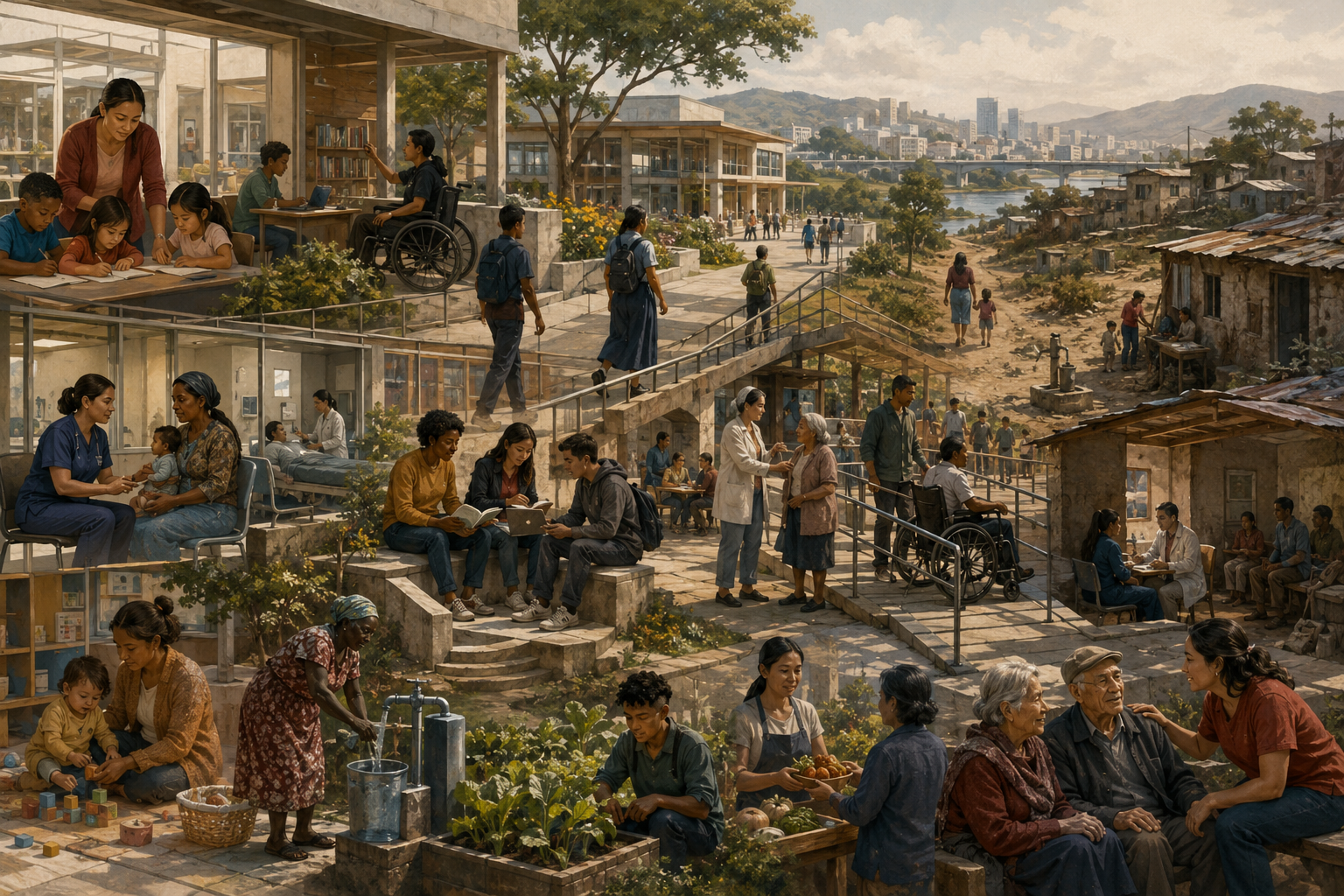
The human development tradition has made this point with unusual clarity. It defines human development around people’s freedoms, opportunities, choices, and ability to live lives they value. Health and education sit at the center of that tradition because they are not simply services delivered to populations. They are foundations of agency. A person’s ability to learn, reason, remain healthy, recover from illness, interpret the world, participate in public life, and plan for the future depends heavily on the quality and accessibility of health and education systems.
The 2030 Agenda reinforces this centrality. Goal 3 calls for ensuring healthy lives and promoting well-being for all at all ages, while Goal 4 calls for inclusive and equitable quality education and lifelong learning opportunities for all. WHO’s universal health coverage framing deepens the point further by defining UHC as access to the full range of quality health services people need, when and where they need them, without financial hardship. The shared logic is clear: health and education are not peripheral benefits of development. They are core mechanisms through which development becomes real in human lives.
The expanded edition adds the present global context, including the slowdown in universal health coverage, the persistence of out-of-school populations and weak learning, pressures on health and education finance, climate and conflict disruption, disability and gender exclusion, digital public infrastructure, frontline workforce constraints, and the institutional conditions required to convert formal provision into usable freedom.
It also develops a transparent capability-system diagnostic with distribution, household burden, resilience, governance, uncertainty, and a practical twelve-step method. The quantitative workflows are explicitly diagnostic: they make value choices visible and support sensitivity analysis rather than presenting one composite score as an objective measure of human development.
What Human Capability Expansion Means
Human capability expansion refers to the widening of what people are actually able to be and to do. This idea is central to the human development approach, which emphasizes people’s opportunities, choices, freedoms, and real ability to live lives they value rather than treating income growth as an end in itself. A person may formally possess rights or nominal access to institutions, yet still lack the health, knowledge, mobility, safety, confidence, or social recognition needed to make meaningful use of them. Capability expansion therefore concerns substantive opportunity rather than abstract possibility alone.
This matters because development cannot be judged adequately through aggregate economic measures alone. An economy may grow while leaving many people unhealthy, uneducated, insecure, or excluded from social participation. A broader account of development must therefore examine the conditions that enable people to convert resources into actual lives they value. Health and education are among the most important of these conditions because they expand the human capacity to act in the world, interpret it, and shape one’s place within it.
To describe health and education as mechanisms of capability expansion is therefore to say something stronger than that they are beneficial services. It is to say that they widen the real field of human action. They enlarge what can be learned, chosen, endured, imagined, and achieved. They influence how people move through childhood, family life, work, citizenship, aging, and uncertainty. A healthy and educated person is not merely more productive. They are more able to understand choices, resist exploitation, participate in collective life, and shape a meaningful future.
This places the article in direct continuity with From Economic Growth to Human Development, where development is judged by the expansion of meaningful human possibility rather than by output alone. Health and education are among the chief pathways through which that possibility becomes practical.
Why Health and Education Matter So Much
Health and education matter because they affect both the quality and the possibility of human life. Poor health constrains mobility, productivity, concentration, security, and longevity. Weak education constrains literacy, judgment, access to work, political participation, and the ability to navigate institutions. Together, deficits in health and education narrow the horizon of what a person can realistically pursue. Their expansion, by contrast, increases resilience, autonomy, dignity, social participation, and the ability to convert other opportunities into real life chances.
This dual significance is why the human development tradition gives them such prominence. It identifies living a long and healthy life and being knowledgeable as basic dimensions of human development. This formulation is important because it treats health and education not as optional enhancements after income has risen, but as constitutive elements of development itself. A society cannot plausibly describe itself as highly developed if large numbers of its people remain excluded from basic health or meaningful learning.
The 2030 Agenda reflects the same logic in institutional form. Goal 3 on health and Goal 4 on education are not merely social-policy aspirations. They are pillars of a broader development architecture that seeks to build human wellbeing, resilience, and opportunity over time. Their importance is not limited to individual benefit. Healthy and educated populations also strengthen public trust, democratic participation, labor-force capability, social adaptation, institutional competence, and the ability to respond to crisis.
Health and education are therefore both ends and means. They are ends because a healthy life and meaningful learning are part of what human flourishing is. They are means because they support nearly every other development outcome: poverty reduction, gender equality, decent work, civic participation, resilience, innovation, and intergenerational mobility.
This also links naturally to Poverty, Deprivation, and Multidimensional Development, since deprivation in either health or education sharply narrows capability formation and often reinforces other forms of poverty.
The Global Health and Education Landscape in 2026
The present global landscape reinforces the article’s distinction between formal commitment and realized capability. The 2025 global monitoring report on universal health coverage found that the service coverage index rose from 54 in 2000 to 71 in 2023, yet an estimated 4.6 billion people still lacked full coverage for essential health services in 2023. In 2022, 2.1 billion people experienced financial hardship from out-of-pocket health spending. These figures show simultaneous progress and insufficiency: systems have expanded, but the pace and distribution of expansion remain far below the universal standard.
Education reveals a parallel pattern. The United Nations’ 2025 review of Goal 4 estimated that 272 million children and youth were out of school in 2023. Participation in early childhood education remained limited, foundational learning was weak, and 754 million adults remained unable to read and write in 2024, with women accounting for nearly two thirds. The problem is therefore not a single enrollment gap. It is a layered capability deficit involving entry, completion, learning, infrastructure, disability access, digital skills, adult education, and the social conditions that allow learners to persist.
Financing pressures intensify these gaps. UNESCO’s latest education-finance monitoring estimates an annual financing shortfall approaching 100 billion US dollars for countries to reach their education targets by 2030, while aid to education is projected to decline sharply. Health systems face similar pressure from workforce shortages, debt burdens, shrinking external assistance, climate stress, conflict, and rising demand from aging populations and noncommunicable disease. Capability expansion is therefore occurring inside a constrained fiscal and institutional environment.
The central analytical implication is that headline progress should be decomposed. A higher national average may coexist with declining affordability, weak rural coverage, unequal quality, interrupted services, or worsening outcomes for particular groups. A serious human-capability assessment must track average level, distribution, continuity, quality, and resilience together.
Health as a Foundation of Capability
Health is foundational to capability because without it many other opportunities become unusable or severely restricted. A person who is chronically ill, malnourished, disabled without support, exposed to preventable disease, or unable to access basic care may find schooling, work, family life, and civic participation radically constrained. Health affects not only survival, but stamina, concentration, mobility, emotional security, and the ability to convert opportunity into action. In this sense, health is not merely one good among others. It is one of the background conditions that make many other human goods possible.
WHO’s definition of universal health coverage is especially useful here. It states that UHC means all people have access to the full range of quality health services they need, when and where they need them, without financial hardship. That formulation matters because it joins access, quality, timing, and financial protection. Health capability is not secured by nominal service availability alone. It depends on whether services are actually reachable, affordable, timely, respectful, and good enough to preserve or restore functioning.
Health is also developmentally generative. Better health improves educational participation, labor productivity, household security, caregiving capacity, and resilience to shock. A child who is well nourished and vaccinated is more likely to attend school and learn. A worker who can access preventive care is more likely to avoid catastrophic illness. A household protected from medical impoverishment is better able to maintain savings, schooling, and stable livelihoods.
But health should not be valued only for these downstream effects. Health matters intrinsically because a long and healthy life is itself part of what human development is for. To live without avoidable disease, untreated pain, preventable mortality, or financial ruin from medical need is not merely economically useful. It is a matter of dignity and freedom.
Health as capability therefore requires more than hospitals. It requires public health, nutrition, clean water, sanitation, vaccination, maternal care, mental health support, community health systems, disability inclusion, preventive care, environmental health, and financial protection. Human capability depends on the whole health system, not only on medical treatment after illness has already occurred.
Education as a Foundation of Capability
Education is foundational to capability because it expands understanding, interpretation, judgment, communication, imagination, and access to social and economic life. It helps people acquire literacy, numeracy, technical skill, critical reasoning, cultural understanding, and the ability to navigate institutions and claims. In a deeper sense, education changes not only what people know, but what kinds of futures they can realistically imagine and pursue.
The 2030 Agenda’s Goal 4 gives this broad view concrete form. It does not stop at enrollment. It calls for inclusive and equitable quality education and lifelong learning opportunities for all. In its fuller target structure, it extends from early childhood development and free primary and secondary education to technical, vocational, and tertiary access, relevant skills, literacy and numeracy, and knowledge needed to promote sustainable development. This is significant because it treats education as a pathway to participation, equality, competence, sustainability, and civic life rather than simply as attendance within a school system.
Education is also a freedom-expanding institution in a general sense. It enlarges the capacity to make sense of the world, to evaluate options, to engage with public life, and to resist domination through ignorance or exclusion. A person who can read, reason, calculate, communicate, and understand institutions is better positioned to claim rights, access services, participate in politics, protect health, and pursue meaningful work.
For that reason, education belongs not only to labor-market policy or human-capital theory, but to the broader project of human capability expansion. It is a civic institution, a cultural institution, an economic institution, and a moral institution. Its value cannot be exhausted by earnings returns, even though those returns can be important.
This section also complements Intergenerational Justice and Long-Term Stewardship, because education is one of the chief ways societies transmit future possibility rather than future fragility. A society that underinvests in learning does not merely harm present students. It narrows the future intelligence, adaptability, and civic capacity of the whole community.
Formal Access and Real Capability
One of the most important distinctions in human development is the distinction between formal access and real capability. A clinic may exist, yet be too far away, too expensive, too understaffed, unsafe, discriminatory, or too poor in quality to secure meaningful health. A school may exist, yet be overcrowded, under-resourced, socially exclusionary, unsafe, or educationally weak enough that attendance does not translate into learning. Formal provision is therefore not identical to substantive opportunity.
This distinction matters because development discourse often mistakes institutional presence for developmental success. A capability perspective is more demanding. It asks whether people can actually use institutions to expand their lives in meaningful ways. WHO’s emphasis on access to needed quality services without financial hardship is a good example of this stronger standard. The same logic applies to education: enrollment alone is not enough if learning, inclusion, safety, progression, and relevance remain weak.
Real capability depends on quality, reach, affordability, continuity, respect, cultural appropriateness, accessibility, and social inclusion. It is achieved when people can convert services into functioning and freedom. A formal right to education does little for a child whose school lacks teachers. A formal health system does little for a mother who cannot afford transport to a clinic. A nominal program does little for a disabled person if buildings, materials, and services remain inaccessible.
Capability analysis therefore shifts attention from inputs to usability. It asks not only whether a service exists, but whether it can be reached; not only whether a right is written, but whether it can be exercised; not only whether a facility is built, but whether it is trustworthy, inclusive, and effective.
This is why serious development analysis must examine not just nominal access but the conditions under which access becomes transformative. The test is not institutional presence. The test is whether people’s lives become genuinely wider because the institution exists.
Capability Formation Across the Life Course
Health and education shape capability not only at a single moment, but across the life course. Early childhood nutrition, maternal health, developmental support, vaccination, safe housing, emotional security, and foundational learning influence later schooling, cognitive development, labor-market opportunity, social participation, and resilience. Deficits early in life can accumulate, while supportive conditions can generate reinforcing gains over time.
This life-course perspective matters because capability expansion is cumulative. Development is not simply about delivering services episodically. It is about shaping trajectories. A child who grows up healthy, nourished, protected, and well educated enters adulthood with a very different horizon of possibility than one whose early life is structured by illness, interrupted schooling, violence, hunger, or insecurity. The effects are not only personal. They shape households, communities, labor systems, institutions, and future generations.
Capability also changes across adulthood. Workers need skills, health protection, safe workplaces, and opportunities for retraining. Parents need healthcare, childcare, parental support, and educational systems that help families sustain development. Older people need healthcare, social connection, long-term care, and opportunities for participation. A serious human-development framework must therefore think beyond childhood alone while still recognizing that early life is especially consequential.
For sustainable development, this means that health and education should be treated as long-horizon investments in human possibility rather than short-term consumption items. They form part of the intergenerational architecture of development itself. When societies build strong health and education systems, they are not only improving present outcomes. They are altering future capabilities.
This also links closely to Intergenerational Justice and Long-Term Stewardship. The health and education of children today shape the human freedom, resilience, and public capacity of tomorrow.
Early Childhood, Nutrition, and the Foundations of Capability
Early childhood is a period of unusually rapid physical, cognitive, emotional, and social development. Health, nutrition, responsive caregiving, safety, play, language exposure, and early learning interact during this period. A weakness in one domain can constrain the others: repeated illness can reduce attendance and attention; malnutrition can affect growth and cognition; unsafe environments can create chronic stress; limited language interaction can narrow later learning.
This is why early childhood policy should not be divided mechanically between health and education agencies. Maternal health, breastfeeding support, immunization, nutrition, developmental screening, disability identification, childcare, pre-primary education, social protection, and caregiver support form one capability system. Fragmented programs may each achieve narrow outputs while failing to create a coherent developmental environment.
The capability perspective also changes how early-childhood outcomes are interpreted. School readiness is not merely preparation for institutional performance. It reflects whether children have had a fair opportunity to develop communication, movement, attention, emotional security, curiosity, and social participation. These are valuable in themselves and also influence later learning, health, and agency.
Because early disadvantage compounds, investment at this stage has a preventive and distributive function. It can reduce later remediation needs, but it should not be justified only through economic return. Children have present rights to care, health, safety, learning, and inclusion, not merely future value as workers.
How Health and Education Reinforce One Another
Health and education do not simply sit alongside one another as two separate priorities. They interact. Better health supports school attendance, cognitive development, concentration, educational persistence, and the ability to learn. Better education can improve health knowledge, health-seeking behavior, reproductive health outcomes, nutrition practices, disease prevention, and the ability to use medical systems effectively. These are reinforcing processes, which is one reason isolated policy treatment often misses how capability is actually formed.
This interaction is especially important early in life. Poor nutrition, repeated illness, unsafe water, inadequate care, or untreated disability can weaken learning outcomes long before children enter or remain in school. Likewise, interrupted or poor-quality education can narrow later access to work, information, health literacy, institutional navigation, and public voice, which in turn affects health over the life course. The two domains therefore co-produce one another in ways that shape long-run development trajectories.
The interaction also works at household level. A parent’s education can affect a child’s health through nutrition, vaccination, sanitation, health-system use, and family planning. A household’s health security can affect whether children remain in school or are pulled into work and care responsibilities. A serious capability framework therefore cannot treat health and education as separate technical silos. It must examine how they reinforce or undermine each other inside households, communities, and institutions.
A capability-based understanding of development takes this interaction seriously. It asks not merely whether a health ministry and an education ministry are each performing their own tasks, but whether societies are building mutually reinforcing systems that expand the lives people can actually lead. This systems logic also fits closely with Trade-Offs, Synergies, and Policy Coherence.
When health and education work together, capability expansion becomes cumulative. When they fail together, deprivation becomes self-reinforcing.
Policy Coherence and Joint Capability Formation
Health and education outcomes are jointly produced by systems that are often governed separately. Nutrition programs influence school participation. School meals influence health and household security. Water and sanitation affect infection and attendance. Transport determines whether clinics and schools are reachable. Social protection affects whether households can keep children in school and seek care without selling assets. Housing quality affects respiratory disease, sleep, safety, and study conditions.
Policy coherence means identifying these dependencies before programs are designed. A vaccination campaign may fail if transport and trust are weak. A school-enrollment initiative may fail if children are hungry, unsafe, disabled without support, or responsible for unpaid care. A digital learning program may widen inequality if electricity, devices, connectivity, language access, and teacher support are uneven.
Joint capability formation does not require merging every ministry or budget. It requires shared outcomes, interoperable data where appropriate, coordinated delivery, clear referral pathways, and accountability for cross-sector effects. The relevant unit of analysis is often the person, household, or community rather than the administrative sector.
A capability-oriented government therefore asks how policies combine in lived experience. The measure of coherence is not how many interministerial committees exist, but whether barriers are reduced and usable opportunity expands across the life course.
Public Systems, Universal Access, and Institutional Capacity
Health and education become capability-expanding in real terms only when public systems are capable of delivering them broadly, reliably, and equitably. This means that human development depends not only on household effort or private provision, but on institutions: clinics, hospitals, schools, teacher training, health workforces, financing systems, public administration, transport, water and sanitation systems, data systems, and legal commitments that make access durable.
This is one reason WHO’s UHC framing is so important. It defines the issue not simply as medical care in the abstract, but as access to a full range of quality services without financial hardship. The emphasis on financial hardship is especially important because access that impoverishes households is not genuine capability expansion. A household that receives treatment only by selling assets, withdrawing children from school, or entering debt has not been protected in the full developmental sense.
Likewise, educational access that exists only in nominal form falls short of meaningful educational development. Schools need trained teachers, safe facilities, materials, inclusive environments, adequate time, relevant curricula, language support, and learning outcomes that actually expand capability. Education policy cannot stop at buildings and enrollment figures. It must ask whether students are learning, whether marginalized groups are included, and whether education supports meaningful participation in society.
Institutional capacity therefore matters at every level. Sustainable development requires health and education systems that are not only formally present but substantively effective. A society can proclaim commitment to human development while leaving the underlying delivery systems weak, unequal, or underfinanced. In such cases, the language of capability expansion remains aspirational rather than real.
Public systems also matter because private markets alone tend to distribute access according to purchasing power. Health and education are too central to human freedom to be left only to market ability. Universal access requires collective provision, public finance, regulation, and accountability.
Frontline Workforces and Relational Capability
Health and education systems are experienced through people. Teachers, nurses, community health workers, physicians, school leaders, counselors, therapists, social workers, laboratory staff, administrators, and support workers translate budgets and policies into care and learning. Infrastructure matters, but buildings without capable, supported, and equitably distributed workforces do not create capability.
Workforce capacity includes more than headcount. It includes training, supervision, workload, safety, compensation, professional autonomy, materials, referral support, language competence, geographic distribution, retention, and time for meaningful interaction. A clinic can be officially staffed while workers are overburdened and essential medicines absent. A school can meet a nominal teacher ratio while classrooms remain overcrowded and teachers lack preparation or support.
The relational dimension is especially important. Respect, trust, communication, continuity, and cultural understanding shape whether people seek care, disclose concerns, persist in learning, or feel that public institutions belong to them. Capability can be narrowed by humiliation, discrimination, fear, or institutional indifference even when a service is technically available.
Strengthening frontline systems therefore requires both capacity and working conditions. Policies that expand enrollment or coverage without expanding workforce support can create shallow universality: more people enter the system, but quality and trust deteriorate.
Governance, Accountability, and Public Trust
Universal systems depend on institutions that can plan, finance, regulate, learn, and correct failure. Governance includes budget credibility, procurement, workforce deployment, data integrity, anti-corruption controls, professional standards, local authority, complaint mechanisms, and the ability to sustain services through political and economic change.
Accountability should operate in several directions. Providers need clear responsibilities and resources. Governments need transparent targets and expenditure records. Communities need channels to report exclusion, abuse, or service failure. Independent institutions need access to evidence. Users need remedies when rights are denied. Accountability without resources can become blame; resources without accountability can become waste or capture.
Public trust is both an outcome and a productive asset. People are more likely to seek preventive care, follow public-health guidance, enroll children, share accurate data, and cooperate during emergencies when institutions are reliable and respectful. Trust can be damaged by discriminatory treatment, opaque decisions, unstable fees, corruption, misinformation, or repeated promises without delivery.
Capability expansion therefore requires institutions that are not only technically competent but publicly legitimate. Participation should influence priorities, service design, and evaluation rather than serving as ceremonial consultation after decisions are fixed.
Inequality, Exclusion, and Unequal Capability Formation
Health and education are shaped by inequality. Not all populations encounter the same quality of care, schools, teachers, infrastructure, safety, or developmental support, and not all can convert available services into real opportunity on equal terms. Gender, geography, disability, poverty, race, ethnicity, language, conflict exposure, migration status, caste, legal status, and institutional neglect all influence how capabilities are formed and restricted.
The 2030 Agenda’s educational and health commitments reflect this concern directly through their emphasis on inclusion, equity, and universal access. This matters because aggregate gains can conceal severe inequality in who actually benefits from development. A country may improve average school enrollment while leaving rural girls, disabled children, linguistic minorities, displaced children, or poor urban communities without meaningful learning. A country may improve average health coverage while leaving certain regions, informal workers, or marginalized communities exposed to preventable disease and catastrophic cost.
A capability framework insists that development be judged not only by average expansion, but by whether meaningful opportunity is broadening for those who are structurally constrained. Health follows a similar pattern. Financial hardship, unequal coverage, workforce shortages, discrimination, language barriers, disability exclusion, and regional disparities mean that formal commitments to healthcare often coexist with exclusion in practice.
Capability expansion is therefore always a distributive question as well as a developmental one. Who gains, who is left behind, who receives low-quality provision, who bears the costs of access, and who is treated with dignity all matter to the moral content of development.
This section also pairs naturally with Poverty, Deprivation, and Multidimensional Development. Poverty is often reproduced through unequal access to the very systems that should expand human capability.
Disability Inclusion and Universal Design
Disability exposes the difference between nominal universality and usable access. A school may be open to all while entrances, toilets, transport, teaching materials, assessments, communication systems, or classroom practices exclude disabled learners. A clinic may formally serve everyone while diagnostic equipment, information formats, appointment systems, or provider attitudes make care inaccessible.
Capability analysis does not treat disability as an individual deficit alone. It examines the interaction between bodies, environments, technologies, institutions, and social attitudes. Many restrictions arise because systems are designed around a narrow idea of the typical user. Universal design, reasonable accommodation, assistive technology, accessible communication, community-based support, and inclusive professional training can convert formal rights into practical participation.
Inclusion also requires disaggregated evidence. National averages can hide lower attendance, delayed care, higher costs, institutionalization, violence, or weak learning outcomes among disabled people. Yet data collection must avoid reducing people to diagnostic categories or exposing sensitive information without safeguards.
A capability-expanding system values autonomy, participation, support, and dignity. It does not measure success only by physical presence in a classroom or clinic, but by whether people can communicate, learn, make choices, receive appropriate care, and participate on equal terms.
Gender, Care, and Reproductive Capability
Health and education systems are shaped by gendered power and care responsibilities. Girls may face school interruption because of early marriage, violence, pregnancy, unpaid care, unsafe transport, or inadequate menstrual-health support. Women may face barriers to reproductive care, respectful maternity services, mental-health support, property, income, or decision-making. Men and boys may face norms that discourage help-seeking or constrain educational engagement.
Unpaid care is a central capability issue. When health and education systems are weak, households absorb the work through caregiving, home treatment, travel, tutoring, and crisis management. That burden is often distributed unequally to women and girls, reducing their time for learning, paid work, rest, political participation, and health.
Reproductive capability includes access to accurate information, contraception, maternal care, safe childbirth, protection from coercion, and the ability to make decisions about family and bodily life. Education can strengthen these capabilities, but only when curricula, institutions, and public norms respect rights rather than reproduce discrimination.
Gender-responsive policy therefore examines safety, time, income, care, voice, and institutional treatment together. Equal enrollment or nominal service coverage does not establish equality when the surrounding distribution of risk and responsibility remains unequal.
Quality, Learning, and the Problem of Nominal Provision
A major challenge in both health and education is that formal provision can conceal weak quality. A school may enroll students without ensuring learning. A clinic may count as access without offering reliable diagnosis, medicine, continuity, or respectful care. A program may exist on paper while failing in the lived experience of those who depend on it. Capability analysis therefore requires a quality standard, not only an access standard.
In education, quality means more than test performance, although learning outcomes matter. It includes foundational literacy and numeracy, critical thinking, inclusion, safety, teacher preparation, cultural relevance, civic understanding, and the ability to continue learning over time. An education system that moves students through grades without learning may satisfy administrative indicators while failing the capability test.
In health, quality includes timely care, skilled providers, safe facilities, effective medicines, continuity of treatment, prevention, respectful treatment, referral systems, and trust. A healthcare system that is technically available but unreliable, unaffordable, or unsafe does not expand capability adequately. People must be able to rely on health systems before crisis destroys household security.
Quality also has equity dimensions. Marginalized communities often receive lower-quality services even when they are formally included. Poorer schools may lack trained teachers. Rural clinics may lack staff and supplies. Disabled people may face inaccessible facilities. Linguistic minorities may be unable to communicate with providers. Quality is therefore not just a technical issue; it is a justice issue.
Nominal provision can create the illusion of progress. A capability framework cuts through that illusion by asking whether services actually change what people are able to do and become.
Health Financing, Financial Protection, and Household Security
Health financing is central to capability expansion because illness can become a direct pathway into poverty. If households must pay high out-of-pocket costs for treatment, medicines, transport, or emergency care, health need can turn into debt, asset loss, school withdrawal, food insecurity, or delayed care. This is why WHO’s UHC definition includes protection from financial hardship. Health access that destroys household security is incomplete access.
Financial protection matters especially for poor and precarious households. A wealthier household may absorb medical costs without losing long-run stability. A poorer household may be pushed into crisis by the same illness. This makes healthcare financing a distributive issue. Capability expansion requires that the cost of illness not fall so heavily on households that health care itself becomes a source of deprivation.
Health financing also shapes trust. People may avoid care if they fear cost, mistreatment, or debt. Delayed care can worsen illness, increase mortality, and raise long-run costs for households and systems. A functioning health system must therefore be financially accessible as well as clinically effective.
Public finance, pooled risk, social insurance, primary care investment, and protection against catastrophic expenditure are not merely technical matters. They are mechanisms for preserving human capability under conditions of vulnerability. Illness is part of life. Development depends on whether illness is allowed to become social collapse.
This also shows why health and education interact with poverty policy. A household facing medical debt may withdraw children from school or reduce nutrition. A health shock can become an education shock, an income shock, and an intergenerational capability shock. Financial protection is therefore part of human development.
Education Financing and Household Burden
Education is often described as free while households continue to pay for uniforms, transport, books, examinations, devices, connectivity, tutoring, meals, or informal charges. These costs can exclude poorer learners, delay enrollment, increase dropout, or shift children toward lower-quality provision. Formal fee abolition is therefore only one component of financial access.
Public financing shapes both level and distribution. Funding formulas can equalize opportunity by directing additional resources toward rural schools, disabled learners, language minorities, displaced populations, early childhood, and communities facing concentrated poverty. Alternatively, flat or historically inherited allocations can reproduce existing inequality.
Financing must also support quality. Expanding enrollment without adequate teachers, materials, infrastructure, maintenance, and learning support can increase access while reducing the value of attendance. Capital projects are visible, but recurrent expenditures often determine whether systems actually function.
The distributive question is not only how much is spent, but who benefits, who pays privately, how funds reach frontline institutions, and whether expenditure produces inclusive learning. Transparent finance should be connected to service conditions and outcomes without reducing education to narrow performance contracts.
Conflict, Displacement, and System Fragility
Conflict, displacement, disaster, and political instability can destroy capability systems quickly. Facilities may be damaged, workers displaced, supply chains interrupted, records lost, and families forced to move. Schools and clinics may become targets, shelters, or inaccessible spaces. Interrupted services can produce long-term effects even after immediate violence declines.
Displaced people often encounter administrative barriers such as missing documents, residency rules, language differences, uncertain eligibility, and fragmented referrals. Children may lose years of schooling. People with chronic illness may lose continuity of treatment. Mental-health needs may increase while specialist capacity collapses.
Resilient systems require more than emergency response. They need portable records with privacy safeguards, flexible enrollment, mobile and community services, protected facilities, contingency financing, multilingual communication, workforce surge plans, and coordination between humanitarian and national systems.
Capability protection in crisis also requires attention to dignity and agency. Affected communities should not be treated only as passive recipients. Their knowledge, networks, and priorities are essential to designing services that are trusted, safe, and sustainable.
Health, Education, and Sustainable Development
The relationship between health, education, and sustainable development is deeper than the simple claim that both are socially desirable. Health and education help determine whether societies can adapt, innovate, cooperate, and remain resilient under changing conditions. They influence labor-force quality, public trust, democratic participation, household security, scientific capacity, civic judgment, and the capacity to respond to ecological or economic stress. In that sense, they are not only outcomes of development. They are part of the infrastructure of long-run development itself.
This is why the human development approach remains so important to sustainable development. It helps clarify what development is for: not output accumulation alone, but the expansion of people’s freedoms and opportunities. Current human-development framing reiterates that the choices people have and can realize within expanding freedoms are essential to human development. Health and education are among the most important institutions through which such choices become real.
At the same time, sustainable development adds a further question: whether gains in health and education can be secured durably under ecological and institutional constraint. A society that improves schooling and healthcare in the short run while degrading the systems on which long-run wellbeing depends is still acting on unstable terms. Sustainable development therefore asks for capability expansion that is both just and durable.
Health and education also shape adaptive capacity. Climate change, technological disruption, pandemics, food insecurity, displacement, and institutional stress all require populations capable of learning, coordinating, interpreting risk, using evidence, and maintaining social trust. Health and education are therefore resilience systems as well as welfare systems.
This connects directly to Safe Operating Space and the Conditions of Long-Run Development. Human capability cannot be separated from the ecological and institutional conditions that sustain life, learning, health, and social cooperation over time.
Climate, Environment, and Resilient Capability Systems
Climate change and environmental degradation affect health and education simultaneously. Heat, air pollution, floods, drought, wildfire, vector-borne disease, food insecurity, unsafe water, and displacement increase health risks and disrupt learning. Schools and clinics may close during extreme events or operate in buildings that are unsafe, overheated, or without reliable energy and water.
Resilience begins with facility design and location, but it extends to supply chains, workforce protection, disease surveillance, school calendars, transport, cooling, ventilation, water, sanitation, and continuity plans. A health or education system that performs well in normal conditions but collapses under predictable stress does not provide durable capability.
Environmental conditions also shape inequality. Poorer communities are more likely to face pollution, hazardous work, weak infrastructure, and climate exposure while having fewer resources to adapt. Climate policy that ignores health, education, and care can transfer burdens to those with the least capability to absorb them.
Capability-oriented adaptation therefore protects both services and the underlying conditions of learning and health. It links decarbonization, environmental justice, public infrastructure, and social policy rather than treating climate as an external sector.
Digital Health, Education Technology, and Artificial Intelligence
Digital systems can expand reach through telehealth, remote learning, digital records, adaptive materials, translation, accessibility tools, decision support, and public information. They can help connect remote communities, support frontline workers, and maintain continuity during disruption. But digital availability is not equivalent to digital capability.
Effective use depends on electricity, connectivity, devices, affordability, language, literacy, accessibility, teacher or clinician integration, technical support, and trust. A platform can widen inequality when better-resourced users receive more benefit. Remote services may be unsuitable for complex diagnosis, safeguarding, hands-on learning, or situations where privacy is weak.
Artificial intelligence introduces additional questions. Models may prioritize patients, generate educational content, predict dropout, recommend treatment, or automate assessment. These systems can reproduce historical bias, obscure uncertainty, expose sensitive data, and shift authority away from professionals or communities. Performance in one population or institution may not transfer to another.
Responsible digital capability requires public-interest governance: clear purposes, human oversight, accessibility, procurement transparency, data minimization, security, contestability, independent evaluation, and non-digital alternatives. Technology should strengthen relationships and public systems rather than substitute for them.
Measurement, Indicators, and Capability Evidence
Capability is broader than any single indicator. Health-service coverage, school enrollment, completion, test performance, mortality, spending, workforce density, and financial protection each reveal part of the system. None alone establishes whether people possess real freedom to live healthy and knowledgeable lives.
A robust measurement architecture distinguishes inputs, processes, outputs, outcomes, distribution, and lived experience. It tracks whether resources reach facilities, whether services are delivered, whether people can use them, whether quality is adequate, whether outcomes improve, and whether gains are shared across groups.
Disaggregation is essential but should be purposeful. Geography, income, gender, disability, age, language, migration status, and other characteristics can reveal exclusion. Small groups and sensitive data require privacy protection, careful uncertainty communication, and safeguards against stigmatization or punitive use.
Qualitative evidence also matters. Waiting time, respect, safety, cultural fit, confidence, and institutional trust may not be visible in administrative records. Capability assessment should combine quantitative indicators with community knowledge, professional judgment, and direct accounts of service use.
Political Economy and the Distribution of Capability
Health and education systems distribute resources, authority, employment, and social status. Their design is therefore political, not merely technical. Tax systems, debt, decentralization, private provision, professional power, procurement, labor relations, and electoral incentives influence whose needs are funded and whose remain peripheral.
Privatization can add capacity or innovation, but it can also fragment risk pools, increase household costs, concentrate quality, and weaken public accountability. Public provision can promote universality, but it can also become bureaucratic or exclusionary if governance is weak. The relevant question is not public versus private in the abstract, but how the overall system distributes access, quality, cost, voice, and risk.
Reform creates winners and losers. Reallocating staff, changing fees, regulating providers, or shifting funds toward disadvantaged regions can face resistance from actors who benefit from current arrangements. Implementation analysis must therefore examine incentives, coalitions, administrative authority, and the capacity to sustain change.
A capability perspective makes distribution explicit. It asks who controls resources, whose knowledge is recognized, whose time is consumed, and whether reform expands substantive freedom for groups that have historically been excluded.
Participation, Voice, and Contestability
People are not only users of health and education systems. They are rights holders, citizens, caregivers, workers, learners, patients, and sources of knowledge about institutional performance. Participation can reveal barriers that administrative data miss and help align services with local priorities.
Meaningful participation requires more than public meetings. Information must be understandable and accessible. Marginalized groups need practical support to participate. Feedback must reach decision-makers, and institutions must explain how it influenced action. Otherwise consultation can legitimize decisions without sharing power.
Contestability matters when systems make consequential decisions: eligibility, school placement, disability support, clinical triage, algorithmic risk scores, disciplinary action, or benefit denial. People need reasons, review procedures, and remedies. Automated systems should not remove the possibility of human reconsideration.
Voice can improve quality, but it is also part of capability itself. The ability to question, organize, deliberate, and influence institutions is one of the freedoms that health and education should help expand.
Limits, Risks, and Open Questions
For all their importance, health and education should not be romanticized as if their expansion were politically automatic or institutionally simple. Both require long-term investment, competent administration, trained workforces, infrastructure, community trust, public finance, and accountability. Both are vulnerable to austerity, conflict, ecological disruption, debt pressures, pandemics, privatization without safeguards, institutional fragmentation, and political neglect. Expansion in access alone does not guarantee expansion in quality, and quality itself is often socially unequal.
There is also a risk of reducing health and education to productivity instruments alone. Human-capital framings can be useful because they show how health and education contribute to growth and employment. But they become inadequate when they obscure the intrinsic value of living a healthy life or becoming knowledgeable. Health and education matter because they improve employability, but they also matter because they enlarge dignity, autonomy, imagination, and the ability to live a life one has reason to value. That broader evaluative frame is essential.
A further question concerns how societies balance universality and inequality. Universal systems matter because capability expansion cannot depend entirely on private means. But targeted attention also matters because exclusion is often patterned and cumulative. Sustainable development therefore needs both universal ambition and distributive sensitivity if it is to make health and education genuinely capability-expanding for all.
Another open question concerns technology. Digital health, online learning, artificial intelligence, data systems, and remote service delivery can expand reach, but they can also reproduce inequality if digital access, language, trust, privacy, and public accountability are weak. Technology can support capability, but it cannot substitute for the public systems and human relationships that make care and learning meaningful.
The core challenge is institutional: how can societies build health and education systems that are universal without being shallow, targeted without being stigmatizing, technologically capable without being exclusionary, and fiscally durable without sacrificing quality or justice?
Why This Matters for Sustainable Development
Health, education, and human capability expansion belong together because they shape the real substance of development. They determine whether people can live long lives, gain knowledge, participate in society, exercise judgment, care for others, pursue meaningful futures, and withstand uncertainty. A serious development framework cannot treat them as secondary social sectors. They are among the foundational conditions of human freedom.
This is why they matter so deeply to sustainable development. Health and education are not only desirable outcomes; they are enabling systems that support resilience, inclusion, public trust, ecological adaptation, institutional competence, and long-run social viability. Where they are absent, human possibility narrows. Where they are robust, equitable, and durable, the scope of development expands in the fullest sense.
The central claim is therefore simple but demanding: health and education are not merely benefits that follow development. They are part of how development happens. They turn resources into capabilities, rights into usable freedoms, and public commitments into lived opportunity. They also shape whether future generations inherit stronger or weaker conditions of possibility.
To take health and education seriously is to take human development seriously. And to take human development seriously is to recognize that sustainable development is not finally about producing wealth alone, but about enlarging the range of lives people are actually able to live—now and into the future.
Development becomes credible when health and education are not left as promises, but built as durable public systems capable of reaching those whose freedoms have been most constrained.
Why This Matters Now
The distance to 2030 is now short, but the purpose of health and education policy is larger than meeting a deadline. The global evidence shows that progress is slowing, financing is tightening, conflict and climate risks are increasing, and billions of people still lack reliable health coverage or meaningful learning. The challenge is no longer to demonstrate that these sectors matter. It is to build systems capable of universal, equitable, high-quality delivery under pressure.
The convergence of digital technology, artificial intelligence, demographic change, climate disruption, and fiscal constraint makes institutional design more consequential. Technology can extend capability, but it can also fragment provision and concentrate power. Aging and chronic disease increase demand for continuous care. Climate shocks interrupt schools and clinics. Debt and aid reductions limit public investment. These pressures make shallow expansion especially dangerous.
A capability perspective provides a disciplined response. It keeps attention on what people can actually do and become, not only on services counted or money spent. It requires average progress to be tested against distribution, quality, continuity, burden, resilience, and voice.
Health and education remain among the strongest ways societies convert collective resources into freedom. Their credibility depends on whether they reach people in forms that are usable, respectful, and durable.
Mathematical Lens: Capability, Distribution, and System Reliability
Mathematical expressions can clarify the structure of capability analysis, but they should not be mistaken for complete measures of human freedom. Health, education, dignity, trust, participation, and institutional quality contain dimensions that cannot be reduced safely to one score. The role of the equations below is to make assumptions visible and to support transparent comparison.
Effective health capability
H^{*}=A_h Q_h F_h C_h
\]
Interpretation: Effective health capability \(H^{*}\) depends jointly on access \(A_h\), quality \(Q_h\), financial protection \(F_h\), and continuity \(C_h\). A severe weakness in one dimension can sharply reduce the usable value of the others.
Effective education capability
E^{*}=A_e Q_e L_e I_e
\]
Interpretation: Effective education capability \(E^{*}\) depends on access \(A_e\), quality \(Q_e\), learning \(L_e\), and inclusion \(I_e\). Attendance without learning or inclusion does not produce the same capability as meaningful participation.
Joint capability formation
C=\alpha H^{*}+\beta E^{*}+\gamma H^{*}E^{*}+\eta S-\delta B
\]
Interpretation: Realized capability \(C\) reflects health and education, their reinforcing interaction, enabling public systems \(S\), and barriers \(B\). The interaction term represents the fact that health supports learning and education supports health.
Distribution-sensitive capability
C_d=\bar{C}-\lambda G
\]
Interpretation: Distribution-sensitive capability \(C_d\) reduces the average capability level \(\bar{C}\) by an inequality penalty \(G\). The weight \(\lambda\) expresses how strongly the assessment values equal distribution.
Household burden
B_h=\frac{O_h+O_e+T}{Y+\epsilon}
\]
Interpretation: Household burden \(B_h\) compares direct health spending \(O_h\), education spending \(O_e\), and time or transport cost \(T\) with household resources \(Y\). The small \(\epsilon\) prevents division by zero in computational implementations.
Service reliability
R_s=\frac{\text{service periods meeting the standard}}{\text{required service periods}}
\]
Interpretation: Reliability distinguishes continuous capability from intermittent provision. A school or clinic that functions only unpredictably may exist formally while providing weak real access.
Life-course accumulation
C_{t+1}=\rho C_t+\theta H_t+\phi E_t+\psi P_t-\omega X_t
\]
Interpretation: Capability at the next life stage depends on existing capability, health, education, protective support \(P_t\), and adverse exposure \(X_t\). The persistence term \(\rho\) represents accumulation over time.
Priority under uncertainty
P_i=V_i(1-C_i)+U_i
\]
Interpretation: A simple priority screen increases when vulnerability \(V_i\) is high, current capability \(C_i\) is low, and uncertainty \(U_i\) is substantial. Uncertainty can justify investigation, but it should not be treated as proof of deprivation.
| Analytical dimension | Question | Example evidence |
|---|---|---|
| Access | Can people reach and enter the service? | Travel time, affordability, eligibility, enrollment, waiting time |
| Quality | Does the service meet an appropriate standard? | Staffing, medicines, teaching quality, safety, continuity |
| Use | Can people convert provision into functioning? | Completion, treatment adherence, learning, recovery, trust |
| Distribution | Who receives lower capability? | Disaggregated outcomes and burden by group or geography |
| Resilience | Does the system continue through shocks? | Closure days, supply interruptions, emergency capacity |
| Voice | Can people influence or contest decisions? | Complaints, participation, reasons, review, remedy |
The equations should be used as transparent diagnostic scaffolds. Weights, thresholds, and normalizations are value-laden choices. They should be documented, tested under alternatives, and reviewed with affected communities and domain experts.
Worked Diagnostic: A Four-Territory Capability System
Consider a regional program comparing four territories: a dense metropolitan district, a remote rural district, a displacement-affected border district, and a climate-exposed coastal district. Each territory has normalized indicators for health-service coverage, financial protection, education participation, foundational learning, service quality, workforce capacity, early-childhood support, disability access, household burden, climate resilience, data completeness, and public trust. The purpose is not to declare one territory universally “best” or “worst.” It is to identify different mechanisms of capability loss and the actions each mechanism requires.
Step 1: Define the capability question
The program defines its decision as: which barriers most constrain residents’ ability to remain healthy, learn, and use public systems across the life course? This prevents the exercise from collapsing into a generic ranking. It also establishes that health and education must be interpreted jointly.
Step 2: Separate access from quality
The metropolitan district has high facility and school access but uneven quality and long waiting times. The rural district has acceptable reported quality in functioning facilities but long travel distances and frequent staff vacancies. The border district has interrupted access and weak continuity. The coastal district has broad nominal coverage but recurring climate-related closures. The same average access score would conceal these distinct failure modes.
Step 3: Add financial and time burden
Household survey data show that the metropolitan district has high private education and transport costs, while the rural district has high travel time and medicine costs. The border district has low formal fees but substantial documentation and informal-access barriers. The coastal district faces episodic disaster-related expenses. Burden is therefore analyzed as money, time, uncertainty, and administrative effort.
Step 4: Examine learning and health outcomes
Education participation is high in the metropolitan district, but foundational learning is unequal. The rural district has lower completion but stronger results among those who remain. The border district shows interrupted learning and vaccination. The coastal district shows seasonal absenteeism and increasing heat-related illness. Outcomes are interpreted in relation to system conditions rather than as attributes of communities.
Step 5: Test inclusion and distribution
Disaggregation reveals that disabled residents face the largest access gaps in the rural and border districts, while low-income households bear the largest costs in the metropolitan district. Girls’ secondary participation falls sharply in the border district, and older adults have weak access to continuing education in all four territories. Average scores are therefore reported alongside group gaps.
Step 6: Assess institutional capacity and resilience
The metropolitan district has strong data and financing capacity but fragmented providers. The rural district has trusted frontline workers but weak staffing pipelines. The border district depends on unstable humanitarian funding. The coastal district has strong local coordination but inadequate facility resilience. These differences shape which reforms are feasible and how quickly they can be sustained.
Step 7: Run uncertainty and sensitivity analysis
A 2,000-trial ensemble perturbs indicator values and model weights. The border district remains high priority in most trials, indicating robust concern. The rural district’s ranking depends strongly on travel-time assumptions. The metropolitan district appears lower risk on averages but rises when household burden and inequality receive greater weight. The coastal district rises under climate-resilience scenarios. The analysis reports these changes rather than hiding them behind one score.
Step 8: Match actions to diagnosed mechanisms
The resulting actions differ: integrated continuity and documentation support in the border district; workforce, transport, and mobile services in the rural district; financial protection and quality equalization in the metropolitan district; and climate-resilient facilities and continuity planning in the coastal district. The diagnostic succeeds because it produces differentiated action, not a league table.
| Territory | Primary constraint | Evidence concern | Immediate action |
|---|---|---|---|
| Metropolitan district | Unequal quality and household burden | Averages conceal neighborhood and income gaps | Financial protection, quality equalization, disaggregated monitoring |
| Remote rural district | Distance and workforce scarcity | Travel time and seasonal access are undermeasured | Mobile services, workforce retention, transport support |
| Border district | Interrupted and exclusionary access | Population denominators and records are unstable | Portable eligibility, continuity systems, multilingual services |
| Coastal district | Climate-related interruption | Historical averages understate future risk | Resilient facilities, backup systems, adaptive service calendars |
The worked example illustrates why capability assessment should remain multidimensional and decision-specific. Different territories can require urgent action for different reasons, and uncertainty can change which evidence should be collected next.
Practical Method: Assessing Health, Education, and Human Capability
This twelve-step method can be used for a country, region, city, district, institution, program, or community. It is designed to connect rights and human-development principles to measurable system conditions without pretending that capability can be reduced to one universal index.
Step 1: State the decision and population
Define what decision the assessment must support, whose capabilities are in scope, and the time horizon. Avoid starting with available indicators before the decision has been clarified.
Step 2: Define valued capabilities
Specify the health, learning, participation, autonomy, security, and life-course capabilities that matter. Include community and professional perspectives rather than relying only on administrative categories.
Step 3: Map the service and conversion chain
Trace how finance, infrastructure, workforces, supplies, information, transport, household resources, and social conditions convert formal provision into real use and outcomes.
Step 4: Identify experimental and decision units
Clarify whether the unit is a person, household, school, clinic, district, cohort, or service episode. Do not treat nested or repeated observations as independent evidence.
Step 5: Separate access, quality, continuity, and burden
Measure these dimensions independently. A high access value should not compensate automatically for unsafe quality, catastrophic cost, or unreliable continuity.
Step 6: Measure distribution and exclusion
Disaggregate by relevant geography and social group. Examine intersectional barriers while protecting privacy and avoiding stigmatizing use of data.
Step 7: Add life-course and intergenerational structure
Include early childhood, transitions, adult learning, aging, caregiving, and cumulative disadvantage. Identify where an intervention affects future capability as well as current outcomes.
Step 8: Assess institutional capacity and political feasibility
Review financing, workforce, authority, procurement, trust, implementation history, and reform incentives. Distinguish technical desirability from practical capacity.
Step 9: Document data quality and uncertainty
Record source, reference year, missingness, modelled values, sampling error, definitional changes, and known blind spots. Do not turn an uncertain estimate into a precise rank.
Step 10: Test weights, thresholds, and scenarios
Run sensitivity analysis and alternative value choices. Report where conclusions are robust and where they depend on contested assumptions.
Step 11: Match interventions to mechanisms
Choose actions that address the diagnosed cause: finance, distance, quality, staffing, discrimination, continuity, climate exposure, data weakness, or governance failure. Avoid generic recommendations detached from mechanism.
Step 12: Establish learning, accountability, and revision
Set review intervals, public reporting, participation, complaint routes, and adaptation rules. Capability assessment should support continuous institutional learning rather than a one-time score.
Common Pitfalls in Capability Assessment
- Treating enrollment or facility presence as capability: formal provision may remain unusable, unsafe, or low quality.
- Collapsing health and education into one score too early: aggregation can hide the mechanism that policy must address.
- Ignoring household time and administrative burden: access costs include travel, waiting, documentation, caregiving, and uncertainty.
- Using national averages without distribution: progress can coexist with widening group or geographic gaps.
- Confusing expenditure with performance: spending matters, but allocation, execution, quality, and accountability determine capability.
- Blaming communities for system outcomes: low use may reflect distrust, discrimination, cost, language, or service unreliability.
- Equating uncertainty with absence of need: weak data often occur where systems are weakest.
- Treating digital delivery as automatically inclusive: connectivity, accessibility, language, privacy, and human support determine benefit.
- Ignoring frontline working conditions: unsupported workers cannot sustain universal, respectful services.
- Using static data for climate and crisis risk: historical averages may understate future interruption.
- Consulting after decisions are fixed: participation without influence does not create accountability.
- Publishing rankings without action rules: measurement should identify mechanisms, responsibilities, and next steps.
Python and R Workflows
The article-level examples below show the structure of the diagnostic without presenting it as an objective measure of human freedom. The complete bundle adds input validation, regional summaries, a deterministic 2,000-trial uncertainty ensemble, synthetic data, tests, metric documentation, and checksums.
Python example: transparent capability diagnostic
from __future__ import annotations

import csv
import math
from statistics import mean

def clip(value: float) -> float:
    return max(0.0, min(1.0, value))

def geometric_mean(values: list[float]) -> float:
    safe = [max(value, 1e-9) for value in values]
    return math.prod(safe) ** (1.0 / len(safe))

def capability_diagnostic(row: dict[str, float]) -> dict[str, float | str]:
    health = geometric_mean([
        row["health_coverage"],
        row["financial_protection"],
        row["service_quality"],
        row["workforce_capacity"],
    ])

    education = geometric_mean([
        row["education_access"],
        row["learning_quality"],
        row["service_quality"],
        row["early_childhood_support"],
    ])

    enabling = mean([
        row["public_system_reach"],
        row["governance_capacity"],
        row["public_trust"],
        row["climate_resilience"],
        row["digital_access"],
        row["disability_access"],
    ])

    barriers = mean([
        row["household_burden"],
        row["inequality_exclusion"],
        1 - row["disability_access"],
        1 - row["financial_protection"],
    ])

    interaction = math.sqrt(health * education)

    capability = clip(
        0.29 * health
        + 0.29 * education
        + 0.17 * interaction
        + 0.25 * enabling
        - 0.18 * barriers
    )

    risk = clip(
        0.45 * (1 - capability)
        + 0.25 * barriers
        + 0.15 * (1 - row["data_completeness"])
        + 0.15 * (1 - row["climate_resilience"])
    )

    return {
        "effective_health_capability": health,
        "effective_education_capability": education,
        "enabling_systems": enabling,
        "barriers": barriers,
        "realized_capability": capability,
        "capability_risk": risk,
    }
The multiplicative health and education components make weak links visible: high service presence cannot fully offset poor financial protection, learning, quality, or workforce capacity. The interaction term recognizes mutual reinforcement, while barriers remain visible rather than being hidden inside a positive average.
R example: cross-language calculation
# Base R cross-check for normalized capability indicators.

gmean <- function(x) {
  exp(mean(log(pmax(x, 1e-9))))
}

cap$effective_health_capability <- apply(
  cap[c(
    "health_coverage",
    "financial_protection",
    "service_quality",
    "workforce_capacity"
  )],
  1,
  gmean
)

cap$effective_education_capability <- apply(
  cap[c(
    "education_access",
    "learning_quality",
    "service_quality",
    "early_childhood_support"
  )],
  1,
  gmean
)

cap$enabling_systems <- rowMeans(
  cap[c(
    "public_system_reach",
    "governance_capacity",
    "public_trust",
    "climate_resilience",
    "digital_access",
    "disability_access"
  )]
)

cap$barriers <- rowMeans(
  data.frame(
    cap$household_burden,
    cap$inequality_exclusion,
    1 - cap$disability_access,
    1 - cap$financial_protection
  )
)
The R cross-check uses the same normalized inputs and conceptual structure. Agreement across languages is useful for reproducibility, but it does not validate the substantive weights. Those require sensitivity analysis, domain review, and public justification.
Uncertainty ensemble
The bundled Python uncertainty workflow runs 2,000 trials. Each normalized indicator is perturbed using a triangular distribution whose width increases as data completeness falls. The workflow reports fifth, fiftieth, and ninety-fifth percentiles for capability and risk, plus the probability that a territory remains in the high-risk band. These are sensitivity intervals under explicit assumptions, not forecasts or empirical probability distributions.
GitHub Repository
The companion repository provides a reproducible technical scaffold for the article’s capability-system analysis. It includes validated synthetic territory data, transparent indicator definitions, standard-library Python diagnostics, a 2,000-trial uncertainty ensemble, a base R cross-check, output tables, tests, provenance notes, and checksum verification.
The full code distribution for this article, including capability diagnostics, uncertainty analysis, public-system and distributional summaries, reproducible data structures, and responsible-use documentation, is available on GitHub.
Conclusion
Health and education are not secondary benefits of development. They are constitutive dimensions of human freedom and practical systems through which other opportunities become usable. They affect survival, knowledge, judgment, mobility, work, care, participation, and the ability to imagine and pursue a future.
The capability approach makes the standard demanding. A facility, school, legal right, platform, or budget does not establish capability by itself. Real expansion depends on access, quality, affordability, continuity, inclusion, institutional trust, and the power to influence decisions. It also depends on whether systems remain functional through crisis and environmental change.
The most important policy question is therefore not simply how many services exist. It is whether people—especially those facing the greatest structural barriers—can convert those services into healthier, more knowledgeable, more autonomous, and more secure lives.
Sustainable development becomes human development when public systems turn formal commitments into lived freedom across the life course and across generations.
Related Articles
- From Economic Growth to Human Development
- Economic Growth and Human Progress
- Poverty, Deprivation, and Multidimensional Development
- Intergenerational Justice and Long-Term Stewardship
- Trade-Offs, Synergies, and Policy Coherence
- Safe Operating Space and the Conditions of Long-Run Development
- Inequality and Inclusive Development
- Food Security, Nutrition, and Human Development
- Gender, Exclusion, and Development Justice
- Risk, Shock, and Fragility in Development Systems
Further Reading
- United Nations Development Programme (2025) Human Development Report 2025: A Matter of Choice: People and Possibilities in the Age of AI. Available at: UNDP Human Development Report 2025
- World Health Organization and World Bank (2025) Tracking Universal Health Coverage: 2025 Global Monitoring Report. Available at: WHO publication page
- United Nations Statistics Division (2025) The Sustainable Development Goals Report 2025: Goal 3. Available at: Goal 3 progress
- United Nations Statistics Division (2025) The Sustainable Development Goals Report 2025: Goal 4. Available at: Goal 4 progress
- UNESCO Global Education Monitoring Report (2026) Monitoring SDG 4: Education Finance. Available at: Education finance monitoring
- UNICEF (2025) The State of the World’s Children 2025: Ending Child Poverty. Available at: UNICEF report
- UNICEF (2025) Prospects for Children in 2025: Building Resilient Systems for Children’s Futures. Available at: Global outlook
- World Bank (n.d.) What Is Learning Poverty?. Available at: Learning poverty overview
- Sen, A. (1999) Development as Freedom. Oxford: Oxford University Press.
- Nussbaum, M.C. (2011) Creating Capabilities: The Human Development Approach. Cambridge, MA: Harvard University Press.
References
- Haq, M. ul (1995) Reflections on Human Development. Oxford: Oxford University Press.
- Nussbaum, M.C. (2011) Creating Capabilities: The Human Development Approach. Cambridge, MA: Harvard University Press.
- Sen, A. (1999) Development as Freedom. Oxford: Oxford University Press.
- United Nations (2015) Transforming our world: the 2030 Agenda for Sustainable Development. Available at: 2030 Agenda
- United Nations Development Programme (1990) Human Development Report 1990: Concept and Measurement of Human Development. Available at: UNDP report
- United Nations Development Programme (2025) Human Development Report 2025: A Matter of Choice: People and Possibilities in the Age of AI. Available at: UNDP report
- United Nations Statistics Division (2025) The Sustainable Development Goals Report 2025. Available at: SDG Report 2025
- UNESCO Global Education Monitoring Report (2026) Monitoring SDG 4: Education Finance. Available at: UNESCO GEM
- UNICEF (2025) The State of the World’s Children 2025: Ending Child Poverty. Available at: UNICEF report
- World Bank (n.d.) What Is Learning Poverty?. Available at: World Bank overview
- World Health Organization and World Bank (2025) Tracking Universal Health Coverage: 2025 Global Monitoring Report. Available at: WHO publication
- World Health Organization (2025) Universal health coverage (UHC). Available at: WHO fact sheet