Problem Solving

Problem solving refers to the cognitive and strategic processes used to identify challenges, analyze underlying causes, and develop effective solutions. In complex environments, problem solving requires more than analytical reasoning; it involves integrating creative thinking, structured analysis, and systems-level understanding.

Traditional models of problem solving emphasized linear processes such as defining the problem, generating alternatives, and selecting optimal solutions. Contemporary research recognizes that many real-world problems are complex, dynamic, and interconnected, requiring iterative approaches that incorporate experimentation, feedback, and adaptive learning.

Modern problem-solving frameworks often draw from multiple disciplines, including cognitive psychology, systems thinking, design research, and decision science. These approaches help individuals and organizations understand how problems emerge within broader systems and how interventions may produce both intended and unintended consequences.

Effective problem solving is central to innovation, policy development, and strategic planning. In rapidly changing environments, organizations increasingly rely on interdisciplinary problem-solving methods that combine analytical rigor with creative exploration.

Editorial illustration of an open manuscript connecting four sacred narrative patterns: creation, flood, exile, and return.

Creation, Flood, Exile, and Return: Narrative Patterns of Origin, Rupture, and Renewal

Creation, Flood, Exile, and Return as Narrative Patterns examines four durable story structures that organize origin, catastrophe, displacement, memory, restoration, and responsibility. This article explains how creation stories establish world order, relation, boundary, and obligation; how flood stories dramatize overwhelming rupture, cleansing, survival, covenant, and dangerous renewal; how exile stories preserve longing, identity, lament, witness, and hope under displacement; and how return stories test restoration, repair, homecoming, justice, and contested belonging. It explores sacred history, myth, ritual, oral tradition, literature, media, civic memory, institutional storytelling, climate narrative, systems collapse, and renewal language. The article also warns against origin nostalgia, cleansing fantasy, exile romanticization, false return, historical flattening, political entitlement, and institutional mythmaking. As part of the Storytelling series, it connects narrative pattern analysis with ethics, cultural memory, and responsible interpretation.


Editorial illustration of an open sacred codex with branching circular scenes of ancestral procession, ritual gathering, revelatory encounter, ruins, celestial patterns, and a path toward renewal.

Sacred History and Revelatory Narrative: How Stories Turn Memory Into Meaning

Sacred History and Revelatory Narrative examines stories in which history is remembered as revelation, covenant, judgment, promise, exile, deliverance, witness, and responsibility. This article explains how sacred history differs from ordinary chronology by treating events as disclosures of sacred, divine, ancestral, moral, or ultimate meaning. It explores revelatory narrative, sacred time, covenant memory, prophecy, command, exile and return, apocalypse, testimony, martyrdom, scripture, oral tradition, interpretive authority, communal identity, and public memory. The article also addresses ethical risks including sacred certainty, historical flattening, victim-blaming, political sanctification, exclusion, appropriation, witness extraction, false repair, and institutional mythology. As part of the Storytelling series, it connects myth studies, religious narrative, cultural memory, narrative ethics, institutional storytelling, and responsible interpretation across sacred, civic, organizational, literary, and public narrative systems, while preserving humility before belief, history, community authority, and contested meanings in inherited traditions today.

Editorial illustration of a central storytelling circle surrounded by four symbolic mythic domains: cosmic ritual, natural order, community ceremony, and individual journey.

The Four Functions of Myth: How Stories Shape Culture, Meaning, and Social Order

The Four Functions of Myth and the Cultural Work of Story examines Joseph Campbell’s framework for understanding how myths shape human meaning, culture, and social life. This article explains the mystical function, which awakens awe before existence; the cosmological function, which offers a picture of the world; the sociological function, which authorizes order, belonging, roles, and norms; and the pedagogical function, which guides people through life passages, crisis, maturity, suffering, and death. It explores myth as cultural work, ritual memory, social power, institutional storytelling, secular mythmaking, and ethical responsibility. The article also warns against sacred reduction, functional approval, power blindness, cultural flattening, institutional mythology, and the misuse of mythic authority. As part of the Storytelling series, it connects myth studies, cultural memory, narrative ethics, analytical psychology, and responsible interpretation across sacred, civic, organizational, and modern media contexts.

Editorial illustration of an open manuscript surrounded by connected scenes of threshold crossing, storm, cave passage, confrontation, mountain ascent, battle, and transformation.

Thresholds, Trials, and Transformative Ordeals

Thresholds, Trials, and Transformative Ordeals examines the pressure zone where a story’s journey becomes costly, meaningful, and transformative. This article explains how thresholds mark the passage from known to unknown, how guardians and boundary tests reveal readiness, how trials differ from ordinary obstacles, and how ordeals create the conditions for symbolic death, descent, revelation, and change. It explores the road of trials, threshold crossing, trial depth, ordeal transformation, descent imagery, ethical risk, trauma framing, cultural specificity, collective agency, and the difference between spectacle and transformation. The article also warns against romanticized suffering, false closure, monster-making, formula drift, and the misuse of ordeal language in media, memoir, public narrative, and brand storytelling. As part of the Storytelling series, it connects myth studies, hero’s journey analysis, narrative ethics, cultural memory, and responsible interpretation across sacred, literary, civic, and institutional story systems.

Editorial illustration of an open manuscript surrounded by connected journey scenes, including departure, sea crossing, mentor encounter, cave threshold, ordeal, transformation, and return.

The Hero’s Journey: Departure, Initiation, and Return

The Hero’s Journey: Departure, Initiation, and Return examines Joseph Campbell’s most familiar story pattern as a symbolic structure of transformation rather than a rigid plot formula. This article explains how departure separates the hero from the known world, how initiation subjects the hero to trial, descent, symbolic death, revelation, and change, and how return brings the boon, insight, healing, or responsibility back into ordinary life. It explores the call to adventure, refusal, threshold crossing, helpers, guardians, trials, descent imagery, transformation, return difficulty, reintegration, and the ethical meaning of the boon. The article also addresses formula drift, gender critique, cultural specificity, collective agency, false closure, and the misuse of heroic framing in modern media, memoir, public narrative, and brand storytelling. As part of the Storytelling series, it connects myth studies with responsible narrative interpretation.

Editorial illustration of an open manuscript surrounded by connected mythic journey scenes, including departure, sea crossing, mentor encounter, descent, transformation, and return.

The Monomyth: What Joseph Campbell Actually Argued About the Hero’s Journey

The Monomyth: What Campbell Actually Argued clarifies one of the most influential and misunderstood ideas in modern storytelling. This article explains that Joseph Campbell’s monomyth was not a rigid screenwriting formula, but a comparative and symbolic model of heroic transformation organized around departure, initiation, and return. It examines the call to adventure, threshold crossing, trial, descent, symbolic death, boon, reentry, and the difficult problem of bringing transformation back into the ordinary world. The article also distinguishes Campbell’s actual argument from later formulaic uses of the hero’s journey in writing guides, film analysis, branding, and leadership culture. It addresses strengths, limits, gender critique, cultural specificity, counterexamples, formula drift, and ethical risk. As part of the Storytelling series, it connects myth studies, comparative mythology, analytical psychology, narrative structure, cultural memory, and responsible interpretation across ancient, modern, sacred, literary, and institutional stories.

Editorial illustration of a myth scholar studying an open notebook, surrounded by connected mythic scenes of journeys, mountains, ritual figures, animal guides, caves, rebirth, and communal gatherings.

Joseph Campbell and the Comparative Study of Myth: The Monomyth, Archetypes, and Responsible Comparison

Joseph Campbell and the Comparative Study of Myth examines Campbell’s influential role in bringing comparative mythology, archetypal interpretation, and the hero’s journey into modern storytelling culture. This article explains what Campbell was trying to do, why The Hero with a Thousand Faces became so influential, how the monomyth was later simplified into a popular story formula, and why Campbell’s work remains useful but limited. It explores comparative mythology, symbolic pattern, departure, initiation, return, archetypes, ritual context, source traditions, film influence, creative writing, public scholarship, and modern mythmaking. The article also addresses critiques involving universalism, selective evidence, gender, cultural specificity, colonial framing, and formula drift. As part of the Storytelling series, it connects myth studies with narrative theory, analytical psychology, cultural memory, ethics, and practical methods for comparing stories responsibly without flattening difference, context, authority, or tradition.

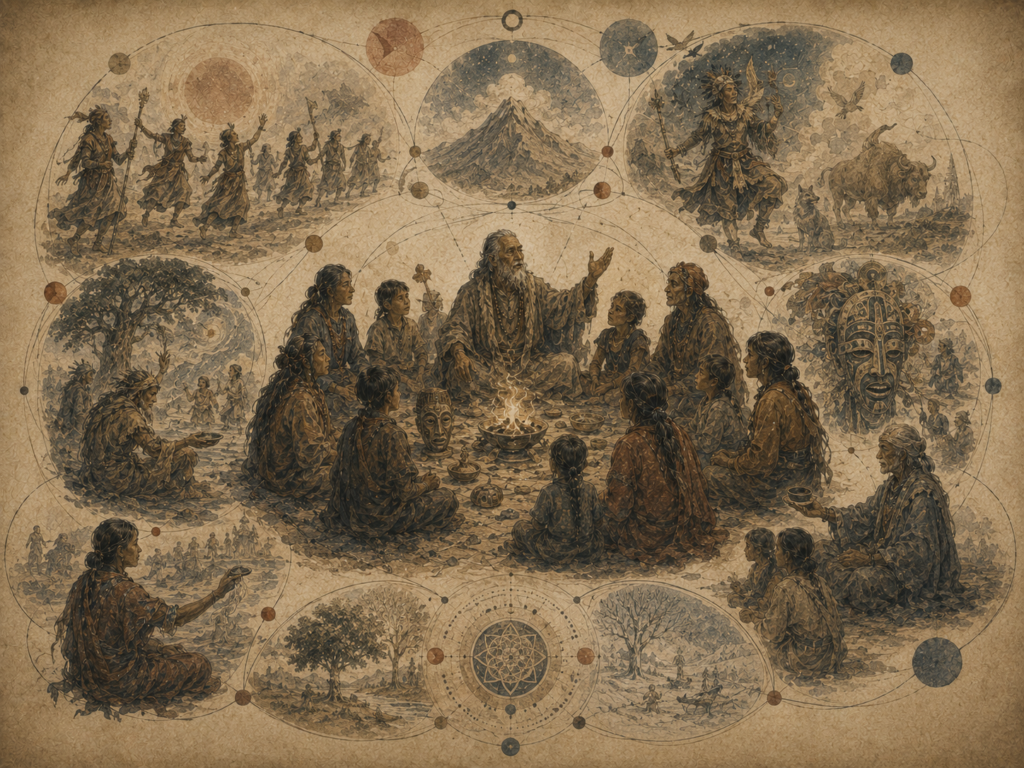
Editorial illustration of a ceremonial storytelling gathering surrounded by mythic symbols, ritual objects, dancers, animals, seasonal imagery, and symbolic pathways.

Myth, Ritual, and the Symbolic Work of Story: Meaning, Power, and Transformation

Myth, Ritual, and the Symbolic Work of Story examines how symbolic narratives and embodied practices organize origin, order, memory, identity, transformation, authority, and belonging. This article explains why myth should not be reduced to falsehood and why ritual should not be dismissed as empty repetition. It explores creation stories, sacred narratives, ritual action, symbolic objects, liminality, thresholds, sacrifice, renewal, repair, public ceremony, institutional myth, modern civic rituals, psychological interpretation, and the ethical risks of symbolic storytelling. The article also considers how myths and rituals can sustain communal meaning while also legitimizing hierarchy, exclusion, scapegoating, appropriation, or institutional power. As part of the Storytelling series, it connects myth studies, ritual theory, symbolic interpretation, cultural memory, analytical psychology, ethics, and practical methods for interpreting symbolic stories with context, humility, governance, and responsibility across religious, civic, cultural, psychological, and institutional life today.

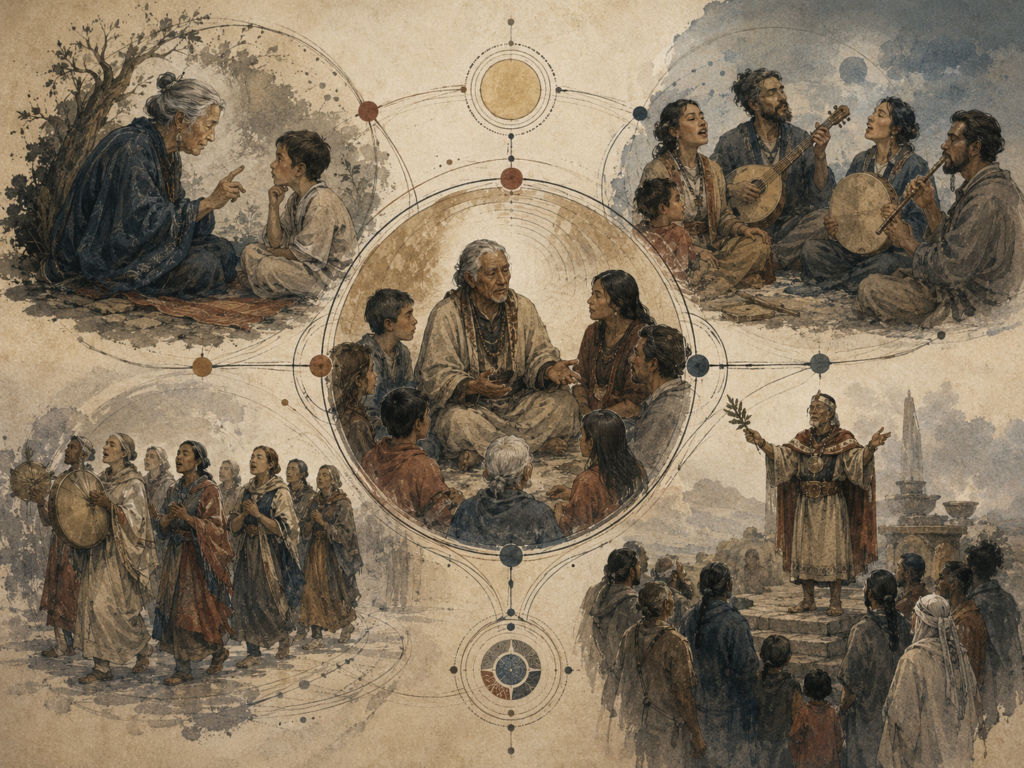
Editorial illustration of an elder speaking to an intergenerational circle, surrounded by scenes of proverb teaching, communal song, chant, and ritual speech.

Proverb, Song, Chant, and Ritual Speech: Compact Forms of Oral Storytelling

Proverb, Song, Chant, and Ritual Speech examines compact, musical, rhythmic, and ceremonial forms of oral storytelling that carry meaning without always relying on extended plot. This article explains how proverbs compress social knowledge, moral judgment, warning, humor, and critique; how songs preserve memory through melody, rhythm, refrain, voice, and belonging; how chants use cadence, repetition, and collective voicing to create ritual or public force; and how ritual speech blesses, names, mourns, vows, invokes, authorizes, or transforms social reality. It explores language, sound, performance context, repetition, participation, translation, authority, access protocol, documentation, archive risk, digital circulation, and ethical interpretation. As part of the Storytelling series, it connects oral tradition with cultural memory, folklore, ritual practice, performance studies, narrative ethics, and practical methods for analyzing compact oral forms with context, consent, and responsibility.

Scroll to Top