
Last Updated June 11, 2026
Creation, flood, exile, and return are among the deepest narrative patterns in sacred, mythic, civic, literary, and institutional storytelling. They are not merely plot events. They are ways of organizing human memory around origin, rupture, judgment, displacement, purification, restoration, renewal, and responsibility.
Creation, Flood, Exile, and Return as Narrative Patterns examines how these recurring forms help communities tell stories about beginnings, catastrophe, loss, survival, homecoming, and moral repair. Creation stories ask how a world begins and what order it carries. Flood stories ask what happens when corruption, violence, chaos, or disorder overwhelms a world. Exile stories ask how identity survives displacement. Return stories ask whether restoration is possible, what must be repaired, and who is allowed to come home.
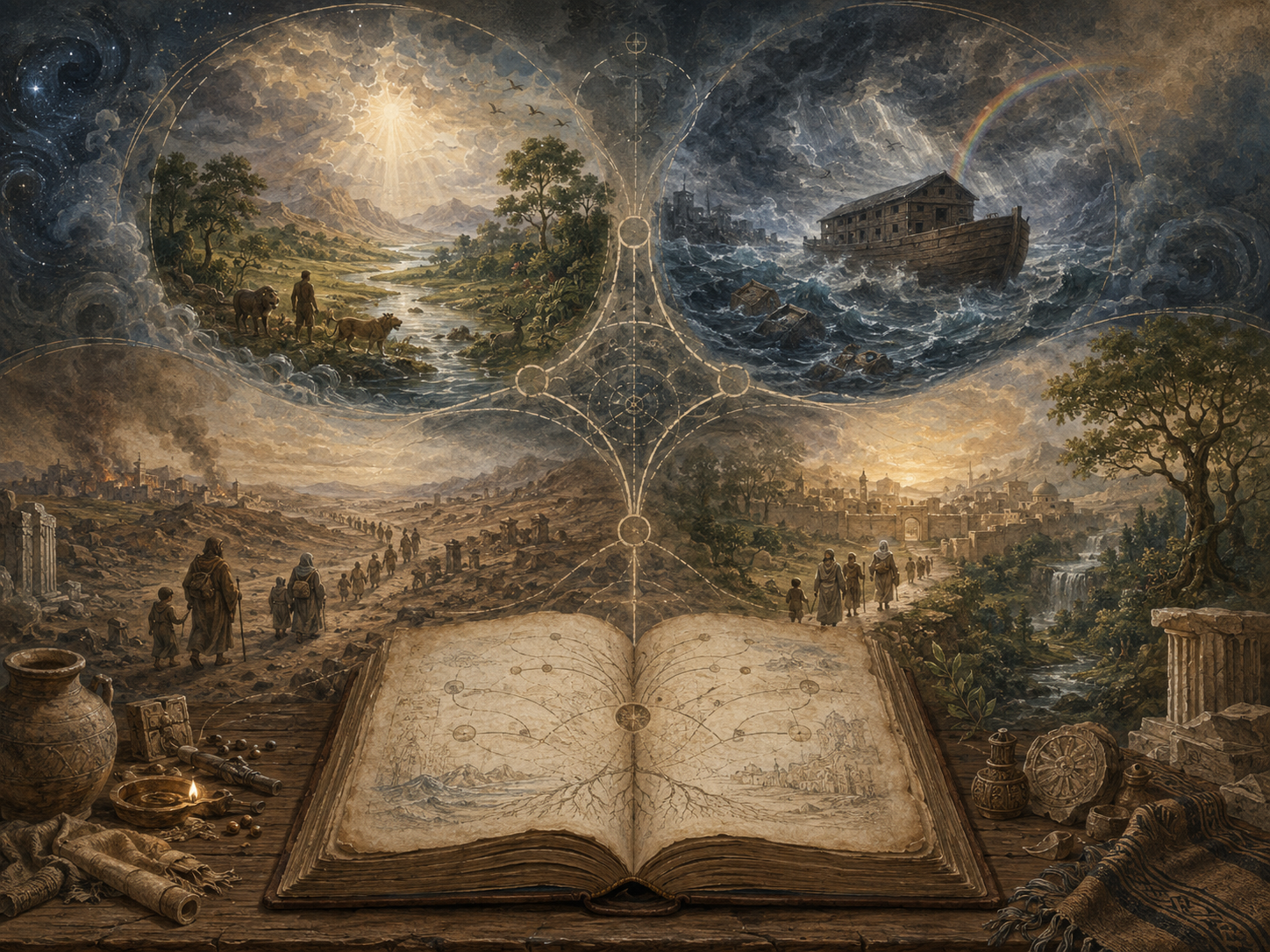
This article treats creation, flood, exile, and return as narrative patterns rather than fixed formulas. It examines how these patterns appear in sacred history, myth, oral tradition, scripture, national memory, institutional storytelling, memoir, migration narratives, ecological storytelling, apocalyptic imagination, and public ethics. It also includes computational workflows for auditing how origin, rupture, displacement, renewal, authority, and ethical risk operate across stories without flattening sacred, cultural, historical, or political difference.
Why These Patterns Matter
Creation, flood, exile, and return matter because they organize some of the most durable questions in storytelling. Where did this world come from? Why did order break? What happens when people are displaced from home, land, innocence, covenant, identity, or belonging? Can return happen, and if it can, what must be repaired?
These patterns appear in religious narrative, myth, folklore, epic, national memory, migration stories, memoir, climate writing, postwar reconstruction stories, organizational change stories, and institutional origin stories. They give shape to both cosmic and ordinary experience. A family can tell an exile-and-return story. A nation can tell one. A company can tell one. A displaced community can tell one. A religious tradition can live inside one.
The danger is that such patterns are easy to oversimplify. Creation can become nostalgia for purity. Flood can become punishment fantasy. Exile can become romantic suffering. Return can become false closure or entitlement. Responsible analysis asks how the pattern works, who benefits from it, who is harmed by it, and what historical, cultural, or sacred context must be preserved.
| Pattern | Core question | Narrative work |
|---|---|---|
| Creation | How does a world begin? | Establishes origin, order, relation, responsibility, and meaning. |
| Flood | What happens when a world is overwhelmed? | Stages catastrophe, judgment, cleansing, survival, and renewal. |
| Exile | How does identity survive displacement? | Explores loss, longing, discipline, memory, witness, and hope. |
| Return | Can restoration happen? | Tests homecoming, repair, justice, renewal, and responsibility. |
These patterns matter because they turn memory into a moral architecture of beginning, rupture, endurance, and repair.
Creation as Narrative Pattern
Creation stories do more than explain beginnings. They describe the conditions under which life, order, responsibility, kinship, land, language, law, ritual, or human identity becomes possible. A creation narrative may begin with chaos, void, darkness, water, divine speech, cosmic struggle, earth-diver, sacrifice, emergence, dream, birth, or shaping hand. Its deepest question is not only “How did things begin?” but “What kind of world is this?”
Creation establishes the moral and symbolic grammar of a story world. It can define the relation between humans and nature, gods and mortals, ancestors and descendants, land and people, work and rest, speech and reality, time and ritual, or order and chaos. In sacred history, creation may become the source of obligation. In civic narrative, founding can function as creation. In institutional storytelling, the founder’s vision can become a creation myth.
Creation also creates boundaries. It may define what is good, forbidden, ordered, chaotic, sacred, profane, human, animal, divine, natural, or artificial. Because of this, creation stories should be read as world-making stories. They do not merely begin a sequence. They establish the framework inside which later events become meaningful.
| Creation feature | How it works | Review question |
|---|---|---|
| Origin | Names a beginning for world, people, law, place, or institution. | What beginning is being authorized? |
| Order | Separates chaos from form, darkness from light, sea from land, or before from after. | What order does the story make natural? |
| Relation | Defines kinship among humans, land, ancestors, animals, gods, or cosmos. | What obligations follow from relation? |
| Boundary | Marks taboo, limit, role, permission, or prohibition. | Who controls the boundary? |
| Gift | Frames life, land, speech, fire, law, or culture as given. | What gratitude or duty follows? |
| Founding | Turns an origin into memory, legitimacy, or mission. | What is omitted from the origin story? |
Creation is the narrative pattern of beginning, ordering, and responsibility.
Flood as Narrative Pattern
Flood stories dramatize overwhelming rupture. Water rises. Boundaries fail. The world is submerged, cleansed, judged, destroyed, renewed, or remade. In many traditions, flood narratives connect catastrophe with moral disorder, divine judgment, cosmic reset, survival, covenant, warning, or ecological memory.
The flood pattern is powerful because it joins destruction and renewal. A flood can destroy a corrupt world and make possible a new one. It can expose human vulnerability before nature, divine power, fate, or systems collapse. It can also preserve a remnant: a survivor, family, animal pair, seed, archive, vessel, ritual memory, or promise.
Flood narratives require ethical care. Catastrophe should not be treated casually as purification. Real floods kill, displace, and traumatize. Stories of destruction can become dangerous when they imagine cleansing as moral solution. A responsible reading asks who is destroyed, who survives, who decides, what is renewed, and what violence the pattern may hide.
| Flood feature | Narrative function | Ethical question |
|---|---|---|
| Overwhelming water | Represents rupture, chaos, judgment, cleansing, or systems collapse. | Does the story romanticize catastrophe? |
| Ark or vessel | Preserves life, memory, law, or possibility through crisis. | Who is saved, and who is not? |
| Remnant | Survival becomes the seed of a new order. | Does survival become superiority? |
| Cleansing | Destruction is framed as purification or reset. | Does the story imagine violence as repair? |
| Covenant | After catastrophe, a new obligation is established. | What promise limits future destruction? |
| Memory | The flood becomes warning, ritual, archive, or origin of renewed order. | What does the community remember or forget? |
Flood is the narrative pattern of overwhelming rupture, survival, and dangerous renewal.
Exile as Narrative Pattern
Exile is the narrative pattern of displacement from a place, order, identity, covenant, home, land, innocence, language, body, community, or divine presence. It can be geographical, political, spiritual, social, psychological, or institutional. Exile asks what remains when the center is lost.
Exile stories preserve longing. They ask how memory survives when people are separated from the place or order that once gave life meaning. They also ask how identity changes under pressure. Exile can generate lament, discipline, prophecy, adaptation, diaspora, resistance, grief, creativity, and hope. It can make a community more conscious of what it has lost and what it must carry.
But exile should never be romanticized. Displacement is not automatically ennobling. Exile involves loss, danger, grief, vulnerability, and often violence. A responsible narrative analysis distinguishes symbolic exile from material displacement. It asks whether the story protects the dignity of those displaced or uses exile as a convenient metaphor for growth.
| Exile feature | How it works | Review question |
|---|---|---|
| Displacement | A person or community is removed from home, land, role, or sacred order. | What has been lost materially and symbolically? |
| Longing | Memory turns toward what is absent. | Does longing preserve hope or trap the story in nostalgia? |
| Lament | Grief becomes public speech. | Does the story allow sorrow without forcing closure? |
| Discipline | Exile becomes a site of reflection, repentance, or reorientation. | Does interpretation blame the displaced? |
| Diaspora | Identity survives outside the original center. | How does the community adapt without erasing memory? |
| Witness | The displaced preserve truth against official forgetting. | Who is responsible to listen? |
Exile is the narrative pattern of loss, memory, endurance, and unresolved hope.
Return as Narrative Pattern
Return is not simply going back. In strong narrative structure, return tests whether restoration is possible after rupture. A return may be homecoming, renewal, reconciliation, restoration, reentry, rebuilding, resurrection, reintegration, or repair. It asks what has changed, what remains broken, and what responsibility follows from survival.
Return can complete a sacred-history pattern: creation establishes order, flood or catastrophe breaks it, exile tests memory, and return seeks restoration. But return is rarely simple. The place returned to may no longer be the same. The returning person or community may have changed. Others may now occupy the place. The promised restoration may require justice, not mere arrival.
Return stories carry ethical risk because they can become entitlement narratives. A claim of return may ignore contested land, displaced others, unfinished repair, or changed conditions. Responsible storytelling asks who has the right to return, what restoration means, and whether renewal includes accountability.
| Return feature | Narrative function | Ethical question |
|---|---|---|
| Homecoming | The displaced return to place, relation, office, covenant, or identity. | Is home unchanged, or must it be reimagined? |
| Restoration | Broken order is repaired or renewed. | What repair is material, not merely symbolic? |
| Recognition | The returning figure or community is seen again. | Who refuses recognition? |
| Reintegration | Experience from exile is brought back into communal life. | What has exile taught, and who listens? |
| Renewed covenant | Return produces new obligation. | What responsibility prevents repetition of rupture? |
| Contested return | Homecoming conflicts with other claims, memories, or rights. | Who else has a history there? |
Return is the narrative pattern of restoration under the pressure of memory, justice, and change.
Sequence and Cycle
Creation, flood, exile, and return can appear as a sequence, but they can also appear as a cycle. A story may begin with creation, move into corruption or rupture, pass through flood or catastrophe, continue through exile, and seek return. Another story may begin in exile and imagine creation as a future renewal. Another may treat return as the beginning of a new creation.
This flexibility matters. The pattern is not a rigid plot machine. It is a set of narrative functions. Creation names origin. Flood names overwhelming rupture. Exile names displacement. Return names restoration. These functions can be arranged differently depending on tradition, genre, history, and purpose.
Some communities live inside cyclical versions of the pattern: creation, failure, catastrophe, displacement, remembrance, return, renewal, and renewed vulnerability. Others live inside unfinished versions: exile without return, flood without covenant, creation corrupted before it is understood, or return that remains promised rather than achieved.
| Pattern shape | Description | Example analytic question |
|---|---|---|
| Linear sequence | Origin leads to rupture, displacement, and restoration. | What changes at each stage? |
| Cycle | Renewal creates conditions for future rupture and repair. | What repeats, and why? |
| Interrupted return | The story longs for return but does not complete it. | What remains unresolved? |
| Return as new creation | Restoration becomes a second beginning. | What is renewed rather than simply restored? |
| Exile as identity | Displacement becomes a long-term mode of communal life. | How does memory survive without return? |
| Flood as reset | Catastrophe is framed as cleansing or system restart. | Does the reset hide violence? |
The pattern is most useful when read as a flexible structure of meaning, not a required order.
Origin, Rupture, and Renewal
At a deeper level, creation, flood, exile, and return organize three major narrative forces: origin, rupture, and renewal. Creation answers the question of origin. Flood and exile answer the question of rupture. Return answers the question of renewal.
Origin gives a story its first order. Rupture reveals what is fragile, corrupt, contested, or vulnerable inside that order. Renewal tests whether the story can move beyond mere repetition. A weak renewal simply restores the old order. A stronger renewal learns from rupture and creates new responsibility.
This triad matters for modern storytelling. Organizational change stories often begin with a founding vision, describe crisis, and promise renewal. Climate stories describe planetary origin, systems rupture, displacement, and restoration. Memoir often moves from childhood world to rupture to exile from self or community to some form of return. Political movements use origin, rupture, and renewal to define public purpose.
| Force | Associated patterns | Core question |
|---|---|---|
| Origin | Creation, founding, emergence, birth, covenant. | What order begins the story? |
| Rupture | Flood, fall, catastrophe, exile, judgment, displacement. | What breaks the world or the self? |
| Memory | Lament, witness, ritual, archive, diaspora, testimony. | What must be carried through loss? |
| Survival | Ark, remnant, exile community, witness, adaptation. | What preserves possibility? |
| Renewal | Return, restoration, second creation, repair, covenant. | What becomes possible after rupture? |
| Responsibility | Law, ritual, vow, justice, governance, remembrance. | What obligation follows renewal? |
The pattern is not only about story structure. It is about how communities imagine repair after rupture.
Sacred History and Memory
In sacred history, creation, flood, exile, and return become memory structures. They help communities remember not only events, but meanings. Creation may become the memory of divine order. Flood may become the memory of judgment and covenant. Exile may become the memory of loss and discipline. Return may become the memory of restoration and promise.
These memories are often renewed through ritual, calendar, scripture, song, pilgrimage, law, liturgy, oral tradition, and public teaching. A story that begins as sacred history may become a repeated pattern for interpreting later events. A community may read new crises as flood, new displacements as exile, new reforms as return, or new beginnings as creation.
This is why sacred-history patterns require humility. The same pattern can illuminate or distort. It can help people find courage, but it can also force complex events into inherited meaning too quickly. Responsible storytelling asks whether the pattern is clarifying the event or controlling it.
| Sacred-memory form | Pattern connection | Review question |
|---|---|---|
| Creation memory | Origin becomes sacred order. | What world does the community remember as given? |
| Flood memory | Catastrophe becomes warning or covenant. | What lesson is drawn from destruction? |
| Exile memory | Displacement becomes identity and longing. | How is loss preserved without romanticizing it? |
| Return memory | Restoration becomes hope or fulfillment. | What is repaired, and what remains contested? |
| Ritual memory | The pattern is embodied through repeated practice. | Who performs and interprets the ritual? |
| Counter-memory | Suppressed versions challenge official patterning. | Whose story interrupts the dominant version? |
Sacred history keeps patterns alive by making memory active across generations.
Myth, Ritual, and Culture
Creation, flood, exile, and return often become ritualized. Creation may be remembered through new year rites, birth rituals, agricultural cycles, or founding ceremonies. Flood may be remembered through purification, cleansing, warning, or covenant symbols. Exile may be remembered through lament, fasting, pilgrimage, diaspora practice, or songs of longing. Return may be remembered through festivals, processions, restoration rites, and public vows.
Ritual gives pattern a body. It does not merely repeat a story; it allows people to inhabit the story. A ritual may return participants to an origin, mark a rupture, preserve grief, enact purification, or rehearse hope. Through ritual, narrative becomes practice.
Cultural analysis must ask who controls the ritual and who is allowed to participate. Ritual can preserve memory and dignity. It can also enforce hierarchy, silence dissent, or turn contested history into official ceremony. Pattern analysis must therefore include ritual authority, community protocols, and ethical boundaries.
| Ritual form | Pattern function | Governance question |
|---|---|---|
| New beginning rite | Reactivates creation or founding. | What origin is being made present? |
| Purification rite | Symbolically marks flood, cleansing, or renewal. | Does cleansing language hide harm? |
| Lament | Embodies exile, loss, and longing. | Is grief allowed to remain unresolved? |
| Pilgrimage | Stages exile, journey, return, or sacred geography. | Who has access to the place and path? |
| Restoration ceremony | Marks return, repair, rebuilding, or recommitment. | Is repair symbolic or material? |
| Commemoration | Preserves catastrophe, survival, and promise. | What memories are left out? |
Ritual turns narrative pattern into repeated cultural action.
Literary and Media Uses
Creation, flood, exile, and return are common in literature, film, television, games, and serialized media because they give stories large-scale emotional architecture. A fantasy world may begin with creation mythology, fall into corruption, suffer catastrophe, send characters into exile, and conclude with return or restoration. A science-fiction story may begin with a technological creation, move through ecological flood or systems collapse, follow displaced survivors, and imagine rebuilding.
The patterns also appear in character arcs. A person’s childhood world may function as creation. A trauma, betrayal, or disaster may function as flood. Alienation may function as exile. Reconciliation, return to community, or self-reintegration may function as return. The pattern can be cosmic or intimate.
Media storytelling often simplifies the pattern into spectacle. Flood becomes disaster imagery. Exile becomes moody wandering. Return becomes victory. A stronger story preserves moral complexity: What caused rupture? What was lost? Who survives? What responsibility follows return? What cannot be restored?
| Media use | Pattern function | Risk |
|---|---|---|
| Fantasy worldbuilding | Creation myth establishes order and conflict. | Origin lore may become decorative rather than meaningful. |
| Disaster narrative | Flood stages overwhelming rupture. | Spectacle may erase grief and accountability. |
| Heroic exile | Displacement tests identity and memory. | Exile may be romanticized as growth. |
| Homecoming arc | Return completes transformation. | Return may become false closure. |
| Post-apocalyptic story | Flood becomes systems collapse and survival. | Survivalism may replace public responsibility. |
| Game narrative | Player moves through ruins, exile, restoration, and world repair. | Repair may be reduced to completion mechanics. |
Literary and media uses are strongest when the pattern carries memory and responsibility, not just scale.
Civic and Institutional Uses
Nations, movements, universities, companies, religious institutions, and civic organizations often tell creation, flood, exile, and return stories. A nation may tell a creation story of founding, a flood story of war or crisis, an exile story of betrayal or occupation, and a return story of restoration. An organization may narrate a founder’s vision, a period of crisis, a loss of mission, and a strategic renewal.
These patterns can help institutions explain change. They can preserve memory, clarify mission, and guide repair. But they can also hide responsibility. A company may describe its crisis as flood while ignoring who caused harm. A nation may describe return while omitting those displaced by that return. An institution may frame reform as renewal while avoiding material accountability.
Civic and institutional use requires governance. Story should not become immunity from critique. If a public narrative uses creation, flood, exile, or return language, it should disclose what happened, who was harmed, what was omitted, who benefits, and what repair is required.
| Institutional pattern | Common use | Governance concern |
|---|---|---|
| Creation | Founder story, origin mission, charter, founding values. | Does the origin story omit labor, conflict, or exclusion? |
| Flood | Crisis, scandal, collapse, disruption, emergency. | Does catastrophe language hide accountability? |
| Exile | Loss of mission, public trust, market position, or identity. | Is displacement metaphor used to avoid real harm? |
| Return | Reform, renewal, comeback, restoration, recommitment. | What repair is real and measurable? |
| Second creation | Rebrand, restructuring, relaunch, new strategic era. | Does new beginning erase past responsibility? |
| Commemoration | Anniversary, memorial, founder day, public ritual. | What is remembered and what remains unsaid? |
Institutional storytelling becomes responsible only when renewal includes accountability.
Ecological and Systems Uses
Creation, flood, exile, and return are also useful for ecological and systems storytelling. Creation can represent the emergence of a stable system. Flood can represent disturbance, overshoot, collapse, or overwhelming feedback. Exile can represent displacement from ecological balance, community, habitat, or inherited practice. Return can represent restoration, resilience, adaptation, repair, or regenerative transition.
Climate storytelling often uses these patterns, sometimes explicitly and sometimes implicitly. A stable world is disrupted. Water rises. Communities are displaced. Return becomes uncertain. Restoration may require not a simple homecoming, but a transformed relationship with land, energy, infrastructure, agriculture, economy, and responsibility.
Ecological pattern analysis must avoid moral simplification. Floods and climate disasters are not convenient metaphors. They are material events with unequal impacts. Stories of restoration must not imply that all losses can be reversed. Some returns are partial. Some are impossible. Some require adaptation rather than restoration.
| Systems reading | Pattern | Responsible framing |
|---|---|---|
| Emergence | Creation | Describe how order forms from relation and constraint. |
| Overwhelm | Flood | Connect catastrophe to systems causes and unequal exposure. |
| Displacement | Exile | Preserve the material cost of migration and loss. |
| Restoration | Return | Distinguish repair, adaptation, resilience, and irreversible loss. |
| Regeneration | Second creation | Ask what new responsibilities govern the renewed system. |
| Collapse memory | Flood and exile | Use warning without fatalism or spectacle. |
Ecological storytelling needs these patterns, but it also needs material honesty.
Ethical Risks in Pattern Analysis
The main ethical risk is formula. Creation, flood, exile, and return are powerful because they feel archetypal, but that power can flatten difference. Not every origin is creation. Not every catastrophe is flood. Not every loss is exile. Not every reform is return.
Another risk is moral violence. Flood stories can frame destruction as necessary cleansing. Exile stories can blame the displaced. Return stories can justify entitlement. Creation stories can naturalize hierarchy. If the analyst is not careful, narrative pattern becomes a tool for making harmful interpretations feel sacred, inevitable, or elegant.
A third risk is historical erasure. Pattern analysis can make stories seem timeless while ignoring concrete causes, dates, people, institutions, conflicts, and consequences. Responsible interpretation preserves both pattern and history. It asks what the pattern reveals and what it might hide.
| Risk | How it appears | Responsible response |
|---|---|---|
| Formula drift | The pattern is forced onto every story. | Use pattern as lens, not template. |
| Creation nostalgia | Origin is treated as pure or unquestionable. | Ask what the origin story omits. |
| Cleansing fantasy | Flood is treated as morally necessary destruction. | Protect the reality of harm and loss. |
| Romanticized exile | Displacement becomes an elegant growth metaphor. | Preserve material cost and grief. |
| False return | Homecoming is treated as complete repair. | Ask what remains unresolved or contested. |
| Historical erasure | Pattern replaces evidence and context. | Keep dates, sources, power, and consequences visible. |
Pattern analysis is responsible only when it deepens history rather than replacing it.
Examples of Pattern Analysis
The examples below show how creation, flood, exile, and return can be analyzed without reducing stories to generic stages.
Creation narrative
Weak: The story is treated only as an explanation of how the world began.
Stronger: The analysis asks what order, relation, boundary, gift, and obligation the creation story establishes.
Why it works: It reads origin as ethical world-making.
Flood narrative
Weak: Flood is interpreted as a simple punishment-and-reset story.
Stronger: The analysis asks who is destroyed, who survives, what covenant follows, and whether cleansing language hides violence.
Why it works: It separates renewal from moralized destruction.
Exile narrative
Weak: Exile is framed as a necessary stage of personal development.
Stronger: The analysis preserves grief, displacement, longing, historical cause, community memory, and the possibility of unresolved loss.
Why it works: It refuses to romanticize displacement.
Return narrative
Weak: Return is treated as closure.
Stronger: The analysis asks what has changed, who else has claims, what repair is required, and whether restoration is possible.
Why it works: It treats return as accountability, not just homecoming.
Institutional renewal story
Weak: A company tells a crisis-and-comeback story.
Stronger: The analysis asks what caused the crisis, who was harmed, what was omitted, and whether reform includes measurable repair.
Why it works: It prevents mythic renewal from hiding governance failure.
Climate displacement story
Weak: Flood and exile imagery are used for drama.
Stronger: The analysis connects water, displacement, infrastructure, inequality, memory, adaptation, and limits of return.
Why it works: It keeps material systems visible.
The point is not to find the pattern everywhere. The point is to ask what the pattern reveals and what it might conceal.
Mathematics, Computation, and Modeling
Creation, flood, exile, and return can be modeled as a pattern audit. Computation cannot interpret sacred truth, cultural authority, or historical meaning on its own. It can, however, help make editorial judgments visible: how strongly a story emphasizes origin, rupture, displacement, renewal, ethical risk, and interpretation readiness.
A pattern-strength score can estimate the degree to which the four patterns are present:
P_s = \frac{C_r + F_l + E_x + R_t}{4}
\]
Interpretation: Pattern strength \(P_s\) averages creation \(C_r\), flood \(F_l\), exile \(E_x\), and return \(R_t\) signals.
A rupture-renewal score can estimate how strongly the story links crisis to restoration:
R_n = \frac{F_l + E_x + M_m + R_p}{4}
\]
Interpretation: Rupture-renewal \(R_n\) averages flood rupture \(F_l\), exile displacement \(E_x\), memory maintenance \(M_m\), and repair responsibility \(R_p\).
An ethical-risk score can estimate whether the pattern requires deeper review:
E_r = N_ow_n + C_fw_c + E_rw_e + F_rw_f + P_bw_p + (1 – U_n)w_u
\]
Interpretation: Ethical risk \(E_r\) rises with origin nostalgia \(N_o\), cleansing fantasy \(C_f\), exile romanticization \(E_r\), false return \(F_r\), power blindness \(P_b\), and weak uncertainty marking \(U_n\).
An interpretation-readiness score can estimate whether a pattern analysis is responsible enough for reuse:
I_r = \frac{S_c + H_c + C_x + M_l + E_g + U_n}{6}
\]
Interpretation: Interpretation readiness \(I_r\) averages source context \(S_c\), historical context \(H_c\), counterexamples \(C_x\), method limits \(M_l\), ethics governance \(E_g\), and uncertainty notes \(U_n\).
| Modeling task | Interpretive question | Example output |
|---|---|---|
| Pattern audit | Which patterns are active? | Creation, flood, exile, return profile. |
| Rupture audit | How does the story represent catastrophe or displacement? | Rupture-renewal score. |
| Return audit | Does return involve repair, entitlement, or false closure? | Return-responsibility note. |
| Risk audit | Does the pattern romanticize harm or hide power? | Ethical-risk score. |
| Context audit | Are sacred, historical, cultural, and material contexts preserved? | Interpretation-readiness score. |
| Canvas audit | Is the analysis ready for reuse? | Canvas card and governance queue. |
Computation can support interpretive accountability by making assumptions visible, but it cannot replace historical judgment, cultural literacy, or ethical review.
Python Workflow: Creation, Flood, Exile, and Return Audit
The Python workflow below follows the advanced Catalyst Canvas standard: typed records, config-driven scoring, validation, governance notes, Canvas-card exports, CSV outputs, JSON outputs, markdown governance queues, and strict review priorities. The companion repository version includes the shared `python/catalyst_canvas/` layer plus article-specific data for creation, flood, exile, and return analysis.
# run_creation_flood_exile_return_canvas_audit.py
from __future__ import annotations

from dataclasses import dataclass
from pathlib import Path
import csv
import json
from hashlib import sha256
from statistics import mean
from typing import Any


ARTICLE_ROOT = Path(__file__).resolve().parents[1]
OUTPUTS = ARTICLE_ROOT / "outputs"


@dataclass(frozen=True)
class NarrativePatternRecord:
    item: str
    claim_context: str
    creation_signal: float
    flood_signal: float
    exile_signal: float
    return_signal: float
    memory_maintenance: float
    repair_responsibility: float
    source_context: float
    historical_context: float
    counterexamples: float
    method_limits: float
    ethics_governance: float
    uncertainty_notes: float
    origin_nostalgia: float
    cleansing_fantasy: float
    exile_romanticization: float
    false_return: float
    power_blindness: float
    public_consequence: float
    owner: str = "editorial"
    status: str = "active"
    notes: str = ""


@dataclass(frozen=True)
class PatternConfig:
    article_title: str = "Creation, Flood, Exile, and Return as Narrative Patterns"
    article_slug: str = "creation-flood-exile-and-return-as-narrative-patterns"
    medium_threshold: float = 0.45
    high_threshold: float = 0.62
    allowed_statuses: tuple[str, ...] = ("active", "archive", "review", "revise")


def validate_score(value: float, field_name: str) -> None:
    if value < 0 or value > 1:
        raise ValueError(f"{field_name} must be between 0 and 1.")


def validate_record(record: NarrativePatternRecord, config: PatternConfig) -> None:
    if not record.item.strip():
        raise ValueError("item is required.")
    if not record.claim_context.strip():
        raise ValueError("claim_context is required.")
    if record.status not in config.allowed_statuses:
        raise ValueError(f"Invalid status: {record.status}")

    for field_name, value in record.__dict__.items():
        if isinstance(value, float):
            validate_score(value, field_name)


def pattern_strength(record: NarrativePatternRecord) -> float:
    return mean([
        record.creation_signal,
        record.flood_signal,
        record.exile_signal,
        record.return_signal,
    ])


def rupture_renewal_strength(record: NarrativePatternRecord) -> float:
    return mean([
        record.flood_signal,
        record.exile_signal,
        record.memory_maintenance,
        record.repair_responsibility,
    ])


def interpretation_readiness(record: NarrativePatternRecord) -> float:
    return mean([
        record.source_context,
        record.historical_context,
        record.counterexamples,
        record.method_limits,
        record.ethics_governance,
        record.uncertainty_notes,
    ])


def ethical_risk(record: NarrativePatternRecord) -> float:
    return min(
        1.0,
        record.origin_nostalgia * 0.18
        + record.cleansing_fantasy * 0.20
        + record.exile_romanticization * 0.18
        + record.false_return * 0.18
        + record.power_blindness * 0.16
        + (1 - record.uncertainty_notes) * 0.10,
    )


def governance_priority_score(record: NarrativePatternRecord, config: PatternConfig) -> float:
    score = (
        ethical_risk(record) * 0.40
        + (1 - interpretation_readiness(record)) * 0.28
        + record.public_consequence * 0.17
        + (1 - record.repair_responsibility) * 0.15
    )

    if record.status == "revise":
        score = max(score, config.high_threshold)
    elif record.status == "review":
        score = max(score, config.medium_threshold)

    return min(1.0, max(0.0, score))


def review_priority(record: NarrativePatternRecord, config: PatternConfig) -> str:
    score = governance_priority_score(record, config)
    if score >= config.high_threshold:
        return "high"
    if score >= config.medium_threshold:
        return "medium"
    return "standard"


def card_id(record: NarrativePatternRecord, config: PatternConfig) -> str:
    raw = f"{config.article_slug}|{record.item}|{record.claim_context}"
    return sha256(raw.encode("utf-8")).hexdigest()[:16]


def governance_note(record: NarrativePatternRecord, config: PatternConfig) -> str:
    priority = review_priority(record, config)
    risk = ethical_risk(record)
    readiness = interpretation_readiness(record)

    notes = []

    if priority == "high":
        notes.append("High-priority pattern governance review required.")
    elif priority == "medium":
        notes.append("Medium-priority review recommended before reuse.")
    else:
        notes.append("Standard editorial review sufficient.")

    if risk >= 0.55:
        notes.append("Ethical risk is elevated; review nostalgia, cleansing fantasy, exile romanticization, false return, and power blindness.")
    if readiness < 0.60:
        notes.append("Interpretation readiness is limited; strengthen source context, historical context, counterexamples, method limits, and uncertainty notes.")
    if record.notes:
        notes.append(record.notes)

    return " ".join(notes)


def canvas_card(record: NarrativePatternRecord, config: PatternConfig) -> dict[str, Any]:
    return {
        "schema_version": "1.0.0",
        "card_id": card_id(record, config),
        "card_type": "creation_flood_exile_return_pattern",
        "article_title": config.article_title,
        "article_slug": config.article_slug,
        "item": record.item,
        "claim_context": record.claim_context,
        "scores": {
            "pattern_strength": round(pattern_strength(record), 4),
            "rupture_renewal_strength": round(rupture_renewal_strength(record), 4),
            "ethical_risk": round(ethical_risk(record), 4),
            "interpretation_readiness": round(interpretation_readiness(record), 4),
            "governance_priority_score": round(governance_priority_score(record, config), 4),
        },
        "review": {
            "priority": review_priority(record, config),
            "owner": record.owner,
            "status": record.status,
            "governance_note": governance_note(record, config),
        },
    }


def write_csv(path: Path, rows: list[dict[str, Any]]) -> None:
    path.parent.mkdir(parents=True, exist_ok=True)
    fieldnames = list(rows[0].keys())
    with path.open("w", encoding="utf-8", newline="") as handle:
        writer = csv.DictWriter(handle, fieldnames=fieldnames)
        writer.writeheader()
        writer.writerows(rows)


def write_json(path: Path, payload: Any) -> None:
    path.parent.mkdir(parents=True, exist_ok=True)
    path.write_text(json.dumps(payload, indent=2), encoding="utf-8")


def write_markdown_queue(path: Path, rows: list[dict[str, Any]]) -> None:
    path.parent.mkdir(parents=True, exist_ok=True)
    lines = [
        "# Creation, Flood, Exile, and Return Governance Queue",
        "",
        "| Item | Context | Pattern | Rupture-renewal | Risk | Readiness | Priority | Owner |",
        "|---|---|---:|---:|---:|---:|---|---|",
    ]

    for row in rows:
        lines.append(
            f"| {row['item']} | {row['claim_context']} | "
            f"{row['pattern_strength']} | {row['rupture_renewal_strength']} | "
            f"{row['ethical_risk']} | {row['interpretation_readiness']} | "
            f"{row['review_priority']} | {row['owner']} |"
        )

    path.write_text("\n".join(lines) + "\n", encoding="utf-8")


def main() -> None:
    config = PatternConfig()

    records = [
        NarrativePatternRecord(
            "Creation narrative",
            "origin and world-order pattern",
            0.96, 0.20, 0.24, 0.42, 0.70, 0.76,
            0.84, 0.78, 0.74, 0.72, 0.78, 0.74,
            0.38, 0.20, 0.24, 0.30, 0.32, 0.70,
            "editorial", "active",
            "Preserve origin context and avoid nostalgia."
        ),
        NarrativePatternRecord(
            "Flood and renewal",
            "catastrophe survival and covenant pattern",
            0.42, 0.94, 0.48, 0.72, 0.82, 0.78,
            0.80, 0.76, 0.78, 0.76, 0.82, 0.80,
            0.34, 0.62, 0.36, 0.44, 0.40, 0.82,
            "ethics review", "review",
            "Review cleansing language and catastrophe framing."
        ),
        NarrativePatternRecord(
            "Exile and return",
            "displacement memory and contested restoration",
            0.38, 0.56, 0.94, 0.86, 0.90, 0.84,
            0.82, 0.86, 0.84, 0.78, 0.86, 0.82,
            0.32, 0.40, 0.58, 0.62, 0.54, 0.90,
            "governance", "review",
            "Review land memory, displacement, and false return."
        ),
    ]

    rows = []
    cards = []

    for record in records:
        validate_record(record, config)
        cards.append(canvas_card(record, config))
        rows.append({
            "item": record.item,
            "claim_context": record.claim_context,
            "pattern_strength": round(pattern_strength(record), 4),
            "rupture_renewal_strength": round(rupture_renewal_strength(record), 4),
            "ethical_risk": round(ethical_risk(record), 4),
            "interpretation_readiness": round(interpretation_readiness(record), 4),
            "governance_priority_score": round(governance_priority_score(record, config), 4),
            "review_priority": review_priority(record, config),
            "owner": record.owner,
            "status": record.status,
            "governance_note": governance_note(record, config),
        })

    priority_order = {"high": 3, "medium": 2, "standard": 1}
    rows = sorted(
        rows,
        key=lambda row: (
            priority_order.get(str(row["review_priority"]), 0),
            float(row["governance_priority_score"]),
        ),
        reverse=True,
    )

    queue = [row for row in rows if row["review_priority"] != "standard"]
    queue_cards = [card for card in cards if card["review"]["priority"] != "standard"]

    write_csv(OUTPUTS / "tables" / "creation_flood_exile_return_audit.csv", rows)
    write_csv(OUTPUTS / "tables" / "creation_flood_exile_return_governance_queue.csv", queue)
    write_json(OUTPUTS / "json" / "creation_flood_exile_return_canvas_cards.json", cards)
    write_json(OUTPUTS / "json" / "creation_flood_exile_return_governance_queue.json", queue_cards)
    write_markdown_queue(OUTPUTS / "markdown" / "creation_flood_exile_return_governance_queue.md", queue)

    print("Creation, flood, exile, and return Canvas audit complete.")


if __name__ == "__main__":
    main()
This workflow makes pattern analysis reviewable without treating the pattern as a universal law.
R Workflow: Narrative Pattern Diagnostics
The R workflow below provides a portable base R diagnostic for creation, flood, exile, and return pattern analysis. It calculates pattern strength, rupture-renewal strength, ethical risk, interpretation readiness, governance priority, and review priority.
# creation_flood_exile_return_diagnostics.R
# Base R workflow for Creation, Flood, Exile, and Return as Narrative Patterns.

args <- commandArgs(trailingOnly = FALSE)
file_arg <- grep("^--file=", args, value = TRUE)

if (length(file_arg) > 0) {
  script_path <- normalizePath(sub("^--file=", "", file_arg[1]), mustWork = TRUE)
  article_root <- normalizePath(file.path(dirname(script_path), ".."), mustWork = TRUE)
} else {
  article_root <- getwd()
}

setwd(article_root)

tables_dir <- file.path(article_root, "outputs", "tables")
figures_dir <- file.path(article_root, "outputs", "figures")
dir.create(tables_dir, recursive = TRUE, showWarnings = FALSE)
dir.create(figures_dir, recursive = TRUE, showWarnings = FALSE)

records <- data.frame(
  item = c("Creation narrative", "Flood and renewal", "Exile and return"),
  claim_context = c(
    "origin and world-order pattern",
    "catastrophe survival and covenant pattern",
    "displacement memory and contested restoration"
  ),
  creation_signal = c(0.96, 0.42, 0.38),
  flood_signal = c(0.20, 0.94, 0.56),
  exile_signal = c(0.24, 0.48, 0.94),
  return_signal = c(0.42, 0.72, 0.86),
  memory_maintenance = c(0.70, 0.82, 0.90),
  repair_responsibility = c(0.76, 0.78, 0.84),
  source_context = c(0.84, 0.80, 0.82),
  historical_context = c(0.78, 0.76, 0.86),
  counterexamples = c(0.74, 0.78, 0.84),
  method_limits = c(0.72, 0.76, 0.78),
  ethics_governance = c(0.78, 0.82, 0.86),
  uncertainty_notes = c(0.74, 0.80, 0.82),
  origin_nostalgia = c(0.38, 0.34, 0.32),
  cleansing_fantasy = c(0.20, 0.62, 0.40),
  exile_romanticization = c(0.24, 0.36, 0.58),
  false_return = c(0.30, 0.44, 0.62),
  power_blindness = c(0.32, 0.40, 0.54),
  public_consequence = c(0.70, 0.82, 0.90),
  owner = c("editorial", "ethics review", "governance"),
  status = c("active", "review", "review"),
  stringsAsFactors = FALSE
)

records$pattern_strength <- rowMeans(records[, c(
  "creation_signal",
  "flood_signal",
  "exile_signal",
  "return_signal"
)])

records$rupture_renewal_strength <- rowMeans(records[, c(
  "flood_signal",
  "exile_signal",
  "memory_maintenance",
  "repair_responsibility"
)])

records$interpretation_readiness <- rowMeans(records[, c(
  "source_context",
  "historical_context",
  "counterexamples",
  "method_limits",
  "ethics_governance",
  "uncertainty_notes"
)])

records$ethical_risk <- pmin(
  1,
  records$origin_nostalgia * 0.18 +
    records$cleansing_fantasy * 0.20 +
    records$exile_romanticization * 0.18 +
    records$false_return * 0.18 +
    records$power_blindness * 0.16 +
    (1 - records$uncertainty_notes) * 0.10
)

records$governance_priority_score <- pmin(
  1,
  records$ethical_risk * 0.40 +
    (1 - records$interpretation_readiness) * 0.28 +
    records$public_consequence * 0.17 +
    (1 - records$repair_responsibility) * 0.15
)

records$review_priority <- ifelse(
  records$status == "revise" | records$governance_priority_score >= 0.62,
  "high",
  ifelse(
    records$status == "review" | records$governance_priority_score >= 0.45,
    "medium",
    "standard"
  )
)

records <- records[order(records$governance_priority_score, decreasing = TRUE), ]

write.csv(records, file.path(tables_dir, "creation_flood_exile_return_diagnostics.csv"), row.names = FALSE)
write.csv(records[records$review_priority != "standard", ], file.path(tables_dir, "creation_flood_exile_return_governance_queue.csv"), row.names = FALSE)

png(file.path(figures_dir, "pattern_strength_scores.png"), width = 1200, height = 700)
barplot(
  records$pattern_strength,
  names.arg = records$item,
  las = 2,
  ylab = "Pattern strength",
  main = "Creation, Flood, Exile, and Return Pattern Strength"
)
grid()
dev.off()

png(file.path(figures_dir, "ethical_risk_scores.png"), width = 1200, height = 700)
barplot(
  records$ethical_risk,
  names.arg = records$item,
  las = 2,
  ylab = "Ethical risk",
  main = "Pattern Analysis Ethical Risk"
)
grid()
dev.off()

print(records[, c(
  "item",
  "claim_context",
  "pattern_strength",
  "rupture_renewal_strength",
  "ethical_risk",
  "interpretation_readiness",
  "review_priority"
)])
This workflow supports structured editorial review while preserving the limits of computational interpretation.
GitHub Repository
The companion repository for this article supports creation, flood, exile, and return pattern analysis as a Catalyst Canvas-ready module. It includes advanced additive `python/catalyst_canvas/` governance infrastructure, article-specific narrative-pattern data, config-driven scoring, validation, governance notes, Canvas card generation, CSV/JSON/markdown exporters, CLI workflows, smoke tests, unit tests, R diagnostics, SQL structures, documentation, and reusable pattern-analysis templates.
Complete Code Repository
Companion repository for the article, including advanced Catalyst Canvas-ready code for creation, flood, exile, and return pattern analysis, ethical-risk review, interpretation-readiness scoring, governance queues, JSON exports, Canvas cards, and reproducible research workflows.
articles/creation-flood-exile-and-return-as-narrative-patterns/
├── canvas/
│   ├── canvas_manifest.json
│   ├── input_schema.json
│   ├── output_schema.json
│   ├── catalyst_canvas_config.json
│   ├── catalyst_canvas_manifest.json
│   ├── catalyst_canvas_cards.json
│   └── catalyst_canvas_governance_queue.json
├── html/
├── css/
├── php/
├── java/
├── python/
│   ├── catalyst_canvas/
│   │   ├── __init__.py
│   │   ├── __main__.py
│   │   ├── cli.py
│   │   ├── models.py
│   │   ├── scoring.py
│   │   ├── validation.py
│   │   ├── governance.py
│   │   └── exporters.py
│   ├── narrative_pattern_canvas/
│   │   ├── __init__.py
│   │   ├── models.py
│   │   ├── scoring.py
│   │   ├── validation.py
│   │   ├── governance.py
│   │   └── exporters.py
│   ├── tests/
│   │   ├── test_catalyst_canvas.py
│   │   └── test_narrative_pattern_canvas.py
│   ├── run_catalyst_canvas_audit.py
│   └── run_creation_flood_exile_return_canvas_audit.py
├── r/
│   ├── creation_flood_exile_return_diagnostics.R
│   └── run_all_creation_flood_exile_return_workflows.R
├── sql/
│   ├── canvas_schema.sql
│   └── canvas_queries.sql
├── docs/
│   ├── article_notes.md
│   ├── modeling_principles.md
│   ├── creation_pattern.md
│   ├── flood_pattern.md
│   ├── exile_pattern.md
│   ├── return_pattern.md
│   ├── rupture_and_renewal.md
│   ├── ethical_risk.md
│   ├── responsible_use.md
│   ├── governance_notes.md
│   └── catalyst_canvas_upgrade_notes.md
├── data/
│   ├── narrative_pattern_claims.csv
│   ├── creation_pattern_notes.csv
│   ├── flood_pattern_notes.csv
│   ├── exile_pattern_notes.csv
│   ├── return_pattern_notes.csv
│   ├── pattern_governance_notes.csv
│   └── catalyst_canvas_assessment.csv
├── outputs/
│   ├── figures/
│   ├── json/
│   ├── markdown/
│   └── tables/
├── notebooks/
├── shared/
│   ├── schemas/
│   ├── narrative-templates/
│   ├── story-archetypes/
│   ├── character-models/
│   ├── plot-structures/
│   ├── rhetorical-frameworks/
│   ├── cultural-memory/
│   ├── narrative-patterns/
│   └── governance/
├── tests/
└── README.md
Related Articles
- Sacred History and Revelatory Narrative
- The Four Functions of Myth and the Cultural Work of Story
- Myth, Ritual, and the Symbolic Work of Story
- Thresholds, Trials, and Transformative Ordeals
- The Hero’s Journey: Departure, Initiation, and Return
- Narratology and the Grammar of Story
A Practical Method for Analyzing the Pattern
Creation, flood, exile, and return should be analyzed as interpretive functions, not mandatory plot steps.
1. Identify the pattern elements
Ask whether the story contains origin, overwhelming rupture, displacement, survival, memory, return, restoration, or renewed obligation.
2. Separate literal from symbolic use
A flood may be literal, ecological, political, psychological, institutional, or symbolic. Exile may be material or metaphorical. Do not collapse the difference.
3. Preserve source context
Document religious, cultural, historical, literary, oral, ecological, or institutional context before comparing the pattern across stories.
4. Ask what creation establishes
Identify what origin story authorizes: order, relation, law, land, identity, vocation, hierarchy, or responsibility.
5. Ask what flood destroys or reveals
Identify whether catastrophe functions as judgment, cleansing, systems collapse, trauma, warning, or renewal.
6. Ask what exile preserves
Look for memory, lament, adaptation, diaspora, witness, longing, and unresolved loss.
7. Ask what return requires
Distinguish homecoming from repair. A return that does not address harm may be false closure.
8. Audit ethical risk
Review origin nostalgia, cleansing fantasy, exile romanticization, false return, power blindness, and omitted counterexamples.
9. Include counter-patterns
Some stories refuse return, reject cleansing, expose false origins, or remain in exile. These matter.
10. Mark limits
State what the pattern helps explain and what it cannot explain.
This method treats narrative pattern as a disciplined reading tool, not a universal key.
Common Pitfalls
Several pitfalls appear when creation, flood, exile, and return are handled carelessly.
- Origin nostalgia: Creation is treated as a pure beginning that should simply be restored.
- Cleansing fantasy: Flood is treated as necessary destruction rather than catastrophe with victims.
- Exile romanticization: Displacement is framed as growth while material loss disappears.
- False return: Homecoming is treated as complete repair.
- Historical flattening: Pattern replaces dates, causes, evidence, and contested memory.
- Sacred reduction: Living religious stories are flattened into generic archetypes.
- Institutional mythmaking: Organizations use creation and return language to avoid accountability.
- Political entitlement: Return stories are used to ignore others’ claims and histories.
- Disaster spectacle: Flood imagery becomes dramatic scenery rather than moral and material rupture.
- Ignoring unfinished stories: Exile without return, repair without restoration, and loss without closure are overlooked.
The central pitfall is turning a powerful pattern into a formula that erases responsibility.
Why These Patterns Still Matter
Creation, flood, exile, and return still matter because people continue to tell stories about beginnings, rupture, displacement, and repair. These patterns help communities make sense of origin, catastrophe, survival, longing, homecoming, restoration, and responsibility. They appear in sacred history, myth, folklore, literature, media, civic memory, ecological storytelling, memoir, and institutional change.
Their power comes from their emotional and moral range. Creation gives a world. Flood overwhelms it. Exile preserves memory through loss. Return asks whether repair is possible. Together, they form one of storytelling’s strongest architectures for thinking about what has been given, what has been broken, what must be carried, and what might be renewed.
But their power requires caution. These patterns can clarify memory, but they can also distort history. They can sustain hope, but they can also justify cleansing, nostalgia, entitlement, and false closure. Responsible storytelling does not abandon the pattern. It reads it carefully: What began? What broke? Who was displaced? What survived? Who returns? What must be repaired? And what responsibility follows from telling the story again?
Further Reading
- Assmann, J. (2011) Cultural Memory and Early Civilization: Writing, Remembrance, and Political Imagination. Cambridge: Cambridge University Press.
- Britannica (2026) Genesis. Available at: https://www.britannica.com/topic/Genesis-Old-Testament
- Britannica (n.d.) Flood myth. Available at: https://www.britannica.com/topic/flood-myth
- Campbell, J. (1949) The Hero with a Thousand Faces. New York: Pantheon Books.
- Campbell, J. (1964) The Masks of God: Occidental Mythology. New York: Viking Press.
- Eliade, M. (1954) The Myth of the Eternal Return: Cosmos and History. Princeton: Princeton University Press.
- Eliade, M. (1959) The Sacred and the Profane: The Nature of Religion. New York: Harcourt.
- Ricoeur, P. (1984) Time and Narrative, Volume 1. Chicago: University of Chicago Press.
- Smith-Christopher, D. (2024) Exile: History, Interpretation, and Theology. St Andrews Encyclopaedia of Theology. Available at: https://www.saet.ac.uk/Christianity/ExileHistoryInterpretationandTheology
- Turner, V. (1969) The Ritual Process: Structure and Anti-Structure. Chicago: Aldine.
References
- Assmann, J. (2011) Cultural Memory and Early Civilization: Writing, Remembrance, and Political Imagination. Cambridge: Cambridge University Press.
- Britannica (2026) Genesis. Available at: https://www.britannica.com/topic/Genesis-Old-Testament
- Britannica (n.d.) Flood myth. Available at: https://www.britannica.com/topic/flood-myth
- Campbell, J. (1949) The Hero with a Thousand Faces. New York: Pantheon Books.
- Campbell, J. (1964) The Masks of God: Occidental Mythology. New York: Viking Press.
- Eliade, M. (1954) The Myth of the Eternal Return: Cosmos and History. Princeton: Princeton University Press.
- Eliade, M. (1959) The Sacred and the Profane: The Nature of Religion. New York: Harcourt.
- Ricoeur, P. (1984) Time and Narrative, Volume 1. Chicago: University of Chicago Press.
- Smith-Christopher, D. (2024) Exile: History, Interpretation, and Theology. St Andrews Encyclopaedia of Theology. Available at: https://www.saet.ac.uk/Christianity/ExileHistoryInterpretationandTheology
- Turner, V. (1969) The Ritual Process: Structure and Anti-Structure. Chicago: Aldine.