
Last Updated June 10, 2026
The hero’s journey is often presented as a familiar story pattern: a person leaves home, enters danger, faces trials, changes, and returns with something valuable. That summary is useful, but it can also make the framework seem simpler than it is. In Joseph Campbell’s work, the hero’s journey is not merely an adventure outline. It is a symbolic pattern of transformation organized around departure, initiation, and return.
The Hero’s Journey: Departure, Initiation, and Return examines the three major movements of Campbell’s model as a structure of symbolic change. Departure marks separation from the known world. Initiation marks testing, descent, revelation, symbolic death, and transformation. Return marks the difficult work of bringing a boon, insight, healing, or renewed relation back into ordinary life. The article explains how this pattern works, why it became influential, where it helps, where it distorts, and how to use it responsibly without turning every story into the same heroic formula.
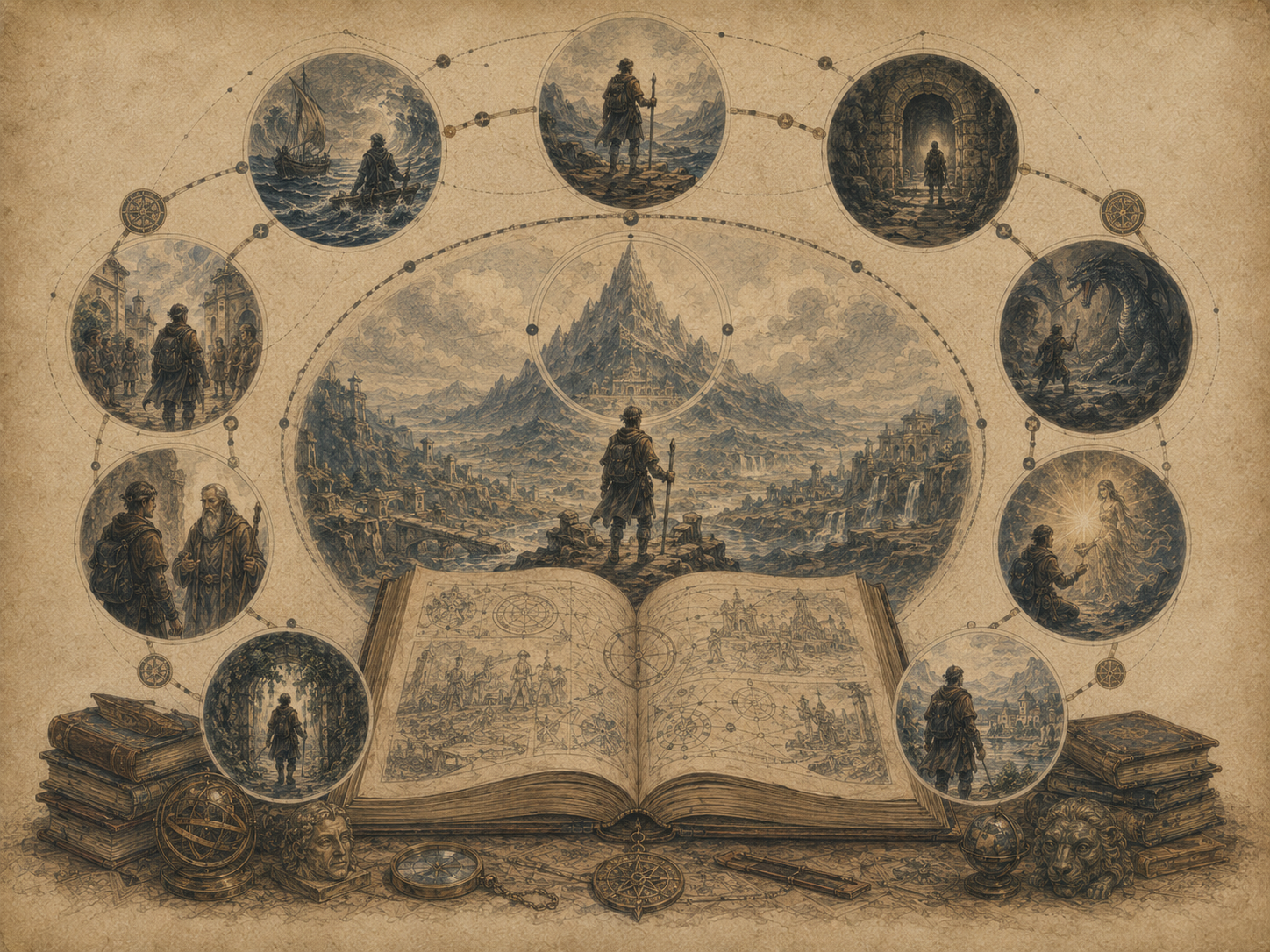
This article treats departure, initiation, and return as symbolic movements rather than required plot beats. It examines the call to adventure, refusal, threshold crossing, helpers, trials, descent, symbolic death, revelation, boon, return threshold, reintegration, failed return, ethical risk, gender critique, cultural specificity, and modern adaptations. It also includes computational workflows for auditing hero’s journey claims, transformation structure, formula drift, source specificity, return responsibility, and Catalyst Canvas-ready governance outputs.
Why the Hero’s Journey Matters
The hero’s journey matters because it gives a memorable language for transformation. Many stories begin with a stable world that becomes insufficient, broken, threatened, or too small. A protagonist is called out of that world, faces danger, receives help, endures trial, confronts fear, changes, gains something, and must return with that change. The pattern feels powerful because it connects external movement with inner transformation.
The framework also matters because it has traveled far beyond myth studies. It appears in screenwriting, fiction, game design, memoir, leadership training, education, brand storytelling, therapy-adjacent self-help, and public narrative. Writers use it to organize character arcs. Teachers use it to introduce myth. Institutions use it to frame mission. Audiences use it to understand personal change.
But the hero’s journey can also become a problem. If treated as a universal template, it narrows the range of story. It overcenters individual heroic action. It can flatten cultural difference. It can turn sacred or oral traditions into examples for a modern writing formula. It can make every difficulty seem like a private quest, even when the real problem is collective, systemic, historical, or political.
| Use | What the hero’s journey clarifies | What it can distort |
|---|---|---|
| Myth interpretation | Thresholds, trials, transformation, return. | Source tradition, ritual context, cultural specificity. |
| Creative writing | Character movement and transformational arc. | Non-heroic, communal, cyclical, tragic, or unresolved forms. |
| Education | Accessible entry point into mythic structure. | Overteaching one model as if it explains all stories. |
| Film analysis | Adventure structure and emotional progression. | Mechanical beat matching. |
| Memoir | Life transition, crisis, growth, return. | False closure or forced redemption. |
| Public narrative | Call, struggle, transformation, collective purpose. | Manipulative heroic framing or institutional self-mythology. |
The hero’s journey matters because it explains one powerful way stories organize change. It becomes harmful when it is treated as the only legitimate way to tell meaningful stories.
The Three Movements: Departure, Initiation, and Return
The core structure of the hero’s journey is departure, initiation, and return. These three movements are more important than the long stage lists often associated with the model. Departure separates the protagonist from the familiar world. Initiation subjects the protagonist to trial, danger, descent, or transformation. Return brings the transformed person, gift, insight, or consequence back into relation with ordinary life.
Departure is the break. Something calls the hero beyond the known world. Initiation is the ordeal. The hero enters a changed order of experience and is tested. Return is the reintegration. The hero must bring the boon, knowledge, healing, or transformation back across the boundary. The movement is circular, but not always simple. Some heroes refuse the call. Some fail the trial. Some never return. Some return with a gift that the community cannot receive.
The three movements can also describe more than physical travel. A person may depart from childhood, illusion, silence, fear, denial, identity, privilege, exile, or ordinary status. Initiation may involve grief, moral crisis, humiliation, illness, revelation, education, confrontation, spiritual encounter, or political awakening. Return may mean teaching, repair, reconciliation, testimony, accountability, or renewed participation.
| Movement | Basic function | Symbolic question |
|---|---|---|
| Departure | Separates the hero from the known world. | What can no longer remain as it was? |
| Initiation | Tests and transforms the hero. | What must be faced, lost, learned, or endured? |
| Return | Brings transformation back into relation. | What responsibility follows from the boon? |
Departure, initiation, and return form a symbolic grammar of transformation: leave, undergo, return changed.
Departure as Separation
Departure begins when the known world no longer holds. The hero may be summoned, exiled, tempted, awakened, threatened, chosen, abandoned, or forced outward by crisis. Sometimes the departure is welcomed. More often, it is resisted. The known world may be flawed, but it is still familiar. Leaving it means giving up safety, identity, status, certainty, or belonging.
Departure is not always heroic at first. The hero may be confused, afraid, immature, privileged, wounded, reluctant, or unprepared. The call exposes a gap between the life the hero knows and the life the story demands. That gap creates movement.
In symbolic terms, departure is separation from a previous condition. It may mark the end of innocence, the collapse of certainty, the beginning of adulthood, the rupture of social order, the loss of home, or the refusal to remain inside a false life. The journey begins because continuity becomes impossible.
| Departure type | Story function | Symbolic meaning |
|---|---|---|
| Summons | A call draws the hero outward. | The larger world demands response. |
| Exile | The hero is expelled or displaced. | Transformation begins through loss of belonging. |
| Crisis | Danger interrupts ordinary life. | The known order is no longer stable. |
| Curiosity | The hero seeks what lies beyond. | Desire for knowledge breaks enclosure. |
| Duty | The hero must act on obligation. | Responsibility overrides comfort. |
| Refusal | The hero resists the journey. | Fear reveals what departure costs. |
Departure matters because transformation rarely begins with mastery. It begins with disruption.
Call, Refusal, and Threshold
The call to adventure announces that ordinary life is no longer enough. It may arrive through a messenger, dream, wound, accident, prophecy, injustice, loss, invitation, threat, or discovery. The call does not simply begin plot. It reveals that the hero’s current life-world is incomplete.
Refusal of the call is just as important. Refusal shows that transformation has a cost. The hero may fear danger, responsibility, failure, exile, grief, or the loss of identity. Refusal humanizes the journey. It shows that heroic movement is not automatic courage, but a struggle with attachment and fear.
The threshold marks the boundary between worlds. Once crossed, the hero enters a different order of experience. The threshold may be a forest, sea, desert, cave, city, school, battlefield, underworld, court, laboratory, road, border, or moral decision. The important point is not the location itself. The threshold marks a shift in reality, status, knowledge, or obligation.
| Element | What it does | Question to ask |
|---|---|---|
| Call | Interrupts ordinary life and opens the journey. | What demands response? |
| Refusal | Reveals fear, attachment, and the cost of change. | What does the hero resist losing? |
| Threshold | Marks entry into a different world or condition. | What boundary is crossed? |
| Threshold danger | Tests whether the hero can enter the unknown. | What makes crossing difficult? |
| Threshold decision | Commits the hero to transformation. | What can no longer be undone? |
The call opens the possibility of change. The refusal names its cost. The threshold makes change irreversible.
Helpers, Guardians, and Threshold Knowledge
Hero’s journey stories often include helpers, guardians, mentors, guides, animals, elders, strangers, divine figures, ancestors, magical objects, maps, songs, prophecies, or instructions. These figures provide threshold knowledge. They help the hero cross into the unknown.
A helper is not only a character type. It is a function. The helper may give protection, warning, training, memory, moral direction, a tool, a name, a blessing, or a way to interpret danger. In some stories, help comes from a person. In others, it comes from an object, ritual, dream, community, landscape, book, or memory.
Guardians perform a different function. They test readiness. A guardian may block the path, ask a riddle, enforce a rule, expose immaturity, or demand courage. Not every guardian is an enemy. Some protect the threshold because the hero is not yet prepared.
| Figure or force | Function | Interpretive caution |
|---|---|---|
| Mentor | Provides instruction, discipline, warning, or symbolic knowledge. | Do not reduce every elder or guide to a generic mentor type. |
| Helper | Gives aid, object, route, protection, or memory. | Ask what kind of help the story values. |
| Threshold guardian | Tests readiness or protects the boundary. | Not every obstacle is evil. |
| Magical object | Concentrates power, memory, blessing, or obligation. | Objects may carry ritual or cultural meaning. |
| Animal guide | Connects the hero to instinct, environment, sacred relation, or hidden path. | Preserve ecological and cultural context. |
| Ancestor or spirit | Links the journey to memory, lineage, or sacred authority. | Respect religious and cultural specificity. |
Helpers and guardians show that transformation is rarely solitary, even when the story centers one hero.
Initiation as Transformation
Initiation is the journey’s central movement. The hero enters a world of tests, trials, reversals, temptations, dangers, and revelations. This stage is often misunderstood as a sequence of action scenes. At its strongest, initiation is not just conflict. It is transformation through ordeal.
Initiation asks what must change inside the hero. The hero may need courage, humility, knowledge, sacrifice, loyalty, discipline, compassion, discernment, grief, or surrender. The trials expose what the hero lacks and what the hero must become. The unknown world becomes a school of transformation.
In many stories, initiation also involves symbolic death. The hero loses an old identity, descends into darkness, faces a monster, enters an underworld, is swallowed, wounded, shamed, stripped, or brought to the edge of failure. This symbolic death is not decorative. It marks the collapse of the old self and the possibility of new life.
| Initiation function | Story expression | Symbolic meaning |
|---|---|---|
| Testing | Trials, tasks, battles, riddles, obstacles. | The hero’s readiness is examined. |
| Instruction | Training, revelation, warning, hidden knowledge. | The hero learns how the new world works. |
| Descent | Cave, underworld, night, sea, prison, wilderness. | The hero enters danger, loss, or hidden reality. |
| Temptation | False reward, power, comfort, distraction. | The hero confronts misdirected desire. |
| Symbolic death | Wounding, defeat, swallowing, silence, loss. | The old identity is broken open. |
| Transformation | Vision, insight, reconciliation, power, humility. | The hero becomes capable of return. |
Initiation is where the hero’s journey becomes more than movement. It becomes change under pressure.
Trial, Descent, and Symbolic Death
Trial gives the journey shape, but descent gives it depth. A trial tests skill, courage, loyalty, or endurance. Descent tests identity. The hero goes down into a place where ordinary confidence fails: the underworld, cave, belly, prison, desert, storm, battlefield, tomb, dream, or memory of trauma.
Symbolic death appears when the hero can no longer continue as before. The hero may lose a weapon, friend, status, illusion, certainty, innocence, or name. In some stories, the hero literally approaches death. In others, the death is social, psychological, moral, or spiritual. The old self must be relinquished.
This is one reason the hero’s journey resonates with rites of passage. Initiation often involves symbolic separation, ordeal, and reintegration. The person who returns is not simply the person who left. Trial and descent make transformation costly.
| Descent image | Possible meaning | Review question |
|---|---|---|
| Underworld | Death, memory, grief, hidden knowledge, ancestral realm. | What knowledge lies below ordinary life? |
| Cave | Interior confrontation, womb, tomb, hidden threshold. | What must be entered in darkness? |
| Sea | Chaos, depth, crossing, danger, rebirth. | What boundary must be crossed without stable ground? |
| Wilderness | Testing, exile, deprivation, revelation. | What does the hero learn away from society? |
| Prison | Confinement, shame, false judgment, waiting. | What freedom must be discovered inside constraint? |
| Monster | Fear, chaos, taboo, shadow, social threat. | What is being confronted, and who is being dehumanized? |
Trial asks whether the hero can endure. Descent asks whether the hero can be transformed.
Revelation, Boon, and Inner Change
The boon is what the hero gains through initiation. It may be a magical object, healing medicine, sacred fire, law, knowledge, weapon, name, reconciliation, restored relation, creative power, forgiveness, or wisdom. In modern stories, the boon may be self-knowledge, courage, testimony, public truth, new responsibility, or renewed capacity to love.
The boon should not be reduced to a prize. It is meaningful because it emerges from transformation. If the hero receives an object without change, the boon is thin. If the hero changes without bringing anything back, the return remains incomplete. The strongest hero’s journey stories connect gain, transformation, and responsibility.
Revelation often precedes the boon. The hero sees something differently: the enemy, the self, the community, the world, the divine, the past, the future, or the nature of fear. This shift in perception is often more important than physical victory.
| Boon type | Story function | Responsibility question |
|---|---|---|
| Object | Concentrates power, memory, or healing in material form. | Who should receive it, and how should it be used? |
| Knowledge | Reveals hidden truth or new perception. | What must the hero now tell or teach? |
| Healing | Restores a person, land, community, or relation. | What repair is now possible? |
| Power | Gives capacity to act. | Does power serve others or dominate them? |
| Identity | Names who the hero has become. | How does the new identity change obligation? |
| Reconciliation | Restores broken relation. | What truth, justice, or accountability is required? |
The boon matters because transformation must become meaningful beyond the hero’s private experience.
Return as Reintegration
Return is the journey’s most underappreciated movement. Many simplified versions treat the return as resolution: the hero comes home, shares the gift, and the story ends. Campbell’s return is more complex. Return asks whether transformation can be integrated into the ordinary world.
The hero may not want to return. The boon may be difficult to communicate. The community may resist the gift. The hero may no longer belong easily to the place they left. The old world may be too small, too broken, or too skeptical to receive what the hero brings. Return is therefore not only an ending. It is a second threshold.
Reintegration means holding together two worlds: the world before transformation and the world opened by initiation. The hero must translate, teach, heal, govern, testify, create, reconcile, or repair. The journey does not matter only because the hero changed. It matters because change must enter relation.
| Return form | Meaning | Risk |
|---|---|---|
| Successful return | The boon renews the community or restores relation. | May create too easy a resolution. |
| Refused return | The hero resists ordinary life after transformation. | Insight becomes private escape. |
| Difficult return | The community cannot easily receive the boon. | Transformation becomes alienation. |
| Failed return | The hero cannot reintegrate. | The story may become tragic or unresolved. |
| Collective return | The group, not one hero, carries change back. | Individual hero framing may be inadequate. |
| Ethical return | The boon requires responsibility, repair, or accountability. | Power may be misused if responsibility is ignored. |
Return is where transformation becomes accountable.
The Problem of Return
The return is a problem because the world has not necessarily changed just because the hero has changed. A person may return from grief, war, exile, illness, education, migration, spiritual experience, activism, or trauma with knowledge that others cannot receive. The boon may be true, but the community may not want it.
This problem appears in myths, memoirs, war narratives, exile stories, recovery stories, prophetic stories, whistleblower narratives, and social-change narratives. The person who crosses the threshold may return with insight that disrupts ordinary life. Return then becomes conflict: between knowledge and denial, healing and habit, truth and comfort, responsibility and avoidance.
A responsible hero’s journey analysis does not assume return is automatically triumphant. It asks what the return demands. Does the hero serve the community? Does the community change? Does the hero become isolated? Does the boon become power? Does the story hide the cost of return?
| Return problem | Story expression | Ethical question |
|---|---|---|
| Incommunicable knowledge | The hero cannot explain what was learned. | What language can carry transformation? |
| Community resistance | The ordinary world rejects the boon. | What truth threatens the community? |
| Alienation | The hero no longer fits the old world. | What does transformation cost? |
| Misused boon | Gift becomes domination, status, or control. | Who benefits from the hero’s power? |
| False closure | The return pretends all harm is repaired. | What remains unresolved? |
| Testimony | The hero must bear witness to what was seen. | Who is obligated to listen? |
The problem of return makes the hero’s journey ethically serious. Transformation must be carried back into a world that may resist being transformed.
Why the Pattern Feels Powerful
The hero’s journey feels powerful because it mirrors common human experiences of change. People leave familiar roles, cross thresholds, enter uncertainty, receive help, endure trial, lose old identities, learn painful truths, and return changed. The pattern gives narrative form to maturation, grief, education, exile, conversion, recovery, activism, creativity, and moral awakening.
The pattern also feels powerful because it connects fear with meaning. Trial is not random suffering inside the story. It becomes part of transformation. Descent is not only loss. It becomes passage. Return is not only an ending. It becomes responsibility. The framework helps readers understand why hardship can become meaningful when it is narratively shaped, ethically interpreted, and socially integrated.
But this is also why the model can be misused. Not every suffering is a growth opportunity. Not every crisis produces a boon. Not every trauma should be framed as a heroic quest. Not every person can or should return transformed for the benefit of others. The pattern is powerful, but it must not romanticize harm.
| Resonance | Why it works | Caution |
|---|---|---|
| Life transition | Departure-initiation-return resembles rites of passage. | Some transitions remain unresolved. |
| Fear and courage | The journey gives fear a narrative place. | Courage should not be demanded from victims. |
| Loss and renewal | Symbolic death can lead to new identity. | Loss should not be romanticized. |
| Learning through ordeal | Trial can reveal hidden capacity. | Not all suffering teaches. |
| Return and service | The boon connects personal change to community. | Return can become coercive or self-glorifying. |
| Symbolic universality | The pattern speaks across many contexts. | Universality must not erase difference. |
The pattern feels powerful because it turns change into story. It must be used carefully because not all change should be forced into heroic meaning.
Where the Model Helps
The hero’s journey helps most when a story truly centers transformation through departure, trial, and return. It is especially useful for quest stories, initiation narratives, coming-of-age stories, pilgrimage, exile-and-return stories, adventure films, some fantasy and science fiction, many superhero narratives, and certain forms of memoir.
For writers, the model can diagnose weak arcs. Has the protagonist truly left the known world? Is the threshold meaningful? Are the trials transformative or merely eventful? Does the boon matter? Does the return place transformation into relation? These questions can strengthen narrative design without requiring mechanical stage matching.
For analysts, the model can reveal symbolic movement. It helps distinguish a mere sequence of events from a meaningful arc of transformation. It can also clarify how stories use helpers, thresholds, descents, ordeals, and returns to organize emotion and meaning.
| Best-fit story type | What the model clarifies | Review question |
|---|---|---|
| Quest | Journey, threshold, trial, boon, return. | What makes the quest transformative? |
| Coming-of-age | Separation from childhood and return with new identity. | What old identity is left behind? |
| Pilgrimage | Physical journey as spiritual or moral transformation. | What sacred or ethical change occurs? |
| Exile and return | Loss of home and difficult reentry. | What does home mean after departure? |
| Recovery story | Descent, help, ordeal, renewed life. | Does the story avoid false triumph? |
| Adventure film | External danger joined to inner change. | Does action produce transformation? |
The model helps when it reveals transformation that is already present in the story.
Where the Model Distorts
The hero’s journey distorts when it is imposed on stories that work differently. Some narratives do not center departure. Some are about staying, enduring, remembering, mourning, repairing, witnessing, or refusing movement. Some stories are communal rather than individual. Some are cyclical rather than linear. Some are tragic rather than restorative. Some are fragmented because trauma, history, or memory cannot be integrated neatly.
The model also distorts when it turns structural similarity into sameness. Two stories may involve descent, but one descent may be a ritual initiation, another a grief journey, another a political imprisonment, another a seasonal myth, another an underworld rescue, and another a psychological crisis. The same apparent structure does not guarantee the same meaning.
The model can also distort social problems. If every problem becomes a hero’s journey, then systemic injustice becomes personal challenge, collective struggle becomes individual triumph, and structural harm becomes inspirational adversity. This is especially risky in organizational, political, and brand storytelling.
| Distortion | How it appears | Better approach |
|---|---|---|
| Forced departure | A story about staying is treated as leaving. | Ask whether endurance, care, or witness is the real structure. |
| Forced return | An unresolved story is given artificial closure. | Respect tragedy, exile, and incomplete repair. |
| Individualization | Collective struggle becomes one hero’s achievement. | Track community, systems, and shared agency. |
| Cultural flattening | Local ritual or oral meaning becomes generic journey structure. | Begin with source context. |
| Trauma romanticizing | Harm is framed as necessary transformation. | Separate meaning-making from harm justification. |
| Brand heroism | Institutions cast themselves as the hero. | Audit power, beneficiaries, and erased harm. |
The hero’s journey distorts when it replaces listening with pattern recognition.
Gender, Community, and Alternative Journeys
The hero’s journey often centers a solitary figure leaving home, entering danger, achieving transformation, and returning with a boon. This pattern can be powerful, but it is not neutral. It often reflects a heroic, individual, outward, and sometimes male-coded model of agency. Many stories organize transformation differently.
Some stories center relational transformation: care, reconciliation, kinship, repair, embodiment, or return to the self rather than conquest of the unknown. Some center community survival rather than individual achievement. Some center land, ancestry, continuity, and obligation rather than departure. Some stories do not return because history has made return impossible. Others do not seek transformation through ordeal, but through memory, attention, listening, and responsibility.
A responsible approach places the hero’s journey alongside other frameworks. The heroine’s journey, Indigenous place-based story, tragedy, cyclical story, oral tradition, postcolonial narrative, ensemble story, trauma narrative, and ecological narrative all challenge the idea that transformation must follow one path.
| Alternative journey | Different structure | Why it matters |
|---|---|---|
| Heroine’s journey | Often emphasizes descent, split identity, embodiment, repair, and integration. | Challenges male-coded heroic departure. |
| Communal journey | Transformation belongs to a group. | Centers shared agency. |
| Place-based journey | Movement may be relational, ancestral, ecological, or cyclical. | Resists abstract universal movement. |
| Tragic journey | Return may fail or expose irreversible loss. | Resists compulsory triumph. |
| Witness journey | The central act is testimony rather than conquest. | Centers truth and responsibility. |
| Care journey | Transformation occurs through sustaining others. | Honors non-spectacular forms of agency. |
The hero’s journey is one grammar of transformation. It becomes richer when placed in conversation with other grammars.
Modern Uses in Film, Games, Memoir, and Public Story
Modern storytelling uses the hero’s journey in many settings. Film and television often use it to structure adventure, fantasy, superhero, coming-of-age, and transformation stories. Games use it for quests, progression, difficulty, reward, and player growth. Memoirs use it to organize crisis, discovery, recovery, and changed identity. Public narratives use it to organize collective challenge and hope.
The framework works well in modern media because it connects action with identity. It gives audiences a way to recognize change. It also creates rhythm: disruption, crossing, difficulty, breakthrough, return. This rhythm is legible and satisfying.
But modern use can become too predictable. A film may feel manufactured if every beat announces itself. A game may reduce player agency if the journey is too linear. A memoir may force pain into redemption too quickly. A public campaign may manipulate people by casting an institution, leader, or brand as the hero while hiding the community’s real work.
| Modern setting | Useful application | Risk |
|---|---|---|
| Film | Builds transformational character arcs. | Can become predictable beat structure. |
| Games | Organizes quest, challenge, progression, and reward. | Can ignore branching agency and player choice. |
| Memoir | Frames crisis, descent, learning, and return. | Can force false redemption. |
| Education | Helps students understand story movement. | Can overteach one model. |
| Leadership | Frames challenge and transformation. | Can become motivational cliché. |
| Brand storytelling | Frames user transformation or mission. | Can manipulate trust through false heroism. |
Modern storytelling should use the hero’s journey as a diagnostic tool, not as a factory mold.
Ethical Risks in Hero’s Journey Storytelling
The hero’s journey carries ethical risk because it makes struggle meaningful. That power can inspire courage, but it can also romanticize suffering. It can help people understand transformation, but it can also suggest that harm exists to build character. It can honor return, but it can also demand that wounded people produce a useful lesson for others.
Another ethical risk is hero centrality. When one figure becomes the hero, everyone else may become helper, obstacle, audience, or reward. This can erase collective labor. It can turn communities into scenery for one person’s transformation. It can make the hero’s growth more important than the harm experienced by others.
Institutional storytelling adds another risk. Organizations may cast themselves as heroes, users as beneficiaries, opponents as monsters, and structural problems as obstacles. This can hide power, accountability, and harm behind uplifting story architecture.
| Ethical risk | How it appears | Review question |
|---|---|---|
| Romanticized suffering | Pain is framed as necessary for growth. | Does the story justify harm? |
| Hero centrality | One protagonist absorbs the meaning of collective struggle. | Whose labor is erased? |
| Monster-making | Opponents or outsiders become symbolic evil. | Who is being dehumanized? |
| False return | The story resolves harm too neatly. | What remains unresolved? |
| Institutional heroism | An organization casts itself as savior. | What power is hidden? |
| Cultural extraction | Sacred or oral material becomes generic journey content. | Who has authority to interpret or reuse this story? |
The hero’s journey should deepen responsibility, not excuse harm or glorify power.
Examples of Hero’s Journey Analysis
The examples below show how departure, initiation, and return can be used carefully without forcing every story into the same formula.
Quest narrative
Weak: The story is reduced to a checklist of stages.
Stronger: The analysis asks how departure changes identity, how trials transform the hero, and what responsibility the boon creates.
Why it works: Structure is connected to meaning.
Coming-of-age story
Weak: Adolescence is treated as an adventure plot.
Stronger: The analysis tracks separation from childhood, social testing, identity conflict, and difficult reintegration.
Why it works: The model clarifies transition without trivializing growth.
Memoir of recovery
Weak: Suffering is framed as necessary because it produced wisdom.
Stronger: The analysis respects harm while studying descent, support, testimony, and partial return.
Why it works: It avoids false redemption.
Game quest
Weak: The game is treated as a linear hero path.
Stronger: The analysis distinguishes quest structure from player agency, branching paths, failure states, and repeat loops.
Why it works: It adapts the framework to interactive media.
Public movement story
Weak: One leader becomes the hero of collective change.
Stronger: The analysis tracks shared departure, communal trial, collective courage, and distributed return.
Why it works: It protects collective agency.
Brand transformation story
Weak: The company casts itself as the hero.
Stronger: The analysis asks whether the audience, community, worker, or public is actually centered and whether power is being hidden.
Why it works: It audits manipulation risk.
Hero’s journey analysis is strongest when it asks what transformation requires, who carries it, and what the return demands.
Mathematics, Computation, and Modeling
The hero’s journey can be modeled as an interpretive audit, not as an automatic story detector. A computational workflow can ask whether a story contains departure, initiation, and return; whether transformation is meaningful; whether return creates responsibility; whether the analysis preserves source context; and whether formula drift or ethical risk is present.
A journey-structure score can estimate whether the three major movements are present:
J_s = \frac{D_p + T_c + I_t + D_s + B_o + R_n}{6}
\]
Interpretation: Journey structure \(J_s\) averages departure pattern \(D_p\), threshold crossing \(T_c\), initiation trial \(I_t\), descent or symbolic death \(D_s\), boon \(B_o\), and return \(R_n\).
A transformation-depth score can estimate whether the journey changes the hero meaningfully:
T_d = \frac{F_c + L_s + R_v + I_c + M_g + A_r}{6}
\]
Interpretation: Transformation depth \(T_d\) averages fear confrontation \(F_c\), loss or sacrifice \(L_s\), revelation \(R_v\), identity change \(I_c\), moral growth \(M_g\), and altered relation \(A_r\).
A return-responsibility score can estimate whether the boon is ethically integrated:
R_r = \frac{C_b + S_r + T_m + H_e + A_c + U_m}{6}
\]
Interpretation: Return responsibility \(R_r\) averages communal benefit \(C_b\), service relation \(S_r\), truth mediation \(T_m\), harm exposure \(H_e\), accountability \(A_c\), and unresolved marking \(U_m\).
A formula-drift score can estimate whether the model is being used mechanically:
F_d = S_lw_s + B_mw_b + C_lw_c + O_fw_o + U_cw_u + (1 – X_n)w_x
\]
Interpretation: Formula drift \(F_d\) rises with stage literalism \(S_l\), beat matching \(B_m\), context loss \(C_l\), overfitting \(O_f\), universal claim strength \(U_c\), and weak counterexample inclusion \(X_n\).
| Modeling task | Interpretive question | Example output |
|---|---|---|
| Journey audit | Are departure, initiation, and return meaningfully present? | Journey-structure score. |
| Transformation audit | Does the journey actually change the protagonist? | Transformation-depth score. |
| Return audit | Does the boon create responsibility beyond the hero? | Return-responsibility score. |
| Specificity audit | Are source context, ritual, culture, and authority preserved? | Specificity-preservation table. |
| Formula audit | Is the analysis becoming mechanical stage matching? | Formula-drift score. |
| Ethics audit | Does heroic framing erase harm, community, or power? | Governance queue. |
Computation can make interpretive assumptions visible. It cannot decide whether a story is meaningful, ethical, or culturally responsible.
Python Workflow: Hero’s Journey Transformation Audit
The Python workflow below evaluates hero’s journey claims by departure pattern, threshold crossing, initiation trial, descent or symbolic death, boon, return, fear confrontation, loss or sacrifice, revelation, identity change, moral growth, altered relation, communal benefit, service relation, truth mediation, harm exposure, accountability, unresolved marking, stage literalism, beat matching, context loss, overfitting, universal claim strength, counterexample inclusion, method limits, ethics governance, ritual verification, and uncertainty marking. The companion repository version extends this into a Catalyst Canvas-ready module with schemas, package-style Python, tests, JSON exports, Canvas cards, markdown governance queues, and reusable hero’s journey analysis templates.
# heros_journey_audit.py
# Dependency-light workflow for auditing departure, initiation, and return.

from __future__ import annotations

from dataclasses import dataclass
from pathlib import Path
import csv
import json
from statistics import mean

ARTICLE_ROOT = Path(__file__).resolve().parents[1]
OUTPUTS = ARTICLE_ROOT / "outputs"
TABLES = OUTPUTS / "tables"
JSON_DIR = OUTPUTS / "json"
MARKDOWN = OUTPUTS / "markdown"


@dataclass
class HerosJourneyClaim:
    item: str
    claim_context: str
    departure_pattern: float
    threshold_crossing: float
    initiation_trial: float
    descent_symbolic_death: float
    boon: float
    return_pattern: float
    fear_confrontation: float
    loss_or_sacrifice: float
    revelation: float
    identity_change: float
    moral_growth: float
    altered_relation: float
    communal_benefit: float
    service_relation: float
    truth_mediation: float
    harm_exposure: float
    accountability: float
    unresolved_marking: float
    language_notes: float
    cultural_tradition: float
    ritual_context: float
    historical_context: float
    oral_performance_context: float
    authority_notes: float
    stage_literalism: float
    beat_matching: float
    context_loss: float
    overfitting: float
    universal_claim_strength: float
    counterexample_inclusion: float
    method_limits: float
    ethics_governance: float
    ritual_verification: float
    uncertainty_marking: float
    community_sensitivity: float
    public_consequence: float
    owner: str
    status: str

    def journey_structure(self) -> float:
        return mean([
            self.departure_pattern,
            self.threshold_crossing,
            self.initiation_trial,
            self.descent_symbolic_death,
            self.boon,
            self.return_pattern,
        ])

    def transformation_depth(self) -> float:
        return mean([
            self.fear_confrontation,
            self.loss_or_sacrifice,
            self.revelation,
            self.identity_change,
            self.moral_growth,
            self.altered_relation,
        ])

    def return_responsibility(self) -> float:
        return mean([
            self.communal_benefit,
            self.service_relation,
            self.truth_mediation,
            self.harm_exposure,
            self.accountability,
            self.unresolved_marking,
        ])

    def specificity_preservation(self) -> float:
        return mean([
            self.language_notes,
            self.cultural_tradition,
            self.ritual_context,
            self.historical_context,
            self.oral_performance_context,
            self.authority_notes,
        ])

    def formula_drift(self) -> float:
        return min(
            1.0,
            self.stage_literalism * 0.18
            + self.beat_matching * 0.18
            + self.context_loss * 0.18
            + self.overfitting * 0.16
            + self.universal_claim_strength * 0.16
            + (1 - self.counterexample_inclusion) * 0.14,
        )

    def interpretation_readiness(self) -> float:
        return mean([
            self.specificity_preservation(),
            self.counterexample_inclusion,
            self.method_limits,
            self.ethics_governance,
            self.ritual_verification,
            self.uncertainty_marking,
        ])

    def governance_priority_score(self) -> float:
        return min(
            1.0,
            self.formula_drift() * 0.30
            + self.community_sensitivity * 0.22
            + self.public_consequence * 0.18
            + (1 - self.return_responsibility()) * 0.15
            + (1 - self.interpretation_readiness()) * 0.15,
        )

    def review_priority(self) -> str:
        drift = self.formula_drift()
        priority = self.governance_priority_score()
        readiness = self.interpretation_readiness()

        if self.status == "revise" or drift >= 0.55 or priority >= 0.62 or readiness < 0.55:
            return "high"
        if self.status == "review" or drift >= 0.40 or priority >= 0.48 or readiness < 0.68:
            return "medium"
        return "standard"


def write_csv(path: Path, rows: list[dict[str, object]]) -> None:
    path.parent.mkdir(parents=True, exist_ok=True)
    if not rows:
        raise ValueError(f"No rows to write: {path}")
    with path.open("w", encoding="utf-8", newline="") as handle:
        writer = csv.DictWriter(handle, fieldnames=list(rows[0].keys()))
        writer.writeheader()
        writer.writerows(rows)


def write_json(path: Path, payload: object) -> None:
    path.parent.mkdir(parents=True, exist_ok=True)
    path.write_text(json.dumps(payload, indent=2), encoding="utf-8")


def write_markdown_queue(path: Path, rows: list[dict[str, object]]) -> None:
    path.parent.mkdir(parents=True, exist_ok=True)
    lines = [
        "# Hero's Journey Governance Queue",
        "",
        "| Item | Context | Journey | Transformation | Return responsibility | Formula drift | Readiness | Priority |",
        "|---|---|---:|---:|---:|---:|---:|---|",
    ]

    for row in rows:
        lines.append(
            f"| {row['item']} | {row['claim_context']} | "
            f"{row['journey_structure']} | {row['transformation_depth']} | "
            f"{row['return_responsibility']} | {row['formula_drift']} | "
            f"{row['interpretation_readiness']} | {row['review_priority']} |"
        )

    path.write_text("\n".join(lines) + "\n", encoding="utf-8")


def main() -> None:
    claims = [
        HerosJourneyClaim(
            "Quest narrative",
            "source-tradition transformation story",
            0.90, 0.86, 0.84, 0.74, 0.78, 0.82,
            0.80, 0.70, 0.76, 0.82, 0.74, 0.78,
            0.78, 0.74, 0.70, 0.62, 0.76, 0.68,
            0.72, 0.80, 0.74, 0.76, 0.68, 0.70,
            0.34, 0.30, 0.32, 0.36, 0.46, 0.74,
            0.72, 0.76, 0.78, 0.70,
            0.72, 0.62,
            "editorial", "active"
        ),
        HerosJourneyClaim(
            "Coming-of-age film",
            "popular media transformation arc",
            0.82, 0.78, 0.74, 0.56, 0.64, 0.76,
            0.76, 0.58, 0.66, 0.82, 0.70, 0.72,
            0.58, 0.56, 0.54, 0.40, 0.52, 0.56,
            0.48, 0.54, 0.42, 0.62, 0.36, 0.40,
            0.64, 0.70, 0.56, 0.68, 0.66, 0.58,
            0.56, 0.54, 0.46, 0.52,
            0.42, 0.70,
            "story review", "review"
        ),
        HerosJourneyClaim(
            "Memoir of recovery",
            "descent return and testimony",
            0.66, 0.70, 0.74, 0.82, 0.62, 0.58,
            0.86, 0.82, 0.76, 0.78, 0.72, 0.80,
            0.54, 0.62, 0.74, 0.88, 0.80, 0.90,
            0.66, 0.56, 0.42, 0.70, 0.34, 0.42,
            0.42, 0.36, 0.44, 0.40, 0.38, 0.82,
            0.80, 0.78, 0.64, 0.84,
            0.86, 0.76,
            "ethics review", "active"
        ),
        HerosJourneyClaim(
            "Collective movement story",
            "public narrative and shared agency",
            0.58, 0.62, 0.70, 0.52, 0.60, 0.64,
            0.78, 0.76, 0.74, 0.70, 0.84, 0.82,
            0.88, 0.86, 0.82, 0.78, 0.86, 0.74,
            0.72, 0.68, 0.58, 0.74, 0.52, 0.66,
            0.54, 0.50, 0.46, 0.48, 0.58, 0.78,
            0.76, 0.74, 0.60, 0.72,
            0.88, 0.90,
            "public narrative review", "active"
        ),
        HerosJourneyClaim(
            "Corporate hero narrative",
            "brand story using hero journey",
            0.82, 0.72, 0.68, 0.46, 0.78, 0.84,
            0.42, 0.28, 0.34, 0.38, 0.30, 0.32,
            0.26, 0.22, 0.24, 0.34, 0.22, 0.18,
            0.22, 0.18, 0.16, 0.28, 0.12, 0.18,
            0.92, 0.88, 0.86, 0.90, 0.94, 0.18,
            0.22, 0.24, 0.16, 0.26,
            0.70, 0.88,
            "governance", "revise"
        ),
    ]

    rows = []

    for claim in claims:
        rows.append({
            "item": claim.item,
            "claim_context": claim.claim_context,
            "journey_structure": round(claim.journey_structure(), 3),
            "transformation_depth": round(claim.transformation_depth(), 3),
            "return_responsibility": round(claim.return_responsibility(), 3),
            "specificity_preservation": round(claim.specificity_preservation(), 3),
            "formula_drift": round(claim.formula_drift(), 3),
            "interpretation_readiness": round(claim.interpretation_readiness(), 3),
            "governance_priority_score": round(claim.governance_priority_score(), 3),
            "review_priority": claim.review_priority(),
            "owner": claim.owner,
            "status": claim.status,
        })

    priority_order = {"high": 3, "medium": 2, "standard": 1}
    rows = sorted(
        rows,
        key=lambda row: (
            priority_order.get(str(row["review_priority"]), 0),
            float(row["formula_drift"])
        ),
        reverse=True,
    )

    governance_queue = [
        row for row in rows
        if row["review_priority"] != "standard"
    ]

    write_csv(TABLES / "heros_journey_audit.csv", rows)
    write_csv(TABLES / "heros_journey_governance_queue.csv", governance_queue)

    write_json(JSON_DIR / "heros_journey_canvas_cards.json", rows)
    write_json(JSON_DIR / "heros_journey_governance_queue.json", governance_queue)

    write_markdown_queue(MARKDOWN / "heros_journey_governance_queue.md", governance_queue)

    print("Hero's journey audit complete.")


if __name__ == "__main__":
    main()
This workflow helps distinguish meaningful transformation analysis from mechanical stage matching, false return, formula drift, and heroic overreach.
R Workflow: Hero’s Journey Diagnostics
The R workflow below creates a synthetic hero’s journey dataset, calculates journey structure, transformation depth, return responsibility, specificity preservation, formula drift, interpretation readiness, governance priority, and review priority, then exports summary tables and base R plots. It is intentionally portable and uses only base R.
# heros_journey_diagnostics.R
# Base R workflow for departure, initiation, and return analysis.

args <- commandArgs(trailingOnly = FALSE)
file_arg <- grep("^--file=", args, value = TRUE)

if (length(file_arg) > 0) {
  script_path <- normalizePath(sub("^--file=", "", file_arg[1]), mustWork = TRUE)
  article_root <- normalizePath(file.path(dirname(script_path), ".."), mustWork = TRUE)
} else {
  article_root <- getwd()
}

setwd(article_root)

tables_dir <- file.path(article_root, "outputs", "tables")
figures_dir <- file.path(article_root, "outputs", "figures")
dir.create(tables_dir, recursive = TRUE, showWarnings = FALSE)
dir.create(figures_dir, recursive = TRUE, showWarnings = FALSE)

claims <- data.frame(
  item = c(
    "Quest narrative",
    "Coming-of-age film",
    "Memoir of recovery",
    "Collective movement story",
    "Corporate hero narrative"
  ),
  claim_context = c(
    "source-tradition transformation story",
    "popular media transformation arc",
    "descent return and testimony",
    "public narrative and shared agency",
    "brand story using hero journey"
  ),
  departure_pattern = c(0.90, 0.82, 0.66, 0.58, 0.82),
  threshold_crossing = c(0.86, 0.78, 0.70, 0.62, 0.72),
  initiation_trial = c(0.84, 0.74, 0.74, 0.70, 0.68),
  descent_symbolic_death = c(0.74, 0.56, 0.82, 0.52, 0.46),
  boon = c(0.78, 0.64, 0.62, 0.60, 0.78),
  return_pattern = c(0.82, 0.76, 0.58, 0.64, 0.84),
  fear_confrontation = c(0.80, 0.76, 0.86, 0.78, 0.42),
  loss_or_sacrifice = c(0.70, 0.58, 0.82, 0.76, 0.28),
  revelation = c(0.76, 0.66, 0.76, 0.74, 0.34),
  identity_change = c(0.82, 0.82, 0.78, 0.70, 0.38),
  moral_growth = c(0.74, 0.70, 0.72, 0.84, 0.30),
  altered_relation = c(0.78, 0.72, 0.80, 0.82, 0.32),
  communal_benefit = c(0.78, 0.58, 0.54, 0.88, 0.26),
  service_relation = c(0.74, 0.56, 0.62, 0.86, 0.22),
  truth_mediation = c(0.70, 0.54, 0.74, 0.82, 0.24),
  harm_exposure = c(0.62, 0.40, 0.88, 0.78, 0.34),
  accountability = c(0.76, 0.52, 0.80, 0.86, 0.22),
  unresolved_marking = c(0.68, 0.56, 0.90, 0.74, 0.18),
  language_notes = c(0.72, 0.48, 0.66, 0.72, 0.22),
  cultural_tradition = c(0.80, 0.54, 0.56, 0.68, 0.18),
  ritual_context = c(0.74, 0.42, 0.42, 0.58, 0.16),
  historical_context = c(0.76, 0.62, 0.70, 0.74, 0.28),
  oral_performance_context = c(0.68, 0.36, 0.34, 0.52, 0.12),
  authority_notes = c(0.70, 0.40, 0.42, 0.66, 0.18),
  stage_literalism = c(0.34, 0.64, 0.42, 0.54, 0.92),
  beat_matching = c(0.30, 0.70, 0.36, 0.50, 0.88),
  context_loss = c(0.32, 0.56, 0.44, 0.46, 0.86),
  overfitting = c(0.36, 0.68, 0.40, 0.48, 0.90),
  universal_claim_strength = c(0.46, 0.66, 0.38, 0.58, 0.94),
  counterexample_inclusion = c(0.74, 0.58, 0.82, 0.78, 0.18),
  method_limits = c(0.72, 0.56, 0.80, 0.76, 0.22),
  ethics_governance = c(0.76, 0.54, 0.78, 0.74, 0.24),
  ritual_verification = c(0.78, 0.46, 0.64, 0.60, 0.16),
  uncertainty_marking = c(0.70, 0.52, 0.84, 0.72, 0.26),
  community_sensitivity = c(0.72, 0.42, 0.86, 0.88, 0.70),
  public_consequence = c(0.62, 0.70, 0.76, 0.90, 0.88),
  owner = c("editorial", "story review", "ethics review", "public narrative review", "governance"),
  status = c("active", "review", "active", "active", "revise"),
  stringsAsFactors = FALSE
)

claims$journey_structure <- rowMeans(claims[, c(
  "departure_pattern",
  "threshold_crossing",
  "initiation_trial",
  "descent_symbolic_death",
  "boon",
  "return_pattern"
)])

claims$transformation_depth <- rowMeans(claims[, c(
  "fear_confrontation",
  "loss_or_sacrifice",
  "revelation",
  "identity_change",
  "moral_growth",
  "altered_relation"
)])

claims$return_responsibility <- rowMeans(claims[, c(
  "communal_benefit",
  "service_relation",
  "truth_mediation",
  "harm_exposure",
  "accountability",
  "unresolved_marking"
)])

claims$specificity_preservation <- rowMeans(claims[, c(
  "language_notes",
  "cultural_tradition",
  "ritual_context",
  "historical_context",
  "oral_performance_context",
  "authority_notes"
)])

claims$formula_drift <- pmin(
  1,
  claims$stage_literalism * 0.18 +
    claims$beat_matching * 0.18 +
    claims$context_loss * 0.18 +
    claims$overfitting * 0.16 +
    claims$universal_claim_strength * 0.16 +
    (1 - claims$counterexample_inclusion) * 0.14
)

claims$interpretation_readiness <- rowMeans(data.frame(
  specificity_preservation = claims$specificity_preservation,
  counterexample_inclusion = claims$counterexample_inclusion,
  method_limits = claims$method_limits,
  ethics_governance = claims$ethics_governance,
  ritual_verification = claims$ritual_verification,
  uncertainty_marking = claims$uncertainty_marking
))

claims$governance_priority_score <- pmin(
  1,
  claims$formula_drift * 0.30 +
    claims$community_sensitivity * 0.22 +
    claims$public_consequence * 0.18 +
    (1 - claims$return_responsibility) * 0.15 +
    (1 - claims$interpretation_readiness) * 0.15
)

claims$review_priority <- ifelse(
  claims$status == "revise" | claims$formula_drift >= 0.55 | claims$governance_priority_score >= 0.62 | claims$interpretation_readiness < 0.55,
  "high",
  ifelse(
    claims$status == "review" | claims$formula_drift >= 0.40 | claims$governance_priority_score >= 0.48 | claims$interpretation_readiness < 0.68,
    "medium",
    "standard"
  )
)

claims <- claims[order(claims$formula_drift, decreasing = TRUE), ]

write.csv(
  claims,
  file.path(tables_dir, "heros_journey_diagnostics.csv"),
  row.names = FALSE
)

governance_queue <- claims[claims$review_priority != "standard", ]

write.csv(
  governance_queue,
  file.path(tables_dir, "heros_journey_governance_queue.csv"),
  row.names = FALSE
)

png(file.path(figures_dir, "journey_structure_scores.png"), width = 1200, height = 700)
barplot(
  claims$journey_structure,
  names.arg = claims$item,
  las = 2,
  ylab = "Journey structure",
  main = "Hero's Journey Structure Scores"
)
grid()
dev.off()

png(file.path(figures_dir, "return_responsibility_scores.png"), width = 1200, height = 700)
barplot(
  claims$return_responsibility,
  names.arg = claims$item,
  las = 2,
  ylab = "Return responsibility",
  main = "Hero's Journey Return Responsibility Scores"
)
grid()
dev.off()

png(file.path(figures_dir, "formula_drift_scores.png"), width = 1200, height = 700)
barplot(
  claims$formula_drift,
  names.arg = claims$item,
  las = 2,
  ylab = "Formula drift",
  main = "Hero's Journey Formula Drift Scores"
)
grid()
dev.off()

print(claims[, c(
  "item",
  "claim_context",
  "journey_structure",
  "transformation_depth",
  "return_responsibility",
  "formula_drift",
  "interpretation_readiness",
  "review_priority"
)])
This workflow turns hero’s journey analysis into a reviewable diagnostic process while preserving the central point: departure, initiation, and return should clarify transformation, not force every story into formula.
GitHub Repository
The companion repository for this article supports hero’s journey analysis as a Catalyst Canvas-ready module. It includes journey-structure scoring, transformation-depth diagnostics, return-responsibility review, formula-drift checks, source and authority review, counterexample tracking, ethical governance, JSON schemas, package-style Python, R workflows, SQL structures, Canvas cards, markdown governance queues, synthetic datasets, documentation, and reusable departure-initiation-return templates.
Complete Code Repository
Companion repository for the article, including Catalyst Canvas-ready code for hero’s journey analysis, departure-initiation-return review, transformation depth, return responsibility, formula drift, counterexample tracking, governance queues, JSON exports, Canvas cards, and reproducible research workflows.
articles/the-heros-journey-departure-initiation-and-return/
├── canvas/
│   ├── canvas_manifest.json
│   ├── input_schema.json
│   ├── output_schema.json
│   ├── canvas_cards.json
│   └── governance_queue.json
├── html/
├── css/
├── php/
├── java/
├── python/
│   ├── heros_journey_canvas/
│   │   ├── __init__.py
│   │   ├── __main__.py
│   │   ├── cli.py
│   │   ├── models.py
│   │   ├── scoring.py
│   │   ├── validation.py
│   │   ├── governance.py
│   │   └── exporters.py
│   ├── tests/
│   │   └── test_heros_journey_canvas.py
│   └── run_heros_journey_canvas_audit.py
├── r/
│   ├── heros_journey_diagnostics.R
│   └── run_all_heros_journey_workflows.R
├── sql/
│   ├── canvas_schema.sql
│   └── canvas_queries.sql
├── docs/
│   ├── article_notes.md
│   ├── modeling_principles.md
│   ├── departure.md
│   ├── initiation.md
│   ├── return.md
│   ├── threshold_and_descent.md
│   ├── return_responsibility.md
│   ├── formula_drift.md
│   ├── critiques_and_limits.md
│   ├── responsible_use.md
│   └── governance_notes.md
├── data/
│   ├── heros_journey_claims.csv
│   ├── journey_movements.csv
│   ├── transformation_features.csv
│   ├── return_responsibility_notes.csv
│   ├── formula_drift_risks.csv
│   └── heros_journey_governance_notes.csv
├── outputs/
│   ├── figures/
│   ├── json/
│   ├── markdown/
│   └── tables/
├── notebooks/
├── shared/
│   ├── schemas/
│   ├── narrative-templates/
│   ├── story-archetypes/
│   ├── character-models/
│   ├── plot-structures/
│   ├── rhetorical-frameworks/
│   ├── cultural-memory/
│   ├── heros-journey/
│   └── governance/
├── tests/
└── README.md
Related Articles
- The Monomyth: What Campbell Actually Argued
- Thresholds, Trials, and Transformative Ordeals
- The Four Functions of Myth and the Cultural Work of Story
- Maureen Murdock and the Heroine’s Journey
- Alternative Story Structures Beyond the Monomyth
- The Hero’s Journey in Film and Popular Narrative
A Practical Method for Using the Hero’s Journey
The hero’s journey can be useful when it is applied as an interpretive lens rather than a universal template.
1. Start with the story’s own context
Document source tradition, genre, language, ritual context, historical setting, oral or performance context, audience, and authority.
2. Identify the three major movements
Ask whether departure, initiation, and return are meaningfully present. Do not force the pattern where it does not fit.
3. Define the threshold
Clarify what boundary is crossed: physical, moral, social, psychological, spiritual, political, or symbolic.
4. Distinguish trial from transformation
Do not count obstacles alone. Ask how the hero changes through trial.
5. Identify the boon
Ask what is gained: object, knowledge, healing, power, truth, identity, reconciliation, or responsibility.
6. Evaluate the return
Ask whether the boon is integrated, refused, misunderstood, misused, shared, or left unresolved.
7. Track counterexamples
Record what does not fit: communal agency, cyclical structure, tragedy, care, place-based relation, unresolved ending, or refusal of return.
8. Review ethical risks
Look for romanticized suffering, hero centrality, monster-making, cultural extraction, institutional heroism, and false closure.
9. Compare alternative models
Use heroine’s journey, tragedy, oral tradition, Indigenous storytelling, postcolonial narrative, care narrative, and systems storytelling where they fit better.
10. Use the framework to deepen reading
A good hero’s journey analysis should reveal transformation, responsibility, and return without making the story smaller.
This method keeps departure, initiation, and return useful while protecting story diversity, source context, and ethical responsibility.
Common Pitfalls
Several pitfalls appear when the hero’s journey is used carelessly.
- Stage matching: The analysis tries to identify every stage instead of asking what transformation is happening.
- Formula drift: A symbolic model becomes a mechanical writing template.
- False universality: One heroic pattern is treated as the structure of all stories.
- Hero centrality: Collective labor becomes one person’s transformation arc.
- Romanticized suffering: Harm is framed as necessary for growth.
- Compulsory return: The story is forced into restoration even when return is failed, tragic, unresolved, or impossible.
- Cultural flattening: Source tradition, ritual, oral performance, and authority disappear behind generic structure.
- Monster-making: Opponents become symbolic evil rather than complex people or systems.
- Institutional heroism: Organizations cast themselves as saviors while hiding power or harm.
- Ignoring alternative structures: Care, witness, community, place, cyclical return, and tragedy are treated as secondary.
The central pitfall is mistaking a powerful journey pattern for the only way transformation can be told.
Why Departure, Initiation, and Return Still Matter
Departure, initiation, and return still matter because they describe one of the most durable ways stories organize transformation. A life-world becomes too small or unstable. A person crosses into uncertainty. Trial breaks open old identity. Revelation or suffering produces change. A boon is gained. The changed person must return, translate, repair, testify, teach, or live differently.
This pattern remains powerful because it joins action to meaning. The hero does not merely move through events. The hero is altered by them. The journey is not complete when danger is survived. It is complete only when transformation becomes accountable to a world beyond the self.
The hero’s journey should therefore be used with both appreciation and restraint. It can clarify thresholds, trials, descents, gifts, and returns. It can help writers strengthen transformation arcs. It can help readers recognize symbolic movement. But it should not erase other forms of story, flatten cultural difference, romanticize suffering, or turn collective struggle into individual triumph. Departure, initiation, and return remain valuable when they deepen interpretation rather than replace it.
Further Reading
- Campbell, J. (1949) The Hero with a Thousand Faces. New York: Pantheon Books.
- Campbell, J. and Moyers, B. (1988) The Power of Myth. New York: Doubleday.
- Britannica (2026) Joseph Campbell. Available at: https://www.britannica.com/biography/Joseph-Campbell-American-author
- Britannica (n.d.) The Hero with a Thousand Faces. Available at: https://www.britannica.com/topic/The-Hero-with-a-Thousand-Faces
- Joseph Campbell Foundation (n.d.) Joseph Campbell and the Hero’s Journey. Available at: https://www.jcf.org/learn/joseph-campbell-heros-journey
- Joseph Campbell Foundation (2020) Separation, Initiation, and Return. Available at: https://www.jcf.org/post/separation-initiation-and-return
- Jung, C.G. (1969) The Archetypes and the Collective Unconscious. 2nd edn. Princeton: Princeton University Press.
- Murdock, M. (1990) The Heroine’s Journey: Woman’s Quest for Wholeness. Boston: Shambhala.
- Segal, R.A. (1999) Theorizing About Myth. Amherst: University of Massachusetts Press.
- Turner, V. (1969) The Ritual Process: Structure and Anti-Structure. Chicago: Aldine.
References
- Campbell, J. (1949) The Hero with a Thousand Faces. New York: Pantheon Books.
- Campbell, J. and Moyers, B. (1988) The Power of Myth. New York: Doubleday.
- Britannica (2026) Joseph Campbell. Available at: https://www.britannica.com/biography/Joseph-Campbell-American-author
- Britannica (n.d.) The Hero with a Thousand Faces. Available at: https://www.britannica.com/topic/The-Hero-with-a-Thousand-Faces
- Joseph Campbell Foundation (n.d.) Joseph Campbell and the Hero’s Journey. Available at: https://www.jcf.org/learn/joseph-campbell-heros-journey
- Joseph Campbell Foundation (2020) Separation, Initiation, and Return. Available at: https://www.jcf.org/post/separation-initiation-and-return
- Jung, C.G. (1969) The Archetypes and the Collective Unconscious. 2nd edn. Princeton: Princeton University Press.
- Murdock, M. (1990) The Heroine’s Journey: Woman’s Quest for Wholeness. Boston: Shambhala.
- Segal, R.A. (1999) Theorizing About Myth. Amherst: University of Massachusetts Press.
- Turner, V. (1969) The Ritual Process: Structure and Anti-Structure. Chicago: Aldine.