Natural Science

Natural Science examines the physical and living world through the systematic study of matter, energy, life, Earth systems, and the broader universe. It seeks to explain the structures, processes, laws, and transformations that govern the natural order, from the smallest physical interactions to the largest planetary and cosmic systems.

This field brings together disciplines that investigate how nature is organized, how change occurs, and how physical and biological systems develop across time and scale. It includes the study of material composition, chemical transformation, living organisms, planetary processes, celestial phenomena, and the environmental conditions that sustain or constrain life.

Natural Science plays a foundational role in human knowledge because it provides disciplined methods for understanding reality beyond opinion, intuition, or custom. By clarifying how the natural world functions, it shapes scientific reasoning, technological development, environmental awareness, and humanity’s broader understanding of life, matter, and the universe.

Abstract editorial scientific illustration of biochemistry, water, biomolecules, folded proteins, enzyme pockets, nucleic-acid-like helices, membrane bilayers, lipid vesicles, metabolites, cofactors, signaling pathways, metabolic networks, structural biology, and computational biochemical workflows in cream, gray, black, aqueous blue-gray, and deep red.

Biochemistry and the Molecular Basis of Life

Biochemistry is the chemistry of life at molecular scale. It explains how atoms, bonds, ions, water, proteins, nucleic acids, carbohydrates, lipids, metabolites, cofactors, membranes, enzymes, and energy flows give living systems their structure, regulation, reproduction, responsiveness, and capacity for transformation. This article introduces biochemistry through water, biomolecules, proteins, enzymes, nucleic acids, carbohydrates, lipids, membranes, metabolism, ATP, redox cofactors, gene expression, molecular recognition, signaling, allostery, biochemical networks, structural biology, molecular evolution, systems biology, and computational biochemical workflows. It shows why life is not separate from chemistry, but chemistry organized into compartmentalized, information-bearing, energy-transducing, catalytic, regulated, self-maintaining, and evolutionarily shaped systems.
Abstract editorial scientific illustration of analytical chemistry, unknown sample clusters, calibration layers, standards, chromatographic peaks, spectral signals, mass-fragment distributions, uncertainty clouds, chemometric feature maps, quality-control gates, and computational analytical workflows in cream, gray, black, metallic charcoal, and deep red.

Analytical Chemistry and the Identification of Matter

Analytical chemistry is the science of identifying, measuring, and interpreting matter. It asks what a sample contains, how much of each component is present, how confident the measurement is, what evidence supports the identification, and whether the result is fit for its intended purpose. This article introduces analytical chemistry through qualitative analysis, quantitative analysis, sampling, sample preparation, measurement signals, calibration curves, blanks, standards, selectivity, sensitivity, accuracy, precision, trueness, detection limits, quantification limits, chromatography, spectroscopy, mass spectrometry, electroanalytical methods, microscopy, surface analysis, chemometrics, uncertainty, reference materials, quality control, method validation, and computational analytical workflows. It shows why analytical chemistry is not merely instrument use, but the disciplined transformation of chemical signals into defensible evidence.

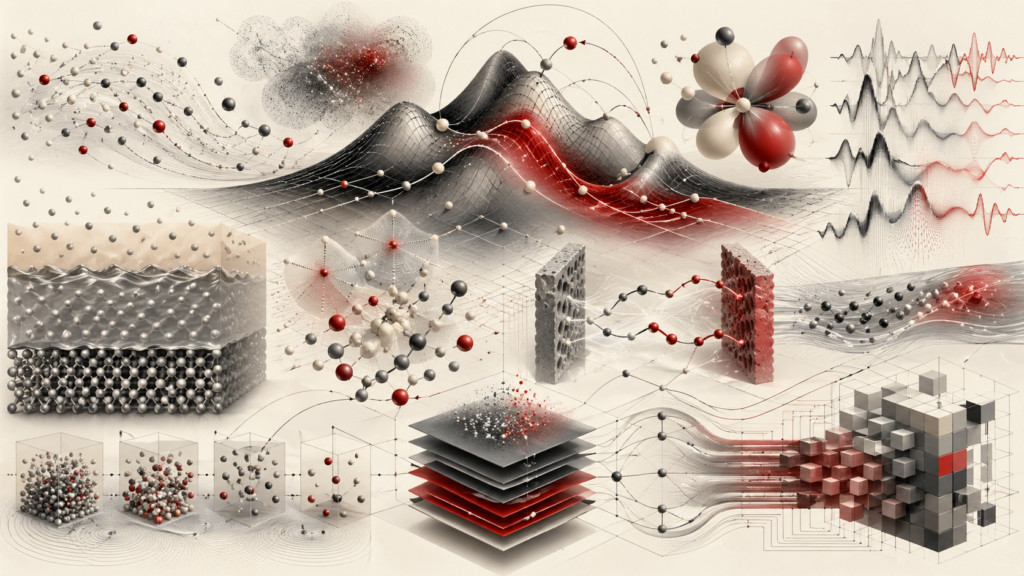
Abstract editorial scientific illustration of physical chemistry, molecular motion, energy landscapes, thermodynamic surfaces, quantum orbital fields, spectral waveforms, phase transitions, diffusion flows, electrochemical transport, statistical ensembles, and computational workflows in cream, gray, black, metallic charcoal, and deep red.

Physical Chemistry and the Chemical Interpretation of Matter

Physical chemistry interprets matter through energy, structure, motion, probability, measurement, and mathematical law. It explains why substances have particular properties, why reactions proceed or fail, why equilibrium has a given composition, why temperature changes chemical behavior, why molecules absorb light, why gases exert pressure, why liquids mix or separate, and why microscopic molecular motion produces macroscopic thermodynamic behavior. This article introduces physical chemistry through states of matter, energy, entropy, enthalpy, Gibbs free energy, chemical potential, equilibrium, reaction kinetics, molecular motion, quantum states, spectroscopy, intermolecular forces, phase transitions, electrochemical potential, statistical ensembles, transport processes, uncertainty, and computational physical chemistry workflows. It shows why physical chemistry is the interpretive core of chemical science, connecting measurable matter to energy, probability, structure, dynamics, and change.

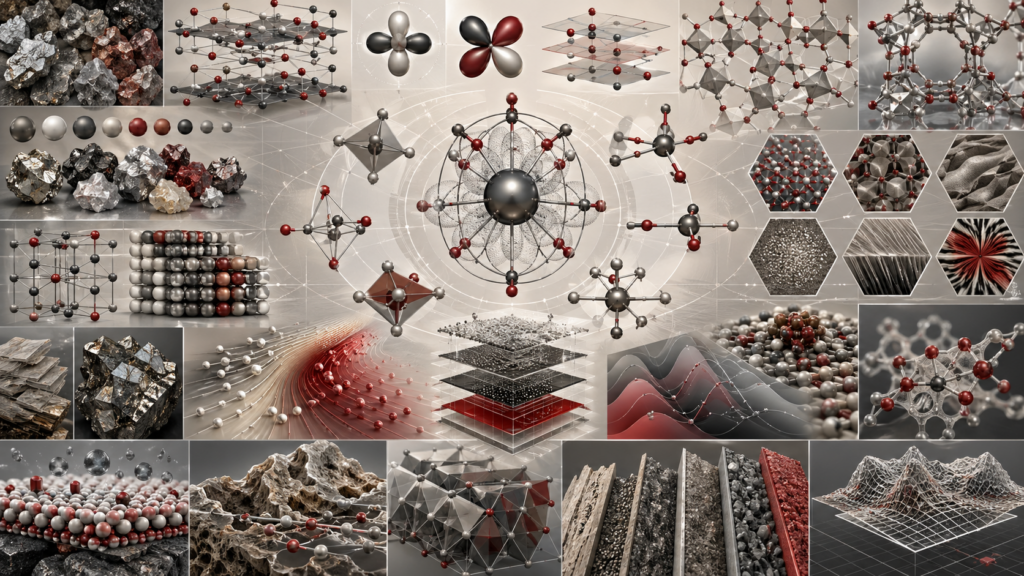
Abstract editorial scientific illustration of inorganic chemistry, elemental diversity, metal-ligand coordination complexes, ionic lattices, mineral structures, crystal-field motifs, solid-state materials, catalyst surfaces, magnetic textures, and computational inorganic workflows in cream, gray, black, metallic charcoal, and deep red.

Inorganic Chemistry and the Diversity of Non-Carbon Systems

Inorganic chemistry is the chemistry of elemental diversity beyond carbon-centered molecular frameworks. It studies metals, salts, minerals, ions, coordination compounds, solid-state materials, oxides, sulfides, phosphates, silicates, clusters, catalysts, electronic materials, magnetic materials, ceramics, semiconductors, batteries, pigments, and the chemical behavior of nearly the entire periodic table. This article introduces inorganic chemistry through periodic trends, main-group chemistry, transition metals, oxidation states, coordination compounds, ligands, crystal-field and ligand-field ideas, ionic solids, lattices, minerals, solid-state structures, acid-base behavior, redox chemistry, organometallic boundaries, bioinorganic chemistry, environmental inorganic systems, materials chemistry, catalysis, energy technologies, and computational inorganic workflows. It shows why inorganic chemistry is best understood as the chemistry of elemental possibility: coordination, redox behavior, crystallization, catalysis, conductivity, magnetism, mineralization, and material function.

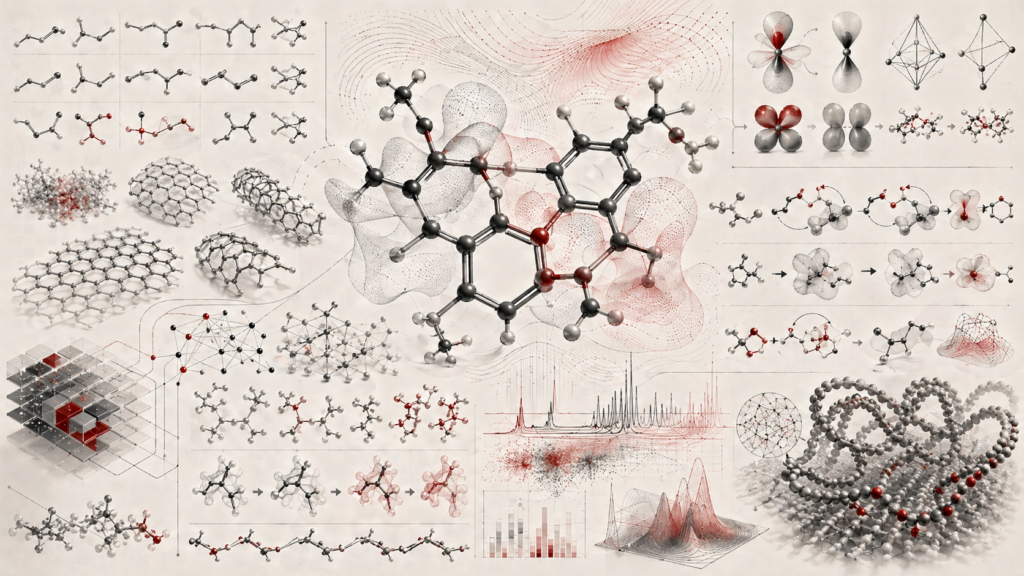
Abstract editorial scientific illustration of organic chemistry, carbon-based molecular frameworks, ring systems, branching chains, stereochemical forms, orbital fields, molecular graphs, polymers, spectroscopy-like patterns, and computational organic-structure workflows in cream, gray, black, and deep red.

Organic Chemistry and Carbon-Based Structure

Organic chemistry is the chemistry of carbon-based structure. It explains how carbon atoms build chains, rings, branches, functional groups, stereocenters, aromatic systems, polymers, biomolecules, pharmaceuticals, fuels, dyes, plastics, solvents, natural products, and molecular materials. This article introduces organic chemistry through carbon valence, hybridization, sigma and pi bonding, molecular geometry, skeletal formulas, hydrocarbons, functional groups, isomerism, stereochemistry, conformations, aromaticity, heteroatoms, polarity, acidity, basicity, nucleophiles, electrophiles, organic reaction mechanisms, spectroscopy, polymers, biomolecules, molecular graphs, structure-property relationships, and computational organic chemistry workflows. It shows why organic chemistry is not a memorization exercise, but a structural language for understanding how carbon frameworks produce properties, reactions, and functions across chemistry, biology, medicine, materials, energy, environment, and computation.

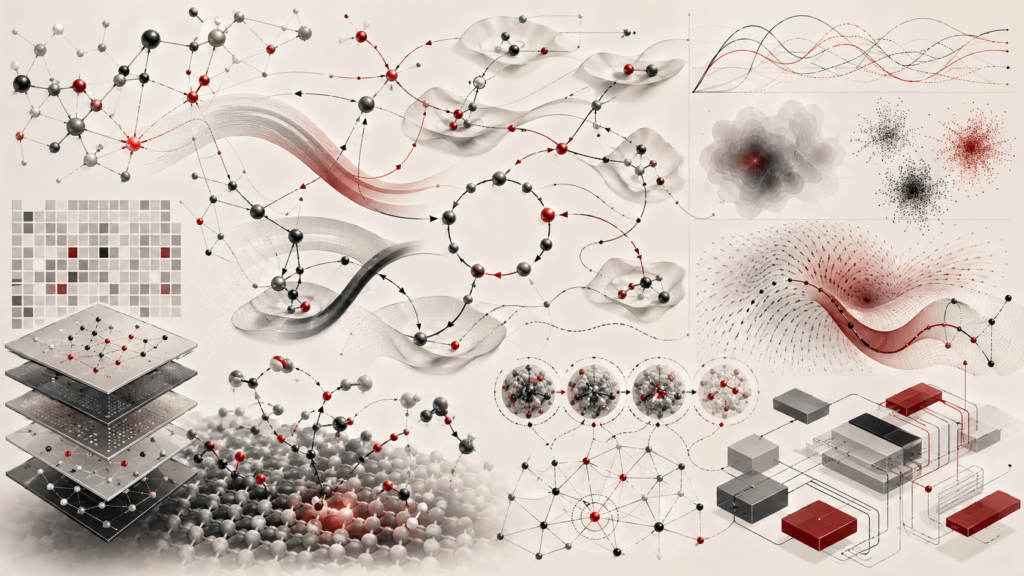
Abstract editorial scientific illustration of reaction networks, chemical systems modeling, molecular nodes, branching pathways, flux ribbons, feedback loops, matrix-like data layers, uncertainty fields, and computational chemistry workflows in cream, gray, black, and deep red.

Reaction Networks and Chemical Systems Modeling

Chemical reactions rarely exist as isolated events. They belong to networks in which species, intermediates, catalysts, side reactions, equilibria, transport, feedback, and environmental conditions interact through time. Reaction networks and chemical systems modeling provide the tools for understanding that connected behavior. This article introduces reaction networks through species, elementary steps, stoichiometric matrices, rate laws, ordinary differential equations, reaction mechanisms, network topology, flux, steady states, sensitivity analysis, parameter estimation, stiffness, uncertainty, reaction-path analysis, catalysis, combustion, atmospheric chemistry, biochemical networks, environmental systems, industrial reactors, and computational workflows. It shows why chemical systems modeling turns chemistry into connected quantitative structure, helping chemists move beyond single-reaction intuition to analyze how many reactions cooperate, compete, branch, inhibit, accelerate, or stabilize one another.

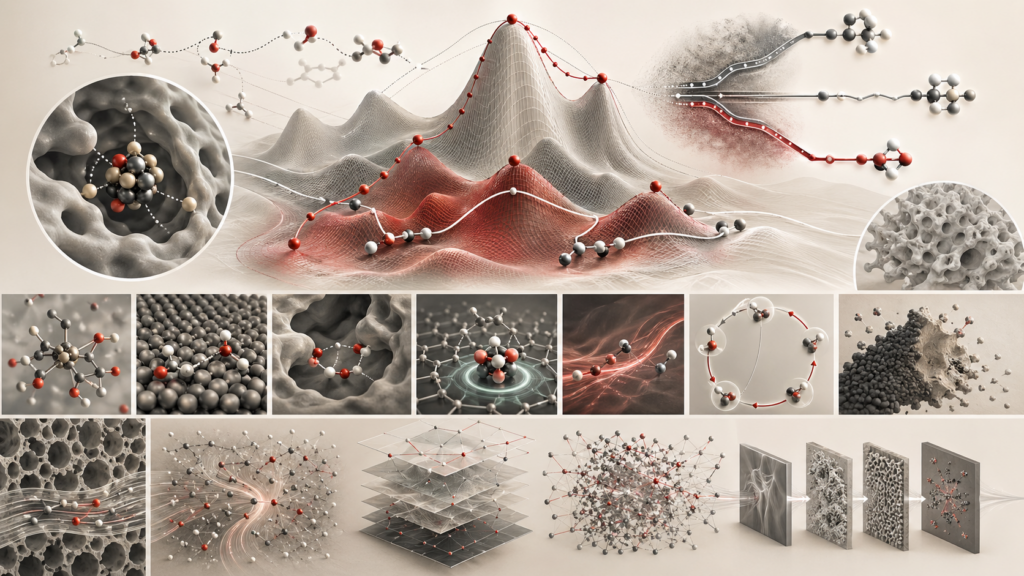
Abstract editorial scientific illustration of catalysis, alternative reaction pathways, lowered activation barriers, catalytic cycles, active sites, surface reactions, enzyme-like cavities, redox catalysis, and computational catalytic workflows in cream, gray, black, and deep red.

Catalysis and the Control of Chemical Pathways

Catalysis is the chemical art of pathway control. A catalyst does not make an impossible reaction thermodynamically possible or change the overall equilibrium position. Instead, it provides an alternative pathway with a lower effective barrier, different intermediate structure, improved molecular orientation, stabilized transition state, altered surface environment, or more favorable sequence of elementary steps. This article introduces catalysis through activation energy, transition states, catalytic cycles, homogeneous catalysis, heterogeneous catalysis, enzyme catalysis, acid-base catalysis, redox catalysis, organometallic catalysis, surface active sites, adsorption, selectivity, turnover number, turnover frequency, inhibition, deactivation, poisoning, diffusion limits, microkinetic modeling, and computational catalytic workflows. It shows why catalysis is best understood as disciplined pathway design: changing how a reaction happens while still obeying thermodynamics, kinetics, structure, and experimental evidence.

Abstract editorial scientific illustration of oxidation, reduction, electron transfer, donor-acceptor molecular systems, redox gradients, charge-flow pathways, corrosion textures, and computational redox workflows in cream, gray, black, and deep red.

Oxidation, Reduction, and Electron Transfer

Oxidation and reduction are paired movements of electrons, charge, oxidation state, energy, and chemical possibility. Whenever one species is oxidized, another is reduced; electrons are transferred, redistributed, shared differently, or accounted for through changes in oxidation state. This article introduces redox chemistry through oxidation states, redox half-reactions, oxidizing and reducing agents, electron balance, redox stoichiometry, standard reduction potentials, cell potential, Gibbs free energy, the Nernst equation, disproportionation, comproportionation, redox titration, corrosion, biological electron transfer, environmental redox gradients, and computational redox workflows. It shows why redox chemistry is not only about “electron loss” and “electron gain,” but a framework for understanding how chemical systems move charge, store energy, transform matter, and couple reactions across molecular, biological, environmental, and technological scales.

Abstract editorial scientific illustration of acids, bases, proton transfer, donor-acceptor molecular pairs, pH-gradient fields, buffer systems, titration transitions, catalytic proton relays, and acid-base speciation workflows in cream, gray, black, and deep red.

Acids, Bases, and Proton Transfer

Acids and bases are systems of proton transfer, electron-pair interaction, solvent response, equilibrium, structure, and chemical identity. Acid-base chemistry explains why water self-ionizes, why pH matters, why weak acids only partially dissociate, why buffers resist change, why titrations reveal concentration, why catalysts accelerate reactions, why biological molecules change charge state, why minerals dissolve, and why oceans buffer carbon dioxide. This article introduces Arrhenius, Brønsted-Lowry, and Lewis definitions; conjugate acid-base pairs; water autoionization; pH; pOH; Ka; Kb; pKa; pKb; strong and weak acids; polyprotic systems; buffers; titration curves; indicators; amphiprotic species; solvent effects; acid-base catalysis; biological protonation; environmental acid-base systems; and computational acid-base workflows. It shows why proton transfer links molecular structure to measurable chemical behavior.

Scroll to Top