
Last Updated May 28, 2026
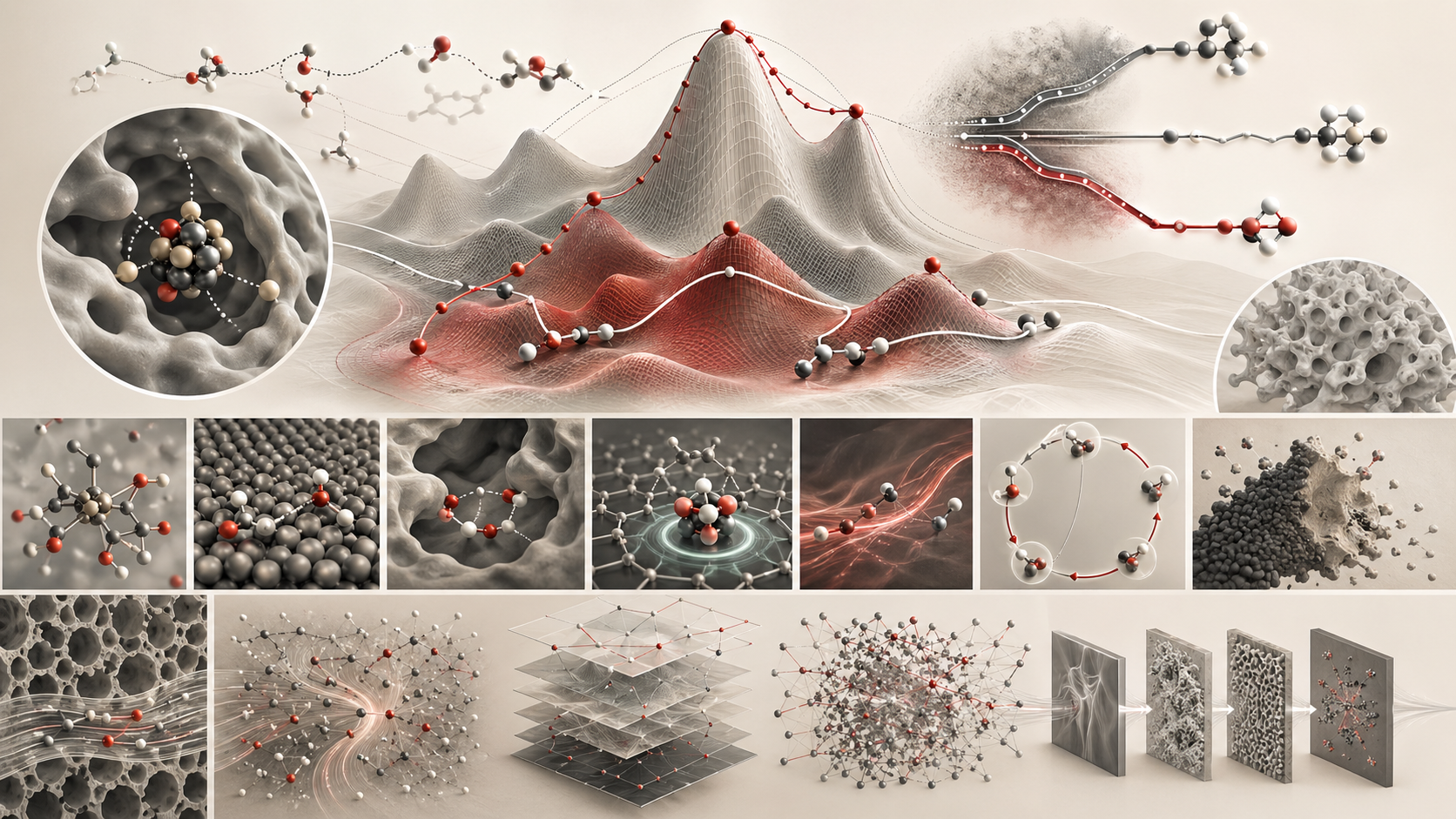
Catalysis is the chemical science of pathway control. A catalyst does not make an impossible reaction thermodynamically possible, and it does not change the overall equilibrium position of a reaction. Instead, it provides an alternative pathway with a lower effective barrier, different intermediate structure, improved molecular orientation, stabilized transition state, altered surface environment, or more favorable sequence of elementary steps. Catalysis changes how a reaction happens.
The central thesis of this article is that catalysis should be understood as disciplined pathway design. A catalyst reshapes the route between reactants and products, but the route still obeys thermodynamics, kinetics, mass balance, charge balance, molecular structure, transport constraints, and experimental evidence.
This distinction is central. Thermodynamics tells whether a transformation is favorable under specified conditions. Kinetics tells how fast it occurs. Mechanism explains the molecular route. Catalysis acts within that kinetic and mechanistic space. A catalyst can accelerate a reaction, redirect selectivity, lower operating temperature, reduce waste, enable milder conditions, organize electron transfer, activate strong bonds, stabilize charged intermediates, or couple chemical steps. But the catalyst is regenerated overall and does not appear as a consumed reagent in the net reaction.
Main Library
Publications
Article Map
Chemistry
Related Topic
Mathematical Modeling
Related Topic
Data Systems & Analytics
Related Topic
Environmental Monitoring Systems
Why Catalysis Matters
Catalysis matters because chemical transformation is rarely useful unless it can be controlled. A reaction may be thermodynamically favorable but too slow. It may occur rapidly but produce the wrong product. It may require harsh conditions that waste energy or damage sensitive molecules. It may generate unwanted byproducts. It may require an activation barrier that ordinary collisions cannot overcome efficiently. Catalysts solve these problems by changing pathway.
This makes catalysis central to both nature and technology. Enzymes catalyze metabolism with extraordinary selectivity under mild biological conditions. Industrial catalysts produce ammonia, methanol, fuels, polymers, acids, hydrogen, and many commodity chemicals. Environmental catalysts reduce vehicle emissions and treat pollutants. Energy catalysts support fuel cells, electrolyzers, hydrogen production, and carbon-conversion systems. Pharmaceutical synthesis often depends on catalysts that control stereochemistry, regioselectivity, and functional-group compatibility.
Catalysis is also central to sustainability. A better catalyst can reduce energy demand, increase selectivity, lower waste, replace toxic reagents, enable renewable feedstocks, improve recycling, and support cleaner chemical manufacturing. Many transitions in energy and materials systems depend not only on discovering new reactions, but on controlling their pathways efficiently.
The field matters scientifically because it sits at the intersection of kinetics, mechanism, thermodynamics, structure, surface science, biology, computation, and engineering. A catalytic system may require molecular-level understanding of active sites, reaction intermediates, transition states, surface coverages, transport limits, heat transfer, product inhibition, deactivation, and regeneration.
For researchers and scientists, catalysis is one of chemistry’s most important forms of control. It determines whether chemical possibility can become useful transformation.
What a Catalyst Does and Does Not Do
A catalyst increases the rate of a reaction by providing an alternative pathway. It participates in the mechanism and is regenerated overall. Because it is regenerated, it is not consumed stoichiometrically in the net reaction, although real catalysts can degrade, deactivate, dissolve, poison, leach, sinter, denature, or change form under operating conditions.
A catalyst does not change the overall standard Gibbs free-energy change of the reaction:
\Delta G^\circ_{\mathrm{overall}}
\]
Interpretation: A catalyst changes the pathway and rate, not the thermodynamic free-energy difference between reactants and products.
It also does not change the equilibrium constant for the net reaction:
K
\]
Interpretation: A catalyst can help a system reach equilibrium faster, but it does not move the equilibrium position by itself.
A catalyst accelerates both forward and reverse pathways in a thermodynamically consistent way. If a reaction is thermodynamically unfavorable under the given conditions, a catalyst alone cannot make the net reaction favorable. External energy, coupling, product removal, pressure change, temperature change, electrochemical driving force, photochemical excitation, or altered reaction conditions may be needed.
This distinction prevents a common misunderstanding. Catalysts are not chemical magic. They do not overrule energy, mass balance, charge balance, or equilibrium. They create routes through which allowable transformations happen faster or more selectively.
For researchers, the defining question is not simply whether a catalyst increases rate. It is how the catalyst changes the pathway, what constraints still apply, and what evidence supports the proposed mechanism.
Activation Energy and Alternative Pathways
Many reactions require molecules to pass through high-energy transition-state regions. A simplified uncatalyzed reaction can be represented as:
\mathrm{Reactants} \rightarrow \mathrm{Transition\ State} \rightarrow \mathrm{Products}
\]
Interpretation: The uncatalyzed pathway requires the system to reach a high-energy transition-state region before products can form.
The activation energy is the barrier associated with reaching the transition-state region. A catalyst provides a different pathway with a lower effective barrier:
\mathrm{Reactants} + \mathrm{Catalyst} \rightarrow \mathrm{Catalytic\ Intermediates} \rightarrow \mathrm{Products} + \mathrm{Catalyst}
\]
Interpretation: The catalyzed pathway may involve multiple lower-barrier steps and regenerated catalyst.
The catalyzed pathway may stabilize a charged intermediate, orient reactants, activate a bond, transfer a proton, shuttle an electron, bind a substrate to a surface, create a metal-ligand complex, or provide a confined environment where the reaction becomes more favorable kinetically.
The Arrhenius equation gives a simple way to see why barrier reduction matters:
k = Ae^{-E_a/(RT)}
\]
Interpretation: The rate constant \(k\) depends exponentially on activation energy \(E_a\), temperature \(T\), gas constant \(R\), and pre-exponential factor \(A\). Lowering the effective barrier can strongly increase the rate.
However, catalysis is not only barrier lowering. Catalysts can also change the pre-exponential factor, reaction order, selectivity, concentration of reactive intermediates, surface coverage, protonation state, electronic structure, or transport regime. A catalyst may make one pathway faster while suppressing another.
For researchers, catalysis reshapes the kinetic landscape. It does not merely “speed things up” in a vague way. It changes the route by which a reaction system moves through molecular states.
Catalytic Cycles and Regeneration
A catalytic cycle is a sequence of elementary steps in which the catalyst participates and is regenerated. A simplified catalytic cycle may be written:
C + A \rightleftharpoons CA
\]
CA + B \rightarrow C + P
\]
Interpretation: \(C\) is catalyst, \(A\) and \(B\) are reactants, \(CA\) is a catalyst-bound intermediate, and \(P\) is product.
The net reaction is:
A + B \rightarrow P
\]
Interpretation: The catalyst appears in the mechanism but cancels from the net equation because it is regenerated overall.
This cancellation is not a mathematical trick. It expresses the defining feature of catalysis: the catalyst enables the pathway but is regenerated overall.
Real catalytic cycles can include substrate binding, oxidative addition, migratory insertion, reductive elimination, proton transfer, electron transfer, ligand exchange, adsorption, surface diffusion, desorption, enzyme conformational change, or active-site regeneration. Some cycles contain off-cycle species that reduce activity. Some include resting states that dominate observed catalyst concentration but are not the most reactive forms.
A catalytic cycle may also include deactivation pathways. The catalyst may form an inactive dimer, bind a poison, undergo ligand loss, precipitate, change oxidation state irreversibly, become covered by carbonaceous deposits, or dissolve from a solid support. These side pathways may not appear in the desired net reaction, but they often determine real catalyst lifetime.
For researchers, a good catalytic mechanism must explain both product formation and catalyst regeneration. If regeneration is not demonstrated, the system may be stoichiometric rather than catalytic.
Homogeneous Catalysis
Homogeneous catalysis occurs when catalyst and reactants are in the same phase, often in solution. This allows molecular-level control because catalysts can be designed with ligands, functional groups, charges, steric environments, and electronic properties that shape reactivity.
Examples include acid catalysis in solution, organocatalysis, transition-metal catalysis, ligand-controlled cross-coupling, hydroformylation, hydrogenation, olefin metathesis, asymmetric catalysis, and many organic transformations. Homogeneous catalysts are often highly selective because their structure can be tuned precisely.
Advantages of homogeneous catalysis include:
- well-defined molecular catalyst structures;
- high selectivity;
- tunable ligands and active sites;
- mechanistic accessibility through spectroscopy and kinetics;
- compatibility with complex molecule synthesis;
- precise control of steric and electronic environment.
Challenges include catalyst separation, recovery, cost, sensitivity to air or water, ligand degradation, metal contamination, solvent use, and scale-up complexity. A homogeneous catalyst may perform well at laboratory scale but become difficult to separate from product, recover, or operate continuously.
Homogeneous catalysis is especially powerful when selectivity matters more than simple throughput. It allows chemists to tune pathways at the molecular level, often through ligand design, counterion control, solvent selection, and mechanistic understanding.
For researchers, homogeneous catalysis illustrates catalysis as molecular engineering: the catalyst is a designed chemical environment that shapes the pathway.
Heterogeneous Catalysis
Heterogeneous catalysis occurs when catalyst and reactants are in different phases, commonly a solid catalyst interacting with gas-phase or liquid-phase reactants. Many industrial catalysts are heterogeneous because solids are easier to separate, recycle, pack into reactors, and operate continuously.
Heterogeneous catalysis often involves several steps:
- transport of reactants to the catalyst surface;
- adsorption onto active sites;
- surface diffusion or reorganization;
- surface reaction;
- product desorption;
- transport away from the surface.
The active site is the specific surface atom, ensemble, defect, pore, edge, crystal face, or chemical environment where catalysis occurs. Different surfaces of the same material can have different activity and selectivity. Particle size, porosity, support material, metal dispersion, oxidation state, acidity, defects, promoters, and surface coverage all matter.
Important heterogeneous catalysts include transition metals, metal oxides, zeolites, supported nanoparticles, acid catalysts, electrocatalysts, photocatalysts, and mixed oxide systems. In real systems, the catalyst may not be a static surface. It can restructure under reaction conditions, change oxidation state, accumulate adsorbates, form surface phases, or degrade over time.
Heterogeneous catalysis is therefore a chemistry of surfaces, interfaces, defects, transport, active-site ensembles, and operating conditions. It often requires methods from surface science, physical chemistry, materials characterization, reaction engineering, and computational modeling.
For researchers, the central challenge is connecting measured catalytic performance to actual active sites under real reaction conditions.
Enzyme Catalysis and Biological Pathway Control
Enzymes are biological catalysts that control reaction pathways with remarkable selectivity. They bind substrates in active sites, stabilize transition states, position functional groups, exclude or organize solvent, use acid-base groups, coordinate metals, form covalent intermediates, or couple reactions to cofactors.
A simplified enzyme mechanism may be written:
E + S \rightleftharpoons ES \rightarrow E + P
\]
Interpretation: \(E\) is enzyme, \(S\) is substrate, \(ES\) is enzyme-substrate complex, and \(P\) is product.
The Michaelis-Menten equation is commonly written:
v = \frac{V_{\max}[S]}{K_M + [S]}
\]
Interpretation: This equation describes saturation behavior under specific assumptions. At low substrate concentration, rate depends strongly on substrate concentration; at high substrate concentration, active-site saturation limits the rate.
Enzymes demonstrate that catalysis is not only chemical acceleration. It is pathway organization in a structured molecular environment. Protein folding, conformational dynamics, allostery, pH, cofactors, metal centers, membrane localization, and cellular regulation all influence catalytic behavior.
Enzyme catalysis can involve general acid-base catalysis, covalent catalysis, metal-ion catalysis, proximity effects, transition-state stabilization, strain, desolvation, and coupled conformational change. Enzyme kinetics may also include inhibition, cooperativity, allosteric regulation, substrate channeling, or multi-enzyme pathway organization.
For researchers, biological catalysis shows that life depends on controlled chemical pathways. Enzymes are not merely fast catalysts; they are regulated molecular systems embedded in networks of metabolism, signaling, and cellular organization.
Acid-Base Catalysis
Acid-base catalysis controls reactions through proton donation and proton acceptance. An acid catalyst can protonate a substrate, making it more electrophilic or improving a leaving group. A base catalyst can deprotonate a substrate, making it more nucleophilic or generating a reactive intermediate.
A general acid-catalytic step may be represented as:
\mathrm{Substrate} + \mathrm{Acid} \rightleftharpoons \mathrm{Protonated\ Substrate}
\]
Interpretation: Protonation can activate a substrate by changing charge, leaving-group ability, electrophilicity, or reaction pathway.
A base-catalytic step may be represented as:
\mathrm{Substrate} + \mathrm{Base} \rightleftharpoons \mathrm{Deprotonated\ Substrate}
\]
Interpretation: Deprotonation can generate a reactive nucleophile, enolate, alkoxide, or other intermediate.
Acid-base catalysis appears in ester hydrolysis, carbonyl chemistry, enzyme mechanisms, aldol reactions, dehydration, hydration, isomerization, and many organic and biological reactions. It can be specific, involving \(H_3O^+\) or \(OH^-\), or general, involving buffer components, functional groups, or enzyme residues.
General acid-base catalysis is especially important in enzymes. Histidine, aspartate, glutamate, lysine, cysteine, tyrosine, and other residues can donate or accept protons depending on local environment. The protein microenvironment can shift \(pK_a\) values and enable proton transfer that would be less favorable in bulk solution.
For researchers, acid-base catalysis links proton transfer to pathway control. It demonstrates that small changes in protonation state can reshape the entire reaction landscape.
Redox Catalysis and Electron Transfer
Redox catalysis controls pathways through electron transfer. A redox catalyst can cycle between oxidation states, accepting electrons in one step and donating them in another. This allows reactions to proceed through controlled electron flow rather than uncontrolled oxidation or reduction.
A simplified redox catalytic sequence may be written:
C_{\mathrm{ox}} + e^- \rightarrow C_{\mathrm{red}}
\]
C_{\mathrm{red}} + \mathrm{Substrate} \rightarrow C_{\mathrm{ox}} + \mathrm{Product}
\]
Interpretation: The catalyst cycles between oxidized and reduced forms while mediating substrate transformation.
Transition metals are especially important in redox catalysis because they can access multiple oxidation states and coordinate substrates. Iron, copper, manganese, cobalt, nickel, ruthenium, palladium, platinum, and other metals participate in redox catalysis across biology, industry, and energy systems.
Redox catalysis is central to oxidation reactions, hydrogenation, oxygen reduction, water splitting, carbon dioxide reduction, nitrogen reduction, fuel cells, batteries, photosynthesis, respiration, and many enzymatic reactions.
Electron transfer must be controlled. A catalyst that transfers electrons too strongly may produce side reactions. A catalyst that binds intermediates too weakly may not activate substrates. A catalyst that binds intermediates too strongly may become blocked. Catalytic redox design often requires balancing thermodynamics, kinetics, binding, and regeneration.
For researchers, redox catalysis shows that pathway control is also electron-flow control. The catalyst must manage oxidation state, substrate activation, electron availability, intermediate stability, and product release.
Organometallic Catalysis and Transition-Metal Cycles
Organometallic catalysis uses metal-carbon bonds or metal-coordinated organic fragments to control pathways. Transition metals can bind substrates, change oxidation state, activate bonds, insert unsaturated molecules, eliminate products, and organize multi-step cycles.
Common elementary steps include:
- ligand association, where a molecule binds to the metal;
- ligand dissociation, where a ligand leaves the metal;
- oxidative addition, where the metal inserts into a bond and increases oxidation state;
- reductive elimination, where two ligands form a bond and the metal is reduced;
- migratory insertion, where one ligand inserts into a metal-ligand bond;
- beta-hydride elimination, where a hydride transfers from ligand to metal;
- transmetalation, where an organic group transfers between metal centers.
These steps allow transition-metal catalysts to perform reactions that would otherwise be difficult, such as cross-coupling, hydrogenation, hydroformylation, polymerization, C-H activation, olefin metathesis, and carbonylation.
Ligands tune catalyst behavior by changing electron density, steric environment, coordination geometry, stability, solubility, and selectivity. A bulky ligand may favor one stereochemical pathway. An electron-rich ligand may accelerate oxidative addition. A chelating ligand may stabilize a reactive metal center. A chiral ligand may create enantioselectivity.
Organometallic catalysis is therefore a highly designed form of pathway control. It sits at the intersection of inorganic chemistry, organic mechanism, molecular structure, spectroscopy, kinetics, and synthesis.
For researchers, the challenge is to connect catalytic performance to a specific sequence of elementary steps, active species, resting states, and off-cycle pathways.
Selectivity and Pathway Choice
Catalysis is not only about speed. It is also about selectivity. A reaction mixture may be able to form multiple products. A catalyst can favor one pathway over another.
Important forms of selectivity include:
- chemoselectivity, favoring reaction of one functional group over another;
- regioselectivity, favoring bond formation or cleavage at one position;
- stereoselectivity, favoring one stereochemical product;
- enantioselectivity, favoring one enantiomer;
- diastereoselectivity, favoring one diastereomer;
- product selectivity, favoring one product distribution in a reaction network.
A catalyst can control selectivity by orienting substrates, stabilizing one transition state more than another, imposing steric constraints, changing electronic structure, controlling proton or electron transfer, or shaping surface binding geometry.
Selectivity is often more valuable than raw rate. A fast reaction that produces many byproducts may be less useful than a slower reaction that gives the desired product cleanly. In pharmaceuticals, materials, fine chemicals, and biological systems, selectivity can determine whether a pathway is usable at all.
Selectivity also has sustainability implications. Better selectivity can reduce purification burden, waste generation, solvent use, energy demand, and byproduct toxicity. A catalyst that improves selectivity can make a process cleaner even if its rate enhancement is modest.
For researchers, catalysis is a science of choosing pathways, not merely accelerating them. The best catalytic system is often the one that directs the network toward the desired transformation while suppressing unwanted routes.
Turnover Number, Turnover Frequency, and Catalytic Activity
Catalyst performance is often described using turnover number and turnover frequency. Turnover number, commonly abbreviated TON, measures how many product molecules are formed per catalyst molecule before the catalyst becomes inactive or the process ends:
TON = \frac{n_{\mathrm{product}}}{n_{\mathrm{catalyst}}}
\]
Interpretation: \(TON\) compares amount of product formed with amount of catalyst used. It is a measure of cumulative catalytic productivity.
Turnover frequency, commonly abbreviated TOF, measures catalytic turnover per unit time:
TOF = \frac{TON}{t}
\]
Interpretation: \(TOF\) measures turnover rate under specified conditions. It is meaningful only when time, conditions, catalyst definition, and active-site basis are clear.
For enzymes and clinical chemistry, catalytic activity may be expressed using the SI unit katal:
1\ \mathrm{kat} = 1\ \mathrm{mol\ s^{-1}}
\]
Interpretation: One katal is the amount of catalyst that converts one mole of substrate per second under specified assay conditions.
These metrics help compare catalysts, but they require careful interpretation. A high TON may come with low rate. A high TOF may occur only under narrow conditions. Catalyst loading, substrate concentration, temperature, solvent, pressure, product inhibition, mass transfer, deactivation, active-site count, and measurement time all affect reported values.
For heterogeneous catalysts, defining the number of active sites can be difficult. A rate normalized per gram of catalyst, per surface area, per metal atom, or per active site may lead to different interpretations. For enzymes, assay conditions strongly affect apparent catalytic activity. For homogeneous catalysts, catalyst speciation may change during reaction.
For researchers, catalytic metrics are useful only when conditions are reported clearly. Catalyst performance is not a single number; it is a context-dependent behavior.
Inhibition, Poisoning, and Deactivation
Catalysts can lose activity. Inhibition, poisoning, fouling, sintering, leaching, denaturation, oxidation-state drift, ligand degradation, coking, product binding, and structural collapse can all reduce catalytic performance.
In homogeneous catalysis, deactivation may occur through irreversible ligand loss, aggregation, metal precipitation, off-cycle complex formation, reaction with impurities, or decomposition of the active species. In heterogeneous catalysis, deactivation may occur through surface poisoning, pore blockage, carbon deposition, particle sintering, phase transformation, or leaching of active metals. In enzymes, deactivation may occur through denaturation, irreversible inhibition, oxidation, proteolysis, or unfavorable pH.
Catalyst poisoning occurs when a species binds strongly to active sites and blocks catalytic turnover. Sulfur compounds, carbon monoxide, heavy metals, phosphines, halides, or other strongly binding species can poison specific catalysts depending on the system.
Inhibition is not always irreversible. Competitive inhibition, product inhibition, reversible adsorption, or substrate inhibition may reduce rate without destroying the catalyst. In some cases, inhibitors are useful because they help identify active sites or mechanism. In other cases, they create process failure.
Catalyst lifetime is often as important as activity. A catalyst that is highly active for minutes may be less useful than a moderately active catalyst that remains stable for months. Industrial catalyst evaluation therefore requires performance over time, not merely initial rate.
For researchers, catalytic performance should be evaluated dynamically: activity, selectivity, stability, deactivation pathway, regeneration, and durability all matter.
Diffusion, Transport, and Observed Catalytic Rate
Observed catalytic rate may not equal intrinsic chemical rate. Reactants must reach the catalyst, bind, react, and leave. Products must diffuse away. Heat must be transferred. In porous catalysts, molecules must move through channels and pores. In enzymes, substrates must diffuse to active sites. In electrocatalysis, ions and electrons must move through interfaces.
If transport is slow, the observed rate can be diffusion-limited rather than chemically limited. This can make a catalyst appear less active than it really is. Conversely, poor experimental design can create misleading apparent kinetics.
Mass-transfer limitations are common in heterogeneous catalysis, electrochemistry, enzymes in crowded media, membranes, porous materials, biofilms, soils, sediments, and industrial reactors. Surface area, mixing, particle size, porosity, boundary layers, solvent viscosity, and temperature all influence observed rate.
Catalytic analysis must therefore distinguish:
- intrinsic catalytic activity;
- surface or active-site availability;
- transport to and from active sites;
- heat transfer;
- reaction-network effects;
- deactivation over time.
Transport is especially important when catalysts are evaluated for scale-up. A catalyst that appears excellent in a stirred laboratory vial may behave differently in a packed bed, membrane reactor, electrode, biofilm, or industrial flow system. Heat and mass transport can alter selectivity, deactivation, and safety.
For researchers, pathway control is chemical, but measured performance is often chemical plus physical. Good catalytic interpretation must separate intrinsic kinetics from transport artifacts.
Catalysis in Industry, Energy, and Environment
Catalysis underlies much of modern chemical industry. Ammonia synthesis depends on catalytic nitrogen activation. Petroleum refining uses acid and metal catalysts. Polymerization depends on catalysts that control chain growth, structure, and stereochemistry. Emissions control relies on catalysts that convert carbon monoxide, hydrocarbons, and nitrogen oxides into less harmful products.
Energy systems depend on catalysis as well. Hydrogen evolution, oxygen evolution, oxygen reduction, carbon dioxide reduction, nitrogen reduction, methane reforming, fuel-cell reactions, and battery side reactions all involve catalytic or electrocatalytic pathways. A sustainable energy transition requires not only energy sources, but catalysts that can mediate difficult chemical transformations efficiently and durably.
Environmental chemistry also depends on catalysts. Photocatalysts can support pollutant degradation. Catalytic converters reduce emissions. Enzymes and microbial catalysts transform nutrients and contaminants. Mineral surfaces catalyze reactions in soils, sediments, and atmospheric particles.
Catalysis also matters for pharmaceutical and fine chemical synthesis. Selective catalysts can reduce protecting-group steps, lower waste, improve stereochemical control, enable late-stage functionalization, and increase access to complex molecules. The environmental and economic benefits can be substantial when pathway control replaces brute-force chemistry.
For researchers, catalysis connects molecular pathway control to industrial infrastructure, environmental protection, public health, and energy transformation. It is both a laboratory science and a systems-level technology.
Critical Materials, Scarcity, and Catalyst Responsibility
Catalysis also raises questions of material responsibility. Many high-performing catalysts rely on scarce, expensive, geographically concentrated, toxic, or difficult-to-recover elements. Platinum-group metals, rare metals, cobalt, nickel, ruthenium, iridium, rhodium, palladium, and other elements can provide exceptional catalytic performance, but their extraction and supply chains may carry environmental, labor, geopolitical, and economic burdens.
Responsible catalyst design therefore asks more than “does it work?” It asks:
- Can the catalyst be made from abundant or lower-impact elements?
- Can the catalyst be recovered, recycled, or regenerated?
- Does the catalyst leach toxic metals into product or environment?
- Does the catalyst reduce overall energy demand and waste?
- Does the process avoid harmful solvents or reagents?
- Does the catalyst remain stable under realistic conditions?
- Does improved selectivity reduce downstream purification burden?
Earth-abundant catalysis, biocatalysis, organocatalysis, recyclable heterogeneous catalysts, supported metal nanoparticles, single-atom catalysts, and metal-free catalytic systems all respond to different parts of this challenge. None is automatically superior in every context. Activity, selectivity, durability, toxicity, recyclability, and process integration must be compared together.
For researchers, catalyst responsibility means linking molecular performance to material sources, environmental consequences, and lifecycle behavior. Pathway control should be evaluated across the whole pathway, not only the reaction flask.
Computational Catalysis and Microkinetic Modeling
Computational catalysis aims to understand and predict catalytic behavior from molecular, surface, energetic, and kinetic information. It may include quantum chemistry, density functional theory, molecular dynamics, kinetic Monte Carlo, microkinetic modeling, machine learning, reaction-network analysis, and process simulation.
A microkinetic model represents a catalytic mechanism as a network of elementary steps. Each step has a rate expression. The model tracks concentrations, surface coverages, intermediates, and product formation over time.
For species concentrations or coverages \(\mathbf{c}\), a kinetic network may be written:
\frac{d\mathbf{c}}{dt} = S\mathbf{r}(\mathbf{c},T)
\]
Interpretation: \(S\) is the stoichiometric matrix and \(\mathbf{r}\) is a vector of elementary-step rates. This form connects catalytic mechanism to dynamic behavior.
Computational catalysis can help identify rate-controlling steps, predict selectivity, compare catalyst candidates, estimate activation barriers, analyze surface coverage, and evaluate deactivation. But computational models require careful assumptions. Exchange-correlation functionals, solvation, entropy, surface structure, coverage effects, transport, parameter uncertainty, and validation data all matter.
Machine learning can accelerate catalyst screening, but it depends on training data quality, descriptor relevance, uncertainty estimates, and domain validity. A model trained on idealized surfaces may fail on reconstructed, poisoned, hydrated, or defect-rich catalysts. A predicted barrier may not capture solvent, electrochemical potential, coverage, or transport.
For researchers, a catalytic model is useful when it remains connected to chemistry, measurement, uncertainty, and reproducibility. Computation should clarify assumptions, not hide them.
Mathematical Lens: Catalysis and Pathway Control
Catalysis is built from rate laws, barrier effects, catalytic cycles, turnover metrics, adsorption relationships, and reaction-network equations. The Arrhenius rate expression is:
k = Ae^{-E_a/(RT)}
\]
Interpretation: A catalyst can increase rate by lowering effective activation energy, changing the pathway, or altering kinetic prefactors and intermediate concentrations.
If a catalyst lowers the effective activation energy by \(\Delta E_a\), a simplified rate enhancement estimate is:
\frac{k_{\mathrm{cat}}}{k_{\mathrm{uncat}}} \approx e^{\Delta E_a/(RT)}
\]
Interpretation: Because rate depends exponentially on activation energy, even moderate barrier lowering can produce large rate enhancement under simplified assumptions.
Michaelis-Menten enzyme kinetics is:
v = \frac{V_{\max}[S]}{K_M + [S]}
\]
Interpretation: The rate increases with substrate concentration and approaches \(V_{\max}\) as active sites become saturated, under the assumptions of the model.
Turnover number is:
TON = \frac{n_{\mathrm{product}}}{n_{\mathrm{catalyst}}}
\]
Interpretation: \(TON\) measures cumulative productivity per catalyst amount.
Turnover frequency is:
TOF = \frac{TON}{t}
\]
Interpretation: \(TOF\) measures turnover rate under specified conditions.
A simplified Langmuir adsorption isotherm is:
\theta = \frac{KP}{1 + KP}
\]
Interpretation: \(\theta\) is fractional surface coverage, \(K\) is an adsorption constant, and \(P\) is pressure or an activity-like measure. This simplified form assumes idealized adsorption behavior.
A simplified Langmuir-Hinshelwood surface rate form is:
r = k\theta_A\theta_B
\]
Interpretation: The surface reaction rate depends on rate constant \(k\) and coverages of adsorbed species \(A\) and \(B\).
The reaction-network form is:
\frac{d\mathbf{c}}{dt} = S\mathbf{r}(\mathbf{c},T)
\]
Interpretation: Catalytic cycles and microkinetic mechanisms can be represented as dynamic reaction networks.
Catalytic activity in katal is:
1\ \mathrm{kat} = 1\ \mathrm{mol\ s^{-1}}
\]
Interpretation: The katal expresses catalytic activity as amount of substrate converted per unit time under specified conditions.
These equations show that catalysis is quantitative pathway control. Catalytic performance depends on energy barriers, binding, coverage, turnover, transport, and reaction-network structure.
Computational Workflows for Catalysis
Computational workflows can make catalysis more transparent. A workflow can track catalyst identity, active-site assumptions, reactants, intermediates, products, kinetic parameters, turnover metrics, adsorption constants, enzyme kinetics, surface coverages, deactivation records, rate laws, model outputs, and provenance.
Useful workflows include Arrhenius barrier comparison, rate-enhancement estimation, TON and TOF calculation, Michaelis-Menten saturation curves, Langmuir adsorption, Langmuir-Hinshelwood surface-rate scaffolds, catalytic-cycle ODEs, deactivation models, microkinetic metadata, catalyst performance tables, and SQL evidence registers.
For researchers, catalytic workflows should preserve four distinctions:
- Thermodynamic favorability versus kinetic acceleration: catalysts change pathways, not overall equilibrium.
- Intrinsic activity versus observed rate: transport, heat transfer, and deactivation can dominate measured performance.
- Catalyst amount versus active-site amount: catalyst mass, total metal, exposed sites, and true active sites are not always the same.
- Model prediction versus catalytic evidence: calculations must be connected to mechanism, characterization, kinetics, and validation.
The examples below use synthetic educational data. They do not validate real catalysts, certify catalytic activity, predict industrial performance, establish safety, approve materials, or replace professional catalysis review. They demonstrate how catalytic reasoning can be organized, audited, and communicated responsibly.
Python Example: Barrier Lowering, Turnover Metrics, Adsorption, Surface Rates, and Provenance
The following Python example uses synthetic educational data. It estimates rate enhancement from barrier lowering, calculates turnover metrics, computes Langmuir adsorption coverage, estimates simplified surface rates, and writes provenance outputs. In real catalysis, these workflows should preserve experimental conditions, catalyst identity, active-site basis, uncertainty, and validation evidence.
from pathlib import Path
from typing import Dict, List
import json
import math
import platform
import sys

import numpy as np
import pandas as pd


# Synthetic catalysis workflow.
# Educational example only; not for catalyst certification,
# reactor design, safety analysis, industrial operation,
# or environmental compliance.


def require_columns(data: pd.DataFrame, required: List[str], table_name: str) -> None:
    """Raise an error if required columns are missing."""
    missing = [column for column in required if column not in data.columns]
    if missing:
        raise ValueError(f"{table_name} is missing required columns: {missing}")


R_J_mol_K = 8.314462618

barrier_cases = pd.DataFrame({
    "case": [
        "modest_barrier_lowering",
        "strong_barrier_lowering",
        "industrial_temperature",
    ],
    "temperature_K": [298.15, 298.15, 600.0],
    "delta_Ea_kJ_mol": [10.0, 40.0, 40.0],
})

require_columns(
    barrier_cases,
    ["case", "temperature_K", "delta_Ea_kJ_mol"],
    "barrier_cases",
)

barrier_cases["rate_enhancement_estimate"] = barrier_cases.apply(
    lambda row: math.exp(
        (row["delta_Ea_kJ_mol"] * 1000.0)
        / (R_J_mol_K * row["temperature_K"])
    ),
    axis=1,
)

turnover_experiments = pd.DataFrame({
    "experiment": ["homogeneous_demo", "enzyme_demo", "heterogeneous_demo"],
    "product_mol": [0.050, 0.00080, 1.50],
    "catalyst_mol": [0.00050, 0.000002, 0.0050],
    "time_s": [3600, 60, 7200],
})

require_columns(
    turnover_experiments,
    ["experiment", "product_mol", "catalyst_mol", "time_s"],
    "turnover_experiments",
)

turnover_experiments["TON"] = (
    turnover_experiments["product_mol"] / turnover_experiments["catalyst_mol"]
)

turnover_experiments["TOF_s_inv"] = (
    turnover_experiments["TON"] / turnover_experiments["time_s"]
)

turnover_experiments["catalytic_activity_mol_s"] = (
    turnover_experiments["product_mol"] / turnover_experiments["time_s"]
)

surface_cases = pd.DataFrame({
    "pressure_bar": np.linspace(0.05, 10.0, 20),
})

K_A = 1.5
K_B = 0.8
k_surface = 0.25

surface_cases["theta_A"] = (
    K_A * surface_cases["pressure_bar"]
    / (1.0 + K_A * surface_cases["pressure_bar"])
)

surface_cases["theta_B"] = (
    K_B * surface_cases["pressure_bar"]
    / (1.0 + K_B * surface_cases["pressure_bar"])
)

surface_cases["langmuir_hinshelwood_rate"] = (
    k_surface * surface_cases["theta_A"] * surface_cases["theta_B"]
)

deactivation = pd.DataFrame({
    "time_h": [0, 1, 2, 4, 8, 16, 24],
    "relative_activity": [1.00, 0.93, 0.86, 0.74, 0.55, 0.32, 0.22],
})

deactivation["activity_loss_fraction"] = 1.0 - deactivation["relative_activity"]

output_dir = Path("outputs")
output_dir.mkdir(exist_ok=True)

barrier_cases.to_csv(output_dir / "synthetic_barrier_lowering.csv", index=False)
turnover_experiments.to_csv(output_dir / "synthetic_turnover_metrics.csv", index=False)
surface_cases.to_csv(output_dir / "synthetic_langmuir_surface_rates.csv", index=False)
deactivation.to_csv(output_dir / "synthetic_catalyst_deactivation.csv", index=False)

manifest: Dict[str, object] = {
    "workflow": "synthetic_catalysis_workflow",
    "data_type": "synthetic educational catalysis records",
    "gas_constant_J_mol_K": R_J_mol_K,
    "barrier_rate_ratio": "k_cat/k_uncat approximated by exp(delta_Ea/(R*T))",
    "turnover_metrics": ["TON = product_mol/catalyst_mol", "TOF = TON/time"],
    "adsorption_model": "theta = K*P/(1 + K*P)",
    "surface_rate_model": "rate = k_surface*theta_A*theta_B",
    "langmuir_constants": {"K_A": K_A, "K_B": K_B},
    "surface_rate_constant": k_surface,
    "python_version": sys.version,
    "platform": platform.platform(),
    "numpy_version": np.__version__,
    "pandas_version": pd.__version__,
    "output_files": [
        "outputs/synthetic_barrier_lowering.csv",
        "outputs/synthetic_turnover_metrics.csv",
        "outputs/synthetic_langmuir_surface_rates.csv",
        "outputs/synthetic_catalyst_deactivation.csv",
        "outputs/catalysis_manifest.json",
    ],
    "responsible_use": [
        "Synthetic educational data only.",
        "Real catalysis workflows require validated catalyst identity, active-site basis, kinetic measurements, transport checks, uncertainty analysis, deactivation study, and experimental comparison.",
    ],
}

with (output_dir / "catalysis_manifest.json").open("w", encoding="utf-8") as file:
    json.dump(manifest, file, indent=2)

print("Barrier-lowering rate enhancement estimates")
print("-------------------------------------------")
print(barrier_cases.round(6).to_string(index=False))

print("\nTurnover metrics")
print("----------------")
print(turnover_experiments.round(8).to_string(index=False))

print("\nLangmuir adsorption and surface-rate scaffold")
print("---------------------------------------------")
print(surface_cases.head(10).round(6).to_string(index=False))

print("\nCatalyst deactivation scaffold")
print("------------------------------")
print(deactivation.round(6).to_string(index=False))
This workflow demonstrates catalytic evidence discipline rather than real catalyst validation. It separates barrier logic, turnover metrics, surface adsorption, surface rates, deactivation, and provenance. A real workflow would add experimental conditions, catalyst characterization, active-site normalization, transport analysis, uncertainty estimates, and independent validation.
R Example: Michaelis-Menten Saturation and Langmuir Surface Rates
The following R example uses synthetic educational data to calculate Michaelis-Menten saturation behavior and simplified Langmuir-Hinshelwood surface rates. In real catalysis, these calculations should be tied to assay conditions, catalyst identity, active-site definition, units, uncertainty, and validation evidence.
# Synthetic catalysis scaffold.
# Educational example only; not for catalyst certification,
# reactor design, safety analysis, industrial operation,
# or environmental compliance.

substrate <- data.frame(
  S_mM = c(0.05, 0.10, 0.25, 0.50, 1.00, 2.00, 5.00, 10.00)
)

Vmax <- 2.0
Km <- 0.75

substrate$rate_umol_min <-
  (Vmax * substrate$S_mM) / (Km + substrate$S_mM)

substrate$fraction_of_vmax <-
  substrate$rate_umol_min / Vmax

pressure <- seq(0.01, 10, length.out = 20)

K_A <- 1.5
K_B <- 0.8
k_surface <- 0.25

theta_A <- (K_A * pressure) / (1 + K_A * pressure)
theta_B <- (K_B * pressure) / (1 + K_B * pressure)

rate <- k_surface * theta_A * theta_B

surface <- data.frame(
  pressure_bar = pressure,
  theta_A = theta_A,
  theta_B = theta_B,
  langmuir_hinshelwood_rate = rate
)

turnover <- data.frame(
  experiment = c("demo_A", "demo_B", "demo_C"),
  product_mol = c(0.05, 0.20, 1.50),
  catalyst_mol = c(0.0005, 0.0010, 0.0050),
  time_s = c(3600, 1800, 7200)
)

turnover$TON <- turnover$product_mol / turnover$catalyst_mol
turnover$TOF_s_inv <- turnover$TON / turnover$time_s

dir.create("outputs", showWarnings = FALSE)

write.csv(
  substrate,
  file = "outputs/r_michaelis_menten_saturation.csv",
  row.names = FALSE
)

write.csv(
  surface,
  file = "outputs/r_langmuir_surface_rate.csv",
  row.names = FALSE
)

write.csv(
  turnover,
  file = "outputs/r_turnover_metrics.csv",
  row.names = FALSE
)

sink("outputs/r_catalysis_report.txt")
cat("Synthetic Catalysis Scaffold Report\n")
cat("===================================\n\n")
cat("Michaelis-Menten saturation table:\n")
print(substrate)
cat("\nLangmuir-Hinshelwood surface-rate table:\n")
print(head(surface, 10))
cat("\nTurnover metrics:\n")
print(turnover)
cat("\nResponsible-use note:\n")
cat("Synthetic educational data only. Real catalysis workflows require validated catalyst identity, active-site basis, kinetic measurements, transport checks, uncertainty analysis, deactivation study, and experimental comparison.\n")
sink()

print(substrate)
print(head(surface, 10))
print(turnover)
This scaffold shows how R can support catalytic summaries and pathway-control reasoning. The central issue is not the language but the evidence chain. Enzyme saturation, surface coverage, surface rates, TON, and TOF should remain connected to conditions, units, active-site basis, and validation evidence.
SQL Example: Catalysis Evidence Register
Catalysis becomes more reliable when catalyst identity, active-site assumptions, reaction conditions, kinetic measurements, turnover metrics, adsorption data, deactivation records, computational models, and interpretation claims are traceable. A simple evidence register can preserve the context needed to audit catalytic results.
CREATE TABLE catalyst_system (
    catalyst_id TEXT PRIMARY KEY,
    catalyst_name TEXT NOT NULL,
    catalyst_type TEXT,
    catalyst_phase TEXT,
    active_site_description TEXT,
    support_material TEXT,
    ligand_or_surface_description TEXT,
    preparation_method_uri TEXT,
    characterization_uri TEXT,
    catalyst_notes TEXT
);

CREATE TABLE catalytic_reaction (
    reaction_id TEXT PRIMARY KEY,
    reaction_name TEXT NOT NULL,
    reaction_family TEXT,
    reactant_description TEXT,
    product_description TEXT,
    net_reaction_equation TEXT,
    thermodynamic_notes TEXT,
    reaction_notes TEXT
);

CREATE TABLE catalyst_experiment (
    experiment_id TEXT PRIMARY KEY,
    catalyst_id TEXT NOT NULL,
    reaction_id TEXT NOT NULL,
    temperature_K REAL,
    pressure_bar REAL,
    solvent_or_medium TEXT,
    ph REAL,
    catalyst_amount_mol REAL,
    substrate_amount_mol REAL,
    time_s REAL,
    reactor_description TEXT,
    transport_check_status TEXT,
    experiment_review_status TEXT,
    FOREIGN KEY (catalyst_id) REFERENCES catalyst_system(catalyst_id),
    FOREIGN KEY (reaction_id) REFERENCES catalytic_reaction(reaction_id)
);

CREATE TABLE catalytic_performance_record (
    performance_id TEXT PRIMARY KEY,
    experiment_id TEXT NOT NULL,
    product_amount_mol REAL,
    conversion_percent REAL,
    selectivity_percent REAL,
    yield_percent REAL,
    turnover_number REAL,
    turnover_frequency_s_inv REAL,
    catalytic_activity_mol_s REAL,
    performance_notes TEXT,
    performance_review_status TEXT,
    FOREIGN KEY (experiment_id) REFERENCES catalyst_experiment(experiment_id)
);

CREATE TABLE kinetic_record (
    kinetic_id TEXT PRIMARY KEY,
    experiment_id TEXT NOT NULL,
    rate_law_expression TEXT,
    measured_rate_value REAL,
    measured_rate_unit TEXT,
    apparent_activation_energy_kj_mol REAL,
    kinetic_model_uri TEXT,
    kinetic_review_status TEXT,
    FOREIGN KEY (experiment_id) REFERENCES catalyst_experiment(experiment_id)
);

CREATE TABLE adsorption_record (
    adsorption_id TEXT PRIMARY KEY,
    catalyst_id TEXT NOT NULL,
    adsorbate_name TEXT,
    adsorption_model TEXT,
    adsorption_constant REAL,
    pressure_or_activity_range TEXT,
    coverage_measurement_uri TEXT,
    adsorption_review_status TEXT,
    FOREIGN KEY (catalyst_id) REFERENCES catalyst_system(catalyst_id)
);

CREATE TABLE deactivation_record (
    deactivation_id TEXT PRIMARY KEY,
    experiment_id TEXT NOT NULL,
    deactivation_mode TEXT,
    initial_activity REAL,
    final_activity REAL,
    time_on_stream_s REAL,
    regeneration_attempted INTEGER CHECK (regeneration_attempted IN (0, 1)),
    regeneration_result TEXT,
    deactivation_notes TEXT,
    deactivation_review_status TEXT,
    FOREIGN KEY (experiment_id) REFERENCES catalyst_experiment(experiment_id)
);

CREATE TABLE catalytic_mechanism_step (
    step_id TEXT PRIMARY KEY,
    reaction_id TEXT NOT NULL,
    step_label TEXT,
    elementary_step INTEGER CHECK (elementary_step IN (0, 1)),
    step_equation TEXT,
    intermediate_description TEXT,
    activation_energy_kj_mol REAL,
    mechanism_evidence_uri TEXT,
    mechanism_review_status TEXT,
    FOREIGN KEY (reaction_id) REFERENCES catalytic_reaction(reaction_id)
);

CREATE TABLE computational_catalysis_record (
    computational_id TEXT PRIMARY KEY,
    catalyst_id TEXT NOT NULL,
    reaction_id TEXT NOT NULL,
    model_type TEXT,
    software_name TEXT,
    software_version TEXT,
    active_site_model TEXT,
    solvation_or_environment_model TEXT,
    output_uri TEXT,
    validation_status TEXT,
    computational_review_status TEXT,
    FOREIGN KEY (catalyst_id) REFERENCES catalyst_system(catalyst_id),
    FOREIGN KEY (reaction_id) REFERENCES catalytic_reaction(reaction_id)
);

CREATE TABLE catalysis_interpretation_claim (
    claim_id TEXT PRIMARY KEY,
    catalyst_id TEXT NOT NULL,
    reaction_id TEXT,
    experiment_id TEXT,
    claim_text TEXT,
    claim_type TEXT,
    confidence_level TEXT,
    limitation_notes TEXT,
    review_status TEXT,
    FOREIGN KEY (catalyst_id) REFERENCES catalyst_system(catalyst_id),
    FOREIGN KEY (reaction_id) REFERENCES catalytic_reaction(reaction_id),
    FOREIGN KEY (experiment_id) REFERENCES catalyst_experiment(experiment_id)
);

SELECT
    c.catalyst_id,
    c.catalyst_name,
    c.catalyst_type,
    c.active_site_description,
    r.reaction_name,
    e.temperature_K,
    e.pressure_bar,
    e.solvent_or_medium,
    e.transport_check_status,
    p.conversion_percent,
    p.selectivity_percent,
    p.turnover_number,
    p.turnover_frequency_s_inv,
    k.measured_rate_value,
    k.measured_rate_unit,
    d.deactivation_mode,
    d.final_activity,
    comp.model_type,
    comp.validation_status,
    claim.claim_type,
    claim.confidence_level,
    CASE
        WHEN c.active_site_description IS NULL
            THEN 'active-site review required'
        WHEN e.temperature_K IS NULL
            THEN 'temperature review required'
        WHEN e.transport_check_status IS NOT NULL
             AND e.transport_check_status != 'pass'
            THEN 'transport review required'
        WHEN p.performance_review_status IS NOT NULL
             AND p.performance_review_status != 'pass'
            THEN 'performance review required'
        WHEN k.kinetic_review_status IS NOT NULL
             AND k.kinetic_review_status != 'pass'
            THEN 'kinetic review required'
        WHEN d.deactivation_review_status IS NOT NULL
             AND d.deactivation_review_status != 'pass'
            THEN 'deactivation review required'
        WHEN comp.computational_review_status IS NOT NULL
             AND comp.computational_review_status != 'pass'
            THEN 'computational catalysis review required'
        WHEN claim.review_status IS NOT NULL
             AND claim.review_status != 'reviewed'
            THEN 'interpretation review required'
        ELSE 'standard review'
    END AS catalysis_review_status
FROM catalyst_system c
LEFT JOIN catalyst_experiment e
    ON c.catalyst_id = e.catalyst_id
LEFT JOIN catalytic_reaction r
    ON e.reaction_id = r.reaction_id
LEFT JOIN catalytic_performance_record p
    ON e.experiment_id = p.experiment_id
LEFT JOIN kinetic_record k
    ON e.experiment_id = k.experiment_id
LEFT JOIN deactivation_record d
    ON e.experiment_id = d.experiment_id
LEFT JOIN computational_catalysis_record comp
    ON c.catalyst_id = comp.catalyst_id
    AND r.reaction_id = comp.reaction_id
LEFT JOIN catalysis_interpretation_claim claim
    ON c.catalyst_id = claim.catalyst_id
ORDER BY catalysis_review_status, c.catalyst_id, r.reaction_id;
The purpose of this register is to keep catalytic interpretation attached to evidence. A catalysis result should preserve catalyst identity, active-site assumptions, reaction conditions, transport checks, performance metrics, kinetic records, adsorption data, deactivation behavior, computational models, and interpretation review. Catalysis becomes stronger when its evidence trail is structured.
GitHub Repository
The companion repository for this article can support reproducible workflows for Arrhenius barrier comparison, turnover metrics, Michaelis-Menten enzyme kinetics, Langmuir adsorption, Langmuir-Hinshelwood surface rates, catalytic-cycle ODEs, deactivation scaffolds, microkinetic metadata, SQL evidence registers, and responsible catalytic interpretation.
Complete Code Repository
The full code distribution for this article, including selected catalysis examples, expanded computational workflows, reproducible data structures, provenance documentation, barrier-lowering estimates, turnover metrics, adsorption and surface-rate scaffolds, deactivation examples, SQL evidence registers, and scientific-computing infrastructure, is available on GitHub.
Limits, Uncertainty, and Responsible Interpretation
Catalysis is powerful, but it is not self-interpreting. A faster reaction does not prove a mechanism. A high conversion does not prove selectivity. A high initial rate does not prove catalyst stability. A computed barrier does not prove real catalytic performance. A surface characterization before reaction may not describe the active surface during reaction.
Uncertainty enters catalysis at many levels: catalyst identity, active-site definition, catalyst loading, exposed surface area, ligand environment, oxidation state, particle size, support effects, solvent, temperature, pressure, pH, mass transfer, heat transfer, substrate purity, product analysis, deactivation, poisoning, computational assumptions, and kinetic model form.
Catalytic results are also context-dependent. A catalyst may be highly active under ideal laboratory conditions but fail under real feedstocks. A catalyst may be selective at low conversion but produce side products at high conversion. A catalyst may appear intrinsically active when the observed rate is actually transport-limited. A catalyst may perform well initially but deactivate through sintering, leaching, coking, poisoning, or ligand loss.
Computational catalysis adds additional uncertainty. Density-functional calculations depend on functional choice, surface model, coverage, solvation, entropy corrections, spin state, charge state, and transition-state search. Machine-learning models depend on training data, descriptors, target definitions, and extrapolation risk. Microkinetic models depend on rate constants, thermodynamic consistency, site balances, and missing pathways.
The computational examples associated with this article are synthetic and educational. They do not validate catalysts, certify catalytic activity, predict industrial performance, establish safety, approve materials, or replace professional catalysis review. They are designed to show how catalytic reasoning can be structured and audited.
Responsible catalytic interpretation should match claim strength to evidence. A catalyst can be promising, active, selective, durable, recyclable, or scalable only under defined conditions and with supporting data. Catalysis is pathway control, but pathway control must be demonstrated, not assumed.
Conclusion
Catalysis and the control of chemical pathways explain how reactions become faster, cleaner, more selective, and more useful. A catalyst does not change the thermodynamic destination of a reaction. It changes the route. It lowers barriers, stabilizes intermediates, organizes substrates, transfers protons or electrons, provides surfaces, tunes selectivity, and enables catalytic cycles that regenerate the active species.
Catalysis connects chemical kinetics, thermodynamics, mechanism, molecular structure, surface science, enzyme function, redox chemistry, materials design, and industrial engineering. It is both a molecular concept and a systems concept. A catalytic pathway may depend on active-site geometry, surface coverage, ligand design, enzyme conformation, transport, deactivation, and reaction-network structure.
Modern chemistry increasingly depends on better catalysts. Clean manufacturing, selective synthesis, emissions control, hydrogen production, carbon conversion, water splitting, polymer recycling, pharmaceutical synthesis, and biological understanding all require pathway control. Catalysis is therefore not a narrow subfield. It is one of the main ways chemistry becomes functional, efficient, selective, and scalable.
To understand catalysis is to understand chemistry as pathway design: not only what can happen, but how it happens, how fast it happens, what else could happen, and how chemical systems can be guided toward desired transformation.
Related articles
- What Is Chemistry?
- Chemical Kinetics and Reaction Mechanisms
- Chemical Thermodynamics and Energetics
- Equilibrium and the Dynamics of Reversible Systems
- Reaction Networks and Chemical Systems Modeling
- Acids, Bases, and Proton Transfer
- Oxidation, Reduction, and Electron Transfer
- Inorganic Chemistry and the Diversity of Non-Carbon Systems
- Organic Chemistry and Carbon-Based Structure
- Physical Chemistry and the Chemical Interpretation of Matter
- Computational Chemistry and Molecular Modeling
- Cheminformatics and Molecular Data Science
Further reading
- Atkins, P., de Paula, J. and Keeler, J. (2018) Atkins’ Physical Chemistry. 11th edn. Oxford: Oxford University Press. Available at: https://global.oup.com/academic/product/atkins-physical-chemistry-9780198769866
- Beller, M. and Bolm, C. (eds.) (2004) Transition Metals for Organic Synthesis. 2nd edn. Weinheim: Wiley-VCH. Available at: https://www.wiley.com/en-us/Transition+Metals+for+Organic+Synthesis%2C+2+Volume+Set%2C+2nd%2C+Completely+Revised+and+Enlarged+Edition-p-9783527306138
- Cornils, B. and Herrmann, W.A. (eds.) (2002) Applied Homogeneous Catalysis with Organometallic Compounds. 2nd edn. Weinheim: Wiley-VCH. Available at: https://www.wiley.com/en-us/Applied+Homogeneous+Catalysis+with+Organometallic+Compounds%3A+A+Comprehensive+Handbook+in+Three+Volumes%2C+2nd%2C+Revised+and+Enlarged+Edition-p-9783527304349
- Laidler, K.J. (1987) Chemical Kinetics. 3rd edn. New York: Harper & Row. Available at: https://archive.org/details/chemicalkinetics0000laid
- MIT OpenCourseWare (2008) Thermodynamics & Kinetics. Available at: https://ocw.mit.edu/courses/5-60-thermodynamics-kinetics-spring-2008/
- Somorjai, G.A. and Li, Y. (2010) Introduction to Surface Chemistry and Catalysis. 2nd edn. Hoboken: Wiley. Available at: https://www.wiley.com/en-us/Introduction+to+Surface+Chemistry+and+Catalysis%2C+2nd+Edition-p-9780470508237
- Masel, R.I. (2001) Chemical Kinetics and Catalysis. New York: Wiley. Available at: https://www.wiley.com/en-us/Chemical+Kinetics+and+Catalysis-p-9780471241973
- Copeland, R.A. (2000) Enzymes: A Practical Introduction to Structure, Mechanism, and Data Analysis. 2nd edn. New York: Wiley. Available at: https://www.wiley.com/en-us/Enzymes%3A+A+Practical+Introduction+to+Structure%2C+Mechanism%2C+and+Data+Analysis%2C+2nd+Edition-p-9780471359296
- Cantera Developers (n.d.) Cantera: Open-source chemical kinetics, thermodynamics, and transport. Available at: https://cantera.org/
- National Institute of Standards and Technology (n.d.) NIST Chemical Kinetics Database. Available at: https://kinetics.nist.gov/
References
- Atkins, P., de Paula, J. and Keeler, J. (2018) Atkins’ Physical Chemistry. 11th edn. Oxford: Oxford University Press. Available at: https://global.oup.com/academic/product/atkins-physical-chemistry-9780198769866
- Beller, M. and Bolm, C. (eds.) (2004) Transition Metals for Organic Synthesis. 2nd edn. Weinheim: Wiley-VCH. Available at: https://www.wiley.com/en-us/Transition+Metals+for+Organic+Synthesis%2C+2+Volume+Set%2C+2nd%2C+Completely+Revised+and+Enlarged+Edition-p-9783527306138
- Cantera Developers (n.d.) Cantera: Open-source chemical kinetics, thermodynamics, and transport. Available at: https://cantera.org/
- Cornils, B. and Herrmann, W.A. (eds.) (2002) Applied Homogeneous Catalysis with Organometallic Compounds. 2nd edn. Weinheim: Wiley-VCH. Available at: https://www.wiley.com/en-us/Applied+Homogeneous+Catalysis+with+Organometallic+Compounds%3A+A+Comprehensive+Handbook+in+Three+Volumes%2C+2nd%2C+Revised+and+Enlarged+Edition-p-9783527304349
- International Union of Pure and Applied Chemistry (n.d.) Compendium of Chemical Terminology: Active Site in Heterogeneous Catalysis. Available at: https://goldbook.iupac.org/terms/view/A00108
- International Union of Pure and Applied Chemistry (n.d.) Compendium of Chemical Terminology: Catalysis. Available at: https://goldbook.iupac.org/terms/view/C00874
- International Union of Pure and Applied Chemistry (n.d.) Compendium of Chemical Terminology: Catalyst. Available at: https://goldbook.iupac.org/terms/view/C00876
- International Union of Pure and Applied Chemistry (n.d.) Compendium of Chemical Terminology: Katal. Available at: https://goldbook.iupac.org/terms/view/K03372
- Laidler, K.J. (1987) Chemical Kinetics. 3rd edn. New York: Harper & Row. Available at: https://archive.org/details/chemicalkinetics0000laid
- Masel, R.I. (2001) Chemical Kinetics and Catalysis. New York: Wiley. Available at: https://www.wiley.com/en-us/Chemical+Kinetics+and+Catalysis-p-9780471241973
- MIT OpenCourseWare (2008) Thermodynamics & Kinetics. Available at: https://ocw.mit.edu/courses/5-60-thermodynamics-kinetics-spring-2008/
- National Institute of Standards and Technology (n.d.) NIST Chemical Kinetics Database. Available at: https://kinetics.nist.gov/
- National Institute of Standards and Technology (n.d.) NIST Chemistry WebBook. Available at: https://webbook.nist.gov/chemistry/
- Somorjai, G.A. and Li, Y. (2010) Introduction to Surface Chemistry and Catalysis. 2nd edn. Hoboken: Wiley. Available at: https://www.wiley.com/en-us/Introduction+to+Surface+Chemistry+and+Catalysis%2C+2nd+Edition-p-9780470508237