Natural Science

Natural Science examines the physical and living world through the systematic study of matter, energy, life, Earth systems, and the broader universe. It seeks to explain the structures, processes, laws, and transformations that govern the natural order, from the smallest physical interactions to the largest planetary and cosmic systems.

This field brings together disciplines that investigate how nature is organized, how change occurs, and how physical and biological systems develop across time and scale. It includes the study of material composition, chemical transformation, living organisms, planetary processes, celestial phenomena, and the environmental conditions that sustain or constrain life.

Natural Science plays a foundational role in human knowledge because it provides disciplined methods for understanding reality beyond opinion, intuition, or custom. By clarifying how the natural world functions, it shapes scientific reasoning, technological development, environmental awareness, and humanity’s broader understanding of life, matter, and the universe.

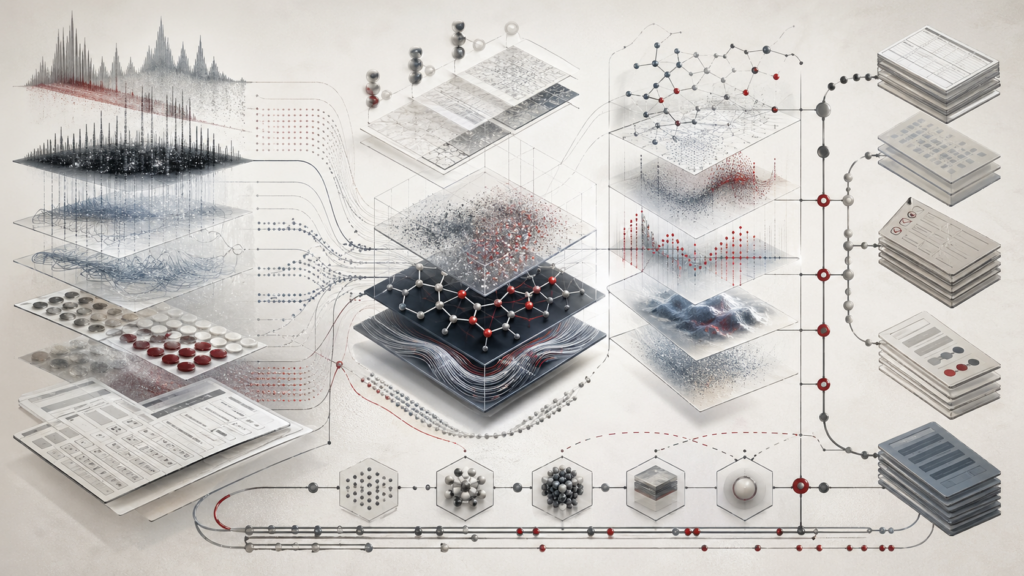
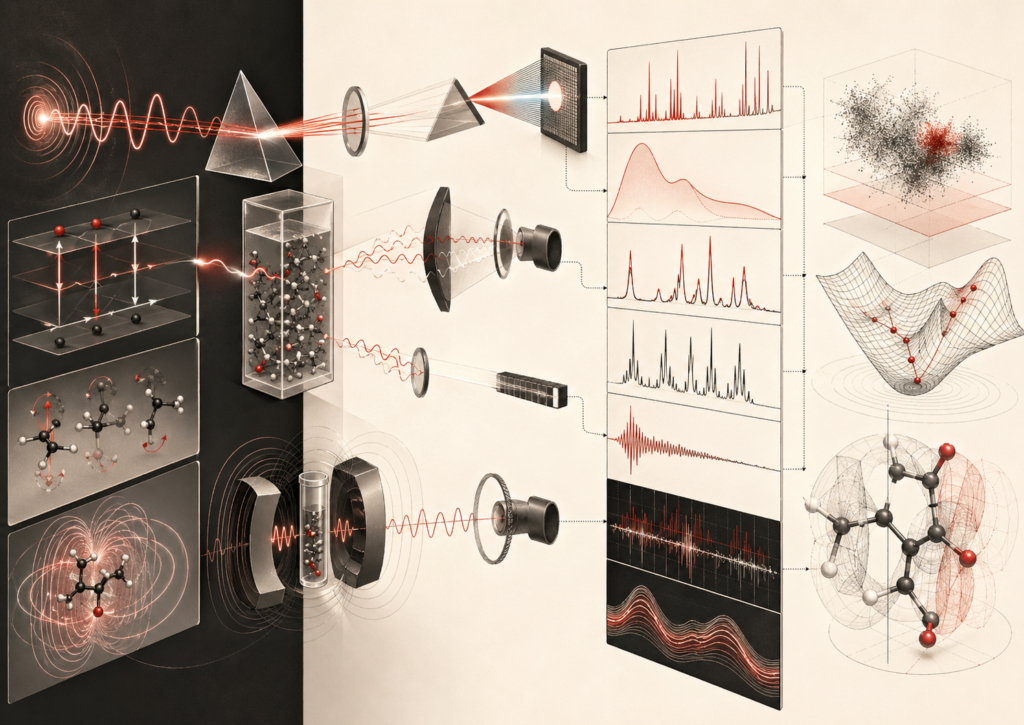
Abstract editorial scientific illustration showing spectroscopy as a workflow from radiation interacting with molecular samples to spectral signals, instrument pathways, data processing, and structural interpretation.

Spectroscopy and the Measurement of Molecular Structure

Spectroscopy is one of chemistry’s most powerful methods for turning invisible molecular structure into measurable evidence. By studying how matter absorbs, emits, scatters, or responds to radiation and magnetic fields, spectroscopy reveals functional groups, bonding, geometry, concentration, electronic structure, local chemical environments, and material state. This article explains spectroscopy as an evidence system rather than a simple catalog of peaks. It introduces the physical relationships among energy, wavelength, frequency, wavenumber, absorbance, molecular vibrations, electronic transitions, and NMR resonance. It also surveys major methods including infrared, Raman, UV-visible, fluorescence, NMR, X-ray, and photoelectron spectroscopy.
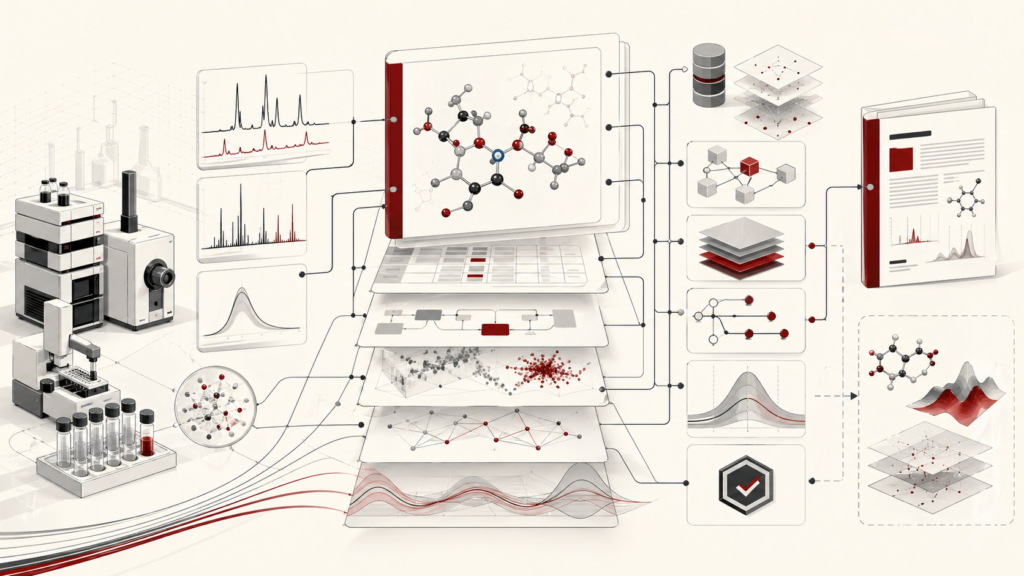
Editorial scientific illustration showing computational notebooks as structured chemical research workflows connecting laboratory instruments, molecular models, data layers, provenance, uncertainty, validation, and scientific reporting.

Computational Notebooks and Reproducible Chemical Research

Computational notebooks are becoming essential tools for modern chemical research because they connect data, code, visualizations, interpretation, and provenance in a single executable record. This article explains how notebooks support reproducibility across analytical chemistry, spectroscopy, kinetics, thermodynamics, molecular simulation, laboratory automation, and chemical data science. It distinguishes repeatability, reproducibility, and replicability while showing why notebooks must preserve more than code: they must also document samples, instruments, units, standards, software environments, uncertainty, model assumptions, and data transformations. Through an analytical framing, article presents notebooks as disciplined chemical research records rather than informal scratchpads.

Abstract editorial scientific illustration of R for chemistry, statistics, and experimental analysis, showing replicate measurement clusters, calibration pathways, uncertainty bands, regression surfaces, residual clouds, experimental design grids, quality-control checkpoints, spectral data layers, statistical reports, and reproducible analytical workflows in cream, gray, black, blue-gray, and deep red.

R for Chemistry, Statistics, and Experimental Analysis

R is one of the most important languages for statistical chemistry, experimental analysis, and reproducible scientific reporting. Where Python often serves as a broad computational bridge across scripting, automation, simulation, and data engineering, R excels as a language for statistical modeling, experimental design, visualization, uncertainty analysis, quality control, and publication-ready analytical workflows. This article introduces R for chemistry, statistics, and experimental analysis through data frames, tidy data, replicate summaries, calibration curves, regression, uncertainty, error propagation, hypothesis testing, ANOVA, experimental design, kinetics, Arrhenius analysis, quality control, visualization, reproducible reports, Quarto, R Markdown, laboratory metadata, and responsible statistical interpretation.

Abstract editorial scientific illustration of Python for chemistry, simulation, and laboratory data, showing laboratory data layers, spectral signal textures, calibration-standard clusters, molecular network motifs, simulation pathways, structured data planes, metadata records, quality-control checkpoints, provenance chains, and reproducible workflow pipelines in cream, gray, black, blue-gray, and deep red.

Python for Chemistry, Simulation, and Laboratory Data

Python has become one of the central languages of modern chemical computation. It connects laboratory measurements, simulation workflows, data cleaning, numerical modeling, visualization, uncertainty analysis, notebooks, chemical informatics, instrument exports, and reproducible scientific reporting into one practical computational environment. This article introduces Python for chemistry, simulation, and laboratory data through arrays, tables, units, calibration, regression, kinetics, numerical integration, error propagation, visualization, instrument data, laboratory metadata, chemical simulation scaffolds, Jupyter notebooks, reproducible workflows, file organization, quality control, and responsible computational practice.

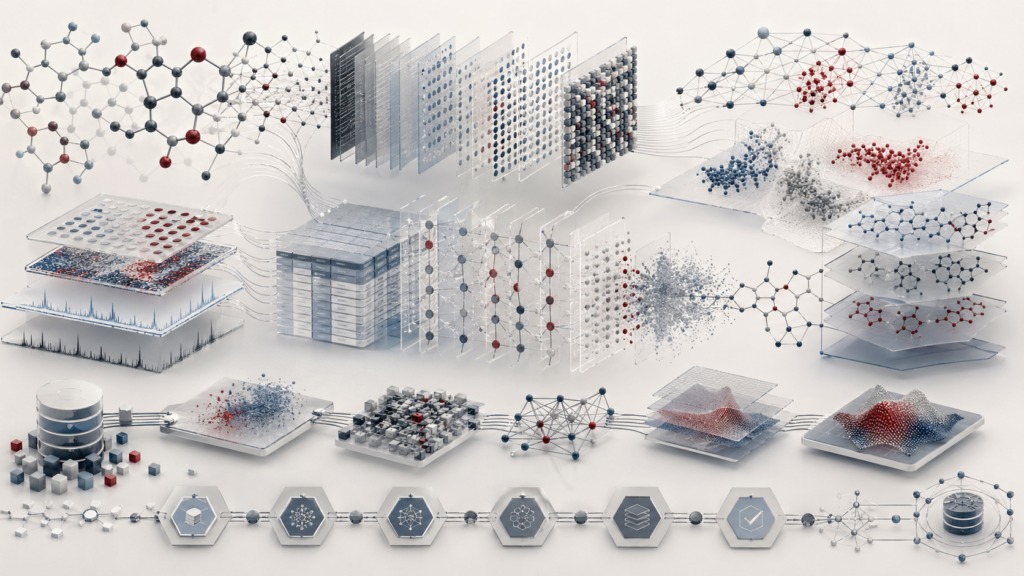
Abstract editorial scientific illustration showing molecular graph networks, layered descriptor matrices, fingerprint-like data structures, chemical-space clusters, assay-data surfaces, and model-validation workflows in a refined cream, gray, blue-gray, black, and deep red palette.

Cheminformatics and Molecular Data Science

Cheminformatics and molecular data science turn chemical structure into computable knowledge. They connect molecules, identifiers, databases, descriptors, fingerprints, reactions, assays, spectra, properties, bioactivity records, similarity metrics, machine-learning models, and reproducible workflows into a practical science of chemical information. This article introduces cheminformatics through molecular representation, SMILES, InChI, molecular graphs, descriptors, fingerprints, Tanimoto similarity, chemical space, compound databases, PubChem, ChEMBL, structure standardization, assay data, QSAR, machine learning, data leakage, validation, reaction data, materials data, FAIR principles, provenance, uncertainty, responsible molecular prediction, and reproducible molecular data workflows.

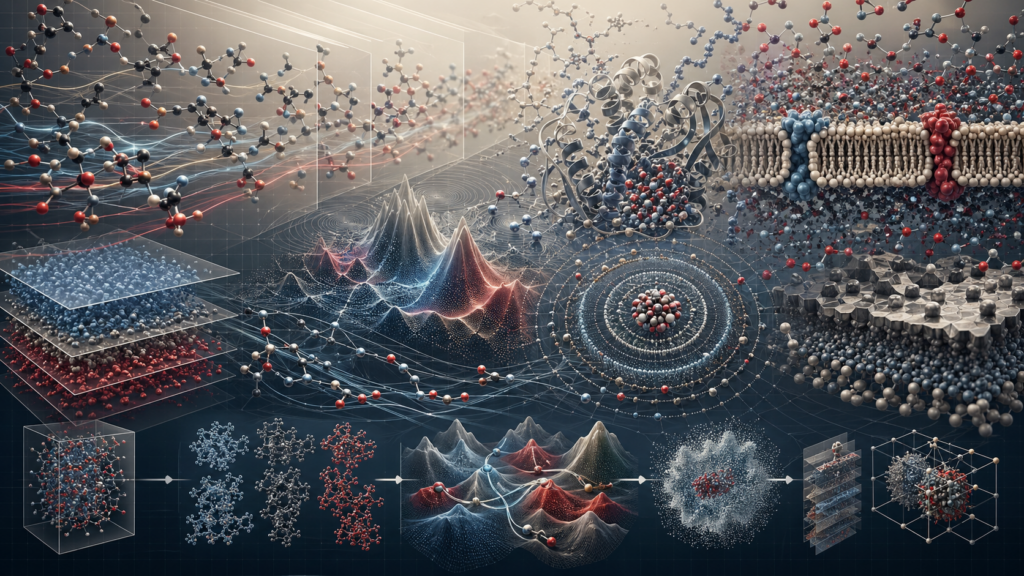
Abstract editorial scientific illustration of molecular dynamics and chemical simulation, showing molecular trajectories, particle motion, force-field landscapes, solvent shells, membrane-like structures, radial distribution patterns, conformational ensembles, diffusion pathways, molecular clusters, materials interfaces, and reproducible simulation workflows in cream, gray, black, blue-gray, and deep red.

Molecular Dynamics and Chemical Simulation

Molecular dynamics is chemistry simulated through time. It asks how atoms, molecules, ions, solvents, polymers, proteins, membranes, materials, interfaces, and condensed phases move when forces act on them. Where quantum chemistry emphasizes electronic structure and molecular energy, molecular dynamics emphasizes motion, sampling, fluctuations, trajectories, and time-dependent molecular behavior. This article introduces molecular dynamics and chemical simulation through Newtonian motion, force fields, potential energy functions, integration algorithms, timesteps, thermostats, barostats, ensembles, periodic boundary conditions, solvation, nonbonded interactions, trajectory analysis, diffusion, radial distribution functions, conformational sampling, enhanced sampling, biomolecular simulation, materials simulation, coarse-graining, uncertainty, validation, and reproducible molecular-simulation workflows.

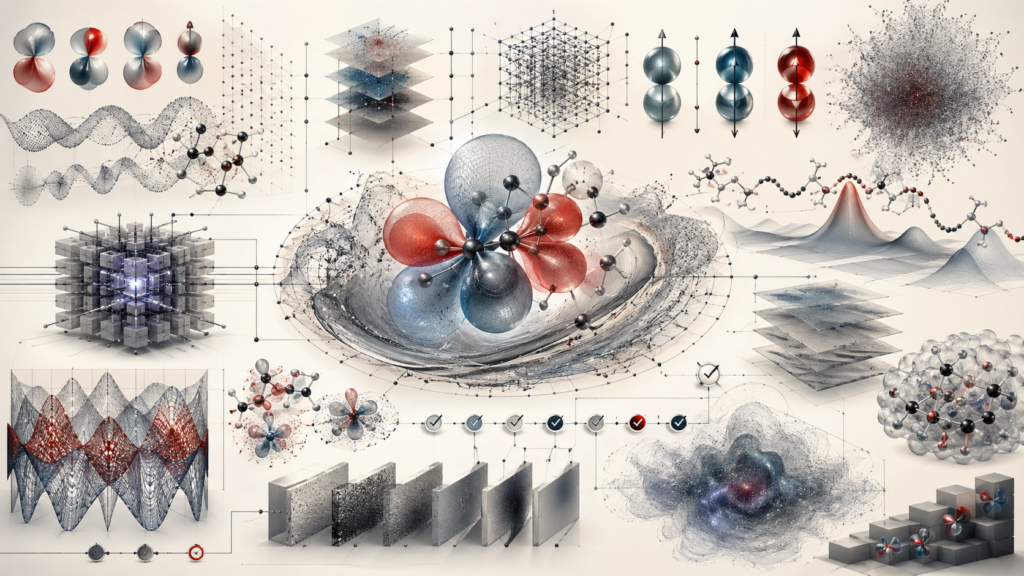
Abstract editorial scientific illustration of quantum chemistry and electronic structure, showing molecular orbital lobes, electron-density clouds, wavefunction-like fields, basis-function grids, spin-state motifs, energy landscapes, transition-state surfaces, solvation textures, periodic lattice structures, uncertainty clouds, and electronic-structure workflows in cream, gray, black, blue-gray, and deep red.

Quantum Chemistry and Electronic Structure

Quantum chemistry explains chemistry from the behavior of electrons. It asks why atoms bond, why molecules have shape, why reactions require activation energy, why light is absorbed at particular frequencies, why radicals behave differently from closed-shell molecules, why metals have unusual electronic states, why molecular orbitals matter, and why small changes in electron distribution can produce large changes in chemical behavior. This article introduces quantum chemistry and electronic structure through wavefunctions, Hamiltonians, the Schrödinger equation, the Born-Oppenheimer approximation, molecular orbitals, electron density, Hartree-Fock theory, electron correlation, configuration interaction, perturbation theory, coupled-cluster theory, density functional theory, basis sets, geometry optimization, vibrational frequencies, excited states, spin, solvation, benchmarking, uncertainty, and reproducible computational workflows.

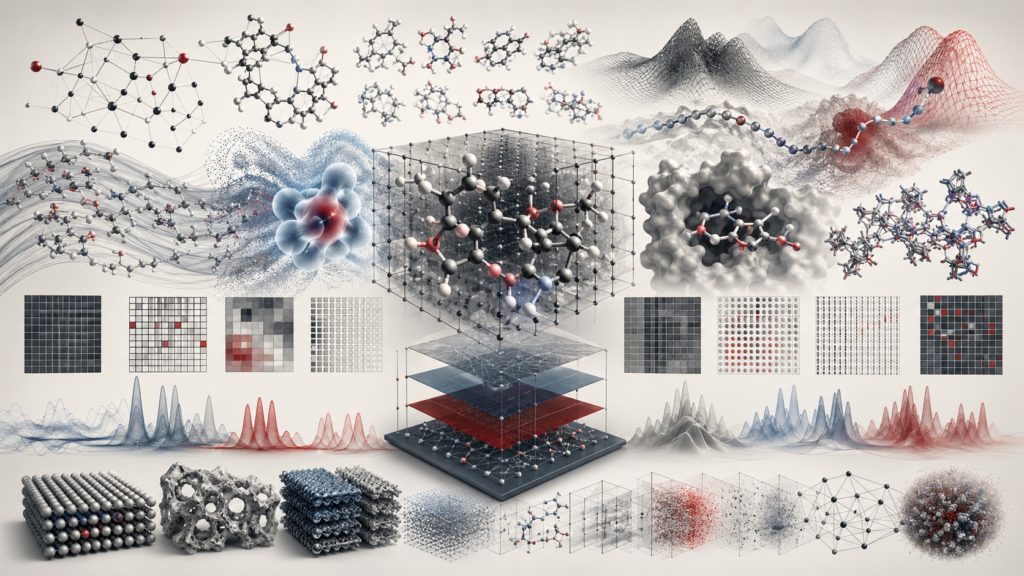
Abstract editorial scientific illustration of computational chemistry and molecular modeling, showing molecular graphs, ball-and-stick molecular structures, coordinate grids, electron-density clouds, energy landscapes, conformer ensembles, molecular docking pockets, descriptor matrices, spectra-like waveforms, materials lattices, similarity networks, and layered computational workflows in cream, gray, black, blue-gray, and deep red.

Computational Chemistry and Molecular Modeling

Computational chemistry uses mathematical models, algorithms, data structures, and simulations to study molecular systems. It turns chemical structure into computable form: atoms become coordinates, bonds become connectivity, electrons become quantum states, molecules become graphs, reactions become energy landscapes, and chemical behavior becomes something that can be estimated, compared, simulated, visualized, and tested. This article introduces computational chemistry and molecular modeling through molecular representations, quantum chemistry, density functional theory, molecular mechanics, force fields, molecular dynamics, Monte Carlo sampling, conformational search, molecular docking, reaction pathways, transition states, computed spectra, cheminformatics, molecular descriptors, fingerprints, materials modeling, benchmarking, uncertainty, reproducibility, artificial intelligence, and computational chemistry workflows.

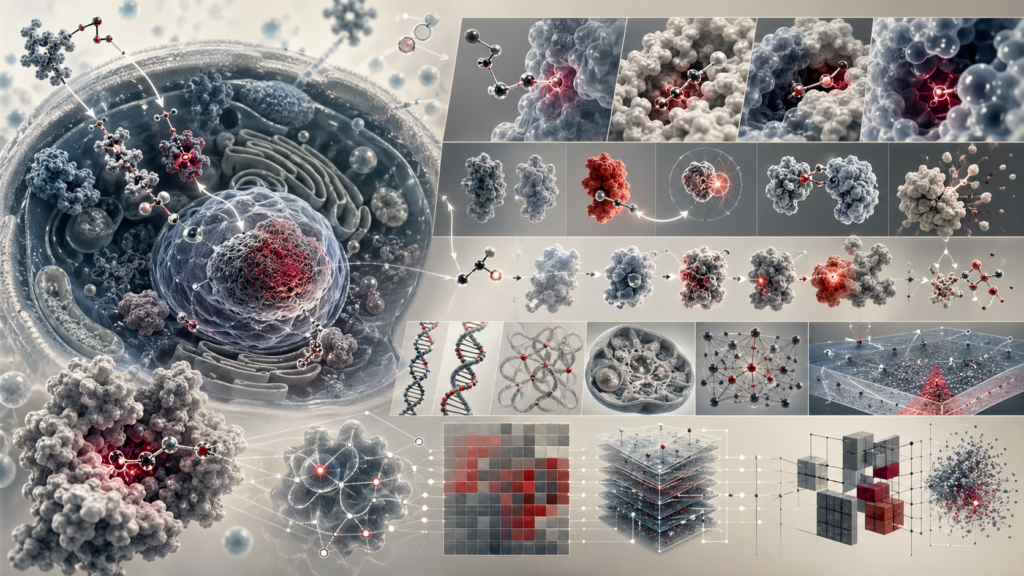
Abstract editorial scientific illustration of chemical biology, molecular probes entering cellular compartments, target-engagement pockets, ligand-binding sites, bioorthogonal labeling motifs, activity-based probe pathways, chemoproteomic grids, perturbation networks, induced-proximity forms, and computational chemical-biology workflows in cream, gray, black, aqueous blue-gray, and deep red.

Chemical Biology and Molecular Intervention in Living Systems

Chemical biology uses chemistry to observe, perturb, and redesign living systems. It stands at the interface of chemistry, biology, biochemistry, pharmacology, molecular biology, systems biology, and biotechnology, using chemical tools to interrogate and control biological processes. This article introduces chemical biology through chemical probes, molecular recognition, target engagement, chemical genetics, activity-based protein profiling, bioorthogonal chemistry, metabolic labeling, imaging probes, fluorescent sensors, covalent ligands, reactive-site mapping, targeted protein degradation, induced proximity, RNA- and DNA-targeting chemistry, metabolic tracing, systems chemical biology, chemoproteomics, computational chemical biology, and responsible molecular intervention. It shows how molecules can become experimental instruments for revealing biological function, testing mechanisms, mapping targets, tracing biomolecules, altering protein fate, and intervening in living systems with chemical precision.

Scroll to Top