
Last Updated May 28, 2026
Acids and bases are not merely substances on opposite sides of a classroom chart. They are systems of proton transfer, electron-pair interaction, solvent response, equilibrium, structure, and chemical identity. Acid-base chemistry explains why water self-ionizes, why pH matters, why weak acids only partially dissociate, why buffers resist change, why titrations reveal concentration, why catalysts accelerate reactions, why biological molecules change charge state, why minerals dissolve, why oceans buffer carbon dioxide, and why many reactions depend on the movement of a single proton.
The central thesis of this article is that acid-base chemistry is equilibrium chemistry in motion. Proton transfer is often fast, but its consequences are structured by thermodynamics, molecular stability, solvent, concentration, charge balance, activity, and reaction context. Acid-base chemistry therefore links molecular structure to measurable chemical behavior.
A proton is small, but proton transfer reorganizes chemical systems. It can change molecular charge, solubility, shape, reactivity, binding, color, phase behavior, enzyme activity, environmental mobility, and reaction mechanism. A carboxylic acid that donates a proton becomes a carboxylate. An amine that accepts a proton becomes an ammonium ion. Water can act as an acid or a base. A buffer can absorb added acid or base without large pH change. A catalyst can speed a reaction by temporarily donating or accepting a proton along a lower-energy pathway.
Main Library
Publications
Article Map
Chemistry
Related Topic
Biology
Related Topic
Environmental Monitoring Systems
Related Topic
Data Systems & Analytics
Why Acid-Base Chemistry Matters
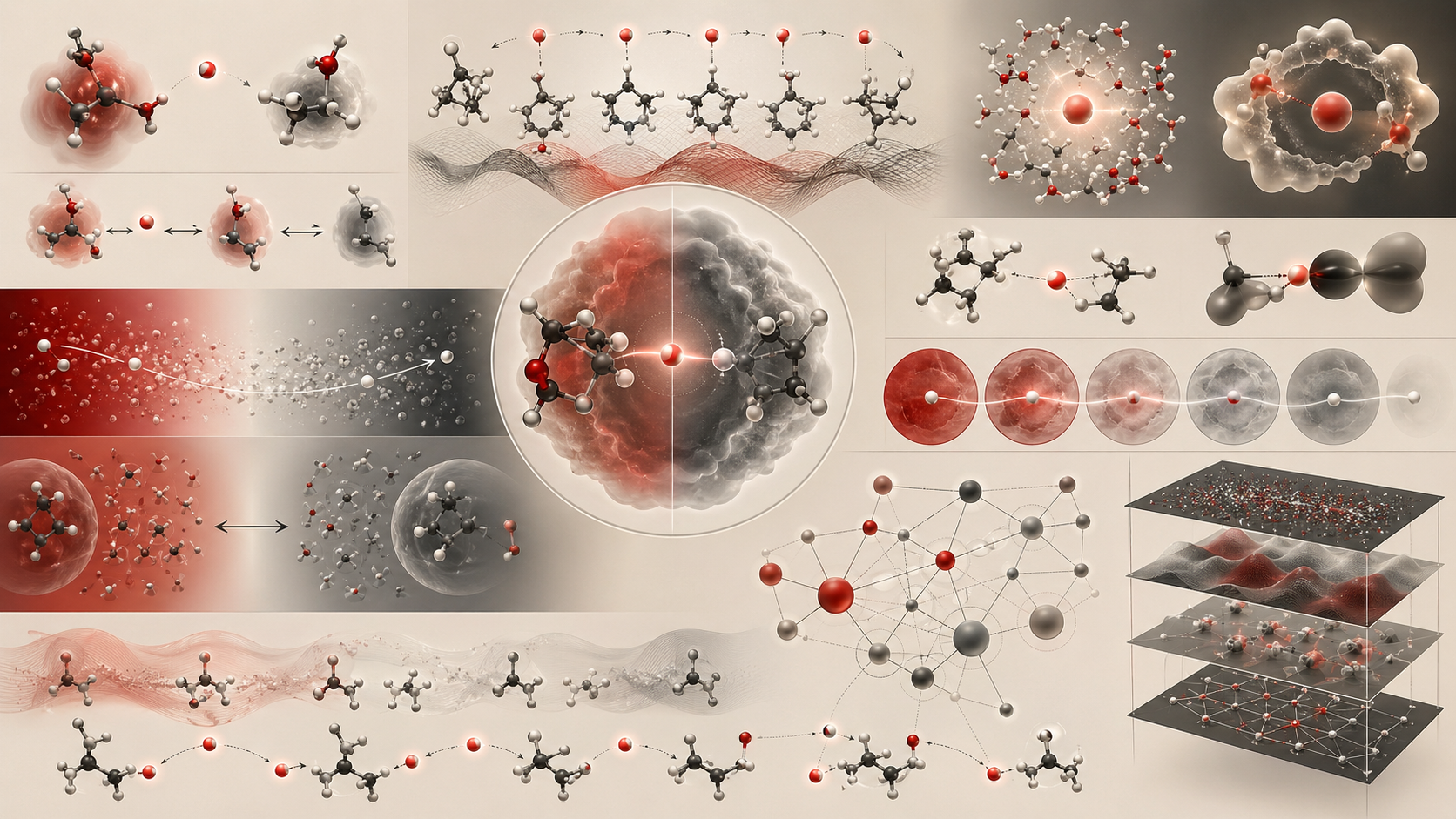
Acid-base chemistry matters because proton transfer changes chemical identity. When a molecule gains or loses a proton, it may change charge, solubility, volatility, reactivity, conformation, binding affinity, optical behavior, phase behavior, or biological activity. A small structural change can produce a large chemical consequence.
This is why acid-base chemistry appears everywhere. It governs titration, pH measurement, buffer design, water chemistry, soil chemistry, ocean carbonate systems, enzyme catalysis, drug ionization, protein folding, fermentation, corrosion, mineral dissolution, food chemistry, cleaning products, industrial neutralization, electrochemistry, and atmospheric chemistry.
Acid-base chemistry is also one of the first places where students encounter the deeper logic of equilibrium. Strong acids and bases behave differently from weak acids and bases. A buffer is not simply a mixture, but an equilibrium system with capacity. A titration curve is not just a graph; it is a map of changing chemical dominance. A \(pK_a\) value is not a label; it encodes a thermodynamic tendency to donate a proton under specified conditions.
In research settings, acid-base chemistry often determines whether a molecule exists in the form being studied. A drug may be neutral in one compartment and protonated in another. A protein residue may act as a catalytic acid only if its local environment shifts its \(pK_a\). A metal ion may precipitate or remain soluble depending on pH. A contaminant may become more mobile when protonation state or mineral surface charge changes. A buffer may preserve an assay or distort it if chosen poorly.
For researchers and scientists, acid-base chemistry is therefore not merely introductory chemistry. It is a framework for understanding how chemical systems respond to proton availability, solvent environment, charge balance, and equilibrium constraints.
Arrhenius, Brønsted-Lowry, and Lewis Definitions
Acid-base chemistry has multiple definitions because different chemical contexts require different levels of generality. These definitions are not rivals. They are nested tools for describing different kinds of acid-base behavior.
The Arrhenius definition is the narrowest common introductory definition. An Arrhenius acid increases hydronium ion concentration in water, while an Arrhenius base increases hydroxide ion concentration in water. This definition works well for many aqueous reactions, but it is limited because it depends on water as solvent and does not fully describe acid-base behavior in nonaqueous or electron-pair contexts.
The Brønsted-Lowry definition is broader. A Brønsted-Lowry acid is a proton donor, and a Brønsted-Lowry base is a proton acceptor. This definition makes proton transfer central:
HA + B \rightleftharpoons A^- + HB^+
\]
Interpretation: \(HA\) donates a proton to \(B\), forming conjugate base \(A^-\) and conjugate acid \(HB^+\).
The Lewis definition is broader still. A Lewis acid accepts an electron pair, and a Lewis base donates an electron pair. This definition includes proton transfer but also covers metal-ligand bonding, boron compounds, coordination chemistry, catalysis, and many reactions where no proton transfer occurs.
A Lewis acid-base interaction can be represented generally as:
A + :B \rightarrow A \leftarrow B
\]
Interpretation: \(A\) is the electron-pair acceptor and \(:B\) is the electron-pair donor. This framework includes coordination and electrophile-nucleophile interactions.
Arrhenius is useful for aqueous introductory chemistry. Brønsted-Lowry is useful for proton transfer. Lewis is useful for electron-pair interaction. In real systems, these categories often overlap. A proton is a Lewis acid because it accepts an electron pair, while many Brønsted bases are also Lewis bases.
For researchers, the best definition is the one that matches the chemical question. Aqueous pH control may require Arrhenius and Brønsted-Lowry language. Coordination chemistry may require Lewis language. Enzyme catalysis may require all three at once.
Proton Transfer and Conjugate Pairs
In Brønsted-Lowry chemistry, acids and bases occur in conjugate pairs. When an acid donates a proton, it becomes its conjugate base. When a base accepts a proton, it becomes its conjugate acid.
For a generic acid:
HA \rightleftharpoons H^+ + A^-
\]
Interpretation: \(HA\) is the acid, and \(A^-\) is its conjugate base. The actual free proton is strongly solvated in most media, especially water.
For ammonia in water:
NH_3 + H_2O \rightleftharpoons NH_4^+ + OH^-
\]
Interpretation: Ammonia acts as a base by accepting a proton from water. Water acts as an acid by donating a proton.
The conjugate acid of ammonia is \(NH_4^+\), and the conjugate base of water is \(OH^-\). This example also shows that acid-base roles are relational. Water can act as an acid in one context and a base in another.
Conjugate-pair reasoning is essential because acid strength and base strength are linked. A strong acid has a weak conjugate base. A weak acid has a conjugate base that may be more significant chemically. This relationship helps explain why chloride ion is a very weak base in water, while acetate can accept protons and affect pH.
Proton transfer is therefore not an isolated property of one molecule. It depends on the proton donor, proton acceptor, solvent, concentration, activity, and competing equilibria. A molecule can behave differently in water, methanol, dimethyl sulfoxide, an enzyme active site, a membrane, a mineral surface, or an aerosol particle.
For researchers, conjugate-pair reasoning is the basis for understanding buffers, titrations, enzyme residues, organic mechanisms, pharmaceutical ionization, environmental speciation, and acid-base catalysis.
Water Autoionization and the Meaning of pH
Water can act as both acid and base. In pure water, a small fraction of molecules undergo autoionization:
2H_2O \rightleftharpoons H_3O^+ + OH^-
\]
Interpretation: One water molecule donates a proton and another accepts it, producing hydronium and hydroxide.
This equilibrium is described by the ion product of water:
K_w = [H_3O^+][OH^-]
\]
Interpretation: \(K_w\) is the water ion product in simplified concentration form. More rigorous treatment uses activities.
At \(25^\circ C\), a common approximate value is:
K_w = 1.0 \times 10^{-14}
\]
Interpretation: This value is temperature-dependent and should not be treated as universal under all conditions.
In neutral water at this temperature:
[H_3O^+] = [OH^-] = 1.0 \times 10^{-7}
\]
Interpretation: Equal hydronium and hydroxide concentrations define neutrality in pure water at 25°C under the simplified concentration model.
The pH scale is defined in simplified concentration-based form as:
pH = -\log_{10}[H_3O^+]
\]
Interpretation: pH is a logarithmic measure of hydronium concentration in simplified calculations. More rigorously, pH relates to hydrogen ion activity.
A solution with pH below 7 is acidic at \(25^\circ C\), while a solution with pH above 7 is basic. But neutrality depends on temperature because \(K_w\) changes with temperature. Therefore, pH 7 is not a universal definition of neutrality under all conditions.
For researchers, pH is not just a number. It is a compact representation of proton activity, solvent behavior, equilibrium, and measurement conditions.
Strong Acids, Weak Acids, and Equilibrium
A strong acid dissociates essentially completely in water under ordinary dilute conditions. A weak acid only partially dissociates and establishes an equilibrium:
HA + H_2O \rightleftharpoons H_3O^+ + A^-
\]
Interpretation: A weak acid transfers protons to water only partially, producing an equilibrium mixture.
The acid dissociation constant is:
K_a = \frac{[H_3O^+][A^-]}{[HA]}
\]
Interpretation: \(K_a\) describes the equilibrium tendency of an acid to donate a proton in water under simplified concentration assumptions.
Strong acids such as hydrochloric acid are often treated as fully dissociated in introductory calculations. Weak acids such as acetic acid require equilibrium analysis. If the initial concentration of a weak acid is \(C\), and \(x\) dissociates, then:
K_a = \frac{x^2}{C-x}
\]
Interpretation: This expression applies to a simple monoprotic weak acid in water when activity corrections and water autoionization are neglected.
Weak does not mean unimportant. Weak acids and bases are central to buffers, biological systems, organic chemistry, pharmaceuticals, food chemistry, environmental systems, and analytical methods. Their partial dissociation makes them chemically flexible.
The distinction between strong and weak is therefore not about danger, corrosiveness, or concentration. It is about equilibrium tendency. A dilute strong acid may be less hazardous than a concentrated weak acid; a weak acid may still be biologically or environmentally significant because it participates in equilibria across relevant pH ranges.
For researchers, acid strength must be interpreted in context: solvent, temperature, ionic strength, concentration, structure, and medium can all change observed acid-base behavior.
Ka, Kb, pKa, and pKb
Acid and base strengths are often expressed using logarithmic quantities. For an acid:
pK_a = -\log_{10}K_a
\]
Interpretation: Lower \(pK_a\) means stronger acid under the specified conditions.
For a base:
pK_b = -\log_{10}K_b
\]
Interpretation: Lower \(pK_b\) means stronger base under the specified conditions.
A lower \(pK_a\) means a stronger acid. A higher \(pK_a\) means a weaker acid. This inverse relationship can be confusing at first because \(pK_a\) is logarithmic and negative with respect to \(K_a\).
For a conjugate acid-base pair in water:
K_aK_b = K_w
\]
Interpretation: The acid dissociation constant of an acid and the base dissociation constant of its conjugate base are linked through the water ion product.
Taking negative logarithms gives:
pK_a + pK_b = pK_w
\]
Interpretation: At 25°C in water, \(pK_w\) is approximately 14.00, but this depends on temperature.
The \(pK_a\) concept is especially powerful because it helps predict protonation state. When pH is below \(pK_a\), the protonated form tends to dominate. When pH is above \(pK_a\), the deprotonated form tends to dominate. At pH equal to \(pK_a\), the acid and conjugate base are present in equal concentrations under the assumptions of the Henderson-Hasselbalch relationship.
For researchers, \(pK_a\) is essential in biochemistry, pharmacology, environmental chemistry, organic reaction mechanism analysis, separations, chromatography, electrophoresis, and molecular modeling. It encodes how structure responds to proton availability.
Polyprotic Acids and Stepwise Dissociation
Polyprotic acids can donate more than one proton. Examples include carbonic acid, sulfuric acid, phosphoric acid, citric acid, amino acids, nucleotides, and many biological molecules. Their dissociation occurs stepwise:
H_2A \rightleftharpoons H^+ + HA^-
\]
Interpretation: The first deprotonation produces a singly deprotonated intermediate.
HA^- \rightleftharpoons H^+ + A^{2-}
\]
Interpretation: The second deprotonation produces the doubly deprotonated form.
Each step has its own dissociation constant:
K_{a1}, K_{a2}, K_{a3}, \ldots
\]
Interpretation: Each proton is removed under a distinct equilibrium condition.
Usually, each successive proton is less easily removed because the molecule becomes more negatively charged. In many common cases:
K_{a1} > K_{a2} > K_{a3}
\]
Interpretation: Successive deprotonation is often less favorable, though molecular structure and solvent can create exceptions or close values.
Polyprotic systems are chemically rich because different protonation states dominate at different pH values. Phosphate chemistry, carbonate chemistry, amino acids, proteins, nucleotides, organic acids, soil chemistry, ocean chemistry, and many environmental buffers depend on stepwise acid-base equilibria.
A single molecule may therefore behave as different chemical species depending on pH. This is one reason acid-base chemistry is central to speciation: the distribution of chemical forms.
For researchers, polyprotic systems require more than one equilibrium constant. They often require full speciation analysis, mass balance, charge balance, and attention to activity effects.
Buffers and Chemical Resistance to Change
A buffer resists pH change when small amounts of acid or base are added. A typical buffer contains a weak acid and its conjugate base, or a weak base and its conjugate acid.
For a weak acid buffer:
HA \rightleftharpoons H^+ + A^-
\]
Interpretation: The buffer contains both proton-donating and proton-accepting capacity through the weak acid and its conjugate base.
The Henderson-Hasselbalch equation is:
pH = pK_a + \log_{10}\frac{[A^-]}{[HA]}
\]
Interpretation: Buffer pH depends on the ratio of conjugate base to weak acid under the assumptions of the equation.
This equation shows that buffer pH depends on the ratio of conjugate base to weak acid, not simply on their absolute amounts. However, buffer capacity depends on total buffer concentration. A dilute buffer may have the correct pH but poor capacity.
Buffers are most effective when pH is close to \(pK_a\), because meaningful amounts of both \(HA\) and \(A^-\) are present. When acid is added, \(A^-\) consumes protons. When base is added, \(HA\) donates protons. The system shifts to absorb the disturbance.
Buffers are central to blood chemistry, enzyme function, cell culture, analytical chemistry, pharmaceuticals, fermentation, water treatment, food systems, and environmental chemistry. A buffer can preserve experimental conditions, but it can also interfere with reactions, bind metals, change ionic strength, absorb carbon dioxide, or participate in catalysis if chosen carelessly.
For researchers, a buffer is a practical example of equilibrium as chemical resilience. Buffer choice should consider \(pK_a\), target pH, concentration, temperature, compatibility, metal binding, biological effects, optical interference, and buffer capacity.
Titration Curves and Equivalence
Titration is a quantitative method in which a solution of known concentration reacts with an analyte. Acid-base titrations use proton-transfer stoichiometry and equilibrium to determine concentration, \(pK_a\), alkalinity, acidity, or composition.
The equivalence point occurs when stoichiometrically equivalent amounts of acid and base have reacted. For a monoprotic acid titrated with a strong base:
n_{\mathrm{acid}} = n_{\mathrm{base}}
\]
Interpretation: At equivalence, the moles of proton-donating acid and proton-accepting base are stoichiometrically matched for a monoprotic system.
The shape of a titration curve depends on acid and base strength. Strong acid-strong base titrations show a sharp pH change near equivalence. Weak acid-strong base titrations show a buffer region before equivalence and an equivalence point above pH 7 because the conjugate base affects pH. Weak base-strong acid titrations show analogous behavior below pH 7 at equivalence. Polyprotic acids can show multiple buffering regions and multiple equivalence points if their \(pK_a\) values are sufficiently separated.
At the half-equivalence point for a weak acid titration:
pH = pK_a
\]
Interpretation: At half-equivalence, weak acid and conjugate base concentrations are equal under idealized assumptions.
Titration curves are therefore maps of changing chemical dominance: excess acid, buffer region, equivalence, and excess base. They also reveal whether a system is strong, weak, monoprotic, polyprotic, buffered, contaminated, or experimentally inconsistent.
For researchers, titration is not only a classroom calculation. It is an analytical method whose reliability depends on standardized reagents, accurate volumes, endpoint choice, pH calibration, temperature, ionic strength, activity effects, and appropriate chemical assumptions.
Acid-Base Indicators and Measurement
Acid-base indicators are weak acids or bases whose protonated and deprotonated forms have different colors. A simplified indicator equilibrium is:
HIn \rightleftharpoons H^+ + In^-
\]
Interpretation: The protonated and deprotonated forms of the indicator absorb light differently, producing a visible color change across a pH range.
The observed color depends on the ratio of \(HIn\) to \(In^-\), which depends on pH. Indicators therefore change color over a pH range rather than at a single exact value. A suitable indicator for a titration should change color near the steep part of the titration curve and close to the equivalence point.
pH meters use electrochemical measurement rather than color. They require calibration, temperature awareness, electrode care, ionic strength considerations, and proper interpretation. Measuring pH in very dilute solutions, concentrated solutions, nonaqueous solvents, suspensions, biological media, high-salt systems, or low-conductivity water can be more complex than reading a digital value.
There is also a distinction between pH as measured and proton concentration as calculated. pH is related to activity, not simply concentration. Activity coefficients can matter in concentrated electrolyte solutions, seawater, brines, biological media, industrial streams, and environmental samples.
For researchers, acid-base measurement combines equilibrium chemistry with instrumentation. A pH number is useful only when calibration, temperature, medium, ionic strength, electrode behavior, and sample matrix are understood.
Amphiprotic Species and Solvent Effects
An amphiprotic species can donate or accept a proton. Water is the most familiar example:
H_2O + H^+ \rightarrow H_3O^+
\]
Interpretation: Water acts as a base by accepting a proton.
H_2O \rightarrow H^+ + OH^-
\]
Interpretation: Water acts as an acid by donating a proton, shown here in simplified form.
Bicarbonate, hydrogen phosphate, amino acids, proteins, nucleotides, and many biological molecules are also amphiprotic. Their behavior depends on pH, partner species, solvent, concentration, local environment, and competing equilibria.
Solvent matters because acids and bases are not defined in a vacuum. Solvents stabilize ions differently, participate in hydrogen bonding, accept or donate protons, and influence activity. Water levels many strong acids because they all transfer protons effectively to water, producing hydronium. In nonaqueous solvents, acid strength ordering can differ.
Solvent effects are important in organic chemistry, electrochemistry, catalysis, extraction, pharmaceutical chemistry, aerosol chemistry, and materials chemistry. A molecule’s acid-base behavior can shift dramatically when moved from water to an organic solvent, membrane, enzyme pocket, aerosol particle, ionic liquid, deep eutectic solvent, or solid surface.
For researchers, acid-base chemistry is always environmental in the molecular sense: the medium matters. Proton transfer depends on where the molecule is, not only what the molecule is.
Lewis Acids, Bases, and Electron-Pair Chemistry
Lewis acid-base chemistry generalizes acid-base behavior beyond proton transfer. A Lewis acid accepts an electron pair, while a Lewis base donates an electron pair.
A classic example is:
BF_3 + NH_3 \rightarrow F_3B \leftarrow NH_3
\]
Interpretation: Nitrogen in ammonia donates an electron pair to electron-deficient boron in boron trifluoride. No proton transfer is required.
Lewis acidity and basicity are central to coordination chemistry, organometallic chemistry, catalysis, materials chemistry, organic reaction mechanisms, and solid acid catalysts. Metal cations often act as Lewis acids by accepting electron density from ligands. Carbonyl carbons can act as electrophilic Lewis acidic centers. Halides, amines, phosphines, alcohols, ethers, sulfides, and many anions can act as Lewis bases.
Lewis acid-base thinking also connects to frontier orbitals, electrophiles, nucleophiles, hard-soft acid-base theory, and catalytic activation. It expands acid-base chemistry from proton movement to electron-pair organization.
This broader framework is essential because many reactions called “acid-base” in advanced chemistry involve both proton transfer and electron-pair interaction. A proton transfer may begin with electron-pair donation to a proton. A metal catalyst may activate a carbonyl by Lewis acid coordination. A solid acid surface may contain both Brønsted acid sites and Lewis acid sites.
For researchers, Lewis acid-base chemistry is a bridge between acid-base equilibrium, bonding, catalysis, and reactivity. It shows that acid-base logic is not limited to aqueous pH.
Acid-Base Catalysis and Reaction Mechanisms
Acids and bases often act as catalysts. They can speed reactions by donating protons, accepting protons, stabilizing charged intermediates, activating leaving groups, increasing electrophilicity, generating nucleophiles, or lowering transition-state energy.
In acid catalysis, protonation can make a molecule more reactive. For example, protonating a carbonyl oxygen increases electrophilicity at the carbonyl carbon. Protonating a hydroxyl group can turn a poor leaving group into water, a better leaving group.
A generic acid-activation step can be represented as:
S + H^+ \rightleftharpoons SH^+
\]
Interpretation: Protonation changes charge and electron distribution, often making the substrate more reactive.
In base catalysis, deprotonation can create a more reactive species. A base may generate an alkoxide, enolate, thiolate, amide, or other nucleophile that reacts more readily than its protonated form.
S-H + B \rightleftharpoons S^- + HB^+
\]
Interpretation: A base removes a proton, producing a more electron-rich conjugate base that may participate in the reaction pathway.
General acid-base catalysis occurs when species other than solvent participate directly in proton transfer during the rate-controlling process. This is common in enzyme active sites, organic mechanisms, buffer catalysis, and solution chemistry.
Acid-base catalysis shows that proton transfer is not only equilibrium. It is also mechanism. The movement of protons can open lower-energy pathways for chemical change, alter selectivity, stabilize transition states, or couple one step to another.
For researchers, acid-base catalysis requires mechanistic evidence. A pH-rate profile, isotope effect, buffer dependence, intermediate trapping, computational transition-state analysis, or structural evidence may be needed to distinguish specific acid catalysis, general acid catalysis, base catalysis, nucleophilic catalysis, or Lewis acid activation.
Acid-Base Chemistry in Biology
Biological chemistry is saturated with acid-base behavior. Amino acid side chains gain and lose protons. Enzyme active sites use proton transfer to catalyze reactions. Proteins fold and bind ligands partly through charge states. DNA and RNA contain acid-base functional groups. Membranes maintain proton gradients. Blood pH is buffered. Cellular compartments maintain different pH values. Metabolic reactions depend on protonation states.
Amino acids are especially important because they contain both acidic and basic groups. Their charge state changes with pH. At certain pH values, an amino acid may exist primarily as a zwitterion, with both positive and negative charges. The isoelectric point is the pH at which the average net charge is zero.
Enzymes often depend on precise proton positioning. A histidine residue may act as an acid or base near physiological pH. Aspartate, glutamate, lysine, cysteine, tyrosine, serine, arginine, and other residues can participate in acid-base catalysis depending on local environment.
Local \(pK_a\) values in proteins can differ from standard solution values because of nearby charges, hydrogen bonding, hydrophobic pockets, metal ions, solvent exclusion, conformational state, and substrate binding. This allows biology to tune proton transfer with remarkable precision.
Proton gradients are also central to bioenergetics. Mitochondria and chloroplasts use membrane-separated proton gradients to help drive ATP synthesis. Bacteria use proton motive force for transport, motility, and energy conversion. Acid-base chemistry is therefore not only molecular; it is cellular and physiological.
For researchers, biological acid-base chemistry is chemistry in structured, crowded, compartmentalized, regulated molecular environments. Proton transfer becomes a mechanism of control.
Environmental and Industrial Acid-Base Systems
Acid-base chemistry shapes environmental systems. Carbon dioxide dissolves in water and participates in carbonate equilibria. Ocean acidification involves shifts in dissolved inorganic carbon, bicarbonate, carbonate, pH, and mineral saturation. Soil pH affects nutrient availability and metal mobility. Acid mine drainage involves sulfide oxidation, acidity, metal dissolution, and precipitation. Atmospheric acids influence aerosols, rainwater, and particle chemistry.
The carbonate system is one of the most important environmental acid-base systems:
CO_2(aq) + H_2O \rightleftharpoons H_2CO_3
\]
H_2CO_3 \rightleftharpoons H^+ + HCO_3^-
\]
HCO_3^- \rightleftharpoons H^+ + CO_3^{2-}
\]
Interpretation: Carbon dioxide, carbonic acid, bicarbonate, carbonate, and protons form a coupled acid-base system central to natural waters and ocean chemistry.
Water treatment depends on acid-base control. Alkalinity, buffering capacity, neutralization, carbonate chemistry, and pH adjustment affect corrosion control, disinfection, coagulation, hardness, and contaminant behavior.
Industry also relies on acid-base systems: fertilizer production, petroleum refining, polymerization, acid catalysis, base catalysis, pharmaceutical manufacturing, food processing, cleaning chemistry, electroplating, pulp and paper, wastewater treatment, and chemical separations.
In all of these settings, pH is not merely a measurement. It is a controlling variable that affects speciation, reaction rate, solubility, corrosion, toxicity, and process performance.
For researchers, environmental and industrial acid-base chemistry links molecular proton transfer to ecosystems, infrastructure, water quality, manufacturing, and public health.
Acid-Base Chemistry in Materials, Water, and Public Health
Acid-base chemistry often determines whether materials persist, dissolve, degrade, or protect themselves. Concrete durability, metal corrosion, mineral weathering, polymer stability, battery electrolytes, membranes, coatings, and catalysts can all depend on acidity, alkalinity, buffering, and interfacial proton transfer.
In water systems, pH affects pipe corrosion, disinfectant effectiveness, lead and copper mobility, carbonate scaling, chlorine speciation, biological activity, taste, odor, and contaminant transformation. A water sample’s pH cannot be interpreted alone; alkalinity, dissolved inorganic carbon, hardness, dissolved oxygen, redox conditions, temperature, and ionic strength also matter.
Public health depends on acid-base control in multiple ways. Drinking water chemistry affects metal release and pathogen control. Pharmaceuticals depend on ionization state for solubility, absorption, distribution, and excretion. Biological fluids maintain narrow pH ranges. Food safety and fermentation depend on acidification. Environmental exposure to acidic or alkaline wastes can harm ecosystems and communities.
These issues also have equity dimensions. Communities facing aging water infrastructure, industrial discharge, mining impacts, agricultural runoff, or wastewater failures may be exposed to acid-base conditions that mobilize metals, alter disinfectant chemistry, or increase contaminant risk. Measuring pH alone is not always enough, but pH is often one of the first signals that chemical conditions are changing.
For researchers, acid-base chemistry is therefore not only molecular theory. It is part of evidence-based water management, infrastructure protection, environmental monitoring, and public accountability.
Computational Acid-Base Workflows
Computational acid-base workflows range from simple pH calculations to large speciation models. A simple weak acid calculation may solve one equilibrium equation. A realistic environmental or biochemical system may require simultaneous mass balance, charge balance, multiple \(K_a\) values, activity corrections, phase equilibria, complex formation, gas exchange, and temperature dependence.
Computational workflows can support:
- weak acid and weak base pH calculations;
- buffer design and Henderson-Hasselbalch estimates;
- titration curve simulation;
- polyprotic acid speciation;
- carbonate system modeling;
- amino acid charge-state distributions;
- pharmaceutical ionization estimates;
- environmental water chemistry;
- acid-base reaction networks;
- laboratory data quality checks;
- charge-balance and mass-balance review;
- pH-dependent solubility and speciation scaffolds.
Reproducibility matters. An acid-base calculation should document temperature, assumptions, constants, activity model, concentration units, charge balance, mass balance, numerical method, and validation source. A pH value without context can be misleading.
Computational acid-base chemistry is especially vulnerable to hidden assumptions. Are concentrations or activities being used? Is \(K_w\) appropriate for the temperature? Is the buffer within its useful range? Are ionic strength effects ignored? Is the acid monoprotic or polyprotic? Are gas exchange and carbonate equilibria included? Is the pH electrode calibrated for the sample matrix?
For researchers, acid-base computation is chemical bookkeeping with thermodynamic meaning. It should make assumptions visible and testable rather than bury them in a spreadsheet or script.
Mathematical Lens: Acids, Bases, and Proton Transfer
Acid-base chemistry is built from equilibrium constants, logarithms, mass balance, charge balance, and reaction stoichiometry. Water autoionization is:
K_w = [H_3O^+][OH^-]
\]
Interpretation: The water ion product links hydronium and hydroxide concentrations in simplified concentration-based calculations.
pH is:
pH = -\log_{10}[H_3O^+]
\]
Interpretation: pH is a logarithmic expression of hydronium concentration in simplified calculations; rigorous pH uses activity.
pOH is:
pOH = -\log_{10}[OH^-]
\]
Interpretation: pOH is the corresponding logarithmic expression for hydroxide concentration.
The pH and pOH relationship is:
pH + pOH = pK_w
\]
Interpretation: At 25°C in water, \(pK_w\) is approximately 14.00, but the value is temperature-dependent.
The acid dissociation constant is:
K_a = \frac{[H_3O^+][A^-]}{[HA]}
\]
Interpretation: \(K_a\) describes acid dissociation for a weak acid in simplified concentration form.
The base dissociation constant is:
K_b = \frac{[BH^+][OH^-]}{[B]}
\]
Interpretation: \(K_b\) describes base reaction with water in simplified concentration form.
\(pK_a\) is:
pK_a = -\log_{10}K_a
\]
Interpretation: Lower \(pK_a\) corresponds to stronger acid behavior under the specified conditions.
The conjugate acid-base relationship is:
K_aK_b = K_w
\]
Interpretation: Acid and conjugate-base strengths are linked through water autoionization.
The Henderson-Hasselbalch equation is:
pH = pK_a + \log_{10}\frac{[A^-]}{[HA]}
\]
Interpretation: Buffer pH depends on the ratio of conjugate base to weak acid under the assumptions of the model.
A weak acid approximation is:
[H_3O^+] \approx \sqrt{K_aC}
\]
Interpretation: This applies to a simple weak monoprotic acid when dissociation is small and water autoionization is negligible.
Charge balance is:
\sum_i z_i c_i = 0
\]
Interpretation: For a closed electroneutral solution model, charged species contributions must balance.
The fraction deprotonated for a monoprotic acid is:
\alpha_{A^-} = \frac{K_a}{K_a + [H^+]}
\]
Interpretation: The deprotonated fraction increases as pH rises relative to \(pK_a\).
These equations show that acid-base chemistry is a structured quantitative language for proton transfer, equilibrium, charge, concentration, speciation, and measurement.
Computational Workflows for Acid-Base Chemistry
Computational workflows can make acid-base chemistry more transparent. A workflow can track acid identities, base identities, \(K_a\), \(K_b\), \(pK_a\), \(pK_b\), temperature, ionic strength, buffer ratios, titration volumes, equivalence points, speciation fractions, charge balance, mass balance, pH measurements, calibration evidence, and provenance.
Useful workflows include weak acid pH calculation, weak base pH calculation, Henderson-Hasselbalch buffer estimates, buffer capacity scaffolds, titration curve simulation, monoprotic speciation, polyprotic speciation, carbonate chemistry scaffolds, amino acid charge-state calculations, pH measurement quality control, and SQL evidence registers.
For researchers, acid-base workflows should preserve four distinctions:
- Concentration versus activity: pH and equilibrium constants are more rigorous when activity is considered.
- pH versus buffer capacity: a buffer can have the correct pH but insufficient resistance to added acid or base.
- Simple acid-base systems versus real matrices: environmental, biological, and industrial samples may contain many coupled equilibria.
- Calculation versus measurement: computed pH and measured pH require validation, calibration, and uncertainty awareness.
The examples below use synthetic educational data. They do not validate real buffer recipes, certify water quality, approve pharmaceutical formulations, establish clinical acid-base status, or replace professional laboratory review. They demonstrate how acid-base reasoning can be organized, audited, and communicated responsibly.
Python Example: Weak Acid pH, Buffers, Speciation, Titration, and Provenance
The following Python example uses synthetic educational data. It calculates weak acid pH using the quadratic solution, estimates buffer pH with Henderson-Hasselbalch, computes monoprotic acid speciation fractions, simulates a strong acid-strong base titration scaffold, and writes provenance outputs. In real acid-base chemistry, these workflows should preserve temperature, activity assumptions, calibration evidence, ionic strength, matrix effects, and uncertainty.
from pathlib import Path
from typing import Dict, List
import json
import math
import platform
import sys

import numpy as np
import pandas as pd


# Synthetic acid-base chemistry workflow.
# Educational example only; not for clinical use,
# water-quality certification, pharmaceutical formulation,
# industrial neutralization, or safety-critical decisions.


def require_columns(data: pd.DataFrame, required: List[str], table_name: str) -> None:
    """Raise an error if required columns are missing."""
    missing = [column for column in required if column not in data.columns]
    if missing:
        raise ValueError(f"{table_name} is missing required columns: {missing}")


def solve_weak_acid(ka: float, concentration: float) -> Dict[str, float]:
    """
    Solve HA <-> H+ + A- for a monoprotic weak acid.

    Assumptions:
    - activity coefficients are treated as 1
    - water autoionization is neglected
    - acid is monoprotic
    """
    hydronium = (-ka + math.sqrt(ka**2 + 4.0 * ka * concentration)) / 2.0
    ph = -math.log10(hydronium)
    percent_dissociation = hydronium / concentration * 100.0

    return {
        "hydronium_mol_l": hydronium,
        "pH": ph,
        "percent_dissociation": percent_dissociation,
    }


acids = pd.DataFrame({
    "acid": ["acetic_acid_like", "formic_acid_like", "benzoic_acid_like"],
    "Ka": [1.8e-5, 1.8e-4, 6.3e-5],
    "initial_concentration_mol_l": [0.100, 0.100, 0.050],
})

require_columns(acids, ["acid", "Ka", "initial_concentration_mol_l"], "acids")

weak_acid_results = pd.concat(
    [
        acids,
        acids.apply(
            lambda row: pd.Series(
                solve_weak_acid(
                    ka=row["Ka"],
                    concentration=row["initial_concentration_mol_l"],
                )
            ),
            axis=1,
        ),
    ],
    axis=1,
)

weak_acid_results["small_dissociation_review"] = np.where(
    weak_acid_results["percent_dissociation"] < 5.0,
    "small-dissociation approximation likely reasonable",
    "exact or numerical treatment preferred",
)

buffers = pd.DataFrame({
    "buffer": ["acetate_buffer", "phosphate_buffer_region", "ammonium_buffer"],
    "pKa": [4.76, 7.21, 9.25],
    "conjugate_base_mol_l": [0.120, 0.080, 0.050],
    "weak_acid_mol_l": [0.100, 0.100, 0.100],
})

require_columns(
    buffers,
    ["buffer", "pKa", "conjugate_base_mol_l", "weak_acid_mol_l"],
    "buffers",
)

buffers["base_to_acid_ratio"] = (
    buffers["conjugate_base_mol_l"] / buffers["weak_acid_mol_l"]
)

buffers["pH"] = buffers.apply(
    lambda row: row["pKa"] + math.log10(row["base_to_acid_ratio"]),
    axis=1,
)

buffers["total_buffer_mol_l"] = (
    buffers["conjugate_base_mol_l"] + buffers["weak_acid_mol_l"]
)

pka = 4.76
ka = 10.0 ** (-pka)

speciation = pd.DataFrame({
    "pH": np.arange(0.0, 14.5, 0.5),
})

speciation["H_mol_l"] = 10.0 ** (-speciation["pH"])
speciation["alpha_HA"] = speciation["H_mol_l"] / (speciation["H_mol_l"] + ka)
speciation["alpha_A_minus"] = ka / (speciation["H_mol_l"] + ka)

acid_concentration = 0.100
acid_volume_l = 0.025
base_concentration = 0.100

base_volumes_l = np.arange(0.0, 0.0501, 0.001)
acid_moles_initial = acid_concentration * acid_volume_l

titration_rows = []

for base_volume_l in base_volumes_l:
    base_moles = base_concentration * base_volume_l
    total_volume_l = acid_volume_l + base_volume_l

    if base_moles < acid_moles_initial:
        h_concentration = (acid_moles_initial - base_moles) / total_volume_l
        ph_value = -math.log10(h_concentration)
        region = "acid excess"
    elif base_moles > acid_moles_initial:
        oh_concentration = (base_moles - acid_moles_initial) / total_volume_l
        poh_value = -math.log10(oh_concentration)
        ph_value = 14.0 - poh_value
        region = "base excess"
    else:
        ph_value = 7.0
        region = "equivalence"

    titration_rows.append({
        "base_volume_ml": base_volume_l * 1000.0,
        "pH": ph_value,
        "region": region,
    })

titration = pd.DataFrame(titration_rows)

output_dir = Path("outputs")
output_dir.mkdir(exist_ok=True)

weak_acid_results.to_csv(output_dir / "synthetic_weak_acid_ph.csv", index=False)
buffers.to_csv(output_dir / "synthetic_buffer_henderson_hasselbalch.csv", index=False)
speciation.to_csv(output_dir / "synthetic_monoprotic_speciation.csv", index=False)
titration.to_csv(output_dir / "synthetic_strong_acid_base_titration.csv", index=False)

manifest: Dict[str, object] = {
    "workflow": "synthetic_acid_base_chemistry_workflow",
    "data_type": "synthetic educational acid-base chemistry records",
    "temperature_assumption": "25 C for simplified pH/pOH relationships",
    "equations": [
        "Ka = [H3O+][A-]/[HA]",
        "pH = -log10([H3O+]) in simplified concentration form",
        "pH = pKa + log10([A-]/[HA])",
        "alpha_A_minus = Ka/(Ka + [H+])",
    ],
    "assumptions": [
        "activity coefficients treated as 1",
        "water autoionization neglected in weak acid examples",
        "strong acid-strong base titration scaffold assumes ideal complete neutralization",
    ],
    "python_version": sys.version,
    "platform": platform.platform(),
    "numpy_version": np.__version__,
    "pandas_version": pd.__version__,
    "output_files": [
        "outputs/synthetic_weak_acid_ph.csv",
        "outputs/synthetic_buffer_henderson_hasselbalch.csv",
        "outputs/synthetic_monoprotic_speciation.csv",
        "outputs/synthetic_strong_acid_base_titration.csv",
        "outputs/acid_base_chemistry_manifest.json",
    ],
    "responsible_use": [
        "Synthetic educational data only.",
        "Real acid-base workflows require validated constants, temperature, activity corrections, calibration evidence, ionic strength, matrix effects, and expert review.",
    ],
}

with (output_dir / "acid_base_chemistry_manifest.json").open(
    "w",
    encoding="utf-8"
) as file:
    json.dump(manifest, file, indent=2)

print("Weak acid pH results")
print("--------------------")
print(weak_acid_results.round(6).to_string(index=False))

print("\nBuffer pH results")
print("-----------------")
print(buffers.round(6).to_string(index=False))

print("\nMonoprotic acid speciation, selected rows")
print("-----------------------------------------")
print(speciation.loc[speciation["pH"].isin([2.0, 4.5, 5.0, 7.0, 10.0])].round(6).to_string(index=False))

print("\nStrong acid-strong base titration scaffold near equivalence")
print("----------------------------------------------------------")
print(titration[titration["base_volume_ml"].between(23, 27)].round(6).to_string(index=False))
This workflow demonstrates acid-base evidence discipline rather than real assay validation. It separates weak acid equilibrium, buffer ratio, speciation, titration regions, and provenance. A real workflow would add activity corrections, temperature-specific constants, pH calibration records, uncertainty estimates, and sample-matrix review.
R Example: Titration Curves and Monoprotic Speciation
The following R example uses synthetic educational data to simulate a strong acid-strong base titration curve and calculate monoprotic acid speciation fractions. In real acid-base analysis, these calculations should be tied to validated concentrations, standardized titrants, calibrated pH measurement, temperature, activity assumptions, and uncertainty review.
# Synthetic acid-base chemistry scaffold.
# Educational example only; not for clinical use,
# water-quality certification, pharmaceutical formulation,
# industrial neutralization, or safety-critical decisions.

acid_concentration <- 0.100
acid_volume_l <- 0.025
base_concentration <- 0.100

base_volume_l <- seq(0, 0.050, by = 0.001)
acid_moles_initial <- acid_concentration * acid_volume_l

titration_results <- data.frame()

for (vb in base_volume_l) {
  base_moles <- base_concentration * vb
  total_volume <- acid_volume_l + vb

  if (base_moles < acid_moles_initial) {
    h_concentration <- (acid_moles_initial - base_moles) / total_volume
    pH <- -log10(h_concentration)
    region <- "acid excess"
  } else if (base_moles > acid_moles_initial) {
    oh_concentration <- (base_moles - acid_moles_initial) / total_volume
    pOH <- -log10(oh_concentration)
    pH <- 14 - pOH
    region <- "base excess"
  } else {
    pH <- 7
    region <- "equivalence"
  }

  titration_results <- rbind(
    titration_results,
    data.frame(
      base_volume_ml = vb * 1000,
      pH = pH,
      region = region
    )
  )
}

pKa <- 4.76
Ka <- 10^(-pKa)

pH_values <- seq(0, 14, by = 0.5)
H <- 10^(-pH_values)

alpha_HA <- H / (H + Ka)
alpha_A <- Ka / (H + Ka)

speciation <- data.frame(
  pH = pH_values,
  alpha_HA = alpha_HA,
  alpha_A_minus = alpha_A
)

buffers <- data.frame(
  buffer = c("acetate_buffer", "phosphate_buffer_region", "ammonium_buffer"),
  pKa = c(4.76, 7.21, 9.25),
  conjugate_base_mol_l = c(0.120, 0.080, 0.050),
  weak_acid_mol_l = c(0.100, 0.100, 0.100)
)

buffers$base_to_acid_ratio <-
  buffers$conjugate_base_mol_l / buffers$weak_acid_mol_l

buffers$pH <-
  buffers$pKa + log10(buffers$base_to_acid_ratio)

buffers$total_buffer_mol_l <-
  buffers$conjugate_base_mol_l + buffers$weak_acid_mol_l

dir.create("outputs", showWarnings = FALSE)

write.csv(
  titration_results,
  file = "outputs/r_strong_acid_base_titration_curve.csv",
  row.names = FALSE
)

write.csv(
  speciation,
  file = "outputs/r_monoprotic_acid_speciation.csv",
  row.names = FALSE
)

write.csv(
  buffers,
  file = "outputs/r_buffer_henderson_hasselbalch.csv",
  row.names = FALSE
)

sink("outputs/r_acid_base_chemistry_report.txt")
cat("Synthetic Acid-Base Chemistry Scaffold Report\n")
cat("=============================================\n\n")
cat("Strong acid-strong base titration near equivalence:\n")
print(titration_results[
  titration_results$base_volume_ml >= 23 &
    titration_results$base_volume_ml <= 27,
])
cat("\nMonoprotic acid speciation near pKa:\n")
print(speciation[which.min(abs(speciation$pH - pKa)), ])
cat("\nBuffer calculations:\n")
print(buffers)
cat("\nResponsible-use note:\n")
cat("Synthetic educational data only. Real acid-base workflows require validated constants, temperature, activity corrections, calibration evidence, ionic strength, matrix effects, and expert review.\n")
sink()

print(head(titration_results, 10))
print(titration_results[
  titration_results$base_volume_ml >= 23 &
    titration_results$base_volume_ml <= 27,
])
print(speciation[which.min(abs(speciation$pH - pKa)), ])
print(buffers)
This scaffold shows how R can support acid-base titration and speciation workflows. The central issue is not the language but the evidence chain. Titration curves, speciation fractions, and buffer pH estimates should remain connected to validated inputs and measurement conditions.
SQL Example: Acid-Base Chemistry Evidence Register
Acid-base chemistry becomes more reliable when acids, bases, constants, buffers, titrations, pH measurements, speciation models, environmental systems, biological systems, computational models, and interpretation claims are traceable. A simple evidence register can preserve the context needed to audit acid-base results.
CREATE TABLE acid_base_system (
    system_id TEXT PRIMARY KEY,
    system_name TEXT NOT NULL,
    system_domain TEXT,
    solvent_or_medium TEXT,
    temperature_K REAL,
    ionic_strength_description TEXT,
    pressure_bar REAL,
    system_notes TEXT
);

CREATE TABLE acid_base_species (
    species_id TEXT PRIMARY KEY,
    system_id TEXT NOT NULL,
    species_name TEXT NOT NULL,
    formula TEXT,
    charge INTEGER,
    species_role TEXT,
    conjugate_partner_species_id TEXT,
    species_review_status TEXT,
    FOREIGN KEY (system_id) REFERENCES acid_base_system(system_id),
    FOREIGN KEY (conjugate_partner_species_id) REFERENCES acid_base_species(species_id)
);

CREATE TABLE equilibrium_constant_record (
    constant_id TEXT PRIMARY KEY,
    species_id TEXT NOT NULL,
    constant_type TEXT,
    constant_value REAL,
    p_constant_value REAL,
    temperature_K REAL,
    solvent_or_medium TEXT,
    ionic_strength_description TEXT,
    source_uri TEXT,
    uncertainty_value REAL,
    uncertainty_unit TEXT,
    constant_review_status TEXT,
    FOREIGN KEY (species_id) REFERENCES acid_base_species(species_id)
);

CREATE TABLE ph_measurement_record (
    measurement_id TEXT PRIMARY KEY,
    system_id TEXT NOT NULL,
    sample_name TEXT,
    measured_ph REAL,
    measurement_temperature_K REAL,
    instrument_description TEXT,
    calibration_uri TEXT,
    electrode_or_indicator_method TEXT,
    matrix_description TEXT,
    measurement_uncertainty REAL,
    measurement_review_status TEXT,
    FOREIGN KEY (system_id) REFERENCES acid_base_system(system_id)
);

CREATE TABLE buffer_record (
    buffer_id TEXT PRIMARY KEY,
    system_id TEXT NOT NULL,
    buffer_name TEXT,
    weak_acid_species_id TEXT,
    conjugate_base_species_id TEXT,
    weak_acid_concentration_mol_l REAL,
    conjugate_base_concentration_mol_l REAL,
    target_ph REAL,
    calculated_ph REAL,
    buffer_capacity_description TEXT,
    compatibility_notes TEXT,
    buffer_review_status TEXT,
    FOREIGN KEY (system_id) REFERENCES acid_base_system(system_id),
    FOREIGN KEY (weak_acid_species_id) REFERENCES acid_base_species(species_id),
    FOREIGN KEY (conjugate_base_species_id) REFERENCES acid_base_species(species_id)
);

CREATE TABLE titration_record (
    titration_id TEXT PRIMARY KEY,
    system_id TEXT NOT NULL,
    analyte_name TEXT,
    titrant_name TEXT,
    analyte_concentration_mol_l REAL,
    analyte_volume_l REAL,
    titrant_concentration_mol_l REAL,
    titrant_volume_l REAL,
    equivalence_point_volume_l REAL,
    endpoint_method TEXT,
    standardized_titrant_status TEXT,
    titration_review_status TEXT,
    FOREIGN KEY (system_id) REFERENCES acid_base_system(system_id)
);

CREATE TABLE speciation_record (
    speciation_id TEXT PRIMARY KEY,
    system_id TEXT NOT NULL,
    species_id TEXT,
    ph REAL,
    fraction_value REAL,
    concentration_mol_l REAL,
    model_type TEXT,
    activity_model_description TEXT,
    speciation_output_uri TEXT,
    speciation_review_status TEXT,
    FOREIGN KEY (system_id) REFERENCES acid_base_system(system_id),
    FOREIGN KEY (species_id) REFERENCES acid_base_species(species_id)
);

CREATE TABLE environmental_acid_base_record (
    environmental_id TEXT PRIMARY KEY,
    system_id TEXT NOT NULL,
    environmental_matrix TEXT,
    alkalinity_description TEXT,
    carbonate_system_status TEXT,
    mineral_saturation_notes TEXT,
    contaminant_mobility_notes TEXT,
    public_health_relevance TEXT,
    environmental_review_status TEXT,
    FOREIGN KEY (system_id) REFERENCES acid_base_system(system_id)
);

CREATE TABLE biological_acid_base_record (
    biological_id TEXT PRIMARY KEY,
    system_id TEXT NOT NULL,
    biomolecule_or_compartment TEXT,
    protonation_state_description TEXT,
    pka_shift_notes TEXT,
    functional_relevance TEXT,
    biological_review_status TEXT,
    FOREIGN KEY (system_id) REFERENCES acid_base_system(system_id)
);

CREATE TABLE computational_acid_base_model (
    model_id TEXT PRIMARY KEY,
    system_id TEXT NOT NULL,
    model_type TEXT,
    software_name TEXT,
    software_version TEXT,
    input_uri TEXT,
    output_uri TEXT,
    numerical_method_description TEXT,
    activity_model_description TEXT,
    validation_status TEXT,
    model_review_status TEXT,
    FOREIGN KEY (system_id) REFERENCES acid_base_system(system_id)
);

CREATE TABLE acid_base_interpretation_claim (
    claim_id TEXT PRIMARY KEY,
    system_id TEXT NOT NULL,
    claim_text TEXT,
    claim_type TEXT,
    confidence_level TEXT,
    limitation_notes TEXT,
    review_status TEXT,
    FOREIGN KEY (system_id) REFERENCES acid_base_system(system_id)
);

SELECT
    s.system_id,
    s.system_name,
    s.system_domain,
    s.solvent_or_medium,
    s.temperature_K,
    sp.species_name,
    sp.species_role,
    k.constant_type,
    k.p_constant_value,
    ph.measured_ph,
    ph.measurement_temperature_K,
    b.buffer_name,
    b.target_ph,
    b.calculated_ph,
    t.analyte_name,
    t.titrant_name,
    t.equivalence_point_volume_l,
    spec.ph AS speciation_ph,
    spec.fraction_value,
    env.environmental_matrix,
    env.carbonate_system_status,
    bio.biomolecule_or_compartment,
    model.model_type,
    model.validation_status,
    claim.claim_type,
    claim.confidence_level,
    CASE
        WHEN s.temperature_K IS NULL
            THEN 'temperature review required'
        WHEN k.constant_review_status IS NOT NULL
             AND k.constant_review_status != 'pass'
            THEN 'equilibrium constant review required'
        WHEN ph.calibration_uri IS NULL
             AND ph.measured_ph IS NOT NULL
            THEN 'pH calibration review required'
        WHEN ph.measurement_review_status IS NOT NULL
             AND ph.measurement_review_status != 'pass'
            THEN 'pH measurement review required'
        WHEN b.buffer_review_status IS NOT NULL
             AND b.buffer_review_status != 'pass'
            THEN 'buffer review required'
        WHEN t.standardized_titrant_status IS NOT NULL
             AND t.standardized_titrant_status != 'pass'
            THEN 'titrant standardization review required'
        WHEN t.titration_review_status IS NOT NULL
             AND t.titration_review_status != 'pass'
            THEN 'titration review required'
        WHEN spec.speciation_review_status IS NOT NULL
             AND spec.speciation_review_status != 'pass'
            THEN 'speciation review required'
        WHEN env.environmental_review_status IS NOT NULL
             AND env.environmental_review_status != 'pass'
            THEN 'environmental acid-base review required'
        WHEN bio.biological_review_status IS NOT NULL
             AND bio.biological_review_status != 'pass'
            THEN 'biological acid-base review required'
        WHEN model.model_review_status IS NOT NULL
             AND model.model_review_status != 'pass'
            THEN 'computational model review required'
        WHEN claim.review_status IS NOT NULL
             AND claim.review_status != 'reviewed'
            THEN 'interpretation review required'
        ELSE 'standard review'
    END AS acid_base_review_status
FROM acid_base_system s
LEFT JOIN acid_base_species sp
    ON s.system_id = sp.system_id
LEFT JOIN equilibrium_constant_record k
    ON sp.species_id = k.species_id
LEFT JOIN ph_measurement_record ph
    ON s.system_id = ph.system_id
LEFT JOIN buffer_record b
    ON s.system_id = b.system_id
LEFT JOIN titration_record t
    ON s.system_id = t.system_id
LEFT JOIN speciation_record spec
    ON s.system_id = spec.system_id
LEFT JOIN environmental_acid_base_record env
    ON s.system_id = env.system_id
LEFT JOIN biological_acid_base_record bio
    ON s.system_id = bio.system_id
LEFT JOIN computational_acid_base_model model
    ON s.system_id = model.system_id
LEFT JOIN acid_base_interpretation_claim claim
    ON s.system_id = claim.system_id
ORDER BY acid_base_review_status, s.system_id;
The purpose of this register is to keep acid-base interpretation attached to evidence. An acid-base result should preserve system conditions, species identities, conjugate pairs, equilibrium constants, pH measurements, buffer composition, titration evidence, speciation models, environmental context, biological relevance, computational assumptions, and interpretation review. Acid-base chemistry becomes stronger when its evidence trail is structured.
GitHub Repository
The companion repository for this article can support reproducible workflows for weak acid pH calculations, weak base pH calculations, Henderson-Hasselbalch buffer estimates, titration curve simulation, monoprotic and polyprotic speciation, carbonate chemistry scaffolds, pH quality-control records, charge-balance checks, SQL evidence registers, and responsible acid-base interpretation.
Complete Code Repository
The full code distribution for this article, including selected acid-base chemistry examples, expanded computational workflows, reproducible data structures, provenance documentation, weak acid and buffer calculations, titration and speciation scaffolds, SQL evidence registers, and scientific-computing infrastructure, is available on GitHub.
Limits, Uncertainty, and Responsible Interpretation
Acid-base chemistry is powerful, but it is not self-interpreting. A pH value does not fully describe a chemical system. A \(pK_a\) value is not universal across all solvents, temperatures, and ionic strengths. A Henderson-Hasselbalch estimate does not prove buffer capacity. A titration curve does not interpret itself without stoichiometry and endpoint discipline. A speciation model is only as good as its constants, assumptions, and validation.
Uncertainty enters acid-base interpretation at many levels: temperature, activity coefficients, ionic strength, calibration, electrode behavior, sample matrix, dissolved gases, carbonate equilibria, salt effects, solvent composition, concentration, competing equilibria, complexation, precipitation, biological microenvironment, and numerical method.
Acid-base systems are also context-dependent. A functional group that is mostly protonated in one environment may be mostly deprotonated in another. A buffer that works well in a simple aqueous assay may interfere with metal ions or enzymes. A pH measurement in pure water may be less reliable than one in a buffered solution. A carbonate calculation may change if gas exchange is allowed. A protein residue may have a shifted \(pK_a\) because of local structure.
Computational acid-base workflows add additional risks. Simple scripts may ignore activity, temperature, ionic strength, water autoionization, polyprotic equilibria, charge balance, or gas exchange. These omissions may be harmless in an educational example but misleading in environmental, biological, industrial, or clinical interpretation.
The computational examples associated with this article are synthetic and educational. They do not validate real buffer recipes, certify water quality, approve pharmaceutical formulations, establish clinical acid-base status, or replace professional laboratory review. They are designed to show how acid-base reasoning can be structured and audited.
Responsible acid-base interpretation should match claim strength to evidence. A strong acid-base claim should specify species, constants, temperature, solvent, concentration, pH method, activity assumptions, charge balance, and uncertainty whenever possible.
Conclusion
Acids, bases, and proton transfer provide one of chemistry’s most important frameworks for understanding change. A proton may be small, but its transfer can reorganize charge, structure, reactivity, solubility, binding, catalysis, phase behavior, environmental mobility, and biological function.
Arrhenius, Brønsted-Lowry, and Lewis definitions each reveal different layers of acid-base behavior. \(K_a\), \(pK_a\), pH, buffers, titration curves, and speciation diagrams convert proton transfer into quantitative chemical reasoning. Acid-base catalysis shows that proton movement is not only equilibrium, but pathway control.
Modern acid-base chemistry also matters because pH and proton transfer sit at the center of environmental, biological, industrial, and technological challenges. Ocean acidification, water treatment, carbon capture, soil fertility, wastewater management, battery electrolytes, corrosion control, pharmaceutical ionization, enzyme design, food chemistry, and atmospheric aerosols all depend on acid-base equilibria.
To understand acid-base chemistry is to understand how chemical systems negotiate proton availability, molecular structure, solvent environment, thermodynamic balance, measurement conditions, and responsible interpretation.
Related articles
- What Is Chemistry?
- Measurement, Quantification, and the Experimental Basis of Chemistry
- Stoichiometry and the Quantitative Language of Reactions
- Chemical Thermodynamics and Energetics
- Chemical Kinetics and Reaction Mechanisms
- Equilibrium and the Dynamics of Reversible Systems
- Oxidation, Reduction, and Electron Transfer
- Catalysis and the Control of Chemical Pathways
- Reaction Networks and Chemical Systems Modeling
- Analytical Chemistry and the Identification of Matter
- Biochemistry and the Molecular Basis of Life
- Environmental Monitoring Systems
Further reading
- Atkins, P., de Paula, J. and Keeler, J. (2018) Atkins’ Physical Chemistry. 11th edn. Oxford: Oxford University Press. Available at: https://global.oup.com/academic/product/atkins-physical-chemistry-9780198769866
- Harris, D.C. (2020) Quantitative Chemical Analysis. 10th edn. New York: W.H. Freeman. Available at: https://www.macmillanlearning.com/college/us/product/Quantitative-Chemical-Analysis/p/1319164301
- Housecroft, C.E. and Sharpe, A.G. (2018) Inorganic Chemistry. 5th edn. Harlow: Pearson. Available at: https://www.pearson.com/en-gb/subject-catalog/p/inorganic-chemistry/P200000003413
- Stumm, W. and Morgan, J.J. (1996) Aquatic Chemistry: Chemical Equilibria and Rates in Natural Waters. 3rd edn. New York: Wiley. Available at: https://www.wiley.com/en-us/Aquatic+Chemistry%3A+Chemical+Equilibria+and+Rates+in+Natural+Waters%2C+3rd+Edition-p-9780471511854
- Morel, F.M.M. and Hering, J.G. (1993) Principles and Applications of Aquatic Chemistry. New York: Wiley. Available at: https://www.wiley.com/en-us/Principles+and+Applications+of+Aquatic+Chemistry-p-9780471548966
- MIT OpenCourseWare (2014) Principles of Chemical Science. Available at: https://ocw.mit.edu/courses/5-111sc-principles-of-chemical-science-fall-2014/
- National Institute of Standards and Technology (n.d.) NIST Chemistry WebBook. Available at: https://webbook.nist.gov/chemistry/
- National Institute of Standards and Technology (n.d.) NIST Standard Reference Database 46: Critically Selected Stability Constants of Metal Complexes. Available at: https://www.nist.gov/srd/nist46
- Royal Society of Chemistry (n.d.) Acids and Bases Resources. Available at: https://edu.rsc.org/resources
- United States Geological Survey (n.d.) pH and Water. Available at: https://www.usgs.gov/special-topics/water-science-school/science/ph-and-water
References
- Atkins, P., de Paula, J. and Keeler, J. (2018) Atkins’ Physical Chemistry. 11th edn. Oxford: Oxford University Press. Available at: https://global.oup.com/academic/product/atkins-physical-chemistry-9780198769866
- Harris, D.C. (2020) Quantitative Chemical Analysis. 10th edn. New York: W.H. Freeman. Available at: https://www.macmillanlearning.com/college/us/product/Quantitative-Chemical-Analysis/p/1319164301
- Housecroft, C.E. and Sharpe, A.G. (2018) Inorganic Chemistry. 5th edn. Harlow: Pearson. Available at: https://www.pearson.com/en-gb/subject-catalog/p/inorganic-chemistry/P200000003413
- International Union of Pure and Applied Chemistry (n.d.) Compendium of Chemical Terminology. Available at: https://goldbook.iupac.org/
- International Union of Pure and Applied Chemistry (n.d.) Compendium of Chemical Terminology: Acid. Available at: https://goldbook.iupac.org/terms/view/A00071
- International Union of Pure and Applied Chemistry (n.d.) Compendium of Chemical Terminology: Base. Available at: https://goldbook.iupac.org/terms/view/B00601
- International Union of Pure and Applied Chemistry (n.d.) Compendium of Chemical Terminology: Brønsted Acid. Available at: https://goldbook.iupac.org/terms/view/B00752
- International Union of Pure and Applied Chemistry (n.d.) Compendium of Chemical Terminology: Lewis Acid. Available at: https://goldbook.iupac.org/terms/view/L03508
- International Union of Pure and Applied Chemistry (n.d.) Compendium of Chemical Terminology: pH. Available at: https://goldbook.iupac.org/terms/view/P04524
- Morel, F.M.M. and Hering, J.G. (1993) Principles and Applications of Aquatic Chemistry. New York: Wiley. Available at: https://www.wiley.com/en-us/Principles+and+Applications+of+Aquatic+Chemistry-p-9780471548966
- National Institute of Standards and Technology (n.d.) NIST Chemistry WebBook. Available at: https://webbook.nist.gov/chemistry/
- National Institute of Standards and Technology (n.d.) NIST Standard Reference Database 46: Critically Selected Stability Constants of Metal Complexes. Available at: https://www.nist.gov/srd/nist46
- National Institute of Standards and Technology (2024) CODATA Recommended Values of the Fundamental Physical Constants: 2022. Available at: https://physics.nist.gov/cuu/Constants/
- Stumm, W. and Morgan, J.J. (1996) Aquatic Chemistry: Chemical Equilibria and Rates in Natural Waters. 3rd edn. New York: Wiley. Available at: https://www.wiley.com/en-us/Aquatic+Chemistry%3A+Chemical+Equilibria+and+Rates+in+Natural+Waters%2C+3rd+Edition-p-9780471511854
- United States Geological Survey (n.d.) pH and Water. Available at: https://www.usgs.gov/special-topics/water-science-school/science/ph-and-water