
Last Updated May 28, 2026
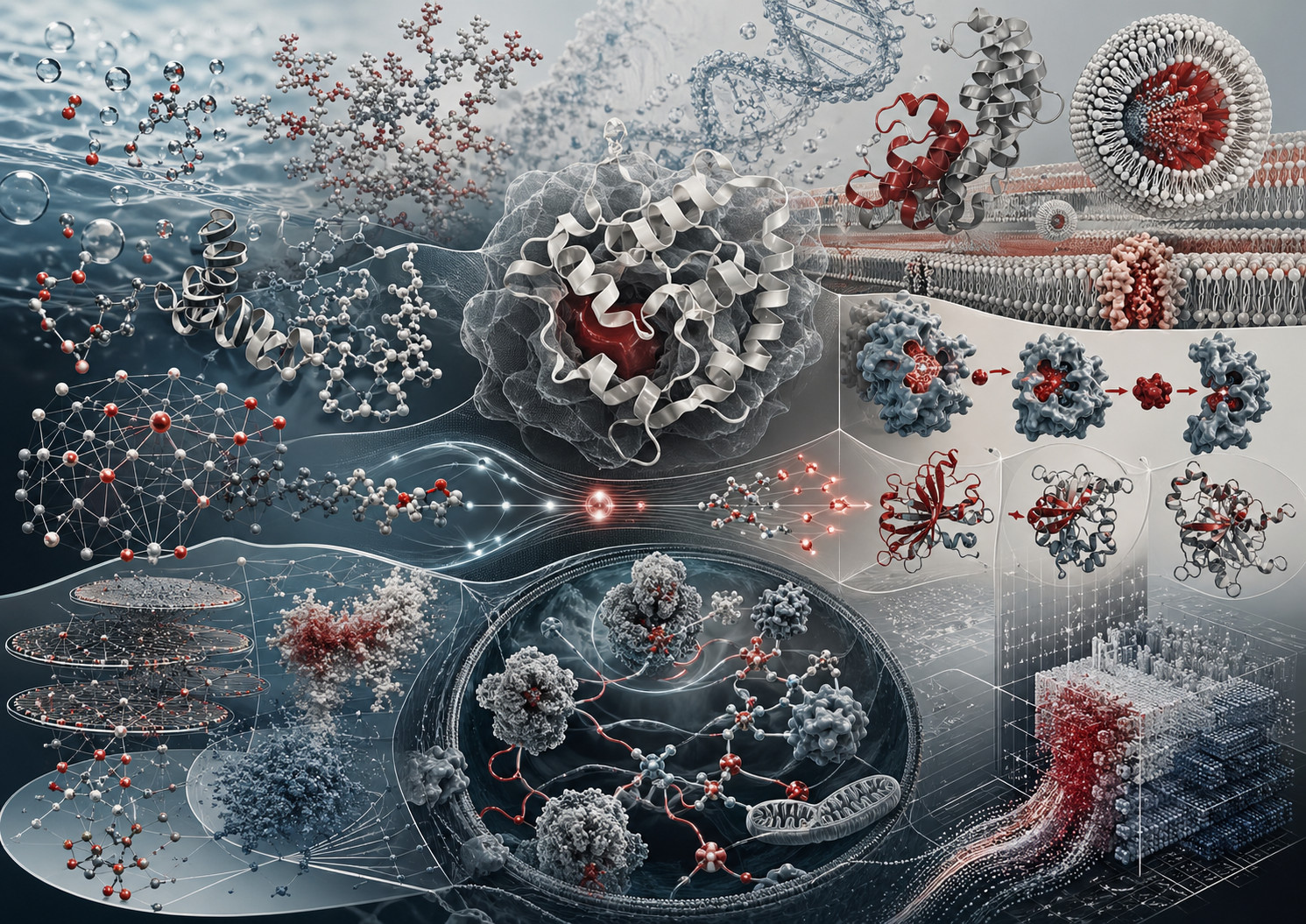
Biochemistry is the chemistry of life at molecular scale. It explains how atoms, bonds, ions, water, proteins, nucleic acids, carbohydrates, lipids, metabolites, cofactors, membranes, enzymes, and energy flows give living systems their structure, regulation, reproduction, responsiveness, and capacity for transformation.
The central thesis of this article is that life is not separate from chemistry. It is chemistry organized in a special way: compartmentalized, information-bearing, energy-transducing, catalytic, regulated, self-maintaining, and evolutionarily shaped. A cell is not merely a bag of molecules. It is a dynamic chemical system in which molecular structure, thermodynamics, kinetics, information, and environment are linked.
Biochemistry turns life into chemically interpretable structure and process. Proteins become molecular machines. DNA becomes a chemical archive of hereditary information. RNA becomes both information carrier and functional molecule. Membranes become selective chemical boundaries. Metabolism becomes a network of coupled transformations. Enzymes become catalysts shaped by structure, motion, and regulation.
Main Library
Publications
Article Map
Chemistry
Related Topic
Biology
Related Topic
Data Systems & Analytics
Related Topic
Mathematical Modeling
Why Biochemistry Matters
Biochemistry matters because life depends on molecular structure and chemical transformation. Health, disease, nutrition, immunity, development, aging, metabolism, infection, genetics, neuroscience, agriculture, biotechnology, pharmacology, ecology, and evolution all involve biochemical systems.
A disease may arise from a single amino acid substitution, an enzyme deficiency, a misfolded protein, an altered receptor, a blocked metabolic pathway, a damaged membrane, a disrupted ion gradient, a mutation in DNA, a defective RNA-processing system, a mitochondrial disorder, a signaling failure, or a breakdown in molecular quality control. A drug may work by binding an enzyme, receptor, ion channel, transporter, nucleic acid, or protein complex. A vaccine depends on molecular recognition. A diagnostic assay detects biochemical markers. A biotechnology process uses enzymes, cells, DNA, RNA, proteins, metabolites, or engineered pathways.
Biochemistry therefore links molecular detail to living consequence. It explains why small structural changes can have large biological effects, why energy flow is necessary for cellular order, why information must be copied and expressed, why membranes are essential boundaries, and why catalysis is central to life.
Biochemistry also matters because modern biology is increasingly molecular, quantitative, and computational. Sequencing produces biochemical information at genomic scale. Proteomics measures proteins and modifications. Metabolomics measures chemical state. Cryo-electron microscopy and structural prediction reveal macromolecular architecture. Mass spectrometry maps molecular composition. Computational models connect sequences, structures, pathways, and networks.
For researchers and scientists, biochemistry is not merely a catalog of molecules. It is the explanatory bridge between chemistry and living systems. To understand biochemistry is to understand that life is not metaphorical chemistry. It is chemistry organized into living systems.
Life as Organized Chemistry
Living systems obey the same chemical and physical laws as nonliving systems. They do not escape thermodynamics, kinetics, quantum structure, diffusion, electrostatics, acid-base chemistry, redox chemistry, or molecular recognition. What makes life distinctive is the organization of those processes.
Living systems are:
- compartmentalized, using membranes and internal structures to separate chemical environments;
- catalytic, using enzymes and ribozymes to accelerate specific reactions;
- informational, storing and expressing hereditary information through nucleic acids;
- metabolic, transforming matter and energy through networks of reactions;
- regulated, adjusting molecular processes in response to internal and external signals;
- evolutionary, shaped by variation, inheritance, selection, drift, and historical constraint.
A cell is therefore a chemical system with boundary, memory, energy flow, catalysis, and regulation. Biochemistry studies how those features arise from molecular interactions. The cell’s boundary is chemical. Its hereditary memory is chemical. Its catalysts are chemical. Its energy carriers are chemical. Its signals are chemical. Its networks are chemical.
Life also depends on nonequilibrium organization. Living systems maintain order by exchanging matter and energy with their environments. They build gradients, repair damage, replace molecules, synthesize macromolecules, degrade waste, and regulate flux. This organization requires continuous chemical work.
The molecular basis of life is not found in one molecule alone. It emerges from networks of molecules interacting in water, across membranes, under thermodynamic constraint, and through information-bearing polymers. DNA alone is not life. Protein alone is not life. Lipid membranes alone are not life. Life arises from coupled molecular systems that store information, transform energy, maintain boundaries, and reproduce with variation.
For researchers, this means biochemistry must be interpreted across scales: atoms, functional groups, macromolecules, complexes, membranes, pathways, cells, organisms, ecosystems, and evolutionary histories.
Water and the Chemical Environment of Life
Water is the chemical environment of life. Its polarity, hydrogen-bonding capacity, high heat capacity, solvent behavior, ionization, and ability to organize hydrophobic and hydrophilic interactions make biological chemistry possible.
Water dissolves ions and polar molecules, participates in acid-base reactions, mediates hydrogen bonding, shapes protein folding, influences membrane formation, and affects enzyme catalysis. It is not just a background medium. It is an active chemical participant.
A simple representation of water autoionization is:
2H_2O \rightleftharpoons H_3O^+ + OH^-
\]
Interpretation: Water can act as both acid and base. Proton transfer in water underlies pH, buffers, enzyme mechanisms, ion gradients, and biochemical regulation.
The equilibrium behavior of protons in water underlies pH, protein charge states, enzyme mechanisms, buffer systems, membrane gradients, and metabolic regulation. A small change in pH can alter ionization states, hydrogen bonding, protein conformation, enzyme activity, membrane transport, and molecular recognition.
Water also helps explain the hydrophobic effect. Nonpolar molecules do not simply “dislike” water. Rather, water molecules organize around nonpolar surfaces in ways that affect entropy and free energy. When nonpolar surfaces cluster, water can regain more favorable organization. This effect contributes to protein folding, membrane assembly, ligand binding, and molecular recognition.
Biochemical water is often structured locally. Water molecules may occupy enzyme active sites, bridge protein-ligand interactions, mediate proton transfer, stabilize nucleic acid grooves, organize around membranes, or participate in ion coordination. Removing or displacing water can be central to binding and catalysis.
For researchers, biochemistry begins with water because biological molecules do not exist in isolation. They function in an aqueous chemical world where solvation, protonation, ionic strength, temperature, and local environment shape molecular behavior.
Biomolecules and Biochemical Diversity
Biomolecules are the chemical substances of living systems. Major classes include proteins, nucleic acids, carbohydrates, lipids, metabolites, cofactors, vitamins, hormones, pigments, signaling molecules, and inorganic ions.
Four broad molecular families are especially central:
- proteins, polymers of amino acids that perform catalysis, structure, transport, signaling, movement, regulation, and recognition;
- nucleic acids, polymers of nucleotides that store, transmit, and express biological information;
- carbohydrates, sugars and polysaccharides that support energy storage, structure, recognition, and extracellular architecture;
- lipids, hydrophobic and amphipathic molecules that form membranes, store energy, signal, and organize cellular compartments.
Biochemistry also depends on smaller molecules: amino acids, nucleotides, monosaccharides, fatty acids, organic acids, vitamins, metal ions, phosphate groups, coenzymes, redox cofactors, second messengers, and metabolic intermediates.
The diversity of biomolecules allows life to solve many chemical problems: storing information, accelerating reactions, building boundaries, sensing conditions, moving charge, controlling pH, storing energy, constructing tissues, regulating gene expression, and responding to stress.
Biochemical diversity also reflects chemical constraint. Carbon can form stable covalent frameworks. Nitrogen and oxygen support hydrogen bonding and acid-base chemistry. Phosphorus supports energy transfer and information-bearing backbones. Sulfur supports redox chemistry and metal coordination. Metal ions support catalysis, electron transfer, structure, and signaling.
For researchers, biomolecules should not be treated as isolated categories. Proteins bind nucleic acids. Lipids regulate proteins. Carbohydrates decorate proteins and lipids. Metabolites control enzymes. Cofactors enable catalysis. Metal ions organize structure and reactivity. Biochemical diversity is functional diversity because biomolecules operate together.
Proteins and Molecular Function
Proteins are among the most versatile biomolecules. They are polymers of amino acids linked by peptide bonds. Their functions depend on sequence, folding, dynamics, chemical groups, cofactors, modifications, binding partners, and environment.
A peptide bond connects amino acids through an amide linkage:
\mathrm{Amino\ acid_1} + \mathrm{Amino\ acid_2} \rightarrow \mathrm{Peptide} + H_2O
\]
Interpretation: Peptide-bond formation links amino acids into polypeptides. In cells, this reaction is performed by ribosomes and supported by activated aminoacyl-tRNA intermediates.
Proteins organize across several structural levels:
- primary structure: amino acid sequence;
- secondary structure: local patterns such as alpha helices and beta sheets;
- tertiary structure: three-dimensional folding of a single polypeptide;
- quaternary structure: assembly of multiple protein subunits.
Protein folding is governed by interactions among amino acid side chains, backbone hydrogen bonding, hydrophobic effects, electrostatics, disulfide bonds, metal coordination, and solvent. Proteins are not rigid sculptures. They move, fluctuate, bind, switch conformations, and respond to chemical signals.
Protein function includes catalysis, structural support, molecular transport, signal transduction, immune recognition, mechanical movement, membrane transport, gene regulation, and metabolic control. A protein’s function may depend on one active site, a distributed allosteric network, a conformational transition, a post-translational modification, or assembly into a larger complex.
Protein dysfunction can arise from altered sequence, misfolding, aggregation, degradation failure, mislocalization, covalent modification, oxidative damage, metal imbalance, or disrupted binding. Many diseases are therefore biochemical protein problems: enzymes lose function, receptors mis-signal, antibodies misrecognize, transporters fail, and structural proteins destabilize tissues.
For researchers, proteins are molecular function made tangible. Their chemistry is encoded by sequence, but realized through folding, dynamics, interactions, and regulation.
Enzymes and Biological Catalysis
Enzymes are biological catalysts. They accelerate chemical reactions by lowering activation barriers, stabilizing transition states, positioning reactants, providing catalytic groups, excluding water, using cofactors, or coupling reactions to favorable processes.
A simplified enzyme reaction is:
E + S \rightleftharpoons ES \rightarrow E + P
\]
Interpretation: \(E\) is enzyme, \(S\) is substrate, \(ES\) is enzyme-substrate complex, and \(P\) is product. The enzyme participates in the mechanism but is regenerated after catalysis.
Enzymes do not change the thermodynamic equilibrium of a reaction. They change how fast equilibrium is approached. This distinction matters: catalysis affects rate, not the fundamental free-energy difference between reactants and products.
Many enzymes use acid-base catalysis, covalent catalysis, metal-ion catalysis, electrostatic stabilization, proximity effects, orientation effects, and conformational change. Some require cofactors such as metal ions, flavins, heme groups, pyridoxal phosphate, biotin, thiamine pyrophosphate, or nicotinamide cofactors.
Enzyme active sites are chemically specialized environments. They may shift pKa values, organize water molecules, stabilize charged intermediates, bind metal ions, exclude bulk solvent, or force substrates into reactive conformations. Enzymatic catalysis is therefore not just chemical reactivity. It is chemical reactivity shaped by molecular architecture.
Enzymes are also regulated. They may be activated or inhibited by metabolites, covalent modification, allosteric binding, compartmentalization, protein-protein interactions, gene expression, or degradation. This regulation allows cells to coordinate metabolic flux, signal response, and energy use.
For researchers, enzymes show why biological life depends on catalysis. Uncatalyzed chemistry is often too slow, too nonspecific, or too poorly controlled for living systems.
Nucleic Acids and Biochemical Information
Nucleic acids are polymers of nucleotides. DNA stores hereditary information. RNA participates in information transfer, catalysis, regulation, translation, and gene expression.
A nucleotide contains a nitrogenous base, a sugar, and phosphate. Nucleic acids have sugar-phosphate backbones with bases projecting outward. Complementary base pairing allows information to be copied and read.
The familiar DNA pairing pattern is:
A \leftrightarrow T
\]
Interpretation: Adenine pairs with thymine in DNA through complementary hydrogen bonding and molecular geometry.
G \leftrightarrow C
\]
Interpretation: Guanine pairs with cytosine in DNA. This base-pairing logic supports replication, transcription, and sequence recognition.
RNA commonly uses uracil instead of thymine:
A \leftrightarrow U
\]
Interpretation: Adenine pairs with uracil in RNA. RNA base pairing supports translation, folding, regulation, and RNA-guided molecular processes.
The central flow of genetic information is often summarized as:
DNA \rightarrow RNA \rightarrow Protein
\]
Interpretation: This simplified framework connects genetic storage, transcription, and translation. Real biological information flow also includes regulation, modification, repair, RNA processing, and feedback from proteins and metabolism.
Nucleic acids are chemical information systems. Their sequence stores instructions, but biological meaning depends on molecular processes: replication, transcription, translation, repair, splicing, modification, folding, regulation, chromatin organization, and interaction with proteins.
This framework is useful, but real biology is richer. RNA can regulate genes, catalyze reactions, form structures, guide modifications, and participate in protein synthesis. DNA can be chemically modified. Proteins regulate DNA and RNA. Metabolism affects gene expression. Cellular context shapes information use.
For researchers, biochemical information is chemical sequence plus molecular interpretation. Sequence matters, but the cell’s chemistry determines how sequence is read, protected, modified, and expressed.
Carbohydrates and Cellular Structure
Carbohydrates include monosaccharides, disaccharides, oligosaccharides, and polysaccharides. They function in energy storage, structure, recognition, signaling, and extracellular organization.
Glucose is a central metabolic sugar. Polysaccharides such as starch and glycogen store energy. Cellulose provides structural support in plant cell walls. Chitin supports arthropod exoskeletons and fungal cell walls. Glycosaminoglycans contribute to extracellular matrices. Glycoproteins and glycolipids participate in cell recognition, immunity, development, and signaling.
Carbohydrates are chemically rich because they contain multiple hydroxyl groups, stereocenters, ring forms, glycosidic linkages, branching patterns, and modifications. Small differences in stereochemistry or linkage position can produce very different biological properties.
A simplified glycosidic bond formation can be represented as:
\mathrm{Sugar{-}OH} + \mathrm{HO{-}Sugar} \rightarrow \mathrm{Sugar{-}O{-}Sugar} + H_2O
\]
Interpretation: Glycosidic bonds link sugar units into oligosaccharides and polysaccharides. In biological systems, enzyme-catalyzed reactions control linkage type, stereochemistry, and branching.
Carbohydrates show that biological information is not stored only in DNA. Glycan structure can encode recognition patterns, cellular identity, immune signals, and developmental information. Cell-surface glycans influence pathogen binding, immune recognition, protein folding, cell adhesion, and intercellular communication.
Glycobiology is difficult because carbohydrate structures are not template-coded in the same direct way as nucleic acids and proteins. Glycan structures emerge from enzyme localization, substrate availability, pathway organization, and cellular state. This makes glycan analysis chemically and computationally challenging.
For researchers, the chemistry of sugars is a chemistry of stereochemistry, linkage, branching, modification, and recognition.
Lipids, Membranes, and Compartmentalization
Lipids are hydrophobic or amphipathic molecules that include fatty acids, triglycerides, phospholipids, sterols, sphingolipids, waxes, lipid-soluble vitamins, and signaling lipids.
Membranes are among life’s most important biochemical structures. Phospholipids have hydrophilic head groups and hydrophobic tails. In water, they can self-assemble into bilayers, forming selective boundaries between cellular compartments and their surroundings.
Membranes do more than enclose cells. They organize proteins, maintain ion gradients, support signaling, control transport, enable energy conversion, and create specialized chemical environments. Mitochondrial membranes support oxidative phosphorylation. Thylakoid membranes support photosynthesis. Plasma membranes support signaling, transport, and cellular identity.
Lipid composition affects membrane fluidity, curvature, permeability, microdomains, protein function, and response to temperature. Cholesterol modulates animal cell membranes. Saturated and unsaturated fatty acids affect packing. Charged lipids influence protein binding and signaling. Sphingolipids and phosphoinositides participate in signaling and membrane organization.
Membranes also define biochemical locality. A reaction at a membrane surface can differ from the same reaction in bulk solution. Membrane-bound proteins experience local lipid composition, curvature, electrostatic environment, tension, and compartmental identity. Many signaling pathways depend on recruitment to membrane surfaces.
For researchers, life requires boundaries, and lipids provide chemically dynamic boundaries. Compartmentalization is not only structural. It is biochemical regulation through space.
Metabolism and the Chemical Economy of Life
Metabolism is the network of chemical reactions that transforms matter and energy in living systems. It includes catabolism, which breaks molecules down and releases useful energy, and anabolism, which builds molecules and requires energy input.
Major metabolic processes include glycolysis, the citric acid cycle, oxidative phosphorylation, photosynthesis, fatty acid metabolism, amino acid metabolism, nucleotide metabolism, gluconeogenesis, glycogen metabolism, and many specialized biosynthetic pathways.
Metabolism is not a random collection of reactions. It is organized by chemical logic:
- carbon skeletons are rearranged, oxidized, reduced, cleaved, and combined;
- phosphate groups activate molecules and transfer energy;
- redox cofactors move electrons;
- coenzyme A carries acyl groups;
- gradients store free energy;
- feedback regulation matches flux to need.
A metabolic pathway is a reaction network. Its behavior depends on enzyme kinetics, substrate availability, product removal, allosteric regulation, compartmentalization, energy charge, redox state, and gene expression.
Metabolism also reflects environment and history. Organisms differ in available nutrients, oxygen exposure, light use, temperature range, ecological niche, and evolutionary inheritance. Some pathways are conserved across life; others are specialized for particular organisms, tissues, symbioses, pathogens, or ecosystems.
For researchers, metabolism is the chemical economy of life: input, transformation, storage, exchange, regulation, and output. It is not only a set of textbook pathways, but an adaptive network that couples molecular chemistry to cellular need.
ATP, Redox Cofactors, and Energy Transduction
Living systems require energy transduction: the conversion of energy from one form into another. ATP, redox cofactors, ion gradients, light-absorbing pigments, and membrane proteins are central to this process.
ATP is often described as an energy currency because its hydrolysis can be coupled to unfavorable processes:
ATP + H_2O \rightarrow ADP + P_i
\]
Interpretation: ATP hydrolysis can be coupled to otherwise unfavorable biochemical processes. Its importance depends on cellular concentration ratios, phosphoryl transfer, enzyme coupling, and free-energy context.
The biochemical importance of ATP is not that one molecule “contains energy” in isolation. Its importance lies in free-energy coupling, phosphoryl-group transfer, cellular concentration ratios, and enzymatic context.
Redox cofactors such as NADH, NADPH, FADH\(_2\), quinones, cytochromes, iron-sulfur clusters, and metal centers move electrons through biochemical systems. Electron transfer is central to respiration, photosynthesis, biosynthesis, detoxification, and oxidative stress.
Membrane gradients also store free energy. Proton gradients across membranes drive ATP synthesis, transport, motility, and signaling. Chemiosmotic coupling links electron transfer to proton movement and ATP formation.
Energy transduction is highly regulated because uncontrolled energy flow is dangerous. Reactive oxygen species, redox imbalance, ATP depletion, proton-gradient collapse, and mitochondrial dysfunction can damage cells. Conversely, controlled energy transduction enables growth, movement, synthesis, repair, and adaptation.
For researchers, biochemistry is not only molecular structure. It is controlled energy flow through molecular systems.
Molecular Recognition, Signaling, and Regulation
Living systems depend on molecular recognition: the ability of molecules to bind selectively to other molecules. Enzymes recognize substrates. Receptors recognize ligands. Antibodies recognize antigens. Transcription factors recognize DNA sequences. Transporters recognize solutes. Chaperones recognize folding states.
Binding depends on shape, charge, hydrogen bonding, hydrophobic interactions, metal coordination, conformational flexibility, water displacement, and thermodynamics.
A simple binding equilibrium is:
P + L \rightleftharpoons PL
\]
Interpretation: \(P\) is protein, \(L\) is ligand, and \(PL\) is the protein-ligand complex. Binding is context-dependent and can be affected by pH, ionic strength, temperature, cofactors, and competing molecules.
The dissociation constant is:
K_d = \frac{[P][L]}{[PL]}
\]
Interpretation: A lower \(K_d\) generally indicates tighter binding under defined conditions. Binding affinity is not identical to biological effect.
Signaling systems use molecular recognition to transmit information. Hormones, neurotransmitters, cytokines, growth factors, second messengers, phosphorylation cascades, G proteins, kinases, phosphatases, receptors, and transcriptional regulators allow cells to respond to their environment.
Regulation prevents biochemical systems from becoming uncontrolled chemistry. It makes metabolism adaptive, gene expression conditional, development organized, and cellular response coordinated. Regulation may occur through allostery, covalent modification, compartmentalization, degradation, feedback inhibition, transcriptional control, translational control, or post-translational modification.
For researchers, life is chemically responsive because biochemical systems can recognize, switch, amplify, inhibit, adapt, and remember molecular signals.
Allostery, Cooperativity, and Biochemical Control
Allostery occurs when binding or modification at one site affects function at another site. It is one of the central mechanisms of biochemical regulation. An allosteric ligand may activate or inhibit an enzyme, shift protein conformation, alter binding affinity, change catalytic rate, or reorganize a molecular complex.
Cooperativity occurs when binding at one site affects binding at additional sites. Hemoglobin is the classic example: oxygen binding changes the protein’s conformation and alters the affinity of remaining binding sites. Cooperativity allows biochemical systems to behave as switches, sensors, and amplifiers.
A simple Hill-type occupancy relationship is:
\theta = \frac{[L]^n}{K_d^n + [L]^n}
\]
Interpretation: \(\theta\) is fractional occupancy, \([L]\) is ligand concentration, \(K_d\) is an apparent dissociation parameter, and \(n\) is a cooperativity parameter. The Hill equation is a useful empirical scaffold, not a complete mechanism by itself.
Allostery and cooperativity show that biomolecules are not static binding surfaces. They are dynamic systems. A small change in one region can propagate across a protein or complex. This propagation may involve conformational shifts, altered dynamics, changed hydration, rearranged electrostatics, or changes in oligomeric state.
Allostery is central to metabolic control, signal transduction, transcriptional regulation, receptor biology, enzyme regulation, drug discovery, and molecular evolution. It also provides a route for selective intervention: allosteric sites may be less conserved than active sites, allowing more specific modulation.
For researchers, allostery is the biochemical principle that local molecular events can produce distant functional consequences. It is one of the reasons molecular biology cannot be understood from static structures alone.
Biochemical Networks and Systems Biology
Biochemical systems are networks. A protein may interact with many partners. A metabolite may participate in several pathways. A gene may regulate many genes. A signaling molecule may activate multiple downstream processes. A membrane gradient may power transport, synthesis, and motility.
Systems biology studies these networks as connected systems. It combines biochemistry, molecular biology, mathematics, computation, and measurement to understand how cellular behavior emerges from molecular interactions.
Important network ideas include:
- metabolic flux;
- feedback inhibition;
- feedforward control;
- allostery;
- signal amplification;
- network motifs;
- homeostasis;
- robustness;
- bistability;
- oscillation;
- noise;
- adaptation.
Biochemical networks explain why molecular-level changes can produce system-level consequences. A mutation can alter enzyme activity. Altered enzyme activity can redirect metabolic flux. Redirected flux can change cellular energy state. Changed energy state can affect gene expression, growth, stress response, and survival.
Networks also explain why biochemical causation can be difficult. A perturbation may trigger feedback. A pathway may compensate. Multiple enzymes may share substrates. A metabolite may act as both intermediate and signal. A protein may have catalytic and structural roles. A phenotype may emerge from distributed changes rather than one isolated molecular event.
For researchers, biochemistry scales from atoms to networks. The challenge is to preserve molecular detail while understanding system behavior.
Structural Biology and Molecular Evidence
Structural biology provides molecular evidence for biochemical function. Techniques such as X-ray crystallography, nuclear magnetic resonance spectroscopy, cryo-electron microscopy, mass spectrometry, and computational structure prediction help reveal the shapes and interactions of biomolecules.
A protein structure can show active sites, binding pockets, allosteric sites, metal centers, membrane-spanning domains, domain organization, conformational states, and interaction surfaces. A nucleic acid structure can reveal base pairing, grooves, tertiary folding, catalytic RNA motifs, and protein-binding interfaces. A macromolecular complex can reveal how molecular machines assemble and function.
Structure does not automatically explain everything. Biomolecules move. Some regions are disordered. Function may depend on dynamics, solvent, pH, ligands, post-translational modifications, membrane environment, crowding, or cellular context. Still, structural evidence is essential because biological function is physically embodied.
Structural evidence also has limits. Crystal packing may constrain conformations. Cryo-EM maps may represent selected states. NMR structures depend on restraints and dynamics. Predicted structures require confidence assessment. A static model may not reveal catalytic timing, allosteric switching, disorder, or transient interactions.
For researchers, biochemistry becomes more powerful when molecular structures are connected to kinetics, thermodynamics, genetics, cellular data, evolutionary comparison, and computational modeling. Structure is a foundation for explanation, not the entire explanation.
Molecular Evolution and Biochemical Constraint
Biochemistry is shaped by evolution. Proteins, enzymes, pathways, membranes, cofactors, and nucleic acid systems carry histories of variation, selection, constraint, duplication, divergence, and adaptation. The molecular basis of life is not designed from scratch. It is inherited, modified, conserved, and repurposed.
Molecular evolution helps explain why some residues are conserved, why enzyme families share structural folds, why metabolic pathways reuse cofactors, why genetic code structure matters, why proteins tolerate some mutations and not others, and why biochemical systems show both robustness and fragility.
Sequence conservation can indicate functional importance, but it must be interpreted carefully. A conserved residue may support catalysis, folding, binding, allostery, stability, localization, or regulation. A variable region may be functionally important in a lineage-specific context. Evolutionary information is therefore evidence, not automatic explanation.
Biochemical constraints also shape what evolution can explore. Protein folding imposes stability constraints. Metabolic pathways impose thermodynamic and stoichiometric constraints. Membranes impose permeability and compartment constraints. Enzymes impose catalytic constraints. Information systems impose replication and repair constraints.
For researchers, molecular evolution adds historical depth to biochemistry. It explains why living chemistry is both inventive and constrained: flexible enough to evolve, but limited by molecular physics and inherited architecture.
Biochemistry, Medicine, and Biotechnology
Biochemistry is foundational to medicine and biotechnology. Many diseases are biochemical disturbances: enzyme deficiencies, receptor defects, protein misfolding, altered metabolism, DNA damage, RNA-processing errors, mitochondrial dysfunction, membrane defects, immune misrecognition, or signaling failures.
Medical biochemistry supports:
- diagnostic biomarkers;
- drug-target discovery;
- pharmacology;
- toxicology;
- metabolic disease analysis;
- cancer biology;
- infectious disease mechanisms;
- genetic testing;
- protein therapeutics;
- enzyme replacement therapies;
- vaccine development.
Biotechnology uses biochemical systems as tools. Recombinant DNA, protein engineering, enzyme catalysis, fermentation, CRISPR systems, biosensors, synthetic biology, metabolic engineering, RNA therapeutics, antibody technologies, and cell-based manufacturing all depend on biochemical principles.
Biochemistry also supports public health and environmental science. Metabolism shapes nutrition and disease risk. Enzymes support industrial biocatalysis. Microbial pathways affect climate, soil, water, and nutrient cycles. Biochemical markers help monitor exposure, disease, and ecological stress.
For researchers, biochemistry is not merely explanatory. It is also constructive. It allows humans to measure, modify, engineer, and design biological systems. That constructive power requires careful validation, safety, ethics, and attention to unequal access to biomedical and biotechnological benefits.
Computational Biochemistry
Computational biochemistry uses data, models, algorithms, and simulations to study biomolecular systems. It includes sequence analysis, protein structure prediction, molecular dynamics, docking, enzyme kinetics, metabolic modeling, pathway analysis, network modeling, omics integration, phylogenetics, and machine learning.
Computational biochemical workflows can support:
- amino acid sequence analysis;
- nucleotide sequence analysis;
- protein-property calculation;
- enzyme kinetic fitting;
- binding-equilibrium analysis;
- metabolic flux scaffolds;
- network graph analysis;
- protein-ligand interaction models;
- structural comparison;
- pathway enrichment;
- multi-omics interpretation.
Computation is valuable because biochemical systems are large, dynamic, and data-rich. A protein sequence may contain evolutionary clues. A structure prediction may guide experiments. A metabolic model may identify pathway constraints. A kinetic fit may reveal catalytic behavior. A network model may show feedback and fragility. A molecular dynamics simulation may suggest conformational mechanisms.
But computational biochemistry requires caution. Sequence similarity does not guarantee identical function. Structure prediction is not the same as experimental validation. Docking scores are not binding free energies. Omics correlations are not mechanisms. Network models depend on assumptions, parameters, and data quality. Machine-learning predictions require applicability-domain awareness.
For researchers, good computational biochemistry connects code, chemistry, biological context, uncertainty, and evidence. Computation should make biochemical reasoning more transparent, not replace biochemical judgment.
Mathematical Lens: Biochemistry
Biochemistry uses mathematics to connect molecular structure, concentration, binding, catalysis, equilibrium, energy, sequence, and networks. Michaelis-Menten kinetics can be written as:
v = \frac{V_{\max}[S]}{K_M + [S]}
\]
Interpretation: \(v\) is reaction velocity, \(V_{\max}\) is maximum velocity, \([S]\) is substrate concentration, and \(K_M\) is the Michaelis constant. The model applies under specific kinetic assumptions and experimental conditions.
Binding equilibrium can be described by:
K_d = \frac{[P][L]}{[PL]}
\]
Interpretation: \(K_d\) relates free protein, free ligand, and bound complex. It is condition-dependent and should not be treated as universal outside the assay context.
Fractional occupancy is:
\theta = \frac{[L]}{K_d + [L]}
\]
Interpretation: \(\theta\) is the fraction of binding sites occupied under a simple one-site binding model.
Gibbs free energy and reaction quotient are related by:
\Delta G = \Delta G^\circ + RT\ln Q
\]
Interpretation: The actual free-energy change depends on standard free energy, temperature, and reaction quotient. Cellular concentrations can shift reaction favorability.
Standard free energy and equilibrium constant are related by:
\Delta G^\circ = -RT\ln K
\]
Interpretation: Favorable standard free energy corresponds to larger equilibrium constants. Biochemical interpretation must consider cellular conditions and coupling.
The Hill equation is:
\theta = \frac{[L]^n}{K_d^n + [L]^n}
\]
Interpretation: The Hill coefficient \(n\) provides a scaffold for cooperative binding behavior. It is often empirical and should not be overinterpreted as a direct count of binding sites.
First-order decay is:
[A](t) = [A]_0e^{-kt}
\]
Interpretation: The concentration of \(A\) decreases exponentially over time under first-order assumptions. This can model degradation, turnover, or decay processes when conditions are appropriate.
A metabolic flux-balance scaffold is:
S\mathbf{v} = 0
\]
Interpretation: \(S\) is the stoichiometric matrix and \(\mathbf{v}\) is the flux vector at steady state. The equation states that internal metabolites do not accumulate under the modeled steady-state assumptions.
Sequence composition can be written as:
f_i = \frac{n_i}{N}
\]
Interpretation: \(f_i\) is the fraction of residue or nucleotide type \(i\), \(n_i\) is its count, and \(N\) is total sequence length. Composition is a simple but useful sequence descriptor.
A perturbation response can be summarized as:
\Delta \mathbf{x} = \mathbf{x}_{\mathrm{treated}} – \mathbf{x}_{\mathrm{control}}
\]
Interpretation: This vector describes how biochemical features change between conditions. Interpretation depends on normalization, measurement quality, and biological context.
These equations show that biochemistry is not only descriptive biology. It is quantitative chemistry applied to living systems.
Computational Workflows for Biochemistry
Computational workflows can make biochemistry more transparent. A workflow can track enzyme parameters, binding constants, sequence composition, mutation records, protein annotations, metabolic stoichiometry, flux assumptions, structural files, biomolecular interactions, assay conditions, pathway membership, and evidence status.
Useful workflows include Michaelis-Menten scaffolds, binding-occupancy curves, sequence-composition summaries, metabolic flux checks, protein-property tables, enzyme activity records, mutation-effect annotations, structural evidence registers, pathway membership tables, and SQL evidence systems.
For researchers, biochemical workflows should preserve four distinctions:
- Presence versus activity: a protein may be present but inactive, inhibited, mislocalized, or modified.
- Sequence versus function: sequence similarity can suggest function, but it does not prove it.
- Structure versus mechanism: a molecular structure can support mechanistic interpretation, but dynamics and context still matter.
- Concentration versus flux: metabolite abundance does not necessarily reveal pathway flow.
The examples below use synthetic educational data. They do not validate enzyme mechanisms, certify binding constants, establish metabolic flux, diagnose disease, or replace professional biochemical review. They demonstrate how biochemical reasoning can be structured, audited, and communicated responsibly.
Python Example: Enzyme Kinetics, Binding Occupancy, Sequence Composition, and Provenance
The following Python example uses synthetic educational data. It calculates Michaelis-Menten velocities, protein-ligand fractional occupancy, amino acid sequence composition, and writes provenance outputs. In real biochemical workflows, these scaffolds would require replicate structure, experimental conditions, uncertainty estimates, assay metadata, pH, temperature, buffer, enzyme preparation, and validation records.
from pathlib import Path
from typing import Dict, List
import json
import platform
import sys

import numpy as np
import pandas as pd


# Synthetic biochemistry workflow.
# Educational example only; not for clinical, diagnostic,
# therapeutic, regulatory, or safety-critical use.


def require_columns(data: pd.DataFrame, required: List[str], table_name: str) -> None:
    """Raise an error if required columns are missing."""
    missing = [column for column in required if column not in data.columns]
    if missing:
        raise ValueError(f"{table_name} is missing required columns: {missing}")


def michaelis_menten(substrate_mM: pd.Series, vmax: float, km_mM: float) -> pd.Series:
    """Calculate Michaelis-Menten velocity."""
    return vmax * substrate_mM / (km_mM + substrate_mM)


def fractional_occupancy(ligand_uM: pd.Series, kd_uM: float) -> pd.Series:
    """Calculate one-site fractional occupancy."""
    return ligand_uM / (kd_uM + ligand_uM)


def sequence_composition(sequence: str) -> pd.DataFrame:
    """Calculate residue composition for a protein-like sequence."""
    residues = list(sequence)
    total = len(residues)

    if total == 0:
        raise ValueError("Sequence must not be empty.")

    counts = pd.Series(residues).value_counts().sort_index()

    return pd.DataFrame({
        "residue": counts.index,
        "count": counts.values,
        "fraction": counts.values / total,
    })


substrate = pd.DataFrame({
    "substrate_mM": [0.1, 0.25, 0.5, 1, 2, 5, 10, 25],
})

substrate["velocity_units"] = michaelis_menten(
    substrate_mM=substrate["substrate_mM"],
    vmax=120.0,
    km_mM=3.5,
)

substrate["low_substrate_review"] = substrate["substrate_mM"] < 0.25

ligand = pd.DataFrame({
    "ligand_uM": [0.01, 0.05, 0.1, 0.5, 1, 2, 5, 10, 50],
})

ligand["fractional_occupancy"] = fractional_occupancy(
    ligand_uM=ligand["ligand_uM"],
    kd_uM=2.0,
)

ligand["high_occupancy"] = ligand["fractional_occupancy"] > 0.8

protein_sequence = "MSTNPKPQRKTKRNTNRRPQDVKFPGG"
composition = sequence_composition(protein_sequence)

composition["enriched_residue_review"] = composition["fraction"] > 0.15

output_dir = Path("outputs")
output_dir.mkdir(exist_ok=True)

substrate.to_csv(output_dir / "synthetic_michaelis_menten.csv", index=False)
ligand.to_csv(output_dir / "synthetic_binding_occupancy.csv", index=False)
composition.to_csv(output_dir / "synthetic_sequence_composition.csv", index=False)

manifest: Dict[str, object] = {
    "workflow": "synthetic_biochemistry_workflow",
    "data_type": "synthetic educational biochemical records",
    "kinetic_model": "v = Vmax * [S] / (Km + [S])",
    "vmax_units": "arbitrary velocity units",
    "km_mM": 3.5,
    "binding_model": "theta = [L] / (Kd + [L])",
    "kd_uM": 2.0,
    "sequence_length": len(protein_sequence),
    "python_version": sys.version,
    "platform": platform.platform(),
    "numpy_version": np.__version__,
    "pandas_version": pd.__version__,
    "output_files": [
        "outputs/synthetic_michaelis_menten.csv",
        "outputs/synthetic_binding_occupancy.csv",
        "outputs/synthetic_sequence_composition.csv",
        "outputs/biochemistry_manifest.json",
    ],
    "responsible_use": [
        "Synthetic educational data only.",
        "Real biochemical workflows require replicate design, assay conditions, uncertainty estimates, protein preparation records, buffer composition, pH, temperature, controls, and expert review.",
    ],
}

with (output_dir / "biochemistry_manifest.json").open(
    "w",
    encoding="utf-8"
) as file:
    json.dump(manifest, file, indent=2)

print("Michaelis-Menten scaffold")
print("-------------------------")
print(substrate.round(6).to_string(index=False))

print("\nBinding-occupancy scaffold")
print("--------------------------")
print(ligand.round(6).to_string(index=False))

print("\nSequence-composition scaffold")
print("-----------------------------")
print(composition.round(6).to_string(index=False))
This workflow demonstrates biochemical evidence discipline rather than real assay validation. It separates enzyme kinetics, binding occupancy, and sequence composition, while preserving units, assumptions, outputs, and responsible-use notes. A real workflow would add replicates, confidence intervals, assay metadata, protein identity, purification records, environmental conditions, and validation evidence.
R Example: Sequence Composition and Metabolic Flux Check
The following R example uses synthetic educational data to calculate sequence composition and perform a simplified metabolic steady-state check. In real biochemical modeling, metabolic flux analysis requires defined network boundaries, stoichiometry, reversibility, constraints, exchange reactions, measurement data, and uncertainty review.
# Synthetic biochemistry scaffold.
# Educational example only; not for clinical, diagnostic,
# therapeutic, regulatory, or safety-critical use.

sequence <- "MSTNPKPQRKTKRNTNRRPQDVKFPGG"

residues <- strsplit(sequence, "")[[1]]
counts <- table(residues)

composition <- data.frame(
  residue = names(counts),
  count = as.integer(counts),
  fraction = as.numeric(counts) / length(residues)
)

composition$enriched_residue_review <- composition$fraction > 0.15

S <- matrix(
  c(
    -1,  0,  0,
     1, -1,  0,
     0,  1, -1
  ),
  nrow = 3,
  byrow = TRUE
)

rownames(S) <- c("A", "B", "C")
colnames(S) <- c("v1_A_to_B", "v2_B_to_C", "v3_C_export")

v <- c(10, 10, 10)

steady_state_balance <- S %*% v

flux_report <- data.frame(
  metabolite = rownames(S),
  balance = as.numeric(steady_state_balance),
  steady_state_review_required = abs(as.numeric(steady_state_balance)) > 1e-9
)

dir.create("outputs", showWarnings = FALSE)

write.csv(
  composition,
  file = "outputs/r_sequence_composition.csv",
  row.names = FALSE
)

write.csv(
  flux_report,
  file = "outputs/r_metabolic_flux_check.csv",
  row.names = FALSE
)

sink("outputs/r_biochemistry_report.txt")
cat("Synthetic Biochemistry Scaffold Report\n")
cat("======================================\n\n")
cat("Sequence composition:\n")
print(composition)
cat("\nStoichiometric matrix:\n")
print(S)
cat("\nSteady-state balance:\n")
print(flux_report)
cat("\nResponsible-use note:\n")
cat("Synthetic educational data only. Real biochemical analysis requires validated sequences, assay metadata, stoichiometric definitions, measurement data, uncertainty review, and expert interpretation.\n")
sink()

print(composition)
print(flux_report)
This scaffold shows how R can support biochemical summaries and simple network checks. The central issue is not the language but the evidence chain. Sequence and flux outputs should remain connected to source data, model assumptions, measurement conditions, and biological context.
SQL Example: Biochemistry Evidence Register
Biochemistry becomes more reliable when biomolecules, sequences, structures, enzyme assays, binding measurements, metabolic pathways, flux models, structural evidence, and interpretation claims are traceable. A simple evidence register can preserve the context needed to audit biochemical results.
CREATE TABLE biomolecule_record (
    biomolecule_id TEXT PRIMARY KEY,
    biomolecule_name TEXT NOT NULL,
    biomolecule_type TEXT,
    organism TEXT,
    gene_symbol TEXT,
    accession_id TEXT,
    sequence_uri TEXT,
    structure_uri TEXT,
    molecular_weight_da REAL,
    record_quality_flag TEXT,
    record_notes TEXT
);

CREATE TABLE protein_sequence_record (
    sequence_id TEXT PRIMARY KEY,
    biomolecule_id TEXT NOT NULL,
    sequence_length INTEGER CHECK (sequence_length >= 0),
    sequence_checksum TEXT,
    source_database TEXT,
    isoform_notes TEXT,
    mutation_notes TEXT,
    sequence_review_status TEXT,
    FOREIGN KEY (biomolecule_id) REFERENCES biomolecule_record(biomolecule_id)
);

CREATE TABLE enzyme_assay_record (
    assay_id TEXT PRIMARY KEY,
    biomolecule_id TEXT NOT NULL,
    substrate_name TEXT,
    assay_type TEXT,
    vmax_value REAL,
    vmax_unit TEXT,
    km_value REAL,
    km_unit TEXT,
    kcat_value REAL,
    kcat_unit TEXT,
    ph REAL,
    temperature_c REAL,
    buffer_description TEXT,
    replicate_count INTEGER CHECK (replicate_count >= 1),
    assay_review_status TEXT,
    FOREIGN KEY (biomolecule_id) REFERENCES biomolecule_record(biomolecule_id)
);

CREATE TABLE binding_measurement_record (
    binding_id TEXT PRIMARY KEY,
    biomolecule_id TEXT NOT NULL,
    ligand_name TEXT,
    ligand_structure_uri TEXT,
    measurement_method TEXT,
    kd_value REAL,
    kd_unit TEXT,
    temperature_c REAL,
    buffer_description TEXT,
    replicate_count INTEGER CHECK (replicate_count >= 1),
    binding_review_status TEXT,
    FOREIGN KEY (biomolecule_id) REFERENCES biomolecule_record(biomolecule_id)
);

CREATE TABLE metabolic_pathway_record (
    pathway_id TEXT PRIMARY KEY,
    pathway_name TEXT NOT NULL,
    organism TEXT,
    compartment TEXT,
    pathway_database_uri TEXT,
    pathway_notes TEXT
);

CREATE TABLE metabolic_reaction_record (
    reaction_id TEXT PRIMARY KEY,
    pathway_id TEXT NOT NULL,
    reaction_name TEXT,
    enzyme_biomolecule_id TEXT,
    stoichiometry_description TEXT,
    reversibility TEXT,
    delta_g_kj_mol REAL,
    evidence_source TEXT,
    reaction_review_status TEXT,
    FOREIGN KEY (pathway_id) REFERENCES metabolic_pathway_record(pathway_id),
    FOREIGN KEY (enzyme_biomolecule_id) REFERENCES biomolecule_record(biomolecule_id)
);

CREATE TABLE structural_evidence_record (
    structure_id TEXT PRIMARY KEY,
    biomolecule_id TEXT NOT NULL,
    structure_method TEXT,
    resolution_angstrom REAL,
    structure_database_id TEXT,
    structure_uri TEXT,
    ligand_bound INTEGER CHECK (ligand_bound IN (0, 1)),
    structure_review_status TEXT,
    FOREIGN KEY (biomolecule_id) REFERENCES biomolecule_record(biomolecule_id)
);

CREATE TABLE biochemical_model_record (
    model_id TEXT PRIMARY KEY,
    model_name TEXT NOT NULL,
    model_type TEXT,
    associated_pathway_id TEXT,
    associated_biomolecule_id TEXT,
    model_file_uri TEXT,
    parameter_source TEXT,
    validation_status TEXT,
    model_notes TEXT,
    FOREIGN KEY (associated_pathway_id) REFERENCES metabolic_pathway_record(pathway_id),
    FOREIGN KEY (associated_biomolecule_id) REFERENCES biomolecule_record(biomolecule_id)
);

CREATE TABLE biochemical_interpretation_claim (
    claim_id TEXT PRIMARY KEY,
    biomolecule_id TEXT,
    pathway_id TEXT,
    model_id TEXT,
    claim_text TEXT,
    claim_type TEXT,
    confidence_level TEXT,
    limitation_notes TEXT,
    review_status TEXT,
    FOREIGN KEY (biomolecule_id) REFERENCES biomolecule_record(biomolecule_id),
    FOREIGN KEY (pathway_id) REFERENCES metabolic_pathway_record(pathway_id),
    FOREIGN KEY (model_id) REFERENCES biochemical_model_record(model_id)
);

SELECT
    b.biomolecule_id,
    b.biomolecule_name,
    b.biomolecule_type,
    b.organism,
    s.sequence_length,
    e.assay_type,
    e.km_value,
    e.km_unit,
    e.replicate_count AS enzyme_replicates,
    m.ligand_name,
    m.kd_value,
    m.kd_unit,
    m.replicate_count AS binding_replicates,
    st.structure_method,
    st.resolution_angstrom,
    c.claim_type,
    c.confidence_level,
    CASE
        WHEN b.accession_id IS NULL
             AND b.sequence_uri IS NULL
             AND b.structure_uri IS NULL
            THEN 'biomolecule identity review required'
        WHEN s.sequence_review_status IS NOT NULL
             AND s.sequence_review_status != 'pass'
            THEN 'sequence review required'
        WHEN e.assay_review_status IS NOT NULL
             AND e.assay_review_status != 'pass'
            THEN 'enzyme assay review required'
        WHEN e.replicate_count IS NOT NULL
             AND e.replicate_count < 3
            THEN 'enzyme replication review required'
        WHEN m.binding_review_status IS NOT NULL
             AND m.binding_review_status != 'pass'
            THEN 'binding review required'
        WHEN m.replicate_count IS NOT NULL
             AND m.replicate_count < 3
            THEN 'binding replication review required'
        WHEN st.structure_review_status IS NOT NULL
             AND st.structure_review_status != 'pass'
            THEN 'structural evidence review required'
        WHEN c.review_status IS NOT NULL
             AND c.review_status != 'reviewed'
            THEN 'interpretation review required'
        ELSE 'standard review'
    END AS biochemistry_review_status
FROM biomolecule_record b
LEFT JOIN protein_sequence_record s
    ON b.biomolecule_id = s.biomolecule_id
LEFT JOIN enzyme_assay_record e
    ON b.biomolecule_id = e.biomolecule_id
LEFT JOIN binding_measurement_record m
    ON b.biomolecule_id = m.biomolecule_id
LEFT JOIN structural_evidence_record st
    ON b.biomolecule_id = st.biomolecule_id
LEFT JOIN biochemical_interpretation_claim c
    ON b.biomolecule_id = c.biomolecule_id
ORDER BY biochemistry_review_status, b.biomolecule_id;
The purpose of this register is to keep biochemical interpretation attached to evidence. A biochemical claim should preserve biomolecule identity, sequence provenance, structure evidence, assay conditions, kinetic parameters, binding measurements, replicate counts, pathway context, model files, validation status, and interpretation review. Biochemistry becomes stronger when its evidence trail is structured.
GitHub Repository
The companion repository for this article can support reproducible workflows for enzyme kinetics, binding curves, sequence composition, metabolic flux scaffolds, biochemical network graphs, structural evidence records, pathway summaries, SQL evidence registers, and responsible biochemical interpretation.
Complete Code Repository
The full code distribution for this article, including selected biochemistry examples, expanded computational workflows, reproducible data structures, provenance documentation, enzyme-kinetics scaffolds, binding-occupancy examples, sequence-composition summaries, metabolic network checks, SQL evidence registers, and scientific-computing infrastructure, is available on GitHub.
Limits, Uncertainty, and Responsible Interpretation
Biochemistry is powerful, but it is not self-interpreting. A protein sequence does not automatically define function. A structure does not automatically explain mechanism. An enzyme assay does not automatically represent cellular activity. A metabolite concentration does not automatically reveal flux. A binding constant does not automatically explain biological response. A biomarker does not automatically establish causality.
Uncertainty enters biochemical interpretation at many levels: sample preparation, purity, pH, temperature, buffer composition, ionic strength, protein folding state, post-translational modification, cofactors, substrate identity, assay interference, replicate design, structural resolution, cellular context, species differences, compartmentalization, and measurement noise.
Biochemical systems are also context-dependent. An enzyme may behave differently in a purified assay than in a crowded cell. A protein may have different functions in different compartments. A pathway may respond differently across cell types. A metabolite may act as substrate, signal, inhibitor, or osmolyte depending on context. A mutation may be benign in one environment and harmful in another.
Computational biochemistry adds additional uncertainties. Sequence similarity can mislead. Structure predictions require confidence assessment. Docking scores can overstate binding evidence. Molecular dynamics simulations require force-field and sampling validation. Metabolic models depend on stoichiometry, constraints, and objective functions. Machine-learning models depend on training data and applicability domain.
The computational examples associated with this article are synthetic and educational. They do not validate enzyme mechanisms, diagnose disease, certify binding constants, establish metabolic flux, approve therapies, or replace professional biochemical review. They are designed to show how biochemical reasoning can be structured and audited.
Responsible biochemical interpretation should avoid both reductionism and vagueness. Life is molecular, but not simple. Strong biochemistry preserves molecular detail, system context, uncertainty, and biological consequence.
Conclusion
Biochemistry and the molecular basis of life reveal living systems as organized chemical systems. Water provides the environment. Proteins perform catalysis, structure, transport, signaling, and regulation. Nucleic acids store and express information. Carbohydrates support energy, structure, and recognition. Lipids form membranes and organize compartments. Metabolism transforms matter and energy. Cofactors move electrons and chemical groups. Signaling systems regulate response. Networks produce cellular behavior.
Biochemistry does not reduce life to lifeless mechanism. It shows how chemical structure, energy flow, information, catalysis, compartmentalization, and regulation make living systems possible. It explains why molecular details matter without pretending that molecules act outside networks, environments, organisms, and evolutionary histories.
Modern biochemistry is increasingly structural, quantitative, computational, and translational. It connects molecular experiments with medicine, biotechnology, systems biology, ecology, evolution, and data science. But its core remains the same: understanding how matter organized at molecular scale becomes living process.
To understand biochemistry is to understand that life is molecular without being simple: chemistry arranged into self-maintaining, information-bearing, energy-transforming systems shaped by evolution.
Related articles
- What Is Chemistry?
- Biology
- Chemical Biology and Molecular Intervention in Living Systems
- Organic Chemistry and Carbon-Based Structure
- Physical Chemistry and the Chemical Interpretation of Matter
- Chemical Kinetics and Reaction Mechanisms
- Reaction Networks and Chemical Systems Modeling
- Analytical Chemistry and the Identification of Matter
- Computational Chemistry and Molecular Modeling
- Molecular Dynamics and Chemical Simulation
- Cheminformatics and Molecular Data Science
- Python for Chemistry, Simulation, and Laboratory Data
Further reading
- Berg, J.M., Tymoczko, J.L., Gatto, G.J. and Stryer, L. (2019) Biochemistry. 9th edn. New York: W.H. Freeman. Available at: https://store.macmillanlearning.com/us/product/Biochemistry/p/1319114679
- Nelson, D.L. and Cox, M.M. (2021) Lehninger Principles of Biochemistry. 8th edn. New York: W.H. Freeman. Available at: https://store.macmillanlearning.com/us/product/Lehninger-Principles-of-Biochemistry/p/1319228003
- Voet, D., Voet, J.G. and Pratt, C.W. (2016) Fundamentals of Biochemistry: Life at the Molecular Level. 5th edn. Hoboken: Wiley. Available at: https://www.wiley.com/en-us/Fundamentals+of+Biochemistry%3A+Life+at+the+Molecular+Level%2C+5th+Edition-p-9781118918401
- Alberts, B. et al. (2002) Molecular Biology of the Cell. 4th edn. New York: Garland Science. Available at: https://www.ncbi.nlm.nih.gov/books/NBK21054/
- Cooper, G.M. (2000) The Cell: A Molecular Approach. 2nd edn. Sunderland: Sinauer Associates. Available at: https://www.ncbi.nlm.nih.gov/books/NBK9839/
- RCSB Protein Data Bank (n.d.) PDB-101: Educational Portal of the RCSB Protein Data Bank. Available at: https://pdb101.rcsb.org/
- Branden, C. and Tooze, J. (1999) Introduction to Protein Structure. 2nd edn. New York: Garland Science. Available at: https://www.routledge.com/Introduction-to-Protein-Structure/Branden-Tooze/p/book/9780815323051
- Garrett, R.H. and Grisham, C.M. (2016) Biochemistry. 6th edn. Boston: Cengage Learning. Available at: https://www.cengage.com/c/biochemistry-6e-garrett/
- UniProt Consortium (n.d.) UniProt. Available at: https://www.uniprot.org/
- Kyoto Encyclopedia of Genes and Genomes (n.d.) KEGG. Available at: https://www.kegg.jp/
References
- Alberts, B. et al. (2002) Molecular Biology of the Cell. 4th edn. New York: Garland Science. Available at: https://www.ncbi.nlm.nih.gov/books/NBK21054/
- Berg, J.M., Tymoczko, J.L., Gatto, G.J. and Stryer, L. (2019) Biochemistry. 9th edn. New York: W.H. Freeman. Available at: https://store.macmillanlearning.com/us/product/Biochemistry/p/1319114679
- Berman, H.M. et al. (2000) ‘The Protein Data Bank’, Nucleic Acids Research, 28(1), pp. 235–242. Available at: https://academic.oup.com/nar/article/28/1/235/2384399
- Branden, C. and Tooze, J. (1999) Introduction to Protein Structure. 2nd edn. New York: Garland Science. Available at: https://www.routledge.com/Introduction-to-Protein-Structure/Branden-Tooze/p/book/9780815323051
- Cooper, G.M. (2000) The Cell: A Molecular Approach — The Molecular Composition of Cells. 2nd edn. Available at: https://www.ncbi.nlm.nih.gov/books/NBK9879/
- International Union of Pure and Applied Chemistry (n.d.) Compendium of Chemical Terminology: Biomacromolecule. Available at: https://goldbook.iupac.org/terms/view/09634
- International Union of Pure and Applied Chemistry (n.d.) Compendium of Chemical Terminology: Biomolecule. Available at: https://goldbook.iupac.org/terms/view/09633
- International Union of Pure and Applied Chemistry (n.d.) Compendium of Chemical Terminology: Ligands. Available at: https://goldbook.iupac.org/terms/view/L03518
- Kyoto Encyclopedia of Genes and Genomes (n.d.) KEGG: Kyoto Encyclopedia of Genes and Genomes. Available at: https://www.kegg.jp/
- National Center for Biotechnology Information (n.d.) NCBI. Available at: https://www.ncbi.nlm.nih.gov/
- National Center for Biotechnology Information (n.d.) PubChem. Available at: https://pubchem.ncbi.nlm.nih.gov/
- Nelson, D.L. and Cox, M.M. (2021) Lehninger Principles of Biochemistry. 8th edn. New York: W.H. Freeman. Available at: https://store.macmillanlearning.com/us/product/Lehninger-Principles-of-Biochemistry/p/1319228003
- RCSB Protein Data Bank (n.d.) RCSB PDB. Available at: https://www.rcsb.org/
- UniProt Consortium (n.d.) UniProt: The Universal Protein Knowledgebase. Available at: https://www.uniprot.org/
- Voet, D., Voet, J.G. and Pratt, C.W. (2016) Fundamentals of Biochemistry: Life at the Molecular Level. 5th edn. Hoboken: Wiley. Available at: https://www.wiley.com/en-us/Fundamentals+of+Biochemistry%3A+Life+at+the+Molecular+Level%2C+5th+Edition-p-9781118918401