
Last Updated May 28, 2026
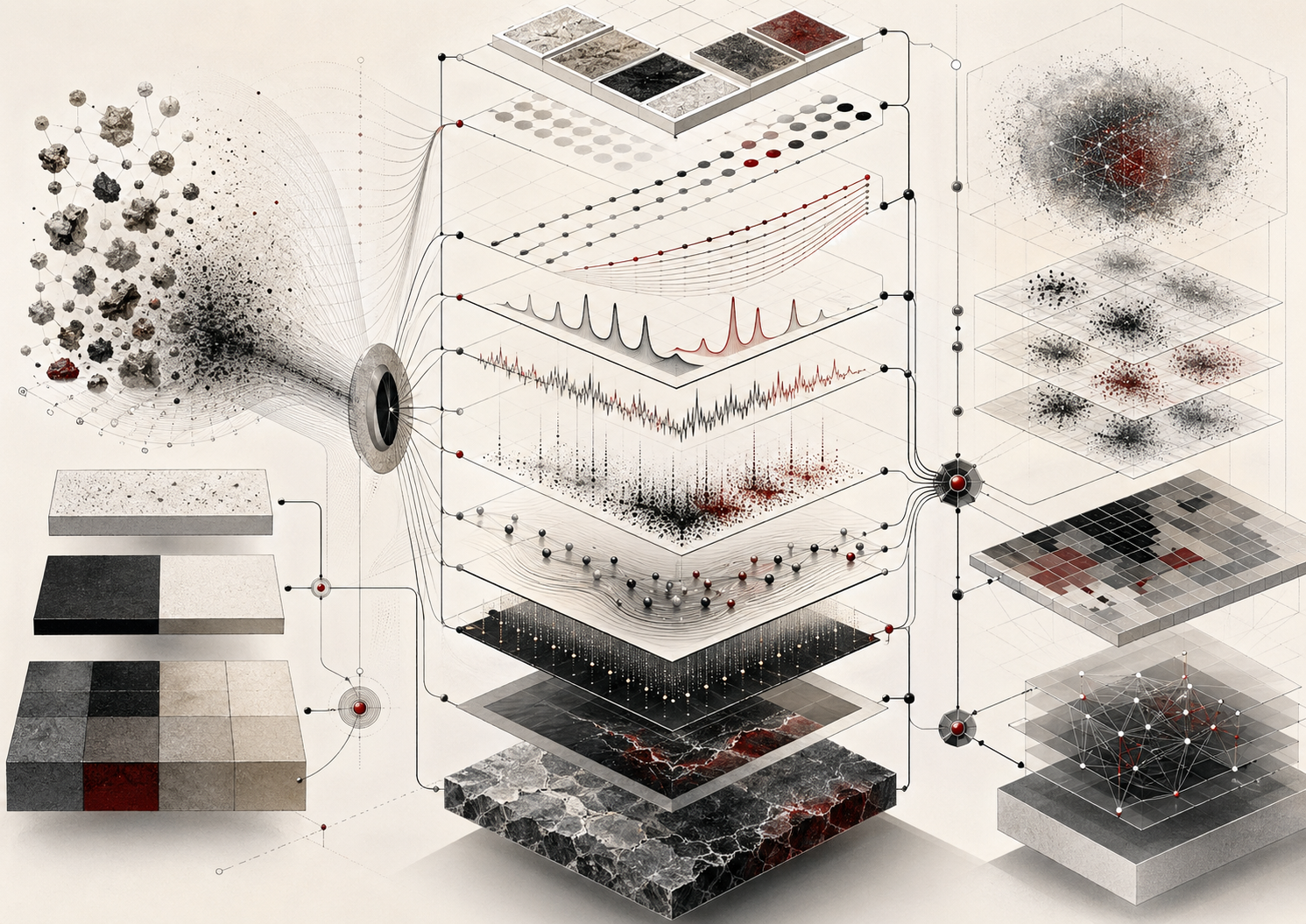
Analytical chemistry is the science of identifying, measuring, and interpreting matter. It asks what a sample contains, how much of each component is present, how confident the measurement is, what evidence supports the identification, and whether the result is fit for its intended purpose. Analytical chemistry turns chemical uncertainty into defensible knowledge.
The central thesis of this article is that analytical chemistry is not merely instrument use. Instruments generate signals. Analytical chemistry turns those signals into reliable chemical claims. Identification requires evidence. Quantification requires calibration. Interpretation requires uncertainty. Trust requires validation.
A sample may be a medicine, mineral, river water, blood serum, battery electrolyte, soil extract, air particle, polymer film, food ingredient, pigment, archaeological residue, environmental contaminant, reaction mixture, protein digest, forensic trace, or industrial process stream. Analytical chemistry provides the concepts and methods needed to transform that sample into evidence: sampling, preparation, separation, detection, calibration, validation, uncertainty, traceability, interpretation, and reporting.
Main Library
Publications
Article Map
Chemistry
Related Topic
Data Systems & Analytics
Related Topic
Environmental Monitoring Systems
Related Topic
Mathematical Modeling
Why Analytical Chemistry Matters
Analytical chemistry matters because chemical claims require evidence. It is not enough to say that a sample contains lead, caffeine, glucose, nitrate, benzene, iron, ethanol, a pesticide, a protein, a polymer additive, or a pharmaceutical impurity. A scientifically useful claim must explain how the substance was identified, how much was present, how the signal was calibrated, how interferences were controlled, what uncertainty remains, and whether the method was suitable for the question.
Modern society depends on analytical chemistry. Food safety, drinking water regulation, medical diagnostics, pharmaceutical quality, forensic investigation, environmental monitoring, materials certification, process control, battery manufacturing, semiconductor fabrication, climate measurement, sports anti-doping, archaeology, art conservation, toxicology, and public health all rely on analytical evidence.
Analytical chemistry is also central to research. New compounds must be characterized. Reaction products must be identified. Biological samples must be measured. Pollutants must be detected at trace levels. Nanomaterials must be distinguished from background matrices. Catalysts must be monitored. Degradation pathways must be followed. Analytical chemistry provides the measurement foundation that makes other chemistry verifiable.
The field is especially important because chemical decisions often have consequences beyond the laboratory. A water contaminant result may affect a community. A clinical assay may shape treatment. A forensic measurement may influence legal judgment. A pharmaceutical impurity profile may determine whether a product is released. An environmental monitoring result may trigger remediation. A materials result may determine whether a component is safe for use.
For researchers and scientists, analytical chemistry is the discipline that makes chemical evidence accountable. Without analytical chemistry, chemical science would have structure and theory but weaker evidence.
What Analytical Chemistry Does
Analytical chemistry answers several kinds of questions:
- What is present? This is identification or qualitative analysis.
- How much is present? This is quantification or quantitative analysis.
- Where is it located? This may involve imaging, surface analysis, mapping, or spatially resolved measurement.
- What form is it in? This may involve speciation, oxidation state, molecular structure, phase, binding state, or isotopic composition.
- How reliable is the answer? This requires uncertainty, validation, calibration, quality control, and traceability.
Analytical chemistry therefore includes more than instrumentation. It includes the full chain from problem definition to reported result. A measurement begins with a question, but then requires sampling, preservation, preparation, separation, detection, calibration, data processing, quality checks, interpretation, and communication.
A good analytical result is not simply a number. It is a number connected to a method, sample, unit, uncertainty, calibration, reference system, and intended use. A concentration value without sample identity, calibration method, matrix context, uncertainty, and validation evidence is not yet a defensible analytical result.
Analytical chemistry also distinguishes between measurement and decision. A method may measure a concentration, but a laboratory or regulator may need to decide whether the value exceeds a threshold, whether the sample is compliant, whether a compound is confirmed, whether a batch passes quality control, or whether further testing is required. Those decisions require explicit criteria.
For researchers, the discipline’s central question is not merely “what did the instrument report?” It is “what chemical claim can this evidence support?”
Qualitative and Quantitative Analysis
Qualitative analysis asks what is present. It may identify a compound by retention time, spectrum, mass-to-charge ratio, isotope pattern, elemental composition, molecular fragments, color change, electrochemical response, diffraction pattern, or comparison to a reference standard.
Quantitative analysis asks how much is present. It converts a signal into an amount, concentration, mass fraction, activity, intensity, isotope ratio, surface coverage, or other measured quantity.
The two questions are related but not identical. A method may detect something without confidently identifying it. Another method may identify a compound but not quantify it accurately. A mass spectrum may suggest a molecular formula, but confirmation may require retention-time matching, tandem mass spectrometry, authentic standards, high-resolution mass accuracy, isotope-pattern agreement, or orthogonal evidence. A peak in a chromatogram may be measurable, but if another compound co-elutes, the quantity may be biased.
Qualitative confidence depends on the strength and independence of evidence. A single retention time may be insufficient in a complex sample. A library match may be misleading if spectra are similar across related compounds. A molecular ion may identify molecular mass but not structure. A colorimetric result may be useful for screening but weak for confirmation. Analytical identification becomes stronger when independent lines of evidence converge.
Quantitative reliability depends on calibration, sample preparation, matrix effects, instrument stability, blank correction, range, recovery, precision, and uncertainty. A quantitatively useful method must show that the signal changes predictably with analyte amount in the relevant matrix and concentration range.
For researchers, analytical chemistry asks whether qualitative confidence and quantitative reliability are strong enough for the purpose: screening, monitoring, compliance, diagnosis, research, manufacturing, forensic testimony, or exploratory discovery.
Sampling and the Integrity of Evidence
Sampling is often the most important and least glamorous part of analytical chemistry. A perfect instrument cannot fix a bad sample. If the sample is not representative, contaminated, degraded, mislabeled, evaporated, oxidized, absorbed to a container, or collected from the wrong location, the final result may be precise but misleading.
Sampling questions include:
- What population or material does the sample represent?
- How heterogeneous is the material?
- How many samples are needed?
- How should samples be preserved?
- What containers prevent contamination or loss?
- What chain-of-custody documentation is required?
- How will blanks, duplicates, and controls be collected?
- What time window does the sample represent?
- What spatial scale does the sample represent?
Environmental analysis illustrates the problem. A river sample may vary by location, depth, time, storm event, season, temperature, sediment load, and biological activity. A soil sample may vary over centimeters. A food sample may contain uneven contamination. A forensic trace may be tiny and vulnerable to contamination. A pharmaceutical batch may require statistically designed sampling to assess quality.
Sampling is also an ethical and institutional issue. Communities affected by pollution may be harmed by poorly designed sampling plans that miss hotspots, average away exposure, or fail to capture seasonal variation. Forensic sampling may affect legal outcomes. Clinical sampling may affect diagnosis. Industrial sampling may determine whether a batch is accepted or rejected.
For researchers, analytical chemistry begins before the instrument is turned on. It begins with the integrity of the sample, the representativeness of the sampling design, and the documentation that connects the sample to the claim.
Sample Preparation and Matrix Effects
Samples are rarely ready for direct measurement. They may contain proteins, salts, particles, fats, solvents, polymers, acids, bases, humic matter, cells, metals, surfactants, or many interfering compounds. Sample preparation transforms the raw sample into a form suitable for analysis.
Common sample-preparation steps include:
- filtration;
- dilution;
- digestion;
- extraction;
- solid-phase extraction;
- derivatization;
- centrifugation;
- precipitation;
- evaporation and reconstitution;
- matrix matching;
- cleanup before chromatography or spectroscopy.
The matrix is everything in the sample other than the analyte of interest. Matrix effects occur when the sample environment changes the signal. In mass spectrometry, co-eluting species may suppress or enhance ionization. In spectroscopy, turbidity or background absorption may interfere. In electrochemistry, other redox-active species may overlap. In atomic analysis, salts and acids can affect plasma behavior or atomization.
Sample preparation can improve selectivity and sensitivity, but it can also introduce error. Analytes can be lost during extraction. Contamination can be introduced during digestion. Volatile compounds can evaporate. Labile compounds can degrade. Derivatization can be incomplete. Surfaces can adsorb trace analytes. Recovery may vary across matrices.
Good analytical methods do not ignore the matrix. They control, compensate, remove, match, dilute, or explicitly model it. Recovery studies, matrix-matched standards, internal standards, isotope dilution, spike experiments, blanks, and reference materials can all help evaluate matrix effects.
For researchers, sample preparation is not a preliminary chore. It is part of the analytical method and must be validated as part of the evidence chain.
Signals, Standards, and Calibration
An analytical instrument usually produces a signal: absorbance, current, intensity, peak area, retention time, mass-to-charge abundance, fluorescence, voltage, conductivity, scattering, counts, or image intensity. Calibration connects signal to quantity.
A simple linear calibration model is:
S = mx + b
\]
Interpretation: \(S\) is analytical signal, \(x\) is concentration or amount, \(m\) is slope or sensitivity, and \(b\) is intercept. The calibration model should be valid over the working range.
Calibration may use external standards, internal standards, standard addition, isotope dilution, matrix-matched calibration, or calibration-free approaches under specific conditions.
External calibration uses separate standards. Internal standards add a known compound to correct for variation in injection, extraction, matrix effects, or instrument response. Standard addition adds known increments of analyte directly to the sample, which can help compensate for matrix effects. Isotope dilution uses isotopically labeled analogs and is often highly robust when properly applied.
Calibration is not merely drawing a line. It requires appropriate standards, concentration range, blank correction, replicate measurement, weighting when needed, residual inspection, uncertainty estimation, and quality control checks. If the calibration range is too narrow, the method may fail for high samples. If low-level points are not weighted appropriately, trace quantification may be biased. If standards are unstable or contaminated, the entire method may be compromised.
Calibration also depends on chemical identity. A standard must correspond to the analyte form being measured, or the method must explicitly account for differences. For speciation analysis, total concentration may not be enough. Oxidation state, isotope form, complexation, molecular structure, or phase may matter.
For researchers, a measurement is only as reliable as the calibration logic that supports it.
Selectivity, Sensitivity, and Interference
Selectivity is the ability of a method to distinguish the analyte from other components. Sensitivity is the change in signal per change in analyte concentration, often represented by the slope of a calibration curve.
A method can be sensitive but not selective. For example, a detector may respond strongly to many compounds, creating overlapping signals. A method can also be selective but insufficiently sensitive if the analyte is present below measurable levels.
Interferences are substances or effects that bias identification or quantification. They can create false positives, false negatives, signal suppression, signal enhancement, overlapping peaks, background drift, spectral overlap, matrix mismatch, instrument contamination, or incorrect baseline correction.
Analytical chemists improve selectivity through separation, selective reagents, spectral resolution, mass accuracy, tandem mass spectrometry, isotope patterns, electrochemical potentials, sample cleanup, chemometric deconvolution, or orthogonal confirmation.
Selectivity is especially important when the stakes are high: contaminants near regulatory thresholds, trace explosives, clinical biomarkers, forensic evidence, pharmaceutical impurities, allergens, toxins, or environmental pollutants. A false positive can cause unnecessary alarm or unjust consequences. A false negative can hide real harm.
Sensitivity must also be interpreted in context. A method may have high instrumental sensitivity but poor practical sensitivity after sample preparation losses, dilution, matrix suppression, or blank contamination. The relevant question is not only the detector’s response, but the method’s performance from sample to result.
For researchers, the question is not only whether a method produces a signal. The question is whether the signal belongs to the analyte and supports the intended claim.
Accuracy, Trueness, Precision, and Uncertainty
Analytical quality depends on several related but distinct ideas.
Precision describes closeness among repeated measurements. A method can be precise if repeated results cluster tightly.
Trueness describes closeness between the average measurement result and a reference value. A method can be precise but biased if results cluster around the wrong value.
Accuracy is often used broadly to describe closeness of agreement between measured and true or accepted values, but careful analytical language distinguishes precision and trueness.
Uncertainty expresses the range within which the measured value is believed to lie with a stated level of confidence. It may include contributions from sampling, weighing, volumetric preparation, calibration, instrument repeatability, blank correction, recovery, matrix effects, drift, reference-material uncertainty, and data processing.
A reported concentration such as:
10.2 \pm 0.4\ \mathrm{mg\ L^{-1}}
\]
Interpretation: A measured value with uncertainty communicates both result and confidence. The uncertainty statement should be tied to a defined coverage level or reporting convention when used in formal measurement.
This is more informative than a bare number because it communicates measurement confidence. A bare number can imply certainty that the method does not possess.
Analytical uncertainty is not a weakness. It is a measure of scientific honesty. Results without uncertainty can be hard to compare, audit, or use for decisions. A concentration just above a threshold may require different interpretation depending on uncertainty. A trend over time may be meaningful or may be within measurement variation.
For researchers, analytical chemistry is not only about producing results. It is about producing results whose reliability can be assessed.
Limits of Detection and Quantification
Detection limits describe the smallest signal, concentration, or amount that can be distinguished from a blank with specified confidence. Quantification limits describe the level at which the analyte can be measured with acceptable precision and trueness for the intended purpose.
A common simplified detection-limit relationship is:
LOD = \frac{3s_b}{m}
\]
Interpretation: \(s_b\) is the standard deviation of blank measurements and \(m\) is calibration slope. This is a teaching approximation and should be adapted to method-specific validation requirements.
A common simplified quantification-limit relationship is:
LOQ = \frac{10s_b}{m}
\]
Interpretation: \(LOQ\) estimates the concentration at which quantification becomes more reliable than detection alone. Real methods require confirmation of acceptable precision, trueness, and matrix performance.
These formulas are useful teaching approximations, but real detection and quantification limits depend on method, matrix, blank behavior, calibration design, decision rules, false-positive risk, false-negative risk, instrument noise, sample preparation, and validation criteria.
Detection is not the same as quantification. A method may detect an analyte but not quantify it reliably. This distinction matters in environmental monitoring, toxicology, trace analysis, forensic science, clinical chemistry, and regulatory reporting. A trace contaminant may be visible but too uncertain for a numerical concentration claim.
Detection limits also require clarity about what is being detected: instrumental signal, method-level concentration after sample preparation, mass on column, concentration in original sample, or concentration after dilution. Ambiguous detection limits can mislead readers and decision-makers.
For researchers, analytical chemistry asks not only whether something is visible, but whether it is visible with enough confidence to support a claim.
Chromatography and Separation Science
Chromatography separates components of a mixture before detection. It is central to modern analytical chemistry because many samples contain multiple compounds whose signals would otherwise overlap.
In chromatography, analytes distribute between a stationary phase and a mobile phase. Differences in retention allow components to separate over time or distance.
Common chromatographic methods include:
- gas chromatography;
- liquid chromatography;
- ion chromatography;
- thin-layer chromatography;
- size-exclusion chromatography;
- affinity chromatography;
- supercritical-fluid chromatography.
Chromatography can be coupled to detectors such as UV-visible absorbance, fluorescence, flame ionization, conductivity, electrochemical detection, mass spectrometry, or infrared spectroscopy.
Key chromatographic concepts include retention time, capacity factor, selectivity, plate number, resolution, peak width, peak area, baseline separation, gradient elution, column chemistry, mobile-phase composition, temperature, flow rate, injection volume, and matrix effects.
Chromatographic resolution can determine whether quantification is trustworthy. Two peaks may appear separated visually but still overlap enough to bias integration. A co-eluting impurity may inflate a concentration. A matrix component may suppress detector response. A retention-time match may be insufficient if multiple compounds share similar retention.
For researchers, chromatography is not simply a way to make peaks. It is a way to separate chemical complexity into interpretable evidence, and its performance must be evaluated as part of the method.
Spectroscopy and Spectral Identification
Spectroscopy identifies and measures matter through interactions with electromagnetic radiation. Different spectroscopic methods probe different aspects of chemical structure.
Infrared spectroscopy measures vibrational transitions and helps identify functional groups. UV-visible spectroscopy measures electronic transitions and is useful for chromophores, metals, dyes, and concentration measurements. Fluorescence spectroscopy measures emission from excited states and can be highly sensitive. Nuclear magnetic resonance spectroscopy reveals local nuclear environments, connectivity, structure, dynamics, and purity. Raman spectroscopy probes vibrational modes through scattering and is useful for materials, liquids, minerals, and biological samples.
Atomic spectroscopy methods, such as atomic absorption, atomic emission, and inductively coupled plasma optical emission spectroscopy, measure elements. X-ray spectroscopies can probe elemental composition, oxidation state, bonding environment, and surfaces.
A simple absorbance relationship is the Beer-Lambert law:
A = \varepsilon bc
\]
Interpretation: \(A\) is absorbance, \(\varepsilon\) is molar absorptivity, \(b\) is path length, and \(c\) is concentration. The relationship assumes appropriate conditions such as linear response and limited interference.
Spectroscopy is powerful because it can provide both identification and quantification. But spectral interpretation requires attention to background, baseline, overlapping bands, calibration, reference spectra, instrument resolution, sample thickness, scattering, solvent effects, path length, and matrix interference.
Spectral libraries can help identify unknowns, but library matching is not final proof. Matches depend on data quality, reference coverage, sample conditions, resolution, preprocessing, and similarity metrics. Orthogonal evidence may be needed when compounds are structurally similar or samples are complex.
For researchers, a spectrum is evidence, not automatic truth. It becomes trustworthy when interpreted through calibration, controls, references, uncertainty, and chemical context.
Mass Spectrometry and Molecular Evidence
Mass spectrometry measures ions according to mass-to-charge ratio. It is one of the most powerful tools for identifying and quantifying molecules, elements, isotopes, proteins, metabolites, pollutants, pharmaceuticals, and reaction products.
A mass spectrometer typically includes ionization, mass analysis, and detection. Ionization methods include electron ionization, electrospray ionization, atmospheric pressure chemical ionization, matrix-assisted laser desorption ionization, and others. Mass analyzers include quadrupoles, time-of-flight instruments, ion traps, Orbitrap systems, and Fourier-transform ion cyclotron resonance instruments.
Mass spectrometry can provide:
- molecular mass;
- isotope patterns;
- fragmentation patterns;
- elemental composition estimates;
- structural clues;
- targeted quantification;
- untargeted screening;
- protein and peptide identification;
- metabolomic and environmental profiles.
Coupling chromatography with mass spectrometry improves identification because retention behavior and mass evidence can be combined. Tandem mass spectrometry adds fragmentation evidence. High-resolution mass spectrometry improves formula assignment, but formula assignment is not the same as full structure identification.
Mass spectrometry is also highly sensitive to matrix effects. Ion suppression, adduct formation, in-source fragmentation, carryover, isotope overlap, and background contaminants can complicate interpretation. Internal standards, isotope dilution, chromatographic separation, matrix-matched calibration, blanks, and quality-control samples are often essential.
For researchers, mass spectrometry is powerful because it produces rich evidence. It is demanding because that evidence must be interpreted carefully, with attention to ionization chemistry, calibration, fragmentation, matrix context, and confidence level.
Electroanalytical Chemistry and Sensors
Electroanalytical chemistry measures chemical information through electrical signals. These methods are especially important for ions, redox-active species, pH, dissolved oxygen, metals, neurotransmitters, corrosion, batteries, fuel cells, environmental monitoring, and biosensors.
Common electroanalytical methods include:
- potentiometry;
- voltammetry;
- amperometry;
- coulometry;
- conductometry;
- impedance spectroscopy;
- ion-selective electrodes;
- electrochemical sensors and biosensors.
Electroanalytical methods can be sensitive, portable, inexpensive, and suitable for field measurement. But they also require careful control of electrode surfaces, reference electrodes, supporting electrolyte, pH, interferences, fouling, mass transport, temperature, and calibration.
Sensors are especially important because they move analytical chemistry outside centralized laboratories. Glucose meters, pH electrodes, gas sensors, wearable sensors, water-quality probes, and electrochemical biosensors show how analytical chemistry becomes embedded in daily life, industry, medicine, and environmental monitoring.
A sensor is only useful if its signal remains chemically meaningful over time. Drift, fouling, temperature change, humidity, biofilm formation, reagent depletion, calibration loss, and cross-sensitivity can all undermine sensor reliability. Field sensors require validation under real-world conditions, not only ideal laboratory conditions.
For researchers, electroanalytical chemistry shows that measurement can be distributed, continuous, and embedded. But distributed measurement still requires calibration, selectivity, uncertainty, and quality control.
Microscopy, Surface Analysis, and Material Identification
Some analytical questions are spatial. What is located where? What is the surface composition? What is the particle morphology? Is the contaminant on the surface or in the bulk? How are elements distributed across a material?
Microscopy and surface analysis address these questions. Optical microscopy, electron microscopy, atomic force microscopy, X-ray imaging, energy-dispersive X-ray spectroscopy, X-ray photoelectron spectroscopy, Auger electron spectroscopy, secondary ion mass spectrometry, and Raman mapping can provide spatially resolved chemical information.
Materials analysis may involve composition, phase, surface chemistry, particle size, roughness, morphology, crystallinity, defects, coatings, inclusions, corrosion products, or contamination.
Surface analysis is especially important because surfaces often control behavior. Catalysis occurs at surfaces. Corrosion begins at surfaces. Coatings fail at surfaces. Sensors respond at surfaces. Battery electrodes degrade at interfaces. Biological materials interact through surfaces.
Spatial analytical methods also require careful interpretation. Sample preparation can alter surfaces. Electron beams can damage materials. Vacuum conditions can change hydration or volatile components. Mapping resolution may be insufficient to detect nanoscale heterogeneity. Surface-sensitive methods may not represent bulk composition.
For researchers, analytical chemistry identifies not only what matter is, but where and how it exists. Spatial evidence must be interpreted with resolution, preparation, sampling depth, and method limitations in mind.
Chemometrics and Pattern-Based Identification
Chemometrics uses statistics, mathematics, and computation to extract chemical information from data. Modern analytical instruments can generate large datasets: spectra, chromatograms, images, mass-spectral profiles, sensor arrays, and time-series measurements.
Chemometric methods include:
- baseline correction;
- peak detection;
- principal component analysis;
- partial least squares regression;
- classification models;
- clustering;
- multivariate calibration;
- deconvolution;
- outlier detection;
- uncertainty modeling.
Chemometrics is powerful because chemical evidence often appears as patterns rather than isolated signals. A spectrum may contain overlapping peaks. A chromatogram may include unresolved compounds. A mass-spectral dataset may contain thousands of features. A sensor array may identify substances through response patterns. A hyperspectral image may contain spatial and spectral information at once.
But pattern recognition must be validated. A model can overfit, learn instrument artifacts, fail outside its training domain, or produce confident but wrong classifications. Analytical chemometrics therefore requires calibration design, validation sets, cross-validation, external testing, interpretability, uncertainty, and domain awareness.
Chemometric models must also preserve chemical meaning. A classification model that separates two sample groups may not reveal the chemical cause. A principal component may capture matrix differences rather than analyte differences. A machine-learning model may detect batch effects, instrument drift, or sample handling artifacts.
For researchers, data science does not replace analytical chemistry. It extends it when used carefully, with validation, uncertainty, chemical interpretation, and transparent preprocessing.
Method Validation and Quality Control
Method validation demonstrates that an analytical method is fit for its intended purpose. It asks whether the method performs adequately for the sample type, analyte, concentration range, matrix, and decision context.
Validation characteristics may include:
- selectivity;
- calibration behavior;
- working range;
- trueness;
- precision;
- recovery;
- limit of detection;
- limit of quantification;
- robustness;
- measurement uncertainty;
- matrix effects;
- stability;
- carryover;
- ruggedness across analysts, instruments, or laboratories.
Quality control maintains confidence during routine use. It may include blanks, calibration checks, control samples, duplicates, spikes, internal standards, reference materials, control charts, system suitability tests, and acceptance criteria.
Validation and quality control distinguish analytical chemistry from mere measurement. A method is not trustworthy because it is sophisticated. It is trustworthy when its performance is demonstrated and monitored.
Validation should match intended use. A screening method may require different evidence than a confirmatory forensic method. A research method may tolerate exploratory uncertainty that a regulatory method cannot. A clinical assay requires performance evidence appropriate to patient impact. A trace environmental method must show low-level reliability in relevant matrices.
For researchers, validation is a scientific argument. It explains why a method should be trusted for a specific purpose, under defined conditions, with known limits.
Traceability, Reference Materials, and Laboratory Trust
Traceability links a measurement result to recognized standards through an unbroken chain of comparisons, each with stated uncertainty. In chemical analysis, traceability is often difficult because measurements involve matrix effects, sample preparation, calibration standards, instrument response, and method-specific operations.
Reference materials and certified reference materials help laboratories evaluate accuracy, calibrate methods, validate procedures, and compare results. A reference material may have certified values for composition, concentration, isotopic ratio, physical property, or other measured quantity.
Traceability matters because analytical results often support public decisions. A water sample may determine regulatory action. A blood test may influence medical care. A pharmaceutical impurity measurement may determine batch release. A forensic result may affect legal outcomes. A materials certificate may support manufacturing. A food contaminant result may trigger recall.
Laboratory trust also depends on documentation, training, method control, instrument maintenance, chain of custody, data integrity, audit trails, proficiency testing, accreditation, and transparent reporting. Analytical chemistry is a technical discipline, but it is also an institutional practice.
For researchers, analytical chemistry is a trust infrastructure. It connects measurement to accountability, and that accountability depends on reference systems, quality systems, and transparent evidence chains.
Analytical Chemistry, Public Health, and Environmental Evidence
Analytical chemistry has public significance because measurement often determines whether harm is visible. Contaminants, toxins, pathogens, metabolites, pollutants, impurities, residues, and exposure markers become actionable only when they can be identified and measured reliably.
Environmental analytical chemistry measures air, water, soil, sediment, food webs, industrial emissions, and biological exposure. Public health analytical chemistry measures biomarkers, clinical analytes, drugs, metabolites, toxins, nutrients, and infectious-disease indicators. In both domains, analytical design can affect whether vulnerable communities, low-level exposures, or episodic contamination are recognized.
Sampling design is especially important. A monitoring program that samples the wrong location, wrong season, wrong matrix, or wrong population can miss real exposure. A method that measures total concentration but not chemical form may miss the toxicologically relevant species. A sensor network that is not calibrated or maintained may create false reassurance.
Analytical chemistry also shapes accountability. Reliable measurements can support remediation, regulation, diagnosis, product recall, occupational safety, and environmental justice. Weak measurements can obscure responsibility or delay action.
For researchers, the public role of analytical chemistry underscores why uncertainty, traceability, and method validation are not bureaucratic extras. They are part of the moral and scientific responsibility of measurement.
Computational Analytical Chemistry
Computational analytical chemistry supports data processing, calibration, uncertainty estimation, spectral matching, chromatographic integration, peak detection, multivariate modeling, sensor fusion, method validation, laboratory automation, and reproducible reporting.
A computational analytical workflow should document:
- sample identifiers;
- instrument method;
- calibration standards;
- blank measurements;
- raw signals;
- preprocessing steps;
- calibration model;
- quality-control results;
- uncertainty estimates;
- acceptance criteria;
- final reported values;
- data provenance.
Reproducibility matters. Analytical data can be transformed by smoothing, baseline correction, peak selection, integration boundaries, normalization, outlier removal, matrix correction, and calibration choices. Without transparent workflows, results become difficult to audit.
Computational analytical chemistry should therefore treat data processing as part of the method, not as an informal afterthought. A peak area is not just a value. It depends on baseline, integration boundaries, smoothing, retention window, and detector response. A spectral match depends on preprocessing, library choice, similarity metric, and threshold. A calibration model depends on standards, weighting, residuals, and range.
For researchers, computational analytical chemistry should make the evidence chain more inspectable. Code should preserve the link between raw data, transformations, calibration, uncertainty, and final claim.
Mathematical Lens: Analytical Chemistry
Analytical chemistry is built from calibration, statistics, signal processing, uncertainty, and decision thresholds. Linear calibration can be written as:
S = mx + b
\]
Interpretation: Signal \(S\) is modeled as a linear function of concentration \(x\), with slope \(m\) and intercept \(b\). Calibration must be validated over the working range.
Concentration from calibration is:
x = \frac{S-b}{m}
\]
Interpretation: An unknown concentration can be estimated from measured signal, calibration intercept, and slope. The estimate inherits uncertainty from signal and calibration.
The mean is:
\bar{x} = \frac{1}{n}\sum_{i=1}^{n}x_i
\]
Interpretation: The mean summarizes repeated measurements, but it should be interpreted with precision, bias, and uncertainty.
The sample standard deviation is:
s = \sqrt{\frac{\sum_{i=1}^{n}(x_i-\bar{x})^2}{n-1}}
\]
Interpretation: The sample standard deviation describes variation among repeated measurements.
Relative standard deviation is:
RSD = \frac{s}{\bar{x}}\times 100\%
\]
Interpretation: RSD expresses precision relative to the mean, making variation easier to compare across concentration levels.
Spike recovery is:
Recovery = \frac{\mathrm{measured\ spike\ response}}{\mathrm{expected\ spike\ response}}\times 100\%
\]
Interpretation: Recovery evaluates whether the method measures a known added amount accurately in the sample matrix.
Limit of detection is:
LOD = \frac{3s_b}{m}
\]
Interpretation: This simplified estimate relates blank noise to calibration sensitivity. Real detection decisions require method-specific validation.
Limit of quantification is:
LOQ = \frac{10s_b}{m}
\]
Interpretation: This simplified estimate indicates a concentration where quantification may become more reliable, subject to validation of precision and trueness.
Signal-to-noise ratio is:
SNR = \frac{S}{N}
\]
Interpretation: Signal-to-noise ratio compares analytical signal with noise. It is commonly used in detection, imaging, spectroscopy, and chromatography.
The Beer-Lambert law is:
A = \varepsilon bc
\]
Interpretation: Absorbance is related to molar absorptivity, path length, and concentration under appropriate optical and chemical conditions.
Chromatographic resolution is:
R_s = \frac{2(t_{R,2}-t_{R,1})}{w_1+w_2}
\]
Interpretation: \(R_s\) compares the separation between two retention times with their peak widths. Higher values indicate better chromatographic separation.
Propagation of independent uncertainty is:
u_c = \sqrt{u_1^2 + u_2^2 + \cdots + u_n^2}
\]
Interpretation: Independent uncertainty components combine as the square root of summed variances. Real uncertainty budgets must reflect the measurement model.
These equations show that analytical chemistry is quantitative evidence science. It transforms signals into chemical claims through calibration, statistics, uncertainty, and method logic.
Computational Workflows for Analytical Chemistry
Computational workflows can make analytical chemistry more transparent. A workflow can track standards, blanks, calibration curves, unknown signals, spike recoveries, precision checks, chromatographic resolution, Beer-Lambert calculations, detection limits, quality-control flags, and provenance records.
Useful workflows include calibration modeling, blank statistics, LOD and LOQ calculation, unknown concentration estimation, spike recovery, replicate precision, chromatographic resolution, spectral matching, peak integration, control-chart scaffolds, and SQL evidence registers.
For researchers, analytical workflows should preserve four distinctions:
- Signal versus analyte: a signal must be connected to the analyte through calibration and selectivity.
- Detection versus quantification: visibility does not automatically mean reliable numerical measurement.
- Precision versus trueness: repeated agreement does not guarantee closeness to the true or reference value.
- Instrument output versus analytical result: a reported value requires method, sample, unit, uncertainty, and validation context.
The examples below use synthetic educational data. They do not validate analytical methods, certify concentrations, establish regulatory compliance, support clinical decisions, or replace professional laboratory review. They demonstrate how analytical reasoning can be structured, audited, and communicated responsibly.
Python Example: Calibration, LOD, LOQ, Resolution, and Provenance
The following Python example uses synthetic educational data. It fits a linear calibration curve, estimates an unknown concentration, calculates simplified LOD and LOQ values from blank statistics, evaluates chromatographic resolution, applies quality-control flags, and writes provenance outputs. In real analytical chemistry, such workflows should preserve raw data, instrument method, standard preparation, matrix information, weighting choices, residual review, uncertainty budgets, and validation records.
from pathlib import Path
from typing import Dict, List
import json
import platform
import sys

import numpy as np
import pandas as pd


# Synthetic analytical chemistry workflow.
# Educational example only; not for clinical, regulatory,
# forensic, environmental compliance, or safety-critical use.


def require_columns(data: pd.DataFrame, required: List[str], table_name: str) -> None:
    """Raise an error if required columns are missing."""
    missing = [column for column in required if column not in data.columns]
    if missing:
        raise ValueError(f"{table_name} is missing required columns: {missing}")


standards = pd.DataFrame({
    "concentration_mg_L": [0, 1, 2, 5, 10, 20],
    "signal": [0.04, 0.58, 1.05, 2.64, 5.18, 10.35],
})

require_columns(
    standards,
    ["concentration_mg_L", "signal"],
    "standards",
)

slope, intercept = np.polyfit(
    standards["concentration_mg_L"],
    standards["signal"],
    deg=1,
)

standards["predicted_signal"] = slope * standards["concentration_mg_L"] + intercept
standards["residual"] = standards["signal"] - standards["predicted_signal"]

blank_signals = np.array([0.035, 0.041, 0.039, 0.044, 0.037], dtype=float)
blank_sd = blank_signals.std(ddof=1)

unknowns = pd.DataFrame({
    "sample_id": ["unknown_001", "unknown_002", "unknown_003"],
    "signal": [3.72, 0.19, 11.25],
})

unknowns["estimated_concentration_mg_L"] = (
    (unknowns["signal"] - intercept) / slope
)

lod = 3.0 * blank_sd / slope
loq = 10.0 * blank_sd / slope

unknowns["below_lod_review"] = unknowns["estimated_concentration_mg_L"] < lod
unknowns["below_loq_review"] = unknowns["estimated_concentration_mg_L"] < loq
unknowns["above_calibration_range_review"] = (
    unknowns["estimated_concentration_mg_L"]
    > standards["concentration_mg_L"].max()
)

peaks = pd.DataFrame({
    "pair": ["A_B", "B_C", "C_D"],
    "tR_1_min": [3.10, 5.20, 7.00],
    "tR_2_min": [5.20, 7.00, 8.10],
    "w1_min": [0.42, 0.50, 0.55],
    "w2_min": [0.50, 0.55, 0.60],
})

require_columns(
    peaks,
    ["pair", "tR_1_min", "tR_2_min", "w1_min", "w2_min"],
    "peaks",
)

peaks["resolution"] = (
    2.0 * (peaks["tR_2_min"] - peaks["tR_1_min"])
    / (peaks["w1_min"] + peaks["w2_min"])
)

peaks["baseline_separation_hint"] = peaks["resolution"] >= 1.5

output_dir = Path("outputs")
output_dir.mkdir(exist_ok=True)

standards.to_csv(output_dir / "synthetic_calibration_table.csv", index=False)
unknowns.to_csv(output_dir / "synthetic_unknown_concentrations.csv", index=False)
peaks.to_csv(output_dir / "synthetic_chromatographic_resolution.csv", index=False)

manifest: Dict[str, object] = {
    "workflow": "synthetic_analytical_chemistry_workflow",
    "data_type": "synthetic educational analytical records",
    "calibration_model": "S = m*x + b",
    "slope": float(slope),
    "intercept": float(intercept),
    "blank_standard_deviation": float(blank_sd),
    "lod_mg_L": float(lod),
    "loq_mg_L": float(loq),
    "calibration_range_mg_L": [
        float(standards["concentration_mg_L"].min()),
        float(standards["concentration_mg_L"].max()),
    ],
    "python_version": sys.version,
    "platform": platform.platform(),
    "numpy_version": np.__version__,
    "pandas_version": pd.__version__,
    "output_files": [
        "outputs/synthetic_calibration_table.csv",
        "outputs/synthetic_unknown_concentrations.csv",
        "outputs/synthetic_chromatographic_resolution.csv",
        "outputs/analytical_chemistry_manifest.json",
    ],
    "responsible_use": [
        "Synthetic educational data only.",
        "Real analytical chemistry workflows require validated methods, raw data retention, calibration review, matrix assessment, uncertainty budgets, quality-control checks, and expert laboratory review.",
    ],
}

with (output_dir / "analytical_chemistry_manifest.json").open(
    "w",
    encoding="utf-8"
) as file:
    json.dump(manifest, file, indent=2)

print("Calibration table")
print("-----------------")
print(standards.round(6).to_string(index=False))

print("\nUnknown concentration estimates")
print("-------------------------------")
print(unknowns.round(6).to_string(index=False))

print("\nChromatographic resolution")
print("--------------------------")
print(peaks.round(6).to_string(index=False))

print(f"\nLOD_mg_L = {lod:.6f}")
print(f"LOQ_mg_L = {loq:.6f}")
This workflow demonstrates analytical evidence discipline rather than real method validation. It separates calibration, blank statistics, unknown estimation, detection-limit review, quantification-limit review, calibration-range review, and chromatographic separation. A real workflow would add uncertainty propagation, residual diagnostics, replicate standards, matrix-matched validation, reference materials, control charts, and acceptance criteria.
R Example: Spike Recovery, Precision, and Beer-Lambert Quantification
The following R example uses synthetic educational data to calculate replicate precision, spike recovery, and Beer-Lambert concentration. In real analytical chemistry, these calculations should be tied to documented samples, standards, calibration records, blanks, units, uncertainty estimates, and validation criteria.
# Synthetic analytical chemistry scaffold.
# Educational example only; not for clinical, regulatory,
# forensic, environmental compliance, or safety-critical use.

measurements <- data.frame(
  sample = c("rep_1", "rep_2", "rep_3", "rep_4", "rep_5"),
  measured_mg_L = c(9.8, 10.1, 10.0, 10.2, 9.9)
)

mean_value <- mean(measurements$measured_mg_L)
sd_value <- sd(measurements$measured_mg_L)
rsd_percent <- 100 * sd_value / mean_value

precision_summary <- data.frame(
  mean_mg_L = mean_value,
  sd_mg_L = sd_value,
  rsd_percent = rsd_percent,
  precision_review_required = rsd_percent > 5
)

unspiked_mg_L <- 4.0
spiked_mg_L <- 8.8
spike_added_mg_L <- 5.0

recovery_percent <- 100 * (spiked_mg_L - unspiked_mg_L) / spike_added_mg_L

recovery_summary <- data.frame(
  unspiked_mg_L = unspiked_mg_L,
  spiked_mg_L = spiked_mg_L,
  spike_added_mg_L = spike_added_mg_L,
  recovery_percent = recovery_percent,
  recovery_review_required = recovery_percent < 80 | recovery_percent > 120
)

absorbance <- 0.625
epsilon_L_mol_cm <- 12500
path_length_cm <- 1.0

concentration_mol_L <- absorbance / (epsilon_L_mol_cm * path_length_cm)

beer_lambert_summary <- data.frame(
  absorbance = absorbance,
  epsilon_L_mol_cm = epsilon_L_mol_cm,
  path_length_cm = path_length_cm,
  concentration_mol_L = concentration_mol_L
)

dir.create("outputs", showWarnings = FALSE)

write.csv(
  measurements,
  file = "outputs/r_replicate_measurements.csv",
  row.names = FALSE
)

write.csv(
  precision_summary,
  file = "outputs/r_precision_summary.csv",
  row.names = FALSE
)

write.csv(
  recovery_summary,
  file = "outputs/r_spike_recovery_summary.csv",
  row.names = FALSE
)

write.csv(
  beer_lambert_summary,
  file = "outputs/r_beer_lambert_summary.csv",
  row.names = FALSE
)

sink("outputs/r_analytical_chemistry_report.txt")
cat("Synthetic Analytical Chemistry Scaffold Report\n")
cat("==============================================\n\n")
cat("Replicate measurements:\n")
print(measurements)
cat("\nPrecision summary:\n")
print(precision_summary)
cat("\nSpike recovery summary:\n")
print(recovery_summary)
cat("\nBeer-Lambert summary:\n")
print(beer_lambert_summary)
cat("\nResponsible-use note:\n")
cat("Synthetic educational data only. Real analytical chemistry requires validated methods, calibration records, blanks, matrix assessment, reference materials, uncertainty budgets, and expert review.\n")
sink()

print(measurements)
print(precision_summary)
print(recovery_summary)
print(beer_lambert_summary)
This scaffold shows how R can support analytical summaries and quality-control review. The central issue is not the language but the evidence chain. Precision, recovery, and absorbance-derived concentration should remain connected to calibration, matrix, sample identity, instrument conditions, uncertainty, and method acceptance criteria.
SQL Example: Analytical Chemistry Evidence Register
Analytical chemistry becomes more reliable when samples, preparation records, instruments, calibration standards, blanks, quality-control checks, raw signals, processed results, validation records, uncertainty estimates, and interpretation claims are traceable. A simple evidence register can preserve the context needed to audit analytical results.
CREATE TABLE analytical_sample (
    sample_id TEXT PRIMARY KEY,
    sample_name TEXT NOT NULL,
    sample_type TEXT,
    collection_datetime TEXT,
    collection_location TEXT,
    collected_by TEXT,
    preservation_method TEXT,
    container_type TEXT,
    chain_of_custody_uri TEXT,
    sample_quality_flag TEXT,
    sample_notes TEXT
);

CREATE TABLE analytical_method (
    method_id TEXT PRIMARY KEY,
    method_name TEXT NOT NULL,
    analyte_name TEXT,
    matrix_type TEXT,
    technique_family TEXT,
    instrument_platform TEXT,
    method_version TEXT,
    validation_status TEXT,
    method_document_uri TEXT,
    method_notes TEXT
);

CREATE TABLE sample_preparation_record (
    preparation_id TEXT PRIMARY KEY,
    sample_id TEXT NOT NULL,
    method_id TEXT NOT NULL,
    preparation_datetime TEXT,
    preparation_steps TEXT,
    dilution_factor REAL,
    extraction_method TEXT,
    derivatization_method TEXT,
    recovery_check_status TEXT,
    preparation_notes TEXT,
    FOREIGN KEY (sample_id) REFERENCES analytical_sample(sample_id),
    FOREIGN KEY (method_id) REFERENCES analytical_method(method_id)
);

CREATE TABLE calibration_record (
    calibration_id TEXT PRIMARY KEY,
    method_id TEXT NOT NULL,
    calibration_datetime TEXT,
    calibration_model TEXT,
    slope REAL,
    intercept REAL,
    concentration_unit TEXT,
    calibration_range_low REAL,
    calibration_range_high REAL,
    r_squared REAL,
    residual_review_status TEXT,
    calibration_notes TEXT,
    FOREIGN KEY (method_id) REFERENCES analytical_method(method_id)
);

CREATE TABLE blank_record (
    blank_id TEXT PRIMARY KEY,
    method_id TEXT NOT NULL,
    blank_type TEXT,
    blank_signal REAL,
    blank_unit TEXT,
    blank_review_status TEXT,
    blank_notes TEXT,
    FOREIGN KEY (method_id) REFERENCES analytical_method(method_id)
);

CREATE TABLE quality_control_record (
    qc_id TEXT PRIMARY KEY,
    method_id TEXT NOT NULL,
    sample_id TEXT,
    qc_type TEXT,
    expected_value REAL,
    measured_value REAL,
    value_unit TEXT,
    acceptance_low REAL,
    acceptance_high REAL,
    qc_status TEXT,
    qc_notes TEXT,
    FOREIGN KEY (method_id) REFERENCES analytical_method(method_id),
    FOREIGN KEY (sample_id) REFERENCES analytical_sample(sample_id)
);

CREATE TABLE analytical_measurement (
    measurement_id TEXT PRIMARY KEY,
    sample_id TEXT NOT NULL,
    method_id TEXT NOT NULL,
    calibration_id TEXT,
    preparation_id TEXT,
    raw_signal REAL,
    signal_unit TEXT,
    processed_value REAL,
    result_unit TEXT,
    measurement_datetime TEXT,
    analyst TEXT,
    instrument_id TEXT,
    raw_data_uri TEXT,
    processed_data_uri TEXT,
    measurement_notes TEXT,
    FOREIGN KEY (sample_id) REFERENCES analytical_sample(sample_id),
    FOREIGN KEY (method_id) REFERENCES analytical_method(method_id),
    FOREIGN KEY (calibration_id) REFERENCES calibration_record(calibration_id),
    FOREIGN KEY (preparation_id) REFERENCES sample_preparation_record(preparation_id)
);

CREATE TABLE uncertainty_record (
    uncertainty_id TEXT PRIMARY KEY,
    measurement_id TEXT NOT NULL,
    uncertainty_type TEXT,
    standard_uncertainty REAL,
    expanded_uncertainty REAL,
    coverage_factor REAL,
    uncertainty_unit TEXT,
    uncertainty_budget_uri TEXT,
    uncertainty_notes TEXT,
    FOREIGN KEY (measurement_id) REFERENCES analytical_measurement(measurement_id)
);

CREATE TABLE identification_evidence_record (
    evidence_id TEXT PRIMARY KEY,
    measurement_id TEXT NOT NULL,
    evidence_type TEXT,
    reference_standard_used INTEGER CHECK (reference_standard_used IN (0, 1)),
    retention_time_match INTEGER CHECK (retention_time_match IN (0, 1)),
    spectral_match_score REAL,
    mass_accuracy_ppm REAL,
    isotope_pattern_review_status TEXT,
    orthogonal_confirmation_status TEXT,
    evidence_review_status TEXT,
    FOREIGN KEY (measurement_id) REFERENCES analytical_measurement(measurement_id)
);

CREATE TABLE analytical_interpretation_claim (
    claim_id TEXT PRIMARY KEY,
    measurement_id TEXT NOT NULL,
    claim_text TEXT,
    claim_type TEXT,
    decision_threshold REAL,
    threshold_unit TEXT,
    decision_status TEXT,
    confidence_level TEXT,
    limitation_notes TEXT,
    review_status TEXT,
    FOREIGN KEY (measurement_id) REFERENCES analytical_measurement(measurement_id)
);

SELECT
    s.sample_id,
    s.sample_name,
    s.sample_type,
    m.method_name,
    m.analyte_name,
    m.technique_family,
    c.calibration_model,
    c.slope,
    c.intercept,
    a.raw_signal,
    a.processed_value,
    a.result_unit,
    u.expanded_uncertainty,
    u.coverage_factor,
    q.qc_type,
    q.qc_status,
    e.evidence_type,
    e.evidence_review_status,
    i.claim_type,
    i.decision_status,
    CASE
        WHEN s.chain_of_custody_uri IS NULL
             AND s.sample_quality_flag = 'custody_required'
            THEN 'chain-of-custody review required'
        WHEN m.validation_status IS NOT NULL
             AND m.validation_status != 'validated'
            THEN 'method validation review required'
        WHEN c.calibration_id IS NULL
            THEN 'calibration review required'
        WHEN c.residual_review_status IS NOT NULL
             AND c.residual_review_status != 'pass'
            THEN 'calibration residual review required'
        WHEN q.qc_status IS NOT NULL
             AND q.qc_status != 'pass'
            THEN 'quality-control review required'
        WHEN u.expanded_uncertainty IS NULL
            THEN 'uncertainty review required'
        WHEN e.evidence_review_status IS NOT NULL
             AND e.evidence_review_status != 'pass'
            THEN 'identification evidence review required'
        WHEN i.review_status IS NOT NULL
             AND i.review_status != 'reviewed'
            THEN 'interpretation review required'
        ELSE 'standard review'
    END AS analytical_review_status
FROM analytical_sample s
LEFT JOIN analytical_measurement a
    ON s.sample_id = a.sample_id
LEFT JOIN analytical_method m
    ON a.method_id = m.method_id
LEFT JOIN calibration_record c
    ON a.calibration_id = c.calibration_id
LEFT JOIN quality_control_record q
    ON m.method_id = q.method_id
    AND (s.sample_id = q.sample_id OR q.sample_id IS NULL)
LEFT JOIN uncertainty_record u
    ON a.measurement_id = u.measurement_id
LEFT JOIN identification_evidence_record e
    ON a.measurement_id = e.measurement_id
LEFT JOIN analytical_interpretation_claim i
    ON a.measurement_id = i.measurement_id
ORDER BY analytical_review_status, s.sample_id;
The purpose of this register is to keep analytical claims attached to evidence. An analytical result should preserve sample identity, method version, sample preparation, calibration, blanks, quality-control checks, raw signal, processed value, uncertainty, identification evidence, and interpretation status. Analytical chemistry becomes stronger when its evidence trail is structured.
GitHub Repository
The companion repository for this article can support reproducible workflows for calibration curves, blank statistics, LOD and LOQ calculations, spike recovery, chromatographic resolution, Beer-Lambert quantification, spectral matching, quality-control checks, uncertainty scaffolds, SQL evidence registers, and responsible analytical interpretation.
Complete Code Repository
The full code distribution for this article, including selected analytical chemistry examples, expanded computational workflows, reproducible data structures, provenance documentation, calibration scaffolds, detection-limit examples, chromatographic-resolution summaries, spike-recovery checks, SQL evidence registers, and scientific-computing infrastructure, is available on GitHub.
Limits, Uncertainty, and Responsible Interpretation
Analytical chemistry is powerful, but it is not self-interpreting. A peak does not automatically identify a compound. A signal does not automatically imply an analyte. A library match does not automatically confirm structure. A low detection limit does not automatically guarantee reliable quantification. A precise number does not automatically mean a true number.
Uncertainty enters analytical chemistry at many levels: sampling design, sample preservation, preparation recovery, contamination, blank correction, matrix effects, calibration standards, instrument drift, detector response, baseline correction, peak integration, spectral matching, statistical modeling, reference materials, and reporting conventions.
Analytical claims should therefore be matched to evidence strength. A screening result may justify further testing. A presumptive identification may suggest a candidate compound. A confirmed identification may require orthogonal evidence. A compliance result may require validated quantification, traceability, uncertainty, and quality-control performance. A forensic claim may require rigorous chain of custody and defensible method validation.
Computational workflows add additional risks. Automated peak picking may select the wrong peak. A machine-learning classifier may learn batch artifacts. A spectral match threshold may be poorly chosen. A calibration script may silently extrapolate beyond range. A smoothing method may distort peaks. A data pipeline may hide manual edits.
The computational examples associated with this article are synthetic and educational. They do not validate analytical methods, certify concentrations, establish regulatory compliance, support clinical decisions, confirm forensic evidence, or replace professional laboratory review. They are designed to show how analytical reasoning can be structured and audited.
Responsible interpretation should avoid both measurement overconfidence and measurement skepticism. Analytical chemistry can produce highly reliable evidence, but reliability is earned through sampling integrity, calibration, validation, uncertainty, traceability, and transparent reporting.
Conclusion
Analytical chemistry and the identification of matter explain how unknown samples become reliable chemical knowledge. Analytical chemistry identifies substances, measures quantities, distinguishes analytes from interferences, validates methods, estimates uncertainty, and connects measurement to standards and purpose.
It is not merely the use of instruments. It is the science of defensible chemical evidence. Chromatography separates mixtures. Spectroscopy reveals structural and energetic signatures. Mass spectrometry provides molecular and isotopic evidence. Electroanalytical methods connect chemical species to electrical signals. Microscopy and surface analysis reveal spatial distribution. Chemometrics extracts patterns from complex data. Validation and traceability establish trust.
Modern analytical chemistry is increasingly computational, automated, miniaturized, networked, and data-rich. But more data do not automatically produce stronger evidence. Evidence becomes stronger when samples are representative, methods are validated, calibration is appropriate, uncertainty is estimated, quality control is monitored, and results are reported with clear limits.
To understand analytical chemistry is to understand that every chemical result is a chain of decisions: how the sample was collected, how it was prepared, how the signal was generated, how the calibration was built, how uncertainty was estimated, and how the final claim was justified.
Related articles
- What Is Chemistry?
- Mathematics for Chemistry and Molecular Systems
- Stoichiometry and the Quantitative Language of Reactions
- Physical Chemistry and the Chemical Interpretation of Matter
- Organic Chemistry and Carbon-Based Structure
- Inorganic Chemistry and the Diversity of Non-Carbon Systems
- Reaction Networks and Chemical Systems Modeling
- Spectroscopy and the Measurement of Molecular Structure
- Cheminformatics and Molecular Data Science
- Computational Chemistry and Molecular Modeling
- Environmental Monitoring Systems
- Data Systems & Analytics
Further reading
- Harris, D.C. (2020) Quantitative Chemical Analysis. 10th edn. New York: W.H. Freeman. Available at: https://store.macmillanlearning.com/us/product/Quantitative-Chemical-Analysis/p/1319164309
- Skoog, D.A., West, D.M., Holler, F.J. and Crouch, S.R. (2014) Fundamentals of Analytical Chemistry. 9th edn. Belmont: Brooks/Cole. Available at: https://www.cengage.com/c/fundamentals-of-analytical-chemistry-9e-skoog-west-holler-crouch/
- Miller, J.N. and Miller, J.C. (2018) Statistics and Chemometrics for Analytical Chemistry. 7th edn. Harlow: Pearson. Available at: https://www.pearson.com/en-gb/subject-catalog/p/statistics-and-chemometrics-for-analytical-chemistry/P200000003369
- Rouessac, F. and Rouessac, A. (2013) Chemical Analysis: Modern Instrumentation Methods and Techniques. 2nd edn. Chichester: Wiley. Available at: https://www.wiley.com/en-us/Chemical+Analysis%3A+Modern+Instrumentation+Methods+and+Techniques%2C+2nd+Edition-p-9780470859032
- Eurachem (2014) The Fitness for Purpose of Analytical Methods: A Laboratory Guide to Method Validation and Related Topics. Available at: https://www.eurachem.org/images/stories/Guides/pdf/MV_guide_2nd_ed_EN.pdf
- International Organization for Standardization (2017) ISO/IEC 17025:2017 — General requirements for the competence of testing and calibration laboratories. Available at: https://www.iso.org/standard/66912.html
- National Institute of Standards and Technology (n.d.) NIST Chemistry WebBook. Available at: https://webbook.nist.gov/chemistry/
- National Institute of Standards and Technology (n.d.) Reference Materials. Available at: https://www.nist.gov/reference-materials
- Massart, D.L. et al. (1997) Handbook of Chemometrics and Qualimetrics: Part A. Amsterdam: Elsevier. Available at: https://www.sciencedirect.com/bookseries/data-handling-in-science-and-technology/vol/20/suppl/C
- Hibbert, D.B. and Gooding, J.J. (2006) Data Analysis for Chemistry: An Introductory Guide for Students and Laboratory Scientists. Oxford: Oxford University Press. Available at: https://global.oup.com/academic/product/data-analysis-for-chemistry-9780195162103
References
- Eurachem (2014) The Fitness for Purpose of Analytical Methods: A Laboratory Guide to Method Validation and Related Topics. Available at: https://www.eurachem.org/images/stories/Guides/pdf/MV_guide_2nd_ed_EN.pdf
- Eurachem/CITAC (2012) Quantifying Uncertainty in Analytical Measurement. 3rd edn. Available at: https://www.eurachem.org/images/stories/Guides/pdf/QUAM2012_P1.pdf
- Harris, D.C. (2020) Quantitative Chemical Analysis. 10th edn. New York: W.H. Freeman. Available at: https://store.macmillanlearning.com/us/product/Quantitative-Chemical-Analysis/p/1319164309
- International Organization for Standardization (2017) ISO/IEC 17025:2017 — General requirements for the competence of testing and calibration laboratories. Available at: https://www.iso.org/standard/66912.html
- International Union of Pure and Applied Chemistry (n.d.) Compendium of Chemical Terminology: Detection Limit in Analysis. Available at: https://goldbook.iupac.org/terms/view/D01629
- International Union of Pure and Applied Chemistry (n.d.) Compendium of Chemical Terminology: Limit of Detection in Analysis. Available at: https://goldbook.iupac.org/terms/view/L03540
- Miller, J.N. and Miller, J.C. (2018) Statistics and Chemometrics for Analytical Chemistry. 7th edn. Harlow: Pearson. Available at: https://www.pearson.com/en-gb/subject-catalog/p/statistics-and-chemometrics-for-analytical-chemistry/P200000003369
- National Institute of Standards and Technology (n.d.) NIST Chemistry WebBook. Available at: https://webbook.nist.gov/chemistry/
- National Institute of Standards and Technology (n.d.) Quantitative Infrared Database. Available at: https://webbook.nist.gov/chemistry/quant-ir/
- National Institute of Standards and Technology (n.d.) Reference Materials. Available at: https://www.nist.gov/reference-materials
- National Institute of Standards and Technology (n.d.) Standard Reference Data. Available at: https://www.nist.gov/srd
- National Institute of Standards and Technology (2020) NIST Reference Materials: Their Purpose and Their Future. Available at: https://www.nist.gov/publications/nist-reference-materials-their-purpose-and-their-future
- Rouessac, F. and Rouessac, A. (2013) Chemical Analysis: Modern Instrumentation Methods and Techniques. 2nd edn. Chichester: Wiley. Available at: https://www.wiley.com/en-us/Chemical+Analysis%3A+Modern+Instrumentation+Methods+and+Techniques%2C+2nd+Edition-p-9780470859032
- Skoog, D.A., West, D.M., Holler, F.J. and Crouch, S.R. (2014) Fundamentals of Analytical Chemistry. 9th edn. Belmont: Brooks/Cole. Available at: https://www.cengage.com/c/fundamentals-of-analytical-chemistry-9e-skoog-west-holler-crouch/
- Thompson, M., Ellison, S.L.R. and Wood, R. (2002) ‘Harmonized Guidelines for Single-Laboratory Validation of Methods of Analysis’, Pure and Applied Chemistry, 74(5), pp. 835–855. Available at: https://publications.iupac.org/pac/pdf/2002/pdf/7405×0835.pdf