
Last Updated May 28, 2026
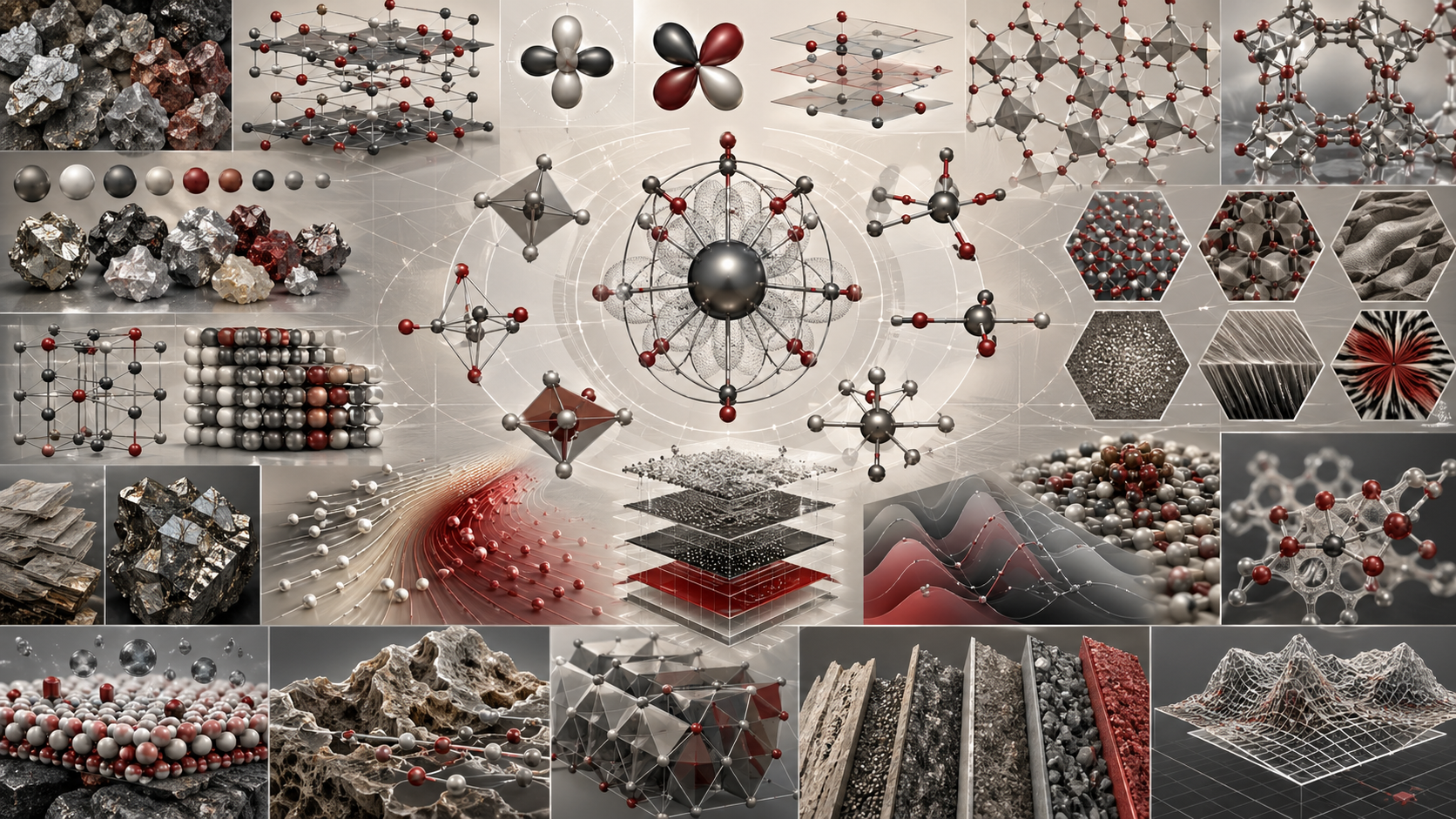
Inorganic chemistry is the chemistry of elemental diversity beyond carbon-centered molecular frameworks. It studies metals, salts, minerals, ions, coordination compounds, solid-state systems, acids, bases, oxides, sulfides, phosphates, silicates, clusters, catalysts, electronic materials, magnetic materials, ceramics, semiconductors, batteries, pigments, corrosion systems, biological metal centers, and the chemical behavior of nearly the entire periodic table.
The central thesis of this article is that inorganic chemistry reveals the chemical possibility of the elements. Organic chemistry shows what carbon frameworks can do. Inorganic chemistry shows what the rest of the periodic table can do: coordinate, oxidize, reduce, crystallize, conduct, magnetize, catalyze, mineralize, dissolve, precipitate, store charge, split water, bind gases, form pigments, support life, and build functional materials.
The phrase “non-carbon systems” does not mean that inorganic chemistry excludes carbon. Carbonates, cyanides, carbides, carbon monoxide complexes, metal carbonyls, organometallic compounds, and metal-organic frameworks all belong partly or fully within inorganic chemistry. The distinction is organizational. Inorganic chemistry is not primarily organized around carbon skeletons, functional groups, and organic reaction families. It is organized around elements, oxidation states, coordination environments, lattice structures, ionic bonding, metallic bonding, acid-base behavior, redox chemistry, periodic trends, and material form.
Main Library
Publications
Article Map
Chemistry
Related Topic
Physics
Related Topic
Environmental Monitoring Systems
Related Topic
Data Systems & Analytics
Why Inorganic Chemistry Matters
Inorganic chemistry matters because most of the periodic table is not carbon. The elements that build minerals, metals, salts, semiconductors, catalysts, batteries, ceramics, pigments, magnetic materials, superconductors, fertilizers, electrodes, corrosion products, water-treatment chemicals, nuclear materials, and biological metal centers belong to the inorganic domain.
Modern civilization depends on inorganic chemistry. Steel, aluminum, silicon chips, glass, cement, ceramics, lithium-ion batteries, fuel cells, catalysts, fertilizers, photovoltaic absorbers, magnets, pigments, flame retardants, corrosion inhibitors, medical imaging agents, industrial gases, water-treatment reagents, and many environmental remediation technologies rely on inorganic systems.
Nature depends on inorganic chemistry as well. Iron carries oxygen in hemoglobin and participates in cytochromes. Magnesium sits at the center of chlorophyll and stabilizes ATP chemistry. Zinc supports enzyme structure and catalysis. Calcium builds bones and shells and acts as a signaling ion. Sodium and potassium support nerve signaling. Molybdenum and iron participate in nitrogen fixation. Manganese participates in photosynthetic water oxidation. Copper, cobalt, nickel, selenium, and many other elements support specialized biological functions.
Inorganic chemistry also matters because elemental behavior has consequences. Elements are not interchangeable abstractions. Lithium, cobalt, nickel, manganese, phosphorus, nitrogen, rare earth elements, platinum-group metals, copper, silicon, aluminum, iron, chromium, arsenic, mercury, lead, and uranium each have distinct chemistry, extraction histories, environmental behavior, toxicity profiles, geopolitical significance, recycling constraints, and material limits.
For researchers and scientists, inorganic chemistry provides the framework for connecting atomic identity to structure, reactivity, environmental fate, technological function, and biological necessity. It turns the periodic table from a classroom chart into a working map of chemical possibility and responsibility.
What Inorganic Chemistry Studies
Inorganic chemistry studies compounds and systems that are not primarily organized around carbon-carbon frameworks. Its scope includes main-group compounds, transition-metal complexes, coordination compounds, ionic solids, minerals, ceramics, semiconductors, metal oxides, sulfides, phosphides, clusters, organometallic compounds, solid-state materials, bioinorganic systems, environmental inorganic species, electrochemical systems, and catalytic materials.
The field is broad because elements behave in many different ways. Some form molecular compounds. Some form extended lattices. Some form ions in solution. Some form metallic solids. Some form oxides, sulfides, phosphates, silicates, nitrides, halides, carbonates, hydrides, boranes, clusters, or coordination complexes. Some elements show one dominant oxidation state, while others move among several oxidation states under accessible conditions.
Important inorganic systems include:
- main-group compounds and salts;
- transition-metal complexes;
- coordination compounds and ligands;
- ionic solids and mineral structures;
- metal oxides, sulfides, nitrides, carbides, and phosphides;
- semiconductors and electronic solids;
- ceramics, glasses, and crystalline solids;
- metal-organic and organometallic systems;
- bioinorganic cofactors and metalloenzymes;
- redox-active environmental species;
- battery electrodes, electrolytes, and interfaces;
- homogeneous and heterogeneous catalysts.
The boundaries between inorganic, organic, physical, analytical, biological, environmental, and materials-oriented chemistry are porous. A metal-organic framework contains metal nodes and organic linkers. An organometallic catalyst contains metal-carbon bonds. A metalloenzyme contains a protein environment around an inorganic active site. A semiconductor may be studied through chemistry, physics, and engineering at once. A mineral surface may control environmental contaminant mobility.
Inorganic chemistry is therefore not a box. It is a perspective: the chemistry of elements, coordination, oxidation state, structure, bonding, reactivity, and material form beyond carbon-centered organic frameworks.
The Periodic Table as an Inorganic Map
The periodic table is the map of inorganic chemistry. It organizes elements by atomic number and recurring chemical behavior. Inorganic chemistry uses periodic trends to understand size, charge, electronegativity, ionization energy, electron affinity, oxidation states, metallic character, coordination preferences, redox behavior, acidity, basicity, and bonding.
Main-group elements often show strong periodic patterns. Alkali metals readily form +1 cations. Alkaline earth metals often form +2 cations. Halogens form halides and participate in oxidation-reduction chemistry. Noble gases are relatively inert but can form compounds under appropriate conditions, especially among heavier noble gases. Oxygen, nitrogen, phosphorus, sulfur, boron, silicon, and the halogens form extensive families of oxides, acids, salts, molecular compounds, and extended structures.
Transition metals add another layer of diversity. Their d electrons support variable oxidation states, coordination complexes, magnetism, color, redox activity, catalytic behavior, and complex geometries. Lanthanides and actinides introduce f-electron chemistry, magnetic behavior, luminescence, nuclear chemistry, high coordination numbers, and specialized bonding environments.
The periodic table also clarifies diagonal relationships, inert-pair effects, lanthanide contraction, hard-soft acid-base tendencies, common ionic radii, preferred coordination numbers, and recurring structural motifs. These patterns help chemists make predictions, but they do not remove the need for evidence. Ligands, solvents, lattices, defects, pH, redox conditions, and temperature can shift behavior.
For researchers, the periodic table is not only a classification system. It is a model of chemical expectation. Inorganic chemistry begins with those expectations and then tests them against structure, bonding, reactivity, measurement, and context.
Main-Group Chemistry
Main-group chemistry includes the s-block and p-block elements. These elements form many of the most familiar inorganic compounds: salts, oxides, acids, bases, halides, hydrides, boranes, silicates, phosphates, sulfates, nitrates, carbonates, noble-gas compounds, and extended network solids.
Main-group chemistry is structurally diverse. Boron forms electron-deficient compounds and clusters. Carbon forms both organic and inorganic compounds. Nitrogen forms ammonia, nitrides, oxides, nitrates, energetic materials, and biologically essential species. Oxygen forms oxides, peroxides, superoxides, water, silicates, and many mineral structures. Silicon forms silicates, semiconductors, glasses, and network solids. Phosphorus forms phosphates essential to life and materials. Sulfur forms sulfides, sulfates, sulfur oxides, and redox-active environmental species. Halogens form salts, interhalogens, oxidants, acids, and coordination compounds.
Main-group chemistry also includes hypervalency, electron-deficient bonding, lone-pair effects, inert-pair behavior, catenation, cluster bonding, polyhedral structures, and extended solid networks. It shows that nonmetal chemistry is not simple or secondary. It is foundational to Earth systems, industry, biology, and technology.
Acid-base behavior is especially important in main-group chemistry. Oxides can be acidic, basic, amphoteric, or redox-active. Phosphates, carbonates, silicates, borates, sulfates, nitrates, and halogen oxoanions structure much of aqueous chemistry, geochemistry, environmental chemistry, and biological chemistry.
For researchers, main-group chemistry reveals how periodic trends and electronic structure generate a wide range of bonding patterns, oxidation states, and molecular or extended structures.
Transition Metals and d-Block Chemistry
Transition metals are central to inorganic chemistry because their d electrons allow rich bonding, color, magnetism, redox behavior, and catalysis. Iron, copper, nickel, cobalt, manganese, chromium, titanium, vanadium, molybdenum, tungsten, platinum, palladium, ruthenium, rhodium, iridium, and many others support complex chemical behavior.
Transition metals often form coordination compounds, where ligands surround a central metal atom or ion. They can adopt multiple oxidation states. They can bind small molecules such as oxygen, nitrogen, carbon monoxide, hydrogen, water, ammonia, chloride, cyanide, and phosphines. They can transfer electrons, activate bonds, stabilize unusual intermediates, and participate in catalytic cycles.
Examples include:
- iron in hemoglobin, cytochromes, iron-sulfur clusters, steel, pigments, and catalysts;
- copper in electron-transfer proteins, oxidation chemistry, and electrical conductors;
- titanium in pigments, structural alloys, catalysts, and oxides;
- platinum in catalysts and anticancer drugs;
- palladium in cross-coupling catalysis;
- nickel in hydrogenation, enzymes, alloys, and batteries;
- manganese in photosynthesis, oxidation chemistry, and battery materials;
- molybdenum in nitrogenase, redox enzymes, and industrial catalysts.
Transition-metal chemistry is often challenging because small changes in ligand environment can alter oxidation state, spin state, geometry, redox potential, ligand lability, catalytic activity, and spectroscopy. A metal ion in water may behave differently from the same metal ion in a protein pocket, oxide lattice, coordination complex, or electrode surface.
For researchers, transition-metal chemistry shows why inorganic chemistry is deeply connected to color, magnetism, redox power, catalysis, and biological function.
Oxidation States and Electron Accounting
Oxidation state is one of the most important organizing tools in inorganic chemistry. It provides a formal way to track electron distribution, redox change, charge balance, and electron accounting.
An atom is oxidized when its oxidation state increases. It is reduced when its oxidation state decreases. In inorganic chemistry, oxidation states help classify compounds, balance redox reactions, predict coordination behavior, interpret spectroscopy, understand magnetic properties, compare periodic trends, and follow catalytic cycles.
For a neutral compound, charge balance can be written as:
\sum_i z_i n_i = 0
\]
Interpretation: \(z_i\) is charge or formal contribution of species \(i\), and \(n_i\) is the number of that species. Neutral compounds require total charge balance.
For a compound or ion, oxidation-state accounting can be written as:
\sum_i OS_i n_i = q
\]
Interpretation: \(OS_i\) is the oxidation state of element \(i\), \(n_i\) is the number of atoms, and \(q\) is total charge. This equation supports formal electron accounting.
For a simple ionic compound such as sodium chloride, sodium is commonly assigned +1 and chloride -1. For an iron redox pair:
Fe^{2+} \rightleftharpoons Fe^{3+} + e^-
\]
Interpretation: Iron changes formal oxidation state from +2 to +3 during oxidation. Electron accounting helps track redox change.
Oxidation state is not always the same as real charge. In covalent, delocalized, mixed-valence, metal-metal bonded, and highly polarizable systems, it is a formal convention. But it remains indispensable because it allows chemists to track redox behavior across metals, oxides, minerals, coordination compounds, catalysts, and biological cofactors.
For researchers, oxidation state is often the first question in inorganic chemistry: what is the formal electron count, what redox transformations are possible, and what does that imply for structure, reactivity, and function?
Coordination Chemistry and Ligands
Coordination chemistry studies compounds in which ligands are bound to a central atom or ion, often a metal. A coordination entity can be understood as a central atom surrounded by attached donor groups called ligands.
A simplified coordination complex may be written:
[M(L)_n]^q
\]
Interpretation: \(M\) is the central metal or atom, \(L\) represents ligands, \(n\) is ligand count, and \(q\) is the overall charge of the coordination entity.
Ligands may be neutral or charged. They may bind through one atom or multiple atoms. They may be small molecules, ions, organic fragments, inorganic anions, biomolecules, or extended linkers.
Common ligands include:
- water;
- ammonia;
- chloride;
- cyanide;
- carbon monoxide;
- hydroxide;
- phosphines;
- amines;
- carboxylates;
- porphyrins;
- chelating ligands such as ethylenediamine;
- macrocyclic ligands and biological donor groups.
Coordination chemistry is important because ligands control metal behavior. Changing ligands can change color, magnetic state, oxidation potential, spin state, geometry, solubility, catalytic activity, biological function, toxicity, and stability.
Coordination compounds may be labile or inert, high-spin or low-spin, mononuclear or polynuclear, soluble or insoluble, redox-active or redox-inert, catalytic or structural. Ligands can stabilize unusual oxidation states, promote electron transfer, tune acidity, enforce geometry, activate substrates, or prevent unwanted aggregation.
For researchers, metal-ligand chemistry is one of the central languages of inorganic chemistry. It connects molecular structure to electronic behavior, reactivity, measurement, and function.
Geometry, Crystal-Field, and Ligand-Field Ideas
Coordination compounds adopt characteristic geometries. Common examples include linear, trigonal planar, tetrahedral, square planar, trigonal bipyramidal, square pyramidal, and octahedral structures.
The coordination number is the number of ligand donor atoms directly attached to the central atom:
CN = \text{number of donor atoms directly bonded to the central atom}
\]
Interpretation: Coordination number counts donor atoms, not necessarily ligand molecules, because some ligands bind through multiple donor atoms.
Geometry matters because it affects d-orbital energies, spin state, magnetism, color, reactivity, stereochemistry, spectroscopy, and catalytic pathways. In octahedral transition-metal complexes, ligand interactions split the d orbitals into different energy levels. Crystal-field theory treats ligands as point charges or dipoles, while ligand-field theory incorporates more covalent bonding effects.
A simplified octahedral d-orbital splitting is represented as:
\Delta_o
\]
Interpretation: \(\Delta_o\) is the octahedral crystal-field splitting energy. It helps explain color, spin state, and magnetic behavior in transition-metal complexes.
A simplified crystal-field stabilization energy for octahedral complexes can be written as:
CFSE = n_{t_{2g}}(-0.4\Delta_o) + n_{e_g}(0.6\Delta_o)
\]
Interpretation: \(n_{t_{2g}}\) and \(n_{e_g}\) are electron counts in lower and upper octahedral d-orbital sets. The expression gives a simplified stabilization estimate relative to an unsplit field.
Spin-only magnetic moment can be estimated as:
\mu = \sqrt{n(n+2)}\ \mu_B
\]
Interpretation: \(n\) is the number of unpaired electrons and \(\mu_B\) is the Bohr magneton. This simplified expression helps connect electron configuration to magnetic behavior.
Ligand strength, metal identity, oxidation state, geometry, electron count, and covalency all affect splitting. This helps explain why transition-metal complexes can be colored, paramagnetic, diamagnetic, high spin, low spin, reactive, inert, labile, or catalytically active.
For researchers, geometry is not decorative. It is chemically causal. It changes orbital energies, reactivity, spectroscopy, and function.
Ionic Solids, Lattices, and Minerals
Many inorganic compounds form extended solids rather than discrete molecules. Ionic solids such as sodium chloride, magnesium oxide, calcium fluoride, and many minerals consist of repeating arrays of cations and anions.
A lattice is a repeating spatial arrangement of particles. The stability of an ionic solid depends on electrostatic interactions, ionic sizes, charges, packing, lattice energy, solvation energy, polarization, and defects.
A simplified Coulombic attraction between ions is:
E \propto \frac{q_1q_2}{r}
\]
Interpretation: \(q_1\) and \(q_2\) are ionic charges and \(r\) is separation distance. Stronger charges and shorter distances generally increase electrostatic attraction.
A simplified lattice-energy trend can be represented as:
U \propto \frac{|z_+z_-|}{r}
\]
Interpretation: Lattice energy tends to increase with larger ionic charge products and smaller ion separations, although real solids require more detailed treatment.
Minerals are inorganic solids with ordered structures and geological significance. Silicates, carbonates, sulfides, oxides, phosphates, halides, and sulfates form much of Earth’s crust and geochemical cycling. Their structures determine hardness, cleavage, solubility, reactivity, weathering, metal mobility, and environmental behavior.
Defects are also central. Vacancies, interstitials, substitutions, dislocations, grain boundaries, and nonstoichiometry can strongly influence conductivity, diffusion, color, strength, catalytic behavior, and reactivity. A mineral, ceramic, or electrode material cannot always be understood from ideal formula alone.
For researchers, inorganic chemistry extends beyond molecules. It studies matter as lattices, crystals, surfaces, defects, grains, phases, and minerals.
Solid-State Inorganic Chemistry
Solid-state inorganic chemistry studies extended structures and inorganic functional solids. It includes metals, alloys, ceramics, semiconductors, superconductors, ionic conductors, battery electrodes, catalysts, pigments, magnetic solids, optical materials, porous frameworks, and electronic materials.
In a solid, properties are not determined only by formula. They depend on crystal structure, defects, grain boundaries, oxidation states, dopants, vacancies, particle size, morphology, surfaces, phase transitions, and electronic band structure.
Examples include:
- silicon becoming electronically useful through controlled doping;
- metal oxides functioning as catalysts, pigments, electrodes, ceramics, or semiconductors;
- perovskite structures supporting photovoltaic, ferroelectric, catalytic, ionic-conducting, or superconducting behavior;
- zeolites combining inorganic frameworks with catalytic and adsorption properties;
- lithium transition-metal oxides storing and releasing ions and electrons in batteries;
- iron oxides acting as pigments, minerals, catalysts, sorbents, or environmental redox phases.
One commonly used descriptor for idealized perovskite structures is the Goldschmidt tolerance factor:
t = \frac{r_A + r_X}{\sqrt{2}(r_B + r_X)}
\]
Interpretation: \(r_A\), \(r_B\), and \(r_X\) are ionic radii in an idealized \(ABX_3\) structure. The tolerance factor is a simplified geometric descriptor, not a complete predictor of stability.
Solid-state inorganic chemistry requires synthesis, structure, and property to be interpreted together. The same nominal composition can behave differently depending on preparation temperature, atmosphere, cooling rate, particle size, dopant distribution, crystallinity, and defect chemistry.
For researchers, solid-state inorganic chemistry shows that inorganic systems can be designed for function, but only when composition, structure, processing, defects, and measurement are kept connected.
Acid-Base and Redox Behavior
Inorganic chemistry is rich in acid-base and redox behavior. Metal ions can act as Lewis acids. Ligands can act as Lewis bases. Oxides can be acidic, basic, amphoteric, or redox-active. Aqueous metal ions can hydrolyze water and affect pH. Minerals can dissolve or precipitate depending on acid-base conditions.
Lewis acid-base behavior can be represented as:
A + :B \rightarrow A \leftarrow B
\]
Interpretation: \(A\) accepts an electron pair and \(:B\) donates an electron pair. Lewis acid-base logic is central to coordination chemistry and metal-ligand bonding.
Redox chemistry is equally central. Transition metals can cycle among oxidation states. Main-group elements such as nitrogen, sulfur, chlorine, oxygen, phosphorus, and iodine can also participate in multiple redox states. Inorganic redox chemistry controls corrosion, batteries, fuel cells, metallurgy, environmental chemistry, catalysis, and biological electron transfer.
In many inorganic systems, acid-base and redox behavior are coupled. Proton concentration can shift redox potential. Metal oxidation state can affect acidity. Ligand binding can stabilize one oxidation state over another. Solids can dissolve, precipitate, or transform depending on pH and electron availability.
Pourbaix-style reasoning, speciation diagrams, solubility products, complex-formation constants, and redox potentials are often needed to understand inorganic systems in water. A metal may exist as free ion, hydroxo complex, carbonate complex, sulfide precipitate, adsorbed surface species, or redox-transformed phase depending on conditions.
For researchers, inorganic chemistry is often a chemistry of coupled equilibria: acid-base, redox, solubility, complexation, adsorption, and phase transformation interact rather than acting separately.
Organometallic Boundaries
Organometallic chemistry sits at the boundary of inorganic and organic chemistry. It studies compounds containing bonds between metals and carbon-containing ligands. Examples include metal carbonyls, metallocenes, alkylmetal compounds, arylmetal compounds, metal carbenes, metal hydrides, and transition-metal catalysts.
Organometallic chemistry is important because metals can activate organic molecules in ways that purely organic reagents often cannot. Metals can bind alkenes, alkynes, carbon monoxide, carbon dioxide, hydrogen, nitrogen, and carbon-hydrogen bonds. They can change oxidation state, insert into bonds, form metal-carbon intermediates, and release products through reductive elimination.
Many catalytic processes depend on organometallic chemistry:
- hydrogenation;
- hydroformylation;
- cross-coupling;
- olefin metathesis;
- polymerization;
- carbonylation;
- C-H activation;
- carbon dioxide reduction.
Organometallic mechanisms often involve oxidative addition, reductive elimination, migratory insertion, beta-hydride elimination, ligand substitution, transmetallation, and metal-ligand cooperative effects. These mechanisms show why electron count, ligand environment, geometry, oxidation state, and substrate binding must be interpreted together.
For researchers, organometallic chemistry shows that inorganic and organic chemistry are not rivals. They interlock through metal-carbon bonding and catalytic pathway control.
Bioinorganic Chemistry
Bioinorganic chemistry studies the roles of inorganic elements in biological systems. Life depends on metal ions and inorganic cofactors for structure, signaling, catalysis, electron transfer, oxygen transport, photosynthesis, and metabolism.
Examples include:
- iron in hemoglobin, myoglobin, cytochromes, and iron-sulfur clusters;
- magnesium in chlorophyll and ATP-binding chemistry;
- zinc in enzymes and transcription factors;
- copper in electron-transfer proteins and oxygen chemistry;
- manganese in the oxygen-evolving complex of photosynthesis;
- molybdenum and iron in nitrogenase;
- cobalt in vitamin B12;
- calcium in bones, shells, signaling, and protein structure;
- nickel in hydrogenases and urease;
- selenium in redox-active selenoproteins.
Metal centers in biology are not isolated ions floating in water. They are embedded in protein, membrane, or molecular environments that tune geometry, oxidation state, ligand field, accessibility, redox potential, and catalytic function. A metal ion’s behavior depends on its ligands, nearby residues, solvent access, protonation state, and larger biological context.
Bioinorganic chemistry is also central to medicine. Platinum anticancer drugs, gadolinium imaging agents, lithium therapies, radiometals, metal-based enzyme inhibitors, iron chelators, antimicrobial metal complexes, and metal homeostasis disorders all involve inorganic chemistry.
For researchers, bioinorganic chemistry shows that life is not purely organic. Living systems are hybrid chemical systems built from carbon frameworks and inorganic centers working together.
Environmental Inorganic Chemistry
Environmental inorganic chemistry studies the behavior of metals, minerals, ions, nutrients, pollutants, and redox-active species in air, water, soils, sediments, and living systems.
Important environmental inorganic systems include:
- iron and manganese redox cycling;
- arsenic mobility;
- lead and mercury contamination;
- chromium speciation;
- phosphate and nitrate chemistry;
- carbonate buffering;
- sulfide and sulfate cycling;
- mineral dissolution and precipitation;
- acid mine drainage;
- ocean carbonate chemistry;
- atmospheric metal particles and aerosols.
Speciation is central. The same element can behave differently depending on oxidation state, pH, ligand binding, mineral phase, particle size, solubility, adsorption, and biological uptake. Chromium(III) and chromium(VI), for example, have very different environmental and toxicological behavior. Arsenic mobility depends strongly on redox state and mineral interactions. Iron oxides can immobilize or release contaminants depending on conditions.
Environmental inorganic chemistry also has justice implications. Communities affected by mining, industrial emissions, contaminated water, battery supply chains, legacy lead infrastructure, coal ash, industrial waste, or metal-bearing dust often face unequal exposure. Analytical measurement, speciation, remediation chemistry, and environmental monitoring determine whether harm is visible and actionable.
For researchers, environmental inorganic chemistry connects molecular speciation to public health, water quality, soil systems, climate, mining, agriculture, and ecological risk.
Inorganic Catalysis, Energy, and Technology
Many of the most important catalysts are inorganic. Metals, metal oxides, sulfides, phosphides, zeolites, supported nanoparticles, coordination complexes, electrocatalysts, photocatalysts, and enzymes with metal centers all mediate chemical pathways.
Inorganic catalysts support:
- ammonia synthesis;
- petroleum refining;
- emissions control;
- hydrogen evolution;
- oxygen reduction;
- oxygen evolution;
- carbon dioxide reduction;
- water splitting;
- fuel cells;
- battery side-reaction control;
- selective oxidation;
- industrial polymerization;
- environmental remediation and pollutant transformation.
Energy technologies also depend on inorganic systems. Batteries use inorganic electrodes, electrolytes, current collectors, coatings, and interfaces. Fuel cells use catalysts and ion conductors. Solar cells use semiconductors and absorber materials. Thermoelectrics, superconductors, magnets, hydrogen-storage materials, carbon-capture sorbents, and corrosion-resistant alloys are often inorganic or hybrid systems.
The chemistry of these systems is not only composition. It involves oxidation state, crystal structure, surface area, morphology, defect chemistry, ion mobility, electron conductivity, phase stability, catalytic site structure, and degradation pathways.
For researchers, inorganic chemistry is central to energy technology because it is a science of electron flow, ion movement, catalysis, phase stability, interfacial chemistry, and durability.
Critical Elements, Scarcity, and Responsible Use
Inorganic chemistry also requires attention to elemental scarcity and responsible use. Elements used in modern technologies often have complex supply chains, uneven geographic distribution, energy-intensive extraction, environmental burdens, labor concerns, toxicity risks, and recycling challenges.
Critical-element questions include:
- Can a high-performing material be made with more abundant elements?
- Can a catalyst avoid scarce or geopolitically constrained metals?
- Can a battery reduce dependence on cobalt or nickel without compromising safety and performance?
- Can rare earth elements be recovered and recycled efficiently?
- Can mining and processing harms be reduced or monitored more transparently?
- Can environmental mobility and toxicity be controlled through better speciation management?
Chemistry alone cannot solve these questions, but chemistry is indispensable. Substitution requires knowledge of oxidation states, ionic radii, electronic structure, crystal structure, and function. Recycling requires separation chemistry, redox chemistry, solubility, complexation, and process design. Toxicity and environmental fate require speciation, mobility, and bioavailability analysis.
Responsible inorganic chemistry therefore links elemental performance to planetary constraint. A material is not only a set of properties. It is also a demand on extraction, energy, waste, labor, and ecological systems.
For researchers, elemental awareness is part of scientific responsibility. The periodic table is not only a field of possibility; it is also a field of limits.
Computational Inorganic Chemistry
Computational inorganic chemistry represents and predicts the behavior of metal complexes, solids, surfaces, clusters, minerals, catalysts, and extended systems. It may involve molecular orbital theory, density functional theory, ligand-field calculations, molecular mechanics, crystal-structure analysis, band-structure modeling, reaction-energy calculations, speciation modeling, machine learning, and materials informatics.
Computational inorganic workflows can support:
- oxidation-state bookkeeping;
- coordination-number calculation;
- ligand classification;
- electron-counting scaffolds;
- crystal-field splitting estimates;
- spin-only magnetic-moment estimates;
- redox-potential analysis;
- solid-state structure descriptors;
- lattice and stoichiometry checks;
- perovskite tolerance-factor estimates;
- materials screening;
- catalyst candidate comparison;
- environmental speciation modeling.
Inorganic computation is challenging because many inorganic systems involve open-shell electrons, multiple oxidation states, spin states, relativistic effects, strong correlation, defects, surfaces, solvation, and extended lattices. A model that works well for a small organic molecule may not be adequate for a transition-metal oxide, a magnetic solid, a redox-active mineral, or a metalloenzyme active site.
Computational inorganic chemistry must therefore be careful about assumptions, validation, spin state, charge, geometry, basis set, functional choice, periodicity, surface model, solvation environment, and experimental context.
For researchers, computation is strongest when it makes inorganic reasoning auditable: what oxidation state was assumed, what spin state was modeled, what ligands or lattice were included, what defects were omitted, what functional or force field was used, and how the result compares with measurement.
Mathematical Lens: Inorganic Systems
Inorganic chemistry uses charge balance, oxidation-state accounting, coordination numbers, crystal-field splitting, lattice descriptors, magnetic-moment estimates, and structure-property relationships. For a neutral compound, charge balance can be written as:
\sum_i z_i n_i = 0
\]
Interpretation: The total charge contribution across all species must sum to zero for a neutral compound.
For a compound or ion, oxidation-state accounting can be written as:
\sum_i OS_i n_i = q
\]
Interpretation: The weighted sum of oxidation states equals the total charge \(q\). This is a formal accounting tool, not always a direct measure of real electron density.
Coordination number is:
CN = \text{number of donor atoms directly bonded to the central atom}
\]
Interpretation: Coordination number helps classify metal-ligand environments and predict geometry, reactivity, and electronic structure.
Crystal-field stabilization energy for an octahedral d-electron configuration can be approximated as:
CFSE = n_{t_{2g}}(-0.4\Delta_o) + n_{e_g}(0.6\Delta_o)
\]
Interpretation: The expression estimates stabilization from occupancy of split octahedral d orbitals under simplified crystal-field assumptions.
Spin-only magnetic moment is:
\mu = \sqrt{n(n+2)}\ \mu_B
\]
Interpretation: The number of unpaired electrons \(n\) gives a simplified magnetic-moment estimate. Real systems may require orbital contributions, spin-orbit coupling, or more advanced treatment.
Lattice-energy scaling can be represented as:
U \propto \frac{|z_+z_-|}{r}
\]
Interpretation: Ionic lattice stabilization tends to increase with larger ionic charges and smaller separations, although real solids require structural and electrostatic detail.
The Goldschmidt tolerance factor for an idealized perovskite \(ABX_3\) is:
t = \frac{r_A + r_X}{\sqrt{2}(r_B + r_X)}
\]
Interpretation: The tolerance factor is a geometric descriptor based on ionic radii. It can guide structural expectations but does not prove phase stability.
A simplified materials-property model can be expressed as:
y = f(\mathbf{x})
\]
Interpretation: A property \(y\) may depend on descriptors \(\mathbf{x}\), such as composition, oxidation states, ionic radii, electronegativity, coordination number, crystal structure, defect concentration, band gap, or magnetic descriptors.
These equations show that inorganic chemistry is not only descriptive. It is a quantitative science of charge, structure, geometry, spin, lattice behavior, redox state, and materials function.
Computational Workflows for Inorganic Chemistry
Computational workflows can make inorganic chemistry more transparent. A workflow can track formula, charge, oxidation states, coordination number, ligand identity, geometry, spin state, crystal-field estimate, magnetic moment, ionic radii, lattice descriptors, solid-state structure, environmental speciation, redox assumptions, and validation evidence.
Useful workflows include oxidation-state accounting, coordination-number tables, ligand descriptors, crystal-field scaffolds, spin-only magnetic-moment estimates, ionic-solid descriptors, perovskite tolerance factors, materials-property tables, environmental speciation registers, and SQL evidence systems.
For researchers, inorganic workflows should preserve four distinctions:
- Formal oxidation state versus real electron density: electron accounting is useful, but it is not always identical to physical charge.
- Formula versus structure: composition alone does not define geometry, lattice, defects, or phase.
- Coordination number versus ligand count: chelating ligands can change this relationship.
- Model descriptor versus material property: descriptors such as tolerance factor or crystal-field splitting guide interpretation but do not replace measurement.
The examples below use synthetic educational data. They do not validate real oxidation-state assignments, certify material stability, predict magnetic behavior, approve catalysts, or replace professional inorganic-chemistry review. They demonstrate how inorganic reasoning can be structured, audited, and communicated responsibly.
Python Example: Oxidation States, Crystal-Field Terms, Magnetic Moments, and Provenance
The following Python example uses synthetic educational data. It calculates unknown oxidation states from formal charge balance, estimates simplified octahedral crystal-field stabilization terms, estimates spin-only magnetic moments, and writes provenance outputs. In real inorganic chemistry, these scaffolds would require structural data, validated oxidation-state assignment, spin-state evidence, spectroscopic support, and chemical review.
from pathlib import Path
from typing import Dict, List
import json
import math
import platform
import sys

import numpy as np
import pandas as pd


# Synthetic inorganic chemistry workflow.
# Educational example only; not for material certification,
# catalyst selection, environmental compliance, or safety decisions.


def require_columns(data: pd.DataFrame, required: List[str], table_name: str) -> None:
    """Raise an error if required columns are missing."""
    missing = [column for column in required if column not in data.columns]
    if missing:
        raise ValueError(f"{table_name} is missing required columns: {missing}")


compounds = pd.DataFrame({
    "compound": ["NaCl", "MgO", "Fe2O3", "KMnO4", "SO4_2_minus"],
    "total_charge": [0, 0, 0, 0, -2],
    "known_contribution": [-1, -2, 3 * -2, 1 + 4 * -2, 4 * -2],
    "unknown_atom_count": [1, 1, 2, 1, 1],
    "unknown_element": ["Na", "Mg", "Fe", "Mn", "S"],
})

require_columns(
    compounds,
    [
        "compound",
        "total_charge",
        "known_contribution",
        "unknown_atom_count",
        "unknown_element",
    ],
    "compounds",
)

compounds["unknown_oxidation_state"] = (
    compounds["total_charge"] - compounds["known_contribution"]
) / compounds["unknown_atom_count"]

compounds["integer_oxidation_state_review"] = (
    np.isclose(
        compounds["unknown_oxidation_state"],
        compounds["unknown_oxidation_state"].round(),
    )
)

complexes = pd.DataFrame({
    "complex": [
        "octahedral_d3",
        "octahedral_high_spin_d5",
        "octahedral_low_spin_d6",
        "octahedral_high_spin_d6",
    ],
    "t2g_electrons": [3, 3, 6, 4],
    "eg_electrons": [0, 2, 0, 2],
    "unpaired_electrons": [3, 5, 0, 4],
    "delta_o_units": [1.0, 1.0, 1.0, 1.0],
})

require_columns(
    complexes,
    [
        "complex",
        "t2g_electrons",
        "eg_electrons",
        "unpaired_electrons",
        "delta_o_units",
    ],
    "complexes",
)

complexes["cfse_delta_o_units"] = (
    complexes["t2g_electrons"] * -0.4 * complexes["delta_o_units"]
    + complexes["eg_electrons"] * 0.6 * complexes["delta_o_units"]
)

complexes["spin_only_magnetic_moment_BM"] = complexes[
    "unpaired_electrons"
].apply(
    lambda n: math.sqrt(n * (n + 2))
)

complexes["magnetic_review"] = np.where(
    complexes["unpaired_electrons"] > 0,
    "paramagnetic scaffold",
    "diamagnetic scaffold",
)

perovskites = pd.DataFrame({
    "material": ["case_A", "case_B", "case_C"],
    "r_A": [1.60, 1.35, 1.80],
    "r_B": [0.60, 0.65, 0.58],
    "r_X": [1.40, 1.40, 1.40],
})

perovskites["tolerance_factor"] = (
    (perovskites["r_A"] + perovskites["r_X"])
    / (math.sqrt(2) * (perovskites["r_B"] + perovskites["r_X"]))
)

perovskites["geometric_review"] = np.select(
    [
        perovskites["tolerance_factor"].between(0.8, 1.05),
        perovskites["tolerance_factor"] < 0.8,
    ],
    [
        "within broad idealized perovskite-like range",
        "small A-site scaffold review",
    ],
    default="large A-site scaffold review",
)

output_dir = Path("outputs")
output_dir.mkdir(exist_ok=True)

compounds.to_csv(output_dir / "synthetic_oxidation_state_accounting.csv", index=False)
complexes.to_csv(output_dir / "synthetic_crystal_field_magnetism.csv", index=False)
perovskites.to_csv(output_dir / "synthetic_perovskite_tolerance_factor.csv", index=False)

manifest: Dict[str, object] = {
    "workflow": "synthetic_inorganic_chemistry_workflow",
    "data_type": "synthetic educational inorganic chemistry records",
    "oxidation_state_formula": "sum_i OS_i * n_i = q",
    "cfse_formula": "CFSE = n_t2g*(-0.4*Delta_o) + n_eg*(0.6*Delta_o)",
    "spin_only_formula": "mu = sqrt(n*(n+2)) Bohr magnetons",
    "tolerance_factor_formula": "t = (r_A + r_X) / (sqrt(2)*(r_B + r_X))",
    "python_version": sys.version,
    "platform": platform.platform(),
    "numpy_version": np.__version__,
    "pandas_version": pd.__version__,
    "output_files": [
        "outputs/synthetic_oxidation_state_accounting.csv",
        "outputs/synthetic_crystal_field_magnetism.csv",
        "outputs/synthetic_perovskite_tolerance_factor.csv",
        "outputs/inorganic_chemistry_manifest.json",
    ],
    "responsible_use": [
        "Synthetic educational data only.",
        "Real inorganic chemistry requires structural evidence, spectroscopy, validated oxidation-state assignment, spin-state review, lattice data, environmental context, and expert interpretation.",
    ],
}

with (output_dir / "inorganic_chemistry_manifest.json").open(
    "w",
    encoding="utf-8"
) as file:
    json.dump(manifest, file, indent=2)

print("Oxidation-state accounting")
print("--------------------------")
print(compounds.round(6).to_string(index=False))

print("\nCrystal-field and magnetic-moment scaffold")
print("------------------------------------------")
print(complexes.round(6).to_string(index=False))

print("\nPerovskite tolerance-factor scaffold")
print("------------------------------------")
print(perovskites.round(6).to_string(index=False))
This workflow demonstrates inorganic evidence discipline rather than real materials prediction. It separates formal oxidation-state accounting, simplified ligand-field reasoning, spin-only magnetic estimates, and geometric descriptors. A real workflow would add crystal structures, spectroscopic evidence, spin-state assignment, DFT or experimental validation, uncertainty, and literature comparison.
R Example: Coordination Tables and Perovskite Tolerance Factors
The following R example uses synthetic educational data to organize coordination-complex descriptors and calculate idealized perovskite tolerance factors. In real inorganic chemistry, these descriptors should be tied to structural measurements, ligand identity, charge balance, crystallographic data, and validation evidence.
# Synthetic inorganic chemistry scaffold.
# Educational example only; not for material certification,
# catalyst selection, environmental compliance, or safety decisions.

complexes <- data.frame(
  complex = c(
    "hexaaqua_metal_like",
    "tetraammine_metal_like",
    "square_planar_metal_like",
    "chelating_ligand_case"
  ),
  coordination_number = c(6, 4, 4, 6),
  ligand_count = c(6, 4, 4, 3),
  geometry = c(
    "octahedral",
    "tetrahedral_or_square_planar",
    "square_planar",
    "octahedral_chelate"
  ),
  formal_metal_oxidation_state = c(2, 2, 2, 3)
)

complexes$high_coordination <-
  as.integer(complexes$coordination_number >= 6)

complexes$chelation_review_required <-
  complexes$coordination_number != complexes$ligand_count

perovskites <- data.frame(
  material = c("case_A", "case_B", "case_C", "case_D"),
  r_A = c(1.60, 1.35, 1.80, 1.20),
  r_B = c(0.60, 0.65, 0.58, 0.75),
  r_X = c(1.40, 1.40, 1.40, 1.40)
)

perovskites$tolerance_factor <- with(
  perovskites,
  (r_A + r_X) / (sqrt(2) * (r_B + r_X))
)

perovskites$geometric_review <- ifelse(
  perovskites$tolerance_factor >= 0.8 &
    perovskites$tolerance_factor <= 1.05,
  "within broad idealized range",
  "geometric review required"
)

dir.create("outputs", showWarnings = FALSE)

write.csv(
  complexes,
  file = "outputs/r_coordination_descriptor_table.csv",
  row.names = FALSE
)

write.csv(
  perovskites,
  file = "outputs/r_perovskite_tolerance_factor.csv",
  row.names = FALSE
)

sink("outputs/r_inorganic_chemistry_report.txt")
cat("Synthetic Inorganic Chemistry Scaffold Report\n")
cat("=============================================\n\n")
cat("Coordination descriptor table:\n")
print(complexes)
cat("\nPerovskite tolerance-factor scaffold:\n")
print(perovskites)
cat("\nResponsible-use note:\n")
cat("Synthetic educational data only. Real inorganic analysis requires structure, composition, charge balance, spectroscopy, crystallography, environmental context, and expert review.\n")
sink()

print(complexes)
print(perovskites)
This scaffold shows how R can support inorganic descriptor summaries and simple structure-property reasoning. The central issue is not the language but the evidence chain. Coordination number, geometry, oxidation state, and tolerance factor should remain connected to structural evidence and chemical context.
SQL Example: Inorganic Chemistry Evidence Register
Inorganic chemistry becomes more reliable when compounds, oxidation states, coordination environments, ligands, crystal structures, spectroscopy, redox data, materials properties, environmental speciation, and interpretation claims are traceable. A simple evidence register can preserve the context needed to audit inorganic-chemistry results.
CREATE TABLE inorganic_compound (
    compound_id TEXT PRIMARY KEY,
    compound_name TEXT NOT NULL,
    formula TEXT,
    compound_class TEXT,
    total_charge INTEGER,
    phase_description TEXT,
    source_or_sample_uri TEXT,
    compound_quality_flag TEXT,
    compound_notes TEXT
);

CREATE TABLE oxidation_state_record (
    oxidation_record_id TEXT PRIMARY KEY,
    compound_id TEXT NOT NULL,
    element_symbol TEXT NOT NULL,
    atom_count INTEGER CHECK (atom_count >= 1),
    assigned_oxidation_state REAL,
    assignment_method TEXT,
    assignment_confidence TEXT,
    assignment_notes TEXT,
    FOREIGN KEY (compound_id) REFERENCES inorganic_compound(compound_id)
);

CREATE TABLE coordination_environment (
    coordination_id TEXT PRIMARY KEY,
    compound_id TEXT NOT NULL,
    central_atom TEXT,
    coordination_number INTEGER CHECK (coordination_number >= 0),
    geometry TEXT,
    spin_state TEXT,
    ligand_field_description TEXT,
    coordination_review_status TEXT,
    FOREIGN KEY (compound_id) REFERENCES inorganic_compound(compound_id)
);

CREATE TABLE ligand_record (
    ligand_id TEXT PRIMARY KEY,
    coordination_id TEXT NOT NULL,
    ligand_name TEXT,
    ligand_formula TEXT,
    donor_atom TEXT,
    denticity INTEGER CHECK (denticity >= 1),
    ligand_charge INTEGER,
    ligand_class TEXT,
    ligand_notes TEXT,
    FOREIGN KEY (coordination_id) REFERENCES coordination_environment(coordination_id)
);

CREATE TABLE crystal_structure_record (
    structure_id TEXT PRIMARY KEY,
    compound_id TEXT NOT NULL,
    structure_type TEXT,
    space_group TEXT,
    lattice_a REAL,
    lattice_b REAL,
    lattice_c REAL,
    alpha_deg REAL,
    beta_deg REAL,
    gamma_deg REAL,
    structure_database_id TEXT,
    structure_uri TEXT,
    structure_review_status TEXT,
    FOREIGN KEY (compound_id) REFERENCES inorganic_compound(compound_id)
);

CREATE TABLE spectroscopy_record (
    spectroscopy_id TEXT PRIMARY KEY,
    compound_id TEXT NOT NULL,
    spectroscopy_type TEXT,
    measurement_uri TEXT,
    key_observation TEXT,
    assignment_notes TEXT,
    spectroscopy_review_status TEXT,
    FOREIGN KEY (compound_id) REFERENCES inorganic_compound(compound_id)
);

CREATE TABLE redox_record (
    redox_id TEXT PRIMARY KEY,
    compound_id TEXT NOT NULL,
    redox_couple TEXT,
    potential_value REAL,
    potential_unit TEXT,
    reference_electrode TEXT,
    solvent_or_medium TEXT,
    ph REAL,
    redox_review_status TEXT,
    FOREIGN KEY (compound_id) REFERENCES inorganic_compound(compound_id)
);

CREATE TABLE materials_property_record (
    property_id TEXT PRIMARY KEY,
    compound_id TEXT NOT NULL,
    property_name TEXT,
    property_value REAL,
    property_unit TEXT,
    measurement_method TEXT,
    temperature_K REAL,
    property_review_status TEXT,
    FOREIGN KEY (compound_id) REFERENCES inorganic_compound(compound_id)
);

CREATE TABLE environmental_speciation_record (
    speciation_id TEXT PRIMARY KEY,
    compound_id TEXT NOT NULL,
    environment_matrix TEXT,
    ph REAL,
    redox_condition TEXT,
    dominant_species TEXT,
    mobility_assessment TEXT,
    toxicity_relevance TEXT,
    speciation_review_status TEXT,
    FOREIGN KEY (compound_id) REFERENCES inorganic_compound(compound_id)
);

CREATE TABLE inorganic_interpretation_claim (
    claim_id TEXT PRIMARY KEY,
    compound_id TEXT NOT NULL,
    claim_text TEXT,
    claim_type TEXT,
    confidence_level TEXT,
    limitation_notes TEXT,
    review_status TEXT,
    FOREIGN KEY (compound_id) REFERENCES inorganic_compound(compound_id)
);

SELECT
    c.compound_id,
    c.compound_name,
    c.formula,
    c.compound_class,
    o.element_symbol,
    o.assigned_oxidation_state,
    e.central_atom,
    e.coordination_number,
    e.geometry,
    e.spin_state,
    s.structure_type,
    s.space_group,
    r.redox_couple,
    r.potential_value,
    r.reference_electrode,
    p.property_name,
    p.property_value,
    p.property_unit,
    env.environment_matrix,
    env.dominant_species,
    claim.claim_type,
    claim.confidence_level,
    CASE
        WHEN c.formula IS NULL
            THEN 'formula review required'
        WHEN o.assigned_oxidation_state IS NULL
            THEN 'oxidation-state review required'
        WHEN e.coordination_review_status IS NOT NULL
             AND e.coordination_review_status != 'pass'
            THEN 'coordination review required'
        WHEN s.structure_review_status IS NOT NULL
             AND s.structure_review_status != 'pass'
            THEN 'structure review required'
        WHEN r.redox_review_status IS NOT NULL
             AND r.redox_review_status != 'pass'
            THEN 'redox review required'
        WHEN p.property_review_status IS NOT NULL
             AND p.property_review_status != 'pass'
            THEN 'materials-property review required'
        WHEN env.speciation_review_status IS NOT NULL
             AND env.speciation_review_status != 'pass'
            THEN 'environmental speciation review required'
        WHEN claim.review_status IS NOT NULL
             AND claim.review_status != 'reviewed'
            THEN 'interpretation review required'
        ELSE 'standard review'
    END AS inorganic_chemistry_review_status
FROM inorganic_compound c
LEFT JOIN oxidation_state_record o
    ON c.compound_id = o.compound_id
LEFT JOIN coordination_environment e
    ON c.compound_id = e.compound_id
LEFT JOIN crystal_structure_record s
    ON c.compound_id = s.compound_id
LEFT JOIN redox_record r
    ON c.compound_id = r.compound_id
LEFT JOIN materials_property_record p
    ON c.compound_id = p.compound_id
LEFT JOIN environmental_speciation_record env
    ON c.compound_id = env.compound_id
LEFT JOIN inorganic_interpretation_claim claim
    ON c.compound_id = claim.compound_id
ORDER BY inorganic_chemistry_review_status, c.compound_id;
The purpose of this register is to keep inorganic interpretation attached to evidence. An inorganic-chemistry result should preserve compound identity, formula, oxidation-state assumptions, coordination environment, ligand records, structural evidence, spectroscopy, redox data, materials properties, environmental speciation, and interpretation review. Inorganic chemistry becomes stronger when its evidence trail is structured.
GitHub Repository
The companion repository for this article can support reproducible workflows for oxidation-state accounting, coordination-number tables, ligand descriptors, crystal-field scaffolds, spin-only magnetic-moment estimates, ionic-solid descriptors, perovskite tolerance factors, materials-property records, environmental speciation tables, SQL evidence registers, and responsible inorganic interpretation.
Complete Code Repository
The full code distribution for this article, including selected inorganic chemistry examples, expanded computational workflows, reproducible data structures, provenance documentation, oxidation-state scaffolds, ligand-field examples, coordination descriptors, lattice and tolerance-factor summaries, SQL evidence registers, and scientific-computing infrastructure, is available on GitHub.
Limits, Uncertainty, and Responsible Interpretation
Inorganic chemistry is powerful, but it is not self-interpreting. A formula does not automatically reveal structure. An oxidation state does not automatically equal real charge. A coordination number does not fully describe bonding. A crystal-field diagram does not fully capture covalency, spin-orbit coupling, or electronic correlation. A tolerance factor does not prove material stability. A DFT result does not automatically settle spin state, redox behavior, or catalytic mechanism.
Uncertainty enters inorganic interpretation at many levels: sample purity, hydration state, oxidation-state assignment, mixed valence, ligand identity, protonation state, solvent, pH, ionic strength, crystallinity, defects, particle size, surface composition, magnetic behavior, spectroscopy, computation, and environmental matrix.
Inorganic systems are also often context-dependent. A metal may be harmless in one oxidation state and toxic in another. A catalyst may perform well in a clean test but degrade in real feed conditions. A mineral may immobilize a contaminant under oxidizing conditions and release it under reducing conditions. A battery electrode may perform well initially but fail through phase transformation, dissolution, or interfacial growth.
Computational inorganic chemistry adds additional uncertainty. Transition-metal systems can be sensitive to functional choice, spin state, basis set, solvation model, dispersion treatment, relativistic effects, and structural starting point. Solid-state models can be sensitive to defects, k-point sampling, finite-size effects, surface termination, and choice of unit cell.
The computational examples associated with this article are synthetic and educational. They do not validate oxidation-state assignments, certify materials, approve catalysts, predict environmental fate, establish safety, or replace professional inorganic-chemistry review. They are designed to show how inorganic reasoning can be structured and audited.
Responsible inorganic interpretation should preserve both possibility and constraint. The periodic table offers enormous chemical variety, but each element carries physical, environmental, biological, economic, and ethical consequences.
Conclusion
Inorganic chemistry and the diversity of non-carbon systems reveal the chemical richness of the periodic table. Metals, nonmetals, ions, ligands, coordination compounds, minerals, solids, catalysts, materials, and biological metal centers all belong to this expansive field.
Inorganic chemistry is organized by oxidation state, coordination environment, periodic trends, crystal structure, lattice behavior, redox chemistry, acid-base behavior, spin state, defects, surfaces, and material function. It explains why transition-metal complexes have color and magnetism, why minerals dissolve or persist, why metals corrode, why catalysts work, why batteries store charge, why semiconductors conduct, why pigments absorb light, and why life needs inorganic elements.
Organic chemistry shows the power of carbon frameworks. Inorganic chemistry shows the power of elemental diversity. Together, they form a more complete picture of chemical reality: carbon-centered structure on one side, periodic-table possibility on the other, and many hybrid systems between them.
To understand inorganic chemistry is to understand the periodic table as a field of structure, reactivity, technology, life, environment, scarcity, and responsibility.
Related articles
- What Is Chemistry?
- The Periodic Table and the Logic of Chemical Classification
- Chemical Bonding and Molecular Structure
- Molecular Geometry, Symmetry, and Structure
- Oxidation, Reduction, and Electron Transfer
- Catalysis and the Control of Chemical Pathways
- Organic Chemistry and Carbon-Based Structure
- Physical Chemistry and the Chemical Interpretation of Matter
- Analytical Chemistry and the Identification of Matter
- Computational Chemistry and Molecular Modeling
- Environmental Monitoring Systems
- Data Systems & Analytics
Further reading
- Greenwood, N.N. and Earnshaw, A. (1997) Chemistry of the Elements. 2nd edn. Oxford: Butterworth-Heinemann. Available at: https://www.sciencedirect.com/book/9780750633659/chemistry-of-the-elements
- Housecroft, C.E. and Sharpe, A.G. (2018) Inorganic Chemistry. 5th edn. Harlow: Pearson. Available at: https://www.pearson.com/en-gb/subject-catalog/p/inorganic-chemistry/P200000003413
- Miessler, G.L., Fischer, P.J. and Tarr, D.A. (2014) Inorganic Chemistry. 5th edn. Boston: Pearson. Available at: https://www.pearson.com/en-us/subject-catalog/p/inorganic-chemistry/P200000006907
- Shriver, D.F. and Atkins, P.W. (2010) Inorganic Chemistry. 5th edn. Oxford: Oxford University Press. Available at: https://global.oup.com/academic/product/inorganic-chemistry-9780199236176
- Weller, M., Overton, T., Rourke, J. and Armstrong, F. (2018) Inorganic Chemistry. 7th edn. Oxford: Oxford University Press. Available at: https://global.oup.com/academic/product/inorganic-chemistry-9780198768128
- Cotton, F.A., Wilkinson, G., Murillo, C.A. and Bochmann, M. (1999) Advanced Inorganic Chemistry. 6th edn. New York: Wiley. Available at: https://www.wiley.com/en-us/Advanced+Inorganic+Chemistry%2C+6th+Edition-p-9780471199571
- Crabtree, R.H. (2014) The Organometallic Chemistry of the Transition Metals. 6th edn. Hoboken: Wiley. Available at: https://www.wiley.com/en-us/The+Organometallic+Chemistry+of+the+Transition+Metals%2C+6th+Edition-p-9781118138076
- Lippard, S.J. and Berg, J.M. (1994) Principles of Bioinorganic Chemistry. Mill Valley: University Science Books. Available at: https://uscibooks.aip.org/books/principles-of-bioinorganic-chemistry/
- MIT OpenCourseWare (2014) Lecture 28: Transition Metals: Crystal Field Theory Part I. Available at: https://ocw.mit.edu/courses/5-111sc-principles-of-chemical-science-fall-2014/pages/unit-iv-transition-metals-oxidation-reduction-reactions/lecture-28/
- International Union of Pure and Applied Chemistry (n.d.) Brief Guide to the Nomenclature of Inorganic Chemistry. Available at: https://iupac.qmul.ac.uk/BriefGuide/inorganic.html
References
- Cotton, F.A., Wilkinson, G., Murillo, C.A. and Bochmann, M. (1999) Advanced Inorganic Chemistry. 6th edn. New York: Wiley. Available at: https://www.wiley.com/en-us/Advanced+Inorganic+Chemistry%2C+6th+Edition-p-9780471199571
- Crabtree, R.H. (2014) The Organometallic Chemistry of the Transition Metals. 6th edn. Hoboken: Wiley. Available at: https://www.wiley.com/en-us/The+Organometallic+Chemistry+of+the+Transition+Metals%2C+6th+Edition-p-9781118138076
- Greenwood, N.N. and Earnshaw, A. (1997) Chemistry of the Elements. 2nd edn. Oxford: Butterworth-Heinemann. Available at: https://www.sciencedirect.com/book/9780750633659/chemistry-of-the-elements
- Housecroft, C.E. and Sharpe, A.G. (2018) Inorganic Chemistry. 5th edn. Harlow: Pearson. Available at: https://www.pearson.com/en-gb/subject-catalog/p/inorganic-chemistry/P200000003413
- International Union of Pure and Applied Chemistry (n.d.) Brief Guide to the Nomenclature of Inorganic Chemistry. Available at: https://iupac.qmul.ac.uk/BriefGuide/inorganic.html
- International Union of Pure and Applied Chemistry (n.d.) Compendium of Chemical Terminology: Coordination. Available at: https://goldbook.iupac.org/terms/view/C01329
- International Union of Pure and Applied Chemistry (n.d.) Compendium of Chemical Terminology: Coordination Entity. Available at: https://goldbook.iupac.org/terms/view/C01330
- International Union of Pure and Applied Chemistry (n.d.) Compendium of Chemical Terminology: Ligands. Available at: https://goldbook.iupac.org/terms/view/L03518
- International Union of Pure and Applied Chemistry (n.d.) Compendium of Chemical Terminology: Oxidation State. Available at: https://goldbook.iupac.org/terms/view/O04365
- Lippard, S.J. and Berg, J.M. (1994) Principles of Bioinorganic Chemistry. Mill Valley: University Science Books. Available at: https://uscibooks.aip.org/books/principles-of-bioinorganic-chemistry/
- Miessler, G.L., Fischer, P.J. and Tarr, D.A. (2014) Inorganic Chemistry. 5th edn. Boston: Pearson. Available at: https://www.pearson.com/en-us/subject-catalog/p/inorganic-chemistry/P200000006907
- MIT OpenCourseWare (2014) Principles of Chemical Science: Crystal Field Theory. Available at: https://ocw.mit.edu/courses/5-111sc-principles-of-chemical-science-fall-2014/pages/unit-iv-transition-metals-oxidation-reduction-reactions/lecture-28/
- National Institute of Standards and Technology (n.d.) NIST Chemistry WebBook. Available at: https://webbook.nist.gov/chemistry/
- Shriver, D.F. and Atkins, P.W. (2010) Inorganic Chemistry. 5th edn. Oxford: Oxford University Press. Available at: https://global.oup.com/academic/product/inorganic-chemistry-9780199236176
- Weller, M., Overton, T., Rourke, J. and Armstrong, F. (2018) Inorganic Chemistry. 7th edn. Oxford: Oxford University Press. Available at: https://global.oup.com/academic/product/inorganic-chemistry-9780198768128