
Last Updated May 28, 2026
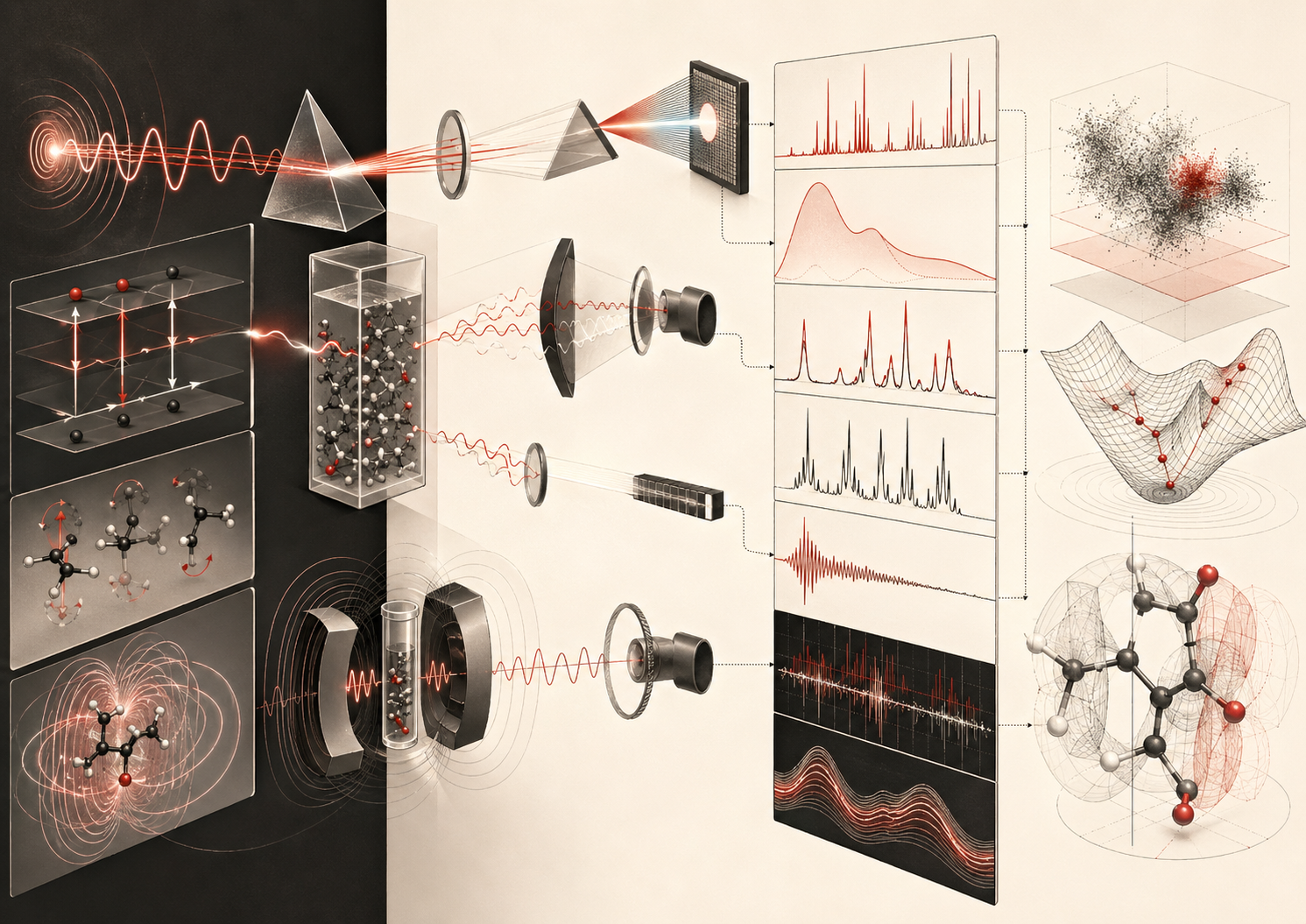
Spectroscopy is one of chemistry’s most powerful ways of turning invisible molecular structure into measurable evidence. Molecules do not simply exist as static formulas on a page. They rotate, vibrate, absorb light, emit light, scatter radiation, shield nuclei, exchange energy with their surroundings, and leave measurable traces across electromagnetic and magnetic environments. Spectroscopy studies those interactions and asks how they reveal molecular identity, bonding, geometry, functional groups, electronic structure, local chemical environments, dynamics, concentration, and material state.
The central thesis of this article is that spectroscopy is not merely a catalog of peaks. It is an evidence system: radiation or fields interact with matter, instruments transform that interaction into signals, mathematical procedures convert signals into spectra, and chemists interpret those spectra in relation to structure, bonding, concentration, symmetry, phase, surface state, and chemical environment. A spectral feature becomes meaningful only when the measurement conditions, sample history, signal processing, reference data, uncertainty, and chemical context are made visible.
Spectroscopy is therefore a bridge between molecular theory, instrumental measurement, computational analysis, and structural inference. It connects quantum transitions to laboratory evidence, functional groups to molecular identity, calibration to concentration, surfaces to materials chemistry, and spectra to reproducible chemical reasoning. To use spectroscopy responsibly is to treat every spectrum as a structured argument about matter, not merely as an image.
Main Library
Publications
Article Map
Chemistry
Related Topic
Physics
Related Topic
Data Systems & Analytics
Related Topic
Biology
What Spectroscopy Measures
Spectroscopy measures how matter interacts with electromagnetic radiation or, more broadly, how physical systems absorb, emit, scatter, resonate, or respond to energy under specific instrumental conditions. In chemistry, these interactions are valuable because atoms and molecules have quantized energy states. A molecule can absorb or emit radiation only when the energy exchanged corresponds to an allowed transition between states. The resulting spectrum becomes a structured record of molecular behavior.
Different spectroscopic methods probe different kinds of structure. Infrared spectroscopy is sensitive to molecular vibrations and therefore to functional groups, bond strengths, local symmetry, hydrogen bonding, and molecular environment. Ultraviolet-visible spectroscopy probes electronic transitions and is useful for conjugated systems, chromophores, metal complexes, concentration measurements, and reaction monitoring. Nuclear magnetic resonance spectroscopy probes the magnetic environments of nuclei and can reveal connectivity, stereochemistry, conformation, dynamics, and molecular identity.
Raman spectroscopy probes vibrational and rotational information through inelastic scattering. X-ray photoelectron spectroscopy probes elemental composition and electronic environments near surfaces. Atomic spectroscopy measures electronic transitions in atoms and ions, making it central to elemental analysis, plasma diagnostics, astrophysics, and reference metrology. Electron paramagnetic resonance probes unpaired electrons and can reveal radicals, transition-metal centers, defects, and spin environments.
The common structure across these methods is this: a physical interaction occurs, an instrument records a response, and the chemist interprets the response in relation to a molecular, material, environmental, biological, or analytical question. Spectroscopy is therefore not a single technique but a family of measurement systems unified by energy, quantization, instrumentation, signal processing, and inference.
Spectroscopy is powerful because it can be both qualitative and quantitative. It can suggest functional groups, distinguish molecular environments, monitor reaction progress, identify materials, measure concentrations, detect impurities, characterize surfaces, and support structural assignments. But its strength depends on conditions. The same compound may produce different spectra in different solvents, phases, temperatures, concentrations, oxidation states, protonation states, crystal forms, or surface environments.
For researchers and scientists, spectroscopy should be treated as chemically contextual evidence. A spectrum is not merely a pattern. It is a record of a measured interaction between a sample and a controlled physical probe.
Radiation, Energy, and Molecular States
Electromagnetic radiation carries energy. When radiation interacts with matter, energy can be absorbed, emitted, scattered, or redistributed. Spectroscopy becomes chemically meaningful because atoms and molecules do not accept arbitrary amounts of energy. Their allowed transitions reflect molecular structure, symmetry, bonding, mass, electronic configuration, nuclear spin, and local environment.
Molecules possess multiple kinds of energy. Rotational energy depends on molecular moments of inertia and is strongly connected to geometry. Vibrational energy depends on bond strength and atomic masses. Electronic energy depends on molecular orbitals and electron distribution. Nuclear magnetic resonance depends on nuclear spin behavior in a magnetic field and the electronic shielding environment around nuclei. X-ray spectroscopies depend on core-level electronic structure and local bonding. Each method samples a different layer of molecular or material structure.
This is why different spectral regions answer different questions. Microwave spectroscopy is sensitive to rotation and molecular geometry. Infrared and Raman spectroscopy probe vibrations. UV-visible spectroscopy probes electronic transitions. NMR probes nuclear magnetic environments. X-ray photoelectron spectroscopy probes surface elemental and electronic states. No single spectroscopic method sees all of chemistry. Each method is selective by physics.
Selection rules also matter. A transition may be energetically possible but weak or forbidden under a particular spectroscopic method. Infrared absorption requires a change in dipole moment during vibration. Raman scattering depends on a change in polarizability. NMR signal depends on magnetically active nuclei and relaxation behavior. UV-visible intensity depends on transition probability, orbital symmetry, and electronic coupling. These rules explain why absence of a peak is not always absence of a structure.
For researchers, the energy-state view prevents oversimplification. Spectra are not arbitrary fingerprints. They are structured consequences of quantized systems interacting with controlled probes under specific experimental conditions.
Spectra as Structural Evidence
A spectrum is often described as a fingerprint, but the metaphor can be misleading if taken too literally. Spectra are not perfect identifiers detached from conditions. Peak positions, intensities, shapes, splitting patterns, baselines, noise, solvent effects, concentration effects, hydrogen bonding, pH, temperature, phase, instrument resolution, sample preparation, and data processing all affect interpretation. A spectrum is better understood as structured evidence that must be read in relation to chemical context.
For example, an infrared absorption near a carbonyl stretching region may suggest the presence of a carbonyl group, but the exact position depends on whether the carbonyl belongs to an aldehyde, ketone, ester, amide, acid chloride, carboxylic acid, anhydride, metal complex, or conjugated system. A proton NMR chemical shift may suggest an aromatic, vinylic, aldehydic, aliphatic, or heteroatom-adjacent hydrogen environment, but coupling, integration, solvent, exchange, concentration, and symmetry matter. A UV-visible absorption band may suggest conjugation, charge transfer, ligand-field transitions, or chromophore behavior, but intensity and solvent dependence must be considered.
Structural interpretation is strongest when several forms of evidence converge. Infrared spectroscopy may identify functional groups, NMR may establish connectivity and local environments, mass spectrometry may support molecular formula and fragmentation, UV-visible spectroscopy may characterize electronic transitions, and XPS or Raman spectroscopy may provide surface or materials information. Spectroscopy is therefore often cumulative rather than isolated.
Spectra also carry negative evidence, but negative evidence must be handled carefully. A missing peak can mean the functional group is absent. It can also mean the transition is weak, overlapped, broadened, shifted, saturated, suppressed by selection rules, hidden by baseline problems, or outside the measured spectral range. A responsible interpretation distinguishes what the spectrum shows from what it cannot show.
For researchers, spectroscopic interpretation should be framed as an argument with confidence levels. Observed features, inferred functional groups, possible structures, excluded alternatives, reference comparisons, and remaining ambiguity should be made explicit. Strong spectroscopic reasoning does not pretend that a spectrum speaks for itself.
Major Spectroscopic Methods in Chemistry
Infrared Spectroscopy
Infrared spectroscopy measures molecular vibrations. Bonds behave approximately like springs connecting atoms, and vibrational frequencies depend on bond strength and reduced mass. Stronger bonds and lighter atoms generally vibrate at higher frequencies. This is why O–H, N–H, and C–H stretching regions occur at relatively high wavenumbers, while heavier-atom vibrations and skeletal modes often occur at lower wavenumbers.
Infrared spectra are especially useful for functional-group identification. Carbonyl stretches, hydroxyl stretches, nitrile stretches, alkene stretches, aromatic ring modes, and fingerprint-region patterns provide structural clues. However, IR spectra rarely solve full molecular structures alone. They are most powerful when combined with NMR, mass spectrometry, elemental analysis, computational vibrational predictions, and known chemical context.
Raman Spectroscopy
Raman spectroscopy measures inelastic scattering of light. It is complementary to infrared spectroscopy because selection rules differ. IR activity depends on changes in dipole moment during vibration, while Raman activity depends on changes in polarizability. Symmetric bonds and nonpolar structural features can be strong in Raman even when weak in IR. This makes Raman spectroscopy especially valuable for materials, minerals, polymers, carbon materials, aqueous samples, battery materials, catalysts, pigments, and systems where IR absorption is difficult.
Raman spectroscopy can also be used in microscopy, process monitoring, and field identification. Its limitations include fluorescence interference, laser-induced sample heating, weak scattering intensity, and the need for careful calibration and baseline treatment. A Raman peak assignment should be interpreted through sample phase, laser wavelength, power, exposure time, and reference data.
Ultraviolet-Visible Spectroscopy
UV-visible spectroscopy measures electronic transitions. It is widely used for chromophores, conjugated organic systems, transition-metal complexes, kinetics, equilibrium studies, and concentration measurements. Because absorbance can often be related to concentration through the Beer–Lambert law, UV-visible spectroscopy is one of chemistry’s most common quantitative tools.
UV-visible spectra can support structural reasoning by showing how electronic transitions shift with conjugation, substituents, solvent, oxidation state, ligand field, or aggregation state. In coordination chemistry, UV-visible spectra help distinguish ligand-field transitions, charge-transfer bands, and metal-centered processes. In physical and analytical chemistry, UV-visible measurements often support reaction monitoring, binding studies, and calibration workflows.
Nuclear Magnetic Resonance Spectroscopy
Nuclear magnetic resonance spectroscopy measures the response of magnetically active nuclei in a magnetic field. In organic and biological chemistry, NMR is one of the central tools for determining structure because it can reveal local chemical environments, numbers of chemically distinct nuclei, spin-spin coupling, connectivity, conformation, stereochemistry, exchange, and dynamics.
Proton NMR, carbon-13 NMR, heteronuclear NMR, and multidimensional methods such as COSY, HSQC, HMBC, NOESY, and DOSY help convert spectral features into structural assignments. The position of a signal, its integration, its multiplicity, and its correlations with other signals all contribute to the structural argument. NMR is therefore not only a detection method but a structural reasoning system.
Fluorescence and Emission Spectroscopy
Fluorescence spectroscopy measures light emitted by a substance after absorption. It is often more sensitive than absorption spectroscopy and is widely used in biochemistry, materials science, environmental monitoring, imaging, sensor development, and photochemistry. Emission intensity, lifetime, wavelength shift, quenching, anisotropy, and quantum yield can reveal molecular environment, binding, conformational change, polarity, aggregation, and energy transfer.
Emission methods require caution because fluorescence depends strongly on matrix, solvent, oxygen, temperature, concentration, inner-filter effects, photobleaching, and quenching. A change in fluorescence intensity may reflect concentration, but it may also reflect environment, binding, aggregation, or instrument geometry.
X-ray and Photoelectron Spectroscopies
X-ray photoelectron spectroscopy measures binding energies of electrons emitted from a material after X-ray irradiation. It is surface-sensitive and widely used for elemental composition, oxidation states, chemical environments, thin films, catalysts, semiconductors, corrosion layers, polymers, and nanomaterials. X-ray absorption spectroscopy, including XANES and EXAFS, can probe oxidation state, coordination environment, and local structure around selected elements.
These methods are especially important in materials chemistry because surfaces, interfaces, and local coordination environments often determine function. A catalyst, battery electrode, semiconductor surface, or corrosion film may have chemistry that differs sharply from the bulk material.
Atomic Spectroscopy
Atomic absorption, atomic emission, and plasma-based spectroscopies are central to elemental analysis. Inductively coupled plasma optical emission spectroscopy and atomic absorption methods can quantify metals and elements in water, soil, food, biological samples, industrial materials, and environmental matrices. These methods do not usually reveal molecular structure, but they provide elemental evidence that can be essential for chemical identification, contamination assessment, materials characterization, and reference measurement.
Electron Paramagnetic Resonance
Electron paramagnetic resonance spectroscopy measures systems with unpaired electrons. It is valuable for radicals, transition-metal complexes, defects in solids, spin labels, catalysts, radiation damage, and biological redox systems. EPR can reveal electronic structure, local symmetry, oxidation state, coordination environment, and dynamic processes that are invisible to methods focused on closed-shell molecules.
For researchers, method selection should follow the chemical question. Functional groups, electronic transitions, nuclear environments, elemental composition, surface states, radical centers, and molecular concentrations require different spectroscopic evidence. The strongest structural interpretation often comes from combining methods rather than relying on one spectrum alone.
Sample Preparation, Phase, Matrix, and Measurement Context
Spectroscopic evidence begins before the instrument records a signal. Sample phase, concentration, solvent, matrix, path length, surface condition, particle size, crystal form, film thickness, temperature, humidity, pH, oxidation state, and preparation history can all shape spectra. A spectrum is evidence about the sample as measured, not necessarily the sample as imagined.
In infrared spectroscopy, an attenuated total reflectance measurement probes a shallow region near the sample surface, while transmission measurements depend on sample thickness and path length. In Raman spectroscopy, laser power and fluorescence background can change the observed spectrum. In UV-visible spectroscopy, absorbance depends on path length and concentration, and scattering or turbidity can distort results. In NMR, solvent, concentration, temperature, exchange, reference standard, and field strength affect spectra. In XPS, surface contamination, charging, sputtering, and vacuum exposure can change interpretation.
Matrix effects are especially important in applied spectroscopy. Biological samples contain proteins, salts, water, lipids, metabolites, and scattering structures. Environmental samples contain particles, organic matter, minerals, ions, and microbial material. Industrial samples may contain additives, polymers, fillers, pigments, solvents, surfactants, or degradation products. These matrices can absorb, scatter, quench, broaden, overlap, shift, or obscure spectral signals.
Sample preparation should therefore be designed around the spectroscopic question. Is the goal to identify a functional group, quantify an analyte, monitor a reaction, characterize a surface, determine a structure, compare materials, or screen unknowns? The answer determines whether dilution, extraction, filtration, drying, derivatization, reference subtraction, matrix matching, internal standards, or surface cleaning is appropriate.
For researchers, sample preparation should be reported as part of the method. Spectroscopic claims are incomplete without the conditions that made the spectrum possible.
Quantitative Spectroscopy, Calibration, and Concentration
Spectroscopy can quantify concentration when signal response is related to amount under controlled conditions. UV-visible absorbance, fluorescence intensity, infrared band area, Raman peak intensity, atomic emission intensity, NMR integration, and XPS peak area can all support quantitative or semi-quantitative analysis. But quantitative spectroscopy requires calibration, controls, and awareness of method limitations.
The simplest quantitative case is absorbance spectroscopy under conditions where the Beer–Lambert law applies. Even then, real measurements can deviate because of stray light, high absorbance, chemical association, scattering, path-length error, matrix effects, temperature, instrument drift, or overlapping absorptions. Calibration curves, blanks, replicates, and quality-control samples are therefore essential.
Fluorescence methods can be highly sensitive but often require extra caution. Fluorescence intensity depends on excitation intensity, quantum yield, quenching, photobleaching, inner-filter effects, solvent, oxygen, pH, and matrix. A fluorescence calibration built in pure solvent may not apply to a complex biological or environmental sample.
NMR can support quantitative analysis when relaxation, integration, acquisition parameters, concentration, and reference standards are controlled. XPS can support surface composition estimates, but sensitivity factors, charging, background subtraction, sampling depth, and surface heterogeneity affect interpretation. Atomic spectroscopy can provide quantitative elemental analysis, but matrix matching, standards, blanks, and instrument calibration remain essential.
For researchers, quantitative spectroscopy should preserve the full calibration chain: standards, blanks, path length, concentration range, regression model, residuals, replicate precision, detection limits, quantitation limits, matrix conditions, and uncertainty. A concentration estimate is the output of a measurement system, not a raw spectral fact.
Instrumentation, Data, and Signal Processing
Spectroscopic instruments differ in design, but most workflows include several common components: a radiation source or magnetic field, a sample interface, wavelength or frequency selection, a detector, signal amplification, data acquisition, and computational processing. Fourier-transform infrared instruments use interferograms and mathematical transformation. NMR instruments record free induction decay signals that are Fourier transformed into frequency-domain spectra. UV-visible spectrometers measure intensity before and after sample interaction. Raman instruments detect scattered light. XPS systems require vacuum conditions, X-ray sources, electron energy analysis, and surface-sensitive interpretation.
Data processing is central. Baseline correction, smoothing, apodization, phase correction, Fourier transformation, peak picking, deconvolution, normalization, reference correction, integration, calibration, library matching, and spectral subtraction can all affect the final spectrum. These steps should be documented because they influence structural interpretation.
Good spectroscopic data practice includes:
- preserving raw instrument files whenever possible;
- recording sample preparation, solvent, matrix, concentration, path length, temperature, pressure, and acquisition settings;
- documenting baseline correction, smoothing, normalization, and peak-picking methods;
- preserving calibration standards and reference materials;
- reporting instrument resolution and spectral range;
- separating automated peak suggestions from expert interpretation;
- linking figures and tables to raw and processed data.
Signal processing can clarify spectra, but it can also distort evidence. Over-smoothing can hide weak peaks. Baseline correction can remove real broad features. Phase errors can distort NMR integration. Deconvolution can create apparent components that depend on model assumptions. Normalization can obscure concentration differences. Spectroscopic processing should therefore be traceable and reproducible.
For researchers, the data pipeline is part of the spectroscopic method. A spectrum shown in a figure should be connected to acquisition settings, processing choices, calibration, and raw data wherever possible.
Spectral Libraries, Reference Data, and Reproducibility
Spectral interpretation often depends on reference data. Infrared and Raman libraries support material and functional-group identification. NMR chemical-shift references support structure assignment. UV-visible reference spectra support chromophore comparison and quantitative methods. Atomic spectra databases support elemental line assignment. XPS databases support binding-energy interpretation. Reference standards provide measured comparison under controlled conditions.
Reference data are powerful because they anchor interpretation, but they are not infallible. A library match can be wrong if the sample is impure, the phase differs, the instrument response differs, the baseline is distorted, the compound is outside the library domain, or the library metadata are incomplete. Reference spectra should be used as evidence, not as automatic truth.
Reproducibility requires more than matching peak positions. It requires method context: sample form, solvent, concentration, path length, instrument resolution, spectral range, acquisition settings, processing method, reference standard, temperature, and matrix. A spectrum collected from a neat liquid may differ from one collected in solution. A solid-state Raman spectrum may differ with polymorph or orientation. An XPS binding energy may shift with charging or calibration. An NMR spectrum may shift with solvent and temperature.
Standards and data formats can support reproducibility. JCAMP-DX, NIST spectral databases, laboratory metadata systems, electronic notebooks, instrument method files, and structured data repositories can make spectra easier to preserve, exchange, and reanalyze. But data standards do not replace chemical judgment. They make judgment more auditable.
For researchers, reference evidence should be cited and described with enough detail for others to evaluate the comparison. A library hit without conditions, score, and limitations is weak evidence. A reference-standard match under the same method is stronger.
Uncertainty, Ambiguity, and Structural Interpretation
Spectroscopy is powerful, but it is not magic. Spectral evidence is often probabilistic, contextual, and method-dependent. A peak may be broad because of hydrogen bonding, concentration, solvent, temperature, unresolved overlapping signals, instrument resolution, relaxation, lifetime effects, or sample heterogeneity. A missing peak may reflect selection rules, low concentration, weak transition probability, noise, baseline problems, saturation, exchange, or actual structural absence. A library match may be wrong if the sample is impure, the phase differs, the instrument response differs, or the compound is outside the library’s domain.
Structural interpretation should therefore be explicit about confidence. A careful spectroscopic report distinguishes among observed features, inferred functional groups, proposed structures, alternative explanations, and confirmed identities. It also reports what the spectrum cannot establish. Infrared spectroscopy may indicate functional groups but not full connectivity. Proton NMR may indicate hydrogen environments but may require carbon NMR and two-dimensional methods for connectivity. UV-visible spectroscopy may show electronic transitions but rarely establishes a complete structure on its own. XPS may reveal surface oxidation states but not necessarily bulk composition.
This is why spectroscopy is strongest as part of an integrated evidence system. The best structural arguments combine spectra, reference data, chemical reasoning, computational predictions, sample history, orthogonal measurements, and uncertainty analysis.
Uncertainty should also be matched to consequence. A classroom exercise can tolerate approximate functional-group assignments. A pharmaceutical impurity investigation, forensic analysis, environmental compliance decision, materials qualification, or medical diagnostic claim requires stronger validation, controls, and documentation. The evidence burden depends on what the spectroscopic conclusion will be used to support.
For researchers, the goal is not to eliminate all ambiguity. The goal is to state what the spectrum supports, what it does not support, what alternatives remain, and what additional evidence would strengthen the claim.
Spectroscopy and Computational Chemistry
Computational chemistry increasingly supports spectroscopic interpretation. Quantum-chemical calculations can predict vibrational frequencies, NMR chemical shifts, UV-visible transitions, Raman intensities, X-ray absorption features, and electronic environments. Molecular dynamics can model conformational ensembles, solvent effects, and time-dependent spectral behavior. Cheminformatics can organize spectral libraries and molecular identifiers. Machine learning can assist with peak assignment, mixture analysis, compound classification, anomaly detection, and spectral search.
However, computational support must be treated carefully. Predicted spectra depend on the level of theory, basis set, solvation model, conformational sampling, scaling factors, and assumptions about molecular state. Machine-learning models depend on training data, domain coverage, preprocessing, and validation. Spectral databases depend on curation, metadata, measurement conditions, and reference quality. Computational methods can sharpen interpretation, but they do not remove the need for chemical judgment.
A rigorous spectroscopic workflow should therefore make computational assumptions visible. If a calculated IR spectrum is compared with an observed spectrum, the method, structure, scaling factor, and conformer selection should be stated. If a spectral library match is used, the library source and match criteria should be documented. If machine learning suggests a classification, the model domain and confidence should be reported.
Computational workflows are also valuable for reproducibility. They can preserve peak tables, calibration models, spectra, processing parameters, reference comparisons, and quality-control flags. They can also make it possible to re-run analyses when standards, libraries, or interpretation rules change.
For researchers, computation should make spectroscopic interpretation more transparent. It should not hide assumptions behind automated labels. The strongest computational spectroscopy keeps raw data, processed data, models, metadata, and interpretation linked.
Responsible Use of Spectroscopic Evidence
Spectroscopic evidence can inform medical, environmental, forensic, industrial, pharmaceutical, materials, agricultural, and safety-related decisions. Responsible use requires clear boundaries between educational analysis, exploratory interpretation, validated laboratory methods, and regulated claims.
Responsible spectroscopic practice includes:
- not treating a single spectral feature as definitive proof of structure;
- documenting sample preparation and acquisition conditions;
- using validated methods for regulated measurement contexts;
- reporting uncertainty, detection limits, calibration range, and quality controls when quantitative claims are made;
- preserving raw data and processing histories;
- avoiding overconfident automated identification from weak library matches;
- using orthogonal evidence when structural, safety, or compliance conclusions matter;
- distinguishing educational synthetic data from real laboratory evidence.
Responsible use also includes communicating what spectroscopy cannot prove alone. A functional-group peak does not prove full molecular structure. A library match does not prove purity. A surface spectrum does not necessarily describe bulk composition. A calibration curve does not prove validity outside its measured range. A spectral change does not automatically establish mechanism. A predicted spectrum does not replace measurement.
The ethical strength of spectroscopy lies in disciplined interpretation. A spectrum can reveal molecular structure, but only when measurement conditions, processing steps, assumptions, uncertainty, and decision context are kept visible.
Mathematical Lens: Energy, Wavelength, Absorbance, and Structure
Spectroscopic interpretation depends on mathematical relationships that connect radiation, molecular transitions, and observed signal. The photon-energy relationship is foundational:
E = h\nu
\]
Interpretation: \(E\) is photon energy, \(h\) is Planck’s constant, and \(\nu\) is frequency. Spectroscopic peak positions correspond to energy differences between states when transitions are allowed and detectable.
Because frequency and wavelength are related by \(c = \lambda\nu\), the same energy can be written as:
E = \frac{hc}{\lambda}
\]
Interpretation: \(c\) is the speed of light and \(\lambda\) is wavelength. Shorter wavelength corresponds to higher photon energy.
Spectroscopists often use wavenumber, especially in infrared spectroscopy:
\tilde{\nu} = \frac{1}{\lambda}
\]
Interpretation: When \(\lambda\) is expressed in centimeters, \(\tilde{\nu}\) has units of \(\mathrm{cm}^{-1}\). Higher wavenumber corresponds to higher energy, which is why infrared spectra often run from high wavenumber on the left to lower wavenumber on the right.
The energy gap between states involved in a transition can be written as:
\Delta E = h\nu = \frac{hc}{\lambda}
\]
Interpretation: A spectrum maps transition energies into observable features. Peak location reflects an energy difference, while intensity reflects transition probability, concentration, path length, population, instrument response, and selection rules.
In infrared spectroscopy, a simple harmonic-oscillator approximation gives a useful starting point for understanding vibrational frequency:
\nu = \frac{1}{2\pi}\sqrt{\frac{k}{\mu}}
\]
Interpretation: \(k\) is an effective force constant and \(\mu\) is the reduced mass. Stronger bonds tend to vibrate at higher frequencies, while heavier atoms tend to lower vibrational frequencies.
The reduced mass is:
\mu = \frac{m_1m_2}{m_1+m_2}
\]
Interpretation: \(m_1\) and \(m_2\) are the masses of the bonded atoms in the simplified oscillator model. Real molecular vibrations are often coupled, anharmonic, and environment-dependent, but this model gives physical meaning to vibrational trends.
For absorption spectroscopy, the Beer–Lambert law is commonly written as:
A = \varepsilon \ell c
\]
Interpretation: \(A\) is absorbance, \(\varepsilon\) is molar absorptivity, \(\ell\) is optical path length, and \(c\) is concentration. The relationship is powerful but depends on conditions such as concentration range, sample clarity, chemical stability, and instrument behavior.
In practical calibration work, the measured relationship is often modeled as:
A_i = \beta_0 + \beta_1 c_i + e_i
\]
Interpretation: \(\beta_0\) is the intercept, \(\beta_1\) is the calibration slope, and \(e_i\) is residual error. This regression form allows blank correction, instrument offsets, replicate variation, and uncertainty to be made visible.
In NMR, the Larmor angular frequency is:
\omega_0 = \gamma B_0
\]
Interpretation: \(\omega_0\) is angular frequency, \(\gamma\) is the gyromagnetic ratio, and \(B_0\) is the applied magnetic field. Resonance behavior depends on the nucleus and its magnetic environment.
Chemical shift expresses resonance differences relative to a reference so that spectra can be compared across instruments of different field strengths:
\delta = \frac{\nu_{\mathrm{sample}}-\nu_{\mathrm{reference}}}{\nu_{\mathrm{reference}}} \times 10^{6}
\]
Interpretation: Chemical shift is reported in parts per million. It reflects how the electronic environment shields or deshields a nucleus relative to a reference.
Together, these equations show why spectroscopy belongs at the intersection of physical chemistry, analytical chemistry, molecular structure, instrumentation, and data science. Spectra are not just pictures. They are quantitative records of energy exchange and molecular response.
Computational Workflows for Spectroscopy
Computational workflows can make spectroscopic interpretation more transparent. A workflow can track sample identity, spectral method, instrument, acquisition settings, raw file, processed file, wavelength or frequency axis, peak positions, peak intensities, assignments, calibration standards, baseline correction, library matches, uncertainty, and interpretation status.
Useful workflows include peak-table generation, functional-group region assignment, absorbance calibration, concentration estimation, replicate summaries, NMR integration checks, Raman baseline review, XPS peak fitting records, spectral library search logs, computational spectrum comparison, and spectral evidence registers. More advanced workflows may integrate instrument files, JCAMP-DX exports, NIST reference data, quantum-chemical predictions, laboratory information systems, and reproducible notebooks.
For researchers, computational workflows should preserve the distinction between observed spectral features, automated suggestions, tentative assignments, confirmed structures, and quantified concentrations. A peak is not an assignment. An assignment is not a full structure. A calibration estimate is not valid outside its validated conditions. The workflow should carry those distinctions forward.
The examples below use synthetic data. They do not identify a real compound, validate a laboratory method, certify a material, or replace professional spectroscopic interpretation. They demonstrate how spectroscopic reasoning can be structured, audited, and communicated responsibly.
Python Example: Spectral Peak Tables and Structural Clues
The following Python example uses synthetic educational peak data to show how a spectroscopy workflow can convert peak tables into structural clues. It does not identify a real unknown compound. Instead, it demonstrates a reproducible pattern: preserve peak positions and intensities, assign approximate regions, calculate simple diagnostics, and write outputs that can be reviewed.
from pathlib import Path
from typing import Dict, List
import json

import pandas as pd


# Synthetic spectroscopy workflow for structural clues.
# Educational example only; not for laboratory identification,
# forensic interpretation, clinical use, or regulatory reporting.


PLANCK_J_S = 6.62607015e-34
LIGHT_M_S = 299792458
AVOGADRO_MOL_MINUS_1 = 6.02214076e23


def assign_ir_region(wavenumber_cm_minus_1: float) -> str:
    """Assign approximate educational IR regions.

    These are broad teaching categories, not validated structural
    identifications.
    """
    if 3200 <= wavenumber_cm_minus_1 <= 3600:
        return "possible O-H or N-H stretching region"
    if 3000 <= wavenumber_cm_minus_1 <= 3100:
        return "possible aromatic or alkene C-H stretching region"
    if 2850 <= wavenumber_cm_minus_1 <= 3000:
        return "possible aliphatic C-H stretching region"
    if 1650 <= wavenumber_cm_minus_1 <= 1800:
        return "possible carbonyl stretching region"
    if 1500 <= wavenumber_cm_minus_1 <= 1650:
        return "possible C=C or aromatic ring region"
    if 1000 <= wavenumber_cm_minus_1 <= 1300:
        return "possible C-O, C-N, or fingerprint-region feature"
    if 650 <= wavenumber_cm_minus_1 <= 900:
        return "possible aromatic C-H out-of-plane region"
    return "unassigned educational region"


def photon_energy_kj_per_mol(wavenumber_cm_minus_1: float) -> float:
    """Convert wavenumber in cm^-1 to photon energy in kJ/mol."""
    photon_energy_j = (
        PLANCK_J_S
        * LIGHT_M_S
        * wavenumber_cm_minus_1
        * 100.0
    )
    return photon_energy_j * AVOGADRO_MOL_MINUS_1 / 1000.0


ir_peaks = pd.DataFrame({
    "peak_id": ["p1", "p2", "p3", "p4", "p5", "p6", "p7"],
    "wavenumber_cm_minus_1": [3350, 3060, 2960, 1718, 1602, 1250, 755],
    "relative_intensity": [0.42, 0.18, 0.35, 0.95, 0.48, 0.56, 0.37],
})

ir_peaks["educational_assignment"] = ir_peaks[
    "wavenumber_cm_minus_1"
].apply(assign_ir_region)

ir_peaks["photon_energy_kj_per_mol"] = ir_peaks[
    "wavenumber_cm_minus_1"
].apply(photon_energy_kj_per_mol)

ir_peaks["strong_peak_flag"] = ir_peaks["relative_intensity"] >= 0.75

structural_clue_summary = (
    ir_peaks
    .groupby("educational_assignment", as_index=False)
    .agg(
        peak_count=("peak_id", "count"),
        strongest_relative_intensity=("relative_intensity", "max"),
        mean_energy_kj_per_mol=("photon_energy_kj_per_mol", "mean"),
    )
    .sort_values("strongest_relative_intensity", ascending=False)
)

output_dir = Path("outputs")
output_dir.mkdir(exist_ok=True)

ir_peaks.to_csv(output_dir / "synthetic_ir_peak_assignments.csv", index=False)
structural_clue_summary.to_csv(
    output_dir / "synthetic_ir_structural_clue_summary.csv",
    index=False,
)

manifest: Dict[str, object] = {
    "workflow": "synthetic_ir_structural_clues",
    "data_type": "educational synthetic IR peak table",
    "peak_count": int(len(ir_peaks)),
    "highest_intensity_peak_cm_minus_1": int(
        ir_peaks.loc[
            ir_peaks["relative_intensity"].idxmax(),
            "wavenumber_cm_minus_1",
        ]
    ),
    "responsible_use": [
        "Assignments are approximate teaching regions, not validated structure identification.",
        "Real workflows require reference spectra, instrument metadata, sample history, uncertainty, and expert interpretation.",
    ],
}

with (output_dir / "spectroscopy_manifest.json").open(
    "w",
    encoding="utf-8"
) as file:
    json.dump(manifest, file, indent=2)

print(ir_peaks[[
    "wavenumber_cm_minus_1",
    "relative_intensity",
    "photon_energy_kj_per_mol",
    "educational_assignment",
]])
print(structural_clue_summary)
The important point is not the simplicity of the rule table. The important point is the workflow discipline. Spectroscopic evidence should be structured, reproducible, and auditable. Peak assignments should be traceable to the original data, and automated suggestions should be distinguished from confirmed chemical interpretation.
R Example: Calibration, Replicates, and Peak Summaries
The following R example models a UV-visible calibration workflow. It uses synthetic absorbance data, fits a linear model, estimates an unknown concentration, summarizes replicate variation, and writes a compact report. This reflects a common spectroscopic task: using a measured optical response to infer concentration while preserving uncertainty and regression diagnostics.
# Synthetic UV-visible calibration workflow.
# Educational example only; not for regulatory or laboratory reporting.

standards <- data.frame(
  standard_id = c("blank", "std_01", "std_02", "std_03", "std_04", "std_05"),
  concentration_mol_L = c(0.000, 0.002, 0.004, 0.006, 0.008, 0.010),
  absorbance = c(0.006, 0.154, 0.301, 0.453, 0.602, 0.748)
)

unknown <- data.frame(
  sample_id = c("unknown_A", "unknown_A", "unknown_A"),
  replicate_id = c("rep_01", "rep_02", "rep_03"),
  absorbance = c(0.386, 0.391, 0.384)
)

calibration_model <- lm(absorbance ~ concentration_mol_L, data = standards)

intercept <- coef(calibration_model)[1]
slope <- coef(calibration_model)[2]

unknown$estimated_concentration_mol_L <-
  (unknown$absorbance - intercept) / slope

summary_table <- data.frame(
  sample_id = "unknown_A",
  mean_absorbance = mean(unknown$absorbance),
  sd_absorbance = sd(unknown$absorbance),
  mean_concentration_mol_L =
    mean(unknown$estimated_concentration_mol_L),
  sd_concentration_mol_L =
    sd(unknown$estimated_concentration_mol_L),
  replicate_count = nrow(unknown)
)

summary_table$relative_sd_percent <-
  100 * summary_table$sd_concentration_mol_L /
    summary_table$mean_concentration_mol_L

summary_table$precision_review_required <-
  summary_table$relative_sd_percent > 10

dir.create("outputs", showWarnings = FALSE)

write.csv(
  standards,
  file = "outputs/uvvis_synthetic_standards.csv",
  row.names = FALSE
)

write.csv(
  unknown,
  file = "outputs/uvvis_unknown_estimates.csv",
  row.names = FALSE
)

write.csv(
  summary_table,
  file = "outputs/uvvis_unknown_summary.csv",
  row.names = FALSE
)

sink("outputs/uvvis_calibration_report.txt")
cat("Synthetic UV-Visible Calibration Report\n")
cat("======================================\n\n")
cat("Calibration model:\n")
print(summary(calibration_model))
cat("\nUnknown sample summary:\n")
print(summary_table)
cat("\nResponsible-use note:\n")
cat("Synthetic educational data only. Real spectroscopic concentration estimates require validated methods, uncertainty budgets, calibration checks, blank correction, and appropriate quality controls.\n")
sink()

print(summary_table)
This workflow illustrates why spectroscopy belongs naturally with reproducible notebooks and computational research. A concentration value is not merely a number. It is the output of standards, instrument response, regression assumptions, path length, sample handling, blank correction, replicate variation, and reporting discipline.
SQL Example: Spectroscopy Evidence Register
Spectroscopic interpretation becomes more reliable when samples, methods, instruments, raw files, processed spectra, peak assignments, calibration records, reference comparisons, and quality-control checks are traceable. A simple evidence register can preserve the context needed to audit spectral claims.
CREATE TABLE spectroscopy_sample (
    sample_id TEXT PRIMARY KEY,
    sample_name TEXT NOT NULL,
    sample_matrix TEXT,
    phase_or_form TEXT,
    preparation_method TEXT,
    solvent_or_medium TEXT,
    concentration_description TEXT,
    sample_notes TEXT
);

CREATE TABLE spectroscopy_method (
    method_id TEXT PRIMARY KEY,
    method_name TEXT NOT NULL,
    method_version TEXT,
    spectroscopy_type TEXT,
    instrument_id TEXT,
    spectral_range TEXT,
    resolution_description TEXT,
    acquisition_parameters TEXT,
    processing_method_version TEXT,
    method_status TEXT
);

CREATE TABLE spectroscopy_run (
    run_id TEXT PRIMARY KEY,
    sample_id TEXT NOT NULL,
    method_id TEXT NOT NULL,
    acquisition_datetime TEXT,
    raw_file_uri TEXT,
    processed_file_uri TEXT,
    file_checksum TEXT,
    run_status TEXT,
    FOREIGN KEY (sample_id) REFERENCES spectroscopy_sample(sample_id),
    FOREIGN KEY (method_id) REFERENCES spectroscopy_method(method_id)
);

CREATE TABLE spectral_peak (
    peak_id TEXT PRIMARY KEY,
    run_id TEXT NOT NULL,
    axis_value REAL NOT NULL,
    axis_unit TEXT NOT NULL,
    intensity_value REAL,
    intensity_unit TEXT,
    peak_width REAL,
    signal_to_noise REAL CHECK (signal_to_noise >= 0),
    baseline_quality_flag TEXT,
    FOREIGN KEY (run_id) REFERENCES spectroscopy_run(run_id)
);

CREATE TABLE spectral_assignment (
    assignment_id INTEGER PRIMARY KEY,
    peak_id TEXT NOT NULL,
    assignment_label TEXT,
    assignment_type TEXT,
    confidence_level TEXT,
    reference_source TEXT,
    reference_match_score REAL CHECK (reference_match_score BETWEEN 0 AND 1),
    assignment_notes TEXT,
    FOREIGN KEY (peak_id) REFERENCES spectral_peak(peak_id)
);

CREATE TABLE spectroscopy_calibration (
    calibration_id INTEGER PRIMARY KEY,
    method_id TEXT NOT NULL,
    analyte_name TEXT,
    calibration_model TEXT,
    concentration_range TEXT,
    slope REAL,
    intercept REAL,
    r_squared REAL CHECK (r_squared BETWEEN 0 AND 1),
    limit_of_detection REAL CHECK (limit_of_detection >= 0),
    limit_of_quantification REAL CHECK (limit_of_quantification >= 0),
    calibration_quality_flag TEXT,
    FOREIGN KEY (method_id) REFERENCES spectroscopy_method(method_id)
);

CREATE TABLE spectroscopy_quality_control (
    qc_id INTEGER PRIMARY KEY,
    run_id TEXT NOT NULL,
    qc_type TEXT,
    qc_status TEXT,
    expected_value REAL,
    measured_value REAL,
    acceptance_min REAL,
    acceptance_max REAL,
    qc_notes TEXT,
    FOREIGN KEY (run_id) REFERENCES spectroscopy_run(run_id)
);

CREATE TABLE spectroscopy_interpretation_review (
    review_id INTEGER PRIMARY KEY,
    run_id TEXT NOT NULL,
    interpretation_claim TEXT,
    orthogonal_evidence_available INTEGER CHECK (orthogonal_evidence_available IN (0, 1)),
    reference_standard_used INTEGER CHECK (reference_standard_used IN (0, 1)),
    quantitative_claim INTEGER CHECK (quantitative_claim IN (0, 1)),
    review_status TEXT,
    limitation_notes TEXT,
    FOREIGN KEY (run_id) REFERENCES spectroscopy_run(run_id)
);

SELECT
    p.peak_id,
    r.sample_id,
    m.spectroscopy_type,
    p.axis_value,
    p.axis_unit,
    p.intensity_value,
    p.signal_to_noise,
    a.assignment_label,
    a.assignment_type,
    a.confidence_level,
    a.reference_match_score,
    q.qc_status,
    v.interpretation_claim,
    v.orthogonal_evidence_available,
    v.reference_standard_used,
    CASE
        WHEN q.qc_status IS NOT NULL AND q.qc_status != 'pass'
            THEN 'quality control review required'
        WHEN p.signal_to_noise IS NOT NULL AND p.signal_to_noise < 10
            THEN 'low signal review required'
        WHEN a.confidence_level IN ('tentative', 'automated suggestion')
            THEN 'assignment confidence review required'
        WHEN v.reference_standard_used = 0
            THEN 'reference standard review required'
        WHEN v.orthogonal_evidence_available = 0
            THEN 'orthogonal evidence review required'
        ELSE 'standard review'
    END AS spectroscopy_review_status
FROM spectral_peak p
JOIN spectroscopy_run r
    ON p.run_id = r.run_id
JOIN spectroscopy_method m
    ON r.method_id = m.method_id
LEFT JOIN spectral_assignment a
    ON p.peak_id = a.peak_id
LEFT JOIN spectroscopy_quality_control q
    ON r.run_id = q.run_id
LEFT JOIN spectroscopy_interpretation_review v
    ON r.run_id = v.run_id
ORDER BY spectroscopy_review_status, p.axis_value;
The purpose of this register is to keep spectroscopic interpretation attached to evidence. A spectral claim should preserve sample identity, method version, instrument settings, raw data, processed spectra, peak assignments, reference comparisons, calibration, QC status, and interpretation confidence. Spectroscopy data become stronger when provenance is part of the record.
GitHub Repository
The companion repository for this article can support reproducible workflows for spectral peak tables, approximate structural clues, photon-energy conversion, UV-visible calibration, replicate summaries, spectral evidence registers, SQL provenance, and responsible spectroscopic interpretation.
Complete Code Repository
The full code distribution for this article, including selected spectroscopy examples, expanded computational workflows, reproducible data structures, provenance documentation, spectral peak assignments, calibration summaries, SQL evidence registers, and scientific-computing scaffolding, is available on GitHub.
Limits, Uncertainty, and Responsible Interpretation
Spectroscopy is powerful, but it is not self-interpreting. A spectrum can suggest molecular structure, but the strength of that suggestion depends on sample preparation, method choice, acquisition settings, signal quality, reference data, processing steps, and chemical context. A single peak rarely proves a structure by itself.
Different spectroscopic methods have different limits. Infrared spectra can identify functional groups but may not establish connectivity. Raman spectra can be affected by fluorescence and sample heating. UV-visible spectra can support concentration or electronic-structure interpretation but often cannot identify full structures alone. NMR spectra can provide rich structural evidence but may be complicated by overlap, exchange, low sensitivity, mixtures, or dynamic behavior. XPS can reveal surface chemistry but not necessarily bulk composition.
Data processing introduces additional uncertainty. Baseline correction, smoothing, Fourier transformation, phase correction, deconvolution, peak picking, normalization, spectral subtraction, and library matching can all change interpretation. Processing choices should therefore be preserved and reviewable.
Reference data and computational predictions are valuable but conditional. A library match may be wrong. A predicted spectrum may depend on the chosen model. A machine-learning classification may fail outside its training domain. A reference standard measured in one phase may not match a sample in another phase. Strong spectroscopic interpretation does not rely on authority alone; it evaluates evidence quality.
The computational examples associated with this article are synthetic and educational. They do not identify real compounds, validate analytical methods, certify materials, establish clinical or forensic conclusions, or replace professional spectroscopic review. They are designed to show how spectroscopic reasoning can be structured and audited.
Responsible interpretation should avoid both overconfidence and underuse. Spectroscopy can reveal molecular structure with remarkable precision when methods are appropriate and evidence is convergent. But its conclusions should always remain tied to the conditions under which the spectrum was produced.
Conclusion
Spectroscopy shows how chemistry turns energy exchange into molecular evidence. Radiation, fields, nuclei, electrons, vibrations, rotations, and surfaces interact in ways that can be measured, processed, and interpreted. Those interactions reveal functional groups, electronic transitions, local environments, concentrations, oxidation states, surface chemistry, and structural relationships that are otherwise invisible.
The field’s central lesson is that a spectrum is not just a pattern of peaks. It is the outcome of sample preparation, physical interaction, instrument design, signal processing, reference comparison, and chemical reasoning. Its meaning depends on the method that produced it and the evidence used to interpret it.
For chemistry as a discipline, spectroscopy is essential because it connects molecular theory to observable evidence. It supports structure determination, quantitative analysis, materials characterization, environmental monitoring, biological chemistry, reaction tracking, surface analysis, and chemical metrology. It is one of the main ways chemistry learns what matter is and how it behaves.
A mature spectroscopic practice does not ask only, “What peaks are present?” It asks: What transition produced the signal? What sample state was measured? What processing was applied? What reference evidence supports the assignment? What alternatives remain? What uncertainty should be reported? The reliability of spectroscopic interpretation depends on answering those questions with discipline.
Related articles
- What Is Chemistry?
- Measurement, Quantification, and the Experimental Basis of Chemistry
- Chemical Metrology, Standards, and Reference Materials
- Mathematics for Chemistry and Molecular Systems
- Computational Notebooks and Reproducible Chemical Research
- Chromatography, Separation Science, and Chemical Identification
- Mass Spectrometry and Molecular Detection
- Electroanalytical Chemistry and Chemical Sensors
- Laboratory Automation, Chemical Data, and Instrument Workflows
- Analytical Chemistry and the Identification of Matter
- Computational Chemistry and Molecular Modeling
- Chemical Bonding and Molecular Structure
Further reading
- Atkins, P. and de Paula, J. (2014) Physical Chemistry. 10th edn. Oxford: Oxford University Press.
- Harris, D.C. (2020) Quantitative Chemical Analysis. 10th edn. New York: W.H. Freeman.
- Pavia, D.L., Lampman, G.M., Kriz, G.S. and Vyvyan, J.R. (2015) Introduction to Spectroscopy. 5th edn. Boston: Cengage Learning.
- Skoog, D.A., Holler, F.J. and Crouch, S.R. (2017) Principles of Instrumental Analysis. 7th edn. Boston: Cengage Learning.
- International Union of Pure and Applied Chemistry (n.d.) Spectroscopy. Available at: https://goldbook.iupac.org/terms/view/S05848
- International Union of Pure and Applied Chemistry (n.d.) Beer–Lambert Law. Available at: https://goldbook.iupac.org/terms/view/B00626
- National Institute of Standards and Technology (n.d.) NIST Chemistry WebBook. Available at: https://webbook.nist.gov/chemistry/
- National Institute of Standards and Technology (n.d.) Atomic Spectra Database. Available at: https://www.nist.gov/pml/atomic-spectra-database
- National Institute of Standards and Technology (n.d.) X-ray Photoelectron Spectroscopy Database. Available at: https://srdata.nist.gov/xps/
- Royal Society of Chemistry Education (n.d.) Introduction to Spectroscopy. Available at: https://edu.rsc.org/resources/introduction-to-spectroscopy/11328.article
- MIT OpenCourseWare (n.d.) Lecture 15: NMR Spectroscopy. Available at: https://ocw.mit.edu/courses/5-310-laboratory-chemistry-fall-2019/resources/lecture-15-nmr-spectroscopy-esterification/
References
- Atkins, P. and de Paula, J. (2014) Physical Chemistry. 10th edn. Oxford: Oxford University Press.
- Harris, D.C. (2020) Quantitative Chemical Analysis. 10th edn. New York: W.H. Freeman.
- International Union of Pure and Applied Chemistry (n.d.) Beer–Lambert Law. Available at: https://goldbook.iupac.org/terms/view/B00626
- International Union of Pure and Applied Chemistry (n.d.) Nuclear Magnetic Resonance Spectroscopy. Available at: https://goldbook.iupac.org/terms/view/08218
- International Union of Pure and Applied Chemistry (n.d.) Nuclear Magnetic Resonance Spectrum. Available at: https://goldbook.iupac.org/terms/view/08384
- International Union of Pure and Applied Chemistry (n.d.) Spectroscopy. Available at: https://goldbook.iupac.org/terms/view/S05848
- Lee, A.Y., Powell, C.J., Shard, A.G. and others (2024) ‘Development of the NIST X-ray Photoelectron Spectroscopy Database, Version 5’, Journal of Research of the National Institute of Standards and Technology. Available at: https://www.nist.gov/publications/development-nist-x-ray-photoelectron-spectroscopy-xps-database-version-5
- Linstrom, P.J. and Mallard, W.G. (eds.) NIST Chemistry WebBook, NIST Standard Reference Database Number 69. National Institute of Standards and Technology. Available at: https://webbook.nist.gov/chemistry/
- National Institute of Standards and Technology (n.d.) Atomic Spectra Database. Available at: https://www.nist.gov/pml/atomic-spectra-database
- National Institute of Standards and Technology (n.d.) X-ray Photoelectron Spectroscopy Database. Available at: https://srdata.nist.gov/xps/
- Pavia, D.L., Lampman, G.M., Kriz, G.S. and Vyvyan, J.R. (2015) Introduction to Spectroscopy. 5th edn. Boston: Cengage Learning.
- Skoog, D.A., Holler, F.J. and Crouch, S.R. (2017) Principles of Instrumental Analysis. 7th edn. Boston: Cengage Learning.