
Last Updated May 28, 2026
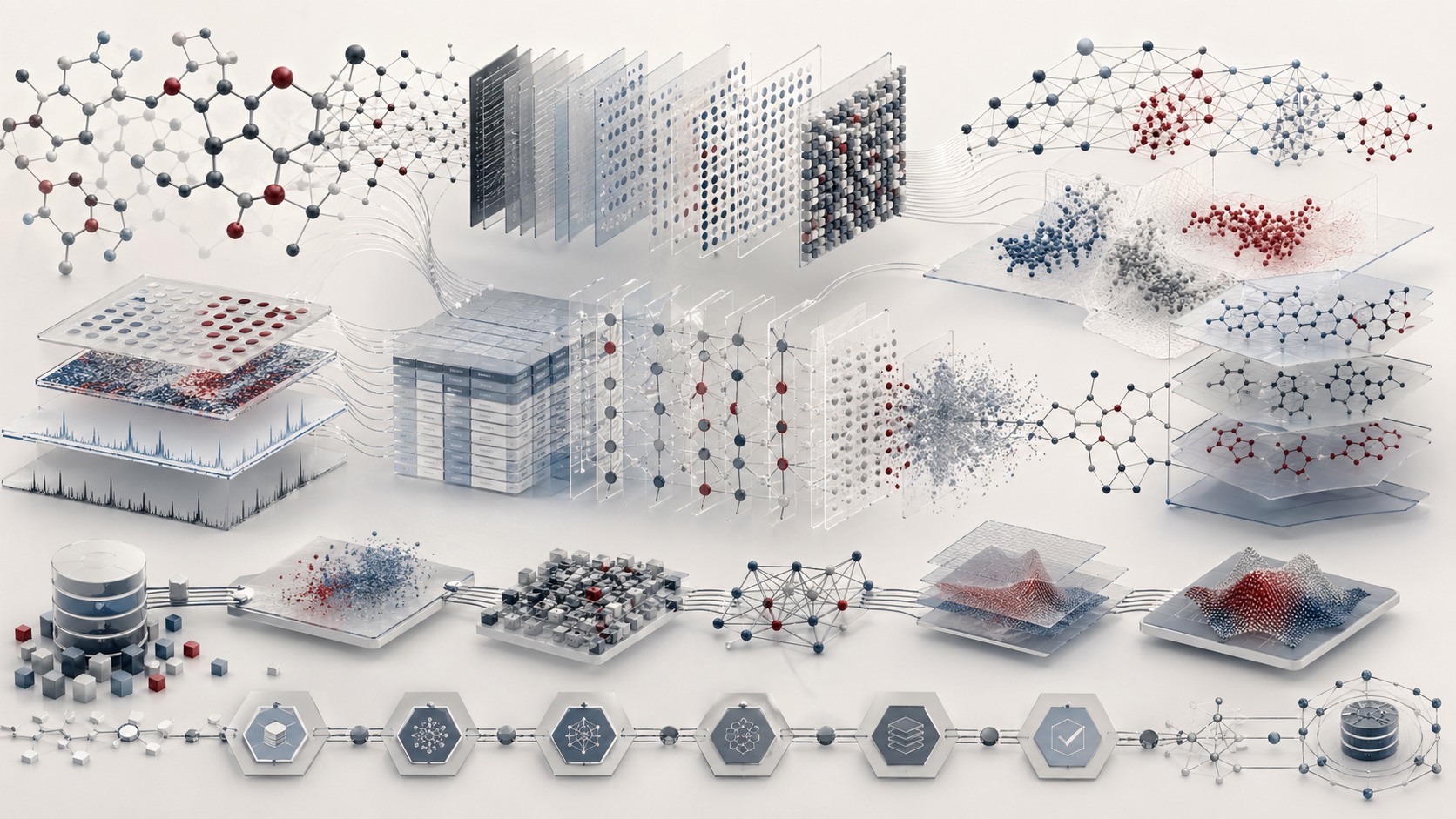
Cheminformatics and molecular data science turn chemical structure into computable knowledge. They connect molecules, identifiers, databases, descriptors, fingerprints, reactions, assays, spectra, properties, bioactivity records, similarity metrics, machine-learning models, and reproducible workflows into a practical science of chemical information.
The central thesis of this article is that molecular data science is not merely software applied to chemistry. It is a way of making chemical knowledge computable while preserving chemical meaning, provenance, uncertainty, and interpretive discipline. A molecule is not only a drawing, name, database entry, SMILES string, graph, descriptor vector, or model input. It is a chemical entity whose representation must remain connected to structure, state, context, evidence, and intended use.
Modern chemistry now operates at scales that exceed manual interpretation: millions of compounds, large assay collections, reaction databases, spectral libraries, materials datasets, omics-linked chemical records, molecular simulations, and machine-learning pipelines. Cheminformatics provides the representational and algorithmic tools for this work. Molecular data science expands those tools into statistical modeling, machine learning, database engineering, uncertainty analysis, workflow design, and responsible interpretation.
Main Library
Publications
Article Map
Chemistry
Related Topic
Data Systems & Analytics
Related Topic
Artificial Intelligence Systems
Related Topic
Biology
Why Cheminformatics Matters
Cheminformatics matters because chemistry now depends on chemical information infrastructure. A molecule must be stored correctly, searched efficiently, compared meaningfully, linked to measurements, connected to assays, retrieved from databases, represented in models, and interpreted in context. Without these systems, modern chemical knowledge becomes fragmented across names, drawings, spreadsheets, instrument outputs, literature records, proprietary databases, model files, and disconnected notebooks.
Modern chemical work relies on identifiers, structure files, molecular graphs, property tables, assay records, reactions, spectra, target annotations, literature links, computational descriptors, and provenance metadata. A medicinal chemist may search analogs across compound libraries. A toxicologist may connect structures to hazard data. A computational chemist may build descriptor matrices. A biochemist may connect small molecules to targets. A materials researcher may compare composition-property records. A data scientist may train a molecular model. Each task depends on reliable chemical representation.
Without cheminformatics, the same compound may appear under multiple names. Salts and parent compounds may be confused. Tautomers may be collapsed or separated inconsistently. Stereochemistry may be missing. Assay records may be mixed across incompatible units. Similarity searches may retrieve misleading neighbors. Machine-learning models may learn dataset artifacts instead of chemical structure-property relationships. A predicted molecule may be syntactically valid but chemically unrealistic.
Cheminformatics helps answer questions such as:
- How should a molecule be represented in a database?
- Are two chemical records describing the same compound?
- Which compounds are structurally similar?
- Which molecular features correlate with a property?
- Which compounds belong to the same scaffold family?
- Which assay records are reliable enough for modeling?
- How should chemical space be searched or clustered?
- How can molecular datasets be made reproducible?
- When is a model predicting chemistry, and when is it memorizing bias?
Molecular data science matters because chemical datasets are powerful but hazardous. They can accelerate discovery, but they can also amplify poor curation, hidden duplication, biased assays, inconsistent units, missing stereochemistry, and false confidence. The central task is not simply to digitize chemistry. It is to preserve chemical meaning while making chemistry computationally usable.
For researchers and scientists, cheminformatics should be understood as chemical evidence infrastructure. It makes molecular information searchable and model-ready, but it also determines what chemical meaning survives the translation into data.
Molecules as Data Objects
A molecule can be treated as a data object in several ways. It may be a name, a structural formula, a connection table, a SMILES string, an InChI, a molecular graph, a 3D coordinate set, a descriptor vector, a fingerprint, a conformer ensemble, a reaction participant, a database record, an assay observation, or a node in a knowledge graph.
Each representation serves a different purpose. A common name may be convenient but ambiguous. A structural drawing may be readable to chemists but difficult for machines. A SMILES string is compact but can vary for the same molecule. An InChI is designed for standardized identification. A fingerprint supports similarity search. A descriptor vector supports statistical modeling. A graph representation supports graph algorithms and graph neural networks. A 3D conformer supports shape and geometry analysis, but only under assumptions about conformation, protonation, and environment.
A molecular record may include:
- structure;
- identifier;
- source database;
- molecular formula;
- molecular weight;
- formal charge;
- stereochemistry;
- tautomer state;
- salt, hydrate, solvate, or parent form;
- assay measurements;
- spectral data;
- computed descriptors;
- experimental provenance;
- model outputs;
- quality flags.
The same molecule can therefore appear in many computational forms. Cheminformatics asks how to translate among those forms without losing chemical meaning. This translation is not automatic. A structure can be standardized in different ways depending on whether the workflow is designed for deduplication, biological modeling, synthetic planning, regulatory identification, environmental fate analysis, or materials screening.
Molecules are also state-dependent. Protonation, tautomerism, stereochemistry, conformation, solvation, oxidation state, isotope composition, salt form, and aggregation can matter. A database representation may simplify these states, but the simplification should be explicit. A model trained on neutral parent compounds may not apply to ionic species in biological pH conditions. A similarity search that ignores stereochemistry may retrieve chemically misleading neighbors.
For researchers, the practical rule is that a molecular data object should always be interpreted with its representation policy. What was kept? What was removed? What was standardized? What was assumed? What chemical state does the record represent?
Molecular Representation
Molecular representation is the foundation of cheminformatics. A representation determines what a computational system can know about a molecule. It also determines what the system cannot know. If stereochemistry is missing, a model cannot distinguish enantiomers. If protonation state is collapsed, pH-dependent behavior may be hidden. If a 2D fingerprint is used, conformational shape may be absent. If a descriptor vector is used without provenance, feature meaning may become opaque.
Common molecular representations include:
- SMILES: a compact line notation for molecular connectivity.
- Canonical SMILES: a standardized SMILES form produced by a specific algorithm.
- Isomeric SMILES: SMILES notation that includes stereochemical information where represented.
- InChI: a layered identifier for chemical substances.
- InChIKey: a hashed fixed-length version useful for indexing.
- MOL and SDF files: file formats storing atoms, bonds, coordinates, and properties.
- Molecular graphs: representations of atoms as nodes and bonds as edges.
- 3D coordinates: representations of molecular geometry.
- Conformer ensembles: collections of plausible geometries.
- Fingerprints: encodings of structural features as bit vectors.
- Descriptor vectors: numerical encodings of molecular properties.
The representation must match the task. A 2D fingerprint may work for library clustering but fail to capture stereochemical binding. A descriptor vector may support simple models but hide substructure logic. A 3D representation may be essential for docking, conformational analysis, shape comparison, or pharmacophore modeling, but it requires careful geometry generation and may depend on force-field or quantum-chemical assumptions.
Representations also differ in reproducibility. A canonical SMILES depends on the toolkit and canonicalization algorithm. A molecular descriptor depends on definitions and parameters. A fingerprint depends on radius, length, hashing, bit collision behavior, and atom invariants. A conformer ensemble depends on generation protocol, energy window, minimization method, and protonation state. A reproducible workflow should state these details.
Cheminformatics begins with representation because computation can only reason over what is encoded. The choice of representation is therefore a chemical decision, not merely a software setting.
Names, Identifiers, and Standardization
Chemical names are useful for people but difficult for databases. A compound may have systematic names, trivial names, trade names, database identifiers, registry numbers, synonyms, abbreviations, and spelling variants. Some names refer to mixtures, salts, formulations, stereochemical families, or poorly specified substances. A name can therefore be convenient but insufficient for computational identity.
Identifiers and standardization help reduce ambiguity. InChI and InChIKey are especially important because they provide standardized structure-derived identifiers. Database identifiers such as PubChem CIDs, ChEMBL IDs, CAS Registry Numbers, DrugBank IDs, vendor IDs, and registry-specific accession numbers can also be useful, but they are database-specific and must be mapped carefully.
Standardization workflows may include:
- removing salts, solvents, or counterions;
- normalizing charges;
- standardizing tautomers;
- checking valence;
- preserving or normalizing stereochemistry;
- canonicalizing SMILES;
- deduplicating structures;
- choosing parent forms;
- flagging mixtures, polymers, organometallics, and poorly specified records;
- recording provenance and transformation rules.
Standardization is not neutral. Removing a salt may be appropriate for some modeling tasks and inappropriate for others. A hydrochloride salt may be collapsed to a parent base for target-bioactivity modeling, but the salt form may matter for solubility, formulation, stability, and manufacturing. Tautomer standardization can improve deduplication but obscure biologically relevant forms. Dropping stereochemistry can collapse distinct compounds into one record. Keeping every variant can create apparent duplicates.
Chemical data cleaning is therefore chemical judgment encoded as workflow. The question is not simply whether a record can be standardized, but whether the standardization policy is appropriate for the scientific task. A workflow for legal substance identity may differ from a workflow for QSAR modeling, which may differ from a workflow for reaction prediction or materials informatics.
For researchers, identifiers should be treated as links between representations, not replacements for chemical understanding. A database ID is useful, but the structural assumptions and curation rules behind it still matter.
Molecular Graphs
A molecular graph represents atoms as nodes and bonds as edges. Nodes may contain atom type, formal charge, aromaticity, hybridization, isotope, stereochemistry, ring membership, valence, and other features. Edges may contain bond order, aromaticity, stereochemistry, conjugation, or ring membership. Molecular graphs are central because chemical connectivity is one of the main ways molecules are distinguished and searched.
A molecular graph can be written as:
G = (V,E)
\]
Interpretation: \(V\) is the set of vertices, often atoms, and \(E\) is the set of edges, often bonds. The graph representation encodes connectivity but may require additional labels to preserve chemical meaning.
Molecular graph representations support:
- substructure search;
- maximum common substructure analysis;
- ring detection;
- scaffold extraction;
- graph descriptors;
- reaction mapping;
- graph neural networks;
- chemical similarity;
- molecular fragmentation;
- database indexing.
A molecular graph adjacency matrix can be written as:
A_{ij} =
\begin{cases}
1 & \text{if atoms } i \text{ and } j \text{ are bonded}\\
0 & \text{otherwise}
\end{cases}
\]
Interpretation: The adjacency matrix records connectivity. More detailed chemical graphs may use weighted or labeled edges to encode bond order, aromaticity, and stereochemical information.
Graph representations are powerful because they allow algorithms to search, compare, and transform molecular structures. They make substructure matching possible. They support scaffold analysis. They allow reaction centers to be mapped. They provide natural inputs for graph neural networks and other structure-aware models.
However, a graph alone may not capture conformations, protonation state, solvation, electronic structure, dynamic behavior, surface interactions, or experimental context. Two molecules with similar graphs can behave differently because of stereochemistry, conformational constraint, tautomer state, charge distribution, metabolism, or binding environment.
For researchers, molecular graphs are foundational but incomplete. They are strong tools for connectivity, but chemical interpretation often requires additional state, context, and evidence.
Descriptors and Molecular Features
Molecular descriptors are numerical features calculated from molecular structure or data. They translate chemical properties into model-ready variables. Descriptors allow molecules to be compared, clustered, modeled, visualized, and searched using statistical and computational methods.
Common descriptor families include:
- Constitutional descriptors: atom count, bond count, molecular weight, formula features, and elemental composition.
- Topological descriptors: graph indices, ring counts, path lengths, branching measures, and connectivity measures.
- Physicochemical descriptors: polarity, hydrophobicity, formal charge, hydrogen-bond donors, hydrogen-bond acceptors, rotatable bonds, and polar surface area.
- Geometric descriptors: shape, volume, surface area, conformational spread, and 3D moments.
- Electronic descriptors: partial charges, polarizability, electrostatic features, orbital-derived measures, and HOMO-LUMO estimates.
- Fragment descriptors: substructure counts, functional-group indicators, and scaffold features.
- Learned descriptors: embeddings from machine-learning models, graph neural networks, or molecular language models.
A descriptor vector for molecule \(i\) can be written as:
\mathbf{x}_i = [x_{i1}, x_{i2}, \ldots, x_{ip}]
\]
Interpretation: \(\mathbf{x}_i\) is a feature vector describing molecule \(i\). Each feature should have a defined meaning, calculation method, and unit or scale where relevant.
Descriptors support property prediction, clustering, visualization, similarity, classification, regression, outlier detection, and chemical-space analysis. A descriptor matrix can represent many molecules at once:
X \in \mathbb{R}^{n \times p}
\]
Interpretation: \(n\) is the number of molecules and \(p\) is the number of descriptors. The matrix becomes the basis for statistical modeling, machine learning, visualization, or similarity analysis.
Descriptors can also mislead. Some are redundant. Some are highly correlated. Some encode dataset artifacts. Some are sensitive to representation choices. Some require 3D conformers whose generation may be uncertain. Some lack physical interpretability. Descriptor selection is therefore part of chemical modeling, not a purely statistical step.
For researchers, descriptors should be treated as hypotheses about what molecular features matter. They should be documented, inspected, scaled appropriately, tested against validation data, and interpreted with chemical caution.
Fingerprints and Structural Encoding
Molecular fingerprints encode structural features into vectors, often binary bit vectors. A bit may indicate the presence or absence of a substructure, path pattern, circular environment, pharmacophore feature, atom-pair relationship, or other structural motif. Fingerprints are widely used because they compress molecular structure into a form suitable for fast similarity search and modeling.
A binary fingerprint can be written as:
\mathbf{f} \in \{0,1\}^{m}
\]
Interpretation: \(\mathbf{f}\) is a binary fingerprint of length \(m\). Each bit encodes whether a particular feature or hashed structural environment is present.
Fingerprints are widely used for:
- similarity search;
- nearest-neighbor retrieval;
- compound clustering;
- diversity selection;
- virtual screening;
- machine learning;
- database indexing;
- chemical-space visualization.
Fingerprints compress molecular structure. That compression is useful, but it creates limitations. Different substructures can collide into the same bit. A fingerprint may capture 2D connectivity but not 3D shape. A fingerprint may encode similarity well for one task but poorly for another. A fingerprint may ignore protonation, tautomeric state, stereochemistry, conformational behavior, or electronic effects depending on how it is constructed.
Fingerprint parameters also matter. Circular fingerprints depend on radius, bit length, atom invariants, chirality settings, and hashing behavior. Path-based fingerprints depend on path length and bond treatment. Pharmacophore fingerprints depend on feature definitions and distance bins. A reproducible workflow should record these parameters.
For researchers, fingerprints should be understood as efficient encodings, not chemical truth. They are valuable because they make large-scale comparison possible, but their interpretation depends on the representation choices behind them.
Similarity and Chemical Neighborhoods
Chemical similarity is one of the central ideas in cheminformatics. The similar property principle suggests that structurally similar molecules often have similar properties, though this principle has many exceptions. Similarity search can identify analogs, scaffold neighbors, possible off-target risks, database duplicates, compound-series relationships, and virtual screening candidates.
A common similarity measure for binary fingerprints is the Tanimoto coefficient:
T = \frac{c}{a+b-c}
\]
Interpretation: \(a\) is the number of active bits in molecule A, \(b\) is the number of active bits in molecule B, and \(c\) is the number of shared active bits. Values closer to 1 indicate greater fingerprint overlap.
Distance in descriptor space can also be used:
d(\mathbf{x}_i,\mathbf{x}_j) =
\sqrt{\sum_{k=1}^{p}(x_{ik}-x_{jk})^2}
\]
Interpretation: Euclidean distance compares molecules using numerical descriptors. It depends strongly on descriptor scaling, feature selection, and representation quality.
Similarity depends on representation. Two molecules may have high fingerprint similarity but different stereochemistry, potency, toxicity, solubility, metabolism, or protein binding. Two molecules may have low 2D similarity but similar 3D pharmacophores. Small structural changes can produce activity cliffs, where similar compounds have sharply different biological activities.
Similarity is therefore a useful guide, not a guarantee. A nearest neighbor can suggest a hypothesis, but it does not prove activity, safety, stability, synthesizability, or mechanism. Similarity should be interpreted with assay context, chemical series knowledge, physicochemical properties, and uncertainty.
For researchers, chemical neighborhoods should be treated as evidence for exploration. They support prioritization and interpretation, but they do not replace experimental confirmation or domain-specific chemical judgment.
Chemical Space
Chemical space refers to the set of possible or relevant molecules under consideration. It may include known compounds, purchasable compounds, natural products, approved drugs, bioactive compounds, virtual libraries, generated molecules, materials, polymers, catalysts, metabolites, or reaction products. The size of chemical space is enormous, and only a tiny fraction has been synthesized, measured, or characterized.
Chemical space can be described using descriptors, fingerprints, embeddings, scaffolds, properties, or learned representations. Dimensionality reduction methods such as principal component analysis, t-SNE, UMAP, or chemical-map approaches can project high-dimensional molecular data into visual form. These projections can reveal clustering, diversity, outliers, domain boundaries, and regions underrepresented in a dataset.
Chemical-space analysis can support:
- library diversity assessment;
- compound selection;
- property-space coverage;
- lead optimization;
- fragment expansion;
- drug-likeness analysis;
- materials discovery;
- outlier detection;
- domain-of-applicability assessment;
- generative model evaluation.
However, maps of chemical space are not neutral. They depend on descriptors, scaling, dimensionality reduction method, distance metric, and dataset composition. A cluster may reflect chemical series, assay source, standardization artifact, library vendor, or descriptor bias. A visually separated region may not correspond to meaningful chemistry. A generated molecule may appear novel in descriptor space while being unstable, toxic, difficult to synthesize, or outside the intended domain.
Molecular data science helps navigate chemical space, but navigation must consider synthesis, stability, toxicity, cost, ethics, environmental impact, and intended use. A model can propose molecules; chemistry must evaluate whether they are meaningful candidates.
For researchers, chemical space should be understood as a representation-dependent map. It is a guide for exploration, not the territory itself.
Compound Databases and Chemical Knowledge Infrastructure
Compound databases are the infrastructure of cheminformatics. They store chemical structures, identifiers, properties, assays, spectra, literature links, supplier information, biological targets, clinical data, computed annotations, and curation histories. They make chemical knowledge searchable, linkable, comparable, and reusable.
Important resources include:
- PubChem: a large public chemical information resource.
- ChEMBL: a curated bioactivity database linking compounds, targets, and assays.
- Protein Data Bank: a major resource for biomolecular structures and ligands in structural context.
- DrugBank: a resource for drugs and drug-target information.
- ChemSpider: a structure-focused chemical database and identifier resource.
- QM9, MoleculeNet, and related benchmarks: datasets used in molecular machine-learning research.
- Materials databases: resources for crystalline, computed, and experimental materials properties.
- Reaction databases: resources for synthesis, retrosynthesis, and reaction prediction tasks.
Databases are not neutral containers. Their value depends on curation, provenance, update history, schema design, licensing, identifier mapping, quality flags, assay normalization, and documentation. A database may contain duplicates, mixtures, inconsistent stereochemistry, uncertain salts, deprecated records, conflicting assay values, and uneven coverage across chemical classes.
A molecular database should not be treated as a simple spreadsheet. It is a chemical knowledge system with assumptions, gaps, and biases. Database records should be interpreted through their source, version, curation policy, field definitions, and quality indicators.
For researchers, database work should preserve download dates, query methods, filters, versions, licenses, identifier mappings, and transformation rules. The same query run years later may return different records as databases evolve. Reproducibility depends on capturing the database context at the time of analysis.
Bioactivity, Assays, and Molecular Evidence
Bioactivity data links molecules to biological measurements. These may include binding affinities, inhibition constants, IC50 values, EC50 values, phenotypic effects, cytotoxicity, enzyme activity, target engagement, ADMET properties, and assay readouts. Such data are powerful because they connect molecular structure to biological behavior, but they are difficult because biological assays are contextual.
A simplified activity table may include:
- compound identifier;
- target identifier;
- assay type;
- measurement value;
- unit;
- standardized value;
- organism;
- cell line;
- assay confidence;
- publication source;
- curation notes.
A common transformation is:
pIC_{50} = -\log_{10}(IC_{50})
\]
Interpretation: \(IC_{50}\) must be expressed in molar units. The transformation converts lower concentration values, which indicate higher potency, into larger positive values.
Bioactivity records are powerful but difficult. A single compound may have many measurements across assays, cell lines, species, targets, concentrations, formats, laboratories, and conditions. Values may not be directly comparable. An IC50 from one assay cannot automatically be merged with an EC50 from another, or with a binding constant from a different target format, without careful interpretation.
Bioactivity modeling requires careful curation. Mixing incompatible assay types, units, targets, species, endpoint definitions, confidence levels, and measurement conditions can produce models that look accurate but have weak biological meaning. A model trained on noisy assay data may learn assay artifacts rather than molecular structure-activity relationships.
For researchers, molecular data science must keep assay context attached to molecular structure. A compound record without assay provenance is incomplete evidence.
QSAR and Property Prediction
Quantitative structure-activity relationship, or QSAR, modeling links molecular features to biological activity or chemical properties. More broadly, property prediction models relate molecular representation to measured or computed outcomes. These models are used in medicinal chemistry, toxicology, environmental chemistry, materials science, formulation research, chemical biology, and screening workflows.
A generic QSAR model can be written as:
y = f(\mathbf{x}) + \varepsilon
\]
Interpretation: \(y\) is a measured property or activity, \(\mathbf{x}\) is a molecular feature vector, \(f\) is the model, and \(\varepsilon\) is error. The model’s meaning depends on the data, descriptors, validation design, and intended domain.
QSAR can be used for:
- bioactivity prediction;
- toxicity screening;
- solubility estimation;
- permeability modeling;
- binding prediction;
- ADMET modeling;
- materials property prediction;
- reaction outcome prediction;
- compound prioritization.
QSAR models are strongest when data are curated, chemical domain is defined, validation is rigorous, descriptors are meaningful, and uncertainty is reported. A model trained on one chemical series may fail on another. A model trained on noisy assay data may learn assay artifacts. A model with excellent random-split performance may fail under scaffold split. A model without domain-of-applicability analysis may overstate confidence on unfamiliar chemistry.
QSAR is not just curve fitting. It is chemical modeling under statistical discipline. The model must be evaluated not only by numerical performance but also by chemical plausibility, validation strategy, dataset quality, applicability domain, and decision context.
For researchers, QSAR should be treated as a hypothesis-generating and prioritization method unless validated for a specific decision. Prediction is not proof; it is a structured estimate with assumptions and limits.
Machine Learning for Molecules
Machine learning has expanded molecular data science. Models may use fingerprints, descriptors, molecular graphs, SMILES strings, 3D structures, spectra, quantum-derived features, assay metadata, or learned embeddings. They can support screening, classification, property prediction, molecule generation, retrosynthesis, active learning, and experimental prioritization.
Methods include:
- linear regression;
- random forests;
- gradient boosting;
- support vector machines;
- kernel methods;
- neural networks;
- graph neural networks;
- transformers for molecular strings;
- generative models;
- Bayesian optimization;
- active learning;
- uncertainty-aware models.
Machine learning can help screen large libraries, propose molecules, predict properties, rank candidates, cluster datasets, identify patterns, and guide experiments. But machine learning does not remove chemistry. A model may generate invalid molecules, unstable structures, impossible syntheses, toxic candidates, assay-biased predictions, or molecules outside its applicability domain. High performance on a benchmark does not guarantee useful real-world performance.
Molecular machine learning is especially vulnerable to hidden structure in datasets. Analog series, duplicate structures, shared scaffolds, assay batches, vendor libraries, and curation artifacts can make models appear better than they are. Random splits may overestimate performance when similar compounds appear in both training and test data. Generated molecules may optimize a score while violating chemical feasibility.
The most trustworthy molecular machine learning combines chemical curation, meaningful validation, uncertainty estimation, mechanistic insight, reproducible workflows, and experimental feedback. Models should be evaluated according to their intended use: ranking within a known analog series, identifying new scaffolds, proposing experiments, prioritizing toxicity review, or supporting a regulated decision all require different evidence standards.
For researchers, molecular machine learning should be treated as an evidence tool, not an oracle. Its outputs are useful when the model domain, uncertainty, data provenance, and validation limits are visible.
Data Leakage, Splits, and Validation
Validation is one of the most important problems in molecular data science. Chemical datasets often contain near-duplicates, analog series, assay artifacts, shared scaffolds, repeated measurements, and hidden correlations. Random train-test splits can overestimate performance because similar compounds may appear in both training and test sets.
Important validation strategies include:
- random splits for initial diagnostics;
- scaffold splits to test generalization across chemical families;
- time splits to mimic prospective prediction;
- cluster splits to reduce near-neighbor leakage;
- external validation datasets;
- applicability-domain analysis;
- uncertainty calibration;
- replicate-aware splitting;
- assay-source-aware validation;
- prospective experimental testing where possible.
Data leakage occurs when information from the test set indirectly enters training. In chemistry, leakage can happen through duplicate structures, salts, stereoisomer collapse, scaffold series, assay batch effects, target-family overlap, normalization using all data, or preprocessing done before splitting.
A model should be evaluated according to the kind of prediction it is expected to make. Predicting another analog in a known series is different from predicting a new scaffold. Predicting within one assay is different from generalizing across laboratories. Predicting a computed quantum property is different from predicting noisy experimental bioactivity. Predicting within a curated benchmark is different from selecting candidates for synthesis.
Applicability-domain analysis asks whether a query molecule is similar enough to the training data for a model prediction to be meaningful. A simple nearest-neighbor distance can be written as:
D_i = \min_j d(\mathbf{x}_i,\mathbf{x}_j)
\]
Interpretation: \(D_i\) is the distance from query molecule \(i\) to its nearest training molecule \(j\). Large distances can indicate predictions outside the training domain.
For researchers, validation must match the intended claim. A model cannot be trusted because it performs well under an easy split. It must be tested under conditions that reflect the decision it will support.
Reactions and Synthesis Data
Cheminformatics also includes reaction data. A reaction record may contain reactants, products, reagents, catalysts, solvents, temperature, yield, time, procedure text, atom mapping, conditions, purification, workup, and source literature. Reaction informatics connects symbolic chemistry, experimental procedure, synthesis planning, laboratory automation, and data-driven prediction.
Reaction informatics supports:
- reaction search;
- retrosynthesis planning;
- condition recommendation;
- yield prediction;
- reaction classification;
- template extraction;
- atom mapping;
- reaction-network analysis;
- green chemistry metrics;
- laboratory automation;
- electronic lab notebook integration.
Reaction data are difficult because chemistry is contextual. The same transformation may work or fail depending on solvent, temperature, concentration, water content, reagent quality, mixing, atmosphere, catalyst loading, substrate impurities, scale, purification method, and workup. A reaction is not just reactants plus products. It is a conditional chemical event.
Reaction records also suffer from publication and reporting bias. Failed reactions are often missing. Conditions may be underspecified. Yields may not be directly comparable. Procedure text may contain critical details not captured in structured fields. Atom mapping may be uncertain. Reaction classification can be ambiguous.
For researchers, molecular data science must treat synthesis data as experimental data, not just symbolic transformation. A retrosynthesis prediction or yield model should preserve reaction context, data provenance, and uncertainty.
Materials and Molecular Data Science
Molecular data science extends beyond small organic molecules. Materials chemistry involves crystals, polymers, surfaces, electrolytes, catalysts, metal-organic frameworks, ceramics, semiconductors, nanoparticles, and composites. These systems require representations that go beyond small-molecule graphs and simple fingerprints.
Materials data may include:
- composition;
- crystal structure;
- defects;
- surface facets;
- processing history;
- phase behavior;
- band gap;
- elastic properties;
- thermal conductivity;
- ionic conductivity;
- adsorption energies;
- catalytic activity;
- stability under conditions;
- computed and experimental provenance.
Materials data science shares many problems with cheminformatics: representation, descriptors, similarity, databases, uncertainty, validation, reproducibility, and domain of applicability. But materials add additional complexity: periodicity, defects, microstructure, processing, interfaces, length scale, and environmental conditions. A nominal composition may not define a material if synthesis route, heat treatment, morphology, impurity level, and surface chemistry matter.
The broader lesson is that chemical data science must be adapted to the chemical system, not imposed as a generic data pipeline. A small-molecule QSAR model, polymer property model, catalyst screening workflow, and crystalline-materials database may all use machine learning, but they encode different chemical realities.
For researchers, molecular data science should remain system-aware. The representation must match the chemistry, and the validation must match the claim.
FAIR Data, Provenance, and Reproducibility
Molecular data are most valuable when they are findable, accessible, interoperable, and reusable. FAIR principles matter because chemical data often move across laboratories, databases, models, publications, repositories, and regulatory or industrial contexts. Reuse is only meaningful when data remain interpretable.
A reproducible cheminformatics workflow should document:
- data sources;
- download dates;
- database versions;
- licenses;
- structure-standardization rules;
- salt and tautomer handling;
- stereochemistry policy;
- identifier mapping;
- unit normalization;
- assay filtering;
- descriptor definitions;
- fingerprint parameters;
- train-test split rules;
- model versions;
- random seeds;
- evaluation metrics;
- uncertainty estimates;
- provenance records.
Provenance is especially important because molecular datasets are often transformed many times. A final modeling table may be far removed from the original records. Without provenance, it may be impossible to reconstruct how a molecule was standardized, why a measurement was retained, which duplicates were removed, how labels were assigned, or whether a model was trained on data that later leaked into validation.
Reproducible molecular data science also requires computational environment discipline. Package versions, toolkit versions, descriptor algorithms, random seeds, database snapshots, and file hashes can all affect results. A workflow that cannot be rerun or inspected is weak evidence, even if its output looks sophisticated.
For researchers, reproducible molecular data science is chemical accountability in computational form. It preserves the chain from molecular source record to model-ready dataset to prediction and interpretation.
Responsible Molecular Prediction
Molecular prediction has consequences. Models can influence which compounds are synthesized, which assays are run, which targets are pursued, which materials are tested, and which risks are ignored. Predictions can accelerate beneficial discovery, but they can also mislead, waste resources, or enable harmful applications.
Responsible molecular prediction requires:
- clear intended use;
- data provenance;
- known limitations;
- applicability-domain analysis;
- uncertainty reporting;
- bias assessment;
- chemical plausibility checks;
- synthesis and stability checks where relevant;
- toxicity and safety awareness;
- human expert review;
- ethical screening where appropriate;
- avoidance of overclaiming.
A molecular model should not be treated as an oracle. It is an instrument trained on data, shaped by representation, limited by assumptions, and meaningful only within an intended domain. A model may be useful for ranking candidates within a chemical series but unreliable for novel scaffolds. A model may predict an assay endpoint without predicting real biological effect. A generative model may optimize a score while proposing unstable, unsynthesizable, or unsafe structures.
Responsible interpretation distinguishes prediction, evidence, hypothesis, and decision. A prediction can prioritize experimental testing. It can suggest analogs. It can identify regions of chemical space worth exploring. But it does not establish molecular truth by itself. Chemical conclusions require evidence appropriate to the consequence of the claim.
For researchers, responsible cheminformatics means preserving the difference between what the model computes and what chemistry supports. Prediction should serve scientific judgment, not replace it.
Mathematical Lens: Molecular Representation, Similarity, and Prediction
Cheminformatics uses mathematics to represent molecules, compare structures, model properties, and evaluate predictions. A molecular graph can be written as:
G = (V,E)
\]
Interpretation: \(V\) is a set of atoms or nodes, and \(E\) is a set of bonds or edges. The graph encodes molecular connectivity.
An adjacency matrix can encode graph connectivity:
A_{ij} =
\begin{cases}
1 & \text{if atoms } i \text{ and } j \text{ are bonded}\\
0 & \text{otherwise}
\end{cases}
\]
Interpretation: \(A_{ij}\) records whether two atoms are connected. More detailed graph representations may encode bond orders, aromaticity, stereochemistry, and atom features.
A descriptor vector is:
\mathbf{x}_i = [x_{i1},x_{i2},\ldots,x_{ip}]
\]
Interpretation: Molecule \(i\) is represented by \(p\) numerical features. These features may describe constitution, topology, physicochemical properties, geometry, electronic structure, or learned embeddings.
A dataset matrix is:
X \in \mathbb{R}^{n \times p}
\]
Interpretation: \(n\) is the number of molecules and \(p\) is the number of features. This matrix supports modeling, clustering, visualization, and similarity analysis.
A binary fingerprint is:
\mathbf{f} \in \{0,1\}^{m}
\]
Interpretation: \(\mathbf{f}\) is a fingerprint of length \(m\). Bits represent structural features or hashed molecular environments.
The Tanimoto similarity is:
T = \frac{c}{a+b-c}
\]
Interpretation: \(a\) and \(b\) are active-bit counts for two molecules, and \(c\) is their shared active-bit count. The score depends on fingerprint design.
Euclidean distance in descriptor space is:
d(\mathbf{x}_i,\mathbf{x}_j) =
\sqrt{\sum_{k=1}^{p}(x_{ik}-x_{jk})^2}
\]
Interpretation: Distance depends on descriptor scaling and feature selection. It should not be interpreted without understanding the descriptor space.
A generic QSAR model is:
y = f(\mathbf{x}) + \varepsilon
\]
Interpretation: The target property \(y\) is modeled as a function of molecular features \(\mathbf{x}\), with error \(\varepsilon\). The model’s validity depends on data quality and validation design.
A classification probability may be written as:
P(y=1|\mathbf{x}) = \sigma(f(\mathbf{x}))
\]
Interpretation: The model estimates the probability of a class label, such as active versus inactive. Probability calibration and applicability domain should be checked before using the output.
The pIC50 transformation is:
pIC_{50} = -\log_{10}(IC_{50})
\]
Interpretation: \(IC_{50}\) should be expressed in molar units. Larger \(pIC_{50}\) values indicate greater potency under the assay conditions.
Root-mean-square error is:
RMSE =
\sqrt{\frac{1}{n}\sum_{i=1}^{n}(y_i-\hat{y}_i)^2}
\]
Interpretation: RMSE summarizes prediction error in the units of the target variable. It should be interpreted relative to experimental uncertainty and intended use.
A simple applicability-domain distance is:
D_i = \min_j d(\mathbf{x}_i,\mathbf{x}_j)
\]
Interpretation: \(D_i\) can be used as a distance-to-training-neighbor diagnostic. Large values may indicate that a molecule lies outside the training domain.
These equations show that cheminformatics is not just database work. It is a mathematical framework for chemical representation, similarity, prediction, uncertainty, and validation.
Computational Workflows for Cheminformatics
Computational workflows can make cheminformatics more transparent. A workflow can track raw molecular records, identifiers, standardization rules, descriptor calculations, fingerprint parameters, assay normalization, train-test splitting, model training, validation metrics, applicability-domain diagnostics, output artifacts, and responsible-use notes.
Useful workflows include structure standardization, duplicate detection, identifier mapping, descriptor table generation, fingerprint similarity, scaffold clustering, chemical-space visualization, pIC50 normalization, assay filtering, scaffold-aware splitting, QSAR modeling, uncertainty summaries, applicability-domain review, reaction record curation, and provenance manifests.
For researchers, cheminformatics workflows should preserve four distinctions:
- Molecule versus representation: the chemical entity is not identical to any one string, descriptor, fingerprint, or graph.
- Record versus evidence: a database row is not automatically a validated measurement.
- Similarity versus equivalence: similar compounds are not necessarily chemically or biologically interchangeable.
- Prediction versus decision: model output can support prioritization, but it does not replace experimental or expert judgment.
The examples below use synthetic educational data. They do not validate a molecular model, identify real compounds, certify bioactivity, support drug discovery decisions, or replace professional cheminformatics review. They demonstrate how molecular data reasoning can be structured, audited, and communicated responsibly.
Python Example: Descriptors, Fingerprints, Similarity, and Provenance
The following Python example uses synthetic educational molecular records. It creates descriptor features, calculates simple derived properties, computes Tanimoto similarity from binary fingerprints, flags an applicability-domain distance, and writes output files with a provenance manifest. In real cheminformatics, these placeholders would be replaced by toolkit-generated descriptors, standardized structures, curated assay records, and documented fingerprint parameters.
from pathlib import Path
from typing import Dict, List
import json
import platform
import sys

import numpy as np
import pandas as pd


# Synthetic cheminformatics workflow.
# Educational example only; not for real molecular screening,
# regulatory use, drug discovery, toxicity prediction, or safety decisions.


def require_columns(data: pd.DataFrame, required: List[str], table_name: str) -> None:
    """Raise an error if required columns are missing."""
    missing = [column for column in required if column not in data.columns]
    if missing:
        raise ValueError(f"{table_name} is missing required columns: {missing}")


def tanimoto_from_arrays(a_bits: np.ndarray, b_bits: np.ndarray) -> float:
    """Calculate Tanimoto similarity for binary fingerprint arrays."""
    a = int(np.sum(a_bits == 1))
    b = int(np.sum(b_bits == 1))
    c = int(np.sum((a_bits == 1) & (b_bits == 1)))

    denominator = a + b - c
    if denominator == 0:
        return 0.0

    return float(c / denominator)


molecules = pd.DataFrame({
    "molecule_id": ["mol_001", "mol_002", "mol_003", "mol_004"],
    "molecule_name": ["ethanol_like", "benzene_like", "acid_like", "aniline_like"],
    "heavy_atoms": [3, 6, 4, 7],
    "hetero_atoms": [1, 0, 2, 1],
    "rings": [0, 1, 0, 1],
    "h_bond_donors": [1, 0, 1, 1],
    "h_bond_acceptors": [1, 0, 2, 1],
    "rotatable_bonds": [1, 0, 1, 1],
    "standardization_status": ["synthetic_clean"] * 4,
})

require_columns(
    molecules,
    [
        "molecule_id",
        "heavy_atoms",
        "hetero_atoms",
        "rings",
        "h_bond_donors",
        "h_bond_acceptors",
        "rotatable_bonds",
    ],
    "molecules",
)

molecules["hetero_atom_fraction"] = (
    molecules["hetero_atoms"] / molecules["heavy_atoms"]
)

molecules["polarity_score"] = (
    molecules["h_bond_donors"] + molecules["h_bond_acceptors"]
)

molecules["flexibility_score"] = (
    molecules["rotatable_bonds"] / molecules["heavy_atoms"]
)

fingerprints = pd.DataFrame({
    "molecule_id": ["mol_001", "mol_002", "mol_003", "mol_004"],
    "bit_1": [1, 1, 0, 1],
    "bit_2": [0, 1, 0, 1],
    "bit_3": [1, 1, 1, 1],
    "bit_4": [1, 0, 1, 0],
    "bit_5": [0, 0, 1, 0],
    "bit_6": [1, 1, 0, 1],
})

bit_columns = [column for column in fingerprints.columns if column.startswith("bit_")]

similarity_rows: List[Dict[str, object]] = []

for i in range(len(fingerprints)):
    for j in range(i + 1, len(fingerprints)):
        row_a = fingerprints.iloc[i]
        row_b = fingerprints.iloc[j]

        similarity_rows.append({
            "molecule_a": row_a["molecule_id"],
            "molecule_b": row_b["molecule_id"],
            "tanimoto": tanimoto_from_arrays(
                row_a[bit_columns].to_numpy(dtype=int),
                row_b[bit_columns].to_numpy(dtype=int),
            ),
        })

similarity_table = pd.DataFrame(similarity_rows)

descriptor_columns = [
    "heavy_atoms",
    "hetero_atoms",
    "rings",
    "h_bond_donors",
    "h_bond_acceptors",
    "rotatable_bonds",
    "hetero_atom_fraction",
    "polarity_score",
    "flexibility_score",
]

training = molecules[molecules["molecule_id"].isin(["mol_001", "mol_002", "mol_003"])].copy()
query = molecules[molecules["molecule_id"].isin(["mol_004"])].copy()

training_matrix = training[descriptor_columns].to_numpy(dtype=float)
query_matrix = query[descriptor_columns].to_numpy(dtype=float)

distances = np.sqrt(
    np.sum((training_matrix[None, :, :] - query_matrix[:, None, :]) ** 2, axis=2)
)

query["nearest_training_distance"] = distances.min(axis=1)
query["applicability_domain_review_required"] = (
    query["nearest_training_distance"] > 3.0
)

output_dir = Path("outputs")
output_dir.mkdir(exist_ok=True)

molecules.to_csv(output_dir / "synthetic_molecular_descriptors.csv", index=False)
fingerprints.to_csv(output_dir / "synthetic_fingerprints.csv", index=False)
similarity_table.to_csv(output_dir / "synthetic_tanimoto_similarity.csv", index=False)
query.to_csv(output_dir / "synthetic_applicability_domain_review.csv", index=False)

manifest: Dict[str, object] = {
    "workflow": "synthetic_cheminformatics_workflow",
    "data_type": "synthetic educational molecular records",
    "descriptor_columns": descriptor_columns,
    "fingerprint_columns": bit_columns,
    "fingerprint_note": "Synthetic binary fingerprints; not generated from real molecular structures.",
    "similarity_metric": "Tanimoto coefficient",
    "applicability_domain_rule": "nearest training distance greater than 3.0 requires review",
    "python_version": sys.version,
    "platform": platform.platform(),
    "numpy_version": np.__version__,
    "pandas_version": pd.__version__,
    "output_files": [
        "outputs/synthetic_molecular_descriptors.csv",
        "outputs/synthetic_fingerprints.csv",
        "outputs/synthetic_tanimoto_similarity.csv",
        "outputs/synthetic_applicability_domain_review.csv",
        "outputs/cheminformatics_manifest.json",
    ],
    "responsible_use": [
        "Synthetic educational data only.",
        "Real workflows require structure standardization, descriptor provenance, fingerprint parameters, assay curation, validation design, uncertainty reporting, and expert chemical review.",
    ],
}

with (output_dir / "cheminformatics_manifest.json").open("w", encoding="utf-8") as file:
    json.dump(manifest, file, indent=2)

print("Descriptor table")
print("----------------")
print(molecules.round(6).to_string(index=False))

print("\nSimilarity table")
print("----------------")
print(similarity_table.round(6).to_string(index=False))

print("\nApplicability-domain review")
print("---------------------------")
print(query[[
    "molecule_id",
    "nearest_training_distance",
    "applicability_domain_review_required",
]].round(6).to_string(index=False))
This workflow demonstrates a core cheminformatics discipline: descriptor values, fingerprint parameters, similarity metrics, applicability-domain thresholds, and output files should remain traceable. The code is simple, but the evidence structure matters. Real workflows should preserve chemical standardization rules, toolkit versions, molecular identifiers, data sources, and validation logic.
R Example: pIC50 Standardization and Applicability-Domain Review
The following R example uses synthetic assay data to demonstrate pIC50 standardization and a simple distance-to-training diagnostic. In real molecular data science, such workflows should also preserve assay type, units, target, organism, cell line, standardization rules, replicate handling, and curation notes.
# Synthetic molecular data science workflow.
# Educational example only; not for real bioactivity modeling,
# drug discovery, clinical use, toxicity prediction, or regulatory decisions.

assays <- data.frame(
  compound_id = c("compound_A", "compound_B", "compound_C", "compound_D"),
  target_id = c("target_1", "target_1", "target_2", "target_2"),
  assay_type = c("IC50", "IC50", "IC50", "IC50"),
  ic50_nM = c(50, 500, 25, 2500),
  assay_confidence = c("high", "medium", "high", "low")
)

required_columns <- c(
  "compound_id",
  "target_id",
  "assay_type",
  "ic50_nM",
  "assay_confidence"
)

missing_columns <- setdiff(required_columns, names(assays))

if (length(missing_columns) > 0) {
  stop(paste("Missing required columns:", paste(missing_columns, collapse = ", ")))
}

assays$ic50_M <- assays$ic50_nM * 1e-9
assays$pIC50 <- -log10(assays$ic50_M)
assays$assay_review_required <- assays$assay_confidence == "low"

train <- data.frame(
  molecule_id = c("train_A", "train_B", "train_C"),
  descriptor_1 = c(1.0, 2.0, 4.0),
  descriptor_2 = c(1.5, 2.5, 4.5)
)

query <- data.frame(
  molecule_id = c("query_X", "query_Y"),
  descriptor_1 = c(2.2, 8.0),
  descriptor_2 = c(2.7, 8.5)
)

distance_to_train <- function(qx1, qx2) {
  distances <- sqrt(
    (train$descriptor_1 - qx1)^2 +
      (train$descriptor_2 - qx2)^2
  )

  min(distances)
}

query$nearest_training_distance <- mapply(
  distance_to_train,
  query$descriptor_1,
  query$descriptor_2
)

query$applicability_domain_review_required <-
  query$nearest_training_distance > 3.0

dir.create("outputs", showWarnings = FALSE)

write.csv(
  assays,
  file = "outputs/r_pic50_standardized_assays.csv",
  row.names = FALSE
)

write.csv(
  query,
  file = "outputs/r_applicability_domain_review.csv",
  row.names = FALSE
)

sink("outputs/r_molecular_data_science_report.txt")
cat("Synthetic Molecular Data Science Report\n")
cat("=======================================\n\n")
cat("pIC50-standardized assay data:\n")
print(assays)
cat("\nApplicability-domain review:\n")
print(query)
cat("\nResponsible-use note:\n")
cat("Synthetic educational data only. Real molecular prediction workflows require assay curation, unit normalization, structure standardization, validation design, uncertainty reporting, and expert review.\n")
sink()

print(assays)
print(query)
This workflow illustrates why assay standardization and applicability-domain checks belong inside molecular data science rather than after it. A transformed activity value should remain connected to units and assay context. A prediction should be flagged when the query molecule is far from training examples.
SQL Example: Cheminformatics Evidence Register
Cheminformatics becomes more reliable when structures, identifiers, standardization rules, descriptors, fingerprints, assay measurements, models, validation splits, and predictions are traceable. A simple evidence register can preserve the context needed to audit molecular data workflows.
CREATE TABLE molecular_record (
    molecule_id TEXT PRIMARY KEY,
    preferred_name TEXT,
    source_database TEXT,
    source_accession TEXT,
    canonical_smiles TEXT,
    inchi TEXT,
    inchikey TEXT,
    molecular_formula TEXT,
    formal_charge INTEGER,
    stereochemistry_status TEXT,
    record_quality_flag TEXT
);

CREATE TABLE structure_standardization_record (
    standardization_id TEXT PRIMARY KEY,
    molecule_id TEXT NOT NULL,
    standardization_version TEXT,
    salt_handling_rule TEXT,
    tautomer_rule TEXT,
    stereochemistry_rule TEXT,
    charge_normalization_rule TEXT,
    parent_molecule_id TEXT,
    standardization_notes TEXT,
    FOREIGN KEY (molecule_id) REFERENCES molecular_record(molecule_id)
);

CREATE TABLE molecular_descriptor_record (
    descriptor_id TEXT PRIMARY KEY,
    molecule_id TEXT NOT NULL,
    descriptor_set_name TEXT,
    descriptor_version TEXT,
    descriptor_name TEXT,
    descriptor_value REAL,
    descriptor_unit TEXT,
    calculation_notes TEXT,
    FOREIGN KEY (molecule_id) REFERENCES molecular_record(molecule_id)
);

CREATE TABLE molecular_fingerprint_record (
    fingerprint_id TEXT PRIMARY KEY,
    molecule_id TEXT NOT NULL,
    fingerprint_type TEXT,
    fingerprint_version TEXT,
    radius INTEGER,
    bit_length INTEGER,
    chirality_used INTEGER CHECK (chirality_used IN (0, 1)),
    fingerprint_uri TEXT,
    fingerprint_notes TEXT,
    FOREIGN KEY (molecule_id) REFERENCES molecular_record(molecule_id)
);

CREATE TABLE assay_record (
    assay_id TEXT PRIMARY KEY,
    molecule_id TEXT NOT NULL,
    target_id TEXT,
    assay_type TEXT,
    endpoint_name TEXT,
    measured_value REAL,
    measured_unit TEXT,
    standardized_value REAL,
    standardized_unit TEXT,
    organism TEXT,
    cell_line TEXT,
    assay_confidence TEXT,
    source_reference TEXT,
    curation_notes TEXT,
    FOREIGN KEY (molecule_id) REFERENCES molecular_record(molecule_id)
);

CREATE TABLE model_training_record (
    model_id TEXT PRIMARY KEY,
    model_name TEXT,
    model_version TEXT,
    target_property TEXT,
    representation_type TEXT,
    training_dataset_uri TEXT,
    validation_strategy TEXT,
    random_seed TEXT,
    model_artifact_uri TEXT,
    model_limitations TEXT
);

CREATE TABLE model_validation_record (
    validation_id TEXT PRIMARY KEY,
    model_id TEXT NOT NULL,
    metric_name TEXT,
    metric_value REAL,
    validation_split_type TEXT,
    validation_dataset_uri TEXT,
    leakage_review_status TEXT,
    applicability_domain_method TEXT,
    validation_notes TEXT,
    FOREIGN KEY (model_id) REFERENCES model_training_record(model_id)
);

CREATE TABLE molecular_prediction_record (
    prediction_id TEXT PRIMARY KEY,
    model_id TEXT NOT NULL,
    molecule_id TEXT NOT NULL,
    predicted_property TEXT,
    predicted_value REAL,
    prediction_unit TEXT,
    uncertainty_value REAL,
    applicability_domain_status TEXT,
    prediction_review_status TEXT,
    prediction_notes TEXT,
    FOREIGN KEY (model_id) REFERENCES model_training_record(model_id),
    FOREIGN KEY (molecule_id) REFERENCES molecular_record(molecule_id)
);

SELECT
    m.molecule_id,
    m.preferred_name,
    m.inchikey,
    m.stereochemistry_status,
    s.standardization_version,
    s.salt_handling_rule,
    s.tautomer_rule,
    a.assay_type,
    a.measured_value,
    a.measured_unit,
    a.standardized_value,
    a.assay_confidence,
    p.predicted_property,
    p.predicted_value,
    p.uncertainty_value,
    p.applicability_domain_status,
    v.validation_split_type,
    v.leakage_review_status,
    CASE
        WHEN m.inchikey IS NULL
            THEN 'identifier review required'
        WHEN m.stereochemistry_status IN ('missing', 'unknown')
            THEN 'stereochemistry review required'
        WHEN s.standardization_version IS NULL
            THEN 'standardization provenance review required'
        WHEN a.assay_confidence IS NOT NULL
             AND a.assay_confidence = 'low'
            THEN 'assay confidence review required'
        WHEN v.leakage_review_status IS NOT NULL
             AND v.leakage_review_status != 'pass'
            THEN 'validation leakage review required'
        WHEN p.applicability_domain_status IS NOT NULL
             AND p.applicability_domain_status != 'inside_domain'
            THEN 'applicability-domain review required'
        WHEN p.prediction_review_status IS NOT NULL
             AND p.prediction_review_status != 'reviewed'
            THEN 'prediction review required'
        ELSE 'standard review'
    END AS cheminformatics_review_status
FROM molecular_record m
LEFT JOIN structure_standardization_record s
    ON m.molecule_id = s.molecule_id
LEFT JOIN assay_record a
    ON m.molecule_id = a.molecule_id
LEFT JOIN molecular_prediction_record p
    ON m.molecule_id = p.molecule_id
LEFT JOIN model_training_record t
    ON p.model_id = t.model_id
LEFT JOIN model_validation_record v
    ON t.model_id = v.model_id
ORDER BY cheminformatics_review_status, m.molecule_id;
The purpose of this register is to keep molecular interpretation attached to evidence. A model-ready molecule should preserve structure identity, standardization rules, descriptor provenance, fingerprint parameters, assay context, validation design, prediction uncertainty, and review status. Cheminformatics becomes stronger when molecular data remain auditable.
GitHub Repository
The companion repository for this article can support reproducible workflows for molecular descriptors, fingerprint similarity, assay normalization, pIC50 transformation, applicability-domain diagnostics, structure-standardization documentation, SQL provenance, model-validation scaffolds, and responsible molecular prediction.
Complete Code Repository
The full code distribution for this article, including selected cheminformatics examples, expanded molecular data science workflows, reproducible data structures, provenance documentation, descriptor tables, fingerprint similarity scripts, assay-standardization examples, SQL evidence registers, and scientific-computing scaffolding, is available on GitHub.
Limits, Uncertainty, and Responsible Interpretation
Cheminformatics is powerful, but it is not self-interpreting. A molecular string is not the molecule. A fingerprint is not the molecule. A descriptor matrix is not the chemistry. A database record is not automatically a validated measurement. A prediction is not experimental evidence. Each representation carries assumptions and omissions.
Uncertainty enters molecular data science at many levels. Structures may be ambiguous. Stereochemistry may be missing. Protonation and tautomer state may be uncertain. Assays may be noisy. Units may be inconsistent. Duplicate records may remain hidden. Descriptors may be redundant. Fingerprints may collide. Validation splits may leak information. Models may extrapolate outside their domain. Predictions may be overconfident.
Data processing choices also shape results. Salt stripping, tautomer canonicalization, duplicate removal, scaffold extraction, fingerprint selection, descriptor scaling, train-test splitting, and assay filtering can all change model behavior. These choices should be documented because they encode chemical judgment.
Machine learning adds further uncertainty. A model may perform well on a benchmark but fail prospectively. A graph neural network may learn dataset artifacts. A generative model may produce high-scoring but unstable molecules. A QSAR model may generalize within one analog series while failing on new scaffolds. Numerical performance should be interpreted with validation design and chemical domain in mind.
The computational examples associated with this article are synthetic and educational. They do not validate molecular models, certify compound identity, establish bioactivity, approve drug discovery decisions, predict toxicity, or replace professional cheminformatics review. They are designed to show how molecular data reasoning can be structured and audited.
Responsible interpretation should avoid both computational overconfidence and anti-computational skepticism. Cheminformatics can make chemical knowledge searchable, scalable, and model-ready. But its conclusions remain strongest when representation, provenance, validation, uncertainty, and chemical judgment remain visible.
Conclusion
Cheminformatics and molecular data science turn chemical structure into searchable, comparable, model-ready knowledge. They represent molecules as strings, identifiers, graphs, descriptors, fingerprints, conformers, assay records, reactions, and database objects. They help chemists search chemical space, compare structures, build models, interpret assays, organize databases, and evaluate predictions.
The field is powerful because chemistry is rich in structure and information. But that richness creates difficulty: names are ambiguous, structures require standardization, assays are contextual, models can leak information, and predictions can exceed their domain. Chemical knowledge becomes computationally useful only when representation choices, curation rules, and validation standards are explicit.
Good cheminformatics is therefore both computational and chemical. It requires algorithms, databases, statistics, and machine learning, but also molecular judgment, provenance, validation, uncertainty, and responsible interpretation. The goal is not simply to make molecules machine-readable. The goal is to make molecular evidence computationally usable without stripping away the chemical meaning that makes it valuable.
To understand cheminformatics is to understand molecules as chemical entities and data objects at the same time. The discipline’s central responsibility is to keep those two meanings connected.
Related articles
- What Is Chemistry?
- Computational Chemistry and Molecular Modeling
- Molecular Dynamics and Chemical Simulation
- Quantum Chemistry and Electronic Structure
- Python for Chemistry, Simulation, and Laboratory Data
- R for Chemistry, Statistics, and Experimental Analysis
- Computational Notebooks and Reproducible Chemical Research
- Chemical Biology and Molecular Intervention in Living Systems
- Analytical Chemistry and the Identification of Matter
- Reaction Networks and Chemical Systems Modeling
- Mathematics for Chemistry and Molecular Systems
- Artificial Intelligence Systems
Further reading
- Gasteiger, J. and Engel, T. (eds.) (2003) Chemoinformatics: A Textbook. Weinheim: Wiley-VCH. Available at: https://www.wiley.com/en-us/Chemoinformatics%3A+A+Textbook-p-9783527306817
- Leach, A.R. and Gillet, V.J. (2007) An Introduction to Chemoinformatics. Revised edn. Dordrecht: Springer. Available at: https://link.springer.com/book/10.1007/978-1-4020-6291-9
- Bajorath, J. (ed.) (2017) Computational Medicinal Chemistry for Drug Discovery. Boca Raton: CRC Press. Available at: https://www.routledge.com/Computational-Medicinal-Chemistry-for-Drug-Discovery/Bajorath/p/book/9781482234596
- RDKit (n.d.) RDKit Documentation. Available at: https://www.rdkit.org/docs/
- PubChem (n.d.) PubChem Documentation. Available at: https://pubchem.ncbi.nlm.nih.gov/docs
- ChEMBL (n.d.) ChEMBL Interface Documentation. Available at: https://chembl.gitbook.io/chembl-interface-documentation
- Wishart, D.S. (2018) ‘DrugBank 5.0: a major update to the DrugBank database for 2018’, Nucleic Acids Research, 46(D1), pp. D1074–D1082. Available at: https://academic.oup.com/nar/article/46/D1/D1074/4602867
- Kim, S. et al. (2021) ‘Exploring Chemical Information in PubChem’, Current Protocols, 1(8), e217. Available at: https://pubmed.ncbi.nlm.nih.gov/34370395/
- Zdrazil, B. et al. (2024) ‘The ChEMBL Database in 2023: a drug discovery platform spanning multiple bioactivity data types and time periods’, Nucleic Acids Research, 52(D1), pp. D1180–D1192. Available at: https://pmc.ncbi.nlm.nih.gov/articles/PMC10767899/
- Wilkinson, M.D. et al. (2016) ‘The FAIR Guiding Principles for scientific data management and stewardship’, Scientific Data, 3, 160018. Available at: https://www.nature.com/articles/sdata201618
References
- Bajorath, J. (ed.) (2017) Computational Medicinal Chemistry for Drug Discovery. Boca Raton: CRC Press. Available at: https://www.routledge.com/Computational-Medicinal-Chemistry-for-Drug-Discovery/Bajorath/p/book/9781482234596
- ChEMBL (n.d.) ChEMBL Interface Documentation. Available at: https://chembl.gitbook.io/chembl-interface-documentation
- EMBL-EBI (n.d.) ChEMBL. Available at: https://www.ebi.ac.uk/chembl/
- EMBL-EBI Training (n.d.) What is ChEMBL? Available at: https://www.ebi.ac.uk/training/online/courses/chembl-quick-tour/what-is-chembl/
- Gasteiger, J. and Engel, T. (eds.) (2003) Chemoinformatics: A Textbook. Weinheim: Wiley-VCH. Available at: https://www.wiley.com/en-us/Chemoinformatics%3A+A+Textbook-p-9783527306817
- International Union of Pure and Applied Chemistry (n.d.) Compendium of Chemical Terminology: Chemometrics. Available at: https://goldbook.iupac.org/terms/view/CT06948
- Kim, S. et al. (2021) ‘Exploring Chemical Information in PubChem’, Current Protocols, 1(8), e217. Available at: https://pubmed.ncbi.nlm.nih.gov/34370395/
- Leach, A.R. and Gillet, V.J. (2007) An Introduction to Chemoinformatics. Revised edn. Dordrecht: Springer. Available at: https://link.springer.com/book/10.1007/978-1-4020-6291-9
- National Center for Biotechnology Information (n.d.) Chemicals. Available at: https://www.ncbi.nlm.nih.gov/home/chemicals/
- PubChem (n.d.) PubChem. Available at: https://pubchem.ncbi.nlm.nih.gov/
- RDKit (n.d.) RDKit: Open-Source Cheminformatics Software. Available at: https://www.rdkit.org/
- RDKit (n.d.) The RDKit Documentation. Available at: https://www.rdkit.org/docs/
- RDKit (n.d.) The Official Sources for the RDKit. Available at: https://github.com/rdkit/rdkit
- Wilkinson, M.D. et al. (2016) ‘The FAIR Guiding Principles for scientific data management and stewardship’, Scientific Data, 3, 160018. Available at: https://www.nature.com/articles/sdata201618
- Wishart, D.S. et al. (2018) ‘DrugBank 5.0: a major update to the DrugBank database for 2018’, Nucleic Acids Research, 46(D1), pp. D1074–D1082. Available at: https://academic.oup.com/nar/article/46/D1/D1074/4602867
- Zdrazil, B. et al. (2024) ‘The ChEMBL Database in 2023: a drug discovery platform spanning multiple bioactivity data types and time periods’, Nucleic Acids Research, 52(D1), pp. D1180–D1192. Available at: https://pmc.ncbi.nlm.nih.gov/articles/PMC10767899/