
Last Updated May 28, 2026
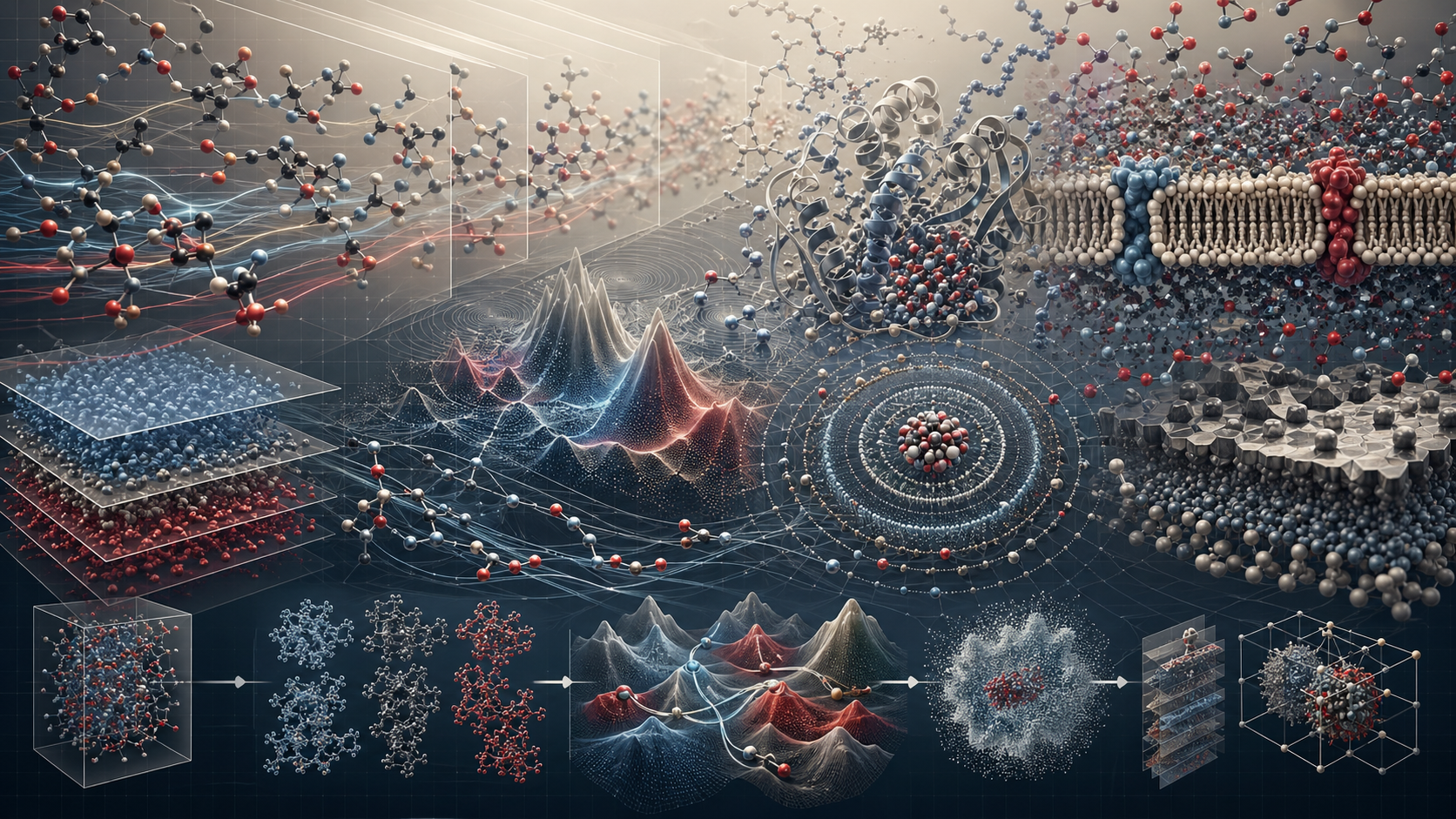
Molecular dynamics is chemistry simulated through time. It asks how atoms, molecules, ions, solvents, polymers, proteins, membranes, materials, interfaces, and condensed phases move when forces act on them. Where quantum chemistry emphasizes electronic structure and molecular energy, molecular dynamics emphasizes motion, sampling, fluctuations, trajectories, and time-dependent molecular behavior.
The central thesis of this article is that molecular dynamics is not merely molecular animation. It is a quantitative simulation method for connecting microscopic forces to macroscopic behavior, molecular structure to motion, and chemical models to time-dependent evidence. A trajectory is not valuable because it moves on a screen. It is valuable because it can be analyzed statistically, compared with experiment, tested for convergence, and interpreted within a defined physical model.
A static molecular structure is only one frame. Real chemical systems vibrate, rotate, diffuse, collide, reorganize, fold, unfold, adsorb, desorb, solvate, crystallize, melt, bind, unbind, exchange energy, and cross barriers. Molecular dynamics turns molecular structure into an evolving system, but its reliability depends on force fields, parameters, preparation, sampling, numerical stability, ensemble choice, trajectory analysis, validation, uncertainty, and reproducibility.
Main Library
Publications
Article Map
Chemistry
Related Topic
Physics
Related Topic
Biology
Related Topic
Mathematical Modeling
Why Molecular Dynamics Matters
Molecular dynamics matters because chemistry happens in motion. A molecule is not only a structure. It is a fluctuating system of atoms moving under forces. A protein active site breathes. A solvent shell reorganizes. An ion migrates through a channel. A polymer chain coils and stretches. A liquid forms local structure. A ligand binds through a sequence of encounters. A crystal surface reconstructs. A membrane fluctuates. A catalytic interface changes as adsorbates move.
Static structures can be profoundly useful, but they can also mislead. A single optimized geometry may not reveal conformational flexibility. A docking pose may not remain stable. A crystal structure may not capture solution motion. A calculated minimum may hide barriers, competing states, solvent effects, or entropy. Molecular dynamics helps fill this gap by producing trajectories: time-ordered molecular configurations that can be analyzed statistically.
Molecular dynamics is especially important in:
- protein and nucleic-acid flexibility;
- ligand binding and unbinding;
- membrane dynamics;
- polymer motion;
- liquid structure;
- ion transport;
- diffusion;
- surface adsorption;
- nanomaterials;
- electrolytes and batteries;
- crystal nucleation;
- solvation and hydrogen bonding;
- enzyme conformational change;
- thermal and mechanical properties of materials.
The method is valuable because it gives chemistry a temporal dimension. It asks how molecular systems behave when allowed to move under a defined model. It connects molecular geometry to fluctuations, fluctuations to averages, averages to thermodynamics, and trajectories to mechanistic hypotheses.
For researchers and scientists, molecular dynamics is most useful when treated as a statistical model of motion rather than a literal movie of reality. The trajectory is evidence only when the model, sampling, analysis, and uncertainty are visible.
Chemical Simulation as Time-Dependent Modeling
A chemical simulation is a model. It does not reproduce reality automatically. It represents a chemical system under chosen assumptions: atom types, charges, force-field parameters, boundary conditions, temperature, pressure, solvent, constraints, timestep, integration scheme, and sampling strategy. Every molecular dynamics result is therefore conditional on the model used to generate it.
A molecular dynamics simulation usually begins with:
- an initial structure;
- a topology describing atoms, bonds, angles, torsions, and nonbonded parameters;
- initial velocities or a temperature assignment;
- a force field or potential energy model;
- a simulation box and boundary conditions;
- solvent and ions where relevant;
- energy minimization;
- equilibration;
- production simulation;
- trajectory analysis.
The simulation produces a sequence of molecular configurations:
\mathbf{R}(t_0), \mathbf{R}(t_1), \mathbf{R}(t_2), \ldots, \mathbf{R}(t_n)
\]
Interpretation: \(\mathbf{R}(t)\) is the set of atomic coordinates at time \(t\). The trajectory becomes useful when these configurations are analyzed statistically and interpreted within the simulation model.
This trajectory is not valuable merely because it moves. It is valuable because it can be analyzed: average structure, fluctuations, distances, hydrogen bonds, angles, diffusion constants, radial distribution functions, conformational states, free-energy surfaces, binding contacts, solvent residence times, cluster states, material deformation, and time-correlation functions.
Chemical simulation is therefore not animation. It is model-based statistical evidence. The model defines which forces are present, which interactions are approximated, which chemistry is excluded, and which questions the simulation can plausibly answer.
For researchers, the most important interpretive question is not “What happened in the trajectory?” but “What does this trajectory support under the assumptions of this model, sampling protocol, and analysis workflow?”
Newtonian Motion and Molecular Trajectories
Classical molecular dynamics usually treats atoms as particles moving according to Newton’s laws. The central relationship is:
\mathbf{F}_i = m_i\mathbf{a}_i
\]
Interpretation: \(\mathbf{F}_i\) is force on atom \(i\), \(m_i\) is atomic mass, and \(\mathbf{a}_i\) is acceleration. Molecular motion is computed by repeatedly updating forces, velocities, and positions.
Forces are derived from the potential energy:
\mathbf{F}_i = -\nabla_i U(\mathbf{R})
\]
Interpretation: \(U(\mathbf{R})\) is the potential energy as a function of atomic coordinates. The negative gradient gives the force acting on each atom.
The simulation repeatedly calculates forces, updates velocities, updates positions, and records configurations. Over time, this produces a trajectory. From that trajectory, molecular motion can be analyzed statistically.
A trajectory can reveal:
- stable and unstable conformations;
- fluctuating distances;
- solvent rearrangement;
- binding-pocket motion;
- protein-domain movements;
- diffusion pathways;
- hydrogen-bond lifetimes;
- ion coordination changes;
- surface residence times;
- phase organization.
However, Newtonian molecular dynamics is an approximation. It usually does not include explicit electronic rearrangement, bond breaking, quantum tunneling, excited-state dynamics, or chemical reactions unless specialized potentials, reactive force fields, or quantum/classical hybrid methods are used. Classical MD is powerful when atomic motion under fixed bonding and force-field assumptions is a suitable model for the chemical question.
For researchers, the value of Newtonian MD lies in its ability to sample motion in many-particle systems. Its limitation is that the motion is only as chemically meaningful as the potential energy model and sampling design behind it.
Force Fields and Potential Energy Functions
A force field is the mathematical model used to calculate potential energy and forces. It usually contains bonded and nonbonded terms. The force field is the heart of a molecular dynamics simulation because it defines how atoms interact, which motions are favored, which conformations are stable, and which thermodynamic and dynamic properties may be reproduced.
A simplified molecular-mechanics energy function is:
U_{\mathrm{total}} = U_{\mathrm{bonds}} + U_{\mathrm{angles}} + U_{\mathrm{torsions}} + U_{\mathrm{nonbonded}}
\]
Interpretation: The total potential energy is assembled from terms representing bonded geometry and through-space interactions. Different force fields use different functional forms and parameterization strategies.
A more detailed expression may include:
U_{\mathrm{total}}
=
\sum k_b(r-r_0)^2
+
\sum k_\theta(\theta-\theta_0)^2
+
\sum V_n[1+\cos(n\phi-\gamma)]
+
\sum_{i<j}
\left[
4\varepsilon_{ij}
\left(
\left(\frac{\sigma_{ij}}{r_{ij}}\right)^{12}
–
\left(\frac{\sigma_{ij}}{r_{ij}}\right)^6
\right)
+
\frac{q_iq_j}{4\pi\varepsilon_0 r_{ij}}
\right]
\]
Interpretation: This expression includes bond stretching, angle bending, torsion rotation, Lennard-Jones interactions, and electrostatics. It is a simplified classical model, not a full quantum description of chemical bonding.
Force fields are parameterized. They do not derive every interaction from first principles during the simulation. Instead, parameters are chosen to reproduce experimental data, quantum calculations, structural behavior, thermodynamic properties, or other reference targets. This makes force fields computationally efficient, but it also means they have domains of validity.
Common force-field families are used for proteins, nucleic acids, lipids, carbohydrates, small molecules, polymers, water models, ionic liquids, metals, oxides, minerals, and coarse-grained systems. A force field suited for folded proteins may not be appropriate for inorganic surfaces. A water model suited for density may not reproduce diffusion perfectly. A small-molecule parameter set may work for neutral organic ligands but fail for unusual ions, metals, radicals, or reactive intermediates.
For researchers, force-field selection is a scientific decision. If the force field is inappropriate for the chemistry, the trajectory may be numerically stable but chemically misleading.
Bonded and Nonbonded Interactions
Bonded interactions describe atoms connected through molecular topology: bonds, angles, torsions, and improper torsions. These terms preserve molecular structure and encode conformational preferences. Bond stretching and angle bending often maintain local geometry, while torsional terms shape conformational landscapes.
Nonbonded interactions describe atoms that are not directly bonded but interact through space. They include electrostatics, van der Waals attraction and repulsion, dispersion, excluded volume, ion pairing, hydrogen bonding as emergent electrostatic and geometric behavior, and solvent-mediated interactions. Many of the most important chemical behaviors in MD arise from nonbonded interactions.
The Lennard-Jones potential is often used to model short-range repulsion and dispersion attraction:
U(r) = 4\varepsilon
\left[
\left(\frac{\sigma}{r}\right)^{12}
–
\left(\frac{\sigma}{r}\right)^6
\right]
\]
Interpretation: The repulsive term rises steeply at short distance, while the attractive term captures dispersion-like behavior. \(\varepsilon\) controls well depth and \(\sigma\) sets a characteristic distance scale.
The Coulomb interaction is:
U(r) = \frac{q_iq_j}{4\pi\varepsilon_0 r}
\]
Interpretation: Electrostatic interaction depends on charges \(q_i\) and \(q_j\), vacuum permittivity \(\varepsilon_0\), and separation \(r\). In condensed-phase simulations, long-range electrostatics require careful numerical treatment.
Nonbonded interactions dominate many chemical phenomena: solvation, protein folding, ligand binding, liquid structure, membrane organization, ion coordination, adsorption, polymer packing, and crystal stability. Because nonbonded interactions occur between many pairs of atoms, they are computationally expensive. Simulations often use cutoffs, neighbor lists, long-range electrostatic methods, switching functions, and periodic boundary conditions to manage cost.
For researchers, nonbonded interactions are where much of the chemistry of molecular dynamics lives. Their treatment should be described clearly because cutoffs, electrostatic methods, water models, ion parameters, and mixing rules can all affect simulation outcomes.
Integration Algorithms and Timesteps
Molecular dynamics integrates equations of motion numerically. Atoms move continuously, but computers update positions and velocities in finite steps. The timestep must be small enough to capture fast motions, especially bond vibrations involving hydrogen. Classical all-atom MD timesteps are often on the order of femtoseconds, with constraints sometimes allowing larger steps.
A common update scheme is based on the velocity Verlet algorithm. In simplified position-update form:
\mathbf{r}(t+\Delta t)
=
\mathbf{r}(t)
+
\mathbf{v}(t)\Delta t
+
\frac{1}{2}\mathbf{a}(t)\Delta t^2
\]
Interpretation: The new position depends on current position, velocity, acceleration, and timestep. The method approximates continuous motion through discrete updates.
If the timestep is too large, energy may drift, atoms may move unrealistically, constraints may fail, and the simulation may become unstable. Even if the simulation does not crash, a poor timestep can distort dynamics, temperature control, bond vibrations, and transport properties.
Integration algorithms therefore connect mathematics to physical fidelity. A molecular dynamics trajectory is only meaningful if the numerical method remains stable and appropriate for the system. The timestep should be reported, along with constraints, hydrogen-mass repartitioning if used, integrator type, thermostat coupling, and barostat settings.
For researchers, timestep choice is not a minor technical detail. It controls the balance among accuracy, stability, computational cost, and dynamical realism.
Ensembles, Thermostats, and Barostats
Molecular dynamics simulations are often designed to sample a thermodynamic ensemble. The ensemble defines which macroscopic quantities are held fixed or controlled and therefore which statistical system the simulation is attempting to represent.
Common ensembles include:
- NVE: constant number of particles, volume, and energy.
- NVT: constant number of particles, volume, and temperature.
- NPT: constant number of particles, pressure, and temperature.
- Grand-canonical ideas: variable particle number in specialized contexts.
A thermostat controls temperature by modifying velocities or coupling the system to a heat bath. A barostat controls pressure by adjusting the simulation box. Different thermostats and barostats can affect dynamics and sampling differently. Some are better for equilibration; others are better for production dynamics or thermodynamic sampling.
Temperature is related to kinetic energy:
\left\langle K \right\rangle = \frac{3}{2}Nk_BT
\]
Interpretation: This idealized expression relates average kinetic energy to particle number \(N\), Boltzmann constant \(k_B\), and temperature \(T\), with degrees-of-freedom corrections needed in real constrained systems.
Choosing an ensemble is a chemical decision. A protein in water may require NPT equilibration to obtain realistic density. A crystal simulation may require pressure control. A diffusion calculation may require care because some thermostats can alter dynamical properties. A surface simulation may need anisotropic box behavior. A membrane simulation may require semi-isotropic pressure coupling.
For researchers, ensembles are not technical decorations. They define the statistical system being simulated and should match the chemical question.
Periodic Boundary Conditions and Solvation
Many molecular dynamics simulations use periodic boundary conditions. Instead of simulating a droplet with artificial edges, the simulation box is repeated in all directions. A molecule leaving one side re-enters from the opposite side, creating the appearance of bulk material. This reduces boundary artifacts, but it also introduces assumptions about finite-size behavior and periodicity.
Periodic boundary conditions are essential for liquids, solids, membranes, electrolyte solutions, crystals, polymers, and many biomolecular simulations. They allow simulations to approximate bulk systems using finite boxes. However, box size, shape, cutoff treatment, long-range electrostatics, and finite-size corrections can all affect results.
Solvation is equally important. A molecule in vacuum may behave very differently from a molecule in water, organic solvent, ionic liquid, membrane, protein pocket, or electrolyte. Solvent affects hydrogen bonding, dielectric screening, conformations, binding, diffusion, reaction barriers, and ion pairing.
Simulation choices include:
- explicit solvent molecules;
- implicit solvent models;
- water-model selection;
- ion concentration;
- box size;
- boundary conditions;
- long-range electrostatics;
- solvent equilibration;
- finite-size corrections where needed.
A simulation without appropriate environment may answer the wrong chemical question. A ligand simulated in vacuum does not represent a ligand in water or in a binding pocket. A membrane protein without a realistic lipid environment may behave artificially. An electrolyte without appropriate ions, concentration, and water model may misrepresent transport.
For researchers, boundary conditions and solvation are part of the model, not setup details. They should be selected and documented according to the chemistry being studied.
Equilibration, Production, and Sampling
Molecular dynamics workflows usually separate preparation, equilibration, and production. Energy minimization removes severe clashes or unrealistic initial contacts. Equilibration allows temperature, pressure, solvent organization, and local structure to settle under controlled conditions. Production simulation generates the trajectory used for analysis.
Sampling is the central challenge. A simulation may run for nanoseconds, microseconds, or longer, but chemical processes may occur on much longer timescales. Some conformational transitions, binding events, folding events, nucleation processes, and rare reactions may not be observed in ordinary simulation.
Good molecular dynamics asks:
- Has the system equilibrated?
- Is the production trajectory long enough?
- Are multiple replicas needed?
- Are observables converged?
- Are rare events being missed?
- Does the analysis depend strongly on starting conditions?
- Are time windows chosen transparently?
- Are reported uncertainties based on independent or correlated samples?
Sampling limitations mean that simulation length, number of replicas, starting structures, enhanced sampling, and analysis methods matter. A single short trajectory may not represent the relevant ensemble. A stable-looking trajectory may be trapped in one basin. A ligand may remain bound simply because unbinding is too rare on the simulation timescale.
For researchers, sampling is where molecular dynamics becomes statistical science. A trajectory is a finite sample from a model-defined ensemble, and its conclusions should be limited by what was actually sampled.
Trajectory Analysis
A trajectory is a dataset. It can be analyzed in many ways depending on the chemical question. Visual inspection is useful for intuition, but quantitative analysis is needed for scientific claims.
Common trajectory analyses include:
- root-mean-square deviation;
- root-mean-square fluctuation;
- radius of gyration;
- distance and angle distributions;
- hydrogen-bond counts and lifetimes;
- solvent-accessible surface area;
- secondary-structure changes;
- contact maps;
- radial distribution functions;
- mean-squared displacement;
- diffusion coefficients;
- cluster analysis;
- principal component analysis;
- free-energy surfaces;
- time-correlation functions;
- residence-time analysis;
- interface roughness or density profiles.
Analysis choices must be documented. Atom selections, alignment procedures, time windows, smoothing, bin sizes, reference structures, clustering thresholds, solvent definitions, hydrogen-bond criteria, periodic unwrapping, and statistical uncertainty can all affect conclusions. A distance distribution measured after alignment may differ from one measured in raw coordinates. A diffusion calculation may require unwrapped trajectories. A contact analysis may depend strongly on cutoff selection.
Trajectory analysis should also separate equilibration from production. Early frames may reflect preparation artifacts rather than equilibrium behavior. In long trajectories, different regions may sample different states. In multiple replicas, summary statistics should distinguish within-replica and between-replica variation.
For researchers, a molecular dynamics result is only as strong as its trajectory analysis. The analysis workflow should be reproducible, parameterized, and connected to the chemical question.
Radial Distribution Functions and Condensed-Matter Structure
Condensed phases such as liquids, solutions, and amorphous materials often lack long-range crystal order but have local structure. Molecular dynamics can reveal this local structure through radial distribution functions.
A radial distribution function \(g(r)\) describes how particle density varies with distance from a reference particle:
g(r) = \frac{\rho(r)}{\rho_{\mathrm{bulk}}}
\]
Interpretation: \(g(r)\) compares local density at distance \(r\) with bulk density. Peaks indicate preferred neighbor distances and local coordination structure.
Peaks in \(g(r)\) indicate preferred neighbor distances. In liquids, the first peak may represent the first solvation shell. Subsequent peaks may show additional coordination shells. In electrolytes, radial distribution functions can reveal ion pairing, hydration structure, and coordination geometry.
Radial distribution functions are useful for:
- water structure;
- ionic solutions;
- solvation shells;
- liquid mixtures;
- molten salts;
- amorphous materials;
- polymer packing;
- interfacial liquids;
- comparison with scattering experiments.
RDF interpretation requires care. The result depends on atom selection, bin width, normalization, trajectory length, finite-size effects, equilibration, and sampling. Peaks can be physically meaningful, but their coordination interpretation may require integration over shell regions and comparison with experimental or structural evidence.
For researchers, radial distribution functions are one of the main ways MD connects atomistic motion to condensed-matter structure. They are strongest when paired with clear selection rules, adequate sampling, and chemically meaningful interpretation.
Diffusion, Transport, and Dynamic Properties
Molecular dynamics can estimate dynamic properties such as diffusion coefficients, viscosity, ionic conductivity, rotational correlation times, residence times, and transport pathways. These properties are important because they connect microscopic motion to macroscopic behavior.
Mean-squared displacement is central to diffusion analysis:
MSD(t) = \left\langle |\mathbf{r}(t)-\mathbf{r}(0)|^2 \right\rangle
\]
Interpretation: The mean-squared displacement measures how far particles move, on average, over time. It is commonly averaged over particles and time origins.
For three-dimensional diffusion:
D = \lim_{t\to\infty}\frac{MSD(t)}{6t}
\]
Interpretation: \(D\) is the diffusion coefficient. The expression applies in the long-time diffusive regime for three-dimensional diffusion.
Transport properties are important in:
- electrolytes;
- battery materials;
- membranes;
- polymer films;
- porous materials;
- aqueous solutions;
- drug transport;
- ion channels;
- gas separation materials;
- catalyst pores.
Dynamic properties require careful simulation. Finite-size effects, thermostat choice, sampling length, force-field quality, viscosity errors, periodic-boundary handling, slow relaxation, and correlated motion can all affect estimates. A diffusion coefficient estimated from the wrong time window can be misleading if the trajectory is still ballistic, subdiffusive, confined, or under-sampled.
For researchers, MD is especially valuable when transport depends on microscopic pathways that are difficult to observe directly. But transport estimates should be reported with the time window, fitting method, uncertainty, and model limitations.
Conformational Dynamics and Free-Energy Landscapes
Molecules with many degrees of freedom can occupy many conformations. Proteins, peptides, polymers, ligands, carbohydrates, and flexible catalysts often exist as ensembles rather than single structures. Molecular dynamics provides a way to observe and quantify transitions among conformational states, within the limits of sampling.
A conformational free-energy landscape describes the relative stability of states along chosen coordinates. It can be estimated from probability distributions:
F(x) = -k_BT\ln P(x) + C
\]
Interpretation: \(P(x)\) is the probability of observing coordinate \(x\), \(k_B\) is Boltzmann’s constant, \(T\) is temperature, and \(C\) is an arbitrary constant. More probable states correspond to lower free energy.
Free-energy landscapes can reveal:
- stable basins;
- transition regions;
- folded and unfolded states;
- binding-competent conformations;
- barriers between states;
- allosteric changes;
- polymer conformational regimes;
- reaction-coordinate behavior in approximate models.
The challenge is choosing meaningful coordinates. A poor reaction coordinate can hide important motions. A two-dimensional plot may oversimplify a high-dimensional system. A trajectory that samples only one basin cannot support a full free-energy landscape. Enhanced sampling may be required for rare transitions, but enhanced sampling introduces additional methodological assumptions.
For researchers, free-energy analysis is powerful because it connects motion, probability, and thermodynamics. It is fragile when sampling is incomplete or coordinates are poorly chosen.
Enhanced Sampling and Rare Events
Many important chemical events are rare on ordinary simulation timescales. Ligand unbinding, protein folding, crystal nucleation, membrane permeation, conformational switching, chemical barrier crossing, and ion-channel transitions may require enhanced methods. Enhanced sampling attempts to improve sampling, estimate free energies, or force transitions that would otherwise be too slow.
Enhanced sampling methods include:
- umbrella sampling;
- metadynamics;
- replica exchange molecular dynamics;
- accelerated molecular dynamics;
- steered molecular dynamics;
- adaptive sampling;
- Markov state models;
- weighted ensemble methods;
- free-energy perturbation;
- thermodynamic integration.
These methods can be powerful, but they require expertise. Biasing potentials, collective variables, convergence checks, replica exchange criteria, window overlap, reweighting methods, path definitions, thermodynamic cycles, and uncertainty estimation must be handled carefully. An enhanced-sampling result can be more misleading than ordinary MD if the biasing coordinate is poor or convergence is assumed rather than demonstrated.
Enhanced sampling does not remove the sampling problem. It changes its form. The question becomes whether the enhanced method sampled the relevant states, whether reweighting is valid, whether uncertainty is quantified, and whether the chosen collective variables capture the chemistry.
For researchers, enhanced sampling should be treated as a specialized inference method. It can extend MD beyond accessible timescales, but it must be documented and validated with discipline.
Biomolecular Simulation
Biomolecular molecular dynamics studies proteins, nucleic acids, lipids, carbohydrates, complexes, membranes, enzymes, receptors, channels, transporters, and molecular machines. These systems are dynamic, solvated, flexible, and sensitive to local interactions, making them natural subjects for MD.
Biomolecular simulations can investigate:
- protein flexibility;
- ligand binding stability;
- allosteric communication;
- enzyme active-site organization;
- membrane-protein dynamics;
- DNA and RNA conformational behavior;
- protein folding and unfolding;
- post-translational modification effects;
- protein-protein interfaces;
- drug-resistance mutations;
- water networks in binding sites;
- ion coordination and channel transport.
Biomolecular MD requires careful preparation: protonation states, missing residues, ligand parameters, metal ions, cofactors, membrane composition, salt concentration, water model, force field, equilibration, and analysis. Small setup choices can affect large conclusions. A missing ion, incorrect protonation state, poor ligand parameterization, or unrealistic membrane composition can change the trajectory.
It is tempting to treat a protein trajectory as a literal movie of life. That is not the right interpretation. A biomolecular trajectory is a model-based sample from a force-field-defined ensemble. It becomes scientifically useful when compared with experiments, structural biology, mutagenesis, kinetics, spectroscopy, thermodynamics, and biochemical evidence.
For researchers, biomolecular MD is strongest when used as one line of evidence. It can suggest mechanisms, reveal plausible motions, and guide experiments, but it should not be overinterpreted without validation and uncertainty analysis.
Materials, Polymers, Surfaces, and Interfaces
Molecular dynamics is also central to materials chemistry. It can model crystals, liquids, glasses, polymers, metals, ceramics, porous materials, nanoparticles, membranes, electrolytes, ionic liquids, surfaces, and interfaces. Materials-focused MD connects molecular-scale motion to properties such as transport, mechanical response, thermal behavior, interfacial structure, and degradation.
Materials-focused MD can estimate:
- density;
- thermal expansion;
- diffusion;
- viscosity;
- mechanical response;
- glass transition behavior;
- polymer chain dynamics;
- surface adsorption;
- interfacial water structure;
- ion transport;
- defect migration;
- crack initiation in simplified models;
- nanoparticle aggregation;
- pore transport.
Different materials require different interaction models. Biomolecular force fields may not suit metals. Metal potentials may not suit organic polymers. Reactive force fields may be needed when bonds form or break. Machine-learned interatomic potentials may be useful for complex materials but require careful training, validation, uncertainty assessment, and domain control.
Materials MD also requires attention to scale. A small periodic cell may not capture defects, grain boundaries, phase separation, or long-range morphology. A short trajectory may not capture glass relaxation or polymer equilibration. A force field may reproduce density but fail transport. A surface model may not represent realistic roughness, charge, reconstruction, hydration, or contamination.
For researchers, materials MD is powerful because it connects molecular-scale motion to material-scale behavior. But its conclusions depend strongly on model choice, system size, timescale, and validation against relevant experimental or higher-level computational evidence.
Coarse-Grained and Multiscale Simulation
All-atom simulations represent atoms explicitly. Coarse-grained simulations group multiple atoms into larger beads or interaction sites. This reduces computational cost and allows longer timescales and larger systems. Coarse-graining is especially useful when large-scale organization matters more than local atomic detail.
Coarse-graining is useful for:
- membranes;
- polymers;
- surfactants;
- protein assemblies;
- phase separation;
- nanoparticle aggregation;
- soft matter;
- self-assembly;
- large biomolecular complexes.
The tradeoff is resolution. Coarse-grained models can capture large-scale organization while losing atomic detail. Parameters must be chosen carefully, often based on experimental data or all-atom simulations. Mapping choices, bead definitions, interaction potentials, time scaling, and backmapping procedures should be documented.
Multiscale simulation combines models at different levels: quantum mechanics for reactive regions, molecular mechanics for larger environments, coarse-grained models for mesoscale organization, and continuum models for macroscopic behavior. Such workflows can be powerful but are difficult because information must pass between scales without introducing hidden inconsistencies.
For researchers, coarse-grained and multiscale simulation are best understood as purposeful approximations. They are useful when the chosen level of detail matches the chemical question, and weak when important chemistry is averaged away without acknowledgement.
Validation, Uncertainty, and Simulation Ethics
Molecular dynamics simulations can look persuasive. A colorful trajectory, stable-looking protein, smooth free-energy surface, or precise diffusion coefficient can create an illusion of certainty. But simulation results depend on assumptions. Responsible simulation requires making those assumptions visible.
Sources of uncertainty include:
- initial structure;
- force-field parameters;
- partial charges;
- water model;
- ion parameters;
- system size;
- boundary conditions;
- timestep;
- thermostat and barostat;
- equilibration protocol;
- sampling length;
- replica variability;
- analysis choices;
- finite-size effects;
- comparison data quality.
Validation may use experimental structures, NMR data, scattering data, diffusion coefficients, densities, viscosities, binding free energies, thermodynamic properties, vibrational spectra, mutational data, or independent simulations. Validation should match the claim. A simulation used to discuss qualitative flexibility requires different evidence than a simulation used to estimate a binding free energy, diffusion coefficient, or material transport property.
Simulation ethics means not overstating what the model proves. A trajectory can support a hypothesis, suggest a mechanism, or reveal plausible dynamics. It does not automatically establish biological, materials, or therapeutic truth. A model that appears precise can still be wrong if its assumptions are inappropriate.
For researchers, good molecular dynamics is transparent about assumptions, limitations, and uncertainty. The strongest simulation work does not hide uncertainty; it makes uncertainty part of the scientific interpretation.
Reproducible Molecular Dynamics
Reproducible MD requires documentation of the full simulation workflow. A useful simulation record should include enough information for another qualified researcher to understand, inspect, rerun, or critique the simulation and analysis.
A reproducible simulation record should include:
- starting structure;
- structure preparation steps;
- protonation states;
- topology files;
- force field and version;
- water model;
- ion parameters;
- box size and shape;
- boundary conditions;
- energy minimization protocol;
- equilibration protocol;
- production simulation length;
- timestep;
- constraints;
- thermostat and barostat;
- random seeds;
- software and version;
- hardware or precision settings if relevant;
- trajectory output frequency;
- analysis scripts;
- statistical uncertainty estimates;
- provenance records.
A reproducible workflow separates raw trajectories, processed trajectories, topology files, parameters, scripts, analysis outputs, and interpretation. It preserves both input and output files. It records software versions and simulation settings. It describes analysis selections and thresholds. It states which trajectory frames were excluded, if any, and why.
Molecular dynamics can generate enormous data. Without careful organization, the result becomes difficult to audit. Reproducibility is therefore not a cosmetic add-on. It is part of the scientific method.
For researchers, reproducible MD means that the trajectory, model, analysis, and interpretation remain connected. A result should be traceable from reported figure back to trajectory frames, topology, force field, analysis script, and simulation protocol.
Mathematical Lens: Molecular Dynamics
Molecular dynamics connects forces, energy, motion, probability, and statistical mechanics. Newton’s second law is:
\mathbf{F}_i = m_i\mathbf{a}_i
\]
Interpretation: Force determines acceleration for atom \(i\). This is the basis of classical time evolution in many MD simulations.
Forces are derived from potential energy:
\mathbf{F}_i = -\nabla_i U(\mathbf{R})
\]
Interpretation: Atoms move according to the gradient of the potential energy surface defined by the force field or potential model.
Kinetic energy is:
K = \sum_i \frac{1}{2}m_i v_i^2
\]
Interpretation: Kinetic energy depends on atomic masses and velocities. It is connected to temperature in statistical mechanics.
Total energy is:
E = K + U
\]
Interpretation: In an ideal NVE simulation, total energy should be conserved apart from numerical error. Energy drift can indicate integration or setup problems.
The Lennard-Jones potential is:
U(r) = 4\varepsilon
\left[
\left(\frac{\sigma}{r}\right)^{12}
–
\left(\frac{\sigma}{r}\right)^6
\right]
\]
Interpretation: This potential approximates short-range repulsion and dispersion attraction between nonbonded particles.
The Coulomb interaction is:
U(r) = \frac{q_iq_j}{4\pi\varepsilon_0 r}
\]
Interpretation: Electrostatic energy depends on charges and distance. Long-range electrostatics require special treatment in periodic systems.
The velocity Verlet position update is:
\mathbf{r}(t+\Delta t)
=
\mathbf{r}(t)
+
\mathbf{v}(t)\Delta t
+
\frac{1}{2}\mathbf{a}(t)\Delta t^2
\]
Interpretation: This update approximates continuous motion over a finite timestep \(\Delta t\). Timestep choice affects stability and accuracy.
The Boltzmann probability of a configuration is:
P(\mathbf{R}) \propto e^{-U(\mathbf{R})/(k_BT)}
\]
Interpretation: Lower-energy configurations are more probable at equilibrium, but entropy and sampling determine what is actually observed in a trajectory.
The radial distribution function is:
g(r) = \frac{\rho(r)}{\rho_{\mathrm{bulk}}}
\]
Interpretation: \(g(r)\) describes local structure by comparing local density at distance \(r\) with bulk density.
Mean-squared displacement is:
MSD(t) = \left\langle |\mathbf{r}(t)-\mathbf{r}(0)|^2 \right\rangle
\]
Interpretation: MSD tracks particle displacement over time and is central to diffusion analysis.
The diffusion coefficient in three dimensions is:
D = \lim_{t\to\infty}\frac{MSD(t)}{6t}
\]
Interpretation: \(D\) is estimated from the long-time linear regime of MSD. The fitting window and finite-size effects matter.
Free energy from probability is:
F(x) = -k_BT\ln P(x) + C
\]
Interpretation: More probable states along coordinate \(x\) correspond to lower free energy. The result depends on sampling and coordinate choice.
These equations show that molecular dynamics is not molecular animation. It is time-dependent statistical mechanics implemented as computational chemistry.
Computational Workflows for Molecular Dynamics
Computational workflows can make molecular dynamics more transparent. A workflow can track starting structures, topology files, force fields, water models, ion parameters, box dimensions, minimization settings, equilibration protocols, production lengths, timesteps, thermostats, barostats, random seeds, trajectory files, analysis scripts, output tables, and interpretation notes.
Useful workflows include velocity-Verlet teaching models, Lennard-Jones potential tables, radial-distribution scaffolds, mean-squared displacement, diffusion estimates, RMSD/RMSF summaries, hydrogen-bond analysis, contact maps, distance distributions, free-energy estimates, trajectory provenance, ensemble metadata, simulation manifests, and quality-control reports.
For researchers, MD workflows should preserve four distinctions:
- Model versus reality: a trajectory is generated by a force field or potential model.
- Equilibration versus production: setup relaxation should not be confused with analyzed sampling.
- Visualization versus evidence: molecular movies help intuition, but quantitative analysis supports claims.
- Single trajectory versus ensemble: one trajectory may not represent all relevant states.
The examples below use synthetic educational data. They do not validate a simulation, estimate real transport properties, certify molecular behavior, or replace professional molecular-simulation review. They demonstrate how simulation reasoning can be structured, audited, and communicated responsibly.
Python Example: Velocity Verlet, MSD, Diffusion, and Provenance
The following Python example uses synthetic educational data. It performs a simple velocity-Verlet-style update, calculates mean-squared displacement from a toy trajectory, estimates a simplified diffusion coefficient from the final point, and writes provenance outputs. In real MD workflows, analysis would use actual trajectory files, proper unwrapping, multiple time origins, uncertainty estimates, finite-size checks, and simulation metadata.
from pathlib import Path
from typing import Dict
import json
import platform
import sys

import numpy as np
import pandas as pd


# Synthetic molecular dynamics workflow.
# Educational example only; not for real simulation, molecular property
# estimation, drug discovery, materials qualification, or regulatory use.


def velocity_verlet_position_update(
    position: np.ndarray,
    velocity: np.ndarray,
    force: np.ndarray,
    mass: np.ndarray,
    timestep_ps: float,
) -> pd.DataFrame:
    """Perform a simple velocity-Verlet-style position and velocity update."""
    acceleration = force / mass

    new_position = (
        position
        + velocity * timestep_ps
        + 0.5 * acceleration * timestep_ps**2
    )

    new_velocity = velocity + acceleration * timestep_ps

    return pd.DataFrame({
        "particle_id": [f"p{i + 1}" for i in range(len(position))],
        "position": position,
        "velocity": velocity,
        "mass": mass,
        "force": force,
        "acceleration": acceleration,
        "new_position": new_position,
        "new_velocity": new_velocity,
    })


def calculate_msd(trajectory: pd.DataFrame) -> pd.DataFrame:
    """Calculate displacement squared relative to the first frame."""
    required_columns = ["time_ps", "x", "y", "z"]

    missing_columns = [
        column for column in required_columns
        if column not in trajectory.columns
    ]

    if missing_columns:
        raise ValueError(f"Trajectory is missing columns: {missing_columns}")

    x0, y0, z0 = trajectory.loc[0, ["x", "y", "z"]]

    result = trajectory.copy()

    result["msd_distance2"] = (
        (result["x"] - x0) ** 2
        + (result["y"] - y0) ** 2
        + (result["z"] - z0) ** 2
    )

    result["diffusive_time_window_review"] = result["time_ps"] <= 0

    return result


timestep_ps = 0.5

position = np.array([0.0, 1.0, 2.0], dtype=float)
velocity = np.array([0.00, 0.05, -0.02], dtype=float)
mass = np.array([1.0, 1.0, 2.0], dtype=float)
force = np.array([0.10, -0.05, 0.02], dtype=float)

verlet_table = velocity_verlet_position_update(
    position=position,
    velocity=velocity,
    force=force,
    mass=mass,
    timestep_ps=timestep_ps,
)

trajectory = pd.DataFrame({
    "time_ps": [0, 1, 2, 3, 4, 5],
    "x": [0.0, 0.4, 0.7, 1.1, 1.3, 1.8],
    "y": [0.0, 0.1, 0.3, 0.2, 0.5, 0.6],
    "z": [0.0, 0.2, 0.1, 0.4, 0.6, 0.7],
})

msd_table = calculate_msd(trajectory)

final = msd_table.iloc[-1]
diffusion_estimate_distance2_per_ps = (
    final["msd_distance2"] / (6.0 * final["time_ps"])
)

msd_table["diffusion_estimate_from_origin_distance2_per_ps"] = np.where(
    msd_table["time_ps"] > 0,
    msd_table["msd_distance2"] / (6.0 * msd_table["time_ps"]),
    np.nan,
)

output_dir = Path("outputs")
output_dir.mkdir(exist_ok=True)

verlet_table.to_csv(output_dir / "synthetic_velocity_verlet_update.csv", index=False)
msd_table.to_csv(output_dir / "synthetic_msd_diffusion_table.csv", index=False)

manifest: Dict[str, object] = {
    "workflow": "synthetic_molecular_dynamics_workflow",
    "data_type": "synthetic educational coordinates",
    "timestep_ps": timestep_ps,
    "diffusion_estimate_distance2_per_ps": float(diffusion_estimate_distance2_per_ps),
    "diffusion_note": (
        "Single-particle final-point estimate for teaching only. "
        "Real diffusion analysis requires multiple particles, multiple time origins, "
        "unwrapped trajectories, an appropriate long-time fitting window, finite-size "
        "checks, and uncertainty estimation."
    ),
    "python_version": sys.version,
    "platform": platform.platform(),
    "numpy_version": np.__version__,
    "pandas_version": pd.__version__,
    "output_files": [
        "outputs/synthetic_velocity_verlet_update.csv",
        "outputs/synthetic_msd_diffusion_table.csv",
        "outputs/molecular_dynamics_manifest.json",
    ],
    "responsible_use": [
        "Synthetic educational data only.",
        "Real molecular dynamics workflows require force-field documentation, topology files, simulation parameters, trajectory provenance, convergence checks, and expert review.",
    ],
}

with (output_dir / "molecular_dynamics_manifest.json").open(
    "w",
    encoding="utf-8"
) as file:
    json.dump(manifest, file, indent=2)

print("Velocity-Verlet update")
print("----------------------")
print(verlet_table.round(6).to_string(index=False))

print("\nMSD and diffusion scaffold")
print("--------------------------")
print(msd_table.round(6).to_string(index=False))

print(
    "\nfinal_point_diffusion_estimate_distance2_per_ps = "
    f"{diffusion_estimate_distance2_per_ps:.6f}"
)
This example demonstrates the workflow logic rather than real MD science. A responsible simulation workflow should preserve the relationship among coordinates, timestep, force model, trajectory output, analysis assumptions, and interpretation. Even a toy example can model good habits: explicit units, structured outputs, provenance, and responsible-use notes.
R Example: Lennard-Jones Potential and Radial Distribution Scaffold
The following R example builds two synthetic educational tables: a Lennard-Jones potential curve and a radial-distribution histogram scaffold. In real molecular dynamics analysis, RDF calculations require proper normalization, periodic boundary conditions, atom selections, bin widths, sufficient sampling, and uncertainty estimates.
# Synthetic molecular dynamics analysis scaffold.
# Educational example only; not for real simulation reporting.

distance <- seq(0.85, 3.0, length.out = 80)
epsilon <- 1.0
sigma <- 1.0

energy <- 4 * epsilon * ((sigma / distance)^12 - (sigma / distance)^6)

lj_table <- data.frame(
  distance = distance,
  energy = energy
)

lj_table$repulsive_region <- distance < sigma
lj_table$attractive_region <- distance > sigma

synthetic_pair_distances <- c(
  0.95, 1.02, 1.08, 1.15, 1.20,
  1.85, 1.92, 2.05, 2.10, 2.20,
  2.75, 2.90, 3.05, 3.20
)

breaks <- seq(0.5, 3.5, by = 0.5)
counts <- hist(synthetic_pair_distances, breaks = breaks, plot = FALSE)

rdf_table <- data.frame(
  r_midpoint = counts$mids,
  count = counts$counts
)

rdf_table$normalized_count <-
  rdf_table$count / max(rdf_table$count)

dir.create("outputs", showWarnings = FALSE)

write.csv(
  lj_table,
  file = "outputs/r_lennard_jones_table.csv",
  row.names = FALSE
)

write.csv(
  rdf_table,
  file = "outputs/r_radial_distribution_scaffold.csv",
  row.names = FALSE
)

sink("outputs/r_md_scaffold_report.txt")
cat("Synthetic Molecular Dynamics Scaffold Report\n")
cat("============================================\n\n")
cat("Lennard-Jones potential table, first rows:\n")
print(head(lj_table, 10))
cat("\nRadial distribution scaffold:\n")
print(rdf_table)
cat("\nResponsible-use note:\n")
cat("Synthetic educational data only. Real RDF analysis requires trajectory data, periodic boundary handling, proper shell-volume normalization, atom-selection documentation, sampling checks, and uncertainty estimates.\n")
sink()

print(head(lj_table, 10))
print(rdf_table)
This scaffold shows how R can support simulation analysis summaries, potential-energy tables, and report generation. The central issue is not the language but the evidence chain. Analysis outputs should remain connected to assumptions, units, input data, and limitations.
SQL Example: Molecular Dynamics Evidence Register
Molecular dynamics becomes more reliable when simulation inputs, force fields, parameters, trajectories, analysis scripts, validation checks, and interpretation claims are traceable. A simple evidence register can preserve the context needed to audit simulation results.
CREATE TABLE md_simulation_system (
    system_id TEXT PRIMARY KEY,
    system_name TEXT NOT NULL,
    system_type TEXT,
    starting_structure_uri TEXT,
    preparation_protocol_uri TEXT,
    protonation_state_notes TEXT,
    topology_uri TEXT,
    coordinate_uri TEXT,
    system_quality_flag TEXT
);

CREATE TABLE md_force_field_record (
    force_field_id TEXT PRIMARY KEY,
    system_id TEXT NOT NULL,
    force_field_name TEXT,
    force_field_version TEXT,
    water_model TEXT,
    ion_parameters TEXT,
    small_molecule_parameters_uri TEXT,
    parameterization_notes TEXT,
    FOREIGN KEY (system_id) REFERENCES md_simulation_system(system_id)
);

CREATE TABLE md_simulation_protocol (
    protocol_id TEXT PRIMARY KEY,
    system_id TEXT NOT NULL,
    ensemble TEXT,
    temperature_K REAL,
    pressure_bar REAL,
    timestep_fs REAL,
    constraints_description TEXT,
    thermostat TEXT,
    barostat TEXT,
    periodic_boundary_conditions INTEGER CHECK (periodic_boundary_conditions IN (0, 1)),
    box_description TEXT,
    minimization_protocol TEXT,
    equilibration_protocol TEXT,
    production_length_ns REAL,
    random_seed TEXT,
    protocol_notes TEXT,
    FOREIGN KEY (system_id) REFERENCES md_simulation_system(system_id)
);

CREATE TABLE md_trajectory_record (
    trajectory_id TEXT PRIMARY KEY,
    protocol_id TEXT NOT NULL,
    trajectory_uri TEXT,
    topology_uri TEXT,
    frame_count INTEGER CHECK (frame_count >= 0),
    frame_interval_ps REAL,
    trajectory_checksum TEXT,
    processed_trajectory_uri TEXT,
    trajectory_status TEXT,
    FOREIGN KEY (protocol_id) REFERENCES md_simulation_protocol(protocol_id)
);

CREATE TABLE md_analysis_record (
    analysis_id TEXT PRIMARY KEY,
    trajectory_id TEXT NOT NULL,
    analysis_type TEXT,
    atom_selection TEXT,
    time_window_ps TEXT,
    analysis_script_uri TEXT,
    analysis_parameters TEXT,
    output_artifact_uri TEXT,
    uncertainty_method TEXT,
    analysis_review_status TEXT,
    FOREIGN KEY (trajectory_id) REFERENCES md_trajectory_record(trajectory_id)
);

CREATE TABLE md_validation_record (
    validation_id TEXT PRIMARY KEY,
    system_id TEXT NOT NULL,
    validation_type TEXT,
    reference_data_source TEXT,
    reference_value REAL,
    simulated_value REAL,
    validation_unit TEXT,
    validation_status TEXT,
    validation_notes TEXT,
    FOREIGN KEY (system_id) REFERENCES md_simulation_system(system_id)
);

CREATE TABLE md_interpretation_claim (
    claim_id TEXT PRIMARY KEY,
    analysis_id TEXT NOT NULL,
    claim_text TEXT,
    claim_type TEXT,
    confidence_level TEXT,
    limitation_notes TEXT,
    review_status TEXT,
    FOREIGN KEY (analysis_id) REFERENCES md_analysis_record(analysis_id)
);

SELECT
    s.system_id,
    s.system_name,
    s.system_type,
    f.force_field_name,
    f.force_field_version,
    f.water_model,
    p.ensemble,
    p.temperature_K,
    p.pressure_bar,
    p.timestep_fs,
    p.production_length_ns,
    t.trajectory_uri,
    t.trajectory_checksum,
    a.analysis_type,
    a.analysis_review_status,
    v.validation_type,
    v.validation_status,
    c.claim_type,
    c.confidence_level,
    CASE
        WHEN s.starting_structure_uri IS NULL
            THEN 'starting structure review required'
        WHEN f.force_field_name IS NULL
            THEN 'force-field review required'
        WHEN p.timestep_fs IS NULL
            THEN 'protocol review required'
        WHEN t.trajectory_checksum IS NULL
            THEN 'trajectory provenance review required'
        WHEN a.analysis_review_status IS NOT NULL
             AND a.analysis_review_status != 'pass'
            THEN 'analysis review required'
        WHEN v.validation_status IS NOT NULL
             AND v.validation_status != 'pass'
            THEN 'validation review required'
        WHEN c.review_status IS NOT NULL
             AND c.review_status != 'reviewed'
            THEN 'interpretation review required'
        ELSE 'standard review'
    END AS molecular_dynamics_review_status
FROM md_simulation_system s
LEFT JOIN md_force_field_record f
    ON s.system_id = f.system_id
LEFT JOIN md_simulation_protocol p
    ON s.system_id = p.system_id
LEFT JOIN md_trajectory_record t
    ON p.protocol_id = t.protocol_id
LEFT JOIN md_analysis_record a
    ON t.trajectory_id = a.trajectory_id
LEFT JOIN md_validation_record v
    ON s.system_id = v.system_id
LEFT JOIN md_interpretation_claim c
    ON a.analysis_id = c.analysis_id
ORDER BY molecular_dynamics_review_status, s.system_id;
The purpose of this register is to keep simulation interpretation attached to evidence. A molecular dynamics result should preserve starting structure, preparation protocol, force field, water model, parameters, simulation protocol, trajectory provenance, analysis scripts, validation records, and interpretation status. MD becomes stronger when its evidence trail is structured.
GitHub Repository
The companion repository for this article can support reproducible workflows for velocity-Verlet integration, Lennard-Jones potentials, radial-distribution scaffolds, mean-squared displacement, diffusion estimates, trajectory summaries, ensemble metadata, simulation provenance, SQL evidence registers, and responsible molecular-simulation interpretation.
Complete Code Repository
The full code distribution for this article, including selected molecular dynamics examples, expanded computational workflows, reproducible data structures, provenance documentation, trajectory-analysis scaffolds, simulation metadata records, SQL evidence registers, and scientific-computing infrastructure, is available on GitHub.
Limits, Uncertainty, and Responsible Interpretation
Molecular dynamics is powerful, but it is not self-interpreting. A trajectory can suggest motion, reveal plausible conformations, estimate properties, or support mechanistic hypotheses, but its meaning depends on the simulation model. A visually stable protein does not prove biological stability. A ligand that remains bound in a short trajectory does not prove binding affinity. A smooth free-energy surface does not prove convergence. A diffusion estimate does not prove transport accuracy without validation.
Uncertainty enters at many levels: initial structure, protonation state, force field, parameterization, water model, ion model, system size, boundary conditions, timestep, thermostat, barostat, equilibration, production length, replica variability, enhanced-sampling method, analysis choices, and comparison data. These sources should be acknowledged rather than hidden behind polished trajectories or exact-looking numbers.
Sampling is one of the most persistent limits. A simulation may be too short to observe relevant transitions. A trajectory may remain trapped in one basin. Rare events may be absent. Multiple replicas may disagree. Enhanced sampling may depend on poorly chosen collective variables. Long simulations do not automatically solve these problems if the model is inappropriate or analysis is weak.
Validation is therefore essential. Simulation results should be compared with experimental structures, thermodynamic data, transport measurements, spectroscopy, scattering, density, viscosity, mutational data, binding measurements, or independent computational evidence where possible. The appropriate validation depends on the claim being made.
The computational examples associated with this article are synthetic and educational. They do not validate real simulations, estimate real molecular properties, establish drug-binding behavior, certify materials performance, or replace professional molecular-simulation review. They are designed to show how simulation reasoning can be structured and audited.
Responsible interpretation should avoid both simulation overconfidence and simulation dismissal. MD can reveal dynamic molecular behavior that is difficult to observe directly. But its conclusions remain strongest when model assumptions, sampling limitations, validation evidence, and uncertainty remain visible.
Conclusion
Molecular dynamics and chemical simulation turn molecular structure into time-dependent behavior. They model atoms moving under forces, generate trajectories, and allow chemists to analyze fluctuations, diffusion, solvation, conformational change, transport, condensed-phase structure, biomolecular motion, and material behavior.
The field is powerful because chemistry is dynamic. Molecules vibrate, rotate, diffuse, bind, unbind, reorganize, and respond to their environment. Molecular dynamics provides a way to study these processes through computational statistical mechanics.
But molecular dynamics is not a moving picture of truth. It is a model-based simulation whose reliability depends on force fields, parameters, preparation, sampling, numerical stability, ensemble choice, analysis methods, validation, and uncertainty. The quality of the simulation is not determined by whether it produces a trajectory, but by whether that trajectory can support the chemical claim being made.
To understand molecular dynamics is to understand chemical systems as moving ensembles: structured, fluctuating, probabilistic, and interpretable through careful simulation. Its strongest contribution is not animation, but disciplined time-dependent evidence.
Related articles
- What Is Chemistry?
- Computational Chemistry and Molecular Modeling
- Quantum Chemistry and Electronic Structure
- Cheminformatics and Molecular Data Science
- Python for Chemistry, Simulation, and Laboratory Data
- R for Chemistry, Statistics, and Experimental Analysis
- Physical Chemistry and the Chemical Interpretation of Matter
- Intermolecular Forces and the Chemistry of Condensed Matter
- Chemical Thermodynamics and Energetics
- Chemical Kinetics and Reaction Mechanisms
- Reaction Networks and Chemical Systems Modeling
- Biochemistry and the Molecular Basis of Life
Further reading
- Frenkel, D. and Smit, B. (2002) Understanding Molecular Simulation: From Algorithms to Applications. 2nd edn. San Diego: Academic Press. Available at: https://www.sciencedirect.com/book/9780122673511/understanding-molecular-simulation
- Allen, M.P. and Tildesley, D.J. (2017) Computer Simulation of Liquids. 2nd edn. Oxford: Oxford University Press. Available at: https://global.oup.com/academic/product/computer-simulation-of-liquids-9780198803201
- Leach, A.R. (2001) Molecular Modelling: Principles and Applications. 2nd edn. Harlow: Pearson. Available at: https://www.pearson.com/en-gb/subject-catalog/p/molecular-modelling-principles-and-applications/P200000003494
- Rapaport, D.C. (2004) The Art of Molecular Dynamics Simulation. 2nd edn. Cambridge: Cambridge University Press. Available at: https://www.cambridge.org/core/books/art-of-molecular-dynamics-simulation/9862B6B6040F27D2F8BCB2F48AC85C68
- GROMACS (n.d.) GROMACS Documentation. Available at: https://manual.gromacs.org/documentation/current/index.html
- OpenMM (n.d.) OpenMM Documentation. Available at: https://docs.openmm.org/
- LAMMPS (n.d.) LAMMPS Molecular Dynamics Simulator. Available at: https://www.lammps.org/
- MDAnalysis (n.d.) MDAnalysis User Guide. Available at: https://userguide.mdanalysis.org/
- MDTraj (n.d.) MDTraj Documentation. Available at: https://www.mdtraj.org/
- Grossfield, A. (n.d.) WHAM: The Weighted Histogram Analysis Method. Available at: http://membrane.urmc.rochester.edu/?page_id=126
References
- Allen, M.P. and Tildesley, D.J. (2017) Computer Simulation of Liquids. 2nd edn. Oxford: Oxford University Press. Available at: https://global.oup.com/academic/product/computer-simulation-of-liquids-9780198803201
- Eastman, P. et al. (2017) ‘OpenMM 7: Rapid development of high performance algorithms for molecular dynamics’, PLOS Computational Biology, 13(7), e1005659. Available at: https://journals.plos.org/ploscompbiol/article?id=10.1371/journal.pcbi.1005659
- Frenkel, D. and Smit, B. (2002) Understanding Molecular Simulation: From Algorithms to Applications. 2nd edn. San Diego: Academic Press. Available at: https://www.sciencedirect.com/book/9780122673511/understanding-molecular-simulation
- GROMACS (n.d.) Molecular Dynamics — GROMACS Documentation. Available at: https://manual.gromacs.org/documentation/current/reference-manual/algorithms/molecular-dynamics.html
- GROMACS (n.d.) Reference Manual. Available at: https://manual.gromacs.org/current/reference-manual/index.html
- International Union of Pure and Applied Chemistry (n.d.) Compendium of Chemical Terminology: Molecular Dynamics in Drug Design. Available at: https://goldbook.iupac.org/terms/view/MT06969
- LAMMPS (n.d.) LAMMPS Molecular Dynamics Simulator. Available at: https://www.lammps.org/
- Leach, A.R. (2001) Molecular Modelling: Principles and Applications. 2nd edn. Harlow: Pearson. Available at: https://www.pearson.com/en-gb/subject-catalog/p/molecular-modelling-principles-and-applications/P200000003494
- OpenMM (n.d.) OpenMM: High Performance, Customizable Molecular Simulation. Available at: https://openmm.org/
- Rapaport, D.C. (2004) The Art of Molecular Dynamics Simulation. 2nd edn. Cambridge: Cambridge University Press. Available at: https://www.cambridge.org/core/books/art-of-molecular-dynamics-simulation/9862B6B6040F27D2F8BCB2F48AC85C68
- Sandia National Laboratories (n.d.) LAMMPS. Available at: https://www.sandia.gov/ccr/software/lammps/
- Thompson, A.P. et al. (2022) ‘LAMMPS — a flexible simulation tool for particle-based materials modeling at the atomic, meso, and continuum scales’, Computer Physics Communications, 271, 108171. Available at: https://www.sciencedirect.com/science/article/pii/S0010465521002836