
Last Updated May 28, 2026
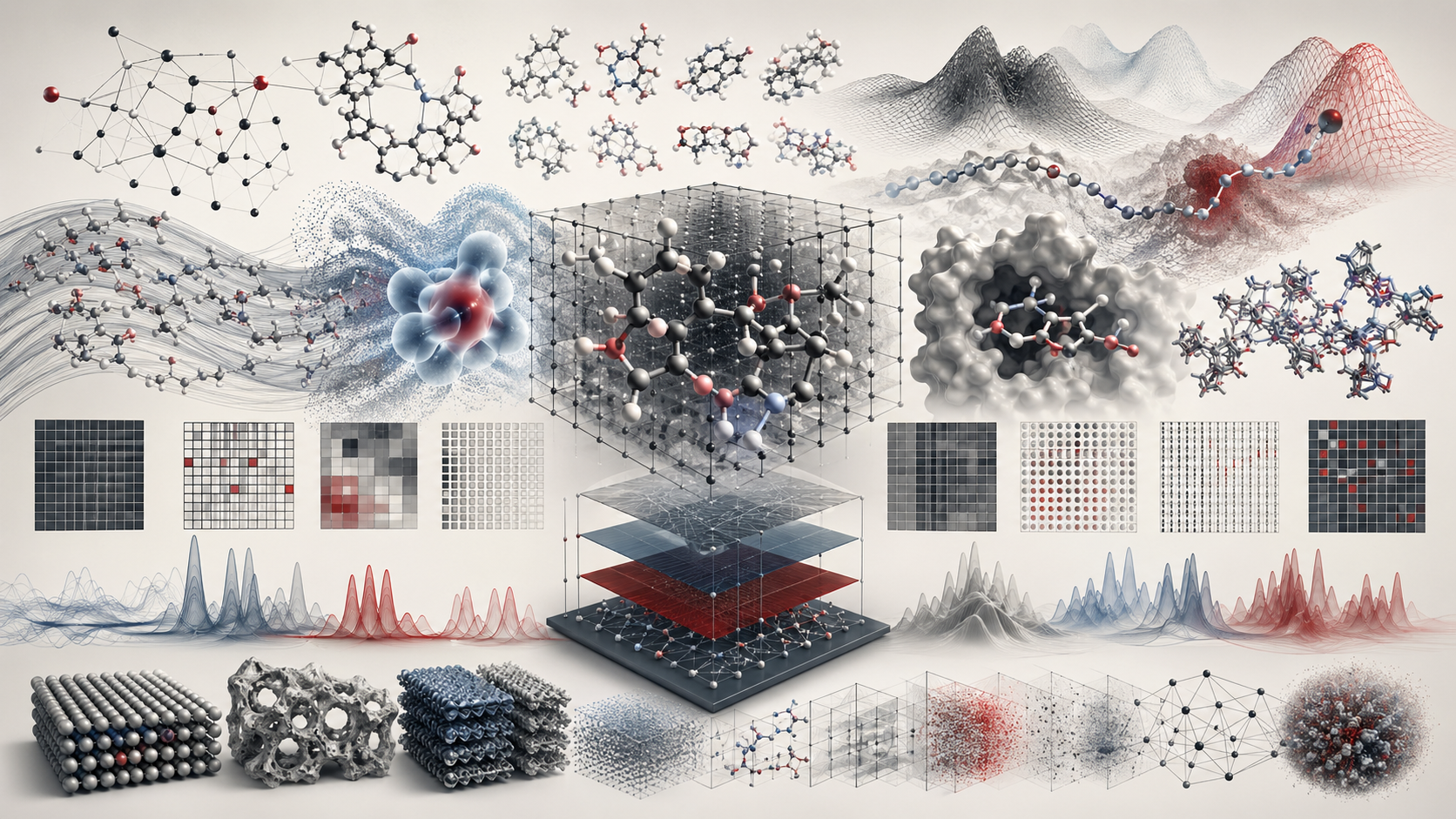
Computational chemistry uses mathematical models, algorithms, data structures, and simulations to study molecular systems. It turns chemical structure into computable form: atoms become coordinates, bonds become connectivity, electrons become quantum states, molecules become graphs, reactions become energy landscapes, and chemical behavior becomes something that can be estimated, compared, simulated, visualized, and tested.
The central thesis of this article is that computational chemistry is chemical reasoning made executable. It translates molecular questions into mathematical and algorithmic form, then uses computation to produce evidence, hypotheses, predictions, and interpretations that must remain accountable to chemical reality. A computational result is not automatically chemical truth. It is a model-based estimate whose usefulness depends on representation, method choice, assumptions, sampling, validation, uncertainty, and reproducibility.
Molecular modeling is closely related. It uses computational chemistry and visualization to create plausible three-dimensional representations of molecular structures and properties under defined assumptions. A molecular model is therefore not a perfect copy of reality. It is a structured approximation: useful when its assumptions, methods, limitations, and validation are understood.
Main Library
Publications
Article Map
Chemistry
Related Topic
Data Systems & Analytics
Related Topic
Artificial Intelligence Systems
Related Topic
Mathematical Modeling
Why Computational Chemistry Matters
Computational chemistry matters because chemical questions often involve structures, energies, pathways, interactions, and probabilities that cannot be fully understood from a formula alone. A molecule may have many conformations. A reaction may have multiple mechanisms. A catalyst may stabilize one transition state over another. A drug candidate may bind differently across related proteins. A material may change properties when doped, strained, solvated, or exposed to defects.
Computational chemistry helps investigate these possibilities before, during, and after experiment. It can suggest which molecules are worth synthesizing, explain why an experiment gave a surprising result, estimate properties that are difficult to measure, compare competing hypotheses, and connect molecular structure to observable behavior.
It is especially important in:
- drug discovery and molecular design;
- reaction mechanism analysis;
- catalyst design;
- materials discovery;
- spectral interpretation;
- protein-ligand modeling;
- chemical informatics;
- environmental fate modeling;
- polymer and soft-matter simulation;
- electrochemistry and battery materials;
- surface chemistry and heterogeneous catalysis;
- quantum chemistry education and benchmarking.
Computational chemistry is powerful because molecules are structured systems. Their behavior is constrained by geometry, charge, electron distribution, thermodynamics, kinetics, solvation, entropy, and environment. Computation gives chemists a way to explore those constraints systematically.
Its value is not only prediction. Computational chemistry also clarifies reasoning. A model can make assumptions explicit. A workflow can preserve the path from input structure to energy, descriptor, trajectory, spectrum, or binding hypothesis. A calculation can expose which variables control an outcome. A simulation can reveal hidden dynamics. A failed model can show what chemistry the approximation failed to capture.
For researchers and scientists, computational chemistry is strongest when it is used as disciplined evidence. It should support chemical reasoning, not obscure it behind software output, beautiful molecular images, or precise-looking numbers.
Molecules as Computable Objects
To compute with molecules, chemistry must be represented in a form a machine can manipulate. A molecule may be treated as:
- a graph of atoms and bonds;
- a set of three-dimensional coordinates;
- a quantum-mechanical system of nuclei and electrons;
- a set of classical particles connected by bonded and nonbonded interactions;
- a collection of conformers;
- a vector of descriptors;
- a fingerprint of structural features;
- a point in chemical space;
- a member of a reaction network;
- a structure embedded in solvent, protein, surface, or material context.
Each representation reveals some features and hides others. A graph captures connectivity but not precise geometry. A three-dimensional structure captures geometry but may represent only one conformation. A quantum calculation captures electronic structure but may be computationally expensive. A fingerprint is useful for similarity search but does not explain physical mechanism.
Computational chemistry therefore begins with representation. The model must match the question. A reaction barrier requires a different model from a database similarity search. A protein-ligand docking experiment requires a different model from a gas-phase vibrational frequency calculation. A polymer melt requires different assumptions from a small rigid molecule.
Representation also determines what errors are possible. A SMILES string may omit stereochemical detail. A force field may lack parameters for an unusual metal center. A docking model may treat a protein as too rigid. A descriptor vector may flatten chemical behavior into features that miss mechanism. A quantum calculation may use the wrong spin state. A simulation may sample only one local basin.
For researchers, the first question in computational chemistry is not “what software should I use?” It is “what chemical reality am I trying to represent?” A computational method is only useful if its representation is appropriate for the molecular question.
Molecular Representations
Molecular representations translate chemistry into data. Common representations include:
- SMILES, a line notation describing molecular connectivity;
- InChI, an identifier designed for chemical information exchange;
- connection tables, listing atoms, bonds, charges, and connectivity;
- XYZ files, listing atom types and Cartesian coordinates;
- PDB files, widely used for biomolecular structures;
- SDF/MOL files, storing structure and associated data;
- molecular graphs, representing atoms as nodes and bonds as edges;
- fingerprints, encoding structural features for similarity search;
- descriptors, numerical features such as mass, polarity, ring count, surface area, charge, or topological indices.
A molecular graph can be described as:
G = (V,E)
\]
Interpretation: \(V\) is the set of atoms or vertices and \(E\) is the set of bonds or molecular connections. Graph representations are useful for cheminformatics, substructure search, fingerprints, and molecular machine learning.
A three-dimensional molecular structure can be represented as a coordinate matrix:
\mathbf{R} =
\begin{bmatrix}
x_1 & y_1 & z_1\\
x_2 & y_2 & z_2\\
\cdots & \cdots & \cdots\\
x_N & y_N & z_N
\end{bmatrix}
\]
Interpretation: Each row gives the Cartesian coordinates of an atom. This representation supports geometry optimization, docking, molecular dynamics, spectroscopy simulation, and structural comparison.
Different computational tasks require different representations. Cheminformatics may use SMILES, graphs, and fingerprints. Quantum chemistry may require coordinates, charge, spin multiplicity, basis set, and method. Molecular dynamics requires coordinates, topology, force-field parameters, solvent, temperature, and boundary conditions.
Representation is also tied to reproducibility. A molecular record should preserve stereochemistry, protonation state, tautomer handling, salt treatment, charge, coordinate source, conformer identity, and file provenance when relevant. Two workflows can start from the same named compound and produce different computational objects if these details are handled differently.
For researchers, representation is the bridge between chemical structure and computation. When that bridge is weak, the calculation may be formally correct but chemically misdirected.
Quantum Chemistry and Electronic Structure
Quantum chemistry models molecules through electrons and nuclei. It is essential for understanding bonding, charge distribution, molecular orbitals, reaction barriers, spectroscopy, excited states, redox behavior, and many properties that depend directly on electronic structure.
The central equation is the Schrödinger equation:
\hat{H}\psi = E\psi
\]
Interpretation: \(\hat{H}\) is the Hamiltonian operator, \(\psi\) is the wavefunction, and \(E\) is energy. The equation states that allowed quantum states have defined energies under the Hamiltonian.
For real molecules, solving this equation exactly is generally impossible. Computational quantum chemistry uses approximations. These include Hartree-Fock theory, post-Hartree-Fock methods, density functional theory, semiempirical methods, and composite methods.
Quantum chemistry can estimate:
- optimized molecular geometries;
- relative energies;
- reaction energies;
- transition-state structures;
- vibrational frequencies;
- dipole moments;
- partial charges;
- frontier orbital energies;
- electron density;
- electrostatic potential;
- spectroscopic transitions;
- thermochemical corrections.
The accuracy of a quantum calculation depends on the method, basis set, molecular system, solvation model, spin state, conformational state, treatment of dispersion, relativistic effects where relevant, and comparison to experiment or higher-level theory.
Quantum chemistry is especially important when electrons determine the question: bond making and breaking, charge transfer, photochemistry, redox behavior, spin states, transition metals, excited states, weak interactions, aromaticity, and spectroscopy. It is less appropriate when the question can be answered more efficiently by a lower-cost representation, such as a descriptor screen or classical simulation.
For researchers, quantum chemistry is not a black box. It is a controlled approximation to molecular electronic structure. The result should remain connected to its assumptions, method, basis set, charge, multiplicity, and validation evidence.
Density Functional Theory
Density functional theory, or DFT, is one of the most widely used methods in computational chemistry. Instead of treating the many-electron wavefunction directly, DFT uses electron density as the central quantity.
The electron density is written:
\rho(\mathbf{r})
\]
Interpretation: \(\rho(\mathbf{r})\) describes how electron probability is distributed in space. It is central to DFT and closely connected to chemical ideas such as charge distribution, polarity, and bonding regions.
In simplified conceptual form, DFT treats energy as a functional of electron density:
E = E[\rho]
\]
Interpretation: The energy is treated as a functional of electron density. Practical DFT depends on approximate exchange-correlation functionals.
DFT is popular because it often provides a practical balance between accuracy and computational cost. It is used in organic chemistry, inorganic chemistry, catalysis, materials science, spectroscopy, surface chemistry, electrochemistry, and biochemistry.
However, DFT is not one method. It is a family of approaches depending on the chosen exchange-correlation functional, basis set, dispersion correction, solvation model, integration grid, and convergence criteria. Different functionals can produce different results, especially for weak interactions, transition metals, charge transfer, radicals, excited states, reaction barriers, and strongly correlated systems.
DFT should therefore be used with chemical judgment. A result is not reliable merely because it came from a DFT calculation. It must be tested against known data, benchmark methods, chemical plausibility, and sensitivity analysis.
For researchers, DFT is often the practical workhorse of computational chemistry, but its usefulness depends on knowing when it is appropriate, when it must be benchmarked, and when higher-level or specialized methods are needed.
Molecular Mechanics and Force Fields
Molecular mechanics treats atoms as classical particles governed by force-field equations. It does not explicitly model electrons. Instead, it uses parameterized functions for bonds, angles, torsions, nonbonded interactions, electrostatics, and van der Waals forces.
A simplified force-field energy expression is:
E_{\mathrm{total}} = E_{\mathrm{bonds}} + E_{\mathrm{angles}} + E_{\mathrm{torsions}} + E_{\mathrm{nonbonded}}
\]
Interpretation: Classical molecular mechanics represents molecular energy as a sum of bonded and nonbonded interaction terms.
More explicitly:
E_{\mathrm{total}} =
\sum k_b(r-r_0)^2
+
\sum k_\theta(\theta-\theta_0)^2
+
\sum V_n[1+\cos(n\phi-\gamma)]
+
\sum
\left[
\frac{A}{r^{12}}
–
\frac{B}{r^6}
+
\frac{q_iq_j}{4\pi\varepsilon_0r}
\right]
\]
Interpretation: This expression includes bond stretching, angle bending, torsions, repulsion, dispersion-like attraction, and electrostatics. It is a classical approximation, not an explicit electronic-structure model.
Force fields are widely used because they can model large systems: proteins, membranes, polymers, liquids, materials, and molecular assemblies. They are essential for molecular dynamics and many biomolecular simulations.
But force fields are approximations. They depend on parameter quality and transferability. A force field trained for proteins may not handle transition-metal complexes well. A small-molecule force field may struggle with unusual chemistries. Fixed-charge force fields may not capture polarization. Classical force fields cannot describe bond breaking unless specially designed.
For researchers, molecular mechanics is powerful when the chemistry fits the parameterization. It is risky when parameters are missing, poorly transferred, or applied outside the force field’s intended domain.
Molecular Dynamics
Molecular dynamics simulates the time evolution of molecular systems. Atoms move according to forces, often derived from a force field or quantum-mechanical calculation. It is one of the main ways computational chemistry studies molecular motion, flexibility, transport, solvation, and time-dependent behavior.
Newton’s equation is:
\mathbf{F}_i = m_i\mathbf{a}_i
\]
Interpretation: \(\mathbf{F}_i\) is force on atom \(i\), \(m_i\) is mass, and \(\mathbf{a}_i\) is acceleration. Molecular dynamics updates positions and velocities through time using forces.
A molecular dynamics simulation generates a trajectory:
\mathbf{R}(t)
\]
Interpretation: \(\mathbf{R}(t)\) represents atomic coordinates as a function of time. A trajectory becomes evidence when analyzed statistically and interpreted within the simulation model.
Molecular dynamics can study:
- protein flexibility;
- ligand binding stability;
- membrane behavior;
- solvation;
- diffusion;
- polymer motion;
- ion transport;
- conformational transitions;
- thermal fluctuations;
- materials dynamics;
- enzyme active-site motion.
The usefulness of molecular dynamics depends on sampling. A short simulation may miss slow conformational changes. A force field may bias behavior. Initial conditions may influence results. Temperature, pressure, solvent model, boundary conditions, timestep, thermostat, barostat, and equilibration all matter.
For researchers, molecular dynamics does not show “what the molecule really does” automatically. It shows what a model does under specified assumptions. The trajectory must be analyzed, validated, and interpreted with uncertainty.
Monte Carlo and Sampling
Monte Carlo methods use random sampling to explore molecular configurations, thermodynamic states, conformations, or statistical distributions. Instead of integrating equations of motion through time, Monte Carlo proposes changes and accepts or rejects them based on a criterion.
A common acceptance probability is:
P = \min(1,e^{-\Delta E/(k_BT)})
\]
Interpretation: \(\Delta E\) is the energy change, \(k_B\) is Boltzmann’s constant, and \(T\) is temperature. Energetically favorable moves are accepted readily, while unfavorable moves may still be accepted with thermodynamic probability.
Monte Carlo can be useful for:
- conformational sampling;
- ligand pose generation;
- statistical thermodynamics;
- solvent and adsorption models;
- polymer configurations;
- materials disorder;
- reaction network sampling;
- Bayesian parameter estimation.
Sampling is one of the central problems in computational chemistry. Molecular systems often have many local minima separated by energy barriers. A model may be mathematically correct but practically misleading if sampling is incomplete.
Monte Carlo methods are especially useful when the goal is to sample configurations rather than simulate real time. They can explore statistical ensembles, but they do not usually produce physically meaningful trajectories unless specially designed to do so.
For researchers, good computational chemistry asks not only “what is the lowest energy structure?” but “how thoroughly was the relevant chemical space explored?” A model’s conclusions are only as reliable as the sampling behind them.
Conformational Search
Many molecules can rotate around bonds, forming different conformations. These conformations may have different energies, shapes, polarities, binding behavior, spectra, and reactivity. A single drawn structure may hide a large conformational ensemble.
A conformational search attempts to identify relevant low-energy structures. It may use systematic torsion scans, distance geometry, stochastic sampling, molecular dynamics, Monte Carlo methods, genetic algorithms, or machine-learning-assisted approaches.
The relative population of a conformation can be estimated from Boltzmann weighting:
p_i = \frac{e^{-E_i/(k_BT)}}{\sum_j e^{-E_j/(k_BT)}}
\]
Interpretation: \(E_i\) is the energy of conformation \(i\). Lower-energy conformers have larger Boltzmann weights, but the result depends on the energy model and whether relevant conformers were found.
Conformational analysis is essential in:
- drug design;
- NMR interpretation;
- reaction modeling;
- molecular docking;
- property prediction;
- polymer chemistry;
- peptide and protein modeling;
- supramolecular chemistry.
Conformer search is difficult because flexible molecules can have many local minima. Missing a relevant conformer can change predicted spectra, binding poses, thermodynamic populations, or reaction pathways. Energy differences may be small, and solvation or entropy can shift conformer populations.
For researchers, conformational search should not be treated as a preliminary nuisance. It is often central to whether a computational model represents the molecule actually relevant to experiment.
Molecular Docking and Binding Models
Molecular docking predicts possible binding poses of a molecule within a target site, often a protein binding pocket. It is widely used in medicinal chemistry, chemical biology, virtual screening, and structural biology.
Docking typically involves:
- preparing the receptor structure;
- preparing ligand structures and protonation states;
- defining a binding site;
- sampling ligand poses;
- scoring poses;
- ranking candidate interactions;
- visual inspection and validation;
- experimental follow-up.
Docking is useful for hypothesis generation, but it is not proof of binding. Docking scores are approximate. Binding depends on solvation, entropy, receptor flexibility, protonation, water networks, induced fit, allostery, kinetics, concentration, and experimental context.
A simplified binding free-energy relationship is:
\Delta G^\circ = RT\ln K_d
\]
Interpretation: Binding free energy is related to the dissociation constant \(K_d\). A docking pose is only one possible structural hypothesis within a larger thermodynamic and kinetic binding process.
Docking failures often come from preparation and assumptions: wrong protonation state, missing cofactors, rigid receptor treatment, poor ligand conformers, absent water molecules, wrong tautomer, inappropriate scoring function, or failure to validate against known ligands.
For researchers, good molecular modeling treats docking as a starting point, not a verdict. Docking can prioritize hypotheses, but binding claims require stronger evidence: experimental assays, structural validation, molecular dynamics, free-energy methods, mutational evidence, or other independent support.
Reaction Pathways and Transition States
Computational chemistry can model chemical reactions by comparing reactants, products, intermediates, and transition states. It can estimate activation barriers, reaction energies, competing mechanisms, stereochemical outcomes, catalytic effects, and solvent influence.
A reaction pathway can be represented as a potential energy surface:
E = E(\mathbf{R})
\]
Interpretation: Energy depends on nuclear coordinates \(\mathbf{R}\). Reactants, intermediates, transition states, and products appear as features on the potential energy surface.
A transition state corresponds to a first-order saddle point on this surface: a maximum along the reaction coordinate and a minimum along other directions.
A rate constant can be related to activation free energy through transition-state theory:
k = \frac{k_BT}{h}e^{-\Delta G^\ddagger/(RT)}
\]
Interpretation: The rate constant depends exponentially on activation free energy. Small errors in \(\Delta G^\ddagger\) can produce large errors in predicted rates.
Reaction modeling can be difficult because the correct pathway may not be obvious. Proton transfers, solvent molecules, counterions, conformational changes, spin states, catalysts, surfaces, and entropy can all alter the mechanism. A computed transition state must be verified, often by vibrational frequency analysis and intrinsic reaction coordinate calculations.
For researchers, computational reaction modeling is a way to test mechanistic hypotheses, not a shortcut around chemical reasoning. A mechanism becomes stronger when multiple computational and experimental lines of evidence support the same pathway.
Spectroscopy and Computed Observables
Computational chemistry can help interpret spectra by predicting molecular observables. These may include vibrational frequencies, infrared intensities, Raman activities, NMR chemical shifts, UV-visible transitions, circular dichroism spectra, electron paramagnetic resonance parameters, and photoelectron spectra.
A computed spectrum is not merely decorative. It can help assign peaks, compare candidate structures, identify conformers, test proposed mechanisms, and connect molecular structure to measurement.
For vibrational frequencies, harmonic approximations are commonly used, but real molecules are anharmonic. Calculated frequencies often require scaling factors when compared to experiment. Solvent, temperature, conformational averaging, instrument conditions, and molecular environment can shift observed signals.
Spectral simulation is especially useful when several structures are plausible. If candidate A matches experimental spectra better than candidate B across independent observables, confidence improves. But spectral agreement must be interpreted with care, especially if the model was tuned to fit the data.
Computed observables are strongest when they are part of a transparent comparison between model and experiment. A spectrum should be connected to method, basis set, conformer population, scaling factors, solvent assumptions, and uncertainty.
For researchers, spectroscopy-oriented computation is not just prediction. It is evidence integration: proposed structure, computed observable, experimental measurement, uncertainty, and chemical interpretation must be compared together.
Cheminformatics, Descriptors, and Fingerprints
Cheminformatics uses computational methods to store, search, compare, analyze, and model chemical structures and data. It is essential for molecular databases, virtual screening, chemical similarity, QSAR modeling, compound libraries, reaction informatics, molecular descriptors, and machine learning.
A molecular descriptor is a numerical feature calculated from a molecule. Descriptors may include:
- molecular weight;
- hydrogen-bond donors and acceptors;
- rotatable bonds;
- topological polar surface area;
- formal charge;
- ring count;
- aromatic atom count;
- fragment counts;
- partial charge descriptors;
- 3D shape descriptors;
- electronic descriptors;
- graph-based indices.
A fingerprint encodes structural features, often as a bit vector. Chemical similarity can be estimated using the Tanimoto coefficient:
T = \frac{c}{a+b-c}
\]
Interpretation: \(a\) and \(b\) are the numbers of active features in two molecules, and \(c\) is the number of shared features. The score depends on fingerprint design.
Cheminformatics is powerful because chemical space is enormous. It allows chemists to search, cluster, compare, predict, and prioritize molecules. But descriptors and fingerprints are abstractions. Similarity in descriptor space does not always mean similarity in biological activity, reactivity, toxicity, synthesis, or material behavior.
Cheminformatics also depends on data curation. Structures may be duplicated, salts may be inconsistently handled, stereochemistry may be missing, assay units may be mixed, and identifiers may not map cleanly. A model built from poorly curated chemical data can be precise-looking and scientifically weak.
For researchers, cheminformatics is useful when its representation matches the chemical question and when its data provenance remains visible.
Materials and Periodic Systems
Computational chemistry also studies solids, surfaces, catalysts, crystals, polymers, and extended molecular assemblies. These systems often require periodic boundary conditions and methods suited to extended structures.
Materials-oriented computational chemistry may estimate:
- crystal structures;
- lattice energies;
- band gaps;
- density of states;
- surface adsorption energies;
- defect formation energies;
- ion migration barriers;
- mechanical properties;
- phonon spectra;
- catalytic reaction pathways;
- electrode behavior;
- polymer morphology.
Periodic systems require careful modeling choices: unit cell, k-point sampling, plane-wave cutoff, pseudopotentials, exchange-correlation functional, dispersion correction, surface slab thickness, vacuum spacing, defect concentration, charge compensation, and convergence thresholds.
Extended systems also raise scale questions. A small unit cell may not capture disorder. A perfect slab may not represent realistic defects. A short simulation may not sample slow structural relaxation. A computed band gap may depend strongly on functional choice. A polymer model may depend on chain length, morphology, and equilibration.
For researchers, materials modeling shows that computational chemistry is not limited to isolated molecules. It can connect atomic structure to macroscopic function in catalysts, batteries, semiconductors, ceramics, membranes, alloys, sorbents, and polymers. But the model must represent the relevant scale, environment, and property.
Benchmarking, Validation, and Uncertainty
Computational chemistry must be validated. A calculation may be precise, reproducible, and wrong if the model is inappropriate. Validation compares computational results against experiment, higher-level theory, benchmark datasets, or independent evidence.
Important validation questions include:
- Was the molecular structure correct?
- Were protonation, charge, and spin state appropriate?
- Was conformational sampling sufficient?
- Was the method suitable for the system?
- Were solvent and environmental effects included when needed?
- Were basis set and convergence settings adequate?
- Were multiple methods compared?
- Were known experimental values reproduced?
- Were uncertainty and sensitivity assessed?
Benchmark databases are valuable because they allow methods to be compared against curated reference data. But benchmarks must also match the chemical domain. A method that performs well for small gas-phase organic molecules may not perform well for transition metals, radicals, excited states, solvated ions, surfaces, or biomolecular complexes.
Uncertainty in computational chemistry may come from model form, parameters, numerical convergence, sampling, experimental reference data, molecular representation, and environmental assumptions. Uncertainty can also arise from human choices: which conformers were considered, which protonation state was selected, which solvent model was used, which docking pose was retained, or which cutoff was used in a simulation.
For researchers, a computational result should be reported as a method-dependent estimate, not as a final chemical fact. Strong computational chemistry makes uncertainty explicit and connects model confidence to the consequence of the claim.
Reproducible Computational Chemistry
Reproducibility is central to computational chemistry. A meaningful computational result should include enough information for another researcher to understand, audit, and ideally reproduce the calculation.
A reproducible computational chemistry workflow should document:
- molecular structure and input files;
- charge and spin multiplicity;
- method and basis set;
- software and version;
- force field and parameters;
- solvation model;
- geometry optimization criteria;
- frequency calculation details;
- molecular dynamics settings;
- temperature and pressure;
- simulation length and timestep;
- random seeds where relevant;
- conformer-generation method;
- descriptor definitions;
- data sources;
- code, scripts, and environment files;
- outputs and provenance records.
Reproducibility also means separating raw data, processed data, scripts, results, and interpretation. Computational chemistry can generate many files, and without a disciplined workflow, it becomes difficult to know which result came from which input.
Good computational chemistry is not only computationally sophisticated. It is auditable. A reported energy should trace back to an input structure, charge, spin, method, basis, software version, convergence state, and output file. A docking result should trace back to receptor preparation, ligand preparation, protonation state, search settings, scoring function, and validation evidence. A molecular dynamics result should trace back to topology, force field, box, solvent, equilibration, production run, trajectory, and analysis script.
For researchers, reproducibility is not just an ideal for sharing. It is a way to prevent scientific error.
Computational Chemistry and AI
Artificial intelligence and machine learning are increasingly important in computational chemistry. Models can predict molecular properties, generate candidate molecules, estimate reaction outcomes, classify spectra, search chemical space, accelerate simulations, identify patterns in materials data, and support molecular design.
AI methods may use descriptors, fingerprints, graphs, 3D coordinates, quantum-derived features, language-like molecular strings, reaction templates, or learned molecular representations.
Applications include:
- property prediction;
- virtual screening;
- molecular generation;
- retrosynthesis planning;
- reaction outcome prediction;
- force-field development;
- interatomic potentials;
- spectral classification;
- materials discovery;
- active learning for experiments;
- structure-property modeling.
AI does not remove the need for chemistry. A model may learn dataset artifacts, fail outside its domain, ignore synthesis constraints, mishandle stereochemistry, underestimate uncertainty, or propose chemically unrealistic structures. Molecular generation is not molecular understanding. Prediction is not validation.
The strongest future of AI in chemistry will combine chemical theory, experimental data, physical constraints, uncertainty estimation, transparent workflows, and human chemical judgment. AI can expand the search space, but chemistry still defines what counts as plausible, useful, safe, synthesizable, and scientifically meaningful.
For researchers, AI should be treated as another computational model: powerful, approximate, data-dependent, and in need of validation. It should strengthen chemical reasoning, not replace it with opaque ranking systems.
Mathematical Lens: Computational Chemistry
Computational chemistry is built from equations connecting structure, energy, probability, motion, similarity, and prediction. The Schrödinger equation is:
\hat{H}\psi = E\psi
\]
Interpretation: This equation connects the Hamiltonian, wavefunction, and energy. It is the governing relation behind quantum chemical electronic-structure methods.
Energy as a function of geometry is:
E = E(\mathbf{R})
\]
Interpretation: Molecular energy depends on nuclear coordinates. This relation underlies geometry optimization, conformational analysis, and reaction-path modeling.
The geometry optimization condition is:
\nabla E(\mathbf{R}) = 0
\]
Interpretation: Stationary points on a potential energy surface satisfy this condition. Minima and transition states must be distinguished by further analysis.
The classical force relation is:
\mathbf{F}_i = -\nabla_i E
\]
Interpretation: Forces are obtained from the gradient of energy with respect to atomic coordinates. This relation connects energy models to molecular motion.
Newtonian dynamics is:
\mathbf{F}_i = m_i\mathbf{a}_i
\]
Interpretation: In molecular dynamics, forces determine accelerations, which update velocities and positions through time.
Boltzmann weighting is:
p_i = \frac{e^{-E_i/(k_BT)}}{\sum_j e^{-E_j/(k_BT)}}
\]
Interpretation: Lower-energy states have larger equilibrium weights, but the result depends on the energy model and whether relevant states were sampled.
Monte Carlo acceptance can be written as:
P = \min(1,e^{-\Delta E/(k_BT)})
\]
Interpretation: This rule allows a sampling algorithm to accept favorable moves and occasionally accept unfavorable moves according to thermal probability.
Binding free energy is related to dissociation constant by:
\Delta G^\circ = RT\ln K_d
\]
Interpretation: Binding is thermodynamic. Docking scores should not be confused with validated binding free energies.
Transition-state theory often uses:
k = \frac{k_BT}{h}e^{-\Delta G^\ddagger/(RT)}
\]
Interpretation: Reaction rates depend exponentially on activation free energy, so small energy errors can produce large rate errors.
Tanimoto similarity is:
T = \frac{c}{a+b-c}
\]
Interpretation: This fingerprint similarity measure depends on active feature counts and shared features. It is representation-dependent.
A machine-learning property model can be written as:
y = f(\mathbf{x})
\]
Interpretation: \(y\) is a molecular property and \(\mathbf{x}\) is a molecular representation. The model’s validity depends on training data, representation, validation design, and applicability domain.
These equations show that computational chemistry is not only visualization. It is a quantitative framework for connecting molecular structure to energy, motion, probability, similarity, and chemical behavior.
Computational Workflows for Molecular Modeling
Computational workflows can make molecular modeling more transparent. A workflow can track molecular structures, coordinate files, graph representations, descriptors, fingerprints, conformers, energy models, force fields, docking settings, simulation parameters, reaction energies, computed observables, validation records, and provenance files.
Useful workflows include descriptor scaffolds, conformer Boltzmann weighting, Lennard-Jones potential tables, Tanimoto similarity, reaction-energy summaries, docking record manifests, molecular dynamics metadata, quantum chemistry input/output registers, spectral-comparison tables, benchmark datasets, and SQL evidence registers.
For researchers, computational chemistry workflows should preserve four distinctions:
- Representation versus molecule: a molecule is not identical to a SMILES string, coordinate file, descriptor vector, or docking pose.
- Model output versus chemical evidence: a calculation is evidence only when its assumptions and validation are visible.
- Visualization versus interpretation: a molecular image can support understanding, but it does not prove a mechanism.
- Prediction versus decision: computational output can prioritize experiments, but it should not replace experimental or expert review when consequences are high.
The examples below use synthetic educational data. They do not validate real molecular properties, approve docking results, establish reaction mechanisms, certify material behavior, or replace professional computational-chemistry review. They demonstrate how computational chemistry reasoning can be structured, audited, and communicated responsibly.
Python Example: Descriptors, Boltzmann Populations, Similarity, and Provenance
The following Python example uses synthetic educational data. It creates a molecular descriptor table, calculates conformer Boltzmann populations, computes a simple Tanimoto similarity table from binary fingerprints, and writes provenance outputs. In real workflows, these placeholders would be replaced by validated structures, descriptor definitions, conformer-generation settings, fingerprint parameters, toolkit versions, and chemical review.
from pathlib import Path
from typing import Dict, List
import json
import math
import platform
import sys

import numpy as np
import pandas as pd


# Synthetic computational chemistry workflow.
# Educational example only; not for real molecular property prediction,
# virtual screening, docking decisions, regulatory use, or safety decisions.


def require_columns(data: pd.DataFrame, required: List[str], table_name: str) -> None:
    """Raise an error if required columns are missing."""
    missing = [column for column in required if column not in data.columns]
    if missing:
        raise ValueError(f"{table_name} is missing required columns: {missing}")


def tanimoto_from_arrays(a_bits: np.ndarray, b_bits: np.ndarray) -> float:
    """Calculate Tanimoto similarity for binary fingerprint arrays."""
    a = int(np.sum(a_bits == 1))
    b = int(np.sum(b_bits == 1))
    c = int(np.sum((a_bits == 1) & (b_bits == 1)))

    denominator = a + b - c
    if denominator == 0:
        return 0.0

    return float(c / denominator)


molecules = pd.DataFrame({
    "molecule": ["water", "ethanol", "benzene", "acetic_acid"],
    "heavy_atoms": [1, 3, 6, 4],
    "hetero_atoms": [1, 1, 0, 2],
    "rings": [0, 0, 1, 0],
    "h_bond_donors": [2, 1, 0, 1],
    "h_bond_acceptors": [1, 1, 0, 2],
})

require_columns(
    molecules,
    [
        "molecule",
        "heavy_atoms",
        "hetero_atoms",
        "rings",
        "h_bond_donors",
        "h_bond_acceptors",
    ],
    "molecules",
)

molecules["hetero_atom_fraction"] = (
    molecules["hetero_atoms"] / molecules["heavy_atoms"]
)

molecules["polarity_score"] = (
    molecules["h_bond_donors"] + molecules["h_bond_acceptors"]
)

conformers = pd.DataFrame({
    "conformer": ["conf_1", "conf_2", "conf_3", "conf_4"],
    "relative_energy_kj_mol": [0.0, 2.5, 5.0, 9.0],
})

gas_constant_j_mol_K = 8.314462618
temperature_K = 298.15

conformers["boltzmann_weight"] = conformers["relative_energy_kj_mol"].apply(
    lambda energy: math.exp(
        -(energy * 1000.0) / (gas_constant_j_mol_K * temperature_K)
    )
)

conformers["population"] = (
    conformers["boltzmann_weight"] / conformers["boltzmann_weight"].sum()
)

fingerprints = pd.DataFrame({
    "molecule": ["water", "ethanol", "benzene", "acetic_acid"],
    "bit_1": [1, 1, 0, 1],
    "bit_2": [0, 1, 1, 0],
    "bit_3": [1, 1, 1, 1],
    "bit_4": [0, 1, 1, 1],
    "bit_5": [1, 0, 1, 0],
    "bit_6": [0, 1, 0, 1],
})

bit_columns = [column for column in fingerprints.columns if column.startswith("bit_")]

similarity_rows: List[Dict[str, object]] = []

for i in range(len(fingerprints)):
    for j in range(i + 1, len(fingerprints)):
        row_a = fingerprints.iloc[i]
        row_b = fingerprints.iloc[j]

        similarity_rows.append({
            "molecule_a": row_a["molecule"],
            "molecule_b": row_b["molecule"],
            "tanimoto": tanimoto_from_arrays(
                row_a[bit_columns].to_numpy(dtype=int),
                row_b[bit_columns].to_numpy(dtype=int),
            ),
        })

similarity_table = pd.DataFrame(similarity_rows)

output_dir = Path("outputs")
output_dir.mkdir(exist_ok=True)

molecules.to_csv(output_dir / "synthetic_descriptor_table.csv", index=False)
conformers.to_csv(output_dir / "synthetic_conformer_populations.csv", index=False)
fingerprints.to_csv(output_dir / "synthetic_fingerprints.csv", index=False)
similarity_table.to_csv(output_dir / "synthetic_similarity_table.csv", index=False)

manifest: Dict[str, object] = {
    "workflow": "synthetic_computational_chemistry_workflow",
    "data_type": "synthetic educational molecular records",
    "temperature_K": temperature_K,
    "descriptor_columns": [
        "heavy_atoms",
        "hetero_atoms",
        "rings",
        "h_bond_donors",
        "h_bond_acceptors",
        "hetero_atom_fraction",
        "polarity_score",
    ],
    "fingerprint_columns": bit_columns,
    "similarity_metric": "Tanimoto coefficient",
    "python_version": sys.version,
    "platform": platform.platform(),
    "numpy_version": np.__version__,
    "pandas_version": pd.__version__,
    "output_files": [
        "outputs/synthetic_descriptor_table.csv",
        "outputs/synthetic_conformer_populations.csv",
        "outputs/synthetic_fingerprints.csv",
        "outputs/synthetic_similarity_table.csv",
        "outputs/computational_chemistry_manifest.json",
    ],
    "responsible_use": [
        "Synthetic educational data only.",
        "Real computational chemistry workflows require validated structures, representation policies, method settings, sampling records, benchmark comparisons, uncertainty analysis, and expert chemical review.",
    ],
}

with (output_dir / "computational_chemistry_manifest.json").open(
    "w",
    encoding="utf-8"
) as file:
    json.dump(manifest, file, indent=2)

print("Descriptor table")
print("----------------")
print(molecules.round(6).to_string(index=False))

print("\nConformer populations")
print("---------------------")
print(conformers.round(6).to_string(index=False))

print("\nSimilarity table")
print("----------------")
print(similarity_table.round(6).to_string(index=False))
This example demonstrates workflow discipline rather than real molecular prediction. Even simple molecular modeling scaffolds should preserve representation choices, units, parameters, output files, and responsible-use notes. A real workflow would add toolkit versions, structure-standardization rules, conformer-generation settings, force-field or quantum method details, and validation evidence.
R Example: Lennard-Jones Potential and Reaction-Energy Table
The following R example builds two synthetic educational tables: a Lennard-Jones potential scaffold and a simple reaction-energy comparison table. In real computational chemistry, these values would come from validated force-field parameters, quantum chemistry calculations, thermochemical corrections, and method documentation.
# Synthetic computational chemistry scaffold.
# Educational example only; not for real molecular modeling decisions.

distance <- seq(0.85, 3.0, length.out = 80)
epsilon <- 1.0
sigma <- 1.0

energy <- 4 * epsilon * ((sigma / distance)^12 - (sigma / distance)^6)

lj_table <- data.frame(
  distance = distance,
  energy = energy
)

lj_table$repulsive_region <- distance < sigma
lj_table$attractive_region <- distance > sigma

reaction_table <- data.frame(
  pathway = c("pathway_A", "pathway_B", "pathway_C"),
  reactant_energy_kj_mol = c(0, 0, 0),
  transition_state_energy_kj_mol = c(62, 78, 55),
  product_energy_kj_mol = c(-18, -5, -24)
)

reaction_table$activation_energy_kj_mol <-
  reaction_table$transition_state_energy_kj_mol -
  reaction_table$reactant_energy_kj_mol

reaction_table$reaction_energy_kj_mol <-
  reaction_table$product_energy_kj_mol -
  reaction_table$reactant_energy_kj_mol

reaction_table$preferred_by_barrier <-
  reaction_table$activation_energy_kj_mol ==
  min(reaction_table$activation_energy_kj_mol)

dir.create("outputs", showWarnings = FALSE)

write.csv(
  lj_table,
  file = "outputs/r_lennard_jones_potential.csv",
  row.names = FALSE
)

write.csv(
  reaction_table,
  file = "outputs/r_reaction_energy_table.csv",
  row.names = FALSE
)

sink("outputs/r_computational_chemistry_report.txt")
cat("Synthetic Computational Chemistry Scaffold Report\n")
cat("================================================\n\n")
cat("Lennard-Jones potential table, first rows:\n")
print(head(lj_table, 10))
cat("\nReaction-energy comparison:\n")
print(reaction_table)
cat("\nResponsible-use note:\n")
cat("Synthetic educational data only. Real computational chemistry requires validated molecular structures, methods, basis sets or force fields, sampling records, benchmark comparisons, and uncertainty review.\n")
sink()

print(head(lj_table, 10))
print(reaction_table)
This scaffold shows how R can support molecular modeling summaries, potential-energy tables, reaction-energy comparisons, and report generation. The central issue is not the language but the evidence chain. Energy tables should remain connected to molecular structures, computational methods, assumptions, units, and uncertainty.
SQL Example: Computational Chemistry Evidence Register
Computational chemistry becomes more reliable when molecular structures, representations, calculations, simulations, descriptors, docking records, validation checks, and interpretation claims are traceable. A simple evidence register can preserve the context needed to audit molecular modeling results.
CREATE TABLE molecular_model_system (
    system_id TEXT PRIMARY KEY,
    system_name TEXT NOT NULL,
    system_type TEXT,
    structure_uri TEXT,
    representation_type TEXT,
    source_database TEXT,
    source_accession TEXT,
    charge INTEGER,
    spin_multiplicity INTEGER CHECK (spin_multiplicity >= 1),
    protonation_state_notes TEXT,
    structure_quality_flag TEXT
);

CREATE TABLE computational_method_record (
    method_id TEXT PRIMARY KEY,
    system_id TEXT NOT NULL,
    method_family TEXT,
    method_name TEXT,
    basis_set TEXT,
    force_field_name TEXT,
    force_field_version TEXT,
    solvation_model TEXT,
    software_name TEXT,
    software_version TEXT,
    method_notes TEXT,
    FOREIGN KEY (system_id) REFERENCES molecular_model_system(system_id)
);

CREATE TABLE calculation_or_simulation_record (
    run_id TEXT PRIMARY KEY,
    system_id TEXT NOT NULL,
    method_id TEXT NOT NULL,
    run_type TEXT,
    input_file_uri TEXT,
    output_file_uri TEXT,
    trajectory_uri TEXT,
    descriptor_table_uri TEXT,
    convergence_status TEXT,
    sampling_status TEXT,
    total_energy_kj_mol REAL,
    run_datetime TEXT,
    run_notes TEXT,
    FOREIGN KEY (system_id) REFERENCES molecular_model_system(system_id),
    FOREIGN KEY (method_id) REFERENCES computational_method_record(method_id)
);

CREATE TABLE conformer_record (
    conformer_id TEXT PRIMARY KEY,
    system_id TEXT NOT NULL,
    conformer_structure_uri TEXT,
    relative_energy_kj_mol REAL,
    population_estimate REAL CHECK (population_estimate >= 0),
    conformer_generation_method TEXT,
    conformer_review_status TEXT,
    FOREIGN KEY (system_id) REFERENCES molecular_model_system(system_id)
);

CREATE TABLE docking_record (
    docking_id TEXT PRIMARY KEY,
    system_id TEXT NOT NULL,
    receptor_structure_uri TEXT,
    ligand_structure_uri TEXT,
    binding_site_definition TEXT,
    scoring_function TEXT,
    docking_score REAL,
    pose_uri TEXT,
    docking_review_status TEXT,
    FOREIGN KEY (system_id) REFERENCES molecular_model_system(system_id)
);

CREATE TABLE descriptor_record (
    descriptor_id TEXT PRIMARY KEY,
    system_id TEXT NOT NULL,
    descriptor_set_name TEXT,
    descriptor_name TEXT,
    descriptor_value REAL,
    descriptor_unit TEXT,
    descriptor_version TEXT,
    descriptor_review_status TEXT,
    FOREIGN KEY (system_id) REFERENCES molecular_model_system(system_id)
);

CREATE TABLE validation_record (
    validation_id TEXT PRIMARY KEY,
    run_id TEXT NOT NULL,
    validation_type TEXT,
    reference_source TEXT,
    computed_value REAL,
    reference_value REAL,
    property_unit TEXT,
    deviation REAL,
    validation_status TEXT,
    validation_notes TEXT,
    FOREIGN KEY (run_id) REFERENCES calculation_or_simulation_record(run_id)
);

CREATE TABLE computational_interpretation_claim (
    claim_id TEXT PRIMARY KEY,
    run_id TEXT NOT NULL,
    claim_text TEXT,
    claim_type TEXT,
    confidence_level TEXT,
    limitation_notes TEXT,
    review_status TEXT,
    FOREIGN KEY (run_id) REFERENCES calculation_or_simulation_record(run_id)
);

SELECT
    s.system_id,
    s.system_name,
    s.system_type,
    s.representation_type,
    s.charge,
    s.spin_multiplicity,
    m.method_family,
    m.method_name,
    m.basis_set,
    m.force_field_name,
    m.software_name,
    r.run_type,
    r.convergence_status,
    r.sampling_status,
    r.total_energy_kj_mol,
    v.validation_type,
    v.validation_status,
    c.claim_type,
    c.confidence_level,
    CASE
        WHEN s.structure_uri IS NULL
            THEN 'structure provenance review required'
        WHEN s.charge IS NULL OR s.spin_multiplicity IS NULL
            THEN 'charge and spin review required'
        WHEN m.method_name IS NULL
             AND m.force_field_name IS NULL
            THEN 'method review required'
        WHEN r.convergence_status IS NOT NULL
             AND r.convergence_status != 'converged'
            THEN 'convergence review required'
        WHEN r.sampling_status IS NOT NULL
             AND r.sampling_status != 'sufficient'
            THEN 'sampling review required'
        WHEN v.validation_status IS NOT NULL
             AND v.validation_status != 'pass'
            THEN 'validation review required'
        WHEN c.review_status IS NOT NULL
             AND c.review_status != 'reviewed'
            THEN 'interpretation review required'
        ELSE 'standard review'
    END AS computational_chemistry_review_status
FROM molecular_model_system s
LEFT JOIN computational_method_record m
    ON s.system_id = m.system_id
LEFT JOIN calculation_or_simulation_record r
    ON s.system_id = r.system_id
    AND m.method_id = r.method_id
LEFT JOIN validation_record v
    ON r.run_id = v.run_id
LEFT JOIN computational_interpretation_claim c
    ON r.run_id = c.run_id
ORDER BY computational_chemistry_review_status, s.system_id;
The purpose of this register is to keep molecular modeling interpretation attached to evidence. A computational chemistry result should preserve structure provenance, representation, charge, spin, method, basis set or force field, software version, convergence status, sampling status, validation records, and interpretation review. Computational chemistry becomes stronger when its evidence trail is structured.
GitHub Repository
The companion repository for this article can support reproducible workflows for molecular descriptor scaffolds, conformer Boltzmann weighting, Lennard-Jones potential examples, Tanimoto similarity, reaction-energy tables, molecular modeling provenance, SQL evidence registers, and responsible computational-chemistry interpretation.
Complete Code Repository
The full code distribution for this article, including selected computational chemistry examples, expanded molecular modeling workflows, reproducible data structures, provenance documentation, descriptor scaffolds, conformer-population estimates, reaction-energy summaries, SQL evidence registers, and scientific-computing infrastructure, is available on GitHub.
Limits, Uncertainty, and Responsible Interpretation
Computational chemistry is powerful, but it is not self-interpreting. A molecular model can look convincing while being based on the wrong protonation state. A docking score can rank candidates without predicting real binding. A quantum calculation can converge with the wrong spin multiplicity. A molecular dynamics trajectory can appear stable while sampling too little. A machine-learning model can perform well on a benchmark while failing outside its training domain.
Uncertainty enters at many levels: molecular representation, structure preparation, charge assignment, spin state, conformer selection, method approximation, basis-set incompleteness, force-field parameters, sampling, solvent treatment, convergence thresholds, simulation length, descriptor design, data curation, validation strategy, and experimental reference quality.
Computational chemistry should therefore be interpreted according to consequence. A teaching model can simplify. A preliminary screening workflow can rank candidates. A mechanistic proposal requires stronger evidence. A high-stakes decision requires validation, uncertainty, domain review, and often experimental confirmation.
Visualization also requires restraint. Molecular graphics, orbital plots, docking poses, density maps, and trajectories can be scientifically useful, but they can also create false confidence. The image is not the result. The result is the model-based evidence, analyzed under declared assumptions.
The computational examples associated with this article are synthetic and educational. They do not validate molecular properties, establish binding, certify reaction mechanisms, approve material performance, predict toxicity, or replace professional computational-chemistry review. They are designed to show how molecular modeling reasoning can be structured and audited.
Responsible interpretation should avoid both computational overconfidence and anti-computational dismissal. Computational chemistry can reveal molecular possibilities that are difficult to see experimentally, but its strongest conclusions preserve representation, assumptions, uncertainty, validation, and chemical judgment.
Conclusion
Computational chemistry and molecular modeling turn chemical questions into explicit models. They represent molecules as graphs, coordinates, wavefunctions, force-field systems, descriptors, fingerprints, trajectories, and data structures. They allow chemists to estimate structure, energy, motion, spectra, binding, similarity, reaction pathways, and material behavior.
The field is powerful because it makes molecular reasoning executable. It can reveal hidden conformations, compare reaction mechanisms, interpret spectra, explore chemical space, simulate dynamics, generate hypotheses, and connect structure to function.
But computational chemistry is not magic. It is model-based science. Every calculation depends on representation, assumptions, parameters, sampling, method choice, and validation. The goal is not simply to compute, but to compute in a way that strengthens chemical understanding.
To understand computational chemistry is to understand molecules as both chemical realities and mathematical objects: structures that can be represented, simulated, tested, and interpreted with care. Its strongest contribution is not only prediction, but accountable molecular explanation.
Related articles
- What Is Chemistry?
- Quantum Chemistry and Electronic Structure
- Molecular Dynamics and Chemical Simulation
- Cheminformatics and Molecular Data Science
- Python for Chemistry, Simulation, and Laboratory Data
- R for Chemistry, Statistics, and Experimental Analysis
- Computational Notebooks and Reproducible Chemical Research
- Mathematics for Chemistry and Molecular Systems
- Physical Chemistry and the Chemical Interpretation of Matter
- Chemical Thermodynamics and Energetics
- Chemical Kinetics and Reaction Mechanisms
- Reaction Networks and Chemical Systems Modeling
Further reading
- Cramer, C.J. (2013) Essentials of Computational Chemistry: Theories and Models. 2nd edn. Chichester: Wiley. Available at: https://www.wiley.com/en-us/Essentials+of+Computational+Chemistry%3A+Theories+and+Models%2C+2nd+Edition-p-9780470091821
- Jensen, F. (2017) Introduction to Computational Chemistry. 3rd edn. Chichester: Wiley. Available at: https://www.wiley.com/en-us/Introduction+to+Computational+Chemistry%2C+3rd+Edition-p-9781118825991
- Leach, A.R. (2001) Molecular Modelling: Principles and Applications. 2nd edn. Harlow: Pearson. Available at: https://www.pearson.com/en-gb/subject-catalog/p/molecular-modelling-principles-and-applications/P200000003494
- Frenkel, D. and Smit, B. (2002) Understanding Molecular Simulation: From Algorithms to Applications. 2nd edn. San Diego: Academic Press. Available at: https://www.sciencedirect.com/book/9780122673511/understanding-molecular-simulation
- Young, D.C. (2001) Computational Chemistry: A Practical Guide for Applying Techniques to Real World Problems. New York: Wiley. Available at: https://www.wiley.com/en-us/Computational+Chemistry%3A+A+Practical+Guide+for+Applying+Techniques+to+Real+World+Problems-p-9780471333685
- RDKit (n.d.) RDKit Documentation. Available at: https://www.rdkit.org/docs/
- Psi4 (n.d.) Psi4 Manual: Open-Source Quantum Chemistry. Available at: https://psicode.org/psi4manual/master/index.html
- GROMACS (n.d.) GROMACS Documentation. Available at: https://manual.gromacs.org/documentation/current/index.html
- OpenMM (n.d.) OpenMM Documentation. Available at: https://docs.openmm.org/
- National Institute of Standards and Technology (n.d.) Computational Chemistry Comparison and Benchmark Database. Available at: https://cccbdb.nist.gov/
References
- Cramer, C.J. (2013) Essentials of Computational Chemistry: Theories and Models. 2nd edn. Chichester: Wiley. Available at: https://www.wiley.com/en-us/Essentials+of+Computational+Chemistry%3A+Theories+and+Models%2C+2nd+Edition-p-9780470091821
- Frenkel, D. and Smit, B. (2002) Understanding Molecular Simulation: From Algorithms to Applications. 2nd edn. San Diego: Academic Press. Available at: https://www.sciencedirect.com/book/9780122673511/understanding-molecular-simulation
- International Union of Pure and Applied Chemistry (n.d.) Compendium of Chemical Terminology: Computational Chemistry. Available at: https://goldbook.iupac.org/terms/view/CT06952
- International Union of Pure and Applied Chemistry (n.d.) Compendium of Chemical Terminology: Molecular Modeling. Available at: https://goldbook.iupac.org/terms/view/MT06971
- Jensen, F. (2017) Introduction to Computational Chemistry. 3rd edn. Chichester: Wiley. Available at: https://www.wiley.com/en-us/Introduction+to+Computational+Chemistry%2C+3rd+Edition-p-9781118825991
- Johnson, R.D. III (1999) NIST 101. Computational Chemistry Comparison and Benchmark Database. Available at: https://www.nist.gov/publications/nist-101-computational-chemistry-comparison-and-benchmark-database
- Leach, A.R. (2001) Molecular Modelling: Principles and Applications. 2nd edn. Harlow: Pearson. Available at: https://www.pearson.com/en-gb/subject-catalog/p/molecular-modelling-principles-and-applications/P200000003494
- National Institute of Standards and Technology (n.d.) Computational Chemistry. Available at: https://www.nist.gov/programs-projects/computational-chemistry
- National Institute of Standards and Technology (n.d.) Computational Chemistry Comparison and Benchmark Database. Available at: https://cccbdb.nist.gov/
- Parrish, R.M. et al. (2017) ‘Psi4 1.1: An Open-Source Electronic Structure Program Emphasizing Automation, Advanced Libraries, and Interoperability’, Journal of Chemical Theory and Computation, 13(7), pp. 3185–3197. Available at: https://pubs.acs.org/doi/10.1021/acs.jctc.7b00174
- Psi4 (n.d.) Psi4: Open-Source Quantum Chemistry. Available at: https://psicode.org/
- RDKit (n.d.) RDKit: Open-Source Cheminformatics. Available at: https://www.rdkit.org/
- Young, D.C. (2001) Computational Chemistry: A Practical Guide for Applying Techniques to Real World Problems. New York: Wiley. Available at: https://www.wiley.com/en-us/Computational+Chemistry%3A+A+Practical+Guide+for+Applying+Techniques+to+Real+World+Problems-p-9780471333685