Natural Science

Natural Science examines the physical and living world through the systematic study of matter, energy, life, Earth systems, and the broader universe. It seeks to explain the structures, processes, laws, and transformations that govern the natural order, from the smallest physical interactions to the largest planetary and cosmic systems.

This field brings together disciplines that investigate how nature is organized, how change occurs, and how physical and biological systems develop across time and scale. It includes the study of material composition, chemical transformation, living organisms, planetary processes, celestial phenomena, and the environmental conditions that sustain or constrain life.

Natural Science plays a foundational role in human knowledge because it provides disciplined methods for understanding reality beyond opinion, intuition, or custom. By clarifying how the natural world functions, it shapes scientific reasoning, technological development, environmental awareness, and humanity’s broader understanding of life, matter, and the universe.

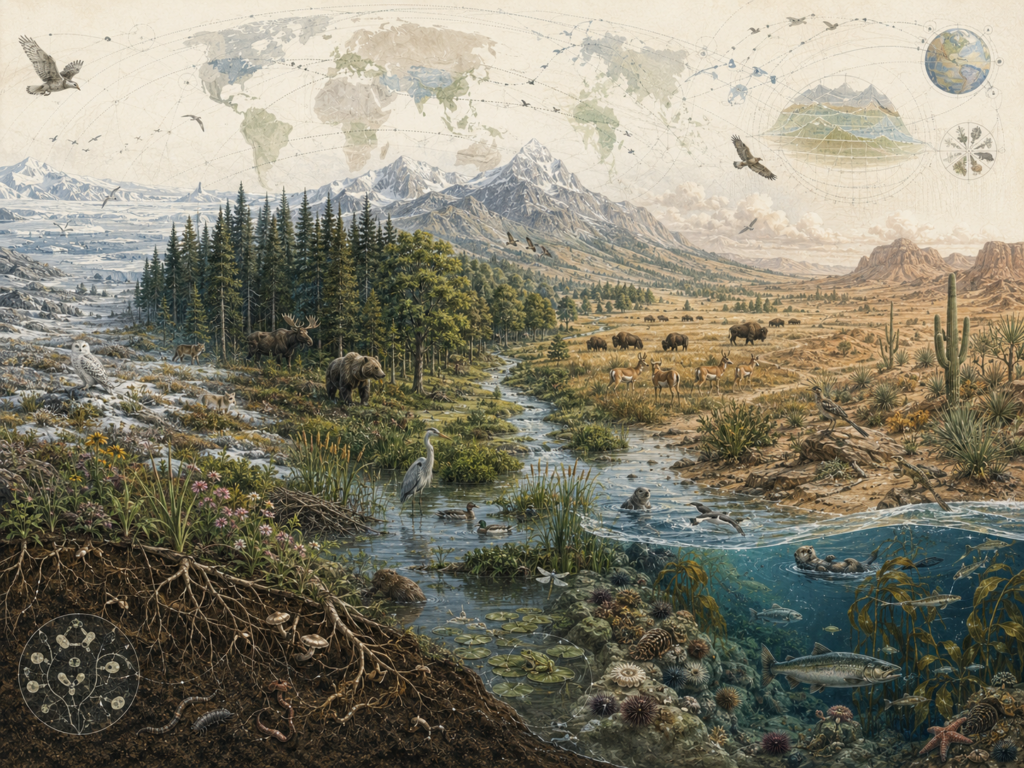
Research-grade ecological atlas illustration showing tundra, boreal forest, temperate forest, grassland, desert, wetland, river, mountain, and coastal marine habitats connected across a continuous landscape with wildlife, plants, soil roots, fungi, and subtle biogeographic map overlays.

Biomes, Habitats, and the Geography of Life

Biomes, habitats, and the geography of life examine how climate, water, seasonality, soils, disturbance, evolutionary history, and dispersal shape the uneven distribution of living systems across Earth. Life is not spread across the planet in a uniform or accidental way. It is organized into broad ecological formations, regional biotas, local habitats, and fine-grained environmental mosaics that reflect both present-day conditions and deep historical processes. This article explores biomes as large-scale ecological formations, habitats and microhabitats, terrestrial and aquatic realms, mountains and islands, endemism and biogeographic regions, human-driven remapping of ecological space, and the growing role of quantitative biogeography, environmental data, R, and Python in understanding the spatial structure of life.
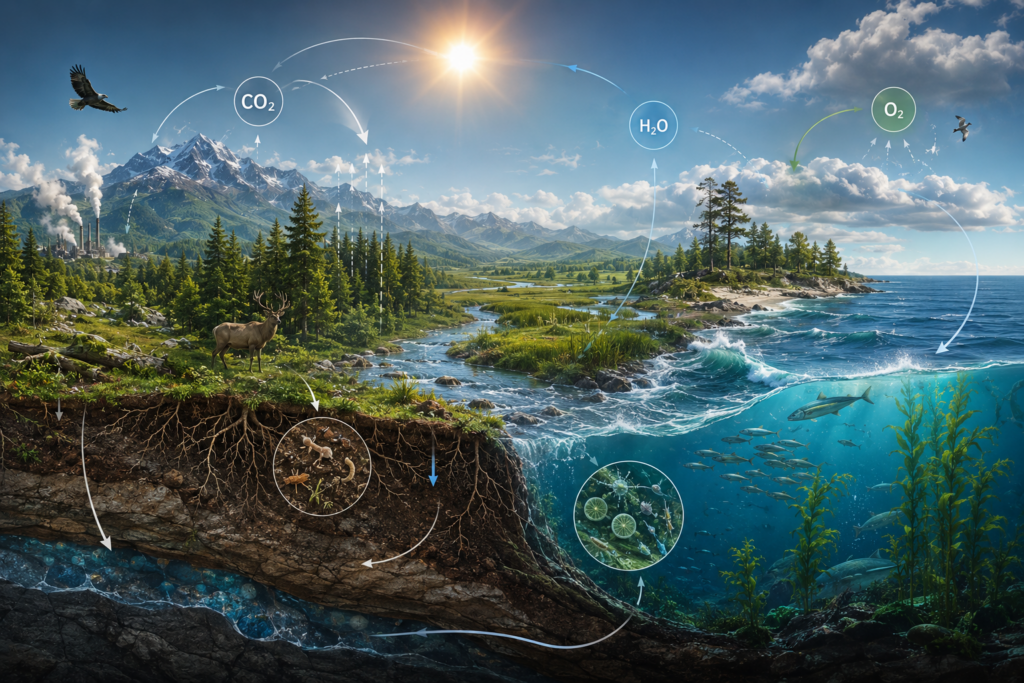
Research-grade Earth systems illustration showing mountains, forests, wetlands, ocean, atmosphere, soil, roots, groundwater, marine life, and minimal cycle markers for carbon, water, and oxygen flows.

Biogeochemical Cycles and the Conditions of Habitability

Biogeochemical cycles and the conditions of habitability examine how water, carbon, nitrogen, phosphorus, sulfur, oxygen, rock weathering, ocean chemistry, soils, and living metabolism interact to make Earth persistently livable. Habitability is not a static background condition. It is an achievement of coupled planetary processes that regulate climate, circulate nutrients, support primary production, maintain liquid water, buffer chemical extremes, and connect life to atmosphere, lithosphere, hydrosphere, and biosphere. This article explores the water, carbon, nitrogen, phosphorus, sulfur, and oxygen cycles; weathering, soils, oceans, sediments, and planetary buffering; biology as a geochemical force; biogeochemical disruption through eutrophication, acidification, and overshoot; and the Earth-system conditions that allow living worlds to remain habitable.

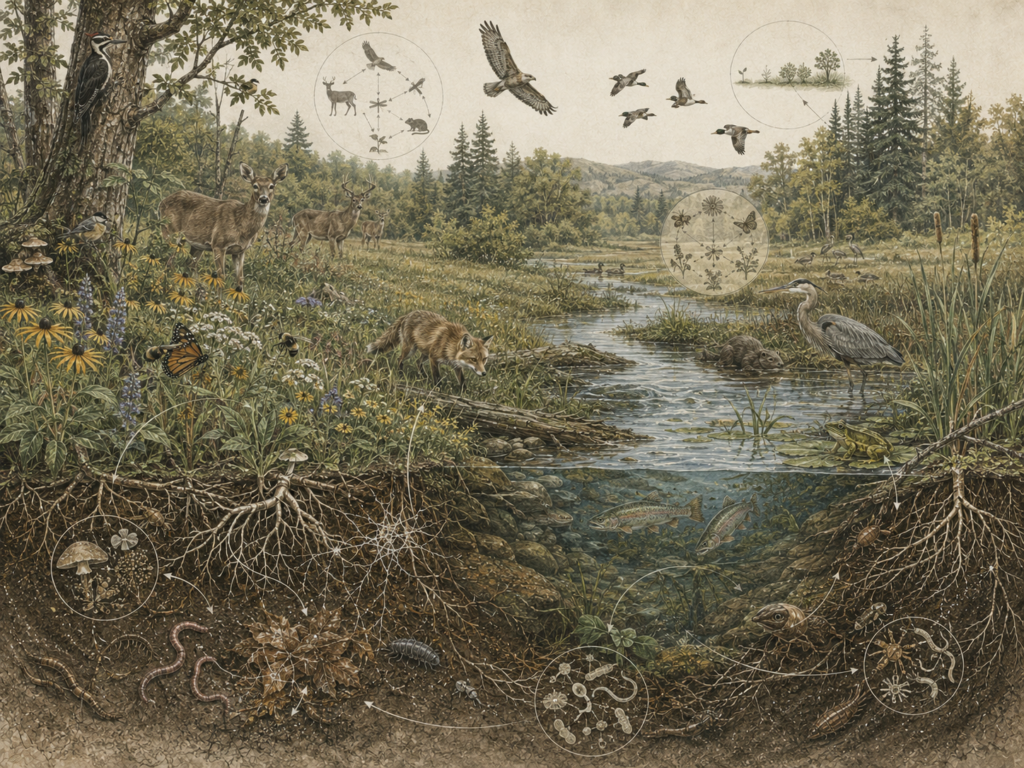
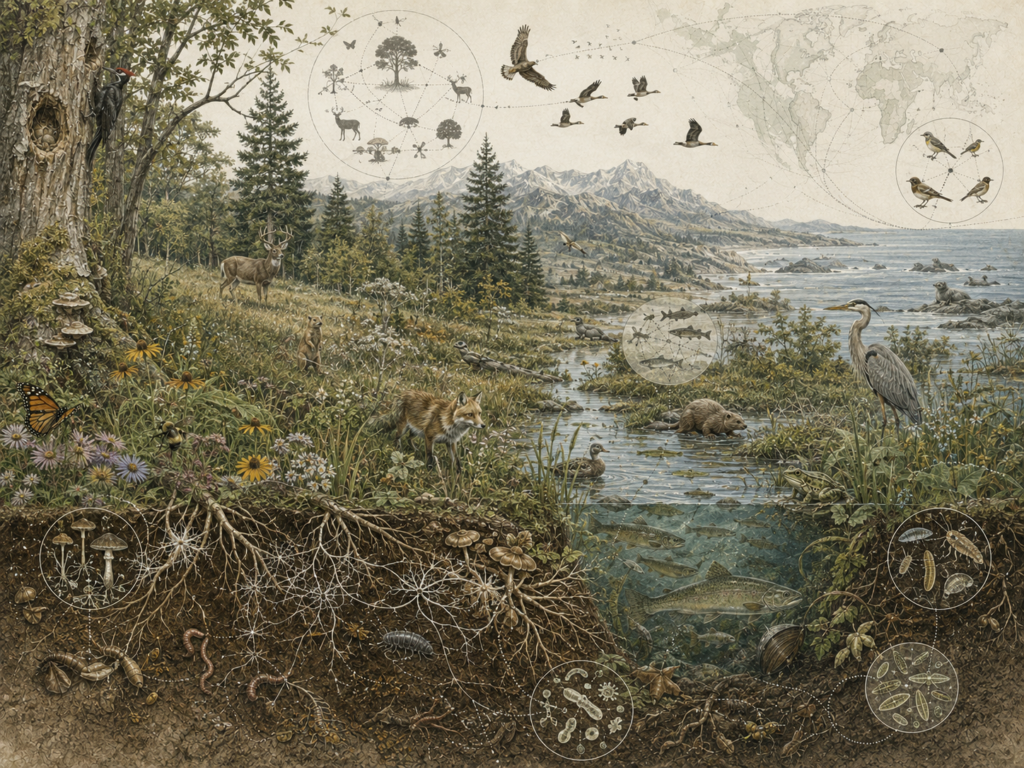
Research-grade ecological systems illustration showing forests, wetlands, rivers, coastal waters, wildlife, plants, roots, fungi, soil organisms, pollinators, fish, birds, and subtle biodiversity network diagrams.

Biodiversity and the Structure of Living Systems

Biodiversity and the structure of living systems examine how life is differentiated and organized across genes, populations, species, functional roles, lineages, communities, ecosystems, and biogeographic regions, and how that diversity helps shape the resilience, productivity, adaptability, and long-term structure of the biosphere. Biodiversity is not simply a count of species. It is the patterned variety of life across scales, including diversity within species, between species, and among ecosystems. This article explores genetic, species, ecosystem, functional, and phylogenetic diversity; richness, evenness, composition, and scale; niche differentiation and coexistence; biodiversity and community assembly; biodiversity and ecosystem functioning; and the consequences of biodiversity loss for the reorganization of living systems.

Research-grade ecological systems illustration showing forest, wetland, stream, soil, roots, fungi, plants, insects, fish, amphibians, birds, deer, foxes, and subtle ecological network diagrams representing population and community interactions.

Populations, Communities, and Ecosystem Dynamics

Population dynamics and ecological modeling examine how living systems are organized across ecological scales, how organisms become populations, how populations become interacting communities, and how communities participate in the flow of energy, cycling of matter, disturbance response, succession, resilience, and long-term ecosystem change. Ecology becomes most powerful when it can move across these levels without collapsing them into one another. Populations concern the dynamics of a single species through time and space. Communities concern the coexistence, interaction, and relative abundance of many species.

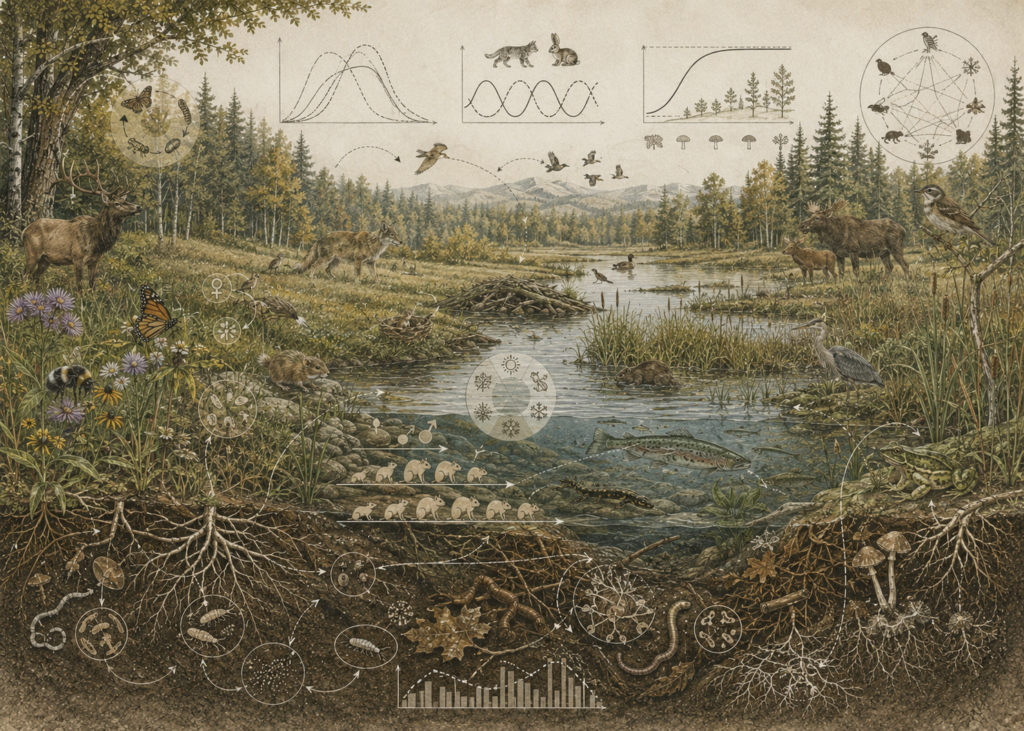
Research-grade ecological systems illustration showing a wetland and forest ecosystem with mammals, birds, amphibians, fish, insects, plants, roots, fungi, soil organisms, and subtle population-modeling diagrams.

Population Dynamics and Ecological Modeling

Population dynamics and ecological modeling examine how populations change through time, how birth, death, immigration, emigration, density dependence, species interactions, and environmental variability shape those changes, and how mathematical and computational models help ecology understand persistence, fluctuation, collapse, recovery, and long-term resilience. This article explores demographic rates, exponential and logistic growth, age and stage structure, predator–prey dynamics, metapopulations, stochasticity, population viability analysis, ecological forecasting, and the applied importance of modeling for conservation, fisheries, restoration ecology, and sustainability-adjacent biology.

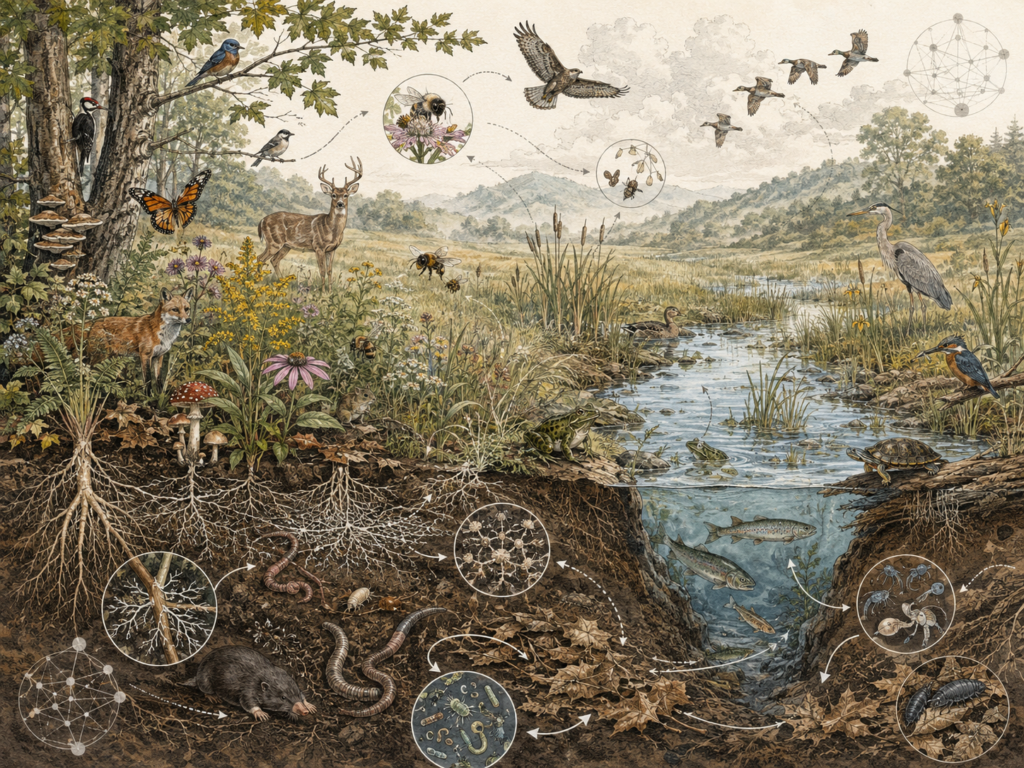
Research-grade ecological systems illustration showing forest, meadow, wetland, stream, soil, roots, fungi, insects, birds, mammals, amphibians, fish, pollinators, decomposers, and subtle ecological network diagrams.

Ecology and the Interdependence of Life

Ecology and the interdependence of life examine how organisms interact with one another and with their physical environments, how those interactions form populations, communities, ecosystems, and landscapes, and how the persistence of life depends on networks of exchange, constraint, adaptation, and material flow. Ecology is central to biology because no organism lives alone. Every form of life exists within relations of energy capture, nutrient cycling, competition, predation, mutualism, decomposition, disturbance, and environmental limitation. Ecology therefore studies not only organisms themselves, but the systems they form together and the conditions under which those systems remain viable or break down.

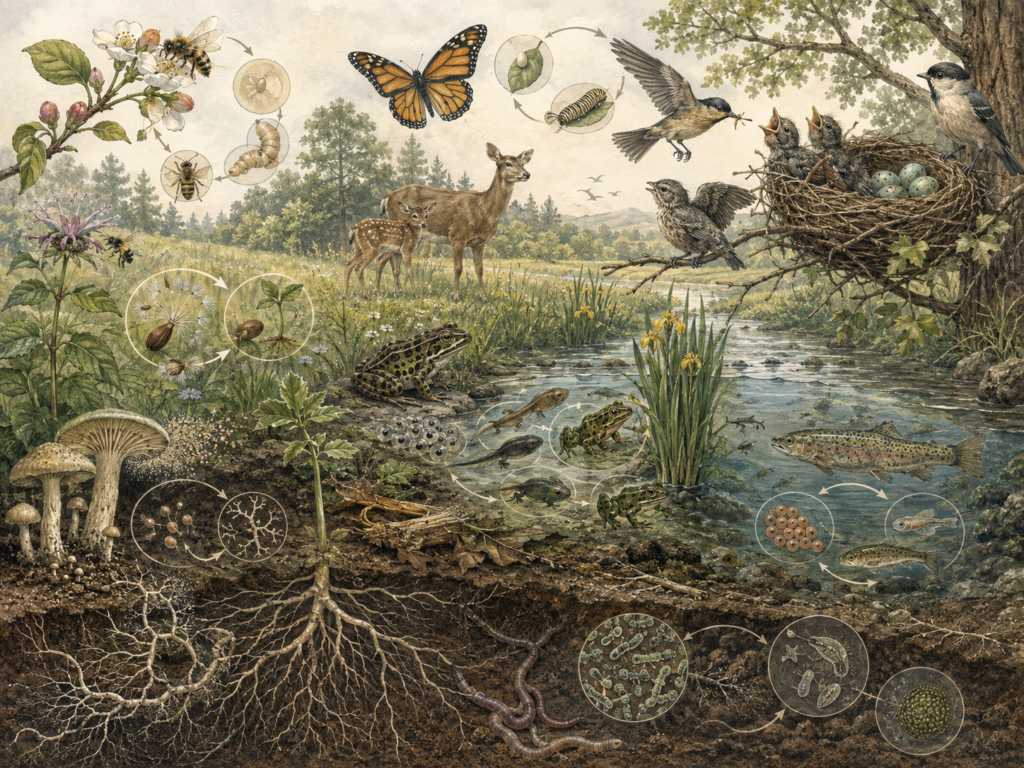
Research-grade ecological systems illustration showing forest, meadow, wetland, stream, soil, roots, fungi, insects, birds, mammals, amphibians, fish, pollinators, decomposers, and subtle ecological network diagrams.

Reproduction, Life Cycles, and Biological Continuity

Reproduction, life cycles, and biological continuity examine how living systems generate new individuals, transmit biological information across generations, alternate between developmental stages, and preserve life through changing forms of inheritance, growth, and renewal. Reproduction is central to biology because life persists not only through metabolism, development, defense, and behavior, but through the capacity to continue beyond the lifespan of any one organism. Life cycles matter because continuity is not achieved by reproduction alone, but by the patterned sequence through which organisms pass across growth, maturation, gamete formation, fertilization, dormancy, metamorphosis, senescence, and renewal.

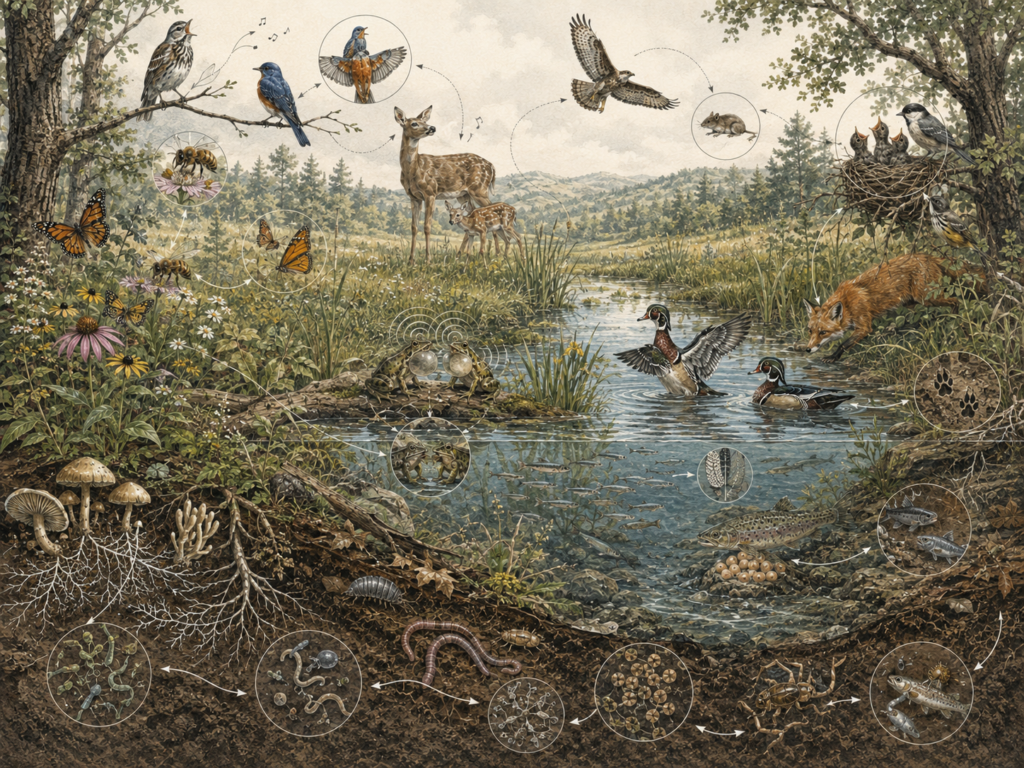
Research-grade natural-history illustration showing animals and plants communicating and behaving strategically across a wetland and meadow ecosystem, including birdsong, pollination, courtship, predator-prey behavior, parental care, amphibian calls, fish schooling, fungi, roots, microbes, and soil organisms.

Behavior, Communication, and Biological Strategy

Behavior, communication, and biological strategy examine how organisms act in the world, exchange information, adjust to opportunity and danger, coordinate with others, and deploy evolved patterns of response that shape survival, reproduction, and ecological success. Behavior is central to biology because organisms do not merely exist as structures or internal physiological systems. They move, choose, signal, court, hide, cooperate, compete, forage, flee, parent, defend, and adapt their actions to changing conditions. Communication matters because many of these actions depend on transmitting information across bodies, whether through sound, posture, color, movement, touch, chemicals, or multimodal signaling. Strategy matters because behavior is not random motion, but organized response shaped by evolution, development, physiology, perception, learning, and ecological context.

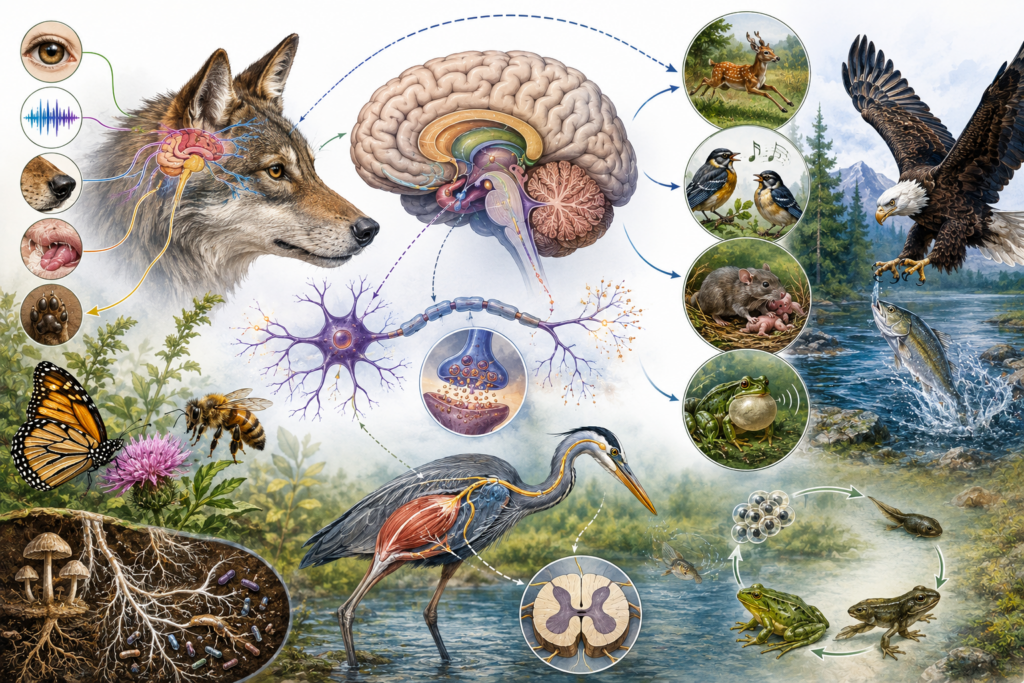
Research-grade neurobiology illustration showing sensory inputs, neural pathways, brain organization, neurons, synaptic signaling, animal behavior, movement, communication, predation, reproduction, and ecological response with minimal text.

Neurobiology and the Organization of Living Response

Neurobiology and the organization of living response examine how nervous systems detect signals, integrate information, coordinate action, generate perception and behavior, and organize the rapid, adaptive responses through which organisms engage changing environments. Neurobiology is central to biology because living systems do not merely persist through metabolism, development, and homeostasis. They must also sense, select, communicate, remember, and respond. Nervous systems make this possible by linking receptors, neurons, circuits, effectors, and whole-body states into organized patterns of action across time. This article explores neurobiology through the lenses of neurons, synapses, circuits, sensory systems, motor coordination, development, plasticity, behavior, and ecological adaptation.

Scroll to Top