
Last Updated May 28, 2026
Reproduction, life cycles, and biological continuity examine how living systems generate new cells, new individuals, and new generations; how biological information is transmitted through cell division, meiosis, fertilization, development, and inheritance; and how life persists through patterned cycles of growth, maturation, reproduction, dormancy, senescence, and renewal. Reproduction is central to biology because life does not persist only by maintaining individual organisms. It persists by passing biological organization forward beyond the lifespan of any single body. Life cycles matter because continuity is not achieved through reproduction alone, but through the ordered sequence by which organisms move across developmental stages, ecological roles, reproductive states, and generational transitions.
Biological continuity is therefore not a single event. It is a coordinated process linking cell-cycle control, DNA replication, chromosome segregation, gamete formation, recombination, fertilization, development, life-history timing, environmental constraint, and population persistence. A lineage continues only when biological information is copied with sufficient fidelity, variation is generated or maintained, developmental sequences remain viable, reproductive stages are reached, and enough offspring survive to reproduce in turn.
Main Library
Publications
Article Map
Biology
Related Topic
Genetics
Related Topic
Evolution
Related Topic
Developmental Biology
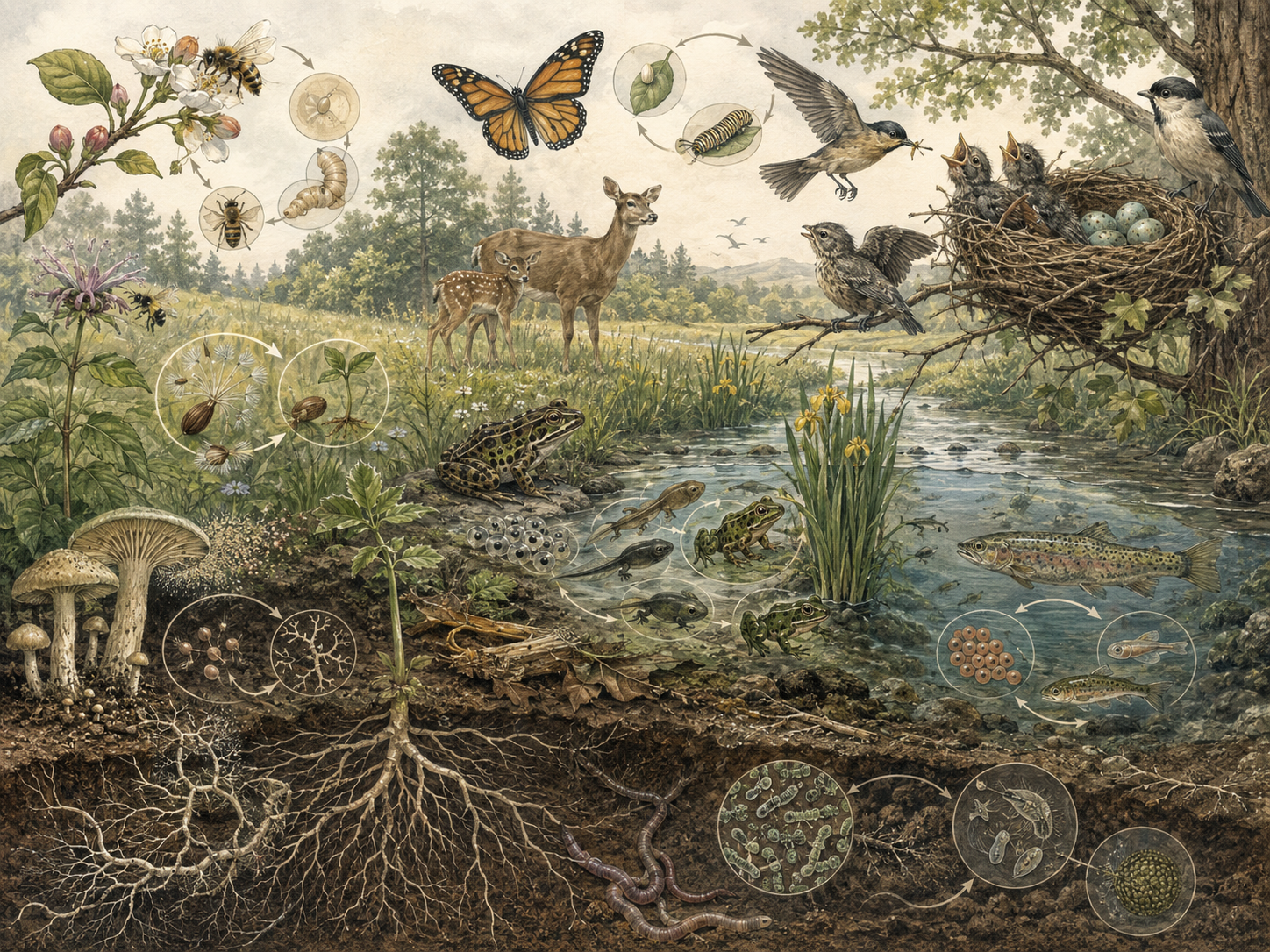
This article develops reproduction, life cycles, and biological continuity as a scale-spanning framework for understanding living persistence. It examines cell division, mitosis, meiosis, asexual reproduction, sexual reproduction, fertilization, gametes, zygotes, embryonic development, life-cycle diversity, alternation of generations, metamorphosis, dormancy, senescence, life-history strategy, trade-offs, reproductive ecology, disease vulnerability, conservation biology, restoration ecology, plant reproduction, animal reproduction, microbial continuity, marine and freshwater life cycles, and computational reproductive biology.
The article is written for developmental biologists, evolutionary biologists, ecologists, marine biologists, freshwater scientists, medical and environmental-health readers, computational biology readers, biodiversity experts, conservation planners, restoration practitioners, plant scientists, animal biologists, microbiologists, and research biologists who need a rigorous account of how reproduction and life-cycle structure connect molecular continuity to organismal, population, and evolutionary persistence.
The article also extends reproductive biology into quantitative and computational biology through generational replacement models, stage-structured matrix projection, dominant eigenvalue growth estimation, stable stage distribution, perturbation and sensitivity screening, life-history trade-off scoring, environmental-stress scenarios, R workflows, Python workflows, SQL provenance structures, and a linked full-stack GitHub repository containing Python, R, Julia, Fortran, Rust, Go, C, C++, SQL, notebooks, data files, and reproducibility documentation.
What reproduction studies
Reproduction studies how living systems produce new cells, new organisms, and new generations. At one level, reproduction concerns the cellular logic by which genetic material is copied, organized, segregated, and transmitted. At another, it concerns the organismal and ecological conditions under which lineages continue through time. Reproduction therefore cannot be confined to fertilization alone, nor to offspring production in the narrow sense. It includes the entire set of processes through which living form persists beyond the lifespan of any one body.
This matters because biological continuity is never automatic. Organisms die, tissues age, environments change, developmental programs can fail, gametes can be damaged, and populations can decline. Yet lineages persist because reproduction links biological information to developmental renewal. Reproduction is therefore not merely a discrete event. It is one of the deepest ways life resists disappearance through time.
For research biologists, reproduction is especially important because it sits at the intersection of cell biology, genetics, developmental biology, ecology, and evolution. DNA replication and chromosome segregation make continuity possible at the cellular scale. Meiosis and recombination reshape inherited variation. Fertilization opens new developmental trajectories. Life cycles organize biological time. Reproductive success affects population dynamics. Selection acts on inherited variation across generations.
Reproduction is therefore not a narrow subfield. It is one of biology’s central connective frameworks: the place where the continuity of cells, organisms, populations, and lineages becomes one problem.
Biological continuity and the problem of generational persistence
Biological continuity refers to the persistence of life across generations despite the mortality of individuals. A life cycle is not just a path from birth to death. It is the recurring sequence through which members of a lineage pass from one developmental starting point back to a comparable starting point in the next generation. That cyclical framing matters because continuity is not simply extension in time. It is patterned recurrence through transformation.
Organisms do not merely reproduce copies of themselves. They pass through sequences of cell division, growth, differentiation, maturation, reproduction, decline, and death that make generational persistence possible. Continuity therefore depends on both inheritance and timing. Life is handed on not just through genes, but through organized cycles of biological change.
The problem is especially clear when one considers that reproduction must solve several tasks at once. Biological information must be copied. Chromosome number must be managed. Genetic variation must be preserved or generated. Developmental competence must be restored. Offspring must survive vulnerable stages. Reproductive adults must be reached. Populations must maintain enough recruitment to persist. Continuity is therefore a chain of linked conditions, not a single successful event.
For ecology and evolutionary biology alike, the central question is not only how organisms reproduce, but how reproductive timing, developmental sequence, survival across stages, environmental conditions, and population structure produce long-run lineage continuity.
Cell division and the foundation of reproductive continuity
At the most basic level, reproduction depends on cell division. The core function of the cell cycle is to duplicate DNA accurately and segregate the copies precisely into daughter cells. This makes cell division the foundation not only of growth and repair, but of reproductive continuity itself. In unicellular organisms, cell division can produce a new organism directly. In multicellular organisms, regulated sequences of cell division generate tissues, organs, germ lines, and bodies capable of later reproduction.
This matters because reproduction begins before organism-level sex, mating, or offspring care. Biological continuity is rooted in cellular continuity. Every complex life cycle depends on the reliable copying of biological information and the regulated distribution of that information into new cells. Mitosis, meiosis, DNA replication, checkpoints, repair, and cell-cycle control are therefore not background mechanisms. They are part of the infrastructure of continuity.
The deeper implication is that continuity depends on high-fidelity copying under conditions that are never perfect. Mutation, replication error, checkpoint failure, chromosomal nondisjunction, genomic instability, and dysregulated proliferation are not marginal exceptions. They are part of the biological reality through which continuity is secured, altered, or broken. In development and medicine, this is why cell-cycle control, programmed cell death, fertility, cancer biology, aging, and reproductive health are connected.
For research biologists, cell division makes clear that reproduction is not only about organisms generating offspring. It is also about cells maintaining the ordered transfer of biological information through time.
Asexual reproduction and the logic of direct continuity
Asexual reproduction generates new individuals without the fusion of gametes. In such systems, continuity is achieved through direct lineage extension rather than through the recombination of two parents. Binary fission, budding, vegetative propagation, clonal fragmentation, spore production, parthenogenesis in some taxa, and related mechanisms all express this logic of direct continuity.
Asexual continuity can be fast, efficient, and well suited to stable environments, rapid colonization, or circumstances in which mate availability is limited. It preserves lineages without requiring mate-finding, specialized sex cells, or coordinated fertilization. Many microbes, plants, fungi, protists, and some animals use asexual strategies either exclusively or in alternation with sexual phases. Asexuality therefore demonstrates that biological continuity does not require one universal reproductive architecture.
At the same time, asexual reproduction often produces less variation through recombination than sexual reproduction does. This does not mean asexual lineages are genetically static. Mutation, horizontal gene transfer in microbes, somatic variation, epigenetic effects, developmental plasticity, and environmental selection still matter. But the structure of inherited variation differs. Asexual reproduction preserves continuity more directly, while sexual reproduction continually reshuffles inherited material.
For microbiologists, plant biologists, fungal biologists, evolutionary biologists, and ecologists, asexual reproduction remains crucial because it shows that continuity has multiple strategies. Life persists not by following one reproductive script, but by evolving mechanisms that work under particular cellular, ecological, and evolutionary constraints.
Sexual reproduction, meiosis, and the generation of variation
Sexual reproduction depends on the alternation of meiosis and fertilization. Meiosis reduces chromosome number, produces haploid gametes or spores, and generates variation through recombination and independent assortment. Fertilization then restores diploidy by joining gametes. Sexual reproduction therefore combines continuity with variation by linking inheritance to genetic reshuffling.
This matters because biological continuity is not only about preserving the past. It is also about generating new combinations that can matter evolutionarily. Recombination, segregation, and the union of distinct gametes create new genetic configurations on which selection, drift, development, and environmental pressures can later act. Sexual reproduction is widespread despite its costs because it changes how variation is produced, organized, and inherited.
The evolutionary significance of sex has been one of biology’s major theoretical questions. Sexual reproduction requires time, energy, mate-finding, and often elaborate behaviors or structures. Yet it can help lineages respond to changing environments, combine advantageous variants, separate harmful mutations from beneficial backgrounds, and generate diversity among offspring. These advantages are context-dependent, but they help explain why sex remains central across so much of eukaryotic life.
For research biologists, sexual reproduction is therefore not simply a mechanism of persistence. It is one of the main ways continuity remains evolutionarily open rather than genetically sealed.
Fertilization, gametes, and the restoration of developmental wholeness
Fertilization joins haploid gametes and restores the diploid condition in many sexual life cycles. But fertilization is not simply a genetic event. It is the beginning of a new developmental trajectory. Once gametes unite, the resulting zygote becomes the starting point for cleavage, differentiation, growth, and the production of a new organismal whole.
This matters because reproduction and development are inseparable. Fertilization restores not only chromosome complement but developmental possibility. The resulting organism is not assembled instantaneously. It emerges through regulated developmental sequence, cell fate commitment, tissue formation, morphogenesis, physiological integration, and organismal maturation.
Gametes also carry more than DNA in a narrow sequence sense. Eggs, for example, can carry cytoplasmic materials, maternal transcripts, organelles, positional information, and molecular conditions needed for early development. Sperm and pollen deliver genetic material within specialized reproductive systems. Fertilization therefore marks a transition from reproductive preparation to developmental execution.
For developmental biology, this is one of the central reasons reproduction cannot be treated as a completed event at conception or gamete fusion. Fertilization is the opening of a developmental process, not its conclusion.
Life cycles as patterned biological time
Life cycles organize biological time into recurring stages. They provide one of biology’s most important temporal frameworks because continuity is not realized in a single instant of reproduction. It is realized through patterned passage: gamete or spore to zygote, embryo to juvenile, juvenile to adult, adult to reproductive state, and reproductive state to senescence, death, or renewal. In many species, dormancy, metamorphosis, alternation of generations, diapause, seed banks, larval dispersal, or clonal phases complicate the pattern still further.
This matters because continuity is stage-dependent. Different forms of mortality, growth, vulnerability, dispersal, and ecological function are often distributed unevenly across the life cycle. One stage may disperse. Another may feed intensively. Another may reproduce. Another may survive seasonal extremes. Another may dominate biomass accumulation. Biological time is therefore structured, not homogeneous.
Life cycles also distribute risk. Many organisms produce numerous offspring because early-stage mortality is high. Others produce few offspring and invest heavily in parental care. Some delay reproduction to grow larger or survive longer. Others reproduce quickly and die. These differences are not random details. They are life-history structures through which continuity is pursued under ecological constraint.
For ecologists and life-history theorists, the life cycle is indispensable because it turns continuity into a temporal system that can be studied, modeled, and compared across taxa.
Plants, animals, protists, fungi, and the diversity of life-cycle organization
Life-cycle organization differs sharply across major branches of life. Animals typically have a dominant multicellular diploid stage, with gametes produced through meiosis. Land plants alternate between multicellular haploid gametophyte and multicellular diploid sporophyte stages, though the relative dominance of those stages differs across plant lineages. Many algae, protists, and fungi display very different timings of meiosis, fertilization, spore formation, and multicellular development. The diversity of life cycles is one of the clearest examples of how biological continuity is conserved while developmental architecture varies.
This matters because reproduction is not one universal script. Biological continuity can be organized through direct development, alternation of generations, haploid-dominant cycles, diploid-dominant cycles, sporic meiosis, gametic meiosis, zygotic meiosis, clonal expansion, budding, spores, seeds, larvae, eggs, live birth, resting stages, and complex reproductive timing. The means of continuity differ, but the problem being solved remains the same: how life can persist by generating new viable stages under real ecological and developmental constraints.
Plants are especially important because their life cycles make visible the relation among reproduction, dispersal, dormancy, and environmental dependence. Seeds, spores, pollen, flowers, fruits, gametophytes, and sporophytes distribute reproductive function across structures and generations. Animals often reveal continuity through gametes, embryos, larvae, metamorphosis, parental care, and reproductive behavior. Fungi and microbes broaden the picture still further by showing how spores, budding, fission, conjugation, hyphal growth, and environmental triggers can sustain lineages in changing conditions.
For research biologists, comparative life-cycle thinking is valuable because it reveals how deeply continuity can vary without ceasing to be continuity at all.
Metamorphosis, dormancy, and developmental transition
Many organisms achieve continuity through radical developmental transition. Larval, pupal, juvenile, dormant, cyst, seed, spore, and adult stages may differ sharply in form, physiology, ecology, and function. Such stages show that continuity can be preserved through discontinuity of appearance. The lineage continues even when morphology, habitat, diet, vulnerability, and reproductive priority shift dramatically.
Metamorphosis is especially revealing because it separates life-cycle functions across distinct forms. A larval stage may specialize in feeding and growth, while the adult specializes in dispersal and reproduction. Aquatic larvae may become terrestrial adults. Sessile stages may produce mobile dispersal stages. Such transitions allow organisms to occupy different niches across the life cycle, reducing direct competition between stages or increasing ecological flexibility.
Dormancy also matters because continuity often requires waiting. Seeds, spores, cysts, diapause stages, resting eggs, and dormant propagules allow organisms to survive unfavorable conditions and resume development when conditions improve. Dormancy is therefore not inactivity in a simple sense. It is an evolved strategy for preserving continuity under temporal uncertainty.
This is one reason reproduction must be understood together with development and ecology. Stage transitions are often the places where vulnerability, dispersal, environmental filtering, and ecological opportunity are most concentrated.
Life-history strategy, timing, and trade-offs
Reproduction is inseparable from life-history strategy. Life history concerns the timing and pattern of development, growth, maturation, reproduction, survival, and lifespan. All living systems require energy to maintain order, grow, repair, defend, move, store, and reproduce, which means reproductive investment must always be balanced against other demands.
This matters because continuity is costly. Organisms allocate energy to mating effort, gamete production, parental care, growth, storage, immune defense, dispersal, repair, and survival under finite constraints. Life-cycle timing therefore reflects trade-offs rather than limitless optimization. Reproduction is never free from ecological and physiological cost.
Life-history theory helps explain why some organisms reproduce early and produce many offspring, while others delay reproduction and invest heavily in fewer offspring. It helps explain semelparity and iteroparity, short and long generation times, high and low fecundity, parental care, dormancy, reproductive delay, and survival-reproduction trade-offs. These strategies are shaped by mortality patterns, environmental predictability, resource availability, body size, predation, competition, and developmental constraints.
For research biologists, life-history theory remains important because it turns reproduction from a descriptive fact into a problem of allocation, constraint, and evolutionary strategy.
Reproduction, ecology, and the persistence of populations
Reproduction is also an ecological process because populations persist only if enough individuals survive to reproduce under real environmental conditions. Timing of breeding, dispersal, fecundity, pollination, nesting, larval settlement, recruitment, juvenile survival, seedling establishment, and adult survival all link life cycles to ecosystems. Biological continuity is therefore population continuity as well as organismal continuity.
This matters because reproduction can fail ecologically even when mechanisms of gamete production or cell division remain intact. Habitat loss, pollinator decline, altered seasonality, disrupted larval habitat, predation, disease, endocrine disruption, thermal stress, salinity change, oxygen decline, food limitation, and resource collapse can all break continuity by interrupting life cycles. Reproduction therefore belongs directly to ecology, conservation, and long-horizon biological stewardship.
This is especially important in conservation biology. A species may remain present but fail to recruit. A forest may contain adult trees but no seedlings. A fish stock may contain adults while larval survival collapses. A pollinator-dependent plant may flower but fail to set seed. A restoration site may look structurally repaired but fail to support complete life cycles. In each case, continuity fails beneath visible presence.
For marine, freshwater, terrestrial, and soil systems alike, life cycles are often where environmental disruption becomes visible first.
Marine, freshwater, soil, and terrestrial continuity
Life cycles unfold differently across marine, freshwater, soil, and terrestrial systems. Aquatic organisms may rely on broadcast spawning, larval dispersal, hydrologically structured development, temperature cues, salinity gradients, oxygen conditions, or substrate availability. Soil organisms may coordinate reproduction with moisture pulses, detrital availability, microbial context, root systems, and seasonal change. Terrestrial plants and animals often face seasonal timing constraints, pollination dependence, migration-linked breeding, overwintering stages, drought tolerance, or habitat fragmentation.
This matters because continuity is always situated in environment. The biological means of persistence depend on climate, medium, dispersal, substrate, habitat stability, resource timing, and environmental predictability. Reproduction is therefore not only a physiological or genetic event, but a habitat-dependent strategy of persistence.
Marine life cycles often reveal how continuity depends on connectivity across vast distances. Larvae may disperse through currents before settling into adult habitat. Freshwater organisms may require connected river networks, floodplain access, or specific flow regimes. Terrestrial organisms may depend on corridors, nesting sites, pollinators, host plants, or seasonal resource pulses. Soil organisms may depend on moisture, organic matter, and microbial community structure.
For research biologists, this is a reminder that no theory of continuity is complete unless it remains ecologically grounded.
Reproduction, disease, and the vulnerability of continuity
Biological continuity can be undermined by disease, genetic disruption, developmental failure, endocrine disruption, toxic exposure, habitat loss, and cellular dysregulation. The cell cycle is genetically regulated, and breakdowns in regulation can lead to uncontrolled proliferation or failed orderly continuity. Reproductive tissues and developmental stages are also vulnerable to infection, toxicity, thermal stress, nutritional deficiency, pollutants, and environmental mismatch.
This matters because continuity is fragile. A lineage persists only if cell cycles remain coordinated, meiosis occurs accurately, fertilization succeeds where required, embryos or propagules develop, and enough offspring survive to reproduce in turn. Reproduction is therefore one of biology’s great points of vulnerability as well as its great mechanism of persistence.
For medical and environmental-health readers, reproduction is an especially important bridge between organismal biology and environmental exposure. Reproductive health, developmental toxicity, fertility, fetal development, endocrine disruption, pathogen exposure, and population-level recruitment are connected through continuity. Effects that appear molecular or physiological can become demographic and ecological when they alter reproductive success across populations.
For conservation and restoration science, reproductive vulnerability is equally important. Protecting adults is not enough if eggs, larvae, seeds, juveniles, or reproductive habitats fail. Biological continuity requires that the full life cycle remain viable.
Genetics, development, and computational relevance
Modern reproductive biology is deeply connected to genetics, developmental biology, and computational analysis. Meiosis, recombination, DNA replication, chromosome segregation, fertilization, cell-cycle control, developmental staging, and inheritance patterns are all now studied through molecular, genomic, imaging, statistical, and computational tools.
This matters because continuity must now be understood across scales: DNA replication, chromosome dynamics, gamete production, fertilization, embryonic onset, cell lineage, tissue formation, life-stage transition, population persistence, and evolutionary change. Reproduction is therefore one of the clearest places where molecular biology, organismal biology, and ecology converge.
Computational biology expands this convergence. Stage-structured matrix models can represent life-cycle transitions. Population models can estimate whether reproductive rates sustain persistence. Genomic tools can track inheritance, recombination, and lineage relationships. Developmental datasets can describe timing and transition. Conservation models can identify which life stages most influence long-term growth. Reproductive ecology increasingly depends on the ability to connect data across levels.
For computational readers and research biologists, reproductive biology now involves structured demographic models, developmental timing data, lineage tracing, genomic analysis, and scenario-based reasoning about continuity and failure.
Quantitative reproduction: mathematics, R, and Python
Reproduction and continuity can be approached quantitatively through growth, replacement, stage structure, and life-history logic. A simple generational continuity model begins with the net reproductive multiplier:
N_{t+1}=R_0N_t
\]
Interpretation: \(N_t\) is the number of reproducing individuals or lineages at time \(t\), and \(R_0\) is the average replacement factor per generation. This is useful because continuity depends on whether reproduction is sufficient to replace or expand the lineage across time.
Research biology usually needs more structure than a single replacement factor. A life-cycle projection can often be written in matrix form:
\mathbf{n}_{t+1}=\mathbf{A}\mathbf{n}_t
\]
Interpretation: \(\mathbf{n}_t\) is a vector of stage abundances at time \(t\), and \(\mathbf{A}\) is a projection matrix containing fecundity, survival, and stage-transition probabilities. This is especially useful because reproduction is rarely equally distributed across stages. Juveniles, larvae, dormant propagules, subadults, and reproductive adults often contribute very differently to long-run continuity.
A compact life-history allocation expression may also be written as:
E=G+M+R+S
\]
Interpretation: Total energetic budget \(E\) is partitioned among growth \(G\), maintenance \(M\), reproduction \(R\), and storage or survival-related investment \(S\). This is not a full mechanistic model, but it captures one of life-history biology’s central ideas: reproduction is constrained by allocation trade-offs rather than pursued in isolation.
Worked example: generational persistence
Suppose a population has \(N_t=100\) effective reproducers and replacement factor \(R_0=1.2\). Then:
N_{t+1}=1.2\times100=120
\]
Interpretation: Under the simplified model, continuity expands because the replacement factor is greater than one.
If instead \(R_0=0.8\), then:
N_{t+1}=0.8\times100=80
\]
Interpretation: Under the simplified model, continuity shrinks because the replacement factor is below one.
The biological question then becomes what combination of fecundity, survival, maturation, environmental constraint, and life-cycle structure produced those different outcomes.
R and Python workflows
The following examples are compact article-level workflows. The full GitHub repository expands them into richer multi-language implementations with SQL provenance, validation notes, stage-structured life-cycle projection, generational replacement modeling, dominant eigenvalue growth estimation, stable stage distribution, life-history trade-off screening, environmental-stress scenarios, and reproducible computational reproductive-biology scaffolding.
R example: stage-structured reproductive projection with perturbation
# Stage-structured reproductive projection in R
#
# This example:
# - models juveniles, subadults, and reproductive adults
# - projects stage abundances through time
# - estimates asymptotic growth from the dominant eigenvalue
# - calculates stable stage distribution
# - perturbs adult survival to show sensitivity
#
# It is a compact life-cycle modeling scaffold, not a calibrated species model.

projection_matrix <- matrix(c(
  0.0, 0.0, 1.8,   # fecundity from adults to juveniles
  0.45, 0.0, 0.0,  # juvenile survival to subadult
  0.0, 0.70, 0.82  # subadult transition to adult + adult survival
), nrow = 3, byrow = TRUE)

colnames(projection_matrix) <- c("juvenile", "subadult", "adult")
rownames(projection_matrix) <- c("juvenile", "subadult", "adult")

initial_stage_vector <- c(
  juvenile = 50,
  subadult = 20,
  adult = 15
)

time_steps <- 20

trajectory <- matrix(
  NA_real_,
  nrow = time_steps + 1,
  ncol = length(initial_stage_vector)
)

trajectory[1, ] <- initial_stage_vector

for (time_step in seq_len(time_steps)) {
  trajectory[time_step + 1, ] <- projection_matrix %*% trajectory[time_step, ]
}

trajectory_df <- data.frame(
  time = 0:time_steps,
  juvenile = trajectory[, 1],
  subadult = trajectory[, 2],
  adult = trajectory[, 3]
)

trajectory_df$total <- rowSums(trajectory_df[, c("juvenile", "subadult", "adult")])

print(round(trajectory_df, 2))

# Eigen analysis.
eigen_result <- eigen(projection_matrix)
dominant_index <- which.max(Re(eigen_result$values))
lambda <- Re(eigen_result$values[dominant_index])

stable_stage <- Re(eigen_result$vectors[, dominant_index])
stable_stage <- stable_stage / sum(stable_stage)

cat("Dominant lambda:", round(lambda, 4), "\n")
cat("Stable stage distribution:\n")
print(round(stable_stage, 4))

# Perturb adult survival by -10 percent.
projection_matrix_perturbed <- projection_matrix
projection_matrix_perturbed["adult", "adult"] <-
  projection_matrix_perturbed["adult", "adult"] * 0.90

eigen_perturbed <- eigen(projection_matrix_perturbed)
lambda_perturbed <- max(Re(eigen_perturbed$values))

cat("Lambda after adult survival reduction:", round(lambda_perturbed, 4), "\n")
cat("Change in lambda:", round(lambda_perturbed - lambda, 4), "\n")

matplot(
  trajectory_df$time,
  trajectory_df[, c("juvenile", "subadult", "adult", "total")],
  type = "l",
  lty = 1,
  lwd = 2,
  xlab = "Time step",
  ylab = "Abundance",
  main = "Stage-Structured Biological Continuity"
)

legend(
  "topleft",
  legend = c("Juvenile", "Subadult", "Adult", "Total"),
  lty = 1,
  lwd = 2,
  bty = "n"
)
This R workflow is more useful than a simple replacement projection because it treats continuity as stage-structured, estimates asymptotic growth, inspects stable stage distribution, and shows how a change in one life-history parameter can alter long-run persistence. A research biologist could adapt it for plants, amphibians, insects, fisheries, conservation breeding programs, seed-bank dynamics, or restoration monitoring.
Python example: comparative reproductive scenarios and life-history trade-off screening
import numpy as np
import pandas as pd

# Example species, populations, or restoration units with contrasting
# life-history traits. Values are synthetic and normalized or scaled
# for demonstration.
life_history_units = pd.DataFrame({
    "unit": ["A", "B", "C", "D", "E"],
    "fecundity": [2.4, 1.9, 3.1, 1.3, 2.2],
    "juvenile_survival": [0.35, 0.55, 0.22, 0.68, 0.40],
    "adult_survival": [0.82, 0.88, 0.60, 0.92, 0.76],
    "maturation_rate": [0.50, 0.40, 0.65, 0.30, 0.48],
    "dormancy_or_buffering": [0.40, 0.52, 0.30, 0.60, 0.45],
    "environmental_stress": [0.25, 0.20, 0.50, 0.18, 0.32]
})

# Composite continuity score:
# higher fecundity, survival, maturation, and buffering support continuity;
# higher environmental stress lowers expected continuity.
life_history_units["continuity_score"] = (
    0.20 * life_history_units["fecundity"] /
    life_history_units["fecundity"].max() +
    0.20 * life_history_units["juvenile_survival"] +
    0.25 * life_history_units["adult_survival"] +
    0.15 * life_history_units["maturation_rate"] +
    0.10 * life_history_units["dormancy_or_buffering"] -
    0.20 * life_history_units["environmental_stress"]
)

# Scenario test: increased environmental stress and reduced juvenile survival.
life_history_units["continuity_score_stress"] = (
    0.20 * life_history_units["fecundity"] /
    life_history_units["fecundity"].max() +
    0.20 * (life_history_units["juvenile_survival"] * 0.90) +
    0.25 * life_history_units["adult_survival"] +
    0.15 * life_history_units["maturation_rate"] +
    0.10 * life_history_units["dormancy_or_buffering"] -
    0.20 * (life_history_units["environmental_stress"] + 0.10)
)

life_history_units["delta_under_stress"] = (
    life_history_units["continuity_score_stress"] -
    life_history_units["continuity_score"]
)

conditions = [
    life_history_units["continuity_score"] >= 0.60,
    (life_history_units["continuity_score"] >= 0.45) &
    (life_history_units["continuity_score"] < 0.60),
    life_history_units["continuity_score"] < 0.45
]

labels = ["relatively-buffered", "vulnerable", "high-risk"]

life_history_units["continuity_class"] = np.select(
    conditions,
    labels,
    default="unknown"
)

print(life_history_units.round(3))
This Python workflow is more useful because it treats reproductive continuity as a structured life-history problem rather than a single scalar projection. It introduces multiple biological parameters, a stress scenario, and a comparative screening framework that could be adapted for restoration, conservation, reproductive ecology, seed-bank persistence, larval recruitment, or developmental-risk analysis.
Python example: stochastic stage-transition stress test
import numpy as np
import pandas as pd

rng = np.random.default_rng(42)

def simulate_life_cycle(
    years=40,
    simulations=500,
    juvenile0=50,
    subadult0=20,
    adult0=15,
    fecundity=1.8,
    juvenile_to_subadult=0.45,
    subadult_to_adult=0.70,
    adult_survival=0.82,
    stress_probability=0.08,
    stress_multiplier=0.75,
):
    """Simulate a compact stochastic stage-structured life cycle."""
    final_totals = []
    min_totals = []

    for _ in range(simulations):
        stages = np.array([juvenile0, subadult0, adult0], dtype=float)
        totals = [stages.sum()]

        for _year in range(years):
            f = fecundity
            js = juvenile_to_subadult
            sa = subadult_to_adult
            ad = adult_survival

            if rng.random() < stress_probability:
                f *= stress_multiplier
                js *= stress_multiplier
                sa *= stress_multiplier

            projection = np.array([
                [0.0, 0.0, f],
                [js, 0.0, 0.0],
                [0.0, sa, ad],
            ])

            stages = projection @ stages
            totals.append(stages.sum())

        final_totals.append(totals[-1])
        min_totals.append(min(totals))

    return pd.DataFrame({
        "final_total": final_totals,
        "minimum_total": min_totals,
    })

baseline = simulate_life_cycle(stress_probability=0.04)
high_stress = simulate_life_cycle(stress_probability=0.16)

summary = pd.DataFrame({
    "scenario": ["baseline", "high_stress"],
    "mean_final_total": [baseline["final_total"].mean(), high_stress["final_total"].mean()],
    "median_final_total": [baseline["final_total"].median(), high_stress["final_total"].median()],
    "low_continuity_risk_below_50": [
        (baseline["minimum_total"] < 50).mean(),
        (high_stress["minimum_total"] < 50).mean(),
    ],
})

print(summary.round(3).to_string(index=False))
This stochastic stage-transition scaffold turns life-cycle continuity into a scenario problem. It can be extended with species-specific vital rates, larval mortality, seed-bank persistence, dormancy, density dependence, reproductive failure, pathogen exposure, toxicological stress, or habitat-linked recruitment.
These examples remain compact enough for an article, but they point toward the kinds of workflows scientists actually use: structured stage projection, sensitivity analysis, comparative scenario testing, stochastic stress testing, and explicit life-history trade-off reasoning.
GitHub repository
The article body includes compact R and Python examples so the biological and scientific argument remains readable. The full repository expands those examples into a broader computational reproductive-biology workflow, including stage-structured life-cycle projection, generational replacement modeling, dominant eigenvalue growth estimation, stable stage distribution, life-history trade-off screening, environmental-stress scenarios, SQL provenance structures, reproducible data files, and full-stack scientific-computing examples across Python, R, Julia, Fortran, Rust, Go, C, C++, SQL, and notebooks.
The full code distribution for this article, including selected article examples, expanded computational workflows, reproducible data structures, provenance documentation, and full-stack scientific-computing scaffolding, is available on GitHub.
Limits, complexity, and modern reproductive thinking
Reproductive biology is foundational, but it should not be reduced to a narrow model of fertilization and offspring alone. Reproduction includes molecular, cellular, organismal, developmental, ecological, demographic, and life-history levels. Continuity depends on timing, survival, development, inheritance, environment, and trade-offs as much as on the act of reproduction itself.
This matters because real continuity is multilevel and context-dependent. A lineage can fail through DNA damage, chromosomal error, gametic failure, developmental collapse, ecological mismatch, disease, environmental toxicity, recruitment failure, or demographic insufficiency. Conversely, a lineage can persist through mechanisms that differ dramatically across taxa: spores, seeds, eggs, larvae, live birth, budding, fission, dormancy, clonal spread, parental care, or alternation of generations.
Modern reproductive thinking is strongest when it integrates cell biology, meiosis, inheritance, development, ecology, and evolutionary strategy rather than isolating one favored mechanism. The point is not to find one universal reproductive pattern, but to understand how different life forms solve the problem of continuity under different constraints.
For research biologists, this is one of the strongest reasons reproduction remains such a central subject: it reveals how deeply biology depends on coordination across scale.
Why this matters for scientific work
Reproduction, life cycles, and biological continuity matter across developmental biology, genetics, evolution, ecology, conservation biology, restoration ecology, plant science, animal biology, microbiology, marine biology, freshwater biology, soil biology, disease ecology, environmental health, and computational biology because continuity is the condition under which all biological systems persist. For developmental biologists, reproduction opens the trajectory through which new organismal form emerges. For geneticists, it defines how inherited information is copied, recombined, and transmitted. For evolutionary biologists, it creates the generational structure through which variation and selection operate.
For ecologists, reproduction determines whether populations actually replace themselves under real environmental conditions. For conservation and restoration scientists, life-cycle completion is often the difference between temporary presence and durable recovery. For marine and freshwater scientists, larval stages, dispersal, settlement, spawning cues, hydrology, oxygen, and temperature can all determine continuity. For environmental-health readers, reproduction and development are among the most sensitive interfaces between biological systems and exposure.
For computational readers, reproduction provides a natural domain for matrix models, stage-structured projections, perturbation analysis, scenario screening, genomic inference, developmental time series, and reproducible workflows. It is one of the clearest areas where mathematical biology, molecular evidence, and ecological interpretation meet.
Reproduction is therefore more than the creation of offspring. It is the biological architecture of persistence.
Conclusion
Reproduction, life cycles, and biological continuity show that life persists through patterned renewal. Cell division, meiosis, fertilization, development, alternation of stages, dormancy, metamorphosis, life-history timing, and ecological recruitment all contribute to the continuity of lineages across time. Reproduction preserves information, life cycles organize biological time, and continuity links inheritance to future living form.
To understand reproduction is therefore to understand one of biology’s deepest organizing achievements: the ability of life to continue beyond the death of individuals while remaining open to variation, development, ecological change, and evolutionary transformation. That is why reproductive biology remains central not only to genetics and development, but also to ecology, conservation, plant science, animal biology, microbiology, and systems-oriented biology more broadly.
Reproduction is thus more than the production of offspring. It is one of the principal ways biology explains how life continues at all.
Related articles
- Biology
- Development, Differentiation, and the Making of Organisms
- Genes, Inheritance, and the Principles of Heredity
- Population Genetics and the Mathematics of Inheritance
- Plant Biology and the Life of Primary Producers
- Animal Biology and the Organization of Complex Life
- Population Dynamics and Ecological Modeling
- Populations, Communities, and Ecosystem Dynamics
- Ecology and the Interdependence of Life
- Natural Selection, Adaptation, and Fitness
- Evolution and the History of Life
Further reading
- Alberts, B. et al. (2002) ‘An overview of the cell cycle’, in Molecular Biology of the Cell. 4th edn. New York: Garland Science. Available at: https://www.ncbi.nlm.nih.gov/books/NBK26869/
- Alberts, B. et al. (2002) ‘The cell cycle and programmed cell death’, in Molecular Biology of the Cell. 4th edn. New York: Garland Science. Available at: https://www.ncbi.nlm.nih.gov/books/NBK21056/
- Nature Education (n.d.) Meiosis, Genetic Recombination, and Sexual Reproduction. Available at: https://www.nature.com/scitable/topicpage/meiosis-genetic-recombination-and-sexual-reproduction-210/
- Nature Education (n.d.) Replication and Distribution of DNA during Meiosis. Available at: https://www.nature.com/scitable/topicpage/replication-and-distribution-of-dna-during-meiosis-6524853/
- Nature Education (n.d.) Sexual Reproduction and the Evolution of Sex. Available at: https://www.nature.com/scitable/topicpage/sexual-reproduction-and-the-evolution-of-sex-824/
- OpenStax (2018) Biology 2e: Sexual Reproduction. Available at: https://openstax.org/books/biology-2e/pages/11-2-sexual-reproduction
- OpenStax (2018) Biology 2e: Reproductive Development and Structure. Available at: https://openstax.org/books/biology-2e/pages/32-1-reproductive-development-and-structure
- OpenStax (2018) Biology 2e: Life Histories and Natural Selection. Available at: https://openstax.org/books/biology-2e/pages/45-2-life-histories-and-natural-selection
- Stearns, S.C. (1992) The Evolution of Life Histories. Oxford: Oxford University Press. Publisher information available at: https://books.google.com/books/about/The_Evolution_of_Life_Histories.html?id=-NcNAZ06nNoC
- Stearns, S.C. (2000) ‘Life history evolution: successes, limitations, and prospects’, Naturwissenschaften, 87, pp. 476–486. Available at: https://stearnslab.yale.edu/sites/default/files/36.stearns2000naturwissenschaften.pdf
- Roff, D.A. (1992) The Evolution of Life Histories: Theory and Analysis. New York: Chapman & Hall. Publisher information available at: https://doi.org/10.1007/978-1-4615-4086-9
- Leslie, P.H. (1945) ‘On the use of matrices in certain population mathematics’, Biometrika, 33(3), pp. 183–212. Available at: https://doi.org/10.1093/biomet/33.3.183
- Caswell, H. (2001) Matrix Population Models: Construction, Analysis, and Interpretation. 2nd edn. Sunderland, MA: Sinauer Associates. Bibliographic information available at: https://www.demographic-research.org/articles/volume/23/19/references
- Fujiwara, M. and Caswell, H. (2017) ‘Constructing stage-structured matrix population models from life tables: comparison of methods’, PeerJ, 5, e3977. Available at: https://pmc.ncbi.nlm.nih.gov/articles/PMC5660883/
References
- Alberts, B., Johnson, A., Lewis, J., Raff, M., Roberts, K. and Walter, P. (2002) ‘An overview of the cell cycle’, in Molecular Biology of the Cell. 4th edn. New York: Garland Science. Available at: https://www.ncbi.nlm.nih.gov/books/NBK26869/
- Alberts, B., Johnson, A., Lewis, J., Raff, M., Roberts, K. and Walter, P. (2002) ‘The cell cycle and programmed cell death’, in Molecular Biology of the Cell. 4th edn. New York: Garland Science. Available at: https://www.ncbi.nlm.nih.gov/books/NBK21056/
- Caswell, H. (2001) Matrix Population Models: Construction, Analysis, and Interpretation. 2nd edn. Sunderland, MA: Sinauer Associates. Bibliographic information available at: https://www.demographic-research.org/articles/volume/23/19/references
- Fujiwara, M. and Caswell, H. (2017) ‘Constructing stage-structured matrix population models from life tables: comparison of methods’, PeerJ, 5, e3977. Available at: https://pmc.ncbi.nlm.nih.gov/articles/PMC5660883/
- Leslie, P.H. (1945) ‘On the use of matrices in certain population mathematics’, Biometrika, 33(3), pp. 183–212. Available at: https://doi.org/10.1093/biomet/33.3.183
- Nature Education (n.d.) Meiosis, Genetic Recombination, and Sexual Reproduction. Available at: https://www.nature.com/scitable/topicpage/meiosis-genetic-recombination-and-sexual-reproduction-210/
- Nature Education (n.d.) Replication and Distribution of DNA during Meiosis. Available at: https://www.nature.com/scitable/topicpage/replication-and-distribution-of-dna-during-meiosis-6524853/
- Nature Education (n.d.) Sexual Reproduction and the Evolution of Sex. Available at: https://www.nature.com/scitable/topicpage/sexual-reproduction-and-the-evolution-of-sex-824/
- OpenStax (2018) Biology 2e: Sexual Reproduction. Available at: https://openstax.org/books/biology-2e/pages/11-2-sexual-reproduction
- OpenStax (2018) Biology 2e: Reproductive Development and Structure. Available at: https://openstax.org/books/biology-2e/pages/32-1-reproductive-development-and-structure
- OpenStax (2018) Biology 2e: Life Histories and Natural Selection. Available at: https://openstax.org/books/biology-2e/pages/45-2-life-histories-and-natural-selection
- Roff, D.A. (1992) The Evolution of Life Histories: Theory and Analysis. New York: Chapman & Hall. Publisher information available at: https://doi.org/10.1007/978-1-4615-4086-9
- Stearns, S.C. (1992) The Evolution of Life Histories. Oxford: Oxford University Press. Publisher information available at: https://books.google.com/books/about/The_Evolution_of_Life_Histories.html?id=-NcNAZ06nNoC
- Stearns, S.C. (2000) ‘Life history evolution: successes, limitations, and prospects’, Naturwissenschaften, 87, pp. 476–486. Available at: https://stearnslab.yale.edu/sites/default/files/36.stearns2000naturwissenschaften.pdf
- Wilbur, H.M. (1980) ‘Complex life cycles’, Annual Review of Ecology and Systematics, 11, pp. 67–93. Available at: https://doi.org/10.1146/annurev.es.11.110180.000435