Natural Science

Natural Science examines the physical and living world through the systematic study of matter, energy, life, Earth systems, and the broader universe. It seeks to explain the structures, processes, laws, and transformations that govern the natural order, from the smallest physical interactions to the largest planetary and cosmic systems.

This field brings together disciplines that investigate how nature is organized, how change occurs, and how physical and biological systems develop across time and scale. It includes the study of material composition, chemical transformation, living organisms, planetary processes, celestial phenomena, and the environmental conditions that sustain or constrain life.

Natural Science plays a foundational role in human knowledge because it provides disciplined methods for understanding reality beyond opinion, intuition, or custom. By clarifying how the natural world functions, it shapes scientific reasoning, technological development, environmental awareness, and humanity’s broader understanding of life, matter, and the universe.

Editorial scientific illustration showing a pendulum trajectory, abstract phase-space curves, smooth geometric manifolds, orbit-like paths, and energy-surface contours.

Lagrangian and Hamiltonian Mechanics

Lagrangian and Hamiltonian mechanics reformulate classical physics around action, energy, constraints, symmetry, generalized coordinates, and phase space. This article examines generalized coordinates, degrees of freedom, constraints, the principle of stationary action, Euler–Lagrange equations, canonical momentum, cyclic coordinates, conservation laws, Hamiltonians, Hamilton’s equations, phase space, Poisson brackets, canonical transformations, symplectic structure, small oscillations, constrained systems, and computational integration. Selected R and Python workflows model pendulum phase-space energy, Hamiltonian dynamics, and symplectic Euler integration, while the linked GitHub repository expands the article with advanced computational scaffolding for reproducible analytical-mechanics workflows.
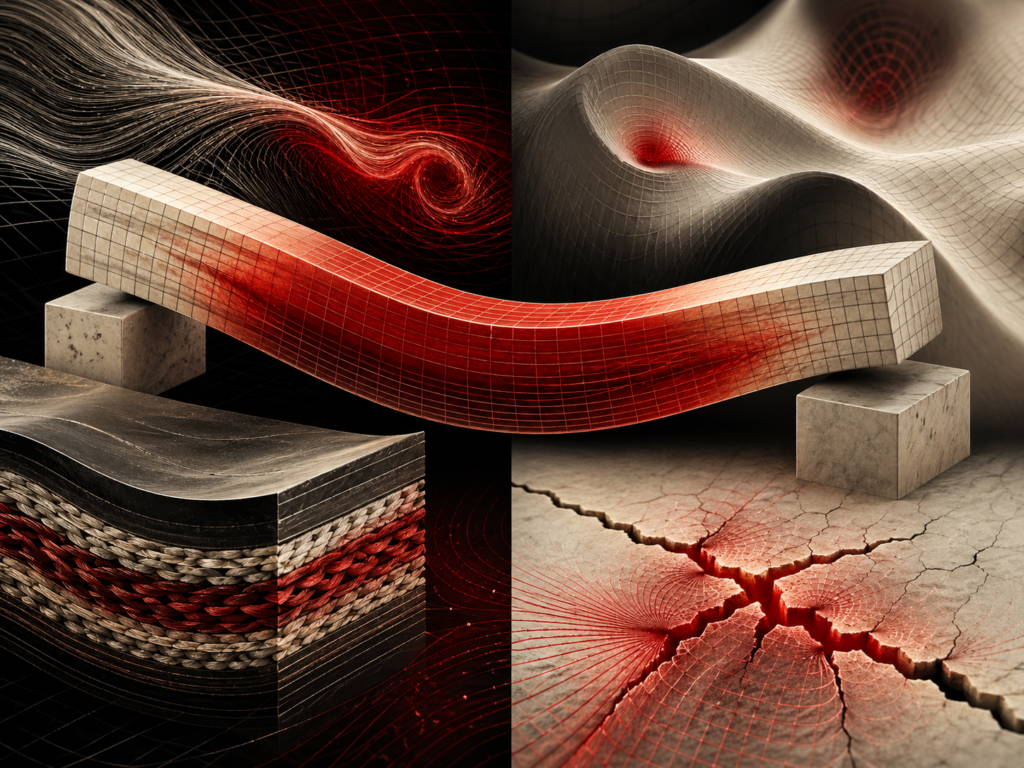
Editorial scientific illustration showing a bending beam under stress, layered composite material, abstract deforming surfaces, and a glowing crack pattern representing stress, strain, and material failure.

Continuum Physics and Material Behavior

Continuum physics and material behavior explain how extended matter deforms, carries load, stores elastic energy, flows slowly, yields, fractures, relaxes, and responds to force across space and time. This article examines the continuum hypothesis, displacement fields, deformation gradients, strain, stress, traction, equilibrium, momentum balance, constitutive laws, linear elasticity, isotropic material parameters, elastic energy, plastic deformation, yield criteria, viscoelasticity, fracture, fatigue, anisotropy, composites, multiphysics coupling, and computational material modeling. Selected R and Python workflows model stress–strain analysis, elastic modulus estimation, stress tensor diagnostics, principal stresses, and von Mises stress, while the linked GitHub repository expands the article with advanced computational scaffolding for reproducible continuum-mechanics workflows.

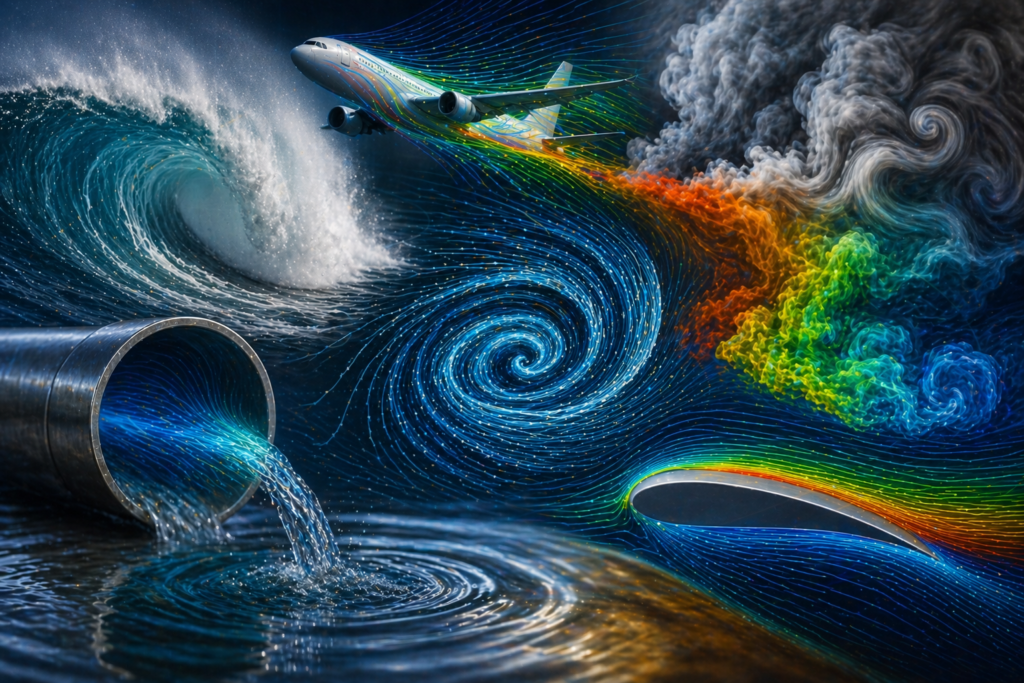
Cinematic scientific illustration showing ocean waves, pipe flow, aerodynamic streamlines, smoke vortices, and colorful flow-field patterns representing fluid dynamics and turbulence.

Fluid Dynamics and the Physics of Flow

Fluid dynamics studies how liquids and gases move, deform, transmit forces, transport momentum, generate pressure, form vortices, and transition to turbulence. This article examines fluids and continua, density, pressure, hydrostatics, velocity fields, the material derivative, conservation of mass, Bernoulli’s equation, viscosity, Newtonian fluids, momentum balance, Navier–Stokes equations, Reynolds number, laminar and turbulent flow, boundary layers, drag, lift, vorticity, circulation, dimensional analysis, environmental flow, biological flow, engineering flow, and computational fluid dynamics. Selected R and Python workflows model Reynolds-number classification and vorticity-field diagnostics, while the linked GitHub repository expands the article with advanced computational scaffolding for reproducible fluid-dynamics workflows.

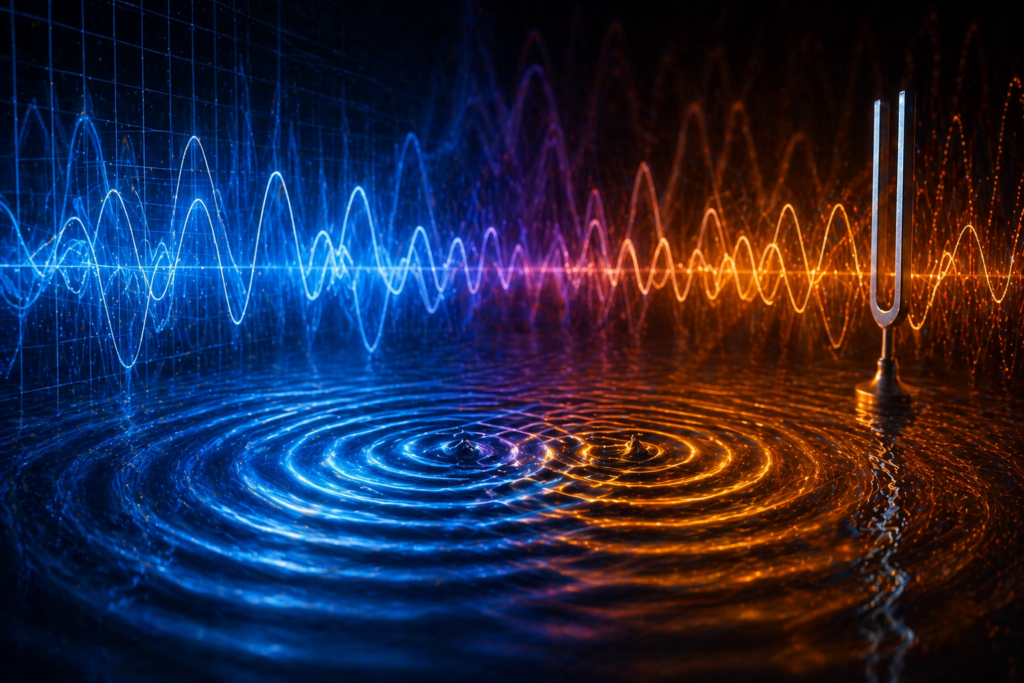
Abstract physics illustration showing glowing waveforms, circular water ripples, and a tuning fork to represent oscillations, resonance, interference, and wave propagation.

Waves, Oscillations, and Resonance

Waves, oscillations, and resonance form one of the great connective structures of physics because they show how systems repeat, transmit energy, respond to frequency, and form collective patterns across space and time. This article examines simple harmonic motion, damping, driven oscillators, resonance, phase, frequency, amplitude, coupled oscillators, normal modes, mechanical waves, the wave equation, standing waves, interference, beats, Fourier decomposition, dispersion, sound, light, and the broader role of wave reasoning across physics. Selected R and Python workflows model resonance curves and damped driven oscillator behavior, while the linked GitHub repository expands the article with advanced computational scaffolding for reproducible wave-physics workflows.

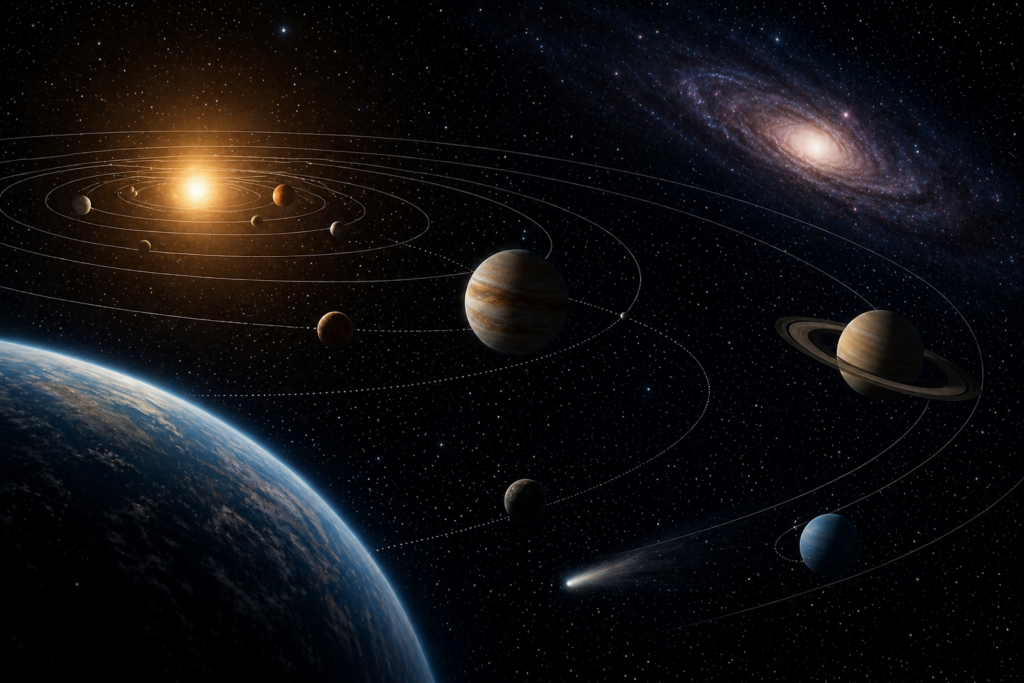
Cinematic space illustration showing planets, elliptical orbital paths, a glowing star, a comet, Earth, and a distant spiral galaxy to represent gravitation, orbital motion, and celestial mechanics.

Gravitation, Orbits, and Celestial Mechanics

Gravitation, orbits, and celestial mechanics show how classical physics extends from falling bodies on Earth to planets, moons, satellites, comets, stars, and spacecraft moving through space. This article examines Newtonian gravitation, Kepler’s laws, central-force motion, the two-body problem, orbital energy, angular momentum, circular orbits, escape speed, the vis-viva equation, orbital elements, perturbations, tides, resonances, many-body dynamics, and basic orbital-transfer reasoning. Selected R and Python workflows model circular orbits, escape speed, orbital period scaling, and two-body integration, while the linked GitHub repository expands the article with advanced computational scaffolding for reproducible celestial-mechanics workflows.

Editorial physics illustration showing a gyroscope, rolling wheel, inclined plane, rotating top, and torque arm to represent rotational dynamics, angular momentum, and rolling motion.

Rotational Dynamics, Torque, and Angular Momentum

Rotational dynamics extends classical mechanics beyond linear motion by explaining how bodies turn, spin, roll, precess, and conserve angular momentum. This article examines angular position, angular velocity, angular acceleration, torque, moment of inertia, rotational kinetic energy, rolling without slipping, angular impulse, gyroscopic behavior, and angular momentum conservation. It shows how rotational motion deepens the classical mechanics sequence by moving from point-particle models to extended bodies with shape, axes, constraints, and mass distribution. Selected R and Python workflows compare rolling objects, energy partition, torque-driven rotation, angular momentum, and rotational kinetic energy, while the linked GitHub repository expands the article with advanced computational scaffolding for reproducible rotational-dynamics workflows.

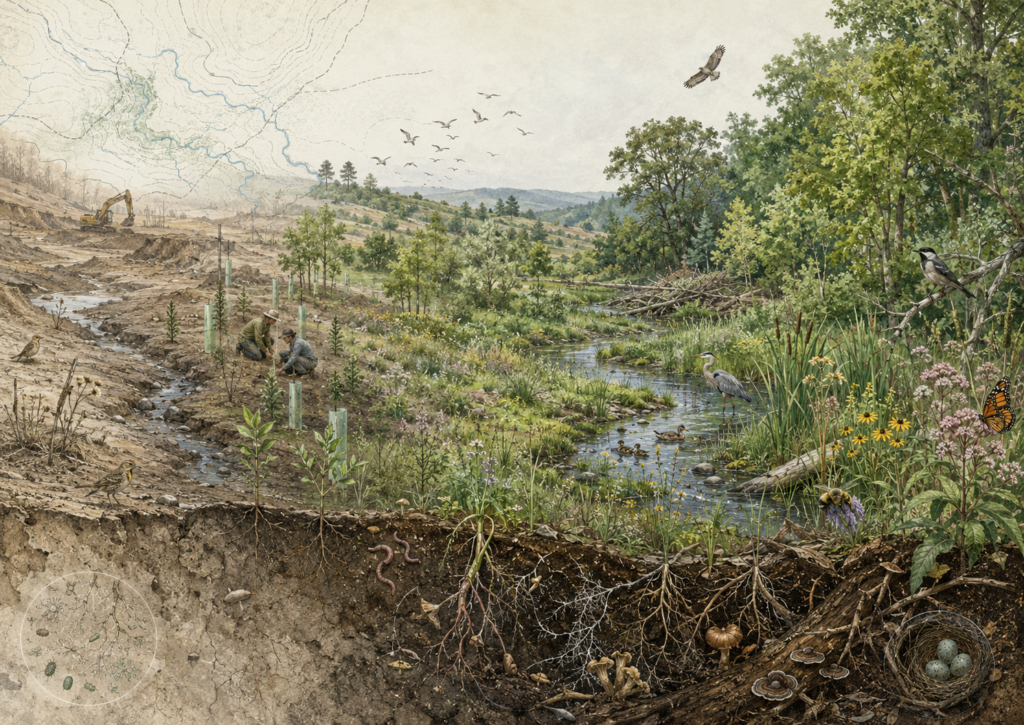
Research-grade ecological restoration illustration showing a degraded landscape transitioning into a restored wetland and forest ecosystem, with native planting, stream recovery, wildlife, soil roots, fungi, and biodiversity returning.

Restoration Ecology and the Repair of Living Systems

Restoration ecology and the repair of living systems examine how damaged ecosystems can recover structure, function, biodiversity, resilience, and ecological process through deliberate intervention, assisted regeneration, disturbance repair, hydrological recovery, soil rebuilding, species reintroduction, and long-term ecological stewardship. Restoration ecology is central to modern biology because the living world is now shaped not only by natural succession and disturbance, but by extraction, fragmentation, pollution, hydrological alteration, invasive species, climate change, biodiversity loss, and systemic ecological simplification. This article explores how degraded systems recover, what can be repaired, how ecological trajectories are redirected, and how ecological integrity can be rebuilt under altered historical and climatic conditions.

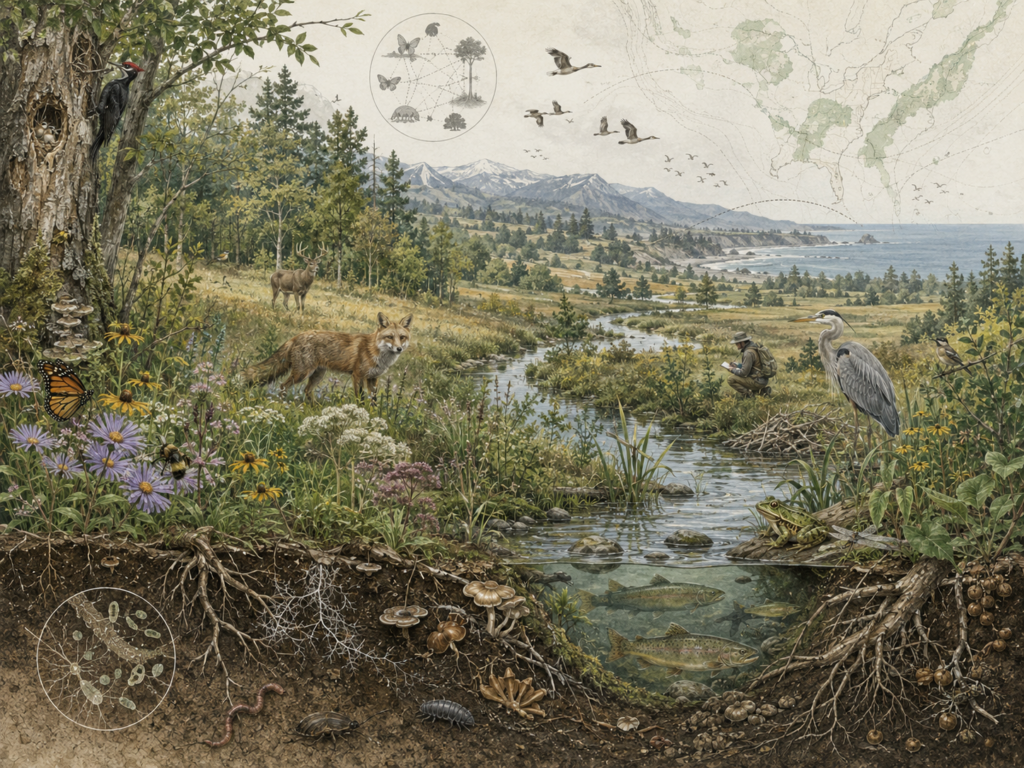
Research-grade conservation biology illustration showing a connected landscape of forest, meadow, wetland, river, and coast with diverse wildlife, native plants, soil roots, fungi, pollinators, fish, birds, and a field biologist observing biodiversity.

Conservation Biology and the Protection of Life

Conservation biology and the protection of life examine how species, populations, ecosystems, and ecological processes can be sustained in the face of extinction risk, habitat loss, fragmentation, overexploitation, invasive species, pollution, and climate-driven environmental change. Conservation biology emerged as a crisis-oriented, interdisciplinary science because the protection of life could no longer be treated as a matter of passive appreciation alone. It required methods for assessing vulnerability, setting priorities, managing uncertainty, restoring damaged systems, and making decisions under conditions in which losses may be irreversible. This article explores extinction risk, population viability, genetic erosion, habitat fragmentation, protected areas, restoration, marine conservation, environmental health relevance, biodiversity governance, and more advanced quantitative approaches in R and Python for conservation decision-making.

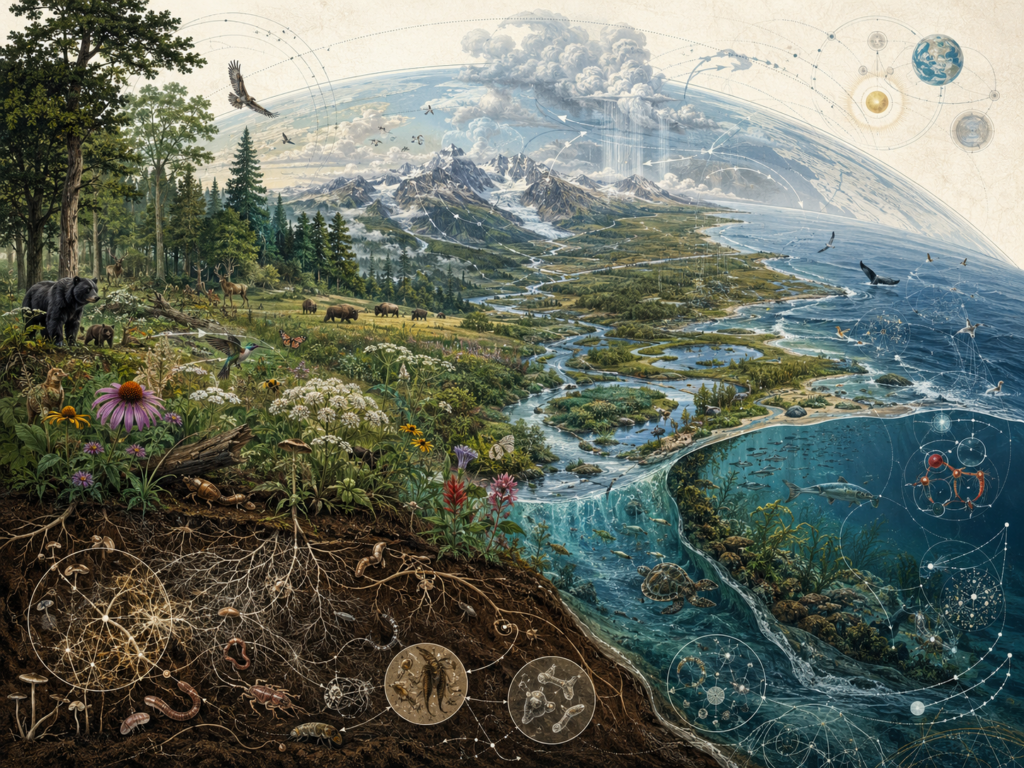
Research-grade Earth systems illustration showing forests, mountains, rivers, wetlands, coastlines, oceans, wildlife, soil roots, fungi, atmosphere, and marine life as interconnected planetary life-support systems.

The Biosphere and Planetary Life Support Systems

The biosphere and planetary life support systems examine how Earth’s living layer interacts with atmosphere, oceans, soils, freshwater, climate, and biogeochemical cycles to sustain the conditions under which complex life can persist. The biosphere is not simply the sum of all organisms. It is the planetary domain in which life reshapes energy flow, nutrient circulation, gas exchange, water movement, food webs, and ecological resilience across scales ranging from microbes and reefs to forests, shelf seas, and continental landscapes. This article explores the biosphere as an Earth-system force, primary production and planetary metabolism, climate regulation, freshwater and hydrological support, biodiversity and resilience, marine and coastal systems, soils and microbes, biosphere integrity, planetary boundaries, and the scientific importance of modeling life-support processes at planetary scale.

Scroll to Top