
Last Updated August 4, 2026
Biodiversity and the structure of living systems examine how life is differentiated, organized, and sustained across genes, populations, species, traits, functional roles, lineages, communities, ecosystems, and biogeographic regions. Biodiversity is not simply a count of species. It is the patterned variety of life across scales, including diversity within species, between species, and among ecosystems. The Convention on Biological Diversity defines biological diversity in exactly those terms, and major global assessments have repeatedly emphasized that biodiversity is fundamental to ecosystem functioning, resilience, adaptation, and the long-term capacity of living systems to persist under change.
Biodiversity is therefore one of biology’s most important structural concepts. It describes how living difference becomes organized into ecological and evolutionary systems. Genetic variation gives populations adaptive capacity. Species diversity shapes community composition and ecological interaction. Functional diversity determines how organisms contribute to production, decomposition, pollination, predation, nutrient cycling, disease regulation, and ecosystem engineering. Phylogenetic diversity preserves evolutionary history. Ecosystem diversity creates the environmental heterogeneity through which populations diverge, communities assemble, and life remains distributed across the biosphere.
Main Library
Publications
Article Map
Biology
Related Topic
Environmental Science
Related Topic
Earth Science
Related Topic
Mathematical Modeling
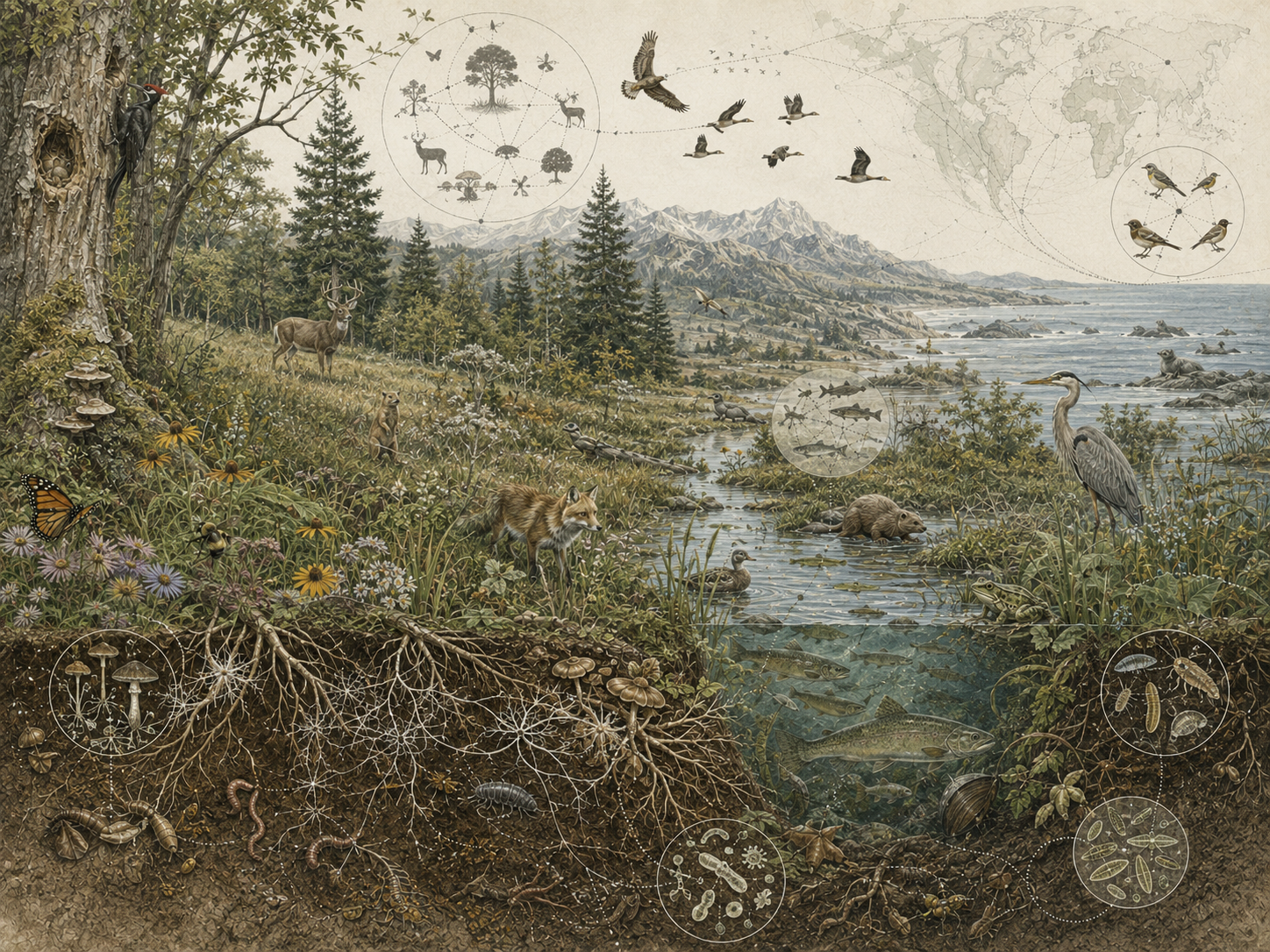
The article is written for ecologists, marine biologists, freshwater scientists, medical and environmental-health readers, computational biology readers, biodiversity experts, restoration practitioners, conservation planners, and research biologists who need a rigorous account of how living difference is measured, maintained, transformed, and threatened across scales.
The article also extends biodiversity science into quantitative and computational biology through Shannon diversity, Simpson diversity, Hill numbers, beta diversity, ordination, trait-based diversity, functional dispersion, community-weighted means, biodiversity-risk screening, R workflows, Python workflows, SQL provenance structures, and a linked full-stack GitHub repository containing Python, R, Julia, Fortran, Rust, Go, C, C++, SQL, notebooks, data files, and reproducibility documentation.
What biodiversity is
Biodiversity is the variability of life. In the most authoritative policy definition, the Convention on Biological Diversity defines biological diversity as variability among living organisms from all sources, including terrestrial, marine, and other aquatic ecosystems, and the ecological complexes of which they are part; this includes diversity within species, between species, and of ecosystems. That definition remains important because it resists the common mistake of reducing biodiversity to species richness alone. Biodiversity includes genes, populations, species, traits, communities, ecosystems, and ecological complexes. It is therefore a property of the organization of life, not merely a list of named organisms.
This broader definition also explains why biodiversity belongs at the center of biology rather than at its margins. Diversity is how life is distributed across form, function, lineage, interaction, and environment. It is the raw material of adaptation, the substrate of ecological assembly, and one of the principal ways that living systems maintain options under uncertainty. Major assessments have treated biodiversity as foundational to ecosystem functioning and to the continued capacity of ecosystems to support life under pressure.
Biodiversity also connects different biological scales. Genetic diversity influences population resilience, disease resistance, inbreeding risk, and adaptive potential. Species diversity shapes community structure, trophic interactions, and ecosystem functioning. Functional diversity determines whether ecological roles remain available when conditions change. Phylogenetic diversity preserves deep evolutionary history and often captures forms of biological distinctiveness that species counts alone miss. Ecosystem diversity creates the landscape and seascape heterogeneity through which biodiversity is generated and maintained.
For research biologists, this is a crucial point: biodiversity is not a decorative outcome of evolution and ecology. It is one of the main ways the structure of living systems becomes legible.
A rigorous definition must also separate biodiversity state from biodiversity knowledge. The number of taxa recorded from a place depends on biological reality, but also on sampling effort, taxonomic expertise, reference collections, detection technology, season, spatial grain, and the willingness of institutions to maintain long-term observations. An apparently species-poor site may truly be simplified, or it may be poorly surveyed. Conversely, a well-sampled site may appear richer merely because observation is more complete. Biodiversity science therefore studies both living structure and the observation process through which that structure becomes data.
Biodiversity is also dynamic. Populations expand and contract, ranges shift, communities turn over, traits change in frequency, interactions rewire, and ecosystems cross thresholds. A static inventory can be valuable, but it cannot by itself show whether a system is stable, recovering, homogenizing, or losing adaptive capacity. The biological object of interest is not only the set of organisms present at one moment. It is the changing distribution of variation, abundance, function, lineage, and relationship through time.
The Current Global Biodiversity Context
Biodiversity science now operates inside a global implementation challenge as well as a scientific one. The Kunming–Montreal Global Biodiversity Framework establishes four goals for 2050 and twenty-three targets for 2030, accompanied by a monitoring framework, national planning and reporting requirements, and mechanisms for collective review. In 2026, Parties were asked to submit seventh national reports using agreed headline and binary indicators, while the Convention’s first global review of collective progress entered scientific and peer review. This makes measurement architecture central: governments need indicators that are scientifically credible, repeatable, comparable, disaggregated where necessary, and connected to action.
The current extinction-risk evidence remains severe but must be interpreted correctly. The IUCN Red List version 2026-1 includes 175,909 assessed species, of which 49,505 are classified as threatened. Those figures represent an expanding assessment system, not a census of all life. Some groups—birds, mammals, amphibians, cycads, reef-building corals, trees, and several freshwater groups—have much stronger coverage than most invertebrates, fungi, microorganisms, and marine taxa. Apparent gaps in threat may therefore reflect missing assessment, missing taxonomy, and missing observation rather than ecological security.
Recent assessments also reinforce that biodiversity cannot be isolated from water, food, health, climate, and institutions. The 2024 IPBES Nexus Assessment examines interdependence among biodiversity, water, food, and health, while the 2024 Transformative Change Assessment focuses on the underlying causes of biodiversity loss and the institutional, economic, social, and cultural changes required to address them. These assessments expand the scientific question from “What is declining?” to “What systems are producing decline, who benefits from those systems, who bears the consequences, and what forms of change can alter the trajectory?”
| Current scientific challenge | Why it matters | Required response |
|---|---|---|
| Uneven taxonomic and geographic knowledge | Well-studied groups and regions can dominate global conclusions. | Targeted inventories, taxonomic capacity, open collections, and uncertainty reporting. |
| Fragmented monitoring systems | Short projects and incompatible methods weaken trend detection. | Long-term design, shared variables, interoperable data, and persistent institutions. |
| Multiple dimensions of biodiversity | Species richness can remain stable while genes, functions, or interactions decline. | Integrated taxonomic, genetic, functional, phylogenetic, spatial, and interaction measures. |
| Imperfect detection | Observed absence may reflect failed observation rather than true absence. | Replication, occupancy models, calibration, and explicit observation models. |
| Rapid environmental change | Historical baselines may no longer describe feasible future states. | Dynamic reference conditions, scenario analysis, refugia, and adaptive monitoring. |
| Implementation and justice | Conservation can fail or cause harm when rights, livelihoods, and local knowledge are ignored. | Participation, consent, benefit sharing, tenure security, and accountable governance. |
The central implication is that biodiversity monitoring cannot be a disconnected accumulation of observations. It must connect biological theory, sampling design, data infrastructure, indicators, governance, and decisions. The scientific objective is not to produce the largest possible database. It is to build a defensible account of how living systems are changing, why they are changing, what uncertainty remains, and which interventions are most likely to protect or restore biological structure.
Why biodiversity is structural, not incidental
Biodiversity is structural because living systems are built through difference. Species occupy different niches, use resources in different ways, vary in life history, respond differently to disturbance, and contribute distinct functional effects to communities and ecosystems. A forest, estuary, grassland, coral reef, wetland, river, agricultural mosaic, or soil system is not simply “alive.” It is organized through layered differences among organisms whose coexistence shapes the structure and behavior of the whole.
This means biodiversity is not an ornamental feature added on top of ecological systems after the fact. It is one of the reasons ecosystems have the form they do. The diversity of producers, consumers, decomposers, symbionts, parasites, pathogens, and engineers determines how matter moves, how energy is transferred, how disturbances are absorbed, and how recovery becomes possible. Communities contain species filling diverse ecological roles, and that diversity can stabilize ecological functioning through time.
The structural importance of biodiversity becomes especially visible when it is lost. A community may retain biomass while losing functional roles. A forest may remain green while losing pollinators, seed dispersers, fungal associates, predators, or specialized understory species. A coral reef may retain physical structure while losing living coral cover and associated fish diversity. A soil system may still support plant growth while losing microbial diversity and nutrient-cycling capacity. Biodiversity loss is therefore not only subtraction from a species list. It can be a reorganization of biological architecture.
The deeper implication is that biodiversity is not external to biological explanation. It is internal to the causal architecture of living systems.
Structure also means constraint and possibility. The organisms already present influence which newcomers can establish, which disturbances can be absorbed, which nutrients remain available, and which recovery pathways are open after disruption. Foundation species create habitat. Ecosystem engineers alter hydrology or substrate. Predators regulate prey and behavior. Mutualists connect reproduction and dispersal. Microbial communities transform chemical environments. Biodiversity is therefore part of the causal machinery that determines what a living system can become next.
This is why the same total biomass or vegetation cover can conceal radically different ecological states. A monoculture plantation and an old-growth forest may both register as tree cover. A reservoir and a floodplain wetland may both contain water. A turf-dominated reef and a coral-dominated reef may both retain benthic cover. Biological structure is carried by composition, traits, interactions, age structure, spatial pattern, and evolutionary history—not by bulk quantity alone.
Genetic, species, and ecosystem diversity
The conventional tripartite structure of biodiversity distinguishes genetic diversity, species diversity, and ecosystem diversity. Genetic diversity concerns variation within species and populations. It matters because populations with more variation may have greater adaptive capacity, lower vulnerability to inbreeding, and more options under environmental change. Species diversity concerns the number, relative abundance, and identity of species within a community or region. Ecosystem diversity concerns the variety of habitats, ecological processes, and environmental contexts across landscapes and seascapes.
These levels are analytically distinct but biologically connected. Genetic diversity influences population resilience and speciation potential. Species diversity shapes community structure and ecosystem functioning. Ecosystem diversity creates the environmental heterogeneity within which populations diverge, communities assemble, and regional biodiversity is maintained. The result is a nested architecture in which diversity at one level both depends on and conditions diversity at other levels.
The nesting is not merely conceptual. A fragmented landscape may reduce gene flow within populations, lower population viability, reduce species persistence, alter community composition, and simplify ecosystem function at the same time. Conversely, a heterogeneous landscape with connected habitats may support genetically diverse populations, multiple species pools, high beta diversity, and resilient ecological processes. Diversity at one scale can therefore reinforce diversity at another.
For research biologists, this nesting matters because biodiversity data are often collected at one level but interpreted through another. Population genetic signals, species-abundance distributions, trait distributions, community turnover, and ecosystem change are rarely independent stories. They are different views of the same layered structure of life.
The levels also respond at different rates. Allelic variation may erode before a population disappears. Local populations may vanish while the species remains globally extant. Community composition may change before ecosystem boundaries are visibly altered. Ecosystem conversion may then feed back to reduce gene flow and population viability. Monitoring only one level can therefore miss early warning at another.
A nested assessment should ask at least four questions: Is genetic and demographic variation sufficient for persistence? Are populations connected enough for movement and recolonization? Does the community retain functional and interaction diversity? Does the landscape or seascape retain the environmental heterogeneity that supports those lower levels? The answers need not move together. A protected area can retain habitat while losing population connectivity, or retain species richness while losing functional distinctiveness.
Intraspecific, Genomic, and Population Diversity
Species-level analysis can conceal major biological erosion within species. A taxon may remain present across a broad range while local populations disappear, effective population size declines, unique adaptations are lost, and gene flow becomes fragmented. These changes matter because populations are the demographic and evolutionary units through which species persist. A species composed of many connected, viable, environmentally differentiated populations has more options than one reduced to a few isolated remnants.
Intraspecific diversity includes allelic variation, heterozygosity, haplotype diversity, structural variation, epigenetic variation, phenotypic diversity, demographic structure, and local adaptation. No single measure captures all of these. Neutral markers can reveal population history and connectivity but may not directly measure adaptive potential. Candidate genes can be informative but risk narrow interpretation. Whole-genome data can identify broader patterns but require careful sampling, reference quality, bioinformatics, and attention to population structure. Common-garden and reciprocal-transplant studies remain valuable because they connect genetic difference to phenotype and environment.
Effective population size, \(N_e\), is especially important because it reflects the population size relevant to genetic drift and inbreeding rather than simply the number of individuals counted. When \(N_e\) becomes small, rare alleles can be lost, relatedness can rise, and adaptive capacity can narrow. Yet genetic rescue and assisted gene flow are not automatically beneficial. Introducing variation can reduce inbreeding and improve fitness, but it can also disrupt local adaptation or introduce disease. Management decisions require evidence about demographic urgency, environmental similarity, lineage history, and uncertainty.
H_E = 1 – \sum_{i=1}^{k} p_i^2
\]
Interpretation: Expected heterozygosity \(H_E\) summarizes the probability that two sampled alleles differ. It is useful but does not by itself describe adaptive variation, demographic trend, or spatial structure.
Population structure also links genetics to landscapes and seascapes. Roads, dams, agriculture, urbanization, altered flow, artificial lighting, and climate barriers can reduce movement. Corridors may restore connectivity, but corridor design must match dispersal behavior and life history. For aquatic species, hydrological connectivity may matter more than geographic distance. For plants, pollinator and seed-disperser movement can determine gene flow. For marine organisms, larval duration and current systems shape connectivity across apparently open water.
Conservation monitoring should therefore preserve more than species presence. It should ask whether populations are demographically viable, whether genetic variation is distributed across environmental gradients, whether movement remains possible, and whether management protects evolutionarily significant or locally adapted components. Species persistence without population diversity can represent a slow loss of future options.
Richness, evenness, and composition
Species richness is the simplest biodiversity measure: how many species are present. But richness alone is often insufficient. Two communities may each contain twenty species while differing profoundly in dominance structure, rarity, ecological roles, functional traits, and evolutionary distinctiveness. This is why biodiversity analysis also considers evenness, relative abundance, turnover, and composition.
Evenness matters because a community dominated by one or two species behaves differently from a community in which abundance is more evenly distributed. Composition matters because the identity of species determines ecological roles, interactions, and functional consequences. Turnover matters because regional diversity may depend less on how many species occur at any one site than on how much communities differ across space. A landscape where every site contains the same common species may have lower regional biodiversity than one where local sites differ strongly.
Whittaker’s classic discussion of species diversity helped formalize this point by distinguishing multiple dimensions of diversity and by linking diversity measurement to ecological gradients and community structure. In practice, biodiversity is not just about how many species are present, but about which species are present, how abundant they are, how they differ, and how those differences are distributed in ecological space.
This shift from counting to structure is one of the most important advances in biodiversity science. It is also what makes biodiversity measurement genuinely biological rather than merely tabular.
Abundance distributions are especially important when ecological change proceeds through replacement rather than immediate local extinction. A specialist may decline from common to rare while a disturbance-tolerant generalist becomes dominant. Richness can remain constant even though the community’s identity, interaction structure, and future trajectory have changed. This is one reason compositional time series and abundance-sensitive measures are often more diagnostic than repeated species counts alone.
Rare species require careful interpretation. Some are naturally rare because they occupy narrow niches, occur at low density, or sit near range boundaries. Others are rare because of recent decline. Sampling design must distinguish those conditions where possible. Rare taxa can carry unique functions or evolutionary history, but their estimated contribution to diversity is also sensitive to detection error. Good analysis therefore reports observed richness, estimated unseen diversity, abundance structure, and uncertainty rather than presenting one number as complete.
Functional and phylogenetic diversity
Modern biodiversity science extends beyond taxonomic counts to include functional diversity and phylogenetic diversity. Functional diversity concerns differences in ecological traits and roles: nitrogen fixation, pollination, seed dispersal, decomposition, predator strategy, rooting depth, thermal tolerance, body size, trophic position, dispersal capacity, drought response, reproductive timing, disease susceptibility, and many others. Phylogenetic diversity concerns the evolutionary distinctiveness represented within a community or region.
These extensions matter because not all species contribute to ecological structure in the same way. Two species may increase richness by one unit each, yet one may add a novel functional role or deep evolutionary history while the other may be functionally similar to species already present. Species identity and functional traits often matter as much as richness itself. A community may lose few species numerically while losing a key pollinator, apex predator, foundation species, decomposer, reef builder, nitrogen fixer, or seed disperser. The resulting functional change may be disproportionate to the change in richness.
Functional diversity also matters for resilience. If species differ in their responses to drought, heat, flood, disease, salinity, nutrient loading, or disturbance, the system may preserve function even when some species decline. Phylogenetic diversity matters because evolutionary history can encode unique traits, developmental pathways, ecological strategies, and future adaptive potential. A loss of phylogenetic diversity can therefore represent not only current ecological loss but loss of deep biological history.
For research biologists and computational readers, this means biodiversity metrics have to be matched to the biological question. Trait space and phylogenetic breadth are not decorative additions to diversity analysis. They often change the answer.
Functional metrics also depend on how traits are selected and scaled. Traits should be tied to a biological mechanism: resource acquisition, dispersal, thermal response, trophic role, reproductive strategy, body size, or ecosystem effect. Combining unrelated traits without a clear question can create an impressive-looking distance space with weak ecological meaning. Trait databases are also incomplete and taxonomically biased, so missingness and imputation decisions should be documented.
Phylogenetic diversity is similarly informative but not interchangeable with functional diversity. Closely related species may differ ecologically, and distantly related species may converge on similar functions. Phylogeny can proxy unmeasured trait differences and evolutionary history, but it is not a universal substitute for measured biology. Strong studies compare taxonomic, functional, and phylogenetic results and explain when those dimensions agree or diverge.
Interaction Diversity and Ecological Networks
Living systems are structured not only by which organisms occur, but by what they do to one another. Pollination, seed dispersal, predation, herbivory, competition, parasitism, mutualism, facilitation, infection, decomposition, and host–microbe association create networks through which energy, matter, information, and evolutionary pressure move. Interaction diversity can decline before species disappear. A pollinator may remain present but visit fewer plants. A predator may persist at densities too low to regulate prey. A host and symbiont may become temporally mismatched. Species lists can therefore overstate ecological integrity.
Network analysis describes nodes, links, direction, weight, modularity, nestedness, connectance, centrality, and robustness. These quantities can clarify which species act as hubs, which interactions bridge modules, and where apparent redundancy is weak. Yet network metrics are sensitive to effort. More observation usually reveals more links. Rare interactions are easily missed. Interaction strength can vary by season and context. A defensible network study therefore documents sampling duration, observation method, detectability, temporal coverage, and whether links represent direct observation, molecular inference, literature compilation, or model prediction.
C = \frac{L}{S_1S_2}
\]
Interpretation: In a bipartite network, connectance \(C\) is the proportion of possible links that are observed, where \(L\) is the number of realized interactions and \(S_1S_2\) is the number of possible cross-group links. Observed connectance depends strongly on sampling completeness.
Interaction loss can create coextinction risk. A specialized plant may depend on one pollinator, a parasite on one host, or a seed disperser on a narrow set of fruiting species. The disappearance of one partner can destabilize another even when habitat remains. Conversely, generalized networks can sometimes rewire after loss, but rewiring does not guarantee equivalent ecological function. A substitute interaction may be less efficient, occur at the wrong time, or fail to support reproduction at population scale.
Microbiomes make interaction structure especially important. Host health, nutrient acquisition, disease resistance, development, and environmental tolerance can depend on microbial communities whose membership and functions shift rapidly. Similar logic applies to soils, rhizospheres, coral holobionts, animal guts, and aquatic microbial loops. Biodiversity analysis that excludes microorganisms and interactions can miss a substantial portion of living organization.
For conservation and restoration, the practical question is not only whether species return, but whether relationships return. Monitoring can include visitation networks, diet metabarcoding, co-occurrence models, stable isotopes, acoustic interaction, pathogen surveillance, and repeated measures of reproductive or trophic function. A restored community with many species but few functioning relationships may remain ecologically incomplete.
Niche differentiation and the problem of coexistence
One of the deepest questions in ecology is why there are so many kinds of organisms at all. Hutchinson’s famous “Homage to Santa Rosalia” framed this as a central problem of coexistence, while subsequent work in niche theory and community ecology explored how species can persist together through differentiation in resource use, timing, space, behavior, physiology, or interaction structure. Biodiversity, in this view, is not simply given. It is achieved through ecological and evolutionary processes that reduce complete overlap and allow coexistence.
Niche differentiation can occur in many ways. Species may use different resources, forage at different times, occupy different microhabitats, tolerate different temperatures, reproduce in different seasons, specialize on different hosts, or interact with different mutualists and enemies. In plants, rooting depth, shade tolerance, phenology, nutrient strategy, and drought tolerance can structure coexistence. In marine systems, depth, substrate, flow, light, larval dispersal, and trophic strategy can partition ecological space. In microbial communities, chemical gradients, oxygen availability, substrate use, and metabolic pathways can generate extraordinary forms of coexistence.
This is why biodiversity is inseparable from ecological structure. Communities are not just piles of species; they are arrangements of organisms distributed across niches, interaction networks, and environmental gradients. Where differentiation weakens, exclusion may intensify. Where heterogeneity increases, coexistence opportunities often expand. Biodiversity is therefore partly a record of how life partitions possibility.
For scientists, coexistence theory remains one of the core conceptual bridges between biodiversity pattern and ecological mechanism.
Modern coexistence theory further distinguishes stabilizing mechanisms from fitness differences. Stabilizing mechanisms make species limit themselves more than they limit competitors, preserving opportunities for coexistence. Fitness differences favor some species over others and can overwhelm stabilization. Disturbance, spatial heterogeneity, temporal variation, storage effects, enemy partitioning, and facilitation can all influence that balance. Biodiversity patterns therefore emerge from the interaction between environmental variation and species differences, not from niche labels alone.
Neutral and stochastic processes also matter. Dispersal limitation, demographic chance, historical sequence, and ecological drift can shape who occurs where even when species have similar average performance. A serious account of biodiversity does not force every pattern into one mechanism. It compares niche, dispersal, historical, and stochastic explanations and asks which are supported at the scale of study.
Biodiversity across scales
Biodiversity is also scale-dependent. Ecologists often distinguish alpha diversity, beta diversity, and gamma diversity. Alpha diversity concerns diversity within a local site or community. Beta diversity concerns turnover or compositional difference among sites. Gamma diversity concerns total diversity at larger regional scales. Whittaker’s framing of these levels remains one of the classic ways of understanding how biodiversity is distributed across space.
This matters because local richness can remain unchanged while regional diversity declines if communities become homogenized. Likewise, a landscape with moderate alpha diversity but high beta diversity may hold more total biodiversity than a landscape where every site contains the same common set of species. Biodiversity structure is therefore spatial as well as numerical. It depends on patchiness, barriers, gradients, dispersal, disturbance, history, habitat heterogeneity, and regional species pools.
The scaling problem is especially important in marine, freshwater, and landscape-scale ecology. A reef system may contain high beta diversity among reef patches. A river network may hold different assemblages across headwaters, floodplains, and estuaries. A forest landscape may contain different communities across soil types, slopes, canopy ages, and disturbance histories. A restoration site may increase local diversity while doing little for regional diversity if it simply reproduces common assemblages.
For biodiversity experts, this means diversity is always partly a matter of where and at what grain it is measured. The same ecological system can look diverse, simplified, stable, or transformed depending on scale.
Scale has temporal as well as spatial dimensions. A one-season survey can miss migratory, dormant, episodic, or disturbance-dependent taxa. Interannual climate variability can change detectability and occupancy. Long-lived organisms may show delayed demographic responses, while microbial communities can reorganize rapidly. Biodiversity change must therefore be interpreted relative to the life histories and turnover rates of the organisms being studied.
Cross-scale analysis is particularly important for conservation. A local intervention may improve alpha diversity while regional homogenization continues. A reserve may protect a core habitat while movement corridors degrade. A restoration project may recreate common habitat but fail to recover the mosaic needed for beta diversity. Monitoring should therefore connect plot, site, landscape, watershed, and regional indicators rather than assuming that success at one grain guarantees success at another.
Biodiversity and community assembly
Communities are assembled through dispersal, environmental filtering, competition, facilitation, disturbance, historical contingency, mutualism, predation, parasitism, and speciation-extinction dynamics. Biodiversity emerges from this assembly process rather than standing outside it. A wetland community differs from a desert community not simply because one has “more species,” but because environmental conditions and evolutionary histories filter different lineages and functional strategies.
This assembly perspective is important because it explains why biodiversity is patterned rather than random. Species pools differ among regions. Habitats favor some traits over others. Disturbance regimes open or close opportunities. Keystone effects, mutualisms, and trophic interactions can alter who persists. Dispersal barriers may prevent otherwise suitable species from arriving. Historical contingencies may cause communities with similar environments to differ in composition.
Assembly also helps explain why restoration is difficult. Restoring habitat structure does not automatically restore the full community if seed banks, dispersal pathways, microbial communities, hydrological regimes, pollinator networks, or disturbance processes have been lost. Biodiversity is not simply poured back into a habitat after physical repair. It assembles through time, interaction, movement, and ecological compatibility.
That makes biodiversity analysis inseparable from history, environment, and process.
Community assembly is often evaluated through trait and phylogenetic patterns, null models, joint species-distribution models, and experiments. Environmental filtering may cluster similar strategies under harsh conditions, while competition may produce trait divergence; yet the same pattern can arise through different mechanisms. Inference requires caution because observed composition is shaped by the available species pool, imperfect dispersal, observation error, and historical disturbance.
Priority effects illustrate why history matters. Early-arriving species can modify resources, enemies, or habitat in ways that favor one trajectory over another. Two restored sites with similar physical conditions may therefore develop different communities because colonization sequence differs. Restoration and invasion biology both depend on this insight: changing habitat conditions is necessary, but the timing and order of biological arrival can determine the eventual state.
Biodiversity and ecosystem functioning
A large body of ecological research shows that biodiversity affects ecosystem functioning. This includes productivity, nutrient cycling, soil formation, decomposition, pollination, trophic transfer, disease regulation, invasion resistance, water filtration, carbon storage, and other core processes. Landmark syntheses concluded that biodiversity change can alter ecosystem properties and that the effects of diversity depend not only on species number but also on species composition, functional traits, and environmental context.
This relationship does not mean that “more diversity” always produces the same outcome everywhere. Context matters. The effect of biodiversity may vary across ecosystems, functions, disturbance regimes, spatial scales, and time horizons. Some systems may show functional redundancy for certain processes, while others may depend strongly on particular species or trait combinations. Some effects may be visible quickly, while others emerge only under stress, seasonal variation, or long-term environmental change.
The broader conclusion remains robust: losing biodiversity can alter ecological functioning, and the identity of what is lost often matters profoundly. Functional redundancy may buffer some losses temporarily, but response diversity, rare species effects, interaction networks, and context dependence mean that simplified systems often become more fragile over time. Biodiversity supports functioning not because every species does everything, but because different organisms contribute differently under different conditions.
For research biologists, the important lesson is that biodiversity-function relationships are not just abstract ecological theory. They are testable, measurable, and central to understanding how living systems operate.
Biodiversity–function relationships can arise through complementarity, selection, facilitation, and response diversity. Complementarity occurs when species use resources in different ways or at different times. Selection effects occur when a diverse community is more likely to contain a particularly influential species. Facilitation occurs when one organism improves conditions for another. Response diversity stabilizes function when species contributing to the same broad process respond differently to environmental change.
Multifunctionality changes the interpretation further. A community optimized for one measured function may perform poorly across a wider set of functions. High biomass does not guarantee decomposition, pollination, nutrient retention, habitat provision, or resilience. Studies that evaluate multiple functions often find that maintaining many ecological processes requires more biodiversity than maintaining any single process. This supports a portfolio view of biodiversity: different organisms matter under different functions, places, and times.
Biodiversity, stability, and resilience
Biodiversity has long been linked to questions of stability and resilience. Ecologists once debated whether more diverse systems were necessarily more stable, and that debate became especially important after May’s work on complexity and stability. Later research refined the question, distinguishing among stability, resistance, recovery, variability, resilience, and persistence. The modern consensus is more careful: biodiversity can stabilize ecosystem properties, especially under environmental fluctuation, but the mechanisms differ by scale, function, and kind of diversity being considered.
One of the most important mechanisms is insurance through difference. If species vary in how they respond to heat, drought, pathogens, floods, nutrient pulses, grazing pressure, salinity, fire, or storms, then functional performance at the system level may persist even when some species decline. This is one reason biodiversity matters under environmental change. It does not guarantee invulnerability, but it broadens the portfolio of ecological responses available to living systems.
Resilience also depends on interaction structure. A community with diverse pollinators, seed dispersers, decomposers, predators, symbionts, and microbial pathways may recover differently from one in which those roles have been simplified. Functional redundancy can matter, but so can functional uniqueness. A system may appear stable until a rare or inconspicuous species is lost and a key process weakens.
For biodiversity experts, resilience is therefore not simply persistence. It is the capacity of diverse systems to continue functioning through heterogeneous response.
Stability should be decomposed rather than treated as one outcome. Resistance describes how little a system changes during disturbance. Recovery describes the rate and completeness of return. Persistence concerns continued presence. Temporal invariability concerns fluctuations through time. Resilience may refer to recovery within the same regime or to the capacity to reorganize without losing core function. A system can score well on one dimension and poorly on another.
Early warning is difficult because ecological thresholds are often nonlinear and context dependent. Rising variance, autocorrelation, slowing recovery, loss of response diversity, and increasing spatial synchronization can indicate declining resilience, but none is universally reliable. Monitoring should combine mechanistic understanding, repeated observations, and scenario analysis rather than relying on a single generic threshold indicator.
Biogeography, island systems, and spatial structure
Biodiversity is shaped not only by local ecological processes but also by regional and biogeographic structure. Island biogeography remains one of the classic frameworks for understanding how colonization, extinction, isolation, and area shape species richness. The broader insight extends beyond literal islands to fragmented habitats, mountaintops, lakes, forest remnants, wetlands, reefs, caves, seamounts, and ecological patches surrounded by hostile matrices. Spatial structure influences how biodiversity accumulates, persists, and disappears.
This is particularly important in the contemporary world because fragmentation often transforms continuous habitats into insular systems. Biodiversity loss then becomes not just a matter of local disturbance but of reduced connectivity, lower recolonization potential, smaller population sizes, and altered extinction dynamics. A habitat patch may retain some local richness in the short term while becoming increasingly vulnerable over time because immigration, gene flow, and rescue effects have weakened.
Spatial biodiversity is therefore inseparable from conservation planning, corridor design, reserve theory, and landscape ecology. The question is not merely how much habitat remains, but how habitat is arranged, connected, protected, and embedded within wider land- and seascapes. For marine scientists, analogous logic applies to reefs, seamounts, estuaries, kelp forests, mangroves, and other semi-isolated habitat systems connected by currents rather than continuous land.
For research biologists, spatial structure clarifies why biodiversity cannot be understood only as a local property. It is regional, historical, and connected.
Metacommunity and metapopulation perspectives extend island logic by treating local communities as connected through dispersal. Connectivity can provide rescue, gene flow, and recolonization, but it can also spread pathogens, invasive species, or synchronized disturbance. The relevant question is not whether connectivity is always good, but which organisms move, through what matrix, at what life stage, and under what disturbance regime.
Climate change makes spatial structure more dynamic. Protected areas fixed in place may no longer overlap future climate space. Elevational and poleward shifts can compress ranges, isolate populations, and create novel communities. Conservation planning therefore increasingly needs climate corridors, refugia, stepping stones, hydrological connectivity, and attention to barriers that different species experience differently.
Rare Species, Dark Diversity, and Extinction Debt
Observed communities contain only part of the biodiversity story. Rare species may be present but undetected. Other species may be absent from a site even though environmental conditions and regional history suggest they could occur there. This expected-but-missing component is sometimes described as dark diversity. It can help distinguish naturally species-poor environments from communities that are incomplete because dispersal, degradation, or historical loss prevents suitable species from occurring.
Estimating dark diversity requires a defensible species pool. The pool may be defined by biogeographic region, habitat affinity, co-occurrence, dispersal distance, phylogeny, or environmental suitability. A pool that is too broad labels impossible species as missing; one that is too narrow hides restoration potential. The concept is therefore most useful when the biological and spatial basis of expectation is explicit.
Extinction debt describes future species loss caused by past habitat destruction or fragmentation. Long-lived organisms can persist for years or decades after conditions become insufficient for recruitment. Small populations may remain visible while genetic and demographic processes move them toward collapse. Colonization credit is the reverse delay: habitat may be restored before expected species arrive. Both concepts show why short evaluation windows can misread biodiversity trajectories.
Rare species, dark diversity, and extinction debt complicate simple before-and-after comparisons. A site may show little immediate richness change after disturbance while delayed losses accumulate. A restoration site may initially look unsuccessful even though habitat suitability has improved and colonization is still unfolding. Monitoring should therefore include demographic indicators, recruitment, population age structure, habitat continuity, dispersal pathways, and repeated surveys long enough to match organismal life cycles.
These concepts also caution against equating novelty with recovery. New species can increase observed richness after disturbance, but if specialists are replaced by widespread generalists the system may be homogenizing. A complete interpretation separates gains, losses, turnover, expected species, functional change, and temporal delay.
Biodiversity loss and the reorganization of living systems
Biodiversity loss is not simply subtraction. It reorganizes living systems. Declines in biodiversity can alter ecosystem structure, functioning, and the life-support processes ecosystems provide. Global assessments have documented widespread human-driven decline across genes, species, ecosystems, and ecological interactions. The consequences are not limited to the disappearance of individual taxa. They include changes in food webs, productivity, nutrient cycling, disease dynamics, pollination, decomposition, water quality, carbon storage, and resilience.
This is why biodiversity loss can have effects far beyond the disappearance of individual species. Pollination systems can weaken. Food webs can simplify. Disease dynamics can shift. Nutrient cycling can change. Resilience to drought, heat, invasive species, or disturbance can decline. The loss of rare, functionally distinctive, interaction-rich, or evolutionarily unique species may have consequences disproportionate to their abundance.
Biodiversity decline is therefore better understood as ecological reorganization than as mere reduction in variety. A simplified system may still contain life. It may even remain productive for a time. But it may become more dominated by generalists, more vulnerable to invasion, less resilient to disturbance, less functionally diverse, and less capable of sustaining ecological processes across changing conditions.
For research biologists, that means the response variable is often not “species lost,” but change in system structure.
Reorganization can include biotic homogenization, trophic downgrading, novel ecosystems, range redistribution, and loss of ecological interactions. Generalist species may spread while specialists contract, causing distant communities to become more similar. Large predators or herbivores may disappear, altering food webs and vegetation. Climate-driven arrivals may create communities with no historical analogue. The result is not always an empty system; often it is a differently organized system with altered risks and functions.
Extinction risk is also unevenly observed. The IUCN Red List version 2026-1 includes 175,909 assessed species, of which 49,505 are classified as threatened, but assessment coverage differs greatly among taxonomic groups. Those totals are therefore not a direct estimate of the fraction of all life threatened. They are a powerful but incomplete evidence base shaped by taxonomy, data availability, and assessment capacity. Biodiversity science must treat data deficiency as a scientific and governance problem rather than as evidence of low risk.
Drivers, Cumulative Pressure, and Ecological Reorganization
Biodiversity change is usually produced by interacting direct and indirect drivers rather than a single isolated pressure. Land- and sea-use change, direct exploitation, climate change, pollution, invasive alien species, altered fire, hydrological modification, disease, and infrastructure can combine with consumption, trade, finance, governance, technology, and inequality. A pressure that appears moderate alone may become severe when it interacts with others.
Climate change is a multiplier because it alters exposure, phenology, disturbance, disease, oxygen, hydrology, and species interactions. Habitat fragmentation can prevent range shifts. Pollution can reduce tolerance to heat. Overharvest can remove large or reproductive individuals needed for recovery. Invasive species can exploit disturbed conditions. Cumulative assessment should therefore test joint pressure and sequence rather than simply adding independent scores.
R = \sum_{j=1}^{m} w_j P_j + \sum_{j<k}\theta_{jk}P_jP_k
\]
Interpretation: A cumulative-risk model can include weighted pressures \(P_j\) and interaction terms \(\theta_{jk}\). Positive interaction terms represent amplification beyond a simple additive model.
Pressure maps are useful but can be misleading when they substitute for biological observation. A low-pressure area may contain naturally small or highly vulnerable populations. A high-pressure area may retain important biodiversity because of refugia or management. Threat data should be connected to species, traits, habitats, exposure pathways, and response evidence. Otherwise the analysis measures human activity rather than biological consequence.
Drivers also operate through telecoupling. Consumption in one region can cause habitat conversion, extraction, or pollution elsewhere. Supply chains relocate pressure across borders. Conservation gains in one jurisdiction can coincide with leakage into another. A system boundary limited to the project site may therefore overstate success. Biodiversity accounting should examine displaced impacts, imported commodities, infrastructure networks, and financial incentives where they are causally relevant.
Ecological reorganization is not always reversible by removing the original driver. Soil legacies, altered food webs, invasive species, lost mutualists, changed hydrology, and climate shifts can maintain a new state. Intervention design must ask whether the system can recover passively, requires active restoration, or has crossed into a regime where historical reconstruction is no longer feasible.
Detectability, Sampling Bias, and Uncertainty
All biodiversity observations are filtered through detection. An organism must be present, available to the method, detected, identified, and recorded correctly. Weather, observer skill, vegetation density, depth, noise, turbidity, season, behavior, equipment, primer choice, sequencing depth, and reference-library coverage can alter that process. Absence from a dataset therefore does not automatically mean absence from the environment.
Repeated surveys allow occupancy models to separate ecological occurrence from detection probability. A simple formulation uses a latent occurrence state \(z_{ij}\) for species \(i\) at site \(j\), and an observation \(y_{ijk}\) for replicate \(k\):
z_{ij}\sim\operatorname{Bernoulli}(\psi_{ij})
\]
\[
y_{ijk}\sim\operatorname{Bernoulli}(z_{ij}p_{ijk})
\]
Interpretation: \(\psi_{ij}\) is the probability that the species occurs, while \(p_{ijk}\) is the conditional probability of detecting it during a particular survey. Replication helps distinguish non-detection from true absence.
Abundance estimates have analogous problems. Counts can be biased by availability and observation, while sequence reads are not direct organism counts because amplification and copy number differ. Camera-trap detections depend on movement and field of view. Acoustic detections depend on calling behavior and propagation. Remote sensing detects structure or spectral properties rather than most species directly. Each method has an observation model, whether or not the analysis acknowledges it.
Sampling bias is often spatial and social. Accessible roads, protected areas, wealthy regions, charismatic species, and daytime conditions are overrepresented. Conflict zones, private lands, deep oceans, soils, tropical invertebrates, fungi, and microorganisms are underrepresented. Citizen science can expand coverage enormously, but participation and identification effort are uneven. Model outputs can reproduce these biases while appearing spatially complete.
Uncertainty should be decomposed into measurement error, process variability, model uncertainty, taxonomic uncertainty, sampling uncertainty, and scenario uncertainty. These components have different remedies. More replicates can reduce sampling error. Better reference libraries can reduce identification uncertainty. Alternative models can test structural assumptions. No amount of statistical precision can resolve a poorly defined ecological question.
| Uncertainty source | Example | Response |
|---|---|---|
| Detection | A present species is missed during a survey. | Replicate surveys, calibration, occupancy or distance models. |
| Taxonomy | Cryptic species or outdated names create mismatches. | Voucher specimens, reference collections, taxonomic reconciliation. |
| Sampling design | Sites cluster near roads or protected areas. | Probability sampling, stratification, weights, and explicit bias analysis. |
| Model structure | Different habitat models imply different ranges. | Model comparison, ensembles, diagnostics, and external validation. |
| Temporal variability | One year differs because of climate or disturbance. | Longitudinal monitoring and hierarchical time-series models. |
| Future scenario | Land use or climate pathways diverge. | Multiple scenarios and decision-making under uncertainty. |
A credible biodiversity result therefore includes a measurement, a sampling frame, an observation model, an uncertainty statement, and a clear account of what the data cannot support.
Monitoring Technologies and Essential Biodiversity Variables
Biodiversity monitoring increasingly combines field observation, museum and herbarium collections, environmental DNA, genomics, bioacoustics, camera traps, automated imaging, remote sensing, telemetry, citizen science, and ecological models. These methods are complementary because they observe different components at different scales. The goal is not to replace natural history with automation, but to connect biological expertise with technologies capable of extending coverage, frequency, and reproducibility.
Environmental DNA and molecular observation
Environmental DNA and metabarcoding can detect genetic material from water, soil, sediment, air, or biological substrates. They are powerful for cryptic, aquatic, microbial, and multi-species surveys, but the data-generating process is complex. Collection volume, transport, degradation, extraction, primer bias, polymerase-chain-reaction replication, sequencing depth, contamination control, bioinformatic thresholds, and reference databases all influence results. Sequence reads should not be treated as simple abundance counts without validation. Molecular detections are strongest when supported by field controls, technical replicates, positive and negative controls, and transparent pipelines.
Bioacoustics, cameras, and automated image analysis
Acoustic sensors can monitor vocal taxa and soundscape properties across long periods. Camera traps and imaging systems can document terrestrial wildlife, insects, plankton, benthic organisms, and individual phenotypes. Machine learning can accelerate classification, but training data often contain geographic, taxonomic, and environmental bias. False positives and false negatives must be measured, and automated labels should preserve links to source media and human review. A model that performs well on a curated test set may fail under rain, vegetation, novel species, low light, or a new region.
Remote sensing and ecological structure
Satellites, aircraft, drones, lidar, radar, thermal sensors, and hyperspectral instruments can observe habitat extent, canopy structure, productivity, phenology, inundation, disturbance, and some aspects of functional or spectral diversity. Remote sensing provides repeated, large-area coverage, but most biodiversity is inferred through proxies or models rather than directly observed. Field data remain necessary for calibration, validation, and biological interpretation. Spectral heterogeneity can correlate with plant diversity in some contexts, yet the relationship depends on spatial resolution, canopy structure, season, environment, and scale.
Essential Biodiversity Variables
The Essential Biodiversity Variables framework helps organize measurements between raw observations and high-level indicators. Broad classes include genetic composition, species populations, species traits, community composition, ecosystem structure, and ecosystem function. EBVs do not eliminate methodological diversity; they define the biological variables that monitoring systems should estimate consistently enough to support indicators and decisions.
| Observation system | Strongest contribution | Key limitation |
|---|---|---|
| Field plots and expert surveys | Species identity, abundance, demography, traits, and ecological context. | Cost, limited coverage, observer differences, and short project duration. |
| Collections and archives | Historical baselines, vouchers, taxonomy, morphology, and genomic material. | Uneven collection effort and incomplete metadata. |
| eDNA and metabarcoding | Multi-taxon detection, cryptic organisms, aquatic and microbial monitoring. | Contamination, primer and reference bias, transport, and uncertain abundance meaning. |
| Acoustics and cameras | Repeated passive observation and behaviorally relevant evidence. | Taxon-specific detectability and classification error. |
| Remote sensing | Habitat, ecosystem structure, disturbance, phenology, and broad spatial coverage. | Indirect relation to many taxa and dependence on field calibration. |
| Citizen science | Large geographic reach, repeated observations, public participation. | Opportunistic sampling and variable identification skill. |
| Integrated models | Combining complementary evidence into spatial and temporal estimates. | Results depend on model assumptions and input bias. |
Interoperability matters as much as instrumentation. Taxonomic names, coordinates, dates, methods, effort, detection limits, units, licenses, and provenance must be machine-readable. FAIR principles—findability, accessibility, interoperability, and reusability—support scientific reuse, but biodiversity data also require CARE principles and governance for collective benefit, authority, responsibility, and ethics, especially where Indigenous data, traditional knowledge, sensitive species locations, or genetic resources are involved.
Monitoring systems should be designed backward from decisions. If the decision concerns extinction risk, population trend and demography may be central. If it concerns ecosystem restoration, composition, traits, interactions, and process may matter. If it concerns national reporting, indicators must be scalable and repeatable. Technology is useful when it improves inference and action, not merely when it produces more records.
Restoration, Reference Conditions, and Moving Baselines
Restoration requires a definition of what recovery means. A reference ecosystem can provide information about composition, structure, function, and process, but no reference is perfectly neutral. Historical records may be incomplete. Past ecosystems were dynamic. Climate, hydrology, land use, and species pools may have changed. A single historical snapshot can become an unrealistic target if it ignores natural variability and future conditions.
Reference conditions are strongest when they combine multiple lines of evidence: remnant sites, long-term monitoring, paleoecological records, historical maps, collections, Indigenous and local knowledge, environmental reconstruction, and mechanistic understanding. The goal is not always to reproduce a specific date. It may be to restore native composition, connectivity, self-organization, ecosystem process, and adaptive capacity within a changing environment.
Restoration metrics should distinguish intervention outputs from ecological outcomes. Planting trees is an output. Survival, recruitment, structural complexity, native understory recovery, soil development, interaction return, and landscape connectivity are outcomes. Short-term increases in cover can coexist with low diversity or poor persistence. Monitoring should include trajectories, not only end points.
Climate change creates moving baselines. Some historical assemblages may no longer be viable, while future-adapted species or genotypes may be needed. Assisted migration and climate-adjusted provenancing remain contested because they can reduce climate mismatch but create ecological and genetic risks. Decisions should document objectives, alternatives, reversibility, uncertainty, and monitoring triggers.
Recovery can also be constrained by extinction debt, colonization credit, missing mutualists, altered soil, invasive species, and lost disturbance regimes. Passive restoration may be appropriate where propagules and processes remain. Active intervention may be necessary where thresholds have been crossed. A credible restoration plan identifies the limiting mechanisms and tests whether management actually relaxes them.
Biodiversity, Health, Food, Water, and Justice
Biodiversity is connected to people through material, ecological, cultural, and relational pathways. Wild species and managed diversity support food, medicine, livelihoods, pollination, soil fertility, water regulation, coastal protection, and cultural identity. Microbial and ecosystem diversity influence exposure, disease dynamics, and environmental buffering. These connections are neither simple nor uniformly beneficial: biodiversity can include pathogens, vectors, predators, and harmful organisms, while ecological simplification can sometimes reduce one risk and intensify another.
The IPBES Nexus framing is valuable because interventions in one domain can shift costs elsewhere. Agricultural intensification can raise short-term production while reducing pollinators, water quality, soil biodiversity, and dietary diversity. Dams can provide electricity and storage while fragmenting rivers and altering fisheries. Disease control can affect non-target species. Conservation restrictions can protect habitats while harming communities if rights and livelihoods are ignored. Biodiversity policy therefore requires cross-system analysis.
Justice matters because the causes and consequences of biodiversity loss are unevenly distributed. Indigenous peoples and local communities often steward areas of high biodiversity while facing insecure tenure, extractive pressure, or exclusion from decisions. Conservation projects can reproduce dispossession when they treat inhabited landscapes as empty nature. Conversely, rights recognition, community governance, and locally grounded monitoring can strengthen ecological outcomes.
Access and benefit sharing are especially important for genetic resources and digital sequence information. Scientific openness can advance knowledge, but samples and sequence data can also be disconnected from source communities, institutions, or countries. Ethical research should clarify consent, authority, benefit, data governance, attribution, and downstream use. Sensitive locality data may need protection to prevent poaching or exploitation.
Biodiversity valuation should also resist reducing living systems to monetary services alone. Economic valuation can reveal hidden dependence and support policy, but species and ecosystems also have intrinsic, cultural, spiritual, relational, and option values that are not fully captured by prices. Decisions should make value pluralism visible rather than presenting one metric as ethically complete.
Global Frameworks, Indicators, and Biodiversity Governance
The Kunming–Montreal Global Biodiversity Framework translates broad ambition into goals, targets, planning, monitoring, reporting, finance, capacity, and review. Its effectiveness depends on whether national and subnational institutions can connect those elements. Indicators alone do not implement conservation. They must be linked to authority, budgets, land and water governance, enforcement, incentives, public participation, and learning.
The GBF monitoring framework includes headline, binary, component, and complementary indicators. Headline indicators support high-level tracking, while more detailed measures can address national context and specific targets. A scientifically mature monitoring system should retain the traceability between raw observations, Essential Biodiversity Variables, derived indicators, and policy claims. Without that chain, an indicator may be repeatable but difficult to interpret or audit.
Indicator design involves unavoidable trade-offs. Global comparability favors standardization. Local relevance favors context. Simplicity supports communication. Ecological realism requires multidimensionality. Frequent reporting favors remotely sensed or administrative data. Some biological responses require slow, expert field monitoring. A portfolio is therefore more defensible than a single biodiversity index.
| Governance layer | Scientific requirement | Institutional requirement |
|---|---|---|
| Site or project | Mechanistic indicators tied to management actions. | Clear responsibility, safeguards, and adaptive triggers. |
| Landscape or seascape | Connectivity, turnover, cumulative pressure, and cross-boundary processes. | Coordination among jurisdictions and rights holders. |
| National | Representative monitoring and transparent aggregation. | Stable financing, statistical capacity, and reporting institutions. |
| Global | Comparable variables, metadata, and uncertainty. | Collective review, technical cooperation, finance, and accountability. |
Governance must also respond to perverse incentives and leakage. Subsidies, infrastructure, trade, procurement, and finance can drive biodiversity loss far from the place where decisions are made. Target achievement based only on protected-area coverage or restoration area can hide weak ecological condition, displacement, or inequitable implementation. Indicators should therefore be paired with quality, additionality, permanence, connectivity, and distributional safeguards.
The 2026 global-review process makes these issues practical. National reports are not only compliance documents; they are tests of whether biodiversity evidence can be assembled into a coherent account of progress. The quality of that account depends on sustained observation, transparent methods, capacity, and the willingness to treat uncertainty and lack of progress honestly.
Quantifying Biodiversity: Mathematics and Inference
Biodiversity metrics answer different questions. Richness asks how many taxa are observed. Evenness asks how abundance is distributed. Hill numbers convert abundance distributions into effective numbers of species. Beta diversity asks how communities differ. Functional and phylogenetic metrics ask how organisms differ in trait or evolutionary space. Occupancy and abundance models estimate ecological state while accounting for observation. No single metric is sufficient because biodiversity is not one-dimensional.
Hill numbers and effective diversity
{}^{q}D=\left(\sum_{i=1}^{S}p_i^q\right)^{1/(1-q)}
\]
Interpretation: \(p_i\) is relative abundance and \(q\) controls sensitivity to common versus rare taxa. At \(q=0\), diversity is richness; at \(q=1\), it is the exponential of Shannon entropy; at \(q=2\), it is the inverse Simpson concentration.
Hill numbers are valuable because all orders are expressed as effective numbers. If a community has \({}^{1}D=8\), its Shannon diversity is equivalent to eight equally common species. Comparing \(q=0\), \(q=1\), and \(q=2\) reveals whether diversity depends heavily on rare taxa or remains high among common taxa.
Evenness
J = \frac{H’}{\ln S}
\]
Interpretation: Pielou evenness \(J\) compares observed Shannon entropy \(H’\) with the maximum possible entropy for richness \(S\). It ranges from low dominance-adjusted evenness toward one under equal abundance.
Alpha, gamma, and multiplicative beta diversity
{}^{q}D_{\gamma} = {}^{q}D_{\alpha}\times{}^{q}D_{\beta}
\]
Interpretation: Multiplicative partitioning treats regional gamma diversity as the product of average local alpha diversity and effective community differentiation, beta diversity.
This decomposition helps separate local richness from regional complementarity. A region can have moderate local diversity but high gamma diversity because sites contain distinct assemblages. Conservation that protects only the richest site may therefore fail to protect regional turnover.
Compositional dissimilarity
BC_{jk}=
\frac{\sum_i |x_{ij}-x_{ik}|}
{\sum_i (x_{ij}+x_{ik})}
\]
Interpretation: Bray–Curtis dissimilarity compares abundance composition between sites \(j\) and \(k\). It ranges from zero for identical abundance vectors toward one for completely distinct composition.
Bray–Curtis is widely used but should not be confused with a complete measure of beta diversity. It is affected by abundance, sampling effort, and total counts. Presence–absence partitioning can separate replacement from richness difference, while model-based approaches can account for detection and environmental covariates.
Functional diversity through Rao’s quadratic entropy
Q = \sum_i\sum_j p_ip_jd_{ij}
\]
Interpretation: Rao’s \(Q\) weights pairwise functional or phylogenetic distance \(d_{ij}\) by species relative abundances. The result increases when abundant organisms are more dissimilar in the chosen trait space.
The result depends on trait choice, scaling, distance method, and missing-data treatment. Traits should be standardized when units differ, and categorical, ordinal, and continuous traits may require a distance such as Gower rather than Euclidean distance.
Sample coverage and unseen diversity
Observed richness rises with sampling effort. Rarefaction standardizes comparisons by sample size or, preferably, sample completeness. Coverage-based methods ask how much of the community’s abundance distribution has likely been represented. Extrapolation can estimate additional diversity, but uncertainty grows beyond the observed data. Comparisons should avoid declaring one site more diverse merely because it received more effort.
Trend and change
\Delta D = D_{t_2}-D_{t_1}
\qquad
r_D = \frac{\ln D_{t_2}-\ln D_{t_1}}{t_2-t_1}
\]
Interpretation: Absolute change \(\Delta D\) and log-rate change \(r_D\) answer different questions. Trend estimates should use comparable methods and account for temporal autocorrelation, detectability, and changes in effort.
Decision-support scores
Composite scores can help screening when their assumptions remain visible. A site-priority model might combine effective diversity, functional structure, irreplaceability, threat, management gap, connectivity, and knowledge gap:
P^{eco}_j =
\omega_B B_j +
\omega_V V_j
\]
\[
B_j = a_1D_j+a_2F_j+a_3I_j
\]
\[
V_j = b_1T_j+b_2M_j+b_3C_j
\]
\[
P^{survey}_j = c_1K_j+c_2B_j+c_3T_j
\]
Interpretation: Ecological priority and survey priority are kept separate. \(B_j\) is biodiversity value, \(V_j\) is ecological vulnerability, and \(K_j\) is a knowledge gap. Incomplete monitoring can justify additional evidence collection without being misrepresented as proof of ecological value.
| Scientific question | Useful measure | What it can miss |
|---|---|---|
| How many taxa occur? | Observed and estimated richness | Abundance, identity, function, and detection bias |
| How is abundance distributed? | Hill numbers and evenness | Traits, interactions, and spatial turnover |
| How different are communities? | Bray–Curtis, Jaccard, or model-based beta diversity | Mechanism and observation error unless modeled |
| How different are organisms biologically? | Functional or phylogenetic diversity | Unmeasured traits and context-dependent function |
| Is a species absent? | Occupancy model with replicated surveys | Requires adequate design and assumptions about detection |
| Where is action urgent? | Multicriteria priority screening | Weight dependence, rights, feasibility, and causal effectiveness |
The most defensible workflow reports a family of measures, checks sensitivity to choices, validates the observation process, and keeps biological interpretation ahead of arithmetic.
Reproducible Python and R Workflows
The companion workflows translate the article’s multidimensional framework into a transparent site-comparison model. They use a site table, a long-form abundance table, and a species-trait table. The main Python workflow calculates Hill numbers, evenness, functional Rao diversity, species irreplaceability, pairwise Bray–Curtis turnover, regional multiplicative beta diversity, vulnerability, and an explicitly weighted priority screen. A second Python workflow tests sensitivity to sampling variation and imperfect detection through a 1,000-trial ensemble. The R workflow reproduces the core taxonomic and turnover analysis using base R.
The synthetic data are designed for validation and teaching. They are not empirical claims about real sites. In a real project, the analyst would replace them with documented survey data, preserve sampling effort, validate taxonomic names, define biologically meaningful traits, and adapt the observation model to the method used.
Python: multidimensional biodiversity diagnostics
# biodiversity_structure_workflow.py
# Dependency-light biodiversity diagnostics using only the Python standard library.
# Inputs are expected in ../data and outputs are written to ../outputs/tables.

from __future__ import annotations

from collections import defaultdict
from dataclasses import dataclass
from pathlib import Path
import csv
import math
from statistics import mean, pstdev

ARTICLE_ROOT = Path(__file__).resolve().parents[1]
DATA_DIR = ARTICLE_ROOT / "data"
OUTPUT_DIR = ARTICLE_ROOT / "outputs" / "tables"

ABUNDANCE_FILE = DATA_DIR / "biodiversity_abundance.csv"
SITE_FILE = DATA_DIR / "biodiversity_sites.csv"
TRAIT_FILE = DATA_DIR / "biodiversity_traits.csv"


@dataclass(frozen=True)
class SiteContext:
    site_id: str
    region: str
    ecosystem: str
    fragmentation_pressure: float
    invasive_pressure: float
    climate_pressure: float
    protection_strength: float
    connectivity: float
    monitoring_completeness: float


def clamp(value: float, low: float = 0.0, high: float = 1.0) -> float:
    return max(low, min(high, value))


def read_csv(path: Path) -> list[dict[str, str]]:
    with path.open(newline="", encoding="utf-8") as handle:
        return list(csv.DictReader(handle))


def write_csv(path: Path, rows: list[dict[str, object]]) -> None:
    path.parent.mkdir(parents=True, exist_ok=True)
    if not rows:
        return
    with path.open("w", newline="", encoding="utf-8") as handle:
        writer = csv.DictWriter(handle, fieldnames=list(rows[0].keys()))
        writer.writeheader()
        writer.writerows(rows)


def load_sites(path: Path) -> dict[str, SiteContext]:
    rows = read_csv(path)
    sites: dict[str, SiteContext] = {}
    required = {
        "site_id", "region", "ecosystem", "fragmentation_pressure",
        "invasive_pressure", "climate_pressure", "protection_strength",
        "connectivity", "monitoring_completeness",
    }
    for row in rows:
        missing = required - row.keys()
        if missing:
            raise ValueError(f"Missing site columns: {sorted(missing)}")
        values = {
            name: float(row[name])
            for name in (
                "fragmentation_pressure", "invasive_pressure",
                "climate_pressure", "protection_strength",
                "connectivity", "monitoring_completeness",
            )
        }
        if any(not 0 <= value <= 1 for value in values.values()):
            raise ValueError(f"Site indices must be in [0, 1]: {row['site_id']}")
        sites[row["site_id"]] = SiteContext(
            site_id=row["site_id"],
            region=row["region"],
            ecosystem=row["ecosystem"],
            **values,
        )
    return sites


def load_abundance(path: Path) -> dict[str, dict[str, float]]:
    rows = read_csv(path)
    abundance: dict[str, dict[str, float]] = defaultdict(dict)
    for row in rows:
        count = float(row["count"])
        if count < 0:
            raise ValueError("Abundance counts cannot be negative.")
        abundance[row["site_id"]][row["species_id"]] = count
    return dict(abundance)


def load_traits(path: Path) -> dict[str, dict[str, float]]:
    rows = read_csv(path)
    trait_names = [name for name in rows[0] if name != "species_id"]
    traits: dict[str, dict[str, float]] = {}
    for row in rows:
        traits[row["species_id"]] = {
            name: float(row[name]) for name in trait_names
        }
    return traits


def relative_abundance(counts: dict[str, float]) -> dict[str, float]:
    positive = {species: count for species, count in counts.items() if count > 0}
    total = sum(positive.values())
    if total <= 0:
        return {}
    return {species: count / total for species, count in positive.items()}


def hill_number(counts: dict[str, float], q: float) -> float:
    p = list(relative_abundance(counts).values())
    if not p:
        return 0.0
    if q == 0:
        return float(len(p))
    if q == 1:
        entropy = -sum(value * math.log(value) for value in p if value > 0)
        return math.exp(entropy)
    return sum(value ** q for value in p) ** (1.0 / (1.0 - q))


def pielou_evenness(counts: dict[str, float]) -> float:
    richness = hill_number(counts, 0)
    if richness <= 1:
        return 0.0
    shannon = math.log(hill_number(counts, 1))
    return shannon / math.log(richness)


def bray_curtis(left: dict[str, float], right: dict[str, float]) -> float:
    species = set(left) | set(right)
    numerator = sum(abs(left.get(sp, 0.0) - right.get(sp, 0.0)) for sp in species)
    denominator = sum(left.get(sp, 0.0) + right.get(sp, 0.0) for sp in species)
    return numerator / denominator if denominator else 0.0


def standardize_traits(
    traits: dict[str, dict[str, float]]
) -> dict[str, dict[str, float]]:
    trait_names = sorted(next(iter(traits.values())).keys())
    means = {
        name: mean(values[name] for values in traits.values())
        for name in trait_names
    }
    sds = {
        name: pstdev(values[name] for values in traits.values())
        for name in trait_names
    }
    output: dict[str, dict[str, float]] = {}
    for species, values in traits.items():
        output[species] = {
            name: (
                (values[name] - means[name]) / sds[name]
                if sds[name] > 0 else 0.0
            )
            for name in trait_names
        }
    return output


def euclidean(left: dict[str, float], right: dict[str, float]) -> float:
    return math.sqrt(sum((left[name] - right[name]) ** 2 for name in left))


def rao_quadratic_entropy(
    counts: dict[str, float],
    standardized_traits: dict[str, dict[str, float]],
) -> float:
    p = relative_abundance(counts)
    species = [sp for sp in p if sp in standardized_traits]
    score = 0.0
    for left in species:
        for right in species:
            distance = euclidean(
                standardized_traits[left], standardized_traits[right]
            )
            score += p[left] * p[right] * distance
    return score


def normalize(values: dict[str, float]) -> dict[str, float]:
    if not values:
        return {}
    low, high = min(values.values()), max(values.values())
    if math.isclose(low, high):
        return {key: 0.5 for key in values}
    return {key: (value - low) / (high - low) for key, value in values.items()}


def build_diagnostics(
    sites: dict[str, SiteContext],
    abundance: dict[str, dict[str, float]],
    traits: dict[str, dict[str, float]],
) -> tuple[list[dict[str, object]], list[dict[str, object]], list[dict[str, object]]]:
    standardized_traits = standardize_traits(traits)

    occurrence: dict[str, int] = defaultdict(int)
    for counts in abundance.values():
        for species, count in counts.items():
            if count > 0:
                occurrence[species] += 1

    raw_metrics: dict[str, dict[str, float]] = {}
    for site_id, context in sites.items():
        counts = abundance.get(site_id, {})
        present = [sp for sp, count in counts.items() if count > 0]
        irreplaceability = sum(1.0 / occurrence[sp] for sp in present) if present else 0.0
        raw_metrics[site_id] = {
            "richness": hill_number(counts, 0),
            "hill_q1": hill_number(counts, 1),
            "hill_q2": hill_number(counts, 2),
            "evenness": pielou_evenness(counts),
            "functional_rao_q": rao_quadratic_entropy(counts, standardized_traits),
            "irreplaceability_raw": irreplaceability,
            "pressure": mean([
                context.fragmentation_pressure,
                context.invasive_pressure,
                context.climate_pressure,
            ]),
            "management_gap": 1.0 - context.protection_strength,
            "connectivity_gap": 1.0 - context.connectivity,
            "knowledge_gap": 1.0 - context.monitoring_completeness,
        }

    normalized = {
        metric: normalize({
            site_id: values[metric] for site_id, values in raw_metrics.items()
        })
        for metric in ("hill_q1", "functional_rao_q", "irreplaceability_raw")
    }

    site_rows: list[dict[str, object]] = []
    for site_id, context in sites.items():
        values = raw_metrics[site_id]
        biodiversity_value = (
            0.40 * normalized["hill_q1"][site_id]
            + 0.30 * normalized["functional_rao_q"][site_id]
            + 0.30 * normalized["irreplaceability_raw"][site_id]
        )
        vulnerability = (
            0.50 * values["pressure"]
            + 0.30 * values["management_gap"]
            + 0.20 * values["connectivity_gap"]
        )
        ecological_priority = clamp(
            0.60 * biodiversity_value + 0.40 * vulnerability
        )
        survey_priority = clamp(
            0.65 * values["knowledge_gap"]
            + 0.20 * biodiversity_value
            + 0.15 * values["pressure"]
        )
        decision_priority = max(ecological_priority, 0.75 * survey_priority)
        if decision_priority >= 0.75:
            band = "Very high"
        elif decision_priority >= 0.60:
            band = "High"
        elif decision_priority >= 0.40:
            band = "Moderate"
        else:
            band = "Lower"
        priority_type = (
            "Ecological intervention"
            if ecological_priority >= 0.75 * survey_priority
            else "Evidence improvement"
        )

        site_rows.append({
            "site_id": site_id,
            "region": context.region,
            "ecosystem": context.ecosystem,
            "richness_q0": round(values["richness"], 4),
            "hill_q1": round(values["hill_q1"], 4),
            "hill_q2": round(values["hill_q2"], 4),
            "pielou_evenness": round(values["evenness"], 4),
            "functional_rao_q": round(values["functional_rao_q"], 4),
            "irreplaceability_raw": round(values["irreplaceability_raw"], 4),
            "biodiversity_value": round(biodiversity_value, 4),
            "vulnerability": round(vulnerability, 4),
            "ecological_priority": round(ecological_priority, 4),
            "survey_priority": round(survey_priority, 4),
            "decision_priority": round(decision_priority, 4),
            "priority_band": band,
            "priority_type": priority_type,
        })

    pairwise_rows: list[dict[str, object]] = []
    site_ids = sorted(sites)
    for index, left in enumerate(site_ids):
        for right in site_ids[index + 1:]:
            pairwise_rows.append({
                "site_a": left,
                "site_b": right,
                "bray_curtis": round(
                    bray_curtis(abundance.get(left, {}), abundance.get(right, {})),
                    4,
                ),
            })

    regional_rows: list[dict[str, object]] = []
    by_region: dict[str, list[str]] = defaultdict(list)
    for site_id, context in sites.items():
        by_region[context.region].append(site_id)

    for region, regional_sites in sorted(by_region.items()):
        pooled: dict[str, float] = defaultdict(float)
        alpha_values: list[float] = []
        for site_id in regional_sites:
            counts = abundance.get(site_id, {})
            alpha_values.append(hill_number(counts, 1))
            for species, count in counts.items():
                pooled[species] += count

        gamma_q1 = hill_number(dict(pooled), 1)
        mean_alpha_q1 = mean(alpha_values) if alpha_values else 0.0
        beta_q1 = gamma_q1 / mean_alpha_q1 if mean_alpha_q1 else 0.0
        regional_rows.append({
            "region": region,
            "site_count": len(regional_sites),
            "mean_alpha_hill_q1": round(mean_alpha_q1, 4),
            "gamma_hill_q1": round(gamma_q1, 4),
            "multiplicative_beta_q1": round(beta_q1, 4),
        })

    site_rows.sort(key=lambda row: float(row["decision_priority"]), reverse=True)
    pairwise_rows.sort(key=lambda row: float(row["bray_curtis"]), reverse=True)
    return site_rows, pairwise_rows, regional_rows


def main() -> None:
    sites = load_sites(SITE_FILE)
    abundance = load_abundance(ABUNDANCE_FILE)
    traits = load_traits(TRAIT_FILE)

    site_rows, pairwise_rows, regional_rows = build_diagnostics(
        sites, abundance, traits
    )
    write_csv(OUTPUT_DIR / "biodiversity_site_diagnostics.csv", site_rows)
    write_csv(OUTPUT_DIR / "biodiversity_pairwise_turnover.csv", pairwise_rows)
    write_csv(OUTPUT_DIR / "biodiversity_regional_partition.csv", regional_rows)

    print("Biodiversity diagnostics complete.")
    for row in site_rows:
        print(
            f"{row['site_id']}: decision={row['decision_priority']} "
            f"({row['priority_band']}; {row['priority_type']}), "
            f"Hill q1={row['hill_q1']}"
        )


if __name__ == "__main__":
    main()
The workflow makes several assumptions visible. Effective diversity, functional structure, and irreplaceability contribute to biodiversity value. Fragmentation, invasive-species pressure, climate pressure, weak protection, low connectivity, and incomplete monitoring contribute to vulnerability. The score is useful for comparing scenarios and identifying diagnostic gaps, but the weights should be reviewed with domain experts and affected decision-makers.
Python: bootstrap and imperfect-detection sensitivity
# biodiversity_uncertainty_ensemble.py
# Bootstrap and imperfect-detection sensitivity analysis using the standard library.

from __future__ import annotations

from collections import defaultdict
from pathlib import Path
import csv
import math
import random
from statistics import mean

ARTICLE_ROOT = Path(__file__).resolve().parents[1]
DATA_DIR = ARTICLE_ROOT / "data"
OUTPUT_DIR = ARTICLE_ROOT / "outputs" / "tables"

TRIALS = 1000
SEED = 20260804


def read_csv(path: Path) -> list[dict[str, str]]:
    with path.open(newline="", encoding="utf-8") as handle:
        return list(csv.DictReader(handle))


def write_csv(path: Path, rows: list[dict[str, object]]) -> None:
    path.parent.mkdir(parents=True, exist_ok=True)
    with path.open("w", newline="", encoding="utf-8") as handle:
        writer = csv.DictWriter(handle, fieldnames=list(rows[0].keys()))
        writer.writeheader()
        writer.writerows(rows)


def quantile(values: list[float], probability: float) -> float:
    ordered = sorted(values)
    if not ordered:
        return float("nan")
    position = (len(ordered) - 1) * probability
    lower = math.floor(position)
    upper = math.ceil(position)
    if lower == upper:
        return ordered[lower]
    fraction = position - lower
    return ordered[lower] * (1 - fraction) + ordered[upper] * fraction


def multinomial_bootstrap(
    counts: dict[str, int], rng: random.Random
) -> dict[str, int]:
    species = [name for name, count in counts.items() if count > 0]
    total = sum(counts[name] for name in species)
    if total <= 0 or not species:
        return {}
    weights = [counts[name] for name in species]
    draws = rng.choices(species, weights=weights, k=total)
    output = {name: 0 for name in species}
    for name in draws:
        output[name] += 1
    return output


def hill_q1(counts: dict[str, int]) -> float:
    total = sum(counts.values())
    if total <= 0:
        return 0.0
    proportions = [count / total for count in counts.values() if count > 0]
    entropy = -sum(value * math.log(value) for value in proportions)
    return math.exp(entropy)


def richness(counts: dict[str, int]) -> int:
    return sum(1 for count in counts.values() if count > 0)


def load_inputs():
    abundance_rows = read_csv(DATA_DIR / "biodiversity_abundance.csv")
    site_rows = read_csv(DATA_DIR / "biodiversity_sites.csv")
    trait_rows = read_csv(DATA_DIR / "biodiversity_traits.csv")

    abundance: dict[str, dict[str, int]] = defaultdict(dict)
    for row in abundance_rows:
        abundance[row["site_id"]][row["species_id"]] = int(float(row["count"]))

    sites = {row["site_id"]: row for row in site_rows}
    species = sorted(row["species_id"] for row in trait_rows)

    regional_frequency: dict[str, float] = {}
    for name in species:
        occupied = sum(
            1 for counts in abundance.values() if counts.get(name, 0) > 0
        )
        regional_frequency[name] = occupied / max(len(abundance), 1)

    return dict(abundance), sites, species, regional_frequency


def priority_proxies(
    q1: float,
    q1_reference: float,
    richness_value: float,
    richness_reference: float,
    site: dict[str, str],
) -> tuple[float, float, float]:
    biodiversity_value = min(
        1.0,
        0.65 * (q1 / q1_reference if q1_reference else 0.0)
        + 0.35 * (
            richness_value / richness_reference if richness_reference else 0.0
        ),
    )
    pressure = mean([
        float(site["fragmentation_pressure"]),
        float(site["invasive_pressure"]),
        float(site["climate_pressure"]),
    ])
    vulnerability = (
        0.50 * pressure
        + 0.30 * (1 - float(site["protection_strength"]))
        + 0.20 * (1 - float(site["connectivity"]))
    )
    ecological = max(
        0.0, min(1.0, 0.60 * biodiversity_value + 0.40 * vulnerability)
    )
    survey = max(
        0.0,
        min(
            1.0,
            0.65 * (1 - float(site["monitoring_completeness"]))
            + 0.20 * biodiversity_value
            + 0.15 * pressure,
        ),
    )
    decision = max(ecological, 0.75 * survey)
    return ecological, survey, decision

def main() -> None:
    abundance, sites, species, regional_frequency = load_inputs()
    rng = random.Random(SEED)

    q1_reference = max(hill_q1(counts) for counts in abundance.values())
    richness_reference = max(richness(counts) for counts in abundance.values())

    trial_rows: list[dict[str, object]] = []
    summaries: dict[str, dict[str, list[float]]] = {
        site_id: {
            "hill_q1": [],
            "richness": [],
            "ecological": [],
            "survey": [],
            "decision": [],
        }
        for site_id in sites
    }

    for trial in range(1, TRIALS + 1):
        for site_id, site in sites.items():
            sampled = multinomial_bootstrap(abundance.get(site_id, {}), rng)
            completeness = float(site["monitoring_completeness"])

            # Sensitivity layer for non-detection. This does not assert that
            # unobserved species are present. It asks how conclusions change
            # if some regionally plausible taxa were missed.
            for species_id in species:
                if sampled.get(species_id, 0) > 0:
                    continue
                plausibility = regional_frequency[species_id]
                missed_probability = (
                    plausibility * (1 - completeness) * 0.22
                )
                if rng.random() < missed_probability:
                    sampled[species_id] = 1

            q1 = hill_q1(sampled)
            q0 = richness(sampled)
            ecological, survey, decision = priority_proxies(
                q1, q1_reference, q0, richness_reference, site
            )

            summaries[site_id]["hill_q1"].append(q1)
            summaries[site_id]["richness"].append(float(q0))
            summaries[site_id]["ecological"].append(ecological)
            summaries[site_id]["survey"].append(survey)
            summaries[site_id]["decision"].append(decision)
            trial_rows.append({
                "trial": trial,
                "site_id": site_id,
                "hill_q1": round(q1, 5),
                "richness_q0": q0,
                "ecological_priority": round(ecological, 5),
                "survey_priority": round(survey, 5),
                "decision_priority": round(decision, 5),
            })

    summary_rows: list[dict[str, object]] = []
    for site_id, metrics in summaries.items():
        ecological_values = metrics["ecological"]
        survey_values = metrics["survey"]
        decision_values = metrics["decision"]
        probability_high = sum(value >= 0.60 for value in decision_values) / TRIALS
        summary_rows.append({
            "site_id": site_id,
            "hill_q1_median": round(quantile(metrics["hill_q1"], 0.50), 5),
            "hill_q1_p05": round(quantile(metrics["hill_q1"], 0.05), 5),
            "hill_q1_p95": round(quantile(metrics["hill_q1"], 0.95), 5),
            "richness_median": round(quantile(metrics["richness"], 0.50), 3),
            "ecological_priority_median": round(
                quantile(ecological_values, 0.50), 5
            ),
            "survey_priority_median": round(quantile(survey_values, 0.50), 5),
            "decision_priority_median": round(
                quantile(decision_values, 0.50), 5
            ),
            "decision_priority_p05": round(quantile(decision_values, 0.05), 5),
            "decision_priority_p95": round(quantile(decision_values, 0.95), 5),
            "probability_decision_priority_at_least_high": round(
                probability_high, 4
            ),
        })

    summary_rows.sort(
        key=lambda row: float(row["decision_priority_median"]), reverse=True
    )
    write_csv(
        OUTPUT_DIR / "biodiversity_uncertainty_ensemble.csv", trial_rows
    )
    write_csv(
        OUTPUT_DIR / "biodiversity_uncertainty_summary.csv", summary_rows
    )

    print(f"Completed {TRIALS} trials for {len(sites)} sites.")
    for row in summary_rows:
        print(
            f"{row['site_id']}: median decision="
            f"{row['decision_priority_median']}, "
            f"P(high+)="
            f"{row['probability_decision_priority_at_least_high']}"
        )


if __name__ == "__main__":
    main()
The uncertainty workflow bootstraps observed counts and performs a conservative sensitivity exercise in which regionally plausible but undetected taxa can enter a trial with probability conditioned on monitoring completeness. It does not claim those species are truly present. It tests whether site rankings remain stable when observation is imperfect.
R: diversity, turnover, and regional partitioning
# biodiversity_structure_diagnostics.R
# Base R workflow for diversity, turnover, and site-priority diagnostics.

article_root <- normalizePath(file.path(dirname(sys.frame(1)$ofile), ".."))
data_dir <- file.path(article_root, "data")
output_dir <- file.path(article_root, "outputs", "tables")
dir.create(output_dir, recursive = TRUE, showWarnings = FALSE)

abundance <- read.csv(file.path(data_dir, "biodiversity_abundance.csv"))
sites <- read.csv(file.path(data_dir, "biodiversity_sites.csv"))
traits <- read.csv(file.path(data_dir, "biodiversity_traits.csv"))

required_site_cols <- c(
  "site_id", "region", "ecosystem", "fragmentation_pressure",
  "invasive_pressure", "climate_pressure", "protection_strength",
  "connectivity", "monitoring_completeness"
)

missing_site_cols <- setdiff(required_site_cols, names(sites))
if (length(missing_site_cols) > 0) {
  stop(paste("Missing site columns:", paste(missing_site_cols, collapse = ", ")))
}

index_cols <- c(
  "fragmentation_pressure", "invasive_pressure", "climate_pressure",
  "protection_strength", "connectivity", "monitoring_completeness"
)

if (any(sites[index_cols] < 0 | sites[index_cols] > 1)) {
  stop("All site indices must be normalized to [0, 1].")
}

species_ids <- sort(unique(abundance$species_id))
site_ids <- sort(unique(sites$site_id))

comm <- matrix(
  0,
  nrow = length(site_ids),
  ncol = length(species_ids),
  dimnames = list(site_ids, species_ids)
)

for (i in seq_len(nrow(abundance))) {
  comm[abundance$site_id[i], abundance$species_id[i]] <- abundance$count[i]
}

hill_q <- function(counts, q) {
  counts <- counts[counts > 0]
  if (length(counts) == 0) return(0)
  p <- counts / sum(counts)
  if (q == 0) return(length(p))
  if (q == 1) return(exp(-sum(p * log(p))))
  (sum(p^q))^(1 / (1 - q))
}

pielou <- function(counts) {
  richness <- hill_q(counts, 0)
  if (richness <= 1) return(0)
  log(hill_q(counts, 1)) / log(richness)
}

bray_curtis <- function(x, y) {
  denominator <- sum(x + y)
  if (denominator == 0) return(0)
  sum(abs(x - y)) / denominator
}

site_summary <- data.frame(
  site_id = site_ids,
  richness_q0 = apply(comm, 1, hill_q, q = 0),
  hill_q1 = apply(comm, 1, hill_q, q = 1),
  hill_q2 = apply(comm, 1, hill_q, q = 2),
  pielou_evenness = apply(comm, 1, pielou),
  stringsAsFactors = FALSE
)

site_summary <- merge(site_summary, sites, by = "site_id", all.x = TRUE)
site_summary$pressure <- rowMeans(site_summary[c(
  "fragmentation_pressure", "invasive_pressure", "climate_pressure"
)])
site_summary$management_gap <- 1 - site_summary$protection_strength
site_summary$connectivity_gap <- 1 - site_summary$connectivity
site_summary$knowledge_gap <- 1 - site_summary$monitoring_completeness

normalize01 <- function(x) {
  if (max(x) == min(x)) return(rep(0.5, length(x)))
  (x - min(x)) / (max(x) - min(x))
}

site_summary$biodiversity_value <- (
  0.65 * normalize01(site_summary$hill_q1) +
  0.35 * normalize01(site_summary$richness_q0)
)

site_summary$vulnerability <- (
  0.50 * site_summary$pressure +
  0.30 * site_summary$management_gap +
  0.20 * site_summary$connectivity_gap
)

site_summary$ecological_priority <- pmin(
  1,
  pmax(
    0,
    0.60 * site_summary$biodiversity_value +
      0.40 * site_summary$vulnerability
  )
)

site_summary$survey_priority <- pmin(
  1,
  pmax(
    0,
    0.65 * site_summary$knowledge_gap +
      0.20 * site_summary$biodiversity_value +
      0.15 * site_summary$pressure
  )
)

site_summary$decision_priority <- pmax(
  site_summary$ecological_priority,
  0.75 * site_summary$survey_priority
)

site_summary$priority_band <- cut(
  site_summary$decision_priority,
  breaks = c(-Inf, 0.40, 0.60, 0.75, Inf),
  labels = c("Lower", "Moderate", "High", "Very high"),
  right = FALSE
)

pairwise_rows <- list()
row_index <- 1
for (i in seq_len(nrow(comm) - 1)) {
  for (j in (i + 1):nrow(comm)) {
    pairwise_rows[[row_index]] <- data.frame(
      site_a = rownames(comm)[i],
      site_b = rownames(comm)[j],
      bray_curtis = bray_curtis(comm[i, ], comm[j, ])
    )
    row_index <- row_index + 1
  }
}
pairwise <- do.call(rbind, pairwise_rows)

regional_rows <- list()
row_index <- 1
for (region_name in unique(sites$region)) {
  regional_sites <- sites$site_id[sites$region == region_name]
  regional_matrix <- comm[regional_sites, , drop = FALSE]
  alpha_q1 <- apply(regional_matrix, 1, hill_q, q = 1)
  pooled <- colSums(regional_matrix)
  gamma_q1 <- hill_q(pooled, 1)
  mean_alpha <- mean(alpha_q1)
  regional_rows[[row_index]] <- data.frame(
    region = region_name,
    site_count = length(regional_sites),
    mean_alpha_hill_q1 = mean_alpha,
    gamma_hill_q1 = gamma_q1,
    multiplicative_beta_q1 = ifelse(mean_alpha > 0, gamma_q1 / mean_alpha, 0)
  )
  row_index <- row_index + 1
}
regional_summary <- do.call(rbind, regional_rows)

site_summary <- site_summary[order(-site_summary$decision_priority), ]
pairwise <- pairwise[order(-pairwise$bray_curtis), ]

write.csv(
  site_summary,
  file.path(output_dir, "biodiversity_site_diagnostics_r.csv"),
  row.names = FALSE
)
write.csv(
  pairwise,
  file.path(output_dir, "biodiversity_pairwise_turnover_r.csv"),
  row.names = FALSE
)
write.csv(
  regional_summary,
  file.path(output_dir, "biodiversity_regional_partition_r.csv"),
  row.names = FALSE
)

cat("Biodiversity R diagnostics complete.\n")
print(site_summary[, c(
  "site_id", "hill_q1", "ecological_priority",
  "survey_priority", "decision_priority", "priority_band"
)])
These workflows are intentionally dependency-light. More advanced projects could add coverage-based rarefaction, multispecies occupancy models, generalized dissimilarity modeling, joint species-distribution models, phylogenetic trees, remote-sensing covariates, Bayesian trend analysis, and spatial optimization. The essential requirement is that every derived result remain traceable to observations, metadata, assumptions, and code.
Worked Diagnostic: A Four-Site Biodiversity Monitoring System
Consider a regional program monitoring four sites: a montane forest, a river delta wetland, a coastal reef mosaic, and an urbanizing grassland. Each site has a species-abundance table, a shared trait table, and normalized indicators for fragmentation, invasive pressure, climate pressure, protection strength, connectivity, and monitoring completeness. The goal is not to declare one site universally most important. It is to identify what each site contributes, where evidence is weak, and which management question is urgent.
Step 1: Compare effective diversity
Richness, Hill \(q=1\), and Hill \(q=2\) are calculated for each site. Suppose the forest has high richness but moderate \(q=2\), indicating that a few species dominate. The wetland has lower richness but relatively high evenness. The reef has high effective diversity and several species found nowhere else in the four-site network. The grassland has moderate richness dominated by widespread generalists.
Step 2: Compare functional structure
Rao’s \(Q\) is calculated from standardized body-size, trophic, dispersal, and thermal-response traits. The reef and wetland show high functional dispersion, while the grassland’s species are taxonomically numerous but functionally similar. This changes interpretation: richness alone would overstate the grassland’s contribution to regional functional diversity.
Step 3: Measure turnover and regional complementarity
Pairwise Bray–Curtis dissimilarity shows that the wetland and reef are compositionally distinct from the terrestrial sites. Regional multiplicative beta diversity is high, which means no single site represents the regional species pool. Protecting the locally richest site would leave major compositional components unprotected.
Step 4: Add irreplaceability
Species occurring at only one site receive greater irreplaceability weight than species found everywhere. This is not a complete conservation value: a widespread declining species can still require action, and rare observations may be errors. But the measure reveals where site loss would remove unique represented biodiversity from the monitored network.
Step 5: Examine vulnerability and knowledge gaps
The reef faces high climate pressure and moderate protection. The wetland faces hydrological fragmentation and invasive pressure. The forest has strong nominal protection but low connectivity. The grassland has the lowest monitoring completeness, so its apparent simplicity is uncertain. The analysis therefore separates ecological concern from knowledge concern. A knowledge gap can justify additional survey effort without being interpreted as proof of high biodiversity.
Step 6: Run uncertainty analysis
The 1,000-trial ensemble resamples counts and tests sensitivity to possible non-detection. The reef remains high priority in most trials, indicating robust evidence. The wetland shifts between moderate and high priority depending on rare taxa. The grassland ranking is unstable because monitoring completeness is low. This suggests three different actions: immediate risk reduction at the reef, targeted replication at the wetland, and improved baseline monitoring at the grassland.
| Diagnostic pattern | Interpretation | Possible next action |
|---|---|---|
| High value, high vulnerability, stable ranking | Evidence supports urgent intervention. | Reduce pressure, secure protection, and monitor response. |
| High turnover, moderate local richness | The site contributes regional complementarity. | Protect network representation and connectivity. |
| Moderate score, high uncertainty | Decision is sensitive to incomplete observation. | Increase replication or use complementary methods. |
| High richness, low functional distinctiveness | Many taxa occupy similar measured trait space. | Review trait choice and protect missing functions elsewhere. |
| Strong protection, poor connectivity | Site-level status may not ensure long-term persistence. | Restore corridors or hydrological and dispersal pathways. |
The example shows why biodiversity assessment should produce a diagnosis rather than a league table. Different sites can matter for different reasons, and different uncertainties call for different responses. The purpose of computation is to make those reasons explicit and testable.
GitHub Repository
The article body includes the conceptual framework and readable computational workflows. The companion repository expands those materials into a reproducible biodiversity-analysis package with synthetic data, validation tests, generated outputs, metadata, and implementation notes.
Complete Code Repository
The full code distribution includes Hill-number and evenness calculations, functional Rao diversity, irreplaceability, Bray–Curtis turnover, regional diversity partitioning, pressure and knowledge-gap screening, bootstrap and imperfect-detection sensitivity analysis, base R diagnostics, data contracts, and output tables.
A production repository should also include taxonomic authority versions, trait provenance, sampling effort, coordinate and date precision, sensitive-data controls, data licenses, software environments, and a record of every transformation from raw observation to published indicator. Reproducibility is not only the ability to rerun code. It is the ability to understand what biological claim each output represents.
A Practical Method for Assessing Biodiversity and Living-System Structure
A disciplined biodiversity assessment moves from the biological question to a defensible observation system, multidimensional analysis, and decision process. The steps below are designed for research, monitoring, restoration, or conservation planning.
1. Define the biological system and decision
Specify the geographic boundary, time horizon, ecosystems, taxa, biological levels, and decision the analysis must support. Clarify whether the priority is inventory, trend detection, restoration evaluation, extinction risk, connectivity, impact assessment, or policy reporting.
2. Define biodiversity dimensions
Choose the dimensions relevant to the mechanism: genetic, demographic, taxonomic, functional, phylogenetic, interaction, ecosystem, or spatial diversity. Do not default to species richness when the decision concerns population viability, ecological function, or regional turnover.
3. Establish the species pool and reference frame
Define which taxa could reasonably occur and what comparison is meaningful. Use regional history, habitat, collections, reference sites, Indigenous and local knowledge, paleoecology, and environmental constraints. Document whether the reference is historical, contemporary, dynamic, or scenario-based.
4. Design representative sampling
Match spatial grain, temporal frequency, replication, strata, and effort to organism life history and expected variability. Include gradients, disturbance states, seasons, and accessibility bias. Preserve enough replication to estimate detection where absence matters.
5. Document the observation process
Record methods, observers, equipment, dates, effort, detection limits, weather, primers, sequencing controls, model versions, and identification confidence. Treat field, molecular, acoustic, image, and remote-sensing methods as observation systems with distinct errors.
6. Validate taxonomy and traits
Reconcile scientific names, retain original identifications, link vouchers or media, and document uncertain records. Select traits tied to the biological question, standardize units, and report missingness and imputation.
7. Calculate a metric portfolio
Report richness or coverage, abundance-sensitive effective diversity, composition, turnover, and any functional, phylogenetic, interaction, or genetic measures required by the question. Avoid collapsing dimensions before examining them separately.
8. Model detection and uncertainty
Use repeated surveys, occupancy or abundance models, bootstrap intervals, alternative taxonomic decisions, sensitivity analysis, and scenario testing. Distinguish observation error, process variation, model uncertainty, and future uncertainty.
9. Connect biodiversity to drivers and mechanisms
Test relationships with habitat, climate, exploitation, pollution, invasive species, hydrology, disturbance, connectivity, and governance. Include cumulative and displaced pressures where causally relevant. Do not infer a driver from spatial correlation alone.
10. Evaluate distribution, rights, and safeguards
Identify who controls land, water, samples, data, and decisions; who benefits; and who bears restrictions or risks. Protect sensitive locations, respect consent and authority, and define benefit sharing for genetic resources, digital sequence information, and local knowledge.
11. Link results to actions and thresholds
Specify what result would trigger more monitoring, pressure reduction, protection, restoration, connectivity work, or a change in strategy. Separate legal or ethical obligations from weighted optimization, and state which decisions remain robust across uncertainty.
12. Build a long-term learning cycle
Archive data and code, maintain persistent identifiers, revisit assumptions, compare predictions with outcomes, and adapt methods without breaking time-series comparability. Biodiversity monitoring becomes useful when institutions can learn across years rather than restarting with each project.
This method treats biodiversity as a dynamic, multidimensional, and imperfectly observed property of living systems. Its purpose is not to create one final score, but to build a transparent chain from biological reality to evidence and action.
Common Analytical and Monitoring Pitfalls
Biodiversity analysis can appear rigorous while remaining biologically weak. Several recurring errors deserve explicit review.
- Equating biodiversity with species richness: Richness can remain stable while abundance, composition, functions, interactions, or genetic diversity decline.
- Treating non-detection as absence: Failure to observe a taxon may reflect method, timing, effort, or reference-library limitations.
- Comparing unequal effort: Sites sampled with different intensity or completeness should not be compared without standardization or an observation model.
- Using traits without mechanism: A large trait table does not create meaningful functional diversity unless traits relate to the ecological question.
- Ignoring scale: Local gains can coexist with regional homogenization, and short-term stability can conceal delayed extinction.
- Assuming remote sensing directly measures species diversity: Most remotely sensed products measure habitat or ecosystem properties that require biological calibration.
- Reading sequence counts as organism abundance: eDNA reads are shaped by shedding, transport, extraction, amplification, and copy-number differences.
- Using one composite index as objective truth: Weighting embeds judgments and can permit compensation among dimensions that should remain non-substitutable.
- Optimizing protection area without ecological quality: Coverage alone can hide poor condition, weak connectivity, displacement, and lack of permanence.
- Ignoring taxonomy and provenance: Name changes, uncertain identifications, duplicate records, and missing effort metadata can invalidate trend analysis.
- Confusing correlation with cause: A biodiversity–environment association does not establish the mechanism or intervention effect.
- Excluding people and rights: Conservation can fail scientifically and ethically when tenure, knowledge, consent, livelihoods, and benefit sharing are treated as external.
The central safeguard is traceability. Every claim should be connected to a biological question, observation process, dataset, method, assumption, uncertainty, and decision context.
Why this matters for scientific work
Biodiversity and the structure of living systems matter across conservation biology, restoration ecology, agroecology, marine biology, freshwater ecology, forestry, soil biology, disease ecology, environmental health, climate adaptation, and Earth-system science because each of these fields depends on how living differences are organized and maintained. For ecologists, biodiversity is the structure through which coexistence, assembly, and functioning become possible. For marine biologists, it clarifies why reef systems, estuaries, shelf habitats, kelp forests, mangroves, and planktonic communities cannot be understood through biomass alone. For freshwater scientists, it shows why stream, lake, wetland, and floodplain communities require attention to turnover, habitat structure, and connectivity.
For medical and environmental-health readers, biodiversity shows how changes in ecological composition can alter vectors, reservoirs, pathogen dynamics, exposure patterns, water quality, food systems, and environmental buffering. For computational and biotechnology-oriented readers, it demonstrates why biodiversity science increasingly depends on trait data, ordination, turnover metrics, genomic information, phylogenetic structure, eDNA, remote sensing, and reproducible analytical workflows. For research biologists more broadly, it links organismal variation, population process, community structure, and ecosystem behavior inside one scientifically coherent framework.
This makes biodiversity one of the central bridges between biology and long-horizon responsibility. It links genes to populations, populations to communities, communities to ecosystems, and ecosystems to food, water, climate regulation, ecological resilience, and habitability. Biodiversity is not a luxury. It is part of the structure through which life remains possible.
The subject also matters because biodiversity science is increasingly asked to operate across disciplinary and institutional boundaries. Field ecologists, taxonomists, geneticists, remote-sensing scientists, statisticians, data engineers, Indigenous knowledge holders, public agencies, and local practitioners may observe different parts of the same system. A strong research architecture preserves those differences while making evidence interoperable.
For decision science, biodiversity is an unusually demanding domain because values and mechanisms are plural. A reserve can maximize species richness, protect evolutionary history, support ecosystem function, maintain livelihoods, or secure climate refugia—and those objectives may not identify the same place. Scientific work should reveal the trade-offs and complementarities rather than hide them inside one optimization target.
For responsible AI and computational biology, biodiversity provides a clear test of whether technology remains subordinate to evidence. Models can classify images, predict ranges, infer traits, and prioritize surveys, but they cannot eliminate sampling bias, taxonomic uncertainty, or ethical responsibility. Human expertise, field verification, governance, and contestability remain part of the scientific system.
Conclusion
Biodiversity is one of the deepest structural properties of life. It names not only the abundance of kinds, but the organization of living difference across genes, species, traits, lineages, communities, ecosystems, and regions. To study biodiversity is therefore to study how living systems are composed, how they endure, how they function, and how ecological and evolutionary possibility is distributed through the biosphere.
This is why biodiversity belongs at the center of biology. It shapes coexistence, ecosystem functioning, stability, resilience, and the adaptive capacity of populations and communities under change. It also clarifies why biodiversity loss is so consequential: what disappears is not merely a set of names, but part of the architecture through which living systems remain diverse, functional, resilient, and open to the future.
Biodiversity is not simply the world’s biological inventory. It is the structure of life as difference, relation, function, memory, and possibility. When biodiversity is protected, more than species are preserved. The living architecture that allows ecosystems to adapt, recover, and continue is kept intact.
The practical consequence is a shift from inventory toward living-system diagnosis. The question is not only how many species exist, but which populations are viable, which functions and interactions remain, how communities differ across space, what processes are driving change, how certain the observations are, and whether institutions can respond before options disappear.
Biodiversity science is strongest when it remains plural without becoming incoherent: multiple dimensions, multiple methods, multiple knowledge systems, and multiple scales connected by explicit questions and transparent inference. That is the level of rigor required to monitor the Global Biodiversity Framework, evaluate restoration, guide conservation, and understand how the biosphere reorganizes under accelerating change.
Related articles
- Biology
- Population Dynamics and Ecological Modeling
- Populations, Communities, and Ecosystem Dynamics
- Ecology and the Interdependence of Life
- Natural Selection, Adaptation, and Fitness
- Mutation, Variation, and the Sources of Novelty
- Population Genetics and the Mathematics of Inheritance
- Coevolution, Symbiosis, and the Dynamics of Mutual Change
- Extinction, Contingency, and Evolutionary History
- Biomes, Habitats, and the Geography of Life
- The Biosphere and Planetary Life Support Systems
- Conservation Biology and the Protection of Life
Further Reading
- Convention on Biological Diversity (1992) Convention on Biological Diversity. Available at: https://www.cbd.int/doc/legal/cbd-en.pdf
- Convention on Biological Diversity (2022) Kunming–Montreal Global Biodiversity Framework. Available at: https://www.cbd.int/gbf
- Convention on Biological Diversity (2026) Global review of collective progress in implementation of the Kunming–Montreal Global Biodiversity Framework. Available at: https://www.cbd.int/gbf/implementation/globalreview
- IUCN (2026) The IUCN Red List of Threatened Species: Summary Statistics, Version 2026-1. Available at: https://nrl.iucnredlist.org/resources/summary-statistics
- IPBES (2019) Global Assessment Report on Biodiversity and Ecosystem Services. Available at: https://www.ipbes.net/global-assessment
- IPBES (2024) Thematic Assessment Report on the Interlinkages among Biodiversity, Water, Food and Health. DOI: 10.5281/zenodo.13850054
- IPBES (2024) Thematic Assessment Report on the Underlying Causes of Biodiversity Loss and the Determinants of Transformative Change. DOI: 10.5281/zenodo.11382215
- Chao, A., Chiu, C.-H. and Jost, L. (2014) ‘Unifying species, phylogenetic and functional diversity through Hill numbers’, Annual Review of Ecology, Evolution, and Systematics, 45, pp. 297–324. DOI: 10.1146/annurev-ecolsys-120213-091540
- Pereira, H.M. et al. (2013) ‘Essential Biodiversity Variables’, Science, 339, pp. 277–278. DOI: 10.1126/science.1229931
- Proença, V. et al. (2017) ‘Global biodiversity monitoring: from data sources to Essential Biodiversity Variables’, Biological Conservation, 213, pp. 256–263. DOI: 10.1016/j.biocon.2016.07.014
- Jetz, W. et al. (2019) ‘Essential biodiversity variables for mapping and monitoring species populations’, Nature Ecology & Evolution, 3, pp. 539–551. DOI: 10.1038/s41559-019-0826-1
- MacKenzie, D.I. et al. (2002) ‘Estimating site occupancy rates when detection probabilities are less than one’, Ecology, 83(8), pp. 2248–2255. DOI: 10.1890/0012-9658(2002)083[2248:ESORWD]2.0.CO;2
- Sandré, É. et al. (2026) ‘Passive environmental DNA sampling: current practices, limitations and future directions’, Methods in Ecology and Evolution. DOI: 10.1111/2041-210X.70247
References
- Cadotte, M.W., Cardinale, B.J. and Oakley, T.H. (2008) ‘Evolutionary history and the effect of biodiversity on plant productivity’, Proceedings of the National Academy of Sciences, 105(44), pp. 17012–17017. DOI: 10.1073/pnas.0805962105
- Cardinale, B.J. et al. (2012) ‘Biodiversity loss and its impact on humanity’, Nature, 486, pp. 59–67. DOI: 10.1038/nature11148
- Chao, A., Chiu, C.-H. and Jost, L. (2014) ‘Unifying species diversity, phylogenetic diversity, functional diversity, and related similarity and differentiation measures through Hill numbers’, Annual Review of Ecology, Evolution, and Systematics, 45, pp. 297–324. DOI: 10.1146/annurev-ecolsys-120213-091540
- Convention on Biological Diversity (1992) Convention on Biological Diversity. Available at: https://www.cbd.int/doc/legal/cbd-en.pdf
- Convention on Biological Diversity (2022) Kunming–Montreal Global Biodiversity Framework. Available at: https://www.cbd.int/gbf
- Faith, D.P. (1992) ‘Conservation evaluation and phylogenetic diversity’, Biological Conservation, 61(1), pp. 1–10. DOI: 10.1016/0006-3207(92)91201-3
- Hooper, D.U. et al. (2005) ‘Effects of biodiversity on ecosystem functioning: a consensus of current knowledge’, Ecological Monographs, 75(1), pp. 3–35. DOI: 10.1890/04-0922
- Hsieh, T.C., Ma, K.H. and Chao, A. (2016) ‘iNEXT: an R package for rarefaction and extrapolation of species diversity’, Methods in Ecology and Evolution, 7, pp. 1451–1456. DOI: 10.1111/2041-210X.12613
- Hutchinson, G.E. (1959) ‘Homage to Santa Rosalia or why are there so many kinds of animals?’, The American Naturalist, 93(870), pp. 145–159. DOI: 10.1086/282070
- IPBES (2019) Global Assessment Report on Biodiversity and Ecosystem Services. Bonn: IPBES Secretariat.
- IPBES (2024) Thematic Assessment Report on the Interlinkages among Biodiversity, Water, Food and Health. DOI: 10.5281/zenodo.13850054
- IPBES (2024) Thematic Assessment Report on the Underlying Causes of Biodiversity Loss and the Determinants of Transformative Change. DOI: 10.5281/zenodo.11382215
- Jetz, W. et al. (2019) ‘Essential biodiversity variables for mapping and monitoring species populations’, Nature Ecology & Evolution, 3, pp. 539–551. DOI: 10.1038/s41559-019-0826-1
- Jost, L. (2006) ‘Entropy and diversity’, Oikos, 113(2), pp. 363–375. DOI: 10.1111/j.2006.0030-1299.14714.x
- Leibold, M.A. et al. (2004) ‘The metacommunity concept: a framework for multi-scale community ecology’, Ecology Letters, 7, pp. 601–613. DOI: 10.1111/j.1461-0248.2004.00608.x
- Loreau, M. et al. (2001) ‘Biodiversity and ecosystem functioning: current knowledge and future challenges’, Science, 294(5543), pp. 804–808. DOI: 10.1126/science.1064088
- MacArthur, R.H. and Wilson, E.O. (1967) The Theory of Island Biogeography. Princeton, NJ: Princeton University Press.
- MacKenzie, D.I. et al. (2002) ‘Estimating site occupancy rates when detection probabilities are less than one’, Ecology, 83(8), pp. 2248–2255.
- May, R.M. (1972) ‘Will a large complex system be stable?’, Nature, 238, pp. 413–414. DOI: 10.1038/238413a0
- Pereira, H.M. et al. (2013) ‘Essential Biodiversity Variables’, Science, 339, pp. 277–278. DOI: 10.1126/science.1229931
- Proença, V. et al. (2017) ‘Global biodiversity monitoring: from data sources to Essential Biodiversity Variables’, Biological Conservation, 213, pp. 256–263. DOI: 10.1016/j.biocon.2016.07.014
- Rao, C.R. (1982) ‘Diversity and dissimilarity coefficients: a unified approach’, Theoretical Population Biology, 21(1), pp. 24–43. DOI: 10.1016/0040-5809(82)90004-1
- Sandré, É. et al. (2026) ‘Passive environmental DNA sampling: current practices, limitations and future directions’, Methods in Ecology and Evolution. DOI: 10.1111/2041-210X.70247
- Tilman, D., Reich, P.B. and Knops, J.M.H. (2006) ‘Biodiversity and ecosystem stability in a decade-long grassland experiment’, Nature, 441, pp. 629–632. DOI: 10.1038/nature04742
- Vellend, M. (2010) ‘Conceptual synthesis in community ecology’, Quarterly Review of Biology, 85(2), pp. 183–206. DOI: 10.1086/652373
- Whittaker, R.H. (1972) ‘Evolution and measurement of species diversity’, Taxon, 21(2/3), pp. 213–251. DOI: 10.2307/1218190