Chemistry

Chemistry examines the composition, structure, properties, and transformation of matter at the atomic and molecular levels. It seeks to explain how substances are constituted, how they interact, and how chemical processes generate both stability and change across natural and synthetic systems.

This field brings together the study of elements, compounds, bonding, reactions, equilibrium, energetics, and molecular behavior. It provides the crucial bridge between the laws of physics and the complex material organization of organisms, environments, technologies, and the substances that make up the physical world.

Chemistry plays a central role in the natural sciences because it explains the material basis of interaction, transformation, and form. By clarifying how matter combines, reorganizes, and behaves under different conditions, it supports inquiry into biology, Earth systems, materials science, medicine, industry, and the physical processes that underlie life and environment.

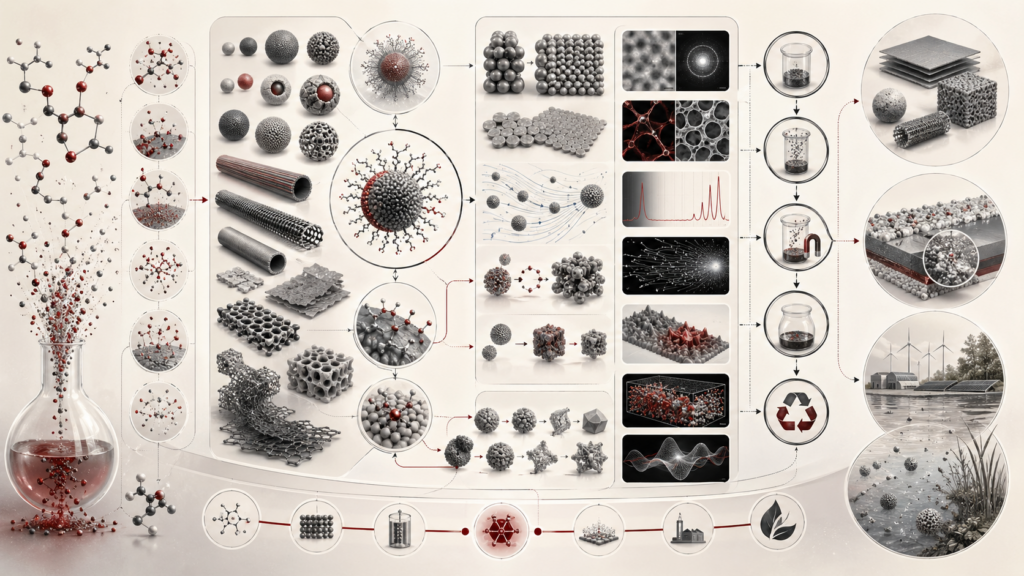
Abstract editorial scientific illustration showing nanochemistry as a molecular-scale materials workflow connecting nanoparticles, quantum dots, nanowires, nanosheets, ligand shells, self-assembly, characterization, stability testing, lifecycle pathways, and responsible design.

Nanochemistry and Molecular-Scale Materials

Nanochemistry studies chemical systems whose structure, reactivity, assembly, and function are shaped by dimensions on the nanometer scale. This article explains why nanoscale materials can behave differently from bulk matter, showing how surface atoms, quantum confinement, curvature, defects, interfaces, ligand shells, aggregation, and local environment shape chemical behavior. It introduces nanoparticles, colloids, quantum dots, nanowires, nanotubes, nanosheets, porous nanomaterials, nanocomposites, self-assembled systems, nanocatalysts, nanosensors, and nanomedicine platforms. With mathematical framing, Python and R workflows, and a full GitHub scaffold, the article presents nanochemistry as a molecular-scale design field that requires careful characterization, exposure-aware thinking, stability testing, and responsible lifecycle design.
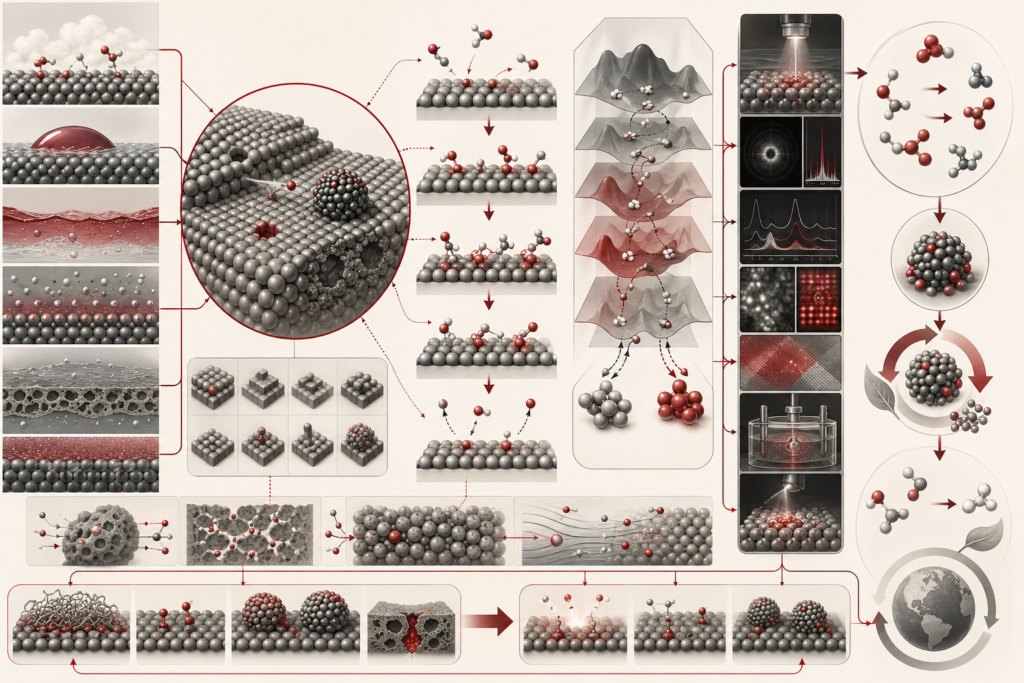
Abstract editorial scientific illustration showing surface chemistry as an interfacial workflow connecting phase boundaries, adsorption, active sites, catalytic pathways, characterization, regeneration, and sustainable chemical transformation.

Surface Chemistry, Interfaces, and Catalysis

Surface chemistry studies what happens where phases meet: solid and gas, solid and liquid, liquid and gas, electrode and electrolyte, catalyst and reactant, coating and substrate. This article explains why interfaces are chemically powerful, showing how adsorption, surface coverage, surface excess, wetting, interfacial energy, defects, active sites, charge transfer, diffusion, and surface reconstruction shape chemical behavior. It introduces heterogeneous catalysis, electrocatalysis, catalyst selectivity, deactivation, poisoning, regeneration, surface characterization, operando measurement, and sustainable catalyst design. With mathematical framing, Python and R workflows, and a full GitHub scaffold, the article presents surfaces and interfaces as chemically active regions where material structure, molecular binding, kinetics, transport, and responsible transformation converge.

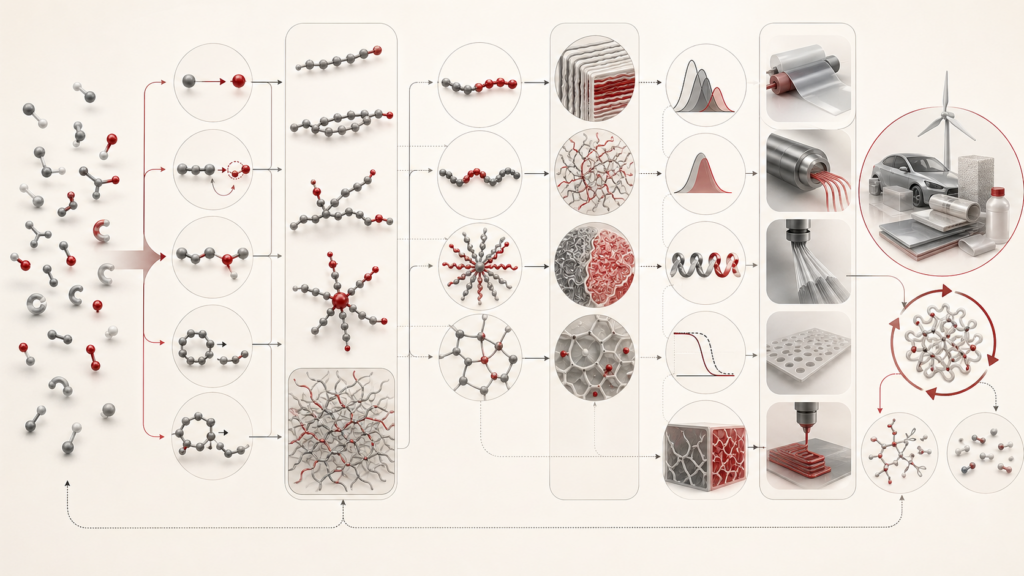
Abstract editorial scientific illustration showing polymer chemistry as a workflow connecting monomers, polymerization, chain architectures, morphology, processing, characterization, recycling, and functional macromolecular materials.

Polymer Chemistry and Macromolecular Materials

Polymer chemistry studies how small molecular units become macromolecules and how those macromolecules become materials with useful function. This article explains polymers as chemical systems shaped by monomer identity, polymerization mechanism, chain length, molar-mass distribution, architecture, stereochemistry, branching, crosslinking, crystallinity, glass transition, entanglement, additives, fillers, degradation, processing, and use environment. It introduces chain-growth, step-growth, ring-opening, coordination, and network-forming polymerization; examines copolymers, elastomers, thermoplastics, thermosets, hydrogels, fibers, membranes, and composites; and connects polymer structure to thermal, mechanical, transport, optical, surface, and sustainability behavior.

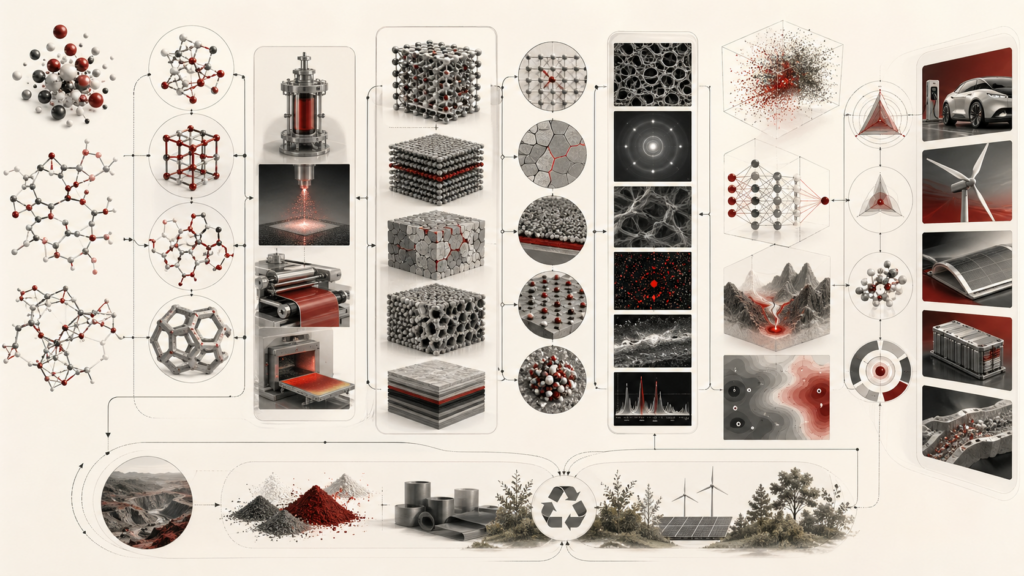
Abstract editorial scientific illustration showing materials chemistry as a design workflow connecting molecular composition, crystal structures, polymer chains, processing, microstructure, defects, characterization, computational screening, sustainability, and functional applications.

Materials Chemistry and the Design of Function

Materials chemistry studies how matter can be designed, synthesized, processed, characterized, and organized to produce useful function. This article explains how composition, bonding, structure, processing, defects, interfaces, morphology, and environment shape materials that conduct electricity, store energy, catalyze reactions, absorb light, separate gases, protect surfaces, filter water, or respond to stimuli. It introduces structure-property-processing-function relationships across polymers, ceramics, metals, semiconductors, porous materials, composites, biomaterials, and soft materials. With mathematical framing, Python and R workflows, and a full GitHub scaffold, the article treats materials chemistry as a design discipline that connects molecular and atomic structure to performance, sustainability, lifecycle constraints, and responsible functional innovation.

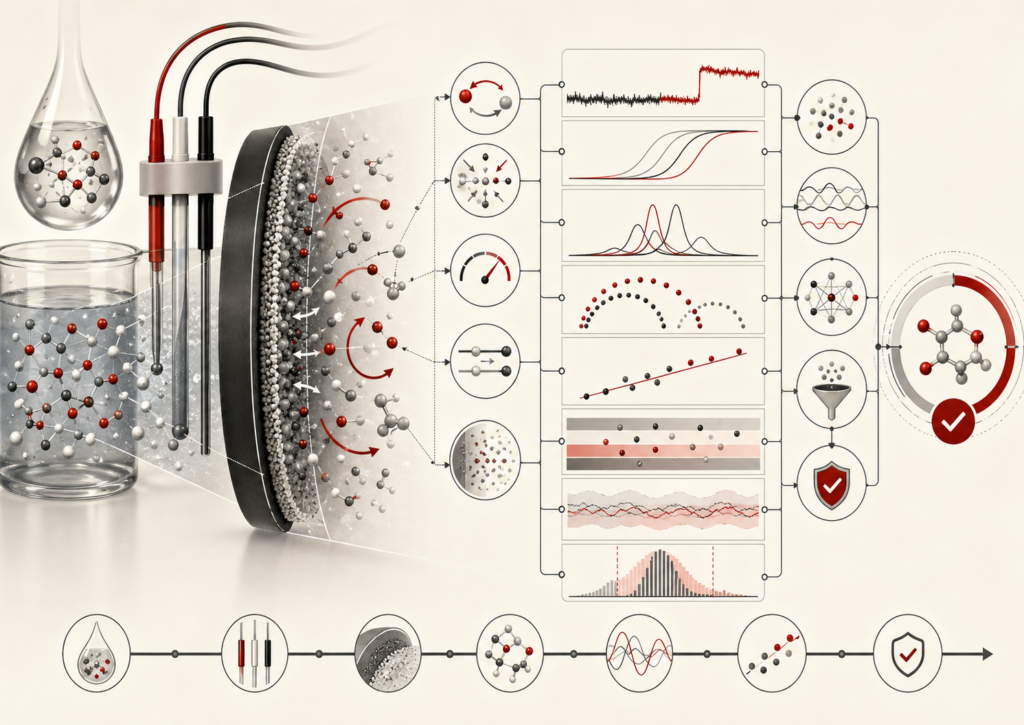
Abstract editorial scientific illustration showing electroanalytical chemistry as a sensor workflow connecting electrode interfaces, redox reactions, ion activity, electrical signals, calibration, drift, interference analysis, and validated chemical detection.

Electroanalytical Chemistry and Chemical Sensors

Electroanalytical chemistry measures chemical systems through electrical signals such as potential, current, charge, conductivity, resistance, capacitance, and impedance. This article explains how chemical sensors convert analyte activity, redox reactions, interfacial charge, diffusion, adsorption, and binding events into measurable electrical evidence. It introduces potentiometry, amperometry, voltammetry, coulometry, conductometry, impedance, electrode interfaces, reference electrodes, transduction mechanisms, selectivity, interference, drift, and validation. With mathematical framing around the Nernst equation, Faraday’s law, the Cottrell equation, calibration models, and detection limits, the article shows why electrochemical sensor outputs must be interpreted through calibration, matrix effects, electrode materials, uncertainty, and deployment context.

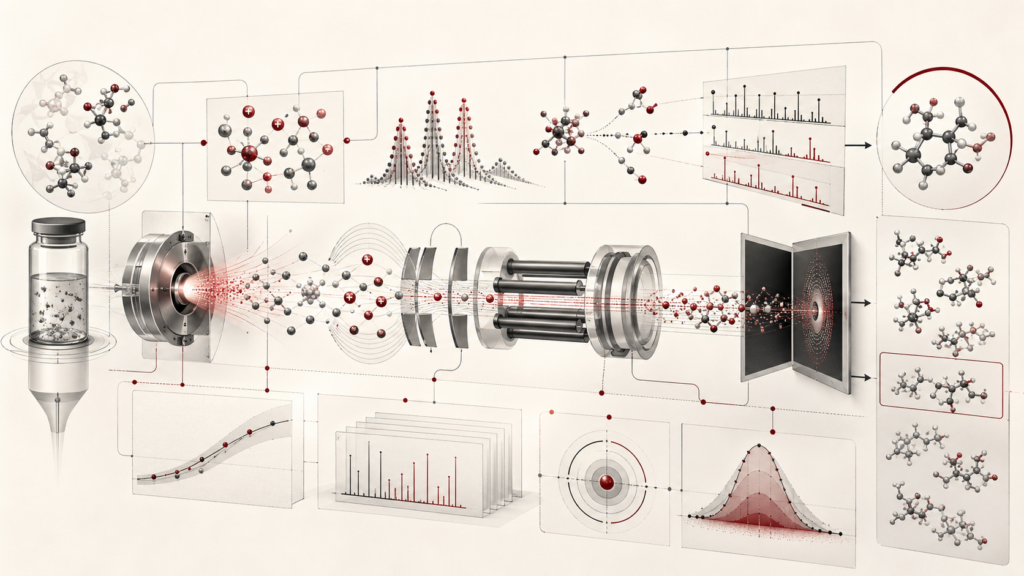
Abstract editorial scientific illustration showing mass spectrometry as a molecular detection workflow connecting sample introduction, ionization, charged molecules, mass-to-charge separation, isotope patterns, fragmentation, detector response, calibration, and chemical identification.

Mass Spectrometry and Molecular Detection

Mass spectrometry is one of chemistry’s most powerful methods for detecting molecules by transforming them into ions and measuring their mass-to-charge behavior. This article explains how ionization, mass analyzers, detector response, isotope patterns, fragmentation, chromatography coupling, calibration, and spectral libraries support molecular detection and chemical identification. It distinguishes detected features from confirmed compounds, showing why exact mass alone is not definitive evidence of identity. The article surveys electron ionization, electrospray ionization, MALDI, quadrupoles, time-of-flight instruments, ion traps, Orbitrap systems, tandem MS, GC-MS, and LC-MS. With mathematical framing, Python and R workflows, and a full GitHub code scaffold, it presents mass spectrometry as a rigorous evidence system for molecular detection, quantification, and reproducible analytical chemistry.

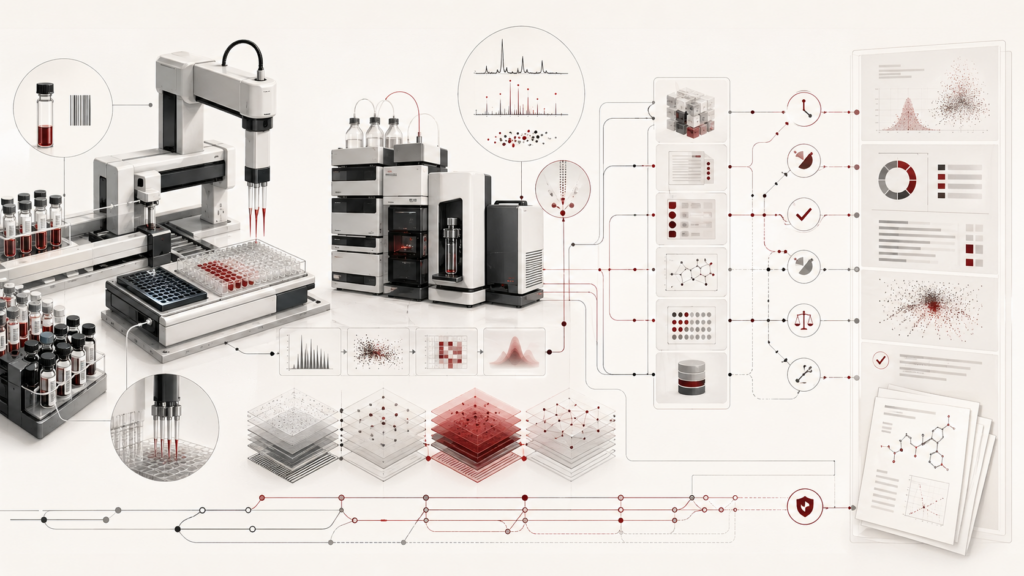
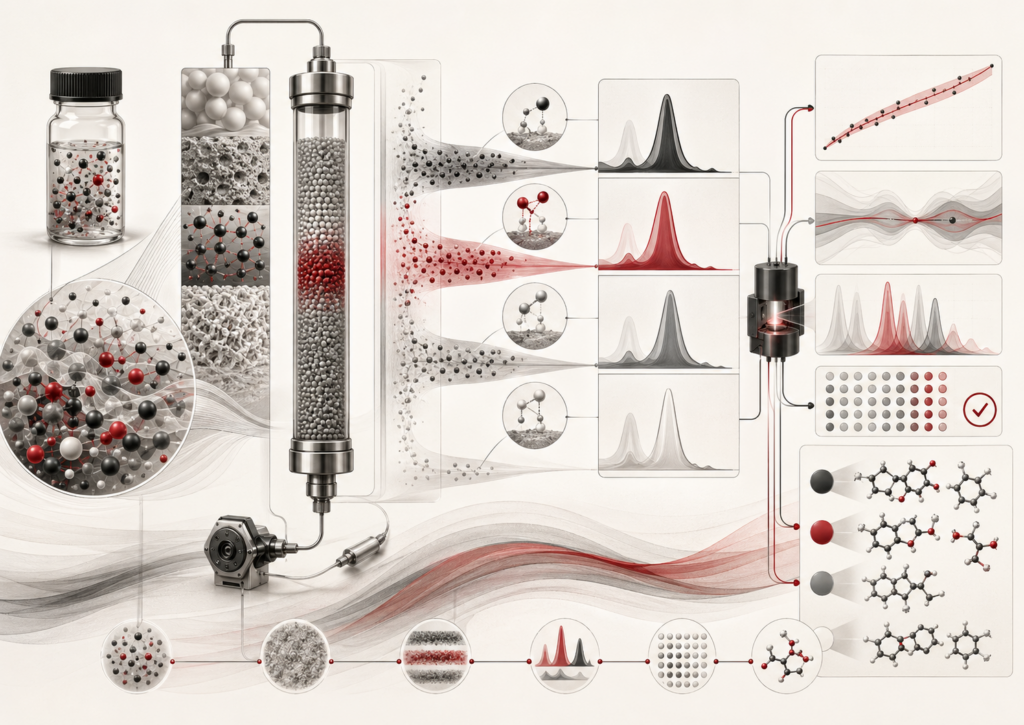
Abstract editorial scientific illustration showing chromatography as a separation workflow moving from complex chemical mixtures through a column, separated bands, detector response, peak patterns, calibration, quality control, and molecular identification.

Chromatography, Separation Science, and Chemical Identification

Chromatography is one of chemistry’s most important methods for making complex mixtures intelligible. By separating compounds before detection, chromatography transforms environmental extracts, biological fluids, food matrices, reaction mixtures, pharmaceutical impurities, industrial formulations, and other complex samples into ordered chemical evidence. This article explains chromatography as both separation science and chemical identification, covering stationary and mobile phases, retention time, selectivity, resolution, theoretical plates, calibration, peak integration, quality control, and uncertainty. It surveys major methods including gas chromatography, liquid chromatography, thin-layer chromatography, ion chromatography, size-exclusion chromatography, affinity chromatography, and chiral chromatography.

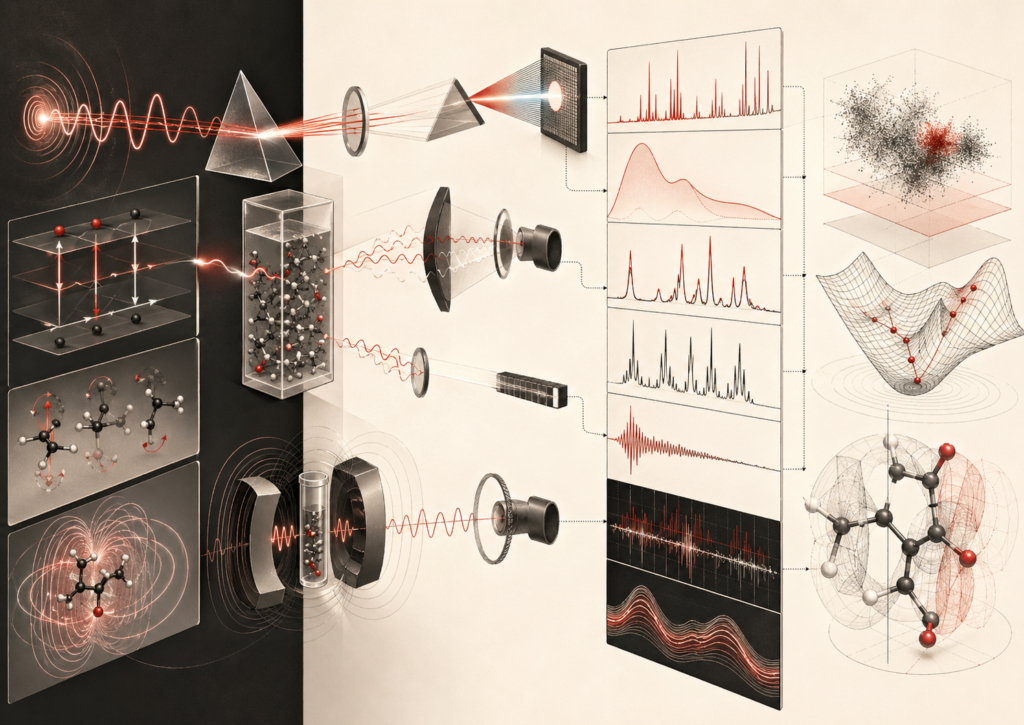
Abstract editorial scientific illustration showing spectroscopy as a workflow from radiation interacting with molecular samples to spectral signals, instrument pathways, data processing, and structural interpretation.

Spectroscopy and the Measurement of Molecular Structure

Spectroscopy is one of chemistry’s most powerful methods for turning invisible molecular structure into measurable evidence. By studying how matter absorbs, emits, scatters, or responds to radiation and magnetic fields, spectroscopy reveals functional groups, bonding, geometry, concentration, electronic structure, local chemical environments, and material state. This article explains spectroscopy as an evidence system rather than a simple catalog of peaks. It introduces the physical relationships among energy, wavelength, frequency, wavenumber, absorbance, molecular vibrations, electronic transitions, and NMR resonance. It also surveys major methods including infrared, Raman, UV-visible, fluorescence, NMR, X-ray, and photoelectron spectroscopy.

Scroll to Top