
Last Updated May 28, 2026
Electroanalytical chemistry measures chemical systems through electrical signals. Instead of observing color, mass, light absorption, retention time, or molecular fragmentation alone, it asks how chemical species exchange charge, alter potential, carry current, change impedance, accumulate at interfaces, modify electrode surfaces, or respond to applied electrical fields. This makes electroanalysis especially powerful for detecting ions, redox-active molecules, gases, biomarkers, pollutants, metals, metabolites, nutrients, pharmaceuticals, corrosion products, and surface reactions in real time.
The central thesis of this article is that electrochemical signals are not merely electrical outputs. They are structured chemical evidence produced at interfaces and shaped by thermodynamics, kinetics, mass transport, electrode materials, reference systems, calibration, fouling, interference, and uncertainty. A sensor current, potential, impedance spectrum, or voltammetric peak becomes meaningful only when connected to analyte chemistry, electrode state, measurement conditions, calibration model, signal processing, validation evidence, and decision context.
Electroanalytical chemistry is therefore both a measurement discipline and a sensor science. It connects redox reactions, ion activity, electrode interfaces, transduction mechanisms, data processing, field deployment, quality control, and responsible interpretation. Chemical sensors become scientifically useful only when the relationship between analyte, electrode, recognition layer, electrical signal, calibration, selectivity, drift, and validation is made visible.
Main Library
Publications
Article Map
Chemistry
Related Topic
Data Systems & Analytics
Related Topic
Environmental Monitoring Systems
Related Topic
Embedded & Edge Systems
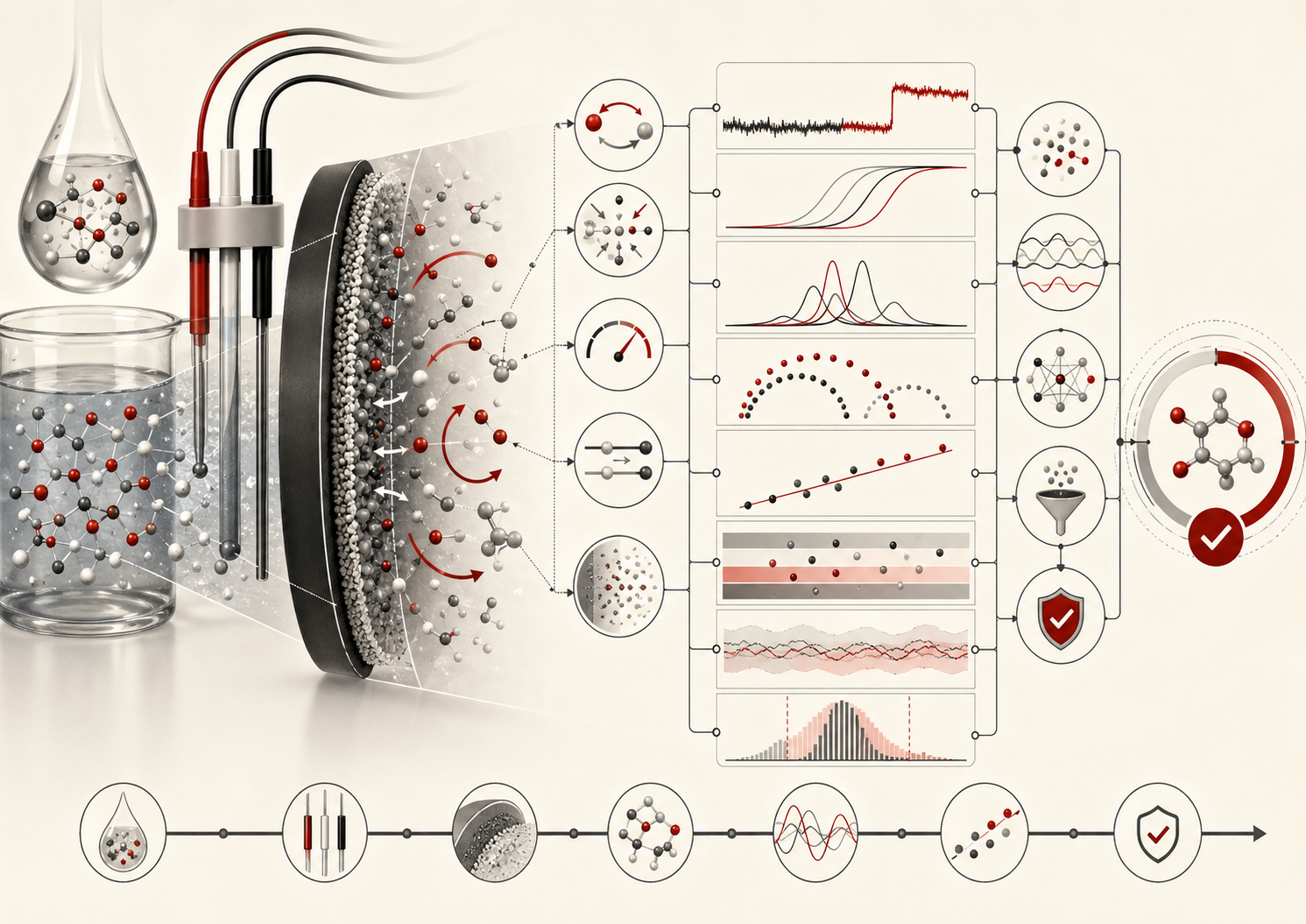
What Electroanalytical Chemistry Measures
Electroanalytical chemistry studies chemical systems by measuring electrical quantities such as potential, current, charge, conductivity, resistance, capacitance, and impedance. These quantities become analytically meaningful because chemical species can participate in oxidation-reduction reactions, alter ion activity, change interfacial charge distribution, move through solution under concentration gradients, adsorb to electrode surfaces, form films, or modify the electrical properties of an electrode interface.
In potentiometric measurements, the signal is an electrical potential related to chemical activity. A pH electrode is the familiar example: the measured potential reflects hydrogen-ion activity through the behavior of an ion-selective glass membrane and reference electrode system. In amperometric measurements, the signal is current generated by oxidation or reduction of an analyte at a controlled potential. In voltammetric methods, the potential is varied and the resulting current response provides information about redox behavior, concentration, kinetics, adsorption, and transport. In conductometric and impedimetric methods, the signal reflects changes in conductivity or impedance caused by ions, reactions, binding events, coatings, corrosion, interfaces, or biological recognition layers.
The distinctive strength of electroanalysis is that it can be direct, sensitive, inexpensive, miniaturizable, and compatible with field deployment. Electrochemical sensors can operate in water, blood, sweat, soil extracts, industrial streams, gas environments, food matrices, microfluidic systems, and process equipment. They can be made from metals, carbon, semiconductors, polymers, nanomaterials, enzymes, membranes, molecularly imprinted polymers, and biological recognition layers.
But this same flexibility creates risk. Signals can be affected by interferences, electrode fouling, drift, temperature, pH, ionic strength, oxygen, sample matrix, reference-electrode condition, surface contamination, and uncontrolled surface chemistry. A sensor signal is therefore not merely a number. It is a response of a chemical interface under specified conditions.
For researchers and scientists, electroanalytical chemistry requires discipline at three levels: chemical mechanism, measurement system, and evidence interpretation. The analyte must produce a meaningful electrochemical response. The electrode and instrument must convert that response into reliable signal. The calibration and validation system must justify the reported conclusion.
The Electrochemical Interface
Electroanalytical chemistry happens at interfaces. The electrode is not merely a wire. It is a chemically active boundary where electronic conduction in a solid meets ionic conduction in a solution, gas, gel, film, membrane, or biological medium. At this boundary, charge may accumulate, ions may reorganize, molecules may adsorb, electrons may transfer, surface films may form, and chemical reactions may become measurable as electrical signals.
The electrochemical interface contains multiple coupled regions. The electrode surface may contain defects, oxide layers, functional groups, adsorbed molecules, catalysts, pores, nanoparticles, polymer coatings, or biological recognition layers. The solution near the electrode may contain a double layer, concentration gradients, pH gradients, dissolved oxygen, supporting electrolyte, interferents, and reaction products. The measured signal emerges from this coupled interfacial system.
A typical electrochemical cell includes a working electrode, reference electrode, and counter electrode. The working electrode is where the analytical reaction or sensing event is monitored. The reference electrode provides a stable potential reference. The counter electrode completes the circuit and carries current. In two-electrode systems, functions may be combined, but three-electrode configurations are common when control of working-electrode potential is important.
The electrode surface controls much of the chemistry. Surface roughness, crystallographic orientation, oxide layers, functional groups, porosity, catalytic sites, biofilm formation, polymer coatings, nanostructures, and adsorbed contaminants can all change response. A sensor is therefore not defined only by its analyte. It is defined by the interface that converts chemical presence into an electrical signal.
Interfaces also change over time. Electrodes can foul, passivate, corrode, oxidize, reduce, restructure, adsorb proteins, accumulate reaction products, lose enzymes, dry out, swell, or become coated by environmental matter. A calibration performed at one moment may not describe sensor behavior after repeated use, storage, cleaning, sterilization, or field deployment.
For researchers, the practical lesson is that electrochemical measurement is surface-sensitive evidence. The same analyte may produce different responses on gold, platinum, carbon, boron-doped diamond, mercury, metal oxide, screen-printed carbon, enzyme-modified electrodes, or nanostructured surfaces. The interface is part of the method.
Electrodes, Reference Systems, and Cell Configuration
Electroanalytical results depend on electrode configuration. The working electrode provides the analytical surface. The reference electrode provides a stable potential reference. The counter electrode carries current so that the working electrode can be controlled. Supporting electrolyte controls solution resistance and ionic strength. Cell geometry, stirring, flow, temperature, and sample volume can all influence the signal.
Reference electrodes are especially important because potential is always measured relative to a reference. Common reference systems include silver/silver chloride, saturated calomel, mercury/mercurous sulfate, and pseudo-reference electrodes in miniaturized or nonaqueous systems. Reference-electrode drift, junction potentials, chloride leakage, clogging, evaporation, or contamination can shift measured potentials and distort interpretation.
Electrode area and geometry matter. A macroelectrode may produce transient diffusion layers and capacitive background currents. A microelectrode can produce radial diffusion and rapid steady-state responses. Porous electrodes can increase surface area but complicate mass transport. Screen-printed electrodes can be inexpensive and disposable but may vary by manufacturing batch. Nanostructured electrodes can improve signal but may also increase background, fouling, and reproducibility challenges.
Cell configuration also influences uncompensated resistance and potential control. In poorly conductive media, high current can produce voltage drops that shift effective electrode potential. Electrode placement, electrolyte conductivity, current magnitude, and cell geometry all matter. For quantitative electroanalysis, instrument settings and cell design should be reported with enough detail to reproduce the potential and current conditions.
For researchers, electrode systems should not be treated as interchangeable accessories. They define the measurement environment. Strong electroanalytical reporting includes working-electrode material, surface preparation, geometric or effective area, reference electrode, counter electrode, electrolyte, pH, temperature, oxygen status, stirring or flow, and conditioning history.
Major Electroanalytical Methods
Potentiometry
Potentiometry measures potential under conditions where little or no current flows. The signal is related to the activity of an ion or chemical species through an electrode system. Ion-selective electrodes, glass pH electrodes, fluoride electrodes, chloride electrodes, nitrate electrodes, and other membrane-based sensors are common examples. Potentiometry is attractive because it can be simple, low-power, and selective when the membrane or recognition chemistry is well designed.
The challenge is that potentiometric signals depend on activity, not simply concentration. Ionic strength, interfering ions, membrane conditioning, junction potentials, temperature, and calibration history can affect results. A potentiometric sensor must therefore be calibrated and interpreted within a defined chemical context.
Amperometry
Amperometry measures current at a controlled potential. If an analyte is oxidized or reduced at the working electrode, the measured current can be related to its concentration under defined mass-transport and kinetic conditions. Many chemical sensors are amperometric because current can be measured continuously and because the signal can be sensitive to low analyte concentrations.
Glucose sensors are a major example. In enzymatic designs, glucose oxidase or related chemistry converts glucose recognition into an electrochemical signal. Amperometric sensing is also used for oxygen, hydrogen peroxide, nitrite, sulfide, chlorine, neurotransmitters, pharmaceuticals, metals, and environmental contaminants. However, selectivity can be difficult because multiple species may oxidize or reduce at similar potentials.
Voltammetry
Voltammetry measures current while the applied potential is swept, stepped, pulsed, or otherwise varied. Cyclic voltammetry is widely used to explore redox behavior, reversibility, formal potentials, diffusion, adsorption, electrode kinetics, and coupled chemical reactions. Differential pulse voltammetry and square-wave voltammetry can improve sensitivity and resolution by suppressing background currents and emphasizing faradaic response.
Voltammetry is both analytical and mechanistic. A peak can indicate a redox process. Peak position provides information about potential. Peak current can relate to concentration. Peak separation and shape can reveal kinetic or reversibility information. But voltammograms require careful interpretation because background current, uncompensated resistance, adsorption, fouling, dissolved oxygen, pH, scan rate, and electrode history can all distort response.
Coulometry
Coulometry measures total charge passed during an electrochemical process. If the reaction goes to completion and the number of electrons is known, charge can be used to determine the amount of substance. Coulometry can be highly accurate because it is connected directly to Faraday’s constant, but it requires careful control of reaction completeness, side reactions, background currents, and cell efficiency.
Conductometry
Conductometric methods measure solution conductivity or changes in conductance. They are useful for ionic strength, acid-base titrations, water quality, gas sensing through electrolyte changes, and simple ion detection. Conductometric sensors can be simple and rugged, but selectivity is often limited unless the measurement is paired with selective membranes, reactions, separations, or pattern-recognition approaches.
Electrochemical Impedance Spectroscopy
Electrochemical impedance spectroscopy measures frequency-dependent response. It can probe charge transfer, double-layer capacitance, diffusion, coatings, corrosion, films, membranes, biosensor binding events, and interfacial structure. Impedance methods are powerful because they can separate processes that occur at different time scales, but they require careful equivalent-circuit modeling and validation.
For researchers, method selection should follow the chemical question. Potentiometry is appropriate for activity-based ion sensing. Amperometry is useful for continuous redox-active analyte detection. Voltammetry is useful for redox mechanisms and concentration analysis. Impedance is useful for interfacial films and binding events. Coulometry is useful when complete charge accounting is possible. No electroanalytical method is universally superior; each has assumptions.
Chemical Sensors and Transduction
A chemical sensor converts chemical information into a measurable signal. In electrochemical sensors, the transduction mechanism is electrical: potential, current, conductance, resistance, capacitance, or impedance changes in response to an analyte or chemical event. The sensor usually combines a recognition element with a transducer.
Recognition elements include ion-selective membranes, enzymes, antibodies, aptamers, molecularly imprinted polymers, catalytic surfaces, redox mediators, metal-organic frameworks, nanostructured materials, conducting polymers, and functionalized carbon surfaces. The transducer converts the chemical recognition event into an electrical signal. A good sensor must therefore solve two problems at once: chemical selectivity and signal transduction.
Important sensor characteristics include:
- Sensitivity: how strongly the signal changes with analyte concentration.
- Selectivity: how well the sensor distinguishes the target analyte from interferents.
- Limit of detection: the smallest amount that can be reliably distinguished from background.
- Linear range: the concentration interval over which response can be modeled reliably.
- Response time: how quickly the sensor reaches a usable signal.
- Stability: whether the signal remains reliable over repeated use, storage, and deployment.
- Reversibility: whether the sensor returns to baseline after exposure.
- Robustness: whether performance persists under realistic sample conditions.
A sensor that performs well in a clean buffer may fail in a biological fluid, river water, soil extract, industrial stream, or food matrix. Sensor evaluation must therefore include the matrix in which the device is expected to operate.
Transduction also matters because different electrical signals encode different chemical events. A potentiometric sensor responds to activity. An amperometric sensor responds to current from redox reaction or mediator cycling. An impedimetric biosensor may respond to binding-induced changes in charge-transfer resistance or capacitance. A conductometric sensor responds to changes in ionic conduction. A sensor report should therefore explain not only what signal changed, but why that signal is chemically meaningful.
For researchers, sensor design should begin with the full chain of evidence: analyte, recognition chemistry, electrode material, interface, transduction mode, calibration model, interferences, drift, validation, and decision use. A signal without this chain is not yet a reliable sensor.
Selectivity, Interference, and Sensor Reliability
Selectivity is one of the central challenges in electrochemical sensing. Many species can undergo oxidation or reduction at overlapping potentials. A sensor designed for one analyte may respond to another. In biological samples, ascorbic acid, uric acid, acetaminophen, dopamine, glucose, proteins, salts, and dissolved oxygen may interfere depending on the target system. In environmental samples, metal ions, natural organic matter, pH, chloride, sulfide, nitrate, dissolved oxygen, suspended particles, and biofouling can change response.
Interferences arise through several mechanisms:
- direct oxidation or reduction of another species;
- competition for active sites or membrane transport;
- changes in pH, ionic strength, conductivity, or oxygen concentration;
- surface fouling or adsorption;
- matrix suppression or enhancement;
- electrode poisoning;
- gas crossover or membrane permeability;
- temperature-dependent response shifts;
- biofilm formation or protein adsorption;
- reference-electrode instability or junction potential shifts.
Reliable sensors must be tested against realistic interferents and validated under expected use conditions. A calibration curve alone is not enough. A credible sensor report should include selectivity studies, repeatability, reproducibility, response time, drift, stability, recovery, matrix testing, blank response, and uncertainty.
Sensor reliability also depends on distinguishing sensitivity from usefulness. A sensor may have a low detection limit in clean buffer but fail in complex matrices because of fouling, drift, cross-sensitivity, or calibration instability. A sensor may respond strongly to an analyte but also respond strongly to common interferents. A sensor may be precise in the laboratory but unstable in field temperature cycles.
For researchers, selectivity testing should be designed from the sample environment. A river-water sensor should be tested in waters with natural organic matter, suspended solids, dissolved ions, pH variation, temperature variation, and biofouling risk. A biomedical sensor should be tested against relevant metabolites, proteins, salts, drugs, and biological matrices. A food sensor should be tested in the food matrix, not only in buffer.
Mass Transport, Electrode Kinetics, and Surface Effects
Electroanalytical signals depend on how analyte molecules reach the electrode, how fast electrons transfer, and how the surface changes during measurement. Mass transport can occur by diffusion, migration, and convection. Diffusion arises from concentration gradients. Migration arises from electric fields acting on charged species. Convection arises from stirring, flow, vibration, or movement of the sample. Supporting electrolyte is often used to suppress migration so that diffusion and convection can be better controlled.
Electrode kinetics describe how quickly electrons transfer between the electrode and chemical species. A reaction may be thermodynamically possible but kinetically slow. Electrode materials and surface modification can lower overpotential, increase apparent rate, or change selectivity. Catalytic electrodes and mediators are often used to make otherwise sluggish reactions analytically useful.
Surface effects are especially important. Adsorption can preconcentrate analytes and improve sensitivity, but it can also cause fouling or memory effects. Oxide layers can enable or block reactions. Nanostructures can increase area and catalytic activity, but they can also increase background current or reproducibility challenges. Polymer films can provide selectivity, but they can swell, age, or exclude analyte under some conditions.
Mass transport and kinetics can also shape calibration. At low concentrations, current may be proportional to concentration. At higher concentrations, active sites can saturate, diffusion can limit response, or reaction products can accumulate. A linear range should therefore be demonstrated, not assumed.
For researchers, electroanalytical interpretation should ask whether the signal is controlled by analyte concentration, diffusion, kinetics, adsorption, surface coverage, background current, or matrix effects. A measured current is not automatically a concentration; it is the result of an electrochemical system.
Electrode Materials, Miniaturization, and Sensor Platforms
Electrochemical sensors are highly material-dependent. Platinum, gold, glassy carbon, boron-doped diamond, carbon paste, screen-printed carbon, graphene, carbon nanotubes, metal oxides, conducting polymers, silicon nanowires, metal nanoparticles, and enzyme-modified electrodes all create different interfacial environments. Electrode materials can improve sensitivity, reduce overpotential, enhance selectivity, resist fouling, increase surface area, or enable miniaturized devices.
Screen-printed electrodes are important because they allow low-cost, disposable, and portable electrochemical testing. Microelectrodes and nanoelectrodes can change mass-transport behavior and support rapid steady-state response. Microfabricated sensors can integrate heaters, electrodes, membranes, and electronics. Wearable sensors can monitor sweat chemistry. Implantable or minimally invasive sensors can support biomedical research. Environmental sensors can support field monitoring of water, soil, and air.
Miniaturization does not automatically improve analytical validity. Smaller sensors may suffer from fabrication variability, surface contamination, calibration instability, limited lifetime, or matrix effects. A rigorous sensor platform must connect material design to analytical performance.
Electrode materials also raise responsible-design questions. Noble metals may provide excellent performance but increase cost and material-sourcing concerns. Nanomaterials can improve sensitivity but introduce reproducibility, exposure, and lifecycle questions. Disposable sensors can improve field access but create waste. Wearable and implanted sensors can provide rich data but raise privacy, medical interpretation, and validation issues.
For researchers, electrode material selection should be justified by the analyte, matrix, operating potential, fouling risk, manufacturing method, stability, calibration needs, and end-use context. The electrode is not only a transducer; it is a designed chemical interface.
Biosensors, Enzymes, Recognition Layers, and Biointerfaces
Electrochemical biosensors combine biological recognition with electrical transduction. Enzymes, antibodies, aptamers, nucleic acids, cells, receptors, peptides, and biomimetic materials can be immobilized on or near electrodes to detect specific analytes or biological events. Glucose sensors are the most familiar electrochemical biosensors, but the broader field includes lactate, cholesterol, neurotransmitters, pathogens, nucleic acids, proteins, toxins, hormones, and inflammatory markers.
Enzymatic biosensors often rely on a reaction that produces or consumes an electroactive species. For example, an enzyme may convert an analyte into hydrogen peroxide or use a redox mediator to shuttle electrons to the electrode. The signal depends not only on analyte concentration, but also on enzyme activity, immobilization chemistry, mediator behavior, oxygen availability, pH, temperature, film thickness, diffusion, and stability.
Affinity biosensors may detect binding events through impedance, capacitance, current suppression, redox-label changes, or surface blocking. These systems require careful control because nonspecific adsorption, protein fouling, matrix effects, and incomplete regeneration can produce false signals. Biological recognition does not eliminate the need for electrochemical validation.
Biointerfaces are dynamic. Proteins can adsorb to surfaces. Enzymes can denature. Membranes can swell. Cells can attach or die. Biological fluids can foul electrodes. Sterilization can damage recognition layers. Long-term operation can shift baselines and sensitivity. Biosensors must therefore be evaluated over time and under realistic biological conditions.
For researchers, electrochemical biosensor claims should distinguish proof-of-concept detection from validated biological measurement. A sensor that detects a purified biomarker in buffer has not yet demonstrated performance in serum, saliva, sweat, urine, interstitial fluid, or tissue unless those matrices have been tested.
Environmental, Industrial, and Field Sensing
Electrochemical sensors are attractive for environmental and industrial monitoring because they can be portable, low-cost, low-power, and compatible with continuous measurement. They can detect dissolved oxygen, pH, conductivity, oxidation-reduction potential, chlorine, sulfide, nitrite, nitrate, heavy metals, corrosion products, nutrients, gases, and organic contaminants. They can also support monitoring in water systems, wastewater, soil extracts, air, process streams, pipelines, storage tanks, and corrosion environments.
Field sensing is difficult because real samples are chemically complex. Temperature changes, suspended solids, biofilms, variable ionic strength, natural organic matter, flow rate, pressure, bubbles, pH, redox conditions, and fouling can all affect response. A field sensor must therefore be evaluated not only for sensitivity, but for robustness, calibration maintenance, drift, cleaning, sensor replacement, power supply, data transmission, and failure detection.
Industrial electrochemical monitoring often emphasizes reliability and maintenance. A corrosion sensor, process pH sensor, dissolved oxygen probe, or gas sensor may operate under harsh conditions. Signal stability, calibration frequency, electrode lifetime, membrane integrity, and maintenance procedures can be more important than ultra-low detection limits.
Environmental decision-making also requires appropriate evidence standards. A sensor can be excellent for screening, early warning, trend monitoring, or adaptive sampling while still requiring confirmatory laboratory analysis for enforcement or public-health decisions. Responsible field deployment should specify whether the sensor supports screening, monitoring, compliance, diagnosis, or research.
For researchers, field validation should include comparison against reference methods, realistic deployment duration, environmental variability, matrix effects, calibration drift, sensor replacement, and data-quality flags. Field sensors are not judged only by laboratory calibration curves; they are judged by performance under the conditions they claim to monitor.
Instrumentation, Data, and Signal Processing
Electroanalytical instruments range from simple potentiometers to sophisticated potentiostats, impedance analyzers, multiplexed sensor arrays, microfluidic devices, wireless field platforms, and integrated wearable systems. A potentiostat controls the working electrode potential relative to a reference electrode and measures current through the counter electrode. The quality of this control affects voltammetric and amperometric data.
Electrochemical data processing may include baseline subtraction, smoothing, peak detection, integration, background correction, drift correction, impedance fitting, equivalent-circuit modeling, temperature compensation, calibration fitting, and sensor-array classification. Each processing step can affect the final conclusion. A voltammetric peak may shift with pH or scan rate. An amperometric baseline may drift. An impedance spectrum may be fit by more than one equivalent circuit. A machine-learning sensor array may overfit laboratory data and fail in real samples.
Good electrochemical data practice includes:
- recording electrode material, geometry, surface preparation, and modification chemistry;
- documenting reference electrode type and condition;
- recording electrolyte, pH, ionic strength, temperature, oxygen status, and stirring or flow conditions;
- preserving raw current, potential, time, frequency, phase, and impedance data;
- documenting baseline correction, drift correction, filtering, and peak-picking methods;
- reporting calibration range, sensitivity, detection limit, response time, repeatability, and selectivity;
- testing matrix effects and realistic interferences;
- linking sensor outputs to calibration and quality-control records.
Signal processing should be transparent. Filtering can reduce noise but also distort peaks. Baseline correction can improve quantification but introduce bias. Equivalent-circuit fitting can suggest mechanisms but may not be unique. Machine-learning classification can identify patterns but may hide fragile dependencies on training data. Electrochemical data pipelines should therefore preserve raw data, processing code or settings, model assumptions, and uncertainty.
For researchers, electrochemical instrumentation should be treated as part of the measurement method. Instrument settings, electrode configuration, acquisition parameters, and processing rules are not background details; they shape the evidence.
Quality Control, Validation, and Field Deployment
Electrochemical sensors often move from clean laboratory solutions toward complex real-world samples. This transition is difficult. A sensor may perform beautifully in buffer but fail in river water, serum, sweat, wastewater, soil leachate, food extract, gas streams, or industrial process fluids. Validation must therefore match intended use.
Quality-control practices may include blanks, calibration checks, replicate measurements, spike recovery, standard additions, interference panels, matrix-matched calibration, reference-method comparison, response-time testing, storage stability, repeated-use cycling, drift monitoring, electrode-to-electrode reproducibility, and field blanks. For deployable sensors, additional issues arise: power, temperature, humidity, biofouling, clogging, membrane degradation, wireless data integrity, calibration maintenance, and user handling.
Sensor validation should also state the decision context. A teaching sensor, screening sensor, research prototype, environmental early-warning device, clinical diagnostic sensor, and regulatory-compliance instrument do not require the same evidence standard. Overstating sensor readiness is a serious problem when results affect public health, safety, environmental enforcement, or clinical decisions.
Validation should include uncertainty. Sensitivity, intercept, detection limit, precision, bias, recovery, response time, selectivity, drift rate, lifetime, and failure modes should be quantified where relevant. A sensor that produces precise but biased readings is not accurate. A sensor that is accurate at the beginning of deployment but drifts rapidly may require frequent calibration or limited operating windows.
For researchers, validation should not be treated as a final figure in a paper. It is the bridge between electrochemical mechanism and responsible use. The stronger the consequence of the measurement, the stronger the validation burden.
Responsible Use of Electrochemical Sensor Evidence
Electrochemical sensors are increasingly used in high-consequence domains: medical diagnostics, environmental monitoring, workplace exposure, food safety, water quality, industrial control, wearable health devices, corrosion monitoring, and chemical security. Their portability and apparent simplicity can create misplaced confidence. A sensor reading can be easy to obtain but difficult to interpret correctly.
Responsible electrochemical practice includes:
- not treating an unvalidated sensor response as definitive chemical evidence;
- distinguishing prototype performance from validated measurement capability;
- testing realistic matrix effects and interferents;
- documenting calibration, drift, response time, and uncertainty;
- using reference methods when decisions are high consequence;
- preserving raw data and processing records;
- reporting sensor limitations honestly;
- avoiding clinical, environmental, forensic, or regulatory claims without appropriate validation.
Responsible use also includes data governance. Field and wearable sensors can generate continuous streams of chemical data. These data may affect health interpretation, workplace safety, infrastructure maintenance, or environmental response. Sensor systems should preserve calibration history, device identity, firmware version, sampling conditions, data-quality flags, and user or operator actions.
The ethical strength of electroanalytical chemistry lies in transparency. Electrical signals can make chemistry portable, rapid, and sensitive, but those signals become reliable evidence only when the electrode interface, calibration system, selectivity, uncertainty, and deployment context are scientifically accountable.
Mathematical Lens: Potential, Current, Charge, Diffusion, and Detection
Electroanalytical chemistry is built on quantitative relationships among chemical activity, potential, current, charge, diffusion, and concentration. The Nernst equation connects equilibrium electrode potential to chemical composition. A simplified form for a redox reaction is:
E = E^{\circ} – \frac{RT}{nF}\ln Q
\]
Interpretation: \(E\) is electrode potential, \(E^{\circ}\) is standard potential, \(R\) is the gas constant, \(T\) is thermodynamic temperature, \(n\) is the number of electrons transferred, \(F\) is Faraday’s constant, and \(Q\) is the reaction quotient.
At \(25^{\circ}\mathrm{C}\), a base-10 logarithmic form is often written as:
E = E^{\circ} – \frac{0.05916}{n}\log_{10}Q
\]
Interpretation: This relationship explains why potentiometric sensors often respond logarithmically to activity rather than linearly to concentration.
Faraday’s law connects charge to amount of substance:
Q = nFN
\]
Interpretation: \(Q\) is charge, \(n\) is the number of electrons per molecule or ion, \(F\) is Faraday’s constant, and \(N\) is amount of substance in moles.
If current is integrated over time, total charge can support quantitative analysis:
Q = \int i(t)\,dt
\]
Interpretation: Current is charge flow per unit time. Integrating current over time gives total charge, which can be related to amount of electroactive material when side reactions and background currents are controlled.
For diffusion-controlled chronoamperometry at a planar electrode under idealized conditions, the Cottrell equation gives:
i(t) = \frac{nFAc\sqrt{D}}{\sqrt{\pi t}}
\]
Interpretation: \(i(t)\) is current, \(A\) is electrode area, \(c\) is bulk concentration, \(D\) is diffusion coefficient, and \(t\) is time. This equation shows why current can decay with time even when concentration remains constant: the diffusion layer grows.
For reversible diffusion-controlled cyclic voltammetry under idealized conditions, peak current often scales with the square root of scan rate:
i_p \propto n^{3/2} A D^{1/2} C v^{1/2}
\]
Interpretation: \(i_p\) is peak current, \(A\) is electrode area, \(D\) is diffusion coefficient, \(C\) is concentration, and \(v\) is scan rate. Deviations can reveal adsorption, kinetic limitations, uncompensated resistance, or surface effects.
For practical sensor calibration, a simple amperometric model may be written as:
i_i = \beta_0 + \beta_1 c_i + e_i
\]
Interpretation: \(i_i\) is measured current, \(c_i\) is concentration, \(\beta_0\) is background current, \(\beta_1\) is sensitivity, and \(e_i\) is residual error.
A common approximate detection-limit expression is:
\mathrm{LOD} = \frac{3s_{\mathrm{blank}}}{\beta_1}
\]
Interpretation: \(s_{\mathrm{blank}}\) is the standard deviation of blank measurements. The expression is simple, but its meaning depends on how blanks are measured, whether the calibration model is valid, and whether noise behaves consistently across the relevant concentration range.
A simple drift model for a sensor signal can be written as:
s(t) = s_0 + kt + \varepsilon(t)
\]
Interpretation: \(s(t)\) is sensor signal at time \(t\), \(s_0\) is initial signal, \(k\) is drift rate, and \(\varepsilon(t)\) is residual noise. Drift matters because sensor calibration may become invalid over time.
These equations are useful because they make electroanalytical assumptions visible. Potential depends on activity. Current depends on reaction and transport. Charge depends on electron count and amount. Detection limits depend on noise and sensitivity. Drift depends on time and interface stability. The equations do not replace validation; they structure it.
Computational Workflows for Electroanalytical Chemistry
Computational workflows can make electroanalytical interpretation more transparent. A workflow can track electrode identity, surface preparation, reference electrode, electrolyte, method, potential program, sampling rate, calibration standards, blanks, raw signals, baseline correction, drift correction, calibration model, detection limit, unknown estimates, QC flags, matrix type, interferents, and validation status.
Useful workflows include amperometric calibration, potentiometric slope checks, voltammetric peak analysis, blank-noise estimation, detection-limit calculation, replicate precision summaries, drift modeling, sensor-array data processing, interference panels, field-deployment QC dashboards, impedance model tracking, and reference-method comparison. More advanced workflows may integrate potentiostat files, embedded sensor logs, microcontroller data, cloud telemetry, laboratory information systems, and machine-learning classification.
For researchers, computational workflows should preserve raw data and processing assumptions. A concentration estimate should link to calibration standards and blank measurements. A voltammetric peak should link to baseline correction and scan parameters. An impedance fit should link to the equivalent circuit and residuals. A field sensor reading should link to calibration history, temperature, device identity, and quality flags.
The examples below use synthetic data. They do not validate sensors, certify clinical or environmental measurements, approve regulatory results, or replace professional electroanalytical method validation. They demonstrate how electrochemical sensor reasoning can be structured, audited, and communicated responsibly.
Python Example: Amperometric Calibration and Detection Limits
The following Python example uses synthetic educational data to model an amperometric chemical sensor. It fits a calibration curve, estimates sensitivity, calculates a simple detection limit, evaluates unknown samples, flags estimates below the detection limit, and writes reproducible outputs. Real sensor validation requires matrix testing, interferences, drift, electrode-to-electrode variability, uncertainty analysis, and independent verification.
from pathlib import Path
from typing import Dict
import json

import numpy as np
import pandas as pd


# Synthetic amperometric sensor calibration workflow.
# Educational example only; not for clinical, environmental,
# industrial, forensic, or regulatory reporting.


def fit_linear_calibration(calibration: pd.DataFrame) -> Dict[str, float]:
    """Fit current = intercept + sensitivity * concentration."""

    x = calibration["concentration_uM"].to_numpy(dtype=float)
    y = calibration["current_uA"].to_numpy(dtype=float)

    sensitivity, intercept = np.polyfit(x, y, deg=1)
    predicted = intercept + sensitivity * x
    residuals = y - predicted

    ss_residual = float(np.sum(residuals ** 2))
    ss_total = float(np.sum((y - np.mean(y)) ** 2))
    r_squared = 1.0 - ss_residual / ss_total

    blank_current = calibration.loc[
        calibration["concentration_uM"] == 0,
        "current_uA",
    ]

    blank_sd = float(blank_current.std(ddof=1))
    limit_of_detection_uM = float(3.0 * blank_sd / sensitivity)

    return {
        "sensitivity_uA_per_uM": float(sensitivity),
        "intercept_uA": float(intercept),
        "r_squared": float(r_squared),
        "blank_standard_deviation_uA": blank_sd,
        "limit_of_detection_uM": limit_of_detection_uM,
    }


calibration = pd.DataFrame({
    "standard_id": [
        "blank_1",
        "blank_2",
        "blank_3",
        "std_01",
        "std_02",
        "std_03",
        "std_04",
        "std_05",
    ],
    "concentration_uM": [0, 0, 0, 5, 10, 25, 50, 100],
    "current_uA": [0.012, 0.015, 0.011, 0.188, 0.351, 0.842, 1.685, 3.372],
})

unknowns = pd.DataFrame({
    "sample_id": [
        "unknown_A",
        "unknown_A",
        "unknown_A",
        "unknown_B",
        "unknown_B",
        "unknown_B",
    ],
    "replicate_id": ["r1", "r2", "r3", "r1", "r2", "r3"],
    "current_uA": [1.214, 1.238, 1.205, 2.112, 2.090, 2.128],
})

calibration_result = fit_linear_calibration(calibration)

sensitivity = calibration_result["sensitivity_uA_per_uM"]
intercept = calibration_result["intercept_uA"]
lod = calibration_result["limit_of_detection_uM"]

unknowns["estimated_concentration_uM"] = (
    (unknowns["current_uA"] - intercept) / sensitivity
)

unknowns["below_detection_limit"] = unknowns["estimated_concentration_uM"] < lod

summary = (
    unknowns
    .groupby("sample_id", as_index=False)
    .agg(
        mean_current_uA=("current_uA", "mean"),
        sd_current_uA=("current_uA", "std"),
        mean_concentration_uM=("estimated_concentration_uM", "mean"),
        sd_concentration_uM=("estimated_concentration_uM", "std"),
        replicate_count=("replicate_id", "count"),
        any_below_detection_limit=("below_detection_limit", "any"),
    )
)

output_dir = Path("outputs")
output_dir.mkdir(exist_ok=True)

calibration.to_csv(output_dir / "sensor_calibration_data.csv", index=False)
unknowns.to_csv(output_dir / "sensor_unknown_estimates.csv", index=False)
summary.to_csv(output_dir / "sensor_unknown_summary.csv", index=False)

manifest: Dict[str, object] = {
    "workflow": "synthetic_amperometric_sensor_calibration",
    "calibration_model": "current_uA = intercept + sensitivity * concentration_uM",
    **calibration_result,
    "responsible_use": [
        "Synthetic educational data only.",
        "Real sensors require validation for selectivity, matrix effects, drift, fouling, stability, uncertainty, and reference-method comparison where relevant.",
    ],
}

with (output_dir / "electrochemical_sensor_manifest.json").open(
    "w",
    encoding="utf-8"
) as file:
    json.dump(manifest, file, indent=2)

print(summary)
print("Sensitivity:", sensitivity, "uA/uM")
print("Estimated LOD:", lod, "uM")
print("R-squared:", calibration_result["r_squared"])
This workflow illustrates how electrochemical sensor values should be treated as outputs of a measurement system rather than isolated readings. The reported concentration depends on calibration, blank variability, electrode response, signal stability, and the assumption that the unknown sample behaves like the calibration standards.
R Example: Replicate Sensor Response and Drift Summary
The following R example summarizes synthetic repeated sensor measurements over time. It estimates drift, replicate precision, and concentration summaries from a calibration model. Drift is especially important for chemical sensors because electrode surfaces, membranes, enzymes, and coatings can change during storage or use.
# Synthetic electrochemical sensor drift and replicate workflow.
# Educational example only; not for validated field, clinical,
# industrial, environmental, or regulatory reporting.

calibration <- data.frame(
  concentration_uM = c(0, 0, 0, 5, 10, 25, 50, 100),
  current_uA = c(0.012, 0.015, 0.011, 0.188, 0.351, 0.842, 1.685, 3.372)
)

time_series <- data.frame(
  time_min = c(0, 5, 10, 15, 20, 25, 30, 35),
  sample_id = rep("sensor_check", 8),
  current_uA = c(1.000, 0.992, 0.984, 0.981, 0.973, 0.968, 0.961, 0.956)
)

unknowns <- data.frame(
  sample_id = c(
    "unknown_A", "unknown_A", "unknown_A",
    "unknown_B", "unknown_B", "unknown_B"
  ),
  current_uA = c(1.214, 1.238, 1.205, 2.112, 2.090, 2.128)
)

calibration_model <- lm(current_uA ~ concentration_uM, data = calibration)

intercept <- coef(calibration_model)[1]
slope <- coef(calibration_model)[2]

unknowns$estimated_concentration_uM <- (
  unknowns$current_uA - intercept
) / slope

unknown_summary <- aggregate(
  estimated_concentration_uM ~ sample_id,
  data = unknowns,
  FUN = function(x) c(mean = mean(x), sd = sd(x), n = length(x))
)

unknown_summary_clean <- data.frame(
  sample_id = unknown_summary$sample_id,
  mean_concentration_uM =
    unknown_summary$estimated_concentration_uM[, "mean"],
  sd_concentration_uM =
    unknown_summary$estimated_concentration_uM[, "sd"],
  replicate_count =
    unknown_summary$estimated_concentration_uM[, "n"]
)

drift_model <- lm(current_uA ~ time_min, data = time_series)

drift_summary <- data.frame(
  drift_slope_uA_per_min = coef(drift_model)[2],
  initial_current_uA = time_series$current_uA[1],
  final_current_uA = time_series$current_uA[nrow(time_series)],
  percent_change = 100 * (
    time_series$current_uA[nrow(time_series)] -
      time_series$current_uA[1]
  ) / time_series$current_uA[1]
)

unknown_summary_clean$precision_review_required <-
  unknown_summary_clean$sd_concentration_uM > 1.0

drift_summary$drift_review_required <-
  abs(drift_summary$percent_change) > 2.0

dir.create("outputs", showWarnings = FALSE)

write.csv(
  unknown_summary_clean,
  file = "outputs/electrochemical_unknown_summary.csv",
  row.names = FALSE
)

write.csv(
  drift_summary,
  file = "outputs/electrochemical_drift_summary.csv",
  row.names = FALSE
)

sink("outputs/electrochemical_sensor_report.txt")
cat("Synthetic Electrochemical Sensor Report\n")
cat("======================================\n\n")
cat("Calibration model:\n")
print(summary(calibration_model))
cat("\nUnknown concentration summary:\n")
print(unknown_summary_clean)
cat("\nDrift summary:\n")
print(drift_summary)
cat("\nResponsible-use note:\n")
cat("Synthetic educational data only. Real sensors require selectivity testing, matrix validation, uncertainty analysis, drift evaluation, and field comparison where relevant.\n")
sink()

print(unknown_summary_clean)
print(drift_summary)
The drift example is intentionally simple, but it points toward a broader principle. Chemical sensors must be evaluated over time, not only at a single calibration moment. Stability, fouling, baseline shift, hysteresis, and repeated-use performance often determine whether a sensor is practically useful.
SQL Example: Electrochemical Sensor Evidence Register
Electroanalytical interpretation becomes more reliable when electrode identity, calibration, raw signals, sensor results, interference testing, drift studies, and validation status are traceable. A simple evidence register can preserve the context needed to audit electrochemical sensor claims.
CREATE TABLE electrochemical_sensor (
    sensor_id TEXT PRIMARY KEY,
    sensor_name TEXT NOT NULL,
    target_analyte TEXT,
    transduction_mode TEXT,
    electrode_material TEXT,
    electrode_geometry TEXT,
    recognition_layer TEXT,
    intended_matrix TEXT,
    responsible_use_notes TEXT
);

CREATE TABLE electrochemical_method (
    method_id TEXT PRIMARY KEY,
    sensor_id TEXT NOT NULL,
    method_name TEXT,
    method_version TEXT,
    reference_electrode TEXT,
    counter_electrode TEXT,
    electrolyte_description TEXT,
    pH REAL,
    temperature_c REAL,
    potential_program TEXT,
    acquisition_parameters TEXT,
    validation_status TEXT,
    FOREIGN KEY (sensor_id) REFERENCES electrochemical_sensor(sensor_id)
);

CREATE TABLE calibration_record (
    calibration_id INTEGER PRIMARY KEY,
    sensor_id TEXT NOT NULL,
    method_id TEXT NOT NULL,
    calibration_datetime TEXT,
    calibration_model TEXT,
    sensitivity_uA_per_uM REAL,
    intercept_uA REAL,
    r_squared REAL CHECK (r_squared BETWEEN 0 AND 1),
    blank_standard_deviation_uA REAL CHECK (blank_standard_deviation_uA >= 0),
    limit_of_detection_uM REAL CHECK (limit_of_detection_uM >= 0),
    calibration_range_uM TEXT,
    quality_flag TEXT,
    FOREIGN KEY (sensor_id) REFERENCES electrochemical_sensor(sensor_id),
    FOREIGN KEY (method_id) REFERENCES electrochemical_method(method_id)
);

CREATE TABLE sensor_measurement (
    measurement_id INTEGER PRIMARY KEY,
    sensor_id TEXT NOT NULL,
    method_id TEXT NOT NULL,
    sample_id TEXT,
    sample_matrix TEXT,
    measurement_datetime TEXT,
    raw_data_uri TEXT,
    processed_data_uri TEXT,
    measured_signal_uA REAL,
    estimated_concentration_uM REAL,
    qc_status TEXT,
    limitation_notes TEXT,
    FOREIGN KEY (sensor_id) REFERENCES electrochemical_sensor(sensor_id),
    FOREIGN KEY (method_id) REFERENCES electrochemical_method(method_id)
);

CREATE TABLE interference_test (
    interference_id INTEGER PRIMARY KEY,
    sensor_id TEXT NOT NULL,
    interferent_name TEXT,
    interferent_concentration TEXT,
    target_concentration_uM REAL,
    signal_change_percent REAL,
    test_matrix TEXT,
    review_status TEXT,
    FOREIGN KEY (sensor_id) REFERENCES electrochemical_sensor(sensor_id)
);

CREATE TABLE drift_test (
    drift_id INTEGER PRIMARY KEY,
    sensor_id TEXT NOT NULL,
    test_datetime TEXT,
    test_duration_min REAL CHECK (test_duration_min >= 0),
    drift_slope_signal_per_min REAL,
    percent_signal_change REAL,
    storage_or_operating_condition TEXT,
    review_status TEXT,
    FOREIGN KEY (sensor_id) REFERENCES electrochemical_sensor(sensor_id)
);

CREATE TABLE sensor_validation_review (
    review_id INTEGER PRIMARY KEY,
    sensor_id TEXT NOT NULL,
    matrix_validation_completed INTEGER CHECK (matrix_validation_completed IN (0, 1)),
    interference_panel_completed INTEGER CHECK (interference_panel_completed IN (0, 1)),
    drift_review_completed INTEGER CHECK (drift_review_completed IN (0, 1)),
    reference_method_comparison_completed INTEGER CHECK (reference_method_comparison_completed IN (0, 1)),
    validation_scope TEXT,
    review_notes TEXT,
    FOREIGN KEY (sensor_id) REFERENCES electrochemical_sensor(sensor_id)
);

SELECT
    s.sensor_id,
    s.target_analyte,
    s.transduction_mode,
    s.electrode_material,
    s.intended_matrix,
    c.sensitivity_uA_per_uM,
    c.limit_of_detection_uM,
    m.sample_matrix,
    m.estimated_concentration_uM,
    m.qc_status,
    d.percent_signal_change,
    v.validation_scope,
    CASE
        WHEN m.qc_status != 'pass'
            THEN 'measurement QC review required'
        WHEN d.percent_signal_change IS NOT NULL
             AND ABS(d.percent_signal_change) > 5
            THEN 'drift review required'
        WHEN v.matrix_validation_completed = 0
            THEN 'matrix validation review required'
        WHEN v.interference_panel_completed = 0
            THEN 'interference review required'
        WHEN v.reference_method_comparison_completed = 0
            THEN 'reference comparison review required'
        ELSE 'standard review'
    END AS sensor_review_status
FROM electrochemical_sensor s
JOIN calibration_record c
    ON s.sensor_id = c.sensor_id
LEFT JOIN sensor_measurement m
    ON s.sensor_id = m.sensor_id
LEFT JOIN drift_test d
    ON s.sensor_id = d.sensor_id
LEFT JOIN sensor_validation_review v
    ON s.sensor_id = v.sensor_id
ORDER BY sensor_review_status, s.sensor_id;
The purpose of this register is to keep electrochemical sensor interpretation attached to evidence. A concentration estimate should preserve sensor identity, electrode material, method version, calibration model, raw data, matrix, QC status, interference testing, drift testing, and validation scope. Electroanalytical data become stronger when provenance is part of the record.
GitHub Repository
The companion repository for this article can support reproducible workflows for amperometric calibration, detection-limit estimation, drift analysis, replicate summaries, interference review, SQL provenance, and responsible electrochemical sensor interpretation.
Complete Code Repository
The full code distribution for this article, including selected electroanalytical chemistry examples, expanded computational workflows, reproducible data structures, provenance documentation, sensor calibration scripts, drift summaries, SQL evidence registers, and scientific-computing scaffolding, is available on GitHub.
Limits, Uncertainty, and Responsible Interpretation
Electroanalytical chemistry is powerful, but electrochemical signals are easy to overinterpret. A current peak is not automatically a confirmed analyte. A potential shift is not automatically selective recognition. An impedance change is not automatically a binding event. A low detection limit in buffer is not automatically useful field performance. Electrochemical evidence must be connected to controls, calibration, selectivity, matrix testing, and uncertainty.
Measurement uncertainty arises from many sources: electrode-to-electrode variation, reference-electrode drift, surface fouling, pH changes, dissolved oxygen, temperature, ionic strength, mass transport, uncompensated resistance, electrode cleaning, calibration model choice, baseline correction, and data filtering. Sensor reports should not hide these conditions behind a single performance number.
Sensor materials also change over time. Enzymes lose activity. membranes age. nanomaterials aggregate. coatings swell. electrodes foul. reference electrodes drift. adhesives delaminate. biological fluids deposit proteins. environmental waters grow biofilms. A sensor that works at time zero may not work after storage, repeated measurements, sterilization, field deployment, or exposure to complex matrices.
Clinical, environmental, forensic, and regulatory uses require especially careful validation. A research prototype can be valuable without being ready for decision-making. A field screening tool can be useful without replacing confirmatory laboratory analysis. A wearable sensor can show trends without supporting medical diagnosis. Responsible interpretation requires matching evidence strength to consequence.
The computational examples associated with this article are synthetic and educational. They do not validate sensors, certify clinical use, establish environmental compliance, approve industrial process control, determine regulatory suitability, or replace professional electroanalytical method validation. They are designed to show how electrochemical sensor reasoning can be structured and audited.
Responsible interpretation should avoid both sensor hype and sensor dismissal. Electrochemical sensors can make chemistry portable, fast, sensitive, and distributed. But they become trustworthy only when the interface, calibration, selectivity, drift, matrix effects, and decision context are scientifically visible.
Conclusion
Electroanalytical chemistry shows how chemical information can be translated into electrical signals. Potential, current, charge, conductivity, capacitance, and impedance become meaningful because ions, molecules, surfaces, and redox reactions interact at electrode interfaces. This makes electroanalysis one of chemistry’s most powerful bridges between molecular events and real-time measurement.
The field’s central lesson is that an electrochemical signal is not self-explanatory. It is shaped by electrode material, surface state, reference system, potential control, mass transport, kinetics, calibration, matrix, interference, and drift. A sensor is therefore not only a device; it is a chemical interface embedded in a measurement system.
For chemistry as a discipline, electroanalytical methods are essential because they support sensing, monitoring, diagnostics, environmental measurement, corrosion analysis, energy systems, biological chemistry, industrial control, and field deployment. They also carry responsibility because portable signals can influence decisions quickly, sometimes before their limitations are understood.
A mature electroanalytical chemistry does not ask only, “Can this sensor produce a signal?” It asks: What chemical event produces the signal? What else can produce the same signal? How stable is the interface? How was the calibration built? What matrix was tested? What uncertainty remains? What decision will the result support? The reliability of electrochemical sensing depends on answering those questions with evidence.
Related articles
- What Is Chemistry?
- Measurement, Quantification, and the Experimental Basis of Chemistry
- Chemical Metrology, Standards, and Reference Materials
- Mathematics for Chemistry and Molecular Systems
- Computational Notebooks and Reproducible Chemical Research
- Spectroscopy and the Measurement of Molecular Structure
- Chromatography, Separation Science, and Chemical Identification
- Mass Spectrometry and Molecular Detection
- Electrochemistry, Batteries, and Energy Storage
- Laboratory Automation, Chemical Data, and Instrument Workflows
- Surface Chemistry, Interfaces, and Catalysis
- Environmental Chemistry and the Chemical Conditions of Habitability
Further reading
- Bard, A.J. and Faulkner, L.R. (2001) Electrochemical Methods: Fundamentals and Applications. 2nd edn. New York: Wiley.
- Brett, C.M.A. and Brett, A.M.O. (1993) Electrochemistry: Principles, Methods, and Applications. Oxford: Oxford University Press.
- International Union of Pure and Applied Chemistry (n.d.) Nernst Equation. Available at: https://goldbook.iupac.org/terms/view/09068
- International Union of Pure and Applied Chemistry (2020) Electrochemical Methods of Analysis: Terminology. Available at: https://publications.iupac.org/pac/92/4/0641/
- National Institute of Standards and Technology (n.d.) Electrochemistry. Available at: https://www.nist.gov/programs-projects/electrochemistry
- National Institute of Standards and Technology (n.d.) Chemical/Biochemical Microsensor Science. Available at: https://www.nist.gov/programs-projects/chemicalbiochemical-microsensor-science
- Privett, B.J., Shin, J.H. and Schoenfisch, M.H. (2010) ‘Electrochemical Sensors’, Analytical Chemistry, 82(12), pp. 4723–4741. Available at: https://pubs.acs.org/doi/10.1021/ac101075n
- Wang, J. (2006) Analytical Electrochemistry. 3rd edn. Hoboken: Wiley-VCH.
References
- Bard, A.J. and Faulkner, L.R. (2001) Electrochemical Methods: Fundamentals and Applications. 2nd edn. New York: Wiley.
- Brett, C.M.A. and Brett, A.M.O. (1993) Electrochemistry: Principles, Methods, and Applications. Oxford: Oxford University Press.
- International Union of Pure and Applied Chemistry (n.d.) Nernst Equation. Available at: https://goldbook.iupac.org/terms/view/09068
- International Union of Pure and Applied Chemistry (2020) ‘Terminology of Electrochemical Methods of Analysis’, Pure and Applied Chemistry, 92(4), pp. 641–694. Available at: https://publications.iupac.org/pac/92/4/0641/
- National Institute of Standards and Technology (n.d.) Chemical/Biochemical Microsensor Science. Available at: https://www.nist.gov/programs-projects/chemicalbiochemical-microsensor-science
- National Institute of Standards and Technology (n.d.) Electrochemistry. Available at: https://www.nist.gov/programs-projects/electrochemistry
- Privett, B.J., Shin, J.H. and Schoenfisch, M.H. (2010) ‘Electrochemical Sensors’, Analytical Chemistry, 82(12), pp. 4723–4741. Available at: https://pubs.acs.org/doi/10.1021/ac101075n
- Royal Society of Chemistry (n.d.) Electroanalytical Sensing Systems Group. Available at: https://members.rsc.org/site/content/Community/InterestGroups/ElectroanalyticalSensingSystemsGroup.aspx
- Skoog, D.A., Holler, F.J. and Crouch, S.R. (2017) Principles of Instrumental Analysis. 7th edn. Boston: Cengage Learning.
- Wang, J. (2006) Analytical Electrochemistry. 3rd edn. Hoboken: Wiley-VCH.