
Last Updated May 28, 2026
Surface chemistry studies what happens where phases meet: solid and gas, solid and liquid, liquid and gas, solid and solid, electrode and electrolyte, catalyst and reactant, membrane and solution, biomaterial and tissue, particle and atmosphere, coating and substrate. Interfaces are chemically powerful because atoms and molecules at boundaries experience different coordination, charge distribution, mobility, polarity, curvature, defects, hydration, and local environments than atoms and molecules in the bulk. At a surface, matter becomes chemically exposed.
The central thesis of this article is that many important chemical processes do not occur in a homogeneous bulk phase. They occur at boundaries where adsorption, desorption, electron transfer, acid-base chemistry, bond activation, diffusion, wetting, surface reconstruction, and interfacial transport determine the outcome. Catalysis is one of the most important examples: a catalyst can accelerate a reaction by creating an interfacial pathway that changes kinetics without changing the overall thermodynamic driving force.
Surface chemistry is therefore a bridge between molecular structure and material function. It explains heterogeneous catalysis, corrosion, electrochemistry, colloids, detergency, adhesion, coatings, lubrication, sensors, biomaterials, atmospheric aerosols, soil chemistry, nanomaterials, batteries, fuel cells, semiconductor processing, water treatment, and environmental remediation. To understand surfaces is to understand why chemistry often becomes most consequential at boundaries.
Main Library
Publications
Article Map
Chemistry
Related Topic
Physics
Related Topic
Environmental Science
Related Topic
Intelligent Infrastructure Systems
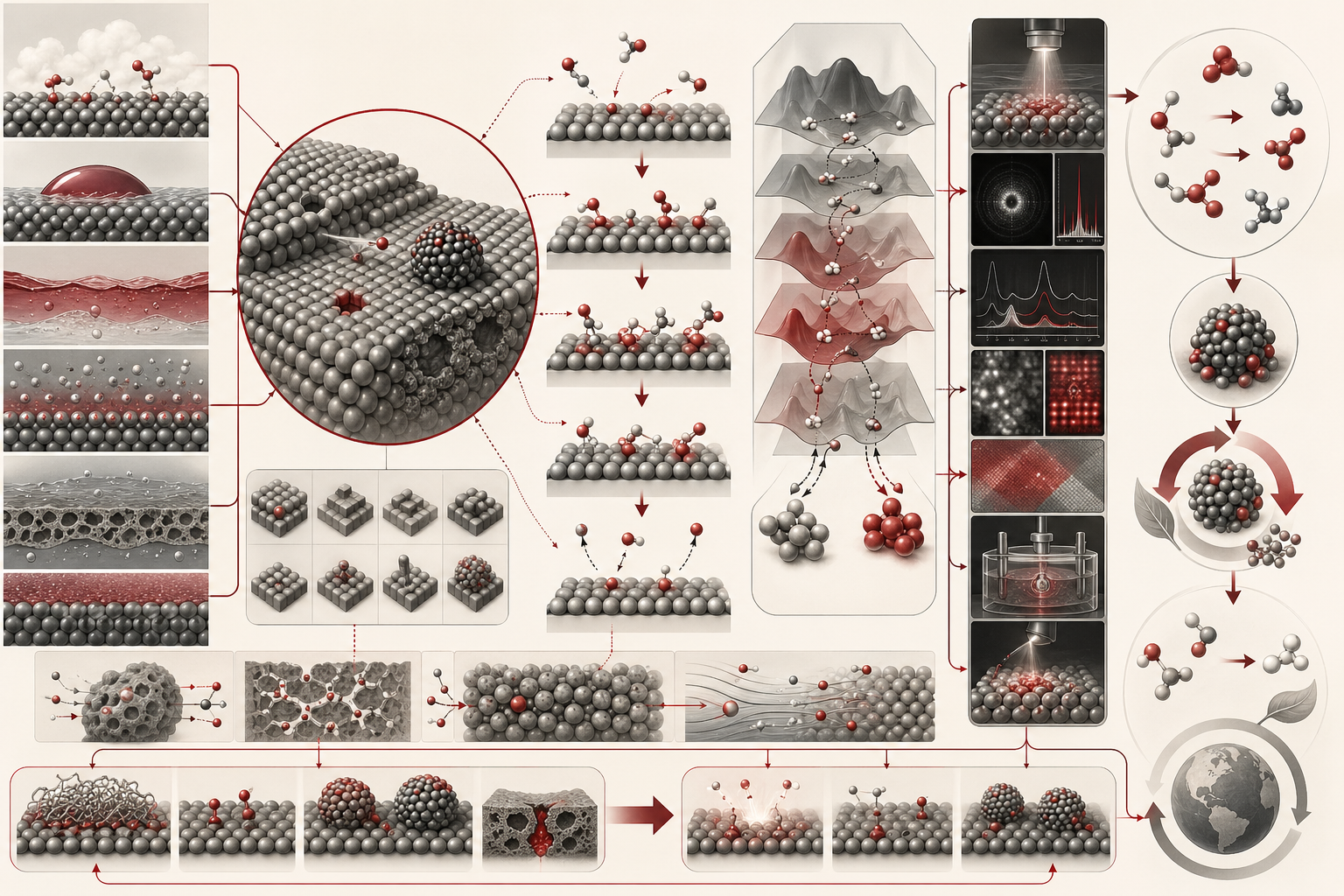
Why Surfaces Matter in Chemistry
Surfaces matter because chemical reactivity is often controlled by atoms, functional groups, charges, defects, pores, and adsorbed species at boundaries. A bulk solid may appear inert, but its surface may bind oxygen, water, ions, hydrocarbons, proteins, pollutants, or reaction intermediates. A liquid may be homogeneous in the interior but organize differently near air, oil, mineral particles, membranes, or electrodes. A metal nanoparticle may have catalytic activity because a large fraction of its atoms are exposed at edges, corners, terraces, and defect sites.
Surface chemistry is central to heterogeneous catalysis, corrosion, electrochemistry, colloids, membranes, detergency, adhesion, coatings, lubrication, sensors, biomaterials, atmospheric aerosols, soil chemistry, nanomaterials, batteries, fuel cells, semiconductor processing, water treatment, and environmental remediation. In many systems, the surface is where chemical function becomes possible.
A surface is not merely the outside of a material. It is a chemically structured region with its own composition, energy, electronic structure, roughness, reconstruction, hydration, contamination, adsorbates, and history. A freshly prepared surface may behave differently from an aged, oxidized, fouled, hydrated, poisoned, or regenerated surface. This makes surface chemistry experimentally demanding and conceptually important.
Surfaces also make chemistry spatial. The same molecule can behave differently in the gas phase, dissolved in solution, adsorbed on a metal, trapped in a pore, bound to an oxide, confined in a membrane, or immobilized on a polymer. A reaction pathway that is slow in solution can become fast on a surface if adsorption brings reactants together, weakens bonds, stabilizes transition states, or changes electron density.
For researchers and scientists, the surface-centered view changes the question. Instead of asking only what substances are present, surface chemistry asks where they are, how they bind, what sites they occupy, what nearby species are present, how long they remain adsorbed, whether they desorb, and whether the surface itself changes during the process.
Surface Chemistry Versus Bulk Chemistry
Bulk chemistry describes matter away from boundaries. Surface chemistry describes matter at or near boundaries. The distinction matters because atoms at a surface usually have fewer neighbors than atoms in the bulk. They may have unsatisfied bonds, altered electron density, different coordination numbers, local strain, surface dipoles, acid-base sites, or exposed functional groups. These features can change adsorption, reaction rates, charge transfer, wetting, nucleation, and stability.
For example, a metal surface may activate hydrogen, oxygen, carbon monoxide, nitrogen oxides, or hydrocarbons. An oxide surface may expose Lewis acid sites, Brønsted acid sites, oxygen vacancies, hydroxyl groups, or redox-active metal centers. A polymer surface may be hydrophobic, hydrophilic, charged, oxidized, rough, functionalized, or biologically fouled. A carbon surface may contain graphitic domains, edge sites, defects, oxygen-containing groups, and pores.
The surface-to-volume ratio is especially important for small particles and porous materials. As particles become smaller, a larger fraction of atoms reside at or near the surface. This is one reason nanoparticles, catalysts, adsorbents, porous carbons, zeolites, metal-organic frameworks, and high-surface-area oxides can behave differently from bulk solids of similar composition.
Surface chemistry also explains why preparation history matters. Grinding, polishing, annealing, plasma treatment, oxidation, reduction, acid washing, calcination, hydration, drying, exposure to air, or contact with biological fluids can change surface composition without changing bulk composition. A material may have the same chemical formula before and after treatment but a different surface and therefore a different function.
Bulk measurements can therefore be misleading when surface processes dominate. A catalyst’s bulk elemental composition may not identify its active surface state. A biomaterial’s bulk polymer chemistry may not predict protein adsorption. A corrosion-resistant alloy may fail if the passive surface layer breaks down. A nanoparticle’s bulk composition may matter less than its ligand shell. Surface chemistry asks which atoms and molecules are actually exposed to the chemical environment.
Interfaces, Wetting, and Interfacial Energy
An interface is a boundary between phases. Interfaces may be sharp, diffuse, chemically reactive, electrically charged, mechanically rough, hydrated, contaminated, or dynamically changing. Solid-gas interfaces matter in catalysis and atmospheric chemistry. Solid-liquid interfaces matter in electrochemistry, corrosion, water treatment, mineral chemistry, and biomaterials. Liquid-liquid interfaces matter in emulsions, extraction, membranes, and soft matter. Solid-solid interfaces matter in composites, coatings, electronics, batteries, and mechanical adhesion.
Interfacial energy helps determine whether phases spread, adhere, separate, nucleate, or restructure. Wetting describes how a liquid contacts a surface. A water droplet may spread on a hydrophilic surface or bead up on a hydrophobic one. Contact angle is a macroscopic signal of interfacial interactions, but it depends on surface chemistry, roughness, contamination, heterogeneity, and measurement conditions.
Interfaces can also organize molecules. Surfactants accumulate at liquid interfaces. Proteins adsorb to biomaterial surfaces. Ions form electrical double layers near charged interfaces. Solvent molecules orient near polar surfaces. Reaction intermediates bind to catalytic sites. These interfacial arrangements can control reactivity, transport, adhesion, and selectivity.
Wetting is especially important because it connects chemistry to practical performance. A coating must wet the substrate before it can adhere. A membrane must control wetting to separate phases. A catalyst pellet must be wetted by reactants in liquid-phase catalysis. A battery electrode must be wetted by electrolyte. A medical implant is immediately conditioned by water, ions, proteins, and cells at its surface. Surface chemistry becomes application chemistry when wetting determines contact.
Interfaces are also where mechanical, electrical, and chemical effects intersect. A rough surface can trap air, alter apparent contact angle, increase friction, concentrate stress, or expose high-energy sites. A charged interface can change ion distribution and reaction rates. A porous interface can slow transport. An electronically conductive interface can transfer charge. Surface chemistry is therefore not only about composition; it is about boundary conditions.
Adsorption, Surface Coverage, and Surface Excess
Adsorption is the accumulation of atoms, ions, or molecules at a surface or interface. It is different from absorption, where species enter the bulk of a material. Adsorption can be physical or chemical, weak or strong, reversible or irreversible, selective or nonspecific. It may involve van der Waals interactions, electrostatics, hydrogen bonding, coordination, covalent bonding, acid-base interactions, or charge transfer.
Surface coverage describes how much of a surface is occupied by adsorbed species. At low coverage, adsorbates may be far apart and interact weakly. At high coverage, adsorbate-adsorbate interactions, steric crowding, site competition, surface reconstruction, and multilayer adsorption may become important. In catalysis, coverage can determine whether a surface is active, poisoned, saturated, or selective.
Surface excess is a thermodynamic way of describing how much of a component is present at an interface relative to a chosen reference system. It is especially important for liquid interfaces, adsorption from solution, and interfacial thermodynamics. The concept reminds us that interfaces are not simply geometric surfaces; they are regions where composition differs from the adjoining bulk phases.
Adsorption controls many environmental and industrial processes. Activated carbon adsorbs organic compounds. Metal oxides adsorb phosphate, arsenic, metals, and natural organic matter. Catalyst surfaces adsorb reactants and intermediates. Soil minerals adsorb nutrients and contaminants. Proteins adsorb to medical devices. Surfactants adsorb at liquid interfaces. Semiconductor surfaces adsorb oxygen, water, or ligands that alter electronic behavior.
Adsorption can be helpful or harmful. It can remove contaminants, stabilize emulsions, enable catalysis, immobilize enzymes, or support sensors. It can also poison catalysts, foul membranes, bind proteins nonspecifically, reduce drug availability, deactivate electrodes, or trap pollutants in sediments. The same surface affinity that makes a material useful can also make it vulnerable to fouling or deactivation.
For researchers, adsorption should be interpreted in relation to medium, concentration, time, competition, reversibility, and surface state. A single adsorption value measured in pure solution may not predict behavior in wastewater, blood, soil porewater, flue gas, electrolyte, or mixed-reactant streams.
Surface Forces, Roughness, and Chemical Heterogeneity
Real surfaces are rarely ideal. They contain steps, kinks, terraces, defects, grain boundaries, pores, hydroxyl groups, oxides, adsorbates, impurities, charges, and roughness across multiple length scales. These features can create chemically distinct sites on the same material. A catalyst may contain metal terraces, edge sites, oxide patches, support interfaces, and defect sites at once. A polymer surface may contain domains with different composition, orientation, or mobility.
Surface forces include van der Waals attraction, electrostatic interactions, hydration forces, steric repulsion, capillary forces, hydrophobic interactions, specific binding, and acid-base interactions. These forces shape colloid stability, adhesion, friction, wetting, protein adsorption, membrane fouling, particle aggregation, and interfacial self-assembly.
Roughness can amplify or complicate surface behavior. It can increase surface area and create more active sites, but it can also trap contaminants, alter contact-angle measurements, create nonuniform electric fields, and make characterization harder. A highly rough surface may appear more hydrophobic or hydrophilic depending on chemistry and trapped phases. Surface roughness is therefore not only a geometric descriptor; it affects chemical exposure.
Chemical heterogeneity can create selective adsorption and reaction pathways. A mixed oxide may have both acidic and basic sites. A supported metal catalyst may have sites at metal particles, support surfaces, and metal-support interfaces. A corroding alloy may expose multiple phases. A biomaterial may present hydrophobic domains and charged groups. These heterogeneous sites can produce useful selectivity or unwanted complexity.
For researchers, idealized surface models are useful but incomplete. Single-crystal surfaces, clean vacuum conditions, and simplified adsorbates provide mechanistic insight, while real systems introduce moisture, contaminants, pressure, solvent, roughness, support effects, and restructuring. Strong surface chemistry connects controlled model systems to working materials without confusing one for the other.
Catalysis as Interfacial Chemical Control
A catalyst increases reaction rate by offering a different kinetic pathway. It does not change the overall thermodynamic driving force of the reaction. This distinction is crucial. Thermodynamics determines what transformations are energetically possible or favored. Catalysis changes how quickly and selectively those transformations occur.
Catalysis may be homogeneous, heterogeneous, enzymatic, electrocatalytic, photocatalytic, acid-base, organocatalytic, metal-mediated, bifunctional, or surface-mediated. In heterogeneous catalysis, the reaction occurs at or near an interface between phases. Reactants may adsorb, diffuse, dissociate, react, rearrange, desorb, or compete for active sites. Products must leave the surface for the catalyst to continue functioning.
Good catalysts are not simply fast. They must be selective, stable, regenerable, tolerant of impurities, compatible with process conditions, and economically and environmentally practical. A catalyst that produces unwanted byproducts, deactivates quickly, uses scarce or toxic elements, or requires extreme conditions may be scientifically interesting but industrially or socially problematic.
Catalysis is often about balancing adsorption strength. If adsorption is too weak, reactants may not bind or activate. If adsorption is too strong, the surface may become blocked, products may not desorb, or intermediates may accumulate. This balance appears in many catalytic systems, from hydrogenation and oxidation to electrocatalysis and enzyme-like surface design.
Catalysis also shows why kinetics and selectivity must be considered together. A catalyst can increase conversion while reducing desired-product selectivity. It can favor one pathway under low conversion and another at high conversion. It can change behavior as the surface becomes covered, poisoned, reduced, oxidized, or reconstructed. A catalyst is not only a material; it is a working chemical state under reaction conditions.
Heterogeneous Catalysis and Active Sites
Heterogeneous catalysis depends on active sites. An active site may be a single atom, a metal ensemble, an oxide vacancy, an acid site, a step edge, a nanoparticle corner, a metal-support interface, a pore mouth, a functional group, or a combination of nearby sites. Many catalytic reactions require ensembles rather than isolated atoms because reactants, intermediates, and transition states may span multiple atoms or phases.
A simplified heterogeneous catalytic cycle often includes:
- transport of reactants to the catalyst surface;
- adsorption of reactants on active sites;
- activation or dissociation of bonds;
- surface diffusion or rearrangement;
- reaction between adsorbed species;
- desorption of products;
- regeneration of active sites.
Catalyst performance depends on both chemistry and structure. Particle size, dispersion, support acidity, porosity, metal oxidation state, surface area, pore diffusion, defects, promoters, binders, heat transfer, mass transfer, and reactor conditions all matter. A catalyst may fail because of poisoning, sintering, coking, leaching, phase transformation, oxidation, reduction, pore blockage, thermal shock, or mechanical attrition.
Active-site identification is difficult because the most abundant surface species are not always the most active. A small number of rare sites can dominate reaction rate. A surface may restructure under reaction conditions. A support may participate in the reaction. A promoter may change electron density or adsorption strength without being the main active site. A catalyst described by its nominal formula may hide the true reactive ensemble.
For researchers, heterogeneous catalysis requires linking structure to function. Surface area, conversion, and selectivity are not enough by themselves. Strong evidence connects preparation, pretreatment, active-site density, adsorption behavior, kinetic data, product distribution, stability, and characterization before, during, and after reaction.
Transport, Porosity, and Accessible Sites
A catalytic or adsorptive surface is useful only if molecules can reach it. Porosity, pore size distribution, tortuosity, diffusion, fluid flow, particle size, pellet geometry, binder content, and external mass transfer all affect access to active sites. A high-surface-area material may underperform if its pores are inaccessible, blocked, flooded, fouled, or too narrow for the relevant reactants.
Porous materials include zeolites, mesoporous silicas, activated carbons, aluminas, metal-organic frameworks, covalent organic frameworks, aerogels, catalyst supports, membranes, and structured monoliths. Their performance depends on surface chemistry and transport architecture together. A zeolite can be highly selective because its pores constrain molecular access. A membrane can separate molecules because transport through pores or channels differs by size, charge, affinity, or diffusivity. A catalyst pellet can fail if diffusion limits prevent inner sites from being used.
Transport limitations can masquerade as chemical kinetics. If reactants cannot reach the surface fast enough, the measured rate may reflect diffusion rather than intrinsic reaction. If heat cannot be removed, hot spots can change selectivity, accelerate deactivation, or create safety hazards. If products cannot leave pores, secondary reactions may occur. Surface chemistry must therefore be interpreted with mass and heat transfer in view.
Accessible surface area is not always equal to measured surface area. Gas adsorption measurements can reveal textural surface area under particular conditions, but liquid-phase reactants, biological molecules, polymers, or electrolyte ions may not access the same pores. A material can have impressive surface area and still be poorly matched to its application.
For researchers, transport checks are essential before assigning mechanism. Particle-size variation, stirring tests, flow-rate variation, Weisz-Prater-style checks, effectiveness factors, and reactor controls can help distinguish intrinsic surface chemistry from transport artifacts. Without transport discipline, catalytic and adsorption claims can become misleading.
Catalyst Deactivation, Poisoning, and Regeneration
Catalysts are often evaluated by initial activity, but long-term performance depends on stability. Deactivation occurs when catalytic activity or selectivity declines over time. It can result from poisoning, sintering, coking, fouling, leaching, oxidation, reduction, phase transformation, pore blockage, structural collapse, support degradation, mechanical attrition, or deposition of impurities.
Poisoning occurs when species bind strongly to active sites and block desired reactions. Sulfur, phosphorus, chlorine, heavy metals, carbon monoxide, nitrogen compounds, siloxanes, tars, or trace impurities can poison different catalysts. In some cases, poisoning is reversible; in others, it permanently changes the catalyst.
Sintering occurs when small particles grow into larger particles, reducing exposed surface area and changing site structure. It is often accelerated by high temperature, steam, reactive gases, or weak support interactions. Coking occurs when carbonaceous deposits accumulate, especially in hydrocarbon reactions. Leaching can remove active metals or ligands into solution, raising performance, contamination, and environmental concerns.
Regeneration attempts to restore catalytic function. It may involve oxidation, reduction, washing, solvent treatment, thermal treatment, hydrogen treatment, acid-base treatment, or removal of deposits. Regeneration can also damage catalysts if it alters structure, removes promoters, collapses pores, or creates new phases. Regenerability should therefore be demonstrated, not assumed.
For researchers and industrial users, deactivation is not a minor operational issue. A catalyst with excellent initial activity but rapid deactivation may be unusable. A catalyst with modest activity but strong stability, selectivity, regeneration, and low critical-material burden may be more valuable. Catalysis should be judged across time, not only at the beginning of a test.
Electrocatalysis and Electrochemical Interfaces
Electrocatalysis occurs at electrode-electrolyte interfaces. It is central to fuel cells, electrolyzers, batteries, carbon dioxide reduction, nitrogen reduction, oxygen evolution, hydrogen evolution, oxygen reduction, chlorine evolution, metal deposition, sensors, and corrosion processes. In electrocatalysis, applied potential, surface structure, electrolyte composition, pH, ion transport, double-layer structure, and adsorbed intermediates shape the reaction.
Electrocatalytic performance is often described through current density, overpotential, Tafel slope, faradaic efficiency, turnover frequency, stability, and selectivity. However, these metrics are highly dependent on surface area normalization, mass transport, uncompensated resistance, catalyst loading, electrode roughness, bubble formation, electrolyte purity, and product analysis.
Electrocatalysis is a reminder that interfaces can be both chemical and electrical. The local environment at the electrode surface may differ strongly from the bulk solution. Concentration gradients, local pH shifts, electric fields, cation effects, interfacial water structure, and adsorbed ions can all influence reaction pathways.
Electrocatalysts also change under operation. A metal surface may oxidize or reduce. A catalyst may dissolve and redeposit. A reconstruction may create the true active phase. A binder or ionomer may block access or change local transport. Bubbles may cover active sites. Carbon supports may corrode. These changes mean that pre-test characterization may not describe the working catalyst.
For researchers, electrocatalytic evidence should include product quantification, faradaic efficiency, stability, surface-area basis, mass-transport controls, resistance correction, electrolyte composition, electrode geometry, and post-test characterization. Current alone is not proof of desired chemistry; it may include side reactions.
Photocatalysis and Light-Activated Surfaces
Photocatalysis uses light-absorbing materials to drive or accelerate chemical transformations. It often occurs at semiconductor surfaces, molecular catalysts immobilized on supports, or hybrid interfaces where photons generate excited states, electron-hole pairs, or charge-transfer states. These excited species can reduce or oxidize adsorbed reactants if they survive long enough to reach reactive sites.
Photocatalysis is important in water splitting, carbon dioxide reduction, pollutant transformation, organic synthesis, antimicrobial surfaces, self-cleaning materials, and environmental remediation concepts. Its performance depends on light absorption, band alignment, carrier lifetime, surface reaction kinetics, co-catalysts, adsorption, mass transfer, pH, solvent, oxygen, sacrificial reagents, and product separation.
Photocatalytic claims require careful controls. Dye disappearance may reflect adsorption rather than degradation. Apparent activity may come from direct photolysis, sensitization, impurities, leached species, or sacrificial reagents. Product quantification is essential. For carbon dioxide reduction, isotope controls may be needed. For water splitting, hydrogen and oxygen balance matters. For pollutant degradation, mineralization and transformation products may matter more than color loss.
Surface chemistry is central because light absorption alone is not enough. Carriers must separate, migrate, and react at surfaces before recombination. Surface defects can either trap carriers productively or accelerate recombination. Co-catalysts can improve reaction kinetics. Surface hydroxyls, adsorbed oxygen, water, carbonate, or organic matter can change pathways.
For researchers, photocatalysis should be treated as interfacial photochemistry under mass-balance discipline. A surface that responds to light must still be evaluated through reaction products, quantum efficiency, stability, selectivity, and realistic conditions.
Environmental, Biological, and Atmospheric Interfaces
Surface chemistry is central to environmental systems. Minerals adsorb nutrients, metals, and contaminants. Soil particles carry surface charges and organic coatings. Atmospheric aerosols react with gases and water. Sediments bind or release phosphorus, arsenic, mercury, organic contaminants, and metals depending on redox state and surface chemistry. Membranes and filters remove contaminants through interfacial interactions. Environmental chemistry is often surface chemistry distributed through air, water, soil, and sediments.
Biological interfaces are equally important. Proteins adsorb to implants, nanoparticles, sensors, membranes, and medical devices. Cell membranes interact with ions, drugs, particles, toxins, and signaling molecules. Enzymes create active sites with chemically structured surfaces. Biofilms create hydrated interfacial communities where gradients, adhesion, and extracellular polymers control chemical behavior.
Atmospheric interfaces include aerosols, cloud droplets, soot, mineral dust, sea-salt particles, and organic films. These particles can adsorb gases, scatter light, absorb radiation, participate in heterogeneous reactions, and serve as cloud condensation nuclei. Surface chemistry helps explain atmospheric aging, pollutant transformation, aerosol hygroscopicity, and exposure.
Interfaces also mediate environmental risk. A contaminant adsorbed strongly to sediment may be less immediately bioavailable but may persist as a reservoir. A nanoparticle surface may acquire natural organic matter and change mobility. A metal oxide surface may immobilize arsenic under one redox condition and release it under another. A membrane surface may foul, reducing treatment performance.
For researchers, environmental and biological interfaces require realistic media. Pure-water adsorption experiments can be useful, but real systems contain salts, organic matter, proteins, microbes, competing ions, particles, and changing pH or redox conditions. Surface chemistry becomes decision-useful when it is tested in the environment implied by the claim.
Surface and Interface Characterization
Surface and interface characterization is difficult because the chemically relevant region may be only atoms to nanometers thick. Many methods are surface-sensitive, but each method sees a different aspect of the interface. X-ray photoelectron spectroscopy can probe elemental composition and chemical states near surfaces. Auger electron spectroscopy, secondary ion mass spectrometry, infrared spectroscopy, Raman spectroscopy, scanning probe microscopy, electron microscopy, ellipsometry, contact-angle measurement, adsorption analysis, temperature-programmed methods, and X-ray absorption methods all provide different evidence.
For catalysis, operando and in situ characterization are especially important. A catalyst measured after reaction may not represent the catalyst during reaction. Surface oxidation state, adsorbed intermediates, reconstruction, coverage, and active-site identity may change under realistic temperature, pressure, gas composition, solvent, potential, or illumination. Measuring catalysts under working conditions is therefore a major frontier in surface chemistry and catalysis.
Characterization should match the claim. If a catalyst is described as stable, evidence should include time-on-stream or cycling data. If a surface is described as functionalized, evidence should show surface composition and bonding. If an adsorbent is described as selective, evidence should include competitive adsorption and realistic matrix conditions. If an electrocatalyst is described as efficient, evidence should include product quantification, faradaic efficiency, and stability.
Common surface and interface characterization methods include:
- X-ray photoelectron spectroscopy for surface composition and chemical state;
- Auger electron spectroscopy for surface elemental analysis;
- secondary ion mass spectrometry for surface and depth-profile information;
- infrared and Raman spectroscopy for functional groups and adsorbates;
- temperature-programmed desorption, reduction, and oxidation for surface reactivity;
- BET and gas adsorption methods for surface area and porosity;
- electron microscopy for morphology, particles, supports, and interfaces;
- atomic force microscopy and scanning tunneling microscopy for nanoscale topography and local properties;
- contact-angle measurement for wetting behavior;
- electrochemical methods for electrode interfaces and charge-transfer behavior;
- X-ray absorption spectroscopy for oxidation state and local coordination.
For researchers, the strongest surface evidence usually combines methods. Surface area alone does not identify active sites. Microscopy alone does not identify surface chemistry. XPS alone may not describe buried interfaces or working states. Catalytic conversion alone does not prove mechanism. Surface chemistry is strongest when structural, chemical, kinetic, and stability evidence converge.
Operando Evidence and Working Surfaces
Operando characterization measures a material while it is functioning and links the measurement to performance. This is especially valuable in catalysis, electrocatalysis, photocatalysis, corrosion, batteries, sensors, and membrane systems because working surfaces may differ from prepared or postmortem surfaces.
A catalyst may reduce or oxidize under reaction gas. A metal nanoparticle may change shape. A support may hydroxylate. An electrode may form an interphase. A photocatalyst may accumulate surface defects. A membrane may foul. A corrosion surface may form a passive film. A sensor surface may adsorb interferents. Post-test characterization can miss transient states that control function.
Operando evidence is difficult because working environments are complex. Pressure, temperature, solvent, electrolyte, illumination, electrical bias, flow, gases, and reactants can interfere with measurement. The surface may be buried, rough, wet, hot, reactive, or changing quickly. Experimental cells must balance realistic operation with measurement access.
Despite these challenges, operando approaches help prevent false mechanism claims. They can reveal when the active phase forms only under reaction conditions, when deactivation begins, when adsorbates accumulate, when oxidation state changes, or when transport limits dominate. They can also show that a proposed active site is not present during operation.
For researchers, operando evidence should still be interpreted carefully. A working measurement may probe only part of the surface, a model environment, or an averaged state. Operando data are strongest when paired with kinetic measurements, product analysis, controls, and post-reaction characterization.
Catalysis, Sustainability, and Responsible Chemical Transformation
Catalysis is central to sustainable chemistry because catalysts can reduce energy demand, improve selectivity, lower waste, enable milder conditions, and make otherwise difficult transformations practical. Catalysts are important in ammonia synthesis, petroleum refining, polymer production, emissions control, hydrogen production, biomass upgrading, carbon dioxide conversion, fuel cells, water splitting, fine chemicals, pharmaceuticals, and environmental remediation.
However, catalysis is not automatically sustainable. A catalytic process may depend on scarce platinum-group metals, toxic supports, high-temperature regeneration, hazardous solvents, fossil feedstocks, or difficult catalyst disposal. A catalyst that improves yield may still support an unsustainable supply chain. A catalyst that captures or converts carbon dioxide may still require large energy input or produce low-value products. Responsible catalyst design must evaluate full system consequences.
Important sustainability questions include:
- Does the catalyst use scarce, toxic, conflict-associated, or geopolitically constrained elements?
- Can catalyst loading be reduced without sacrificing performance?
- Can the catalyst be regenerated, recovered, recycled, or safely disposed of?
- Does the catalyst improve selectivity enough to reduce downstream separation burden?
- Does the reaction reduce energy use under realistic process conditions?
- Are solvents, supports, binders, promoters, and preparation methods also considered?
- Does the catalytic process shift harm from the reactor to extraction, waste, or end-of-life systems?
Surface chemistry therefore connects molecular efficiency to industrial and environmental responsibility. The best catalytic pathway is not only the fastest pathway; it is the pathway whose performance, selectivity, durability, material sourcing, and lifecycle can be justified.
Responsible catalysis also requires humility about scale. A catalyst that works in a small laboratory reactor may fail at scale because of heat transfer, mass transfer, pressure drop, impurity tolerance, catalyst lifetime, mechanical strength, regeneration difficulty, or waste handling. Surface chemistry supports sustainability only when connected to process reality.
Responsible Use of Surface and Catalysis Evidence
Surface and catalytic claims can influence industrial processes, energy systems, environmental technologies, pollution control, medical materials, sensors, batteries, and chemical manufacturing. Responsible interpretation requires attention to what was actually measured, under what conditions, and whether the evidence supports the claimed application.
Responsible surface and catalysis practice includes:
- distinguishing surface composition from bulk composition;
- reporting catalyst preparation, pretreatment, activation, and history;
- including surface area, site density, particle size, dispersion, and support information where relevant;
- testing stability, deactivation, poisoning, and regeneration;
- checking heat and mass-transfer limitations before interpreting kinetic data;
- reporting selectivity and product balance, not only conversion;
- using operando or in situ evidence when active states may change under reaction conditions;
- considering critical materials, toxicity, waste, and lifecycle impacts.
Responsible interpretation also requires distinguishing evidence scales. A molecular simulation may suggest an adsorption pathway, but it does not prove full catalyst performance. A model surface may reveal mechanism, but it may not represent an industrial catalyst. A high conversion value may result from transport or heat effects rather than intrinsic surface chemistry. A catalyst screening metric may hide selectivity loss, poisoning, or regeneration burden.
The ethical strength of surface chemistry and catalysis lies in making invisible interfaces accountable. Surfaces can accelerate reactions, stabilize materials, bind pollutants, control wetting, mediate charge transfer, and enable cleaner chemical transformations. But they become trustworthy chemical evidence only when interfacial structure, measurement conditions, uncertainty, and application context are made visible.
Mathematical Lens: Surface Area, Coverage, Isotherms, and Rates
Surface chemistry is quantitative because interfacial processes depend on area, coverage, concentration, pressure, temperature, and rate. For a dispersed solid, specific surface area can be written as:
a_s = \frac{A}{m}
\]
Interpretation: \(a_s\) is specific surface area, \(A\) is total accessible surface area, and \(m\) is mass. High surface area can increase the number of accessible adsorption or catalytic sites, but surface area alone does not guarantee activity. Site identity, accessibility, transport, and stability matter.
Surface coverage is often written as:
\theta = \frac{N_{\mathrm{occupied}}}{N_{\mathrm{total}}}
\]
Interpretation: \(\theta\) is fractional coverage, \(N_{\mathrm{occupied}}\) is the number of occupied sites, and \(N_{\mathrm{total}}\) is the number of available sites. Coverage affects reaction rates, site blocking, poisoning, and selectivity.
A simple Langmuir adsorption model for one adsorbate can be written as:
\theta = \frac{KP}{1 + KP}
\]
Interpretation: \(K\) is an adsorption equilibrium constant and \(P\) is pressure. This model assumes a fixed number of equivalent sites, monolayer adsorption, no lateral interactions, and simple adsorption behavior. Real surfaces often violate these assumptions.
For competitive adsorption of species \(A\) and \(B\), a simplified expression for coverage of \(A\) is:
\theta_A = \frac{K_A P_A}{1 + K_A P_A + K_B P_B}
\]
Interpretation: Species compete for sites. Strong adsorption can help activate a reactant, but adsorption that is too strong can poison the surface or block product desorption.
A simplified surface reaction rate may be written as:
r = k \theta_A \theta_B
\]
Interpretation: \(r\) is rate, \(k\) is the surface reaction rate constant, and \(\theta_A\) and \(\theta_B\) are coverages of reacting adsorbates. This expression illustrates how adsorption and kinetics combine.
Temperature dependence is often approximated by the Arrhenius equation:
k = A e^{-E_a/(RT)}
\]
Interpretation: \(A\) is the pre-exponential factor, \(E_a\) is activation energy, \(R\) is the gas constant, and \(T\) is temperature. Catalysts reduce kinetic barriers for particular pathways, but they do not remove the need to understand transport, adsorption, desorption, selectivity, and deactivation.
For an electrocatalytic reaction, faradaic efficiency can be written as:
FE_i = \frac{n_i F N_i}{Q}
\]
Interpretation: \(FE_i\) is faradaic efficiency for product \(i\), \(n_i\) is electrons required per molecule, \(F\) is Faraday’s constant, \(N_i\) is amount of product formed, and \(Q\) is total charge passed. This metric connects current to chemical product formation.
For catalyst deactivation, a simple first-order activity loss model can be written as:
a(t) = a_0 e^{-k_d t}
\]
Interpretation: \(a(t)\) is activity at time \(t\), \(a_0\) is initial activity, and \(k_d\) is a deactivation constant. Real deactivation can involve multiple mechanisms, including poisoning, sintering, coking, leaching, and pore blockage.
These equations are useful because they expose the structure of surface reasoning. Surface area defines possible exposure. Coverage defines occupied sites. Isotherms define adsorption assumptions. Rate laws connect coverage to reaction. Deactivation models remind us that catalysts must be evaluated over time.
Computational Workflows for Surface Chemistry and Catalysis
Computational workflows can make surface and catalysis interpretation more transparent. A workflow can track catalyst identity, surface area, site density, pore volume, particle size, support, active phase, pretreatment, adsorption constants, conversion, selectivity, rate, time-on-stream, deactivation slope, product balance, critical-material flag, regeneration status, and responsible-design review.
Useful workflows include adsorption-isotherm fitting, competitive-adsorption screening, catalyst replicate summaries, selectivity tracking, time-on-stream deactivation analysis, turnover-frequency estimation, surface-area normalization, mass-transfer flagging, electrocatalytic faradaic-efficiency calculation, product-balance auditing, regeneration comparison, and catalyst-lifecycle review. More advanced workflows may integrate reactor data, spectroscopy, microscopy, process historians, high-throughput catalyst screening, density-functional theory outputs, and operando datasets.
For researchers, computational workflows should preserve assumptions. Was rate normalized by mass, surface area, site density, or metal loading? Was selectivity carbon-based, molar, or mass-based? Was surface area accessible under reaction conditions? Were transport limitations checked? Was conversion low enough for kinetic interpretation? Was deactivation measured under realistic feed conditions? These questions should be embedded in the data structure.
The examples below use synthetic data. They do not design catalysts, validate mechanisms, certify process safety, determine industrial performance, or replace professional catalyst testing. They demonstrate how surface chemistry and catalysis reasoning can be structured, audited, and communicated responsibly.
Python Example: Adsorption Isotherms and Catalytic Rate Screening
The following Python example uses synthetic educational data to model competitive Langmuir adsorption and a simplified surface-reaction rate. The workflow is intentionally simplified. Real catalytic modeling requires validated mechanisms, transport analysis, uncertainty, site density, catalyst history, and product analysis.
from pathlib import Path
from typing import Dict, List
import json
import math

import pandas as pd


# Synthetic surface chemistry and catalysis workflow.
# Educational example only; not for catalyst design, process engineering,
# safety claims, procurement, or regulatory decisions.


def screen_catalysts(catalysts: pd.DataFrame) -> pd.DataFrame:
    """Calculate simplified competitive adsorption and catalytic screening metrics.

    Real catalyst evaluation requires validated mechanisms, kinetic analysis,
    heat-transfer and mass-transfer checks, site normalization, product analysis,
    stability testing, regeneration review, and safety assessment.
    """

    catalysts = catalysts.copy()

    pressure_A_bar = 1.0
    pressure_B_bar = 0.5
    temperature_K = 550.0
    gas_constant_kJ_mol_K = 0.008314
    pre_exponential = 1.0e5

    theta_A_values: List[float] = []
    theta_B_values: List[float] = []
    rate_proxy_values: List[float] = []

    for _, row in catalysts.iterrows():
        denominator = (
            1.0
            + row["K_A_bar_inv"] * pressure_A_bar
            + row["K_B_bar_inv"] * pressure_B_bar
        )

        theta_A = row["K_A_bar_inv"] * pressure_A_bar / denominator
        theta_B = row["K_B_bar_inv"] * pressure_B_bar / denominator

        rate_constant = pre_exponential * math.exp(
            -row["activation_energy_kJ_mol"]
            / (gas_constant_kJ_mol_K * temperature_K)
        )

        rate_proxy = (
            rate_constant
            * theta_A
            * theta_B
            * row["site_density_umol_g"]
        )

        theta_A_values.append(theta_A)
        theta_B_values.append(theta_B)
        rate_proxy_values.append(rate_proxy)

    catalysts["theta_A"] = theta_A_values
    catalysts["theta_B"] = theta_B_values
    catalysts["surface_rate_proxy"] = rate_proxy_values

    catalysts["site_accessibility_proxy"] = (
        catalysts["site_density_umol_g"]
        / catalysts["surface_area_m2_g"]
    )

    catalysts["stability_review_required"] = (
        catalysts["deactivation_index"] > 0.25
    )

    catalysts["selectivity_review_required"] = (
        catalysts["selectivity_target"] < 0.75
    )

    catalysts["responsible_material_review_required"] = (
        catalysts["critical_metal_flag"]
    )

    catalysts["catalyst_review_required"] = (
        catalysts["stability_review_required"]
        | catalysts["selectivity_review_required"]
        | catalysts["responsible_material_review_required"]
    )

    # Higher score is better in this hypothetical screening model.
    catalysts["screening_score"] = (
        0.45 * catalysts["surface_rate_proxy"]
        + 20.0 * catalysts["selectivity_target"]
        + 0.02 * catalysts["surface_area_m2_g"]
        - 10.0 * catalysts["deactivation_index"]
        - 15.0 * catalysts["critical_metal_flag"].astype(int)
    )

    ranked = catalysts.sort_values("screening_score", ascending=False).copy()
    ranked["rank"] = range(1, len(ranked) + 1)

    ranked.attrs["pressure_A_bar"] = pressure_A_bar
    ranked.attrs["pressure_B_bar"] = pressure_B_bar
    ranked.attrs["temperature_K"] = temperature_K

    return ranked


catalysts = pd.DataFrame({
    "catalyst_id": ["cat_A", "cat_B", "cat_C", "cat_D"],
    "surface_area_m2_g": [85.0, 210.0, 145.0, 60.0],
    "site_density_umol_g": [120.0, 240.0, 180.0, 95.0],
    "K_A_bar_inv": [1.8, 0.9, 2.6, 0.4],
    "K_B_bar_inv": [0.7, 1.2, 0.5, 2.0],
    "activation_energy_kJ_mol": [58.0, 72.0, 54.0, 80.0],
    "selectivity_target": [0.82, 0.74, 0.88, 0.61],
    "deactivation_index": [0.12, 0.18, 0.31, 0.09],
    "critical_metal_flag": [False, False, True, False],
})

ranked = screen_catalysts(catalysts)

output_dir = Path("outputs")
output_dir.mkdir(exist_ok=True)

ranked.to_csv(output_dir / "catalyst_surface_screening.csv", index=False)

manifest: Dict[str, object] = {
    "workflow": "synthetic_surface_catalysis_screening",
    "model": "competitive Langmuir coverage with simplified rate proxy",
    "pressure_A_bar": ranked.attrs["pressure_A_bar"],
    "pressure_B_bar": ranked.attrs["pressure_B_bar"],
    "temperature_K": ranked.attrs["temperature_K"],
    "best_candidate": ranked.iloc[0]["catalyst_id"],
    "responsible_use": [
        "Synthetic educational data only.",
        "Real catalyst design requires validated mechanisms, transport analysis, uncertainty, stability testing, product analysis, and safety review.",
    ],
}

with (output_dir / "surface_catalysis_manifest.json").open(
    "w",
    encoding="utf-8"
) as file:
    json.dump(manifest, file, indent=2)

print(ranked[[
    "catalyst_id",
    "theta_A",
    "theta_B",
    "surface_rate_proxy",
    "selectivity_target",
    "deactivation_index",
    "screening_score",
    "rank",
    "catalyst_review_required",
]])
This workflow demonstrates a core idea: surface function depends on multiple coupled factors. A high-surface-area material may not be the best catalyst if it adsorbs the wrong species too strongly, lacks selective sites, deactivates, or depends on scarce materials. The purpose is not the synthetic ranking itself, but the auditable structure of the comparison.
R Example: Catalyst Replicates, Selectivity, and Deactivation
The following R example uses synthetic catalytic testing data to summarize activity, selectivity, and time-on-stream deactivation. In real catalysis, conclusions should include reactor configuration, mass-transfer checks, heat-transfer checks, product calibration, catalyst mass, site normalization, and uncertainty.
# Synthetic catalyst performance workflow.
# Educational example only; not for catalyst certification or process design.

catalyst_runs <- data.frame(
  catalyst_id = c(
    "cat_A", "cat_A", "cat_A",
    "cat_B", "cat_B", "cat_B",
    "cat_C", "cat_C", "cat_C"
  ),
  replicate = c(1, 2, 3, 1, 2, 3, 1, 2, 3),
  conversion_percent = c(
    42.1, 41.5, 42.8,
    34.2, 35.0, 33.8,
    46.5, 47.1, 45.9
  ),
  selectivity_percent = c(
    82.4, 81.7, 82.9,
    74.2, 73.8, 74.9,
    88.1, 87.6, 88.4
  )
)

time_on_stream <- data.frame(
  catalyst_id = rep("cat_C", 6),
  time_h = c(0, 1, 2, 4, 8, 12),
  normalized_rate = c(1.00, 0.96, 0.93, 0.88, 0.81, 0.74)
)

summary_table <- aggregate(
  cbind(conversion_percent, selectivity_percent) ~ catalyst_id,
  data = catalyst_runs,
  FUN = function(x) c(mean = mean(x), sd = sd(x))
)

summary_clean <- data.frame(
  catalyst_id = summary_table$catalyst_id,
  mean_conversion_percent =
    summary_table$conversion_percent[, "mean"],
  sd_conversion_percent =
    summary_table$conversion_percent[, "sd"],
  mean_selectivity_percent =
    summary_table$selectivity_percent[, "mean"],
  sd_selectivity_percent =
    summary_table$selectivity_percent[, "sd"]
)

deactivation_model <- lm(normalized_rate ~ time_h, data = time_on_stream)

deactivation_summary <- data.frame(
  catalyst_id = "cat_C",
  deactivation_slope_per_h = coef(deactivation_model)[2],
  initial_rate = time_on_stream$normalized_rate[1],
  final_rate = time_on_stream$normalized_rate[nrow(time_on_stream)],
  percent_rate_loss = 100 * (
    time_on_stream$normalized_rate[1] -
      time_on_stream$normalized_rate[nrow(time_on_stream)]
  ) / time_on_stream$normalized_rate[1]
)

summary_clean$selectivity_review_required <-
  summary_clean$mean_selectivity_percent < 75

summary_clean$replicate_variability_review_required <-
  summary_clean$sd_conversion_percent > 1.5

dir.create("outputs", showWarnings = FALSE)

write.csv(
  summary_clean,
  file = "outputs/catalyst_replicate_summary.csv",
  row.names = FALSE
)

write.csv(
  deactivation_summary,
  file = "outputs/catalyst_deactivation_summary.csv",
  row.names = FALSE
)

sink("outputs/surface_catalysis_report.txt")
cat("Synthetic Surface Catalysis Report\n")
cat("=================================\n\n")
cat("Catalyst replicate summary:\n")
print(summary_clean)
cat("\nDeactivation model:\n")
print(summary(deactivation_model))
cat("\nDeactivation summary:\n")
print(deactivation_summary)
cat("\nResponsible-use note:\n")
cat("Synthetic educational data only. Real catalyst evaluation requires validated mechanisms, mass-transfer checks, heat-transfer checks, product calibration, stability testing, and safety review.\n")
sink()

print(summary_clean)
print(deactivation_summary)
This workflow highlights that catalyst activity alone is not enough. Selectivity and stability matter. A catalyst that begins fast but deactivates rapidly may be less useful than a slower catalyst with better durability, cleaner product distribution, regenerability, safer sourcing, and lower lifecycle burden.
SQL Example: Surface Chemistry and Catalysis Evidence Register
Surface chemistry and catalysis interpretation becomes more reliable when catalyst preparation, surface properties, adsorption data, catalytic tests, deactivation records, and responsible-design reviews are traceable. A simple evidence register can preserve the context needed to audit catalytic claims.
CREATE TABLE catalyst_material (
    catalyst_id TEXT PRIMARY KEY,
    catalyst_name TEXT NOT NULL,
    active_phase TEXT,
    support_material TEXT,
    synthesis_route TEXT,
    pretreatment_condition TEXT,
    critical_metal_flag INTEGER CHECK (critical_metal_flag IN (0, 1)),
    responsible_use_notes TEXT
);

CREATE TABLE surface_characterization (
    characterization_id INTEGER PRIMARY KEY,
    catalyst_id TEXT NOT NULL,
    measurement_datetime TEXT,
    method_name TEXT,
    surface_area_m2_g REAL CHECK (surface_area_m2_g >= 0),
    site_density_umol_g REAL CHECK (site_density_umol_g >= 0),
    particle_size_nm REAL CHECK (particle_size_nm >= 0),
    pore_volume_cm3_g REAL CHECK (pore_volume_cm3_g >= 0),
    surface_state_notes TEXT,
    quality_flag TEXT,
    FOREIGN KEY (catalyst_id) REFERENCES catalyst_material(catalyst_id)
);

CREATE TABLE adsorption_measurement (
    adsorption_id INTEGER PRIMARY KEY,
    catalyst_id TEXT NOT NULL,
    adsorbate TEXT NOT NULL,
    pressure_bar REAL CHECK (pressure_bar >= 0),
    temperature_k REAL CHECK (temperature_k >= 0),
    coverage_fraction REAL CHECK (coverage_fraction BETWEEN 0 AND 1),
    adsorption_constant_bar_inv REAL CHECK (adsorption_constant_bar_inv >= 0),
    model_name TEXT,
    quality_flag TEXT,
    FOREIGN KEY (catalyst_id) REFERENCES catalyst_material(catalyst_id)
);

CREATE TABLE catalytic_test (
    test_id INTEGER PRIMARY KEY,
    catalyst_id TEXT NOT NULL,
    reaction_name TEXT,
    reactor_type TEXT,
    temperature_k REAL CHECK (temperature_k >= 0),
    pressure_bar REAL CHECK (pressure_bar >= 0),
    conversion_percent REAL CHECK (conversion_percent BETWEEN 0 AND 100),
    selectivity_percent REAL CHECK (selectivity_percent BETWEEN 0 AND 100),
    rate_mol_g_h REAL CHECK (rate_mol_g_h >= 0),
    product_balance_percent REAL CHECK (product_balance_percent BETWEEN 0 AND 120),
    mass_transfer_checked INTEGER CHECK (mass_transfer_checked IN (0, 1)),
    heat_transfer_checked INTEGER CHECK (heat_transfer_checked IN (0, 1)),
    quality_flag TEXT,
    FOREIGN KEY (catalyst_id) REFERENCES catalyst_material(catalyst_id)
);

CREATE TABLE catalyst_deactivation (
    deactivation_id INTEGER PRIMARY KEY,
    catalyst_id TEXT NOT NULL,
    time_on_stream_h REAL CHECK (time_on_stream_h >= 0),
    normalized_activity REAL CHECK (normalized_activity >= 0),
    suspected_deactivation_mode TEXT,
    regeneration_attempted INTEGER CHECK (regeneration_attempted IN (0, 1)),
    regeneration_notes TEXT,
    review_status TEXT,
    FOREIGN KEY (catalyst_id) REFERENCES catalyst_material(catalyst_id)
);

CREATE TABLE catalyst_responsible_design_review (
    review_id INTEGER PRIMARY KEY,
    catalyst_id TEXT NOT NULL,
    critical_material_review_completed INTEGER CHECK (critical_material_review_completed IN (0, 1)),
    toxicity_review_completed INTEGER CHECK (toxicity_review_completed IN (0, 1)),
    regeneration_review_completed INTEGER CHECK (regeneration_review_completed IN (0, 1)),
    lifecycle_review_completed INTEGER CHECK (lifecycle_review_completed IN (0, 1)),
    review_notes TEXT,
    review_status TEXT,
    FOREIGN KEY (catalyst_id) REFERENCES catalyst_material(catalyst_id)
);

SELECT
    c.catalyst_id,
    c.active_phase,
    c.support_material,
    s.surface_area_m2_g,
    s.site_density_umol_g,
    t.reaction_name,
    t.conversion_percent,
    t.selectivity_percent,
    t.rate_mol_g_h,
    t.product_balance_percent,
    d.normalized_activity,
    c.critical_metal_flag,
    CASE
        WHEN t.product_balance_percent < 95
            THEN 'product balance review required'
        WHEN t.mass_transfer_checked = 0
            THEN 'mass transfer review required'
        WHEN t.heat_transfer_checked = 0
            THEN 'heat transfer review required'
        WHEN t.selectivity_percent < 75
            THEN 'selectivity review required'
        WHEN d.normalized_activity < 0.80
            THEN 'deactivation review required'
        WHEN c.critical_metal_flag = 1
            THEN 'critical material review required'
        ELSE 'standard review'
    END AS screening_result
FROM catalyst_material c
JOIN surface_characterization s
    ON c.catalyst_id = s.catalyst_id
JOIN catalytic_test t
    ON c.catalyst_id = t.catalyst_id
LEFT JOIN catalyst_deactivation d
    ON c.catalyst_id = d.catalyst_id
ORDER BY screening_result, t.selectivity_percent DESC;
The purpose of this register is to keep catalytic interpretation attached to evidence. A rate should preserve reaction conditions and normalization basis. A selectivity value should preserve product balance. A surface-area value should preserve method. A stability claim should preserve time-on-stream and deactivation mode. A responsible-design claim should preserve critical-material, toxicity, regeneration, and lifecycle review status. Catalysis data become stronger when provenance is part of the record.
GitHub Repository
The companion repository for this article can support reproducible workflows for adsorption-isotherm screening, competitive coverage calculations, catalytic rate proxies, selectivity summaries, deactivation analysis, surface-property evidence registers, SQL provenance, and responsible catalyst interpretation.
Complete Code Repository
The full code distribution for this article, including selected surface chemistry and catalysis examples, expanded computational workflows, reproducible data structures, provenance documentation, adsorption models, catalytic screening metrics, deactivation summaries, SQL evidence registers, and scientific-computing scaffolding, is available on GitHub.
Limits, Uncertainty, and Responsible Interpretation
Surface chemistry is difficult because surfaces are thin, heterogeneous, reactive, and history-dependent. A surface may change during preparation, storage, measurement, reaction, regeneration, or exposure to air and water. A surface-sensitive measurement may probe only the outermost few nanometers, while performance may depend on buried interfaces, pores, supports, or dynamic working states.
Catalytic interpretation is especially vulnerable to overclaiming. Conversion alone does not prove catalytic quality. Rate alone does not prove selectivity. Selectivity alone does not prove durability. Surface area alone does not identify active sites. A clean model surface does not always represent a working industrial catalyst. A catalyst measured after reaction may not represent the catalyst during reaction.
Measurement uncertainty appears in many forms. Adsorption data depend on equilibrium assumptions, surface cleanliness, pressure, temperature, pore accessibility, and model choice. Kinetic data depend on heat and mass transfer, reactor configuration, concentration gradients, catalyst history, and product calibration. Electrocatalytic data depend on surface-area normalization, resistance correction, electrolyte purity, gas bubbles, and product quantification. Photocatalytic data depend on photon flux, wavelength, optical path length, and controls.
Sustainability claims also require caution. A catalyst that improves one metric can worsen another. It may increase selectivity but depend on scarce metals. It may lower reaction temperature but require energy-intensive preparation. It may convert a waste stream but produce difficult byproducts. It may improve yield while shifting burdens to mining, regeneration, or disposal. Responsible catalysis evaluates the whole system.
The computational examples associated with this article are synthetic and educational. They do not design catalysts, validate mechanisms, certify process safety, determine industrial performance, establish environmental benefit, or replace professional surface science, catalysis, process engineering, toxicological, environmental, or lifecycle review. They are designed to show how surface chemistry reasoning can be structured and audited.
Responsible interpretation should avoid both catalytic hype and categorical dismissal. Catalysts can enable cleaner, faster, more selective, and less wasteful chemical transformation. But their value depends on evidence: active sites, mechanism, selectivity, stability, regenerability, material sourcing, process conditions, and lifecycle consequences.
Conclusion
Surface chemistry shows that chemical function often emerges at boundaries. Atoms and molecules at surfaces experience different coordination, energy, charge, hydration, and reactivity from those in the bulk. These differences shape adsorption, wetting, adhesion, corrosion, sensing, catalysis, electrochemistry, membranes, particles, coatings, and environmental interfaces.
The field’s importance lies in its ability to connect invisible interfacial structure to practical outcomes. A surface can activate a bond, bind a pollutant, stabilize a droplet, passivate a metal, transfer electrons, guide crystal growth, foul a membrane, poison a catalyst, or make a material biocompatible. Interfaces are not peripheral; they are often the place where chemistry becomes useful or harmful.
Catalysis is one of surface chemistry’s most powerful expressions. A catalyst can change the pathway of a reaction, improve selectivity, lower energy demand, and reduce waste. But good catalysis requires more than activity. It requires stability, regenerability, responsible materials, product balance, transport discipline, and lifecycle evidence.
For chemistry as a discipline, surface chemistry is a reminder that matter is not only defined by composition. It is defined by exposure, boundaries, and working conditions. A chemically serious understanding of surfaces asks what is exposed, what binds, what reacts, what changes over time, what evidence supports the claim, and whether interfacial power is being used responsibly.
Related articles
- What Is Chemistry?
- Chemical Bonding and Molecular Structure
- Intermolecular Forces and the Properties of Matter
- Chemical Kinetics and Reaction Mechanisms
- Chemical Thermodynamics and Energetics
- Materials Chemistry and the Design of Function
- Nanochemistry and Molecular-Scale Materials
- Colloids, Soft Matter, and Complex Fluids
- Electrochemistry, Batteries, and Energy Storage
- Electroanalytical Chemistry and Chemical Sensors
- Industrial Chemistry and Transformation at Scale
- Green Chemistry, Responsibility, and Sustainable Transformation
Further reading
- Bartholomew, C.H. and Farrauto, R.J. (2011) Fundamentals of Industrial Catalytic Processes. 2nd edn. Hoboken: Wiley.
- Butt, H.-J., Graf, K. and Kappl, M. (2013) Physics and Chemistry of Interfaces. 3rd edn. Weinheim: Wiley-VCH.
- Masel, R.I. (2001) Chemical Kinetics and Catalysis. New York: Wiley-Interscience.
- Somorjai, G.A. and Li, Y. (2010) Introduction to Surface Chemistry and Catalysis. 2nd edn. Hoboken: Wiley.
- Thomas, J.M. and Thomas, W.J. (1997) Principles and Practice of Heterogeneous Catalysis. Weinheim: Wiley-VCH.
- National Institute of Standards and Technology (n.d.) Surface and Trace Chemical Analysis Group. Available at: https://www.nist.gov/mml/mmsd/surface-and-trace-chemical-analysis-group
- National Institute of Standards and Technology (n.d.) Surface and Interface Metrology Group. Available at: https://www.nist.gov/pml/sensor-science/surface-and-interface-metrology
References
- Atkins, P., de Paula, J. and Keeler, J. (2018) Atkins’ Physical Chemistry. 11th edn. Oxford: Oxford University Press.
- Bartholomew, C.H. and Farrauto, R.J. (2011) Fundamentals of Industrial Catalytic Processes. 2nd edn. Hoboken: Wiley.
- Butt, H.-J., Graf, K. and Kappl, M. (2013) Physics and Chemistry of Interfaces. 3rd edn. Weinheim: Wiley-VCH.
- International Union of Pure and Applied Chemistry (n.d.) Catalyst. Available at: https://goldbook.iupac.org/terms/view/C00876
- International Union of Pure and Applied Chemistry (n.d.) Surface Excess. Available at: https://goldbook.iupac.org/terms/view/S06171
- International Union of Pure and Applied Chemistry (1976) Manual of Symbols and Terminology for Physicochemical Quantities and Units: Appendix II, Colloid and Surface Chemistry. Available at: https://publications.iupac.org/pac/1976/pdf/4601×0071.pdf
- International Union of Pure and Applied Chemistry (n.d.) Active Site in Heterogeneous Catalysis. Available at: https://goldbook.iupac.org/terms/view/A00108
- Masel, R.I. (2001) Chemical Kinetics and Catalysis. New York: Wiley-Interscience.
- National Institute of Standards and Technology (n.d.) Surface and Trace Chemical Analysis Group. Available at: https://www.nist.gov/mml/mmsd/surface-and-trace-chemical-analysis-group
- National Institute of Standards and Technology (n.d.) Surface and Interface Metrology Group. Available at: https://www.nist.gov/pml/sensor-science/surface-and-interface-metrology
- National Institute of Standards and Technology (n.d.) X-ray Testbed for Breakthrough Catalyst Measurements. Available at: https://www.nist.gov/programs-projects/x-ray-testbed-breakthrough-catalyst-measurements
- Somorjai, G.A. and Li, Y. (2010) Introduction to Surface Chemistry and Catalysis. 2nd edn. Hoboken: Wiley.
- Thomas, J.M. and Thomas, W.J. (1997) Principles and Practice of Heterogeneous Catalysis. Weinheim: Wiley-VCH.