
Last Updated May 28, 2026
Materials chemistry studies how matter can be designed, synthesized, processed, characterized, and organized to produce useful function. It is not only concerned with what a substance is, but with what it can do: conduct electricity, store energy, resist fracture, catalyze a reaction, absorb light, separate gases, heal tissue, protect a surface, respond to stimuli, filter water, carry charge, change phase, capture carbon, or survive demanding environments. Materials chemistry asks how composition, bonding, structure, processing, defects, interfaces, morphology, and environment combine to create function.
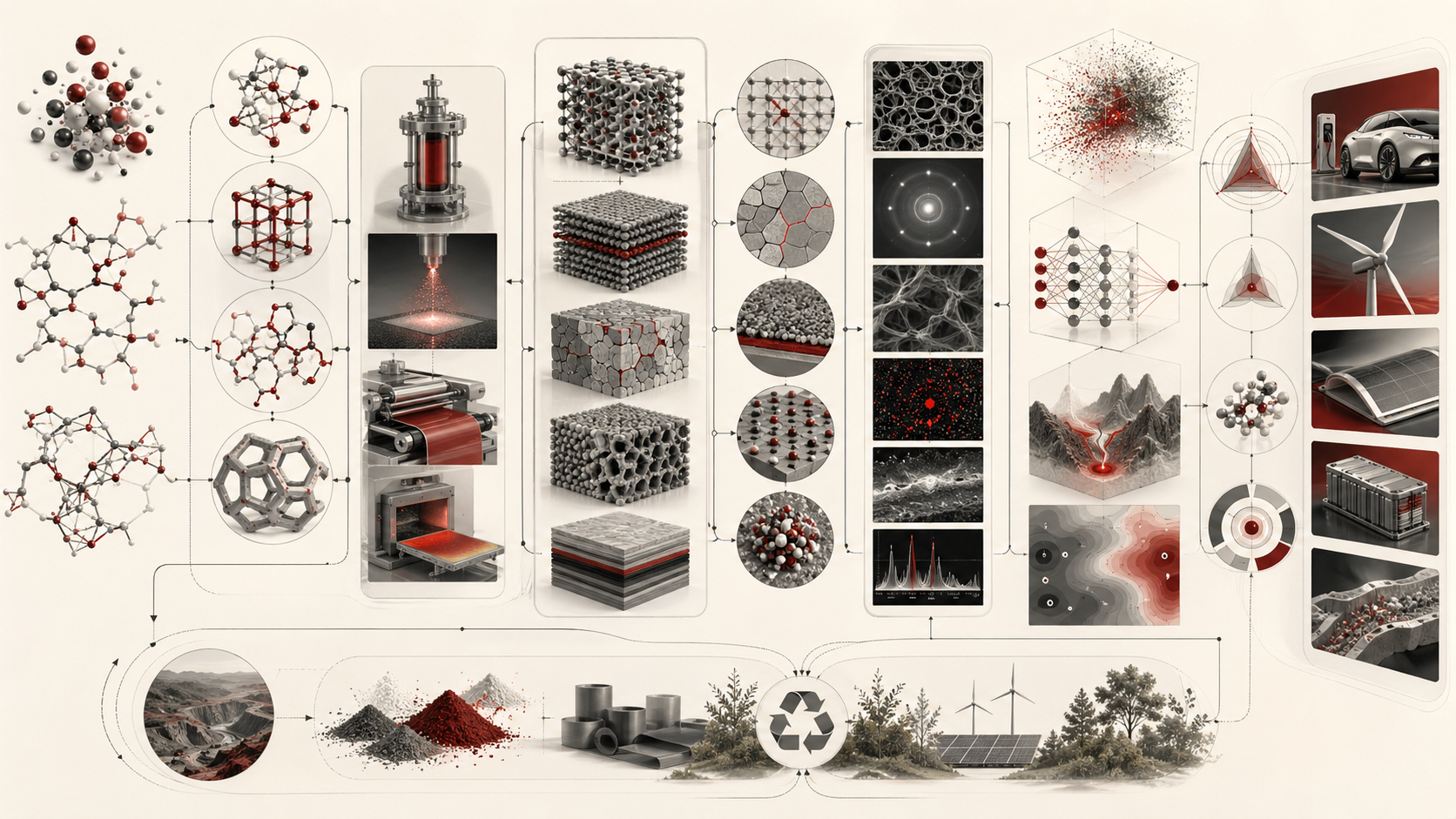
The central thesis of this article is that materials are not passive substances waiting to be classified. They are engineered chemical systems whose useful behavior emerges from relationships among composition, synthesis, processing, microstructure, surface chemistry, defects, phase behavior, measurement, modeling, and application context. A material is not fully defined by formula, phase, or property table. It is defined by how structure and chemistry perform under real conditions.
Materials chemistry is therefore a bridge between molecular design and material consequence. It connects atomic structure to macroscopic performance, laboratory synthesis to manufacturing, characterization to evidence, modeling to discovery, and sustainability to responsible design. To understand materials chemistry scientifically is to understand how matter becomes function through structure, processing, and use.
Main Library
Publications
Article Map
Chemistry
Related Topic
Physics
Related Topic
Environmental Science
Related Topic
Data Systems & Analytics
What Materials Chemistry Designs
Materials chemistry designs matter for function. A material may be a polymer, ceramic, alloy, glass, composite, semiconductor, catalyst, membrane, hydrogel, porous framework, coating, nanoparticle, biomaterial, electrolyte, battery electrode, photovoltaic absorber, sensor layer, adhesive, lubricant, pigment, textile, concrete, or responsive molecular solid. In each case, the material is chemically meaningful because its structure and composition produce behavior under use conditions.
The phrase “design of function” is important. Materials chemistry does not stop at identifying a compound or measuring a property. It asks how a material can be made to perform a role. A catalyst must not only accelerate a reaction; it must remain active, selective, stable, and recoverable. A battery electrode must not only store charge; it must do so across cycles, temperatures, rates, and safety constraints. A membrane must not only separate species; it must balance permeability, selectivity, mechanical strength, fouling resistance, chemical durability, manufacturability, and cost. A biomaterial must not only have a desirable surface; it must interact responsibly with living systems.
Materials chemistry therefore sits between molecular chemistry and engineering. It uses chemical synthesis, solid-state chemistry, polymer chemistry, surface chemistry, supramolecular chemistry, electrochemistry, spectroscopy, microscopy, crystallography, thermal analysis, mechanical testing, computational chemistry, and data science to connect composition to performance.
Materials chemistry also asks what counts as evidence. A claimed material function should be supported by characterization, measurement conditions, uncertainty, repeatability, application context, and failure analysis. A material with a promising property in one test may fail under humidity, temperature cycling, chemical exposure, mechanical stress, fatigue, contamination, scaling, manufacturing variation, or long-term aging. Material function is always conditional.
For researchers and scientists, materials chemistry requires a systems view of matter. The material is not only the sample in the vial or the specimen in the instrument. It is also the processing route, microstructure, surface state, defect population, phase distribution, use environment, degradation pathway, and end-of-life consequence.
Structure, Property, Processing, and Function
The central logic of materials chemistry can be summarized as a relationship among composition, structure, processing, properties, and function. Composition describes what the material is made of. Structure describes how atoms, molecules, ions, phases, domains, chains, grains, pores, or interfaces are arranged. Processing describes how the material is synthesized, shaped, annealed, cured, deposited, printed, cast, sintered, quenched, stretched, doped, coated, or otherwise transformed. Properties describe measurable responses. Function describes useful performance in context.
A simplified relationship can be represented as:
\mathrm{Function} = f(\mathrm{composition}, \mathrm{structure}, \mathrm{processing}, \mathrm{properties}, \mathrm{environment})
\]
Interpretation: This expression is not a universal predictive law. It is a design reminder: material function emerges from multiple interacting variables, not from composition alone.
Function is contextual. A polymer with excellent strength may fail if it swells in solvent. A ceramic with high thermal stability may be too brittle for a mechanical application. A catalyst with high activity may deactivate rapidly. A semiconductor with an attractive band gap may be difficult to process or unstable under light, moisture, or heat. A biodegradable polymer may work in one environment and fail in another.
Materials chemistry therefore involves tradeoffs. The best material for a function is rarely the material that maximizes one property in isolation. It is the material that satisfies a linked set of chemical, physical, mechanical, economic, environmental, and operational constraints.
Processing is especially important because it can convert identical composition into different structures. Cooling rate can change crystallinity. Sintering can change grain size and porosity. Drawing can orient polymer chains. Annealing can relieve stress or create phase separation. Deposition conditions can change film roughness and defects. Additive manufacturing can introduce anisotropy. A material’s history becomes part of its performance.
For researchers, the structure-property-processing-function relationship should guide both experimentation and interpretation. A property table is incomplete without the material history that produced it and the conditions under which it was measured.
Major Classes of Functional Materials
Polymers and Soft Materials
Polymers are materials made from macromolecules. Their properties depend on monomer chemistry, molecular weight, molecular-weight distribution, tacticity, branching, crosslinking, crystallinity, glass-transition temperature, additives, plasticizers, fillers, and processing history. Polymers can be flexible, tough, transparent, adhesive, insulating, conductive, biodegradable, stimuli-responsive, or biocompatible depending on chemical design.
Soft materials include gels, elastomers, colloids, surfactant assemblies, membranes, foams, liquid crystals, and biological materials. Their function often emerges from mesoscale organization rather than molecular identity alone. A hydrogel, for example, may be designed for water uptake, mechanical softness, drug release, ionic conductivity, or tissue compatibility.
Ceramics, Glasses, and Inorganic Solids
Ceramics and inorganic solids can provide high-temperature stability, hardness, corrosion resistance, ionic conductivity, dielectric behavior, catalytic activity, optical response, and structural durability. Their properties are strongly affected by crystal structure, grain size, porosity, stoichiometry, defects, dopants, sintering conditions, and phase boundaries.
Inorganic materials include oxides, nitrides, carbides, sulfides, phosphates, silicates, perovskites, spinels, zeolites, and metal-organic or covalent frameworks. These materials are central to batteries, fuel cells, catalysts, membranes, sensors, electronics, refractories, construction materials, and environmental technologies.
Metals and Alloys
Metals and alloys derive function from metallic bonding, crystal structure, grain boundaries, dislocations, precipitates, phase transformations, and processing history. Alloying can tune strength, ductility, corrosion resistance, magnetism, conductivity, density, oxidation behavior, and high-temperature performance. Heat treatment, mechanical deformation, additive manufacturing, casting, welding, and surface treatments all alter microstructure.
Materials chemistry contributes to alloy design by connecting thermodynamics, phase diagrams, oxidation chemistry, corrosion mechanisms, surface modification, coating chemistry, and computational screening. It also contributes to questions of critical metals, corrosion protection, recyclability, and high-performance substitutes for scarce materials.
Semiconductors, Electronic Materials, and Photonic Materials
Semiconductors and electronic materials are designed around charge transport, band structure, doping, interfaces, dielectric properties, defects, carrier mobility, recombination, optical absorption, and device architecture. Silicon, compound semiconductors, organic semiconductors, perovskites, oxides, two-dimensional materials, and quantum dots all show how chemical composition and structure shape electronic function.
Photonic and optical materials control light through absorption, emission, refractive index, scattering, nonlinear response, photoluminescence, plasmonic behavior, or photochemical stability. Their design requires both molecular-scale chemistry and materials-scale control of morphology, purity, defects, and interfaces.
Porous Materials and Frameworks
Porous materials include zeolites, activated carbons, metal-organic frameworks, covalent organic frameworks, mesoporous oxides, aerogels, and membranes. Their function depends on pore size, pore connectivity, surface chemistry, framework stability, adsorption enthalpy, diffusion pathways, and chemical selectivity. They are important for catalysis, gas storage, carbon capture, separations, sensing, water treatment, and controlled release.
Biomaterials and Biointerfaces
Biomaterials are designed to interact with biological systems. Their function depends on surface chemistry, mechanical properties, degradation, protein adsorption, immune response, sterilization, porosity, swelling, toxicity, and tissue integration. A biomaterial is not only a material in the abstract; it is a chemical interface with living matter.
Composites, Coatings, and Hybrid Materials
Composite and hybrid materials combine phases to produce properties that no single component provides alone. Polymer composites may combine toughness with reinforcement. Ceramic-metal composites may combine hardness with conductivity. Hybrid organic-inorganic materials may combine processability with electronic or optical function. Coatings can protect, passivate, lubricate, sense, repel water, resist fouling, or control adhesion.
For researchers, material classification is useful but incomplete. A material’s class does not determine performance by itself. A polymer composite, ceramic membrane, alloy coating, or semiconductor film must be interpreted through composition, processing, microstructure, interfaces, testing, and use environment.
Synthesis, Processing, and Microstructure
Materials chemistry depends on synthesis, but synthesis alone does not determine function. Processing often controls the structure that actually performs. A material’s measured behavior may depend on particle size, crystallinity, grain growth, porosity, film thickness, solvent evaporation, annealing temperature, cooling rate, pressure, humidity, shear, curing time, deposition method, or additive distribution.
For example, two samples with the same nominal composition may behave differently if one is amorphous and the other crystalline. A polymer film cast slowly may phase-separate differently from one spin-coated rapidly. A ceramic sintered at a higher temperature may have lower porosity and larger grains. A catalyst prepared with a different support may expose different active sites. A perovskite film may show different photovoltaic performance depending on solvent, precursor ratio, humidity, and annealing.
This is why materials chemistry is often described through processing-structure-property relationships. The route matters. Function is not only encoded in formula; it is produced through history.
Synthesis methods include solution synthesis, sol-gel processing, precipitation, hydrothermal synthesis, solvothermal synthesis, polymerization, vapor deposition, electrodeposition, melt processing, combustion synthesis, mechanochemistry, self-assembly, atomic layer deposition, chemical vapor deposition, physical vapor deposition, additive manufacturing, and biomediated growth. Each method creates characteristic distributions of size, phase, defect, and morphology.
Processing methods include casting, extrusion, spinning, coating, sintering, annealing, curing, quenching, calendaring, printing, drawing, laminating, foaming, hot pressing, cold pressing, rolling, welding, polishing, lithography, and surface treatment. These methods determine texture, porosity, orientation, residual stress, grain size, interface quality, and defects.
For researchers, synthesis and processing should be reported as part of the evidence. A material’s formula may be reproducible while its microstructure is not. Without processing details, a materials claim can be difficult to verify, reproduce, or translate.
Characterization and Materials Evidence
Materials characterization asks what structure, composition, morphology, phase, surface, defect population, and property distribution are actually present. Common methods include X-ray diffraction, electron microscopy, atomic force microscopy, spectroscopy, thermal analysis, mechanical testing, rheology, surface-area analysis, porosimetry, electrochemical testing, conductivity measurement, ellipsometry, scattering, tomography, and chromatography or mass spectrometry when extractables, degradation products, or additives matter.
Characterization is strongest when methods are complementary. X-ray diffraction may identify crystalline phases but miss amorphous components. Electron microscopy may reveal morphology but may not provide bulk composition. Spectroscopy may identify bonding environments but may require calibration or comparison. Thermal analysis may reveal transitions but not molecular origin. Mechanical testing may reveal performance but not failure mechanism.
A materials claim should therefore connect characterization evidence to the function being asserted. If a coating is described as corrosion resistant, the evidence should include relevant exposure conditions and failure analysis. If a polymer is described as biodegradable, the evidence should specify environment, time, mechanism, and degradation products. If a porous material is described as selective for carbon dioxide, the evidence should include adsorption conditions, competing gases, humidity, regeneration, and stability.
Characterization must also distinguish local evidence from bulk evidence. A microscope image may show one region. A diffraction pattern may average across a larger volume. A surface measurement may probe only the outermost nanometers. A mechanical test may reveal the weakest defects. A device test may combine material, interface, geometry, and packaging. Materials evidence is often scale-dependent.
For researchers, characterization should be designed backward from the claim. A claim about function requires property evidence. A claim about mechanism requires structural and chemical evidence. A claim about reliability requires aging and failure evidence. A claim about sustainability requires lifecycle, toxicity, and end-of-life evidence. Characterization is not decoration; it is the foundation of materials trust.
Defects, Interfaces, and Emergent Behavior
Defects are not always flaws. Vacancies, interstitials, dopants, dislocations, grain boundaries, stacking faults, surface steps, dangling bonds, and nonstoichiometry can control materials function. Oxygen vacancies may influence ionic conductivity and catalytic behavior. Dopants can tune semiconductor conductivity. Dislocations can strengthen or weaken metals. Grain boundaries can enhance or degrade transport. Surface defects can create active catalytic sites.
Interfaces are equally important. Many functional materials work because of what happens at boundaries: electrode-electrolyte interfaces, polymer-filler interfaces, catalyst-support interfaces, grain boundaries, heterojunctions, surface coatings, biological interfaces, and phase-separated domains. A battery may fail because of interfacial instability. A composite may succeed because load transfers across an interface. A sensor may work because analytes bind at a functionalized surface. A membrane may separate because its interface controls sorption and diffusion.
Materials chemistry therefore requires a multi-scale view. Atomic structure matters, but so do mesoscale morphology, macroscale processing, and use-environment history.
Emergent behavior appears when structure at one scale produces properties at another. A block copolymer can self-assemble into nanoscale domains that affect ion transport. A nanostructured catalyst can expose sites that do not exist in the bulk. A composite can become conductive when filler loading crosses a percolation threshold. A porous framework can separate molecules through the combination of pore geometry and surface chemistry. A phase-change material can store information through reversible structural transformation.
For researchers, defects and interfaces should be treated as design variables, not only as imperfections. The question is not whether a material contains defects or boundaries; all real materials do. The question is which defects and interfaces exist, how they were formed, how they change under operation, and whether they support or undermine the intended function.
Phase Behavior, Stability, and Transformation
Materials often contain multiple phases or transform between phases. Phase behavior determines melting, crystallization, glass formation, phase separation, precipitation, transformation toughening, order-disorder transitions, magnetic transitions, ferroelectric transitions, gelation, and phase-change memory. A material’s function may depend on phase stability or controlled phase transformation.
Phase diagrams, thermodynamic models, and kinetic pathways help explain why phases form and persist. A material may be thermodynamically metastable but kinetically trapped. Rapid cooling can preserve amorphous structures. Annealing can produce crystallization. Additives can suppress or promote phase separation. Dopants can stabilize phases that would otherwise transform. Processing can therefore select structures that are not obvious from equilibrium chemistry alone.
Phase transformation can be useful. Shape-memory alloys exploit reversible structural transformations. Phase-change materials support data storage. Crystallization can strengthen polymers. Precipitation hardening can strengthen alloys. Battery materials store charge through phase changes, solid solutions, intercalation, conversion, or alloying reactions. Transformation can also be harmful when it causes cracking, volume change, embrittlement, degradation, or loss of conductivity.
Stability must be interpreted in context. A material stable in dry air may degrade in humid air. A catalyst stable under inert conditions may restructure under reactants. A semiconductor stable in the dark may degrade under illumination. A polymer stable at room temperature may creep under load or oxidize under heat. Stability is not a single property; it is resistance to transformation under specified conditions.
For researchers, phase behavior should be connected to time, temperature, pressure, composition, atmosphere, mechanical stress, electrochemical potential, radiation, and chemical exposure. A stable material is stable only within a defined window.
Surfaces, Coatings, and Boundary Control
Surfaces often determine whether a material succeeds in use. Surfaces control wetting, adhesion, friction, corrosion, fouling, catalysis, biocompatibility, charge transfer, optical reflection, microbial attachment, and environmental degradation. A bulk material with excellent intrinsic properties can fail if its surface reacts, cracks, fouls, oxidizes, delaminates, leaches, or adsorbs unwanted species.
Coatings and surface treatments are therefore central to materials chemistry. A coating may protect against corrosion, reduce friction, improve adhesion, block water, change color, resist fouling, conduct ions, passivate a semiconductor, improve biocompatibility, or provide catalytic activity. Surface treatments may include plasma activation, oxidation, silanization, grafting, self-assembled monolayers, anodization, passivation, deposition, etching, polishing, and functional coatings.
Surface chemistry is especially important in batteries, catalysts, membranes, biomedical implants, sensors, electronics, coatings, and composites. An electrode coating may suppress side reactions. A catalyst support may stabilize nanoparticles. A membrane surface may resist fouling. A biomaterial surface may reduce protein adsorption or promote tissue integration. A polymer-fiber interface may determine composite strength.
Surfaces also age. They adsorb water, oxygen, oils, salts, proteins, pollutants, and organic matter. They may oxidize, hydrate, crack, wear, erode, or reconstruct. A freshly prepared surface may not represent the surface after use. Surface evidence should therefore include exposure history and operating conditions.
For researchers, surface modification should be evaluated as part of the material system, not as a cosmetic layer. A coating is successful only if it adheres, survives, performs, and remains compatible with the substrate and environment over the required lifetime.
Transport, Diffusion, Conductivity, and Permeability
Many materials functions depend on transport. Ions move through electrolytes and membranes. Electrons move through conductors and semiconductors. Heat moves through solids and interfaces. Molecules diffuse through polymers and porous materials. Water moves through gels and membranes. Gases permeate packaging films. Reactants move through catalyst pores. Pollutants move through adsorbents and filters.
Transport depends on structure. Crystallinity, free volume, pore size, tortuosity, grain boundaries, defects, swelling, hydration, phase separation, and interfaces can all control movement. A polymer membrane’s gas permeability depends on solubility and diffusivity. A ceramic electrolyte’s ionic conductivity depends on vacancy concentration, crystal structure, and grain boundaries. A porous adsorbent’s performance depends on pore access and diffusion. A composite’s electrical conductivity may appear only when conductive filler networks connect.
Transport is also coupled to environment. Humidity can increase ionic conductivity in some materials and degrade others. Temperature can increase diffusion but reduce stability. Pressure can drive permeation. Swelling can open transport pathways. Fouling can block pores. Mechanical stress can crack barriers. Chemical exposure can change surface charge or pore chemistry.
For researchers, transport measurements should specify conditions. Conductivity, permeability, diffusivity, and flux values are not universal constants for most real materials. They depend on temperature, humidity, concentration, pressure, microstructure, sample thickness, conditioning, and measurement method.
Transport limitations can also distort interpretation. A catalyst may seem less active because reactants cannot reach active sites. A membrane may seem selective because of fouling rather than intrinsic separation. A battery electrode may lose performance because ions cannot move through thick films. Materials chemistry must therefore connect function to accessible pathways.
Mechanical Performance, Fracture, Fatigue, and Lifetime
Materials must often carry load, resist deformation, survive impact, avoid cracking, tolerate fatigue, and maintain performance over time. Mechanical behavior depends on bonding, microstructure, defects, interfaces, grain size, crystallinity, porosity, molecular weight, crosslink density, filler dispersion, and processing history.
Important mechanical properties include stiffness, strength, hardness, toughness, ductility, elongation, creep resistance, fatigue resistance, fracture toughness, wear resistance, and impact resistance. These properties cannot always be optimized together. A very stiff material may be brittle. A tough material may be less stiff. A lightweight material may have lower strength. A porous material may have useful transport but weaker mechanics.
Failure often begins at defects and interfaces. Cracks may initiate at pores, inclusions, grain boundaries, scratches, voids, delaminations, residual stresses, weld lines, or phase boundaries. Fatigue can accumulate damage under cyclic loading. Creep can deform materials under long-term stress. Environmental stress cracking can combine chemical exposure and mechanical stress. Thermal cycling can create mismatch stresses at interfaces.
Lifetime prediction is difficult because materials age under combined conditions. A component may experience load, heat, humidity, UV light, salt, chemicals, vibration, and abrasion together. Accelerated tests can help, but they must reflect relevant failure mechanisms. A test that is faster is not automatically more predictive.
For researchers, mechanical data should include specimen preparation, processing history, orientation, geometry, test method, strain rate, temperature, humidity, and failure mode. Mechanical performance is not just a property value; it is a response under conditions.
Electronic, Optical, Catalytic, and Responsive Materials
Functional materials are designed to produce specific responses. Electronic materials conduct, insulate, switch, store charge, or control carrier movement. Optical materials absorb, emit, reflect, scatter, guide, or convert light. Catalytic materials accelerate and select chemical transformations. Responsive materials change properties in response to temperature, pH, light, electric field, magnetic field, mechanical stress, humidity, ions, or chemical signals.
Electronic function depends on band structure, carrier concentration, mobility, defects, dopants, contacts, interfaces, and stability. Optical function depends on absorption, emission, refractive index, scattering, photostability, and morphology. Catalytic function depends on active sites, surface area, adsorption, selectivity, transport, deactivation, and regeneration. Responsive function depends on reversible change, fatigue resistance, response time, hysteresis, and environmental compatibility.
Materials chemistry is essential because function often requires controlled imperfections. A dopant can make a semiconductor useful. A vacancy can support ion conduction. A surface defect can become a catalytic site. A phase boundary can improve toughness. A porous network can provide separation. A molecular switch can create responsiveness. The task is not simply to eliminate disorder, but to control structure at the scale where function emerges.
Functional materials also require device context. A photovoltaic absorber needs contacts, transport layers, encapsulation, and stability. A catalyst needs a reactor and regeneration pathway. A sensor needs calibration and anti-fouling behavior. A membrane needs pressure tolerance and cleaning. A responsive polymer needs repeatability. Material function becomes useful only when integrated into a working system.
For researchers, functional claims should identify the full chain from structure to performance. The strongest materials chemistry connects synthesis, characterization, mechanism, device or application testing, stability, and responsible use.
Materials Data, FAIR Workflows, and Computational Discovery
Materials chemistry is increasingly data-intensive. Experimental measurements, crystallographic structures, spectra, microscopy images, thermal traces, mechanical tests, synthesis recipes, processing histories, simulation outputs, and device-performance records can all become part of a materials knowledge system. Open materials databases and computational platforms now support screening, comparison, and discovery across large chemical and structural spaces.
High-throughput computation can estimate formation energies, band gaps, elastic constants, diffusion barriers, phase stability, magnetic behavior, adsorption energies, and other properties. Experimental repositories can preserve measured data, synthesis conditions, and characterization records. FAIR data principles are especially important because materials data become more valuable when they can be found, accessed, interoperated with, and reused across instruments, laboratories, and computational tools.
However, materials data are difficult. The same nominal material may behave differently depending on synthesis route, processing, defects, microstructure, measurement method, temperature, humidity, pressure, surface condition, and aging. A computed ideal crystal may not represent a real processed film. A database property may not apply to a composite, doped material, nanostructure, or degraded sample. A machine-learning model may fail outside the domain of its training data.
Materials-data workflows should preserve:
- composition, structure, phase, morphology, and processing route;
- sample preparation, measurement method, instrument settings, and environment;
- raw data, processed data, uncertainty, and quality-control records;
- simulation method, software version, functional, basis set, pseudopotential, convergence criteria, and structure file;
- application context, failure criteria, and use-environment assumptions;
- provenance linking the material candidate to all measurements and models used in decision-making.
Computational discovery is powerful when it narrows search spaces, reveals trends, identifies candidates, and makes assumptions explicit. It is weaker when it treats database values as context-free truth. Materials data should not replace materials judgment. It should make judgment more transparent, reproducible, and accountable.
Materials Chemistry, Sustainability, and Responsible Design
Materials design has environmental consequences. A material that performs well technically may depend on scarce elements, toxic precursors, energy-intensive processing, persistent waste, difficult recycling, hazardous degradation products, or unjust extraction systems. Sustainable materials chemistry asks how function can be designed with attention to lifecycle, circularity, toxicity, abundance, energy, durability, repair, reuse, and environmental fate.
Important sustainability questions include:
- Does the material rely on critical or conflict-associated elements?
- Can it be synthesized under lower-energy or lower-toxicity conditions?
- Can it be repaired, reused, recycled, composted, or safely degraded?
- Does it release harmful additives, particles, ions, or degradation products?
- Does longer lifetime reduce total environmental burden?
- Does the material shift harm from one community, region, or generation to another?
- Can performance be achieved with more abundant, safer, or circular feedstocks?
Responsible materials chemistry treats sustainability as a design constraint rather than an afterthought. It connects chemistry to supply chains, infrastructure, public health, environmental justice, manufacturing, waste systems, and long-term stewardship.
Sustainability also requires avoiding simple substitutions. Replacing one material with another may reduce one burden while increasing another. A bio-based material may affect land and water. A high-performance alloy may rely on critical metals. A recyclable material may not be recycled in practice. A lightweight composite may reduce fuel use but be difficult to recover at end of life. A long-lived coating may reduce corrosion but release persistent additives.
For researchers, sustainability claims should identify system boundaries. Which lifecycle stages are included? Which impacts are measured? What happens during mining, synthesis, processing, use, repair, recycling, disposal, and degradation? Materials chemistry becomes responsible when these questions shape design from the beginning.
Responsible Use of Materials Evidence
Materials claims can influence buildings, vehicles, electronics, medical devices, batteries, environmental technologies, consumer products, infrastructure, and energy systems. Responsible use of materials evidence requires caution about scale, context, and validation.
Responsible materials practice includes:
- not treating a single property measurement as proof of application readiness;
- distinguishing laboratory samples from manufacturable materials;
- reporting processing history, sample variability, and test conditions;
- validating function under realistic use environments;
- considering degradation, aging, fatigue, corrosion, fouling, and failure modes;
- preserving raw characterization data and analysis methods;
- including uncertainty and replicate variability;
- evaluating safety, lifecycle, circularity, and environmental fate.
Responsible interpretation also requires distinguishing demonstration from deployment. A small device demonstration does not prove manufacturability. A single high-performance measurement does not prove durability. A computational prediction does not prove synthesis feasibility. A “green” label does not prove lifecycle benefit. A material can be scientifically interesting and still not be ready for use in safety-critical or environmentally consequential systems.
The ethical strength of materials chemistry lies in connecting useful function to accountable design. A material is successful not only when it works in a laboratory demonstration, but when its performance, risks, limitations, and lifecycle consequences are understood well enough to support responsible decisions.
Mathematical Lens: Property Vectors, Objective Functions, and Tradeoffs
Materials design can be represented as a search through possible compositions, structures, processing conditions, and property outcomes. Let \(x\) represent a candidate material and processing route. A simplified property vector can be written as:
\mathbf{p}(x) = [p_1(x), p_2(x), \ldots, p_n(x)]
\]
Interpretation: Each \(p_j(x)\) is a measured or predicted property, such as modulus, density, conductivity, band gap, catalytic activity, permeability, stability, toxicity, recyclability, or cost.
A design target can be represented by a target vector:
\mathbf{p}^{*} = [p_1^{*}, p_2^{*}, \ldots, p_n^{*}]
\]
Interpretation: The target vector describes the desired property profile for a specific use case. It is application-dependent and should not be treated as universal.
A simple weighted objective function can compare candidate materials to target properties:
J(x) = \sum_{j=1}^{n} w_j \left(\frac{p_j(x)-p_j^{*}}{s_j}\right)^2
\]
Interpretation: \(w_j\) is the importance weight for property \(j\), and \(s_j\) is a scaling factor used to compare properties with different units. Lower values of \(J(x)\) indicate closer agreement with the target profile.
Electrical conductivity can be represented in simplified form as:
\sigma = nq\mu
\]
Interpretation: \(\sigma\) is conductivity, \(n\) is charge-carrier concentration, \(q\) is charge, and \(\mu\) is mobility. Conductivity depends on both carrier population and how easily carriers move.
Thermal conduction can be described by Fourier’s law:
\mathbf{q} = -k\nabla T
\]
Interpretation: \(\mathbf{q}\) is heat flux, \(k\) is thermal conductivity, and \(\nabla T\) is the temperature gradient. Thermal performance depends on microstructure, interfaces, defects, porosity, and phase composition.
Diffusion through a material can be approximated by Fick’s first law:
J = -D\frac{dc}{dx}
\]
Interpretation: \(J\) is flux, \(D\) is diffusion coefficient, and \(dc/dx\) is concentration gradient. Diffusion affects membranes, coatings, batteries, corrosion, packaging, and degradation.
A simple strength-to-density comparison can be expressed as:
S_{\rho} = \frac{\sigma_{\mathrm{strength}}}{\rho}
\]
Interpretation: \(S_{\rho}\) is specific strength, \(\sigma_{\mathrm{strength}}\) is strength, and \(\rho\) is density. Lightweight structural materials often require performance normalized by mass.
A simplified property-retention metric after aging can be written as:
R(t) = \frac{P(t)}{P_0}
\]
Interpretation: \(R(t)\) is property retention at time \(t\), \(P(t)\) is the property after exposure, and \(P_0\) is the initial property. Retention metrics help connect materials performance to lifetime.
These equations show that materials function is measurable, modelable, and connected to transport, structure, environment, and tradeoff design. They are simplified, but they make one principle explicit: materials design is rarely about one number.
Computational Workflows for Materials Chemistry
Computational workflows can make materials design more transparent. A workflow can track material class, composition, synthesis route, processing history, density, modulus, thermal stability, conductivity, permeability, recyclability, cost, critical-material flags, uncertainty, and review status. It can also preserve assumptions behind scoring models, screening decisions, and candidate rankings.
Useful workflows include functional target screening, materials tradeoff analysis, property normalization, multi-objective ranking, critical-material flagging, processing-condition tracking, aging-data summaries, failure-mode registers, computational-database comparison, spectroscopy metadata tracking, and lifecycle-evidence mapping. More advanced workflows may integrate crystallographic databases, density-functional theory results, machine-learning models, laboratory information systems, microscopy metadata, mechanical testing files, and environmental assessment data.
For researchers, computational workflows should preserve context. A density value may be simple, but conductivity, modulus, stability, permeability, and catalytic activity depend strongly on sample state and measurement conditions. A model should record whether data are measured, predicted, inferred, simulated, or estimated. It should also preserve uncertainty and limitations.
The examples below use synthetic data. They do not certify materials, select products, determine safety, validate sustainability claims, or replace professional materials testing. They demonstrate how materials chemistry reasoning can be structured, audited, and communicated responsibly.
Python Example: Screening Materials Against Functional Targets
The following Python example uses synthetic educational data to rank candidate materials against a target functional profile. The goal is not to identify a real material but to show a reproducible screening pattern: define targets, normalize properties, score candidates, flag responsible-design concerns, and preserve assumptions.
from pathlib import Path
from typing import Dict, List
import json

import pandas as pd


# Synthetic materials chemistry screening workflow.
# Educational example only; not for engineering certification,
# safety-critical design, procurement, or regulatory decisions.


def screen_materials(materials: pd.DataFrame) -> pd.DataFrame:
    """Rank candidate materials against a hypothetical functional target.

    Real materials decisions require validated measurements, uncertainty
    analysis, application testing, processing trials, safety review,
    degradation studies, and lifecycle evaluation.
    """

    materials = materials.copy()

    targets: Dict[str, float] = {
        "density_g_cm3": 1.5,
        "modulus_GPa": 10.0,
        "thermal_stability_C": 300.0,
        "conductivity_S_m": 1.0,
        "recyclability_score": 0.85,
        "relative_cost_score": 0.30,
    }

    weights: Dict[str, float] = {
        "density_g_cm3": 1.2,
        "modulus_GPa": 0.8,
        "thermal_stability_C": 1.0,
        "conductivity_S_m": 1.0,
        "recyclability_score": 1.4,
        "relative_cost_score": 1.2,
    }

    scales: Dict[str, float] = {
        "density_g_cm3": 1.0,
        "modulus_GPa": 25.0,
        "thermal_stability_C": 250.0,
        "conductivity_S_m": 10.0,
        "recyclability_score": 0.25,
        "relative_cost_score": 0.30,
    }

    score_terms: List[str] = []

    for property_name in targets:
        term_name = f"{property_name}_score_term"
        materials[term_name] = (
            weights[property_name]
            * (
                (materials[property_name] - targets[property_name])
                / scales[property_name]
            ) ** 2
        )
        score_terms.append(term_name)

    materials["functional_mismatch_score"] = materials[score_terms].sum(axis=1)

    materials["lightweight_review_required"] = materials["density_g_cm3"] > 4.0
    materials["thermal_review_required"] = materials["thermal_stability_C"] < 250.0
    materials["circularity_review_required"] = materials["recyclability_score"] < 0.60
    materials["cost_review_required"] = materials["relative_cost_score"] > 0.75

    materials["responsible_design_review_required"] = (
        materials["lightweight_review_required"]
        | materials["thermal_review_required"]
        | materials["circularity_review_required"]
        | materials["cost_review_required"]
        | materials["critical_material_flag"]
    )

    ranked = materials.sort_values("functional_mismatch_score").copy()
    ranked["rank"] = range(1, len(ranked) + 1)

    ranked.attrs["targets"] = targets
    ranked.attrs["weights"] = weights
    ranked.attrs["scales"] = scales

    return ranked


materials = pd.DataFrame({
    "material_id": ["mat_A", "mat_B", "mat_C", "mat_D", "mat_E"],
    "material_class": [
        "polymer_composite",
        "ceramic",
        "porous_framework",
        "alloy",
        "semiconductor",
    ],
    "density_g_cm3": [1.28, 3.85, 0.72, 7.80, 5.30],
    "modulus_GPa": [4.2, 180.0, 2.1, 210.0, 72.0],
    "thermal_stability_C": [180.0, 1150.0, 320.0, 780.0, 540.0],
    "conductivity_S_m": [0.02, 0.0001, 0.004, 1.4e6, 250.0],
    "recyclability_score": [0.72, 0.45, 0.58, 0.88, 0.62],
    "relative_cost_score": [0.35, 0.62, 0.80, 0.55, 0.90],
    "critical_material_flag": [False, False, False, False, True],
})

ranked = screen_materials(materials)

output_dir = Path("outputs")
output_dir.mkdir(exist_ok=True)

ranked.to_csv(output_dir / "materials_function_screening_ranked.csv", index=False)

manifest: Dict[str, object] = {
    "workflow": "synthetic_materials_function_screening",
    "target_profile": ranked.attrs["targets"],
    "weights": ranked.attrs["weights"],
    "scales": ranked.attrs["scales"],
    "best_candidate": ranked.iloc[0]["material_id"],
    "responsible_use": [
        "Synthetic educational data only.",
        "Real materials decisions require validated measurements, application testing, uncertainty analysis, safety review, and lifecycle evaluation.",
    ],
}

with (output_dir / "materials_design_manifest.json").open(
    "w",
    encoding="utf-8"
) as file:
    json.dump(manifest, file, indent=2)

print(ranked[[
    "material_id",
    "material_class",
    "functional_mismatch_score",
    "rank",
    "responsible_design_review_required",
]])
This workflow demonstrates a useful discipline: materials selection should make assumptions visible. The target profile, weights, scales, review flags, and scoring method are not neutral. They encode the design priorities of the application. Changing those priorities may change the preferred material.
R Example: Tradeoff Analysis and Candidate Ranking
The following R example uses synthetic materials data to compare candidates on two common tradeoffs: performance and responsible design. It constructs simple composite scores and identifies candidates that deserve review. In real materials design, scoring systems should be validated against domain knowledge, experimental uncertainty, application constraints, and lifecycle evidence.
# Synthetic materials chemistry tradeoff workflow.
# Educational example only; not for engineering certification.

materials <- data.frame(
  material_id = c("mat_A", "mat_B", "mat_C", "mat_D", "mat_E"),
  material_class = c(
    "polymer_composite",
    "ceramic",
    "porous_framework",
    "alloy",
    "semiconductor"
  ),
  density_g_cm3 = c(1.28, 3.85, 0.72, 7.80, 5.30),
  modulus_GPa = c(4.2, 180.0, 2.1, 210.0, 72.0),
  thermal_stability_C = c(180, 1150, 320, 780, 540),
  recyclability_score = c(0.72, 0.45, 0.58, 0.88, 0.62),
  relative_cost_score = c(0.35, 0.62, 0.80, 0.55, 0.90),
  critical_material_flag = c(FALSE, FALSE, FALSE, FALSE, TRUE)
)

normalize <- function(x) {
  if (max(x) == min(x)) {
    return(rep(0, length(x)))
  }
  (x - min(x)) / (max(x) - min(x))
}

materials$modulus_norm <- normalize(materials$modulus_GPa)
materials$thermal_norm <- normalize(materials$thermal_stability_C)
materials$low_density_norm <- 1 - normalize(materials$density_g_cm3)
materials$low_cost_norm <- 1 - normalize(materials$relative_cost_score)

materials$performance_score <- (
  0.35 * materials$modulus_norm +
    0.35 * materials$thermal_norm +
    0.30 * materials$low_density_norm
)

materials$responsible_design_score <- (
  0.55 * materials$recyclability_score +
    0.35 * materials$low_cost_norm -
    0.10 * as.numeric(materials$critical_material_flag)
)

materials$combined_score <- (
  0.60 * materials$performance_score +
    0.40 * materials$responsible_design_score
)

materials$review_required <- (
  materials$recyclability_score < 0.60 |
    materials$relative_cost_score > 0.75 |
    materials$critical_material_flag
)

materials$rank <- rank(-materials$combined_score, ties.method = "min")

ranked <- materials[order(materials$rank), ]

dir.create("outputs", showWarnings = FALSE)

write.csv(
  ranked,
  file = "outputs/materials_tradeoff_ranking.csv",
  row.names = FALSE
)

sink("outputs/materials_tradeoff_report.txt")
cat("Synthetic Materials Chemistry Tradeoff Report\n")
cat("============================================\n\n")
cat("Candidate ranking:\n")
print(ranked[, c(
  "material_id",
  "material_class",
  "performance_score",
  "responsible_design_score",
  "combined_score",
  "rank",
  "review_required"
)])
cat("\nResponsible-use note:\n")
cat("Synthetic educational data only. Real materials design requires validated measurements, uncertainty analysis, safety review, application testing, and lifecycle evaluation.\n")
sink()

print(ranked)
This workflow makes tradeoffs explicit. A material may perform well but be costly, difficult to recycle, toxic, scarce, energy-intensive to process, or unstable under realistic use. Responsible materials design must therefore evaluate more than technical performance.
SQL Example: Materials Chemistry Evidence Register
Materials chemistry interpretation becomes more reliable when composition, synthesis, processing history, characterization, property measurements, aging tests, and responsible-design reviews are traceable. A simple evidence register can preserve the context needed to audit materials claims.
CREATE TABLE material_candidate (
    material_id TEXT PRIMARY KEY,
    material_name TEXT NOT NULL,
    material_class TEXT,
    nominal_composition TEXT,
    intended_function TEXT,
    critical_material_flag INTEGER CHECK (critical_material_flag IN (0, 1)),
    responsible_use_notes TEXT
);

CREATE TABLE synthesis_processing_record (
    process_id INTEGER PRIMARY KEY,
    material_id TEXT NOT NULL,
    synthesis_route TEXT,
    processing_method TEXT,
    processing_temperature_c REAL,
    processing_time_h REAL CHECK (processing_time_h >= 0),
    atmosphere_or_medium TEXT,
    post_treatment TEXT,
    batch_or_sample_id TEXT,
    FOREIGN KEY (material_id) REFERENCES material_candidate(material_id)
);

CREATE TABLE characterization_record (
    characterization_id INTEGER PRIMARY KEY,
    material_id TEXT NOT NULL,
    method_name TEXT,
    measurement_datetime TEXT,
    phase_or_structure_notes TEXT,
    surface_or_interface_notes TEXT,
    morphology_notes TEXT,
    instrument_settings TEXT,
    quality_flag TEXT,
    FOREIGN KEY (material_id) REFERENCES material_candidate(material_id)
);

CREATE TABLE property_measurement (
    property_id INTEGER PRIMARY KEY,
    material_id TEXT NOT NULL,
    test_datetime TEXT,
    density_g_cm3 REAL CHECK (density_g_cm3 >= 0),
    modulus_GPa REAL CHECK (modulus_GPa >= 0),
    thermal_stability_c REAL,
    conductivity_S_m REAL CHECK (conductivity_S_m >= 0),
    permeability_relative REAL CHECK (permeability_relative >= 0),
    test_condition_notes TEXT,
    uncertainty_notes TEXT,
    FOREIGN KEY (material_id) REFERENCES material_candidate(material_id)
);

CREATE TABLE aging_and_failure_test (
    aging_id INTEGER PRIMARY KEY,
    material_id TEXT NOT NULL,
    exposure_condition TEXT,
    exposure_duration_days REAL CHECK (exposure_duration_days >= 0),
    property_retention_fraction REAL CHECK (property_retention_fraction BETWEEN 0 AND 1.5),
    failure_mode TEXT,
    degradation_product_notes TEXT,
    review_status TEXT,
    FOREIGN KEY (material_id) REFERENCES material_candidate(material_id)
);

CREATE TABLE responsible_design_review (
    review_id INTEGER PRIMARY KEY,
    material_id TEXT NOT NULL,
    recyclability_score REAL CHECK (recyclability_score BETWEEN 0 AND 1),
    relative_cost_score REAL CHECK (relative_cost_score BETWEEN 0 AND 1),
    toxicity_review_completed INTEGER CHECK (toxicity_review_completed IN (0, 1)),
    lifecycle_review_completed INTEGER CHECK (lifecycle_review_completed IN (0, 1)),
    circularity_review_completed INTEGER CHECK (circularity_review_completed IN (0, 1)),
    review_notes TEXT,
    FOREIGN KEY (material_id) REFERENCES material_candidate(material_id)
);

SELECT
    m.material_id,
    m.material_class,
    m.intended_function,
    p.density_g_cm3,
    p.modulus_GPa,
    p.thermal_stability_c,
    p.conductivity_S_m,
    a.property_retention_fraction,
    a.failure_mode,
    r.recyclability_score,
    r.relative_cost_score,
    m.critical_material_flag,
    CASE
        WHEN a.property_retention_fraction < 0.80
            THEN 'aging and lifetime review required'
        WHEN r.recyclability_score < 0.60
            THEN 'circularity review required'
        WHEN r.relative_cost_score > 0.75
            THEN 'cost review required'
        WHEN m.critical_material_flag = 1
            THEN 'critical material review required'
        WHEN r.lifecycle_review_completed = 0
            THEN 'lifecycle review required'
        ELSE 'standard review'
    END AS screening_result
FROM material_candidate m
JOIN property_measurement p
    ON m.material_id = p.material_id
LEFT JOIN aging_and_failure_test a
    ON m.material_id = a.material_id
LEFT JOIN responsible_design_review r
    ON m.material_id = r.material_id
ORDER BY screening_result, p.density_g_cm3 ASC;
The purpose of this register is to keep materials interpretation attached to evidence. A property value should preserve test conditions. A structure claim should preserve characterization method. A lifetime claim should preserve exposure conditions and failure mode. A sustainability claim should preserve recyclability, toxicity, lifecycle, and circularity review status. Materials data become stronger when provenance is part of the record.
GitHub Repository
The companion repository for this article can support reproducible workflows for materials screening, tradeoff analysis, property normalization, functional target ranking, provenance tracking, lifecycle review flags, SQL evidence registers, and responsible materials interpretation.
Complete Code Repository
The full code distribution for this article, including selected materials chemistry examples, expanded computational workflows, reproducible data structures, provenance documentation, materials screening models, tradeoff analysis, SQL evidence registers, and scientific-computing scaffolding, is available on GitHub.
Limits, Uncertainty, and Responsible Interpretation
Materials chemistry is difficult to generalize because material behavior depends on composition, processing, microstructure, defects, interfaces, environment, and measurement method. A property value from one sample may not apply to another sample with the same nominal composition. A database value may not represent a processed film, composite, coating, porous structure, aged material, or device-integrated system.
Measurement uncertainty is substantial. Mechanical properties depend on specimen geometry, strain rate, humidity, temperature, orientation, and defects. Conductivity depends on contacts, microstructure, temperature, and impurities. Catalytic activity depends on transport, surface area, active sites, and product analysis. Stability depends on exposure conditions. Characterization methods probe different length scales and may produce different interpretations.
Computational predictions also require caution. A calculated band gap, formation energy, elastic constant, or diffusion barrier may depend on method, approximations, structure choice, temperature, defects, and surface state. High-throughput screening can identify candidates, but it does not replace synthesis, processing, characterization, and application testing.
Sustainability claims require clear boundaries. A material may perform well but rely on scarce elements, hazardous processing, difficult recycling, or persistent waste. Another material may have lower performance but better recovery, repairability, abundance, or safety. Responsible materials decisions require lifecycle evidence, not only technical metrics.
The computational examples associated with this article are synthetic and educational. They do not certify materials, qualify products, determine safety, validate sustainability claims, predict field lifetime, or replace professional materials characterization, engineering testing, toxicological review, environmental assessment, or lifecycle analysis. They are designed to show how materials chemistry reasoning can be structured and audited.
Responsible interpretation should avoid both technological hype and material pessimism. New materials can support cleaner energy, safer infrastructure, improved medicine, better sensors, and more durable systems. But usefulness depends on evidence, durability, manufacturing realism, safety, circularity, and context.
Conclusion
Materials chemistry shows how matter becomes function. It connects composition, bonding, structure, processing, microstructure, defects, interfaces, measurement, modeling, and environment into a discipline of designed performance. A material is not merely a substance with properties. It is a chemically organized system that behaves under conditions.
The field’s central lesson is that function emerges across scales. Atomic bonding matters, but so do crystal structure, polymer architecture, phase distribution, surface chemistry, pore networks, grain boundaries, defects, additives, processing history, and aging. Materials chemistry is therefore both molecular and systems-oriented.
For chemistry as a discipline, materials chemistry is essential because it links knowledge of matter to practical consequences: energy storage, electronics, catalysis, membranes, coatings, medicine, construction, transportation, environmental protection, and sustainable design. It also carries responsibility because materials shape infrastructures, exposures, supply chains, waste systems, and long-term ecological burdens.
A mature materials chemistry does not ask only, “Can this material perform?” It also asks: under what conditions, for how long, with what evidence, using what resources, creating what risks, and leaving what material future behind?
Related articles
- What Is Chemistry?
- Chemical Bonding and Molecular Structure
- Intermolecular Forces and the Properties of Matter
- Chemical Thermodynamics and Energetics
- Solid-State Chemistry and Crystalline Materials
- Polymer Chemistry and Macromolecular Materials
- Surface Chemistry, Interfaces, and Catalysis
- Nanochemistry and Molecular-Scale Materials
- Semiconductor, Electronic, and Photochemical Materials
- Electrochemistry, Batteries, and Energy Storage
- Computational Chemistry and Molecular Modeling
- Laboratory Automation, Chemical Data, and Instrument Workflows
Further reading
- Ashby, M.F. (2011) Materials Selection in Mechanical Design. 4th edn. Oxford: Butterworth-Heinemann.
- Callister, W.D. and Rethwisch, D.G. (2020) Materials Science and Engineering: An Introduction. 10th edn. Hoboken: Wiley.
- International Union of Pure and Applied Chemistry (2024) Definition of Materials Chemistry. Available at: https://iupac.org/definition-of-materials-chemistry/
- International Union of Pure and Applied Chemistry (n.d.) Materials Chemistry. Available at: https://goldbook.iupac.org/terms/view/09032
- National Institute of Standards and Technology (n.d.) Materials Data Repository. Available at: https://materialsdata.nist.gov/
- National Institute of Standards and Technology (n.d.) Materials Genome Initiative. Available at: https://www.nist.gov/mgi
- Materials Project (n.d.) Materials Project. Available at: https://next-gen.materialsproject.org/
- NOMAD Laboratory (n.d.) NOMAD. Available at: https://nomad-lab.eu/
- Open Quantum Materials Database (n.d.) OQMD. Available at: https://oqmd.org/
- AFLOW (n.d.) Automatic FLOW for Materials Discovery. Available at: https://www.aflowlib.org/
References
- Ashby, M.F. (2011) Materials Selection in Mechanical Design. 4th edn. Oxford: Butterworth-Heinemann.
- Callister, W.D. and Rethwisch, D.G. (2020) Materials Science and Engineering: An Introduction. 10th edn. Hoboken: Wiley.
- Drábik, M. et al. (2024) ‘Definition of materials chemistry’, Pure and Applied Chemistry, 96, pp. 1693–1704. Available at: https://iupac.org/recommendation/definition-of-materials-chemistry/
- International Union of Pure and Applied Chemistry (n.d.) Materials Chemistry. Available at: https://goldbook.iupac.org/terms/view/09032
- Jain, A. et al. (2013) ‘Commentary: The Materials Project: A materials genome approach to accelerating materials innovation’, APL Materials, 1, 011002. Available at: https://next-gen.materialsproject.org/
- Kirklin, S. et al. (2015) ‘The Open Quantum Materials Database (OQMD): assessing the accuracy of DFT formation energies’, npj Computational Materials, 1, 15010. Available at: https://www.nature.com/articles/npjcompumats201510
- National Institute of Standards and Technology (n.d.) Materials Data Repository. Available at: https://www.nist.gov/programs-projects/materials-data-repository
- National Institute of Standards and Technology (n.d.) Materials Genome Initiative. Available at: https://www.nist.gov/mgi
- NOMAD Laboratory (n.d.) NOMAD. Available at: https://nomad-lab.eu/
- Scheffler, M. et al. (2022) ‘FAIR data enabling new horizons for materials research’, Nature / materials-data literature. Available at: https://pure.mpg.de/rest/items/item_3380144/component/file_3658143/content
- Schadler, L.S., Brinson, L.C. and Sawyer, W.G. (2007) ‘Polymer nanocomposites: a small part of the story’, JOM, 59, pp. 53–60.
- Wuttig, M. and Yamada, N. (2007) ‘Phase-change materials for rewriteable data storage’, Nature Materials, 6, pp. 824–832. Available at: https://doi.org/10.1038/nmat2009