Chinese Myth, Folklore & Legend

Chinese Myth, Folklore & Legend examines the narrative traditions through which Chinese civilization has interpreted cosmic order, divine agency, moral struggle, ancestral memory, and the relationship between Heaven, Earth, and human life. In the history of ideas, Chinese mythic and folkloric traditions have contributed to larger conceptions of harmony, destiny, virtue, political legitimacy, and the symbolic structure of the cosmos.

This category explores creation stories, legendary rulers, immortals, spirits, folk deities, and popular tales, including their approaches to order, balance, transformation, moral retribution, and the continuity between the visible and invisible worlds. It considers how myth and folklore express cultural ideas about authority, family, nature, spiritual power, and the formation of civilization through exemplary figures and enduring narrative patterns.

Chinese myth, folklore, and legend play an important role in comparative inquiry because they reveal how narrative, cosmology, and moral imagination have shaped one of the world’s great civilizational traditions. By engaging these stories seriously, this category deepens understanding of Chinese symbolic life and broadens reflection on myth, cultural memory, and the narrative foundations of social order.

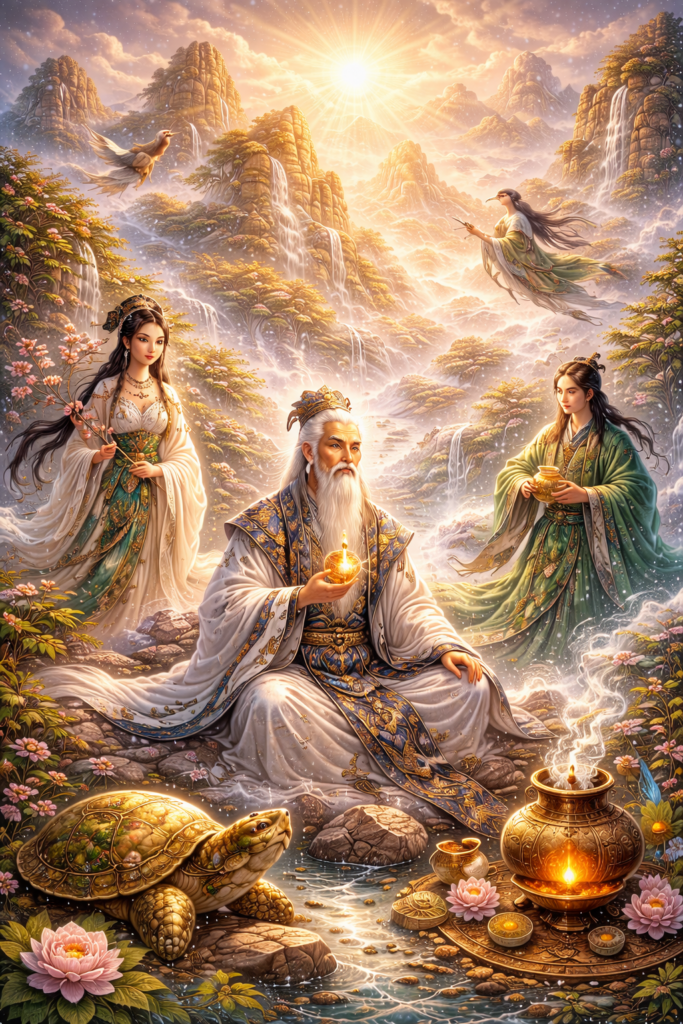
Mythic Daoist scene of immortals, sacred mountains, celestial light, inner cultivation, alchemical vessel, and the supernatural imagination of transcendence

Daoism, Immortality, and the Supernatural Imagination

Daoism has given Chinese civilization one of its richest supernatural imaginations because it refuses to treat transcendence as a distant abstraction. Across transmitted texts, religious practice, and later mythic culture, immortality, spiritual transformation, alchemical refinement, sacred mountains, celestial ascent, inner cultivation, and the disciplined remaking of the body emerge as intertwined possibilities within a single visionary world. This article examines Daoism within the Chinese Myth, Legend, and Folklore knowledge series as a tradition that imagines human life as radically transformable through alignment with the Dao, bodily cultivation, and access to numinous forms of existence. In Daoist supernatural thought, the extraordinary is not merely elsewhere. It may be cultivated through breath, medicine, ritual, meditation, geography, and the reordering of life itself.
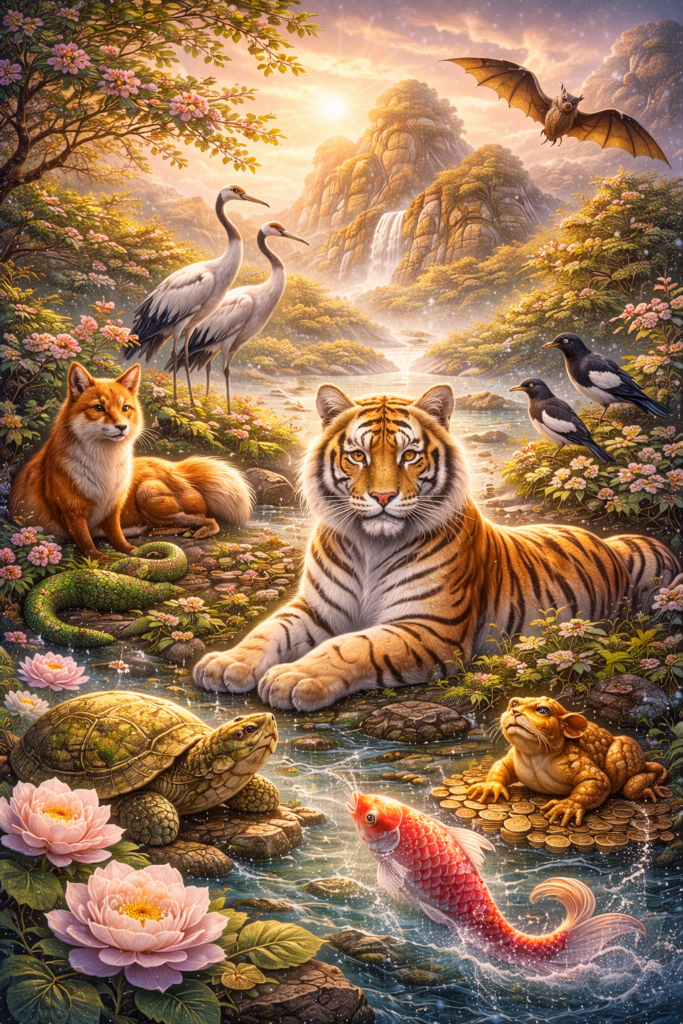
Mythic landscape of symbolic animals including a tiger, fox, turtle, koi, cranes, snake, bat, and toad in a radiant scene of omen, luck, and protection

Animals, Omens, and Symbolic Creatures in Chinese Folk Imagination

Animals, omens, and symbolic creatures occupy a central place in Chinese folk imagination because the natural world has long been understood not only as a field of living beings, but as a realm of signs, warnings, blessings, transformations, and culturally legible presences. Across transmitted texts, strange-tale traditions, ritual practice, and popular symbolism, creatures such as foxes, snakes, birds, turtles, tigers, bats, fish, and other animal forms become carriers of luck, danger, protection, fertility, intelligence, longevity, and moral or political meaning. This article examines how Chinese tradition turned animals into a symbolic ecology through which communities interpreted the world around them, showing that folklore in China often reads living creatures not as mute background to human life, but as expressive forms embedded in omen, ritual, narrative, and everyday imagination.

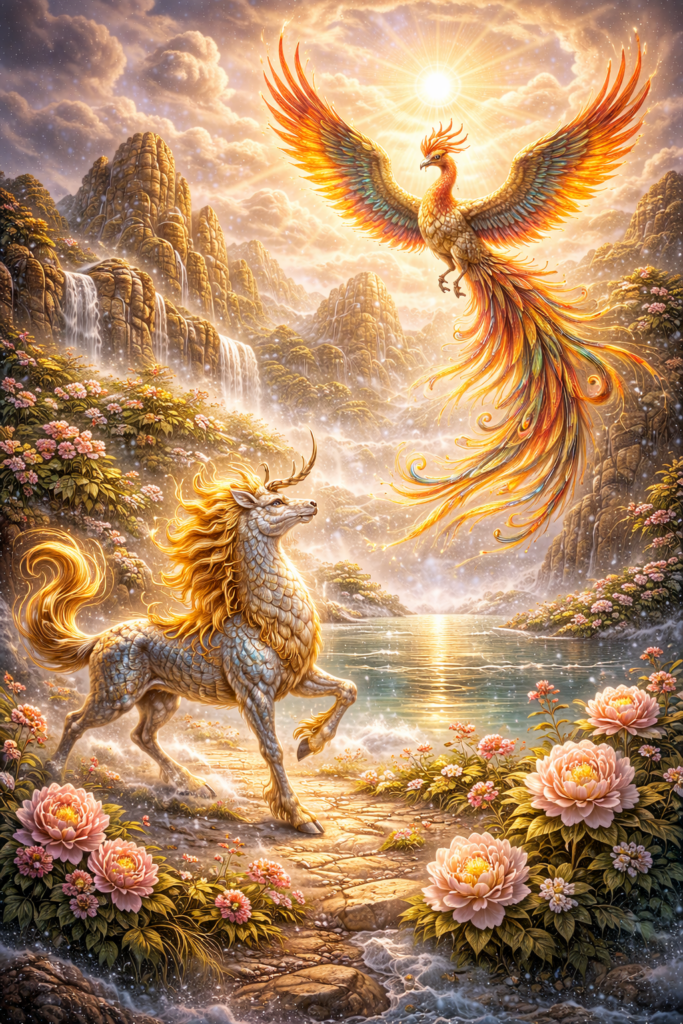
Mythic image of a radiant phoenix and a qilin in a luminous landscape of flowers, waterfalls, and sacred harmony

Phoenix, Qilin, and the World of Auspicious Beings

The fenghuang and the qilin occupy a distinctive place in Chinese mythology because they belong to a world of auspicious beings whose appearance signifies harmony, virtue, sage rule, and the visible flourishing of a rightly ordered realm. In transmitted sources such as the Shanhaijing, the Liji, and the Lunheng, they appear not simply as fabulous animals of wonder, but as symbolic creatures through which Chinese tradition imagines moral order becoming legible in the fabric of the world. This article examines the phoenix, qilin, and the wider field of auspicious beings within the Chinese Myth, Legend, and Folklore knowledge series, showing how omen, beauty, benevolence, and political legitimacy converge in one of the most revealing symbolic registers of Chinese myth.

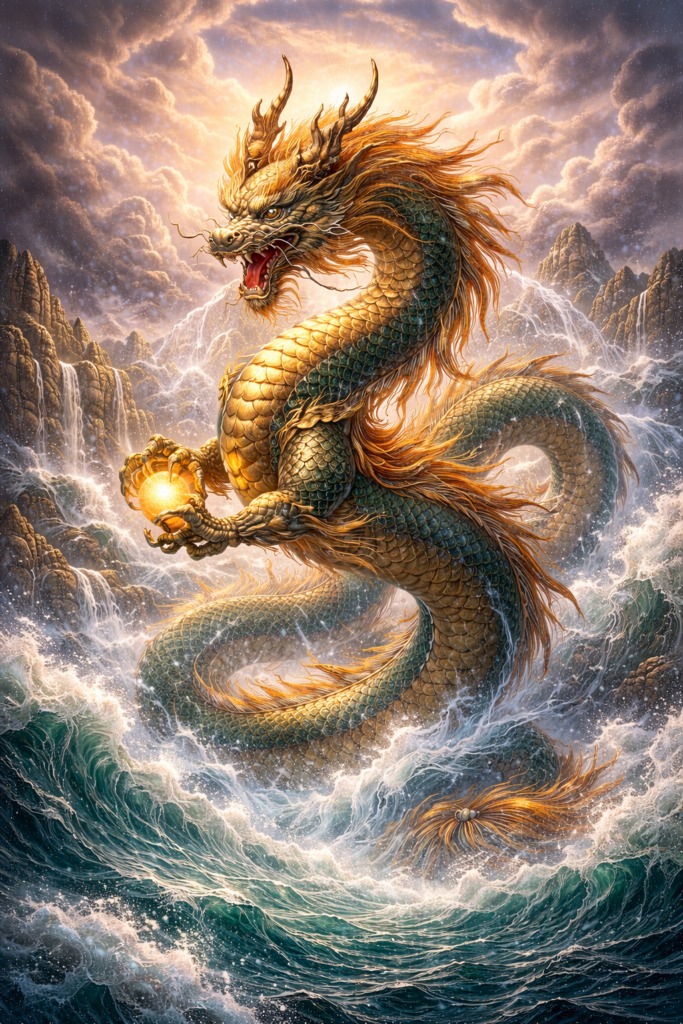
Mythic Chinese dragon rising from storm-tossed waters beneath turbulent clouds, embodying rain power, cosmic force, and imperial symbolism

Dragons in Chinese Myth, Water Cosmology, and Imperial Symbolism

Dragons occupy a singular place in Chinese mythology because they unite natural force, sacred imagination, and political symbolism in one of the tradition’s most enduring figures. In transmitted sources and later cultural memory, they are associated with rain, rivers, lakes, seas, clouds, atmospheric power, and the life-giving circulation of water across the world. This article examines dragons within the Chinese Myth, Legend, and Folklore knowledge series as beings through whom Chinese tradition imagines water cosmology, fertility, weather regulation, and the movement between earthly and heavenly domains. It also traces how the dragon became one of the most powerful emblems of imperial authority, linking sovereignty to cosmic vitality, beneficent force, and the ordering of the realm.

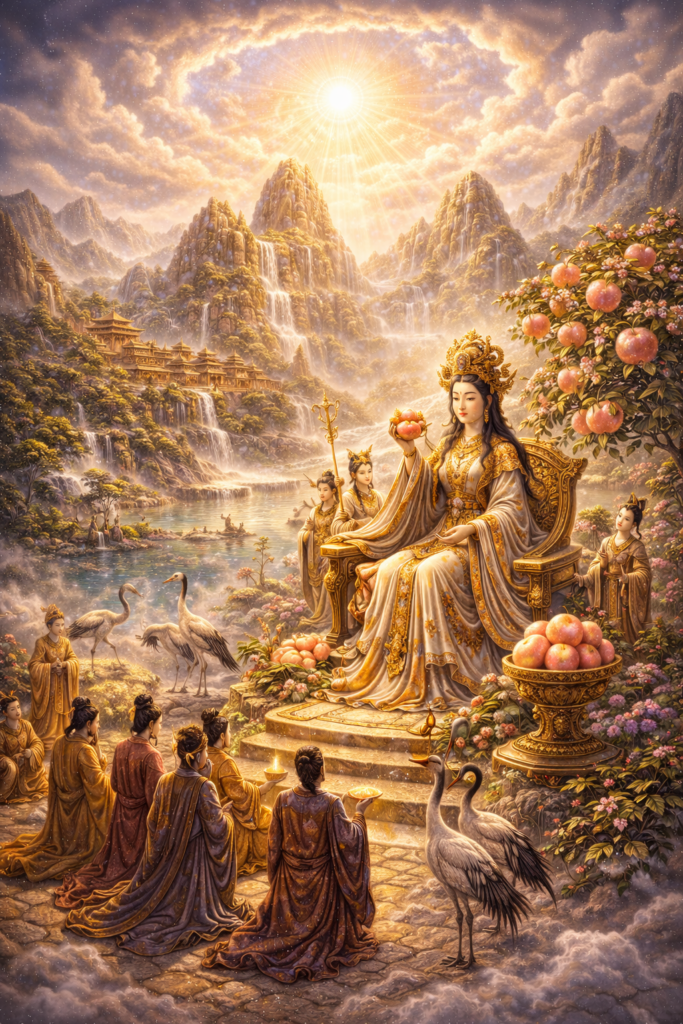
Mythic image of the Queen Mother of the West enthroned in a western paradise with peaches of immortality, sacred mountains, attendants, and celestial light

The Queen Mother of the West and the Imagery of Immortality

The Queen Mother of the West, Xiwangmu, is one of the most important figures in Chinese mythology because she gathers sacred geography, western transcendence, divine sovereignty, paradise imagery, and the longing for immortality into a single enduring symbol. In transmitted sources, she appears first as a formidable western mountain power associated with Yushan and the charged landscape of the far west, before later tradition transforms her into the queen of immortals presiding over celestial banquets, paradise gardens, and the peaches of long life. This article examines Xiwangmu within the Chinese Myth, Legend, and Folklore knowledge series as a figure through whom Chinese tradition imagines both the danger and promise of the sacred west. In her, the western mountains become not merely distant terrain, but a domain of awe, sovereignty, beauty, and the possibility of life beyond ordinary mortality.

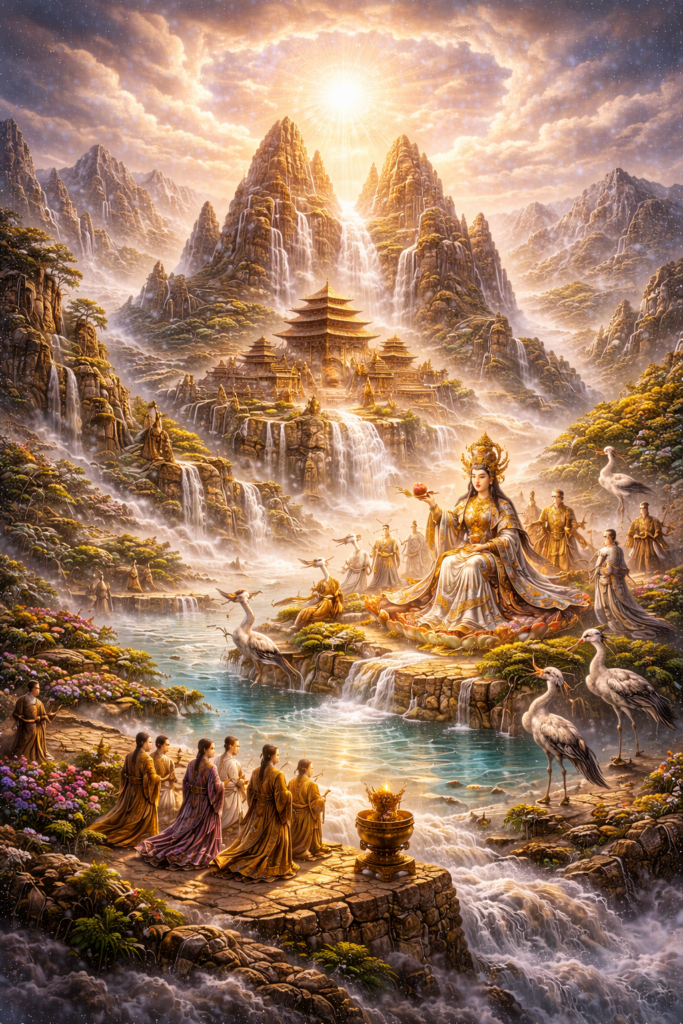
Mythic western mountain paradise of Kunlun with radiant peaks, waterfalls, divine court, attendants, and sacred landscape associated with Xiwangmu

Kunlun, Paradise Mountains, and the Sacred Geography of the West

Kunlun occupies a singular place in Chinese mythology because it is at once mountain, threshold, paradise, courtly destination, and sacred geography of the far west. In transmitted sources such as the Shanhaijing, the Mutianzi zhuan, and the Liezi, it appears as a charged western mountain world associated with Xiwangmu, difficult access, royal aspiration, divine sovereignty, and the possibility of immortality. This article examines Kunlun within the Chinese Myth, Legend, and Folklore knowledge series as one of the great symbolic landscapes of Chinese myth, showing how the western mountain becomes a site where sacred distance, cosmic prestige, political longing, and transcendence converge. In Kunlun, Chinese tradition preserves a geography that is never merely spatial. It is a map of paradise, remoteness, and the limits of ordinary human access.

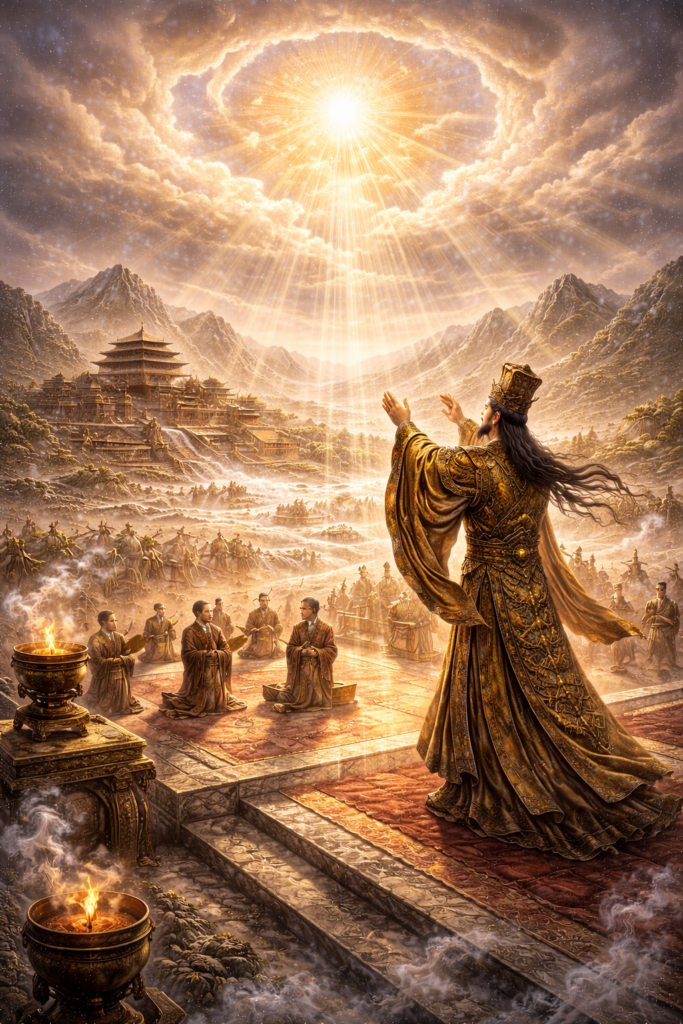
Mythic scene of an ancient Chinese ruler performing ritual beneath a radiant heavenly sky, with temples, officials, and symbols of cosmic legitimacy

Heaven, Mandate, and the Mythic Imagination of Rule

The Mandate of Heaven is one of the most consequential ideas in the Chinese political imagination because it places rulership within a moral and cosmic order in which legitimacy depends on virtue, public welfare, ritual adequacy, and responsiveness to the people. This article examines Heaven, mandate, and the mythic imagination of rule through transmitted sources such as the Shangshu and Mencius, showing how political authority in early China was understood not as unconditional possession, but as a charge granted, judged, and potentially revoked. Read within the Chinese Myth, Legend, and Folklore knowledge series, the doctrine reveals how Chinese civilization joined cosmos, morality, succession, rebellion, and governance into a single framework of political meaning. Under the Mandate of Heaven, rule is never merely held. It must be justified.

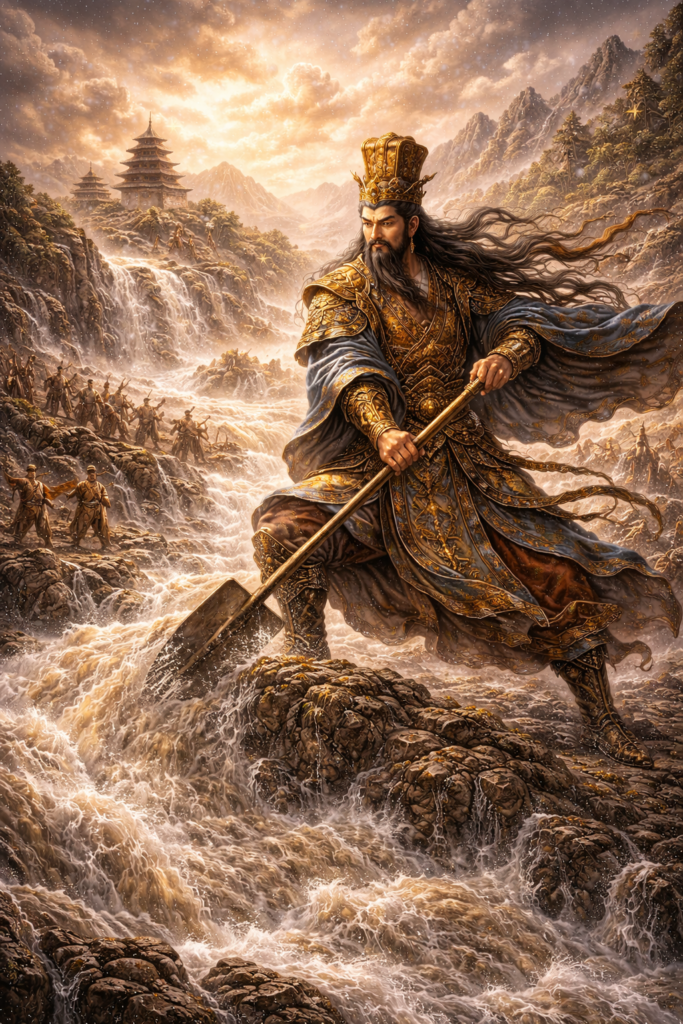
Mythic image of Yu the Great directing floodwaters across a rugged landscape with rushing rivers, laborers, mountains, and early structures of rule

Yu the Great, Flood Control, and the Birth of Political Order

Yu the Great occupies a decisive place in Chinese legendary history because he stands at the point where environmental mastery, territorial ordering, and political legitimacy converge. In the transmitted tradition, he is remembered not chiefly as a distant sage, but as the figure who traversed mountains and rivers, opened channels, disciplined waters, and made political order materially possible. This article examines Yu within the Chinese Myth, Legend, and Folklore knowledge series as the legendary ruler through whom Chinese civilization linked flood control, geographic intelligibility, public labor, and the birth of dynastic order. Under Yu’s name, the realm becomes governable because the landscape itself has been made habitable.

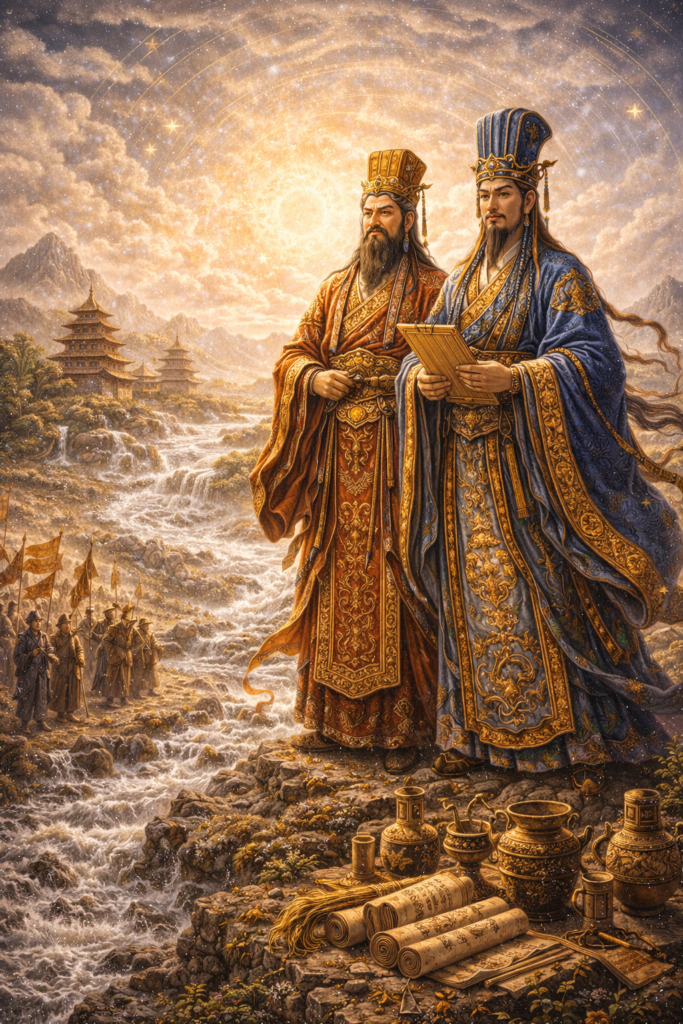
Mythic image of Yao and Shun as sage-kings in ceremonial robes beside flowing waters, ritual vessels, scrolls, and a cosmically ordered landscape

Yao, Shun, and the Sage-Kings in Legendary History

Yao and Shun occupy a central place in Chinese legendary history because they represent a vision of rulership grounded in moral authority, ritual order, administrative discernment, and responsiveness to the conditions of the world. In transmitted sources such as the Shangshu and the Shiji, they appear not chiefly as conquerors or mythic warriors, but as sage-kings whose legitimacy rests on luminous virtue, calendrical and cosmological alignment, just governance, and the recognition of worth in others. This article examines Yao and Shun within the Chinese Myth, Legend, and Folklore knowledge series as figures through whom Chinese tradition imagines the highest form of early kingship. Their stories reveal that the beginnings of political order are not only matters of force, territory, or ancestry, but of moral judgment, public responsibility, and the exemplary conduct of rule itself.

Scroll to Top