
Last Updated May 5, 2026
Yao and Shun occupy a central place in Chinese legendary history because they represent a form of rulership defined less by conquest than by moral authority, ritual order, administrative discernment, calendrical responsibility, and responsiveness to the conditions of the world. If the Yellow Emperor stands at the mythic politics of consolidation, Yao and Shun stand at the mythic politics of exemplary governance. In the transmitted tradition, they are not remembered primarily as founders of political order through war, but as sage-kings whose legitimacy rests on virtue, cosmological attentiveness, just administration, public welfare, and the capacity to recognize worth in others.
Their importance lies in the fact that they become models not only of early rulership, but of what rulership ought to be. Yao and Shun are figures of normative antiquity: rulers from the deep past whose stories became standards for later thought about virtue, succession, administration, punishment, ritual, flood control, and the moral obligations of power. They are legendary, but their legendary status is inseparable from their political force. Their stories are not merely about what happened long ago. They are about how rightful rule should be imagined.
Article Map
Chinese Myth, Folklore & Legend
Related Topic
Huangdi & Political Origins
Series context: This article is part of the Chinese Myth, Folklore & Legend knowledge series. It should be read alongside What Is Chinese Myth, Folklore & Legend?, The Problem of Sources in Chinese Mythology, The Yellow Emperor and the Mythic Politics of Chinese Origins, Shennong and the Invention of Agriculture, Medicine, and Rule, and Yu the Great, Flood Control, and the Birth of Political Order. Within that sequence, Yao and Shun shift the emphasis from the securing of rule to the moral testing of rule.
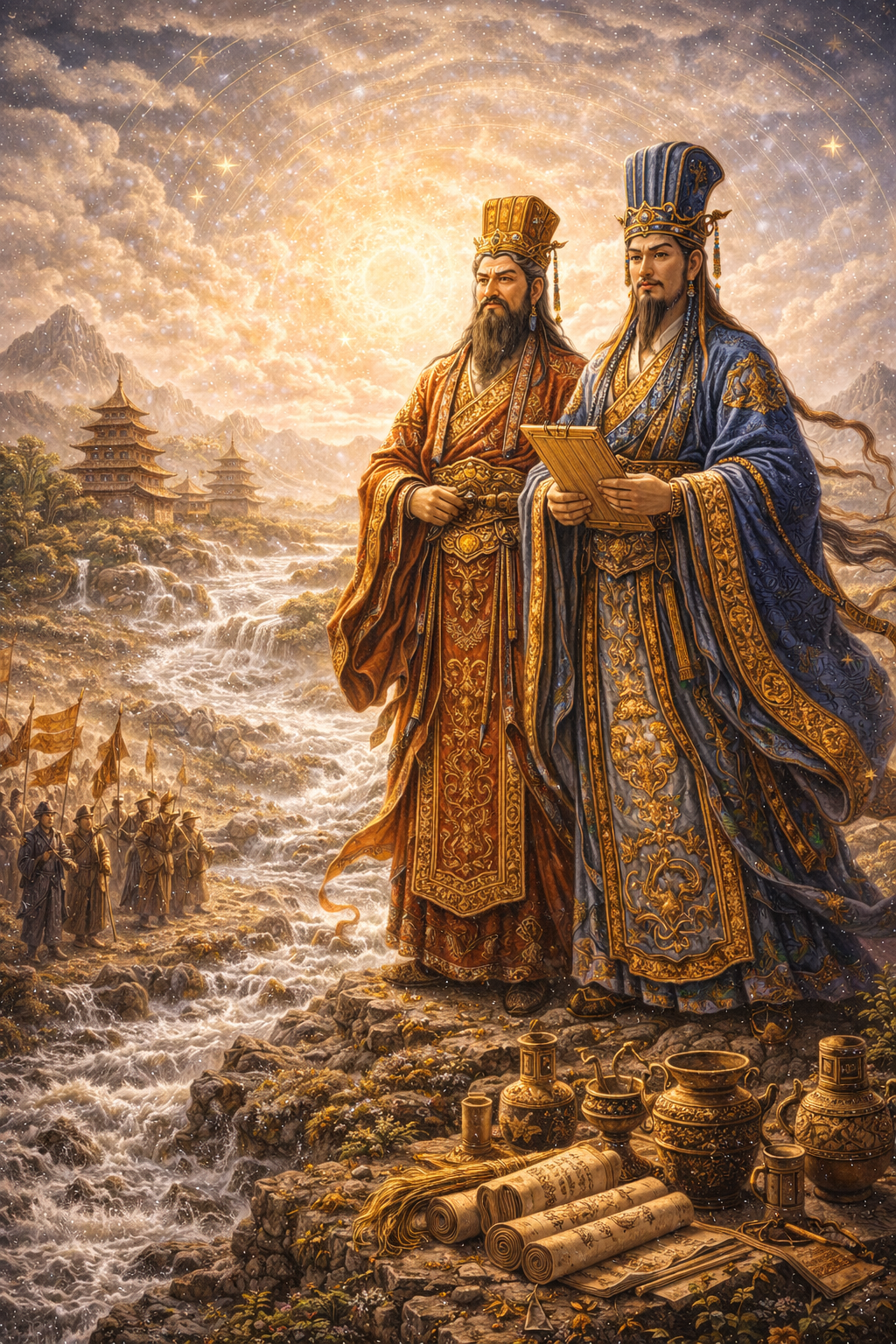
The primary textual basis for their significance is unusually strong. The Shangshu preserves the Canon of Yao and the Canon of Shun, which present the two rulers through a language of luminous virtue, calendrical and astronomical ordering, administrative selection, hydrological concern, penal judgment, ritual responsibility, and public care. The Shiji, in the Annals of the Five Emperors, absorbs and reorganizes these traditions into a broader narrative of ancient rulership and succession. These texts do not merely remember Yao and Shun as names from a distant past. They install them as paradigmatic rulers in a moralized antiquity.
This makes Yao and Shun essential to the study of Chinese myth, folklore, and legend. Their stories show how myth can become political theory, how legendary history can become moral instruction, and how ancient rulership can be imagined as accountable to heaven, calendar, people, territory, family, law, and the material conditions of life. In their tradition, the highest ruler is not simply the most powerful. He is the one whose virtue becomes public order.
Who Are Yao and Shun?
Yao and Shun are remembered as sage-kings, figures whose greatness lies not primarily in mythic violence, miraculous creation, or conquest, but in the just and discerning exercise of rule. In the Canon of Yao, Yao is described through a vocabulary of reverence, intelligence, accomplishment, generosity, and the power to harmonize kindred, people, and states. In the Canon of Shun, Shun appears as the one who is elevated, tested, entrusted, and eventually charged with ordering the land, administering punishments, conducting ritual, and maintaining obedience under a just order.
The transmitted texts therefore treat them less as isolated heroes than as embodiments of the highest form of early kingship. Their stories ask a question that remained central to Chinese political thought: what makes rule legitimate? The answer given through Yao and Shun is not blood alone, not force alone, and not administrative capacity alone. Legitimate rule requires virtue made visible in public order.
Primary Source
曰若稽古帝堯,曰放勳,欽、明、文、思、安安,允恭克讓,光被四表,格于上下。克明俊德,以親九族。九族既睦,平章百姓。百姓昭明,協和萬邦。Examining antiquity, we find Emperor Yao, called Fangxun: reverent, intelligent, accomplished, thoughtful, and naturally at ease; sincerely respectful and able to yield. His radiance reached the four quarters and extended above and below. He made able virtue clear, brought harmony to the nine kin-groups, ordered the many people, and brought concord to the myriad states.Shangshu, “Canon of Yao” 堯典.
The passage introduces Yao through luminous virtue that becomes public harmony. His personal qualities are meaningful because they radiate outward into kinship, people, and political order.
The Shiji intensifies this by placing Yao and Shun within a continuous annalistic account of early rulership. Yao recognizes that his son Danzhu is unfit and yields authority to Shun so that the wider realm may benefit rather than a single lineage. This framing matters because it turns Yao and Shun into political exemplars of a principle that later Chinese thought treated as foundational: rule should follow worth, not mere blood.
The Canon of Yao and the Image of Luminous Rule
The Canon of Yao presents Yao as a ruler whose virtue radiates outward as ordered harmony. The text’s language is strikingly cosmological, familial, and administrative at once. Yao’s rule begins not with the display of force, but with the power of moral clarity: kin groups are harmonized, the people become ordered, and the myriad states come into concord. His authority is imagined as luminous because it spreads beyond the ruler’s own person into the visible organization of the world.
This image of rule is foundational for later political imagination. The ruler’s virtue is not private spirituality. It is not merely inward refinement. It has consequences for the world. A ruler whose virtue cannot become public order is incomplete. Yao’s greatness lies in the union of inner quality and outer effect: his reverence, intelligence, and capacity to yield are visible in the transformed condition of people and states.
The Canon of Yao also makes clear that sage-kingship is relational. Yao’s rule is described through kinship, people, states, heaven, earth, seasons, officials, and work. He is not a solitary hero standing apart from society. He is the center of an ordered field. His virtue matters because it creates right relation among many levels of life.
This image becomes one of the reasons Yao remained so powerful in later memory. He is the ruler whose authority does not need to be justified by conquest alone. His legitimacy is proven by harmonization. The world under him becomes more coherent, and that coherence is the evidence of his rule.
Cosmos, Calendar, and the Ordering of Time
One of the most important features of the Canon of Yao is its attention to astronomy, seasonality, and the regulation of time. The text describes Yao commanding the Xi and He officials to observe the heavens, calculate the movements of sun, moon, stars, and celestial spaces, and respectfully deliver the seasons to the people. This is not antiquarian detail. It reveals a fundamental principle of early Chinese political imagination: a ruler must order time as well as territory.
The calendar is not a technical side matter. It is a condition of just rule. Agriculture, labor, ritual, seasonal movement, and public administration all depend upon correct timing. A ruler who cannot align society with the rhythms of heaven cannot fully order the human world. In this tradition, time is political because people live through seasons, crops, ritual cycles, work periods, and the coordination of public tasks.
Primary Source
乃命羲和,欽若昊天,曆象日月星辰,敬授人時。He then commanded Xi and He, in reverent accordance with the vast heavens, to calculate and model the sun, moon, stars, and celestial markers, and respectfully to give the people the proper seasons.Shangshu, “Canon of Yao” 堯典.
The passage makes calendrical order a royal responsibility. Yao’s rule aligns the human community with the patterned movements of heaven.
This cosmological dimension matters because it shows that the sage-king is not merely a moral exemplar in human affairs. He is also the mediator through whom society is aligned with the patterned order of the cosmos. Yao’s greatness therefore lies partly in making time itself governable and socially meaningful.
The same passage also shows why Yao belongs in a mythology series, not merely a political-history discussion. His kingship is mythic because it is cosmological. He orders society by recognizing that human life depends on heavenly pattern. In the sage-king tradition, the calendar is one of the first instruments of civilization.
Shun and the Politics of Recognition
Shun’s legendary significance begins in recognition. The received tradition remembers him as one whose worth is perceived, tested, and entrusted with power. In the Canon of Shun, his virtue is heard “on high,” and he is appointed to office. In the Shiji, Yao asks for possible successors and is directed toward Shun, an obscure figure whose virtue has become visible despite difficult family circumstances.
This makes Shun a figure of political recognition rather than sheer inheritance. He becomes the exemplary recipient of authority because he has been judged worthy of it. Later political thought would repeatedly return to this model because it dramatizes a fundamental tension within rulership: how can power be made legitimate? The Shun story answers by making legitimacy an affair of tested virtue and visible capacity.
Primary Source
曰若稽古帝舜,曰重華協于帝。濬哲文明,溫恭允塞,玄德升聞,乃命以位。Examining antiquity, we find Emperor Shun, called Chonghua, fully in accord with the former emperor. He was deep, wise, accomplished, and intelligent; gentle, respectful, and truly sincere. The report of his hidden virtue rose upward, and he was appointed to office.Shangshu, “Canon of Shun” 舜典.
Shun’s authority begins with recognized virtue. He does not seize rule; he is identified, tested, and entrusted.
This recognition model is one of the most important differences between Shun and a purely dynastic heir. Shun’s legitimacy emerges because Yao and the wider political order identify worth outside the immediate line of inheritance. His story therefore preserves the possibility that true political capacity may appear in obscurity, outside elite expectation, and must be actively sought.
In this sense, Shun’s legend also carries a subtle critique of power. It implies that inherited status is not enough. A ruler must be found, tested, and proven. Power is not legitimate simply because it is available; it must correspond to virtue, capacity, and public need.
Abdication, Merit, and the Ideal of Succession
The transfer from Yao to Shun is among the most politically influential narratives in the Chinese tradition. In the Shiji, Yao knows that his son Danzhu is unworthy and concludes that he cannot harm the whole realm in order to benefit one individual. He therefore yields authority to Shun. This is the core of the abdication ideal: succession should follow merit and public welfare rather than familial attachment alone.
Whether treated as literal history, normative legend, or historiographical construction, the story’s function is unmistakable. It defines a horizon of political legitimacy against which later practices could be measured. The highest ruler is the one capable of subordinating lineage interest to the well-being of the realm.
Primary Source
授舜,則天下得其利而丹朱病;授丹朱,則天下病而丹朱得其利。堯曰:「終不以天下之病而利一人」,而卒授舜以天下。If he gave it to Shun, all under heaven would gain the benefit and Danzhu would suffer; if he gave it to Danzhu, all under heaven would suffer and Danzhu would gain the benefit. Yao said, “I will never cause all under heaven to suffer in order to benefit one man,” and in the end he gave all under heaven to Shun.Shiji, “Annals of the Five Emperors” 五帝本紀.
The passage makes abdication a moral drama of succession. The welfare of the whole is placed above the advantage of the ruler’s son.
What matters here is not whether abdication was a normal historical practice in antiquity. What matters is that the story became canonical as an image of rightful succession. It establishes a political imaginary in which the ruler is accountable to the whole, not merely to family line. That principle is one reason Yao and Shun became more than legendary kings. They became standards.
At the same time, the abdication ideal must be read source-critically. Later writers could use Yao and Shun to criticize hereditary rule, defend meritocratic ideals, or imagine a lost age of moral politics. The story is not politically neutral. It is powerful precisely because it became available for later argument about legitimacy, inheritance, virtue, and the public good.
Filial Trial, Family, and the Testing of Virtue
Shun’s family story is one of the most morally charged parts of his legend. In the Shiji, Shun is described as the son of a blind father, with difficult family relations involving a harsh father, stepmother, and arrogant brother. Yet he continues to act with careful filial conduct. This family setting becomes part of the political testing of Shun’s virtue. Before he is fit to order the realm, he must be shown capable of maintaining order under intimate pressure.
This element of the tradition reveals how Chinese legendary history connects household ethics and political ethics. The ruler is not imagined as someone whose public authority can be separated from relational conduct. The family becomes a training ground for rule, not because family hierarchy is identical to political order, but because both require self-restraint, discernment, patience, and the capacity to transform difficult relations without escalating disorder.
Shun’s family trial also complicates the ideal of sage-kingship. His virtue is not presented as easy. It is tested under adverse conditions. He must maintain conduct in a household where affection and justice are unstable. The point is not simply that Shun is obedient. The point is that he can endure moral difficulty without losing the discipline that later qualifies him for rule.
Modern readers should handle this material carefully. The tradition’s admiration for filial endurance should not be used to romanticize family harm or normalize abuse. Its mythic function is to show that Shun’s virtue is tested under pressure and recognized as politically significant. Read responsibly, the story is less a demand for passive suffering than a narrative of moral steadiness before power is entrusted.
Ritual, Cosmos, and the Sage-King’s Responsibility
The Canon of Shun expands the sage-king’s responsibility beyond moral recognition into ritual and cosmic alignment. Once Shun assumes the work of government, he examines astronomical instruments, harmonizes the “seven regulators,” sacrifices to the high deity, performs rites to honored powers, offers to mountains and rivers, and extends worship to the host of spirits. This is rulership as ritual mediation.
Such passages show that Yao and Shun belong to a worldview in which governance is inseparable from cosmic and ritual order. The ruler is not merely an administrator of human affairs. He is responsible for maintaining proper relation among heaven, earth, spirits, mountains, rivers, regional lords, calendars, measures, punishments, and public works.
Primary Source
在璿璣玉衡,以齊七政。肆類于上帝,禋于六宗,望于山川,徧于群神。He examined the jeweled turning sphere and jade transverse tube, in order to harmonize the seven regulators. Thereafter he offered the proper sacrifice to the High Deity, made pure offerings to the Six Honored Ones, offered to the mountains and rivers, and extended worship to the multitude of spirits.Shangshu, “Canon of Shun” 舜典.
The passage frames Shun’s rule as cosmological and ritual as well as administrative. The sage-king orders society by aligning it with heaven, sacred powers, mountains, rivers, and spirits.
This ritual dimension makes sage-kingship mythically dense. Yao and Shun are not simply good rulers in an abstract ethical sense. They are rulers who stand at the center of a cosmos requiring observance, calibration, reverence, and periodic renewal. Their politics is inseparable from sacred order.
The result is a model of rulership in which moral charisma must become ritual practice. Virtue alone is not enough if it does not stabilize the relationships that bind the human community to the larger world. In Yao and Shun, legitimate rule is both ethical and ceremonial, practical and cosmological.
Administration, Punishment, and the Work of Government
The Canon of Shun is especially important because it shows that sage-kingship is not charisma alone. Shun’s rule involves institution-building, territorial division, river works, offices, punishments, compassion in judgment, and the handling of disorder. The text states that the land was divided into twelve provinces, altars were raised on twelve hills, rivers were deepened, punishments were ordered, and major offenders were removed so that all under heaven submitted.
This is crucial for interpretation. The sage-king is not an abstract moral icon detached from institutions. He governs through offices, sanctions, divisions, ritual, and public works. The tradition thus combines ethical legitimacy with administrative capacity. Shun’s greatness consists not only in being virtuous, but in making order operative.
Primary Source
肇十有二州,封十有二山,濬川。象以典刑,流宥五刑,鞭作官刑,扑作教刑,金作贖刑。眚災肆赦,怙終賊刑。欽哉,欽哉,惟刑之恤哉!He began the division into twelve provinces, raised altars on twelve mountains, and deepened the rivers. He displayed the statutory punishments, used banishment to mitigate the five punishments, made the whip a punishment for officials, the stick a punishment for instruction, and fines a way to redeem offences. Accidental faults were pardoned, but obstinate repeated wrongdoing was punished. Reverent, reverent—let punishment be handled with compassion.Shangshu, “Canon of Shun” 舜典.
This passage presents Shun as administrator, judge, territorial organizer, and river-ordering ruler. Sage-kingship is ethical, but also institutional.
The phrase “let punishment be handled with compassion” is especially important. The text does not imagine justice as mere severity. It distinguishes accidental fault from obstinate wrongdoing and frames punishment as a matter requiring reverence. This is a powerful early image of law as moral responsibility rather than arbitrary force.
Shun’s administration therefore belongs in the same mythic-political sequence as Yao’s calendar. Yao orders time; Shun orders territory, ritual, punishment, and public works. Together they show that sage-kingship is a total art of alignment: cosmic, social, juridical, and infrastructural.
Flood Control and the Conditions of Rule
Yao and Shun are inseparable from the problem of water and flood, one of the great recurring themes in early Chinese political mythology. In the received tradition, Yao confronts the problem of deluge and seeks a solution; under Shun, the issue remains central and leads into the later story of Yu. This matters because it reveals that rulership in legendary history is measured not only by moral speech or ritual order, but by the capacity to secure the material conditions of life against environmental threat.
Flood in this archive is never merely a natural disaster. It is a political test. A ruler who cannot answer water’s disorder cannot fully claim to order the world. This is why the Yao-Shun traditions flow so naturally into the Yu tradition. Governance, morality, hydrology, territory, and public labor belong to one continuous field of responsibility.
The Shiji preserves this problem vividly. Yao asks who can respond to the floodwaters that rise toward heaven, surround mountains, overtop hills, and trouble the people. Gun is recommended and tested, but his work fails. This failure prepares the narrative ground for Yu, whose later flood-control labor becomes one of the great foundations of political order.
In this sense, Yao and Shun do not merely precede Yu chronologically. They create the conditions under which Yu’s significance becomes intelligible. Yao recognizes the crisis; Shun administers the world in which the crisis must be solved; Yu becomes the worker-ruler whose success transforms flood control into a foundation of dynastic memory. The flood sequence links environmental management to legitimacy.
Yao, Shun, and Yu
The sequence from Yao to Shun to Yu is one of the most important structures in Chinese legendary history. Yao represents luminous virtue, calendrical order, and the recognition of worthy succession. Shun represents tested virtue, ritual centrality, administrative organization, punishment, and the public work of governance. Yu represents the successful ordering of floodwaters and the transition toward dynastic foundation. Together, they form a moral and political chain of civilization.
This sequence is not simply a list of early rulers. It is an argument about political order. Rule begins in virtue, must be recognized through merit, must be administered through institutions, must respond to environmental crisis, and must secure the conditions of public life. The sage-kings are therefore not passive symbols of a golden age. They are figures through whom the tasks of governance are mythically distributed.
The transition from Shun to Yu also complicates the abdication ideal. The tradition remembers Yao yielding to Shun and Shun eventually transmitting authority to Yu, but the later movement toward dynastic inheritance creates tension between merit succession and hereditary rule. This tension became important for later political reflection. The ancient sequence could be used both to idealize merit and to explain the emergence of dynastic order.
For Chinese myth studies, this matters because it shows how legendary history operates. It does not merely preserve events. It encodes problems: How should rulers be chosen? What makes a ruler legitimate? How should environmental crisis be managed? Can virtue be institutionalized? When does public service become political authority? Yao, Shun, and Yu are enduring because they make these questions narratable.
Sage-Kingship as Legendary History
Yao and Shun are best read as legendary history: figures presented in historical form but carrying unmistakably normative and mythic weight. They are neither purely fabulous deities nor modern historical personalities recoverable through documentary precision. Their function lies elsewhere. They create an antiquity in which the highest standards of rule can be imagined as already having been achieved.
This is why their stories remained so central to later ethical and political argument. A later thinker could invoke Yao and Shun not simply as ancestors but as measures. They became names for what it would mean for rule to be aligned with virtue, ritual, public need, and cosmic order. Their legendary historicity gives their ethical authority a special force: the standard is imagined not as abstract theory, but as remembered antiquity.
The form is important. Because they are narrated in canons and annals rather than only in wonder tales, their moral force becomes historically proximate. They are not remote cosmic abstractions. They are rulers of a remembered antiquity. The resulting effect is powerful: politics can be judged by reference to sage-kingship because sage-kingship is embedded in the very story of beginnings.
At the same time, this legendary history should not be mistaken for neutral documentation. The texts that preserve Yao and Shun are shaped by ritual, moral, political, and historiographical concerns. Their power lies in curated memory. They are constructed as ancient because antiquity itself becomes the ground of moral authority.
Yao, Shun, and the Problem of Sources
A scholarly reading of Yao and Shun must attend to the shaping force of the sources themselves. The Shangshu presents them in a highly stylized and normatively charged form; the Shiji reorders and narrativizes them within a broader historical architecture; later philosophical discourse takes them as paradigms of sage-rule, abdication, and meritocratic succession. What survives, therefore, is not a neutral record of unfiltered antiquity, but a transmitted and curated image of political beginnings.
This does not diminish their value. It defines it. Yao and Shun matter precisely because the archive chose to preserve them as standards. To study them is to study the construction of exemplary antiquity in Chinese civilization. Their legendary status and their normative authority are inseparable.
The Canon of Yao and Canon of Shun should also be read as textual formations with complex histories rather than as transparent windows into a single early period. Their language is ancient in authority but layered in transmission. The same is true of the Shiji, which arranges inherited material into a powerful annalistic sequence. Source criticism helps preserve the distinction between early memory, later ordering, and enduring political symbolism.
For this series, Yao and Shun are therefore crucial because they show how Chinese myth can take the form of moralized historiography. There are no monsters in their central stories, no cosmic eggs, no sky-mending stones. Yet their legends are deeply mythic because they make political order sacredly and morally intelligible.
Why Yao and Shun Still Matter
Yao and Shun still matter because they condense one of the deepest political hopes in the Chinese tradition: that power may be exercised with virtue, transmitted by worth, aligned with the cosmos, and made answerable to the welfare of the people. They stand for the possibility that rulership can be wise rather than merely forceful, discerning rather than merely hereditary, and effective without ceasing to be moral.
They also matter because their stories reveal how Chinese mythology and political thought converge. Under Yao and Shun, origin is no longer only cosmological or civilizational. It becomes ethical and administrative. The beginning of order is the beginning of good government. That is why the sage-kings remain indispensable to any serious account of Chinese legendary history.
Yao and Shun also matter because they preserve a vision of power limited by responsibility. Yao does not hand the realm to his son merely because he can. Shun does not become legitimate merely because he is selected. Both figures are tested by the effects of rule: harmony, calendar, ritual, punishment, flood response, public welfare, and the recognition of ability. In their tradition, legitimacy must become visible.
Finally, they matter because they show that myth does not always speak through spectacle. Sometimes myth speaks through the image of a ruler who orders time, recognizes merit, refuses selfish succession, administers punishment with compassion, and confronts the material conditions of public life. Yao and Shun are myths of governance because they imagine rule as a moral burden.
Related Reading
- Chinese Myth, Folklore & Legend
- What Is Chinese Myth, Folklore & Legend?
- The Problem of Sources in Chinese Mythology
- The Yellow Emperor and the Mythic Politics of Chinese Origins
- Shennong and the Invention of Agriculture, Medicine, and Rule
- Yu the Great, Flood Control, and the Birth of Political Order
- Heaven, Mandate, and the Mythic Imagination of Rule
- Chinese Thought
Primary Sources
- Chinese Text Project (n.d.) Shangshu: Canon of Yao 尚書:堯典. Available at: https://ctext.org/shang-shu/canon-of-yao/ens
- Chinese Text Project (n.d.) Shangshu: Canon of Yao 尚書:堯典, Chinese text. Available at: https://ctext.org/shang-shu/canon-of-yao/zh
- Chinese Text Project (n.d.) Shangshu: Canon of Shun 尚書:舜典. Available at: https://ctext.org/shang-shu/canon-of-shun/ens
- Chinese Text Project (n.d.) Shangshu: Canon of Shun 尚書:舜典, Chinese text. Available at: https://ctext.org/shang-shu/canon-of-shun/zh
- Chinese Text Project (n.d.) Shiji: Wudi benji 史記:五帝本紀 / Annals of the Five Emperors. Available at: https://ctext.org/shiji/wu-di-ben-ji/ens
- Chinese Text Project (n.d.) Shiji: Wudi benji 史記:五帝本紀, Chinese text. Available at: https://ctext.org/shiji/wu-di-ben-ji/zh
- Chinese Text Project (n.d.) Shangshu: Counsels of the Great Yu 尚書:大禹謨. Available at: https://ctext.org/shang-shu/counsels-of-the-great-yu/ens
Further Reading
- Chinese Text Project (n.d.) Shangshu: Canon of Yao. Available at: https://ctext.org/shang-shu/canon-of-yao/ens
- Chinese Text Project (n.d.) Shangshu: Canon of Shun. Available at: https://ctext.org/shang-shu/canon-of-shun/ens
- Chinese Text Project (n.d.) Shiji: Annals of the Five Emperors. Available at: https://ctext.org/shiji/wu-di-ben-ji/ens
- Stanford Encyclopedia of Philosophy (2023) “Social and Political Thought in Chinese Philosophy.” Available at: https://plato.stanford.edu/entries/chinese-social-political/
- Encyclopaedia Britannica (n.d.) “Yao.” Available at: https://www.britannica.com/topic/Yao-Chinese-mythology
- Encyclopaedia Britannica (n.d.) “Shun.” Available at: https://www.britannica.com/topic/Shun-Chinese-mythology
- Nylan, M. (2001) The Five “Confucian” Classics. New Haven: Yale University Press.
- Lewis, M.E. (1999) Writing and Authority in Early China. Albany: State University of New York Press.
- Puett, M. (2002) To Become a God: Cosmology, Sacrifice, and Self-Divinization in Early China. Cambridge, MA: Harvard University Asia Center.
References
- Chinese Text Project (n.d.) Shangshu: Canon of Yao. Available at: https://ctext.org/shang-shu/canon-of-yao/ens
- Chinese Text Project (n.d.) Shangshu: Canon of Yao, Chinese text. Available at: https://ctext.org/shang-shu/canon-of-yao/zh
- Chinese Text Project (n.d.) Shangshu: Canon of Shun. Available at: https://ctext.org/shang-shu/canon-of-shun/ens
- Chinese Text Project (n.d.) Shangshu: Canon of Shun, Chinese text. Available at: https://ctext.org/shang-shu/canon-of-shun/zh
- Chinese Text Project (n.d.) Shangshu: Counsels of the Great Yu. Available at: https://ctext.org/shang-shu/counsels-of-the-great-yu/ens
- Chinese Text Project (n.d.) Shiji: Wudi benji. Available at: https://ctext.org/shiji/wu-di-ben-ji/ens
- Chinese Text Project (n.d.) Shiji: Wudi benji, Chinese text. Available at: https://ctext.org/shiji/wu-di-ben-ji/zh
- Encyclopaedia Britannica (n.d.) “Shun.” Available at: https://www.britannica.com/topic/Shun-Chinese-mythology
- Encyclopaedia Britannica (n.d.) “Yao.” Available at: https://www.britannica.com/topic/Yao-Chinese-mythology
- Lewis, M.E. (1999) Writing and Authority in Early China. Albany: State University of New York Press.
- Nylan, M. (2001) The Five “Confucian” Classics. New Haven: Yale University Press.
- Puett, M. (2002) To Become a God: Cosmology, Sacrifice, and Self-Divinization in Early China. Cambridge, MA: Harvard University Asia Center.
- Stanford Encyclopedia of Philosophy (2023) “Social and Political Thought in Chinese Philosophy.” Available at: https://plato.stanford.edu/entries/chinese-social-political/