
Last Updated May 5, 2026
The Queen Mother of the West, Xiwangmu, is one of the most important figures in Chinese mythology because she condenses several of the tradition’s deepest themes into a single divine image: sacred geography, western transcendence, altered forms of sovereignty, the allure of paradise, and the human longing to exceed mortality. She is never only a goddess in the narrow sense. In the transmitted archive, she is at once a mountain power, a ruler of a western domain, a receiver of royal visitors, and later the great queen of immortals whose garden, court, and peaches become among the most enduring images of transcendence in Chinese civilization.
What makes Xiwangmu especially significant is that her mythic life preserves both severity and promise. She begins in the record not as a merely gentle celestial hostess, but as a formidable western being whose domain lies at the charged edge of the known world. In the Shanhaijing, she is associated with Yushan, leopard tail, tiger teeth, disheveled hair, heavenly calamities, and the Five Disasters. In later Daoist, visual, and popular tradition, she becomes queen of immortals, sovereign of a western paradise, guardian of extraordinary peaches, and hostess of banquets that mark access to another order of life. That transformation is not a contradiction to be erased. It is the history of the symbol.
Article Map
Chinese Myth, Folklore & Legend
Related Topic
Kunlun & Sacred Geography
Series context: This article is part of the Chinese Myth, Folklore & Legend knowledge series. It should be read alongside What Is Chinese Myth, Folklore & Legend?, The Problem of Sources in Chinese Mythology, Reading the Shanhaijing: Mythic Geography, Strange Beings, and Sacred Space, Kunlun, Paradise Mountains, and the Sacred Geography of the West, and Daoism, Immortality, and the Supernatural Imagination. Within that sequence, Xiwangmu matters because she gives western sacred geography a face, a court, and an afterlife. Through her, the far west becomes not only remote landscape but a domain of immortality, audience, distinction, and transformed existence.
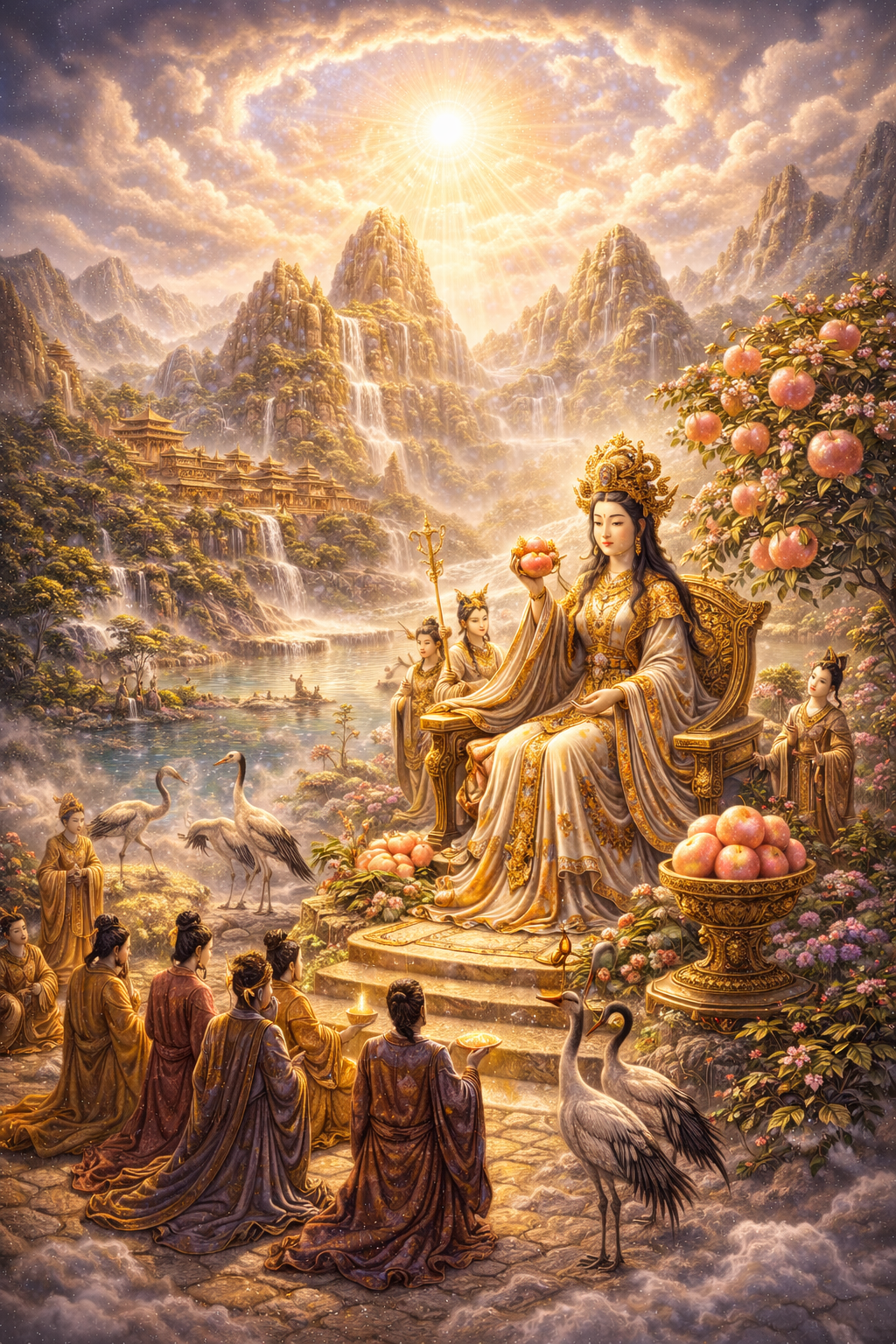
The primary sources do not preserve a single unchanging image of the Queen Mother of the West. Rather, they show one of the most striking developments in the whole Chinese mythic archive. In the Shanhaijing, she appears at Yushan in the western mountains with tiger teeth, leopard tail, disheveled hair, and authority over heavenly calamities and the Five Disasters. In the Mutianzi zhuan, she appears in relation to King Mu’s westward journey, banquet, and song beside the Jade Pond. In later Daoist and popular traditions, she becomes queen of immortals, sovereign of a western fairyland, and guardian of the peaches of immortality. In Han and later visual culture, she appears enthroned, attended, paired with the Lord of the East, and surrounded by mythical beings. These layers should not be collapsed into one timeless portrait. Xiwangmu remains compelling because she preserves archaic mountain numinosity and later paradisal sovereignty in one continuing figure.
Who Is Xiwangmu?
Xiwangmu, the Queen Mother of the West, is one of the great western sovereigns of Chinese myth. Her title itself is geographically, cosmologically, and politically charged. She is not simply a female deity among others. She is defined by direction, by domain, and by rulership. The west in Chinese mythic geography is a zone of remoteness, marvel, difficult access, sacred encounter, and transformed existence, and Xiwangmu is the power who gives that zone one of its most enduring forms. She is therefore both a personified divinity and an ordering principle of the western sacred world.
Her name gathers together several distinct kinds of authority. “West” marks her relation to direction, distance, sunset, edge, and sacred remoteness. “Queen Mother” marks her as a sovereign female presence whose authority is neither merely domestic nor merely decorative. She rules a domain. She receives kings. She presides over immortals. She becomes the keeper of a garden and banquet beyond ordinary life. Across the long tradition, her figure asks how divine power can be both terrifying and hospitable, distant and desirable, feminine and sovereign, dangerous and salvific.
What makes her especially important is the breadth of the symbolic work she performs. She can appear as a fierce mountain being, as a queen of paradise, as a hostess to kings, as guardian of immortal fruit, as sovereign of an otherworldly court, and as an image of female cosmic rulership. These are not merely accumulated decorative traits. Together they show how Chinese tradition used her image to think about the relation between danger and transcendence, remoteness and desire, mortality and the possibility of another order of life.
Xiwangmu is therefore not best understood through one fixed category such as “goddess,” “fairy,” “immortal,” or “spirit.” She exceeds those categories because she developed across multiple textual, religious, and visual worlds. She belongs to the archaic mountain archive of the Shanhaijing, the royal travel world of the Mutianzi zhuan, the immortality imagination of Daoist tradition, and the material visual culture of Han mirrors and later art. Her power lies in that layeredness.
The Archaic Western Goddess in the Shanhaijing
The earliest major transmitted image of Xiwangmu in the archive is startlingly unlike the refined paradise queen of later art. In the Shanhaijing’s Xishan jing, Yushan lies to the west, and it is identified as the dwelling place of the Queen Mother of the West. There she is described as human-like in appearance, but with leopard tail and tiger teeth, disheveled hair adorned with a headdress, and authority over heavenly calamities and the Five Disasters. This is one of the most important passages for understanding her because it preserves an archaic form of western divinity that is wild, formidable, and dangerous rather than merely auspicious.
Primary Source
又西三百五十里,曰玉山,是西王母所居也。西王母其狀如人,豹尾虎齒而善嘯,蓬髮戴勝,是司天之厲及五殘。A further three hundred fifty li to the west is called Yushan, where the Queen Mother of the West dwells. Her form is like that of a human, but she has a leopard’s tail and tiger’s teeth, and she is skilled at howling. With disheveled hair and a headdress, she presides over Heaven’s calamities and the Five Disasters.Shanhaijing, “Western Mountains Classic” 西山經.
This early image of Xiwangmu is not yet the serene paradise queen of later tradition. The western sacred mountain world is fearsome, numinous, and bound to calamity as well as divine presence.
This early image matters because it prevents later tradition from flattening her into a purely benevolent goddess of graceful immortality. The Queen Mother begins in the archive as a power whose body itself crosses categories and whose domain includes destructive as well as sovereign force. Her association with disaster and celestial affliction marks her as a being of judgment and danger, not simply as the dispenser of delights.
The animal features are especially important. Leopard tail and tiger teeth place her at the threshold of human and animal, court and wilderness, beauty and terror. She is not monstrous in a simple sense. She is more-than-human. Her hybrid body signals that the western sacred world is not domesticated. It belongs to a mode of power older, stranger, and more severe than later paradise imagery alone can convey.
This archaic stratum remains essential even when later tradition transforms her. The peaches, banquet, garden, and immortal court do not erase the mountain being. They rest upon her. Xiwangmu’s later hospitality is powerful precisely because it belongs to a figure who was never merely gentle. She can offer immortality because she is also associated with the powers that threaten and define mortal existence.
Yushan, Kunlun, and the Sacred West
Xiwangmu’s significance cannot be separated from western sacred geography. Even when particular texts place her at Yushan rather than in a single fixed Kunlun topography, she belongs to the same symbolic west that later tradition associates with paradise mountains, difficult access, divine court, and immortal life. The western mountain world is where political ambition, sacred remoteness, danger, and the possibility of transformed existence converge. Under Xiwangmu’s sign, that geography becomes courtly as well as topographic.
This western setting is essential because Chinese mythology repeatedly uses space to think about difference in mode of being. The farther west one travels in the mythic archive, the nearer one comes to a domain not wholly available to ordinary human habitation. Xiwangmu’s westernness is therefore not merely directional. It marks ontological remove. Her court lies where earthly rule approaches another order but cannot simply master it.
The relationship between Yushan and Kunlun should therefore be treated carefully. They should not be mechanically collapsed into one identical place, but neither should they be read as unrelated. The sources preserve a broader western sacred geography whose mountains, thresholds, gates, waters, and divine residents shift across textual layers. Xiwangmu’s western home participates in that field. Later tradition increasingly links her with Kunlun, paradise mountains, Jade Pond, and the courtly landscape of immortality.
The sacred west gives Xiwangmu her horizon. She is not simply a deity who happens to live somewhere remote. Her remoteness is part of her power. She rules a domain not immediately available to ordinary life. Kings may journey toward it; immortals may belong to it; artists may depict it; religious imagination may long for it. But its distance remains meaningful. Xiwangmu’s authority is inseparable from the fact that she dwells where the ordinary world reaches its limit.
From Mountain Power to Queen of Immortals
One of the most remarkable developments in Chinese myth is the transformation of Xiwangmu from the fierce western being of the Shanhaijing into the queen of immortals of later Daoist and popular tradition. Later summaries preserve this development clearly: she becomes queen of the immortals, associated with female spirits in a western fairyland, rare flowers, extraordinary birds, and the peaches of immortality. That continuity is crucial. The refined queen is not detached from the archaic mountain being; she is its later elaboration.
The symbolic consequences of this transformation are profound. A western power once associated with calamity and mountain wildness becomes the center of a celestial court and a sovereign of transcendent life. This is not a simple softening. It is a shift in register from awe to invitation, from danger to paradisal order, from threshold terror to courtly immortality. Yet the authority remains western, remote, and elevated. Xiwangmu’s sovereignty is preserved even as its imagery changes.
This transformation also reveals how Chinese mythology often develops: not by replacing one image with another, but by layering meanings across time. The same figure can be wild and courtly, dangerous and salvific, mountain-like and palace-like, archaic and refined. Later paradise imagery does not invalidate the earlier stratum. It reorients it. The mountain sovereign becomes queen of a heavenly garden; the being of calamity becomes guardian of long life; the far western danger becomes a desired threshold.
This is why source history matters so much for Xiwangmu. Without the Shanhaijing, she becomes too sweet, too decorative, too easily reduced to a benevolent fairy queen. Without the later Daoist and visual traditions, she remains too narrowly archaic, and her enormous role in immortality imagery is lost. Her full significance depends on holding both together.
The Imagery of Immortality
Xiwangmu becomes one of the great bearers of immortality imagery in the Chinese tradition. Under her sign, immortality is not only a metaphysical abstraction. It is visualized through courtly abundance, paradisal distance, rare fruit, extraordinary birds, divine attendants, mountain landscapes, precious gardens, and the suspension of ordinary human limits. Immortality in this world is not mere endless duration. It is admission into another mode of life, another society, another landscape.
This is why her image proved so durable. She turns the abstract human desire not to perish into an entire symbolic environment. Paradise becomes feminine court, garden, banquet, and mountain sovereignty at once. Through Xiwangmu, immortality is imagined as both privilege and placement. One does not merely live forever; one belongs to the western paradise.
The spatial dimension of immortality is crucial. Xiwangmu’s paradise gives transcendence a location. It is not just an inner state or a philosophical idea. It is imagined as a place with gardens, fruit, attendants, courtly order, and sacred distance. Such imagery makes the longing for immortality visible. People can paint it, carve it, narrate it, celebrate it, or invoke it through visual symbols of longevity.
At the same time, immortality under Xiwangmu’s sign is not simply available to everyone. It is mediated by access, selection, timing, and courtly inclusion. The peaches grow in her garden. The banquet is hers. The court is hers. Immortality is therefore not only a biological fantasy; it is a matter of relation to divine sovereignty. Long life is imagined through admission into her order.
Peaches, Banquet, and the Paradise Garden
Among the most enduring images associated with Xiwangmu are the peaches of immortality and the celestial banquet. Later tradition imagines her fairyland garden as filled with rare flowers, extraordinary birds, and the flat peach of immortality. The pantao, or flat peach, becomes one of the most concentrated symbols of long life in Chinese mythic and visual culture. Its power lies in its temporality as well as its beauty: it belongs to a realm where growth, ripening, and renewal operate on a scale beyond ordinary human time.
The imagery is important for more than its charm. The peach is a figure of controlled access to transcendence. It is not common food. It belongs to a garden beyond ordinary reach and matures across an extraordinary temporal scale. The banquet likewise stages immortality as courtly inclusion. To eat in Xiwangmu’s presence is to cross the threshold between mortal and immortal society. The paradise garden is therefore not decorative scenery. It is a political and soteriological landscape.
The banquet tradition also clarifies Xiwangmu’s role as hostess and sovereign. She is not merely guarding a substance. She presides over a courtly event. Immortality becomes ritualized through hospitality, hierarchy, timing, and recognition. Those who attend are not simply consumers of magic fruit. They are participants in a divine order.
This is why the peaches became so visually and culturally durable. They condensed Xiwangmu’s whole symbolic world into a single image: fruit from the western garden, ripened beyond ordinary time, served under divine authority, and associated with the promise that mortal limits might be overcome. The peach is small, but it carries an entire mythic geography within it.
King Mu and the Politics of Western Audience
Xiwangmu’s significance is intensified by the tradition that kings seek audience with her. The western journey material associated with King Mu of Zhou turns the Queen Mother into more than a distant deity. She becomes the sovereign whose acknowledgment confers a different kind of prestige. The king’s westward movement is not mere travel narrative. It is political desire extended toward sacred recognition beyond the ordinary center.
This matters because it reveals a persistent structure in Chinese myth: earthly rulership seeks confirmation at the threshold of the more-than-human. Xiwangmu’s court becomes a place where the ordinary logic of terrestrial kingship encounters another hierarchy. To be received in the west is to approach a level of legitimacy, wonder, or prestige inaccessible within ordinary state ritual alone. The Queen Mother is thus not only a paradise figure; she is also a sovereign before whom kings appear as petitioners or guests.
Primary Source
天子觴西王母于瑤池之上。西王母為天子謠。The Son of Heaven held a banquet with the Queen Mother of the West beside the Jade Pond. The Queen Mother of the West sang for the Son of Heaven.Mutianzi zhuan 穆天子傳.
The King Mu tradition makes the sacred west a site of royal encounter. Xiwangmu receives the king not as a subordinate, but as the sovereign presence of another order.
The banquet scene is politically subtle. It is not a conquest. The king does not seize the western paradise. He is received there. He shares drink, hears song, and encounters a ruler whose domain lies outside ordinary Zhou political space. The scene therefore reverses normal political geography. The Son of Heaven travels to the Queen Mother of the West; the earthly center moves toward the sacred margin.
This movement gives the story its force. King Mu may possess terrestrial authority, but Xiwangmu’s western realm remains beyond possession. It can receive him, honor him, enchant him, and draw him into desire, but it cannot be reduced to his domain. The Queen Mother’s court marks the limit at which earthly sovereignty becomes guesthood.
Gender, Sovereignty, and Divine Court
Xiwangmu is crucial because she gives Chinese myth one of its strongest images of female sovereignty. She is not simply consort, muse, helper, or secondary spirit. She rules. Her title gives her domain and rank. Later tradition remembers her as presiding over immortals and a western paradise of her own. Her court is not derivative of male kingship; it stands as an autonomous western counterpart with its own attendants, garden, rhythm, and authority.
This is one reason her image became so powerful in both religious and visual culture. She allows transcendence to be imagined in courtly feminine form without losing majesty or severity. Her sovereignty is beautiful, but it is not merely ornamental. It is structurally central to the western sacred world. Through her, immortality, hospitality, danger, and rule are gathered into one figure of commanding presence.
Her gender also matters because it complicates the structure of political imagination. In many legendary traditions, rulers, travelers, and seekers are male figures moving toward a female sovereign whose domain they do not control. The Queen Mother receives emperors, but she is not absorbed by them. She grants, withholds, hosts, sings, or appears according to the logic of her own court. Her power is not simply relational to male heroes; male heroes become legible through their relation to her.
Xiwangmu therefore belongs beside other major female figures in Chinese myth, including Nüwa, Chang’e, Mazu, White Snake, and powerful spirit women of later folklore. But she remains distinctive because her power is not only maternal, erotic, salvific, or protective. It is sovereign. She rules the west as a divine queen whose authority is cosmological, paradisal, and visual.
Xiwangmu, Lord of the East, and Cosmic Pairing
Later visual tradition often pairs Xiwangmu with a male eastern counterpart, commonly known as the Lord of the East or Duke Father of the East. This pairing matters because it places the Queen Mother within a wider cosmic order of directions, gendered sovereignty, and complementary immortal realms. The west is not simply isolated paradise; it becomes part of a larger structure of east and west, female and male, reception and balance.
The Han-period mirror tradition is especially important here. The Met’s bronze mirror record identifies a seated figure with two attendants as the Queen Mother of the West and places the Lord of the East opposite her, noting that according to Han dynasty mythology they jointly ruled the universe. This is a crucial visual witness because it shows that Xiwangmu’s sovereignty was not only described in texts. It was materially represented, circulated, and viewed through objects associated with cosmological imagery, reflection, and auspicious protection.
The mirror itself is an especially fitting medium. Mirrors in Chinese visual and ritual culture often carry associations with reflection, protection, cosmology, and patterned order. To place Xiwangmu and the Lord of the East on such an object is to make divine rulership visible in a portable and symbolic form. The viewer encounters the cosmic pair through a material object that also reflects the human face.
This visual pairing helps prevent a narrow reading of Xiwangmu as merely a solitary paradise goddess. She is sovereign of the west, but the west belongs to a structured universe. Her authority is directional, gendered, courtly, and cosmological. She is one pole of a broader sacred order, yet she remains fully sovereign within her own domain.
Xiwangmu in Daoist and Visual Tradition
Later Daoist and artistic traditions expanded Xiwangmu’s prestige enormously. Her description as queen of immortals in Daoist mythology reflects a much broader cultural afterlife in which she became a major icon of paradise, immortality, and celestial courtliness. Her imagery circulated through stories, paintings, mirrors, decorative arts, ritual imagination, and later popular culture. The western paradise could now be seen as well as described.
This visual and religious expansion matters because it shows that Xiwangmu was never confined to literary allusion. She became part of the lived symbolic world of Chinese civilization. The queen of immortals could be represented in courtly splendor, invoked in longevity imagery, and woven into the broader paradise imagination that linked mountains, peaches, banquets, and immortal beings into a coherent sacred repertoire.
Visual culture also intensifies her authority by giving her a throne, attendants, setting, attributes, and compositional centrality. A viewer does not simply read that Xiwangmu rules; the image stages her rule. The divine court becomes an arrangement of bodies, objects, animals, and sacred scenery. Her sovereignty is made visible through posture, placement, and surrounding signs of immortality.
Daoist religious imagination further expands her world. In that setting, Xiwangmu is not only a mythic memory from old texts, but part of a broader universe of immortals, paradises, registers, mountains, and ritual aspiration. She becomes one of the great figures through whom the desire for transcendence enters Chinese religious and visual life.
Xiwangmu and the Politics of Access
One of the deepest patterns in Xiwangmu’s myth is controlled access. Her domain is remote. Her garden is not common land. Her peaches are not ordinary fruit. Her banquet is not open to everyone. Kings may travel toward her, but even they appear as visitors rather than owners. The structure of her myth is therefore not only about immortality, but about who may approach immortality, under what conditions, and by whose authority.
This politics of access gives her myth much of its tension. Xiwangmu’s paradise is desired because it is not easily available. If the peaches were ordinary food, they would lose their symbolic force. If the western court could be entered casually, its prestige would collapse. The very difficulty of access creates the sacred value of the encounter.
This also gives Xiwangmu a distinctive kind of power. She mediates desire. She is not simply the object of longing; she is the ruler who controls the terms of approach. The king, immortal, devotee, or later viewer encounters not an open resource but a sovereign order. Immortality is not extracted from her world. It is granted, celebrated, staged, or withheld within it.
Seen this way, Xiwangmu’s paradise is not escapist fantasy. It is a mythic system of distinction. It asks who belongs to the immortal court, who remains outside, what forms of virtue, favor, ritual, destiny, or divine recognition permit entry, and how mortal longing is disciplined by sacred hierarchy.
Female Power, Danger, and Transcendence
Xiwangmu’s long development is especially important for thinking about female power in Chinese mythology. She is not confined to a single acceptable form of femininity. In early form, she is dangerous, hybrid, severe, and associated with heavenly disasters. In later form, she is courtly, beautiful, paradisal, and associated with immortality. Both images carry power. Neither should be erased.
The danger of the early Xiwangmu is not a flaw to be corrected by later refinement. It is part of her sacred force. She belongs to a world where divine femininity is not merely nurturing or ornamental. It can be terrifying, judicial, and wild. Her later transformation into queen of immortals does not remove this depth; it channels it into sovereign form.
This makes her one of the most complex female figures in the Chinese mythic archive. She is not simply mother, lover, wife, fairy, or protectress. She is ruler of a direction and keeper of another mode of life. Her court organizes paradise; her garden mediates immortality; her early body carries the signs of animal power and cosmic danger. She gathers many forms of female sacred authority that later traditions often separate.
Xiwangmu therefore offers a powerful counterimage to simplified ideas of divine femininity. She is not gentle because she is female, nor severe despite being female. She is sovereign, and her sovereignty includes both danger and welcome. That is what makes her so enduring.
Source History and Interpretive Caution
A careful reading of Xiwangmu requires distinguishing among textual layers and symbolic registers. The Shanhaijing gives the archaic western mountain power. Western travel traditions such as the Mutianzi zhuan give her a role in royal encounter. Later Daoist and popular traditions give her the paradise court, the peaches, and the queenly authority over immortals. Han and later visual traditions make her image materially visible through mirrors and other objects. These are not mutually exclusive portraits but stages in the long mythic history of the figure.
The key is not to collapse them into one timeless image too quickly. If one begins only with the peaches and the celestial banquet, one loses the fiercer archaic stratum. If one begins only with the leopard tail and tiger teeth, one misses the later paradise symbolism that made her one of the most beloved figures in Chinese religious imagination. The interpretive task is to keep both in view.
It is also important not to treat later summaries as substitutes for primary sources. Britannica and museum entries are useful for orientation, especially for later Daoist and visual traditions, but the Shanhaijing and Mutianzi zhuan remain essential primary witnesses for the early mountain and royal-journey layers. Visual objects such as Han mirrors provide another kind of witness: not a narrative text, but evidence of how Xiwangmu’s image circulated in material culture.
The history of Xiwangmu is therefore a history of transformation across media. Text gives her archaic form and narrative encounter. Religious tradition gives her paradise and immortality. Visual culture gives her a throne, attendants, cosmic pairing, and material presence. Folklore and later popular imagination keep her available as a figure of longing, blessing, and transcendence. Her identity lies in that whole layered archive.
Why Xiwangmu Still Matters
Xiwangmu still matters because she gives one of the fullest Chinese answers to the human desire for another order of life. She is western distance turned into divine court, mountain danger turned into paradisal sovereignty, and mortality answered through image, fruit, banquet, and sacred inclusion. Few mythic figures hold together so many themes so powerfully.
She also matters because her story shows how Chinese mythology transforms geography into transcendence. The far west is not emptiness. Under her sign, it becomes value, promise, awe, danger, and invitation. Sacred geography becomes a way of imagining the limits of ordinary life and the possibility of crossing toward another mode of existence.
Xiwangmu matters, too, because she is one of the tradition’s great images of female sovereignty. She is not secondary to a male ruler. Kings come to her. Immortals attend her banquet. The peaches grow in her garden. The western paradise is organized around her court. Her myth preserves a model of divine female authority that is autonomous, directional, visual, and cosmological.
Finally, Xiwangmu matters because she reveals how myth survives by transformation. The leopard-tailed mountain being, the western queen, the banquet hostess, the keeper of peaches, the ruler of female immortals, and the figure on Han mirrors are not separate unrelated characters. They are stages in the unfolding of one of Chinese mythology’s most enduring symbols: the Queen Mother of the West, sovereign of the threshold where distance becomes paradise and mortality dreams of another life.
Related Reading
- Chinese Myth, Folklore & Legend
- What Is Chinese Myth, Folklore & Legend?
- The Problem of Sources in Chinese Mythology
- Reading the Shanhaijing: Mythic Geography, Strange Beings, and Sacred Space
- Kunlun, Paradise Mountains, and the Sacred Geography of the West
- Daoism, Immortality, and the Supernatural Imagination
- The Eight Immortals and the Popular Religious Imagination
- Women, Spirits, and Gendered Power in Chinese Legend
Primary Sources
- Chinese Text Project (n.d.) Shanhaijing: Xishan jing 山海經:西山經 / Western Mountains Classic. Available at: https://ctext.org/shan-hai-jing/xi-shan-jing
- Chinese Text Project (n.d.) Mutianzi zhuan 穆天子傳 / Transmission of the Son of Heaven Mu. Available at: https://ctext.org/mutianzi-zhuan/ens
- Chinese Text Project (n.d.) Liezi: Zhou Mu Wang 列子:周穆王. Available at: https://ctext.org/liezi/zhou-mu-wang
- Chinese Text Project (n.d.) Shanhaijing: Hainei xi jing 山海經:海內西經 / Classic of Regions Within the Seas: West. Useful for the broader Kunlun sacred-geography field. Available at: https://ctext.org/shan-hai-jing/hai-nei-xi-jing
- Chinese Text Project (n.d.) dictionary entry preserving parallel notices on Kunlun, Weak Water, Yushan, and the Queen Mother of the West. Available at: https://ctext.org/dictionary.pl?chapter=135156&if=en&sid=1970&trid=4078450
Further Reading
- Chinese Text Project (n.d.) Shanhaijing: Xishan jing. Available at: https://ctext.org/shan-hai-jing/xi-shan-jing
- Chinese Text Project (n.d.) Mutianzi zhuan. Available at: https://ctext.org/mutianzi-zhuan/ens
- Chinese Text Project (n.d.) Liezi: Zhou Mu Wang. Available at: https://ctext.org/liezi/zhou-mu-wang
- Encyclopaedia Britannica (n.d.) “Xiwangmu.” Available at: https://www.britannica.com/topic/Xiwangmu
- Encyclopaedia Britannica (n.d.) “Pantao.” Available at: https://www.britannica.com/topic/pantao
- The Metropolitan Museum of Art (n.d.) “Mirror with Queen Mother of the West, Lord of the East, and mythical creatures.” Available at: https://www.metmuseum.org/art/collection/search/49527
- The Metropolitan Museum of Art (n.d.) “Visit of Mu Wang to Xi Wang Mu, the Western Queen Mother.” Available at: https://www.metmuseum.org/art/collection/search/61496
- Cahill, S.E. (1993) Transcendence and Divine Passion: The Queen Mother of the West in Medieval China. Stanford: Stanford University Press.
- Birrell, A. (1993) Chinese Mythology: An Introduction. Baltimore: Johns Hopkins University Press. Available at: https://archive.org/details/chinesemythology0000birr
- Yang, L. and An, D. (2005) Handbook of Chinese Mythology. Santa Barbara: ABC-CLIO. Available at: https://archive.org/details/handbookofchines0000yang
- The Metropolitan Museum of Art (2011) “Daoism and Daoist Art.” Available at: https://www.metmuseum.org/essays/daoism-and-daoist-art
- The Metropolitan Museum of Art (2010) “Longevity in Chinese Art.” Available at: https://www.metmuseum.org/essays/longevity-in-chinese-art
References
- Birrell, A. (1993) Chinese Mythology: An Introduction. Baltimore: Johns Hopkins University Press. Available at: https://archive.org/details/chinesemythology0000birr
- Cahill, S.E. (1993) Transcendence and Divine Passion: The Queen Mother of the West in Medieval China. Stanford: Stanford University Press.
- Chinese Text Project (n.d.) dictionary entry preserving parallel notices on Kunlun, Weak Water, Yushan, and the Queen Mother of the West. Available at: https://ctext.org/dictionary.pl?chapter=135156&if=en&sid=1970&trid=4078450
- Chinese Text Project (n.d.) Liezi: Zhou Mu Wang. Available at: https://ctext.org/liezi/zhou-mu-wang
- Chinese Text Project (n.d.) Mutianzi zhuan. Available at: https://ctext.org/mutianzi-zhuan/ens
- Chinese Text Project (n.d.) Shanhaijing: Hainei xi jing. Available at: https://ctext.org/shan-hai-jing/hai-nei-xi-jing
- Chinese Text Project (n.d.) Shanhaijing: Xishan jing. Available at: https://ctext.org/shan-hai-jing/xi-shan-jing
- Encyclopaedia Britannica (n.d.) “Pantao.” Available at: https://www.britannica.com/topic/pantao
- Encyclopaedia Britannica (n.d.) “Xiwangmu.” Available at: https://www.britannica.com/topic/Xiwangmu
- The Metropolitan Museum of Art (n.d.) “Mirror with Queen Mother of the West, Lord of the East, and mythical creatures.” Available at: https://www.metmuseum.org/art/collection/search/49527
- The Metropolitan Museum of Art (n.d.) “Visit of Mu Wang to Xi Wang Mu, the Western Queen Mother.” Available at: https://www.metmuseum.org/art/collection/search/61496
- The Metropolitan Museum of Art (2010) “Longevity in Chinese Art.” Available at: https://www.metmuseum.org/essays/longevity-in-chinese-art
- The Metropolitan Museum of Art (2011) “Daoism and Daoist Art.” Available at: https://www.metmuseum.org/essays/daoism-and-daoist-art
- Yang, L. and An, D. (2005) Handbook of Chinese Mythology. Santa Barbara: ABC-CLIO. Available at: https://archive.org/details/handbookofchines0000yang