Chinese Myth, Folklore & Legend

Chinese Myth, Folklore & Legend examines the narrative traditions through which Chinese civilization has interpreted cosmic order, divine agency, moral struggle, ancestral memory, and the relationship between Heaven, Earth, and human life. In the history of ideas, Chinese mythic and folkloric traditions have contributed to larger conceptions of harmony, destiny, virtue, political legitimacy, and the symbolic structure of the cosmos.

This category explores creation stories, legendary rulers, immortals, spirits, folk deities, and popular tales, including their approaches to order, balance, transformation, moral retribution, and the continuity between the visible and invisible worlds. It considers how myth and folklore express cultural ideas about authority, family, nature, spiritual power, and the formation of civilization through exemplary figures and enduring narrative patterns.

Chinese myth, folklore, and legend play an important role in comparative inquiry because they reveal how narrative, cosmology, and moral imagination have shaped one of the world’s great civilizational traditions. By engaging these stories seriously, this category deepens understanding of Chinese symbolic life and broadens reflection on myth, cultural memory, and the narrative foundations of social order.

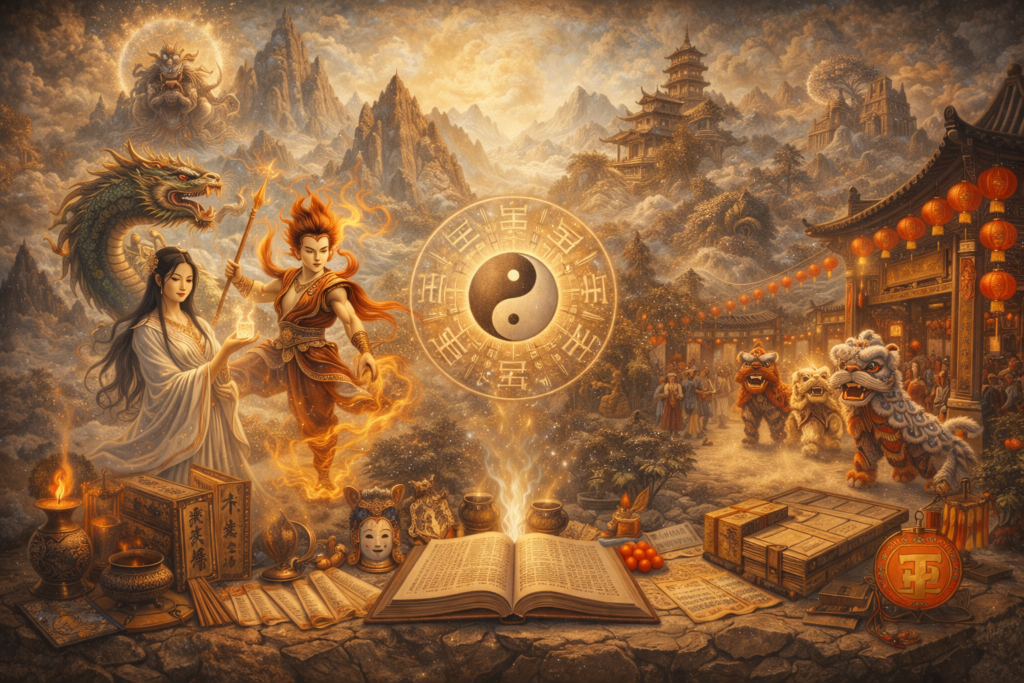
Symbolic Chinese mythic landscape with legendary figures, dragon, sacred mountains, ritual objects, festival lanterns, lion dancers, and cosmological imagery.

Why Chinese Myth, Folklore & Legend Still Matter

Chinese myth, folklore, and legend still matter because they preserve one of the world’s richest symbolic archives for thinking about cosmos, society, landscape, memory, and moral order. This article explores why these traditions remain intellectually, culturally, and socially significant, showing how they survived not through a single canon, but through a distributed field of texts, rituals, festivals, regional traditions, sacred geographies, performances, and modern media reinventions. Far from being relics of a vanished world, they continue to shape how communities remember, inherit, imagine, and reinterpret meaning across generations. In their persistence, adaptability, and symbolic depth, Chinese mythic traditions reveal how old stories remain alive by continuing to speak to questions of order, danger, belonging, transformation, and cultural continuity.
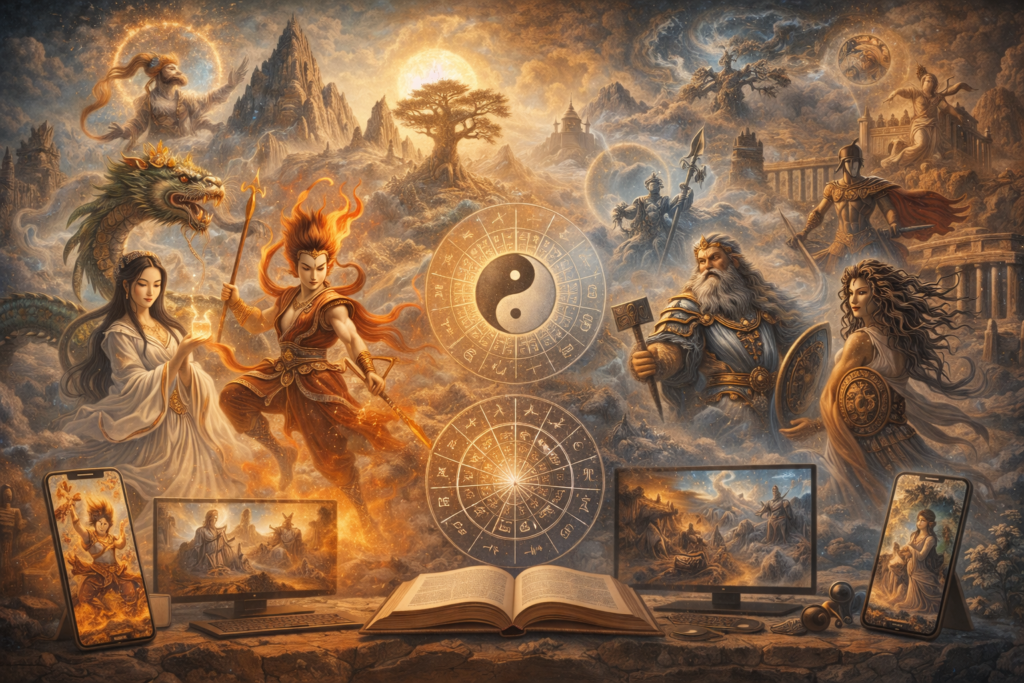
Comparative mythology scene juxtaposing Chinese mythic figures, sacred landscapes, and cosmological symbols with figures and motifs from other world myth traditions.

Chinese Myth in Comparative Perspective

Chinese myth becomes especially illuminating when placed in comparative perspective, but only if comparison avoids forcing it into models shaped by Greece, India, Mesopotamia, or the Norse world. This article explores how Chinese myth differs in formal structure, cosmological imagination, sacred geography, political order, and modes of transmission, showing that it survives less as a single epic canon than as a layered archive carried through classics, ritual, folklore, landscape, performance, and reinvention. By comparing themes such as creation, flood, divine authority, heroism, and mythic place, it argues that Chinese mythology is not an incomplete version of some more familiar pattern, but a distinct civilizational formation whose fragmentary, correlative, and distributed character expands what comparative mythology itself can mean.

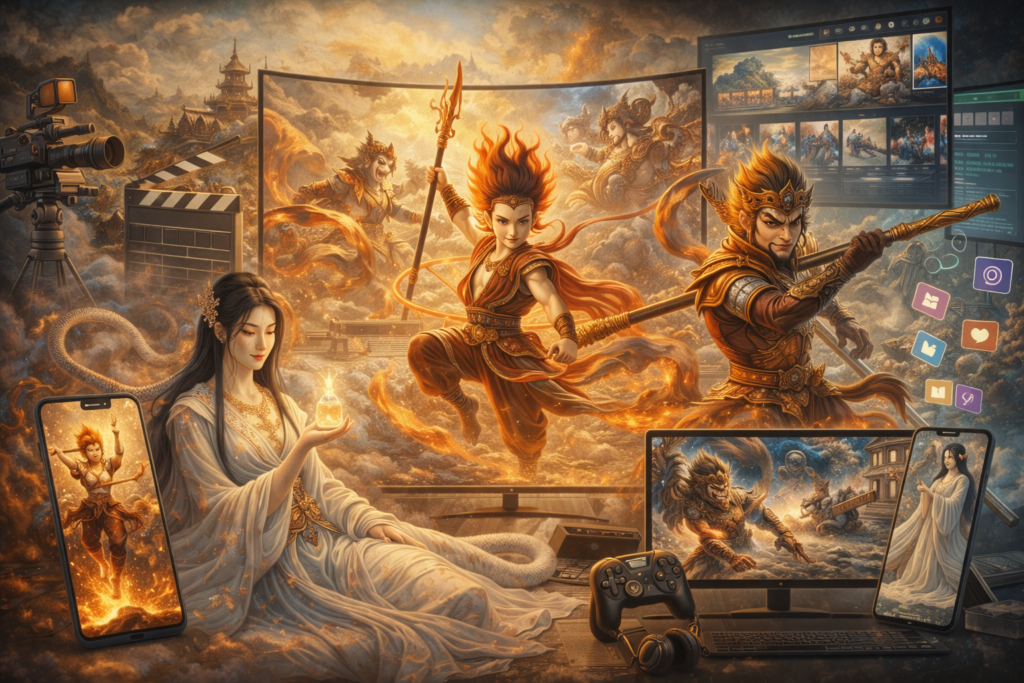
Modern media collage featuring Chinese mythic figures like Nezha, Sun Wukong, and White Snake across screens, gaming devices, and cinematic imagery.

Modern China and the Reinvention of Myth in Film, Television, and Digital Media

Chinese myth survives in modern China not by remaining fixed, but by being reinvented. This article explores how film, television, animation, streaming platforms, and digital media have transformed legendary figures such as Nezha, White Snake, Sun Wukong, and Yang Jian into contemporary icons shaped by spectacle, psychology, serial storytelling, and franchise logic. Rather than treating modern media as a break from tradition, it shows how they extend a much older pattern of adaptation through which myth has always moved across performance, text, image, and audience. In the process, Chinese legend becomes newly visible as a living field of cultural memory, commercial reinvention, national symbolism, and digitally accelerated afterlife.

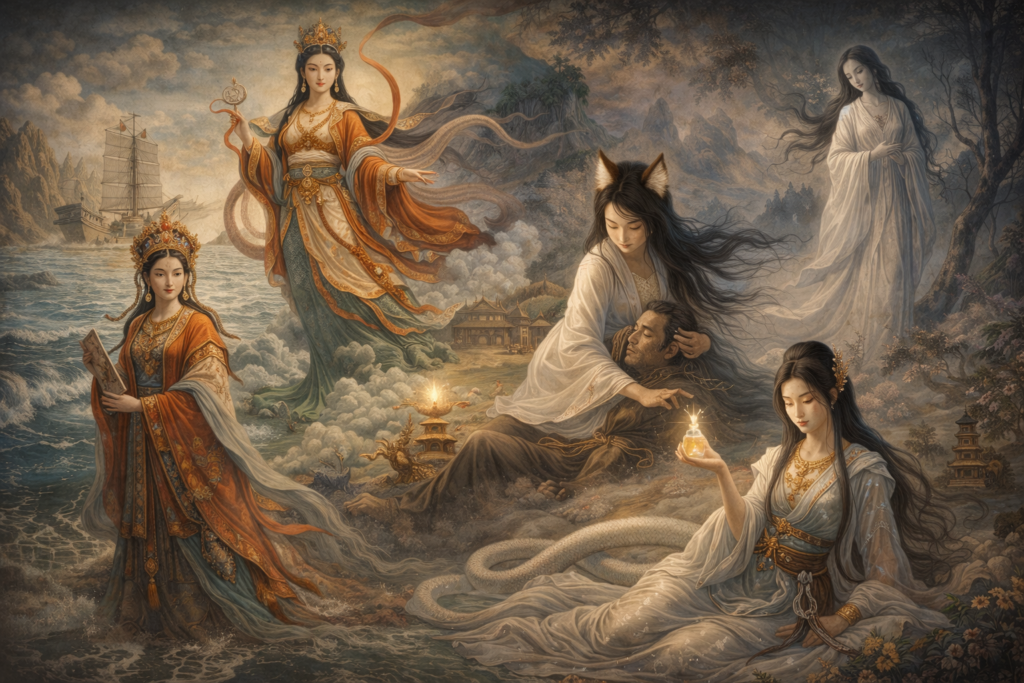
Mythic Chinese scene featuring goddess figures, a fox spirit, a ghostly woman, and White Snake imagery in a symbolic landscape of sacred power, desire, and supernatural presence.

Women, Spirits, and Gendered Power in Chinese Legend

Chinese legend is filled with women whose power exceeds ordinary social boundaries. This article explores how goddesses, fox spirits, ghost-women, supernatural wives, divine mothers, and sea-protectors became central figures in the Chinese mythic imagination, not as marginal curiosities, but as forces through which desire, protection, transgression, virtue, grief, and sovereignty were imagined. Moving across traditions associated with Nüwa, Mazu, White Snake, and female spirit lore, it shows how gendered power in Chinese legend often appears at unstable thresholds between household and wilderness, morality and enchantment, devotion and danger, human and nonhuman worlds. These figures reveal that feminine power in Chinese myth is not singular, but multiple: nurturing, disruptive, erotic, sacred, maternal, haunted, and cosmologically charged.

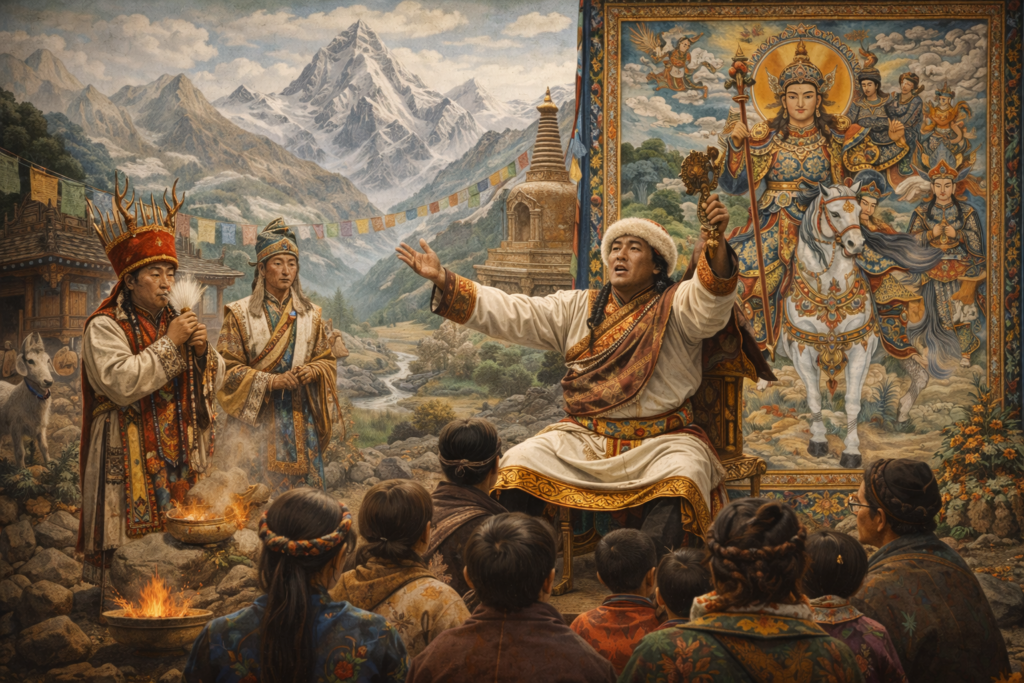
Mountain ritual scene inspired by Qiang and Tibetan traditions, with ceremonial figures, bardic performance, sacred thangka imagery, prayer flags, and gathered community.

Qiang, Tibetan, and Other Regional Mythic Traditions

The mythic traditions of China cannot be reduced to a single literary canon or a uniform civilizational voice. This article explores Qiang, Tibetan, and other regional mythic traditions as vital parts of a wider narrative field shaped by ritual specialists, sacred landscapes, oral performance, festival life, visual art, and community memory. Drawing on traditions such as the Qiang New Year festival, Tibetan opera, Regong arts, and the Gesar epic, it shows how regional worlds preserve distinct understandings of nature, divinity, protection, ancestry, and communal identity. In doing so, these traditions reveal Chinese mythology not as a single closed archive, but as a plural and layered constellation of symbolic worlds.

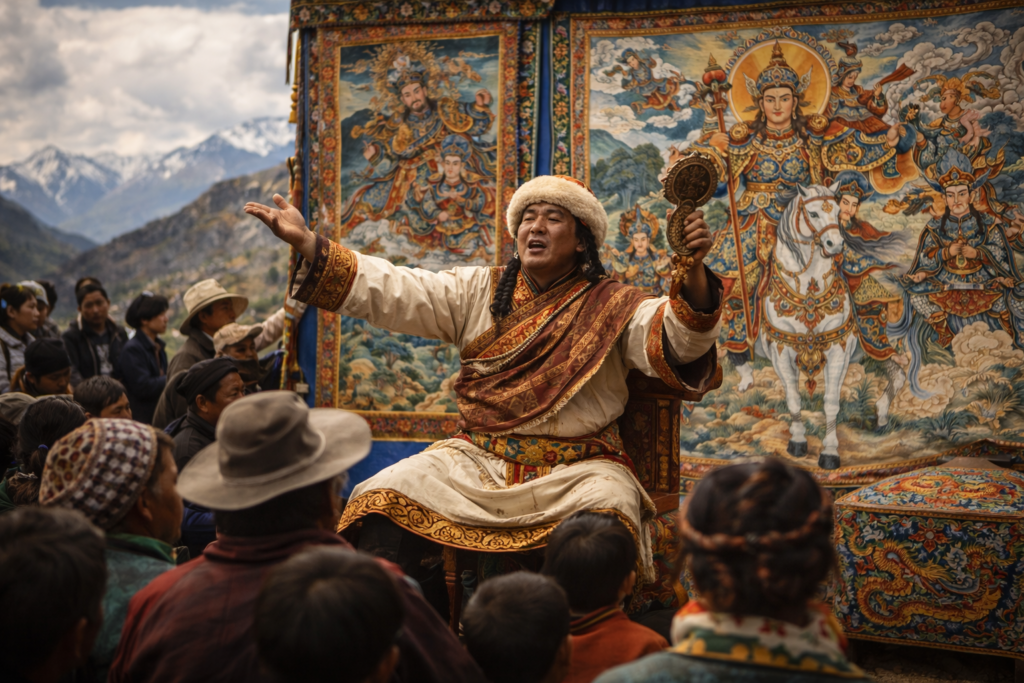
Tibetan bard performing the Gesar epic before a gathered audience, with thangka-style images of King Gesar and mountain landscape in the background.

The Gesar Epic and the Plural Narrative Worlds of China

The Gesar epic is one of the clearest signs that the mythic archive of China is irreducibly plural. This article explores Gesar not only as one of the great heroic traditions of the Tibetan cultural world, but as a living multiethnic narrative ecology carried through singers, ritual specialists, local lineages of performance, printed compilations, manuscript culture, painting, opera, and communal memory. Moving across Tibetan, Mongolian, and Tu contexts, it shows that Gesar survives not as a single fixed book, but as a layered tradition whose authority rests in both oral transmission and textual witness. In doing so, the epic reveals that Chinese myth, folklore, and legend extend far beyond a Han-centered canon into a wider civilizational field of heroic imagination, sacred performance, and regional narrative continuity.

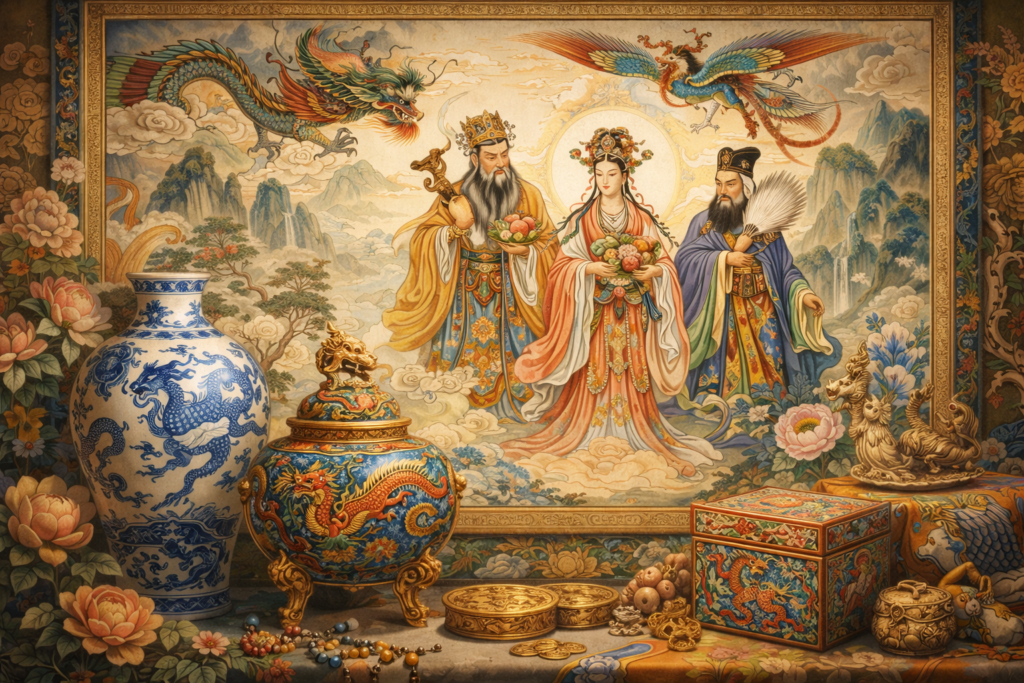
Traditional Chinese mythic art scene with divine figures, dragons, phoenixes, painted scroll imagery, porcelain, incense burner, and richly decorated auspicious objects.

Myth in Painting, Print, and Decorative Art

Chinese myth has long endured not only in texts and performances, but in images and objects that made symbolic worlds visible in everyday life. This article explores how painting, woodblock prints, temple arts, ceramics, lacquer, textiles, and decorative objects carried dragons, immortals, goddesses, auspicious beasts, and sacred motifs across centuries of Chinese culture. By tracing myth through visual and material form, it shows how images functioned not merely as illustration, but as active media of ritual presence, protection, wish, memory, and cosmological meaning. In this wider visual archive, myth became inhabitable through what could be seen, displayed, worn, gifted, and ritually encountered.

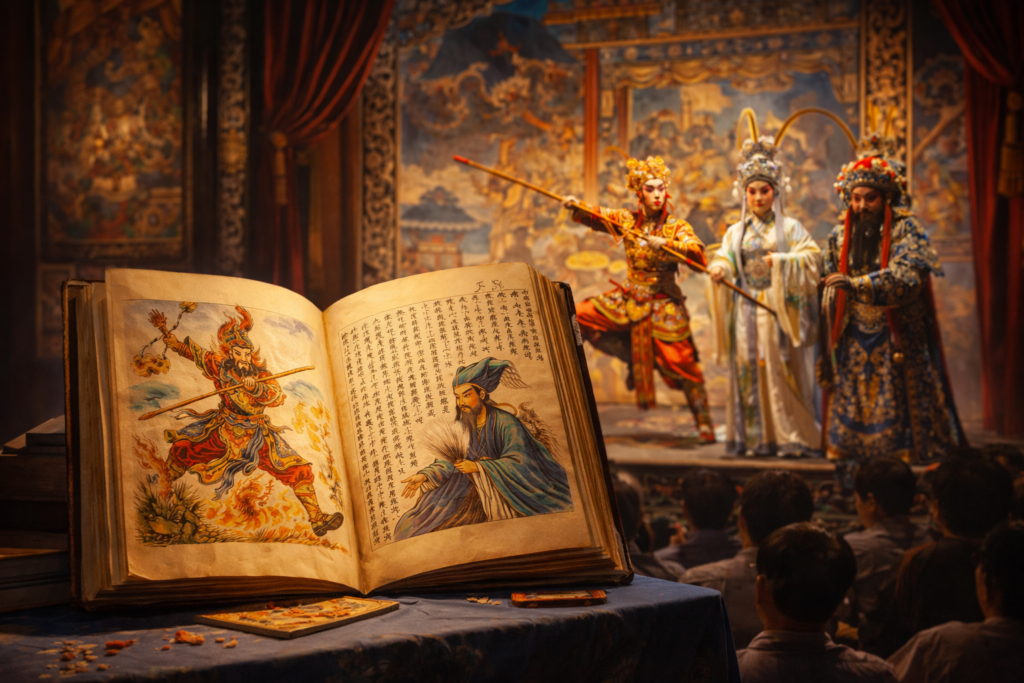
Traditional Chinese opera performance beside an illustrated vernacular book, showing mythic and historical figures carried from printed narrative into staged performance.

Opera, Vernacular Fiction, and the Transmission of Myth

Chinese myth often survived not by remaining fixed in a single sacred or literary canon, but by moving restlessly between oral tale, written narrative, staged performance, and public memory. This article explores how vernacular fiction, storytelling, and opera became the great media through which dispersed mythic materials were consolidated, dramatized, and socially transmitted across late imperial and modern China. From the narrative worlds of Journey to the West and Romance of the Three Kingdoms to the embodied stylization of Kunqu, Peking opera, and regional performance traditions, it shows how legend gained continuity not only through writing, but through repeated acts of voicing, staging, adaptation, and audience recognition. In this media ecology, myth endured because it could move between page and stage without losing its symbolic force.

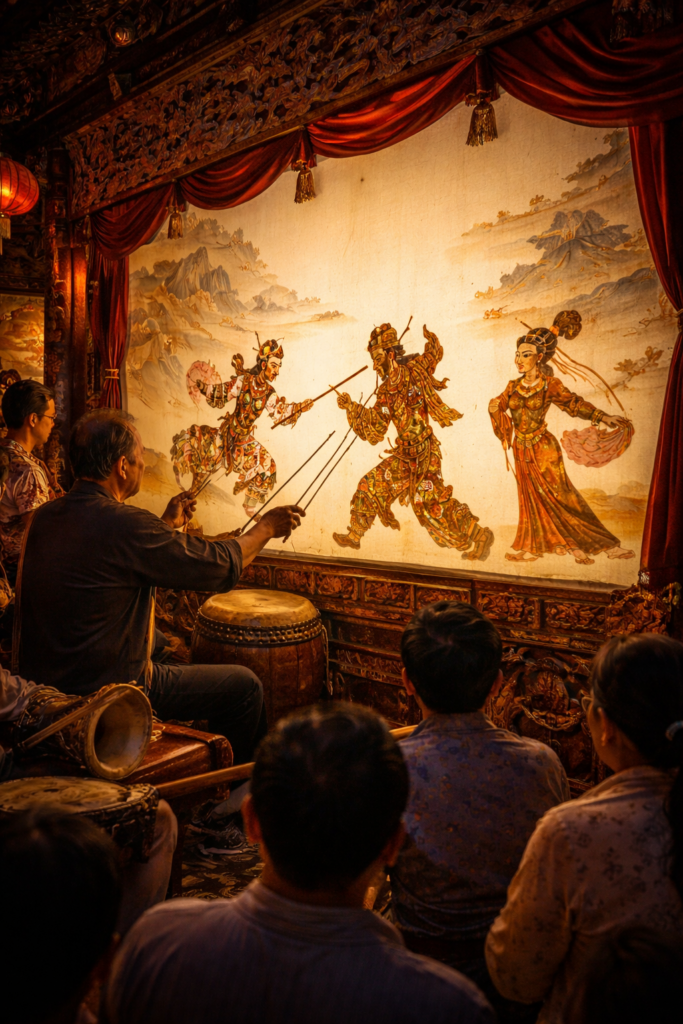
Traditional Chinese shadow puppetry performance with illuminated screen, carved puppet figures, musicians, and an audience watching legendary characters brought to life in silhouette.

Chinese Shadow Puppetry and the Performance of Legend

Chinese shadow puppetry transforms legend into light, silhouette, music, and voice. Far more than a theatrical curiosity, it has long served as a living medium through which myths, historical romances, supernatural tales, and regional legends were transmitted across generations. This article explores shadow puppetry as both an artisanal tradition and a narrative archive, examining how carved figures, oral repertoire, musical accompaniment, and public performance preserved the mythic imagination in embodied form. In the luminous space of the shadow screen, story became movement, memory became spectacle, and inherited legend remained socially alive.

Scroll to Top