Chinese Myth, Folklore & Legend

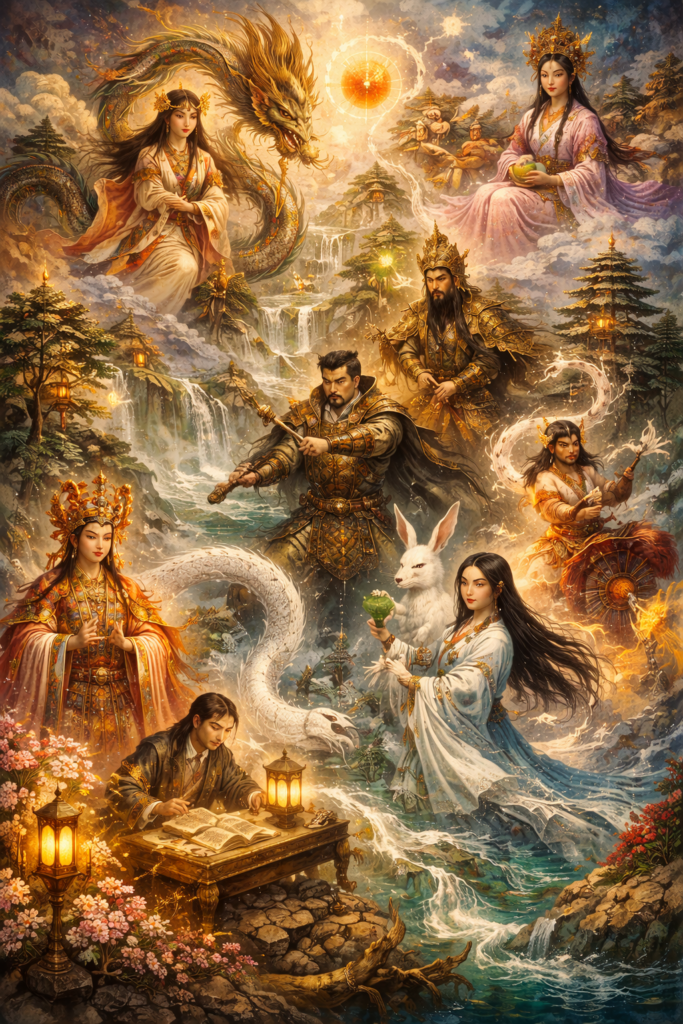
Chinese Myth, Folklore & Legend examines the narrative traditions through which Chinese civilization has interpreted cosmic order, divine agency, moral struggle, ancestral memory, and the relationship between Heaven, Earth, and human life. In the history of ideas, Chinese mythic and folkloric traditions have contributed to larger conceptions of harmony, destiny, virtue, political legitimacy, and the symbolic structure of the cosmos.

This category explores creation stories, legendary rulers, immortals, spirits, folk deities, and popular tales, including their approaches to order, balance, transformation, moral retribution, and the continuity between the visible and invisible worlds. It considers how myth and folklore express cultural ideas about authority, family, nature, spiritual power, and the formation of civilization through exemplary figures and enduring narrative patterns.

Chinese myth, folklore, and legend play an important role in comparative inquiry because they reveal how narrative, cosmology, and moral imagination have shaped one of the world’s great civilizational traditions. By engaging these stories seriously, this category deepens understanding of Chinese symbolic life and broadens reflection on myth, cultural memory, and the narrative foundations of social order.

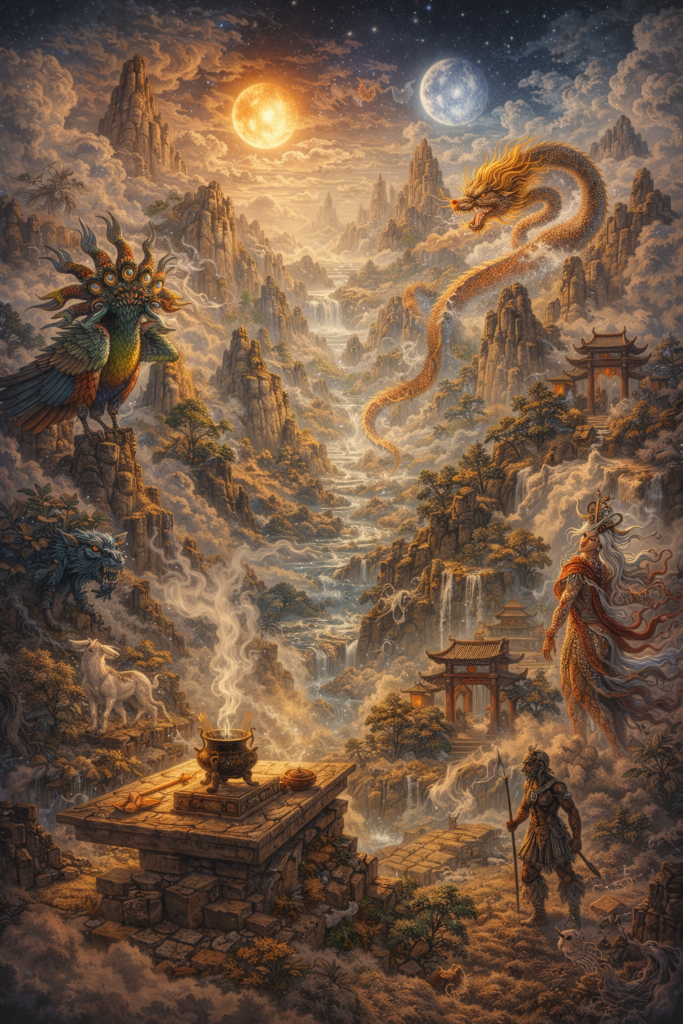
Fantastical landscape inspired by the Shanhaijing with sacred mountains, strange mythic creatures, ritual altar, temples, dragon, and celestial sky

Reading the Shanhaijing: Mythic Geography, Strange Beings, and Sacred Space

The Shanhaijing is one of the foundational texts for the study of Chinese mythology, not because it offers a single continuous mythological narrative, but because it preserves a richly spatial archive of sacred mountains, strange beings, ritual substances, distant regions, and cosmological boundaries. This article reads the Classic of Mountains and Seas as a work of mythic geography in which landscape itself becomes a medium of symbolic power. By examining its sacred topographies, extraordinary creatures, and charged borderlands, the article shows how the Shanhaijing preserves an early Chinese imagination of space as numinous, morally textured, and inseparable from the more-than-human world.
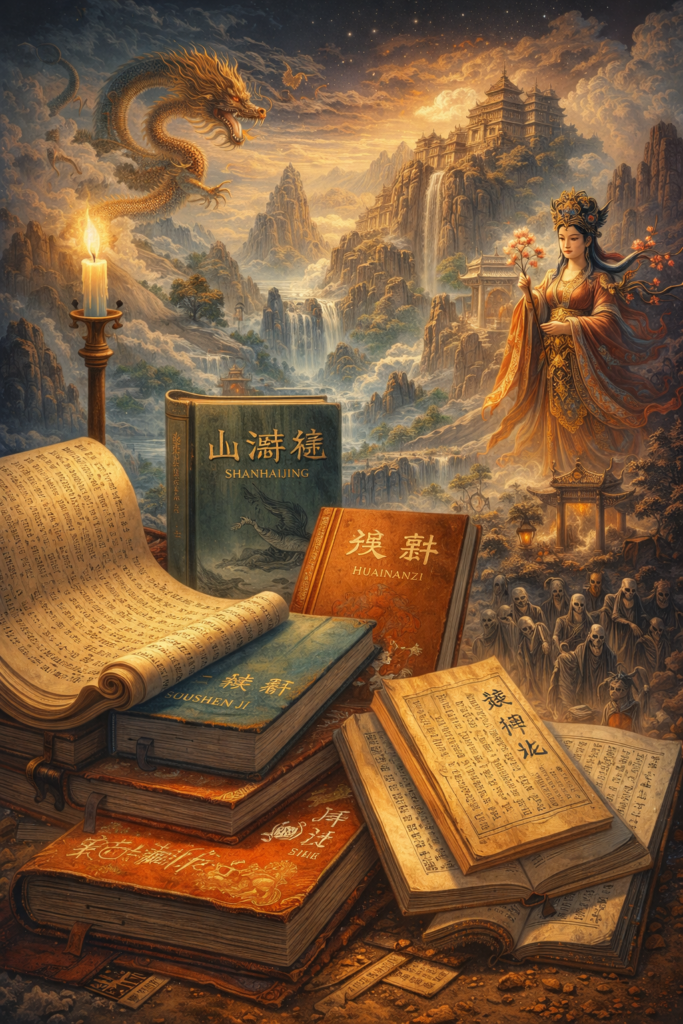
Painterly illustration of Chinese mythic sources with ancient books, sacred mountains, dragon, divine female figure, temples, and supernatural imagery

The Problem of Sources in Chinese Mythology

The study of Chinese mythology begins with a methodological challenge: the tradition does not survive as a single canonical mythology, but as a dispersed and layered archive preserved across classical texts, poetry, philosophical writings, historical compilations, religious traditions, local cults, folklore, and performance. This article examines the source problem at the heart of Chinese myth studies, showing why works such as the Shanhaijing, Chu ci, Huainanzi, and Soushen Ji must be read critically and comparatively, and why ritual life, popular religion, and living heritage are essential parts of the archive. Rather than weakening the field, this distributed survival reveals the historical depth, adaptability, and civilizational reach of Chinese mythic tradition.

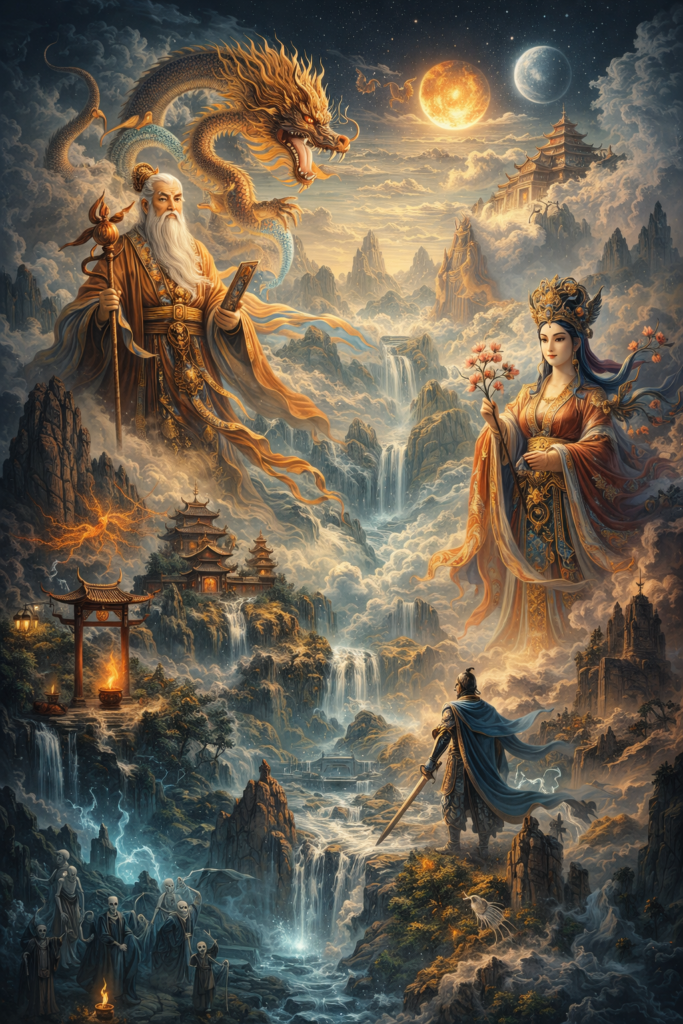
Mythic Chinese fantasy landscape with dragon, divine figures, sacred mountains, waterfalls, temples, celestial bodies, and supernatural underworld imagery

What Is Chinese Myth, Folklore & Legend?

Chinese myth, folklore, and legend form a vast and layered field of cultural memory in which cosmology, sacred geography, legendary history, supernatural beings, ritual practice, and literary reinvention converge. Rather than surviving as a single canonical mythology, the Chinese mythic archive extends across classical texts, religious traditions, local cults, oral storytelling, festival life, performance, and visual culture. This article introduces the field by explaining what distinguishes myth, folklore, and legend, why Chinese mythology survives in dispersed form, and how these traditions continue to shape religion, art, historical imagination, and living heritage.

Digital painting inspired by Chinese myth and folklore featuring dragons, divine figures, legendary heroes, celestial imagery, waterfalls, sacred mountains, and supernatural beings in a richly detailed mythic landscape.

Chinese Myth, Folklore & Legend: Cosmos, Spirits, and the Sacred Imagination of Civilization

Chinese Myth, Folklore & Legend: Cosmos, Spirits, and the Sacred Imagination of Civilization explores a vast and internally diverse mythic archive in which cosmogony, culture heroes, sacred geography, dynastic memory, supernatural beings, ritual order, and popular religion intersect. From the Shanhaijing, Chuci, and Huainanzi to dragons, fox spirits, immortals, festival traditions, local cults, oral epics, and regional narrative worlds, this category examines how myth has shaped the symbolic, religious, and literary life of the Chinese world across classical texts, ritual practice, vernacular transmission, and visual culture.

Scroll to Top