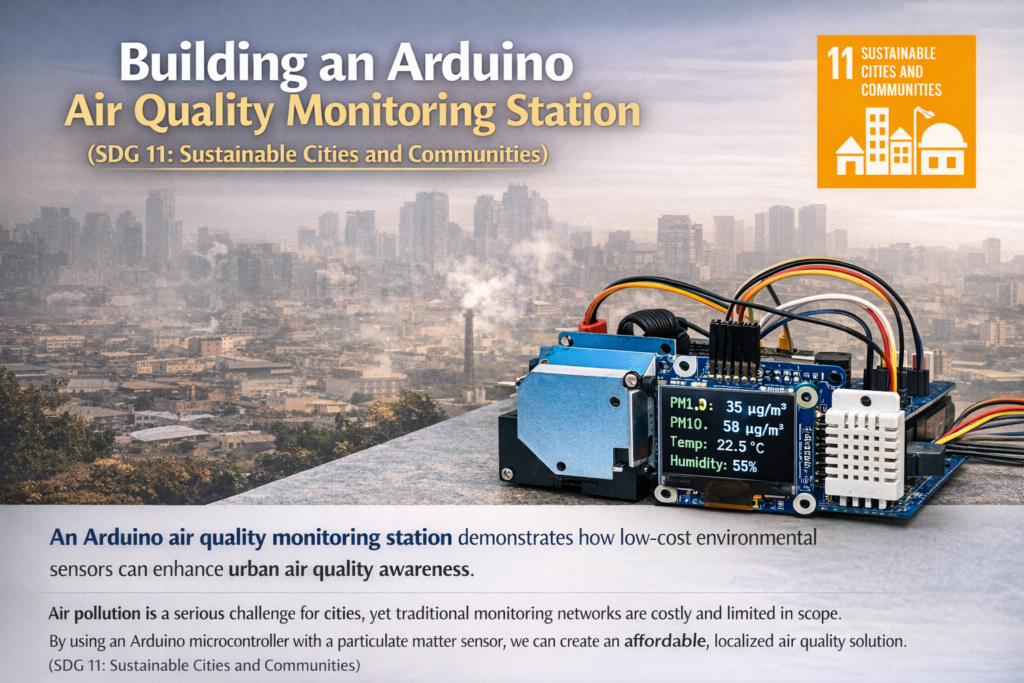
Building an Arduino Air Quality Monitoring Station (SDG 11: Sustainable Cities and Communities)
An Arduino air quality monitoring station demonstrates how low-cost embedded sensing can support urban environmental awareness, neighborhood-scale monitoring, and SDG 11: Sustainable Cities and Communities. This project combines an Arduino-compatible microcontroller with a particulate matter sensor and temperature/humidity sensing to measure PM1.0, PM2.5, PM10, and atmospheric conditions in real time. While the prototype is not a certified regulatory instrument, it shows how distributed monitoring can make localized air-quality variation more visible for classrooms, community science, sustainability labs, and urban infrastructure projects. The article connects the build to environmental monitoring systems, intelligent infrastructure, atmospheric aerosol loading, climate change, planetary boundaries, and sustainable development, showing how practical sensor projects can help communities observe environmental risk more clearly and support healthier, more resilient cities.