Systems Thinking

Systems thinking examines how interdependence, feedback, emergence, and nonlinear relationships shape the behavior of complex systems over time. In interdisciplinary fields such as sustainability, governance, economics, infrastructure, and organizational analysis, outcomes rarely emerge from isolated causes. Instead, they arise from patterns of interaction among multiple components whose relationships generate dynamics that are often difficult to perceive through linear reasoning alone.

This mode of thought involves tracing connections between parts, identifying reinforcing and balancing feedback loops, recognizing delays, and understanding how system structure influences behavior. Systems thinking shifts attention away from isolated events and toward the deeper relationships, dependencies, and recurring patterns that produce long-term outcomes across social, ecological, and technological domains.

Systems thinking plays a foundational role in strategy, policy analysis, resilience planning, and institutional design. By helping people understand how complex wholes behave, it supports more coherent analysis of unintended consequences, systemic risk, and long-range change, making it an essential intellectual framework for navigating complexity in an interconnected world.

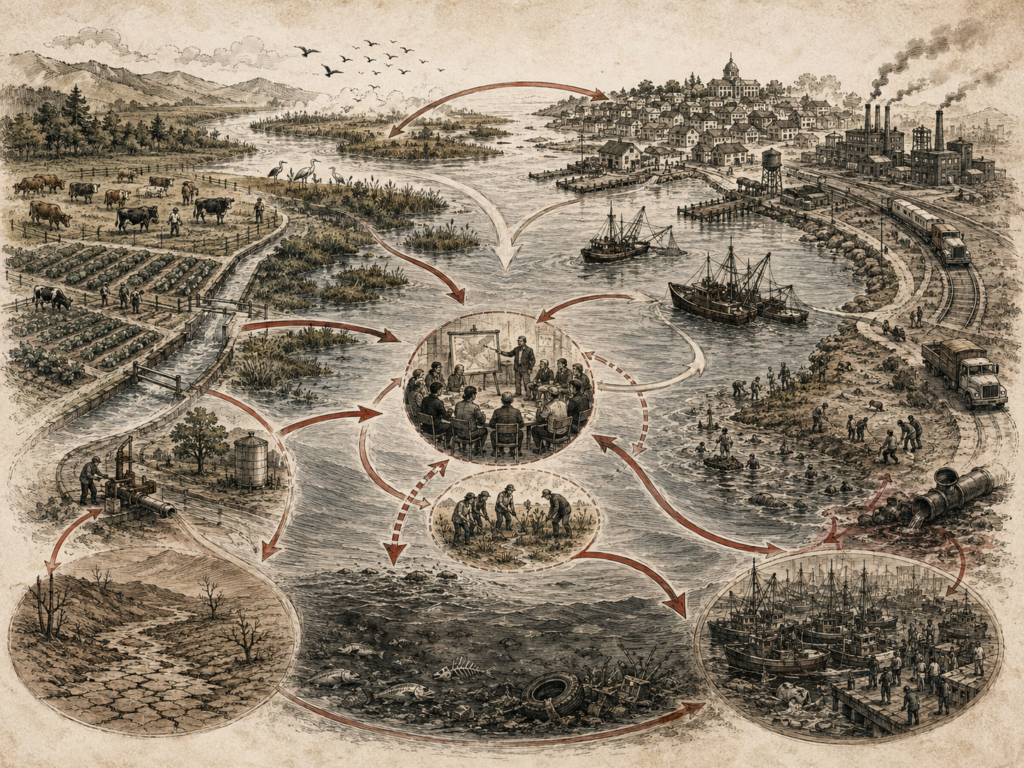
Scholarly systems-thinking illustration of shared waterways, grazing land, farms, fisheries, industry, public planning, degraded ecosystems, and collective governance connected by feedback pathways.

Tragedy of the Commons and Shared Resource Systems

Tragedy of the Commons and Shared Resource Systems explains how shared resources become depleted when individual actors benefit from use while the costs of overuse are distributed across the wider system. The article shows that commons are not limited to pastures, fisheries, forests, or water, but also include the atmosphere, public trust, infrastructure capacity, attention, information quality, institutional legitimacy, workforce capacity, open-source software, and ecological resilience. It distinguishes governed commons from unmanaged open access, emphasizing trust, fair rules, monitoring, sanctions, participation, restoration, and legitimacy. Through examples from public health, infrastructure, organizations, education, artificial intelligence, climate systems, economics, and public administration, the article examines how private gain and shared cost create depletion. Readers gain a practical method for diagnosing commons systems, identifying users, tracking resource stocks, analyzing unequal responsibility, and designing stewardship institutions.
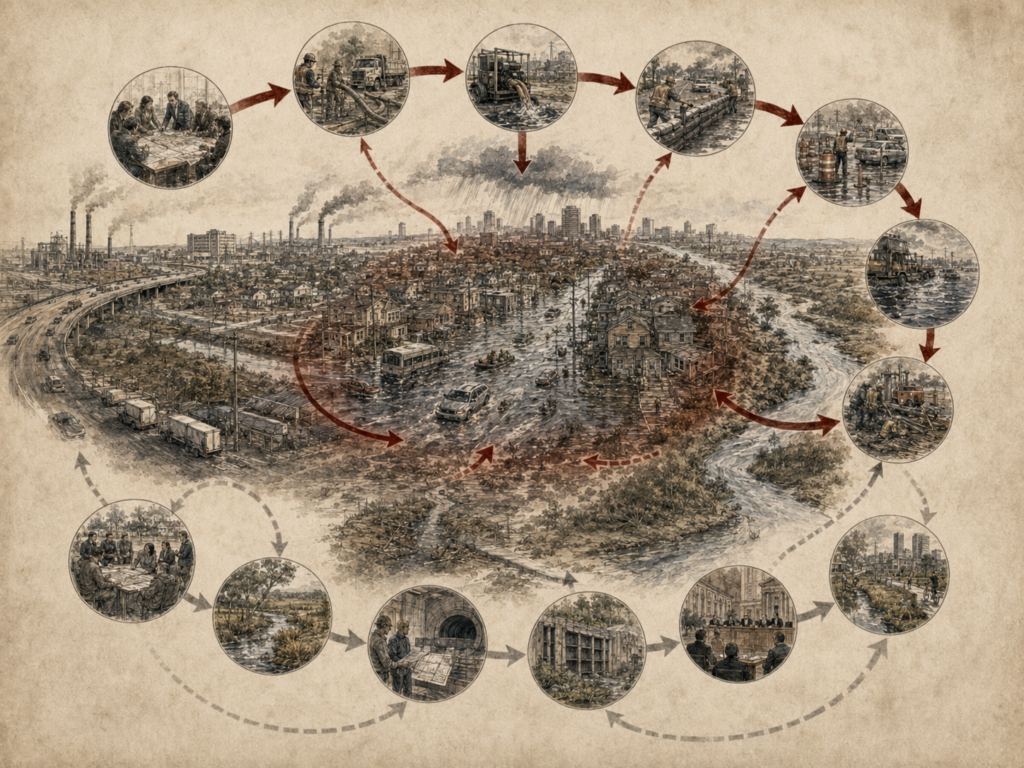
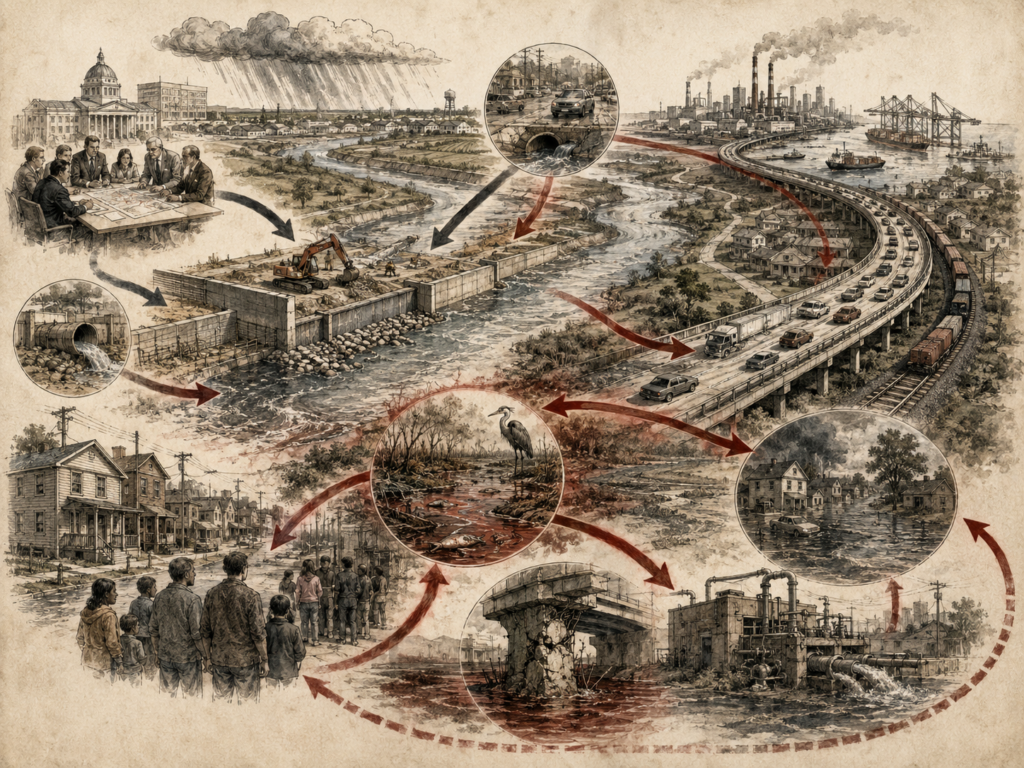
Scholarly systems-thinking illustration of an urban flooding system with emergency repairs, damaged neighborhoods, infrastructure responses, public planning scenes, ecological degradation, and circular feedback pathways.

Shifting the Burden

Shifting the Burden explains how systems become dependent on symptomatic relief while the fundamental solution weakens. The article shows how overtime, emergency care, debt, policing, messaging, automation, temporary aid, and crisis repair can reduce visible pressure while displacing the deeper work of prevention, capacity building, trust repair, redesign, restoration, and accountability. It examines the symptomatic solution, the fundamental solution, dependency loops, capacity erosion, institutional learning failure, externalized burden, and relief-plus-repair transition strategies. Through examples from public health, infrastructure, organizations, education, artificial intelligence, climate systems, economics, and public administration, the article shows how unresolved problems are shifted onto workers, households, applicants, communities, ecosystems, and future generations. Readers gain a practical method for diagnosing dependency, measuring hidden burdens, rebuilding fundamental capacity, changing incentives, and ensuring that immediate relief becomes a bridge to repair rather than a permanent substitute for structural change.

Scholarly systems-thinking illustration of urban flooding, infrastructure repairs, highways, industry, neighborhoods, damaged waterways, public planning scenes, and feedback loops showing unintended consequences.

Fixes That Fail

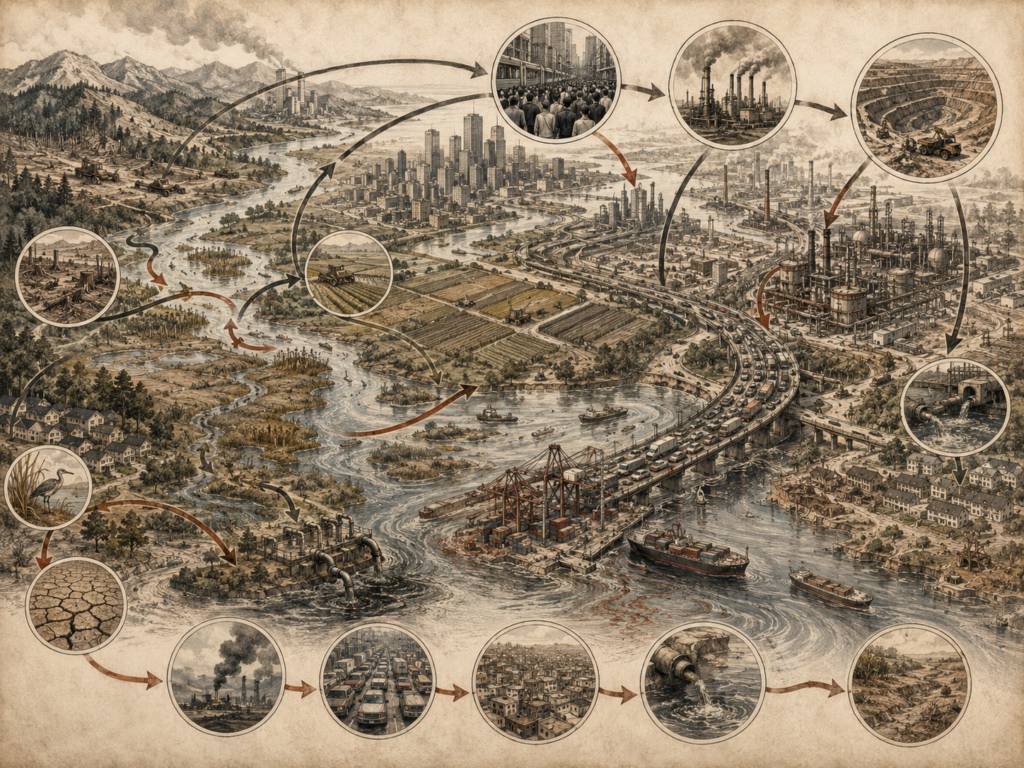
Fixes That Fail explains how quick solutions can reduce visible symptoms while creating delayed consequences that make the original problem return or worsen. The article shows why temporary relief is often attractive: it lowers pressure, reassures stakeholders, and appears successful within short evaluation windows. Yet when relief replaces structural repair, the fix can deplete capacity, increase dependency, shift burden, erode trust, create rework, deepen debt, or externalize harm to workers, communities, ecosystems, and future budgets. Through examples from public health, infrastructure, organizations, education, artificial intelligence, climate systems, economics, and public administration, the article distinguishes responsible emergency response from failed system repair. Readers gain a practical method for diagnosing quick-fix loops, delayed consequence loops, depleted stocks, dependency patterns, distributional harms, and the deeper repair needed to prevent recurring problems from becoming institutional habit.

Scholarly systems-thinking illustration of a regional landscape with cities, industry, farms, ports, highways, extraction sites, polluted waterways, degraded ecosystems, and circular feedback pathways.

Limits to Growth

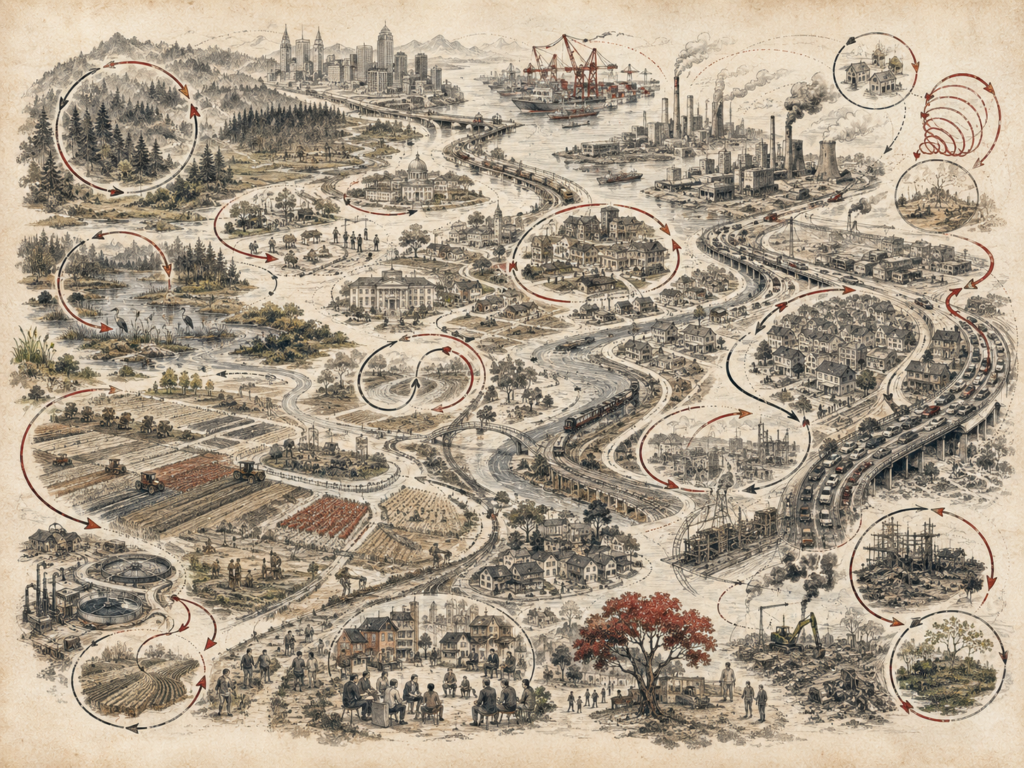
Limits to Growth explains how reinforcing growth loops eventually encounter constraints that slow, stop, or reverse expansion. The article shows why early success can create overconfidence when growth consumes hidden stocks such as capacity, trust, infrastructure, attention, legitimacy, workforce energy, ecological resilience, or public patience. It examines the interaction between reinforcing growth and balancing constraints, showing how delays, misperception, overshoot, and poor feedback can cause systems to push harder on the very growth engine that is creating the limit. Through examples from public health, infrastructure, organizations, education, artificial intelligence, climate systems, economics, and public administration, the article distinguishes growth from development and asks when constraints should be relieved, respected, or used to question the system goal. Readers gain a practical method for diagnosing growth loops, identifying limiting conditions, tracking leading indicators, and designing responsible responses before growth becomes collapse.

Scholarly systems-thinking illustration of a regional landscape with forests, wetlands, farms, neighborhoods, highways, ports, industry, institutions, community scenes, and recurring feedback loops.

System Archetypes and Recurring Patterns

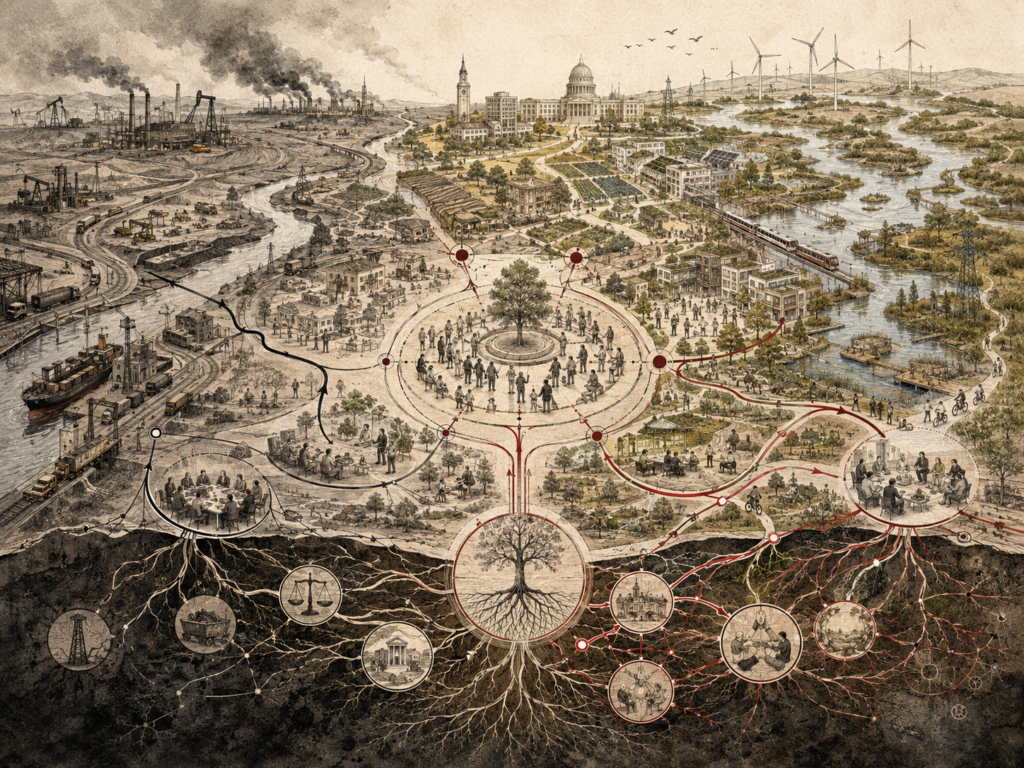
System Archetypes and Recurring Patterns explains how systems thinkers recognize recurring feedback structures beneath different problems. The article shows why backlogs, burnout, congestion, distrust, underinvestment, escalation, inequality, commons depletion, and policy resistance often return because system structure keeps reproducing them. It examines major archetypes including limits to growth, fixes that fail, shifting the burden, eroding goals, escalation, success to the successful, tragedy of the commons, growth and underinvestment, and compensating feedback. Through examples from public health, infrastructure, organizations, education, artificial intelligence, climate systems, economics, and public administration, the article treats archetypes as diagnostic hypotheses rather than labels. It also explores the ethical stakes of archetype analysis: who is blamed for structural patterns, who benefits from recurrence, who bears delayed costs, and how recognizing repeated system behavior can reveal leverage points for repair, accountability, resilience, and institutional learning over time.

Scholarly systems-thinking illustration of a regional landscape transitioning from extractive industrial systems toward civic, ecological, renewable, and community-centered systems, with roots, feedback pathways, institutions, and deep structural connections.

Paradigms, Goals, and Deep System Change

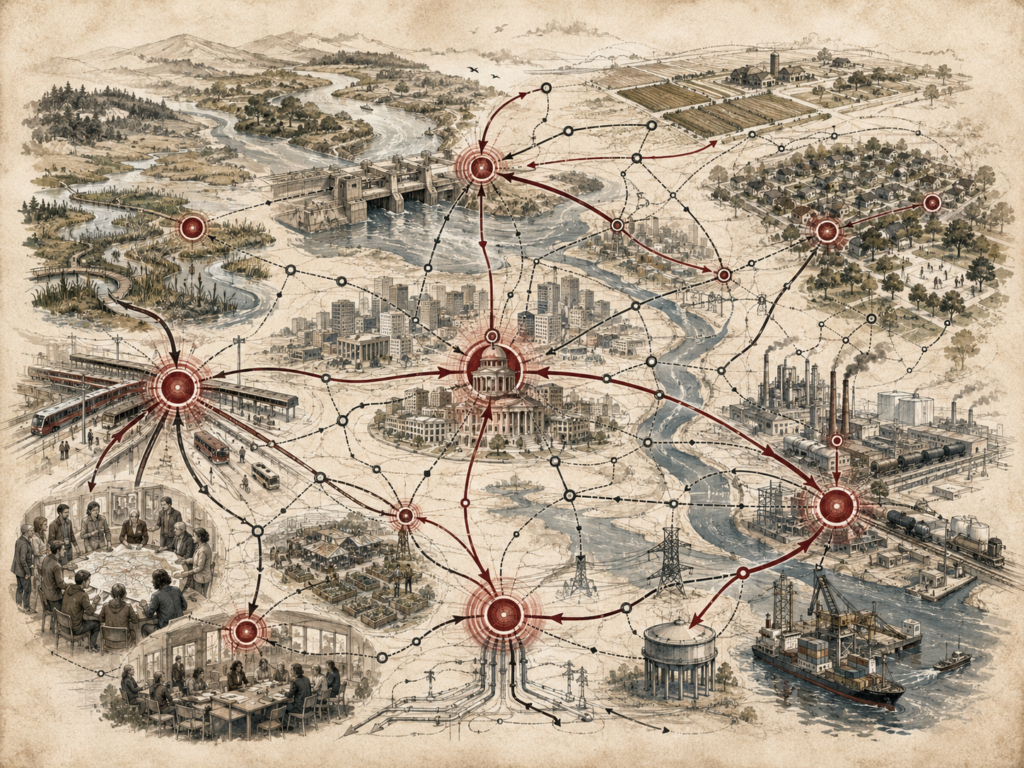
Paradigms, Goals, and Deep System Change explains why the deepest systems interventions begin by questioning what a system is actually organized to achieve. The article distinguishes explicit goals from implicit operating goals, showing how institutions may claim dignity, learning, sustainability, or service while optimizing throughput, control, growth, reputation, or risk avoidance. It examines paradigms as the deeper assumptions that define what counts as value, evidence, efficiency, realism, and success. Through examples from public health, infrastructure, organizations, education, artificial intelligence, climate systems, economics, and public administration, the article shows why surface reform often fails when deeper goals remain unchanged. It also explores the ethical stakes of paradigm change: whose worldview defines the system, whose harm is normalized, whose knowledge is excluded, and how deep change can redirect feedback, rules, metrics, power, and responsibility toward durable repair and justice over time.

Scholarly systems-thinking illustration of a regional system with rivers, cities, farms, industry, ports, public institutions, planning meetings, infrastructure, and highlighted intervention points connected by causal pathways.

Leverage Points and Places to Intervene in a System

Leverage Points and Places to Intervene in a System explains how systems thinkers identify where focused intervention can change recurring behavior rather than merely react to symptoms. The article shows why the most visible problem is not always the highest-leverage place to act. It examines parameters, stocks, flows, buffers, feedback loops, delays, information flows, rules, incentives, goals, paradigms, and power as different levels of intervention. Through examples from public health, infrastructure, organizations, education, artificial intelligence, climate systems, economics, and public administration, it distinguishes shallow fixes from structural change. The article also asks the ethical question that leverage analysis cannot avoid: leverage for whom? Readers gain a practical method for finding intervention points that repair depleted stocks, change harmful feedback, improve learning, reduce burden, and shift system behavior toward resilience, dignity, justice, and long-term responsibility across complex institutions and communities.

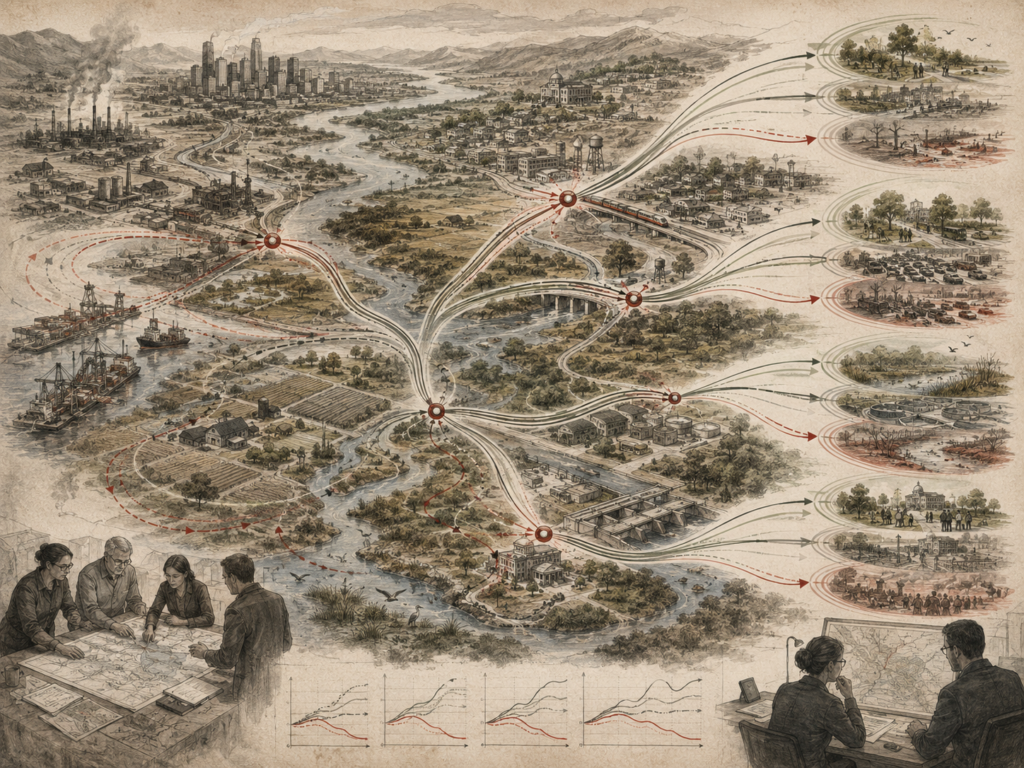
Scholarly systems-thinking illustration of a regional landscape with rivers, cities, ports, farms, infrastructure, planning teams, branching intervention pathways, alternative outcomes, and behavior-over-time curves.

Sensitivity Analysis for System Interventions

Sensitivity Analysis for System Interventions explains how systems thinkers test whether policy conclusions remain credible when assumptions change. The article shows how intervention outcomes can depend on uncertain parameters, feedback strength, implementation delay, behavioral response, threshold values, system capacity, trust, demand, funding, and distributional vulnerability. It distinguishes uncertainty from sensitivity, local from global sensitivity, and fragile interventions from robust ones. Through examples from public health, infrastructure, organizations, education, artificial intelligence, climate systems, economics, and public administration, it demonstrates why interventions should be tested under stress, not only under preferred assumptions. The article also examines the ethical stakes of assumption testing: whose risks are hidden, which groups are most exposed when assumptions fail, and how sensitivity analysis can strengthen monitoring, safeguards, adaptive design, and responsible system intervention under uncertainty, especially when complex systems behave differently than planners initially expected significantly.

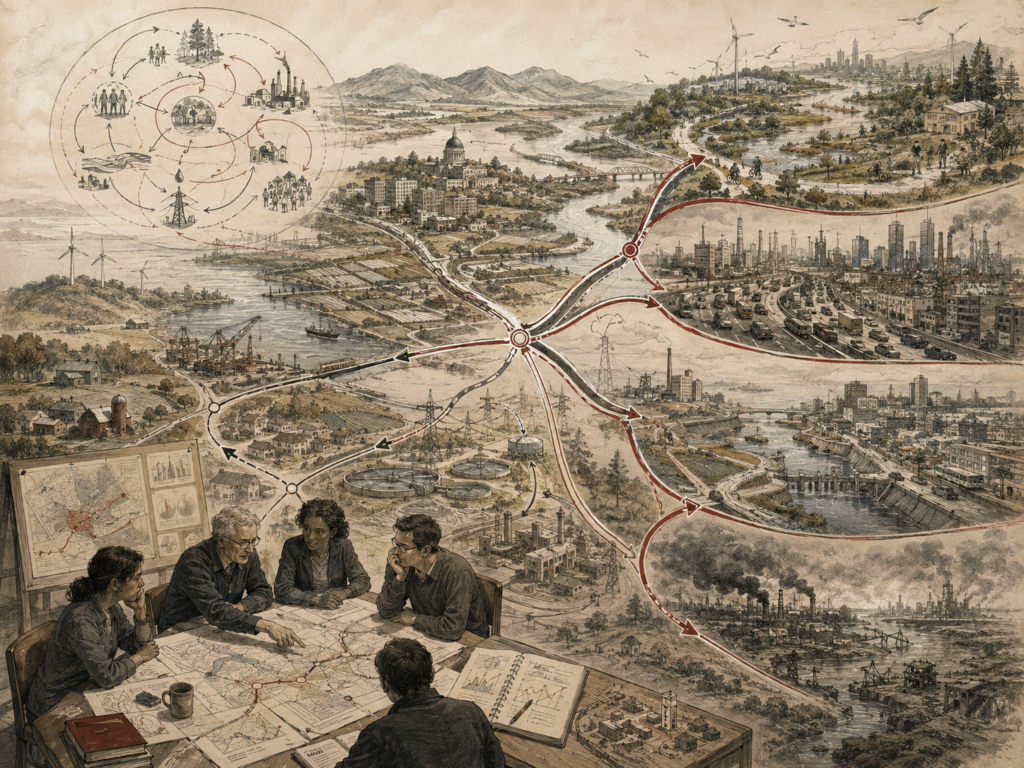
Scholarly systems-thinking illustration of a regional landscape with branching scenario pathways, cities, rivers, ports, industry, infrastructure, planning teams, maps, and alternative future outcomes.

Scenario Modeling in Systems Thinking

Scenario Modeling in Systems Thinking explains how analysts compare plausible futures without pretending the future can be predicted with certainty. The article distinguishes scenarios from forecasts, showing how structured assumptions, feedback loops, stocks, flows, delays, interventions, stress conditions, and uncertainty shape possible system behavior over time. It examines baselines, counterfactuals, intervention pathways, resilience stress tests, robustness checks, and distributional scenarios that ask who benefits, who bears risk, and who inherits delayed consequences. Through examples from public health, infrastructure, organizations, education, artificial intelligence, climate systems, economics, and public administration, the article shows how scenario modeling reveals hidden assumptions and prevents narrow policy optimism. It also examines the ethical stakes of future imagination: whose futures are modeled, whose harms are counted, and how scenario work can strengthen responsibility, monitoring, prevention, repair, and adaptive systems governance.

Scroll to Top