
Last Updated June 1, 2026
Shifting the burden is a systems archetype that describes what happens when a system relies on symptomatic relief instead of addressing the underlying condition that produces the symptom. The temporary solution reduces pressure, but it also diverts attention, funding, authority, learning, and capacity away from the fundamental solution. Over time, the system becomes dependent on the symptomatic response. The original problem remains, the deeper capacity weakens, and the burden of failure is often shifted onto people, communities, institutions, ecosystems, or future generations with less power to refuse it.
This archetype appears whenever a system manages visible distress without repairing the structure that creates it. Emergency rooms substitute for primary care. Overtime substitutes for staffing and workload redesign. Policing substitutes for housing, care, and prevention. Debt substitutes for income security. Messaging substitutes for trust repair. Automation substitutes for administrative simplification. Temporary grants substitute for durable public capacity. The symptom improves just enough for the system to keep avoiding the deeper work.
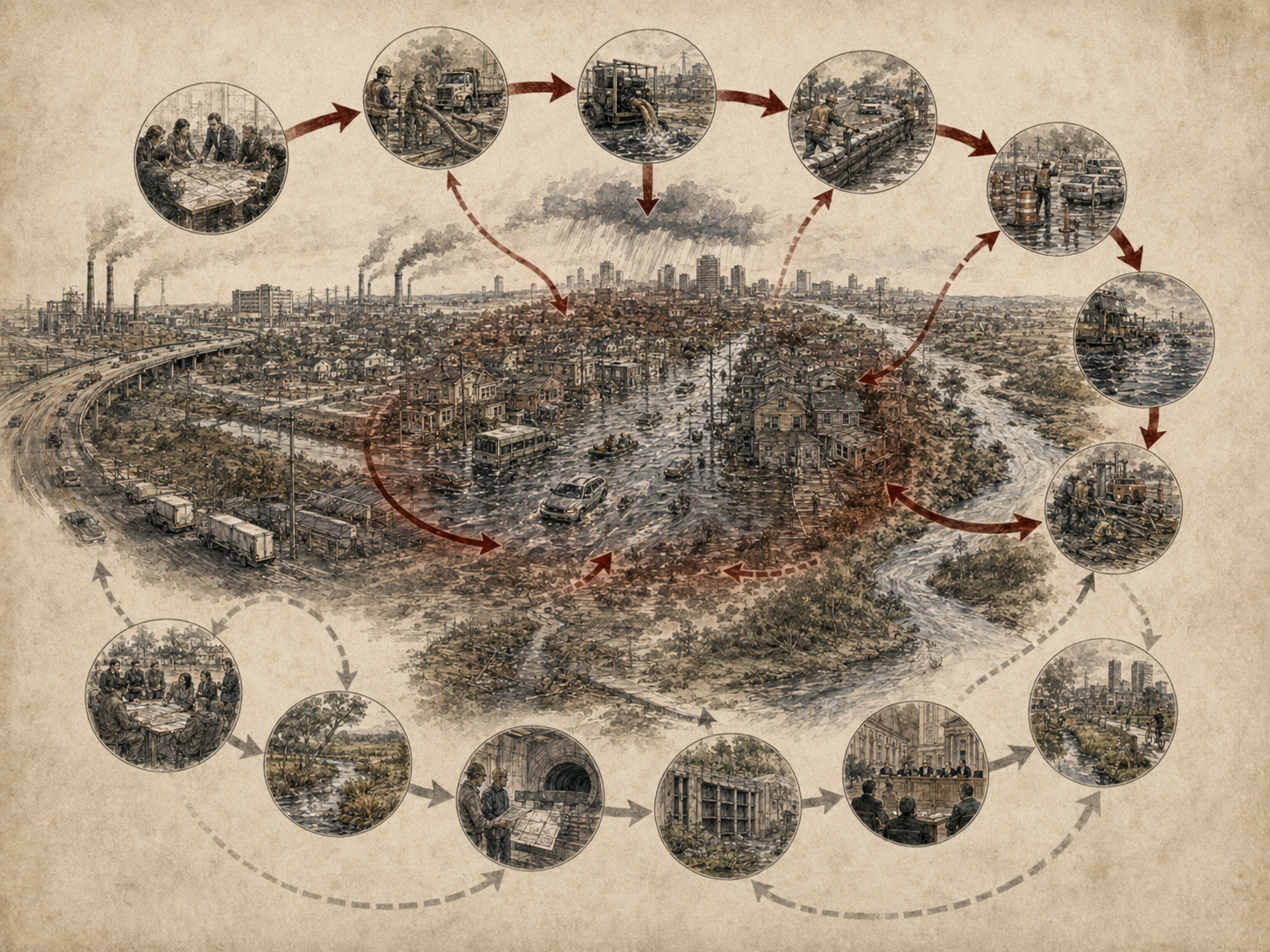
This article examines shifting the burden as a core systems archetype. It explains how symptomatic solutions become attractive, how they weaken fundamental capacity, why dependency grows over time, and how institutions normalize temporary relief as permanent operating logic. It also examines the ethical stakes of burden shifting: who receives relief, who absorbs hidden labor, whose suffering is managed rather than repaired, and how systems can escape dependency by pairing immediate support with structural investment, prevention, repair, and accountability.
Why Shifting the Burden Matters
Shifting the burden matters because many systems learn to manage symptoms instead of changing the conditions that produce them. The visible problem is reduced, but the deeper problem remains. The system becomes more skilled at relief and less capable of repair. It builds departments, budgets, routines, metrics, technologies, and professional identities around the symptomatic solution. Over time, the temporary response becomes the normal operating model.
This archetype is closely related to fixes that fail, but the emphasis is different. Fixes that fail focuses on a quick fix that creates delayed consequences. Shifting the burden focuses on substitution: the symptomatic solution displaces the fundamental solution. The system becomes dependent on relief, and the underlying capacity needed for durable change erodes.
For example, an organization may rely on overtime to handle recurring workload. Overtime reduces the visible backlog, but it substitutes for staffing, workload redesign, prioritization, training, and process improvement. As people become exhausted, turnover rises, institutional memory declines, and the organization becomes more dependent on overtime. The burden has shifted from structural management to individual endurance.
A public system may rely on emergency services because prevention, primary care, housing, income security, and community support remain underdeveloped. Emergency services are essential, but when they become the substitute for prevention, the system absorbs distress after damage has accumulated. The burden shifts to patients, frontline workers, emergency responders, and public budgets.
| Visible symptom | Symptomatic solution | Fundamental solution being displaced |
|---|---|---|
| Work backlog | Overtime, urgency, temporary staff. | Workload redesign, staffing, process simplification, capacity planning. |
| Health crisis | Emergency treatment. | Prevention, primary care, housing, nutrition, environmental protection. |
| Public distrust | Messaging and reputation management. | Accountability, repair, reliable service, participation, burden reduction. |
| Administrative delay | Automation layered onto complex rules. | Rule simplification, appeal rights, staffing, service redesign, accessibility. |
| Household insecurity | Debt, emergency aid, temporary relief. | Income security, affordable housing, healthcare access, stable work, care infrastructure. |
| Ecological stress | Technical mitigation after damage appears. | Reduced harmful flows, ecosystem restoration, stewardship rules, regeneration. |
Shifting the burden is dangerous because it can look compassionate, efficient, or practical in the short term. Relief is real. The symptom is real. But if relief becomes the substitute for repair, the system quietly abandons the deeper work. The burden does not disappear. It moves.
What the Shifting-the-Burden Archetype Means
The shifting-the-burden archetype contains three interacting dynamics. First, a problem symptom creates pressure. Second, a symptomatic solution reduces the symptom quickly. Third, a fundamental solution would reduce the underlying cause, but it is slower, harder, more expensive, more political, or less visible. As the symptomatic solution is used repeatedly, investment in the fundamental solution declines. Dependency grows.
The basic structure can be represented as two competing paths. The symptomatic path is fast and visible. The fundamental path is slower and deeper. The more the system relies on the symptomatic path, the less pressure remains to pursue the fundamental path. If the symptomatic solution also weakens fundamental capacity, the pattern becomes self-reinforcing.
\text{Problem Symptom} \rightarrow \text{Symptomatic Solution} \rightarrow \text{Temporary Relief}
\]
\[
\text{Problem Symptom} \rightarrow \text{Fundamental Solution} \rightarrow \text{Durable Relief}
\]
\[
\text{Symptomatic Solution} \xrightarrow{-} \text{Fundamental Solution Capacity}
\]
Interpretation: The symptomatic solution reduces pressure quickly, but over time it can weaken attention, investment, and capacity for the fundamental solution that would create durable relief.
The archetype often unfolds in stages:
- A recurring symptom creates pressure for action.
- A symptomatic solution provides visible short-term relief.
- The fundamental solution is delayed because pressure has fallen.
- The underlying cause remains active.
- The symptom returns.
- The system applies the symptomatic solution again.
- Dependency on the symptomatic solution grows.
- Capacity for the fundamental solution weakens.
- The burden shifts to people or systems forced to absorb the recurring problem.
The key diagnostic clue is not merely that a quick fix exists. Many systems need immediate relief. The clue is that reliance on the symptomatic solution increases while the fundamental solution receives less investment, authority, credibility, or attention. The system becomes better at managing symptoms and worse at changing causes.
Shifting the burden is therefore a story of displaced responsibility. The system says it is addressing the problem, but it is actually moving the problem into another stock, another body, another department, another generation, another ecosystem, or another time horizon.
The Symptomatic Solution
The symptomatic solution is the response that reduces visible pressure. It is usually attractive because it works quickly, fits existing routines, avoids deeper conflict, and produces measurable action. It may be politically easier than structural repair. It may be cheaper in the short term. It may require less institutional humility. It may allow the system to continue operating without questioning its goals, incentives, rules, or assumptions.
Symptomatic solutions are not automatically bad. Emergency shelters matter when people are unhoused tonight. Pain medication matters when someone is in pain. Temporary staffing matters during a surge. Emergency infrastructure repair matters when public safety is at risk. The problem arises when symptom management becomes the system’s substitute for prevention, capacity, and repair.
In shifting the burden, the symptomatic solution has several features:
- It produces relief faster than the fundamental solution.
- It is easier to measure than structural change.
- It fits the existing institutional logic.
- It lowers pressure for deeper reform.
- It can be repeated without changing the system.
- It may produce dependency or reduce long-term capacity.
P_t \uparrow \Rightarrow S_t \uparrow \Rightarrow P_t \downarrow
\]
Interpretation: As problem pressure \(P_t\) rises, the symptomatic solution \(S_t\) is applied, reducing visible pressure in the short term.
The symptomatic solution often becomes organizationally protected. Budgets support it. Performance metrics reward it. Leaders praise it. Staff become skilled at it. Vendors sell tools for it. Political narratives defend it. Over time, the system’s identity may become tied to its ability to manage symptoms.
This is why shifting the burden can be difficult to challenge. Criticizing the symptomatic solution can sound like criticizing relief itself. Systems thinking requires a more careful distinction: relief may be necessary, but relief should not become the reason repair never happens.
The central question is not “Should the system provide relief?” The question is “Does relief create the conditions for repair, or does it substitute for repair?”
The Fundamental Solution
The fundamental solution addresses the underlying condition that produces the symptom. It changes the system structure rather than repeatedly managing the output. It may involve capacity building, prevention, rule change, redesign, trust repair, ecological restoration, redistribution, public investment, governance reform, workload redesign, rights protection, or a change in system goals.
Fundamental solutions are often slower because they must change stocks, flows, rules, and feedback loops. Trust does not rebuild instantly. Workforce capacity requires hiring, training, retention, and recovery. Infrastructure condition requires maintenance, investment, and planning. Public health requires housing, care access, prevention, and environmental protection. Administrative burden requires rule simplification, accessibility, and institutional accountability. Ecological restoration requires reduced harm and time for regeneration.
This slower time scale makes the fundamental solution vulnerable. Because it does not produce immediate relief, it can be dismissed as impractical. Because it may require redistribution or rule change, it can be politically contested. Because it may expose institutional failure, it can be resisted. Because its benefits accumulate over time, it may not fit short evaluation cycles.
C_{t+1} = C_t + R_t – D_t
\]
Interpretation: Fundamental capacity \(C\) grows through repair and investment \(R_t\), but declines through depletion, neglect, or damage \(D_t\). Durable relief requires increasing capacity, not only suppressing symptoms.
A fundamental solution usually asks different questions from a symptomatic solution:
| Symptomatic question | Fundamental question |
|---|---|
| How do we reduce the visible problem now? | Why does the problem keep being produced? |
| How do we process more cases? | Why are cases complex, delayed, or avoidable? |
| How do we handle more demand? | What system conditions are creating demand? |
| How do we quiet criticism? | What harm or distrust needs repair? |
| How do we make people comply? | Are the rules legitimate, accessible, and just? |
| How do we keep output high? | What capacity, recovery, and learning are required for durable performance? |
The fundamental solution is not always obvious. It may require participatory diagnosis, historical analysis, modeling, experimentation, and humility. People closest to the burden often understand the fundamental problem better than those managing the symptom from above.
A system begins to escape shifting the burden when it protects time, funding, authority, and legitimacy for the fundamental solution even while providing short-term relief.
The Dependency Loop
The dependency loop is what makes shifting the burden so powerful. The more the system relies on the symptomatic solution, the less it invests in the fundamental solution. As fundamental capacity weakens, the symptom returns more often or more intensely. The system then relies even more on the symptomatic solution. Dependency becomes self-reinforcing.
In an organization, repeated overtime can reduce investment in staffing, process redesign, and realistic prioritization. As staff become exhausted, capacity falls. As capacity falls, overtime becomes more necessary. In public health, emergency care may become the default substitute for prevention. As prevention remains underfunded, crisis care demand rises. The system then spends more on emergency response, leaving less for prevention.
S_t \uparrow \Rightarrow C_t \downarrow \Rightarrow P_{t+1} \uparrow \Rightarrow S_{t+1} \uparrow
\]
Interpretation: Greater reliance on the symptomatic solution \(S_t\) can reduce fundamental capacity \(C_t\), increasing future problem pressure \(P_{t+1}\) and driving still more reliance on the symptomatic solution.
The dependency loop can be institutional, financial, technological, cultural, or psychological. It may appear as:
- routine use of emergency measures;
- normalization of overload or crisis response;
- budgets that fund symptoms but not causes;
- metrics that reward visible relief over capacity building;
- technology that helps manage complexity instead of reducing it;
- loss of internal skill because external substitutes are used repeatedly;
- public expectations shaped around emergency response rather than prevention;
- political narratives that treat structural repair as unrealistic.
Dependency also changes perception. The system may stop seeing the fundamental solution as available. It may describe prevention as idealistic, staffing as too expensive, trust repair as too slow, ecological restoration as impractical, or rule simplification as risky. The symptomatic solution begins to define what counts as realistic.
Breaking dependency requires rebuilding the system’s confidence in the fundamental solution. That means demonstrating that repair is possible, funding it long enough to work, protecting it from short-term pressure, and tracking whether reliance on symptomatic relief actually declines.
Capacity Erosion and Institutional Learning Failure
Shifting the burden often erodes capacity. Capacity includes staffing, knowledge, trust, infrastructure, governance, relationships, public legitimacy, ecological resilience, and institutional memory. When a system repeatedly uses symptomatic relief, it may fail to build or maintain the capacity needed for fundamental repair.
Capacity erosion can be subtle. A public agency that relies on contractors may lose internal expertise. A hospital system that relies on emergency care may underinvest in primary care and community health. A school system that relies on test preparation may weaken broader learning capacity. A government that relies on disaster response may underinvest in climate adaptation. An organization that relies on heroic individual effort may neglect staffing, process design, and sustainable workload.
Institutional learning also suffers. Because the symptom is repeatedly reduced, the system receives less pressure to ask why the symptom exists. The symptomatic solution dampens the feedback that would otherwise force deeper inquiry. In this way, relief can become a learning suppressant.
L_t = f(P_t, F_t, A_t)
\]
Interpretation: Institutional learning \(L_t\) depends on problem pressure \(P_t\), feedback quality \(F_t\), and attention \(A_t\). Symptomatic relief can reduce pressure and attention before fundamental learning occurs.
Capacity erosion appears through signals such as:
- fewer people understand the root process;
- the system becomes dependent on external vendors or emergency teams;
- frontline knowledge does not reach decision-makers;
- preventive work is postponed repeatedly;
- staff turnover increases;
- trust declines despite more communication;
- maintenance, prevention, or training budgets are cut first;
- repeated crisis becomes accepted as normal.
Capacity erosion matters because the fundamental solution often requires the very capacity that has been weakened. A system that delays repair too long may face a harder transition. Rebuilding trust after years of performative communication is harder. Rebuilding infrastructure after decades of deferred maintenance is harder. Rebuilding internal expertise after outsourcing is harder. Rebuilding ecological resilience after severe degradation is harder.
The burden shifts not only because the symptom is managed elsewhere. It shifts because the system loses the capacity to stop shifting it.
Who Receives the Burden?
The phrase “shifting the burden” is not only technical. It is ethical. The burden of an unresolved system problem does not disappear. It is carried by someone or something. Workers carry it as fatigue. Households carry it as debt. Applicants carry it as administrative burden. Communities carry it as exposure. Ecosystems carry it as depletion. Future generations carry it as infrastructure failure, climate risk, and reduced options.
The system may describe the symptomatic solution as efficient because institutional costs fall. But costs may have been moved outside the accounting boundary. A public agency may reduce internal workload by requiring more documentation from applicants. A company may reduce labor costs by increasing precarity. A city may attract development revenue while residents absorb displacement. A platform may increase engagement while users and society absorb attention harm. An economy may grow while ecosystems absorb waste.
| System burden | Where it may be shifted | What becomes hidden |
|---|---|---|
| Administrative complexity | Applicants, families, caseworkers, community organizations. | Time, stress, appeals, nonparticipation, distrust. |
| Workload pressure | Employees, caregivers, families, future teams. | Fatigue, turnover, errors, lost recovery, institutional memory loss. |
| Infrastructure underinvestment | Residents, future budgets, emergency responders. | Risk, failure, disruption, higher lifecycle costs. |
| Health system gaps | Patients, emergency departments, families, public budgets. | Preventable illness, delayed care, crisis demand. |
| Ecological damage | Communities, nonhuman life, future generations. | Exposure, biodiversity loss, climate risk, regeneration loss. |
| Governance failure | Users, frontline staff, courts, appeal systems, civil society. | Contest burden, distrust, rights violations, legitimacy loss. |
Burden shifting is often invisible because official metrics are too narrow. If the system measures internal cost but not public burden, it can call a policy efficient while making life harder. If it measures throughput but not fatigue, it can call a team productive while depleting capacity. If it measures engagement but not attention quality, it can call a platform successful while degrading trust.
Diagnosing shifting the burden requires asking who has to work harder because the system refuses to repair itself. It also requires asking whether the people carrying the burden have voice, protection, and power.
Addiction to Relief and System Dependence
Some versions of shifting the burden resemble addiction because the symptomatic solution provides relief while weakening the system’s ability to recover without it. The system becomes dependent on the intervention that is preventing deeper repair. This does not mean every case involves literal addiction. It means the feedback structure has a dependency pattern.
Debt can relieve immediate financial pressure while increasing future repayment burden. Overtime can relieve immediate workload pressure while increasing fatigue. Emergency aid can prevent immediate harm while leaving structural insecurity intact. Performance pressure can raise short-term output while reducing learning, creativity, and trust. Enforcement can suppress visible behavior while worsening legitimacy and cooperation.
The dependency pattern has a familiar rhythm: pressure, relief, recurrence, more relief. The system experiences the symptomatic solution as necessary because the underlying problem remains. Yet the underlying problem remains partly because reliance on the symptomatic solution delays fundamental change.
D_{t+1} = D_t + \alpha S_t – \beta R_t
\]
Interpretation: Dependency \(D\) grows with reliance on the symptomatic solution \(S_t\) and declines through repair, recovery, or fundamental capacity \(R_t\).
Dependency can become self-protecting. If someone proposes reducing reliance on the symptomatic solution, the system feels threatened because fundamental capacity is weak. Leaders may say there is no choice. In a narrow sense, they may be right: once dependency has grown, abrupt withdrawal can cause harm. But this is precisely why transition planning matters.
Escaping dependency requires:
- maintaining enough relief to avoid immediate harm;
- investing steadily in fundamental capacity;
- measuring dependency directly;
- creating transition milestones;
- protecting repair work from short-term pressure;
- reducing the need for the symptomatic solution over time;
- making the hidden costs of dependency visible.
The goal is not withdrawal for its own sake. The goal is recovery of fundamental capacity. A system has escaped the archetype when symptoms decline because the underlying condition has changed, not because the symptomatic solution has become more intense.
Breaking the Pattern: Relief Plus Repair
Breaking a shifting-the-burden pattern requires pairing short-term relief with long-term repair. The symptomatic solution may still be needed, but it must be subordinated to the fundamental solution. The system must stop treating relief as success and begin treating reduced dependence on relief as success.
The first step is to identify the symptom and the symptomatic solution. The second is to name the fundamental solution being displaced. The third is to measure dependency: how often the symptomatic solution is used, how much it costs, who carries its burden, and whether fundamental capacity is improving or declining. The fourth is to invest in repair and protect that investment long enough to matter.
Relief plus repair might look like:
- using overtime temporarily while redesigning workload and hiring sustainably;
- funding emergency shelter while expanding permanent housing and prevention;
- providing emergency medical care while investing in primary care and social conditions of health;
- using automation carefully while simplifying rules and protecting appeal rights;
- repairing infrastructure failures while funding preventive maintenance;
- offering debt relief while addressing income, housing, and healthcare cost pressures;
- using crisis communication while changing institutional behavior that caused distrust.
\text{Escape Path} = \text{Immediate Relief} + \text{Protected Repair Investment} + \text{Declining Dependency}
\]
Interpretation: A system escapes shifting the burden when relief prevents immediate harm, repair builds fundamental capacity, and dependency on the symptomatic solution declines over time.
Breaking the pattern also requires changing metrics. If the system measures only symptom reduction, it will continue rewarding the symptomatic solution. It must also measure fundamental capacity, dependency, burden distribution, delayed consequences, and repair progress.
| Old success metric | Repair-oriented metric |
|---|---|
| Backlog reduced this month. | Backlog reduced while overtime, errors, rework, and turnover decline. |
| Emergency response delivered. | Emergency response delivered while preventable crisis demand falls. |
| Processing speed increased. | Speed improved while burden, appeals, and exclusion decline. |
| Public criticism decreased. | Trust increased through behavior change, accountability, and repair. |
| Short-term cost reduced. | Lifecycle cost, risk, burden, and future liability decline. |
Relief plus repair is difficult because it requires the system to operate on two time scales. It must respond now and rebuild for later. Systems that cannot hold both time scales are likely to remain trapped.
Ethics: Managing Symptoms or Repairing Harm?
Shifting the burden raises an ethical question: is the system managing symptoms in order to avoid repairing harm? This question matters because burden shifting often preserves institutional comfort while placing unresolved costs on people with less power. The system appears responsive, but the deeper injury remains.
An institution may manage public complaints through communication while refusing accountability. It may manage poverty through emergency assistance while leaving wages, housing, healthcare, and debt structures unchanged. It may manage school performance through test preparation while ignoring housing instability, exclusion, hunger, teacher capacity, and belonging. It may manage public disorder through enforcement while failing to provide care, housing, and prevention.
Ethical analysis asks whether the symptomatic solution protects those experiencing harm or protects the system from the pressure to change. Sometimes it does both. Emergency relief can be life-saving. But if relief is designed in ways that preserve the conditions creating the emergency, it becomes ethically incomplete.
Ethical shifting-the-burden analysis asks:
- Who defines the symptom?
- Who defines the fundamental problem?
- Who benefits from the symptomatic solution?
- Who carries the burden of unresolved structure?
- Whose labor makes the symptomatic solution work?
- What repair is postponed?
- What costs are externalized?
- Who has authority to demand fundamental change?
- How will dependency be reduced?
- What would accountability look like?
Shifting the burden is especially important for justice because marginalized communities often receive symptom management rather than structural repair. They are offered policing instead of safety, emergency aid instead of security, procedural access instead of meaningful rights, consultation instead of power, adaptation instead of protection, and resilience language instead of relief from harm.
Systems thinking should not make this pattern sound neutral. A burden shifted is a burden imposed. If a system repeatedly manages symptoms while refusing repair, it is making a moral choice even when it presents itself as practical.
Examples Across Systems
Shifting the burden appears across social, ecological, technical, and institutional systems. The examples below show how the archetype changes diagnosis.
Public health
A health system may rely on emergency departments to handle preventable illness, untreated chronic conditions, mental-health crises, and social instability. Emergency care is necessary, but when it substitutes for prevention, primary care, housing, nutrition, environmental protection, and community trust, the burden shifts to patients, emergency workers, families, and public budgets. The fundamental solution requires upstream public health, access, prevention, and social conditions that reduce crisis demand.
Infrastructure
Emergency repair can substitute for preventive maintenance. A city repairs visible failures but defers the asset-management system needed to prevent them. Emergency repairs absorb budget, leaving less for planned maintenance. Infrastructure condition declines further. Residents carry the burden through disruption, risk, cost, and distrust. The fundamental solution is lifecycle funding, maintenance governance, climate adaptation, and asset-condition transparency.
Organizations
An organization may rely on heroic effort, overtime, and temporary contractors instead of sustainable staffing, clear priorities, process redesign, and recovery time. Output continues temporarily, but fatigue, error, turnover, and knowledge loss rise. The burden shifts to workers and future teams. The fundamental solution is capacity design, workload governance, retention, prioritization, and institutional learning.
Education
A school system may rely on test preparation, remediation, discipline, or individual student interventions while avoiding deeper investment in teacher capacity, belonging, family support, housing stability, nutrition, mental health, and curriculum quality. The system manages performance symptoms while leaving the conditions of learning underdeveloped. The burden shifts to students, teachers, and families.
Artificial intelligence systems
An institution may use AI to manage administrative complexity without simplifying the rules that produce complexity. Automation may increase throughput while shifting error correction, appeals, and interpretation burden onto users. The system treats technology as the solution when the fundamental issue is governance, rights, process design, accountability, and human support.
Climate and ecology
A society may rely on adaptation and technical mitigation while avoiding reductions in harmful flows, extraction, emissions, land conversion, and ecological degradation. Adaptation is necessary, but if it substitutes for prevention and regeneration, the burden shifts to vulnerable communities, ecosystems, and future generations. The fundamental solution requires emission reduction, ecological restoration, stewardship rules, and changed economic incentives.
Economics
Household debt can substitute for income security, affordable housing, healthcare access, childcare, and stable work. Debt relieves immediate pressure, but repayment burden reduces future security. The burden shifts from the economy and policy system to households. The fundamental solution is not simply financial literacy; it is reducing the structural conditions that make borrowing necessary for basic stability.
Public administration
A public agency may rely on caseworkers and community organizations to help people navigate complex rules rather than simplifying the rules themselves. Assistance matters, but if navigation support substitutes for burden reduction, the system leaves complexity intact. The burden shifts to applicants, families, advocates, and frontline staff. The fundamental solution is accessible design, simplified eligibility, trusted support, appeal rights, and accountability for administrative burden.
Across these domains, shifting the burden reveals a recurring structure: the system manages pain after it is produced rather than changing the structure that produces it. The ethical question is whether relief is being used as a bridge to repair or as a permanent substitute for it.
Mathematics, Computation, and Modeling
Shifting the burden can be modeled with causal-loop diagrams, stock-flow models, dependency indicators, scenario analysis, delay structures, and capacity-depletion equations. The purpose of modeling is to show how symptomatic relief, fundamental repair, and dependency interact over time.
A simple problem-pressure model can be written as:
P_{t+1} = P_t + D_t – aS_t – bF_t
\]
Interpretation: Problem pressure \(P\) increases with demand or stress \(D_t\), decreases through symptomatic relief \(S_t\), and decreases more durably through fundamental solution effort \(F_t\).
A fundamental-capacity model can be written as:
C_{t+1} = C_t + rF_t – hS_t
\]
Interpretation: Fundamental capacity \(C\) grows through investment in the fundamental solution \(F_t\), but can be weakened by repeated reliance on the symptomatic solution \(S_t\).
A dependency model can be represented as:
D_{t+1} = D_t + \alpha S_t – \beta F_t
\]
Interpretation: Dependency \(D\) increases with use of the symptomatic solution and decreases when the fundamental solution receives sustained investment.
A burden-shifting measure can be represented as:
B_{\text{external},t} = B_{\text{total},t} – B_{\text{internal},t}
\]
Interpretation: Externalized burden is the portion of total system burden not counted inside the institution’s own metrics or cost boundary.
A repair transition target can be represented as:
\frac{S_t}{F_t + C_t} \downarrow
\]
Interpretation: A healthy transition should reduce reliance on symptomatic relief relative to fundamental investment and restored capacity.
A scenario comparison can be represented as:
Y^{(s)}_t = f(P_t, S_t, F_t, C_t, D_t)
\]
Interpretation: Scenario \(s\) evaluates system outcomes as a function of problem pressure, symptomatic relief, fundamental repair, capacity, and dependency.
| Modeling task | Shifting-the-burden question | Example output |
|---|---|---|
| Symptom trajectory | How does the visible problem change over time? | Backlog, crisis demand, distrust, debt, or workload curve. |
| Relief simulation | How much pressure does the symptomatic solution reduce? | Short-term symptom reduction. |
| Fundamental-capacity modeling | Is the system building or depleting long-term capacity? | Trust, workforce, infrastructure, prevention, or ecological-capacity trajectory. |
| Dependency indicator | Is reliance on the symptomatic solution increasing? | Dependency ratio over time. |
| Externalized burden analysis | Who is carrying the unresolved problem? | Applicant burden, worker fatigue, household debt, ecological harm, future cost. |
| Scenario comparison | What happens under relief-only versus relief-plus-repair? | Symptom, capacity, dependency, and burden trajectories. |
| Sensitivity analysis | Which assumptions determine escape from dependency? | Repair rate, dependency growth, demand pressure, capacity depletion, delay. |
A useful model should not only show that the symptomatic solution reduces the problem. It should show whether reliance on that solution is rising or falling, whether fundamental capacity is recovering, and where the burden is being carried. Otherwise, the model may reproduce the same narrow view that keeps the archetype hidden.
Python Workflow: Symptomatic Relief, Fundamental Repair, Dependency, and Burden Diagnostics
The Python workflow below turns shifting-the-burden analysis into a small reproducible systems model. It compares four scenarios: symptom management dependency, relief without protected repair, relief plus capacity building, and transition to fundamental repair. It also includes one-at-a-time sensitivity analysis for the transition scenario. The script uses only the Python standard library, writes CSV outputs relative to the article folder, and is designed as a clear starting point for companion repository work.
# shifting_the_burden_workflow.py
# Dependency-light workflow for shifting-the-burden diagnostics:
# symptomatic relief, fundamental repair, dependency growth,
# capacity erosion, externalized burden, and transition milestones.
# Writes outputs relative to the article root.

from __future__ import annotations

from dataclasses import dataclass, replace
from pathlib import Path
import csv
from statistics import mean

ARTICLE_ROOT = Path(__file__).resolve().parents[1]
TABLES = ARTICLE_ROOT / "outputs" / "tables"


@dataclass
class BurdenShiftScenario:
    name: str
    initial_problem_pressure: float
    stress_inflow: float
    symptomatic_solution_intensity: float
    symptomatic_effectiveness: float
    fundamental_solution_investment: float
    capacity_building_rate: float
    dependency_growth_rate: float
    burden_externalization_rate: float
    repair_accountability: float
    burden_visibility: float
    affected_voice: float
    transition_discipline: float


def clamp(value: float, low: float = 0.0, high: float = 140.0) -> float:
    return max(low, min(high, value))


def run_scenario(scenario: BurdenShiftScenario, periods: int = 64) -> list[dict[str, object]]:
    problem_pressure = scenario.initial_problem_pressure
    fundamental_capacity = 44.0 + scenario.capacity_building_rate * 18.0
    dependency_stock = 24.0 + scenario.symptomatic_solution_intensity * 18.0
    externalized_burden = 34.0 + scenario.burden_externalization_rate * 18.0
    trust_stock = 42.0 + scenario.repair_accountability * 18.0
    learning_capacity = 34.0 + scenario.burden_visibility * 16.0
    vulnerable_group_burden = 32.0 + scenario.burden_externalization_rate * 14.0
    rows: list[dict[str, object]] = []

    for period in range(periods + 1):
        system_pressure = clamp(
            scenario.stress_inflow * 18.0
            + max(0.0, problem_pressure - 50.0) * 0.22
            + max(0.0, 55.0 - fundamental_capacity) * 0.14
            + externalized_burden * 0.08
            - scenario.transition_discipline * 3.0,
            0.0,
            120.0,
        )

        symptomatic_relief_flow = clamp(
            scenario.symptomatic_solution_intensity * 18.0
            + system_pressure * 0.24
            + dependency_stock * 0.04
            - scenario.transition_discipline * 4.0
            - scenario.repair_accountability * 2.0,
            0.0,
            120.0,
        )

        visible_relief = clamp(
            symptomatic_relief_flow * scenario.symptomatic_effectiveness * 0.82
            + scenario.repair_accountability * 1.5,
            0.0,
            120.0,
        )

        fundamental_repair_flow = clamp(
            scenario.fundamental_solution_investment * 18.0
            + scenario.capacity_building_rate * 14.0
            + scenario.repair_accountability * 9.0
            + scenario.burden_visibility * 7.0
            + scenario.affected_voice * 8.0
            + scenario.transition_discipline * 8.0,
            0.0,
            120.0,
        )

        capacity_erosion = clamp(
            dependency_stock * 0.08
            + symptomatic_relief_flow * 0.08
            + externalized_burden * 0.05
            - scenario.capacity_building_rate * 3.0
            - scenario.fundamental_solution_investment * 3.0,
            0.0,
            120.0,
        )

        externalized_burden_flow = clamp(
            scenario.burden_externalization_rate * 14.0
            + symptomatic_relief_flow * 0.10
            + max(0.0, problem_pressure - fundamental_capacity) * 0.07
            + dependency_stock * 0.05
            - scenario.burden_visibility * 4.0
            - scenario.affected_voice * 3.0
            - scenario.repair_accountability * 2.5,
            0.0,
            120.0,
        )

        dependency_inflow = clamp(
            scenario.dependency_growth_rate * 14.0
            + symptomatic_relief_flow * 0.12
            + max(0.0, visible_relief - fundamental_repair_flow) * 0.08
            - scenario.transition_discipline * 5.0
            - scenario.repair_accountability * 2.0,
            0.0,
            120.0,
        )

        dependency_outflow = clamp(
            fundamental_repair_flow * 0.12
            + scenario.transition_discipline * 12.0
            + scenario.burden_visibility * 4.0
            + scenario.affected_voice * 4.0,
            0.0,
            120.0,
        )

        problem_pressure = clamp(
            problem_pressure
            + scenario.stress_inflow * 2.0
            + dependency_stock * 0.06
            + externalized_burden * 0.06
            + max(0.0, 55.0 - fundamental_capacity) * 0.06
            - visible_relief * 0.12
            - fundamental_repair_flow * 0.10,
            0.0,
            140.0,
        )

        fundamental_capacity = clamp(
            fundamental_capacity
            + fundamental_repair_flow * 0.11
            + scenario.capacity_building_rate * 1.1
            - capacity_erosion * 0.12
            - max(0.0, problem_pressure - 70.0) * 0.04,
            0.0,
            120.0,
        )

        dependency_stock = clamp(
            dependency_stock
            + dependency_inflow * 0.13
            - dependency_outflow * 0.12,
            0.0,
            120.0,
        )

        externalized_burden = clamp(
            externalized_burden
            + externalized_burden_flow * 0.12
            - scenario.burden_visibility * 1.2
            - scenario.affected_voice * 1.0
            - scenario.repair_accountability * 0.8,
            0.0,
            120.0,
        )

        vulnerable_group_burden = clamp(
            vulnerable_group_burden
            + externalized_burden * 0.045
            + dependency_stock * 0.035
            + max(0.0, problem_pressure - fundamental_capacity) * 0.035
            - scenario.affected_voice * 1.4
            - scenario.repair_accountability * 0.8
            - scenario.burden_visibility * 0.8,
            0.0,
            100.0,
        )

        learning_capacity = clamp(
            learning_capacity
            + scenario.burden_visibility * 1.4
            + scenario.affected_voice * 1.2
            + scenario.repair_accountability * 1.1
            + fundamental_repair_flow * 0.035
            - symptomatic_relief_flow * 0.035
            - dependency_stock * 0.025,
            0.0,
            100.0,
        )

        trust_stock = clamp(
            trust_stock
            + scenario.repair_accountability * 1.3
            + scenario.affected_voice * 1.0
            + fundamental_capacity * 0.035
            - externalized_burden * 0.035
            - vulnerable_group_burden * 0.035
            - dependency_stock * 0.020,
            0.0,
            100.0,
        )

        dependency_ratio = symptomatic_relief_flow / max(1.0, fundamental_repair_flow + fundamental_capacity)
        externalization_index = clamp(
            externalized_burden * 0.25
            + vulnerable_group_burden * 0.25
            + dependency_stock * 0.16
            + max(0.0, 60.0 - learning_capacity) * 0.12
            + max(0.0, 55.0 - trust_stock) * 0.12,
            0.0,
            100.0,
        )

        transition_score = clamp(
            fundamental_capacity * 0.18
            + learning_capacity * 0.16
            + trust_stock * 0.16
            + fundamental_repair_flow * 0.16
            + scenario.repair_accountability * 10.0
            + scenario.affected_voice * 10.0
            + scenario.transition_discipline * 10.0
            - dependency_stock * 0.15
            - externalized_burden * 0.15
            - vulnerable_group_burden * 0.16
            - problem_pressure * 0.10,
            0.0,
            100.0,
        )

        rows.append({
            "period": period,
            "scenario": scenario.name,
            "problem_pressure": round(problem_pressure, 3),
            "fundamental_capacity": round(fundamental_capacity, 3),
            "dependency_stock": round(dependency_stock, 3),
            "externalized_burden": round(externalized_burden, 3),
            "trust_stock": round(trust_stock, 3),
            "learning_capacity": round(learning_capacity, 3),
            "vulnerable_group_burden": round(vulnerable_group_burden, 3),
            "system_pressure": round(system_pressure, 3),
            "symptomatic_relief_flow": round(symptomatic_relief_flow, 3),
            "visible_relief": round(visible_relief, 3),
            "fundamental_repair_flow": round(fundamental_repair_flow, 3),
            "capacity_erosion": round(capacity_erosion, 3),
            "dependency_ratio": round(dependency_ratio, 4),
            "externalization_index": round(externalization_index, 3),
            "transition_score": round(transition_score, 3),
        })

    return rows


def summarize(rows: list[dict[str, object]]) -> list[dict[str, object]]:
    output: list[dict[str, object]] = []
    for scenario_name in sorted({row["scenario"] for row in rows}):
        subset = [row for row in rows if row["scenario"] == scenario_name]
        final = subset[-1]
        avg_relief = mean(float(row["symptomatic_relief_flow"]) for row in subset)
        avg_repair = mean(float(row["fundamental_repair_flow"]) for row in subset)
        avg_dependency = mean(float(row["dependency_stock"]) for row in subset)
        avg_externalized = mean(float(row["externalized_burden"]) for row in subset)
        avg_transition = mean(float(row["transition_score"]) for row in subset)

        if float(final["transition_score"]) >= 65 and float(final["dependency_stock"]) <= 35:
            diagnostic = "relief is becoming a bridge to fundamental repair"
        elif avg_relief > avg_repair and avg_dependency >= 55:
            diagnostic = "symptomatic relief is displacing fundamental repair"
        elif avg_externalized >= 55:
            diagnostic = "the system is shifting unresolved burden outward"
        elif avg_dependency >= 55:
            diagnostic = "dependency on symptom management remains high"
        elif avg_transition >= 55:
            diagnostic = "partial transition with remaining dependency risk"
        else:
            diagnostic = "weak evidence of structural repair"

        output.append({
            "scenario": scenario_name,
            "final_transition_score": final["transition_score"],
            "final_problem_pressure": final["problem_pressure"],
            "final_fundamental_capacity": final["fundamental_capacity"],
            "final_dependency_stock": final["dependency_stock"],
            "final_externalized_burden": final["externalized_burden"],
            "final_vulnerable_group_burden": final["vulnerable_group_burden"],
            "average_symptomatic_relief_flow": round(avg_relief, 3),
            "average_fundamental_repair_flow": round(avg_repair, 3),
            "average_dependency_stock": round(avg_dependency, 3),
            "average_externalized_burden": round(avg_externalized, 3),
            "average_transition_score": round(avg_transition, 3),
            "diagnostic": diagnostic,
        })

    return output


def one_at_a_time(base: BurdenShiftScenario, delta: float = 0.10) -> list[dict[str, object]]:
    base_score = float(run_scenario(base)[-1]["transition_score"])
    parameters = [
        "stress_inflow",
        "symptomatic_solution_intensity",
        "symptomatic_effectiveness",
        "fundamental_solution_investment",
        "capacity_building_rate",
        "dependency_growth_rate",
        "burden_externalization_rate",
        "repair_accountability",
        "burden_visibility",
        "affected_voice",
        "transition_discipline",
    ]

    rows: list[dict[str, object]] = []
    for parameter in parameters:
        for direction in (-1, 1):
            current = getattr(base, parameter)
            revised_value = max(0.0, min(1.0, current + direction * delta))
            revised = replace(base, name=f"{base.name} {parameter} {direction * delta:+.2f}", **{parameter: revised_value})
            revised_score = float(run_scenario(revised)[-1]["transition_score"])
            rows.append({
                "parameter": parameter,
                "delta": direction * delta,
                "base_value": current,
                "revised_value": revised_value,
                "base_final_transition_score": round(base_score, 3),
                "revised_final_transition_score": round(revised_score, 3),
                "score_change": round(revised_score - base_score, 3),
                "absolute_score_change": round(abs(revised_score - base_score), 3),
            })

    return sorted(rows, key=lambda row: float(row["absolute_score_change"]), reverse=True)


def write_csv(path: Path, rows: list[dict[str, object]]) -> None:
    path.parent.mkdir(parents=True, exist_ok=True)
    if not rows:
        raise ValueError(f"No rows to write: {path}")
    with path.open("w", newline="", encoding="utf-8") as handle:
        writer = csv.DictWriter(handle, fieldnames=list(rows[0].keys()))
        writer.writeheader()
        writer.writerows(rows)


def main() -> None:
    scenarios = [
        BurdenShiftScenario("Symptom management dependency", 62.0, 0.70, 0.82, 0.76, 0.18, 0.22, 0.72, 0.72, 0.22, 0.20, 0.18, 0.18),
        BurdenShiftScenario("Relief without protected repair", 60.0, 0.62, 0.66, 0.70, 0.38, 0.36, 0.58, 0.56, 0.38, 0.34, 0.34, 0.32),
        BurdenShiftScenario("Relief plus capacity building", 58.0, 0.52, 0.48, 0.62, 0.70, 0.68, 0.36, 0.38, 0.66, 0.64, 0.62, 0.62),
        BurdenShiftScenario("Transition to fundamental repair", 56.0, 0.42, 0.34, 0.54, 0.84, 0.82, 0.24, 0.24, 0.84, 0.82, 0.84, 0.84),
    ]

    rows: list[dict[str, object]] = []
    for scenario in scenarios:
        rows.extend(run_scenario(scenario))

    write_csv(TABLES / "shifting_the_burden_timeseries.csv", rows)
    write_csv(TABLES / "shifting_the_burden_summary.csv", summarize(rows))
    write_csv(TABLES / "shifting_the_burden_sensitivity_analysis.csv", one_at_a_time(scenarios[-1]))

    print("Shifting-the-burden workflow complete.")
    print(TABLES / "shifting_the_burden_timeseries.csv")


if __name__ == "__main__":
    main()
The workflow is intentionally simple enough to inspect. It shows how symptomatic relief, fundamental repair, dependency, capacity erosion, externalized burden, learning, affected voice, trust, and transition discipline interact over time. It also shows why dependency should be measured directly: a system has not escaped the archetype if symptom relief improves while fundamental capacity continues to erode. The model is synthetic and illustrative; it supports disciplined inquiry rather than replacing domain expertise, stakeholder evidence, or ethical judgment.
R Workflow: Burden-Shift Summary and Relief-versus-Repair Visualization
The R workflow reads the Python-generated time-series and sensitivity outputs, creates scenario summaries, and exports base R plots for problem pressure, symptomatic relief, fundamental repair, dependency, externalized burden, and transition score. It uses only base R so it remains portable across simple local environments.
# shifting_the_burden_diagnostics.R
# Base R workflow for burden-shift summary and relief-versus-repair visualization.

args <- commandArgs(trailingOnly = FALSE)
file_arg <- grep("^--file=", args, value = TRUE)

if (length(file_arg) > 0) {
  script_path <- normalizePath(sub("^--file=", "", file_arg[1]), mustWork = TRUE)
  article_root <- normalizePath(file.path(dirname(script_path), ".."), mustWork = TRUE)
} else {
  article_root <- getwd()
}

setwd(article_root)

tables_dir <- file.path(article_root, "outputs", "tables")
figures_dir <- file.path(article_root, "outputs", "figures")

if (!dir.exists(tables_dir)) {
  dir.create(tables_dir, recursive = TRUE)
}

if (!dir.exists(figures_dir)) {
  dir.create(figures_dir, recursive = TRUE)
}

timeseries_path <- file.path(tables_dir, "shifting_the_burden_timeseries.csv")
sensitivity_path <- file.path(tables_dir, "shifting_the_burden_sensitivity_analysis.csv")

if (!file.exists(timeseries_path)) {
  stop(paste("Missing", timeseries_path, "Run the Python workflow first."))
}

data <- read.csv(timeseries_path, stringsAsFactors = FALSE)

last_by_scenario <- do.call(
  rbind,
  lapply(split(data, data$scenario), function(df) df[nrow(df), ])
)

avg_relief <- aggregate(symptomatic_relief_flow ~ scenario, data = data, FUN = mean)
avg_repair <- aggregate(fundamental_repair_flow ~ scenario, data = data, FUN = mean)
avg_dependency <- aggregate(dependency_stock ~ scenario, data = data, FUN = mean)
avg_externalized <- aggregate(externalized_burden ~ scenario, data = data, FUN = mean)
avg_transition <- aggregate(transition_score ~ scenario, data = data, FUN = mean)

names(avg_relief)[2] <- "average_symptomatic_relief_flow"
names(avg_repair)[2] <- "average_fundamental_repair_flow"
names(avg_dependency)[2] <- "average_dependency_stock"
names(avg_externalized)[2] <- "average_externalized_burden"
names(avg_transition)[2] <- "average_transition_score"

final_fields <- last_by_scenario[, c(
  "scenario",
  "transition_score",
  "problem_pressure",
  "fundamental_capacity",
  "dependency_stock",
  "externalized_burden",
  "vulnerable_group_burden"
)]

names(final_fields) <- c(
  "scenario",
  "final_transition_score",
  "final_problem_pressure",
  "final_fundamental_capacity",
  "final_dependency_stock",
  "final_externalized_burden",
  "final_vulnerable_group_burden"
)

summary_table <- Reduce(
  function(x, y) merge(x, y, by = "scenario"),
  list(avg_relief, avg_repair, avg_dependency, avg_externalized, avg_transition, final_fields)
)

summary_table$diagnostic <- ifelse(
  summary_table$final_transition_score >= 65 &
    summary_table$final_dependency_stock <= 35,
  "relief is becoming a bridge to fundamental repair",
  ifelse(
    summary_table$average_symptomatic_relief_flow > summary_table$average_fundamental_repair_flow &
      summary_table$average_dependency_stock >= 55,
    "symptomatic relief is displacing fundamental repair",
    ifelse(
      summary_table$average_externalized_burden >= 55,
      "the system is shifting unresolved burden outward",
      ifelse(
        summary_table$average_dependency_stock >= 55,
        "dependency on symptom management remains high",
        ifelse(
          summary_table$average_transition_score >= 55,
          "partial transition with remaining dependency risk",
          "weak evidence of structural repair"
        )
      )
    )
  )
)

summary_table <- summary_table[order(summary_table$final_transition_score, decreasing = TRUE), ]

write.csv(
  summary_table,
  file.path(tables_dir, "shifting_the_burden_r_summary.csv"),
  row.names = FALSE
)

if (file.exists(sensitivity_path)) {
  sensitivity <- read.csv(sensitivity_path, stringsAsFactors = FALSE)
  sensitivity_ranked <- sensitivity[order(sensitivity$absolute_score_change, decreasing = TRUE), ]
  write.csv(
    sensitivity_ranked,
    file.path(tables_dir, "shifting_the_burden_sensitivity_ranked_r.csv"),
    row.names = FALSE
  )
}

plot_metric <- function(metric, label, file_name) {
  png(file.path(figures_dir, file_name), width = 1200, height = 700)
  scenarios <- unique(data$scenario)
  plot(
    NA,
    xlim = range(data$period),
    ylim = range(data[[metric]], na.rm = TRUE),
    xlab = "Period",
    ylab = label,
    main = paste(label, "by Shifting-the-Burden Scenario")
  )
  for (scenario_name in scenarios) {
    subset_data <- data[data$scenario == scenario_name, ]
    lines(subset_data$period, subset_data[[metric]], lwd = 2)
  }
  legend("topleft", legend = scenarios, lwd = 2, cex = 0.8, bty = "n")
  grid()
  dev.off()
}

plot_metric("problem_pressure", "Problem pressure", "problem_pressure_trajectories.png")
plot_metric("symptomatic_relief_flow", "Symptomatic relief flow", "symptomatic_relief_trajectories.png")
plot_metric("fundamental_repair_flow", "Fundamental repair flow", "fundamental_repair_trajectories.png")
plot_metric("dependency_stock", "Dependency stock", "dependency_stock_trajectories.png")
plot_metric("externalized_burden", "Externalized burden", "externalized_burden_trajectories.png")
plot_metric("transition_score", "Transition score", "transition_score_trajectories.png")

png(file.path(figures_dir, "final_transition_scores.png"), width = 1200, height = 700)
barplot(
  summary_table$final_transition_score,
  names.arg = summary_table$scenario,
  las = 2,
  ylab = "Final transition score",
  main = "Final Transition Score by Scenario"
)
grid()
dev.off()

print(summary_table)
This workflow supports the article’s central methodological claim: symptom reduction should be evaluated against dependency, capacity recovery, and burden distribution. The R outputs help readers compare symptom management with a repair-oriented transition path.
GitHub Repository
The companion repository for this article should help readers model shifting the burden through symptomatic relief, fundamental repair, dependency growth, capacity erosion, externalized burden, scenario comparison, and distributional analysis using synthetic datasets and reproducible workflows.
Complete Code Repository
Companion repository for the article, including shifting-the-burden simulations, symptomatic-versus-fundamental solution models, dependency diagnostics, capacity erosion examples, externalized burden analysis, synthetic datasets, documentation assets, and multi-language scaffolds for systems analysis.
articles/shifting-the-burden/
├── python/
│   ├── shifting_the_burden_workflow.py
│   ├── shifting_burden_baseline.py
│   ├── symptomatic_solution_model.py
│   ├── fundamental_solution_capacity.py
│   ├── dependency_loop_simulation.py
│   ├── externalized_burden_analysis.py
│   ├── relief_plus_repair_scenarios.py
│   ├── distributional_burden_outputs.py
│   ├── validation_checks.py
│   └── run_all_shifting_burden_workflows.py
├── r/
│   ├── shifting_the_burden_diagnostics.R
│   ├── shifting_burden_plots.R
│   ├── dependency_visualization.R
│   ├── capacity_erosion_tables.R
│   ├── relief_repair_comparison.R
│   ├── externalized_burden_summary.R
│   └── run_all_shifting_burden_workflows.R
├── julia/
│   ├── nonlinear_burden_shift_dynamics.jl
│   ├── dependency_capacity_model.jl
│   └── repair_transition_simulation.jl
├── sql/
│   ├── schema_problem_symptoms.sql
│   ├── schema_symptomatic_solutions.sql
│   ├── schema_fundamental_solutions.sql
│   ├── schema_capacity_stocks.sql
│   ├── schema_dependency_indicators.sql
│   ├── schema_externalized_burdens.sql
│   ├── schema_model_runs.sql
│   └── schema_outputs.sql
├── rust/
│   └── burden_shift_diagnostics_cli.rs
├── go/
│   └── relief_repair_runner.go
├── cpp/
│   ├── efficient_dependency_scan.cpp
│   └── repair_transition_solver.cpp
├── fortran/
│   └── recurrence_burden_shift_model.f90
├── c/
│   └── low_level_burden_shift_engine.c
├── docs/
│   ├── modeling_principles.md
│   ├── article_notes.md
│   ├── shifting_the_burden_framework.md
│   ├── diagnostic_questions.md
│   ├── ethics_and_distribution_notes.md
│   ├── assumptions_and_limitations.md
│   └── responsible_use.md
├── data/
│   ├── synthetic_problem_symptoms.csv
│   ├── synthetic_symptomatic_solutions.csv
│   ├── synthetic_fundamental_solutions.csv
│   ├── synthetic_capacity_stocks.csv
│   ├── synthetic_dependency_indicators.csv
│   ├── synthetic_externalized_burdens.csv
│   ├── synthetic_model_runs.csv
│   └── synthetic_outputs.csv
├── outputs/
│   ├── README.md
│   ├── figures/
│   └── tables/
└── notebooks/
    ├── python_shifting_burden_walkthrough.ipynb
    └── r_burden_shift_visualization_placeholder.ipynb
This repository structure supports the article’s central argument: systems can become dependent on symptom relief while fundamental capacity erodes. The data/ folder separates problem symptoms, symptomatic solutions, fundamental solutions, capacity stocks, dependency indicators, externalized burdens, model runs, and outputs. The python/ and r/ folders support symptomatic-solution modeling, fundamental-capacity simulation, dependency-loop analysis, relief-plus-repair scenarios, externalized burden analysis, and distributional outputs. The julia folder supports nonlinear dependency and repair-transition models. The sql folder defines schemas for symptoms, solutions, capacity, dependency, externalized burden, and outputs. The lower-level language folders provide scaffolds for diagnostics, dependency scanning, recurrence modeling, repair transition solving, and low-level simulation.
A Practical Method for Diagnosing Shifting the Burden
Diagnosing shifting the burden requires identifying both the symptomatic solution and the fundamental solution being displaced. The goal is to determine whether the system is using relief to buy time for repair or using relief to avoid repair.
1. Identify the recurring symptom
Begin with the visible problem: backlog, crisis demand, burnout, public distrust, poverty, homelessness, ecological stress, infrastructure failure, administrative delay, or declining quality.
2. Name the symptomatic solution
Identify what reduces pressure quickly. Is the system using overtime, emergency response, debt, messaging, enforcement, automation, outsourcing, temporary aid, or crisis repair?
3. Identify the fundamental solution
Ask what would reduce the underlying cause. This may include prevention, capacity building, rule change, trust repair, housing, care infrastructure, workload redesign, ecological restoration, or governance reform.
4. Compare time horizons
Determine why the symptomatic solution is favored. Is it faster, cheaper, more measurable, less political, or more compatible with existing authority?
5. Measure dependency
Track whether reliance on the symptomatic solution is increasing. How often is it used? How much budget does it consume? How many people or processes now depend on it?
6. Measure fundamental capacity
Track whether the deeper capacity is improving or eroding: staffing, trust, prevention, infrastructure condition, ecological resilience, internal knowledge, or community support.
7. Identify who carries the burden
Ask who absorbs the unresolved problem: workers, applicants, households, patients, residents, ecosystems, future generations, or frontline institutions.
8. Build relief-plus-repair scenarios
Compare the current dependency path with a transition path that maintains relief while increasing fundamental repair.
9. Change metrics and incentives
Stop rewarding symptom reduction alone. Measure dependency reduction, burden reduction, capacity recovery, and structural change.
10. Create transition milestones
Define how and when reliance on the symptomatic solution should decline as fundamental capacity improves.
This method helps systems thinkers identify whether a system is solving the problem or becoming more skilled at carrying it forward.
Common Pitfalls
Shifting-the-burden analysis can be misused if it becomes too simplistic or too dismissive of immediate harm. Several pitfalls are common.
- Condemning all symptomatic relief: Relief may be necessary and humane. The problem is not relief itself; it is relief that permanently substitutes for repair.
- Failing to name the fundamental solution: Criticizing symptom management is not enough. The analysis must identify what structural repair would reduce the symptom.
- Ignoring transition risk: A system dependent on symptomatic relief may not be able to stop immediately without harming people. Transition design is essential.
- Measuring only symptom reduction: If the system measures only visible pressure, it will reward relief even when capacity erodes.
- Missing hidden burden: The unresolved problem may be carried outside the institution’s metrics by workers, families, communities, ecosystems, or future budgets.
- Treating dependency as individual failure: Dependency is often structural. People and institutions rely on symptomatic solutions because fundamental solutions have been underbuilt or blocked.
- Ignoring power: Some actors benefit when the burden is shifted. The symptomatic solution may preserve existing authority, budgets, markets, or institutional reputation.
- Confusing emergency response with system design: A system may need emergency response capacity, but it should not be organized around permanent crisis management.
The central pitfall is treating the symptom as the problem. Shifting the burden asks what the symptom is trying to reveal and what the system has learned to avoid repairing.
Why Shifting-the-Burden Thinking Matters
Shifting-the-burden thinking matters because it reveals how systems can appear responsive while becoming less capable of repair. A symptom rises, relief is applied, pressure falls, and the deeper problem remains. Over time, the system becomes dependent on relief. Fundamental capacity weakens. The burden moves to workers, households, communities, ecosystems, future budgets, or people forced to navigate the consequences of unresolved structure.
The archetype does not reject immediate help. It insists that immediate help be honest. Relief should reduce harm now while building the conditions that make relief less necessary later. If the need for relief keeps growing, the system is not escaping the problem. It is adapting to it.
This distinction is crucial for public health, infrastructure, organizations, education, artificial intelligence, climate policy, economics, and public administration. In each domain, systems can manage crisis after crisis while neglecting prevention, repair, capacity, trust, and justice. The burden is shifted, not solved.
The real test of a system is not whether it can temporarily reduce symptoms. It is whether it can stop producing the same symptoms by repairing the structures that make them recur.
Related Articles
- Fixes That Fail
- Limits to Growth
- System Archetypes and Recurring Patterns
- Tragedy of the Commons and Shared Resource Systems
- Stocks, Flows, and the Architecture of Change
- Dynamic Complexity and Policy Resistance
- Leverage Points and Places to Intervene in a System
- Sensitivity Analysis for System Interventions
Further Reading
- Senge, Peter M. The Fifth Discipline: The Art and Practice of the Learning Organization. Doubleday/Currency.
- Senge, Peter M., Kleiner, Art, Roberts, Charlotte, Ross, Richard B., and Smith, Bryan J. The Fifth Discipline Fieldbook: Strategies and Tools for Building a Learning Organization. Doubleday.
- Kim, Daniel H. and Anderson, Virginia. Systems Archetype Basics: From Story to Structure. Pegasus Communications.
- Wolstenholme, Eric F. “Towards the Definition and Use of a Core Set of Archetypal Structures in System Dynamics.” System Dynamics Review.
- Meadows, Donella H. Thinking in Systems: A Primer. Chelsea Green Publishing.
- Sterman, John D. Business Dynamics: Systems Thinking and Modeling for a Complex World. Irwin/McGraw-Hill.
- Forrester, Jay W. Industrial Dynamics. MIT Press.
- Homer, Jack B. and Hirsch, Gary B. “System Dynamics Modeling for Public Health: Background and Opportunities.” American Journal of Public Health.
- Herd, Pamela and Moynihan, Donald P. Administrative Burden: Policymaking by Other Means. Russell Sage Foundation.
References
- Forrester, J.W. (1961) Industrial Dynamics. Cambridge, MA: MIT Press.
- Herd, P. and Moynihan, D.P. (2018) Administrative Burden: Policymaking by Other Means. New York: Russell Sage Foundation.
- Homer, J.B. and Hirsch, G.B. (2006) “System Dynamics Modeling for Public Health: Background and Opportunities.” American Journal of Public Health, 96(3), pp. 452–458. Available at: https://www.ncbi.nlm.nih.gov/pmc/articles/PMC1470514/
- Kim, D.H. and Anderson, V. (1998) Systems Archetype Basics: From Story to Structure. Waltham, MA: Pegasus Communications.
- Meadows, D.H. (2008) Thinking in Systems: A Primer. White River Junction, VT: Chelsea Green Publishing. Available at: https://www.chelseagreen.com/product/thinking-in-systems/
- MIT OpenCourseWare (2013) Introduction to System Dynamics. Massachusetts Institute of Technology. Available at: https://ocw.mit.edu/courses/15-871-introduction-to-system-dynamics-fall-2013/
- Senge, P.M. (1990) The Fifth Discipline: The Art and Practice of the Learning Organization. New York: Doubleday/Currency.
- Senge, P.M., Kleiner, A., Roberts, C., Ross, R.B. and Smith, B.J. (1994) The Fifth Discipline Fieldbook: Strategies and Tools for Building a Learning Organization. New York: Doubleday.
- Sterman, J.D. (2000) Business Dynamics: Systems Thinking and Modeling for a Complex World. Boston: Irwin/McGraw-Hill.
- Wolstenholme, E.F. (2003) “Towards the Definition and Use of a Core Set of Archetypal Structures in System Dynamics.” System Dynamics Review, 19(1), pp. 7–26.