Systems Thinking

Systems thinking examines how interdependence, feedback, emergence, and nonlinear relationships shape the behavior of complex systems over time. In interdisciplinary fields such as sustainability, governance, economics, infrastructure, and organizational analysis, outcomes rarely emerge from isolated causes. Instead, they arise from patterns of interaction among multiple components whose relationships generate dynamics that are often difficult to perceive through linear reasoning alone.

This mode of thought involves tracing connections between parts, identifying reinforcing and balancing feedback loops, recognizing delays, and understanding how system structure influences behavior. Systems thinking shifts attention away from isolated events and toward the deeper relationships, dependencies, and recurring patterns that produce long-term outcomes across social, ecological, and technological domains.

Systems thinking plays a foundational role in strategy, policy analysis, resilience planning, and institutional design. By helping people understand how complex wholes behave, it supports more coherent analysis of unintended consequences, systemic risk, and long-range change, making it an essential intellectual framework for navigating complexity in an interconnected world.

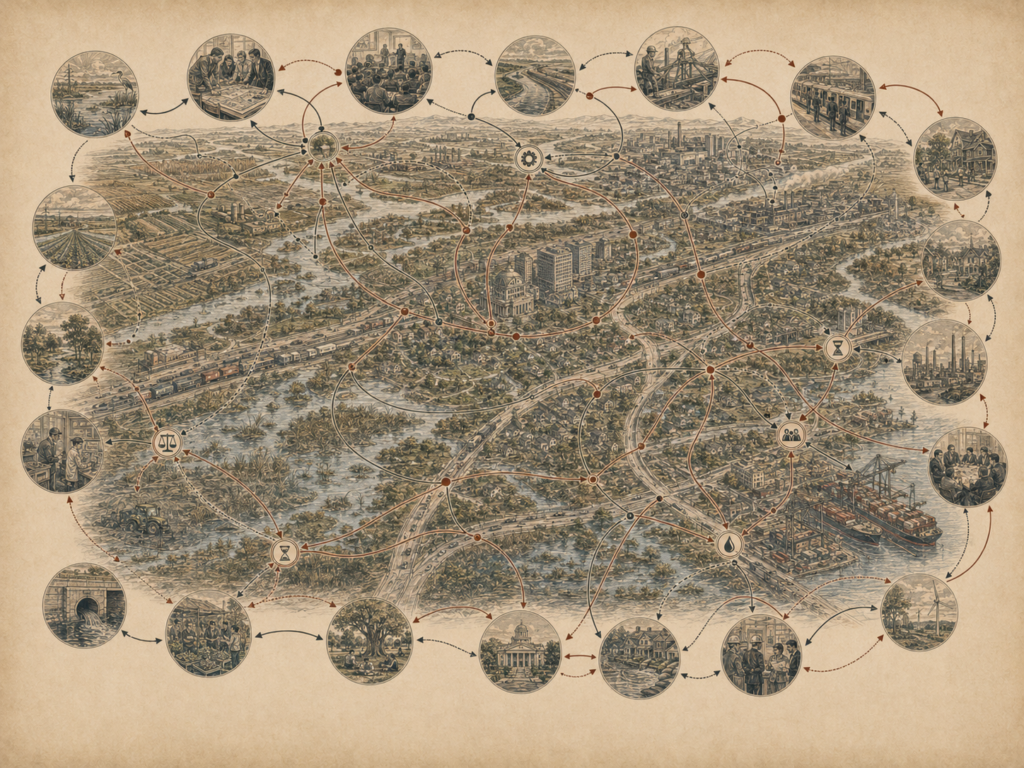
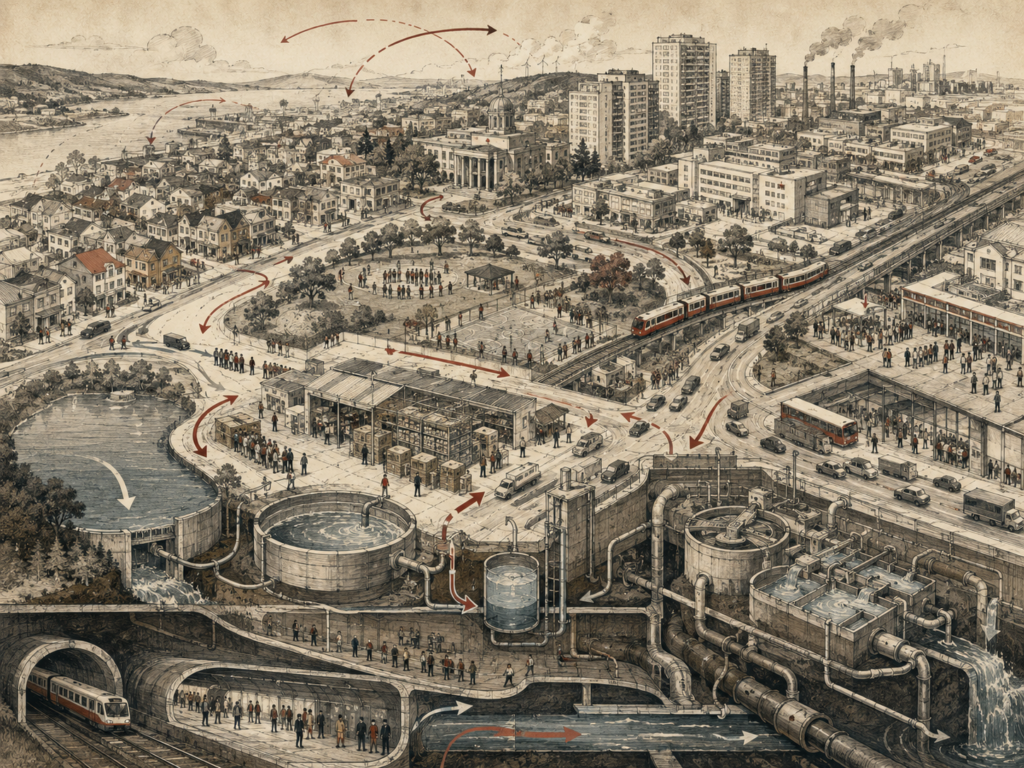
Scholarly systems-thinking illustration of an urban social system with neighborhoods, transit, public services, civic institutions, infrastructure reservoirs, underground pipes, and directional flow arrows.

Stock-Flow Thinking in Social Systems

Stock-Flow Thinking in Social Systems explains how social life is shaped by accumulation. The article shows how trust, wealth, debt, administrative burden, legitimacy, capability, trauma, institutional capacity, and social cohesion function as stocks that build or drain over time. It distinguishes social stocks from flows such as income, repayment, repair, exclusion, participation, displacement, learning, turnover, and public investment. Through examples from public benefits, education, public health, housing, work, criminal justice, digital platforms, and climate justice, the article shows why social crises often appear sudden after years of hidden accumulation. It also examines the ethical stakes of unequal accumulation: who inherits advantage, who inherits burden, whose harm remains invisible, and what repair flows are required. Readers gain a practical method for analyzing social systems through history, feedback, distribution, responsibility, and structural repair over time.
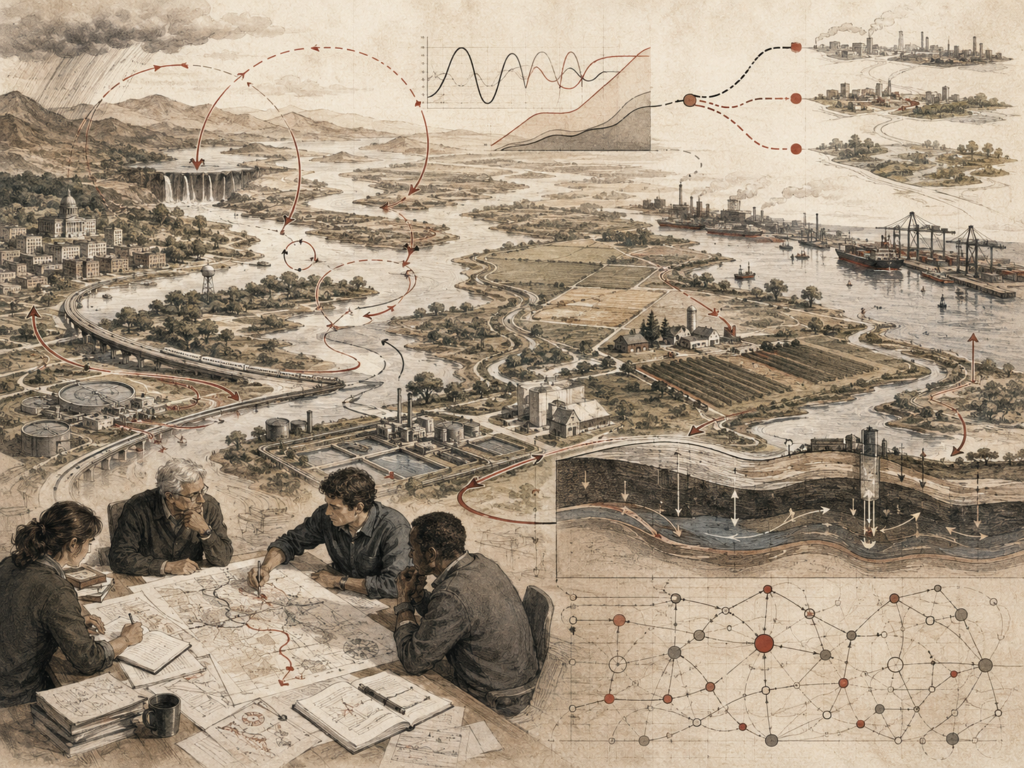

Scholarly systems-thinking illustration of a regional landscape with rivers, farms, cities, ports, infrastructure, industrial systems, planning teams, feedback loops, behavior curves, and simulation diagrams.

System Dynamics and Simulation Modeling

System Dynamics and Simulation Modeling explains how systems thinkers move from causal insight to formal simulation. The article shows how feedback loops, stocks, flows, delays, nonlinear relationships, thresholds, scenarios, sensitivity analysis, and validation help analysts connect structure with behavior over time. It distinguishes systems thinking from system dynamics, showing how causal-loop diagrams can become stock-flow models that test assumptions and compare possible futures. Through examples from public health, infrastructure, organizations, education, artificial intelligence, climate systems, economics, and public administration, the article demonstrates why simulation is useful for studying delayed consequences, hidden accumulation, policy resistance, and unintended effects. It also examines the ethical stakes of modeling: whose assumptions define the model, whose costs are included, whose futures are simulated, and how models can clarify or obscure responsibility for long-term system behavior and governance decisions.

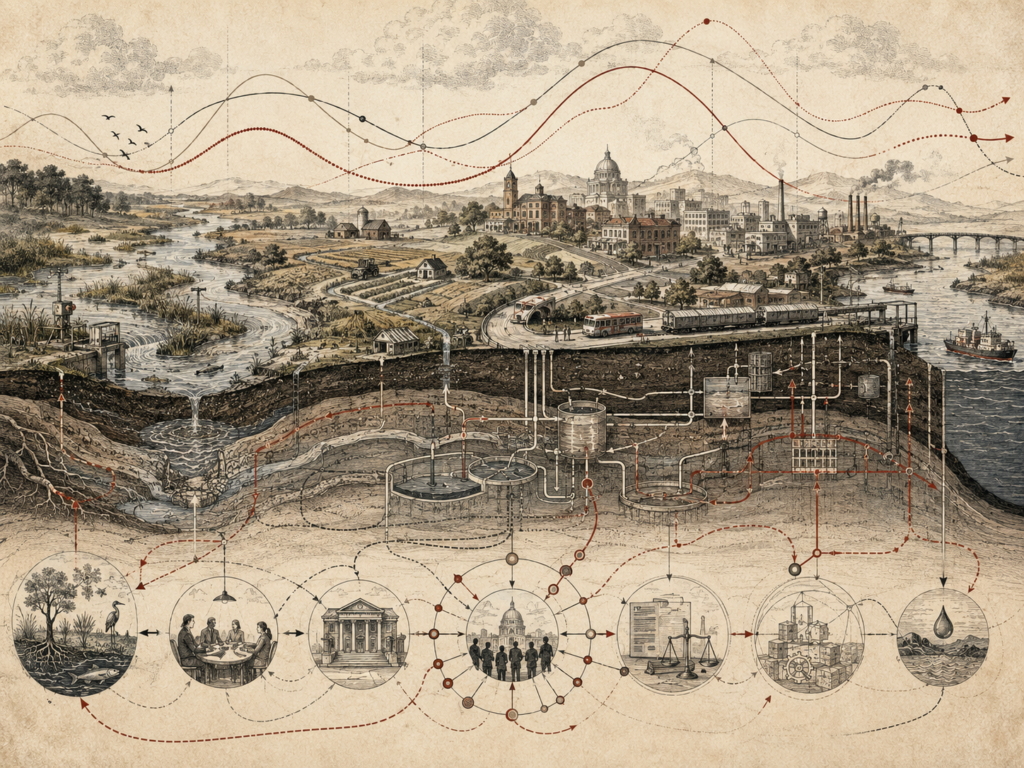
Scholarly systems-thinking illustration of a regional landscape with rivers, reservoirs, wetlands, cities, farms, ports, factories, infrastructure, underground water systems, and flow pathways.

Stocks, Flows, and the Architecture of Change

Stocks, Flows, and the Architecture of Change explains how systems accumulate trust, debt, carbon, fatigue, knowledge, biodiversity, maintenance backlog, institutional capacity, and public legitimacy over time. The article distinguishes stocks, which store the effects of past behavior, from flows, which increase or decrease those accumulated conditions. It shows why systems often appear stable while hidden stocks are eroding, why crises can seem sudden after years of accumulation, and why policy activity does not equal durable change unless it alters the relevant stock. Through examples from public health, infrastructure, organizations, education, artificial intelligence, climate systems, economics, and public administration, the article examines inflows, outflows, net change, feedback-controlled flows, delays, inertia, and unequal accumulation. Readers gain a practical method for identifying what systems build, drain, preserve, exhaust, repair, and pass forward across generations and institutions.

Scholarly systems-thinking illustration of an urban and rural regional system connected by causal loops, feedback arrows, civic institutions, wetlands, farms, infrastructure, ports, industry, and community scenes.

Causal Loop Diagrams and the Logic of Interaction

Causal Loop Diagrams and the Logic of Interaction explains how systems thinkers map the relationships that generate recurring behavior over time. The article shows why causal loop diagrams are more than visual aids: they clarify variables, causal links, polarity, feedback loops, delays, boundaries, and evidence. It distinguishes reinforcing loops that amplify change from balancing loops that counteract change, while emphasizing that diagrams should be treated as disciplined hypotheses rather than final truth. Through examples from public health, infrastructure, organizations, education, artificial intelligence, climate systems, economics, and public administration, the article demonstrates how interaction logic reveals policy resistance, hidden depletion, trust erosion, workload spirals, and unintended consequences. It also examines the ethical stakes of causal mapping: whose experience defines the variables, whose burdens are excluded, and how diagrams can clarify responsibility for structural harm and repair in complex systems analysis.

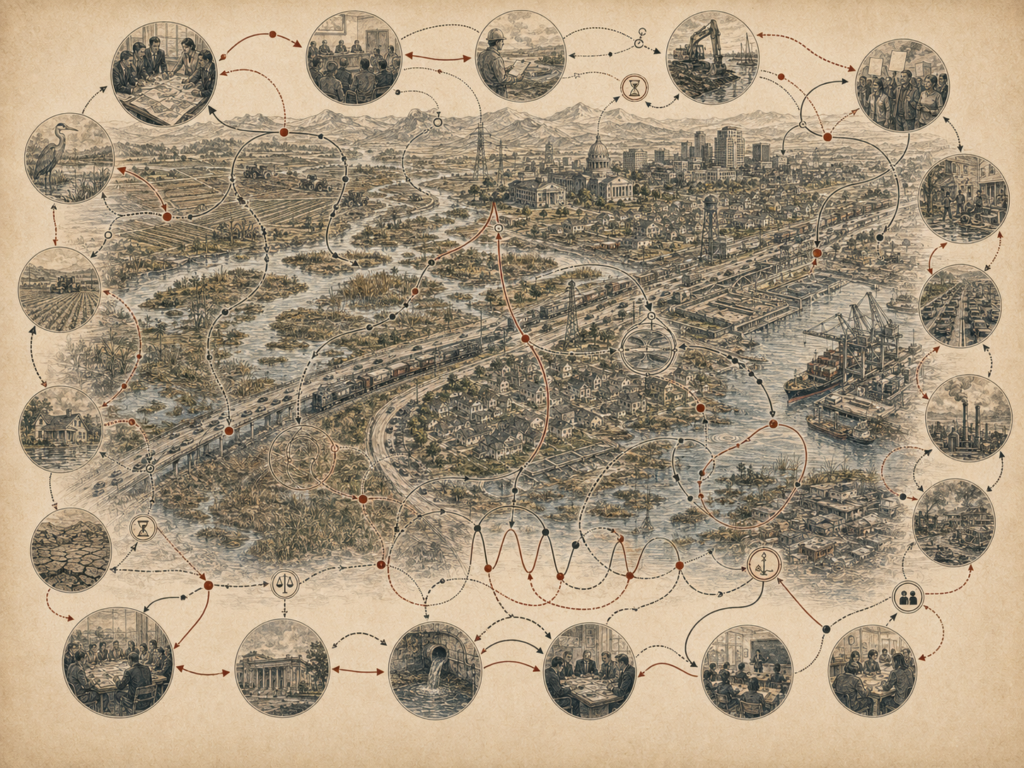
Scholarly systems-thinking illustration of a regional landscape with wetlands, farms, cities, ports, industry, infrastructure, public meetings, protests, policy institutions, and tangled feedback pathways.

Dynamic Complexity and Policy Resistance

Dynamic Complexity and Policy Resistance explains why policy interventions often produce delayed, indirect, adaptive, or unintended effects in complex systems. The article distinguishes detail complexity from dynamic complexity, showing how feedback loops, time delays, compensating responses, adaptive actors, implementation limits, measurement incentives, and boundary errors can weaken or reverse intended change. Through examples from public health, infrastructure, organizations, education, artificial intelligence, climate systems, economics, and public administration, it examines why policies may appear successful in one metric while shifting costs elsewhere. The article also explores the ethical stakes of policy resistance: who gets blamed when interventions fail, whose constraints are ignored, whose burdens are externalized, and how institutions can mistake resistance for irrational noncompliance rather than evidence of deeper structure. Readers gain a practical method for diagnosing policy resistance and designing interventions that change system behavior durably over time.

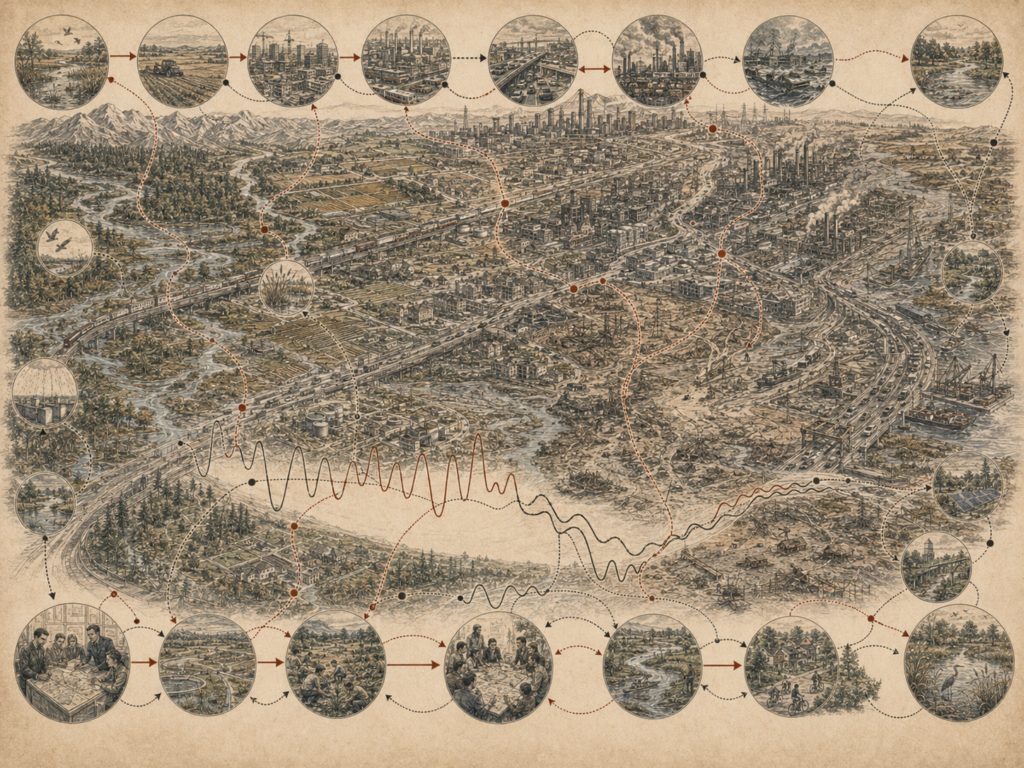
Scholarly systems-thinking illustration of a regional landscape showing industrial expansion, ecological stress, urban growth, infrastructure pressure, system decline, recovery efforts, and corrective feedback pathways.

Overshoot, Collapse, and Correction

Overshoot, Collapse, and Correction explains how systems exceed sustainable limits when growth, demand, pressure, or extraction outruns feedback, regeneration, and repair. The article shows how reinforcing dynamics, delayed balancing feedback, hidden depletion, depleted buffers, and narrow success metrics can make systems appear healthy while they consume the foundations of future resilience. Through examples from ecology, climate systems, infrastructure, organizations, public institutions, artificial intelligence, and economics, it examines how collapse often appears sudden even when capacity, trust, maintenance, biodiversity, legitimacy, or human energy has been eroding for years. The article also explores correction as more than emergency repair: it requires reducing pressure, rebuilding stocks, restoring buffers, redesigning feedback, and changing goals that reward overshoot. Readers gain a practical method for identifying limits early and preventing collapse before crisis becomes the only signal strong enough to be believed.

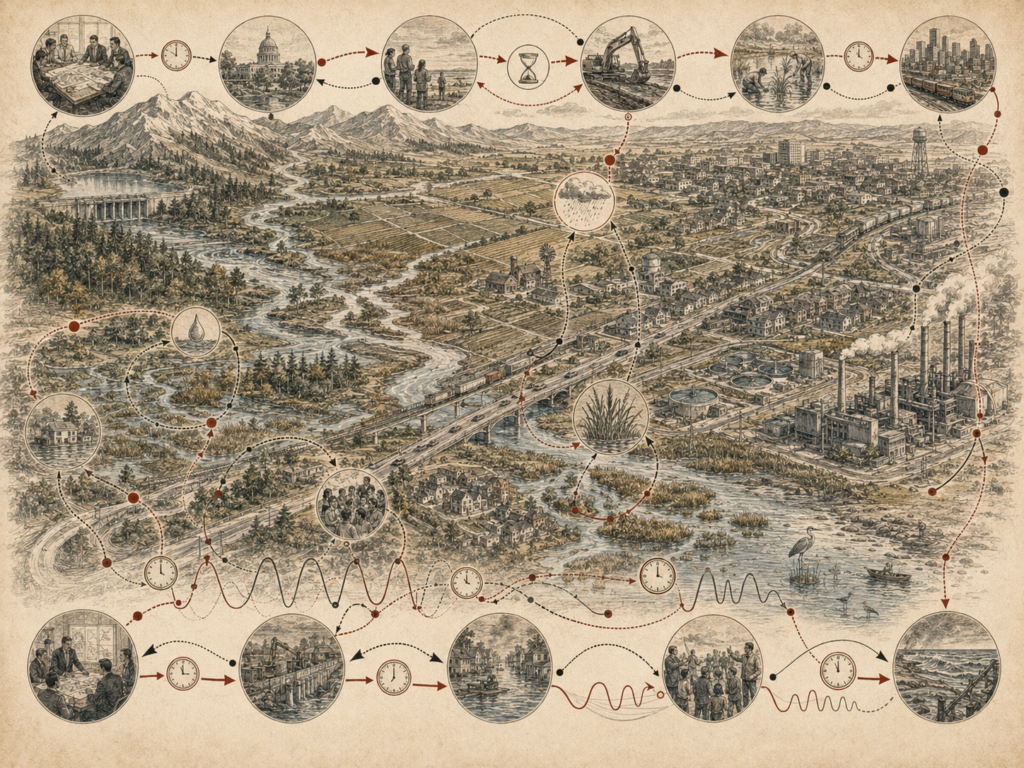
Scholarly systems-thinking illustration of a regional landscape with rivers, wetlands, farms, neighborhoods, infrastructure, industry, civic planning scenes, clocks, looped pathways, and delayed feedback signals.

Delayed Feedback and Policy Timing

Delayed Feedback and Policy Timing explains why policies often fail, arrive too late, overcorrect, or appear ineffective because system consequences unfold slowly. The article shows how delays separate policy action from visible outcomes, implementation from real-world change, early signals from lagging indicators, and short-term political cycles from long-term system dynamics. Through examples from public health, infrastructure, climate adaptation, organizations, education, artificial intelligence, ecology, and economics, it examines feedback lags, information lags, implementation delays, overcorrection, policy swings, precaution, and the risk of judging policies too early or too late. The article also explores the ethical stakes of delayed consequences: who benefits before harms appear, who pays afterward, and how workers, marginalized communities, ecosystems, and future generations often absorb costs created elsewhere. Readers gain a practical method for aligning policy timing with system feedback, prevention, learning, and accountability.

Scholarly editorial illustration of a regional landscape with rivers, wetlands, farms, cities, industry, infrastructure, and public institutions connected by red and black causal arrows with positive and negative polarity signs.

Feedback Loop Polarity and Causal Signs

Feedback Loop Polarity and Causal Signs explains the causal grammar behind systems-thinking diagrams. The article clarifies why a positive sign means variables move in the same direction, why a negative sign means variables move in opposite directions, and why neither sign means good or bad. It distinguishes link polarity from loop polarity, showing how individual causal signs combine into reinforcing or balancing feedback loops. Through examples from public health, infrastructure, organizations, education, artificial intelligence, climate systems, ecology, and economics, the article demonstrates how unclear variables, mistaken signs, ignored delays, conditional relationships, and power-shaped assumptions can distort system interpretation. It also explains how signed graphs, adjacency matrices, loop-polarity calculations, and scenario comparison can support disciplined causal analysis. Readers gain a practical method for assigning causal signs, testing assumptions, and making feedback-loop diagrams clearer, contestable, evidence-aware, and more responsible in practice.

Scholarly editorial illustration of a regional landscape with rivers, wetlands, agriculture, cities, infrastructure, industry, underground systems, feedback pathways, institutions, and behavior-over-time curves.

Behavior Over Time and Structural Explanation

Behavior Over Time and Structural Explanation explains how systems thinking moves beyond isolated events by examining how conditions change across time. The article shows why recurring patterns, trends, delays, oscillations, temporary improvements, hidden accumulations, and sudden crises often reveal deeper structures that event-level explanations miss. It connects behavior-over-time graphs to structural causes such as feedback loops, stocks, flows, incentives, rules, boundaries, information delays, and mental models. Through examples from public health, infrastructure, organizations, education, artificial intelligence, climate systems, ecology, and economics, the article demonstrates how temporal patterns help distinguish symptoms from causes and temporary fixes from durable change. It also examines the ethical stakes of pattern recognition: whose repeated harm is treated as isolated, which metrics hide unequal burdens, and when recurrence creates responsibility to redesign the system rather than merely respond to the next visible event in practice.

Scroll to Top