
Last Updated June 1, 2026
Deep system change begins when people stop asking only how to improve system performance and begin asking what the system is actually organized to achieve. Every system has goals. Some are explicit: reduce emissions, improve health, deliver education, maintain infrastructure, process applications, grow revenue, protect rights, or increase productivity. Others are implicit: preserve authority, minimize institutional risk, maximize throughput, avoid blame, extract value, maintain hierarchy, or protect existing arrangements. The deepest systems work asks whether the visible goals and the real operating goals are the same.
Paradigms sit even deeper than goals. A paradigm is a shared way of seeing reality: what the system assumes to be true, valuable, possible, natural, measurable, legitimate, or inevitable. Paradigms define what counts as success, what counts as evidence, who counts as a stakeholder, what costs are ignored, what harms are normalized, and what futures are treated as realistic. Changing parameters can adjust a system. Changing feedback can redirect behavior. Changing goals can transform priorities. Changing paradigms can redefine what the system is for.
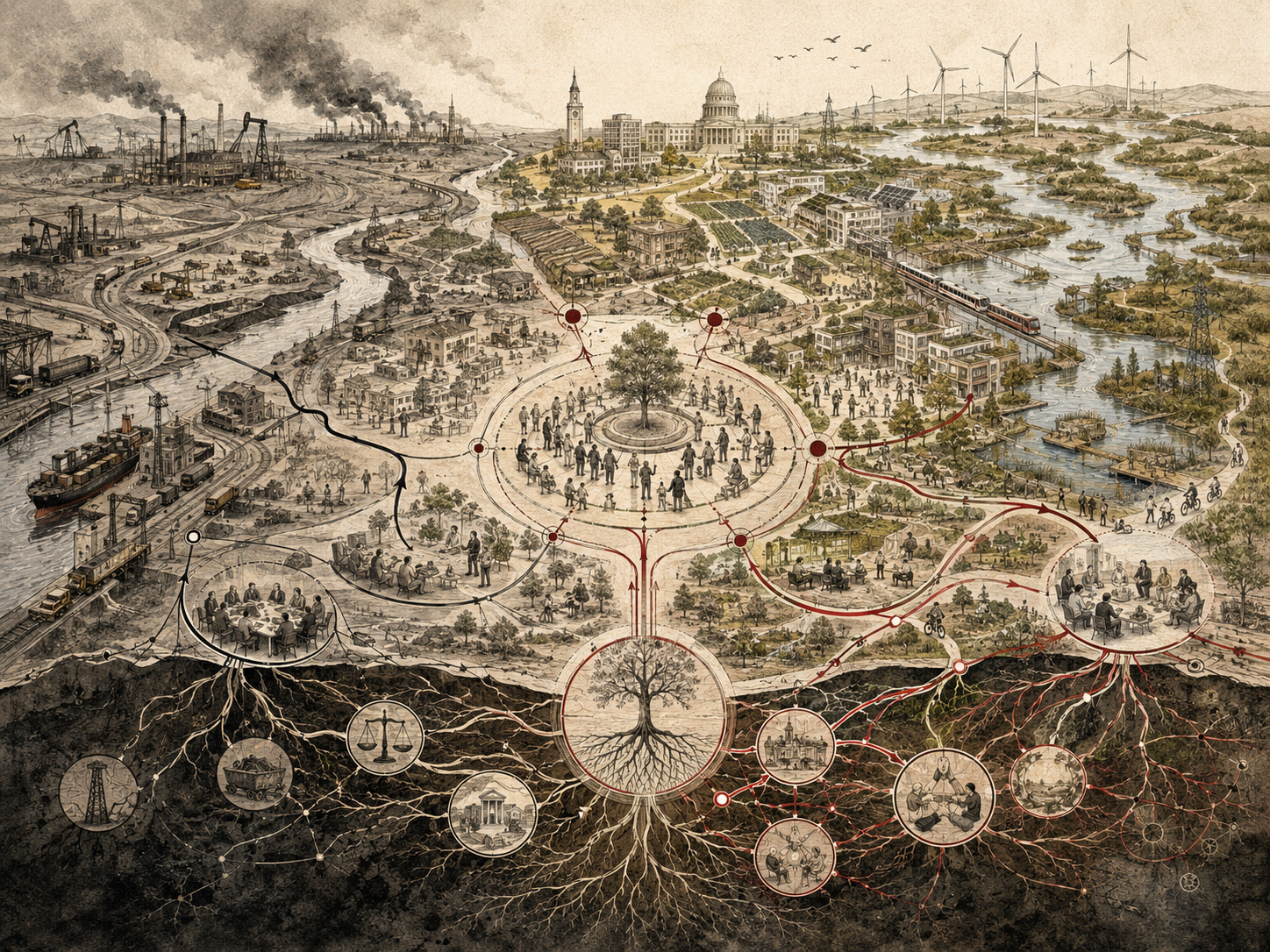
This article examines paradigms, goals, and deep system change as the most powerful levels of systems intervention. It explains how goals organize feedback, how paradigms define what systems treat as normal, how institutions defend their operating logic, and why surface reform often fails when deeper assumptions remain untouched. It also examines the ethical stakes of paradigm change: whose worldview defines the system, whose knowledge is excluded, whose harm is normalized, and what responsibilities follow when a system’s deepest assumptions produce recurring damage.
Why Paradigms and Goals Matter
Paradigms and goals matter because they determine what the system tries to preserve. A system can change its procedures, metrics, technologies, budgets, and communication strategies while still reproducing the same pattern if its deeper goal remains unchanged. An institution may announce reform while continuing to optimize reputation protection. A workplace may launch wellbeing programs while continuing to optimize maximum extraction from human capacity. A city may adopt sustainability language while continuing to optimize growth, revenue, and land-value appreciation. A public agency may claim access as a goal while designing its procedures around suspicion and risk avoidance.
Systems thinking asks what the system is actually organized to do. This question can be uncomfortable because the official goal is often not the operating goal. The official goal may be dignity, learning, health, safety, sustainability, public service, or justice. The operating goal may be throughput, growth, compliance, cost control, institutional protection, political survival, attention capture, or extraction. Deep change begins when the operating goal becomes visible.
Goals shape what feedback matters. If a system’s goal is speed, it measures speed. If its goal is cost reduction, it measures cost. If its goal is growth, it measures expansion. If its goal is dignity, it must measure burden, access, harm, repair, and lived experience. If its goal is ecological stewardship, it must measure regeneration, depletion, resilience, and intergenerational responsibility. Feedback follows goals; behavior follows feedback.
| System level | Typical intervention | Depth of change |
|---|---|---|
| Parameters | Change a number, target, threshold, budget, or rate. | Can improve conditions but often leaves structure intact. |
| Feedback loops | Strengthen, weaken, shorten, or redirect system feedback. | Can change recurring behavior over time. |
| Information flows | Change who knows what, when, and with what authority. | Can improve learning, accountability, and correction. |
| Rules and incentives | Change what is allowed, rewarded, punished, funded, or measured. | Can redirect institutional behavior. |
| Goals | Change what the system is trying to achieve. | Can transform what feedback and rules are designed to support. |
| Paradigms | Change the worldview that defines reality, value, legitimacy, and possibility. | Can redefine the system itself. |
Paradigms and goals are powerful because they make some interventions seem obvious and others unthinkable. If the paradigm is extraction, ecological limits appear as constraints to manage. If the paradigm is stewardship, ecological systems become living foundations to protect. If the goal is institutional risk avoidance, people become liabilities. If the goal is public dignity, people become rights-bearing participants. The same system looks different when its deepest assumptions change.
What a System Goal Is
A system goal is the organizing purpose that shapes behavior. It defines what the system treats as success and what it treats as failure. Goals can be formal, such as a mission statement, statute, policy target, strategic plan, or performance requirement. They can also be informal, embedded in incentives, habits, professional norms, budgets, dashboards, authority structures, and political expectations.
A system’s goal is not always what it says. A school may say its goal is learning, but if it rewards test scores above all else, the operating goal may become test performance. A platform may say its goal is community, but if it rewards engagement above all else, the operating goal may become attention capture. A public agency may say its goal is service, but if it rewards error avoidance and punishes discretion, the operating goal may become procedural defensiveness. A city may say its goal is sustainability, but if budgeting depends on growth-oriented development, the operating goal may become expansion.
Systems reveal their goals through behavior. What does the system protect under stress? What does it sacrifice first? What does it measure most carefully? What does it fund reliably? What does it ignore repeatedly? Who is blamed when the system fails? What feedback is acted on? What feedback is dismissed? These questions expose the real goal more clearly than official language.
\text{Operating Goal} \approx \text{What the System Repeatedly Optimizes Under Constraint}
\]
Interpretation: A system’s real goal can often be inferred from what it consistently protects, rewards, measures, and reproduces when resources, legitimacy, or time are constrained.
Goals influence:
- what variables are measured;
- which feedback signals matter;
- which behaviors are rewarded;
- which costs are externalized;
- which groups are prioritized;
- which harms are tolerated;
- which futures are treated as acceptable;
- which interventions seem realistic.
Changing a goal can therefore change the whole system. If the goal shifts from throughput to dignity, procedures, metrics, staffing, training, appeals, and accountability must change. If the goal shifts from growth to resilience, buffers, maintenance, ecological limits, and long-term capacity become central. If the goal shifts from compliance to learning, reporting, feedback, error correction, and psychological safety matter more than blame.
Goals are leverage points because they organize the system’s attention.
Explicit Goals and Implicit Operating Goals
Many systems contain a gap between explicit goals and implicit operating goals. The explicit goal is what the system says it values. The implicit operating goal is what its structure actually rewards. Deep system change often begins by diagnosing this gap.
A public institution may explicitly value equity, but its application process may require time, documentation, digital access, language fluency, transportation, and procedural confidence that many people do not have. The operating goal may be administrative control rather than equitable access. A company may explicitly value employee wellbeing, but its staffing model, deadlines, promotion incentives, and availability norms may reward overwork. The operating goal may be output extraction rather than sustainable capacity.
When explicit and implicit goals conflict, behavior usually follows the implicit goal. People adapt to what is measured, funded, rewarded, and punished. Mission statements rarely override incentive structures. Training rarely overrides workload design. Communication rarely overrides lived experience. Values language rarely overrides rules.
| Explicit goal | Possible implicit operating goal | Evidence to examine |
|---|---|---|
| Public service | Risk avoidance or procedural defensiveness. | Eligibility rules, burden, appeals, denial incentives, error tolerance. |
| Learning | Test-score optimization. | Assessment pressure, curriculum narrowing, teacher evaluation, student belonging. |
| Wellbeing | Productivity extraction. | Workload, staffing, recovery time, promotion incentives, turnover. |
| Sustainability | Growth with environmental branding. | Land use, emissions, extraction, restoration, ecological accounting. |
| Safety | Control or liability protection. | Surveillance, enforcement, trust, rights, accountability, distribution of harm. |
| Innovation | Adoption speed or market positioning. | Governance, harms, evidence, user rights, accountability, repair mechanisms. |
This gap matters because reform can fail when it addresses the explicit goal while leaving the implicit goal unchanged. A workplace may add wellness programming but retain an operating goal of maximum availability. A public agency may add user-friendly language but retain suspicion-based eligibility logic. A platform may add safety features but retain engagement maximization. A city may add climate language but retain development incentives that increase exposure.
Deep system change requires aligning operating structure with stated purpose. If the system says dignity but rewards speed, dignity will remain decorative. If it says sustainability but rewards extraction, sustainability will remain performative. If it says learning but rewards compliance, learning will be narrowed.
The real goal is not what the system says. It is what the system repeatedly does.
What a Paradigm Is
A paradigm is the deeper framework of assumptions through which a system understands reality. It defines what the system treats as natural, rational, efficient, desirable, measurable, legitimate, and possible. Paradigms shape goals, rules, metrics, institutions, technologies, and identities. They often operate below awareness because they feel like common sense.
For example, a growth paradigm assumes that expansion is a primary sign of health. Under this paradigm, rising output, consumption, development, traffic, enrollment, engagement, or revenue may be treated as success. Costs such as ecological depletion, displacement, stress, unpaid care, or future risk may be treated as externalities. A stewardship paradigm begins differently. It asks whether growth preserves the living, social, and institutional stocks that make future life possible.
A control paradigm assumes that problems are solved by increasing oversight, enforcement, prediction, and compliance. A learning paradigm asks how the system can receive feedback, correct harm, build trust, and adapt responsibly. A scarcity paradigm assumes that public support must be tightly guarded against misuse. A dignity paradigm asks how systems can reduce burden and ensure access while maintaining accountability.
\text{Paradigm} \rightarrow \text{Goals} \rightarrow \text{Rules} \rightarrow \text{Feedback} \rightarrow \text{Behavior}
\]
Interpretation: Paradigms shape the goals a system pursues, the rules it creates, the feedback it values, and the behavior it reproduces.
Paradigms are powerful because they define the boundaries of imagination. Within one paradigm, some questions seem reasonable and others seem unrealistic. Within a growth paradigm, the question may be how to grow with fewer visible harms. Within a sufficiency or stewardship paradigm, the question may be what kinds of growth should stop, what should be repaired, what should be shared, and what limits should be honored. Within a compliance paradigm, the question may be how to make people follow rules. Within a justice paradigm, the question may be whether the rules themselves are legitimate.
Paradigms can be detected through repeated assumptions:
- What does the system treat as valuable?
- What does it treat as waste?
- What does it measure?
- What does it leave unmeasured?
- Whose knowledge counts?
- Whose burden is invisible?
- What futures are considered realistic?
- What harms are treated as unavoidable?
Changing a paradigm is difficult because paradigms are defended by institutions, language, status, expertise, budgets, technology, professional identity, and political power. But paradigm change is also one of the deepest forms of systems change because it alters what the system can see.
How Goals Organize Feedback
Feedback loops do not operate in a vacuum. They are organized around goals. A balancing loop compares current conditions with a desired state and then acts to reduce the gap. A reinforcing loop may amplify behavior that the system rewards. If the goal changes, the meaning of feedback changes.
Consider a public agency. If its goal is to minimize improper payments, it may treat verification burden as acceptable. The feedback it values will include error detection, denial rates, documentation completeness, and compliance. If its goal is dignified access, it must also treat participation, burden, appeal fairness, trust, and unmet need as core feedback. The same agency can behave differently because the goal defines which signals matter.
Consider a workplace. If the goal is maximum output, feedback may focus on deadlines, utilization, productivity, and responsiveness. Burnout may be treated as an individual resilience issue. If the goal is sustainable capacity, feedback must include workload, recovery, errors, turnover, learning, trust, and institutional memory. The goal changes what the system sees as success.
e_t = G – x_t
\]
Interpretation: In a goal-seeking system, the error signal \(e_t\) is the gap between the goal \(G\) and the current state \(x_t\). Changing the goal changes what the system tries to correct.
When goals are narrow, feedback becomes narrow. A system that measures only speed may create fast injustice. A system that measures only cost may create hidden burden. A system that measures only growth may create ecological depletion. A system that measures only engagement may create attention harm. A system that measures only compliance may create fear and silence.
When goals are broader and more ethically grounded, feedback must become richer. A system committed to dignity must measure burden, access, participation, harm, repair, and trust. A system committed to resilience must measure buffers, redundancy, recovery, ecological condition, and stress capacity. A system committed to justice must measure distribution, historical harm, power, and voice. A system committed to learning must measure error, feedback quality, psychological safety, and adaptation.
Goal change is deep leverage because it redesigns the feedback architecture. It changes what the system notices, what it rewards, what it corrects, and what it allows to persist.
Why Systems Defend Their Goals
Systems defend their goals because goals are connected to identity, authority, status, resources, routines, expertise, and legitimacy. A goal is not only an abstract purpose. It organizes careers, budgets, departments, technologies, laws, metrics, and professional norms. Changing a goal can threaten people and institutions whose authority depends on the old goal.
If a school system has organized itself around standardized testing, a shift toward broader learning may threaten evaluation systems, vendor contracts, professional identities, political narratives, and accountability routines. If a public agency has organized itself around fraud prevention, a shift toward access and dignity may challenge suspicion-based procedures and risk-avoidance culture. If a platform has organized itself around engagement, a shift toward user wellbeing may challenge revenue models. If an economy has organized itself around growth, a shift toward sufficiency and ecological limits may challenge foundational assumptions.
Goal defense can appear as rational argument, bureaucratic delay, metric substitution, symbolic reform, professional resistance, political backlash, or claims that alternatives are unrealistic. Sometimes resistance is sincere. People may genuinely believe that the old goal is necessary. Sometimes resistance protects power. Systems thinking must analyze both.
| Form of goal defense | How it appears | Systems interpretation |
|---|---|---|
| Metric defense | “This is how we measure accountability.” | The metric protects the old goal. |
| Feasibility defense | “That sounds good, but it is not realistic.” | The paradigm defines what counts as realistic. |
| Risk defense | “We cannot reduce burden because misuse may increase.” | Risk avoidance may override access or dignity. |
| Efficiency defense | “This will slow us down.” | Speed may be treated as more important than justice, learning, or repair. |
| Identity defense | “This is how professionals in our field operate.” | Professional identity stabilizes the old system logic. |
| Symbolic reform | New language without structural change. | The system absorbs pressure while preserving its operating goal. |
Systems defend goals because goals create coherence. Changing them can produce uncertainty. But that uncertainty may be necessary when the existing goal produces harm. Deep system change requires patience, conflict, evidence, participation, and institutional redesign. It also requires understanding that resistance is not always proof that change is wrong. It may be proof that the intervention has reached a real leverage point.
Surface Reform and Deep Change
Surface reform changes visible features while leaving deeper system logic intact. It may introduce new language, new dashboards, new training, new technology, new committees, new branding, or new procedures. These changes can be useful, but they become shallow if the operating goal and paradigm remain unchanged.
Deep change alters what the system is trying to do and how it understands reality. It changes the goal, the rules, the feedback, the authority structure, the metrics, and the underlying assumptions. It does not merely make the old system more efficient. It changes the pattern the system reproduces.
For example, a workplace may respond to burnout with wellness sessions. That is surface reform if workload, staffing, recovery time, decision authority, and output expectations remain unchanged. A deeper change would treat human capacity as a stock that must be protected. It would redesign work, staffing, priorities, incentives, leadership accountability, and recovery norms.
A public agency may respond to access problems with clearer website language. That may help, but it is surface reform if eligibility rules, documentation burdens, appeal barriers, distrust, and processing delays remain. A deeper change would shift from a suspicion paradigm to an access-with-accountability paradigm. It would redesign rules, burdens, feedback, staffing, and rights of appeal.
| Surface reform | Deep system change |
|---|---|
| New terminology. | New operating goals and accountability structures. |
| More communication. | Changed behavior that rebuilds trust. |
| New dashboard. | New feedback that changes decisions and authority. |
| Training without structural support. | Rules, incentives, workload, and power redesigned around the stated purpose. |
| Technology layered onto old logic. | Technology governed by rights, accountability, appeal, and human purpose. |
| Short-term initiative. | Sustained change in stocks, flows, feedback, rules, and goals. |
Surface reform is not always bad. It may be a beginning, a signal, or a bridge. But it becomes harmful when it absorbs pressure for change without changing the structure. In that case, reform becomes a balancing loop that stabilizes the old system. The institution appears responsive while the paradigm remains intact.
Deep change is harder because it threatens the system’s self-understanding. It asks not only how the system can perform better, but whether the system’s idea of performance is wrong.
Mental Models, Ideology, and Common Sense
Mental models are the assumptions people use to interpret systems. They include beliefs about causality, value, responsibility, risk, power, fairness, human behavior, nature, technology, and time. Paradigms are shared mental models that become institutionalized. They become embedded in law, language, metrics, markets, professional training, organizational routines, and technology.
Many systems problems persist because the dominant mental model misidentifies the cause. Poverty is framed as individual failure rather than accumulated insecurity and structural exclusion. Burnout is framed as lack of resilience rather than workload design. Public distrust is framed as misinformation rather than accumulated institutional behavior. Ecological collapse is framed as a resource-management problem rather than a paradigm of extraction. Technology harm is framed as user error rather than system design and governance failure.
When a mental model becomes common sense, alternatives can sound unrealistic even when they are more accurate. For example, if efficiency is defined as maximum output with minimal slack, then buffers look wasteful. But in resilience thinking, buffers are capacity. If public support is defined through suspicion, then burden looks like accountability. But in a dignity paradigm, excessive burden is a form of exclusion. If nature is defined as external resource, then depletion looks like economic activity. But in a living-systems paradigm, depletion is damage to the foundations of life.
\text{Mental Model} \rightarrow \text{Problem Definition} \rightarrow \text{Intervention Choice}
\]
Interpretation: The way a system defines a problem shapes the interventions it considers legitimate, realistic, and necessary.
Changing mental models requires more than information. People do not abandon paradigms simply because facts are presented. Paradigms are supported by identity, interest, expertise, fear, habit, and institutional reward. Change often requires lived contradiction, alternative models, trusted relationships, practical demonstration, new language, new metrics, and new forms of participation.
Systems thinking helps by making mental models visible. It asks:
- What does this system assume about people?
- What does it assume about nature?
- What does it assume about value?
- What does it assume about risk?
- What does it assume about responsibility?
- What does it treat as inevitable?
- What does it treat as impossible?
- Who benefits when this mental model remains dominant?
Deep system change requires changing not only what the system does, but what the system believes it is seeing.
Paradigm Shifts and System Transformation
A paradigm shift occurs when a system’s basic assumptions change. The same facts are reorganized under a different frame. What once seemed peripheral becomes central. What once seemed natural becomes contestable. What once seemed impossible becomes necessary. A paradigm shift changes the questions the system asks.
In public health, a paradigm shift might move from treating illness primarily as individual behavior to understanding health as shaped by housing, labor, environment, care access, stress, racism, food systems, and public infrastructure. In sustainability, a paradigm shift might move from managing environmental externalities to recognizing ecological systems as the living foundations of economic and social life. In education, a paradigm shift might move from compliance and sorting to capability, belonging, development, and democratic participation.
Paradigm shifts are often uneven. New language may spread before institutions change. Old metrics may remain after new values are announced. Power may appropriate the new paradigm and use it symbolically. Deep transformation requires translating paradigm change into goals, rules, feedback, resources, authority, and accountability.
P_{\text{old}} \rightarrow G_{\text{old}} \rightarrow B_{\text{old}}
\qquad
P_{\text{new}} \rightarrow G_{\text{new}} \rightarrow B_{\text{new}}
\]
Interpretation: A paradigm shift changes the system’s goals and therefore changes the behavior the system is organized to reproduce.
Paradigm shifts can occur through many pathways:
- accumulated evidence that the old paradigm cannot explain;
- crisis that reveals hidden system failure;
- social movements that contest dominant assumptions;
- new scientific understanding;
- moral recognition of excluded people or harms;
- technological or ecological disruption;
- institutional learning from repeated policy failure;
- alternative practices that demonstrate another way is possible.
Paradigm change is not automatically emancipatory. A new paradigm can be more humane, more ecological, and more just. It can also be more controlling, extractive, technocratic, or exclusionary. Systems thinkers must therefore evaluate paradigm shifts ethically. What values are being elevated? What harms are being hidden? Whose knowledge is being centered? What futures does the new paradigm make possible?
Deep system change requires both imagination and governance. A new paradigm must become actionable without becoming authoritarian. It must create new feedback, new protections, new accountability, and new ways to repair harm.
Resistance, Power, and Institutional Self-Protection
Deep system change often meets resistance because it threatens power. Systems are not neutral arrangements of parts. They distribute benefits, burdens, authority, status, risk, and legitimacy. A paradigm or goal can persist because it serves those who have the power to preserve it.
Resistance can appear as denial, delay, procedural complexity, selective evidence, symbolic reform, professional gatekeeping, budgetary constraint, legal obstruction, metric manipulation, or claims that alternatives are unrealistic. Sometimes resistance comes from fear of disorder. Sometimes it comes from genuine concern about unintended consequences. Sometimes it comes from actors who benefit from the current system.
Systems thinking should take resistance seriously without automatically accepting it. Resistance may reveal practical constraints. It may also reveal the system defending itself. If a reform aimed at reducing administrative burden is opposed because it reduces institutional control, the resistance reveals the operating paradigm. If a sustainability reform is opposed because it slows profitable extraction, the resistance reveals the system goal. If a workplace capacity reform is opposed because it reduces short-term output, the resistance reveals what the system values.
| Resistance pattern | What it may reveal | Deep-change response |
|---|---|---|
| “This is not realistic.” | The old paradigm defines possibility. | Show alternative models, evidence, pilots, and lived consequences. |
| “We need more data before acting.” | Delay may protect the current system. | Distinguish genuine uncertainty from avoidant uncertainty. |
| “This will reduce efficiency.” | Efficiency may be narrowly defined. | Include resilience, burden, repair, and long-term costs. |
| “People will abuse the system.” | Suspicion may dominate access design. | Design accountable access without excessive burden. |
| “This is outside our scope.” | The boundary may exclude externalized harm. | Expand the boundary to include shifted costs and affected people. |
Institutional self-protection is especially strong when systems face legitimacy threats. An institution may protect reputation rather than repair harm. It may treat criticism as a communication problem rather than a feedback signal. It may produce committees, statements, dashboards, and pilots that absorb pressure while leaving the operating goal intact.
Deep system change requires changing the structures that allow self-protection to override learning. This may include independent oversight, participatory governance, transparent data, appeal rights, whistleblower protection, redistributed authority, changed incentives, and stronger accountability for harms that were previously externalized.
Ethics: Whose Paradigm Defines the System?
Paradigms and goals have ethical stakes because they determine whose reality counts. A system can be internally coherent and morally wrong. It can measure what it values and ignore what it harms. It can optimize efficiently around a goal that produces exclusion, extraction, surveillance, ecological depletion, or human exhaustion. Deep systems work must therefore ask not only whether the system works, but for whom it works and at whose expense.
Paradigms often become invisible to those who benefit from them. A system built around property value may not see displacement as central. A system built around compliance may not see administrative burden as harm. A system built around productivity may not see burnout as depletion. A system built around engagement may not see attention capture as damage. A system built around growth may not see ecological limits until collapse becomes visible.
Ethical paradigm analysis asks:
- Whose worldview defines the system?
- Whose knowledge is treated as evidence?
- Whose harm is treated as external?
- Whose burden is normalized?
- Whose future is discounted?
- What does the system call success?
- What does it refuse to measure?
- What repair does the current paradigm make impossible?
Deep system change should not simply replace one dominant paradigm with another imposed from above. It should widen participation in defining system purpose. People affected by the system should help define the goals, feedback, rules, and measures that govern it. Ecological systems and future generations cannot speak in ordinary institutional processes, so stewardship requires representation, precaution, and long time horizons.
Ethical deep change also requires humility. Paradigm change can be powerful and dangerous. A new worldview can open possibilities, but it can also justify coercion if treated as unquestionable truth. Systems thinking should keep paradigms visible and contestable. The goal is not final certainty. It is more responsible learning, repair, and accountability.
The deepest question is not only “How do we change the system?” It is “Who gets to say what the system is for?”
Examples Across Systems
Paradigms and goals shape systems across domains. The examples below show how deep system change differs from surface adjustment.
Public health
A narrow public-health paradigm may treat health primarily as individual behavior and medical treatment. A deeper systems paradigm sees health as shaped by housing, work, environment, food systems, stress, inequality, trust, public infrastructure, and access to care. Under the first paradigm, interventions focus on messaging and treatment. Under the second, interventions include housing stability, environmental protection, community trust, prevention, care access, and social conditions that make health possible.
Infrastructure
An infrastructure system may operate under a short-term cost paradigm, treating maintenance as an expense to defer. The operating goal becomes budget relief. A stewardship paradigm treats infrastructure condition as a public stock that must be maintained for safety, continuity, and future responsibility. Under this paradigm, preventive maintenance, resilience, redundancy, and ecological adaptation become core obligations rather than optional costs.
Organizations
An organization may say it values people while operating under a productivity-extraction paradigm. Workload, availability, and urgency become normalized, while fatigue is individualized. A sustainable-capacity paradigm treats human energy, trust, learning, and institutional memory as stocks that must be protected. The system goal shifts from maximum short-term output to durable performance within human limits.
Education
An education system may operate under a sorting paradigm: rank students, measure compliance, and allocate opportunity through standardized performance. A capability paradigm asks whether students are developing knowledge, confidence, belonging, agency, creativity, and civic capacity. Deep change would alter assessment, discipline, curriculum, teacher support, family engagement, and the meaning of educational success.
Artificial intelligence systems
An AI system may operate under an efficiency paradigm: automate decisions, reduce cost, and scale processing. A rights-and-accountability paradigm asks whether people can understand, contest, appeal, and repair automated harm. Under this paradigm, model accuracy is not enough. Governance, transparency, oversight, due process, human judgment, and institutional accountability become central system requirements.
Climate and ecology
A conventional economic paradigm may treat nature as an external resource and environmental harm as a manageable side effect. A living-systems paradigm treats ecological systems as the foundation of social and economic life. The system goal shifts from extraction and mitigation to regeneration, limits, stewardship, resilience, and intergenerational obligation.
Economic systems
An economy organized around aggregate growth may treat rising output as success even when inequality, debt, ecological depletion, and insecurity accumulate. A wellbeing and sufficiency paradigm asks whether economic activity supports dignity, capability, ecological stability, fair distribution, and long-term resilience. This changes what is measured, taxed, subsidized, protected, and valued.
Public administration
A public administration system may operate under a suspicion paradigm, treating applicants as risks to control. This produces verification burden, delay, and distrust. A dignity-and-access paradigm treats people as rights-bearing participants. It still protects accountability, but it redesigns rules around accessible service, procedural justice, appeal rights, and burden reduction.
Across these examples, deep system change is not merely better implementation. It is a change in what the system is organized to see, value, and reproduce.
Mathematics, Computation, and Modeling
Paradigms and goals may seem difficult to model because they are conceptual and cultural. But their effects can be represented in systems models through objective functions, feedback priorities, rule sets, measurement choices, boundary definitions, and scenario structures. The model does not capture the whole paradigm. It represents how different goals and assumptions change system behavior.
A simple goal-seeking model can be written as:
e_t = G – x_t
\]
Interpretation: A system compares the current state \(x_t\) with a goal \(G\). The gap \(e_t\) generates correction pressure. Changing \(G\) changes what the system tries to correct.
A policy objective can be represented as:
\max_{u \in U} \; J(u)
\]
Interpretation: A system chooses intervention \(u\) to maximize an objective \(J\). Deep change asks whether the objective itself reflects the right goal.
A narrow objective might be:
J_{\text{narrow}} = \text{Throughput} – \text{Cost}
\]
Interpretation: A narrow goal may reward speed and cost reduction while ignoring burden, trust, harm, resilience, or distribution.
A broader systems objective might be:
J_{\text{systems}} = \alpha A + \beta D + \gamma R – \delta B – \eta H
\]
Interpretation: A broader objective can include access \(A\), dignity \(D\), resilience \(R\), burden \(B\), and harm \(H\), making the system accountable to more than throughput or cost.
A paradigm shift can be represented as a change in model structure:
F_{\text{old}}(x_t, u_t) \neq F_{\text{new}}(x_t, u_t)
\]
Interpretation: A paradigm shift changes the governing structure of the model. The same intervention can produce different behavior when assumptions, goals, boundaries, and feedback priorities change.
A boundary change can be represented as:
W_{\text{expanded}} = W_{\text{internal}} – C_{\text{externalized}}
\]
Interpretation: Expanding the system boundary changes evaluation by including costs that were previously externalized to communities, ecosystems, workers, households, or future generations.
| Modeling task | Deep-change question | Example output |
|---|---|---|
| Objective-function comparison | How do outcomes change when the system optimizes a different goal? | Throughput-only versus dignity-and-access scenarios. |
| Metric sensitivity | Which measures shape system behavior? | Behavior changes when burden, trust, or resilience are included. |
| Boundary expansion | What happens when externalized costs are counted? | Internal efficiency becomes whole-system harm. |
| Rule-set comparison | How do different institutional rules change feedback? | Suspicion-based eligibility versus accessible accountability. |
| Paradigm scenario modeling | How do different worldviews define different futures? | Growth paradigm versus resilience paradigm trajectories. |
| Distributional analysis | Who benefits under each goal structure? | Group-level outcomes under competing system goals. |
Computational modeling can help reveal the consequences of goals and paradigms, but it cannot determine values on its own. The choice of objective function is an ethical and political act. The choice of boundary is an ethical and political act. The choice of what counts as harm is an ethical and political act. Modeling can clarify tradeoffs and consequences, but deep system change still requires public reasoning, participation, and accountability.
Python Workflow: Goals, Paradigms, Boundary Costs, and Deep-Change Diagnostics
The Python workflow below turns goals and paradigms into a small reproducible systems model. It compares four scenarios: throughput and cost paradigm, surface reform with old operating goal, dignity/access/resilience goal, and stewardship with accountable paradigm shift. It also includes one-at-a-time sensitivity analysis for the deepest scenario. The script uses only the Python standard library, writes CSV outputs relative to the article folder, and is designed as a clear starting point for companion repository work.
# paradigms_goals_deep_system_change_workflow.py
# Dependency-light workflow for comparing system goals, objective functions,
# paradigm scenarios, boundary expansion, metric sensitivity,
# rule-set changes, and distributional outcomes.
# Writes outputs relative to the article root.

from __future__ import annotations

from dataclasses import dataclass, replace
from pathlib import Path
import csv
from statistics import mean

ARTICLE_ROOT = Path(__file__).resolve().parents[1]
TABLES = ARTICLE_ROOT / "outputs" / "tables"


@dataclass
class GoalParadigmScenario:
    name: str
    throughput_weight: float
    cost_control_weight: float
    dignity_weight: float
    access_weight: float
    resilience_weight: float
    ecological_stewardship_weight: float
    burden_visibility: float
    boundary_expansion: float
    affected_voice: float
    repair_accountability: float
    implementation_capacity: float
    institutional_resistance: float


def clamp(value: float, low: float = 0.0, high: float = 120.0) -> float:
    return max(low, min(high, value))


def normalize_goal_weights(scenario: GoalParadigmScenario) -> dict[str, float]:
    weights = {
        "throughput": scenario.throughput_weight,
        "cost_control": scenario.cost_control_weight,
        "dignity": scenario.dignity_weight,
        "access": scenario.access_weight,
        "resilience": scenario.resilience_weight,
        "ecological_stewardship": scenario.ecological_stewardship_weight,
    }
    total = sum(weights.values()) or 1.0
    return {key: value / total for key, value in weights.items()}


def simulate(scenario: GoalParadigmScenario, periods: int = 60) -> list[dict[str, object]]:
    weights = normalize_goal_weights(scenario)

    throughput = 48.0
    cost_efficiency = 52.0
    access = 42.0
    dignity = 38.0
    resilience = 40.0
    ecological_condition = 44.0
    hidden_burden = 54.0
    externalized_cost = 50.0
    public_trust = 40.0
    institutional_learning = 32.0
    rows: list[dict[str, object]] = []

    for period in range(periods + 1):
        old_goal_pressure = clamp(
            weights["throughput"] * 28.0
            + weights["cost_control"] * 26.0
            + scenario.institutional_resistance * 16.0,
            0.0,
            100.0,
        )

        deep_goal_pressure = clamp(
            weights["dignity"] * 24.0
            + weights["access"] * 22.0
            + weights["resilience"] * 22.0
            + weights["ecological_stewardship"] * 22.0
            + scenario.affected_voice * 10.0
            + scenario.repair_accountability * 10.0,
            0.0,
            100.0,
        )

        measurement_reform = clamp(
            scenario.burden_visibility * 20.0
            + scenario.boundary_expansion * 18.0
            + scenario.affected_voice * 14.0
            + scenario.repair_accountability * 8.0,
            0.0,
            100.0,
        )

        implementation_friction = clamp(
            scenario.institutional_resistance * 18.0
            + max(0.0, 55.0 - scenario.implementation_capacity * 100.0) * 0.18
            + max(0.0, 55.0 - public_trust) * 0.10
            - scenario.affected_voice * 4.0
            - scenario.repair_accountability * 3.0,
            0.0,
            100.0,
        )

        throughput = clamp(
            throughput
            + old_goal_pressure * 0.10
            + scenario.implementation_capacity * 1.2
            - deep_goal_pressure * 0.03
            - implementation_friction * 0.03,
            0.0,
            100.0,
        )

        cost_efficiency = clamp(
            cost_efficiency
            + weights["cost_control"] * 2.0
            + old_goal_pressure * 0.05
            - scenario.boundary_expansion * 1.0
            - scenario.repair_accountability * 0.6,
            0.0,
            100.0,
        )

        access = clamp(
            access
            + weights["access"] * 3.0
            + scenario.affected_voice * 1.6
            + scenario.implementation_capacity * 1.2
            + measurement_reform * 0.04
            - hidden_burden * 0.045
            - implementation_friction * 0.04,
            0.0,
            100.0,
        )

        dignity = clamp(
            dignity
            + weights["dignity"] * 3.2
            + scenario.repair_accountability * 1.5
            + scenario.affected_voice * 1.4
            - hidden_burden * 0.05
            - externalized_cost * 0.03,
            0.0,
            100.0,
        )

        resilience = clamp(
            resilience
            + weights["resilience"] * 2.8
            + scenario.repair_accountability * 1.2
            + scenario.boundary_expansion * 1.0
            - externalized_cost * 0.04
            - old_goal_pressure * 0.025,
            0.0,
            100.0,
        )

        ecological_condition = clamp(
            ecological_condition
            + weights["ecological_stewardship"] * 3.2
            + scenario.boundary_expansion * 1.5
            + scenario.repair_accountability * 0.9
            - old_goal_pressure * 0.05
            - externalized_cost * 0.04,
            0.0,
            100.0,
        )

        hidden_burden = clamp(
            hidden_burden
            + old_goal_pressure * 0.10
            + implementation_friction * 0.08
            - scenario.burden_visibility * 1.6
            - scenario.affected_voice * 1.3
            - weights["dignity"] * 1.6,
            0.0,
            100.0,
        )

        externalized_cost = clamp(
            externalized_cost
            + old_goal_pressure * 0.10
            + weights["cost_control"] * 1.2
            - scenario.boundary_expansion * 1.8
            - weights["ecological_stewardship"] * 1.7
            - scenario.repair_accountability * 1.0,
            0.0,
            100.0,
        )

        public_trust = clamp(
            public_trust
            + dignity * 0.035
            + access * 0.030
            + scenario.repair_accountability * 1.4
            + scenario.affected_voice * 1.2
            - hidden_burden * 0.040
            - externalized_cost * 0.025,
            0.0,
            100.0,
        )

        institutional_learning = clamp(
            institutional_learning
            + measurement_reform * 0.06
            + scenario.affected_voice * 1.2
            + scenario.repair_accountability * 1.1
            - scenario.institutional_resistance * 1.0
            - implementation_friction * 0.03,
            0.0,
            100.0,
        )

        narrow_objective = clamp(
            throughput * 0.55
            + cost_efficiency * 0.45
            - hidden_burden * 0.05,
            0.0,
            100.0,
        )

        systems_objective = clamp(
            dignity * 0.18
            + access * 0.18
            + resilience * 0.18
            + ecological_condition * 0.18
            + public_trust * 0.16
            + institutional_learning * 0.12
            - hidden_burden * 0.16
            - externalized_cost * 0.16,
            0.0,
            100.0,
        )

        paradigm_alignment_score = clamp(
            systems_objective
            + deep_goal_pressure * 0.12
            + measurement_reform * 0.10
            - old_goal_pressure * 0.10
            - implementation_friction * 0.10,
            0.0,
            100.0,
        )

        rows.append({
            "period": period,
            "scenario": scenario.name,
            "throughput": round(throughput, 3),
            "cost_efficiency": round(cost_efficiency, 3),
            "access": round(access, 3),
            "dignity": round(dignity, 3),
            "resilience": round(resilience, 3),
            "ecological_condition": round(ecological_condition, 3),
            "hidden_burden": round(hidden_burden, 3),
            "externalized_cost": round(externalized_cost, 3),
            "public_trust": round(public_trust, 3),
            "institutional_learning": round(institutional_learning, 3),
            "old_goal_pressure": round(old_goal_pressure, 3),
            "deep_goal_pressure": round(deep_goal_pressure, 3),
            "measurement_reform": round(measurement_reform, 3),
            "implementation_friction": round(implementation_friction, 3),
            "narrow_objective": round(narrow_objective, 3),
            "systems_objective": round(systems_objective, 3),
            "paradigm_alignment_score": round(paradigm_alignment_score, 3),
        })

    return rows


def summarize(rows: list[dict[str, object]]) -> list[dict[str, object]]:
    output: list[dict[str, object]] = []
    for scenario_name in sorted({row["scenario"] for row in rows}):
        subset = [row for row in rows if row["scenario"] == scenario_name]
        final = subset[-1]
        avg_narrow = mean(float(row["narrow_objective"]) for row in subset)
        avg_systems = mean(float(row["systems_objective"]) for row in subset)
        avg_burden = mean(float(row["hidden_burden"]) for row in subset)
        avg_externalized = mean(float(row["externalized_cost"]) for row in subset)
        avg_alignment = mean(float(row["paradigm_alignment_score"]) for row in subset)

        if float(final["paradigm_alignment_score"]) >= 65 and float(final["hidden_burden"]) <= 35:
            diagnostic = "deep goal alignment with visible burden and repair"
        elif avg_narrow >= 60 and avg_systems < 45:
            diagnostic = "narrow objective appears successful while system harm persists"
        elif avg_burden >= 55 or avg_externalized >= 55:
            diagnostic = "hidden burden or externalized cost remains central"
        elif avg_alignment >= 55:
            diagnostic = "partial paradigm shift with remaining implementation risk"
        else:
            diagnostic = "old operating goal remains dominant"

        output.append({
            "scenario": scenario_name,
            "final_paradigm_alignment_score": final["paradigm_alignment_score"],
            "final_narrow_objective": final["narrow_objective"],
            "final_systems_objective": final["systems_objective"],
            "final_hidden_burden": final["hidden_burden"],
            "final_externalized_cost": final["externalized_cost"],
            "average_narrow_objective": round(avg_narrow, 3),
            "average_systems_objective": round(avg_systems, 3),
            "average_hidden_burden": round(avg_burden, 3),
            "average_externalized_cost": round(avg_externalized, 3),
            "average_paradigm_alignment_score": round(avg_alignment, 3),
            "diagnostic": diagnostic,
        })

    return output


def one_at_a_time(base: GoalParadigmScenario, delta: float = 0.10) -> list[dict[str, object]]:
    base_final = float(simulate(base)[-1]["paradigm_alignment_score"])
    parameters = [
        "throughput_weight",
        "cost_control_weight",
        "dignity_weight",
        "access_weight",
        "resilience_weight",
        "ecological_stewardship_weight",
        "burden_visibility",
        "boundary_expansion",
        "affected_voice",
        "repair_accountability",
        "implementation_capacity",
        "institutional_resistance",
    ]

    rows: list[dict[str, object]] = []
    for parameter in parameters:
        for direction in (-1, 1):
            current = getattr(base, parameter)
            revised_value = max(0.0, min(1.0, current + direction * delta))
            revised = replace(
                base,
                name=f"{base.name} {parameter} {direction * delta:+.2f}",
                **{parameter: revised_value},
            )
            revised_final = float(simulate(revised)[-1]["paradigm_alignment_score"])
            rows.append({
                "parameter": parameter,
                "delta": direction * delta,
                "base_value": current,
                "revised_value": revised_value,
                "base_final_paradigm_alignment_score": round(base_final, 3),
                "revised_final_paradigm_alignment_score": round(revised_final, 3),
                "score_change": round(revised_final - base_final, 3),
                "absolute_score_change": round(abs(revised_final - base_final), 3),
            })

    return sorted(rows, key=lambda row: float(row["absolute_score_change"]), reverse=True)


def write_csv(path: Path, rows: list[dict[str, object]]) -> None:
    path.parent.mkdir(parents=True, exist_ok=True)
    if not rows:
        raise ValueError(f"No rows to write: {path}")
    with path.open("w", newline="", encoding="utf-8") as handle:
        writer = csv.DictWriter(handle, fieldnames=list(rows[0].keys()))
        writer.writeheader()
        writer.writerows(rows)


def main() -> None:
    scenarios = [
        GoalParadigmScenario("Throughput and cost paradigm", 0.82, 0.78, 0.18, 0.22, 0.20, 0.18, 0.24, 0.22, 0.20, 0.24, 0.66, 0.74),
        GoalParadigmScenario("Surface reform with old operating goal", 0.66, 0.62, 0.38, 0.42, 0.34, 0.32, 0.42, 0.38, 0.36, 0.42, 0.60, 0.58),
        GoalParadigmScenario("Dignity access and resilience goal", 0.42, 0.38, 0.72, 0.74, 0.68, 0.62, 0.70, 0.66, 0.68, 0.70, 0.64, 0.36),
        GoalParadigmScenario("Stewardship and accountable paradigm shift", 0.30, 0.28, 0.82, 0.80, 0.84, 0.86, 0.84, 0.86, 0.84, 0.86, 0.72, 0.24),
    ]

    rows: list[dict[str, object]] = []
    for scenario in scenarios:
        rows.extend(simulate(scenario))

    write_csv(TABLES / "paradigms_goals_timeseries.csv", rows)
    write_csv(TABLES / "paradigms_goals_summary.csv", summarize(rows))
    write_csv(TABLES / "paradigms_goals_sensitivity_analysis.csv", one_at_a_time(scenarios[-1]))

    print("Paradigms, goals, and deep system change workflow complete.")
    print(TABLES / "paradigms_goals_timeseries.csv")


if __name__ == "__main__":
    main()
The workflow is intentionally simple enough to inspect. It shows how objective functions, boundary expansion, burden visibility, affected voice, repair accountability, and institutional resistance change system behavior. It also shows why a narrow objective can appear successful while hidden burden and externalized costs persist. The model is synthetic and illustrative; it supports disciplined inquiry rather than replacing domain expertise, stakeholder evidence, or ethical judgment.
R Workflow: Goal Comparison and Paradigm-Scenario Visualization
The R workflow reads the Python-generated time-series and sensitivity outputs, creates goal-comparison summaries, and exports base R plots for paradigm alignment, narrow objectives, systems objectives, hidden burden, externalized cost, and public trust. It uses only base R so it remains portable across simple local environments.
# paradigms_goals_deep_system_change_diagnostics.R
# Base R workflow for goal comparison and paradigm-scenario visualization.

args <- commandArgs(trailingOnly = FALSE)
file_arg <- grep("^--file=", args, value = TRUE)

if (length(file_arg) > 0) {
  script_path <- normalizePath(sub("^--file=", "", file_arg[1]), mustWork = TRUE)
  article_root <- normalizePath(file.path(dirname(script_path), ".."), mustWork = TRUE)
} else {
  article_root <- getwd()
}

setwd(article_root)

tables_dir <- file.path(article_root, "outputs", "tables")
figures_dir <- file.path(article_root, "outputs", "figures")

if (!dir.exists(tables_dir)) {
  dir.create(tables_dir, recursive = TRUE)
}

if (!dir.exists(figures_dir)) {
  dir.create(figures_dir, recursive = TRUE)
}

timeseries_path <- file.path(tables_dir, "paradigms_goals_timeseries.csv")
sensitivity_path <- file.path(tables_dir, "paradigms_goals_sensitivity_analysis.csv")

if (!file.exists(timeseries_path)) {
  stop(paste("Missing", timeseries_path, "Run the Python workflow first."))
}

data <- read.csv(timeseries_path, stringsAsFactors = FALSE)

last_by_scenario <- do.call(
  rbind,
  lapply(split(data, data$scenario), function(df) df[nrow(df), ])
)

avg_narrow <- aggregate(narrow_objective ~ scenario, data = data, FUN = mean)
avg_systems <- aggregate(systems_objective ~ scenario, data = data, FUN = mean)
avg_burden <- aggregate(hidden_burden ~ scenario, data = data, FUN = mean)
avg_externalized <- aggregate(externalized_cost ~ scenario, data = data, FUN = mean)
avg_alignment <- aggregate(paradigm_alignment_score ~ scenario, data = data, FUN = mean)

names(avg_narrow)[2] <- "average_narrow_objective"
names(avg_systems)[2] <- "average_systems_objective"
names(avg_burden)[2] <- "average_hidden_burden"
names(avg_externalized)[2] <- "average_externalized_cost"
names(avg_alignment)[2] <- "average_paradigm_alignment_score"

final_fields <- last_by_scenario[, c(
  "scenario",
  "paradigm_alignment_score",
  "narrow_objective",
  "systems_objective",
  "hidden_burden",
  "externalized_cost",
  "public_trust",
  "institutional_learning"
)]

names(final_fields) <- c(
  "scenario",
  "final_paradigm_alignment_score",
  "final_narrow_objective",
  "final_systems_objective",
  "final_hidden_burden",
  "final_externalized_cost",
  "final_public_trust",
  "final_institutional_learning"
)

summary_table <- Reduce(
  function(x, y) merge(x, y, by = "scenario"),
  list(avg_narrow, avg_systems, avg_burden, avg_externalized, avg_alignment, final_fields)
)

summary_table$diagnostic <- ifelse(
  summary_table$final_paradigm_alignment_score >= 65 &
    summary_table$final_hidden_burden <= 35,
  "deep goal alignment with visible burden and repair",
  ifelse(
    summary_table$average_narrow_objective >= 60 &
      summary_table$average_systems_objective < 45,
    "narrow objective appears successful while system harm persists",
    ifelse(
      summary_table$average_hidden_burden >= 55 |
        summary_table$average_externalized_cost >= 55,
      "hidden burden or externalized cost remains central",
      ifelse(
        summary_table$average_paradigm_alignment_score >= 55,
        "partial paradigm shift with remaining implementation risk",
        "old operating goal remains dominant"
      )
    )
  )
)

summary_table <- summary_table[order(summary_table$final_paradigm_alignment_score, decreasing = TRUE), ]

write.csv(
  summary_table,
  file.path(tables_dir, "paradigms_goals_r_summary.csv"),
  row.names = FALSE
)

if (file.exists(sensitivity_path)) {
  sensitivity <- read.csv(sensitivity_path, stringsAsFactors = FALSE)
  sensitivity_ranked <- sensitivity[order(sensitivity$absolute_score_change, decreasing = TRUE), ]
  write.csv(
    sensitivity_ranked,
    file.path(tables_dir, "paradigms_goals_sensitivity_ranked_r.csv"),
    row.names = FALSE
  )
}

plot_metric <- function(metric, label, file_name) {
  png(file.path(figures_dir, file_name), width = 1200, height = 700)
  scenarios <- unique(data$scenario)
  plot(
    NA,
    xlim = range(data$period),
    ylim = range(data[[metric]], na.rm = TRUE),
    xlab = "Period",
    ylab = label,
    main = paste(label, "by Paradigm Scenario")
  )
  for (scenario_name in scenarios) {
    subset_data <- data[data$scenario == scenario_name, ]
    lines(subset_data$period, subset_data[[metric]], lwd = 2)
  }
  legend("topleft", legend = scenarios, lwd = 2, cex = 0.8, bty = "n")
  grid()
  dev.off()
}

plot_metric("paradigm_alignment_score", "Paradigm alignment score", "paradigm_alignment_trajectories.png")
plot_metric("narrow_objective", "Narrow objective", "narrow_objective_trajectories.png")
plot_metric("systems_objective", "Systems objective", "systems_objective_trajectories.png")
plot_metric("hidden_burden", "Hidden burden", "hidden_burden_trajectories.png")
plot_metric("externalized_cost", "Externalized cost", "externalized_cost_trajectories.png")
plot_metric("public_trust", "Public trust", "public_trust_trajectories.png")

png(file.path(figures_dir, "final_paradigm_alignment_scores.png"), width = 1200, height = 700)
barplot(
  summary_table$final_paradigm_alignment_score,
  names.arg = summary_table$scenario,
  las = 2,
  ylab = "Final paradigm alignment score",
  main = "Final Paradigm Alignment Score by Scenario"
)
grid()
dev.off()

print(summary_table)
This workflow supports the article’s central methodological claim: deep change requires changing what the system values, measures, protects, and reproduces. The R outputs help readers compare surface reform with scenarios that alter goals, boundaries, feedback, and institutional accountability.
GitHub Repository
The companion repository for this article should help readers explore how goals, objective functions, boundary choices, rule sets, feedback priorities, and paradigm scenarios change system behavior using synthetic datasets and reproducible workflows.
Complete Code Repository
Companion repository for the article, including goal-structure simulations, objective-function comparisons, paradigm scenario models, boundary expansion examples, metric sensitivity workflows, distributional outcome analysis, synthetic datasets, documentation assets, and multi-language scaffolds for systems analysis.
articles/paradigms-goals-and-deep-system-change/
├── python/
│   ├── paradigms_goals_deep_system_change_workflow.py
│   ├── goal_structure_simulation.py
│   ├── objective_function_comparison.py
│   ├── paradigm_scenario_model.py
│   ├── boundary_expansion_analysis.py
│   ├── metric_sensitivity_workflow.py
│   ├── rule_set_comparison.py
│   ├── distributional_goal_analysis.py
│   ├── validation_checks.py
│   └── run_all_paradigm_workflows.py
├── r/
│   ├── paradigms_goals_deep_system_change_diagnostics.R
│   ├── goal_comparison_plots.R
│   ├── objective_function_tables.R
│   ├── paradigm_scenario_visualization.R
│   ├── boundary_expansion_summary.R
│   ├── distributional_outcome_summary.R
│   └── run_all_paradigm_workflows.R
├── julia/
│   ├── nonlinear_goal_dynamics.jl
│   ├── paradigm_shift_simulation.jl
│   └── objective_function_scan.jl
├── sql/
│   ├── schema_system_goals.sql
│   ├── schema_paradigm_assumptions.sql
│   ├── schema_objective_functions.sql
│   ├── schema_system_metrics.sql
│   ├── schema_boundary_costs.sql
│   ├── schema_scenario_outputs.sql
│   └── schema_model_runs.sql
├── rust/
│   └── goal_diagnostics_cli.rs
├── go/
│   └── paradigm_scenario_runner.go
├── cpp/
│   ├── efficient_objective_scan.cpp
│   └── goal_feedback_solver.cpp
├── fortran/
│   └── recurrence_goal_dynamics.f90
├── c/
│   └── low_level_goal_feedback_engine.c
├── docs/
│   ├── modeling_principles.md
│   ├── article_notes.md
│   ├── paradigms_and_goals_framework.md
│   ├── objective_function_notes.md
│   ├── ethics_and_power_notes.md
│   ├── assumptions_and_limitations.md
│   └── responsible_use.md
├── data/
│   ├── synthetic_system_goals.csv
│   ├── synthetic_paradigm_assumptions.csv
│   ├── synthetic_objective_functions.csv
│   ├── synthetic_system_metrics.csv
│   ├── synthetic_boundary_costs.csv
│   ├── synthetic_scenario_outputs.csv
│   └── synthetic_model_runs.csv
├── outputs/
│   ├── README.md
│   ├── figures/
│   └── tables/
└── notebooks/
    ├── python_paradigms_goals_walkthrough.ipynb
    └── r_goal_comparison_visualization_placeholder.ipynb
This repository structure supports the article’s central argument: deep system change requires changing what the system is organized to value, measure, protect, and reproduce. The data/ folder separates system goals, paradigm assumptions, objective functions, metrics, boundary costs, scenario outputs, and model runs. The python/ and r/ folders support goal-structure simulation, objective-function comparison, paradigm scenario modeling, boundary expansion, metric sensitivity, rule-set comparison, and distributional outcome analysis. The julia folder supports nonlinear goal dynamics and paradigm-shift examples. The sql folder defines schemas for goals, assumptions, objectives, metrics, costs, outputs, and runs. The lower-level language folders provide scaffolds for diagnostics, scenario execution, recurrence modeling, objective scans, and low-level feedback simulation.
A Practical Method for Deep System Change
Deep system change can become practical through a disciplined sequence of questions. The goal is not to leap immediately into abstract claims about paradigms. The goal is to connect visible behavior to deeper goals, assumptions, rules, feedback, and power.
1. Identify the recurring behavior
Begin with a pattern: recurring backlog, burnout, distrust, ecological degradation, displacement, unequal access, policy resistance, attention harm, or institutional failure. Deep change begins with behavior over time.
2. Map the structure that produces the pattern
Identify stocks, flows, feedback loops, delays, rules, incentives, boundaries, and information flows. Ask what structure keeps reproducing the behavior.
3. Compare stated goals with operating goals
List what the system says it values and what it actually rewards, measures, funds, protects, and reproduces under pressure.
4. Identify the dominant paradigm
Ask what assumptions define value, responsibility, risk, evidence, human behavior, nature, technology, time, and possibility.
5. Examine who benefits and who bears harm
Analyze distribution. A goal may look reasonable from one position and harmful from another. Deep change must include affected people and externalized costs.
6. Identify feedback that protects the old goal
Look for balancing loops that absorb reform, symbolic changes that reduce pressure, metrics that defend the old logic, and authority structures that block learning.
7. Define an alternative goal
State what the system should be organized to achieve: dignity, resilience, learning, repair, stewardship, access, public trust, ecological regeneration, or democratic accountability.
8. Translate the new goal into rules and metrics
A new goal must change measurement, incentives, funding, authority, feedback, and accountability. Otherwise it remains aspirational language.
9. Build repair and learning mechanisms
Deep change requires feedback from affected people, transparent indicators, adaptive correction, appeal pathways, and the ability to repair harm.
10. Monitor for symbolic absorption
Ask whether the system is adopting new language while preserving the old operating goal. Deep change must be tracked through behavior, not rhetoric.
This method treats paradigms and goals as practical system structures. They are not abstract decorations. They determine what the system does when choices become difficult.
Common Pitfalls
Paradigms, goals, and deep system change are often misunderstood. Several pitfalls are common.
- Confusing values language with system change: New language does not change the system unless rules, metrics, feedback, authority, and resource flows change with it.
- Ignoring implicit operating goals: A system may say one thing and optimize another. Reform fails when it addresses stated values while leaving operating incentives intact.
- Treating paradigms as merely personal beliefs: Paradigms are institutionalized in law, metrics, budgets, technology, professional norms, and authority structures. They are not only attitudes.
- Assuming deep change is immediate: Changing goals and paradigms takes time because they are embedded in routines, identities, and power.
- Using paradigm language to avoid operational detail: Deep change must eventually become rules, metrics, budgets, accountability, and practice. Otherwise it remains rhetorical.
- Ignoring power: Systems do not preserve paradigms by accident. Existing goals often benefit some actors while burdening others.
- Replacing one imposed paradigm with another: Deep change should widen participation and accountability, not simply install a new unquestionable worldview.
- Failing to track behavior over time: If the system’s recurring behavior does not change, the paradigm may not have changed in practice.
The central pitfall is treating deep change as a change in intention. In systems thinking, deep change is a change in what the system repeatedly produces.
Why Paradigms and Goals Change Systems
Paradigms and goals change systems because they define what the system is for. They shape what is measured, what is rewarded, what is ignored, what is protected, what is sacrificed, and what futures are considered possible. A system can adjust many surface features while remaining loyal to the same deeper goal. That is why reform often fails. The old paradigm continues to organize behavior beneath new language.
Deep system change requires asking whether the system’s operating goal is worthy of preservation. If the goal is extraction, control, throughput, growth, or reputation protection, then improvements may simply make harm more efficient. If the goal changes toward dignity, resilience, stewardship, justice, learning, and repair, then the system must redesign its rules, feedback, metrics, authority, and resource flows around that purpose.
Paradigm change is difficult because it challenges common sense. It asks people to see what the old system made invisible: externalized costs, hidden burdens, depleted stocks, silenced knowledge, delayed harm, and futures treated as disposable. But that difficulty is also what makes paradigm change powerful.
To change a system deeply is to change what it values enough to reproduce. The deepest intervention is not only a new policy or a new metric. It is a new understanding of what the system owes to people, communities, ecosystems, and the future.
Related Articles
- Leverage Points and Places to Intervene in a System
- Sensitivity Analysis for System Interventions
- Scenario Modeling in Systems Thinking
- System Dynamics and Simulation Modeling
- Stock-Flow Thinking in Social Systems
- Dynamic Complexity and Policy Resistance
- System Archetypes and Recurring Patterns
- Limits to Growth and Escalation Archetypes
Further Reading
- Meadows, Donella H. Thinking in Systems: A Primer. Chelsea Green Publishing.
- Meadows, Donella H. “Leverage Points: Places to Intervene in a System.” The Sustainability Institute.
- Kuhn, Thomas S. The Structure of Scientific Revolutions. University of Chicago Press.
- Senge, Peter M. The Fifth Discipline: The Art and Practice of the Learning Organization. Doubleday/Currency.
- Sterman, John D. Business Dynamics: Systems Thinking and Modeling for a Complex World. Irwin/McGraw-Hill.
- Ostrom, Elinor. Understanding Institutional Diversity. Princeton University Press.
- Sen, Amartya. Development as Freedom. Oxford University Press.
- Nussbaum, Martha C. Creating Capabilities: The Human Development Approach. Harvard University Press.
- Raworth, Kate. Doughnut Economics: Seven Ways to Think Like a 21st-Century Economist. Chelsea Green Publishing.
References
- Kuhn, T.S. (1962) The Structure of Scientific Revolutions. Chicago: University of Chicago Press.
- Meadows, D.H. (1999) “Leverage Points: Places to Intervene in a System.” The Sustainability Institute. Available at: https://donellameadows.org/archives/leverage-points-places-to-intervene-in-a-system/
- Meadows, D.H. (2008) Thinking in Systems: A Primer. White River Junction, VT: Chelsea Green Publishing. Available at: https://www.chelseagreen.com/product/thinking-in-systems/
- MIT OpenCourseWare (2013) Introduction to System Dynamics. Massachusetts Institute of Technology. Available at: https://ocw.mit.edu/courses/15-871-introduction-to-system-dynamics-fall-2013/
- Nussbaum, M.C. (2011) Creating Capabilities: The Human Development Approach. Cambridge, MA: Harvard University Press.
- Ostrom, E. (2005) Understanding Institutional Diversity. Princeton, NJ: Princeton University Press.
- Raworth, K. (2017) Doughnut Economics: Seven Ways to Think Like a 21st-Century Economist. White River Junction, VT: Chelsea Green Publishing.
- Sen, A. (1999) Development as Freedom. Oxford: Oxford University Press.
- Senge, P.M. (1990) The Fifth Discipline: The Art and Practice of the Learning Organization. New York: Doubleday/Currency.
- Sterman, J.D. (2000) Business Dynamics: Systems Thinking and Modeling for a Complex World. Boston: Irwin/McGraw-Hill.