Resilience Thinking

Resilience thinking examines how complex systems respond to disturbance, disruption, and long-term structural change. Originally developed within ecology, resilience theory has expanded into fields such as sustainability science, climate adaptation, infrastructure planning, and social systems analysis.

Resilience focuses on a system’s capacity to absorb shocks while maintaining core functions and adapting to new conditions. Rather than assuming stability or equilibrium, resilience thinking recognizes that ecological and social systems continually experience stress and transformation.

Key concepts include adaptive cycles, system thresholds, redundancy, and recovery capacity. Researchers analyze how systems transition between phases of growth, stability, collapse, and renewal.

Resilience thinking has become central to addressing challenges such as climate change, biodiversity loss, and economic instability. By identifying vulnerabilities and strengthening adaptive capacity, resilience-oriented approaches help institutions design systems capable of withstanding uncertainty and maintaining long-term sustainability.

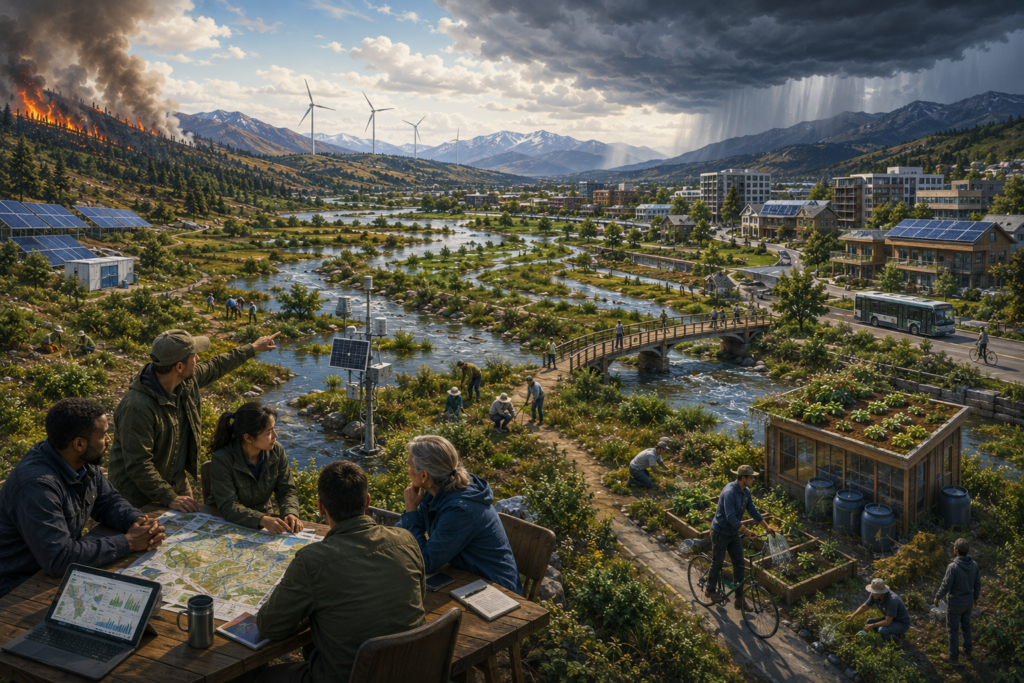
Panoramic illustration of a resilient town economy with local businesses, transit, farms, restoration work, infrastructure repair, community planning, storm pressure, and a recovering burned hillside.

Economic Resilience: Stability, Adaptation, and Systemic Capacity in Dynamic Economies

Economic Resilience examines how economies absorb shocks, restore essential functions, and adapt to structural change without sacrificing long-term viability. The article argues that economic resilience is not simply a matter of returning aggregate output to pre-crisis levels, but of preserving the broader conditions that support livelihoods, stability, innovation, and future adaptability. It explores resistance, recovery, reorganization, adaptive capacity, and transformative capacity through the lenses of sectoral diversity, supply networks, financial systems, labor markets, climate risk, and public policy. It also emphasizes that resilient economies balance stability with flexibility rather than maximizing efficiency alone. The article includes an evergreen mathematical lens, along with advanced R and Python workflows for comparing economic resilience strategies and analyzing uncertainty in long-term economic adjustment and policy choices.
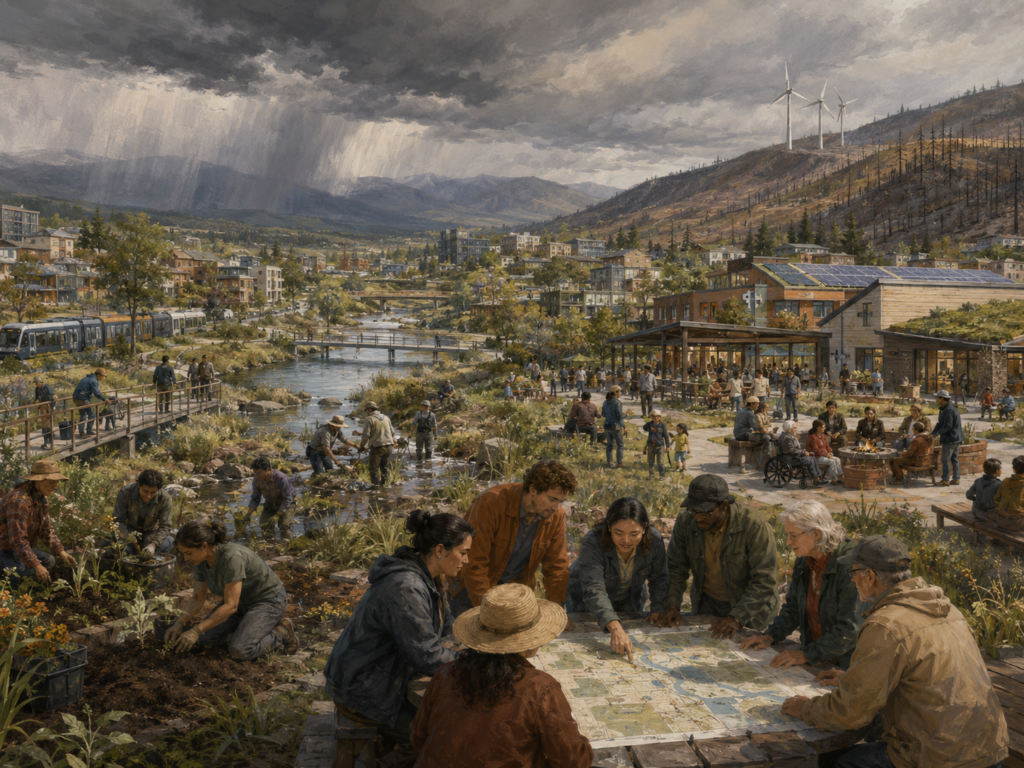

Panoramic illustration of a resilient community with residents, planners, restoration workers, public gathering spaces, transit, wetlands, renewable energy, storm clouds, and recovering hillsides.

Community Resilience: Collective Capacity, Social Systems, and Adaptive Response

Community Resilience examines how groups of people, local institutions, and place-based systems sustain collective life under disruption. The article argues that community resilience is not simply the sum of individual coping capacities, but an emergent property of social relationships, trust, shared resources, infrastructure access, institutional coordination, and adaptive learning. It explores core dimensions such as social capital, inequality, infrastructure dependence, social-ecological context, feedback loops, threshold dynamics, preparedness, recovery, and long-term adaptation. The article also emphasizes that resilience at the community level is fundamentally relational, shaped by how communities organize, communicate, and support vulnerable members under stress. It includes an evergreen mathematical lens, along with advanced R and Python workflows for comparing community resilience strategies and analyzing uncertainty in local adaptation and collective response choices.

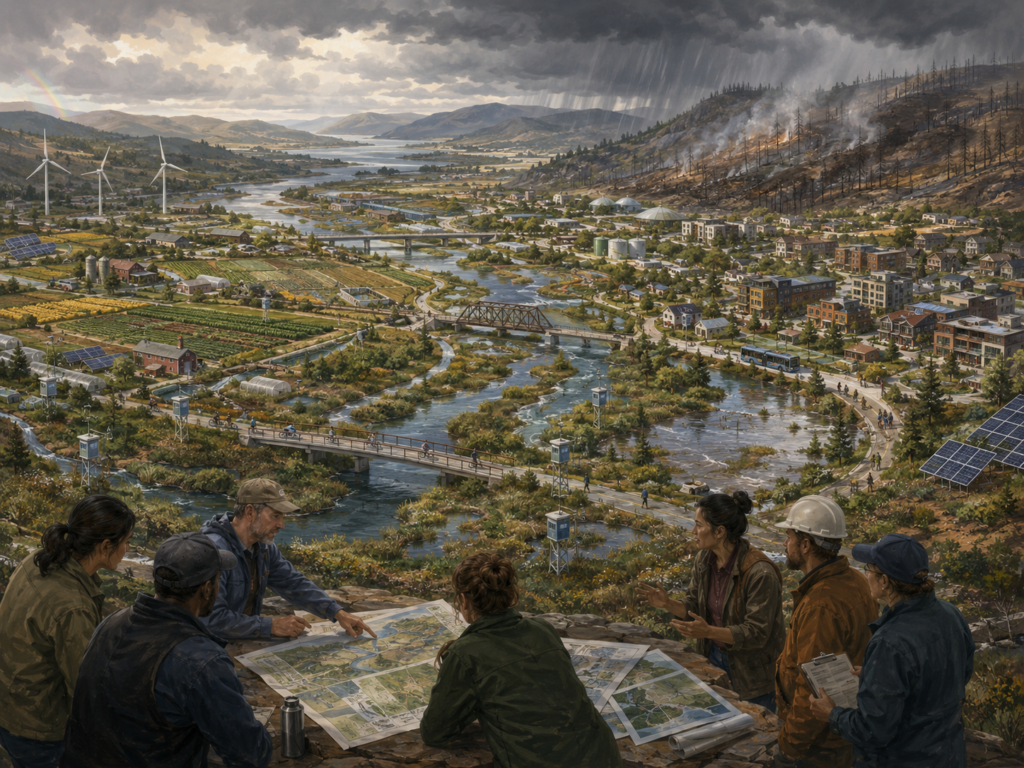
Panoramic illustration of a resilient city with bridges, transit, water infrastructure, renewable energy, green infrastructure, storm defenses, wildfire risk, and planners coordinating system upgrades.

Infrastructure Resilience: Designing Reliable and Adaptive Systems

Infrastructure Resilience examines how critical physical and digital systems sustain essential services under disruption rather than merely surviving as isolated assets. The article argues that true resilience lies in service continuity, rapid recovery, adaptive redesign, and the management of cascading interdependence across power, water, transport, communications, health support, and logistics. It distinguishes resilience from reliability and robustness, emphasizes the importance of redundancy, modularity, diversity, governance, maintenance, and climate-adjusted design, and shows why infrastructure must be understood as a network of networks rather than a collection of separate engineering objects. The article also foregrounds equity by asking for whom services remain available during failure. It includes an evergreen mathematical lens, along with advanced R and Python workflows for comparing infrastructure resilience strategies and analyzing uncertainty in long-term service continuity and cascading-risk choices.

Panoramic illustration of a climate-resilient community with wetlands, renewable energy, green infrastructure, public transit, restoration work, storm clouds, wildfire, and planners reviewing maps.

Climate Resilience: Adapting Systems to Environmental Change and Uncertainty

Climate Resilience examines how human and natural systems sustain essential functions under climate-related shocks, chronic stress, and long-term environmental transformation. The article argues that climate resilience is not merely the ability to survive floods, heatwaves, droughts, or storms, but the broader capacity to reduce exposure, lower vulnerability, adapt over time, recover without deepening fragility, and transform when older development patterns become untenable. It explores climate-resilient development, systemic risk, ecosystem-based adaptation, urban and infrastructure resilience, maladaptation, justice, governance, and threshold dynamics as interconnected dimensions of the same problem. The article also emphasizes that climate resilience is inseparable from development choices, social inequality, and ecological condition. It includes an evergreen mathematical lens, along with advanced R and Python workflows for comparing climate resilience strategies and analyzing uncertainty in long-term adaptation and transformation choices.

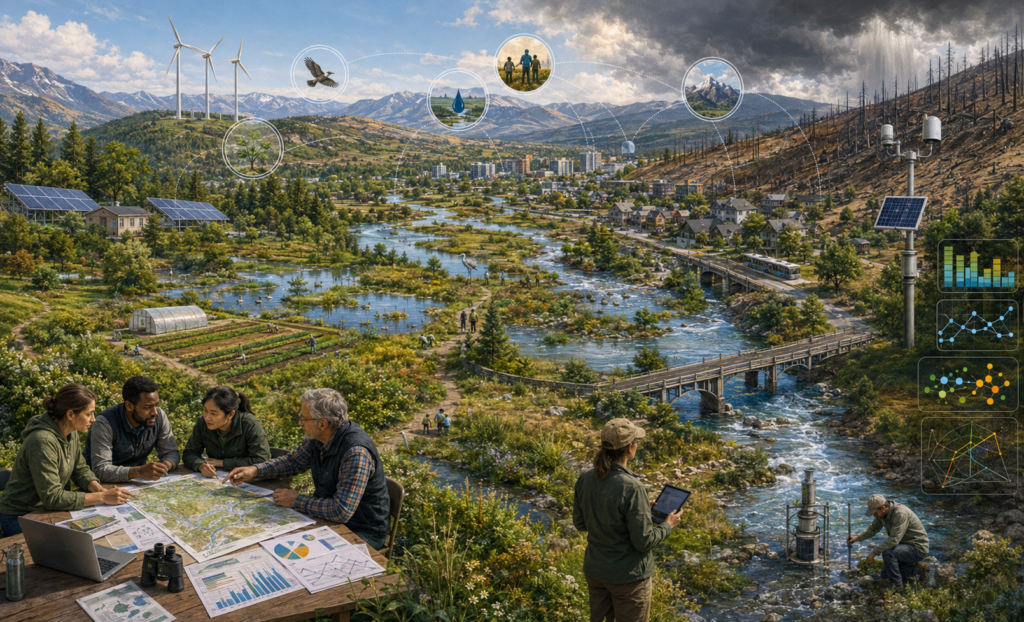
Panoramic systems illustration of a monitored river valley with wetlands, farms, renewable energy, bridges, ecological restoration, storm disturbance, and planners assessing resilience.

Resilience Metrics and Measurement: Quantifying Stability, Adaptation, and System Performance

Resilience Metrics and Measurement examines why resilience is both strategically essential and analytically difficult to assess in complex systems. The article argues that resilience cannot be captured by a single universal score because systems may appear stable while hiding fragility, recover rapidly while eroding long-term capacity, or perform well at one scale while shifting risk to another. It develops a structured framework around resistance, recovery, adaptive capacity, buffering, diversity, threshold proximity, and transformative capacity, while comparing indicator-based, performance-based, and scenario-based approaches to assessment. The article also emphasizes that good measurement depends on defining the system, the relevant disturbances, the essential functions, and the timescale of concern. It includes an evergreen mathematical lens, along with advanced R and Python workflows for comparing resilience measurement frameworks and analyzing uncertainty in resilience assessment choices.

Panoramic systems illustration of a resilient town, wetlands, farms, bridges, renewable energy, water infrastructure, transit routes, and planners designing overlapping system supports.

Redundancy and Diversity in System Design: Building Resilience Through Capacity and Variation

Redundancy and Diversity in System Design examines why resilient systems need both overlapping capacity and meaningful variation if they are to withstand disturbance without collapsing into brittle failure. The article argues that redundancy alone is insufficient when backups fail in the same way, and that diversity alone is insufficient when variation does not preserve critical function. Its central concept is diverse redundancy: multiple elements performing similar roles through different structures, pathways, or responses. Through ecological, infrastructural, organizational, and governance examples, the article shows how redundancy, diversity, and response diversity widen adaptive options, reduce common-mode failure, and help systems stay farther from dangerous thresholds. It also explores the efficiency trap, the limits of excess overlap or fragmentation, and the strategic importance of designing for function under uncertainty rather than optimization under stable conditions.

Panoramic ecological systems illustration of a mountain watershed, wetlands, farms, town, storm clouds, restoration workers, monitoring equipment, and curved feedback pathways.

Feedback Loops in Resilient Systems: Reinforcement, Regulation, and System Dynamics

Feedback Loops in Resilient Systems examines the recursive causal structures through which systems amplify, dampen, delay, or redirect change over time. The article argues that resilience depends not only on external shocks, but on the internal loop structure that determines whether disturbance is absorbed, escalated, or transformed into wider systemic change. It distinguishes reinforcing loops, which intensify growth or decline, from balancing loops, which regulate and stabilize behavior, and shows how their interaction helps explain nonlinear change, delay effects, threshold dynamics, policy resistance, and adaptive capacity. Drawing on ecological, social-ecological, organizational, governance, and climate examples, the article shows why feedback awareness is essential for understanding resilience as dynamic behavior rather than static endurance. It also includes an evergreen mathematical lens, along with advanced R and Python workflows for exploring feedback structure over time.

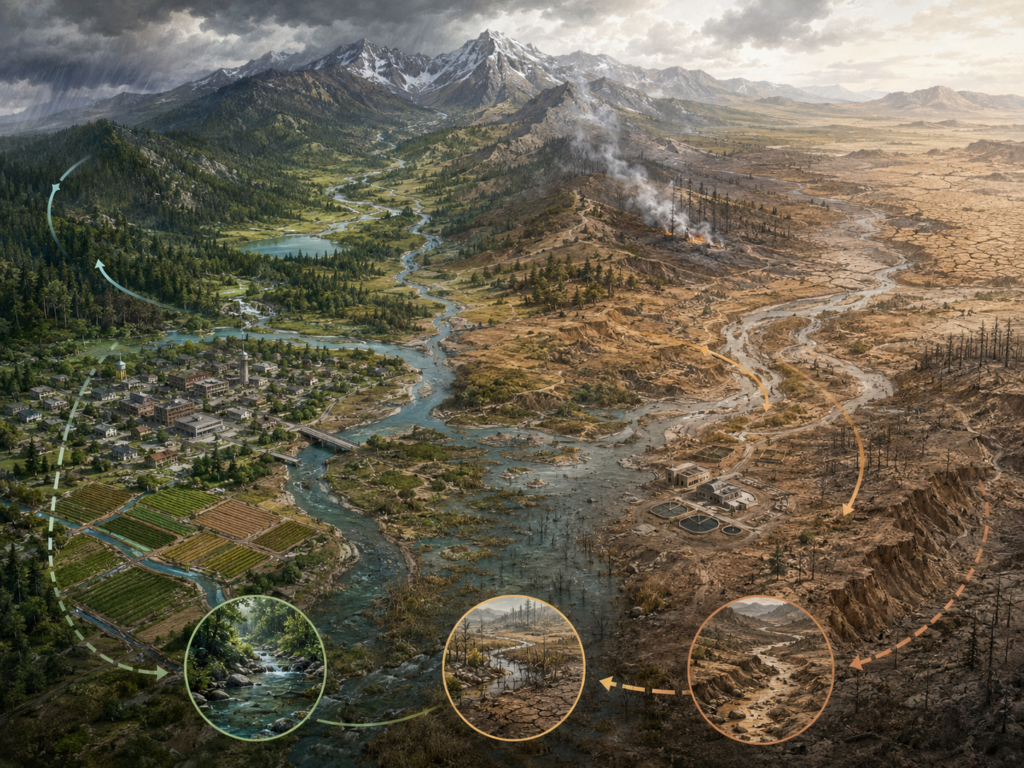
Panoramic systems illustration of a watershed shifting from healthy forest, farms, and rivers into burned slopes, drought, erosion, degraded waterways, and barren land.

System Thresholds and Tipping Points: Nonlinear Change in Complex Systems

System Thresholds and Tipping Points examines how complex systems can absorb pressure for long periods and then shift abruptly once critical boundaries are crossed. The article argues that thresholds are structural boundaries separating alternative regimes, while tipping points are the dynamic moments when reinforcing feedbacks push systems into new patterns of organization. It develops this through nonlinear change, regime shifts, critical transitions, early warning signals, ecological and climate tipping processes, institutional breakdown, hysteresis, and irreversibility. The article emphasizes that resilience depends not only on recovering from disturbance, but on remaining within viable system states before feedback-driven change becomes self-sustaining. It also includes an evergreen mathematical lens, along with advanced R and Python workflows for simulating threshold crossings, hysteresis, and early warning signals in nonlinear systems.

Panoramic ecological systems illustration of a mountain watershed showing forests, wetlands, farms, wildfire disturbance, regrowth, restoration work, and circular adaptive-cycle pathways.

Adaptive Cycles and Panarchy: Dynamics of Growth, Collapse, and Renewal

Adaptive Cycles and Panarchy examines how complex systems move through recurring phases of growth, conservation, release, and reorganization, and how those cycles interact across nested scales. The article argues that resilience depends not on permanent stability, but on the capacity to navigate changing phases without losing essential function or the possibility of renewal. It develops the adaptive cycle through the four phases of exploitation, conservation, release, and reorganization, then extends the analysis through panarchy, where smaller, faster systems generate novelty and larger, slower systems retain memory, constraint, and accumulated structure. The article also explores revolt and remember linkages, social-ecological and institutional applications, strategic lock-in, renewal, and the limits of treating the model as a universal law. It includes an evergreen mathematical lens, along with advanced R and Python workflows for simulating adaptive-cycle phase shifts and cross-scale panarchy dynamics.

Scroll to Top