
Last Updated June 2, 2026
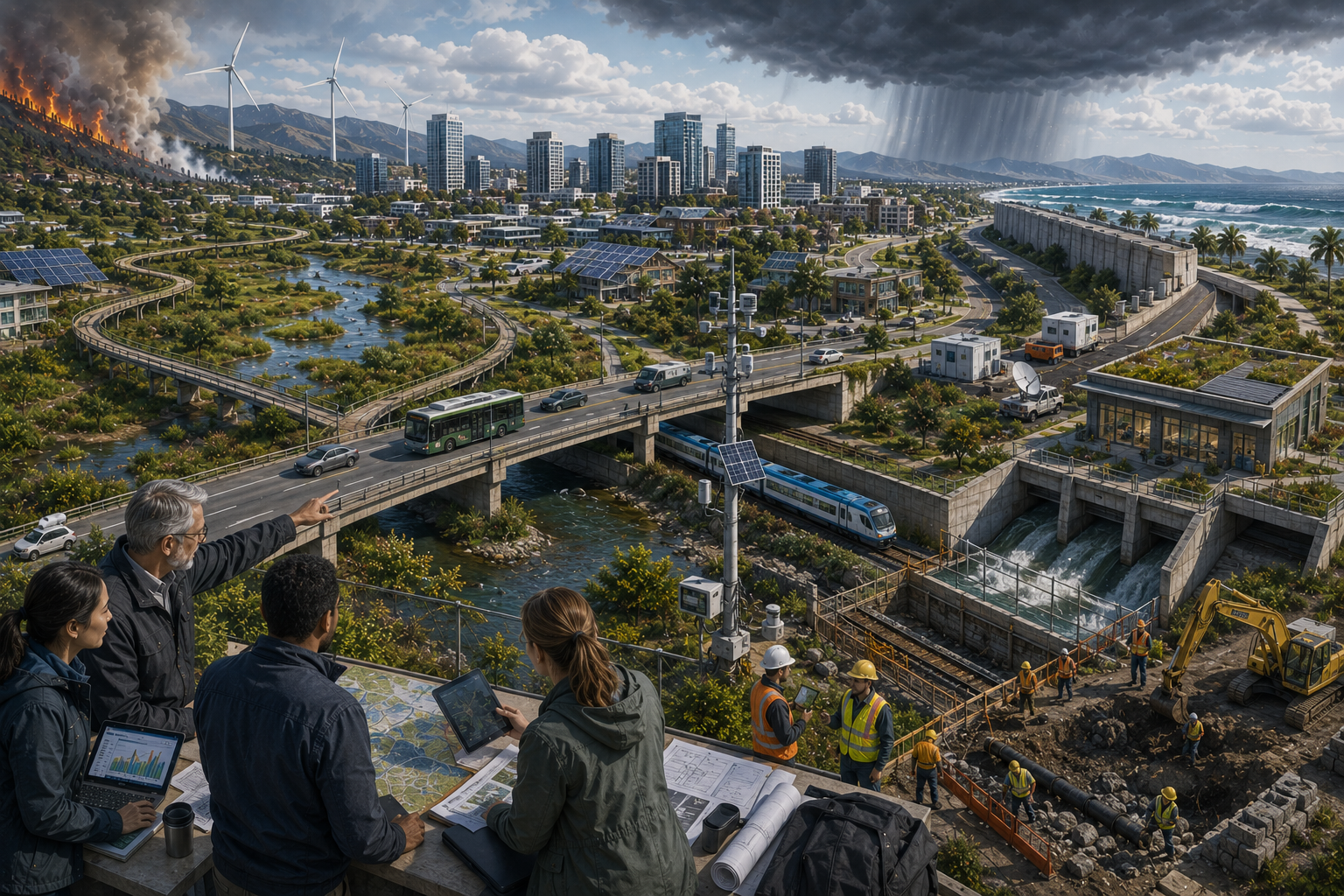
Infrastructure resilience is the capacity of critical physical, ecological, digital, and institutional systems to anticipate disruption, withstand stress, absorb loss, recover essential function, adapt to changing conditions, and, where necessary, transform before failure becomes systemic. It is not only a question of whether a bridge, grid, pipe, port, data center, hospital, rail line, or stormwater system survives a shock. It is a question of whether the services that depend on infrastructure—energy, water, mobility, communications, health support, logistics, sanitation, cooling, emergency response, and public safety—remain available or can be restored fast enough to prevent wider social failure.
Modern infrastructure systems rarely fail in isolation. Power grids depend on communications, fuel logistics, cooling systems, water, maintenance crews, digital controls, and access roads. Water systems depend on electricity, chemicals, telemetry, pumping stations, watersheds, storage, and treatment capacity. Hospitals depend on transport, power, oxygen, telecommunications, pharmaceuticals, staffing, and supply chains. Ports, rail, roads, airports, warehouses, cloud platforms, emergency operations centers, and public agencies shape how quickly communities can respond to disruption and recover afterward. Infrastructure resilience is therefore not simply an engineering topic. It is a systems topic involving interdependence, redundancy, modularity, maintenance, governance, finance, climate risk, ecological buffering, cybersecurity, public trust, and long-term adaptation under uncertainty.
This article examines infrastructure resilience as a core concept in resilience thinking. It explains why infrastructure must be understood as service continuity rather than asset survival, why cascading failure is one of the defining risks of modern infrastructure, how reliability and robustness differ from resilience, why climate change is destabilizing historical design assumptions, how redundancy and modularity reduce systemic fragility, why nature-based and hybrid infrastructure matter, and why infrastructure resilience must be measured through equity, recovery, governance, and long-term service performance rather than through asset condition alone. It also extends the discussion into applied modeling workflows for comparing infrastructure resilience strategies under uncertainty.
What Infrastructure Resilience Means
Infrastructure resilience means maintaining or restoring essential service performance under stress rather than merely protecting assets in place. A bridge may remain standing and still fail the resilience test if transport service is interrupted for too long. A data center may remain structurally intact and still produce systemic disruption if network continuity is lost. A water utility may avoid catastrophic damage and still fail if households, hospitals, schools, or emergency responders cannot access safe water during a prolonged outage.
This distinction matters because resilient infrastructure is defined less by static strength alone than by service continuity, recovery time, adaptive capacity, equitable access, and system-level function. Resilience therefore extends beyond hardening individual assets. It includes backup pathways, modularity, interoperability, maintenance, monitoring, governance, public communication, emergency coordination, workforce capacity, financing, data systems, ecological buffers, and the ability to operate under changing hazard conditions.
Infrastructure is also a public systems problem because the services it provides are foundational to health, safety, livelihoods, education, mobility, communication, and economic continuity. When infrastructure fails, the consequences are not evenly distributed. Households without backup power, people dependent on medical devices, renters in heat-vulnerable buildings, workers without paid leave, residents without vehicles, rural communities with long repair times, and neighborhoods with historically undermaintained assets may experience infrastructure failure as a direct threat to life and dignity.
| Infrastructure concept | Primary question | Resilience implication |
|---|---|---|
| Asset survival | Did the physical or digital asset remain intact? | Necessary but insufficient; an intact asset may still fail to provide service. |
| Service continuity | Can people still access essential services? | Focuses resilience on social function, not only engineering condition. |
| Recovery time | How quickly can service be restored? | Determines whether disruption remains temporary or becomes systemic harm. |
| Adaptive capacity | Can the system learn, reroute, reconfigure, and improve? | Supports resilience under changing hazard conditions and uncertain futures. |
| Equitable access | Who loses service first and who recovers last? | Prevents aggregate resilience metrics from hiding unequal outage and recovery. |
Infrastructure resilience is therefore not only the ability to resist disruption. It is the capacity to keep essential social functions available under stress and to restore them justly when interruption occurs.
Why Infrastructure Resilience Matters
Infrastructure resilience matters because infrastructure failure amplifies disruption across society. Damage to electric power affects water treatment, hospitals, refrigeration, cooling systems, telecommunications, traffic control, fuel pumps, elevators, wastewater systems, digital payments, and emergency coordination. Transport failure interrupts emergency response, labor mobility, food distribution, medical supply movement, school access, and evacuation. Communications failure weakens situational awareness, warning, public instructions, mutual aid, logistics, and institutional coordination. Infrastructure is therefore foundational rather than sectoral. When it fails, many other systems fail with it.
This is especially important under conditions of compounding and cascading risk. A storm may cause flooding, which disrupts roads, which delays fuel delivery, which weakens backup power, which affects hospitals and digital networks. A heatwave may increase electricity demand, reduce transmission efficiency, increase water demand, degrade road and rail surfaces, strain public health, and reduce outdoor labor capacity at the same time. A cyberattack may disrupt billing, telemetry, logistics, dispatch, and public communication even when physical assets remain intact.
Infrastructure resilience is also a matter of public trust. People depend on infrastructure systems they usually cannot inspect, repair, or replace themselves. If service failure is repeated, unexplained, unequal, or poorly governed, trust erodes. That erosion becomes part of the resilience problem because people may ignore warnings, avoid public shelters, distrust outage estimates, resist relocation, or lose faith in institutional capacity. Physical resilience and institutional legitimacy are therefore connected.
Why infrastructure resilience is a systems priority
Critical services depend on networks
Water, power, healthcare, transport, communications, food logistics, and public safety depend on one another.
Failures cascade
A local outage can propagate across systems when dependencies are tight and backups are weak.
Hazard baselines are changing
Climate, cyber, supply-chain, geopolitical, and demographic pressures can exceed old design assumptions.
Recovery is unequal
Some users, neighborhoods, and regions lose service earlier and recover later than others.
Maintenance is resilience
Deferred maintenance quietly reduces capacity before a visible crisis exposes fragility.
Public trust matters
Emergency communication, warning compliance, and recovery legitimacy depend on accountable institutions.
Infrastructure resilience matters because it determines whether disruption remains contained or spreads into wider social, ecological, economic, and institutional breakdown.
Reliability, Robustness, and Resilience
Infrastructure resilience overlaps with reliability and robustness, but it is not identical to either. Reliability usually refers to consistent performance under expected operating conditions. A reliable system works when demand is normal, inputs are available, equipment is maintained, and disturbances remain within expected ranges. Robustness refers to the ability to withstand specified disturbances while preserving function. A robust bridge, levee, pipe, grid component, or server architecture may tolerate a known stress better than a fragile one.
Resilience is broader. It includes disturbance absorption, continuity of critical service, graceful degradation, recovery, learning, adaptation, and transformation when conditions exceed what designers originally assumed. A system can be reliable in routine conditions and still lack resilience under compound hazard. It can be robust against one hazard and still be vulnerable to cascading failure through another system. It can recover quickly in technical terms and still leave marginalized users without service for unacceptable periods.
This distinction is central to resilience thinking. Infrastructure designed only for reliability may perform well until it encounters a disturbance outside routine assumptions. Infrastructure designed only for robustness may resist known hazards but fail under novel risks, changing climate baselines, supply-chain disruption, cyber-physical attack, or multi-system cascade. Resilience adds the capacity to recover, reorganize, learn, and continue serving society under uncertainty. This article therefore builds directly on Resilience vs Stability vs Robustness.
| Concept | Focus | Limitation if used alone |
|---|---|---|
| Reliability | Consistent performance under expected conditions | May fail when conditions depart from historical averages or routine operating assumptions. |
| Robustness | Resistance to specified disturbance | May protect known components while ignoring recovery, adaptation, equity, or cross-system cascade. |
| Resilience | Continuity, recovery, adaptation, learning, and transformation under disruption | Requires broader governance, data, finance, and social accountability beyond asset strength. |
| Antifragility-like claims | Improvement through stress | Can be misleading when stress harms people, exhausts workers, or damages ecosystems. |
Reliability and robustness are important, but resilience asks a larger systems question: what happens when the expected operating world no longer holds?
Core Properties of Resilient Infrastructure
Although frameworks vary by sector, resilient infrastructure usually depends on a recurring set of properties. These properties are not independent. Robustness without redundancy can create brittle confidence. Redundancy without maintenance can produce false security. Rapidity without equity can restore service for some users while leaving others behind. Adaptability without governance can remain theoretical. Interdependence awareness without investment may identify risk without reducing it. Infrastructure resilience emerges when these properties reinforce one another.
Robustness
Robustness is the ability of infrastructure to tolerate stress without disproportionate performance loss. It includes structural strength, design margins, hazard-aware engineering, code quality, cybersecurity controls, physical protection, and environmental siting. Robustness matters because infrastructure should not fail under predictable or reasonably foreseeable conditions. But robustness alone is not resilience if the system lacks recovery pathways, redundancy, learning, or adaptation when stress exceeds design assumptions.
Redundancy
Redundancy means critical functions do not depend on a single asset, route, supplier, server, treatment plant, bridge, substation, control room, or pathway. Reserve capacity, alternative routing, backup power, data replication, spare parts, mutual aid agreements, local storage, and overlapping networks reduce single-point failure risk. Redundancy is especially important where interruption creates immediate health, safety, or public-service consequences.
Resourcefulness
Resourcefulness is the ability of operators, agencies, utilities, communities, and institutions to diagnose problems, mobilize resources, coordinate response, improvise safely, and adjust under changing conditions. It depends on training, authority, information, staffing, procurement, local knowledge, communication channels, and institutional trust. Infrastructure resilience is weakened when physical systems are strong but institutions cannot act quickly or coherently.
Rapidity
Rapidity refers to the speed of restoring essential services after disruption. Recovery time matters because outage duration can transform a manageable interruption into public-health crisis, economic loss, displacement, contamination, or institutional failure. Rapidity depends on pre-positioned resources, repair crews, mutual aid, interoperable parts, emergency contracts, situational awareness, access routes, and clear decision authority.
Adaptability
Adaptability is the ability of infrastructure systems to evolve as hazards, technologies, demand patterns, ecological conditions, and social needs change. It includes design flexibility, modular upgrades, scenario planning, monitoring, revised standards, adaptive operations, and long-term renewal strategies. Adaptability is crucial when climate, cybersecurity, demographic, and supply-chain conditions make historical design assumptions unreliable.
Interdependence Awareness
Interdependence awareness is the capacity to understand how infrastructure systems depend on one another and how failure can propagate. Power, water, transport, communications, health systems, logistics, finance, emergency response, and digital platforms often shape one another’s performance. Resilient infrastructure planning therefore requires dependency mapping, cross-sector exercises, cascade scenarios, and investment in critical nodes where failure could spread rapidly.
| Property | Primary function | Failure if neglected |
|---|---|---|
| Robustness | Withstand stress without disproportionate performance loss | Infrastructure fails under predictable or foreseeable disturbance. |
| Redundancy | Provide backup pathways and reserve capacity | Single-point failure interrupts critical service. |
| Resourcefulness | Mobilize people, information, materials, and authority under pressure | Systems remain damaged because institutions cannot coordinate response. |
| Rapidity | Restore essential service fast enough to prevent cascading harm | Temporary outage becomes public-health, economic, or social crisis. |
| Adaptability | Revise design and operations as conditions change | Old assumptions remain embedded in long-lived systems. |
| Interdependence awareness | Identify dependencies and cascade pathways across networks | Sector-by-sector planning misses systemic risk. |
Infrastructure resilience is strongest when these properties are treated as an integrated design, governance, and operations portfolio rather than as isolated engineering traits.
Service Continuity Rather Than Asset Survival
One of the most important shifts in resilience thinking is the movement from asset-centered design to service-centered design. Infrastructure exists to provide services, not merely to preserve objects. A water plant exists to provide safe water. A grid exists to supply usable power. A road network exists to support mobility, emergency response, logistics, and access. A telecommunications system exists to preserve communication, coordination, data flow, and warning. Asset survival matters, but it is not the final measure.
Service-centered resilience asks whether people, institutions, and critical systems can still function under degraded conditions. This requires defining minimum acceptable levels of service, acceptable outage duration, priority users, critical dependencies, recovery sequences, and equity safeguards. A technically “surviving” infrastructure system may still be socially disastrous if it cannot support basic needs. Conversely, a damaged system may remain resilient if service continues through rerouting, backup systems, local capacity, or rapid restoration.
| Service continuity question | Why it matters | Example |
|---|---|---|
| Can people still access essential services? | Social function is the real output of infrastructure | Water access, cooling, transit, communications, emergency care. |
| How long can degraded service continue? | Duration determines whether disruption remains tolerable | Backup power hours, water storage days, communication redundancy. |
| Who loses service first? | Aggregate performance can hide unequal failure | Low-income neighborhoods, rural areas, medically vulnerable users, transit-dependent residents. |
| Who is restored first? | Recovery order reflects public priorities and institutional accountability | Hospitals, water systems, emergency routes, shelters, vulnerable users. |
| What level of service is acceptable? | Resilience requires explicit thresholds, not vague continuity language | Minimum pressure, voltage, transit access, connectivity, response time. |
Service continuity shifts infrastructure resilience from the question “Did the asset survive?” to the more important question “Can society still function?”
Interdependence and Cascading Failure
Resilient infrastructure planning must treat infrastructure as a network of networks. Energy depends on fuel logistics, communications, cooling, market systems, control software, physical access, and repair crews. Water systems depend on electricity, chemicals, sensors, pumping, storage, treatment, and watershed conditions. Transport depends on energy, data, labor, bridges, tunnels, ports, pavement, public safety, and weather. Healthcare depends on all of these. These interdependencies make cascading failure one of the greatest resilience challenges.
Cascading failure occurs when disruption in one system propagates into others. Sometimes the triggering event is modest compared with the resulting consequences. A substation outage can affect pumping stations, which affect water availability, which affects hospitals, which affect public health, which affects workforce availability, which slows repair. A data outage can affect dispatch, payment systems, logistics, emergency communications, and public information. A bridge failure can reroute freight, delay ambulances, isolate neighborhoods, and disrupt supply chains.
This is why infrastructure resilience requires more than sector-by-sector hardening. It requires system mapping, dependency analysis, scenario planning, cross-sector exercises, and identification of critical nodes where failure could spread rapidly. This connects directly to Feedback Loops in Resilient Systems, System Thresholds and Tipping Points, and Modularity and Cascading Failure.
| Initial infrastructure disruption | Possible cascade | Resilience strategy |
|---|---|---|
| Power outage | Water pumping failure → hospital stress → communications disruption → delayed repair | Microgrids, backup power, islanding, fuel planning, priority restoration. |
| Flooded transport corridor | Emergency delay → supply disruption → fuel shortage → slower infrastructure recovery | Alternate routes, elevated corridors, local storage, resilient logistics hubs. |
| Telecommunications failure | Loss of warning → poor coordination → slow response → public distrust | Redundant communication channels, low-tech backups, trusted local messengers. |
| Cyber disruption | Control-system failure → billing/logistics delay → service interruption → recovery confusion | Segmentation, manual fallback, incident response, cyber-physical exercises. |
| Water treatment failure | Unsafe water → health burden → school/business closures → public emergency | Backup treatment, storage, testing, mutual aid, emergency distribution. |
Infrastructure resilience depends on understanding where systems are coupled tightly enough for failure to travel faster than institutions can respond.
Climate Change and Infrastructure Resilience
Climate change has made infrastructure resilience more urgent because historical design assumptions are becoming less reliable. Assets built for past rainfall, temperature, coastal, wildfire, drought, and storm conditions may underperform under emerging climate extremes. Heat affects grids, roads, rails, buildings, cooling demand, public health, worker safety, and telecommunications equipment. Sea-level rise affects ports, drainage, wastewater, coastal roads, underground utilities, housing, and insurance systems. Extreme precipitation affects culverts, bridges, tunnels, stormwater systems, slope stability, and water quality. Wildfire affects power transmission, communications, transport corridors, air quality, water supplies, and evacuation.
This means infrastructure resilience cannot be treated as a one-time protective upgrade. It requires dynamic adjustment to evolving hazard profiles. Design standards, maintenance schedules, asset renewal plans, capital budgets, operational thresholds, emergency plans, and land-use decisions must all account for changing environmental baselines. A system that is resilient under past climate conditions may become fragile under future conditions if adaptation is delayed.
Climate change also creates compound risk. Heat can increase electricity demand while reducing system efficiency. Drought can reduce hydropower while increasing wildfire risk. Flooding can damage roads while interrupting emergency response. Sea-level rise can worsen storm surge while affecting wastewater and groundwater. Infrastructure resilience therefore links directly to Climate Resilience and to disaster risk reduction.
Climate pressures on infrastructure resilience
Heat
Stresses grids, roads, rails, cooling systems, buildings, communications equipment, and public health.
Extreme precipitation
Overloads drainage, damages bridges, floods tunnels, contaminates water, and disrupts transport.
Sea-level rise
Threatens ports, coastal roads, wastewater systems, drainage, underground utilities, and property systems.
Wildfire
Damages transmission, communications, transport corridors, water quality, housing, and air safety.
Drought
Reduces water availability, hydropower, navigation capacity, ecosystem buffering, and firefighting capacity.
Compound events
Combine heat, drought, flood, smoke, outage, and supply-chain stress in ways old standards may not capture.
Climate-aware infrastructure resilience requires planning for future operating conditions, not simply repairing systems built for the past.
Hardening vs Adaptation
A common mistake is to reduce infrastructure resilience to hardening. Hardening matters, especially where physical damage risk is high. Levees, seawalls, bridge upgrades, undergrounding, fire-resistant materials, stronger poles, floodproofed facilities, seismic retrofits, cybersecurity controls, and protected substations can reduce damage. But harder systems can still fail if they lack redundancy, if recovery is slow, if backup systems depend on the same vulnerable inputs, or if new conditions exceed design assumptions.
Adaptation broadens the frame. It includes modular redesign, flexible operations, decentralized capacity, revised maintenance practices, updated design standards, nature-based protection, distributed energy, demand management, strategic relocation where necessary, and long-term renewal pathways. Adaptation asks whether the infrastructure system can function differently when resistance alone is insufficient. It also asks whether continued defense of an asset is socially, financially, and ecologically viable under changing conditions.
| Approach | Strength | Risk if overused |
|---|---|---|
| Hardening | Reduces damage to specific assets under known hazards | Can create false security, transfer risk, or lock in unsafe development. |
| Adaptation | Adjusts design, operations, governance, and location as conditions change | Can remain vague without funding, decision triggers, and implementation authority. |
| Redundancy | Maintains service when one pathway fails | Can become expensive or ineffective if backups share common-mode vulnerabilities. |
| Transformation | Changes infrastructure pathways when old systems are no longer viable | Can become unjust if communities are excluded or displaced. |
Infrastructure resilience is not a choice between hardening and adaptation. It is a disciplined portfolio that asks where to protect, where to reroute, where to redesign, where to decentralize, and where to transform.
Redundancy, Modularity, and Diversity
Three design principles are especially important in infrastructure resilience: redundancy, modularity, and diversity. Redundancy provides backup pathways when a component fails. Modularity helps isolate disruption so that local failure does not become systemic collapse. Diversity reduces common-mode failure by ensuring that systems do not all depend on one identical component, one technology, one energy source, one supplier, one operating platform, or one mode of response.
These principles matter because infrastructure systems that are tightly coupled and highly uniform often fail more dramatically when stressed. Efficiency can reduce slack. Standardization can increase common-mode vulnerability. Centralization can improve coordination in routine conditions but create high-consequence nodes. By contrast, systems with overlapping capacity, modular structure, and heterogeneous pathways are better able to reroute, localize, absorb, and recover from disruption. This article therefore connects closely to Redundancy and Diversity in System Design.
| Design principle | Resilience function | Infrastructure example |
|---|---|---|
| Redundancy | Provides backup capacity when a route, asset, or input fails | Backup power, alternate roads, spare pumps, redundant fiber routes, mutual aid. |
| Modularity | Contains failure and prevents system-wide propagation | Microgrids, sectionalized water networks, network segmentation, modular repair units. |
| Diversity | Reduces shared vulnerability to one failure mode | Multiple energy sources, varied suppliers, mixed transport modes, hybrid grey-green systems. |
| Interoperability | Allows systems, crews, data, and equipment to work together in disruption | Common communication protocols, compatible parts, shared emergency data standards. |
Redundancy, modularity, and diversity preserve options. They are the infrastructure equivalent of keeping a system from becoming too brittle, too centralized, or too dependent on one fragile pathway.
Distributed vs Centralized Systems
Infrastructure resilience is shaped by architecture. Highly centralized systems can be efficient, easier to monitor, and easier to manage in routine conditions, but they may create major single points of failure. Distributed systems often offer more redundancy, local autonomy, and adaptability, but they may introduce coordination challenges, uneven capacity, cybersecurity complexity, and governance fragmentation.
In practice, resilient infrastructure often combines centralized coordination with distributed capability. Examples include microgrids connected to larger grids, decentralized water storage within larger utility networks, regional health systems with local surge capacity, distributed cloud architectures with centralized security governance, and public transit networks that combine trunk lines with flexible local access. The key issue is not choosing one architecture dogmatically. The key issue is understanding how structure affects failure propagation, service continuity, accountability, and recovery options.
| Architecture | Strength | Resilience concern |
|---|---|---|
| Centralized | Efficiency, coordination, economies of scale, standardized operations | High-consequence nodes, single points of failure, long recovery if core assets fail. |
| Distributed | Local capacity, redundancy, modular recovery, reduced dependence on one node | Coordination complexity, uneven quality, interoperability and governance challenges. |
| Hybrid | Central oversight with distributed operational capability | Requires careful design of control authority, data sharing, and emergency protocols. |
Resilient infrastructure architecture is not simply decentralized or centralized. It is designed so that failure can be localized and service can continue through multiple pathways.
Nature-Based and Hybrid Infrastructure
Infrastructure resilience increasingly includes nature-based and hybrid approaches. Wetlands, mangroves, floodplains, forests, dunes, urban tree cover, permeable landscapes, restored rivers, healthy soils, and watershed protection can reduce hazard exposure while providing ecological and social co-benefits. Hybrid approaches combine conventional engineering with ecosystem functions to create more flexible, absorptive, and adaptive protection systems.
This matters because resilience is not always improved by more concrete, higher walls, more rigid control, or more asset hardening. In some settings, ecological buffers provide adaptive and regenerative forms of protection that purely engineered barriers cannot provide alone. Wetlands can store water and reduce flood peaks. Tree canopy can reduce heat. Dunes and marshes can reduce coastal energy. Healthy watersheds can improve water quality and reduce sedimentation. Soil restoration can improve infiltration and drought resilience.
Nature-based infrastructure should not be romanticized. Ecosystems also have thresholds, maintenance needs, governance challenges, land conflicts, and climate vulnerabilities. A restored wetland can fail if upstream development, pollution, hydrological alteration, or sea-level rise overwhelms it. A tree-canopy program can worsen green gentrification if housing protections are absent. Nature-based resilience therefore requires ecological realism, monitoring, community stewardship, and justice safeguards. This creates an important bridge between infrastructure resilience and Social-Ecological Systems.
| Infrastructure type | Resilience function | Risk if poorly governed |
|---|---|---|
| Wetlands and floodplains | Store water, reduce flood peaks, improve water quality, support biodiversity | Can be overwhelmed if development and hydrological change continue upstream. |
| Urban tree canopy | Reduces heat, improves air quality, supports stormwater absorption | Can become unevenly distributed or contribute to displacement if equity is ignored. |
| Dunes, marshes, and mangroves | Reduce coastal wave energy and erosion | Can degrade under sea-level rise, pollution, or poorly designed coastal development. |
| Hybrid flood systems | Combine levees, pumps, wetlands, retention, and land-use planning | Can fail if grey and green components are not maintained together. |
Nature-based and hybrid infrastructure broaden resilience from asset protection to living systems that absorb, buffer, regenerate, and adapt.
Governance, Finance, and Maintenance
Infrastructure resilience is not just a design issue. It is also a governance and finance issue. Even well-designed infrastructure becomes fragile when maintenance is deferred, asset data are incomplete, agencies are fragmented, procurement is slow, risk ownership is unclear, or long-term investment is sacrificed for short-term savings. Governance quality shapes inspection, repair, emergency coordination, capital planning, land-use alignment, data sharing, public communication, and the distribution of infrastructure risk.
Finance matters because resilience often requires spending before disaster rather than after it. Preventive maintenance, redundancy, monitoring, cyber controls, ecosystem restoration, resilient design standards, backup systems, workforce training, and emergency logistics can look expensive before failure occurs. After failure, the same investments often appear obvious. This creates a political and budgetary bias toward visible response rather than invisible prevention.
Maintenance is one of the most overlooked forms of resilience. Deterioration quietly reduces capacity long before visible failure. A culvert loses hydraulic capacity. A bridge loses structural margin. A transformer ages. A pipe leaks. A pump lacks parts. A database becomes outdated. A communications protocol becomes obsolete. A staff team loses institutional memory. When disruption arrives, the system appears to fail suddenly, but fragility has been accumulating for years.
| Governance dimension | Resilience function | Failure mode |
|---|---|---|
| Asset management | Tracks condition, risk, maintenance, renewal, and performance | Hidden deterioration accumulates until failure. |
| Public finance | Funds prevention, redundancy, maintenance, and recovery capacity | Systems depend on emergency spending after avoidable failure. |
| Institutional coordination | Aligns agencies, utilities, emergency managers, and communities | Fragmented decisions miss interdependencies. |
| Risk ownership | Clarifies who is responsible for reducing and disclosing risk | Accountability disappears between jurisdictions or private operators. |
| Learning systems | Uses near misses, outages, and after-action reviews to improve | Failures repeat because lessons are documented but not implemented. |
Infrastructure resilience is built not only in construction projects, but in the everyday institutional discipline of maintenance, funding, monitoring, and accountability.
Equity and Infrastructure Resilience
Infrastructure resilience has a distributional dimension. The same infrastructure failure does not affect all populations equally. Service outages, transport disruptions, flood exposure, cooling deficits, water contamination, digital disconnection, and delayed repair tend to fall hardest on communities with fewer alternatives, weaker housing, lower mobility, poorer health, lower income, less political influence, or longer histories of infrastructure neglect. A system may appear resilient in aggregate while leaving some neighborhoods, users, or regions highly exposed.
Equity is therefore not external to resilience. It is part of whether resilience is real. A grid that restores affluent districts quickly while medically vulnerable households remain without power is not fully resilient. A flood system that protects high-value property while shifting water into lower-income areas is not just. A transit network that resumes service to commercial centers while essential workers remain disconnected is only partially recovered. A broadband system that appears available in aggregate but fails rural, low-income, or tribal communities during emergency communication is a resilience failure.
Infrastructure resilience analysis must therefore ask not only whether the system continues functioning, but for whom it continues functioning. It should track differential outage duration, service quality, recovery order, repair funding, exposure, affordability, accessibility, disability inclusion, language access, tenant protection, and community participation in infrastructure decisions.
| Equity question | Infrastructure implication | Example metric |
|---|---|---|
| Who loses service first? | Reveals vulnerability hidden by aggregate uptime | Outage onset by neighborhood, income, race, health burden, age, disability, rurality. |
| Who recovers last? | Shows whether restoration is equitable | Time to restore power, water, transit, broadband, healthcare access by group and place. |
| Who can afford alternatives? | Identifies private resilience gaps | Backup power, bottled water, cooling access, private transport, insurance, relocation capacity. |
| Who participates in decisions? | Determines legitimacy and local fit | Community representation in planning, siting, recovery, and capital prioritization. |
| Who bears risk shifted by protection? | Detects maladaptation and unequal exposure | Downstream flood risk, displacement, green gentrification, service withdrawal. |
Infrastructure resilience that protects only the already protected is not public resilience. It is selective continuity.
Cyber-Physical and Digital Infrastructure
Infrastructure resilience now includes cyber-physical and digital systems because modern infrastructure depends on sensors, supervisory control and data acquisition systems, cloud platforms, dispatch software, digital communications, billing systems, geospatial data, remote monitoring, logistics platforms, identity systems, and automated controls. A physical asset may remain intact while its digital control layer fails. A cyberattack may disrupt service without damaging the pipe, wire, road, or plant itself.
This expands the resilience problem. Infrastructure operators must maintain not only physical robustness but also digital continuity, cybersecurity, data integrity, manual fallback, backup communication, and staff capacity to operate under degraded digital conditions. Cyber-physical interdependence also creates cascading risk: a communications outage can impair grid restoration; a control-system compromise can interrupt water treatment; a cloud outage can disrupt logistics and public communication; misinformation can undermine emergency instructions.
Digital dimensions of infrastructure resilience
Control systems
Operational technology must be protected, segmented, monitored, and able to fail safely.
Data integrity
Operators need trustworthy sensor, asset, outage, and geospatial data during disruption.
Manual fallback
Critical services need procedures for degraded operation when automation or networks fail.
Cybersecurity
Prevention, detection, response, recovery, and governance must cover cyber-physical risk.
Communications continuity
Emergency coordination depends on redundant communication channels and public information systems.
Platform dependency
Cloud, vendor, software, and logistics dependencies can create hidden single points of failure.
Digital infrastructure is now part of physical resilience. The boundary between engineering reliability and information-system continuity is no longer clean.
Measuring Infrastructure Resilience
Infrastructure resilience is measured through combinations of structural, functional, recovery-oriented, equity-oriented, and scenario-based indicators. Common metrics include downtime, restoration time, reserve capacity, network connectivity, service continuity, redundancy, modularity, asset condition, interdependence risk, maintenance backlog, cyber resilience, and performance under stress scenarios. But no single metric is enough.
A system may have strong components but poor recovery capacity. It may have fast recovery for affluent districts but prolonged outage elsewhere. It may perform well under one hazard and badly under compound events. It may appear resilient because easy-to-measure indicators are improving while slow variables such as maintenance backlog, workforce shortage, institutional trust, spare-parts dependency, or ecological degradation are worsening. This is why infrastructure resilience assessment often relies on scenario analysis and stress testing rather than static condition metrics alone. That connects directly to Resilience Metrics and Measurement.
| Measurement domain | Example indicator | Dashboard risk |
|---|---|---|
| Service continuity | Percent of essential service maintained during disruption | May hide which users lost service first. |
| Recovery time | Time to restore minimum and full service | Aggregate restoration can hide prolonged outage in vulnerable areas. |
| Redundancy | Backup capacity, alternate routing, spare parts, reserve margins | Backups may share the same hazard or supplier vulnerability. |
| Interdependence risk | Number and strength of cross-system dependencies | Dependencies may be invisible without cross-sector data sharing. |
| Asset condition | Maintenance backlog, age, inspection status, failure probability | Condition scores may not reflect climate or cyber-physical stress. |
| Equity | Outage duration, service quality, and recovery order by population and place | Equity may be treated as secondary rather than central to resilience. |
Responsible measurement should show uncertainty, missing data, distributional differences, and decision triggers. The goal is not to produce a polished resilience score. The goal is to support better decisions before failure spreads.
Infrastructure Resilience and Time
Infrastructure resilience has to be understood across multiple time horizons. There is short-term resilience during acute events, medium-term resilience during recovery and repair, and long-term resilience in renewal, redesign, adaptation, and transformation. A system can do well at one horizon and fail at another. Emergency generators may support short-term continuity but say little about long-term grid adaptation. Temporary flood barriers may reduce immediate loss while leaving settlement patterns unchanged. Rapid restoration may mask the fact that each recovery rebuilds the same underlying fragility.
Infrastructure also has long asset lifetimes. Decisions made today can shape exposure, emissions, land use, public health, ecosystem condition, and service equity for decades. This creates a major resilience challenge: infrastructure must be designed for futures that cannot be predicted precisely. Scenario planning, adaptive pathways, modular upgrades, monitoring, and decision triggers help avoid locking systems into fragile assumptions.
| Time horizon | Resilience question | Example |
|---|---|---|
| Immediate response | Can essential service continue during disruption? | Backup power, emergency communications, temporary water distribution, alternate routes. |
| Short-term recovery | Can minimum service be restored quickly and safely? | Repair crews, spare parts, mutual aid, priority restoration, damage assessment. |
| Medium-term rebuilding | Does repair reduce future risk? | Improved standards, relocation of critical assets, drainage redesign, cyber upgrades. |
| Long-term adaptation | Can infrastructure evolve with changing baselines? | Climate-adjusted design, modular renewal, nature-based buffers, adaptive investment pathways. |
| Transformation | When should old systems or locations be replaced? | Managed retreat, grid decentralization, water reuse, transit redesign, land-use change. |
Infrastructure resilience is not only the capacity to respond to disruption. It is the capacity to avoid rebuilding yesterday’s vulnerability into tomorrow’s systems.
A Practical Framework for Infrastructure Resilience Planning
A practical infrastructure resilience process should move from service definition to dependency mapping, stress testing, investment, monitoring, and learning. It should not begin with generic asset lists or end with generic hardening recommendations. The framework must identify which services are essential, who depends on them, what hazards and stresses matter, which assets and systems provide the service, how failure could cascade, what minimum service levels are acceptable, who is restored first, and when adaptation or transformation is required.
| Step | Question | Output |
|---|---|---|
| Define essential services | What must continue under disruption? | Minimum service levels for power, water, transport, communications, health, sanitation, logistics. |
| Map users and equity | Who depends on the service and who has few alternatives? | Disaggregated service dependence, vulnerable users, critical facilities, access gaps. |
| Identify hazards and stresses | What shocks, chronic stresses, and future baselines matter? | Climate, cyber, physical, supply-chain, demographic, ecological, and operational risk profile. |
| Map assets and dependencies | What systems provide the service and what do they depend on? | Asset inventory, dependency map, critical nodes, shared suppliers, digital dependencies. |
| Stress test scenarios | How does service perform under compound disruption? | Scenario results, failure pathways, outage duration, cascade risks. |
| Design resilience portfolio | What combination of hardening, redundancy, adaptation, and governance reduces risk? | Capital projects, operational plans, maintenance priorities, ecological buffers, cyber controls. |
| Set decision triggers | When must action escalate? | Thresholds for service loss, climate indicators, maintenance backlog, demand growth, recovery failure. |
| Monitor and learn | How will outages, near misses, and changing conditions revise strategy? | Dashboards, after-action review, public reporting, adaptive investment updates. |
This framework treats infrastructure resilience as an ongoing public systems practice rather than a one-time engineering upgrade.
Mathematical Lens: Modeling Service Continuity, Redundancy, and Cascading Risk
Infrastructure resilience is not reducible to a single number, but formal models can clarify the dimensions that must be balanced. One useful abstraction is to treat infrastructure resilience \(R_i\) as a function of service continuity, redundancy, recovery speed, adaptive capacity, equity of service, and cascading exposure:
R_i = w_s S_i + w_d D_i + w_q Q_i + w_a A_i + w_e E_i – w_c C_i
\]
Interpretation: \(S_i\) represents service continuity, \(D_i\) redundancy and backup capacity, \(Q_i\) recovery speed, \(A_i\) adaptive capacity, \(E_i\) equitable service protection, and \(C_i\) cascading exposure. The weights reflect analytical priorities.
The usefulness of this model lies not in collapsing infrastructure systems into arithmetic, but in making explicit that resilience depends on multiple interacting qualities rather than asset strength alone. A strategy may improve robustness but leave cascading exposure unchanged. Another may improve recovery speed while failing equity. Another may reduce cascading risk through modularity and dependency mapping even if it does not make every asset physically stronger.
System performance under disruption can also be represented over time. Let functional performance at time \(t\) be \(F_t\), shock intensity be \(K_t\), adaptive response be \(A_t\), recovery support be \(P_t\), and interdependence amplification be \(I_t\):
F_{t+1} = F_t – \alpha K_t + \beta A_t + \delta P_t – \gamma I_t
\]
Interpretation: Infrastructure function depends not only on the size of the shock, but on adaptation, recovery support, and whether interdependencies amplify disruption across networks.
A pathway framing is useful as well. If each resilience pathway \(j\) has probability \(p_j\) of sustaining long-term service continuity, expected resilience can be represented as:
E(P) = \sum_{j=1}^{n} p_j R_j
\]
Interpretation: Infrastructure resilience emerges from a portfolio of interventions: design, redundancy, governance, maintenance, adaptation, ecological buffering, cyber resilience, and recovery planning.
A justice-adjusted infrastructure resilience score can include a penalty for unequal outage, delayed restoration, or service exclusion:
R_i^{*} = R_i – \lambda U_i
\]
Interpretation: \(U_i\) represents unequal service loss, such as longer outages for vulnerable communities, inaccessible alternatives, or recovery priorities that leave high-risk users behind.
These models do not replace engineering judgment, community participation, operator experience, emergency management practice, ecological monitoring, cybersecurity review, or public accountability. They help make assumptions visible so that infrastructure resilience choices can be debated, tested, and improved.
Advanced R Workflow: Comparing Infrastructure Resilience Strategies
The R workflow below compares several infrastructure resilience strategies across service continuity, redundancy, recovery speed, adaptive capacity, equity protection, and cascading exposure. It then shows how rankings shift under different strategic priorities.
# Install packages if needed.
# install.packages(c("tidyverse", "scales"))

library(tidyverse)
library(scales)

# -------------------------------------------------------------------
# Example infrastructure resilience strategies.
# Higher cascading_exposure means a larger penalty.
# Values are synthetic and for methodological demonstration only.
# -------------------------------------------------------------------

strategies <- tibble(
  strategy = c(
    "Grid Redundancy and Microgrid Expansion",
    "Flood-Resilient Transport Retrofit Program",
    "Distributed Backup Water and Pumping Capacity",
    "Cross-Network Monitoring and Dependency Mapping",
    "Hybrid Wetland and Stormwater Infrastructure",
    "Equitable Critical Service Restoration Program"
  ),
  service_continuity = c(8.7, 8.1, 8.3, 7.9, 8.0, 8.4),
  redundancy = c(8.9, 7.6, 8.5, 7.4, 7.8, 8.0),
  recovery_speed = c(8.0, 7.8, 7.9, 8.2, 7.6, 8.6),
  adaptive_capacity = c(8.2, 7.9, 8.0, 8.6, 8.4, 8.1),
  equity_protection = c(7.8, 7.6, 7.9, 7.7, 8.1, 8.9),
  cascading_exposure = c(3.9, 4.1, 4.0, 3.8, 3.6, 3.4)
)

# -------------------------------------------------------------------
# Weighted resilience value function.
# -------------------------------------------------------------------

score_strategies <- function(data, ws, wd, wq, wa, we, wc) {
  data %>%
    mutate(
      resilience_value =
        ws * service_continuity +
        wd * redundancy +
        wq * recovery_speed +
        wa * adaptive_capacity +
        we * equity_protection -
        wc * cascading_exposure
    ) %>%
    arrange(desc(resilience_value))
}

# -------------------------------------------------------------------
# Scenario weights for different priorities.
# -------------------------------------------------------------------

scenarios <- tribble(
  ~scenario,                 ~ws,  ~wd,  ~wq,  ~wa,  ~we,  ~wc,
  "Balanced",                0.22, 0.20, 0.18, 0.16, 0.16, 0.08,
  "Continuity-first",        0.42, 0.16, 0.14, 0.12, 0.10, 0.06,
  "Redundancy-first",        0.16, 0.42, 0.14, 0.12, 0.10, 0.06,
  "Recovery-first",          0.16, 0.14, 0.42, 0.12, 0.10, 0.06,
  "Adaptation-first",        0.14, 0.14, 0.14, 0.42, 0.10, 0.06,
  "Equity-first",            0.14, 0.14, 0.14, 0.12, 0.42, 0.04,
  "Cascade-sensitive",       0.18, 0.16, 0.14, 0.14, 0.12, 0.26
)

# -------------------------------------------------------------------
# Evaluate strategies across scenarios.
# -------------------------------------------------------------------

scenario_results <- scenarios %>%
  rowwise() %>%
  do(
    score_strategies(
      strategies,
      ws = .$ws,
      wd = .$wd,
      wq = .$wq,
      wa = .$wa,
      we = .$we,
      wc = .$wc
    ) %>%
      mutate(scenario = .$scenario)
  ) %>%
  ungroup()

ranked_results <- scenario_results %>%
  group_by(scenario) %>%
  arrange(desc(resilience_value), .by_group = TRUE) %>%
  mutate(rank = row_number()) %>%
  ungroup()

print(ranked_results)

# -------------------------------------------------------------------
# Visualize ranking shifts across priorities.
# -------------------------------------------------------------------

ggplot(ranked_results, aes(x = strategy, y = resilience_value, group = scenario)) +
  geom_point(size = 3) +
  geom_line(aes(color = scenario), linewidth = 1) +
  coord_flip() +
  labs(
    title = "Infrastructure Resilience Strategy Value Across Priority Scenarios",
    x = "Strategy",
    y = "Weighted Resilience Value",
    color = "Scenario"
  ) +
  theme_minimal(base_size = 12)

# -------------------------------------------------------------------
# Summarize which strategies rank first most often.
# -------------------------------------------------------------------

top_rank_summary <- ranked_results %>%
  filter(rank == 1) %>%
  count(strategy, name = "times_ranked_first") %>%
  arrange(desc(times_ranked_first))

print(top_rank_summary)

# -------------------------------------------------------------------
# Export results for review.
# -------------------------------------------------------------------

write_csv(ranked_results, "infrastructure_resilience_strategy_rankings.csv")
write_csv(top_rank_summary, "infrastructure_resilience_top_rank_summary.csv")
This workflow shows why infrastructure resilience strategy rankings depend on values and assumptions. A continuity-first strategy, redundancy-first strategy, equity-first strategy, and cascade-sensitive strategy may rank differently. A responsible infrastructure planning process should make these trade-offs explicit rather than hiding them inside a single score.
Advanced Python Workflow: Uncertainty Analysis for Infrastructure Resilience Choices
The Python workflow below extends the same logic with Monte Carlo simulation. Instead of assuming fixed values, it models uncertainty across service continuity, redundancy, recovery speed, adaptive capacity, equity protection, and cascading exposure.
# Install packages if needed:
# pip install pandas numpy matplotlib

import numpy as np
import pandas as pd
import matplotlib.pyplot as plt

# ---------------------------------------------------------------------
# Example infrastructure resilience strategies.
# Values are synthetic and for methodological demonstration only.
# Higher cascading_exposure is worse.
# ---------------------------------------------------------------------

strategies = pd.DataFrame({
    "strategy": [
        "Grid Redundancy and Microgrid Expansion",
        "Flood-Resilient Transport Retrofit Program",
        "Distributed Backup Water and Pumping Capacity",
        "Cross-Network Monitoring and Dependency Mapping",
        "Hybrid Wetland and Stormwater Infrastructure",
        "Equitable Critical Service Restoration Program"
    ],
    "service_continuity": [8.7, 8.1, 8.3, 7.9, 8.0, 8.4],
    "redundancy": [8.9, 7.6, 8.5, 7.4, 7.8, 8.0],
    "recovery_speed": [8.0, 7.8, 7.9, 8.2, 7.6, 8.6],
    "adaptive_capacity": [8.2, 7.9, 8.0, 8.6, 8.4, 8.1],
    "equity_protection": [7.8, 7.6, 7.9, 7.7, 8.1, 8.9],
    "cascading_exposure": [3.9, 4.1, 4.0, 3.8, 3.6, 3.4]
})

# ---------------------------------------------------------------------
# Baseline weights.
# ---------------------------------------------------------------------

weights = {
    "service_continuity": 0.22,
    "redundancy": 0.20,
    "recovery_speed": 0.18,
    "adaptive_capacity": 0.16,
    "equity_protection": 0.16,
    "cascading_exposure": 0.08
}

# ---------------------------------------------------------------------
# Weighted resilience value function.
# ---------------------------------------------------------------------

def compute_resilience_value(df, weights_dict):
    result = df.copy()
    result["resilience_value"] = (
        weights_dict["service_continuity"] * result["service_continuity"]
        + weights_dict["redundancy"] * result["redundancy"]
        + weights_dict["recovery_speed"] * result["recovery_speed"]
        + weights_dict["adaptive_capacity"] * result["adaptive_capacity"]
        + weights_dict["equity_protection"] * result["equity_protection"]
        - weights_dict["cascading_exposure"] * result["cascading_exposure"]
    )

    result["diagnostic"] = np.select(
        [
            result["cascading_exposure"] >= 4.0,
            result["equity_protection"] < 7.8,
            result["redundancy"] < 7.8,
            result["adaptive_capacity"] < 8.0
        ],
        [
            "cascade review needed",
            "equity protection needs strengthening",
            "redundancy constraint",
            "adaptive capacity constraint"
        ],
        default="promising but requires infrastructure scenario validation"
    )

    return result.sort_values("resilience_value", ascending=False)

baseline_results = compute_resilience_value(strategies, weights)
print("Baseline infrastructure resilience ranking:")
print(baseline_results[["strategy", "resilience_value", "diagnostic"]])

# ---------------------------------------------------------------------
# Monte Carlo simulation.
# Allow values to vary around current estimates.
# ---------------------------------------------------------------------

np.random.seed(42)
n_simulations = 5000
simulation_rows = []

for simulation_id in range(n_simulations):
    simulated = strategies.copy()

    for col in [
        "service_continuity",
        "redundancy",
        "recovery_speed",
        "adaptive_capacity",
        "equity_protection",
        "cascading_exposure"
    ]:
        simulated[col] = np.random.normal(
            loc=strategies[col],
            scale=0.6
        )
        simulated[col] = simulated[col].clip(1, 10)

    simulated_results = compute_resilience_value(simulated, weights)

    for rank, (_, row) in enumerate(simulated_results.iterrows(), start=1):
        simulation_rows.append({
            "simulation_id": simulation_id,
            "strategy": row["strategy"],
            "rank": rank,
            "resilience_value": row["resilience_value"],
            "diagnostic": row["diagnostic"],
            "winner": simulated_results.iloc[0]["strategy"]
        })

simulation = pd.DataFrame(simulation_rows)

summary = (
    simulation
    .groupby("strategy")
    .agg(
        mean_resilience_value=("resilience_value", "mean"),
        median_resilience_value=("resilience_value", "median"),
        probability_ranked_first=("rank", lambda x: (x == 1).mean() * 100),
        probability_top_two=("rank", lambda x: (x <= 2).mean() * 100),
        probability_bottom_two=("rank", lambda x: (x >= 5).mean() * 100),
        cascade_review_rate=("diagnostic", lambda x: (x == "cascade review needed").mean() * 100)
    )
    .reset_index()
    .sort_values("probability_ranked_first", ascending=False)
)

print("\nStrategy robustness under uncertainty:")
print(summary)

# ---------------------------------------------------------------------
# Plot robustness under uncertainty.
# ---------------------------------------------------------------------

plt.figure(figsize=(10, 6))
plt.bar(summary["strategy"], summary["probability_ranked_first"])
plt.xticks(rotation=20, ha="right")
plt.ylabel("Probability of Ranking First (%)")
plt.title("Robustness of Infrastructure Resilience Choices Under Uncertainty")
plt.tight_layout()
plt.show()

# ---------------------------------------------------------------------
# Plot cascade-review rate.
# ---------------------------------------------------------------------

plt.figure(figsize=(10, 6))
plt.bar(summary["strategy"], summary["cascade_review_rate"])
plt.xticks(rotation=20, ha="right")
plt.ylabel("Cascade Review Rate (%)")
plt.title("How Often Infrastructure Strategies Trigger Cascade Review")
plt.tight_layout()
plt.show()

# ---------------------------------------------------------------------
# Export summary for reporting.
# ---------------------------------------------------------------------

baseline_results.to_csv("infrastructure_resilience_baseline_results.csv", index=False)
simulation.to_csv("infrastructure_resilience_uncertainty_simulation.csv", index=False)
summary.to_csv("infrastructure_resilience_uncertainty_summary.csv", index=False)
This workflow shows why infrastructure resilience decisions should be evaluated under uncertainty. A strategy that appears strongest under fixed assumptions may not remain robust when service continuity, redundancy, recovery speed, adaptive capacity, equity protection, and cascading exposure estimates vary. A strategy may also score well while still triggering cascade review or equity review.
GitHub Repository
The companion GitHub repository for this article is designed as an advanced infrastructure-resilience modeling scaffold. It translates service continuity, redundancy, recovery speed, adaptive capacity, equity protection, cascading exposure, and uncertainty into reproducible workflows for infrastructure resilience analysis.
Complete Code Repository
Companion code for infrastructure resilience modeling, including service-continuity scoring, redundancy and recovery diagnostics, cascading-exposure review, equity-adjusted resilience value, Monte Carlo uncertainty analysis, responsible-use notes, and multi-language computational examples.
The companion article directory is articles/infrastructure-resilience/. It is structured to support a professional modeling workflow: Python for uncertainty analysis and scenario simulation; R for strategy comparison and ranking sensitivity; SQL for assets, services, dependencies, hazards, strategies, scenarios, model runs, and outputs; Julia for infrastructure pathway examples; and Rust, Go, C, C++, and Fortran for lightweight diagnostic and simulation utilities.
The modeling objective is to explore how service continuity, redundancy, recovery speed, adaptive capacity, equity protection, and cascading exposure shape infrastructure resilience choices under uncertainty. The scaffold includes synthetic data, validation notes, responsible-use documentation, generated outputs, and notebook placeholders.
This repository extends the article from conceptual infrastructure resilience into applied resilience modeling. It gives readers a reproducible foundation for examining when infrastructure strategies strengthen service continuity, when they risk cascading exposure, and how priorities shift under different uncertainty assumptions.
Conclusion
Infrastructure resilience matters because infrastructure defines the operating conditions of society. It shapes whether communities can access water, energy, transport, communications, health support, sanitation, logistics, public safety, and the other services on which everyday life and crisis response depend. When infrastructure remains functional under disruption, wider systems retain the capacity to recover. When it fails, disruption can spread quickly across domains.
Seen clearly, infrastructure resilience is not simply about stronger assets. It is about service continuity, redundancy, recovery, adaptability, equity, governance, maintenance, and the ability to manage interdependence under uncertainty. That is why resilience cannot be reduced to hardening alone. It must also include public finance, ecological systems, cybersecurity, scenario planning, institutional learning, and the capacity to redesign systems as hazards and baselines evolve.
The field is weakened when infrastructure is treated as a set of isolated engineering objects. It is strongest when infrastructure is understood as a dynamic network of networks supporting social life, economic continuity, ecological viability, public health, and long-term development. In that sense, infrastructure resilience is one of the clearest expressions of why resilience thinking must move beyond assets toward systems, services, and the conditions that make collective life possible.
In the broader Resilience Thinking series, infrastructure resilience connects disaster risk reduction, climate resilience, redundancy, cascading failure, social-ecological systems, resilience metrics, adaptive governance, and community resilience. The central lesson is straightforward but demanding: infrastructure is resilient only when essential services continue, recover, and adapt in ways that protect the whole public—not only the assets that are easiest to count.
Related Articles
- Disaster Risk Reduction and Resilience
- Climate Resilience
- Redundancy and Diversity in System Design
- Modularity and Cascading Failure
- Feedback Loops in Resilient Systems
- System Thresholds and Tipping Points
- Resilience Metrics and Measurement
Further Reading
- Cybersecurity and Infrastructure Security Agency (CISA) (2021) Infrastructure Resilience Planning Framework: A Guide for Building Regional Resilience. Available at: https://www.cisa.gov/resources-tools/resources/irpf-application-hazard-mitigation-planning.
- National Academies of Sciences, Engineering, and Medicine (2022) Equitable and Resilient Infrastructure Investments. Washington, DC: The National Academies Press. Available at: https://nap.nationalacademies.org/catalog/26633/equitable-and-resilient-infrastructure-investments.
- National Institute of Standards and Technology (NIST) (2015) Community Resilience Planning Guide for Buildings and Infrastructure Systems, Volume I. Gaithersburg, MD: NIST. Available at: https://www.nist.gov/publications/community-resilience-planning-guide-buildings-and-infrastructure-systems-volume-i.
- National Institute of Standards and Technology (NIST) (2020) Community Resilience Planning Guide for Buildings and Infrastructure Systems Playbook. Gaithersburg, MD: NIST. Available at: https://www.nist.gov/publications/community-resilience-planning-guide-buildings-and-infrastructure-systems-playbook.
- United Nations Office for Disaster Risk Reduction (UNDRR) (2023) Principles for Resilient Infrastructure. Geneva: UNDRR. Available at: https://www.undrr.org/publication/principles-resilient-infrastructure.
- United Nations Office for Disaster Risk Reduction (UNDRR) (2023) Handbook for Implementing the Principles for Resilient Infrastructure. Geneva: UNDRR. Available at: https://www.undrr.org/publication/handbook-implementing-principles-resilient-infrastructure.
References
- Cybersecurity and Infrastructure Security Agency (CISA) (2021) Infrastructure Resilience Planning Framework: A Guide for Building Regional Resilience. Available at: https://www.cisa.gov/resources-tools/resources/irpf-application-hazard-mitigation-planning.
- Cybersecurity and Infrastructure Security Agency (CISA) (no date) Our Approach to Infrastructure Resilience. Available at: https://www.cisa.gov/our-approach-infrastructure-resilience.
- National Academies of Sciences, Engineering, and Medicine (2022) Equitable and Resilient Infrastructure Investments. Washington, DC: The National Academies Press. Available at: https://nap.nationalacademies.org/catalog/26633/equitable-and-resilient-infrastructure-investments.
- National Institute of Standards and Technology (NIST) (2015) Community Resilience Planning Guide for Buildings and Infrastructure Systems, Volume I. Gaithersburg, MD: NIST. Available at: https://www.nist.gov/publications/community-resilience-planning-guide-buildings-and-infrastructure-systems-volume-i.
- National Institute of Standards and Technology (NIST) (2020) Community Resilience Planning Guide for Buildings and Infrastructure Systems Playbook. Gaithersburg, MD: NIST. Available at: https://www.nist.gov/publications/community-resilience-planning-guide-buildings-and-infrastructure-systems-playbook.
- Ouyang, M. (2014) ‘Review on modeling and simulation of interdependent critical infrastructure systems’, Reliability Engineering & System Safety, 121, pp. 43–60. Available at: https://doi.org/10.1016/j.ress.2013.06.040.
- Rinaldi, S.M., Peerenboom, J.P. and Kelly, T.K. (2001) ‘Identifying, understanding, and analyzing critical infrastructure interdependencies’, IEEE Control Systems Magazine, 21(6), pp. 11–25. Available at: https://doi.org/10.1109/37.969131.
- United Nations Office for Disaster Risk Reduction (UNDRR) (2023a) Principles for Resilient Infrastructure. Geneva: UNDRR. Available at: https://www.undrr.org/publication/principles-resilient-infrastructure.
- United Nations Office for Disaster Risk Reduction (UNDRR) (2023b) Handbook for Implementing the Principles for Resilient Infrastructure. Geneva: UNDRR. Available at: https://www.undrr.org/publication/handbook-implementing-principles-resilient-infrastructure.
- Vespignani, A. (2010) ‘Complex networks: The fragility of interdependency’, Nature, 464, pp. 984–985. Available at: https://doi.org/10.1038/464984a.