
Last Updated June 2, 2026
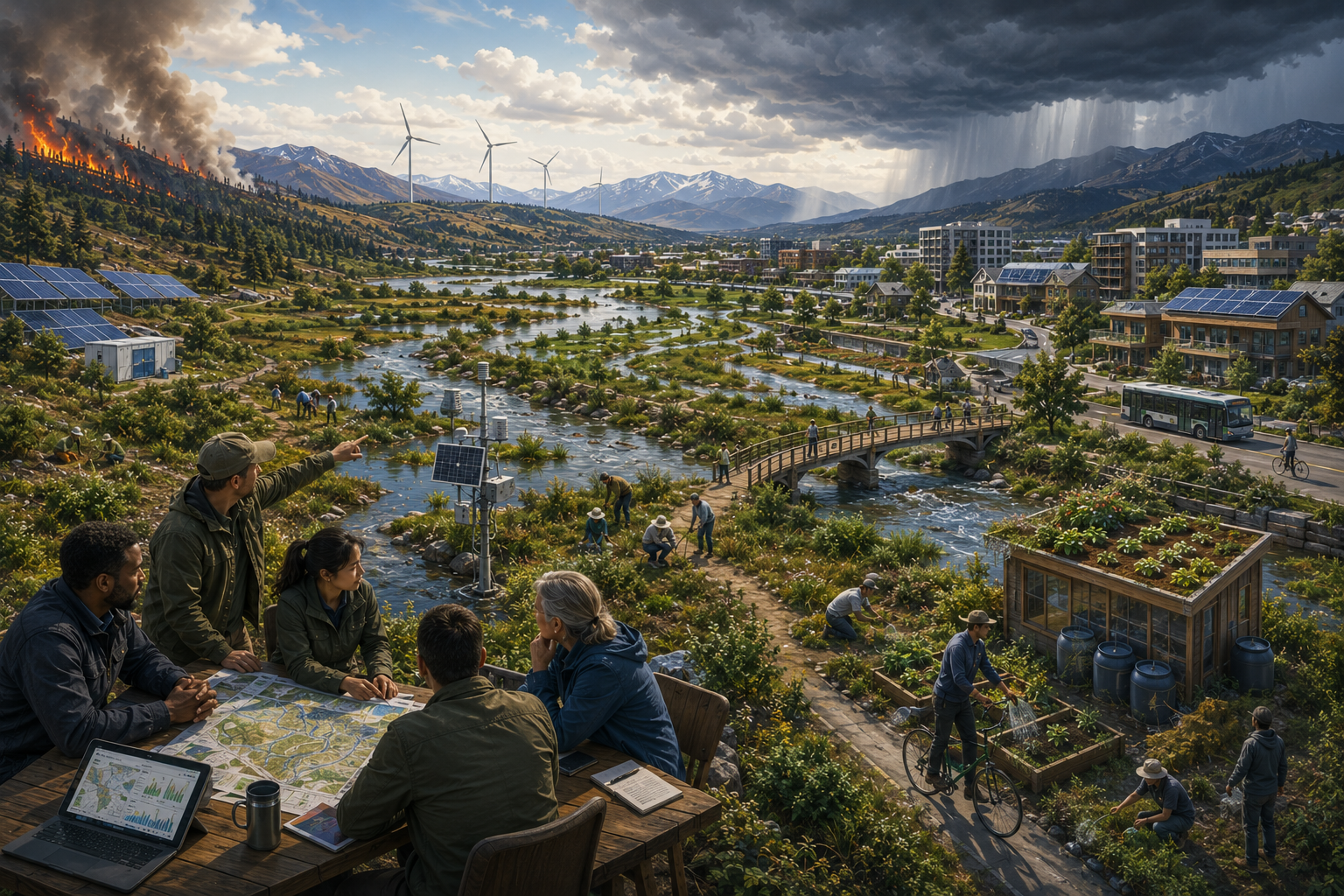
Climate resilience is the capacity of human and natural systems to anticipate, absorb, adapt to, recover from, and transform under climate-related shocks and stresses while preserving essential functions, dignity, ecological integrity, and future development possibilities. It is not simply the ability to survive storms, floods, heatwaves, wildfires, droughts, or sea-level rise. It is the broader capacity to function under changing climatic conditions, learn from disturbance, reduce vulnerability, avoid maladaptation, and protect the people and ecosystems most exposed to harm.
Climate change is not a single disturbance. It is a systemic force that reshapes temperature patterns, hydrological cycles, sea levels, wildfire regimes, ecosystems, food systems, water security, public health, infrastructure stress, housing vulnerability, migration pressures, labor conditions, insurance markets, and political stability over time. It produces acute shocks such as floods, storms, heatwaves, and fires, but also slow-onset pressures such as chronic heat, drought, desertification, permafrost thaw, ocean warming, ecological decline, and long-term sea-level rise. Many systems face both types of stress at once.
This article examines climate resilience as a core concept in resilience thinking, sustainability, risk governance, infrastructure planning, ecosystem stewardship, public health, disaster risk reduction, and climate-resilient development. It explains why climate resilience is a systems problem, how exposure and vulnerability interact, why ecosystems and social institutions are central to adaptation, how maladaptation can deepen future risk, and why justice is not optional. It also extends the conceptual discussion into applied modeling workflows for comparing climate resilience strategies under uncertainty.
What Climate Resilience Means
Climate resilience refers to the ability of systems to cope with climate variability and climate change without losing essential functions, becoming trapped in unacceptable vulnerability, or shifting risk onto already burdened people and ecosystems. It includes preparation, protection, adaptation, recovery, learning, and in some cases transformation. A climate-resilient system is not one that avoids all damage. It is one that can continue or restore essential functions while reducing future vulnerability and preserving long-term viability.
This makes climate resilience broader than emergency response. A city may recover from one flood and still remain highly vulnerable to repeated flooding. An agricultural system may maintain yields temporarily through groundwater depletion, synthetic inputs, or heat-tolerant varieties while becoming less sustainable over time. A coastal community may rebuild after storms while remaining exposed to sea-level rise and insurance withdrawal. A public-health system may respond to heat emergencies while failing to change housing, labor, energy, and care systems that produce heat vulnerability.
Climate resilience also differs from climate mitigation, though the two are inseparable in practice. Mitigation aims to reduce greenhouse gas emissions and limit future warming. Climate resilience focuses on how systems live with climate risks already present or increasingly unavoidable. The strongest climate strategies integrate mitigation and resilience because high-emissions adaptation can create future risk, while mitigation without adaptation leaves people and ecosystems exposed to existing hazards.
| Concept | Primary question | Example |
|---|---|---|
| Mitigation | How can future warming be limited? | Reducing fossil-fuel use, protecting carbon sinks, improving energy efficiency. |
| Adaptation | How can systems adjust to actual or expected climate impacts? | Heat action plans, floodplain restoration, drought-tolerant agriculture, upgraded drainage. |
| Resilience | Can the system function, recover, learn, and adapt under disturbance? | Maintaining essential services, protecting vulnerable groups, preserving ecosystems, revising policies. |
| Transformation | When is deeper structural change necessary? | Relocation from repeatedly flooded areas, redesigned food systems, new land-use pathways. |
Climate resilience is therefore not a narrow technical category. It is a systems capacity that connects environment, infrastructure, institutions, economies, health, justice, and long-term development choices.
Climate Resilience and Resilience Thinking
Climate resilience belongs within resilience thinking because climate change tests the stability, adaptability, thresholds, and feedback structures of coupled systems. It does not simply add more hazards to existing planning frameworks. It changes the conditions under which those frameworks operate. Historical flood maps become less reliable. Old assumptions about cooling demand, wildfire season, crop zones, water supply, ecological range, and infrastructure design standards become unstable. Past performance no longer guarantees future viability.
Resilience thinking asks how systems respond to disturbance, how they maintain essential functions, how they reorganize, and when adaptation within the existing structure is no longer enough. Climate resilience applies those questions to a world in which environmental baselines are shifting. It asks whether systems can operate under new patterns of heat, water, fire, storm, disease, ecological stress, and social vulnerability.
This is why climate resilience connects directly to Adaptive Capacity in Complex Systems, System Thresholds and Tipping Points, Feedback Loops in Resilient Systems, Social-Ecological Systems, Resilience Metrics and Measurement, Modularity and Cascading Failure, and Resilience Indicators and Dashboard Risk.
Climate resilience through a resilience-thinking lens
Disturbance
Climate change increases the frequency, intensity, duration, and compounding nature of many shocks and stresses.
Feedback
Climate impacts interact with ecological, social, infrastructural, and economic feedback loops.
Thresholds
Systems may cross limits where recovery becomes harder, costlier, or impossible under old assumptions.
Adaptive capacity
Systems must learn, reorganize, and revise strategy as climate conditions change.
Transformation
Some risks cannot be managed through incremental adjustment alone.
Justice
Climate impacts are filtered through unequal exposure, unequal protection, and unequal recovery capacity.
Climate resilience is strongest when it is treated not as a checklist, but as a way of governing complex systems under changing environmental reality.
Climate-Resilient Development
Climate-resilient development emphasizes that adaptation, mitigation, and development choices are inseparable. Development pathways shape exposure, vulnerability, emissions, adaptive capacity, ecosystem condition, and future risk. A society does not become resilient only by adding protective infrastructure after climate risk appears. It becomes resilient—or more fragile—through housing patterns, transportation systems, energy systems, land use, food systems, water governance, public health, labor protections, ecosystem stewardship, and social policy.
This is a crucial shift. Climate resilience is not only about technical adaptation projects. It is about the structure of development itself. A development model that builds in floodplains, removes wetlands, expands car-dependent heat islands, concentrates poverty, underfunds public health, privatizes risk, and ignores ecological limits can produce economic growth while eroding resilience. By contrast, development that reduces exposure, strengthens social protection, protects ecosystems, invests in public infrastructure, and expands adaptive capacity can reduce climate risk before the next disaster occurs.
| Development choice | Resilience effect | Risk if poorly governed |
|---|---|---|
| Land-use planning | Can reduce exposure to flood, fire, heat, and sea-level rise | Can concentrate risk in marginalized areas if power and property interests dominate. |
| Infrastructure investment | Can maintain essential services under climate stress | Can harden existing inequity or create maladaptive lock-in. |
| Ecosystem protection | Can preserve flood buffering, cooling, water regulation, and biodiversity | Can become symbolic if restoration ignores climate thresholds and local communities. |
| Housing policy | Can reduce heat, flood, and displacement vulnerability | Can produce green gentrification or relocation without justice. |
| Public health capacity | Can reduce mortality and morbidity during heat, smoke, disease, and disaster | Can fail if it ignores labor, housing, trust, and access. |
Climate-resilient development asks whether development pathways make future life more viable, more just, and less vulnerable under changing climate conditions.
Why Climate Resilience Matters
Climate resilience matters because climate risks are already interacting with weaknesses in infrastructure, ecosystems, institutions, markets, public health, and social systems. Heat stress affects health, labor productivity, electricity demand, transportation reliability, and urban habitability. Flooding disrupts housing, schools, transit, water systems, communications, livelihoods, and public budgets. Drought affects agriculture, hydropower, ecosystems, food prices, migration, and regional stability. Wildfire affects air quality, insurance, land management, public health, energy infrastructure, and community continuity.
The same hazard can produce radically different outcomes depending on system structure. A heatwave is more dangerous where housing is poorly insulated, power is unreliable, tree canopy is sparse, outdoor workers lack protections, older adults are isolated, public health is underfunded, and energy costs are high. A flood is more damaging where wetlands have been destroyed, drainage systems are undermaintained, housing is insecure, transportation options are limited, and public recovery programs are slow or exclusionary.
Climate resilience is therefore not only about climate. It is about the conditions through which climate stress becomes harm.
Why climate resilience is a public systems priority
Climate hazards are intensifying
Many systems face more frequent, severe, longer-lasting, or compound environmental stress.
Historical baselines are weakening
Design standards based on past climate conditions may no longer match future risk.
Vulnerability is unequal
Exposure and recovery capacity are shaped by income, race, health, housing, labor, geography, and political power.
Infrastructure is interdependent
Failure in one system can cascade into water, power, health, transport, communications, and supply chains.
Ecosystems are protective infrastructure
Wetlands, forests, soils, rivers, mangroves, grasslands, and biodiversity support resilience.
Delay increases future cost
Underinvestment can turn manageable adaptation into crisis response or forced transformation.
Climate resilience matters because the future cost of inaction is not evenly distributed, and the people least responsible for climate risk are often most exposed to its consequences.
Climate Risks Are Systemic
Climate risks are systemic because they do not remain neatly contained within one sector. A drought can affect water supply, agriculture, hydropower, ecosystems, food prices, migration, public finance, and political stability. A heatwave can strain health systems, electricity grids, labor systems, schools, transport, housing, and water infrastructure simultaneously. A flood can damage housing, roads, water treatment, communications, hospitals, supply chains, and local tax bases in one event.
This systemic quality is one of the main reasons climate resilience cannot be built through isolated interventions alone. A stormwater upgrade may fail if land-use patterns continue increasing runoff. A hospital climate plan may fail if power, transport, staffing, and supply chains are not resilient. A heat plan may fail if renters lack cooling, outdoor workers lack labor protections, and electricity bills force households to choose between safety and affordability.
| Climate stress | Possible systemic effects | Resilience implication |
|---|---|---|
| Heatwave | Health emergencies, power demand, labor risk, school disruption, water stress, transport failure | Requires housing, energy, labor, public health, urban design, and social protection coordination. |
| Flood | Housing loss, infrastructure damage, contamination, displacement, business interruption, public debt | Requires watershed planning, drainage, housing policy, emergency support, and ecological buffers. |
| Drought | Crop loss, food prices, hydropower decline, groundwater depletion, ecosystem stress, conflict over allocation | Requires water governance, agricultural adaptation, demand management, and ecosystem protection. |
| Wildfire | Air pollution, evacuation, housing loss, grid risk, insurance withdrawal, ecosystem change, trauma | Requires land management, health preparedness, housing policy, energy planning, and community support. |
| Sea-level rise | Coastal flooding, salinization, infrastructure loss, displacement, insurance retreat, cultural loss | Requires long-term planning, managed retreat where necessary, ecosystem protection, and justice safeguards. |
A systems approach to climate resilience asks how hazards move through dependencies, feedback loops, institutional decisions, and social inequalities.
Shocks, Stresses, and Slow-Onset Change
Climate resilience requires attention to both shocks and stresses. Shocks are acute events: floods, storms, heatwaves, wildfires, landslides, extreme precipitation, cold snaps, or storm surges. Stresses are chronic pressures: rising temperatures, drought, ecological decline, water scarcity, sea-level rise, salinization, glacier loss, desertification, health burden, insurance retreat, migration pressure, or repeated infrastructure strain.
Many climate failures occur when chronic stress erodes capacity before an acute shock arrives. A heatwave is more dangerous after years of housing insecurity, utility burden, tree canopy loss, and chronic illness. A flood is more damaging after decades of wetland loss, impervious surfaces, undermaintained drainage, and disinvestment. A drought becomes crisis when groundwater, soil health, crop diversity, and governance trust have already declined.
| Risk type | Time pattern | Example | Resilience response |
|---|---|---|---|
| Acute shock | Sudden, high-impact disturbance | Flood, heatwave, wildfire, storm surge | Emergency response, continuity planning, rapid recovery, early warning. |
| Chronic stress | Persistent pressure that erodes capacity | Water scarcity, chronic heat, underinsurance, infrastructure backlog | Long-term adaptation, public investment, social protection, ecological restoration. |
| Slow-onset change | Gradual environmental transformation | Sea-level rise, desertification, salinization, ecosystem range shifts | Pathway planning, threshold monitoring, relocation where necessary, transformation. |
| Compound risk | Multiple hazards or stresses interacting | Heat plus drought plus wildfire smoke plus grid stress | Cross-sector planning, redundancy, cascading-risk analysis, integrated governance. |
Climate resilience is weakened when planning focuses only on the dramatic event and ignores the slow erosion of capacity that makes the event more damaging.
Exposure, Vulnerability, and Adaptive Capacity
Climate risk is often understood through the interaction of hazard, exposure, vulnerability, and adaptive capacity. A hazard is the climate-related event or process. Exposure describes who or what is in harm’s way. Vulnerability describes susceptibility to harm. Adaptive capacity describes the ability to adjust, prepare, recover, learn, and transform.
This framework matters because climate resilience is not only about reducing hazards. Many hazards are intensified by global climate change and cannot be eliminated locally. But exposure and vulnerability can be reduced, and adaptive capacity can be strengthened. Land-use policy can reduce flood exposure. Housing policy can reduce heat vulnerability. Health systems can reduce mortality. Ecosystem restoration can reduce flood and drought impacts. Governance can improve learning and coordination.
| Risk component | Question | Example intervention |
|---|---|---|
| Hazard | What climate event or process creates potential harm? | Heatwave, flood, drought, wildfire, storm surge, sea-level rise. |
| Exposure | Who or what is located where harm can occur? | Restrict development in high-risk zones, protect floodplains, redesign evacuation access. |
| Vulnerability | Who or what is likely to suffer severe harm if exposed? | Improve housing, healthcare, income security, water access, labor protections, ecosystem condition. |
| Adaptive capacity | Can the system learn, adjust, and reorganize? | Monitoring, flexible governance, community participation, funding, institutional learning. |
| Residual risk | What risk remains after adaptation? | Insurance reform, managed retreat, social protection, contingency planning, transformation pathways. |
Climate resilience policy becomes more powerful when it stops treating harm as natural and starts asking how social, ecological, and infrastructural conditions turn hazards into disaster.
Core Dimensions of Climate Resilience
Although climate resilience is applied across many fields, several recurring dimensions appear across research and practice. These dimensions are not independent. Exposure reduction, vulnerability reduction, adaptive capacity, recovery capacity, and transformative capacity interact. A system that improves one dimension while weakening another may not become more resilient overall.
Exposure Reduction
Exposure reduction means limiting the degree to which people, ecosystems, infrastructure, services, and assets are placed in harm’s way. It includes land-use planning, managed retreat where necessary, coastal buffer protection, floodplain restoration, wildfire defensible space, heat-sensitive urban design, and avoiding development in high-risk areas.
Vulnerability Reduction
Vulnerability reduction addresses the conditions that make exposed systems more likely to suffer harm. It includes poverty reduction, public health capacity, stronger housing, reliable energy access, water security, insurance access, labor protections, ecological restoration, and institutional trust.
Adaptive Capacity
Adaptive capacity is the ability to adjust behavior, rules, designs, investments, knowledge systems, and governance arrangements as climate conditions change. It depends on monitoring, learning, flexibility, participation, funding, institutional memory, and the ability to revise assumptions.
Recovery Capacity
Recovery capacity is the ability to restore essential functions after climate shocks. It includes emergency response, repair capacity, social protection, mutual aid, infrastructure redundancy, public finance, healthcare access, housing support, and governance continuity.
Transformative Capacity
Transformative capacity is the ability to make deeper structural changes when incremental adaptation is insufficient. It may involve relocating settlements, redesigning agriculture, changing water allocation, transforming energy systems, rethinking development pathways, or restoring ecosystems at landscape scale.
| Dimension | Primary focus | Failure if neglected |
|---|---|---|
| Exposure reduction | Keeping people and assets out of harm’s way | Repeated loss from avoidable placement in high-risk zones. |
| Vulnerability reduction | Reducing susceptibility to harm | Hazards produce disproportionate damage among already burdened groups. |
| Adaptive capacity | Learning and adjusting under uncertainty | Plans become obsolete as climate conditions change. |
| Recovery capacity | Restoring essential functions after disturbance | Temporary disruption becomes long-term decline or displacement. |
| Transformative capacity | Changing systems when old arrangements no longer work | Resources are spent preserving fragile or unjust pathways. |
Climate resilience is a portfolio of capacities. It cannot be reduced to infrastructure hardening, disaster response, or adaptation planning alone.
Ecosystems and Nature-Based Climate Resilience
Ecosystems play a central role in climate resilience because they are both affected by climate change and vital to adaptation. Wetlands buffer floods. Mangroves reduce coastal storm impacts. Forests influence hydrology, carbon storage, slope stability, cooling, and biodiversity. Grasslands and soils affect water retention, drought resilience, and carbon cycling. Rivers, lakes, watersheds, reefs, floodplains, and urban green spaces all shape climate risk.
This is why ecosystem-based adaptation and nature-based solutions have become important in climate policy. Protecting and restoring ecosystems is not only a conservation strategy. It is also a resilience strategy. Systems that degrade ecological buffers often become more climate-vulnerable even if they appear productive in the short term.
At the same time, ecosystems themselves require resilience. Climate change can push ecosystems toward thresholds, alter species ranges, intensify disturbance regimes, increase invasive species pressure, and reduce ecological memory. A restored wetland may not provide future buffering if upstream hydrology, heat stress, pollution, or land conversion continues to undermine it. Nature-based resilience therefore requires ecological realism, not decorative greening.
| Ecosystem feature | Climate resilience function | Risk if degraded |
|---|---|---|
| Wetlands and floodplains | Store water, reduce flood peaks, improve water quality, support biodiversity | Flood risk increases and downstream communities face greater exposure. |
| Mangroves and coastal marshes | Reduce wave energy, protect coasts, store carbon, support fisheries | Storm surge, erosion, and livelihood vulnerability intensify. |
| Forests | Regulate water, store carbon, moderate heat, stabilize soils, support habitat | Fire risk, erosion, biodiversity loss, and hydrological instability rise. |
| Soils | Store carbon, retain water, support crops and vegetation recovery | Drought vulnerability, crop failure, erosion, and runoff increase. |
| Urban tree canopy | Reduces heat, improves air quality, supports public health and stormwater absorption | Heat islands intensify and public-health burdens become unequal. |
Climate resilience is strengthened when ecosystems are treated as living infrastructure, not as scenery or compensatory offsets.
Urban and Infrastructure Climate Resilience
Cities and infrastructures are among the most visible arenas of climate resilience because climate impacts concentrate where people, buildings, networks, and services are dense. Urban resilience involves managing heat, flood exposure, water stress, energy reliability, transport continuity, housing risk, health vulnerability, and economic disruption under changing climate conditions.
Infrastructure resilience depends on more than physical strength. It also depends on modularity, reserve capacity, diversified supply lines, recovery planning, maintenance, real-time monitoring, and the ability to function under new environmental baselines. A drainage system designed for historical rainfall may fail under intensified precipitation. A power grid may face new stress from prolonged heat, wildfire exposure, electrification, peak demand, or cooling dependence. Buildings and public spaces may need redesign to manage rising heat rather than occasional disaster response.
Infrastructure climate resilience priorities
Design for future baselines
Update standards for rainfall, heat, fire, flood, storm surge, and sea-level rise rather than relying only on historical averages.
Protect critical functions
Prioritize water, power, healthcare, communications, transport, cooling, shelter, and emergency response.
Reduce cascading failure
Map interdependencies across electricity, water, health, transport, communications, and supply chains.
Build redundancy and modularity
Use distributed systems, backups, local capacity, and isolation options to prevent total failure.
Maintain assets
Deferred maintenance is climate vulnerability because stressed assets fail faster under extreme conditions.
Design for equity
Ensure adaptation investments protect communities with the greatest exposure and lowest recovery capacity.
Infrastructure climate resilience is not simply hardening. It is redesigning systems to remain viable under changing climatic assumptions.
Food, Water, and Energy Systems
Food, water, and energy systems are deeply climate-sensitive and deeply interconnected. Drought affects crops, hydropower, groundwater, livestock, ecosystems, and food prices. Heat affects crop yields, worker safety, energy demand, refrigeration, transport, and water consumption. Flooding affects soil, storage, contamination, logistics, and household access. Energy failures can disrupt irrigation, water treatment, refrigeration, hospitals, and communications.
Climate resilience in food-water-energy systems therefore requires integrated planning. It is not enough to improve one sector while increasing stress in another. Expanding irrigation may support crops in the short term while depleting groundwater. Increasing air conditioning may reduce heat mortality while increasing electricity demand and emissions if the grid remains fossil-dependent and fragile. Building reservoirs may support water storage while disrupting ecosystems, communities, and sediment flows if poorly governed.
| System | Climate resilience concerns | Resilience strategies |
|---|---|---|
| Food systems | Heat, drought, flood, pests, soil loss, supply-chain disruption, price volatility | Crop diversity, soil health, regional storage, resilient logistics, farmer support, food access programs. |
| Water systems | Drought, flood, contamination, groundwater decline, infrastructure stress, allocation conflict | Demand management, watershed restoration, leak reduction, reuse, equitable allocation, monitoring. |
| Energy systems | Heat demand, wildfire exposure, storm damage, fuel disruption, grid overload, cooling dependence | Distributed renewables, storage, microgrids, efficiency, demand response, critical-service islanding. |
| Food-water-energy nexus | Interdependencies among irrigation, power, cooling, transport, production, and household security | Integrated planning, scenario stress testing, cross-sector governance, public investment. |
Climate resilience requires seeing these systems as linked, not separate policy silos.
Public Health, Labor, and Human Well-Being
Climate resilience is fundamentally about human well-being. Heatwaves, wildfire smoke, floods, drought, storms, infectious disease shifts, food insecurity, water contamination, displacement, and trauma all have public-health consequences. These harms are mediated by housing, labor conditions, healthcare access, income, age, disability, geography, language access, social isolation, and institutional trust.
Heat is one of the clearest examples. Heat risk is not only a temperature problem. It is a housing problem, labor problem, energy problem, health problem, urban design problem, and inequality problem. Outdoor workers, older adults, children, people with chronic illness, unhoused people, incarcerated people, tenants in poor-quality housing, and households facing utility shutoffs may experience heat as a direct threat to life.
Climate resilience must therefore include public-health preparedness, care infrastructure, labor protections, cooling access, trusted communication, clean air shelters, mental-health support, community outreach, and social protection. It must also include prevention: reducing heat islands, improving housing, protecting workers, strengthening healthcare systems, and reducing exposure before emergencies occur.
| Climate health pathway | Who may be especially exposed | Resilience response |
|---|---|---|
| Extreme heat | Older adults, outdoor workers, tenants, children, people with chronic illness, unhoused people | Cooling access, labor standards, housing retrofits, tree canopy, energy affordability, outreach. |
| Wildfire smoke | People with respiratory conditions, children, outdoor workers, low-income households | Clean air shelters, filtration, worker protections, monitoring, health communication. |
| Flooding | Residents in flood-prone housing, renters, people with limited mobility, low-income households | Safe housing, evacuation support, sanitation, recovery assistance, mold remediation. |
| Drought and food insecurity | Farmworkers, small farmers, rural communities, low-income households | Water security, food assistance, resilient agriculture, worker protections, livelihood support. |
| Displacement and trauma | Communities facing repeated disaster, relocation, cultural loss, or livelihood disruption | Mental-health care, housing support, participatory relocation, community continuity. |
A climate-resilient society protects bodies, homes, livelihoods, relationships, and places—not only assets and infrastructure.
Climate Resilience in Social-Ecological Systems
Climate resilience is especially important in social-ecological systems, where environmental processes and human systems are tightly linked. Agricultural systems, fisheries, forests, river basins, coastal zones, rangelands, wetlands, and urban watersheds are all shaped by ecological dynamics, governance, livelihoods, technology, markets, and cultural practices.
In these systems, climate resilience cannot be understood purely as ecological robustness or social preparedness. It emerges from the coupled system. Water availability, biodiversity, crop diversity, fishing rights, infrastructure, market access, local knowledge, public policy, and ecological thresholds may all matter at once. A climate shock may expose weaknesses not in one component, but in how the components interact.
Social-ecological climate resilience questions
Ecological function
Are soils, watersheds, habitats, species, and disturbance regimes able to sustain recovery?
Livelihood viability
Can people continue meaningful livelihoods under changing climate conditions?
Governance flexibility
Can rules, rights, and institutions adapt as environmental conditions change?
Knowledge diversity
Are local, Indigenous, scientific, technical, and lived forms of knowledge integrated?
Threshold awareness
Are there ecological or social boundaries beyond which recovery becomes difficult?
Justice and power
Who controls resources, adaptation choices, relocation decisions, and recovery benefits?
Climate change is a master stressor of social-ecological systems because it changes ecological conditions and social choices at the same time.
Compound Risk, Cascading Failure, and Climate Stress
Climate risks often compound. A region may face drought, heat, wildfire smoke, grid stress, crop failure, and water restrictions together. A coastal storm may coincide with high tide, saturated soils, power outages, fuel disruption, communications failure, and evacuation congestion. A heatwave may coincide with poor air quality, hospital crowding, labor risk, and housing insecurity. These interactions can produce impacts larger than the sum of separate hazards.
Cascading failure occurs when disruption spreads across dependent systems. Climate stress can trigger or amplify cascades because infrastructure, ecosystems, social systems, and institutions depend on one another. A flood can damage power. Power loss can disrupt water treatment. Water disruption can affect hospitals. Hospital stress can affect public health. Public-health stress can affect workforce availability. Workforce disruption can slow repair.
| Initial climate stress | Possible cascade | Resilience strategy |
|---|---|---|
| Heatwave | Cooling demand → grid stress → outage → health emergency → hospital surge | Building efficiency, distributed energy, cooling centers, demand response, health outreach. |
| Flood | Road closures → supply disruption → delayed emergency response → prolonged recovery | Alternative routes, local storage, resilient transport, neighborhood hubs. |
| Drought | Water shortage → crop loss → food prices → household insecurity → public-health burden | Water governance, resilient agriculture, food assistance, soil health, demand management. |
| Wildfire | Fire damage → smoke exposure → evacuation → grid shutdown → displacement | Fuel management, clean air shelters, grid resilience, evacuation planning, housing support. |
Climate resilience must therefore include dependency mapping, cascade-risk analysis, modularity, redundancy, and coordination across sectors.
Adaptation and Maladaptation
Not all adaptation increases resilience. Some responses reduce short-term risk while increasing long-term vulnerability, shifting risk to other places, or locking systems into fragile pathways. This is maladaptation. It is one of the most important concepts in climate resilience because it forces adaptation to be evaluated systemically rather than by project intent alone.
Examples include flood defenses that protect one area while worsening flood risk downstream; cooling strategies that increase emissions and grid fragility; groundwater pumping that sustains agriculture while depleting aquifers; wildfire suppression that increases fuel accumulation; insurance systems that encourage rebuilding in repeatedly damaged zones; or climate infrastructure that protects high-value property while displacing low-income residents.
Common forms of maladaptation
Risk transfer
An intervention protects one group, sector, or place by increasing risk elsewhere.
Short-term relief, long-term fragility
A solution works temporarily while eroding future capacity.
Emissions-intensive adaptation
Adaptation increases energy demand or emissions in ways that worsen future climate risk.
Lock-in
Infrastructure or policy commits a system to a pathway that becomes unsafe under future conditions.
Social exclusion
Adaptation protects assets while increasing displacement, inequality, or loss of access.
False security
Protective infrastructure encourages more exposure in hazardous areas.
Climate resilience asks whether adaptation improves long-term system viability, not only whether it reduces immediate visible risk.
Managed Retreat, Transformation, and Difficult Choices
Some climate risks cannot be solved through incremental adaptation. Repeated flooding, chronic coastal erosion, wildfire exposure, desertification, salinization, water scarcity, or loss of habitability may eventually require transformation. This can include managed retreat, land-use change, infrastructure relocation, livelihood transition, ecosystem restoration, or redesigned settlement patterns.
Transformation is difficult because it involves grief, identity, property, cultural memory, political power, public finance, and distributional justice. The question is not only whether relocation or transformation is technically necessary. It is who decides, who pays, who benefits, who loses, what history is preserved, and whether affected people have real authority over the process.
Managed retreat is especially sensitive. If imposed from above, it can become displacement. If delayed too long, it can leave communities exposed to repeated harm. If designed with justice, participation, compensation, cultural continuity, and public investment, it can become part of a climate-resilient pathway.
| Transformation question | Why it matters | Responsible approach |
|---|---|---|
| Is incremental adaptation still viable? | Some systems reach limits where continued defense is unsafe or unjust | Use thresholds, scenarios, cost, harm, and community-defined values. |
| Who defines acceptable risk? | Technical risk estimates may ignore lived experience and cultural meaning | Include affected communities in defining risk, loss, and acceptable pathways. |
| Who pays? | Adaptation and relocation costs can deepen inequality | Use public finance, compensation, social protection, and anti-displacement safeguards. |
| What is preserved? | Places contain memory, culture, relationships, livelihoods, and identity | Protect community continuity, cultural heritage, and social networks. |
| What future is created? | Transformation should not only remove risk; it should expand viable futures | Connect retreat or redesign to housing, livelihoods, public services, and ecological repair. |
Transformation is not a failure of resilience. It can be resilience when the existing system has become unsafe, unjust, or ecologically untenable.
Equity, Justice, and Climate Resilience
Climate resilience is inseparable from equity and justice because climate vulnerability is unevenly distributed. Low-income communities, marginalized populations, Indigenous peoples, informal settlements, climate-sensitive livelihoods, incarcerated people, disabled people, older adults, children, migrants, renters, outdoor workers, and communities facing historical disinvestment often face greater exposure and lower adaptive capacity.
Justice matters because aggregate resilience can hide unequal harm. A city may improve overall resilience indicators while some neighborhoods remain exposed to heat, flooding, pollution, power outages, and delayed recovery. A country may protect valuable infrastructure while rural communities, informal workers, or coastal cultures absorb loss. A climate adaptation project may reduce risk for property owners while displacing renters or excluding people without formal land title.
Climate resilience must therefore ask: resilience for whom, to what, at whose expense, and under whose authority?
| Justice dimension | Climate resilience question | Example |
|---|---|---|
| Distributive justice | Who receives protection, investment, and recovery support? | Cooling centers, flood defenses, housing retrofits, public health outreach. |
| Procedural justice | Who participates in defining risk and adaptation pathways? | Community-led planning, Indigenous governance, worker participation, public hearings with real authority. |
| Recognitional justice | Whose knowledge, identity, culture, and history are respected? | Local knowledge, cultural sites, ancestral land, oral history, lived experience of harm. |
| Restorative justice | How are past harms addressed? | Investment in disinvested communities, pollution repair, anti-displacement protections. |
| Intergenerational justice | What risks are shifted to future generations? | Emissions, debt, ecological degradation, unsafe development, long-lived infrastructure lock-in. |
Climate resilience without justice can become protection for the already protected. Serious climate resilience must reduce vulnerability where it is deepest, not merely defend the most valuable assets.
Local Knowledge, Participation, and Legitimacy
Climate resilience depends on knowledge, but not only expert modeling. Local communities often know where flooding occurs before maps reflect it, which homes overheat, which roads fail, which households need help, which institutions are trusted, which ecological changes are visible, and which official plans do not work under real conditions. Workers know operational fragility. Indigenous communities may hold long-term ecological knowledge that reveals change across generations. Farmers, fishers, caregivers, tenants, and neighborhood groups often detect weak signals before formal systems do.
Participation is therefore not a decorative legitimacy exercise. It is a knowledge function. It improves risk identification, indicator design, emergency response, adaptation priorities, and accountability. But participation must be meaningful. Consultation without authority can become extraction. Community reporting without investment can become surveillance. Climate resilience requires participation that shapes decisions, budgets, timelines, and governance structures.
Knowledge sources for climate resilience
Residents
Know lived exposure, informal recovery costs, local routes, housing risks, and trust conditions.
Workers
Know operational bottlenecks, unsafe conditions, workarounds, maintenance gaps, and service fragility.
Indigenous and local stewards
Know ecological change, seasonal patterns, cultural landscapes, and long-term environmental memory.
Public agencies
Hold regulatory authority, infrastructure records, planning tools, emergency protocols, and public finance capacity.
Scientists and modelers
Provide climate projections, hazard analysis, uncertainty methods, ecological monitoring, and systems modeling.
Community organizations
Connect trust, outreach, mutual aid, social vulnerability, and practical response capacity.
Climate resilience improves when different forms of knowledge are brought into accountable relationship rather than ranked as official and unofficial truth.
Measuring Climate Resilience
Climate resilience is difficult to measure because it is multidimensional, system-specific, time-dependent, and partly visible only under stress. Measurement often combines indicators of exposure, vulnerability, adaptive capacity, infrastructure robustness, ecosystem condition, recovery time, institutional readiness, social protection, and threshold proximity. No single score can fully capture climate resilience.
The strongest measurement systems combine structural indicators, performance indicators, participatory indicators, and scenario-based stress testing. Structural indicators show underlying conditions before disturbance. Performance indicators show how the system behaves during and after disturbance. Participatory indicators show lived experience and local knowledge. Scenario tests ask how the system may behave under future climate conditions.
| Measurement domain | Example indicator | Dashboard risk |
|---|---|---|
| Exposure | Population, infrastructure, or ecosystem function exposed to flood, heat, fire, or drought | Exposure may be hidden if mapped too coarsely. |
| Vulnerability | Housing quality, health burden, income insecurity, ecological degradation, service dependency | Aggregate measures can hide unequal harm. |
| Adaptive capacity | Monitoring quality, governance flexibility, funding access, community participation, institutional learning | Plans may be counted as capacity even when implementation is weak. |
| Recovery capacity | Time to restore essential services, repair backlog, social protection access, recovery funding | Fast recovery for some groups can hide prolonged recovery for others. |
| Threshold proximity | Groundwater decline, repeated heat exceedance, ecological warning signals, infrastructure overload | Threshold risk may disappear inside composite averages. |
| Justice | Disaggregated exposure, recovery time, access to protection, repair priority, participation | Justice may be treated as a secondary variable rather than central resilience evidence. |
Because climate change is dynamic, climate resilience metrics must also be dynamic. A system that is resilient under present warming may not remain resilient under stronger future stress.
Thresholds, Tipping Points, and Decision Triggers
Climate resilience is deeply shaped by thresholds and tipping points. Some climate-related risks accumulate gradually and then intensify rapidly once critical boundaries are crossed. This can happen in ecological systems, water systems, infrastructure tolerances, public-health capacity, insurance markets, and social responses to repeated loss.
Thresholds matter because resilience planning that focuses only on average loss can miss nonlinear change. A drainage system may handle storms until rainfall intensity exceeds design limits. A power grid may operate until heat-driven demand overwhelms capacity. A forest may recover from fire until repeated heat and drought prevent regeneration. A community may rebuild after disasters until insurance, debt, trauma, and repeated displacement make recovery impossible.
| Threshold type | Example | Decision trigger |
|---|---|---|
| Infrastructure threshold | Stormwater system repeatedly exceeds design capacity | Upgrade design standards, restrict development, restore flood storage, activate capital planning. |
| Ecological threshold | Forest regeneration fails after repeated drought and fire | Shift restoration strategy, protect refugia, revise fire management, consider transformation pathways. |
| Public-health threshold | Heat emergencies exceed hospital and outreach capacity | Expand cooling systems, labor protections, housing retrofits, and public-health staffing. |
| Social threshold | Repeated disasters trigger displacement, debt, and loss of trust | Invest in recovery justice, housing security, relocation options, and institutional repair. |
| Financial threshold | Insurance withdrawal makes rebuilding unaffordable | Reform risk finance, restrict unsafe rebuilding, fund adaptation and managed retreat. |
Climate resilience requires decision triggers that identify when existing adaptation is no longer enough.
Governance and Institutional Capacity
Governance is one of the strongest determinants of climate resilience because adaptation requires coordination across sectors, scales, institutions, and time horizons. Climate risks cut across infrastructure, land use, public health, environment, agriculture, housing, finance, emergency management, labor policy, and social protection. Weak coordination can turn manageable pressures into cascading failures.
Resilient governance is anticipatory, flexible, participatory, transparent, and capable of learning. It integrates climate information into planning, invests before crises become catastrophic, revises strategies as conditions change, and remains accountable to affected communities. It does not wait for disaster to make risk politically visible.
Governance capacities for climate resilience
Anticipatory planning
Uses scenarios, projections, and stress tests to prepare before climate impacts become crisis.
Cross-sector coordination
Connects land use, infrastructure, health, environment, housing, energy, and finance.
Adaptive learning
Updates policies as monitoring, experience, and climate conditions change.
Public accountability
Makes responsibilities, funding, indicators, and implementation visible.
Participatory legitimacy
Includes affected communities in defining risk, priorities, and adaptation pathways.
Institutional memory
Preserves lessons from past disasters, near misses, repairs, and community warnings.
Without institutions capable of interpreting risk and acting on it, technical solutions alone are not enough.
Climate Finance, Public Investment, and Resilience Capacity
Climate resilience requires investment. Early warning systems, housing retrofits, stormwater upgrades, ecosystem restoration, public health capacity, cooling access, resilient energy, water security, transportation redesign, and social protection all require funding. Underinvestment can create a false economy: costs are deferred until they appear as disaster recovery, health burden, displacement, ecological loss, or infrastructure failure.
Finance also shapes justice. Wealthier households, firms, and jurisdictions may be able to purchase private resilience: insurance, backup power, relocation, air filtration, private cooling, and emergency reserves. Lower-income communities may be left with public fragility. If public investment does not correct this imbalance, climate resilience becomes privatized protection for those already able to protect themselves.
| Investment area | Resilience function | Justice concern |
|---|---|---|
| Housing retrofits | Reduce heat, flood, mold, and energy vulnerability | Must protect renters and prevent green displacement. |
| Public health | Reduce mortality, disease burden, smoke exposure, and heat risk | Must reach communities with lower access and higher exposure. |
| Ecosystem restoration | Restore flood buffering, cooling, water regulation, and biodiversity | Must include local stewardship and avoid exclusionary conservation. |
| Infrastructure adaptation | Maintain essential services under future climate stress | Must not prioritize only high-property-value areas. |
| Social protection | Support recovery, relocation, income stability, and household resilience | Must include informal workers, migrants, renters, and vulnerable households. |
Climate resilience depends on whether societies are willing to fund prevention, repair, and adaptation before catastrophe forces the issue.
A Practical Framework for Climate Resilience Planning
Climate resilience planning should move from system definition to action, not from generic vulnerability language to generic project lists. A practical framework begins by defining the system, the climate hazards, the essential functions, the people and ecosystems at risk, the thresholds that matter, and the governance decisions that must follow.
| Step | Question | Output |
|---|---|---|
| Define the system | Resilience of what? | System boundary, essential functions, sectors, populations, ecosystems. |
| Identify climate stresses | Resilience to what? | Hazard profile, slow-onset risks, compound scenarios, future baselines. |
| Assess exposure | Who and what is in harm’s way? | Exposure maps, asset inventories, community vulnerability profiles. |
| Assess vulnerability | Why does exposure become harm? | Housing, health, ecosystem, infrastructure, income, governance, and access indicators. |
| Map dependencies | How could climate stress cascade? | Infrastructure, supply-chain, ecological, social, and institutional dependency maps. |
| Evaluate capacities | What buffers, backups, knowledge, and institutions exist? | Adaptive capacity, recovery capacity, social protection, ecosystem function, governance review. |
| Identify thresholds | When does incremental adaptation fail? | Decision triggers, escalation levels, transformation pathways. |
| Design interventions | What reduces risk without creating maladaptation? | Portfolio of exposure reduction, vulnerability reduction, ecosystem protection, infrastructure, and governance actions. |
| Monitor and revise | How will learning change action? | Indicators, dashboards, after-action review, participatory monitoring, adaptation updates. |
This framework treats climate resilience as a living governance process, not a one-time plan.
Mathematical Lens: Modeling Exposure, Vulnerability, Adaptation, and Recovery
Climate resilience is not reducible to a single metric, but formal models can clarify the dimensions that must be balanced. One useful abstraction is to treat climate resilience \(R_i\) as a function of exposure reduction, vulnerability reduction, adaptive capacity, recovery capacity, and transformative capacity:
R_i = w_e E_i + w_v V_i + w_a A_i + w_r Q_i + w_t T_i
\]
Interpretation: \(E_i\) represents reduced exposure, \(V_i\) reduced vulnerability, \(A_i\) adaptive capacity, \(Q_i\) recovery capacity, and \(T_i\) transformative capacity. The weights reflect analytical priorities and value judgments.
This model is useful not because it produces a perfect score, but because it makes trade-offs explicit. A strategy may reduce exposure but do little for vulnerability. Another may strengthen recovery but fail to address future thresholds. Another may improve adaptive capacity while leaving current harm unaddressed.
System performance under climate stress can also be expressed dynamically. Let functional performance at time \(t\) be \(F_t\), climate stress intensity be \(K_t\), adaptive response be \(A_t\), and recovery support be \(S_t\):
F_{t+1} = F_t – \alpha K_t + \beta A_t + \gamma S_t
\]
Interpretation: Performance under climate stress depends not only on disturbance severity, but on whether adaptation and recovery support can prevent losses from becoming structural.
Because climate resilience depends on pathways rather than single interventions, expected resilience across possible adaptation pathways can be represented as:
E(P) = \sum_{j=1}^{n} p_j R_j
\]
Interpretation: Each pathway \(j\) has a probability \(p_j\) of sustaining long-term viability and a resilience value \(R_j\). Scenario analysis helps compare pathways under uncertainty.
A justice-adjusted resilience score can include a penalty for unequal exposure or unequal recovery:
R_i^{*} = R_i – \lambda J_i
\]
Interpretation: \(J_i\) represents distributional injustice, such as unequal exposure, unequal protection, delayed recovery, or exclusion from decision-making. The penalty prevents aggregate resilience from hiding concentrated harm.
These equations do not replace participatory governance, domain expertise, or field evidence. They help clarify assumptions so that climate resilience choices can be debated, tested, and revised.
Advanced R Workflow: Comparing Climate Resilience Strategies
The R workflow below compares climate resilience strategies across exposure reduction, vulnerability reduction, adaptive capacity, recovery capacity, transformative capacity, justice protection, and maladaptation risk. It then shows how rankings shift under different strategic priorities.
# Install packages if needed.
# install.packages(c("tidyverse", "scales"))

library(tidyverse)
library(scales)

strategies <- tibble(
  strategy = c(
    "Heat-Resilient Urban Redesign",
    "Coastal Ecosystem-Based Adaptation Program",
    "Climate-Resilient Water and Food Security Plan",
    "Integrated Climate Risk Governance Framework",
    "Community-Led Floodplain Adaptation",
    "Distributed Energy and Critical Service Microgrids"
  ),
  exposure_reduction = c(8.2, 8.5, 8.1, 7.8, 8.3, 7.9),
  vulnerability_reduction = c(7.9, 8.3, 8.4, 8.1, 8.5, 7.8),
  adaptive_capacity = c(8.0, 7.9, 8.5, 8.7, 8.2, 8.0),
  recovery_capacity = c(7.8, 7.6, 8.0, 8.2, 7.9, 8.7),
  transformative_capacity = c(8.1, 8.4, 8.3, 8.6, 8.4, 7.8),
  justice_protection = c(8.0, 7.8, 8.2, 8.1, 8.8, 7.6),
  maladaptation_risk = c(3.5, 3.0, 3.6, 3.2, 2.8, 3.8)
)

score_strategies <- function(data, we, wv, wa, wr, wt, wj, wm) {
  data %>%
    mutate(
      resilience_value =
        we * exposure_reduction +
        wv * vulnerability_reduction +
        wa * adaptive_capacity +
        wr * recovery_capacity +
        wt * transformative_capacity +
        wj * justice_protection -
        wm * maladaptation_risk
    ) %>%
    arrange(desc(resilience_value))
}

scenarios <- tribble(
  ~scenario,                 ~we,  ~wv,  ~wa,  ~wr,  ~wt,  ~wj,  ~wm,
  "Balanced",                0.16, 0.16, 0.16, 0.15, 0.15, 0.14, 0.08,
  "Exposure-first",          0.36, 0.12, 0.12, 0.12, 0.10, 0.10, 0.08,
  "Vulnerability-first",     0.12, 0.36, 0.12, 0.12, 0.10, 0.10, 0.08,
  "Adaptation-first",        0.12, 0.12, 0.36, 0.12, 0.10, 0.10, 0.08,
  "Recovery-first",          0.12, 0.12, 0.12, 0.36, 0.10, 0.10, 0.08,
  "Transformation-first",    0.12, 0.12, 0.12, 0.10, 0.34, 0.12, 0.08,
  "Justice-first",           0.10, 0.12, 0.12, 0.11, 0.11, 0.36, 0.08,
  "Maladaptation-sensitive", 0.12, 0.13, 0.13, 0.12, 0.12, 0.12, 0.26
)

scenario_results <- scenarios %>%
  rowwise() %>%
  do(
    score_strategies(
      strategies,
      we = .$we,
      wv = .$wv,
      wa = .$wa,
      wr = .$wr,
      wt = .$wt,
      wj = .$wj,
      wm = .$wm
    ) %>%
      mutate(scenario = .$scenario)
  ) %>%
  ungroup()

ranked_results <- scenario_results %>%
  group_by(scenario) %>%
  arrange(desc(resilience_value), .by_group = TRUE) %>%
  mutate(rank = row_number()) %>%
  ungroup()

print(ranked_results)

ggplot(ranked_results, aes(x = strategy, y = resilience_value, group = scenario)) +
  geom_point(size = 3) +
  geom_line(aes(color = scenario), linewidth = 1) +
  coord_flip() +
  labs(
    title = "Climate Resilience Strategy Value Across Priority Scenarios",
    x = "Strategy",
    y = "Weighted Resilience Value",
    color = "Scenario"
  ) +
  theme_minimal(base_size = 12)

top_rank_summary <- ranked_results %>%
  filter(rank == 1) %>%
  count(strategy, name = "times_ranked_first") %>%
  arrange(desc(times_ranked_first))

print(top_rank_summary)

write_csv(ranked_results, "climate_resilience_strategy_rankings.csv")
write_csv(top_rank_summary, "climate_resilience_top_rank_summary.csv")
This workflow shows how climate resilience strategy rankings change depending on whether the priority is exposure reduction, vulnerability reduction, adaptation, recovery, transformation, justice, or maladaptation avoidance. A responsible strategy process should test these assumptions rather than hiding them inside a single score.
Advanced Python Workflow: Uncertainty Analysis for Climate Resilience Choices
The Python workflow below extends the same logic with Monte Carlo simulation. Instead of assuming fixed values, it models uncertainty across exposure reduction, vulnerability reduction, adaptive capacity, recovery capacity, transformative capacity, justice protection, and maladaptation risk.
# Install packages if needed:
# pip install pandas numpy matplotlib

import numpy as np
import pandas as pd
import matplotlib.pyplot as plt

strategies = pd.DataFrame({
    "strategy": [
        "Heat-Resilient Urban Redesign",
        "Coastal Ecosystem-Based Adaptation Program",
        "Climate-Resilient Water and Food Security Plan",
        "Integrated Climate Risk Governance Framework",
        "Community-Led Floodplain Adaptation",
        "Distributed Energy and Critical Service Microgrids"
    ],
    "exposure_reduction": [8.2, 8.5, 8.1, 7.8, 8.3, 7.9],
    "vulnerability_reduction": [7.9, 8.3, 8.4, 8.1, 8.5, 7.8],
    "adaptive_capacity": [8.0, 7.9, 8.5, 8.7, 8.2, 8.0],
    "recovery_capacity": [7.8, 7.6, 8.0, 8.2, 7.9, 8.7],
    "transformative_capacity": [8.1, 8.4, 8.3, 8.6, 8.4, 7.8],
    "justice_protection": [8.0, 7.8, 8.2, 8.1, 8.8, 7.6],
    "maladaptation_risk": [3.5, 3.0, 3.6, 3.2, 2.8, 3.8]
})

weights = {
    "exposure_reduction": 0.16,
    "vulnerability_reduction": 0.16,
    "adaptive_capacity": 0.16,
    "recovery_capacity": 0.15,
    "transformative_capacity": 0.15,
    "justice_protection": 0.14,
    "maladaptation_risk": 0.08
}

def compute_resilience_value(df, weights_dict):
    result = df.copy()
    result["resilience_value"] = (
        weights_dict["exposure_reduction"] * result["exposure_reduction"]
        + weights_dict["vulnerability_reduction"] * result["vulnerability_reduction"]
        + weights_dict["adaptive_capacity"] * result["adaptive_capacity"]
        + weights_dict["recovery_capacity"] * result["recovery_capacity"]
        + weights_dict["transformative_capacity"] * result["transformative_capacity"]
        + weights_dict["justice_protection"] * result["justice_protection"]
        - weights_dict["maladaptation_risk"] * result["maladaptation_risk"]
    )

    result["diagnostic"] = np.select(
        [
            result["maladaptation_risk"] >= 3.7,
            result["justice_protection"] < 7.8,
            result["adaptive_capacity"] < 8.0
        ],
        [
            "maladaptation review needed",
            "justice protection needs strengthening",
            "adaptive capacity constraint"
        ],
        default="promising but requires climate scenario validation"
    )

    return result.sort_values("resilience_value", ascending=False)

baseline_results = compute_resilience_value(strategies, weights)
print("Baseline climate resilience ranking:")
print(baseline_results[["strategy", "resilience_value", "diagnostic"]])

np.random.seed(42)
n_simulations = 5000
simulation_rows = []

for simulation_id in range(n_simulations):
    simulated = strategies.copy()

    for col in [
        "exposure_reduction",
        "vulnerability_reduction",
        "adaptive_capacity",
        "recovery_capacity",
        "transformative_capacity",
        "justice_protection",
        "maladaptation_risk"
    ]:
        simulated[col] = np.random.normal(
            loc=strategies[col],
            scale=0.6
        )
        simulated[col] = simulated[col].clip(1, 10)

    simulated_results = compute_resilience_value(simulated, weights)

    for rank, (_, row) in enumerate(simulated_results.iterrows(), start=1):
        simulation_rows.append({
            "simulation_id": simulation_id,
            "strategy": row["strategy"],
            "rank": rank,
            "resilience_value": row["resilience_value"],
            "diagnostic": row["diagnostic"],
            "winner": simulated_results.iloc[0]["strategy"]
        })

simulation = pd.DataFrame(simulation_rows)

summary = (
    simulation
    .groupby("strategy")
    .agg(
        mean_resilience_value=("resilience_value", "mean"),
        median_resilience_value=("resilience_value", "median"),
        probability_ranked_first=("rank", lambda x: (x == 1).mean() * 100),
        probability_top_two=("rank", lambda x: (x <= 2).mean() * 100),
        probability_bottom_two=("rank", lambda x: (x >= 5).mean() * 100),
        maladaptation_review_rate=("diagnostic", lambda x: (x == "maladaptation review needed").mean() * 100)
    )
    .reset_index()
    .sort_values("probability_ranked_first", ascending=False)
)

print("\nStrategy robustness under uncertainty:")
print(summary)

plt.figure(figsize=(10, 6))
plt.bar(summary["strategy"], summary["probability_ranked_first"])
plt.xticks(rotation=20, ha="right")
plt.ylabel("Probability of Ranking First (%)")
plt.title("Robustness of Climate Resilience Choices Under Uncertainty")
plt.tight_layout()
plt.show()

plt.figure(figsize=(10, 6))
plt.bar(summary["strategy"], summary["maladaptation_review_rate"])
plt.xticks(rotation=20, ha="right")
plt.ylabel("Maladaptation Review Rate (%)")
plt.title("How Often Strategies Trigger Maladaptation Review")
plt.tight_layout()
plt.show()

baseline_results.to_csv("climate_resilience_baseline_results.csv", index=False)
simulation.to_csv("climate_resilience_uncertainty_simulation.csv", index=False)
summary.to_csv("climate_resilience_uncertainty_summary.csv", index=False)
This workflow shows why climate resilience decisions should be evaluated under uncertainty. A strategy that ranks highest under fixed assumptions may not remain robust when estimates vary. A strategy may also perform well on aggregate resilience value while still requiring maladaptation review.
GitHub Repository
The companion GitHub repository for this article is designed as an advanced climate-resilience modeling scaffold. It translates exposure reduction, vulnerability reduction, adaptive capacity, recovery capacity, transformative capacity, justice protection, maladaptation risk, climate stress, and uncertainty into reproducible workflows for resilience analysis.
Complete Code Repository
Companion code for climate resilience modeling, including strategy comparison, exposure and vulnerability scoring, adaptive and recovery capacity diagnostics, transformation-pathway analysis, maladaptation-risk review, justice-weighted resilience scoring, Monte Carlo uncertainty analysis, responsible-use notes, and multi-language computational examples.
The companion article directory is articles/climate-resilience/. It is structured to support a professional modeling workflow: Python for uncertainty analysis and scenario simulation; R for strategy comparison and ranking sensitivity; SQL for climate strategies, indicators, scenarios, model runs, and outputs; Julia for resilience-pathway examples; and Rust, Go, C, C++, and Fortran for lightweight diagnostic and simulation utilities.
The modeling objective is to explore how exposure, vulnerability, adaptive capacity, recovery capacity, transformative capacity, justice protection, and maladaptation risk shape climate resilience choices under uncertainty. The scaffold includes synthetic data, validation notes, responsible-use documentation, generated outputs, and notebook placeholders.
This repository extends the article from conceptual climate resilience into applied resilience modeling. It gives readers a reproducible foundation for examining when climate adaptation strengthens long-term viability, when it risks maladaptation, and how strategy choices shift under different priorities and uncertainty assumptions.
Conclusion
Climate resilience matters because climate change changes the operating conditions of systems. It alters assumptions about infrastructure, agriculture, water, health, ecosystems, insurance, migration, labor, housing, public finance, and development. Strategies built around historical baselines may become obsolete or dangerously misleading.
Seen clearly, climate resilience is not simply the capacity to endure isolated extremes. It is the broader ability of human and natural systems to function, adapt, recover, and where necessary transform under changing climatic conditions. That requires attention to ecosystems, infrastructure, governance, social inequality, development pathways, and the long-term thresholds that define viable futures.
The field is weakened when climate resilience is treated as a narrow adaptation checklist, a technical add-on, or a branding term for disaster preparedness. It is strongest when it becomes a systems framework for governing uncertainty, reducing vulnerability, preventing maladaptation, protecting ecological function, and sustaining just futures under climate change.
In the broader Resilience Thinking series, climate resilience connects adaptive capacity, thresholds, feedback loops, social-ecological systems, infrastructure resilience, disaster risk reduction, resilience indicators, and just transformation. It reminds us that resilience is not only about recovering from what climate change damages. It is about changing the conditions that make climate stress become catastrophe in the first place.
Related Articles
- Resilience Indicators and Dashboard Risk
- Adaptive Capacity in Complex Systems
- System Thresholds and Tipping Points
- Feedback Loops in Resilient Systems
- Social-Ecological Systems
- Resilience Metrics and Measurement
- Disaster Risk Reduction and Resilience
Further Reading
- Adger, W.N. (2006) ‘Vulnerability’, Global Environmental Change, 16(3), pp. 268–281. Available at: https://doi.org/10.1016/j.gloenvcha.2006.02.006.
- Biggs, R., Schlüter, M. and Schoon, M.L. (eds.) (2015) Principles for Building Resilience: Sustaining Ecosystem Services in Social-Ecological Systems. Cambridge: Cambridge University Press. Available at: https://www.cambridge.org/core/books/principles-for-building-resilience/578EBCAA6C9A18430498982D66CFB042.
- Intergovernmental Panel on Climate Change (IPCC) (2022) Climate Change 2022: Impacts, Adaptation and Vulnerability. Cambridge: Cambridge University Press. Available at: https://www.ipcc.ch/report/ar6/wg2/.
- Intergovernmental Panel on Climate Change (IPCC) (2022) ‘Chapter 18: Climate Resilient Development Pathways’, in Climate Change 2022: Impacts, Adaptation and Vulnerability. Available at: https://www.ipcc.ch/report/ar6/wg2/chapter/chapter-18/.
- Meadows, D.H. (2008) Thinking in Systems: A Primer. White River Junction, VT: Chelsea Green. Available at: https://www.chelseagreen.com/product/thinking-in-systems/.
- United Nations Environment Programme (UNEP) (no date) Ecosystem-based Adaptation. Available at: https://www.unep.org/topics/climate-action/adaptation/ecosystem-based-adaptation.
- United Nations Office for Disaster Risk Reduction (UNDRR) (2015) Sendai Framework for Disaster Risk Reduction 2015–2030. Available at: https://www.undrr.org/publication/sendai-framework-disaster-risk-reduction-2015-2030.
- Walker, B. and Salt, D. (2012) Resilience Practice: Building Capacity to Absorb Disturbance and Maintain Function. Washington, DC: Island Press. Available at: https://islandpress.org/books/resilience-practice.
References
- Adger, W.N. (2006) ‘Vulnerability’, Global Environmental Change, 16(3), pp. 268–281. Available at: https://doi.org/10.1016/j.gloenvcha.2006.02.006.
- Adger, W.N., Hughes, T.P., Folke, C., Carpenter, S.R. and Rockström, J. (2005) ‘Social-ecological resilience to coastal disasters’, Science, 309(5737), pp. 1036–1039. Available at: https://doi.org/10.1126/science.1112122.
- Biggs, R., Schlüter, M. and Schoon, M.L. (eds.) (2015) Principles for Building Resilience: Sustaining Ecosystem Services in Social-Ecological Systems. Cambridge: Cambridge University Press. Available at: https://www.cambridge.org/core/books/principles-for-building-resilience/578EBCAA6C9A18430498982D66CFB042.
- Intergovernmental Panel on Climate Change (IPCC) (2022a) Climate Change 2022: Impacts, Adaptation and Vulnerability. Cambridge: Cambridge University Press. Available at: https://www.ipcc.ch/report/ar6/wg2/.
- Intergovernmental Panel on Climate Change (IPCC) (2022b) ‘Chapter 18: Climate Resilient Development Pathways’, in Climate Change 2022: Impacts, Adaptation and Vulnerability. Available at: https://www.ipcc.ch/report/ar6/wg2/chapter/chapter-18/.
- Intergovernmental Panel on Climate Change (IPCC) (2023) Climate Change 2023: Synthesis Report. Geneva: IPCC. Available at: https://www.ipcc.ch/report/ar6/syr/.
- Meadows, D.H. (2008) Thinking in Systems: A Primer. White River Junction, VT: Chelsea Green. Available at: https://www.chelseagreen.com/product/thinking-in-systems/.
- Olsson, P., Folke, C. and Berkes, F. (2004) ‘Adaptive comanagement for building resilience in social-ecological systems’, Environmental Management, 34, pp. 75–90. Available at: https://doi.org/10.1007/s00267-003-0101-7.
- Schipper, E.L.F. (2020) ‘Maladaptation: When adaptation to climate change goes very wrong’, One Earth, 3(4), pp. 409–414. Available at: https://doi.org/10.1016/j.oneear.2020.09.014.
- United Nations Environment Programme (UNEP) (no date) Ecosystem-based Adaptation. Available at: https://www.unep.org/topics/climate-action/adaptation/ecosystem-based-adaptation.
- United Nations Office for Disaster Risk Reduction (UNDRR) (2015) Sendai Framework for Disaster Risk Reduction 2015–2030. Available at: https://www.undrr.org/publication/sendai-framework-disaster-risk-reduction-2015-2030.
- Walker, B. and Salt, D. (2012) Resilience Practice: Building Capacity to Absorb Disturbance and Maintain Function. Washington, DC: Island Press. Available at: https://islandpress.org/books/resilience-practice.