
Last Updated June 1, 2026
Adaptive cycles and panarchy are among the most important concepts in resilience thinking because they explain how complex systems move through growth, conservation, release, and renewal across nested scales. Instead of treating stability as the normal condition of living, institutional, ecological, or economic systems, the adaptive-cycle framework treats change as intrinsic. Systems accumulate resources, build connections, become more efficient, harden into rigidity, experience disturbance, release stored structure, and reorganize into new arrangements that may restore, degrade, or transform essential function.
The adaptive cycle became influential because it helps explain why systems that look successful can become vulnerable. A forest accumulating biomass, a city expanding infrastructure, a bureaucracy consolidating authority, a supply chain optimizing for speed, or an economy concentrating capital may all appear strong during growth and conservation. Yet the same connectedness that produces performance can also reduce flexibility, suppress experimentation, remove redundancy, and increase the risk of abrupt release.
Panarchy extends this insight by showing that systems are not isolated cycles. They are nested, overlapping, cross-scale arrangements of faster and slower dynamics. Smaller, faster systems often generate experimentation, innovation, disturbance, and novelty. Larger, slower systems often store memory, resources, constraints, infrastructure, law, culture, and ecological legacies. Together, these cross-scale interactions shape whether disturbance becomes collapse, renewal, transformation, or long-term decline.
This article provides a deep-dive treatment of adaptive cycles and panarchy as a framework for ecological resilience, social-ecological systems, institutions, governance, disaster recovery, climate adaptation, infrastructure, economic systems, and strategy. It explains the four phases of the adaptive cycle, the meaning of panarchy, the “revolt” and “remember” cross-scale linkages, the dangers of lock-in, the openings created by release, and the ethical limits of using cyclical metaphors in systems shaped by power, injustice, and unequal vulnerability.
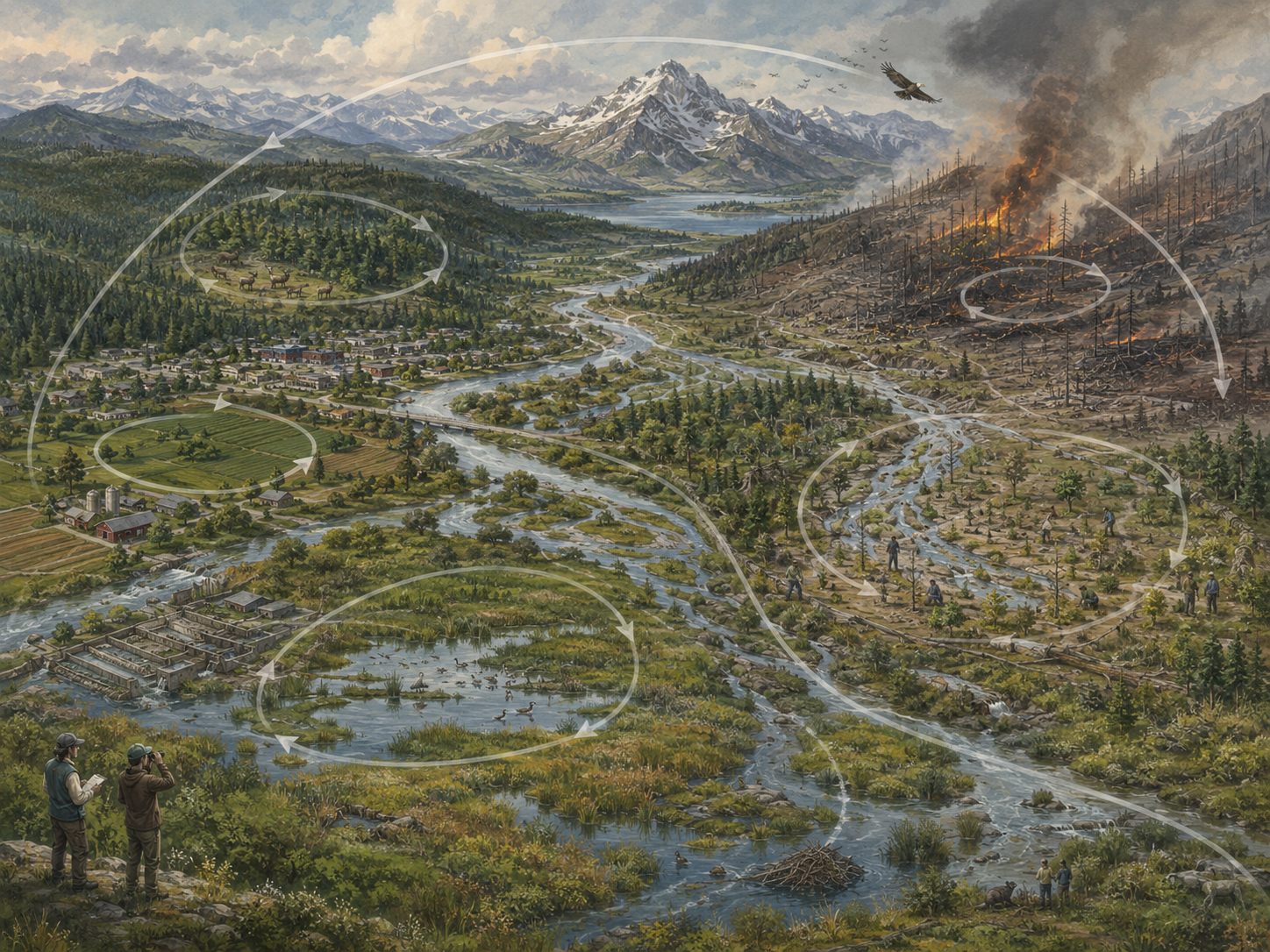
What Is the Adaptive Cycle?
The adaptive cycle is a conceptual model describing recurring phases of change in complex systems: growth or exploitation, conservation, release, and reorganization. These phases are often represented as \(r\), \(K\), \(\Omega\), and \(\alpha\). The model is used in resilience thinking because it explains why systems do not simply move from instability to stability or from crisis back to equilibrium. Instead, many systems move through cycles of expansion, consolidation, disruption, and renewal.
The adaptive cycle is not a rigid law. It is a disciplined interpretive framework. Its value lies in helping analysts ask better questions: Is the system expanding? Is it accumulating resources? Is it becoming more connected and efficient? Is it also becoming more rigid? Is disturbance beginning to release stored structure? Is reorganization opening pathways for renewal or degradation?
In ecological systems, adaptive cycles can describe succession after disturbance, biomass accumulation, fire release, and post-fire regeneration. In institutions, they can describe innovation, bureaucratic consolidation, legitimacy crisis, and reform. In economic systems, they can describe expansion, concentration, crash, and restructuring. In infrastructure systems, they can describe build-out, standardization, failure, and redesign. In each case, the core insight is similar: the same processes that generate order may eventually create vulnerability.
| Adaptive-cycle phase | Symbol | Basic meaning | Resilience significance |
|---|---|---|---|
| Growth or exploitation | r | Rapid expansion, opportunity, colonization, experimentation, and resource mobilization | Creates novelty and growth, but may lack coordination or long-term structure. |
| Conservation | K | Accumulation, efficiency, connectedness, institutionalization, and stability | Stores resources and memory, but can deepen rigidity and lock-in. |
| Release | Ω | Breakdown, collapse, disturbance, crisis, unraveling, or rapid liberation of stored structure | Destroys accumulated arrangements, but can open space for renewal. |
| Reorganization | α | Experimentation, recombination, renewal, recovery, or transformation | Determines whether the system regenerates, shifts regime, or declines. |
The adaptive cycle matters because it treats resilience as dynamic. Systems are not simply resilient because they resist change. They may be resilient because they can move through change without losing essential function, or because they can transform when old structures are no longer viable.
Why the Adaptive Cycle Matters
The adaptive cycle matters because it challenges a common mistake: assuming that stability is always strength. In many systems, visible stability is produced by high connectedness, accumulated resources, standardized routines, and tightly coupled relationships. These qualities can improve performance, but they can also reduce flexibility. A system that becomes too connected, too optimized, too centralized, or too invested in its existing structure may become brittle.
This is why successful systems can become vulnerable from within. A forest accumulating fuel may appear mature and stable until drought and ignition trigger severe fire. A government agency may appear orderly until its procedures prevent timely adaptation. A supply chain may appear efficient until a disruption reveals the danger of having removed redundancy. A financial system may appear sophisticated until leverage and interdependence amplify crisis.
The adaptive cycle provides language for this paradox. Growth and conservation are not automatically good. Release and reorganization are not automatically bad. Conservation can store memory and capacity, but it can also store fragility. Release can destroy valued structures, but it can also expose failure and open possibilities. Reorganization can restore function, but it can also deepen inequality or push a system into a degraded regime.
What the adaptive cycle helps reveal
Hidden rigidity
Systems that look strong during conservation may be losing flexibility, redundancy, and response space.
Windows of opportunity
Release and reorganization can open brief periods when rules, relationships, and resource flows become changeable.
Nonlinear change
Long periods of gradual accumulation can be followed by sudden breakdown, threshold crossing, or rapid reassembly.
Memory and renewal
Reorganization depends on what survives: ecological memory, institutional memory, cultural memory, skills, trust, and stored resources.
The adaptive cycle is therefore not a romantic theory of collapse and renewal. It is a warning that performance can harden into fragility, and that renewal must be prepared before disruption arrives.
The Four Phases of the Adaptive Cycle
The four phases of the adaptive cycle describe broad tendencies, not rigid steps that every system must follow. Real systems may overlap phases, skip phases, contain multiple cycles at once, or become trapped in distorted patterns. Still, the four-phase structure is useful because it clarifies how resources, connectedness, rigidity, and resilience change over time.
The front loop of the cycle — growth and conservation — is usually slower and more predictable. It is the period of expansion, accumulation, stabilization, and increasing connectedness. The back loop — release and reorganization — is usually faster, more uncertain, and more volatile. It is the period when accumulated structures break apart and new combinations become possible.
| Phase | Dominant pattern | Typical strengths | Typical vulnerabilities |
|---|---|---|---|
| r | Expansion and experimentation | Flexibility, novelty, opportunity, rapid learning | Weak coordination, instability, limited memory, uneven development |
| K | Consolidation and conservation | Efficiency, stored resources, institutional memory, stability | Rigidity, overconnectedness, lock-in, suppressed alternatives |
| Ω | Release and disruption | Unfreezing of locked structures, exposure of failure, resource release | Loss, instability, cascading failure, trauma, opportunism |
| α | Reorganization and renewal | Experimentation, recombination, transformation, learning | Fragility, uncertainty, capture, unequal reconstruction, maladaptation |
The adaptive cycle is most useful when it helps diagnose where a system is becoming rigid, where memory is preserved, where novelty is emerging, and where intervention can protect essential function or support just transformation.
Growth or Exploitation: The r Phase
The growth phase, often labeled r, is a period of rapid expansion, opportunity, and resource mobilization. In ecological succession, it may involve colonizing species, rapid vegetation growth, or the occupation of newly disturbed space. In organizations, it may involve innovation, experimentation, new programs, startup growth, or institutional expansion. In social movements, it may involve rapid mobilization, coalition building, and new narratives. In economies, it may involve new sectors, technologies, or markets.
The strength of the r phase is flexibility. Connections are not yet fully fixed. Rules are still forming. Experimentation is possible. Resources may be abundant relative to structure. Novel actors can enter. New combinations can emerge. This makes the growth phase important for innovation, learning, and adaptation.
But the r phase also has vulnerabilities. Rapid growth can be unstable. Coordination may be weak. Standards may be unclear. Competition may produce waste or exclusion. Ecological colonization may favor opportunistic species. Institutional innovation may lack accountability. Economic growth may create speculative excess. The growth phase creates possibility, but it does not guarantee resilience.
Growth-phase examples
Ecological succession
Pioneer species colonize disturbed ground, mobilize nutrients, create early habitat, and begin rebuilding structure.
Institutional innovation
New agencies, programs, methods, or partnerships emerge before rules and routines become deeply established.
Technology expansion
New tools and platforms grow quickly before standards, governance, risk controls, or accountability mature.
Community mobilization
Networks form rapidly after disturbance, creating mutual aid, local leadership, and practical experimentation.
The growth phase is adaptive when it preserves learning, openness, and diversity rather than rushing too quickly into rigid consolidation.
Conservation: The K Phase
The conservation phase, labeled K, is the period when resources accumulate, connections deepen, and the system becomes more organized. In ecosystems, this can involve biomass accumulation, mature structure, nutrient storage, stable relationships, and slower turnover. In institutions, it can involve formal rules, standardized procedures, budgets, professional routines, and established authority. In infrastructure, it can involve networks, standards, maintenance regimes, and operational dependencies.
The conservation phase is valuable. It stores memory, resources, capacity, and coordination. It allows systems to perform reliably. It supports stability, predictability, and long-term function. Without some conservation, systems would remain chaotic and underdeveloped.
But conservation also produces risk. As connectedness increases, the system may become less flexible. As routines solidify, experimentation may decline. As capital and authority concentrate, alternatives may be suppressed. As efficiency improves, redundancy may be removed. As rules become entrenched, adaptation may slow. The system may become very good at what it already does and increasingly bad at changing when conditions shift.
| Conservation strength | Why it helps | How it can become brittle |
|---|---|---|
| Accumulated resources | Provide stored capacity, memory, infrastructure, biomass, expertise, or capital | Can become locked into old uses and difficult to redeploy. |
| High connectedness | Improves coordination, efficiency, flow, and integration | Can transmit failure rapidly and reduce modularity. |
| Standardized routines | Improve reliability, predictability, and procedural order | Can suppress learning when conditions change. |
| Institutional authority | Can mobilize resources and enforce commitments | Can become centralized, defensive, or disconnected from feedback. |
| Efficiency | Reduces waste under known conditions | Can remove slack, redundancy, diversity, and response space. |
The conservation phase becomes dangerous when maturity turns into lock-in. Resilience requires conserving what matters while preventing efficiency from hardening into systemic fragility.
Release: The Ω Phase
The release phase, labeled \(\Omega\), is the period of rapid unraveling. Stored resources, tight connections, accumulated structures, and established routines are suddenly disrupted. In ecosystems, release may involve fire, pest outbreaks, drought mortality, disease, flood, storm damage, or regime shift. In institutions, it may involve crisis, scandal, legitimacy collapse, financial breakdown, policy failure, or organizational restructuring. In economies, it may involve crash, bankruptcy, supply-chain failure, or technological displacement.
Release is often destructive. It can involve loss of life, livelihoods, habitat, trust, infrastructure, species, institutional memory, and public confidence. It can produce cascading failure and trauma. It can also create openings because structures that were previously locked become movable. Resources are released. Old assumptions are questioned. New actors may enter. Reorganization becomes possible.
The danger is that release does not automatically produce renewal. It can produce opportunistic capture, authoritarian consolidation, ecological degradation, social abandonment, or repeated crisis. Whether release leads to recovery, transformation, or decline depends on memory, diversity, adaptive capacity, governance, justice, and the quality of reorganization that follows.
Release-phase dynamics
Stored fragility becomes visible
Weaknesses that were hidden during conservation become undeniable when disturbance disrupts normal operation.
Connections can fail together
Tightly coupled systems may transmit disturbance quickly through ecological, financial, institutional, or infrastructure networks.
Resources are unfrozen
Capital, nutrients, political attention, land use, authority, or organizational structures may become available for reallocation.
Risk of capture rises
Crisis can create opportunity for renewal, but also for exploitation, privatization, repression, displacement, or unjust reconstruction.
The release phase must be treated ethically. Calling crisis an “opportunity” can be morally careless if it ignores suffering. The practical resilience question is how to reduce harm while preserving the possibility of accountable renewal.
Reorganization: The α Phase
The reorganization phase, labeled \(\alpha\), is the period when new combinations become possible. After release, system components are less tightly fixed. Structures have been disrupted. Resources may be redistributed. New relationships, rules, species assemblages, institutions, technologies, policies, or practices can emerge.
Reorganization is a fragile window. It is filled with uncertainty, experimentation, contestation, and possibility. In ecological systems, reorganization may depend on surviving organisms, seed banks, soil structure, refugia, species dispersal, climate conditions, and disturbance legacies. In institutions, it may depend on leadership, trust, public legitimacy, legal pathways, memory, staffing, funding, and political coalitions. In communities, it may depend on mutual aid, housing security, public investment, cultural memory, and social networks.
Reorganization can produce several outcomes. A system may recover into a similar regime. It may transform into a more resilient and just arrangement. It may shift into a degraded regime. It may become trapped in repeated crisis. It may be captured by powerful actors who use disruption to consolidate advantage. Reorganization is therefore both an ecological and political process.
| Reorganization factor | How it supports renewal | How it can fail |
|---|---|---|
| Ecological memory | Surviving organisms, seeds, soils, microbes, refugia, and habitat legacies support regeneration. | Severe disturbance may erase memory and push the system toward regime shift. |
| Institutional memory | Records, experience, lessons learned, and professional norms guide reconstruction. | Staff loss, denial, or political manipulation may cause repeated mistakes. |
| Diversity and novelty | Multiple actors, species, ideas, and strategies create more possible futures. | Novelty may be suppressed by incumbents or captured by narrow interests. |
| Legitimacy and trust | Cooperation and difficult reforms become possible when institutions are credible. | Distrust can block coordination or produce fragmented recovery. |
| Justice safeguards | Rights, participation, and public accountability prevent unequal reconstruction. | Recovery can reproduce displacement, exposure, or extraction. |
The reorganization phase is where resilience becomes most morally serious. The question is not only whether a system comes back, but what it comes back as.
The Front Loop and Back Loop
The adaptive cycle is often divided into a front loop and a back loop. The front loop includes growth and conservation. It is usually slower, more predictable, and oriented toward accumulation. The back loop includes release and reorganization. It is usually faster, more uncertain, and oriented toward breakdown and renewal.
The front loop is where systems build structure. It is associated with productivity, efficiency, connectedness, institutionalization, capital formation, biomass accumulation, and routine. The back loop is where structures loosen. It is associated with disturbance, recombination, learning, reassembly, and transformation. Both loops are necessary, but each has dangers.
A system trapped in front-loop thinking may worship growth, efficiency, and stability while ignoring rigidity. A system trapped in back-loop romanticism may celebrate disruption without accounting for harm, loss, trauma, and unequal vulnerability. A mature resilience perspective recognizes both: accumulation is necessary, but can become brittle; release can create renewal, but can also devastate.
Front-loop and back-loop logic
Front loop
Growth and conservation build resources, order, performance, and memory, but may also increase connectedness and rigidity.
Back loop
Release and reorganization loosen structures, open alternatives, and permit renewal, but may also involve severe loss and instability.
Front-loop risk
The system becomes efficient in known conditions but loses response space under changing conditions.
Back-loop risk
Disruption becomes unmanaged, unjust, captured, or repeated without genuine renewal.
The art of resilience governance is not to avoid cycles entirely. It is to manage accumulation without rigidity and disruption without abandonment.
What Is Panarchy?
Panarchy is the framework that links multiple adaptive cycles together across scales. It describes how smaller, faster cycles and larger, slower cycles interact. A forest patch is nested in a landscape. A landscape is nested in a region. A region is nested in climate systems, legal systems, markets, and cultural systems. A neighborhood is nested in a city, a city in a metropolitan region, a region in national policy, and all of them in global ecological and economic processes.
Panarchy matters because resilience is rarely determined at one scale. A local ecosystem may recover from disturbance if regional seed sources, climate conditions, and governance structures support recovery. A neighborhood may adapt to heat if city infrastructure, housing policy, public health systems, and funding align. A local innovation may spread upward if larger institutions are receptive. A local crisis may cascade upward if larger systems are already brittle.
Panarchy rejects the idea that hierarchy is only top-down control. Instead, it describes nested adaptive systems with cross-scale feedback. Larger systems can constrain smaller systems, but smaller systems can destabilize or transform larger systems. Slower cycles can preserve memory, but they can also impose lock-in. Faster cycles can generate novelty, but they can also generate instability.
| Scale | Typical speed | Common role | Potential risk |
|---|---|---|---|
| Small / fast cycles | Rapid | Experimentation, novelty, local response, innovation, disturbance signals | Instability, fragmentation, weak memory, limited resources |
| Middle cycles | Intermediate | Coordination, translation, management, organizations, regional governance | Siloing, bureaucratic lock-in, uneven implementation |
| Large / slow cycles | Slow | Memory, law, infrastructure, culture, climate, capital, long-term constraint | Rigidity, path dependence, delayed feedback, resistance to reform |
Panarchy is useful because it explains why local resilience can be undermined by larger forces and why larger systems can be transformed by local disturbances or innovations.
Revolt and Remember
Two cross-scale linkages are central to panarchy: revolt and remember. These terms describe how smaller and larger cycles influence one another during periods of disturbance and reorganization.
Revolt occurs when a smaller, faster cycle triggers change in a larger, slower cycle. This can happen when disturbance, innovation, protest, ecological change, technological disruption, or local crisis cascades upward. A pest outbreak in a forest patch can spread across a region. A local flood can expose national infrastructure failure. A neighborhood movement can force citywide policy change. A banking failure can destabilize the broader financial system. A small fire can become a megafire when larger landscape and climate conditions are primed.
Remember occurs when a larger, slower cycle shapes reorganization in a smaller, faster cycle. Larger systems store memory, resources, rules, infrastructure, cultural practices, legal structures, ecological legacies, and institutional constraints. After disturbance, reorganization is not pure improvisation. It is shaped by what larger systems make possible, preserve, prohibit, fund, or remember.
Revolt and remember
Revolt
Small, fast cycles can cascade upward when larger systems are vulnerable, rigid, or near threshold.
Remember
Large, slow cycles provide memory, resources, constraints, and inherited structure during reorganization.
Positive revolt
Local innovation, social movements, or ecological renewal can challenge locked systems and open reform.
Negative revolt
Local disturbances can escalate into cascading failure when larger systems are overconnected or brittle.
The power of panarchy lies in this cross-scale logic. Resilience is not stored at one level. It depends on whether scales interact in ways that support learning, memory, justice, and renewal rather than cascade, lock-in, and decline.
Cross-Scale Dynamics
Cross-scale dynamics are the interactions among processes operating at different spatial, temporal, institutional, and ecological levels. These dynamics matter because what looks adaptive at one scale may be maladaptive at another. A city may protect one district with floodwalls while increasing downstream risk. A forest management strategy may reduce short-term fire risk while increasing long-term fuel accumulation. A national policy may stabilize markets while undermining local livelihoods. A local conservation project may succeed temporarily but fail if regional climate, land use, or governance trends move against it.
Panarchy helps analyze these tensions. It asks which scale is moving quickly, which scale is locked in, which scale stores memory, which scale generates novelty, and which scale holds authority. It also asks whether cross-scale interactions are supportive or destructive.
| Cross-scale issue | Example | Resilience question |
|---|---|---|
| Scale mismatch | A watershed problem governed by fragmented municipal boundaries | Do institutions match the ecological scale of the problem? |
| Fast disturbance, slow response | Flash flooding, wildfire spread, disease outbreak, infrastructure failure | Can slower institutions respond quickly enough? |
| Slow variable, sudden release | Fuel accumulation, soil degradation, groundwater depletion, trust erosion | Are slow changes being monitored before rapid collapse? |
| Local innovation, systemic constraint | Community adaptation blocked by funding rules or legal barriers | Do larger systems enable or suppress adaptive experimentation? |
| Local crisis, systemic cascade | A small failure spreading through financial, infrastructure, or ecological networks | Is the larger system modular enough to contain disturbance? |
Panarchy is therefore especially useful for governance and planning because it helps identify when problems are being managed at the wrong scale.
Adaptive Cycles, Resilience, and Thresholds
Adaptive cycles are closely related to thresholds and tipping points. As systems move through growth and conservation, they may accumulate potential and connectedness while losing flexibility. If connectedness rises too high and resilience falls too low, disturbance can trigger release. In this sense, the conservation phase may hide threshold risk.
Thresholds are not always visible from surface performance. A forest may look mature while regeneration capacity is declining. A city may appear prosperous while infrastructure maintenance is deferred. A public institution may appear stable while legitimacy erodes. A supply chain may appear efficient while redundancy disappears. These systems may continue functioning until a disturbance reveals that they were closer to threshold than expected.
Adaptive cycles help explain why thresholds can be crossed suddenly after long periods of apparent stability. Panarchy adds that thresholds at one scale can be influenced by conditions at other scales. A local ecosystem may cross a threshold because regional climate pressure changed. A local institution may fail because national funding rules narrowed response space. A city may face cascading flood risk because watershed-scale development altered hydrology.
How adaptive cycles connect to threshold risk
Accumulation can hide risk
Stored resources and high performance may conceal declining flexibility, redundancy, or recovery capacity.
Connectedness can amplify release
Highly connected systems can transmit disturbance quickly when buffers and modularity are weak.
Slow variables matter
Soil fertility, trust, maintenance, biodiversity, groundwater, legitimacy, and institutional capacity may erode gradually before sudden failure.
Reorganization determines trajectory
After threshold disturbance, surviving memory, diversity, governance, and justice shape whether renewal or degradation follows.
The adaptive-cycle framework does not predict thresholds automatically, but it helps analysts look for the structural conditions under which thresholds become more likely.
Adaptive Capacity, Lock-In, and Response Space
Adaptive capacity is the ability of a system to adjust, learn, reorganize, and maintain essential function under changing conditions. In adaptive-cycle terms, adaptive capacity determines how well a system moves through phases without catastrophic loss. It is especially important during conservation, release, and reorganization.
During conservation, adaptive capacity prevents connectedness from hardening into lock-in. It preserves diversity, monitoring, feedback, slack, and flexibility. During release, adaptive capacity helps reduce harm, mobilize resources, and prevent cascading collapse. During reorganization, adaptive capacity supports learning, experimentation, memory, and deliberate transformation.
Lock-in is the opposite tendency. It occurs when rules, infrastructures, habits, incentives, investments, and power relations make change difficult even when feedback shows that change is needed. Lock-in can be ecological, institutional, technological, economic, cultural, or political. It is one of the main reasons systems remain in the conservation phase too long and then experience disruptive release.
| Adaptive-capacity element | How it protects the cycle | Lock-in risk when absent |
|---|---|---|
| Learning | Detects changing conditions before crisis | Old assumptions persist until disturbance forces change. |
| Diversity | Provides multiple response pathways | The system depends on one strategy, species, technology, or institution. |
| Slack | Buys time during stress | Every disturbance immediately becomes a crisis. |
| Modularity | Limits cascading release | Failures spread quickly through overconnected systems. |
| Governance flexibility | Allows rule revision before threshold crossing | Procedures remain fixed even when conditions change. |
| Trust and legitimacy | Supports cooperation during reorganization | Recovery becomes fragmented, contested, or captured. |
Adaptive capacity keeps systems from becoming prisoners of their own success. It protects response space before release makes change unavoidable.
Ecological Applications
In ecology, adaptive cycles help explain succession, disturbance regimes, forest dynamics, grassland renewal, lake regime shifts, wetland change, coral reef disturbance, pest outbreaks, fire recovery, and landscape reorganization. Ecological systems often accumulate biomass, nutrients, structure, and species interactions over time. These accumulations support function, but they can also create vulnerability under changing disturbance regimes.
A forest may move through rapid regrowth after fire, mature into a dense and connected stand, accumulate fuel, experience severe fire or pest outbreak, and then reorganize through surviving seed sources, soil memory, species dispersal, climate conditions, and landscape refugia. A lake may accumulate nutrients gradually until a threshold is crossed into eutrophication. A grassland may shift toward shrubland if grazing, fire suppression, drought, and soil feedbacks interact. A coral reef may reorganize after bleaching depending on herbivory, water quality, temperature, storm history, recruitment, and local stressors.
The adaptive cycle is especially useful in ecology because disturbance is not simply external damage. Many ecosystems depend on disturbance for renewal. The question is whether disturbance regimes remain within ranges that preserve recovery capacity, or whether changing frequency, severity, timing, and extent push ecosystems into degraded regimes.
Ecological examples of adaptive-cycle logic
Forest fire regimes
Biomass accumulation can support mature forest function but also increase vulnerability when drought and fuel continuity intensify fire severity.
Lake eutrophication
Nutrient accumulation can push lakes across thresholds into algal-dominated regimes that are difficult to reverse.
Grassland-shrubland shifts
Changes in fire, grazing, drought, and soil feedback can reorganize vegetation structure and reduce recovery pathways.
Coral reef reorganization
Bleaching, overfishing, water quality, herbivory, and recruitment shape whether reefs recover or shift toward algal dominance.
Ecological resilience depends on preserving the memory, diversity, disturbance regimes, and landscape structure that allow reorganization after release.
Social-Ecological Systems
Adaptive cycles and panarchy are especially important for social-ecological systems because ecological change, livelihoods, governance, culture, infrastructure, and markets interact. A fishery is not only a fish population. It is also harvesting practice, regulation, local knowledge, market demand, climate conditions, habitat quality, enforcement, and community livelihood. A watershed is not only hydrology. It is also land use, water rights, agriculture, cities, institutions, forests, wetlands, and climate pressure.
Panarchy helps explain why interventions in social-ecological systems often fail when they ignore scale. Local conservation may be undermined by regional market pressure. National rules may fail because local ecological knowledge is ignored. A community may adapt to one hazard but remain vulnerable because larger infrastructure systems are brittle. A restoration project may succeed ecologically but fail socially if it ignores rights, livelihoods, or governance legitimacy.
Social-ecological resilience depends on whether cycles across ecological and social scales reinforce learning rather than lock-in. Smaller-scale experimentation can produce innovation. Larger-scale institutions can provide resources and memory. But larger systems can also suppress local adaptation, and local disturbances can cascade upward when broader systems are already fragile.
| Social-ecological system | Fast cycles | Slow cycles | Panarchy question |
|---|---|---|---|
| Fishery | Harvest behavior, market shifts, seasonal recruitment, local observation | Ocean climate, habitat condition, law, cultural practice, fishing rights | Do governance and livelihoods adapt before stock collapse? |
| Watershed | Storms, withdrawals, local land-use decisions, pollution pulses | Groundwater, soil, forest cover, water law, infrastructure, climate | Do institutions match hydrological scale and slow-variable risk? |
| Fire landscape | Ignitions, weather events, local fuel treatments, emergency response | Fuel accumulation, forest structure, climate, housing patterns, fire culture | Are fast fires interacting with slow lock-in and land-use choices? |
| Urban climate system | Heat events, outages, emergency response, public communication | Housing, tree canopy, zoning, infrastructure, inequality, regional climate | Does adaptation change the structures that concentrate exposure? |
Panarchy makes social-ecological analysis more realistic because it shows that resilience is produced across scales, not inside isolated systems.
Institutions and Governance
Institutions often move through adaptive-cycle patterns. New institutions or programs begin with experimentation and flexibility. Over time, they develop routines, procedures, expertise, budgets, authority, and legitimacy. This conservation phase can be valuable because it preserves memory and capacity. But it can also produce rigidity, siloing, proceduralism, and defensiveness.
Institutional release can occur through scandal, fiscal crisis, public distrust, administrative failure, legal challenge, disaster, political turnover, technological disruption, or legitimacy collapse. During release, established arrangements are questioned and resources may be reallocated. Reorganization may produce reform, learning, democratized participation, technocratic centralization, privatization, austerity, authoritarian control, or institutional decay.
Adaptive governance seeks to prevent institutions from remaining locked in outdated conservation phases. It supports monitoring, learning, public accountability, rule revision, cross-scale coordination, participation, and experimentation. The goal is not constant disruption. The goal is to preserve the ability to adapt before crisis forces release.
Institutional adaptive-cycle patterns
Program growth
New agencies, policies, or partnerships form around urgent problems and experiment with methods.
Procedural conservation
Rules, budgets, expertise, and authority stabilize action but may become rigid or self-protective.
Legitimacy release
Crisis exposes failure, weak feedback, unequal outcomes, or institutional disconnection from public need.
Reform or capture
Reorganization may expand accountability and learning, or be captured by incumbents and narrow interests.
Institutions need conservation because memory and capacity matter. But they also need mechanisms that prevent conservation from becoming a refusal to learn.
Disaster, Crisis, and Recovery
Disasters often reveal panarchy in stark form. A flood, wildfire, earthquake, pandemic, or infrastructure failure is not only a hazard event. It is the interaction of fast disturbance with slow variables: land use, inequality, building codes, ecological degradation, infrastructure age, public health, housing insecurity, emergency planning, trust, insurance, and governance capacity.
Release during disaster can be devastating. Lives, homes, ecosystems, institutions, and livelihoods may be damaged or lost. Reorganization after disaster can follow very different paths. Recovery may rebuild the same vulnerabilities. It may produce safer and more equitable systems. It may displace marginalized communities. It may privatize recovery benefits. It may strengthen public infrastructure. It may deepen mistrust if affected people are excluded from decision-making.
Panarchy helps explain why disaster recovery is a reorganization phase shaped by larger cycles. Local communities may mobilize mutual aid, but larger systems control funding, insurance, land-use rules, infrastructure standards, relocation policy, and legal authority. Recovery is therefore not only local resilience. It is cross-scale governance under pressure.
| Disaster phase | Adaptive-cycle interpretation | Justice concern |
|---|---|---|
| Pre-disaster accumulation | Slow variables build: exposure, fuel, deferred maintenance, housing vulnerability, ecological degradation | Risk is often concentrated in communities with less power. |
| Hazard impact | Release exposes accumulated fragility and disrupts normal function | Losses are unevenly distributed by race, class, housing, health, and infrastructure. |
| Emergency response | Fast-cycle mobilization attempts to contain release | Response may be unequal, under-resourced, or poorly trusted. |
| Recovery | Reorganization determines whether vulnerability is rebuilt or reduced | Reconstruction can displace, exclude, or exploit affected people. |
| Long-term adaptation | Memory is institutionalized or forgotten | Lessons may be ignored once crisis attention fades. |
Disaster recovery is where the ethics of panarchy become unavoidable. Reorganization is not automatically renewal. It must be governed.
Climate Adaptation and Panarchy
Climate change is transforming disturbance regimes and reshaping adaptive cycles across scales. Fire seasons lengthen, floods intensify, heat waves become more dangerous, droughts deepen, species ranges shift, pests expand, coastal hazards increase, and infrastructure standards based on historical assumptions become less reliable. Climate change does not only add new shocks. It changes the background conditions under which cycles unfold.
Climate adaptation is a panarchy problem because climate signals operate across large and slow scales while impacts appear through local and fast disturbances. A global atmospheric process becomes a neighborhood heat emergency. A regional drought becomes household water insecurity. A changing fire regime becomes local evacuation, insurance loss, forest mortality, and public-health harm. Larger systems shape local vulnerability, while local crises can reveal the inadequacy of larger institutions.
Adaptive-cycle thinking helps climate planners ask whether current systems are trapped in conservation phases built around obsolete assumptions. Are flood maps, building codes, water rights, insurance systems, infrastructure designs, fire policies, agricultural practices, and emergency plans still suited to changing conditions? Are reorganization windows being used to reduce vulnerability or to rebuild old risk?
Climate adaptation through panarchy
Slow climate forcing
Climate change alters the background conditions that shape fire, flood, drought, heat, disease, and ecosystem recovery.
Fast local disturbance
Extreme events expose whether local systems have enough response space, infrastructure, trust, and governance capacity.
Locked assumptions
Design standards, insurance models, zoning, water allocation, and emergency plans may remain tied to past conditions.
Adaptive pathways
Staged decisions, monitoring triggers, and flexible investments help systems adapt without pretending the future is certain.
Climate adaptation requires managing cycles before release becomes catastrophic. It requires using memory without being trapped by the past.
Infrastructure and Technological Systems
Infrastructure systems also move through adaptive-cycle dynamics. Early infrastructure build-out often involves experimentation, expansion, and competing designs. Conservation follows when standards, networks, institutions, supply chains, financing, maintenance regimes, and user habits become established. This conservation phase allows reliable service, but it can also create path dependence and lock-in.
Infrastructure release occurs when systems fail, become obsolete, or are overwhelmed by conditions outside their design assumptions. A stormwater system designed for past rainfall may fail under new extremes. A power grid optimized around centralized generation may struggle with climate hazards or distributed demand. A transportation network may become locked into car dependency. A digital platform may become so interconnected that failure, misinformation, or security risk spreads rapidly.
Reorganization can produce more adaptive infrastructure: modular systems, distributed generation, nature-based buffers, redundant communication pathways, flexible standards, maintenance renewal, public accountability, and equitable service planning. Or it can produce brittle upgrades that preserve the same vulnerabilities in more expensive form.
| Infrastructure cycle | Pattern | Resilience question |
|---|---|---|
| Growth | New networks expand rapidly | Are design choices preserving future flexibility? |
| Conservation | Standards, financing, dependencies, and maintenance routines stabilize the system | Is reliability becoming rigidity? |
| Release | Failure, overload, obsolescence, or climate stress disrupts service | Can failure be contained and essential functions protected? |
| Reorganization | Repair, redesign, investment, and governance reform become possible | Will rebuilding reduce vulnerability or reproduce it? |
Infrastructure resilience depends on recognizing when a system is being conserved past the limits of its original assumptions.
Economic Systems, Lock-In, and Renewal
Economic systems often display adaptive-cycle dynamics through growth, concentration, crisis, and restructuring. Sectors expand, firms scale, supply chains optimize, capital accumulates, standards consolidate, and institutions adapt around dominant models. Over time, the system may become efficient but fragile. Diversity declines, redundancy is reduced, local capacity is displaced, and dependence on tightly coupled networks increases.
Release can occur through recession, financial crisis, supply shock, technological disruption, political instability, ecological constraint, or legitimacy crisis. Reorganization may create new industries, regulations, ownership models, public investment strategies, labor protections, or local economic capacity. But it may also produce austerity, consolidation, predatory acquisition, privatized gains, and socialized losses.
Panarchy is useful in economics because local economies, national systems, global markets, household security, infrastructure, ecological constraints, and political institutions interact across scales. A local factory closure may reflect global supply chains. A regional food-system shock may reflect climate, land policy, labor conditions, transportation, and market concentration. A financial crisis may begin in one sector and cascade through credit, employment, housing, and public budgets.
Economic adaptive-cycle patterns
Growth
New sectors, firms, technologies, or markets expand rapidly and mobilize capital.
Concentration
Dominant actors, standards, supply chains, and financial arrangements consolidate power and efficiency.
Crisis
Overconnectedness, leverage, ecological limits, or demand shocks release accumulated fragility.
Restructuring
Reorganization can democratize capacity, rebuild local resilience, or deepen concentration and inequality.
Economic resilience should not mean restoring the same brittle system after each crisis. It should mean reorganizing toward broader security, ecological viability, and more accountable distribution of risk.
Strategy, Planning, and Decision-Making
For strategy, adaptive cycles and panarchy offer a way to think beyond short-term optimization. They ask what phase the system is in, where rigidity is building, where slow variables are changing, which scales are constraining response, where release may occur, and what memory or novelty might shape reorganization.
This matters for planning because strategies suited to one phase may be dangerous in another. Growth-phase systems may need coordination, standards, and memory. Conservation-phase systems may need experimentation, decentralization, scenario testing, and redundancy. Release-phase systems need harm reduction, triage, legitimacy, and protection of essential function. Reorganization-phase systems need accountable innovation, public learning, and safeguards against capture.
Panarchy also helps planners avoid single-scale thinking. Local resilience strategies may fail if regional funding, national law, climate pressure, or market systems block adaptation. Large-scale policies may fail if they ignore local knowledge, trust, and implementation capacity. Strategy must connect scales.
| Strategic question | Why it matters | Possible action |
|---|---|---|
| What phase is the system in? | Different phases require different interventions. | Diagnose growth, conservation, release, or reorganization tendencies. |
| Where is rigidity building? | Lock-in increases release risk. | Preserve flexibility, diversity, modularity, and feedback mechanisms. |
| What slow variables are changing? | Slow erosion can precede sudden release. | Monitor trust, maintenance, biodiversity, groundwater, soil, legitimacy, and debt. |
| Which scales constrain action? | Local adaptation may be blocked by larger systems. | Align governance, funding, law, and ecological scale. |
| What memory must survive? | Reorganization depends on stored knowledge and recovery sources. | Protect ecological, institutional, cultural, and community memory. |
Adaptive cycles and panarchy are not prediction engines. They are strategic lenses for seeing timing, lock-in, scale, memory, and renewal.
Justice, Power, and the Politics of Reorganization
Adaptive cycles and panarchy can become misleading if they are treated as neutral natural patterns detached from power. Social systems are not forests. They contain conflict, hierarchy, coercion, law, race, class, colonial histories, property regimes, gendered labor, state power, corporate power, and unequal exposure to harm. A crisis may be a “release” in systems language, but for affected people it may be death, displacement, unemployment, trauma, or loss of home.
Reorganization is especially political. Who gets to rebuild? Who receives aid? Who owns the land after disaster? Who benefits from reform? Who is displaced? Whose memory counts? Whose knowledge is recognized? Who is asked to be resilient, and who is allowed to remain secure?
A justice-centered use of adaptive cycles asks whether reorganization expands dignity, accountability, ecological function, and shared security — or whether it simply restores the old regime under a new name. It also asks whether “remember” preserves wisdom or preserves injustice. Large, slow systems can store ecological memory and cultural knowledge, but they can also store dispossession, segregation, extractive law, and institutional violence. Not all memory is benign.
Justice questions for adaptive cycles and panarchy
Who experiences release?
System disruption is not evenly distributed. Some groups face more exposure, fewer resources, and slower recovery.
Who controls reorganization?
Recovery can become democratic renewal, technocratic redesign, elite capture, austerity, or displacement.
What does memory preserve?
Memory may preserve ecological knowledge and institutional learning, but also unjust property, law, and hierarchy.
What counts as resilience?
Enduring repeated harm is not justice. Resilience must not become a demand that vulnerable people absorb systemic failure.
Adaptive cycles are most useful when paired with moral clarity: renewal should not mean rebuilding the machinery of harm.
Limitations and Cautions
Adaptive cycles and panarchy are powerful, but they can be overused. Not every system moves cleanly through four phases. Real systems may contain multiple overlapping cycles, partial releases, delayed reorganization, contradictory scale dynamics, or long periods of stagnation. A system may be in conservation at one level and release at another. A city may be growing economically while its infrastructure is in decay. A forest may be regenerating in one patch and crossing thresholds in another.
The framework can also become too metaphorical if analysts force every case into the same diagram. Adaptive cycles should guide inquiry, not replace evidence. They should be used alongside empirical data, historical analysis, local knowledge, institutional context, ecological monitoring, and political-economic interpretation.
Another caution is that social systems involve agency and contestation. Ecological cycles do not vote, lobby, privatize, incarcerate, segregate, speculate, colonize, or manipulate crisis for profit. Human systems do. Any application of panarchy to society must account for power, conflict, and responsibility.
| Limitation | Risk | Better use |
|---|---|---|
| Overgeneralization | Forcing every system into the same four-phase pattern | Use the cycle as a diagnostic lens, not a universal script. |
| Metaphor without evidence | Replacing empirical analysis with elegant diagrams | Ground phase claims in data, history, observation, and stakeholder knowledge. |
| Power blindness | Treating social reorganization as neutral or natural | Ask who benefits, who loses, who decides, and whose memory is preserved. |
| Collapse romanticism | Calling disruption creative while ignoring suffering | Prioritize harm reduction, justice, and accountable renewal. |
| Scale confusion | Missing how local, regional, national, and global cycles interact | Use panarchy to identify cross-scale constraints and cascades. |
Adaptive cycles and panarchy are strongest when used humbly: as tools for asking better questions about timing, scale, rigidity, memory, disturbance, and renewal.
Measurement and Indicators
Measuring adaptive cycles and panarchy requires indicators that capture phase tendencies, connectedness, rigidity, potential, resilience, memory, disturbance pressure, and cross-scale interaction. The goal is not to assign a perfect phase label. The goal is to diagnose whether a system is accumulating fragility, approaching release, preserving memory, or entering reorganization.
Useful indicators vary by domain. In ecosystems, analysts may track biomass, fuel load, species composition, regeneration, soil condition, hydrology, pest pressure, disturbance severity, and ecological memory. In institutions, they may track rule flexibility, legitimacy, staff capacity, feedback use, coordination, public trust, and crisis performance. In infrastructure, they may track maintenance backlog, redundancy, modularity, interdependency, failure history, and climate design assumptions. In communities, they may track social networks, mutual aid, public services, housing security, mobility, and recovery resources.
| Indicator category | Possible measures | Interpretation |
|---|---|---|
| Potential | Stored biomass, capital, knowledge, infrastructure, capacity, organizational resources | Shows what has accumulated and may be conserved, released, or reorganized. |
| Connectedness | Network density, supply-chain coupling, institutional interdependence, habitat connectivity | Shows whether coordination is strong or whether failure may cascade. |
| Rigidity | Rule inflexibility, path dependence, monoculture, lock-in, procedural delay, centralized control | Shows whether conservation is becoming brittle. |
| Adaptive capacity | Learning, diversity, slack, redundancy, trust, governance flexibility, response space | Shows whether the system can adjust before release becomes catastrophic. |
| Memory | Seed banks, refugia, institutional records, local knowledge, cultural practice, experienced personnel | Shows what can guide reorganization after release. |
| Cross-scale pressure | Climate forcing, legal constraints, market pressure, regional hydrology, national funding rules | Shows whether larger cycles constrain or support local adaptation. |
| Reorganization quality | Equity, function recovery, participation, learning, restored diversity, reduced exposure | Shows whether renewal is resilient, just, or maladaptive. |
Measurement should preserve complexity. A single adaptive-cycle score may hide more than it reveals. The better aim is structured diagnosis.
Management Principles
Managing with adaptive cycles and panarchy means recognizing that systems change through phases, that resilience depends on timing, that cross-scale interactions matter, and that reorganization must be shaped before crisis. It requires maintaining adaptive capacity during conservation, reducing harm during release, and governing reorganization with memory, justice, and learning.
Principles for adaptive-cycle and panarchy practice
Monitor rigidity
Track when efficiency, connectedness, standardization, and concentration begin reducing flexibility and response space.
Protect memory
Preserve ecological, institutional, cultural, and community memory before release destroys the sources of renewal.
Maintain diversity
Support biological, institutional, technical, livelihood, and knowledge diversity so reorganization has multiple pathways.
Build modularity
Prevent every disturbance from becoming systemic by designing semi-independent parts and backup pathways.
Use crisis carefully
Release may open windows for change, but crisis should never be romanticized or exploited.
Align scales
Match governance, ecological processes, infrastructure, and funding to the scale of the problem.
Support just reorganization
Recovery should reduce vulnerability, expand accountability, protect rights, and avoid rebuilding old harms.
Institutionalize learning
Convert disturbance experience into revised rules, better monitoring, stronger capacity, and public memory.
Adaptive-cycle management is not about controlling change completely. It is about preparing systems to move through change without losing what matters.
Mathematical Lens: Cycle Phase, Rigidity, Release, and Renewal
The adaptive cycle is usually presented qualitatively, but its logic can be clarified through stylized variables. A simple system state can be represented as potential, connectedness, and resilience:
S_t = (P_t, C_t, R_t)
\]
Interpretation: \(S_t\) is the system state at time \(t\), \(P_t\) is potential or accumulated resources, \(C_t\) is connectedness or lock-in, and \(R_t\) is resilience or adaptive flexibility. During growth and conservation, potential and connectedness often rise, while resilience may decline if rigidity deepens.
A stylized growth-conservation process can be represented with a bounded growth equation:
P_{t+1} = P_t + gP_t\left(1 – \frac{P_t}{K}\right)
\]
Interpretation: \(P_t\) is accumulated potential, \(g\) is a growth coefficient, and \(K\) is a carrying or storage limit. This captures rapid early accumulation followed by slower growth as the system approaches a conservation phase.
Connectedness may rise as relationships, infrastructure, routines, or ecological structure become more tightly coupled:
C_{t+1} = C_t + \beta(1 – C_t)
\]
Interpretation: \(C_t\) increases toward an upper bound as the system becomes more connected, organized, and locked in. This may support performance, but high connectedness can also increase cascade risk.
Release can be represented as a threshold condition:
\text{if } C_t > C^{*} \text{ and } R_t < R^{*}, \text{ then } \Omega
\]
Interpretation: Release becomes likely when connectedness exceeds a critical rigidity level \(C^{*}\) while resilience falls below a viability threshold \(R^{*}\). This does not predict collapse mechanically, but it represents the structural logic of brittleness.
Reorganization can be represented as a combination of memory and novelty:
P_{t+1} = \lambda M_t + \epsilon_t
\]
Interpretation: \(M_t\) is memory retained from larger or slower cycles, \(\lambda\) is the strength of that memory, and \(\epsilon_t\) is novelty, experimentation, or recombination. Reorganization is never pure improvisation; it is shaped by what survives and what becomes possible.
A simple cross-scale panarchy effect can be represented as:
R^{slow}_{t+1} = R^{slow}_t – \phi \Omega^{fast}_t + \psi M^{slow}_t
\]
Interpretation: A release event in a faster cycle can reduce resilience in a slower cycle when revolt cascades upward. At the same time, memory in the slower cycle can support recovery and reorganization. This captures the interaction between “revolt” and “remember.”
These equations are not universal laws. They are conceptual scaffolds that make the adaptive-cycle logic explicit: accumulation can create connectedness, connectedness can become rigidity, rigidity can trigger release, and reorganization depends on memory, novelty, and cross-scale interaction.
Advanced R Workflow: Simulating Adaptive-Cycle Phase Shifts
The R workflow below simulates a stylized adaptive cycle using potential, connectedness, resilience, rigidity, memory, and novelty. It is designed as a transparent teaching and modeling scaffold, not a literal prediction model.
# Install packages if needed.
# install.packages(c("tidyverse"))

library(tidyverse)

# ------------------------------------------------------------
# R Workflow:
# Simulating Adaptive-Cycle Phase Shifts
#
# Purpose:
#   Illustrate movement through growth, conservation,
#   release, and reorganization using simple state variables:
#   potential, connectedness, resilience, rigidity, memory,
#   and novelty.
# ------------------------------------------------------------

set.seed(42)

time_steps <- 1:120

adaptive_cycle_df <- tibble(
  time = time_steps,
  potential = numeric(length(time_steps)),
  connectedness = numeric(length(time_steps)),
  resilience = numeric(length(time_steps)),
  rigidity = numeric(length(time_steps)),
  memory = numeric(length(time_steps)),
  novelty = numeric(length(time_steps)),
  phase = character(length(time_steps))
)

adaptive_cycle_df$potential[1] <- 0.20
adaptive_cycle_df$connectedness[1] <- 0.15
adaptive_cycle_df$resilience[1] <- 0.82
adaptive_cycle_df$rigidity[1] <- 0.10
adaptive_cycle_df$memory[1] <- 0.55
adaptive_cycle_df$novelty[1] <- 0.15
adaptive_cycle_df$phase[1] <- "r"

growth_rate <- 0.11
connect_rate <- 0.08
rigidity_threshold <- 0.72
resilience_threshold <- 0.34
memory_strength <- 0.48

for (t in 2:length(time_steps)) {

  previous_phase <- adaptive_cycle_df$phase[t - 1]

  previous_potential <- adaptive_cycle_df$potential[t - 1]
  previous_connectedness <- adaptive_cycle_df$connectedness[t - 1]
  previous_resilience <- adaptive_cycle_df$resilience[t - 1]
  previous_rigidity <- adaptive_cycle_df$rigidity[t - 1]
  previous_memory <- adaptive_cycle_df$memory[t - 1]

  if (previous_phase %in% c("r", "K")) {

    adaptive_cycle_df$potential[t] <-
      previous_potential +
      growth_rate * previous_potential * (1 - previous_potential)

    adaptive_cycle_df$connectedness[t] <-
      min(1, previous_connectedness + connect_rate * (1 - previous_connectedness))

    adaptive_cycle_df$rigidity[t] <-
      min(1, previous_rigidity + 0.055 * adaptive_cycle_df$connectedness[t])

    adaptive_cycle_df$resilience[t] <-
      max(0, 1 - 0.62 * adaptive_cycle_df$connectedness[t] - 0.35 * adaptive_cycle_df$rigidity[t])

    adaptive_cycle_df$memory[t] <-
      min(1, previous_memory + 0.015 * adaptive_cycle_df$potential[t])

    adaptive_cycle_df$novelty[t] <-
      max(0.02, 0.25 * (1 - adaptive_cycle_df$connectedness[t]))

    adaptive_cycle_df$phase[t] <-
      if_else(adaptive_cycle_df$connectedness[t] > 0.55, "K", "r")

    if (
      adaptive_cycle_df$rigidity[t] > rigidity_threshold &&
      adaptive_cycle_df$resilience[t] < resilience_threshold
    ) {
      adaptive_cycle_df$phase[t] <- "Omega"
    }

  } else if (previous_phase == "Omega") {

    adaptive_cycle_df$potential[t] <- max(0.05, previous_potential * 0.42)
    adaptive_cycle_df$connectedness[t] <- max(0.08, previous_connectedness * 0.32)
    adaptive_cycle_df$rigidity[t] <- max(0.05, previous_rigidity * 0.38)
    adaptive_cycle_df$resilience[t] <- min(1, previous_resilience + 0.30)
    adaptive_cycle_df$memory[t] <- max(0.25, previous_memory * 0.86)
    adaptive_cycle_df$novelty[t] <- runif(1, 0.25, 0.45)
    adaptive_cycle_df$phase[t] <- "alpha"

  } else if (previous_phase == "alpha") {

    adaptive_cycle_df$potential[t] <-
      min(1, memory_strength * previous_memory + runif(1, 0.06, 0.18))

    adaptive_cycle_df$connectedness[t] <-
      min(1, previous_connectedness + runif(1, 0.015, 0.045))

    adaptive_cycle_df$rigidity[t] <-
      max(0.03, previous_rigidity + runif(1, -0.02, 0.015))

    adaptive_cycle_df$resilience[t] <-
      min(1, previous_resilience + runif(1, 0.025, 0.075))

    adaptive_cycle_df$memory[t] <-
      min(1, previous_memory + runif(1, -0.015, 0.025))

    adaptive_cycle_df$novelty[t] <-
      runif(1, 0.18, 0.38)

    adaptive_cycle_df$phase[t] <-
      if_else(
        adaptive_cycle_df$potential[t] > 0.32 &&
          adaptive_cycle_df$connectedness[t] < 0.50,
        "r",
        "alpha"
      )
  }
}

adaptive_long <- adaptive_cycle_df %>%
  pivot_longer(
    cols = c(potential, connectedness, resilience, rigidity, memory, novelty),
    names_to = "state_variable",
    values_to = "value"
  )

phase_summary <- adaptive_cycle_df %>%
  count(phase, name = "time_steps_in_phase")

print(adaptive_cycle_df)
print(phase_summary)

ggplot(adaptive_long, aes(x = time, y = value, color = state_variable)) +
  geom_line(linewidth = 1.05) +
  labs(
    title = "Stylized Adaptive Cycle State Variables",
    x = "Time Step",
    y = "Value",
    color = "State Variable"
  ) +
  theme_minimal(base_size = 12)

ggplot(adaptive_cycle_df, aes(x = time, y = phase, color = phase)) +
  geom_point(size = 2.4) +
  labs(
    title = "Adaptive Cycle Phase Assignment",
    x = "Time Step",
    y = "Phase"
  ) +
  theme_minimal(base_size = 12)

write_csv(adaptive_cycle_df, "adaptive_cycle_phase_simulation.csv")
write_csv(adaptive_long, "adaptive_cycle_phase_simulation_long.csv")
write_csv(phase_summary, "adaptive_cycle_phase_summary.csv")
This workflow helps illustrate why conservation can become brittle, why release may occur when rigidity rises and resilience falls, and why reorganization depends on both memory and novelty.
Advanced Python Workflow: Modeling Cross-Scale Panarchy Dynamics
The Python workflow below simulates a two-level panarchy with a faster local cycle and a slower regional cycle. It includes phase transitions, release events, revolt effects, remember effects, memory strength, and cross-scale reorganization. The code is intentionally simplified, but it is structured so the logic remains inspectable and extensible.
# Install packages if needed:
# pip install pandas numpy matplotlib

import numpy as np
import pandas as pd
import matplotlib.pyplot as plt

# ------------------------------------------------------------
# Python Workflow:
# Modeling Cross-Scale Panarchy Dynamics
#
# Purpose:
#   Simulate a stylized two-level panarchy:
#   - a smaller, faster local cycle
#   - a larger, slower regional cycle
#
#   The model demonstrates:
#   - growth and conservation
#   - release when rigidity rises and resilience falls
#   - reorganization through memory and novelty
#   - revolt from fast to slow cycle
#   - remember from slow to fast cycle
# ------------------------------------------------------------

rng = np.random.default_rng(42)
time_steps = np.arange(1, 121)

def initialize_cycle(name, potential, connectedness, resilience, rigidity, memory, phase):
    return {
        "name": name,
        "potential": potential,
        "connectedness": connectedness,
        "resilience": resilience,
        "rigidity": rigidity,
        "memory": memory,
        "phase": phase
    }

fast = initialize_cycle(
    name="local_fast_cycle",
    potential=0.24,
    connectedness=0.20,
    resilience=0.82,
    rigidity=0.12,
    memory=0.42,
    phase="r"
)

slow = initialize_cycle(
    name="regional_slow_cycle",
    potential=0.64,
    connectedness=0.68,
    resilience=0.48,
    rigidity=0.46,
    memory=0.78,
    phase="K"
)

def update_cycle(cycle, growth_rate, connect_rate, rigidity_threshold, resilience_threshold, memory_input=0.0):
    phase = cycle["phase"]

    if phase in ["r", "K"]:
        cycle["potential"] = min(
            1.0,
            cycle["potential"] + growth_rate * cycle["potential"] * (1 - cycle["potential"])
        )

        cycle["connectedness"] = min(
            1.0,
            cycle["connectedness"] + connect_rate * (1 - cycle["connectedness"])
        )

        cycle["rigidity"] = min(
            1.0,
            cycle["rigidity"] + 0.050 * cycle["connectedness"]
        )

        cycle["resilience"] = max(
            0.0,
            1.0 - 0.62 * cycle["connectedness"] - 0.34 * cycle["rigidity"]
        )

        cycle["memory"] = min(
            1.0,
            cycle["memory"] + 0.012 * cycle["potential"]
        )

        cycle["phase"] = "K" if cycle["connectedness"] > 0.55 else "r"

        if cycle["rigidity"] > rigidity_threshold and cycle["resilience"] < resilience_threshold:
            cycle["phase"] = "Omega"

    elif phase == "Omega":
        cycle["potential"] = max(0.05, cycle["potential"] * 0.42)
        cycle["connectedness"] = max(0.08, cycle["connectedness"] * 0.32)
        cycle["rigidity"] = max(0.05, cycle["rigidity"] * 0.38)
        cycle["resilience"] = min(1.0, cycle["resilience"] + 0.30)
        cycle["memory"] = max(0.20, cycle["memory"] * 0.86)
        cycle["phase"] = "alpha"

    elif phase == "alpha":
        novelty = rng.uniform(0.06, 0.18)
        cycle["potential"] = min(
            1.0,
            0.45 * cycle["memory"] + memory_input + novelty
        )

        cycle["connectedness"] = min(
            1.0,
            cycle["connectedness"] + rng.uniform(0.015, 0.045)
        )

        cycle["rigidity"] = max(
            0.03,
            cycle["rigidity"] + rng.uniform(-0.020, 0.015)
        )

        cycle["resilience"] = min(
            1.0,
            cycle["resilience"] + rng.uniform(0.025, 0.075)
        )

        cycle["memory"] = min(
            1.0,
            cycle["memory"] + rng.uniform(-0.015, 0.025)
        )

        cycle["phase"] = (
            "r"
            if cycle["potential"] > 0.32 and cycle["connectedness"] < 0.50
            else "alpha"
        )

    return cycle

rows = []

for t in time_steps:
    previous_fast_phase = fast["phase"]
    previous_slow_phase = slow["phase"]

    # Remember effect: the slower cycle can support local reorganization.
    remember_effect = 0.18 * slow["memory"] if fast["phase"] == "alpha" else 0.0

    fast = update_cycle(
        fast,
        growth_rate=0.11,
        connect_rate=0.09,
        rigidity_threshold=0.74,
        resilience_threshold=0.33,
        memory_input=remember_effect
    )

    # Revolt effect: fast release can destabilize the slower cycle if the slower cycle is vulnerable.
    revolt_effect = 0.0
    if fast["phase"] == "Omega" and slow["connectedness"] > 0.72 and slow["resilience"] < 0.42:
        revolt_effect = 0.08

    slow["rigidity"] = min(1.0, slow["rigidity"] + revolt_effect)

    slow = update_cycle(
        slow,
        growth_rate=0.035,
        connect_rate=0.030,
        rigidity_threshold=0.78,
        resilience_threshold=0.34,
        memory_input=0.0
    )

    rows.append({
        "time": t,
        "fast_potential": fast["potential"],
        "fast_connectedness": fast["connectedness"],
        "fast_resilience": fast["resilience"],
        "fast_rigidity": fast["rigidity"],
        "fast_memory": fast["memory"],
        "fast_phase": fast["phase"],
        "slow_potential": slow["potential"],
        "slow_connectedness": slow["connectedness"],
        "slow_resilience": slow["resilience"],
        "slow_rigidity": slow["rigidity"],
        "slow_memory": slow["memory"],
        "slow_phase": slow["phase"],
        "revolt_effect": revolt_effect,
        "remember_effect": remember_effect,
        "fast_phase_changed": fast["phase"] != previous_fast_phase,
        "slow_phase_changed": slow["phase"] != previous_slow_phase
    })

panarchy_df = pd.DataFrame(rows)

summary = pd.DataFrame({
    "metric": [
        "fast_release_events",
        "slow_release_events",
        "revolt_events",
        "remember_events"
    ],
    "value": [
        int((panarchy_df["fast_phase"] == "Omega").sum()),
        int((panarchy_df["slow_phase"] == "Omega").sum()),
        int((panarchy_df["revolt_effect"] > 0).sum()),
        int((panarchy_df["remember_effect"] > 0).sum())
    ]
})

print(panarchy_df.head(20))
print(summary)

plt.figure(figsize=(10, 6))
plt.plot(panarchy_df["time"], panarchy_df["fast_potential"], label="Fast cycle potential")
plt.plot(panarchy_df["time"], panarchy_df["slow_potential"], label="Slow cycle potential")
plt.xlabel("Time Step")
plt.ylabel("Potential")
plt.title("Potential Across Fast and Slow Adaptive Cycles")
plt.legend()
plt.tight_layout()
plt.show()

plt.figure(figsize=(10, 6))
plt.plot(panarchy_df["time"], panarchy_df["fast_resilience"], label="Fast cycle resilience")
plt.plot(panarchy_df["time"], panarchy_df["slow_resilience"], label="Slow cycle resilience")
plt.xlabel("Time Step")
plt.ylabel("Resilience")
plt.title("Cross-Scale Resilience in a Stylized Panarchy")
plt.legend()
plt.tight_layout()
plt.show()

plt.figure(figsize=(10, 6))
plt.plot(panarchy_df["time"], panarchy_df["fast_rigidity"], label="Fast cycle rigidity")
plt.plot(panarchy_df["time"], panarchy_df["slow_rigidity"], label="Slow cycle rigidity")
plt.xlabel("Time Step")
plt.ylabel("Rigidity")
plt.title("Rigidity Across Fast and Slow Adaptive Cycles")
plt.legend()
plt.tight_layout()
plt.show()

panarchy_df.to_csv("panarchy_cross_scale_simulation.csv", index=False)
summary.to_csv("panarchy_cross_scale_summary.csv", index=False)
This model demonstrates the central panarchy insight: local cycles and larger cycles are not independent. Fast-cycle disturbance can destabilize slower systems, while slower systems can provide the memory and resources that shape reorganization.
GitHub Repository
The companion GitHub repository for this article is designed as an advanced adaptive-cycle and panarchy modeling scaffold. It translates growth, conservation, release, reorganization, potential, connectedness, resilience, rigidity, memory, novelty, revolt, remember, and cross-scale interaction into reproducible workflows for resilience analysis.
Complete Code Repository
Companion code for modeling adaptive cycles and panarchy, including phase-shift simulation, growth-conservation dynamics, release thresholds, reorganization with memory and novelty, cross-scale revolt and remember interactions, rigidity diagnostics, scenario comparison, responsible-use notes, and multi-language computational examples.
The companion article directory is articles/adaptive-cycles-and-panarchy/. It is structured to support a professional modeling workflow: Python for cross-scale panarchy simulation and threshold-risk diagnostics; R for adaptive-cycle phase profiles and visualization; SQL for systems, cycles, phases, indicators, scenarios, and model-run schemas; Julia for nonlinear cycle-transition examples; and Rust, Go, C, C++, and Fortran for lightweight diagnostic and simulation utilities.
The modeling objective is to show how potential, connectedness, resilience, rigidity, memory, novelty, disturbance, and cross-scale influence shape movement through adaptive-cycle phases. The scaffold includes synthetic data, validation notes, responsible-use documentation, scenario diagnostics, generated outputs, and notebook placeholders.
This repository extends the article from resilience theory into applied systems modeling. It gives readers a reproducible foundation for exploring when conservation becomes brittle, when release becomes likely, and how reorganization is shaped by memory, novelty, revolt, and remember dynamics.
Conclusion
Adaptive cycles and panarchy make resilience thinking dynamic. They show that systems are not simply stable or unstable, strong or weak, collapsed or recovered. Systems move through phases. They grow, conserve, release, and reorganize. They accumulate resources and rigidity. They preserve memory and suppress novelty. They experience disturbance and open windows for renewal. They interact across scales in ways that can stabilize, constrain, amplify, or transform.
The adaptive cycle is powerful because it explains why success can become vulnerability. The same connectedness that produces coordination can produce brittleness. The same conservation that stores resources can lock systems into outdated structures. The same release that causes harm can create the conditions for change. The same reorganization that promises renewal can also reproduce injustice if memory, power, and governance are not examined.
Panarchy deepens this analysis by showing that no cycle stands alone. Local disturbances can cascade upward through revolt. Larger systems can shape reorganization through remember. Slow variables can prepare sudden release. Fast innovations can challenge locked systems. Resilience depends on how these levels interact.
For ecological stewardship, climate adaptation, institutional reform, infrastructure planning, disaster recovery, and strategy, the lesson is clear: do not wait for release to discover that conservation has become rigidity. Preserve adaptive capacity while systems still appear stable. Protect memory before crisis. Support experimentation before lock-in. Govern reorganization with justice. Build systems that can move through change without losing the conditions for life, dignity, and renewal.
Related Articles
- Adaptive Capacity in Complex Systems
- System Thresholds and Tipping Points
- Feedback Loops in Resilient Systems
- Social-Ecological Systems
- Slow Variables and Hidden System Change
- Regime Shifts and Early Warning Signals
- Decision-Making Under Deep Uncertainty
Further Reading
- Biggs, R., Schlüter, M. and Schoon, M.L. (eds.) (2015) Principles for Building Resilience: Sustaining Ecosystem Services in Social-Ecological Systems. Cambridge: Cambridge University Press. Available at: https://www.cambridge.org/core/books/principles-for-building-resilience/557CAECDFDFA305625E100D99B193718.
- Gunderson, L.H. and Holling, C.S. (eds.) (2002) Panarchy: Understanding Transformations in Human and Natural Systems. Washington, DC: Island Press. Available at: https://islandpress.org/books/panarchy.
- Holling, C.S. (2001) ‘Understanding the complexity of economic, ecological, and social systems’, Ecosystems, 4, pp. 390–405. Available at: https://doi.org/10.1007/s10021-001-0101-5.
- Rocha, J.C., Peterson, G. and Bodin, Ö. (2022) ‘Panarchy: ripples of a boundary concept’, Ecology and Society, 27(3), 21. Available at: https://doi.org/10.5751/ES-13158-270321.
- Walker, B. and Salt, D. (2012) Resilience Practice: Building Capacity to Absorb Disturbance and Maintain Function. Washington, DC: Island Press. Available at: https://islandpress.org/books/resilience-practice.
References
- Allen, C.R., Angeler, D.G., Garmestani, A.S., Gunderson, L.H. and Holling, C.S. (2014) ‘Panarchy: theory and application’, Ecosystems, 17, pp. 578–589. Available at: https://doi.org/10.1007/s10021-013-9744-2.
- Biggs, R., Schlüter, M. and Schoon, M.L. (eds.) (2015) Principles for Building Resilience: Sustaining Ecosystem Services in Social-Ecological Systems. Cambridge: Cambridge University Press. Available at: https://www.cambridge.org/core/books/principles-for-building-resilience/557CAECDFDFA305625E100D99B193718.
- Gunderson, L.H. and Holling, C.S. (eds.) (2002) Panarchy: Understanding Transformations in Human and Natural Systems. Washington, DC: Island Press. Available at: https://islandpress.org/books/panarchy.
- Holling, C.S. (1986) ‘The resilience of terrestrial ecosystems: Local surprise and global change’, in Clark, W.C. and Munn, R.E. (eds.) Sustainable Development of the Biosphere. Cambridge: Cambridge University Press, pp. 292–317. Available at: https://pure.iiasa.ac.at/id/eprint/3088/.
- Holling, C.S. (2001) ‘Understanding the complexity of economic, ecological, and social systems’, Ecosystems, 4, pp. 390–405. Available at: https://doi.org/10.1007/s10021-001-0101-5.
- Resilience Alliance (no date) Adaptive Cycle. Available at: https://www.resalliance.org/adaptive-cycle.
- Resilience Alliance (no date) Panarchy. Available at: https://www.resalliance.org/panarchy.
- Resilience Alliance (no date) Scale and Panarchy. Available at: https://www.resalliance.org/scale-panarchy.
- Rocha, J.C., Peterson, G. and Bodin, Ö. (2022) ‘Panarchy: ripples of a boundary concept’, Ecology and Society, 27(3), 21. Available at: https://doi.org/10.5751/ES-13158-270321.
- Walker, B., Holling, C.S., Carpenter, S.R. and Kinzig, A. (2004) ‘Resilience, adaptability and transformability in social-ecological systems’, Ecology and Society, 9(2), 5. Available at: https://ecologyandsociety.org/vol9/iss2/art5/.