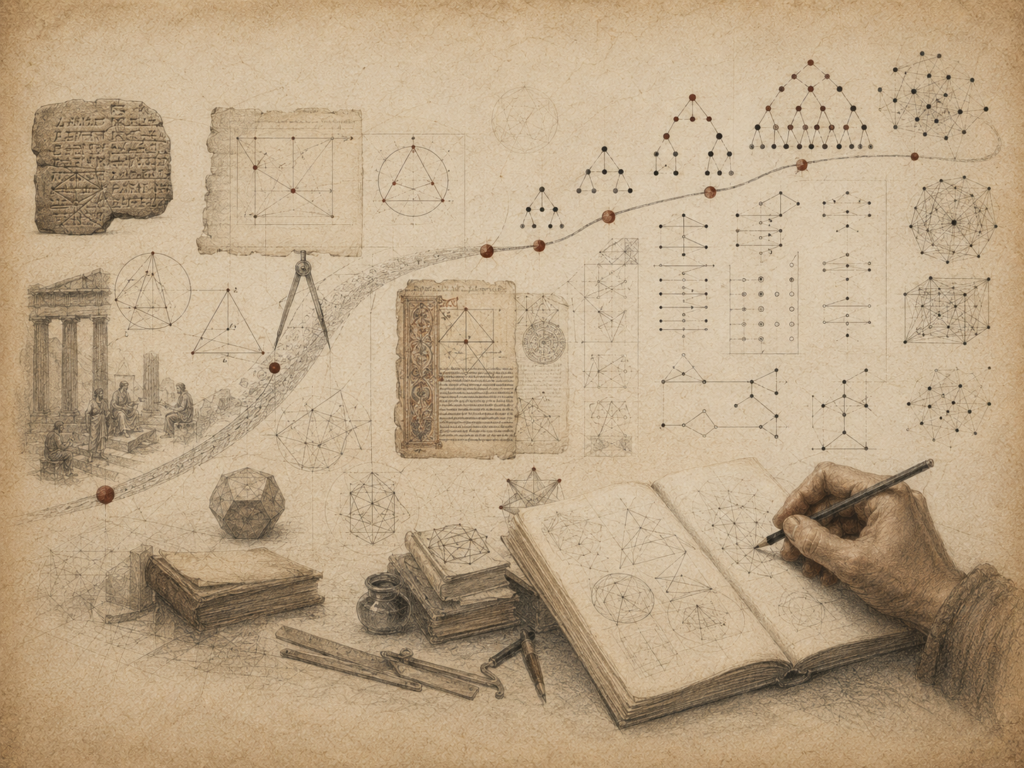
The Historical Development of Proof
The Historical Development of Proof traces proof as a changing human practice of mathematical justification, not a fixed ritual that appeared fully formed. The article follows proof from ancient rule-based calculation, measurement, and scribal procedure through Greek deductive geometry, Euclid’s axiomatic architecture, Aristotelian demonstration, Hellenistic exhaustion, Indian algorithmic and astronomical traditions, Chinese procedural verification, Islamic algebraic-geometric synthesis, medieval scholastic reasoning, early modern symbolism, calculus, nineteenth-century rigor, non-Euclidean geometry, set theory, logic, Gödelian limits, twentieth-century abstraction, and machine-checked proof. It emphasizes that proof standards depend on notation, medium, institution, culture, pedagogy, and community judgment. By foregrounding global traditions and historiographic risks such as Eurocentrism, presentism, canon bias, and technological triumphalism, the article frames proof as both a logical discipline and an ethical practice of intellectual accountability across mathematics, history, education, computation, and responsible public reasoning in modern knowledge systems today.