
Last Updated June 3, 2026
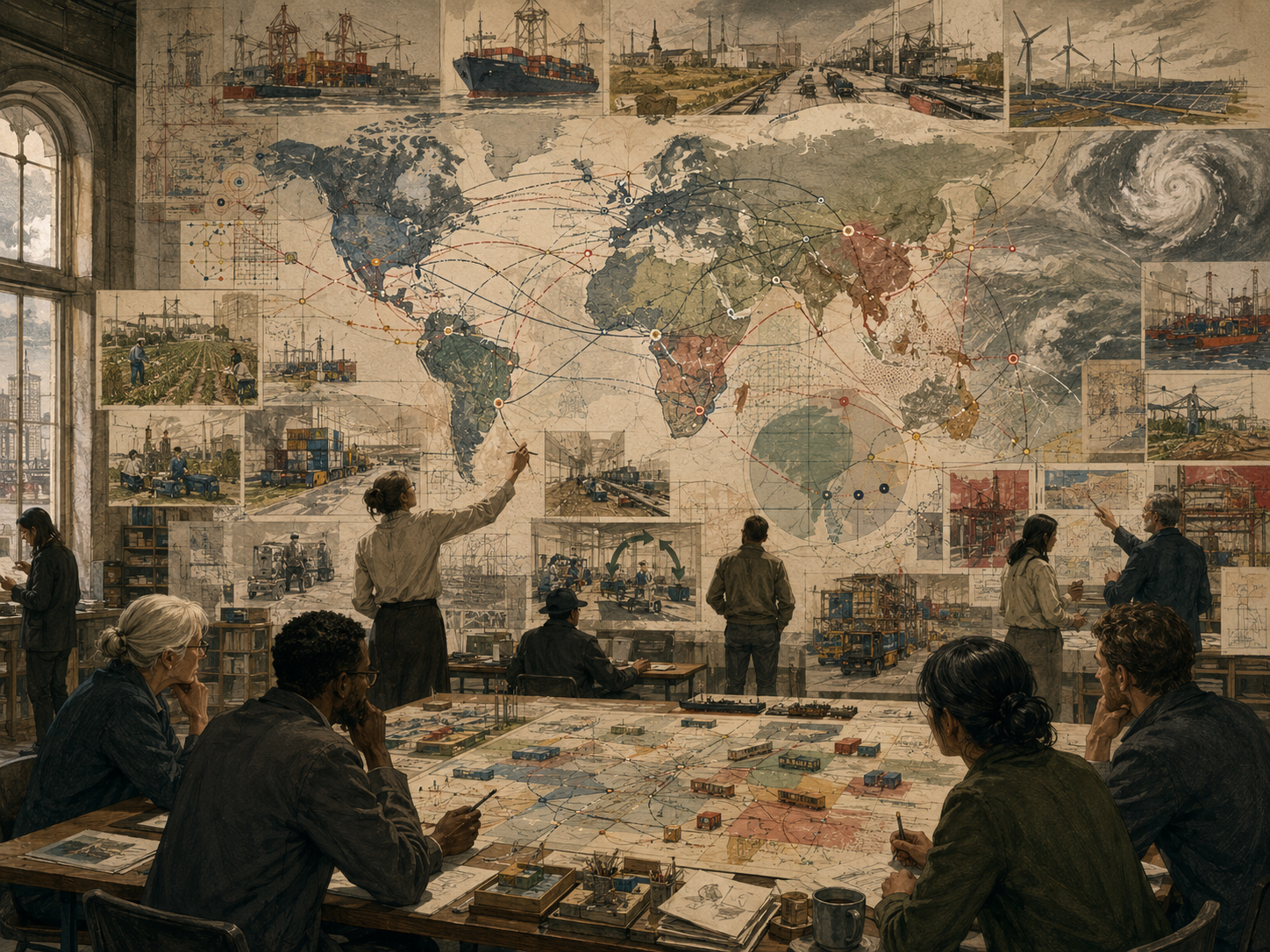
Supply chain futures examine how production, logistics, sourcing, infrastructure, inventory, labor, data systems, geopolitics, climate risk, and market demand may evolve under conditions of disruption and uncertainty. Supply chains are often described as networks that move goods from suppliers to producers, distributors, retailers, institutions, and consumers. A futures-thinking approach widens that frame. It treats supply chains as complex socio-technical systems that connect labor, land, energy, finance, transportation, regulation, technology, ecological constraint, public infrastructure, and global power.
Supply chains are not merely operational systems. They are strategic systems. They determine who controls production, which regions capture value, how firms manage risk, how consumers experience availability and price, how workers are treated, how emissions are distributed, how fragile essential goods become, and how shocks move through the economy. A disruption in one node can cascade through food systems, medical supply networks, energy systems, electronics production, construction materials, consumer goods, and public services.
The core question of supply chain futures is not simply how to make supply chains faster or cheaper. The deeper question is how societies and organizations can design supply systems that are resilient, transparent, just, adaptive, low-carbon, and capable of serving essential needs under unstable future conditions.
This article examines supply chain futures through globalization, regionalization, resilience, automation, logistics infrastructure, labor, climate risk, energy transition, critical minerals, digital traceability, chokepoints, inventory strategy, public procurement, circularity, governance, and systemic risk. It also provides mathematical and computational workflows for comparing supply chain scenarios, stress-testing strategies, and modeling resilience, redundancy, exposure, and adaptive capacity.
Main Library
Publications
Article Map
Futures Thinking
Related Topic
Economic Systems
Related Topic
Risk & Resilience
Related Topic
Intelligent Infrastructure
What Are Supply Chain Futures?
Supply chain futures are alternative possible pathways for how sourcing, production, transportation, warehousing, distribution, inventory, data systems, labor, regulation, and material flows may change over time. They examine how organizations, governments, communities, and global systems prepare for uncertainty in the movement of goods, services, components, food, energy inputs, medicines, infrastructure materials, electronics, and other essential resources.
Supply chain futures matter because supply systems sit between production and everyday life. They determine whether hospitals have medicines, whether grocery shelves remain stocked, whether factories receive components, whether renewable energy projects have critical minerals, whether construction projects receive materials, whether small businesses can source goods, whether disaster response systems receive supplies, and whether consumers experience inflation, delay, substitution, or shortage.
In conventional business language, supply chains are often evaluated through cost, speed, efficiency, vendor performance, logistics optimization, inventory turnover, and service levels. These are important, but insufficient. Futures thinking asks how supply systems behave under disruption, scarcity, political conflict, climate stress, infrastructure failure, cyberattack, labor crisis, regulatory change, demand shock, or financial instability.
| Supply Chain Futures Question | Why It Matters | Strategic Implication |
|---|---|---|
| Where are critical dependencies located? | Production may depend on a small number of firms, regions, ports, minerals, or technologies. | Dependency mapping becomes essential to resilience planning. |
| Which nodes are vulnerable to disruption? | Ports, suppliers, warehouses, transport routes, data systems, and labor pools may become failure points. | Chokepoint analysis and redundancy planning become strategic capabilities. |
| How much resilience is needed? | Highly efficient systems may become brittle under stress. | Organizations must balance cost optimization with buffers, flexibility, and continuity. |
| What risks are hidden upstream? | Labor abuse, environmental harm, emissions, weak standards, and geopolitical exposure may be obscured. | Transparency and accountability become core supply chain functions. |
| How will climate and ecological stress affect flows? | Heat, storms, droughts, floods, water stress, and biodiversity loss can disrupt production and logistics. | Climate scenario analysis becomes part of supply chain design. |
| How will technology change supply systems? | Automation, AI, digital twins, sensors, blockchain, robotics, and predictive logistics may reshape operations. | Data governance, cybersecurity, and labor transition become supply chain issues. |
Supply chain futures shift the focus from moving goods cheaply to sustaining essential flows responsibly under changing conditions.
Supply Chains as Complex Systems
Supply chains are complex systems because they contain many interacting actors, delays, dependencies, feedback loops, and nonlinear effects. A supply chain may include raw material extraction, component suppliers, manufacturers, logistics providers, ports, rail systems, trucking networks, warehouses, digital platforms, customs agencies, regulators, buyers, retailers, consumers, financiers, insurers, and public infrastructure. Each actor makes decisions based on partial information, incentives, contracts, prices, capacity, risk perception, and institutional constraints.
A disruption in one part of the system can produce cascading consequences. A port closure can delay components. Component shortages can halt manufacturing. Manufacturing delays can increase prices. Higher prices can change demand. Demand uncertainty can distort forecasts. Distorted forecasts can create over-ordering or under-ordering. Inventory shifts can worsen upstream volatility. Financial pressure can weaken suppliers. Labor shortages can slow recovery. This is why supply chain futures require systems thinking rather than linear logistics thinking.
A supply chain is not a simple pipeline. It is a networked adaptive system where small disturbances can become system-wide disruptions when dependencies, delays, and feedback reinforce one another.
| Complex-System Feature | Supply Chain Meaning | Futures Implication |
|---|---|---|
| Interdependence | Firms, suppliers, infrastructure, labor, finance, energy, and regulation depend on one another. | Risk cannot be managed one firm or one tier at a time. |
| Feedback loops | Forecasts, orders, prices, inventory, and shortages influence one another. | Demand signals can amplify volatility upstream. |
| Delay | Production, shipping, customs, replenishment, and investment take time. | Late action can create long recovery periods. |
| Nonlinearity | Small disruptions can produce large shortages when systems are tightly coupled. | Stress testing must include threshold and cascade effects. |
| Path dependence | Supplier relationships, infrastructure, contracts, and regional capabilities constrain future options. | Strategic flexibility must be built before disruption. |
| Emergence | System behavior arises from many interacting decisions. | Forecasting individual nodes is not enough to understand whole-system behavior. |
| Adaptation | Suppliers, firms, workers, governments, and consumers adjust to shocks. | Future outcomes depend on how actors respond, not only on the initial disruption. |
Because supply chains are complex systems, resilience cannot be created through a single action. It depends on network design, supplier diversity, inventory policy, public infrastructure, data quality, labor conditions, financial stability, regulation, ecological planning, and organizational learning.
Supply chain futures therefore require a shift from optimization alone to adaptive system design.
Globalization, Regionalization, and Strategic Dependency
Modern supply chains were shaped by globalization, cost arbitrage, containerization, trade liberalization, just-in-time production, specialized manufacturing clusters, global logistics networks, and digital coordination. These systems lowered costs, expanded product availability, and enabled complex global production. They also created strategic dependencies that were often invisible until disruption exposed them.
Supply chain futures may involve a partial rebalancing from hyperglobalized efficiency toward regionalization, diversification, nearshoring, friend-shoring, reshoring, strategic stockpiles, public industrial policy, and resilience-focused sourcing. This does not mean globalization disappears. Many goods will remain global because production depends on specialized capabilities, minerals, knowledge systems, scale economies, and cross-border networks. But the logic of global supply chains is changing.
The future is unlikely to be purely global or purely local. It will likely involve layered supply systems: global where specialization is necessary, regional where resilience matters, local where essential access and responsiveness are critical.
| Supply Chain Model | Strength | Risk | Future Use |
|---|---|---|---|
| Global efficiency model | Low cost, specialization, scale, and broad product access. | Long-distance dependency, geopolitical exposure, emissions, and disruption risk. | Useful where specialization is unavoidable, but requires risk visibility. |
| Regionalized supply model | Reduced distance, faster response, and lower geopolitical exposure. | Higher cost, limited capacity, and regional concentration risk. | Useful for strategic sectors, essential goods, and resilience planning. |
| Nearshoring | Brings production closer to demand centers. | May shift rather than eliminate dependency. | Useful when transport risk and responsiveness matter. |
| Friend-shoring | Aligns supply with trusted geopolitical partners. | Can fragment trade and exclude vulnerable economies. | Useful for strategic goods but politically sensitive. |
| Local resilience model | Supports essential access, community continuity, and place-based capacity. | May lack scale, cost efficiency, or technical specialization. | Useful for food, emergency supplies, repair, and public resilience. |
| Distributed manufacturing | Uses flexible production capacity closer to need. | Requires standards, quality control, skills, and digital coordination. | Useful for spare parts, emergency production, and adaptive manufacturing. |
Strategic dependency becomes especially important for semiconductors, pharmaceuticals, medical supplies, food inputs, fertilizers, energy technologies, rare earth elements, batteries, defense-related materials, telecommunications infrastructure, and critical public systems. A dependency is not automatically bad. It becomes dangerous when it is concentrated, opaque, politically exposed, environmentally fragile, or difficult to substitute.
Supply chain futures will be shaped by the search for a new balance between efficiency, sovereignty, cooperation, resilience, affordability, and justice.
Resilience, Redundancy, and Efficiency
Supply chain management has long prioritized efficiency: lean inventory, low carrying costs, high asset utilization, just-in-time delivery, supplier consolidation, standardized processes, and optimized logistics. These practices can be powerful when conditions are stable. But when systems face uncertainty, efficiency can become fragility if it removes buffers, reduces supplier diversity, and leaves no room for disruption.
Resilience requires the ability to absorb disruption, adapt, recover, and transform. In supply chains, this can include multiple suppliers, safety stock, alternate transport routes, flexible contracts, regional production capacity, modular product design, substitution options, transparent upstream data, emergency procurement rules, and rapid decision protocols. These features may increase short-term cost, but they reduce catastrophic exposure.
The future of supply chain strategy will depend on how organizations price resilience. If resilience is treated only as waste, systems will remain brittle. If resilience is treated as strategic capacity, organizations can make more disciplined choices about where redundancy is necessary and where efficiency remains appropriate.
| Design Principle | Efficiency Logic | Resilience Logic |
|---|---|---|
| Inventory | Minimize stock to reduce carrying cost. | Maintain buffers for critical goods and uncertain lead times. |
| Supplier base | Consolidate suppliers for volume discounts and control. | Diversify suppliers to reduce concentration risk. |
| Transportation | Use lowest-cost routes and optimized schedules. | Preserve alternate routes and flexible logistics capacity. |
| Contracts | Prioritize price, service levels, and efficiency. | Include continuity, transparency, labor, climate, and contingency provisions. |
| Data systems | Track costs, orders, inventory, and performance. | Track risk, exposure, upstream dependencies, and early warning indicators. |
| Production | Specialize for scale and low unit cost. | Build modularity, flexible capacity, and substitution options. |
| Governance | Manage vendor performance and procurement compliance. | Coordinate resilience, ethics, transparency, and strategic risk. |
Resilience is not the opposite of efficiency. It is a broader form of efficiency over time. A system that minimizes cost in normal conditions but fails during disruption may be efficient only in a narrow accounting sense. A more resilient system may appear more expensive until the avoided losses, continuity benefits, and public-interest value are included.
Supply chain futures require moving from lowest-cost optimization to risk-adjusted, resilience-aware value creation.
Chokepoints, Cascades, and Systemic Risk
Supply chain chokepoints are concentrated points whose disruption can affect many downstream systems. They may be physical locations such as ports, canals, rail corridors, bridges, warehouses, border crossings, energy terminals, and logistics hubs. They may also be firms, technologies, standards, suppliers, data platforms, payment systems, labor pools, or regulatory processes.
Chokepoints matter because supply chains can be tightly coupled. When there is little slack, disruption moves quickly. A blocked shipping route can delay inputs. Delayed inputs can halt production. Production delays can create shortages. Shortages can trigger panic buying, over-ordering, hoarding, price spikes, and substitution. These responses can then amplify the original disruption.
Systemic risk in supply chains arises when dependencies are concentrated, substitution is difficult, buffers are thin, information is delayed, and many actors respond to disruption in ways that intensify volatility.
| Chokepoint Type | Example | Failure Consequence | Resilience Response |
|---|---|---|---|
| Geographic chokepoint | Port, canal, border crossing, rail corridor, bridge, logistics hub. | Transport delays, congestion, rerouting costs, and inventory shortages. | Alternate routes, regional warehousing, route risk analysis, infrastructure investment. |
| Supplier chokepoint | Single-source component, specialized manufacturer, dominant raw material supplier. | Production stoppage and price escalation. | Supplier diversification, qualification of alternatives, design substitution. |
| Technology chokepoint | Semiconductor node, proprietary software, platform dependency, data standard. | System lock-in and innovation bottleneck. | Open standards, modular architecture, technology redundancy. |
| Labor chokepoint | Specialized skills, port labor, truck drivers, warehouse workers, technicians. | Operational slowdown and reduced recovery capacity. | Workforce investment, labor standards, training, retention, safety. |
| Energy chokepoint | Fuel supply, grid reliability, energy-intensive processing. | Production disruption and cost spikes. | Energy resilience, electrification, backup systems, efficiency. |
| Regulatory chokepoint | Customs, certification, safety approval, export controls. | Delay, compliance risk, or market access restriction. | Regulatory foresight, documentation quality, compliance planning. |
| Data chokepoint | ERP outage, cyberattack, visibility platform failure, inaccurate forecast data. | Coordination breakdown and decision error. | Cybersecurity, backup systems, data governance, manual continuity plans. |
Supply chain futures require mapping chokepoints not only by location, but by dependency severity, substitutability, recovery time, exposure, and social importance. Essential goods require higher resilience standards than discretionary products because failure has public consequences.
Technology, Automation, and Digital Traceability
Technology will reshape supply chain futures through artificial intelligence, predictive analytics, digital twins, internet-of-things sensors, robotics, warehouse automation, autonomous vehicles, blockchain or distributed ledgers, advanced planning systems, real-time visibility platforms, smart contracts, satellite monitoring, and environmental sensing. These tools can improve forecasting, traceability, inventory planning, routing, emissions accounting, compliance, and risk detection.
But technology also introduces new risks. Automated systems can make brittle decisions if trained on unstable assumptions. Digital platforms can concentrate control over logistics data. Cyberattacks can disrupt operations. Surveillance technologies can intensify labor pressure. Predictive systems may hide bias or create false confidence. Traceability systems can be performative if underlying data are incomplete or manipulated.
Digital supply chain systems are only as trustworthy as the institutions, incentives, data quality, governance, and accountability structures around them.
| Technology | Supply Chain Benefit | Risk or Limitation |
|---|---|---|
| AI forecasting | Improves demand prediction and inventory planning. | Can fail under structural breaks, shocks, or biased data. |
| Digital twins | Simulate supply chain behavior under disruption. | Can create false precision if assumptions are weak. |
| IoT sensors | Track temperature, location, condition, and flow. | Raises cybersecurity, data reliability, and surveillance concerns. |
| Warehouse robotics | Improves throughput and reduces some physical risks. | May displace labor or intensify productivity pressure. |
| Traceability platforms | Improve visibility into origin, labor, emissions, and compliance. | May be incomplete if upstream data are missing or unverifiable. |
| Blockchain-style ledgers | Create tamper-resistant records where governance is appropriate. | Do not guarantee truth of the original data entered. |
| Autonomous logistics | May reduce transport cost and improve routing. | Raises safety, labor, liability, and infrastructure questions. |
Technology should be used to increase resilience, transparency, accountability, and public value—not only to accelerate extraction, surveillance, or cost-cutting. The future of supply chain technology depends on whether digital systems are designed as tools of coordination or instruments of control.
Labor, Rights, and Human Supply Chains
Supply chains are human systems. Every product and material flow depends on workers: farmers, miners, factory workers, seafarers, port workers, truck drivers, warehouse workers, delivery workers, engineers, planners, technicians, data analysts, auditors, mechanics, customs staff, procurement specialists, and retail workers. Yet labor is often treated as a cost variable rather than as a source of knowledge, dignity, resilience, and public responsibility.
Future supply chains will face growing scrutiny around wages, safety, forced labor, child labor, union rights, migrant labor, warehouse surveillance, delivery precarity, heat exposure, gendered labor, racialized labor segmentation, and the working conditions embedded in global production. These issues are not peripheral. They affect reliability, legitimacy, quality, retention, and resilience.
A supply chain that is cheap because workers are exploited is not truly efficient. It is shifting costs onto people with less power.
| Labor Issue | Supply Chain Risk | Future-Oriented Response |
|---|---|---|
| Forced labor and exploitation | Legal exposure, ethical harm, import bans, reputational damage. | Traceability, worker voice, independent auditing, enforcement, supplier accountability. |
| Warehouse surveillance | Injury, burnout, turnover, distrust, and labor conflict. | Human-centered automation, safety standards, worker participation. |
| Migrant labor vulnerability | Recruitment abuse, wage theft, unsafe conditions, lack of remedy. | Responsible recruitment, grievance systems, legal protections. |
| Transport labor shortages | Delivery delays, capacity constraints, safety risks. | Better pay, scheduling, training, retention, safety investment. |
| Heat and climate exposure | Worker illness, productivity loss, and moral hazard. | Climate adaptation, rest standards, protective equipment, scheduling changes. |
| Automation displacement | Job loss, skill mismatch, and political backlash. | Reskilling, transition support, labor consultation, shared productivity gains. |
| Weak worker voice | Risks remain hidden until crisis occurs. | Grievance channels, collective bargaining, worker-led monitoring. |
Workers often know where supply chains are fragile before executives or algorithms do. A future-ready supply chain should treat labor knowledge as intelligence, not as noise. Strong labor standards can improve resilience because they reduce turnover, increase trust, surface problems earlier, and support continuity under stress.
Climate Risk and Ecological Constraint
Climate change and ecological degradation are central to supply chain futures. Heat, drought, floods, storms, sea-level rise, wildfire, water stress, biodiversity loss, soil degradation, and pollution can disrupt production, transportation, storage, labor, insurance, and infrastructure. These risks do not affect all supply chains equally. Food, agriculture, textiles, electronics, mining, construction materials, pharmaceuticals, energy systems, and cold chains may face different forms of exposure.
Climate risk affects supply chains through both physical risk and transition risk. Physical risk includes direct damage, delays, resource scarcity, and unsafe working conditions. Transition risk includes regulation, carbon pricing, disclosure requirements, changing consumer expectations, investor pressure, technological substitution, and stranded assets.
Supply chains built for yesterday’s climate are increasingly misaligned with tomorrow’s operating conditions.
| Climate/Ecological Pressure | Supply Chain Effect | Strategic Response |
|---|---|---|
| Extreme heat | Labor risk, reduced productivity, equipment stress, spoilage. | Heat adaptation, worker protections, cooling infrastructure, schedule changes. |
| Flooding and storms | Port closures, road damage, warehouse loss, inventory destruction. | Site risk mapping, backup routes, resilient infrastructure, insurance review. |
| Drought and water stress | Agricultural losses, industrial water constraints, higher input costs. | Water risk analysis, supplier diversification, water stewardship. |
| Wildfire | Transport disruption, air quality hazards, facility damage. | Regional risk monitoring, emergency logistics, worker safety protocols. |
| Biodiversity loss | Reduced ecosystem services, agricultural instability, regulatory risk. | Nature-positive sourcing, land-use accountability, regenerative practices. |
| Carbon regulation | Higher costs for emissions-intensive transport and production. | Emissions accounting, low-carbon logistics, supplier transition planning. |
| Material scarcity | Input volatility and competition for critical resources. | Circular design, substitution, recycling, strategic reserves. |
Climate-resilient supply chains require more than emissions reporting. They require scenario planning, supplier risk mapping, adaptation investment, material substitution, public infrastructure coordination, and accountability for unequal exposure. Vulnerable workers and communities often bear the first costs of climate-disrupted supply chains.
Energy Transition, Critical Minerals, and Industrial Policy
The energy transition will reshape supply chains through demand for batteries, grid components, transmission equipment, rare earth elements, lithium, nickel, cobalt, copper, semiconductors, solar panels, wind turbine components, heat pumps, electrolyzers, charging infrastructure, and industrial decarbonization technologies. These materials and systems create new opportunities and new dependencies.
Critical minerals are especially important because the transition to low-carbon infrastructure depends on extraction, refining, processing, manufacturing, and recycling systems that are geographically uneven and politically sensitive. Resource-rich countries may gain bargaining power, but they may also face extraction, corruption, environmental harm, labor abuse, and dependency if governance is weak.
Energy transition supply chains are not automatically just or sustainable. They must be deliberately governed to avoid reproducing extractive development under a green label.
| Transition Supply Chain Issue | Opportunity | Risk | Future Strategy |
|---|---|---|---|
| Critical minerals | Supports batteries, electrification, and renewable infrastructure. | Extraction harm, geopolitical concentration, labor abuses. | Responsible sourcing, recycling, circularity, diversification, community rights. |
| Battery manufacturing | Creates industrial jobs and energy-storage capacity. | Material scarcity, waste, safety, and trade dependency. | Regional manufacturing, recycling, standards, safer chemistries. |
| Grid infrastructure | Enables electrification and renewable integration. | Long lead times, permitting delays, transformer shortages. | Industrial policy, workforce development, strategic procurement. |
| Solar and wind components | Accelerates clean-energy deployment. | Supplier concentration, trade conflict, forced labor concerns. | Traceability, diversified production, labor accountability. |
| Industrial decarbonization | Reduces emissions in steel, cement, chemicals, and manufacturing. | High capital costs and uncertain demand. | Public procurement, standards, green finance, infrastructure support. |
| Recycling and reuse | Reduces mineral pressure and waste. | Requires collection systems, design standards, and processing capacity. | Circular supply chains, right-to-repair, reverse logistics. |
Industrial policy is returning to supply chain strategy because states increasingly recognize that markets alone may not build resilient capacity in strategic sectors. Public investment, standards, procurement, research, workforce development, and trade policy will shape future supply chains in energy, health, food, infrastructure, and digital systems.
Inventory, Forecasting, and Demand Volatility
Inventory and forecasting are central to supply chain futures because uncertainty disrupts the relationship between past demand and future demand. Forecasting systems often assume that historical patterns provide useful guidance. That may be true in stable markets, but it becomes fragile under pandemics, climate events, war, inflation, technology shifts, regulatory change, social panic, platform amplification, and sudden consumer substitution.
The bullwhip effect shows how small changes in consumer demand can become amplified upstream through ordering behavior, forecast updates, batch ordering, lead-time uncertainty, and scarcity fears. Future supply chains need better data, but data alone is not enough. They need decision rules that account for uncertainty, behavioral response, and systemic amplification.
The challenge is not only to forecast better, but to design supply chains that remain viable when forecasts are wrong.
| Inventory Strategy | Strength | Risk | Best Use |
|---|---|---|---|
| Just-in-time | Low inventory cost and high efficiency. | Fragile under disruption and lead-time uncertainty. | Stable supply environments with reliable logistics. |
| Safety stock | Buffers demand and supply variability. | Higher carrying cost and risk of obsolescence. | Critical goods, volatile lead times, uncertain demand. |
| Strategic stockpile | Protects essential goods and public systems. | Requires governance, rotation, quality control, and funding. | Medical supplies, emergency goods, defense, food security. |
| Flexible inventory pooling | Shares stock across regions or channels. | Requires visibility and coordination. | Multi-region distribution and high uncertainty. |
| Vendor-managed inventory | Improves coordination with suppliers. | Can shift risk and reduce buyer visibility if poorly governed. | Stable relationships with trusted data sharing. |
| Demand sensing | Uses real-time signals to update planning. | Can overreact to noisy or manipulated signals. | Fast-moving markets with strong data governance. |
Supply chain futures will require hybrid inventory strategies. Not every product needs redundancy. Not every supply flow requires local production. But essential goods, long-lead items, fragile inputs, and high-impact dependencies need explicit resilience thresholds.
Public Procurement and Essential Goods
Supply chain futures are not only private-sector concerns. Public procurement shapes markets for health systems, schools, infrastructure, defense, emergency response, energy, housing, transportation, food programs, and public services. Governments buy goods and services at large scale, and procurement choices can shape resilience, labor standards, environmental performance, local capacity, innovation, and public accountability.
Essential goods require special attention because shortages can harm public welfare. Medicines, vaccines, medical devices, food, water treatment inputs, energy equipment, emergency supplies, school meals, public transit parts, grid components, and disaster-response materials cannot be treated exactly like discretionary retail goods.
Public procurement is a supply chain governance tool. It can either reinforce lowest-cost fragility or build resilient public-interest capacity.
| Procurement Objective | Supply Chain Function | Public-Interest Value |
|---|---|---|
| Resilience | Maintains continuity of essential goods and services. | Protects public health, safety, and institutional capacity. |
| Transparency | Improves visibility into suppliers, labor, emissions, and risks. | Supports accountability and reduces hidden harm. |
| Local and regional capacity | Builds strategic production and service capacity closer to need. | Strengthens regional resilience and economic development. |
| Labor standards | Requires fair wages, safety, and worker protections. | Prevents public spending from subsidizing exploitation. |
| Environmental performance | Reduces emissions, waste, pollution, and resource harm. | Aligns purchasing with climate and ecological goals. |
| Innovation | Creates demand for better technologies and services. | Supports mission-oriented development and public value. |
| Equity | Includes small businesses, minority-owned firms, and underserved regions. | Distributes opportunity more fairly. |
Future-ready procurement needs better data, stronger standards, resilience scoring, lifecycle costing, supplier development, transparent contracting, and long-term public capacity. The lowest bid is not always the best value when fragility, labor abuse, carbon emissions, poor quality, or failure risk are included.
Circular Supply Chains and Material Reuse
Circular supply chains reduce dependence on virgin materials by designing products and systems for repair, reuse, refurbishment, remanufacturing, recycling, sharing, and material recovery. This is increasingly important as climate policy, waste regulation, critical-mineral pressure, consumer expectations, and resource constraints reshape supply chain strategy.
A circular supply chain is not simply recycling at the end of the process. It requires design for durability, modularity, disassembly, standardized components, reverse logistics, repair networks, secondary material markets, product passports, quality standards, and business models that reward longevity instead of disposal.
Circularity changes the supply chain from a one-way extraction-to-disposal model into a looped material system.
| Circular Strategy | Supply Chain Requirement | Future Benefit |
|---|---|---|
| Repairability | Parts access, repair manuals, modular design, skilled technicians. | Extends product life and reduces replacement demand. |
| Reuse | Collection systems, quality grading, resale channels. | Reduces waste and improves affordability. |
| Refurbishment | Inspection, testing, repair, certification. | Creates secondary markets and jobs. |
| Remanufacturing | Recovered components, industrial processing, design standardization. | Reduces material inputs and production emissions. |
| Recycling | Collection, sorting, material processing, contamination control. | Reduces resource pressure but depends on system quality. |
| Product passports | Material data, origin tracking, repair information. | Improves traceability and circular recovery. |
| Reverse logistics | Systems for moving products back through the chain. | Makes circular flows operationally feasible. |
Circular supply chains can support resilience by reducing dependence on volatile inputs, but they can also reproduce inequality if repair, reuse, and recycling labor are unsafe or underpaid. Circular futures must therefore include labor rights, environmental justice, and community protection.
Core Dimensions of Supply Chain Futures
Supply chain futures can be evaluated across several interacting dimensions. These dimensions should not be treated separately. Resilience depends on transparency. Transparency depends on data and governance. Regionalization affects cost and equity. Automation affects labor. Climate risk affects logistics. Circularity affects design and reverse flows. A future-ready supply chain integrates these dimensions into strategic decision-making.
1. Resilience Capacity
Resilience capacity is the ability to absorb disruption, maintain essential flows, recover, and adapt. It includes redundancy, alternate suppliers, safety stock, flexible logistics, emergency protocols, and organizational learning.
2. Dependency Visibility
Dependency visibility refers to knowledge of upstream suppliers, materials, regions, transport routes, labor conditions, data systems, and chokepoints. Hidden dependencies are strategic liabilities.
3. Geographic Diversification
Geographic diversification reduces overdependence on a single region, port, corridor, jurisdiction, or climate-exposed area. It must be balanced with capability, cost, and governance realities.
4. Labor Accountability
Labor accountability includes wages, safety, worker voice, forced-labor prevention, migrant protections, heat safety, and fair treatment across supply tiers. Human resilience is supply chain resilience.
5. Climate Adaptation
Climate adaptation means designing supply systems for heat, storms, floods, drought, water stress, wildfire, sea-level rise, insurance changes, and infrastructure risk.
6. Digital Traceability
Digital traceability uses data systems to track origin, flow, emissions, labor conditions, compliance, inventory, and risk. It requires verification, governance, cybersecurity, and interoperability.
7. Circularity and Material Strategy
Circularity and material strategy reduce dependence on volatile virgin inputs through repair, reuse, recycling, substitution, product design, and reverse logistics.
8. Public-Interest Governance
Public-interest governance aligns supply systems with essential goods, public health, environmental protection, labor rights, equity, procurement standards, and long-term resilience.
| Dimension | Core Question | Failure if Ignored |
|---|---|---|
| Resilience capacity | Can essential flows continue under disruption? | Shortages, production stoppage, public harm. |
| Dependency visibility | Do organizations know where critical risks are located? | Hidden single points of failure. |
| Geographic diversification | Are sources and routes overconcentrated? | Geopolitical, climate, or logistics exposure. |
| Labor accountability | Are workers protected and able to surface risk? | Exploitation, turnover, legal exposure, fragile operations. |
| Climate adaptation | Are supply systems designed for future environmental conditions? | Physical disruption and rising operating cost. |
| Digital traceability | Can flows, risks, and claims be verified? | Opacity, greenwashing, compliance failure. |
| Circularity | Can materials remain useful across multiple life cycles? | Resource dependence, waste, and critical input exposure. |
| Public-interest governance | Do supply chains serve essential needs and social responsibility? | Private optimization creates public fragility. |
Supply chain futures are strongest when resilience, transparency, labor accountability, climate adaptation, circularity, and public-interest governance reinforce one another.
Governance, Standards, and Accountability
Supply chain governance includes the rules, standards, contracts, audits, certifications, disclosures, procurement practices, enforcement systems, and institutional arrangements that shape supply chain behavior. Governance matters because supply chains often cross many jurisdictions, legal regimes, and power relationships. Without accountability, upstream harms can be hidden behind subcontracting, opacity, and distance.
Future supply chain governance will likely focus more heavily on due diligence, forced-labor prevention, emissions disclosure, deforestation-free sourcing, product passports, cybersecurity, supplier resilience, modern slavery reporting, responsible minerals, food traceability, critical infrastructure protection, and public procurement rules. But governance must be more than paperwork. Audits can fail when workers cannot speak freely, when suppliers falsify records, or when buyers impose unrealistic costs and timelines.
Accountability requires aligning buyer behavior with supplier responsibility. A firm cannot demand ethical supply chains while creating price and deadline pressures that make ethical compliance impossible.
| Governance Tool | Function | Risk if Weak |
|---|---|---|
| Supplier due diligence | Identifies labor, environmental, legal, and resilience risks. | Risks remain hidden until scandal or disruption. |
| Traceability standards | Track origin, custody, materials, labor, and emissions. | Claims cannot be verified. |
| Contract clauses | Set expectations for continuity, labor, environment, disclosure, and compliance. | Responsibility remains vague or unenforceable. |
| Worker grievance systems | Allow workers to report harm and risk. | Audits miss lived conditions. |
| Public disclosure | Provides information to regulators, consumers, investors, and civil society. | Opacity enables greenwashing and abuse. |
| Procurement standards | Use purchasing power to shape market behavior. | Lowest-cost procurement reinforces fragility. |
| Enforcement | Creates consequences for noncompliance. | Standards become symbolic. |
Future-ready governance should combine data systems with institutional accountability. Digital traceability can support transparency, but it cannot replace worker voice, public enforcement, independent verification, and responsible purchasing practices.
Future Scenarios for Supply Chain Futures
Supply chain futures can unfold across several plausible pathways. These scenarios are not predictions. They are structured contexts for testing assumptions about resilience, cost, dependency, labor, technology, climate, regulation, and public value.
| Scenario | Description | Supply Chain Risk | Strategic Opportunity |
|---|---|---|---|
| Regional Resilience Shift | Firms and governments regionalize critical supply chains to reduce global exposure. | Higher costs, duplicated capacity, and regional bottlenecks. | Improved continuity, local capability, and strategic flexibility. |
| Fragmented Trade Future | Geopolitical conflict, tariffs, sanctions, and export controls disrupt global flows. | Supply shocks, price volatility, compliance complexity. | Diversification, regulatory foresight, and resilient sourcing. |
| Climate-Disrupted Logistics | Extreme weather and ecological stress disrupt production, ports, roads, labor, and storage. | Physical damage, unreliable lead times, rising insurance and adaptation costs. | Climate-resilient infrastructure, supplier risk mapping, and adaptive logistics. |
| Automated Traceable Supply Chains | AI, sensors, digital twins, robotics, and traceability platforms reshape operations. | Cyber risk, surveillance, data dependency, false precision. | Better visibility, risk detection, emissions tracking, and coordination. |
| Critical Minerals Bottleneck | Energy transition demand creates pressure on minerals, refining, batteries, and grid equipment. | Input scarcity, extraction harm, geopolitical concentration. | Circularity, recycling, responsible sourcing, and industrial policy. |
| Essential Goods Resilience Model | Public procurement and regulation strengthen supply chains for medicines, food, energy, and infrastructure. | Requires funding, governance, and long-term coordination. | Public resilience, strategic stockpiles, and mission-oriented procurement. |
| Lowest-Cost Fragility Return | Organizations return to cost-minimization after immediate crises fade. | Hidden dependencies and brittle systems persist. | Risk-adjusted accounting can show why resilience investment matters. |
Scenario analysis shows that no single supply chain design is optimal for all futures. The right strategy depends on criticality, exposure, substitutability, public importance, and acceptable failure risk.
Strategic Questions for Supply Chain Futures
Supply chain futures analysis should guide strategic questions for firms, governments, public agencies, infrastructure planners, labor organizations, communities, and researchers. These questions help reveal hidden dependencies and future risks before disruption forces action.
| Strategic Question | What It Reveals | Why It Matters |
|---|---|---|
| Which goods, materials, or components are truly critical? | Essential flows and high-impact dependencies. | Critical goods require stronger resilience standards. |
| Where are the hidden single points of failure? | Supplier, route, region, labor, technology, and infrastructure chokepoints. | Hidden concentration creates surprise failure. |
| What assumptions does the current supply chain make about stability? | Embedded beliefs about trade, climate, fuel, labor, finance, and regulation. | Assumptions must be stress-tested against future scenarios. |
| How quickly can the system recover? | Recovery time, substitution options, and adaptive capacity. | Resilience depends on recovery, not just prevention. |
| Who bears the cost of supply chain efficiency? | Labor, communities, suppliers, ecosystems, and consumers affected by hidden costs. | Efficiency can conceal exploitation and environmental harm. |
| Which emissions and ecological harms are embedded upstream? | Climate, biodiversity, water, land, and pollution exposure. | Supply chain sustainability depends on upstream accountability. |
| What data are missing or unverifiable? | Traceability gaps, supplier opacity, and weak evidence. | Claims and risk models fail without trustworthy data. |
| What should be regionalized, diversified, stockpiled, or redesigned? | Strategic options for resilience. | Not all supply chain risk requires the same solution. |
Supply chain futures work is strongest when it connects operational detail to systemic risk, public welfare, labor conditions, ecological limits, and long-term strategic capacity.
Limits and Failure Modes
Supply chain futures analysis has limits. Data may be incomplete, suppliers may be hidden, risk may be underestimated, and models may fail under structural change. Organizations may produce dashboards without changing procurement incentives. Firms may claim resilience while continuing to impose unrealistic costs and deadlines on suppliers. Traceability systems may verify paperwork rather than reality. Reshoring may create new vulnerabilities if it ignores labor, cost, capacity, or ecological exposure.
There is also a risk of treating resilience as a narrow corporate priority while ignoring public consequences. A firm may secure its own supplies by outbidding others, hoarding scarce goods, or shifting risk to weaker suppliers. That may improve private continuity while worsening system-wide fragility.
| Failure Mode | Problem | Corrective Practice |
|---|---|---|
| Dashboard illusion | Visibility tools create confidence without real upstream knowledge. | Combine data systems with verification, supplier engagement, and worker voice. |
| Lowest-cost relapse | Organizations return to brittle cost optimization after crisis fades. | Use risk-adjusted costing and resilience metrics. |
| Resilience theater | Plans exist but are not funded, tested, or operationalized. | Run stress tests, exercises, and governance reviews. |
| Supplier burden shifting | Buyers demand resilience without paying for capacity. | Align contracts, pricing, timelines, and supplier development. |
| Ethical audit failure | Audits miss coercion, fear, subcontracting, or falsified records. | Use worker-led monitoring, grievance systems, and independent enforcement. |
| Overregionalization | Local or regional sourcing is treated as automatically resilient. | Assess capacity, cost, climate exposure, skills, and substitutes. |
| Technology overconfidence | AI or digital twins are treated as substitutes for judgment. | Use scenario analysis, human expertise, and model limitations. |
The goal is not perfect control over supply chains. The goal is better preparedness, clearer accountability, more humane design, and stronger adaptive capacity under uncertainty.
Mathematical Lens: Resilience, Exposure, and Supply Chain Viability
A simple supply chain resilience expression can represent resilience as a function of redundancy, visibility, flexibility, and recovery capacity, offset by exposure:
R_t = \alpha B_t + \beta V_t + \gamma F_t + \delta C_t – \lambda E_t
\]
Interpretation: \(R_t\) is supply chain resilience at time \(t\), \(B_t\) is buffer or redundancy capacity, \(V_t\) is visibility, \(F_t\) is flexibility, \(C_t\) is recovery capacity, and \(E_t\) is exposure. Resilience rises when buffers, visibility, flexibility, and recovery capacity improve, but falls when exposure increases.
Dependency concentration can be represented as:
D = \sum_{i=1}^{n} s_i^2
\]
Interpretation: \(D\) is a concentration measure and \(s_i\) is the share of supply coming from supplier or region \(i\). Higher concentration indicates greater dependency risk, especially when substitution is difficult.
Risk-adjusted supply value can be represented as:
V^*_k = V_k – C_k – L_k
\]
Interpretation: \(V^*_k\) is risk-adjusted value for supply strategy \(k\), \(V_k\) is operational value, \(C_k\) is direct cost, and \(L_k\) is expected loss from disruption, labor exposure, ecological harm, or compliance failure. A low-cost strategy may perform poorly once hidden losses are counted.
Recovery time can be represented as:
T_r = f(S, A, I, K)
\]
Interpretation: \(T_r\) is recovery time, \(S\) is shock severity, \(A\) is adaptive capacity, \(I\) is infrastructure reliability, and \(K\) is knowledge or coordination capacity. Recovery time decreases when adaptive capacity, infrastructure, and coordination improve.
Supply chain viability across scenarios can be represented as:
\Pi_k = \{Q_{k1}, Q_{k2}, \dots, Q_{kn}\}
\]
Interpretation: \(\Pi_k\) is the performance profile of supply chain strategy \(k\) across scenarios, and \(Q_{ks}\) is viability in scenario \(s\). Futures thinking evaluates strategies across multiple plausible conditions rather than one expected future.
These equations are not complete models. They are conceptual tools for making supply chain assumptions explicit: resilience depends on buffers, visibility, flexibility, recovery, concentration, exposure, and scenario performance.
Computational Modeling for Supply Chain Futures
Computational modeling can help compare supply chain futures, stress-test strategies, and make assumptions visible. It should not be used to hide uncertainty behind false precision. Its value lies in clarifying dependencies, comparing scenario performance, estimating resilience, identifying concentration, simulating disruptions, and documenting tradeoffs among cost, continuity, labor, climate, emissions, and public value.
A professional supply chain futures workflow may include:
- Supply chain profiles: cost efficiency, supplier concentration, regional diversification, inventory buffer, visibility, labor accountability, climate exposure, and recovery capacity.
- Future scenarios: regionalization, trade fragmentation, climate disruption, automation, critical minerals bottlenecks, essential goods resilience, and lowest-cost relapse.
- Risk indicators: chokepoint exposure, supplier fragility, lead-time uncertainty, labor risk, water stress, port risk, cyber exposure, and regulatory pressure.
- Resilience strategies: supplier diversification, safety stock, regional capacity, traceability, circularity, strategic stockpiles, and climate adaptation.
- Outputs: resilience scores, dependency concentration, scenario stress tests, disruption simulations, recovery estimates, and governance recommendations.
Supply chain modeling is most useful when it helps decision-makers see hidden dependencies and understand what resilience costs before disruption reveals what fragility costs.
Advanced R Workflow: Comparing Supply Chain Future Profiles
The R workflow below compares stylized supply chain future profiles across cost efficiency, supplier diversification, inventory buffer, visibility, labor accountability, climate adaptation, digital traceability, circularity, and regulatory readiness.
# ------------------------------------------------------------
# R Workflow: Comparing Supply Chain Future Profiles
# Purpose:
#   Compare stylized supply chain futures across efficiency,
#   diversification, buffers, visibility, labor accountability,
#   climate adaptation, traceability, circularity, and regulation.
#
# Optional dependency:
#   install.packages(c("tidyverse"))
# ------------------------------------------------------------

library(tidyverse)

supply_futures <- tibble(
  future_type = c(
    "Lowest-Cost Global Efficiency",
    "Regional Resilience Shift",
    "Fragmented Trade Future",
    "Climate-Adaptive Supply Chain",
    "Automated Traceable Supply Chain",
    "Circular Material Supply Chain",
    "Essential Goods Resilience Model"
  ),
  cost_efficiency = c(0.90, 0.58, 0.46, 0.60, 0.72, 0.54, 0.52),
  supplier_diversification = c(0.34, 0.78, 0.56, 0.70, 0.62, 0.68, 0.76),
  inventory_buffer = c(0.24, 0.70, 0.60, 0.68, 0.54, 0.62, 0.84),
  supply_visibility = c(0.42, 0.66, 0.50, 0.70, 0.90, 0.78, 0.74),
  labor_accountability = c(0.36, 0.64, 0.44, 0.60, 0.52, 0.66, 0.72),
  climate_adaptation = c(0.30, 0.62, 0.46, 0.90, 0.66, 0.74, 0.70),
  digital_traceability = c(0.44, 0.64, 0.52, 0.72, 0.92, 0.78, 0.76),
  circularity = c(0.26, 0.48, 0.36, 0.58, 0.56, 0.90, 0.54),
  regulatory_readiness = c(0.38, 0.66, 0.48, 0.70, 0.74, 0.76, 0.80)
)

supply_futures <- supply_futures %>%
  mutate(
    resilience_score =
      0.12 * cost_efficiency +
      0.16 * supplier_diversification +
      0.15 * inventory_buffer +
      0.15 * supply_visibility +
      0.12 * labor_accountability +
      0.13 * climate_adaptation +
      0.08 * digital_traceability +
      0.05 * circularity +
      0.04 * regulatory_readiness,

    fragility_score =
      0.18 * (1 - supplier_diversification) +
      0.16 * (1 - inventory_buffer) +
      0.15 * (1 - supply_visibility) +
      0.14 * (1 - climate_adaptation) +
      0.12 * (1 - labor_accountability) +
      0.10 * (1 - regulatory_readiness) +
      0.08 * (1 - digital_traceability) +
      0.07 * (1 - circularity),

    future_class = case_when(
      resilience_score >= 0.68 & fragility_score < 0.42 ~ "Stronger resilience profile",
      fragility_score >= 0.60 ~ "High supply chain fragility",
      TRUE ~ "Mixed or transitional profile"
    )
  ) %>%
  arrange(desc(resilience_score))

print(supply_futures)

supply_long <- supply_futures %>%
  select(
    future_type,
    cost_efficiency,
    supplier_diversification,
    inventory_buffer,
    supply_visibility,
    labor_accountability,
    climate_adaptation,
    digital_traceability,
    circularity,
    regulatory_readiness
  ) %>%
  pivot_longer(
    cols = -future_type,
    names_to = "dimension",
    values_to = "value"
  )

ggplot(supply_long, aes(x = dimension, y = value, fill = future_type)) +
  geom_col(position = "dodge") +
  coord_flip() +
  labs(
    title = "Supply Chain Future Profile Dimensions",
    x = "Dimension",
    y = "Value",
    fill = "Future Type"
  ) +
  theme_minimal(base_size = 12)

ggplot(supply_futures, aes(x = reorder(future_type, resilience_score), y = resilience_score)) +
  geom_col() +
  coord_flip() +
  labs(
    title = "Supply Chain Resilience Score",
    x = "Future Type",
    y = "Score"
  ) +
  theme_minimal(base_size = 12)

ggplot(supply_futures, aes(x = resilience_score, y = fragility_score, label = future_type)) +
  geom_point(size = 3) +
  geom_text(nudge_y = 0.02, size = 3) +
  labs(
    title = "Supply Chain Resilience vs Fragility",
    x = "Resilience Score",
    y = "Fragility Score"
  ) +
  theme_minimal(base_size = 12)

dir.create("outputs", showWarnings = FALSE)
write_csv(supply_futures, "outputs/supply_chain_future_profiles.csv")
This workflow illustrates why supply chain futures should be evaluated through resilience, visibility, labor accountability, climate adaptation, and circularity—not only cost efficiency.
Advanced Python Workflow: Simulating Supply Chain Resilience Under Disruption
The Python workflow below simulates supply chain viability under repeated disruptions, comparing systems with different levels of diversification, buffers, visibility, climate adaptation, labor accountability, and recovery capacity.
# ------------------------------------------------------------
# Python Workflow: Simulating Supply Chain Resilience
# Purpose:
#   Compare stylized supply chain strategies under repeated
#   disruptions with different diversification, inventory buffer,
#   visibility, labor accountability, climate adaptation,
#   digital traceability, and recovery capacity.
#
# Optional dependencies:
#   pip install pandas numpy matplotlib
# ------------------------------------------------------------

from pathlib import Path

import numpy as np
import pandas as pd
import matplotlib.pyplot as plt

OUTPUT_DIR = Path("outputs")
OUTPUT_DIR.mkdir(exist_ok=True)

time_steps = np.arange(1, 41)

supply_chains = [
    {
        "system": "Lowest-Cost Global Efficiency",
        "cost_efficiency": 0.90,
        "diversification": 0.34,
        "buffer": 0.24,
        "visibility": 0.42,
        "labor_accountability": 0.36,
        "climate_adaptation": 0.30,
        "traceability": 0.44,
        "recovery_capacity": 0.38
    },
    {
        "system": "Regional Resilience Shift",
        "cost_efficiency": 0.58,
        "diversification": 0.78,
        "buffer": 0.70,
        "visibility": 0.66,
        "labor_accountability": 0.64,
        "climate_adaptation": 0.62,
        "traceability": 0.64,
        "recovery_capacity": 0.74
    },
    {
        "system": "Climate-Adaptive Supply Chain",
        "cost_efficiency": 0.60,
        "diversification": 0.70,
        "buffer": 0.68,
        "visibility": 0.70,
        "labor_accountability": 0.60,
        "climate_adaptation": 0.90,
        "traceability": 0.72,
        "recovery_capacity": 0.78
    },
    {
        "system": "Automated Traceable Supply Chain",
        "cost_efficiency": 0.72,
        "diversification": 0.62,
        "buffer": 0.54,
        "visibility": 0.90,
        "labor_accountability": 0.52,
        "climate_adaptation": 0.66,
        "traceability": 0.92,
        "recovery_capacity": 0.68
    },
    {
        "system": "Essential Goods Resilience Model",
        "cost_efficiency": 0.52,
        "diversification": 0.76,
        "buffer": 0.84,
        "visibility": 0.74,
        "labor_accountability": 0.72,
        "climate_adaptation": 0.70,
        "traceability": 0.76,
        "recovery_capacity": 0.86
    }
]

def simulate_supply_chain(
    cost_efficiency,
    diversification,
    buffer,
    visibility,
    labor_accountability,
    climate_adaptation,
    traceability,
    recovery_capacity,
    initial_viability=1.0
):
    viability = np.zeros(len(time_steps))
    disruption_exposure = np.zeros(len(time_steps))
    recovery_score = np.zeros(len(time_steps))

    viability[0] = initial_viability
    disruption_exposure[0] = (
        0.22 * (1 - diversification)
        + 0.20 * (1 - buffer)
        + 0.18 * (1 - visibility)
        + 0.16 * (1 - climate_adaptation)
        + 0.12 * (1 - labor_accountability)
        + 0.12 * (1 - recovery_capacity)
    )
    recovery_score[0] = (
        0.24 * recovery_capacity
        + 0.20 * visibility
        + 0.18 * buffer
        + 0.16 * diversification
        + 0.12 * traceability
        + 0.10 * labor_accountability
    )

    for t in range(1, len(time_steps)):
        disruption = 0.20 if (t + 1) % 8 == 0 else 0.06

        adaptive_capacity = (
            0.20 * diversification
            + 0.18 * buffer
            + 0.18 * visibility
            + 0.16 * recovery_capacity
            + 0.12 * climate_adaptation
            + 0.10 * traceability
            + 0.06 * labor_accountability
        )

        disruption_exposure[t] = np.clip(
            disruption_exposure[t - 1]
            + 0.06 * disruption
            - 0.03 * diversification
            - 0.03 * buffer
            - 0.03 * visibility
            - 0.03 * climate_adaptation
            - 0.02 * labor_accountability,
            0,
            1.4
        )

        recovery_score[t] = np.clip(
            recovery_score[t - 1]
            + 0.03 * recovery_capacity
            + 0.03 * visibility
            + 0.02 * buffer
            + 0.02 * traceability
            - 0.04 * disruption,
            0,
            1.5
        )

        viability[t] = np.clip(
            viability[t - 1]
            + 0.04 * cost_efficiency
            + 0.08 * adaptive_capacity
            + 0.05 * recovery_score[t]
            - disruption
            - 0.05 * disruption_exposure[t],
            0,
            1.8
        )

    return viability, disruption_exposure, recovery_score

rows = []

for chain in supply_chains:
    viability, exposure, recovery = simulate_supply_chain(
        chain["cost_efficiency"],
        chain["diversification"],
        chain["buffer"],
        chain["visibility"],
        chain["labor_accountability"],
        chain["climate_adaptation"],
        chain["traceability"],
        chain["recovery_capacity"]
    )

    for t, v, e, r in zip(time_steps, viability, exposure, recovery):
        rows.append({
            "system": chain["system"],
            "time": t,
            "supply_chain_viability": v,
            "disruption_exposure": e,
            "recovery_score": r
        })

df = pd.DataFrame(rows)

summary = (
    df.groupby("system")
    .agg(
        final_viability=("supply_chain_viability", "last"),
        mean_viability=("supply_chain_viability", "mean"),
        mean_disruption_exposure=("disruption_exposure", "mean"),
        final_recovery_score=("recovery_score", "last")
    )
    .reset_index()
    .sort_values("final_viability", ascending=False)
)

print(summary)

plt.figure(figsize=(10, 6))
for system_name in df["system"].unique():
    subset = df[df["system"] == system_name]
    plt.plot(subset["time"], subset["supply_chain_viability"], label=system_name)

plt.xlabel("Time Step")
plt.ylabel("Supply Chain Viability")
plt.title("Supply Chain Viability Under Repeated Disruption")
plt.legend()
plt.tight_layout()
plt.savefig(OUTPUT_DIR / "supply_chain_viability_paths.png", dpi=150)
plt.close()

plt.figure(figsize=(10, 6))
for system_name in df["system"].unique():
    subset = df[df["system"] == system_name]
    plt.plot(subset["time"], subset["disruption_exposure"], label=system_name)

plt.xlabel("Time Step")
plt.ylabel("Disruption Exposure")
plt.title("Supply Chain Disruption Exposure")
plt.legend()
plt.tight_layout()
plt.savefig(OUTPUT_DIR / "supply_chain_disruption_exposure_paths.png", dpi=150)
plt.close()

df.to_csv(OUTPUT_DIR / "supply_chain_resilience_paths.csv", index=False)
summary.to_csv(OUTPUT_DIR / "supply_chain_resilience_summary.csv", index=False)
This workflow illustrates why the lowest-cost supply chain may perform well under stable conditions but fail under repeated disruption. Resilience depends on diversification, buffers, visibility, labor accountability, climate adaptation, traceability, and recovery capacity.
GitHub Repository
The companion repository for this article contains computational examples for supply chain futures, resilience scoring, dependency concentration, disruption simulation, supplier diversification, inventory buffers, digital traceability, climate adaptation, labor accountability, circularity, public procurement, and reproducible supply chain foresight workflows.
Complete Code Repository
The companion code includes Python, R, Julia, SQL, Rust, Go, C++, Fortran, C, documentation, synthetic datasets, outputs, and notebook placeholders for applied supply chain futures workflows.
Why This Matters
Supply chain futures matter because supply chains are the hidden architecture of everyday life. They connect food, medicine, energy, housing, transport, electronics, infrastructure, public services, emergency response, manufacturing, and consumer markets. When supply chains work, their complexity disappears from view. When they fail, people experience delay, shortage, inflation, insecurity, and institutional distrust.
Supply chains also matter because they distribute harm. A low-cost product may depend on unsafe labor, high emissions, ecological damage, exploitative sourcing, hidden subcontracting, or fragile logistics. A resilient supply chain may protect one firm while leaving smaller suppliers, workers, or communities exposed. A green transition supply chain may reduce carbon emissions while increasing mineral extraction burdens elsewhere. These tradeoffs must be made visible.
The future of supply chains is therefore not only a business problem. It is a public systems problem.
Future-ready supply chains must be designed for more than speed and cost. They must be prepared for climate disruption, geopolitical instability, cyber risk, labor stress, demand volatility, ecological constraint, public scrutiny, and strategic dependency. They must support transparency, accountability, worker dignity, circular material use, and continuity of essential goods.
This does not mean every supply chain should be local, redundant, or expensive. It means supply chain strategy must become more intelligent about criticality, exposure, substitutability, public consequence, and long-term value. Some flows can remain highly optimized. Others require buffers, diversification, public coordination, and ethical oversight.
Supply chain futures matter because the way societies move materials is inseparable from the way they organize resilience, justice, sustainability, and economic life.
In an age of uncertainty, the strongest supply chains will not simply be the cheapest. They will be the ones capable of learning, adapting, protecting people, preserving essential flows, and operating within ecological and social limits.
Related Articles
- Futures Thinking
- Future Consumer Behavior and Market Change
- Financial Futures and Systemic Risk
- Economic Futures and Global Development
- Futures Thinking in Business Strategy
- Infrastructure Futures
- Food, Water, and Land-Use Futures
- Energy Transition Futures
- Technology Foresight
- Risk & Resilience
- Resilience Thinking
- Intelligent Infrastructure Systems
Further Reading
- Christopher, M. (2016) Logistics & Supply Chain Management. 5th edn. London: Pearson.
- Chopra, S. and Meindl, P. (2019) Supply Chain Management: Strategy, Planning, and Operation. 7th edn. Boston: Pearson.
- Ivanov, D. (2021) Introduction to Supply Chain Resilience: Management, Modelling, Technology. Cham: Springer.
- Sheffi, Y. (2005) The Resilient Enterprise: Overcoming Vulnerability for Competitive Advantage. Cambridge, MA: MIT Press.
- Sheffi, Y. (2020) The New (Ab)Normal: Reshaping Business and Supply Chain Strategy Beyond Covid-19. Cambridge, MA: MIT CTL Media.
- Simchi-Levi, D., Kaminsky, P. and Simchi-Levi, E. (2008) Designing and Managing the Supply Chain. 3rd edn. New York: McGraw-Hill.
- World Economic Forum (no date) Supply Chains and Transportation. Available at: https://www.weforum.org/topics/supply-chains-and-transportation/.
- Organisation for Economic Co-operation and Development (OECD) (no date) Global Value Chains. Available at: https://www.oecd.org/industry/global-value-chains/.
- International Labour Organization (ILO) (no date) Global Supply Chains. Available at: https://www.ilo.org/global/topics/supply-chains/lang–en/index.htm.
- Ellen MacArthur Foundation (no date) Circular Economy Introduction. Available at: https://www.ellenmacarthurfoundation.org/topics/circular-economy-introduction/overview.
References
- Christopher, M. (2016) Logistics & Supply Chain Management. 5th edn. London: Pearson.
- Chopra, S. and Meindl, P. (2019) Supply Chain Management: Strategy, Planning, and Operation. 7th edn. Boston: Pearson.
- Ellen MacArthur Foundation (no date) Circular Economy Introduction. Available at: https://www.ellenmacarthurfoundation.org/topics/circular-economy-introduction/overview.
- International Labour Organization (ILO) (no date) Global Supply Chains. Geneva: ILO. Available at: https://www.ilo.org/global/topics/supply-chains/lang–en/index.htm.
- Ivanov, D. (2021) Introduction to Supply Chain Resilience: Management, Modelling, Technology. Cham: Springer.
- Organisation for Economic Co-operation and Development (OECD) (no date) Global Value Chains. Paris: OECD. Available at: https://www.oecd.org/industry/global-value-chains/.
- Sheffi, Y. (2005) The Resilient Enterprise: Overcoming Vulnerability for Competitive Advantage. Cambridge, MA: MIT Press.
- Sheffi, Y. (2020) The New (Ab)Normal: Reshaping Business and Supply Chain Strategy Beyond Covid-19. Cambridge, MA: MIT CTL Media.
- Simchi-Levi, D., Kaminsky, P. and Simchi-Levi, E. (2008) Designing and Managing the Supply Chain. 3rd edn. New York: McGraw-Hill.
- World Economic Forum (no date) Supply Chains and Transportation. Geneva: World Economic Forum. Available at: https://www.weforum.org/topics/supply-chains-and-transportation/.