
Last Updated June 3, 2026
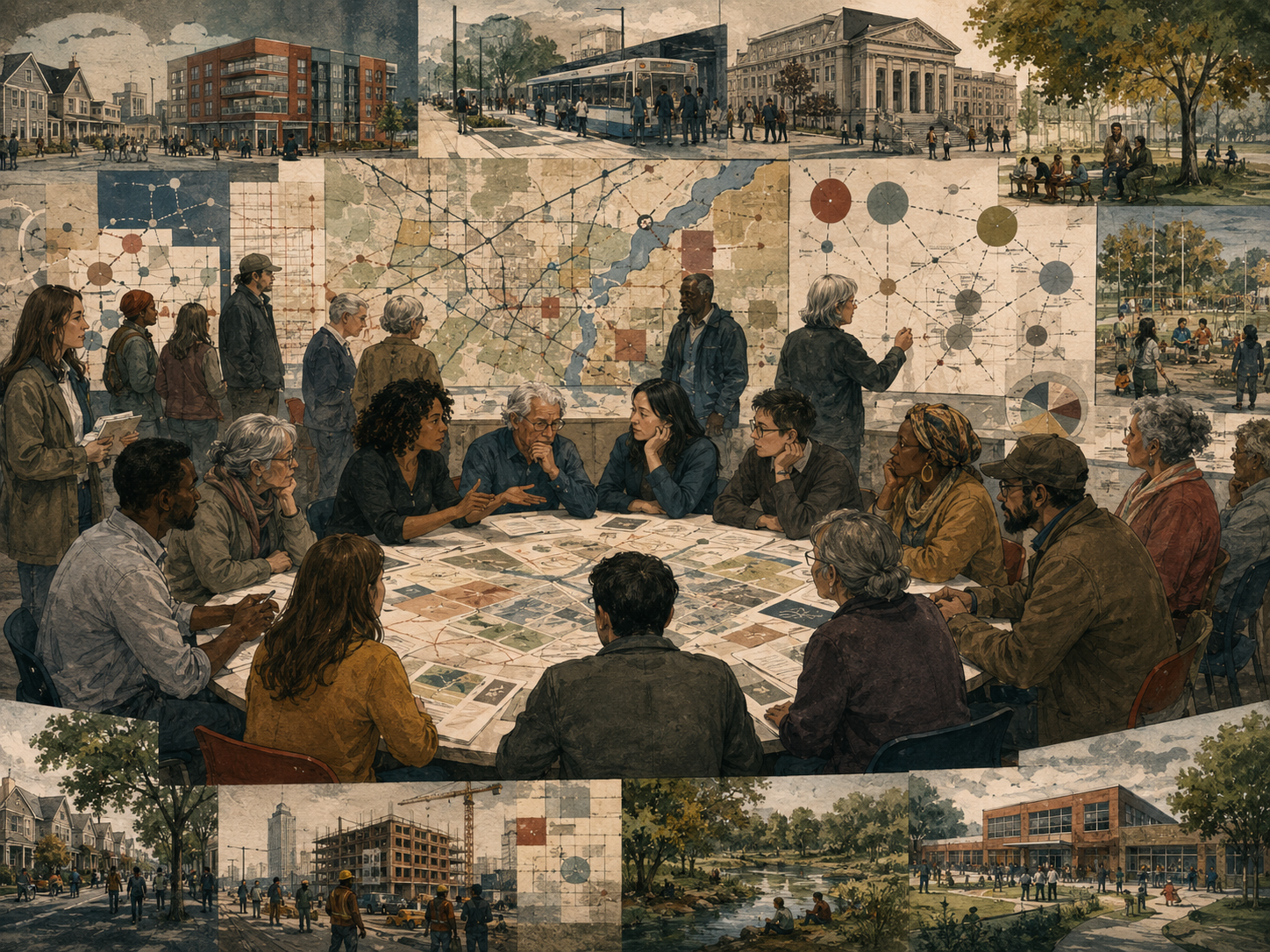
Democratic futures and public participation examine how societies imagine, debate, contest, and govern possible futures through democratic institutions, civic voice, public deliberation, community knowledge, and collective responsibility. Futures thinking is often treated as the work of experts, planners, executives, consultants, technologists, or state institutions. Yet the future is not a technical object waiting to be forecast. It is a political, ethical, cultural, institutional, and social field shaped by power, imagination, exclusion, conflict, aspiration, and collective action.
Democratic futures asks a direct question: who gets to imagine the future, whose risks are recognized, whose hopes are treated as legitimate, and whose lives are shaped by decisions made in the name of tomorrow? Public participation matters because long-term decisions about climate, technology, infrastructure, public health, migration, work, housing, care, education, land, security, and economic transition affect people who are often excluded from future-oriented decision-making.
Foresight without participation can become elite future-making. Scenarios may reproduce the assumptions of powerful institutions. Strategic plans may protect incumbent interests. Technology futures may center firms rather than workers or communities. Climate futures may frame vulnerable groups as passive recipients of risk rather than active knowledge holders. Development futures may ignore colonial histories, Indigenous sovereignty, racial injustice, gendered labor, disability, poverty, and intergenerational harm.
Democratic futures does not mean that every public question can be settled by simple preference aggregation. Future-oriented governance requires evidence, expertise, judgment, legal responsibility, institutional capacity, and long-term stewardship. But it also requires voice, contestability, legitimacy, and the recognition that people are not merely affected by futures. They are participants in defining what futures are desirable, dangerous, unjust, plausible, and worth pursuing.
This article examines democratic futures and public participation as a core part of responsible foresight. It explains why participation matters for futures thinking, how democratic foresight differs from technocratic forecasting, what forms of public participation can support long-term governance, how citizen assemblies and deliberative processes can improve future-oriented policy, why marginalized voices must be central, and how institutions can connect public imagination to real decisions, budgets, law, regulation, and accountability.
Main Library
Publications
Article Map
Futures Thinking
Related Topic
Institutions & Governance
Related Topic
Risk & Resilience
Related Topic
Systems Thinking
What Are Democratic Futures?
Democratic futures are futures shaped through public voice, civic deliberation, institutional accountability, plural knowledge, and shared responsibility rather than imposed by experts, markets, state authorities, or dominant groups alone. The concept begins from the premise that the future is not merely something to forecast. It is something societies negotiate, imagine, build, contest, and govern.
In practice, democratic futures connects futures thinking with democratic participation. It asks how people can participate in identifying long-term risks, defining desirable futures, contesting assumptions, evaluating tradeoffs, and influencing decisions that shape public life. It also asks how institutions can make future-oriented decisions more transparent, inclusive, accountable, and responsive to affected communities.
Democratic futures does not reject expertise. It rejects expert monopoly over the future. Climate scientists, technologists, economists, planners, public-health experts, engineers, legal scholars, and public officials all bring essential knowledge. But people who experience environmental harm, labor insecurity, digital exclusion, housing instability, racial injustice, disability barriers, migration pressure, care burdens, rural abandonment, or infrastructure failure also hold knowledge about the future. Their experience is not anecdotal decoration. It is evidence of how systems behave.
| Futures Approach | Who Defines the Future? | Primary Risk | Democratic Upgrade |
|---|---|---|---|
| Expert forecasting | Specialists, analysts, modelers, and technical institutions. | Public values and lived experience may be excluded. | Combine expert evidence with deliberation and public contestability. |
| Strategic planning | Executives, agencies, ministries, boards, or senior leadership. | Future plans may reflect institutional self-preservation. | Create public review, community input, and accountability mechanisms. |
| Market futures | Firms, investors, consumers, and dominant industries. | Profitable futures may displace just or sustainable futures. | Use public-interest regulation, labor voice, and social impact assessment. |
| Technological futures | Technology developers, funders, platforms, and technical communities. | Capability becomes confused with public value. | Require democratic technology assessment and rights protections. |
| Democratic futures | Publics, institutions, communities, experts, and affected groups together. | Participation can become symbolic if not connected to power. | Institutionalize voice, contestability, decision influence, and follow-through. |
Democratic futures makes future-oriented governance a public practice rather than a closed strategic exercise.
Why Public Participation Matters in Futures Thinking
Public participation matters because future-oriented decisions affect people across time, place, identity, class, generation, and ecological context. A climate adaptation plan changes where people can live. A transportation strategy shapes mobility, labor access, emissions, and urban form. AI governance affects rights, work, privacy, education, welfare, and public services. Public-health preparedness affects trust, surveillance, care, and resource allocation. Infrastructure investment shapes regional opportunity for decades.
Many long-term decisions are made before consequences become visible. This creates a democratic problem. People may not know that their futures are being shaped through technical standards, zoning decisions, procurement contracts, data systems, regulatory definitions, budget formulas, investment pipelines, and institutional assumptions. Public participation helps reveal these hidden future-making processes.
Participation also improves foresight quality. People notice weak signals that institutions miss. Frontline workers see service stress before aggregate indicators shift. Communities experience environmental harm before national data systems recognize it. Young people often sense changing aspirations, insecurity, and legitimacy gaps before institutions do. Indigenous and local knowledge may reveal ecological relationships ignored by technical planning. Workers may see automation risk before official labor statistics show displacement.
| Participation Benefit | Foresight Function | Institutional Value |
|---|---|---|
| Signal detection | Communities identify emerging risks and lived-system stress. | Improves horizon scanning and early warning. |
| Problem reframing | Publics challenge official definitions of the problem. | Prevents narrow technocratic policy frames. |
| Value clarification | Participants identify what matters and what tradeoffs are acceptable. | Connects foresight to democratic legitimacy. |
| Scenario diversity | Plural voices generate more diverse possible futures. | Reduces elite imagination and scenario narrowness. |
| Distributional insight | Affected groups reveal who bears risk and who benefits. | Improves justice analysis and public accountability. |
| Trust building | Transparent participation can improve institutional legitimacy. | Strengthens public acceptance of difficult long-term choices. |
| Implementation realism | Publics and practitioners identify practical barriers. | Improves policy design and delivery. |
Public participation is not only a democratic value. It is a knowledge system for understanding futures that institutions cannot see alone.
Futures Are Political, Not Neutral
Futures are political because they shape what societies prepare for, invest in, regulate, protect, fear, ignore, and make possible. Every future-oriented decision contains assumptions about what matters, whose lives count, what risks are acceptable, what tradeoffs are legitimate, and who has authority to decide.
Scenario planning can appear neutral because it uses structured methods. But scenario design involves choices: which drivers to include, which uncertainties matter, which actors are centered, which time horizon is used, what counts as risk, and what futures are treated as plausible. A scenario set can naturalize inequality, present market priorities as inevitability, treat technological disruption as autonomous, or frame marginalized communities only as vulnerable populations rather than political actors.
Public participation helps politicize futures in the best sense: it makes hidden values visible and contestable. It allows people to ask whether a future is desirable, not only plausible. It exposes how institutions may use uncertainty to avoid responsibility. It also prevents futures thinking from becoming a language through which powerful actors pre-authorize their preferred pathways.
| Future-Making Choice | Political Question | Democratic Practice |
|---|---|---|
| Problem framing | Who defines what problem the future presents? | Participatory diagnosis and plural evidence. |
| Scenario boundaries | What futures are treated as plausible or impossible? | Public scenario review and contested assumptions. |
| Risk prioritization | Whose harms are urgent and whose are normalized? | Distributional risk analysis and affected-community voice. |
| Technology adoption | Who benefits from capability and who bears its risks? | Democratic technology assessment and rights safeguards. |
| Climate adaptation | Which places are protected, transformed, or abandoned? | Community-led adaptation, just transition, and transparent tradeoffs. |
| Long-term investment | Which futures receive public money? | Participatory budgeting and public-interest investment criteria. |
| Intergenerational policy | What obligations do present institutions owe future publics? | Future generations assessment and long-horizon accountability. |
Democratic futures does not pretend that future-oriented decisions are value-free. It makes values, power, and tradeoffs visible so they can be debated and governed.
Core Dimensions of Democratic Futures
Democratic futures requires more than public consultation. It is a system of participation, deliberation, representation, contestability, public learning, institutional uptake, and accountability. These dimensions must be connected. Participation without influence becomes tokenism. Deliberation without information becomes opinion polling. Expertise without public voice becomes technocracy. Public imagination without institutional pathways becomes symbolic expression.
1. Plural Imagination
Plural imagination means that multiple communities, disciplines, generations, regions, cultures, and lived experiences help define possible futures. It resists the idea that one expert or institutional view can represent the future for everyone.
2. Inclusive Participation
Inclusive participation requires deliberate attention to who is present, who is missing, who faces barriers to participation, and who has historically been excluded from public decision-making. Participation must be designed, resourced, accessible, and accountable.
3. Deliberative Quality
Deliberative quality means that participants receive balanced information, hear different perspectives, reason together, examine tradeoffs, and have time to revise judgments. Democratic futures requires more than collecting preferences.
4. Contestability
Contestability is the ability to challenge assumptions, data, models, scenarios, institutional claims, and decisions. Future-oriented governance is dangerous when institutions claim authority over uncertain futures without mechanisms for public challenge.
5. Institutional Uptake
Institutional uptake means that public participation influences policy, budgets, regulation, planning, implementation, and evaluation. Without uptake, participation becomes performance rather than power.
6. Justice and Repair
Democratic futures must account for historical harm, unequal exposure, colonial histories, racialized vulnerability, gendered labor, disability exclusion, class inequality, ecological loss, and intergenerational debt. Participation should not erase the past in the name of the future.
7. Public Learning
Public learning means that participation builds shared understanding of uncertainty, evidence, tradeoffs, and institutional constraints. It also means institutions learn from publics, not merely educate them.
8. Long-Term Accountability
Long-term accountability requires follow-up, public reporting, review cycles, indicators, and mechanisms for future publics or their representatives to revisit decisions. Democratic futures must remain accountable after participatory events end.
| Dimension | Core Function | Failure if Missing |
|---|---|---|
| Plural imagination | Expands what futures are visible and discussable. | Scenarios reproduce elite or institutional assumptions. |
| Inclusive participation | Ensures affected communities can participate meaningfully. | Futures are shaped without those most exposed to consequences. |
| Deliberative quality | Improves public reasoning across evidence and tradeoffs. | Participation becomes shallow preference collection. |
| Contestability | Allows assumptions and decisions to be challenged. | Future claims become technocratic authority. |
| Institutional uptake | Connects participation to decisions. | Participation becomes symbolic. |
| Justice and repair | Centers unequal histories and exposure. | Future work reproduces present injustice. |
| Public learning | Builds shared capacity to reason under uncertainty. | Foresight remains expert-owned. |
| Long-term accountability | Tracks whether participatory commitments are honored. | Institutions can ignore public input after the event. |
Democratic futures requires participation that is inclusive, deliberative, contestable, influential, justice-oriented, and accountable over time.
Forms of Public Participation in Future-Oriented Governance
Public participation takes many forms. Some are consultative, some deliberative, some collaborative, some community-led, and some institutionalized. Different forms serve different purposes. A survey may gather broad opinion but offer little deliberation. A citizen assembly may produce informed recommendations but include fewer people. Participatory budgeting may influence money directly but may focus on near-term local priorities. Community foresight workshops may surface lived futures but require institutional pathways to influence decisions.
Future-oriented governance needs a participation ecology rather than one method. Different questions require different designs. A national climate transition may need citizen assemblies, local community forums, expert panels, youth councils, worker transition boards, Indigenous governance mechanisms, public comment, and participatory budgeting. AI governance may require public registers, rights appeals, worker consultation, technology assessment panels, disability access review, and community impact hearings.
| Participation Form | Best Use | Limitation | Foresight Role |
|---|---|---|---|
| Public consultation | Gathering views on proposed policies or plans. | Often late-stage and weakly influential. | Tests public response and identifies concerns. |
| Citizen assembly | Deliberating complex long-term choices with representative participants. | Requires resources, careful design, and follow-through. | Supports informed public judgment on uncertain futures. |
| Community foresight workshop | Exploring local futures, risks, aspirations, and lived experience. | Can become symbolic if not connected to decisions. | Generates plural scenarios and community knowledge. |
| Participatory budgeting | Directing public funds toward community priorities. | May be limited to small budget shares. | Links future priorities to resource allocation. |
| Youth futures council | Representing long-term stakes and generational concerns. | Can be tokenistic if advisory only. | Brings future generations and youth experience into policy. |
| Worker transition forum | Addressing automation, energy transition, care work, and labor futures. | May exclude informal or precarious workers if poorly designed. | Connects economic futures to labor voice and just transition. |
| Digital participation platform | Scaling input, mapping ideas, and widening access. | Can deepen digital divides or create low-quality engagement. | Expands participation when paired with facilitation and accountability. |
| Community-led planning | Allowing affected communities to define priorities and pathways. | Requires institutional recognition and resources. | Centers self-determination and local knowledge in future-making. |
Democratic futures requires matching participation design to the decision, the affected public, the time horizon, and the degree of influence promised.
Deliberative Democracy and Citizen Assemblies
Deliberative democracy is especially relevant to futures thinking because many long-term issues are complex, uncertain, value-laden, and resistant to simple polling. Citizen assemblies, deliberative panels, citizens’ juries, and deliberative mini-publics bring together broadly representative groups of people to learn, deliberate, question experts, hear from affected communities, discuss tradeoffs, and produce recommendations.
Deliberative processes can help future-oriented governance avoid two common failures: technocracy and populist simplification. Technocracy narrows decisions to experts and institutions. Populist simplification treats public opinion as fixed preference without structured learning. Deliberation creates a middle path: informed public judgment under conditions of uncertainty.
Citizen assemblies have been used for issues such as climate policy, constitutional reform, urban planning, technology, health, and public ethics. Their value depends on design quality: representativeness, inclusion, balanced information, facilitation, sufficient time, transparency, public communication, and institutional response. A citizen assembly without formal follow-up can build hope and then deepen distrust.
| Design Principle | Why It Matters | Future-Oriented Application |
|---|---|---|
| Representative selection | Prevents participation from being dominated by the already powerful or already engaged. | Use sortition and demographic balancing for climate, technology, and long-term policy assemblies. |
| Balanced information | Participants need credible evidence and multiple perspectives. | Provide expert testimony, affected-community evidence, and transparent uncertainty. |
| Deliberative time | People need time to learn, reflect, and revise views. | Use multi-session processes for complex long-term topics. |
| Skilled facilitation | Supports respectful discussion and equal voice. | Prevent domination by confident speakers or professionalized participants. |
| Public transparency | Builds trust beyond the participants themselves. | Publish materials, assumptions, recommendations, and institutional responses. |
| Institutional response | Participation must influence decision-makers. | Require governments to respond publicly to recommendations. |
| Long-term follow-up | Futures work requires accountability over time. | Track implementation of recommendations and update publics. |
Deliberative democracy is valuable for futures thinking because it helps publics reason together about uncertainty, tradeoffs, responsibility, and long-term consequences.
Participatory Foresight Methods
Participatory foresight adapts futures methods so that publics, communities, workers, local officials, civil society, and affected groups help generate, interpret, and evaluate futures. It can include participatory scenario planning, community horizon scanning, futures literacy labs, visioning workshops, backcasting, futures wheels, causal layered analysis, speculative civic design, participatory systems mapping, and democratic technology assessment.
The purpose is not simply to make foresight more engaging. Participatory methods change the substance of foresight. They introduce different evidence, assumptions, metaphors, fears, aspirations, histories, and priorities. They reveal futures that expert or institutional processes may not imagine. They also expose when future-oriented narratives are experienced as threatening, exclusionary, colonial, unrealistic, or disconnected from everyday life.
| Method | How It Supports Democratic Futures | Risk if Poorly Designed |
|---|---|---|
| Participatory scenario planning | Allows diverse publics to co-create plausible futures. | Scenarios may still be controlled by facilitators or sponsors. |
| Community horizon scanning | Uses local experience to identify weak signals and emerging harms. | Input may be collected but not acted on. |
| Futures literacy lab | Helps participants examine assumptions and diversify imagination. | May become abstract if not connected to decisions. |
| Backcasting | Starts from desired futures and works backward to present actions. | May ignore conflict, power, or resource constraints. |
| Futures wheel | Maps consequences and second-order effects of change. | Can become superficial without systems thinking. |
| Causal layered analysis | Examines narratives, worldviews, and myths beneath future claims. | Requires careful facilitation and cultural sensitivity. |
| Participatory systems mapping | Shows feedback, dependencies, and institutional barriers. | May overprivilege visual complexity over decision relevance. |
| Democratic technology assessment | Allows publics to evaluate emerging technologies before lock-in. | Can be captured by technical framing or industry narratives. |
Participatory foresight is strongest when it combines imagination with power analysis, institutional pathways, public accountability, and practical decision influence.
Community Knowledge and Lived Experience
Community knowledge is essential to democratic futures because communities often experience system change before institutions recognize it. People living with flooding, heat, pollution, housing insecurity, care burdens, labor precarity, food insecurity, digital exclusion, unreliable transit, disability barriers, or public-service failure can identify emerging futures from the ground up.
Lived experience is often treated as subjective evidence beneath formal data. That hierarchy is dangerous. Official data systems are themselves designed through institutional categories that may miss harm, delay recognition, or erase certain populations. Community knowledge can reveal what is not measured, what is misclassified, what is normalized, and what institutions fail to see.
For futures thinking, lived experience helps identify early warnings, plausible consequences, implementation barriers, local adaptation strategies, informal resilience, and trust conditions. It also helps evaluate whether institutional futures are meaningful. A city’s smart infrastructure future may look innovative to planners but invasive or irrelevant to residents. A climate relocation strategy may look rational to officials but culturally devastating to communities. A digital welfare system may look efficient to administrators but punitive to service users.
| Community Knowledge Source | Future Signal | Institutional Use |
|---|---|---|
| Frontline workers | Service stress, implementation gaps, unmet needs, workforce burnout. | Improve preparedness, staffing, and delivery design. |
| Residents in high-risk areas | Flooding, heat, pollution, infrastructure failure, displacement pressure. | Improve climate adaptation and local resilience planning. |
| Disabled people | Access barriers, digital exclusion, emergency vulnerability, design failure. | Improve universal design and rights-based planning. |
| Workers in transition sectors | Automation risk, skill mismatch, safety issues, labor-market precarity. | Improve just transition and workforce foresight. |
| Indigenous and local communities | Ecological change, land relationships, cultural continuity, stewardship knowledge. | Improve environmental governance and respect self-determination. |
| Youth and students | Changing aspirations, anxiety, distrust, education-work transition pressures. | Improve education, climate, labor, and democratic participation futures. |
| Migrant communities | Mobility pressure, legal vulnerability, labor exploitation, service barriers. | Improve migration, urban planning, and social cohesion strategies. |
Community knowledge is not an optional supplement to expert foresight. It is a primary source of evidence about how futures are already arriving unevenly.
Youth, Future Generations, and Intergenerational Voice
Future-oriented policy raises a persistent democratic challenge: future generations cannot vote, testify, protest, or participate directly in present institutions. Yet present decisions shape their climate, debt, infrastructure, biodiversity, health systems, legal rights, technological environment, and democratic possibilities. Youth participation partly addresses this gap, though young people are not the same as future generations. They are present citizens and residents whose lives will extend further into the consequences of today’s decisions.
Youth participation matters because many long-term issues are also lived present realities: climate anxiety, housing insecurity, student debt, labor-market uncertainty, digital life, mental health, ecological grief, and mistrust in institutions. Young people are often discussed as future leaders while being excluded from present power.
Institutions can also create formal mechanisms for intergenerational voice: future generations commissioners, long-term impact assessments, youth councils with authority, constitutional duties, intergenerational budget analysis, long-horizon public reporting, and legal standing for environmental and future-oriented claims.
| Mechanism | Purpose | Risk | Democratic Safeguard |
|---|---|---|---|
| Youth futures council | Includes young people in long-term policy advice. | Can become symbolic if advisory only. | Provide formal response duties and decision pathways. |
| Future generations commissioner | Represents long-term public interest across government. | May lack enforcement power. | Give review authority and public reporting capacity. |
| Intergenerational impact assessment | Evaluates long-term consequences of policy. | Can become checklist compliance. | Connect assessment to budget, law, and policy review. |
| Long-term fiscal review | Identifies future debt, maintenance, and investment burdens. | May focus narrowly on finance. | Include ecological, social, and care obligations. |
| Climate and ecological duties | Protects future environmental conditions. | Can be weakened by vague language. | Use measurable commitments, legal remedies, and public review. |
| Participatory youth assemblies | Deliberate on climate, technology, education, and work futures. | Can overburden youth with responsibility without power. | Ensure resources, compensation, and institutional uptake. |
Democratic futures requires institutions that take young people seriously as present participants and future generations seriously as moral and political stakeholders.
Marginalized Voices and Contested Futures
Futures are often contested because societies are unequal. The future imagined by a government agency may not be the future desired by communities facing eviction, pollution, surveillance, exclusion, dispossession, or economic abandonment. The future imagined by a technology company may not be the future desired by workers, disabled people, students, artists, service users, or communities subject to automated decision-making. The future imagined by a national development plan may not align with Indigenous sovereignty, ecological stewardship, or local self-determination.
Marginalized voices matter not because they add diversity to an otherwise complete process, but because exclusion shapes the content of future-making. When marginalized communities are excluded, institutions may misread risk, miss harm, misunderstand aspiration, and reproduce injustice. Participation must therefore do more than invite comments. It must redistribute attention, recognition, resources, and influence.
Contested futures also require conflict literacy. Democratic participation does not eliminate disagreement. It creates structured ways to surface conflict, examine tradeoffs, and make decisions more legitimate. Some future conflicts cannot be harmonized by better facilitation because they involve real material interests: land, jobs, rights, extraction, policing, housing, energy, care, and ecological survival.
| Marginalized Future | Common Institutional Blind Spot | Democratic Foresight Practice |
|---|---|---|
| Climate-exposed communities | Adaptation is framed as infrastructure rather than justice. | Community-led adaptation, relocation rights, and repair-oriented planning. |
| Workers facing automation | Technology is framed as productivity rather than labor transformation. | Worker foresight, bargaining, transition planning, and skills justice. |
| Disabled people | Future systems assume able-bodied users and digital access. | Disability-led design, accessibility review, and rights-based participation. |
| Indigenous communities | Land futures are treated as development or conservation objects. | Respect sovereignty, consent, stewardship, and cultural continuity. |
| Low-income residents | Smart-city and resilience projects ignore affordability and displacement. | Anti-displacement safeguards and participatory investment criteria. |
| Migrant communities | Mobility is framed as risk rather than human adaptation and rights. | Rights-based migration foresight and receiving-community capacity planning. |
| Future generations | Long-term harm is discounted or externalized. | Intergenerational assessment and legal accountability. |
Democratic futures must treat contested imagination as evidence of power, not as a problem to be smoothed away.
Power, Capture, and Tokenism
Participation can fail. It can be symbolic, extractive, manipulative, captured, rushed, inaccessible, or ignored. Institutions may invite public input after key decisions have already been made. They may ask communities to share trauma without transferring power. They may consult marginalized groups but privilege technical or corporate evidence in final decisions. They may use participation to legitimate predetermined futures.
Tokenism is especially dangerous in future-oriented governance because futures language can sound inclusive while decision power remains unchanged. A scenario process may include community workshops but still define policy options internally. A city may gather public visions while procurement decisions are already locked in. A technology assessment may ask users about concerns while vendors control system design.
Capture can also occur when powerful actors dominate future narratives. Industries may promote scenarios that normalize their continued influence. Technology firms may define innovation pathways around their products. Security institutions may frame futures through threat and control. Wealthy communities may secure protection while poorer communities absorb transition costs.
| Failure Pattern | How It Appears | Corrective Practice |
|---|---|---|
| Late-stage consultation | Public input is requested after decisions are effectively made. | Involve publics during problem framing and option design. |
| Symbolic inclusion | Participants are visible but lack influence. | Define decision influence before participation begins. |
| Extractive participation | Communities share knowledge without compensation or power. | Compensate participants and share governance authority. |
| Elite capture | Well-resourced actors dominate the process. | Use representative selection, facilitation, and conflict-of-interest rules. |
| Technical closure | Experts define acceptable futures and dismiss public judgment. | Use plural evidence and public contestability. |
| Consultation fatigue | Communities are repeatedly asked for input without follow-through. | Report what changed and why recommendations were accepted or rejected. |
| Digital exclusion | Online participation excludes those without access, time, or trust. | Use hybrid participation, accessibility, translation, and community facilitation. |
Participation is democratic only when it changes what institutions see, value, decide, fund, regulate, and report back to the public.
From Consultation to Decision Influence
Democratic futures requires moving from consultation to influence. Consultation asks people what they think. Influence gives public participation a defined pathway into decisions. This distinction is crucial. A process can gather thousands of comments and still have little impact if officials are not required to respond, if budgets are already fixed, or if policy options are predetermined.
Decision influence can be designed in several ways. Governments can commit to formal responses to citizen recommendations. Agencies can link participatory foresight to budget criteria. Regulators can require public-interest technology assessments before deployment. Cities can connect community visioning to land-use plans and capital budgets. Public institutions can publish implementation trackers that show which recommendations were accepted, modified, rejected, and why.
| Influence Mechanism | What It Does | Example Use |
|---|---|---|
| Formal response duty | Requires institutions to respond publicly to recommendations. | Citizen assembly recommendations on climate or technology policy. |
| Budget linkage | Connects participation to funding decisions. | Participatory resilience investment or community infrastructure funds. |
| Policy trigger | Requires review or action when participatory findings meet criteria. | Community early-warning signals trigger environmental health review. |
| Implementation tracker | Shows what happened after participation. | Public dashboard of recommendations and government response. |
| Co-governance body | Shares authority between institutions and affected communities. | Climate adaptation boards, data governance councils, or transition councils. |
| Rights and remedy | Allows people to challenge harmful future-oriented decisions. | Appeals for automated public-service decisions or relocation plans. |
| Legislative hearing pathway | Brings participatory findings into formal lawmaking. | Futures assembly reports considered by parliamentary committees. |
The democratic test is not whether people were asked. The test is whether participation had a visible, accountable relationship to public decisions.
Digital Participation and Civic Infrastructure
Digital tools can expand participation, but they do not automatically democratize futures. Online platforms can help collect ideas, map public priorities, host deliberation, translate materials, visualize scenarios, track recommendations, and support hybrid participation. They can also deepen inequality, amplify organized interests, create low-quality engagement, expose participants to harassment, extract data, or reduce civic voice to interface behavior.
Digital participation should be treated as civic infrastructure, not as a substitute for democracy. It requires accessibility, privacy, transparency, moderation, multilingual access, disability inclusion, offline alternatives, public ownership or accountability, data governance, and clear connection to decision pathways.
AI-assisted participation raises additional questions. Automated summarization, clustering, translation, and sentiment analysis may help institutions process large volumes of public input, but these tools can distort meaning, flatten minority perspectives, or privilege easily categorized comments. Democratic futures requires transparency about how digital tools are used and how human judgment, rights, and public contestability are preserved.
| Digital Participation Tool | Potential Value | Governance Risk | Safeguard |
|---|---|---|---|
| Online idea platform | Collects broad public input and proposals. | Dominated by organized groups or digitally connected participants. | Use outreach, moderation, and demographic analysis. |
| Digital deliberation forum | Enables structured discussion across distance. | Can become hostile, shallow, or exclusionary. | Use facilitation, rules, accessibility, and hybrid options. |
| Participatory mapping | Shows local risks, assets, and future priorities. | May expose sensitive community information. | Use privacy controls and community data governance. |
| AI-assisted summarization | Helps process large input volumes. | May erase nuance, minority views, or emotional context. | Publish methods and allow human review and challenge. |
| Public dashboard | Tracks recommendations, indicators, and implementation. | Can become performance theater if metrics are weak. | Use independent review and qualitative context. |
| Digital voting or ranking | Prioritizes options at scale. | Can reduce complex futures to simplistic preferences. | Pair with deliberation and transparent tradeoff information. |
Digital participation should widen democratic capacity, not turn public imagination into data extraction or dashboard performance.
Participation Across Policy Domains
Democratic futures applies across many policy domains. It is not limited to civic engagement or democratic reform. Any long-term policy domain that shapes public life can benefit from meaningful public participation. The design should reflect the domain’s risks, time horizon, affected publics, technical complexity, and institutional authority.
| Policy Domain | Future-Oriented Participation Need | Practical Mechanism |
|---|---|---|
| Climate adaptation | Communities must shape protection, relocation, infrastructure, and land-use futures. | Community adaptation councils, participatory mapping, citizen assemblies. |
| Energy transition | Workers, communities, and ratepayers must shape transition pathways. | Just-transition boards, local energy planning, worker forums. |
| AI and digital systems | People affected by automated systems need voice, rights, and remedy. | Public algorithm registers, impact hearings, data governance councils. |
| Urban futures | Residents should shape housing, mobility, public space, climate resilience, and services. | Participatory planning, community benefits agreements, participatory budgeting. |
| Public health | Trust, preparedness, care, and surveillance require public legitimacy. | Community health boards, public-health assemblies, preparedness exercises. |
| Migration and demography | Mobility, aging, labor, and social cohesion require affected-community voice. | Migrant councils, elder-care forums, demographic futures assemblies. |
| Infrastructure | Long-lived assets shape access, safety, climate exposure, and regional equity. | Infrastructure foresight hearings, participatory capital planning, resilience review. |
| Education futures | Students, families, educators, and communities must shape learning futures. | Youth assemblies, school-community foresight, curriculum futures labs. |
| Security and hybrid risk | Preparedness must not erode civil liberties or target vulnerable groups. | Rights review, public oversight, community safety deliberation. |
Participation is not a single civic add-on. It is a governance requirement wherever long-term public decisions shape unequal futures.
Institutional Design for Democratic Futures
Democratic futures requires institutional design. It cannot depend only on occasional public engagement. Institutions need standing mechanisms that connect public participation to foresight, policy, budgets, regulation, implementation, evaluation, and review.
Institutional design questions include: Who convenes participatory foresight? Who sets the agenda? Who selects participants? How are marginalized communities resourced to participate? What information is provided? How are conflicts handled? What decision pathways exist? What response duties do institutions have? How is implementation tracked? How can participants challenge misrepresentation or non-response?
Democratic futures institutions may include citizen assemblies, future generations offices, participatory foresight units, civic data trusts, public technology assessment bodies, community resilience councils, youth climate councils, worker transition boards, participatory budgeting systems, and legislative foresight committees.
| Institutional Mechanism | Purpose | Design Requirement |
|---|---|---|
| Participatory foresight unit | Integrates public participation into government foresight. | Mandate, budget, trained facilitators, and decision pathways. |
| Citizen assembly program | Uses deliberative publics for complex long-term choices. | Representative selection, balanced evidence, and formal response duty. |
| Future generations office | Reviews long-term policy effects and intergenerational obligations. | Independence, reporting authority, and access to decision processes. |
| Community resilience council | Gives affected communities voice in adaptation and preparedness. | Resources, local authority, and clear influence over investment. |
| Technology assessment body | Evaluates emerging technologies before public lock-in. | Public participation, rights review, audit access, and transparency. |
| Worker transition board | Governs labor futures in automation, energy, and industrial change. | Worker representation, bargaining links, and transition funding. |
| Participatory budget system | Links democratic futures to public finance. | Meaningful budget share, equity criteria, and implementation tracking. |
Democratic futures becomes durable when participation is built into institutional architecture rather than appended to strategy after decisions are made.
Future Scenarios for Democratic Foresight
Democratic foresight can develop in several directions. It may become a serious civic capacity embedded in governance. It may become symbolic consultation. It may be captured by platforms, consultants, or powerful interest groups. It may deepen public learning and legitimacy, or it may become a stage for polarization and distrust if institutions fail to follow through.
| Scenario | Description | Key Risk | Strategic Opportunity |
|---|---|---|---|
| Embedded Democratic Foresight | Public participation becomes a regular part of foresight, policy, budgets, and evaluation. | Requires sustained institutional commitment and resourcing. | Build long-term democratic capacity and public trust. |
| Consultation Theater | Institutions invite input but do not change decisions. | Participation deepens cynicism and distrust. | Create response duties, implementation trackers, and public accountability. |
| Elite Scenario Governance | Experts and powerful institutions define futures with limited public challenge. | Scenarios reproduce existing power and blind spots. | Use deliberative and community-led foresight methods. |
| Platform-Mediated Participation | Digital tools scale participation but shape voice through platform design. | Data extraction, exclusion, manipulation, and shallow engagement. | Build public-interest civic infrastructure and hybrid participation. |
| Community-Led Futures | Local and marginalized communities generate their own future pathways. | Institutions may ignore or underfund community visions. | Link community foresight to budgets, law, and co-governance. |
| Polarized Future Conflict | Future narratives become weapons in political conflict. | Public reasoning collapses into fear, identity, and disinformation. | Invest in deliberation, media literacy, trust, and transparent institutions. |
The future of democratic foresight depends on whether institutions treat participation as legitimacy theater or as a real source of public intelligence, authority, and accountability.
Strategic Questions for Institutions
Institutions can strengthen democratic futures by asking practical questions before designing foresight processes, public consultations, scenario exercises, citizen assemblies, or long-term policy plans.
| Strategic Question | What It Reveals | Why It Matters |
|---|---|---|
| Who gets to define the future problem? | Power over problem framing. | Prevents institutions from narrowing the agenda before participation begins. |
| Who is missing from the process? | Exclusion, barriers, and representational gaps. | Improves legitimacy and reveals hidden risks. |
| What decision will participation influence? | Whether public input has a pathway to power. | Prevents symbolic engagement. |
| What information do participants need? | Evidence, uncertainty, tradeoffs, and institutional constraints. | Supports informed deliberation. |
| Whose knowledge is treated as evidence? | Epistemic hierarchy and institutional bias. | Centers lived experience and plural knowledge. |
| How will conflicting futures be handled? | Material interests and value conflicts. | Prevents false consensus and superficial facilitation. |
| How will institutions respond publicly? | Accountability after participation. | Builds trust and implementation clarity. |
| How will future generations be considered? | Long-term responsibility beyond present voters. | Connects participation to intergenerational ethics. |
Democratic futures begins when institutions ask not only what the future may hold, but who has power to imagine, contest, and shape it.
Limits and Failure Modes
Democratic futures has limits. Participation cannot eliminate uncertainty, conflict, scarcity, or technical complexity. It cannot replace expert knowledge, legal duties, or institutional responsibility. It cannot guarantee consensus. It cannot make every future desirable to everyone. Public participation must be designed with honesty about what is open for influence and what constraints exist.
Participation can also be harmful when poorly designed. It can consume community time without compensation. It can raise expectations that institutions do not meet. It can be dominated by already powerful voices. It can create emotional burdens for marginalized participants. It can be used to legitimate decisions that remain unchanged. It can expose vulnerable communities to political backlash or data misuse.
Democratic futures can also become distorted by disinformation, polarization, organized manipulation, platform dynamics, and unequal civic capacity. Institutions need trust, transparency, facilitation, and public-interest communication to support deliberation in difficult environments.
| Failure Mode | Problem | Corrective Practice |
|---|---|---|
| Tokenism | Participation is visible but not influential. | Define decision influence and report outcomes. |
| Consultation fatigue | Communities are asked repeatedly for input without follow-through. | Coordinate engagement and show what changed. |
| Elite capture | Organized or privileged groups dominate participation. | Use representative selection, outreach, and facilitation. |
| Information imbalance | Participants lack the evidence needed for deliberation. | Provide balanced, accessible materials and expert questioning. |
| Future-washing | Institutions use futures language to appear visionary without changing power. | Evaluate decision uptake, budget influence, and implementation. |
| Digital exclusion | Online participation leaves some publics out. | Use hybrid, accessible, multilingual, offline options. |
| Harmful extraction | Institutions collect community knowledge without compensation or authority-sharing. | Use fair compensation, consent, co-governance, and benefit-sharing. |
The goal is not participation for its own sake. The goal is democratic future-making that is inclusive, informed, influential, accountable, and capable of confronting power.
Mathematical Lens: Participation, Legitimacy, and Future Influence
Democratic futures can be represented conceptually as a relationship among voice, deliberation, inclusion, institutional uptake, and accountability.
D_f = V + I + Q + U + A
\]
Interpretation: \(D_f\) is democratic futures capacity, \(V\) is public voice, \(I\) is inclusion, \(Q\) is deliberative quality, \(U\) is institutional uptake, and \(A\) is accountability. Participation is weak when any of these elements is absent.
Meaningful influence can be represented as:
M = P \times R \times U
\]
Interpretation: \(M\) is meaningful participation, \(P\) is participation quality, \(R\) is institutional responsiveness, and \(U\) is decision uptake. A process with high participation quality still fails democratically if institutions do not respond or decisions do not change.
Justice-adjusted participation can be represented as:
J_d = E + C + Rm + B – X
\]
Interpretation: \(J_d\) is justice-adjusted democratic participation, \(E\) is equitable access, \(C\) is community authority, \(Rm\) is remedy or contestability, \(B\) is benefit-sharing, and \(X\) is extractive burden. Participation is unjust when it extracts knowledge or time without power, protection, or benefit.
Representation across future-impact groups can be represented as:
R_f = \sum_{g=1}^{n} w_g r_g
\]
Interpretation: \(R_f\) is future-impact representation, \(r_g\) is representation quality for group \(g\), and \(w_g\) is the weight assigned to that group’s exposure, stake, or historical exclusion. This expression highlights that democratic futures should account for unequal exposure rather than treating all missing voices as equivalent.
Institutional trust after participation can be represented as:
T_{t+1} = T_t + \alpha U_t + \beta A_t – \gamma N_t
\]
Interpretation: \(T_{t+1}\) is future trust, \(T_t\) is current trust, \(U_t\) is visible uptake, \(A_t\) is accountability, and \(N_t\) is non-response or broken promise. Participation can increase trust when institutions follow through, but it can reduce trust when institutions ignore public input.
These equations are not predictive claims. They are conceptual tools for making democratic assumptions visible: participation must include voice, inclusion, deliberation, decision influence, justice, and accountability.
Computational Modeling for Democratic Futures
Computational modeling can support democratic futures by helping institutions track participation quality, representation, decision uptake, equity exposure, public trust, and follow-through. The purpose is not to quantify democracy into a simplistic score. The purpose is to make institutional commitments visible and auditable.
A professional democratic futures workflow may include:
- Participation register: process type, purpose, decision pathway, participant selection, accessibility, compensation, and outreach.
- Representation profile: demographic balance, affected-community inclusion, youth voice, worker voice, disability access, place-based representation, and historically excluded groups.
- Deliberative quality indicators: balanced information, facilitation, time, expert access, plural evidence, and conflict handling.
- Decision uptake tracker: recommendations accepted, modified, rejected, funded, regulated, or deferred.
- Accountability tracker: public response, implementation status, review date, responsible institution, and reason for non-adoption.
- Justice indicators: distributional impact, community authority, remedy, benefit-sharing, and burden of participation.
- Trust and legitimacy monitoring: whether participation improves public confidence or deepens cynicism through non-response.
Modeling democratic futures should support transparency, not technocracy. The model should help publics see whether participation changed decisions.
Advanced R Workflow: Comparing Participatory Foresight Models
The R workflow below compares stylized participatory foresight models across inclusion, deliberative quality, representation, institutional uptake, accountability, justice safeguards, public learning, and decision influence.
# ------------------------------------------------------------
# R Workflow: Comparing Participatory Foresight Models
# Purpose:
#   Compare democratic futures models across inclusion,
#   deliberative quality, representation, institutional uptake,
#   accountability, justice safeguards, public learning,
#   and decision influence.
#
# Optional dependency:
#   install.packages(c("tidyverse"))
# ------------------------------------------------------------

library(tidyverse)

participation_models <- tibble(
  model = c(
    "Late-Stage Public Consultation",
    "Citizen Assembly",
    "Community-Led Foresight",
    "Participatory Budgeting for Futures",
    "Youth Futures Council",
    "Digital Participation Platform",
    "Co-Governance Futures Board"
  ),
  inclusion = c(0.42, 0.78, 0.86, 0.70, 0.64, 0.50, 0.82),
  deliberative_quality = c(0.34, 0.88, 0.72, 0.58, 0.70, 0.42, 0.78),
  representation = c(0.38, 0.84, 0.78, 0.66, 0.62, 0.46, 0.80),
  institutional_uptake = c(0.26, 0.64, 0.58, 0.82, 0.46, 0.38, 0.78),
  accountability = c(0.30, 0.70, 0.64, 0.76, 0.48, 0.40, 0.82),
  justice_safeguards = c(0.32, 0.68, 0.86, 0.72, 0.60, 0.42, 0.84),
  public_learning = c(0.36, 0.82, 0.76, 0.60, 0.72, 0.46, 0.78),
  decision_influence = c(0.22, 0.66, 0.62, 0.84, 0.44, 0.36, 0.80)
)

participation_models <- participation_models %>%
  mutate(
    democratic_futures_capacity =
      0.13 * inclusion +
      0.14 * deliberative_quality +
      0.13 * representation +
      0.16 * institutional_uptake +
      0.13 * accountability +
      0.13 * justice_safeguards +
      0.08 * public_learning +
      0.10 * decision_influence,

    tokenism_risk =
      0.20 * (1 - institutional_uptake) +
      0.18 * (1 - decision_influence) +
      0.16 * (1 - accountability) +
      0.14 * (1 - justice_safeguards) +
      0.12 * (1 - representation) +
      0.10 * (1 - deliberative_quality) +
      0.10 * (1 - inclusion),

    democratic_class = case_when(
      democratic_futures_capacity >= 0.74 ~ "Strong democratic futures capacity",
      tokenism_risk >= 0.55 ~ "High tokenism or low influence risk",
      TRUE ~ "Developing participatory foresight capacity"
    )
  ) %>%
  arrange(desc(democratic_futures_capacity))

print(participation_models)

models_long <- participation_models %>%
  select(
    model,
    inclusion,
    deliberative_quality,
    representation,
    institutional_uptake,
    accountability,
    justice_safeguards,
    public_learning,
    decision_influence
  ) %>%
  pivot_longer(
    cols = -model,
    names_to = "dimension",
    values_to = "value"
  )

ggplot(models_long, aes(x = dimension, y = value, fill = model)) +
  geom_col(position = "dodge") +
  coord_flip() +
  labs(
    title = "Participatory Foresight Dimensions",
    x = "Dimension",
    y = "Value",
    fill = "Participation Model"
  ) +
  theme_minimal(base_size = 12)

ggplot(participation_models, aes(x = reorder(model, democratic_futures_capacity), y = democratic_futures_capacity)) +
  geom_col() +
  coord_flip() +
  labs(
    title = "Democratic Futures Capacity by Participation Model",
    x = "Participation Model",
    y = "Capacity Score"
  ) +
  theme_minimal(base_size = 12)

dir.create("outputs", showWarnings = FALSE)
write_csv(participation_models, "outputs/democratic_futures_participation_models.csv")
This workflow shows that participatory foresight should be evaluated by more than attendance. Inclusion, deliberation, representation, uptake, accountability, justice safeguards, learning, and decision influence determine whether participation has democratic substance.
Advanced Python Workflow: Simulating Democratic Foresight Capacity
The Python workflow below simulates how democratic futures capacity, public trust, institutional uptake, and tokenism risk may evolve over time under different participation models.
# ------------------------------------------------------------
# Python Workflow: Simulating Democratic Foresight Capacity
# Purpose:
#   Compare participatory foresight models under repeated
#   public trust pressure, institutional response, and decision
#   uptake conditions.
#
# Optional dependencies:
#   pip install pandas numpy matplotlib
# ------------------------------------------------------------

from pathlib import Path

import numpy as np
import pandas as pd
import matplotlib.pyplot as plt

OUTPUT_DIR = Path("outputs")
OUTPUT_DIR.mkdir(exist_ok=True)

time_steps = np.arange(1, 41)

models = [
    {
        "model": "Late-Stage Public Consultation",
        "inclusion": 0.42,
        "deliberation": 0.34,
        "representation": 0.38,
        "uptake": 0.26,
        "accountability": 0.30,
        "justice": 0.32,
        "learning": 0.36,
        "initial_trust": 0.44
    },
    {
        "model": "Citizen Assembly",
        "inclusion": 0.78,
        "deliberation": 0.88,
        "representation": 0.84,
        "uptake": 0.64,
        "accountability": 0.70,
        "justice": 0.68,
        "learning": 0.82,
        "initial_trust": 0.62
    },
    {
        "model": "Community-Led Foresight",
        "inclusion": 0.86,
        "deliberation": 0.72,
        "representation": 0.78,
        "uptake": 0.58,
        "accountability": 0.64,
        "justice": 0.86,
        "learning": 0.76,
        "initial_trust": 0.60
    },
    {
        "model": "Participatory Budgeting for Futures",
        "inclusion": 0.70,
        "deliberation": 0.58,
        "representation": 0.66,
        "uptake": 0.82,
        "accountability": 0.76,
        "justice": 0.72,
        "learning": 0.60,
        "initial_trust": 0.64
    },
    {
        "model": "Co-Governance Futures Board",
        "inclusion": 0.82,
        "deliberation": 0.78,
        "representation": 0.80,
        "uptake": 0.78,
        "accountability": 0.82,
        "justice": 0.84,
        "learning": 0.78,
        "initial_trust": 0.68
    }
]

def simulate_participation_model(
    inclusion,
    deliberation,
    representation,
    uptake,
    accountability,
    justice,
    learning,
    initial_trust
):
    democratic_capacity = np.zeros(len(time_steps))
    public_trust = np.zeros(len(time_steps))
    institutional_uptake = np.zeros(len(time_steps))
    tokenism_risk = np.zeros(len(time_steps))

    democratic_capacity[0] = (
        0.14 * inclusion +
        0.14 * deliberation +
        0.14 * representation +
        0.18 * uptake +
        0.14 * accountability +
        0.14 * justice +
        0.12 * learning
    )

    public_trust[0] = initial_trust
    institutional_uptake[0] = uptake
    tokenism_risk[0] = 1 - (0.50 * uptake + 0.50 * accountability)

    for t in range(1, len(time_steps)):
        pressure = 0.14 if (t + 1) % 8 == 0 else 0.05

        participation_quality = (
            0.22 * inclusion +
            0.22 * deliberation +
            0.18 * representation +
            0.18 * justice +
            0.10 * learning +
            0.10 * accountability
        )

        institutional_response = (
            0.42 * institutional_uptake[t - 1] +
            0.34 * accountability +
            0.24 * learning
        )

        institutional_uptake[t] = np.clip(
            institutional_uptake[t - 1]
            + 0.04 * uptake
            + 0.03 * accountability
            + 0.02 * learning
            - 0.03 * pressure,
            0,
            1.4
        )

        tokenism_risk[t] = np.clip(
            tokenism_risk[t - 1]
            + 0.05 * pressure
            - 0.04 * institutional_uptake[t]
            - 0.04 * accountability
            - 0.03 * justice,
            0,
            1.2
        )

        public_trust[t] = np.clip(
            public_trust[t - 1]
            + 0.05 * institutional_uptake[t]
            + 0.04 * accountability
            + 0.03 * justice
            - 0.06 * tokenism_risk[t]
            - 0.02 * pressure,
            0,
            1.4
        )

        democratic_capacity[t] = np.clip(
            democratic_capacity[t - 1]
            + participation_quality / 7
            + institutional_response / 7
            + 0.04 * public_trust[t]
            - 0.08 * tokenism_risk[t]
            - 0.04 * pressure,
            0,
            1.8
        )

    return democratic_capacity, public_trust, institutional_uptake, tokenism_risk

rows = []

for model in models:
    capacity, trust, uptake_path, tokenism = simulate_participation_model(
        inclusion=model["inclusion"],
        deliberation=model["deliberation"],
        representation=model["representation"],
        uptake=model["uptake"],
        accountability=model["accountability"],
        justice=model["justice"],
        learning=model["learning"],
        initial_trust=model["initial_trust"]
    )

    for t, c, tr, u, tk in zip(time_steps, capacity, trust, uptake_path, tokenism):
        rows.append({
            "model": model["model"],
            "time": t,
            "democratic_futures_capacity": c,
            "public_trust": tr,
            "institutional_uptake": u,
            "tokenism_risk": tk
        })

df = pd.DataFrame(rows)

summary = (
    df.groupby("model")
    .agg(
        final_democratic_capacity=("democratic_futures_capacity", "last"),
        mean_democratic_capacity=("democratic_futures_capacity", "mean"),
        final_public_trust=("public_trust", "last"),
        final_institutional_uptake=("institutional_uptake", "last"),
        mean_tokenism_risk=("tokenism_risk", "mean")
    )
    .reset_index()
    .sort_values("final_democratic_capacity", ascending=False)
)

print(summary)

plt.figure(figsize=(10, 6))
for model_name in df["model"].unique():
    subset = df[df["model"] == model_name]
    plt.plot(subset["time"], subset["democratic_futures_capacity"], label=model_name)

plt.xlabel("Time Step")
plt.ylabel("Democratic Futures Capacity")
plt.title("Democratic Futures Capacity Over Time")
plt.legend()
plt.tight_layout()
plt.savefig(OUTPUT_DIR / "democratic_futures_capacity_paths.png", dpi=150)
plt.close()

plt.figure(figsize=(10, 6))
for model_name in df["model"].unique():
    subset = df[df["model"] == model_name]
    plt.plot(subset["time"], subset["tokenism_risk"], label=model_name)

plt.xlabel("Time Step")
plt.ylabel("Tokenism Risk")
plt.title("Tokenism Risk Under Participation Models")
plt.legend()
plt.tight_layout()
plt.savefig(OUTPUT_DIR / "tokenism_risk_paths.png", dpi=150)
plt.close()

df.to_csv(OUTPUT_DIR / "democratic_futures_capacity_paths.csv", index=False)
summary.to_csv(OUTPUT_DIR / "democratic_futures_capacity_summary.csv", index=False)
This workflow illustrates a central lesson: participation strengthens democratic futures when public voice is paired with institutional uptake, accountability, justice safeguards, and visible follow-through. Participation without response can increase tokenism risk and weaken trust.
GitHub Repository
The companion repository for this article contains computational examples for democratic futures, participatory foresight, citizen assemblies, community knowledge, public legitimacy, decision uptake, tokenism risk, youth and future generations, justice safeguards, digital participation, and reproducible public participation workflows.
Complete Code Repository
The companion code includes Python, R, Julia, SQL, Rust, Go, C++, Fortran, C, documentation, synthetic datasets, outputs, and notebook placeholders for applied democratic futures and public participation workflows.
Why This Matters
Democratic futures matters because the future is already being governed through decisions made today. Budgets, laws, infrastructure, technologies, land-use plans, procurement systems, climate strategies, public-health systems, education reforms, and security policies all create future pathways. When these decisions are made without public participation, future-making becomes concentrated in institutions, markets, expert systems, and powerful interests.
The democratic question is not whether publics should replace expertise. The question is whether expertise, institutions, and public power can be brought into more accountable relationship. Future-oriented decisions require knowledge, but they also require legitimacy. They require evidence, but also values. They require long-term planning, but also contestability. They require institutional capacity, but also public trust.
Democratic futures also matters because inequality shapes who is heard and who is harmed. Climate risk, automation, public-service redesign, urban transformation, migration, financial instability, and ecological degradation do not affect everyone equally. A future that looks efficient to administrators may be violent to those excluded from its design. A future that looks innovative to firms may be precarious to workers. A future that looks resilient to planners may displace communities. A future that looks secure to states may weaken rights.
Public participation can make future-oriented governance more honest. It reveals hidden assumptions, contested values, lived risks, practical barriers, and alternative possibilities. It also makes institutions accountable for what they do with public input. Participation should not end with voice. It should lead to response, explanation, revision, investment, and institutional learning.
Democratic futures is the practice of refusing to let the future be designed only by those who already hold power. It is a commitment to public imagination, shared responsibility, justice, and the right of people to participate in shaping the long-term conditions of their own lives.
Related Articles
- Futures Thinking
- Public-Sector Foresight Capacity
- Law, Regulation, and Emerging Futures
- Anticipatory Governance
- Futures Thinking in Public Policy
- Institutional Adaptation to Long-Term Change
- Strategic Foresight Methods
- Horizon Scanning
- Weak Signals and Early Indicators
- Ethics of Futures Thinking
- Future Generations and Long-Term Responsibility
- Institutions & Governance
- Risk & Resilience
- Systems Thinking
Further Reading
- Fuerth, L.S. and Faber, E.M. (2012) Anticipatory Governance: Practical Upgrades. Washington, DC: National Defense University Press. Available at: https://ndupress.ndu.edu/Portals/68/Documents/Books/anticipatory-governance.pdf.
- Miller, R. (ed.) (2018) Transforming the Future: Anticipation in the 21st Century. Paris: UNESCO and Routledge. Available at: https://www.taylorfrancis.com/books/oa-edit/10.4324/9781351048002/transforming-future-riel-miller.
- Organisation for Economic Co-operation and Development (OECD) (2020) Good Practice Principles for Deliberative Processes for Public Decision Making. Paris: OECD. Available at: https://www.oecd.org/content/dam/oecd/en/topics/policy-issue-focus/innovative-citizen-participation/good-practice-principles-for-deliberative-processes-for-public-decision-making.pdf.
- Organisation for Economic Co-operation and Development (OECD) (2025) Taking Action to Achieve Meaningful Citizen Participation. Paris: OECD. Available at: https://www.oecd.org/en/publications/2025/03/exploring-new-frontiers-in-citizen-participation-in-the-policy-cycle_3b33d845/full-report/taking-action-to-achieve-meaningful-citizen-participation_e0665ac3.html.
- Organisation for Economic Co-operation and Development (OECD) (2025) Citizen Participation and Deliberation. In Government at a Glance 2025. Paris: OECD. Available at: https://www.oecd.org/en/publications/government-at-a-glance-2025_0efd0bcd-en/full-report/citizen-participation-and-deliberation_52b90285.html.
- Organisation for Economic Co-operation and Development (OECD) (2025) Building Anticipatory Capacity with Strategic Foresight in Government. Paris: OECD. Available at: https://www.oecd.org/en/publications/building-anticipatory-capacity-with-strategic-foresight-in-government_d7eb0bb6-en.html.
- Organisation for Economic Co-operation and Development (OECD) (no date) Open Government and Citizen Participation. Paris: OECD. Available at: https://www.oecd.org/en/topics/sub-issues/open-government-and-citizen-participation.html.
- United Nations Development Programme (UNDP) (2018) Foresight Manual: Empowered Futures. Singapore: UNDP Global Centre for Public Service Excellence. Available at: https://www.undp.org/publications/foresight-manual-empowered-futures.
- United Nations Educational, Scientific and Cultural Organization (UNESCO) (no date) Futures Literacy & Foresight. Paris: UNESCO. Available at: https://www.unesco.org/en/futures-literacy.
- United Nations Futures Lab (2025) UN Strategic Foresight Guide, 2nd edition. New York: United Nations. Available at: https://un-futureslab.org/project/un-strategic-foresight-guide-2nd-edition-2025/.
References
- Fuerth, L.S. and Faber, E.M. (2012) Anticipatory Governance: Practical Upgrades. Washington, DC: National Defense University Press. Available at: https://ndupress.ndu.edu/Portals/68/Documents/Books/anticipatory-governance.pdf.
- Miller, R. (ed.) (2018) Transforming the Future: Anticipation in the 21st Century. Paris: UNESCO and Routledge. Available at: https://www.taylorfrancis.com/books/oa-edit/10.4324/9781351048002/transforming-future-riel-miller.
- Organisation for Economic Co-operation and Development (OECD) (2020) Good Practice Principles for Deliberative Processes for Public Decision Making. Paris: OECD. Available at: https://www.oecd.org/content/dam/oecd/en/topics/policy-issue-focus/innovative-citizen-participation/good-practice-principles-for-deliberative-processes-for-public-decision-making.pdf.
- Organisation for Economic Co-operation and Development (OECD) (2021) Foresight and Anticipatory Governance in Practice. Paris: OECD. Available at: https://www.oecd.org/content/dam/oecd/en/about/programmes/strategic-foresight/foresight-and-anticipatory-governance-2021.pdf.
- Organisation for Economic Co-operation and Development (OECD) (2025) Building Anticipatory Capacity with Strategic Foresight in Government. Paris: OECD. Available at: https://www.oecd.org/en/publications/building-anticipatory-capacity-with-strategic-foresight-in-government_d7eb0bb6-en.html.
- Organisation for Economic Co-operation and Development (OECD) (2025) Citizen Participation and Deliberation. In Government at a Glance 2025. Paris: OECD. Available at: https://www.oecd.org/en/publications/government-at-a-glance-2025_0efd0bcd-en/full-report/citizen-participation-and-deliberation_52b90285.html.
- Organisation for Economic Co-operation and Development (OECD) (2025) Taking Action to Achieve Meaningful Citizen Participation. Paris: OECD. Available at: https://www.oecd.org/en/publications/2025/03/exploring-new-frontiers-in-citizen-participation-in-the-policy-cycle_3b33d845/full-report/taking-action-to-achieve-meaningful-citizen-participation_e0665ac3.html.
- Organisation for Economic Co-operation and Development (OECD) (no date) Open Government and Citizen Participation. Paris: OECD. Available at: https://www.oecd.org/en/topics/sub-issues/open-government-and-citizen-participation.html.
- United Nations Development Programme (UNDP) (2018) Foresight Manual: Empowered Futures. Singapore: UNDP Global Centre for Public Service Excellence. Available at: https://www.undp.org/publications/foresight-manual-empowered-futures.
- United Nations Educational, Scientific and Cultural Organization (UNESCO) (no date) Futures Literacy & Foresight. Paris: UNESCO. Available at: https://www.unesco.org/en/futures-literacy.
- United Nations Futures Lab (2025) UN Strategic Foresight Guide, 2nd edition. New York: United Nations. Available at: https://un-futureslab.org/project/un-strategic-foresight-guide-2nd-edition-2025/.