Sustainable Systems

Sustainable systems examine how social, economic, and environmental processes can be organized to support long-term stability and human well-being. Rather than treating environmental protection, economic development, and social equity as separate challenges, sustainable systems research emphasizes their deep interdependence.

The field integrates insights from sustainability science, systems theory, ecological economics, and public policy. Researchers analyze how resource use, technological development, governance structures, and social behavior interact within complex systems.

Designing sustainable systems requires understanding feedback loops, institutional incentives, and long-term environmental constraints. Effective systems must balance efficiency with resilience, innovation with stewardship, and economic opportunity with ecological limits.

By integrating interdisciplinary knowledge, sustainable systems approaches aim to create development pathways that maintain ecological integrity while supporting inclusive and resilient societies.

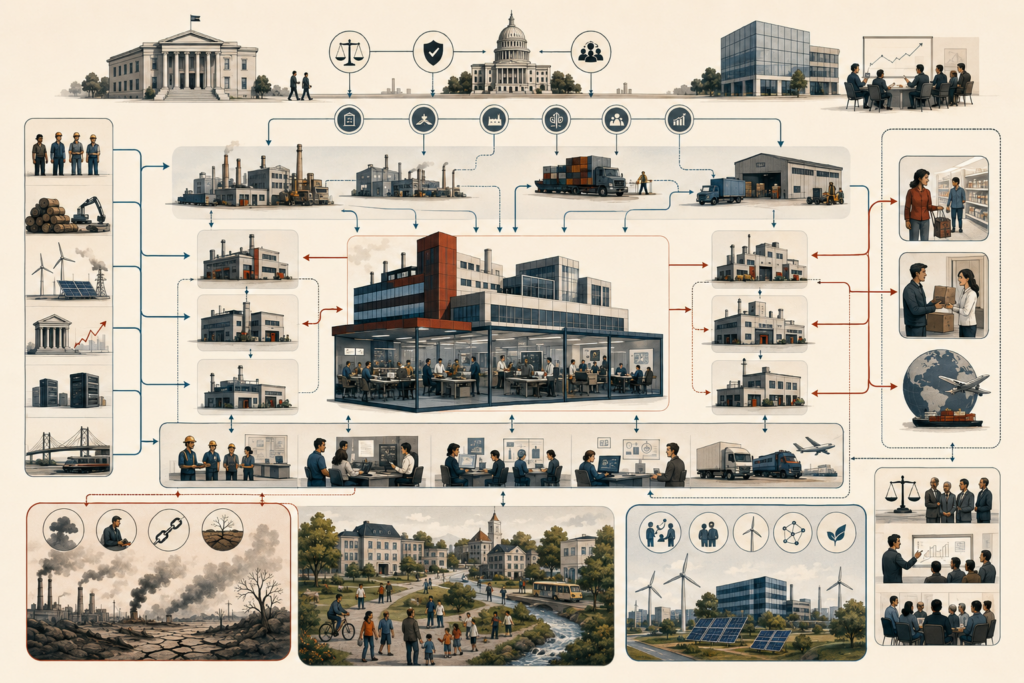
Editorial systems illustration showing firms, suppliers, workers, households, logistics, regulation, market concentration, externalities, and sustainable production within a layered economic network.

Firms, Costs, Competition, and Market Structure

Firms, costs, competition, and market structure are central to economic analysis because they reveal how production is organized, how prices are formed, how power is distributed, and how sectors evolve across time. Firms are not merely technical units of production, but strategic institutions embedded in labor systems, supply chains, financial structures, public rules, and industrial environments. This article examines how cost structures shape pricing, output, investment, and concentration; how competition varies across real markets; and how market structure conditions innovation, bargaining power, resilience, and public legitimacy. It also shows that firm-level efficiency is not always the same as system-level rationality, especially when costs are shifted onto workers, households, public systems, or ecosystems.
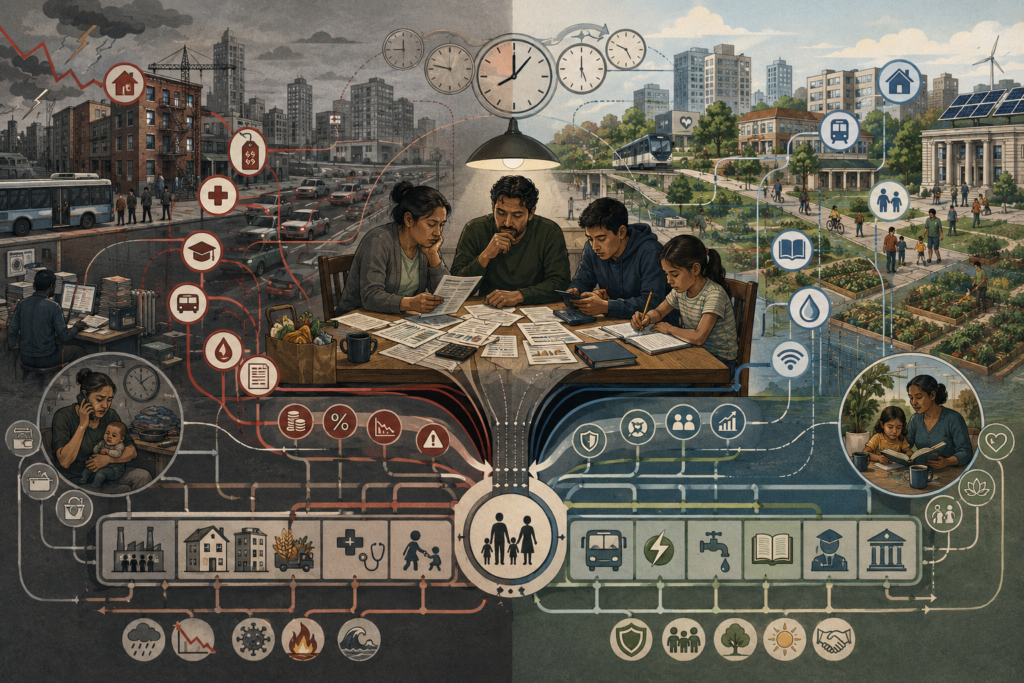
Editorial systems illustration showing a household managing bills, food costs, debt, time pressure, public goods, and everyday economic trade-offs, contrasted with conditions of fragility and more resilient household support systems.

Consumer Choice, Household Welfare, and Everyday Economic Life

Consumer choice is often presented as individual preference, but household welfare reveals a deeper systems problem: how everyday life is provisioned under conditions of income, prices, debt, care, time scarcity, public goods, and unequal access. This article examines how households allocate limited resources across rent, food, transport, utilities, health care, education, debt service, savings, and caregiving while navigating constraints shaped by wages, assets, public provision, infrastructure, and market power. It moves beyond narrow utility and budget-constraint models to explore essentials burdens, time poverty, household fragility, public goods, debt, effective access, and welfare measurement. By connecting consumer choice with Python, R, Stata, SQL, and Julia workflows, the article frames household welfare as a lived test of whether economic systems support dignity, resilience, and durable everyday life.

Editorial illustration of farms, factories, warehouses, markets, transport systems, stores, households, and public spaces connected by flowing pathways that symbolize supply, demand, prices, exchange, and economic coordination.

Supply, Demand, Prices, and Economic Coordination

Supply, demand, prices, and coordination explain how decentralized economies organize exchange under scarcity, interdependence, and incomplete information. This article examines supply as productive capacity shaped by labor, energy, finance, logistics, infrastructure, market structure, and ecological limits; demand as need filtered through income, credit, expectations, public provision, and purchasing power; and prices as signals that both communicate scarcity and ration access. It moves beyond textbook equilibrium to examine elasticity, supply shocks, demand shifts, market power, public goods, externalities, missing prices, and the difference between monetized demand and social need. By connecting supply-demand theory with Python, R, Stata, SQL, and Julia workflows, the article frames economic coordination as an institutional, distributional, and ecological problem—not merely the meeting of curves.

Editorial illustration of households, firms, markets, and public institutions connected by flowing pathways that represent labor, consumption, production, exchange, taxation, regulation, and public services.

Households, Firms, Markets, and States

Households, firms, markets, and states are the central institutional actors through which modern economies organize work, exchange, public authority, and social reproduction. This article explains how households sustain daily life through labor, consumption, care, saving, and borrowing; how firms organize production, employment, investment, and innovation; how markets coordinate exchange through prices, contracts, competition, and purchasing power; and how states provide legal order, public goods, redistribution, regulation, and macroeconomic stabilization. It emphasizes that these institutions are mutually dependent rather than separate spheres. Households absorb shocks, firms shape productive capacity, markets transmit signals and exclusions, and states distribute risk through public policy. By connecting institutional economics with Python, R, Stata, SQL, and Julia workflows, the article frames economic systems as living structures of dependency, power, resilience, and public purpose.

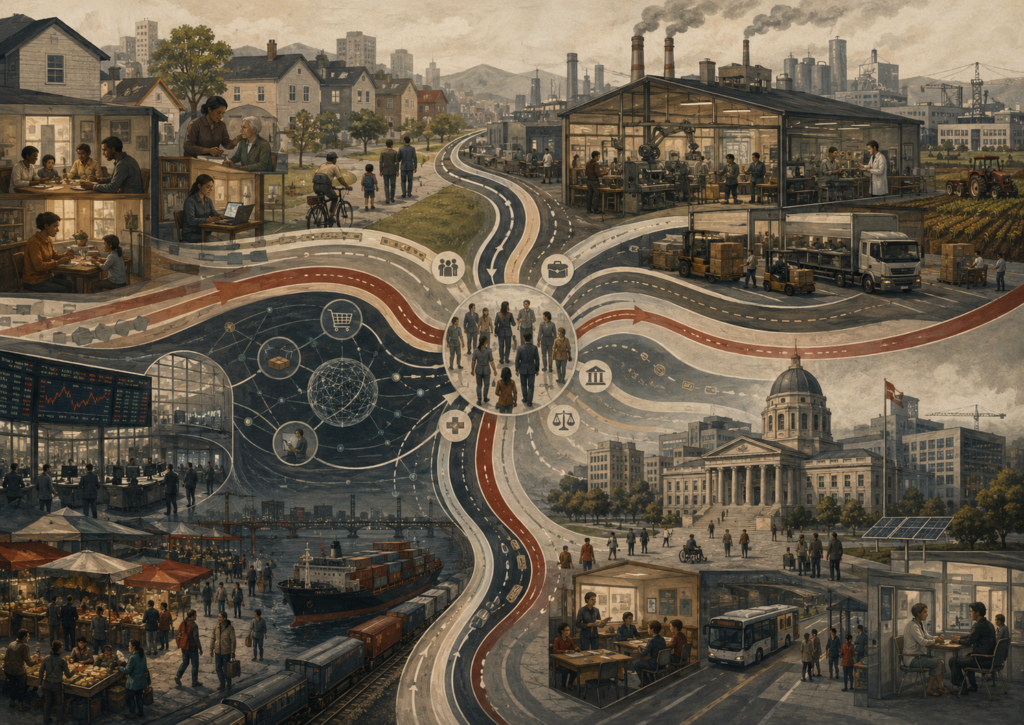
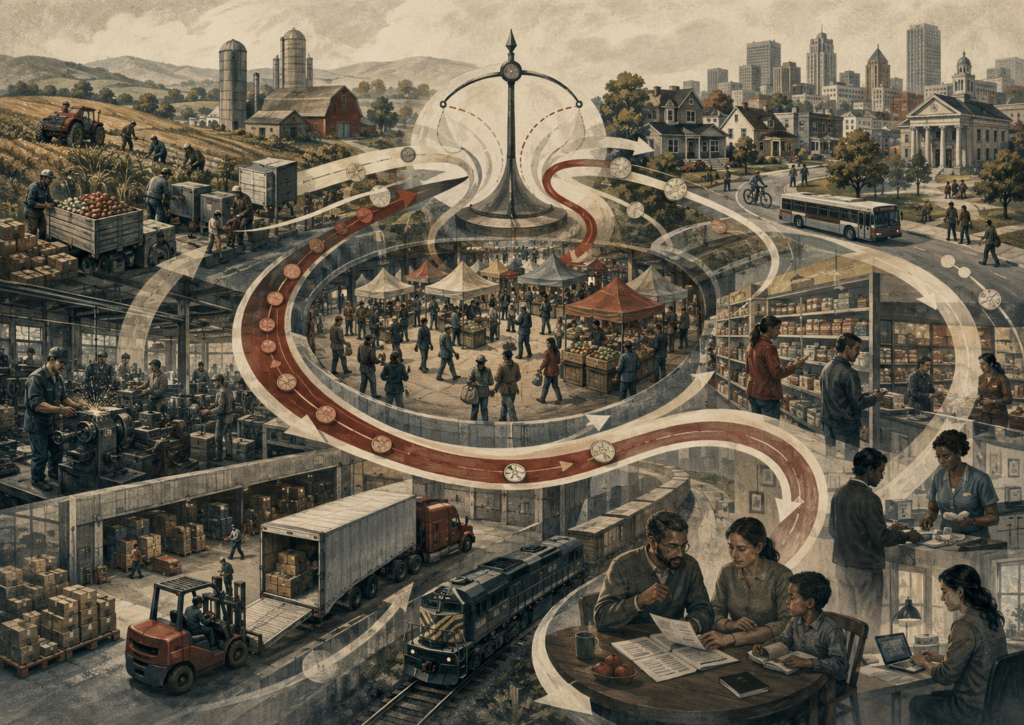
Painterly illustration of production, distribution, and exchange, showing farming, craft work, manufacturing, shipping, rail transport, markets, trade, community life, and global economic interconnection.

Production, Distribution, and Exchange in Human Societies

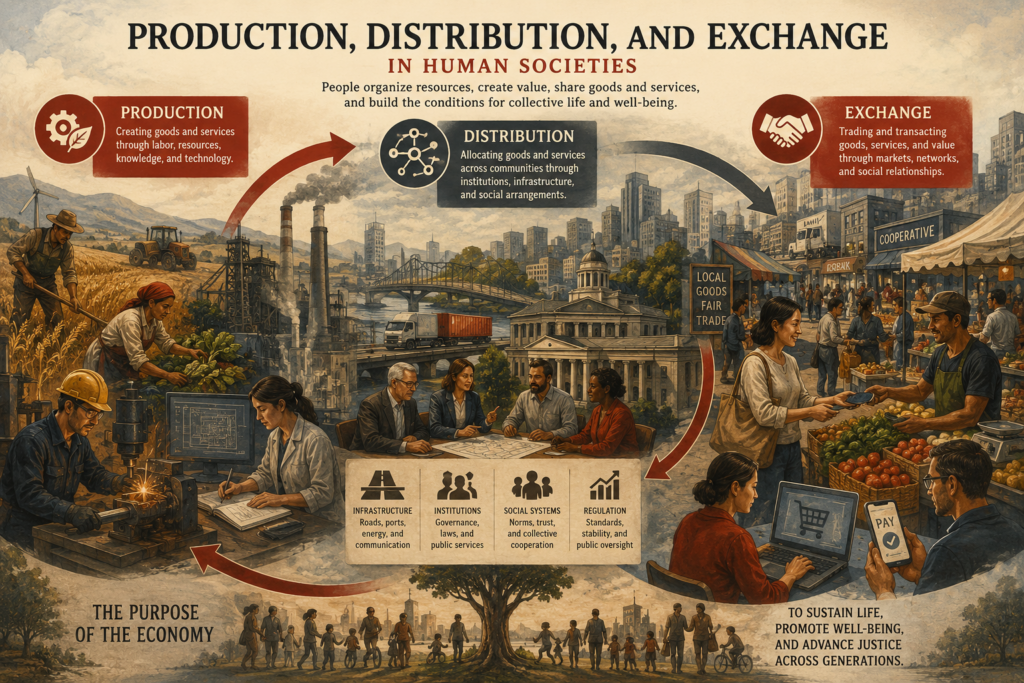
Production, distribution, and exchange are the core processes through which human societies organize material life. This article explains how production creates goods, services, infrastructure, care, and capacity; how distribution divides income, wealth, opportunity, risk, and security; and how exchange coordinates interdependence through markets, public systems, reciprocity, logistics, money, and law. It examines labor, technology, capital, public goods, trade, global value chains, ecological throughput, and the unequal distribution of both benefits and burdens. By connecting input-output analysis, labor-share metrics, ecological intensity, and Python, R, Stata, SQL, and Julia workflows, the article frames economic life not as isolated transactions, but as a structured system of production, distribution, and exchange that determines whether societies build durable prosperity, shared security, and ecological continuity.

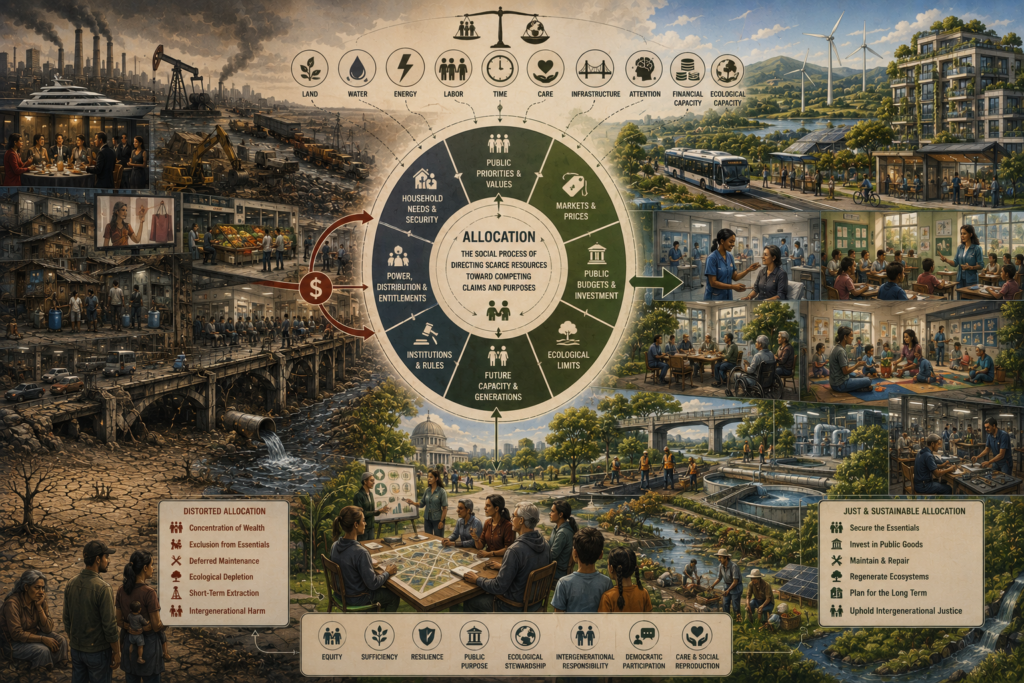
Editorial systems illustration showing scarcity and allocation across land, water, energy, labor, care, infrastructure, markets, public budgets, ecological limits, and future capacity.

Scarcity, Allocation, and the Organization of Material Life

Scarcity is not only the basic economic condition of limited means and competing wants; it is also a social, institutional, ecological, and intertemporal problem. This article explains how scarcity gives rise to allocation: the way societies direct land, labor, money, infrastructure, care, energy, public authority, and ecological capacity across competing uses. It moves beyond the textbook definition of scarcity to examine physical limits, institutional failure, distributional exclusion, market dependence, public goods, social reproduction, ecological depletion, and future capacity. By connecting scarcity to power, public priority, material life, and sustainable systems, the article shows that allocation is never merely technical. It reveals what a society values, whom it protects, what it neglects, and whether it is preserving or consuming the foundations of long-term collective life.

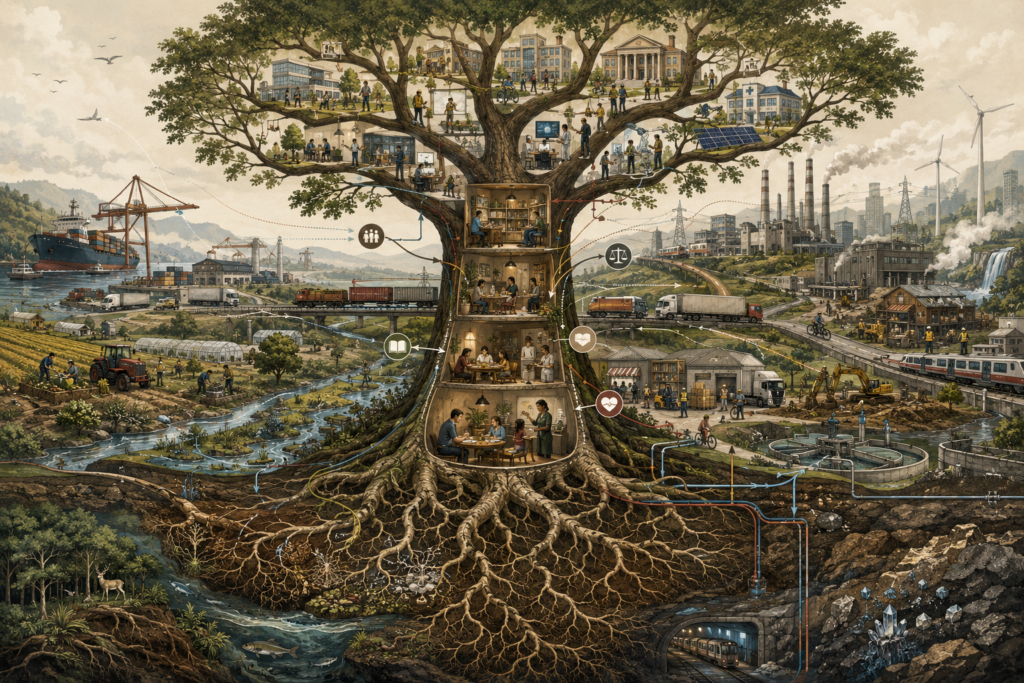
Editorial illustration of an economic system shown as a large tree and root network, with households and care in the trunk, institutions and workplaces in the branches, farms, factories, logistics, finance, infrastructure, and ecological foundations connected across a broad social and environmental landscape.

What Is an Economic System?

An economic system is the organized structure through which a society sustains material life, coordinates production, distributes income and risk, governs exchange, and reproduces the human, institutional, and ecological conditions that make future prosperity possible. This article explains why an economy is never merely “the market,” but a broader system of households, firms, public institutions, labor relations, finance, infrastructure, law, care work, informal activity, and natural foundations. It examines the core functions of production, distribution, allocation, exchange, and reproduction; the role of power and institutional design; the differences among market, planned, mixed, customary, and cooperative systems; and the importance of evaluating economies by resilience, justice, sustainability, public capacity, and intergenerational durability rather than output alone.

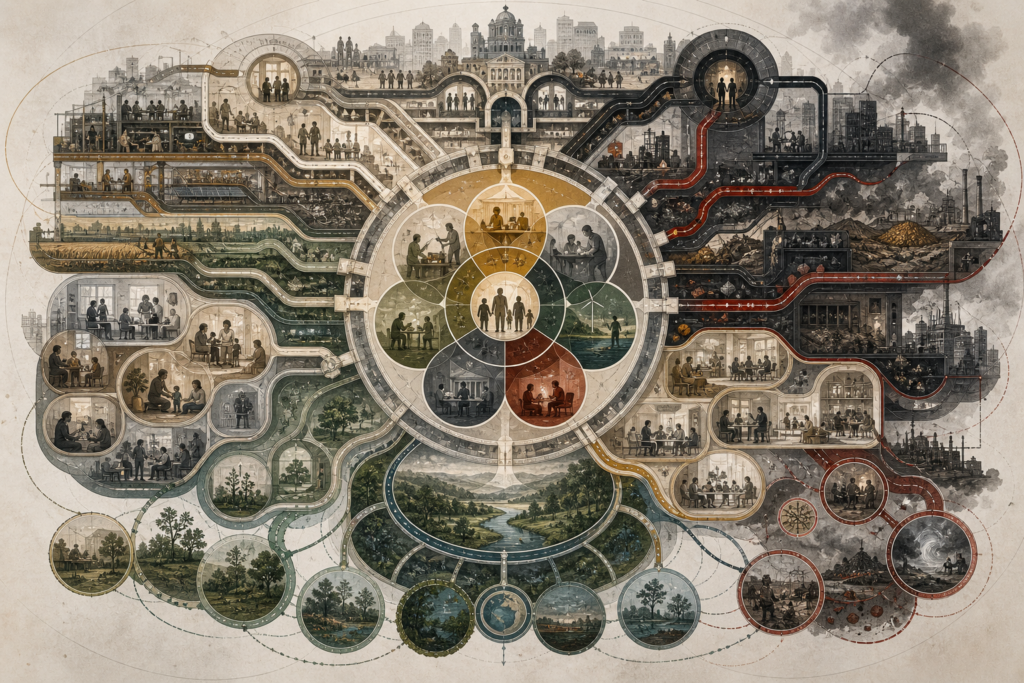
Editorial illustration of economic systems shown as a layered social, financial, productive, institutional, and ecological systems map, with a central economic core connected to labor, care, infrastructure, trade, public services, finance, industry, and environmental landscapes.

Economic Systems: Production, Distribution, Institutions, and Sustainability in Human Societies

Economic systems are not only markets, prices, or financial flows. They are institutional arrangements through which societies organize production, distribution, labor, care, finance, public goods, ecological dependence, and long-term material life. This article introduces economic systems as historically built, politically shaped, and ecologically embedded structures that determine who produces, who benefits, who bears risk, and how societies sustain themselves across generations. It examines households, firms, states, commons, markets, money, infrastructure, social reproduction, and environmental limits as interconnected parts of a wider system. Rather than treating economics as separate from society or nature, it frames economic life as a question of institutions, power, justice, resilience, and sustainability. The central issue is not only how economies grow, but whether they can support dignified human life within planetary boundaries.

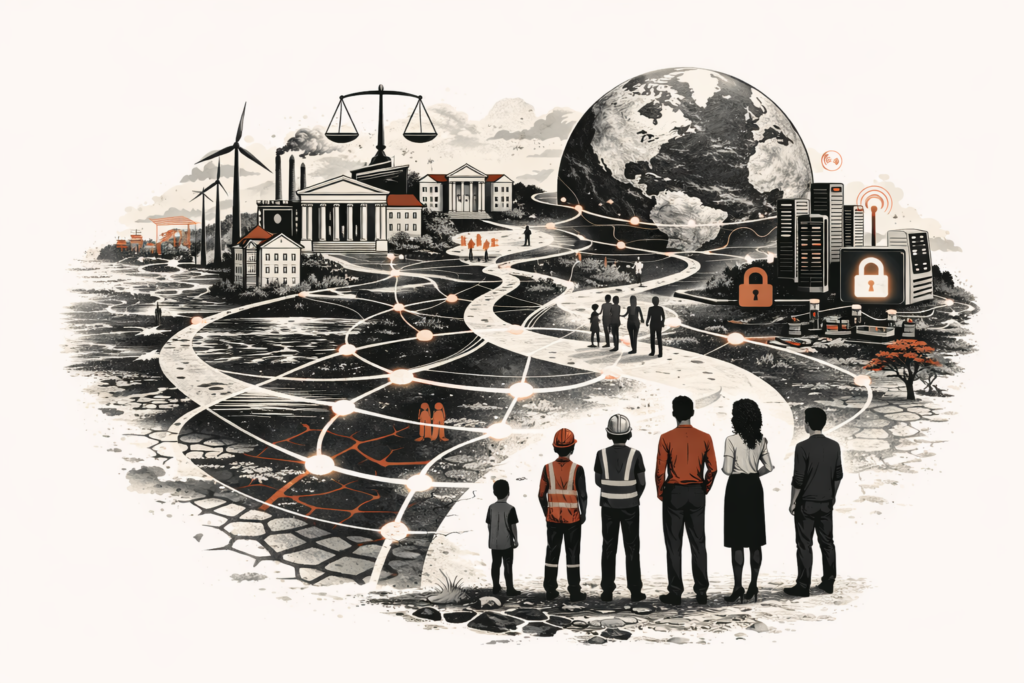
Editorial illustration of the future of stewardship and ethics, showing people, institutions, digital systems, and planetary pathways connected across a shared landscape oriented toward a central Earth.

The Future of Stewardship & Ethics

The future of stewardship and ethics will depend on whether institutions, technologies, economies, and systems of governance can be reorganised around longer time horizons, deeper accountability, and a more serious recognition of interdependence. This article examines stewardship and ethics as the practical art of governing shared futures under conditions of planetary disruption, technological acceleration, widening inequality, and systemic risk. It argues that the future of legitimate governance will require anticipatory judgment, justice-centred transitions, procedural trust, and moral architectures embedded in the ordinary design of institutions rather than ethics treated as commentary after failure.

Scroll to Top