Sustainable Systems

Sustainable systems examine how social, economic, and environmental processes can be organized to support long-term stability and human well-being. Rather than treating environmental protection, economic development, and social equity as separate challenges, sustainable systems research emphasizes their deep interdependence.

The field integrates insights from sustainability science, systems theory, ecological economics, and public policy. Researchers analyze how resource use, technological development, governance structures, and social behavior interact within complex systems.

Designing sustainable systems requires understanding feedback loops, institutional incentives, and long-term environmental constraints. Effective systems must balance efficiency with resilience, innovation with stewardship, and economic opportunity with ecological limits.

By integrating interdisciplinary knowledge, sustainable systems approaches aim to create development pathways that maintain ecological integrity while supporting inclusive and resilient societies.

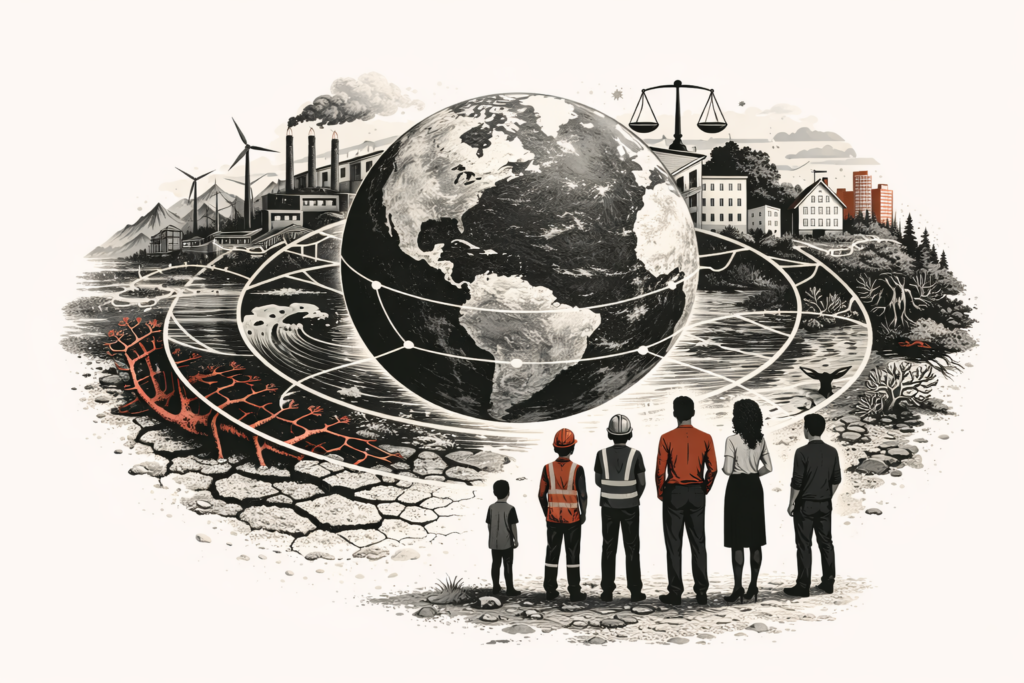
Editorial illustration of planetary stewardship and civilizational responsibility, showing the Earth at the center of interconnected ecological, industrial, institutional, and human systems under conditions of planetary strain.

Planetary Stewardship and Civilizational Responsibility

Planetary stewardship begins from the recognition that human societies now operate within an Earth system increasingly shaped by the cumulative effects of their own power. Climate change, biodiversity loss, freshwater disruption, ecological overshoot, and systemic environmental risk are not isolated problems but signs of a deeper civilizational condition in which technological scale, economic expansion, and institutional fragmentation have outrun the capacities required for long-term responsibility. This article examines planetary stewardship and civilizational responsibility as intertwined ethical and institutional challenges, arguing that durable futures depend on justice, restraint, intergenerational obligation, and the governance of shared planetary conditions rather than short-term management alone.

Editorial illustration of moral architecture, showing a layered institutional structure surrounded by safeguards, barriers, symbols of accountability, and human figures observing the deeper architecture of ethical governance.

From Safeguards to Moral Architecture

Safeguards are necessary, but they are not sufficient to make systems ethically sound. Review processes, audits, disclosures, appeals, and oversight mechanisms can reduce harm, yet they often remain external protections around structures whose deeper moral logic has already been fixed elsewhere. This article argues for a shift from safeguards to moral architecture: from ethics as perimeter control to ethics as something embedded in objectives, institutional design, accountability, participation, dignity, and the treatment of uncertainty. It examines how morally serious governance requires more than preventing abuse at the edges. It requires building institutions and systems whose ordinary operation is aligned with justice, intelligibility, stewardship, and human trust.

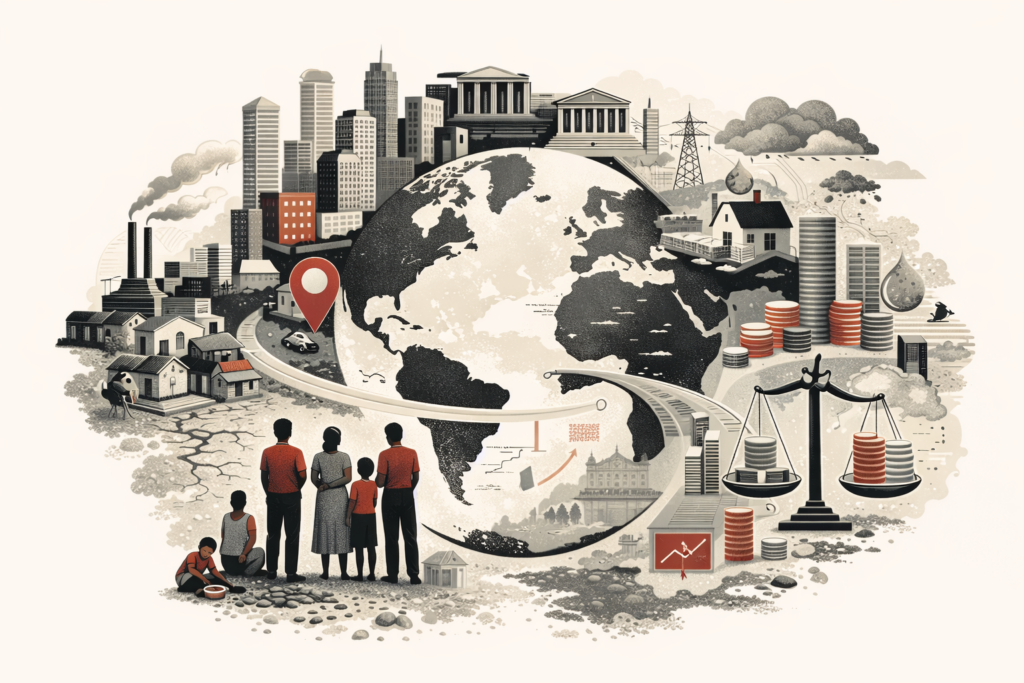
Editorial illustration of global inequality and development stewardship, showing a large globe surrounded by unequal landscapes, urban wealth, rural vulnerability, institutional buildings, financial symbols, and environmental stress.

Development, Stewardship, and the Ethics of Global Inequality

Development is not merely a matter of economic growth. It concerns whether human beings can live with dignity, security, agency, and meaningful opportunity within institutions capable of sustaining flourishing across generations. This article examines development, stewardship, and global inequality as interconnected ethical problems, arguing that poverty, debt, unequal policy space, ecological vulnerability, and unequal voice are not accidental conditions but structural features of the world economy. It explores how justice in development requires more than assistance alone: it requires institutional stewardship capable of reducing structural vulnerability, expanding human capabilities, and aligning development with planetary responsibility.

Editorial illustration of participation, accountability, and procedural justice, showing a civic institution connected to public forums, review pathways, documents, and citizens engaging in hearings, submissions, and administrative processes.

Participation, Accountability, and Procedural Justice

Participation, accountability, and procedural justice are foundational to legitimate governance because they determine whether power is exercised through fair, intelligible, reviewable, and respectful processes. Institutions do not secure legitimacy through outcomes alone. They must also ensure that people can be heard, that decisions can be explained and challenged, and that authority is exercised through procedures that embody dignity rather than arbitrariness. This article examines how participation, accountability, and procedural justice intersect across administrative systems, public institutions, and digital infrastructures, arguing that just governance depends not only on what institutions decide, but on how they decide and whether those decisions remain answerable to the people who live under them.

Editorial illustration of technology and system design as power architecture, showing layered digital and institutional structures, human figures, network connections, and handheld interfaces beneath a red padlock.

Technology, Power, and the Ethics of System Design

Technology is never merely a technical instrument. Every designed system distributes power by shaping what can be seen, measured, decided, permitted, or contested. Interfaces guide behaviour, classifications structure institutional legibility, optimization systems encode value hierarchies, and digital infrastructures reorganize the conditions of social, political, and economic life. This article examines the ethics of system design as a question of power, accountability, participation, legitimacy, and environmental responsibility, arguing that technical capability and ethical legitimacy are distinct achievements in the governance of socio-technical systems.

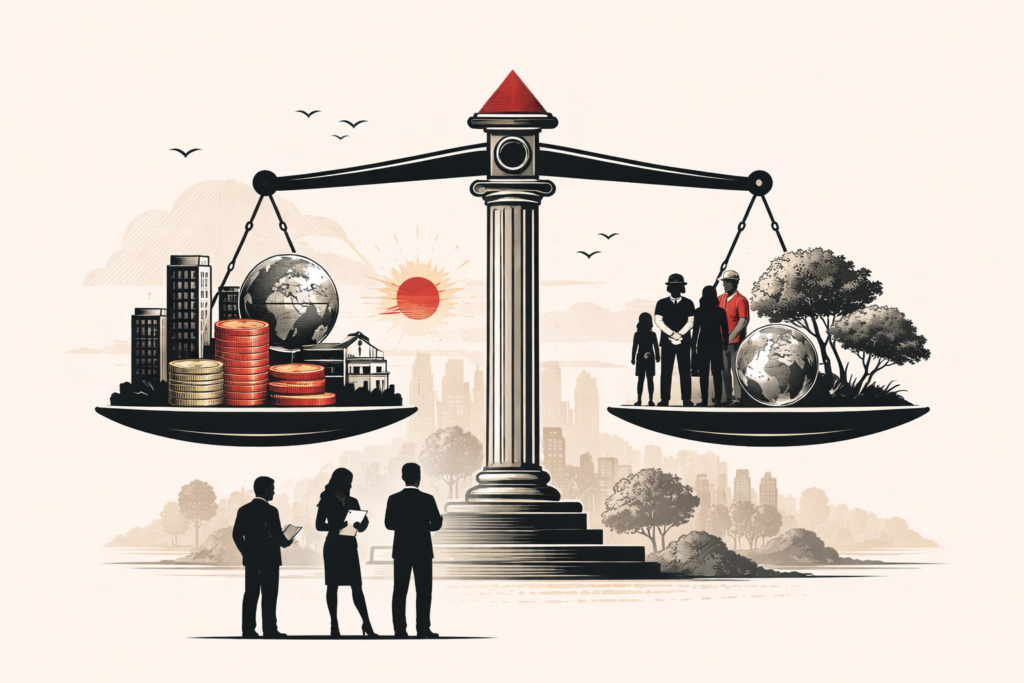
Conceptual editorial illustration of fiduciary duty in finance, showing a large balance scale supported by a classical column, with capital and urban development on one side and people, trees, and the globe on the other.

Fiduciary Duty, Finance, and Responsibility to People and Planet

Fiduciary duty is no longer credibly understood as a narrow obligation to maximise short-term financial return while ignoring the material conditions of social and ecological life. In contemporary finance and governance, climate risk, biodiversity loss, human-rights abuse, labour exploitation, systemic fragility, and institutional breakdown increasingly shape enterprise value, portfolio resilience, and the long-term interests of beneficiaries. This article examines how fiduciary duty is being reinterpreted under conditions of planetary interdependence, distinguishing carefully between financial materiality, stewardship, stakeholder governance, human-rights responsibility, and broader ethical obligations to people and planet.

Editorial governance illustration showing a public trust forum with officials, residents, scientists, auditors, health workers, engineers, civic institutions, infrastructure, public services, climate risks, polluted neighborhoods, and oversight systems symbolizing accountability, evidence, fairness, and institutional stewardship.

Institutional Stewardship, Governance, and Public Trust

Institutional stewardship matters because public trust is not sustained by authority alone. It depends on whether institutions govern power responsibly, act with integrity, use evidence well, protect the vulnerable, and remain answerable to the people and conditions they affect. This article examines how governance, competence, transparency, fairness, responsiveness, long-term responsibility, and ethical institutional design shape public trust. It argues that sustainable systems require more than efficient administration. They require institutions capable of acting as trustworthy stewards of shared conditions of life, justice, and collective future.

Editorial science illustration showing a central scientific integrity review table surrounded by scientists, peer reviewers, data stewards, and policy actors, with research workflows, transparent evidence systems, reproducibility tools, and darker panels depicting conflicts of interest, selective reporting, publication pressure, and other threats to trustworthy inquiry.

Scientific Integrity and Ethical Decision-Making

Scientific integrity matters because knowledge cannot serve the public good if the processes that generate, evaluate, communicate, and apply it are distorted by dishonesty, suppression, manipulation, carelessness, or conflicts of interest. This article examines scientific integrity through truthfulness, transparency, ethical judgment, authorship, peer review, conflicts of interest, institutional incentives, and public trust. It argues that trustworthy science requires more than the avoidance of fraud. It requires research cultures and institutions capable of protecting evidence from distortion and sustaining ethical decision-making under conditions of pressure, uncertainty, and public consequence.

Editorial illustration for biodiversity loss and extinction showing a tiger, elephants, birds, a turtle, and a primate within a landscape divided between wildfire, logging damage, and surviving forest and river ecosystems, alongside two human observers documenting the crisis.

Biodiversity Loss, Extinction, and Moral Responsibility

Biodiversity loss matters ethically because extinction is not merely a biological event. It is a moral event. This article examines the ethical significance of biodiversity decline through extinction, irreversibility, intrinsic and instrumental value, ecological interdependence, differentiated responsibility, climate and land-use pressures, and obligations to future generations. It argues that sustainable systems require more than technical conservation. They require moral restraint, public accountability, and institutions capable of treating species loss as a matter of justice and stewardship rather than as an acceptable externality.

Scroll to Top