
Last Updated August 5, 2026
Production, distribution, and exchange are the core processes through which human societies organize material life. Production creates the goods, services, infrastructures, capacities, and forms of care on which life depends. Distribution determines how output, income, wealth, opportunity, risk, security, and burden are divided across people and institutions. Exchange coordinates movement among households, firms, communities, states, regions, and global systems through markets, public provision, reciprocity, logistics, law, money, and other institutional arrangements.
Taken together, these three processes form the basic architecture of economic order. They determine not only whether a society can produce enough, but what it produces, who benefits from it, whose labor is recognized, whose needs are protected, whose risks are externalized, and whether the system reproduces or depletes the conditions of future life. To study production, distribution, and exchange is therefore not simply to study “the economy” in a narrow technical sense. It is to study how societies organize survival, interdependence, power, and material possibility.
These categories are often separated analytically, but in lived economic systems they are inseparable. Production shapes what can be distributed and exchanged. Distribution shapes effective demand, labor power, social stability, bargaining conditions, and the terms under which exchange occurs. Exchange coordinates movement across the system, but it also reflects prior distributions of wealth, infrastructure, legal entitlement, public capacity, and power. A society may produce immense wealth while distributing it narrowly. It may exchange actively while underproviding essentials. It may achieve high output while relying on exploitative labor, fragile logistics, ecological depletion, or unequal trade relationships that undermine long-term continuity.
Main Library
Publications
Article Map
Economic Systems
Related Topic
Sustainable Development
Related Topic
Institutions & Governance
Related Topic
Risk & Resilience
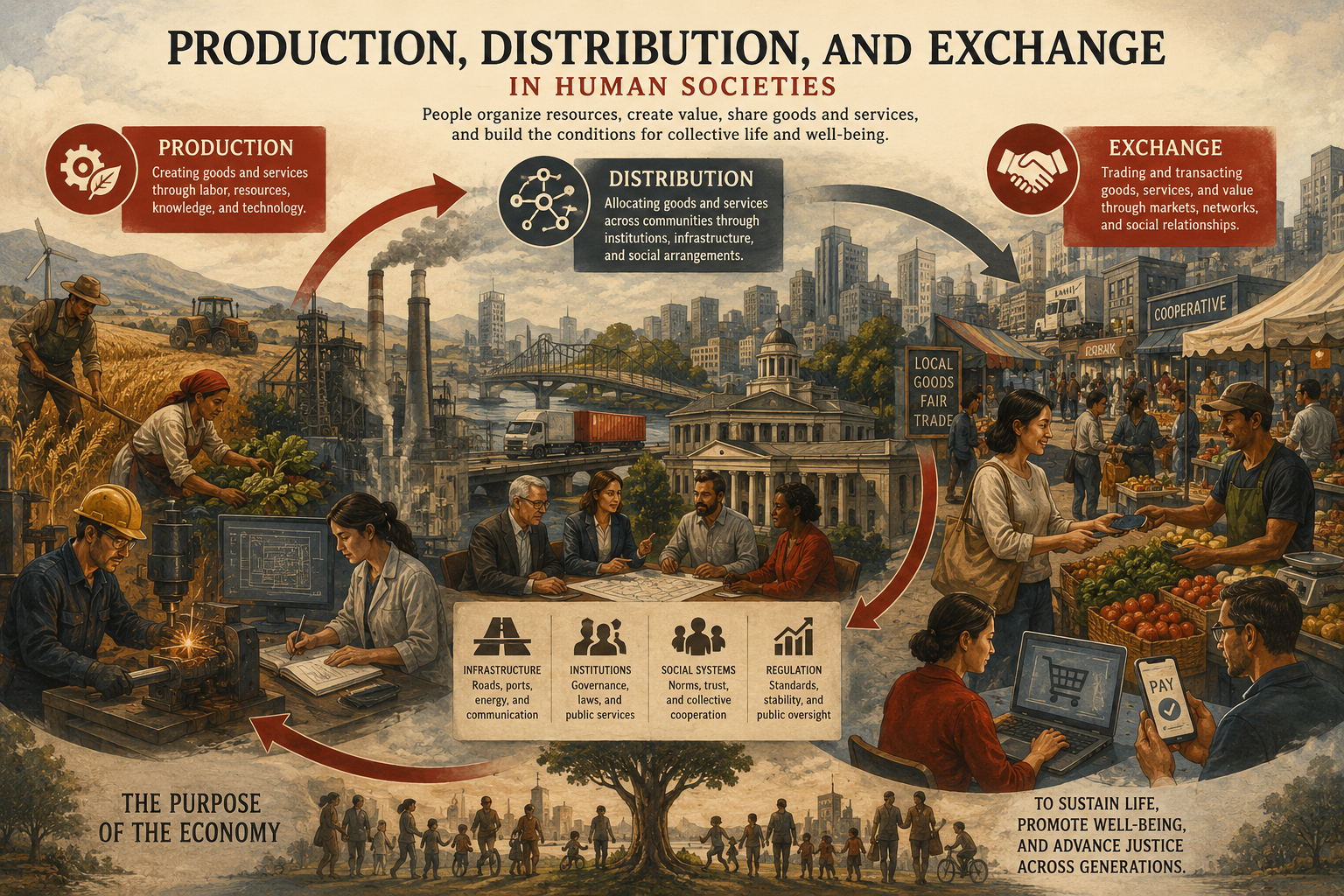
Within a sustainable systems framework, production, distribution, and exchange must be understood as embedded within institutions, history, ecology, and power. Production depends on labor, technology, energy systems, infrastructure, public capacity, and living ecosystems. Distribution depends on wages, property, taxation, welfare, public services, legal entitlement, and bargaining power. Exchange depends on trust, money, logistics, communication, contract enforcement, transport, and rules of coordination. None of these processes is neutral. Each is shaped by institutions, and together they reveal what a society is materially organized to sustain.
Why These Processes Matter
Every society must solve three enduring problems. It must produce the goods, services, capacities, and infrastructures necessary for life. It must distribute the fruits and burdens of that production. And it must organize exchange so that interdependent people, households, firms, communities, institutions, and territories can obtain what they cannot produce alone. These are not secondary features of economic existence. They are its structural core.
This is why production, distribution, and exchange recur across the history of economic thought. Classical political economy was deeply concerned with production, surplus, wages, rents, profits, and the distribution of income across social classes. Later economic traditions shifted emphasis toward price coordination, marginal choice, bargaining, welfare, development, public goods, and global trade. Yet the underlying question remained: how is material life organized, and on what terms?
These processes matter because they reveal the difference between an economy that functions statistically and one that functions socially. Output may rise while care systems deteriorate. Trade may expand while productive dependence deepens. Wealth may accumulate while housing, health care, and basic security become harder to access. The deeper question is therefore not simply whether production, distribution, and exchange occur, but whether they are organized in ways that sustain dignity, resilience, legitimacy, and long-range continuity.
They also matter because they reveal the hidden architecture behind everyday economic life. A wage is not only a market price for labor. It is part of a distributional order. A supply chain is not only a logistical network. It is a system of dependency and bargaining power. A public school or hospital is not only a service. It is a productive and distributive institution. A price is not only information. It is a signal filtered through income, ownership, legal rules, market structure, and institutional access.
To understand any economic system, one must therefore ask how these three processes are connected. What gets produced? Who decides? Who works? Who owns? Who receives income? Who bears risk? Who has access? What is exchanged, under what rules, and with what consequences for the future?
Production
Production refers to the creation of goods and services through the organization of inputs. These inputs include labor, land, energy, raw materials, water, tools, machinery, knowledge, technology, logistics, infrastructure, finance, institutions, and capital. Production is often associated with factories or agriculture, but it is much broader than either. It includes care work, transport, education, maintenance, software, construction, public services, communication systems, scientific research, and the many visible and invisible forms of work through which society reproduces itself.
At one level, production is a transformation process. It turns materials, capabilities, and effort into outputs that satisfy needs or desires. At another level, it is a social relation. Production always raises questions about ownership, control, work organization, compensation, technological choice, and the purposes toward which productive capacity is directed. Who owns productive assets? Who controls machinery, platforms, land, patents, data, logistics, and knowledge? Who performs the labor? Which sectors receive investment, and which are neglected? What is treated as socially necessary production, and what remains hidden or undervalued?
These questions matter because production is never merely technical. It is institutionally organized capacity. Firms produce, but so do households, public systems, cooperatives, informal networks, public agencies, universities, community organizations, and infrastructures maintained collectively. What a society can produce depends not only on entrepreneurial initiative or factor inputs, but on education systems, transport capacity, energy systems, legal rules, public research, credit structures, health systems, and the quality of institutions capable of coordinating effort across time.
Production also has direction. An economy can produce weapons, luxury goods, speculative financial products, public transit, hospitals, housing, clean-energy infrastructure, repair systems, or extractive platforms. The quantity of output matters, but so does its composition. A society’s productive structure reveals what it is organized to make possible. A highly productive system can still fail if it underproduces care, housing, public goods, resilience, or ecological restoration.
Production therefore belongs at the center of economic systems analysis. It is not merely the supply side of a diagram. It is the material, technological, institutional, and social foundation on which distribution and exchange depend.
Distribution
Distribution concerns how the results of production are divided. This includes the distribution of wages, salaries, profits, rents, interest, wealth, assets, public services, opportunities, and access to basic goods. It also includes the distribution of burdens: insecurity, debt, inflation, pollution, ecological damage, care responsibilities, unpaid work, exposure to crisis, and vulnerability to economic shocks.
Distribution is central because production alone does not tell us whether an economy is functioning well. A society may generate high output while concentrating gains narrowly. It may produce extraordinary wealth while keeping wages weak, public infrastructure thin, and housing insecure. It may improve aggregate income while worsening regional abandonment, racialized deprivation, gendered care burdens, or intergenerational inequality. Distribution is therefore not a secondary ethical supplement to economics. It is constitutive of economic order itself.
Distribution takes place through multiple channels at once. Markets distribute through wages, salaries, prices, profits, rents, interest, and capital gains. States redistribute through taxation, transfers, social insurance, public goods, and service provision. Households distribute through care, inheritance, intergenerational support, and unpaid work. Financial systems shape distribution through asset ownership, credit access, debt exposure, and speculative gain. What results is never a single distribution mechanism but a layered institutional structure that determines who commands security and who experiences scarcity as a routine condition of life.
Distribution also shapes macroeconomic stability. If gains flow disproportionately toward households with high savings rates while wages stagnate for households with high spending needs, aggregate demand can weaken. If asset owners gain while renters, workers, and indebted households are squeezed, insecurity rises even when measured wealth increases. If public goods deteriorate, private income must purchase what collective systems once provided. Distribution therefore affects consumption, investment, social trust, political legitimacy, and resilience.
To study distribution is to ask whether the economic system converts productive power into broad welfare or concentrated advantage. It is to ask who receives the social product and who pays the hidden costs of producing it.
Exchange
Exchange refers to the movement of goods, services, labor, money, claims, rights, and obligations among actors. In market societies, exchange often appears as buying and selling mediated by prices and money. But exchange is broader than commercial trade alone. It also includes barter, reciprocity, mutual aid, public provision, administrative allocation, customary obligation, cooperative sharing, household transfer, and shared systems of access not reducible to ordinary commodity exchange.
Exchange is indispensable because complex societies depend on specialization. No individual, household, firm, or region produces everything it needs. Interdependence must therefore be coordinated. Exchange connects producers to consumers, firms to suppliers, workers to incomes, regions to one another, and states to global systems. It allows dispersed capabilities to be integrated into a functioning social order.
Yet exchange is never neutral. It depends on infrastructures, transport networks, payment systems, information flows, logistics, legal rules, standards, contracts, platforms, and shared confidence in money. It also depends on prior distributions of power and wealth. Actors do not enter exchange on equal terms. Some enter with assets, secure wages, information, liquidity, and strategic position. Others enter under pressure, debt, exclusion, or necessity. Exchange coordinates interdependence, but it does so through terms already shaped by the wider economic system.
Exchange can expand freedom when it widens access, connects capabilities, supports specialization, and allows people to obtain what they need from one another. But it can also deepen dependency when essential goods are governed solely by purchasing power, when supply chains become brittle, when platform intermediaries extract rents, or when trade relationships lock regions into unequal positions.
Exchange should therefore be understood as a system of coordination and dependency, not merely a series of transactions. The question is not only whether exchange occurs, but which domains are organized through exchange, what rules govern it, who benefits from those rules, and how exchange affects productive capacity, distribution, resilience, and ecological stability.
The Civilizational Organization of Material Life
Production, distribution, and exchange should be understood not simply as economic functions but as civilizational processes. Together they organize how a society feeds itself, houses itself, educates its members, cares for the vulnerable, builds infrastructure, allocates status, coordinates interdependence, and reproduces the conditions of future life.
They shape whether abundance is broadly shared or tightly enclosed; whether interdependence is experienced as stability or precarity; whether technology supports dignity or intensifies control; whether exchange widens freedom or deepens dependency; and whether production is compatible with ecological continuity.
Seen this way, the economy is not a detached market sphere. It is the material organization of collective life. It is one of the principal ways societies translate values into lived reality. A society that distributes care poorly, underproduces public goods, and treats exchange as the sole measure of value is making a civilizational decision, even if it presents those outcomes as the neutral workings of impersonal markets.
This is why economic systems cannot be evaluated only by output. Output is important, but the deeper question is what kind of social order output sustains. Does production generate capability or exhaustion? Does distribution create security or stratified vulnerability? Does exchange coordinate mutual dependence or convert every necessity into private exposure?
Production, distribution, and exchange are therefore not only analytical categories. They are the living structure of a society’s material commitments.
Labor, Technology, and Capital
Production is often described through the familiar triad of labor, technology, and capital. Each category is useful, but each carries social and political weight.
Labor is not simply an input. It is human activity performed by people who require income, dignity, protection, training, time, health, care, and social reproduction. Labor systems determine how work is organized, compensated, disciplined, protected, and valued. They also determine who has bargaining power, who performs dangerous or invisible work, and whose labor is treated as essential but poorly rewarded.
Technology is not neutral either. It can raise productivity, reduce drudgery, expand capability, improve health, and support ecological monitoring. But it can also displace workers, concentrate ownership, intensify surveillance, raise barriers to entry, and accelerate ecological extraction depending on how it is governed. A technology’s social effect depends on ownership, regulation, institutional design, distributional context, and the purposes toward which it is directed.
Capital refers not only to money, but to the produced means of further production: machinery, facilities, buildings, transport systems, data centers, logistics networks, software systems, inventories, tools, and accumulated organizational capacity. Capital can support long-term productivity when invested in real capability. It can also become speculative when financial returns detach from productive transformation.
How labor, technology, and capital are combined shapes the character of the economic system. A technologically advanced economy may still generate poor distribution if labor bargaining power is weak or ownership is highly concentrated. A capital-rich society may remain fragile if investment flows into speculation rather than infrastructure, resilience, care, or socially necessary production. A productive economy may fail to generate broad welfare if gains are detached from wages, public services, and long-term capacity.
For that reason, the study of production cannot be isolated from labor law, ownership structure, education, public investment, credit, industrial policy, union power, corporate governance, and technological regulation. These govern not only how much is produced, but what forms of production become possible and who benefits from them.
Distribution, Power, and Social Order
Distribution is inseparable from power. Who receives the fruits of production depends not only on productivity, but on property, bargaining power, institutional design, public policy, and political voice. Wage shares, profit shares, rents, asset appreciation, taxes, transfers, social insurance, and access to public support all reflect power relations embedded in law and institutions.
This is why distribution affects social order so profoundly. Extreme concentration of gains can narrow demand, weaken legitimacy, intensify insecurity, and generate persistent political conflict. Broadly shared gains, by contrast, can support social cohesion, human development, public trust, and macroeconomic stability. The distribution of income and wealth therefore shapes not only fairness but the capacity of a society to sustain consent.
Distribution also shapes visibility. Some forms of work, especially care work and reproductive labor, are often undercounted or devalued even when they are indispensable to the continuity of society. Some harms are distributed quietly into particular regions, classes, racialized communities, genders, or generations while remaining obscure in aggregate measures. Distribution is thus not only about who gets what, but about whose labor and whose burdens become legible within the economic order.
The distributional structure of an economy is also cumulative. Households that receive more income can save, invest, educate children, purchase housing, access credit, and accumulate assets. Households that receive less may face debt, insecurity, overcrowding, poor health, and weaker bargaining power. Distribution today shapes command over production and exchange tomorrow.
That is why distribution cannot be treated as something that happens after production. It feeds back into production by shaping demand, skills, health, investment, and political stability. It feeds back into exchange by shaping who can enter markets freely and who must enter under duress. Distribution is not the remainder of economic life. It is one of its governing structures.
Exchange as Coordination and Dependency
Exchange is often celebrated because it allows specialization and mutual gain. That is true, but incomplete. Exchange also creates dependency. Societies become reliant on supply chains, payment systems, transport corridors, imported inputs, financial channels, digital platforms, contract enforcement, and institutional trust. When exchange systems are stable, these dependencies can support abundance. When they break down, apparent efficiency can quickly reveal fragility.
This is why exchange should be understood as a system of coordination rather than a simple field of transactions. The quality of exchange depends on infrastructure, governance, redundancy, legal reliability, logistics capacity, information quality, and the ability to adapt under stress. A system organized only for short-term efficiency may become brittle. One organized with greater redundancy and public coordination may appear less efficient in narrow accounting terms while proving more resilient in disruption.
Exchange also transforms social relations by extending commodity logic into more domains of life. Some expansions of exchange can widen access and lower costs. Others can subordinate housing, care, knowledge, health, water, or energy to purchasing power in ways that undermine basic security. The issue is therefore not merely how much exchange takes place, but which domains are governed by exchange, under what rules, and with what corrective institutions.
Exchange can also obscure dependence. A finished product may appear as a simple market object, but it contains labor, energy, logistics, minerals, financing, regulation, software, shipping, environmental burden, and public infrastructure. Prices rarely reveal the full social and ecological history of what is exchanged.
For that reason, exchange must be analyzed as part of a wider system of production and distribution. It coordinates flows, but it also carries power, dependence, risk, and invisibility through the economy.
Public Goods, Social Provision, and Non-Market Distribution
Not all socially necessary goods are effectively produced or distributed through ordinary market exchange. Public health, sanitation, education, water systems, legal order, transport networks, basic science, emergency preparedness, environmental protection, and many forms of infrastructure often require public provision or strong public coordination because their benefits are diffuse, long-term, or difficult to capture privately.
This matters because public goods are not external supplements to a market economy. They help constitute the productive and distributive order itself. Education produces skills. Health systems sustain labor capacity. Infrastructure connects producers and consumers. Public research supports technological advance. Social insurance stabilizes households and demand. Environmental protection preserves the ecological conditions of future production.
Once this is recognized, the boundary between production and distribution becomes more complex. Public institutions do not merely redistribute after the market has spoken. They shape what can be produced, who can participate productively, and whether the outputs of production remain broadly accessible.
A society that neglects public goods may sustain active private exchange for a time, but often by eroding the conditions that make production and exchange possible in the first place. Underfunded schools, fragile health systems, deteriorating infrastructure, weak environmental protection, and inadequate public administration all create hidden costs. Those costs eventually reappear as lower productivity, higher inequality, weaker resilience, and institutional mistrust.
Social provision also reminds us that distribution is not only monetary. Access to public education, health care, transit, clean water, libraries, parks, legal protection, and digital infrastructure can change the real distribution of life chances even when income remains unequal. Public goods are therefore distributional institutions as well as productive ones.
Trade and the Global Organization of Production
Exchange extends beyond local markets into regional and international trade. Trade can widen access to goods, enable specialization, support industrial learning, connect producers to larger markets, and allow countries to import crucial inputs or technologies. It can also reorganize production and distribution across space in ways that create new dependencies and unequal gains.
Global value chains illustrate this clearly. Production is often distributed across countries, firms, legal jurisdictions, transport systems, and labor regimes. One country may supply raw materials, another may provide low-wage assembly, another may control intellectual property, another may dominate logistics, finance, or branding. The final exchange price rarely reveals how value, labor, risk, and environmental burden are distributed across the chain.
Trade can generate development opportunities, but those opportunities are not automatic. They depend on industrial capability, infrastructure, education, state capacity, bargaining position, technology transfer, domestic linkages, and the ability to move into more complex and higher-value activities. Trade that strengthens domestic capability differs profoundly from trade that enlarges gross flows while leaving a country dependent on volatile commodity exports, low-wage assembly, or imported essentials.
Trade also raises resilience questions. A production system that depends on long, lean, geographically concentrated supply chains may be efficient in normal times but fragile under shock. Pandemics, wars, shipping disruptions, energy shocks, export restrictions, and climate hazards can reveal how dependent domestic material life has become on distant systems.
For this reason, trade cannot be assessed simply by volume. The deeper issue is how exchange shapes productive capacity, wage dynamics, dependency, ecological burden, geopolitical vulnerability, and long-run development.
Ecology, Throughput, and Material Limits
Production is never immaterial. However abstract finance or digital services may appear, all economies remain dependent on energy, land, water, minerals, biomass, built infrastructure, and waste-absorbing ecological systems. Production draws resources from nature, transforms them through labor and technology, and returns wastes and emissions to the environment. Distribution determines who benefits from this process and who bears its harms. Exchange organizes the circulation of these flows, often across long and unequal geographies.
Once this material basis is taken seriously, production, distribution, and exchange must be evaluated not only by output or price efficiency, but by ecological viability. A society may produce intensively and exchange widely while destabilizing climate systems, exhausting aquifers, degrading soils, concentrating pollution, or consuming biodiversity. In those cases, short-term economic success may be purchased through long-term depletion.
Ecological throughput also has distributional consequences. Pollution, heat exposure, industrial hazards, extractive frontiers, waste sites, flood risk, and climate vulnerability are not evenly distributed. Some communities receive the benefits of production, while others receive the burdens. Some countries consume goods whose ecological costs are borne elsewhere. Exchange can separate consumption from harm, making environmental injustice harder to see.
A sustainable systems perspective therefore asks how production can remain compatible with ecological regeneration, how distribution can account for environmental justice, and how exchange can be organized without treating natural systems as infinitely substitutable or endlessly absorbent.
Production, distribution, and exchange must ultimately be understood inside the Earth system. The economy is not above or outside material limits. It is one organized pattern of material transformation within them.
Production, Distribution, and Exchange Within Sustainable Systems
Within sustainable systems, production, distribution, and exchange must be judged together. Productive capacity matters because societies need food, shelter, energy, infrastructure, medicine, care, and repair. Distribution matters because unequal access to essentials undermines legitimacy, resilience, and human development. Exchange matters because interdependence must be coordinated, but also governed so that efficiency does not come at the cost of fragility, exclusion, or ecological damage.
This means the central question is not whether a society produces more, distributes something, and exchanges widely. Every complex society does. The deeper question is whether these processes are organized in ways that support durable flourishing. Does production build capability or merely extraction? Does distribution widen security or intensify precarity? Does exchange strengthen resilience and social coordination or deepen dependence and concentration?
These questions move the analysis beyond economics as a narrow science of transactions and toward economics as the study of how societies organize material life under conditions of scarcity, interdependence, power, and ecological limit.
Sustainable economic systems require productive capacity, but not production at any cost. They require distribution, but not merely after-the-fact redistribution of harms created upstream. They require exchange, but not a total subordination of life to market access. They require institutions capable of deciding when markets work, when public provision is necessary, when care must be protected, when ecological boundaries must constrain throughput, and when resilience must take precedence over short-term efficiency.
In this sense, production, distribution, and exchange are not simply descriptive categories. They are evaluative categories. They help us ask what an economy is for.
How These Processes Should Be Judged
Production, distribution, and exchange can be judged by multiple standards. Output, efficiency, price coordination, and productivity matter, but they are not enough. A serious economic systems framework must also ask whether the system sustains human capability, distributes security fairly, preserves public goods, maintains ecological foundations, and remains resilient under stress.
| Process | Narrow Question | Systems Question |
|---|---|---|
| Production | How much output is created? | What is produced, how is it produced, whose labor is used, what capacity is built, and what ecological burden is created? |
| Distribution | Who receives income? | How are security, risk, public goods, wealth, opportunity, ecological harm, and future claims distributed? |
| Exchange | How efficiently do goods move? | What dependencies, exclusions, bargaining structures, logistics, and vulnerabilities are created by exchange systems? |
| Public Goods | How much does government spend? | Does public provision build the conditions for broad participation, productive capacity, resilience, and legitimacy? |
| Trade | How large are trade flows? | Does trade strengthen capability, or does it deepen dependence, unequal value capture, and exposure to external shocks? |
| Ecology | What is the cost of production? | Does the system preserve the natural foundations of future production and distribute environmental burdens justly? |
This broader evaluation prevents a common mistake: treating economic life as successful whenever output rises or exchange expands. A system can produce more while distributing insecurity. It can trade more while weakening domestic capacity. It can raise efficiency while becoming fragile. It can increase measured value while degrading the ecological foundations of life.
The point is not to reject productivity, trade, or markets. It is to embed them within a larger judgment about material life, social legitimacy, and future continuity.
Social Accounting and the Circular Flow of Production and Income
Production, distribution, and exchange can be represented as a circular system of flows among households, firms, governments, financial institutions, and the rest of the world. Firms purchase labor and other inputs, households receive income and purchase goods and services, governments tax and spend, financial institutions transform saving into credit and investment, and international accounts connect domestic production with imports, exports, income flows, and finance.
A social accounting matrix extends ordinary input-output analysis by recording not only inter-industry transactions but also factor incomes, household groups, taxes, transfers, saving, investment, and external flows. This matters because the same production structure can generate very different social outcomes depending on who receives wages, profits, rents, transfers, and public services.
Receipts_i = \sum_j Transactions_{ij}
\]
Interpretation: Every institutional account receives flows from other accounts, making production and distribution jointly visible.
Balanced accounts do not imply a just or resilient economy. They show consistency, not adequacy. A system can balance while households accumulate debt, public investment declines, profits concentrate, or ecological costs remain outside the accounts.
Input–Output Linkages, Bottlenecks, and Production Multipliers
Input-output systems reveal that final demand in one sector activates production throughout the economy. A transit investment requires construction, metals, electricity, engineering, finance, software, maintenance, and public administration. A hospital requires pharmaceuticals, logistics, food, energy, sanitation, laboratories, and trained labor.
The Leontief inverse estimates direct and indirect output requirements, but multipliers should not be treated as automatic benefits. They depend on idle capacity, import leakage, workforce availability, price pressure, and whether the induced production is socially useful and ecologically viable.
Bottlenecks can dominate system behavior. A shortage of one specialized component, permit, grid connection, port, skill, or financing instrument can constrain a much larger production network. Resilience analysis should therefore identify critical nodes, substitution options, inventories, repair time, and the consequences of failure.
Input-output analysis is strongest when paired with distributional and ecological extensions. It can then show not only which sectors expand, but where income flows, which regions gain, how much import dependence remains, and what material or emissions burden is activated.
Capacity Utilization, Investment, and the Composition of Output
Economies can possess unused productive capacity while essential needs remain unmet. Idle factories, unemployed workers, vacant buildings, or unused public land do not automatically become housing, care, transit, or clean infrastructure because finance, ownership, regulation, skills, and coordination determine what capacity can be redirected.
Capacity utilization measures how intensively existing productive assets are used. High utilization can signal strong demand, but sustained operation near physical limits can create maintenance failure, price pressure, and fragility. Low utilization can indicate weak demand, obsolete assets, regional decline, or deliberate reserve capacity.
Investment changes the future composition of production. A dollar spent on speculative property, a data center, a rail network, a hospital, a weapons system, or ecological restoration creates different capabilities and dependencies. Aggregate investment totals therefore conceal strategic choices.
Production policy should distinguish temporary demand support from long-lived capacity formation. It should also identify whether new capacity displaces, complements, or locks in existing systems.
Ownership, Control, and the Direction of Production
Ownership determines who controls productive assets, receives residual income, sets investment priorities, and bears or transfers risk. Private firms, public enterprises, cooperatives, households, community trusts, pension funds, and platform companies organize these rights differently.
Control can be separated from formal ownership. Creditors, dominant buyers, franchise systems, intellectual-property holders, logistics platforms, and lead firms can direct production without owning every facility or employing every worker. The legal boundary of the firm may therefore understate effective economic control.
Ownership affects time horizon. Some institutions can invest patiently in infrastructure, research, workforce development, or ecological restoration. Others face pressure for rapid cash extraction, asset sales, or shareholder distributions.
The relevant question is not whether one ownership form is always superior. It is whether decision rights, accountability, investment horizon, worker voice, and public obligations fit the social function of the activity.
Functional, Personal, and Wealth Distribution
Functional distribution divides income among wages, profits, rents, interest, and mixed income. Personal distribution asks how income is distributed among households. Wealth distribution records ownership of housing, land, businesses, financial assets, pensions, and debt.
These measures interact but are not interchangeable. A stable labor share can coexist with widening wage inequality. Household income can appear adequate while debt and housing costs rise. Wealth concentration can increase command over production, politics, and future income even when current income inequality changes little.
| Distribution layer | Primary question | Hidden issue |
|---|---|---|
| Functional | How is value added divided among labor and property claims? | Sector shifts and self-employment classification. |
| Personal | How much disposable income reaches households? | Household size, prices, public services, and debt. |
| Wealth | Who owns assets and bears liabilities? | Valuation, inheritance, leverage, and control. |
| Spatial | Which places capture income and investment? | Headquarters effects and regional extraction. |
Distribution should be evaluated before and after taxes and transfers, but also after housing, health, transport, care, energy, and other unavoidable costs.
Predistribution, Redistribution, and Public Services
Predistribution refers to the way market and institutional structures shape income before taxes and transfers. Minimum wages, collective bargaining, competition policy, ownership, education, industrial policy, and labor-market rules influence primary distribution.
Redistribution changes outcomes through taxes, transfers, social insurance, and public spending. Public services create an additional distribution channel because access to health care, education, transit, water, housing, and digital infrastructure changes real living standards independently of cash income.
A system that relies entirely on after-the-fact transfers may leave concentrated market power and weak bargaining structures intact. A system focused only on predistribution may fail to protect people who cannot work, face high needs, or experience shocks.
Effective distribution policy combines fair primary institutions, progressive fiscal systems, universal or targeted services, and mechanisms for wealth, inheritance, and asset access.
Household Production, Care, and Social Reproduction
Households are productive institutions. They cook, clean, care, educate, transport, schedule, repair, and maintain the people who participate in paid production. Much of this work is unpaid and therefore excluded from ordinary measures of output.
Distribution determines which households can purchase care and which must supply it through time. Exchange systems can commercialize some tasks while leaving others within households or communities. Public services alter the boundary by socializing part of the work.
Ignoring household production creates false efficiency. A firm can reduce costs by imposing unpredictable schedules, unpaid digital availability, or weak benefits while shifting coordination and recovery burdens into households.
Social-reproduction analysis asks whether the wider production system replenishes health, skills, care, trust, and time or depletes them faster than they can be restored.
Public Provision and Universal Basic Services
Some goods and services are foundational enough that access should not depend entirely on purchasing power. Water, sanitation, health, education, transport, energy, housing support, legal protection, and digital connectivity shape the capability to participate in the rest of the economy.
Universal basic services can distribute resources in kind, reduce household exposure to volatile prices, and create common infrastructure. Their quality depends on funding, workforce, maintenance, geography, governance, and democratic accountability.
Public provision can coexist with markets, cooperatives, and nonprofit actors. The institutional design should specify service standards, access rights, financing, procurement, complaint mechanisms, and how private suppliers are governed where they participate.
Universal systems also support production by improving health, mobility, skills, and resilience. They are therefore both distributive and productive institutions.
Logistics, Inventories, and the Bullwhip Effect
Exchange depends on physical and informational logistics: ports, roads, rail, warehouses, cold chains, customs, standards, payments, inventories, and forecasts. A transaction is completed only when the good, service, or right reaches the user in usable form.
The bullwhip effect occurs when small changes in final demand create larger order fluctuations upstream. Forecast error, batch ordering, delays, promotions, and shortage gaming can amplify instability.
Bullwhip = \frac{Variance(Orders)}{Variance(Final\ Demand)}
\]
Interpretation: Values above one indicate that upstream orders fluctuate more than customer demand.
Lean inventories can reduce cost in stable conditions but create fragility when lead times are long or suppliers are concentrated. Resilience requires differentiated inventory policy based on criticality, shelf life, substitutability, repair time, and social consequence.
Supply-Chain Resilience, Concentration, and Redundancy
Resilience is the ability to continue essential function, absorb disruption, recover, and adapt. It is not the same as self-sufficiency or indiscriminate reshoring. Diversified suppliers, transparent tiers, interoperable standards, regional capacity, reserves, and trusted trade relationships can all contribute.
Concentration matters at several levels: country, firm, port, technology, logistics platform, financial institution, and standard. A supply chain can contain many nominal suppliers that depend on one upstream producer or one piece of software.
Redundancy appears inefficient when measured against average conditions, but it can have high option value during disruption. The appropriate level depends on consequence, failure probability, recovery time, and the availability of substitution.
The OECD’s 2025 supply-chain review and the WTO’s 2025 global-value-chain report both reflect a policy shift from efficiency alone toward resilience, diversification, and adaptive production networks.
Global Value Chains and the Geography of Value Capture
Global value chains divide design, extraction, components, assembly, logistics, branding, data, finance, and after-sales services across countries and firms. Participation can generate jobs and learning, but gross export value does not reveal domestic value added or the distribution of gains.
Lead firms often control standards, intellectual property, customer access, data, and financing. Suppliers may carry inventory, labor, and compliance risk while receiving thin margins.
Upgrading can occur through process improvement, better products, movement into higher-value functions, or development of domestic linkages and institutions. It is not guaranteed by export participation alone.
Policy should evaluate local value added, wages, skill formation, technology transfer, supplier development, tax contribution, environmental burden, and the resilience of the resulting specialization.
Trade Finance, Currencies, and Payment Infrastructure
International exchange depends on credit lines, insurance, letters of credit, correspondent banking, settlement systems, foreign exchange, and liquidity. A physical supply chain can remain viable while financial access fails.
UNCTAD’s 2025 Trade and Development Report emphasizes that most world trade depends on trade finance and that access remains uneven. Currency volatility and high financing costs can change who can import, export, or hold inventory.
Payment infrastructure is therefore productive infrastructure. Exclusion from banking, sanctions, de-risking, capital controls, or currency shortage can constrain trade even when goods and buyers exist.
Resilient exchange systems require transparent finance, diversified payment channels, prudential safeguards, and development institutions capable of financing long-term productive transformation.
Market Structure, Platforms, and Intermediation
Exchange is increasingly organized by intermediaries that control search, ranking, payment, logistics, advertising, app access, and data. Platforms can reduce transaction costs and widen markets, but they can also become toll collectors over production and exchange.
Market power affects prices, wages, supplier terms, innovation, privacy, and the distribution of surplus. A platform can shift risk to sellers and workers while retaining control over rules and customer relationships.
Intermediation is socially valuable when it improves trust, matching, standards, finance, and logistics. It becomes extractive when fees, self-preferencing, exclusivity, or data control prevent contestability and dependency reduction.
Competition policy, interoperability, data portability, public digital infrastructure, and sector regulation can alter the distribution of power without eliminating useful coordination.
Digital Production, Data, and Intangible Assets
Software, algorithms, data, brands, patents, organizational knowledge, and networks now account for a large share of value in many sectors. Their economics differ from ordinary physical goods because reproduction costs can be low while fixed development costs and network effects are high.
Intangible assets can expand scale rapidly, but control over standards and data can concentrate income. Digital production also remains materially grounded in electricity, chips, data centers, cooling, telecommunications, minerals, and skilled labor.
Data are generated through social activity but often captured as proprietary assets. Governance should address consent, access, portability, public value, competition, security, and the distribution of productivity gains.
The WTO’s 2025 report on AI and trade highlights the potential for lower trade costs and higher productivity while warning that unequal digital infrastructure and skills can produce uneven benefits.
Industrial Policy, Learning, and Productive Transformation
Industrial policy uses public tools to shape productive capabilities, technologies, sectors, regions, and strategic infrastructure. Instruments include procurement, grants, loans, equity, research funding, standards, training, trade policy, public enterprises, and coordination.
Successful policy builds learning, supplier networks, workforce capability, and public value rather than merely protecting incumbents. It requires measurable objectives, sunset or review conditions, competition safeguards, and institutions capable of revising strategy.
Infant-industry support can be justified where learning and coordination spillovers exceed private returns, but permanent protection can preserve weak firms and raise costs.
The OECD’s 2026 Industrial Policy Handbook emphasizes implementation, coordination, competition, open markets, economic security, and evidence-based review. Industrial policy is therefore a governance capability, not simply a subsidy category.
Regional Development, Clusters, and Place
Production and exchange are geographically concentrated. Firms benefit from shared suppliers, skills, infrastructure, research, finance, and tacit knowledge. These agglomeration effects can create productive clusters.
Concentration also creates regional inequality. Headquarters and high-value functions may cluster in prosperous cities while extraction, routine production, pollution, or unemployment are concentrated elsewhere.
Place-based policy should diagnose local capabilities and constraints rather than copy fashionable sectors. It can combine infrastructure, housing, skills, universities, procurement, finance, and institutional coordination.
Regional success should be measured through durable local value, wages, public revenue, resilience, environmental quality, and links to surrounding communities—not only investment announcements or gross output.
Strategic Provisioning: Food, Energy, Health, and Infrastructure
Some production systems are strategically essential because failure threatens life or the continuity of other sectors. Food, energy, water, health products, communications, transport, and critical infrastructure require resilience standards beyond ordinary profitability.
Strategic capacity can be supported through reserves, diversified suppliers, public procurement, domestic or regional capability, maintenance, emergency plans, and international agreements.
Strategic status should not become a blanket justification for wasteful protection, secrecy, or monopoly. The case should identify the failure mode, social consequence, minimum capability, cost, and review process.
Public policy should distinguish routine commercial activity from essential functions whose failure creates systemic harm.
Ecological Input–Output Analysis and Embodied Impacts
Consumption in one place can activate extraction, emissions, water use, land conversion, and pollution elsewhere. Environmentally extended input-output analysis traces these embodied impacts through supply chains.
Footprint = e^\top (I-A)^{-1} f
\]
Interpretation: Environmental intensity \(e\) is propagated through the production network required to satisfy final demand \(f\).
Territorial indicators record impacts within borders, while consumption-based indicators assign upstream impacts to final users. Both are useful and answer different questions.
Ecological extensions should include material use, greenhouse gases, water, land, biodiversity pressure, toxicity, and waste where data permit. Monetary input-output models also require caution because price changes can alter results without equivalent physical change.
Circularity, Maintenance, and Value Retention
Production systems can reduce throughput by maintaining assets, extending product life, reusing components, remanufacturing, and recovering materials at high quality. These strategies affect production and exchange because they change the demand for new goods and create reverse logistics.
Maintenance is often undervalued because it prevents visible failure rather than producing a new asset. Yet deferred maintenance destroys productive capacity and increases future cost.
Circular exchange requires standards, repair information, collection, quality assurance, storage, and markets for secondary goods. A high recycling rate does not prove that virgin extraction declined.
Value-retention strategies should be measured by service delivered, product life, material quality, verified displacement, labor conditions, and total ecological effect.
Just Transition and the Distribution of Structural Change
Decarbonization, automation, trade shifts, and industrial policy reorganize production. Benefits and losses are distributed across workers, regions, consumers, firms, and public budgets.
A just transition includes early participation, income protection, training, pensions, community investment, environmental remediation, and the creation of durable replacement capabilities.
Transition costs should not be assigned only to workers in declining sectors or low-income consumers. Owners, high emitters, public institutions, and beneficiaries of new systems may carry different responsibilities.
Distributional analysis should examine both immediate compensation and long-term power: who owns new infrastructure, controls technology, captures rents, and participates in decisions.
The 2024–2026 Production, Distribution, and Exchange Context
UNEP’s Global Resources Outlook 2024 reports that global resource extraction tripled over the previous five decades and could rise by sixty per cent from 2020 levels by 2060 without major transformation. This places the composition and material intensity of production at the center of economic strategy.
The WTO’s 2025 Global Value Chain Development Report documents the rewiring of production networks through technological change, the green transition, and geopolitical pressure. Its 2025 World Trade Report examines how AI may reduce trade costs while distributing benefits unevenly through infrastructure, skills, and policy.
UNCTAD’s 2025 Trade and Development Report emphasizes the connection between physical trade, finance, currencies, and payment systems. The WTO’s March 2026 outlook shows continuing trade growth alongside energy, conflict, and fragmentation risks.
The OECD’s 2025 supply-chain review and 2026 industrial-policy guidance reflect the same shift: resilience, diversification, implementation capacity, competition, and environmental performance now sit alongside efficiency in production policy.
Worked Diagnostic: A Publicly Supported Battery-Manufacturing Project
Consider a fictional regional government offering land, tax credits, infrastructure, and procurement support for a battery plant. The project promises jobs, exports, and clean-industry growth but depends on imported cells, foreign technology, a concentrated buyer, and large electricity and water demand.
Step 1: Define the public objective
Separate job creation, strategic capacity, decarbonization, regional development, tax revenue, and resilience rather than treating them as one benefit.
Step 2: Map the value chain
Trace minerals, refining, components, software, machinery, logistics, finance, assembly, recycling, and customers.
Step 3: Estimate domestic and regional value capture
Measure wages, supplier purchases, taxes, learning, research, and retained earnings rather than gross plant output alone.
Step 4: Test distribution and labor quality
Assess wages, safety, training, bargaining, contractor conditions, housing pressure, and access to jobs.
Step 5: Assess exchange dependency and resilience
Examine single suppliers, trade finance, currency exposure, logistics, inventories, standards, and substitution.
Step 6: Apply ecological constraints
Measure electricity, water, material origin, pollution, land use, recycling, and lifecycle emissions.
Step 7: Design public conditions
Use milestones, clawbacks, procurement, local capability, worker voice, open technology, environmental safeguards, and reporting.
Step 8: Establish review and exit rules
Define when support expands, changes, pauses, or ends based on verified performance and market conditions.
| Claim | Required evidence | Common failure |
|---|---|---|
| Large economic impact | Net domestic value added and realistic multipliers. | Counting imported inputs and displaced activity as new value. |
| Strategic resilience | Diversified supply, capabilities, inventories, and recovery plans. | Moving one dependency without reducing systemic concentration. |
| Green production | Lifecycle, energy, water, material, and recycling evidence. | Using the final product’s purpose to ignore production impacts. |
| Good jobs | Wages, safety, stability, voice, training, and contractor standards. | Reporting employment totals without job quality. |
The diagnostic shows why industrial projects must be evaluated as production, distribution, exchange, and ecological systems rather than isolated investments.
A Practical Method for Production, Distribution, and Exchange Analysis
1. Define the social need and system boundary
State what capability or service is required, for whom, where, and over what time horizon.
2. Map production
Identify sectors, inputs, labor, capital, technology, energy, materials, infrastructure, and public support.
3. Map exchange and dependency
Trace suppliers, buyers, logistics, finance, standards, payments, platforms, and international links.
4. Map distribution
Measure wages, profits, rents, taxes, transfers, public services, wealth, debt, and ecological burden.
5. Build physical and monetary accounts
Use input-output, social-accounting, stock-flow, and material-flow structures where appropriate.
6. Identify bottlenecks and market power
Assess concentration, critical nodes, bargaining asymmetry, intellectual property, and substitution.
7. Test capacity and resilience
Examine utilization, maintenance, inventories, redundancy, recovery time, and shock scenarios.
8. Evaluate ecological compatibility
Measure embodied materials, energy, emissions, water, land, toxicity, waste, and regeneration.
9. Compare institutional alternatives
Evaluate markets, public provision, cooperatives, regulation, procurement, and mixed systems.
10. Test distribution and justice
Disaggregate gains, costs, access, ownership, labor conditions, regional effects, and future claims.
11. Define implementation and accountability
Assign authority, financing, data, standards, milestones, review, remedy, and exit rules.
12. Monitor actual system outcomes
Track production, access, value capture, resilience, ecological pressure, and correction over time.
Common Pitfalls in Production, Distribution, and Exchange Analysis
- Treating output as welfare: Production composition, access, and burden matter.
- Separating distribution from production: Ownership and bargaining shape production decisions before redistribution.
- Counting gross flows as domestic value: Imports and intermediate inputs can inflate apparent impact.
- Using multipliers mechanically: Capacity, price, displacement, and leakage determine realized effects.
- Ignoring unpaid production: Household and care work sustain the formal economy.
- Assuming exchange is neutral: Finance, platforms, standards, and prior wealth shape terms.
- Optimizing lean supply chains universally: Critical systems may require inventories and redundancy.
- Equating trade volume with development: Learning, linkages, value capture, and resilience matter.
- Calling any subsidy industrial policy: Strategy requires objectives, capability, conditions, and review.
- Ignoring embodied impacts: Consumption can externalize extraction and pollution through trade.
- Measuring jobs without quality: Wage, safety, security, voice, and capability determine social value.
- Ending at project approval: Implementation, monitoring, correction, and exit determine results.
The central error is to treat production, distribution, and exchange as separate technical modules. In real systems they form one architecture of capability, power, dependency, and material consequence.
Mathematical Lens
Mathematics can clarify the structure of production, distribution, and exchange by making relationships explicit. It cannot decide questions of justice, legitimacy, or ecological responsibility on its own, but it can help reveal how output, income claims, sectoral interdependence, labor share, and exchange dependency fit together.
1. A Basic Social Product Identity
Y = \sum_i Q_i P_i
\]
Interpretation: Total output or social product \(Y\) can be represented as the sum of quantities \(Q_i\) multiplied by prices \(P_i\) across goods and services. Production is not a single thing; it is a structured set of outputs generated across sectors.
2. A Broad Production Function
Y = A \cdot F(K,L,E,N)
\]
Interpretation: Output \(Y\) depends on organizational and technological capability \(A\), produced capital \(K\), labor \(L\), energy \(E\), and natural or material inputs \(N\). Production depends not only on labor and capital, but also on energy, ecology, infrastructure, and organization.
3. Distribution of the Social Product
Y = W + \Pi + R + I
\]
Interpretation: Output can be distributed among wages and labor income \(W\), profits \(\Pi\), rents \(R\), and interest or financial returns \(I\). This identity does not explain distribution by itself, but it makes visible that distribution is built into the structure of economic order.
4. Exchange and Input-Output Interdependence
x = Ax + f
\]
Interpretation: Total output \(x\) must satisfy intermediate demand \(Ax\) plus final demand \(f\). Production and exchange are interdependent because sectors rely on inputs from one another.
x = (I – A)^{-1}f
\]
Interpretation: The Leontief inverse \((I-A)^{-1}\) shows the total output required across the system to satisfy final demand. A change in one sector can ripple backward through many others.
5. Labor Share and Distributional Structure
LS = \frac{W}{Y}
\]
Interpretation: The labor share \(LS\) measures labor compensation \(W\) as a share of total output or income \(Y\). It provides a compact way to track whether gains from production are flowing toward labor or away from it.
6. Ecological Throughput
T = \sum_i \theta_i x_i
\]
Interpretation: Ecological throughput \(T\) can be represented as sectoral output \(x_i\) multiplied by ecological intensity \(\theta_i\). This makes visible the material pressure associated with different production structures.
These equations clarify several structural features. Production depends on coordinated inputs, not labor alone. Distribution is built into the economic structure through competing claims on output. Exchange links sectors through dependency, not merely isolated transactions. Distributional metrics such as labor share can reveal whether gains are broadly shared. Ecological-throughput metrics remind us that production remains materially grounded even when exchange appears abstract.
Python Workflow: Production, Distribution, and Exchange
Python is useful for linking production, exchange, and distribution in one transparent workflow. The following compact example models a simple three-sector economy, solves the input-output system, and calculates labor and non-labor income by sector.
from dataclasses import dataclass

@dataclass
class ProductionSystem:
    domestic_value_added: float
    labor_income: float
    public_revenue: float
    import_content: float
    ecological_pressure: float
    resilience: float

    def metrics(self) -> dict[str, float]:
        total_value = max(self.domestic_value_added + self.import_content, 1e-9)
        return {
            "domestic_value_share": self.domestic_value_added / total_value,
            "labor_share_of_domestic_value": self.labor_income / max(
                self.domestic_value_added, 1e-9
            ),
            "public_revenue_share": self.public_revenue / max(
                self.domestic_value_added, 1e-9
            ),
            "net_system_value": (
                self.domestic_value_added
                + self.public_revenue
                + self.resilience
                - self.ecological_pressure
            ),
        }

system = ProductionSystem(
    domestic_value_added=72,
    labor_income=35,
    public_revenue=8,
    import_content=48,
    ecological_pressure=19,
    resilience=12,
)

for name, value in system.metrics().items():
    print(name, round(value, 3))
This workflow links production, exchange, and distribution rather than treating them as separate topics. The input-output matrix shows sectoral dependency. Final demand activates production across the system. Labor-share assumptions show how the resulting output is divided between labor and non-labor claims.
The full GitHub repository expands this example into a six-sector stylized economy with public goods, care, ecological repair, trade exposure, ecological intensity, employment intensity, SQL queries, R and Stata replication workflows, Julia matrix solving, article-ready figures, and scenario outputs.
R Workflow: Input-Output and Labor Share
R is useful for reproducing input-output results, summarizing distributional implications, and producing clean scenario graphics. The following compact workflow performs the same analysis in R.
domestic_value_added <- 72
labor_income <- 35
public_revenue <- 8
import_content <- 48
ecological_pressure <- 19
resilience <- 12

total_value <- domestic_value_added + import_content
domestic_value_share <- domestic_value_added / total_value
labor_share_of_domestic_value <- labor_income / domestic_value_added
public_revenue_share <- public_revenue / domestic_value_added
net_system_value <- (
  domestic_value_added +
  public_revenue +
  resilience -
  ecological_pressure
)

summary_df <- data.frame(
  Metric = c(
    "Domestic Value Share",
    "Labor Share of Domestic Value",
    "Public Revenue Share",
    "Net System Value"
  ),
  Value = c(
    domestic_value_share,
    labor_share_of_domestic_value,
    public_revenue_share,
    net_system_value
  )
)

print(summary_df)
This R workflow is intentionally compact for article readability. In the full repository, R summarizes production-distribution-exchange scenarios, compares system labor shares, visualizes income claims, and tracks how ecological throughput and exchange dependency shift across alternative production structures.
Future Economic Systems articles can extend this foundation with social accounting matrices, official input-output tables, labor-income datasets, trade-shock scenarios, ecological footprint indicators, public-goods multipliers, and distributional national accounts.
Go Workflow: Production-System Value Gate
The Go workflow provides a dependency-free implementation for domestic value capture, labor income, public revenue, import dependence, ecological pressure, resilience, and release conditions.
package main

import "fmt"

type System struct {
	DomesticValueAdded float64
	LaborIncome        float64
	PublicRevenue      float64
	ImportContent      float64
	EcologicalPressure float64
	Resilience         float64
}

func (s System) NetSystemValue() float64 {
	return s.DomesticValueAdded +
		s.PublicRevenue +
		s.Resilience -
		s.EcologicalPressure
}

func main() {
	system := System{
		DomesticValueAdded: 72,
		LaborIncome:        35,
		PublicRevenue:      8,
		ImportContent:      48,
		EcologicalPressure: 19,
		Resilience:         12,
	}
	fmt.Printf("Net system value: %.2f\n", system.NetSystemValue())
}
Structured Research and Scenario-Analysis Companion
The companion build models production, distribution, and exchange as one systems assessment. It separates productive capacity, domestic value, labor share, public value, market concentration, import dependence, supply-chain resilience, essential-service access, ecological pressure, maintenance, institutional capacity, and evidence strength.
| Output | Purpose | Safeguard |
|---|---|---|
| Synthetic system diagnostics | Compare fictional production and exchange structures. | No profile represents a real economy or investment. |
| Institutional pathway matrix | Compare market, public, cooperative, procurement, and resilience strategies. | A score cannot establish policy legitimacy. |
| Stress analysis | Test shocks to trade, capacity, finance, ecology, and logistics. | Results remain conditional on synthetic inputs. |
| Uncertainty ensemble | Show how weak evidence broadens risk ranges. | Quantification cannot replace public judgment. |
| Validation and checksums | Preserve reproducibility and file integrity. | Technical validity is not economic correctness. |
Python, R, and Go workflows are included in the bundle. They must not be used to approve subsidies, forecast a named economy, select suppliers, value a company, or replace qualified economic, legal, environmental, and community review.
GitHub Repository
The article body includes selected computational examples so the conceptual, institutional, and mathematical argument remains readable. The full repository contains the expanded research infrastructure: Python input-output analysis, R labor-share and distribution summaries, Stata applied-economics replication workflows, SQL sector and exchange tables, Julia matrix-based production solving, ecological-throughput scenarios, trade-dependency metrics, documentation, reproducible sample data, and article-ready figures and tables.
The full code distribution for this article, including selected article examples and advanced research-style computational scaffolding for production systems, distributional structure, labor share, non-labor income, input-output exchange, public goods, trade dependency, ecological throughput, reproducibility documentation, and cross-language economic analysis, is available on GitHub.
Conclusion
Production, distribution, and exchange are not merely economic categories. They are the fundamental processes through which human societies organize existence. Production creates the goods, services, infrastructures, and capabilities on which life depends. Distribution determines how those goods, incomes, risks, and securities are shared. Exchange coordinates movement across the system and connects specialized producers, workers, households, regions, institutions, and communities to one another.
To understand any economic system, one must therefore ask how these three processes are structured, by whom, through which institutions, and toward what ends. A society’s answers reveal its deeper priorities: what it values, whose labor it recognizes, whom it protects, what risks it socializes, which harms it hides, and whether it is preserving or consuming the foundations of future life.
In a sustainable systems framework, production must be judged by what it builds and what it depletes. Distribution must be judged by whether it supports dignity, access, and legitimacy. Exchange must be judged by whether it coordinates interdependence without creating fragility, exclusion, or ecological blindness. Together, these processes show that economic life is never only about output, prices, or transactions. It is about the organization of material life itself.
Related Reading
- Economic Systems
- What Is an Economic System?
- Scarcity, Allocation, and the Organization of Material Life
- Households, Firms, Markets, and States
- Labor, Wages, Productivity, and the Social Organization of Work
- Trade, Globalization, and Uneven Development
- Public Finance, State Capacity, and Collective Goods
- Ecological Economics and the Embedded Economy
Further Reading
- Organisation for Economic Co-operation and Development (2026) Industrial Policy Handbook: From Strategy Design to Implementation. Available at: https://www.oecd.org/en/publications/industrial-policy-handbook_ff099713-en.html
- World Trade Organization (2026) Global Trade Outlook and Statistics, March 2026. Available at: https://www.wto.org/english/res_e/publications_e/gtos0326_e.htm
- Organisation for Economic Co-operation and Development (2025) OECD Supply Chain Resilience Review. Available at: https://www.oecd.org/en/publications/oecd-supply-chain-resilience-review_94e3a8ea-en.html
- UN Trade and Development (2025) Trade and Development Report 2025: On the brink. Available at: https://unctad.org/publication/trade-and-development-report-2025
- World Trade Organization (2025) World Trade Report 2025: Making trade and AI work together to the benefit of all. Available at: https://www.wto.org/english/res_e/publications_e/wtr25_e.htm
- World Trade Organization and partner institutions (2025) Global Value Chain Development Report 2025: Rewiring GVCs in a Changing Global Economy. Available at: https://www.wto.org/english/res_e/publications_e/gvcreport2025_e.htm
- United Nations Environment Programme and International Resource Panel (2024) Global Resources Outlook 2024. Available at: https://www.unep.org/resources/Global-Resource-Outlook-2024
- International Labour Organization (ILO) (2019). The Global Labour Income Share and Distribution. Geneva: ILO. Available at: https://www.ilo.org/publications/global-labour-income-share-and-distribution
- International Labour Organization (ILO) (n.d.). Statistics on Earnings and Labour Income. Available at: https://ilostat.ilo.org/topics/wages/
- International Labour Organization (ILO) (2024/25). Global Wage Report 2024–25. Available at: https://www.ilo.org/sites/default/files/2025-02/GWR-2024_Layout_E_RGB_Web.pdf
- Leontief, W. (1986). Input-Output Economics. 2nd edn. New York: Oxford University Press.
- Organisation for Economic Co-operation and Development (OECD) (n.d.). Industrial Policy. Available at: https://www.oecd.org/en/topics/industrial-policy.html
- Polanyi, K. (2001 [1944]). The Great Transformation: The Political and Economic Origins of Our Time. Boston: Beacon Press.
- UN Trade and Development (UNCTAD) (2024). Trade and Development Report 2024. Available at: https://unctad.org/publication/trade-and-development-report-2024
- World Bank (2020). World Development Report 2020: Trading for Development in the Age of Global Value Chains. Available at: https://www.worldbank.org/en/publication/wdr2020
- World Bank (2024). Industrial Policy for Development. Available at: https://www.worldbank.org/en/publication/industrial-policy-for-development
References
- International Labour Organization (ILO) (2019). The Global Labour Income Share and Distribution. Geneva: ILO. Available at: https://www.ilo.org/publications/global-labour-income-share-and-distribution
- International Labour Organization (ILO) (n.d.). Statistics on Earnings and Labour Income. Available at: https://ilostat.ilo.org/topics/wages/
- Organisation for Economic Co-operation and Development (OECD) (n.d.). Industrial Policy. Available at: https://www.oecd.org/en/topics/industrial-policy.html
- UN Trade and Development (UNCTAD) (2024). Trade and Development Report 2024. Geneva: UNCTAD. Available at: https://unctad.org/publication/trade-and-development-report-2024
- World Bank (2020). World Development Report 2020: Trading for Development in the Age of Global Value Chains. Washington, DC: World Bank. Available at: https://www.worldbank.org/en/publication/wdr2020
- World Bank (2024). Industrial Policy for Development. Washington, DC: World Bank. Available at: https://www.worldbank.org/en/publication/industrial-policy-for-development