
Last Updated May 6, 2026
The movement from economic growth to human development marks one of the most important conceptual shifts in modern development thought because it redefined progress from the expansion of output to the expansion of human capability, freedom, and lived possibility. Growth remains indispensable: societies need production, infrastructure, employment, energy, public revenue, and institutional capacity to reduce poverty and provide public goods. But growth alone cannot tell us whether people are healthier, more educated, more secure, more empowered, or better able to live lives they have reason to value.
Human development emerged in response to that limitation by insisting that development must be judged not only by what economies produce, but by what human beings are actually able to become and do. It shifted the reference point of development from national output to human possibility: health, education, agency, security, dignity, public capability, and the social conditions that allow people to participate meaningfully in the world around them.
Main Library
Publications
Article Map
Sustainable Development
Related Topic
Economic Systems
Related Topic
Risk & Resilience
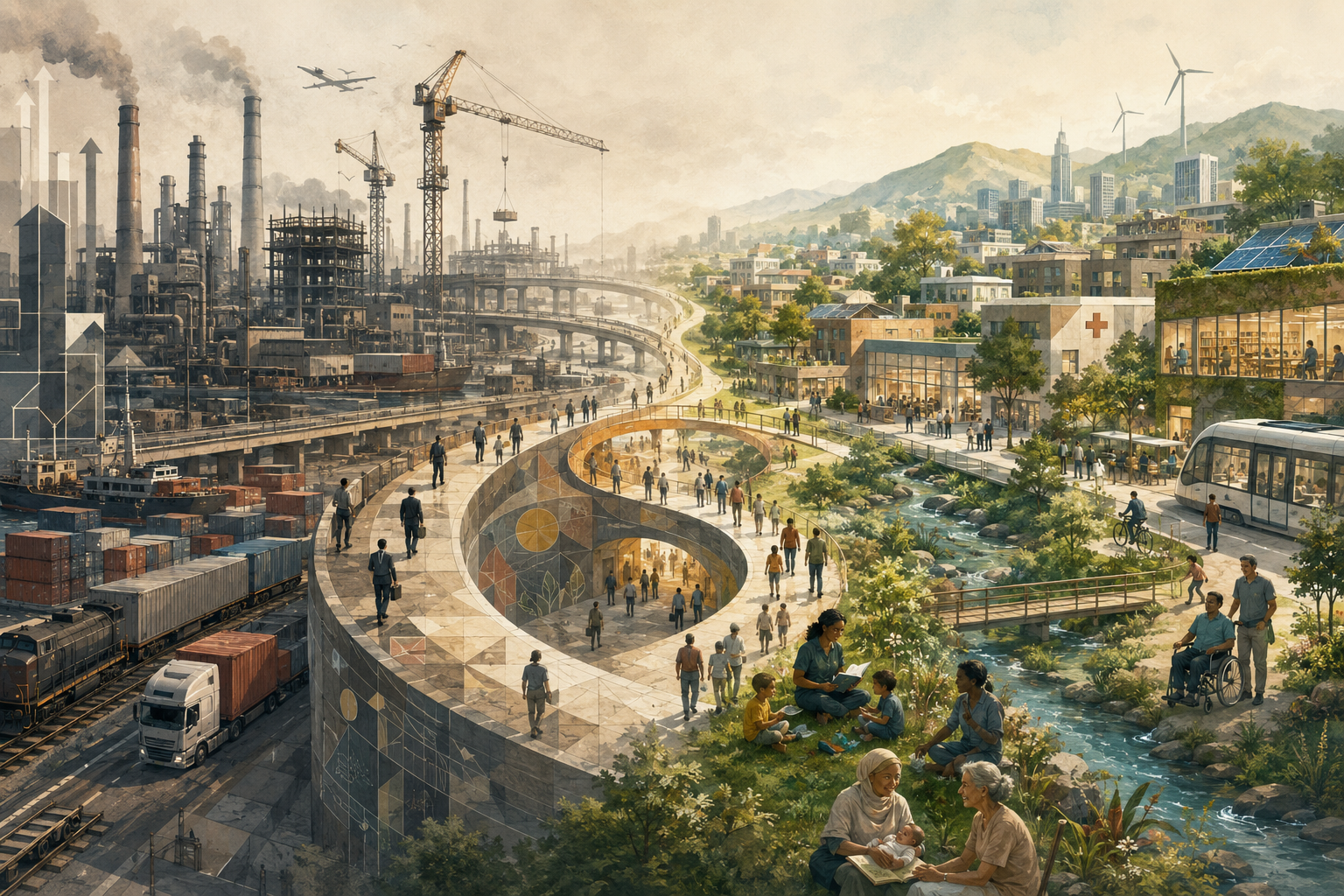
For much of the twentieth century, development was often identified with modernization, industrialization, structural transformation, and rising national income. These were not trivial achievements. Economic growth increased productive capacity, expanded state revenue, financed infrastructure, and made many forms of poverty reduction materially possible. In societies marked by deprivation, low productivity, and institutional weakness, growth answered a real and urgent developmental problem. Yet over time it became increasingly clear that aggregate growth could coexist with deep inequality, weak public institutions, educational exclusion, poor health outcomes, environmental degradation, and forms of political fragility that output statistics alone could not capture.
The human development tradition emerged as a response to that deficiency. Instead of treating development as the accumulation of output alone, it treated development as the expansion of people’s capabilities, choices, and freedoms. This conceptual shift has profound implications for sustainable development. If development is ultimately about human capability rather than output alone, then sustainability cannot be reduced to preserving the conditions for future growth in the abstract. It must preserve the conditions for future flourishing: health, education, ecological stability, institutional trust, security, and the material foundations of meaningful life.
The Growth Paradigm in Development Thought
Economic growth occupied the center of development thought for understandable reasons. Poor societies faced low productivity, weak industry, inadequate infrastructure, limited public revenue, and widespread material deprivation. Under such conditions, development appeared inseparable from expanding output. Industrialization, productivity growth, structural transformation, and capital accumulation seemed to offer the most plausible route out of mass poverty. Growth was not merely one policy objective among others; it became the dominant proxy for development itself.
This framework carried considerable practical force. Growth can widen fiscal space, support transport and energy systems, finance public-health infrastructure, and create the material basis for schools, hospitals, sanitation networks, and administrative institutions. It can generate employment, raise household incomes, and reduce extreme forms of insecurity. Even today, no serious development agenda can dispense entirely with questions of production, infrastructure, investment, taxation, employment, and productive transformation. Development without material capacity is difficult to imagine where deprivation remains severe.
But the older growth paradigm often slid from material realism into analytical reductionism. Once development is identified too closely with income growth, other dimensions of life are treated as derivative or automatic. Health, education, agency, dignity, ecological stability, and institutional quality appear as secondary outcomes that will eventually follow if output grows enough. The history of development showed that this assumption was too simple. Growth can enable development, but it does not define it and does not guarantee it.
This is why the transition to human development was so consequential. It broke the inherited equivalence between economic expansion and social progress, and it opened conceptual space for a richer account of what development is ultimately for. That shift also sits in clear continuity with broader debates across the series on The Brundtland Definition and Its Legacy and How Sustainable Development Is Measured, both of which ask what standards should govern developmental judgment.
Why Growth Dominated for So Long
Growth dominated development thought not only because it addressed real scarcity, but because it was administratively legible. National income could be measured, compared, forecast, and used to guide state planning. Governments, international institutions, and economists could build policy around growth targets more easily than around harder-to-measure concepts such as capability, dignity, agency, or substantive freedom. In that sense, growth had both analytical and bureaucratic appeal: it reduced a complex social question to a tractable macroeconomic indicator.
Growth also fit the political imagination of the postwar era. Development was often understood as catching up with the industrialized world through modernization, urbanization, technological adoption, and rising production. Output growth symbolized not only material advance but entry into a particular image of modernity. It promised factories, roads, electricity, schools, hospitals, administrative capacity, and geopolitical standing. This made it especially powerful as a development narrative, even when the lived distribution of its benefits remained uneven.
Yet these strengths were also sources of blindness. What could be measured most easily came to stand in for what mattered most. Development discourse became vulnerable to the assumption that a richer national economy necessarily reflected broader human advancement. The conceptual importance of human development lies in breaking that equivalence.
The deeper issue here is epistemic as much as economic. Once GDP or national income becomes the privileged summary measure of progress, the institutional gaze narrows. Health outcomes, educational attainment, public capability, gendered access to opportunity, disability access, regional exclusion, civic voice, ecological security, and long-run resilience can recede into the background. Human development matters because it re-expands the informational base of judgment. It asks not simply whether economies are growing, but whether the social world produced by that growth is enlarging the space of human life.
This shift did not make growth irrelevant. It made growth answerable to a larger question. Growth became one input into development rather than the master concept through which all other dimensions were interpreted. That change remains one of the defining achievements of the human development tradition.
Why Growth Alone Became Inadequate
The inadequacy of growth as a stand-alone development metric became visible in several ways. First, growth says little about distribution. Rising average income can coexist with severe inequality, entrenched exclusion, or regional disparity. Second, it says little about public goods and institutional quality. An economy may expand while underinvesting in health systems, education, sanitation, housing, energy access, or administrative capacity. Third, it says little about the actual lives people are able to lead. Income is instrumentally important, but it is not equivalent to agency, security, voice, dignity, or capability.
Growth metrics also struggle to register slow-moving fragility. An economy can expand while degrading ecosystems, exhausting aquifers, locking in polluting infrastructure, or increasing vulnerability to climate disruption. It can also grow through sectors that deliver limited improvements to the majority of the population. In such cases, growth becomes a partial and sometimes misleading account of development, capturing motion without adequately capturing direction or quality.
The problem is not that GDP is useless. GDP can be useful for measuring economic production, comparing output, and understanding broad changes in material capacity. The problem begins when a production measure becomes a civilizational scorecard. Output does not tell us whether children learn, whether people live longer, whether workers are secure, whether women have equal opportunity, whether public institutions are trusted, whether ecosystems remain viable, or whether communities have real voice in decisions affecting their futures.
This critique did not arise because growth ceased to matter. It arose because growth proved to be an insufficient proxy for the actual substance of human progress. Development theory therefore required a broader evaluative language—one capable of asking what economic change was for, rather than assuming that output itself settled the question.
That inadequacy becomes even clearer once development is placed in a sustainability frame. Growth may coexist with boundary stress, ecological overshoot, or mounting systemic fragility. A society can become richer while becoming more exposed to future disruption. This is why the critique of growth reductionism naturally connects to related articles on Boundary Transgression and Development Fragility, Freshwater Change and Development Risk, and Risk, Shock, and Fragility in Development Systems.
The Human Development Turn
The human development approach marked a decisive break by placing people, rather than production, at the center of development analysis. Development came to be understood as the enlargement of human choices and opportunities, not merely the enlargement of the economy. This shifted attention from national output to the conditions under which individuals can live long, knowledgeable, healthy, secure, and meaningful lives.
This was not simply a humane supplement to economics. It was a conceptual reorientation. It implied that the economy should be judged in part by what it enables people to do and to be. A development model that raises GDP while leaving large populations uneducated, unhealthy, politically marginalized, unsafe, or socially insecure cannot be treated as fully developmental within this framework. Human development therefore did not reject economics; it subordinated economic performance to a broader account of human ends.
In this respect, the human development turn changed both the moral and analytical structure of development thought. Morally, it treated persons rather than output as the reference point of progress. Analytically, it broadened the informational base of evaluation by insisting that welfare is multidimensional. The real question was no longer whether an economy had grown, but whether people had become more capable and more free.
The shift also democratized the meaning of development in a deeper intellectual sense. Development was no longer something that could be inferred from national accounts alone. It had to be assessed through health, education, agency, distribution, public goods, social recognition, and institutional access. This made room for experiences that aggregate growth often concealed: the lives of women, rural populations, informal workers, disabled people, racialized communities, Indigenous peoples, low-income households, and regions left behind by national averages.
This was one of the most important maturations in development thought because it restored means-end clarity. Economies matter because they support human life; human life does not matter because it enlarges economies. That reversal may sound obvious, but it corrected decades of conceptual slippage. It also gave sustainable development a more precise moral object: not abstract growth, but the durable expansion of human possibility across time.
Capability, Freedom, and Lived Welfare
At the heart of the human development approach is the recognition that welfare cannot be reduced to income alone. Two people with similar incomes may possess radically different real opportunities depending on health, education, gender, disability, geography, institutional access, social position, environmental exposure, or political freedom. What matters, therefore, is not simply the resources people command, but the substantive freedoms they are able to exercise.
This is why capability and freedom became central concepts. Development, in this view, concerns whether people can live long and healthy lives, acquire knowledge, participate in social and political life, enjoy security and dignity, and convert available resources into meaningful forms of living. Income matters because it can support these outcomes, but it does not exhaust them. A richer society in aggregate may still fail to enlarge real human freedom if its institutions are exclusionary, its public goods are weak, or its social structures prevent people from converting resources into genuine opportunity.
The human development framework therefore expands the evaluative lens from wealth to possibility. It asks not only what people have, but what they can actually do with what they have. This is one reason the approach remains more powerful than purely welfarist or purely income-based accounts. It captures the fact that development is ultimately about the conditions of life, not merely the volume of production.
Capability language also sharpens the relationship between development and justice. It forces attention onto conversion conditions: the institutional, social, ecological, bodily, and political factors that shape whether nominal resources become real opportunities. A wheelchair user, a rural girl without safe transport to school, a worker exposed to toxic air, or a family without secure land tenure may all face capability constraints that are not visible through income alone. In this sense, human development is not just a broader welfare metric. It is a more demanding social ontology of development, because it asks how human beings are situated within systems of provision, power, risk, and possibility.
Freedom in this framework is not a thin abstraction. It includes the real ability to live well: to avoid preventable illness, to learn, to work with dignity, to participate, to be protected by law, to move safely, to care and be cared for, and to imagine a future not foreclosed by deprivation or exclusion. Human development therefore gives sustainable development a deeply human center.
The Human Development Index and the Politics of Measurement
One of the most influential institutional expressions of the human development approach is the Human Development Index. By combining indicators of health, education, and income, the HDI challenged the monopoly of GDP as the summary representation of development. Its significance was not only statistical but political. It signaled that development should be judged through a multidimensional lens and that governments could no longer assume that growth performance alone settled the question of national progress.
The deeper importance of the HDI lies in its refusal of informational narrowness. Once health and education are treated as co-equal dimensions of development, the meaning of progress changes. Economic growth remains present, but it is placed inside a wider evaluative frame. A country can no longer be understood solely through per capita output; it must also be judged by whether its wealth is translated into longer lives, broader knowledge, and more meaningful opportunities.
At the same time, the HDI reminds us that measurement is never neutral. Every index simplifies. Capability, dignity, agency, social freedom, democratic participation, care work, ecological security, and lived experience cannot be exhausted by summary indicators. The point of human development measurement is therefore not to claim that complex lives can be perfectly quantified, but to challenge the far more misleading simplification in which GDP alone stands in for development. The HDI is best understood as an intervention in public reasoning rather than a final description of human welfare.
This is why human development measurement belongs alongside broader debates about indicators, proxy metrics, and the politics of evaluative frameworks. The question is never only what is measured, but what becomes visible or invisible when particular measures dominate. That issue resonates strongly with the wider treatment of SDG Indicators: Strengths, Gaps, and Political Uses, where the problem is not whether indicators matter, but how they structure public reasoning and institutional attention.
The HDI’s lasting importance is that it changed the conversation. It made it harder to treat national income as the only language of progress. It helped create a public vocabulary in which health and education could be understood not as secondary benefits of growth, but as core dimensions of development itself.
Why Growth Still Matters
The shift to human development does not eliminate the importance of growth. This is a crucial point. Human development is not a rejection of material production, nor does it imply that societies can secure capability expansion without resources, institutions, and productive transformation. Schools, clinics, housing systems, transport infrastructure, digital access, sanitation networks, energy systems, and competent public administration all require material capacity and fiscal means.
Where poverty remains widespread, growth continues to matter because deprivation is not solved by normative insight alone. Productive employment, energy access, agricultural improvement, industrial capacity, public investment, and technological capability remain indispensable to the developmental task. This is one reason poverty eradication continues to hold a central place in the 2030 Agenda. The material basis of welfare cannot be ignored simply because growth is an incomplete measure of progress.
The real shift, then, is not from growth to no growth. It is from growth as the definition of development to growth as one necessary but incomplete condition of development. Human development disciplines growth by asking what kind of lives growth is enabling, how its gains are distributed, whether it strengthens public goods, and whether it is producing durable improvements in human possibility.
This distinction is analytically vital. Once growth is treated as a means rather than an end, developmental evaluation becomes more demanding. It must ask not only whether output expands, but what institutional arrangements shape distribution, what public capabilities are created, whose lives improve, whose burdens increase, and whether economic transformation is ecologically durable. Human development therefore preserves the material realism of development economics while refusing its more reductionist forms.
Growth still matters, but it must be interpreted. A society needs to ask whether growth is employment-rich or exclusionary, whether it expands public revenue or concentrates wealth, whether it supports care infrastructure or intensifies precarity, whether it improves resilience or locks in ecological risk. Human development does not discard growth; it asks growth to justify itself in human terms.
Human Development and Sustainable Development
The relationship between human development and sustainable development is intimate but not identical. Human development clarifies what development is for: the expansion of people’s capabilities, choices, and freedoms. Sustainable development introduces a second question: under what ecological, institutional, and temporal conditions can those gains endure? Once these two frameworks are joined, development becomes a question of both welfare and durability.
This matters because capability expansion can occur on unsustainable terms. A society may improve income and educational access in the short run while degrading water systems, intensifying climate exposure, or locking itself into brittle infrastructures that undermine long-run security. In such cases, development in the human sense is occurring on an ecologically unstable basis. Conversely, an environmental agenda that ignores deprivation, exclusion, and unequal access to opportunity also fails the human-development test. Sustainable development is therefore not a substitute for human development. It places human development inside a horizon of intergenerational and Earth-system responsibility.
This is why the transition from economic growth to human development is foundational for the sustainable development field. It prevents sustainability from being interpreted merely as preserving resources for future output. It clarifies that what must be sustained is the possibility of meaningful human flourishing itself: health, knowledge, agency, institutional trust, material security, ecological stability, and the social conditions that support them.
From this perspective, sustainable development can be read as a historical synthesis. The Brundtland tradition introduces the temporal and intergenerational question. The human development tradition clarifies the substantive human ends at stake. More recent work on resilience, fragility, planetary boundaries, and uncertainty adds a systems lens to the problem of durability. Together these traditions create a much richer field of judgment than growth alone ever allowed, connecting directly to related articles on Resilience Thinking and Sustainable Development, Development Under Deep Uncertainty, and Scenario Planning for Sustainable Futures.
The joined framework is demanding because it does not allow easy escape. It refuses a growth model that ignores distribution and ecological limits. It also refuses a sustainability model that ignores poverty, dignity, and capability. It asks societies to expand human possibility while protecting the conditions that make such possibility durable.
Institutions, Public Goods, and Conversion Conditions
Human development depends on institutions because resources do not automatically become capabilities. Income can support welfare, but only if people can convert resources into real opportunities. That conversion depends on public goods, social norms, infrastructure, legal protections, administrative capacity, safety, health systems, education systems, and ecological conditions. A household may have income, but without clean water, safe transport, schools, clinics, secure housing, and public safety, its real capabilities remain constrained.
This is why institutions are central to the human development approach. Public systems help translate economic resources into life chances. Schools convert public finance into learning. Health systems convert knowledge and resources into survival and wellbeing. Legal systems convert formal rights into enforceable protection. Transport systems convert geography into access. Digital infrastructure can convert information into opportunity, but only if access is inclusive and governed responsibly.
Conversion conditions also reveal why inequality is multidimensional. People do not begin from the same social position. Gender, disability, race, class, caste, ethnicity, age, rural location, migration status, and legal recognition all affect whether resources become real freedom. A development model that ignores these conversion conditions may appear successful in aggregate while leaving many people structurally unable to benefit.
Public goods are therefore not merely services. They are capability infrastructures. They are the systems through which societies make freedom more than a formal promise. This is why human development has such strong implications for governance, public finance, and institutional design. The question is not only whether economies grow, but whether public institutions can convert material capacity into broadly shared human possibility.
Human Development in the Anthropocene
The human development tradition has become even more important in the Anthropocene because ecological disruption now threatens the foundations of human capability. Climate instability, biodiversity loss, water stress, pollution, land degradation, and extreme heat do not merely affect “the environment” as a separate domain. They shape health, housing, food security, labor productivity, migration, public finance, conflict risk, education access, and the long-run viability of communities.
This means human development cannot be evaluated only through present indicators. A country may improve health, education, and income while simultaneously increasing exposure to ecological breakdown. A development path may appear successful in the near term while eroding the conditions that allow future people to live healthy, knowledgeable, secure, and meaningful lives. Human development therefore needs a sustainability lens, and sustainable development needs a human-development lens.
The 2020 Human Development Report’s focus on the Anthropocene made this relationship especially clear: human development must be pursued with attention to planetary pressures, not only national welfare indicators. The point is not to weaken the human-development framework but to deepen it. If development is about expanding people’s freedoms, then ecological conditions must be treated as part of the freedom structure. A child’s future capability depends not only on schools and clinics, but also on climate stability, safe water, food systems, disease ecology, livable cities, and resilient institutions.
This ecological reframing also reinforces justice. Communities with the least historic responsibility for planetary pressure are often the most vulnerable to its consequences. Human development in the Anthropocene therefore requires more than adaptation metrics. It requires attention to unequal exposure, historical responsibility, climate finance, technology access, public participation, and the right of poorer societies to develop without being trapped by ecological crises they did not primarily create.
Tensions, Critiques, and Open Questions
For all its strengths, the human development framework does not dissolve every difficulty. One question concerns measurement. Capability is richer than any index can fully capture, and freedom resists simple quantification. Another concerns politics. Capability expansion depends on public institutions, legal systems, and distributive arrangements that are often contested, uneven, and historically fragile. Human development can specify ends more clearly than it can guarantee the institutions that realize them.
There is also a structural tension between capability expansion and ecological constraint. Historically, many advances in income, infrastructure, and life expectancy have been associated with energy-intensive and resource-intensive growth. Sustainable development therefore cannot simply celebrate capability expansion without asking how it is being materially financed. The challenge is to secure welfare gains without reproducing the unsustainable pathways on which earlier forms of development often depended.
A further critique concerns individualism. Some versions of capability language can appear focused on individuals while underemphasizing collective institutions, social movements, public goods, and ecological systems. Yet capability is never only individual in practice. People’s freedoms are formed through social arrangements: families, schools, clinics, law, infrastructure, political rights, ecosystems, and economic systems. A serious human-development approach must therefore remain attentive to social and institutional capability, not only individual outcomes.
These tensions do not weaken the human development approach so much as locate its limits and its necessity. Human development remains indispensable because it tells us what development is for. But it becomes fully adequate only when joined to a serious account of institutions, ecology, power, and long-run viability.
That is precisely why human development remains a live framework rather than a settled doctrine. It opens rather than closes the field of developmental judgment. It demands that economists, policymakers, institutions, and publics think simultaneously about distribution, public goods, human flourishing, and ecological durability. Its enduring power lies in that refusal of simplification.
Mathematical Lens
The move from growth to human development can be expressed as a shift from evaluating aggregate output alone to evaluating multidimensional capability expansion. Let \(D\) denote development quality, \(Y\) aggregate output or income, \(H\) health capability, \(E\) educational capability, \(F\) substantive freedom, and \(S\) long-run sustainability conditions. A simple conceptual form is:
D = \alpha Y + \beta H + \gamma E + \delta F + \epsilon S
\]
Interpretation: Development quality includes income or output, but also depends on health, education, substantive freedom, and sustainability conditions.
The key point is not that income disappears, but that it becomes one dimension within a wider evaluative framework rather than the sole summary of progress.
We can also express human development deficiency under growth reductionism as:
R_h = \lambda G – \mu C
\]
Interpretation: Human-development risk rises when narrow growth emphasis exceeds realized capability expansion.
Here, \(G\) is narrow growth emphasis and \(C\) is realized capability expansion. Higher \(R_h\) means a society is treating economic expansion as developmental success without adequately translating it into human possibility.
Finally, durable human flourishing can be represented as:
V = \theta M + \kappa P + \rho T
\]
Interpretation: Durable flourishing depends on material provision, public capability formation, and temporal durability across ecological and institutional conditions.
In this formulation, \(M\) is material provision, \(P\) is public capability formation, and \(T\) is temporal durability. This helps show why human development and sustainable development belong together.
| Term | Meaning | Interpretive role |
|---|---|---|
| \(D\) | Development quality | Represents development evaluated through multiple dimensions rather than output alone. |
| \(Y\) | Output or income | Represents material production, income, fiscal capacity, and economic resources. |
| \(H\) | Health capability | Represents the ability to live long, healthy, secure lives. |
| \(E\) | Educational capability | Represents knowledge, learning, literacy, skill formation, and interpretive capacity. |
| \(F\) | Substantive freedom | Represents agency, participation, dignity, and real opportunity. |
| \(S\) | Sustainability conditions | Represents ecological and institutional conditions needed for development gains to endure. |
| \(R_h\) | Human-development risk | Represents the danger that output growth is not translated into meaningful capability expansion. |
| \(V\) | Durable human flourishing | Represents the joined goal of human development and sustainable development. |
The equations are conceptual rather than predictive. Their value is to make the shift explicit: growth remains important, but it must be evaluated by its translation into health, education, agency, public goods, ecological durability, and human freedom.
Advanced Python Workflow: Human Development Translation Risk Scoring
This Python workflow translates the article’s core argument into a structured human-development model. Rather than treating growth as self-sufficient, it scores territories across output expansion, capability translation, public-goods conversion, distributional constraint, ecological durability, and institutional support. That makes it possible to compare not only where economies are growing, but where growth is or is not becoming meaningful human development.
from __future__ import annotations

import pandas as pd
import numpy as np

INPUT_FILE = "economic_growth_to_human_development_panel.csv"
OUTPUT_FILE = "economic_growth_to_human_development_scores.csv"


def load_data(path: str) -> pd.DataFrame:
    """
    Load a territory-level human development translation dataset.

    All *_index columns should be normalized to [0, 1].
    Higher values should mean more of the named property.

    Examples:
      - output_growth_index: higher = stronger output growth
      - health_capability_index: higher = stronger health capability
      - distribution_constraint_index: higher = stronger distributional constraint
      - ecological_durability_index: higher = stronger ecological durability
    """
    df = pd.read_csv(path)

    required_columns = [
        "territory_name",
        "country_or_region",
        "territory_type",
        "output_growth_index",
        "health_capability_index",
        "education_capability_index",
        "income_conversion_index",
        "public_goods_conversion_index",
        "distribution_constraint_index",
        "institutional_support_index",
        "ecological_durability_index",
        "agency_freedom_index",
        "human_development_alignment_index",
    ]

    missing = [col for col in required_columns if col not in df.columns]

    if missing:
        raise ValueError(f"Missing required columns: {missing}")

    return df


def validate_indices(df: pd.DataFrame) -> pd.DataFrame:
    """Validate that all *_index fields are complete and normalized to [0, 1]."""
    index_columns = [col for col in df.columns if col.endswith("_index")]

    for col in index_columns:
        if df[col].isna().any():
            raise ValueError(f"Column '{col}' contains missing values.")

        if ((df[col] < 0) | (df[col] > 1)).any():
            raise ValueError(f"Column '{col}' contains values outside [0, 1].")

    return df


def compute_scores(df: pd.DataFrame) -> pd.DataFrame:
    """
    Compute translation pressure, capability expansion, and risk scores.

    Translation pressure is high where growth is not being converted
    into public goods, capability, inclusion, ecological durability,
    institutional support, or agency.

    Capability expansion is high where health, education, income conversion,
    public-goods conversion, agency, and alignment are strong.
    """
    df = df.copy()

    df["growth_translation_pressure_score"] = (
        0.16 * df["output_growth_index"] +
        0.14 * (1 - df["income_conversion_index"]) +
        0.14 * (1 - df["public_goods_conversion_index"]) +
        0.14 * df["distribution_constraint_index"] +
        0.12 * (1 - df["institutional_support_index"]) +
        0.12 * (1 - df["ecological_durability_index"]) +
        0.10 * (1 - df["agency_freedom_index"]) +
        0.08 * (1 - df["human_development_alignment_index"])
    ).clip(lower=0, upper=1)

    df["capability_expansion_score"] = (
        0.22 * df["health_capability_index"] +
        0.22 * df["education_capability_index"] +
        0.18 * df["income_conversion_index"] +
        0.16 * df["public_goods_conversion_index"] +
        0.12 * df["agency_freedom_index"] +
        0.10 * df["human_development_alignment_index"]
    ).clip(lower=0, upper=1)

    df["human_development_risk_score"] = (
        0.50 * df["growth_translation_pressure_score"] +
        0.30 * (1 - df["capability_expansion_score"]) +
        0.20 * df["distribution_constraint_index"]
    ).clip(lower=0, upper=1)

    df["risk_band"] = np.select(
        [
            df["human_development_risk_score"] >= 0.80,
            df["human_development_risk_score"] >= 0.60,
            df["human_development_risk_score"] >= 0.40,
        ],
        [
            "Extreme human development risk",
            "High human development risk",
            "Moderate human development risk",
        ],
        default="Lower human development risk",
    )

    return df


def build_summary(df: pd.DataFrame) -> pd.DataFrame:
    """Return a ranked summary table for reporting."""
    columns = [
        "territory_name",
        "country_or_region",
        "territory_type",
        "growth_translation_pressure_score",
        "capability_expansion_score",
        "human_development_risk_score",
        "risk_band",
    ]

    summary = df[columns].copy()

    summary = summary.sort_values(
        by=[
            "human_development_risk_score",
            "growth_translation_pressure_score",
            "capability_expansion_score",
        ],
        ascending=[False, False, True],
    ).reset_index(drop=True)

    return summary


def main() -> None:
    df = load_data(INPUT_FILE)
    df = validate_indices(df)
    scored = compute_scores(df)
    summary = build_summary(scored)

    summary.to_csv(OUTPUT_FILE, index=False)

    print("From economic growth to human development scoring complete.")
    print(summary.to_string(index=False))


if __name__ == "__main__":
    main()
This workflow is intentionally transparent. It does not claim that human development can be reduced to a single objective score. Instead, it makes the translation problem visible: growth must become health, education, agency, public goods, inclusion, institutional support, and ecological durability before it can be treated as development in the deeper human sense.
Advanced R Workflow: Capability Expansion, HDI Translation, and Governance Risk
This R workflow is designed for the part of the article that emphasizes multidimensional translation from output into real human welfare. It compares settings across growth, health, education, public-goods conversion, agency, and ecological durability, then builds grouped summaries that help show where growth is most likely to expand real capability versus where it remains trapped in narrow output gains.
library(readr)
library(dplyr)

input_file <- "economic_growth_to_human_development_country_panel.csv"
region_output_file <- "cross_region_human_development_summary.csv"
territory_output_file <- "cross_territory_human_development_summary.csv"

hd_df <- read_csv(input_file, show_col_types = FALSE)

required_cols <- c(
  "territory_name",
  "country_or_region",
  "territory_type",
  "output_growth_index",
  "health_capability_index",
  "education_capability_index",
  "income_conversion_index",
  "public_goods_conversion_index",
  "distribution_constraint_index",
  "institutional_support_index",
  "ecological_durability_index",
  "agency_freedom_index",
  "human_development_alignment_index"
)

missing_cols <- setdiff(required_cols, names(hd_df))

if (length(missing_cols) > 0) {
  stop(paste("Missing required columns:", paste(missing_cols, collapse = ", ")))
}

index_cols <- names(hd_df)[grepl("_index$", names(hd_df))]

invalid_index_cols <- index_cols[
  vapply(
    hd_df[index_cols],
    function(x) any(is.na(x) | x < 0 | x > 1),
    logical(1)
  )
]

if (length(invalid_index_cols) > 0) {
  stop(
    paste(
      "Index columns must be complete and normalized to [0, 1]:",
      paste(invalid_index_cols, collapse = ", ")
    )
  )
}

hd_df <- hd_df %>%
  mutate(
    human_development_proxy = (
      output_growth_index +
      (1 - income_conversion_index) +
      (1 - public_goods_conversion_index) +
      distribution_constraint_index +
      (1 - institutional_support_index) +
      (1 - ecological_durability_index) +
      (1 - agency_freedom_index) +
      (1 - human_development_alignment_index)
    ) / 8,
    capability_expansion = (
      health_capability_index +
      education_capability_index +
      agency_freedom_index
    ) / 3,
    risk_band = case_when(
      human_development_proxy >= 0.75 ~ "Extreme human development risk",
      human_development_proxy >= 0.55 ~ "High human development risk",
      human_development_proxy >= 0.35 ~ "Moderate human development risk",
      TRUE ~ "Lower human development risk"
    )
  )

region_summary <- hd_df %>%
  group_by(country_or_region) %>%
  summarise(
    avg_human_development_proxy = mean(human_development_proxy, na.rm = TRUE),
    avg_capability_expansion = mean(capability_expansion, na.rm = TRUE),
    avg_output_growth = mean(output_growth_index, na.rm = TRUE),
    avg_income_conversion = mean(income_conversion_index, na.rm = TRUE),
    avg_public_goods_conversion = mean(public_goods_conversion_index, na.rm = TRUE),
    avg_distribution_constraint = mean(distribution_constraint_index, na.rm = TRUE),
    avg_ecological_durability = mean(ecological_durability_index, na.rm = TRUE),
    observations = n(),
    .groups = "drop"
  ) %>%
  mutate(
    regional_risk_band = case_when(
      avg_human_development_proxy >= 0.75 ~ "Extreme human development risk",
      avg_human_development_proxy >= 0.55 ~ "High human development risk",
      avg_human_development_proxy >= 0.35 ~ "Moderate human development risk",
      TRUE ~ "Lower human development risk"
    )
  ) %>%
  arrange(desc(avg_human_development_proxy))

territory_summary <- hd_df %>%
  group_by(territory_type) %>%
  summarise(
    avg_human_development_proxy = mean(human_development_proxy, na.rm = TRUE),
    avg_capability_expansion = mean(capability_expansion, na.rm = TRUE),
    avg_output_growth = mean(output_growth_index, na.rm = TRUE),
    avg_income_conversion = mean(income_conversion_index, na.rm = TRUE),
    avg_public_goods_conversion = mean(public_goods_conversion_index, na.rm = TRUE),
    avg_distribution_constraint = mean(distribution_constraint_index, na.rm = TRUE),
    avg_ecological_durability = mean(ecological_durability_index, na.rm = TRUE),
    observations = n(),
    .groups = "drop"
  ) %>%
  arrange(desc(avg_human_development_proxy))

write_csv(region_summary, region_output_file)
write_csv(territory_summary, territory_output_file)

cat("Cross-region human development summary exported to:", region_output_file, "\n")
print(region_summary)

cat("\nCross-territory human development summary exported to:", territory_output_file, "\n")
print(territory_summary)
This workflow helps distinguish growth from development. It preserves output growth as an important signal, but it asks whether that growth is being translated into capability, public goods, agency, and ecological durability. A territory with growth but weak conversion capacity is not necessarily developing in the human-development sense. It may be expanding output while leaving the deeper conditions of freedom unchanged.
GitHub Repository
Complete Code Repository
The full code distribution for this article, including human-development scoring workflows, capability-translation diagnostics, SQL materials, optional monitoring support tooling, supporting documentation, and repository structure, is available on GitHub.
Related Articles
- What Is Sustainable Development? Meaning, Systems, and Long-Run Viability
- The Brundtland Definition and Its Legacy
- The Four Dimensions of Sustainable Development
- How Sustainable Development Is Measured
- Poverty, Deprivation, and Multidimensional Development
- Human Development Indicators and Their Limits
- Boundary Transgression and Development Fragility
- Resilience Thinking and Sustainable Development
- Development Under Deep Uncertainty
- Scenario Planning for Sustainable Futures
Further Reading
- United Nations Development Programme (1990) Human Development Report 1990: Concept and Measurement of Human Development. New York: UNDP. Available at: https://hdr.undp.org/content/human-development-report-1990
- United Nations Development Programme (2025) Human Development Report 2025: A Matter of Choice: People and Possibilities in the Age of AI. New York: UNDP. Available at: https://hdr.undp.org/content/human-development-report-2025
- United Nations Development Programme (n.d.) Human Development Index. New York: UNDP. Available at: https://hdr.undp.org/data-center/human-development-index
- United Nations Development Programme (n.d.) Human Development Data Center. New York: UNDP. Available at: https://hdr.undp.org/data-center
- United Nations (2015) Transforming our world: the 2030 Agenda for Sustainable Development. New York: United Nations. Available at: https://sdgs.un.org/2030agenda
- Sen, A. (1999) Development as Freedom. Oxford: Oxford University Press. Available at: https://global.oup.com/academic/product/development-as-freedom-9780192893307
- Haq, M. ul (1995) Reflections on Human Development. Oxford: Oxford University Press. Available at: https://global.oup.com/academic/product/reflections-on-human-development-9780198292180
- Nussbaum, M.C. (2011) Creating Capabilities: The Human Development Approach. Cambridge, MA: Harvard University Press. Available at: https://www.hup.harvard.edu/books/9780674072350
- United Nations Development Programme (2020) Human Development Report 2020: The Next Frontier—Human Development and the Anthropocene. New York: UNDP. Available at: https://hdr.undp.org/content/human-development-report-2020
References
- United Nations Development Programme (1990) Human Development Report 1990: Concept and Measurement of Human Development. New York: UNDP. Available at: https://hdr.undp.org/content/human-development-report-1990
- United Nations Development Programme (2025) Human Development Report 2025: A Matter of Choice: People and Possibilities in the Age of AI. New York: UNDP. Available at: https://hdr.undp.org/content/human-development-report-2025
- United Nations Development Programme (n.d.) What is human development? New York: UNDP. Available at: https://hdr.undp.org/about/human-development
- United Nations Development Programme (n.d.) Human Development Index. New York: UNDP. Available at: https://hdr.undp.org/data-center/human-development-index
- United Nations Development Programme (n.d.) Human Development Data Center. New York: UNDP. Available at: https://hdr.undp.org/data-center
- United Nations (2015) Transforming our world: the 2030 Agenda for Sustainable Development. New York: United Nations. Available at: https://sdgs.un.org/2030agenda
- United Nations Department of Economic and Social Affairs (n.d.) Poverty eradication. New York: United Nations. Available at: https://sdgs.un.org/topics/poverty-eradication
- Sen, A. (1999) Development as Freedom. Oxford: Oxford University Press. Available at: https://global.oup.com/academic/product/development-as-freedom-9780192893307
- Haq, M. ul (1995) Reflections on Human Development. Oxford: Oxford University Press. Available at: https://global.oup.com/academic/product/reflections-on-human-development-9780198292180
- Nussbaum, M.C. (2011) Creating Capabilities: The Human Development Approach. Cambridge, MA: Harvard University Press. Available at: https://www.hup.harvard.edu/books/9780674072350
- United Nations Development Programme (2020) Human Development Report 2020: The Next Frontier—Human Development and the Anthropocene. New York: UNDP. Available at: https://hdr.undp.org/content/human-development-report-2020
- Stewart, F. (2013) Capabilities and Human Development: Beyond the Individual—the Critical Role of Social Institutions and Social Competencies. New York: UNDP. Available at: https://hdr.undp.org/content/capabilities-and-human-development-beyond-individual-critical-role-social-institutions-and
- Samman, E. and Stewart, F. (2018) Advancing Human Development: Theory and Practice. New York: Human Development Report Office. Available at: https://hdr.undp.org/content/advancing-human-development-theory-and-practice