Social Psychology

Social psychology examines how individuals think, feel, and behave within social contexts. The discipline investigates how interactions with others—whether direct or indirect—influence attitudes, judgments, and behavior.

Researchers in social psychology study phenomena such as group dynamics, social identity, conformity, persuasion, cooperation, prejudice, and collective decision-making. The field seeks to understand how social norms, cultural expectations, and interpersonal relationships shape individual cognition and behavior.

Social psychological research often relies on controlled experiments and observational studies to examine how people respond to social influence and group pressures. These insights help explain why individuals behave differently in collective environments than they do in isolation.

Social psychology has broad applications across fields including organizational behavior, political science, marketing, conflict resolution, and public policy. Understanding social influence is essential for analyzing institutional trust, collective action, and the coordination challenges that emerge within complex societies.

Restrained institutional research illustration showing collective action as a cycle of issue recognition, social networks, communication, coordination, resources, leadership, identity, strategy, action, institutional response, and social change.

Collective Action: How Groups Mobilize to Produce Social Change

Collective action refers to coordinated efforts by individuals or groups to achieve shared goals, especially when those goals involve changing social conditions, institutions, or systems of power. In social psychology, it is one of the most consequential forms of social behavior because it transforms private grievance into public demand. People may experience inequality, exclusion, or dissatisfaction in isolation, but social change rarely emerges from isolated discontent alone. It becomes possible when individuals recognize shared interests, develop collective identities, perceive injustice as morally significant, and mobilize together in ways that make coordinated action feel both necessary and effective. This is what gives collective action its distinctive importance: it links individual psychology to structural transformation. It shows how anger, identity, efficacy, networks, and norms can be organized into public force, and how groups acting together can pressure institutions, challenge entrenched arrangements of power, and reshape the very systems that structure their lives.

Restrained institutional research illustration showing the contact hypothesis as structured intergroup contact, with communication, cooperation, equal status, common goals, empathy, reduced anxiety, stereotype revision, trust building, and improved intergroup attitudes.

Contact Hypothesis: How Intergroup Contact Reduces Prejudice

The contact hypothesis proposes that, under specific social conditions, direct interaction between members of different groups can reduce prejudice, weaken stereotypes, and improve intergroup relations. Its importance lies in its challenge to a pessimistic view of group conflict. If prejudice were simply the product of fixed hostility, intergroup relations would appear resistant to change. Contact theory instead argues that bias is often sustained by distance, ignorance, anxiety, segregation, and distorted expectations, and that under the right institutional and relational conditions, interaction can interrupt those dynamics. This makes the contact hypothesis one of the most important frameworks in social psychology because it explains how social experience itself, not just abstract belief change, can soften group boundaries. It also carries a deeper institutional lesson: not all contact is beneficial, and exposure alone is not enough. Contact works best when it occurs under conditions of equal status, common goals, cooperation, and institutional support. For that reason, the theory is not simply about tolerance. It is a framework for understanding how social environments can be structured so that trust becomes more likely, anxiety declines, and people encounter one another as collaborators rather than abstractions.

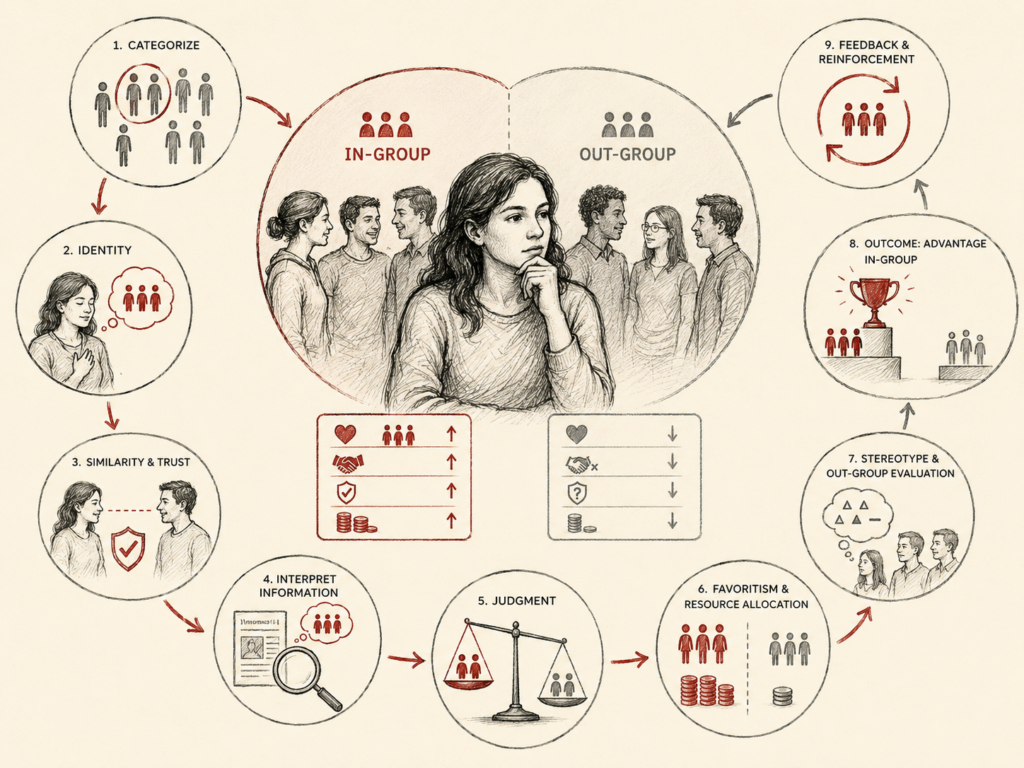
Restrained institutional research illustration showing in-group bias as a social-cognitive process involving categorization, identity, similarity, trust, information interpretation, judgment, favoritism, resource allocation, stereotype formation, outcomes, and reinforcement.

In-Group Bias: Why People Favor Their Own Groups

In-group bias refers to the tendency for individuals to evaluate, trust, and favor members of their own group more positively than members of other groups. Within social psychology, it is one of the foundational mechanisms through which identity becomes socially consequential. Its importance lies in its ordinariness. It does not require hatred, explicit prejudice, or ideological extremism to operate. People may display preferential treatment toward their own group even in the absence of overt hostility toward outsiders, which is precisely why the concept is so powerful. It helps explain how seemingly minor preferences can accumulate into durable patterns of exclusion, favoritism, and asymmetrical opportunity. In-group bias therefore reveals that social inequality does not always begin with explicit animus. Often it begins with quieter forms of loyalty, trust asymmetry, selective generosity, and the presumption that “our people” are more familiar, more deserving, or more trustworthy. For that reason, the concept is essential for understanding intergroup relations, political polarization, organizational inequality, and the everyday psychology through which social boundaries become moral boundaries.

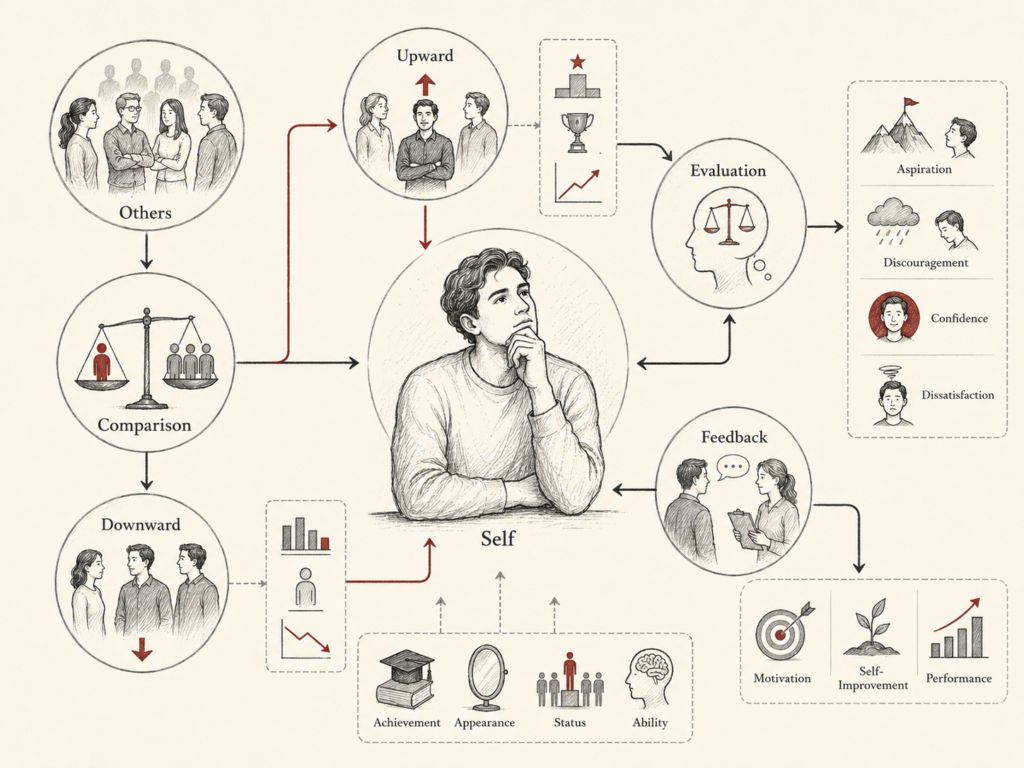
Restrained institutional research illustration showing social comparison theory as a process of self-evaluation through others, upward and downward comparison, feedback, achievement, appearance, status, ability, motivation, self-improvement, and performance.

Social Comparison Theory: How Individuals Evaluate Themselves Through Others

Social comparison theory describes the process through which individuals evaluate their abilities, opinions, and social standing by comparing themselves to other people. First articulated by Leon Festinger, the theory begins from a simple but powerful premise: many of the qualities that matter most in human life do not come with clear objective measures. People often cannot determine in absolute terms whether they are successful, competent, attractive, moral, or respected, so they turn instead to relevant others as social reference points. Through these comparisons, individuals construct implicit benchmarks for achievement, status, belonging, and self-worth. This makes self-evaluation inherently relational rather than isolated. Social comparison is therefore central not only to identity formation and motivation, but also to self-esteem, emotional experience, organizational life, digital media behavior, and institutional competition. By showing that people understand themselves through comparison with others, the theory provides one of the clearest accounts of how self-knowledge, aspiration, hierarchy, and social order become psychologically linked.

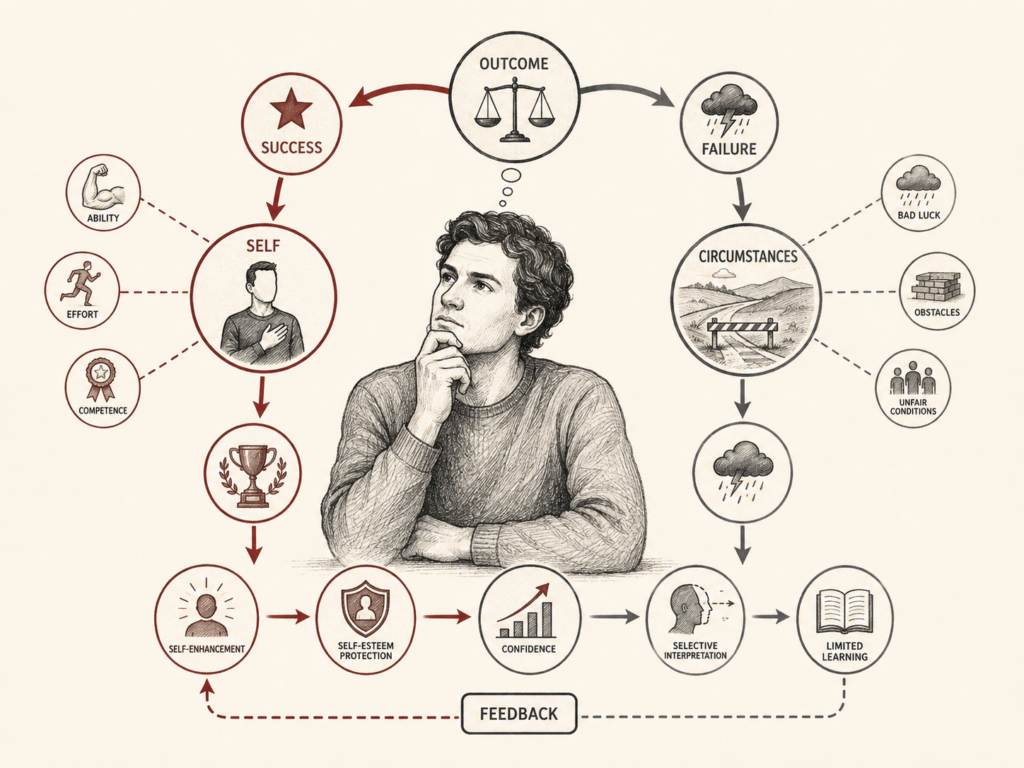
Restrained institutional research illustration showing self-serving bias as a social-cognitive process in which success is attributed to the self, ability, effort, and competence, while failure is attributed to circumstances, bad luck, obstacles, and unfair conditions.

Self-Serving Bias: Why People Take Credit for Success and Blame Circumstances for Failure

The self-serving bias refers to the tendency for individuals to attribute positive outcomes to their own abilities, effort, or character while attributing negative outcomes to external circumstances. Within social psychology, it remains one of the clearest demonstrations that attribution is not a neutral process of causal analysis, but one often shaped by the need to preserve a valued self-concept. When success occurs, people are inclined to read it as evidence of competence, merit, or virtue; when failure occurs, they are more likely to explain it through bad luck, unfair conditions, or forces outside their control. This pattern helps protect dignity, coherence, and self-esteem, but it also distorts responsibility, limits learning from failure, and complicates accountability in relationships, organizations, and public life. For that reason, the self-serving bias is important not only as a bias in judgment, but as a window into the deeper interaction among social cognition, motivation, moral evaluation, and the psychological need to sustain a workable image of the self.

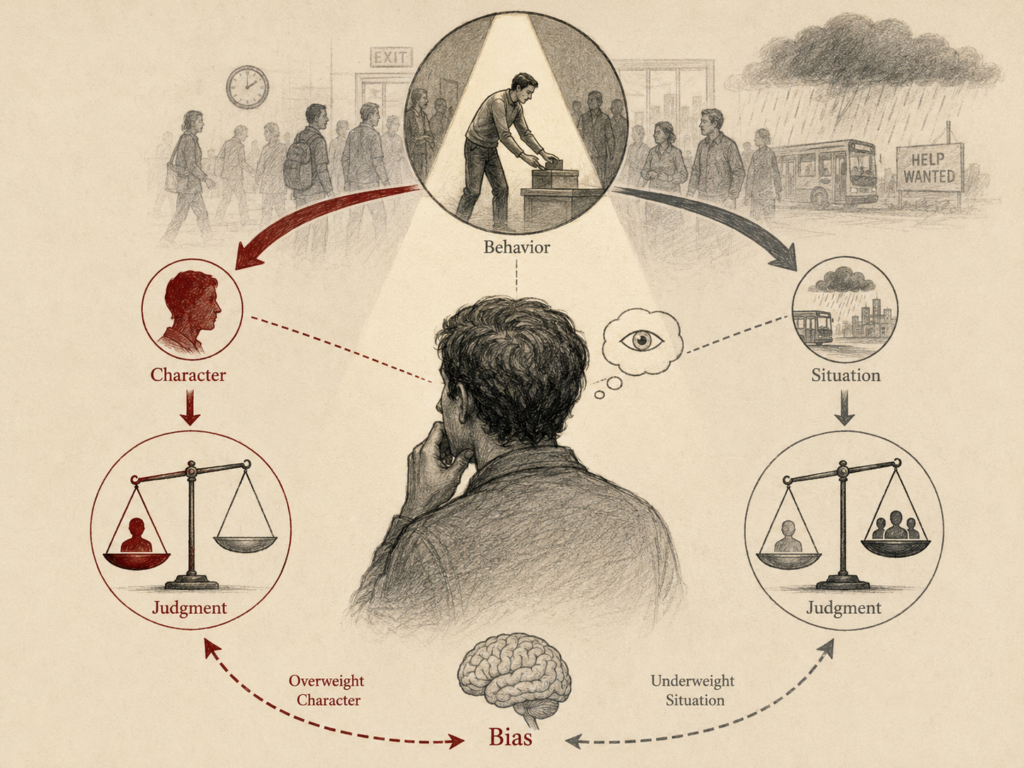
Restrained institutional research illustration showing fundamental attribution error as a social-cognitive bias in which observed behavior is judged mainly through character while situational forces are underweighted.

Fundamental Attribution Error: Why We Overestimate Character and Underestimate Situations

The fundamental attribution error refers to a systematic bias in social perception whereby observers explain others’ behavior primarily in terms of internal traits while underestimating the force of situational conditions. It remains one of the most important findings in social psychology because it shows how easily people treat action as a transparent expression of character, even when behavior is strongly shaped by institutional rules, contextual pressure, environmental constraint, or social expectation. Human observers rarely have direct access to the full structure surrounding another person’s conduct, so they often default to explanations based on personality, intention, or moral disposition. This makes social judgment faster and more coherent, but it also creates a powerful tendency to misread structurally constrained behavior as evidence of who a person “really is.” For that reason, the fundamental attribution error has consequences far beyond laboratory research. It shapes how people assign blame, judge fairness, evaluate leadership, interpret political behavior, and respond to conflict, making it essential for understanding why social explanations so often diverge from the deeper realities that produce human action.

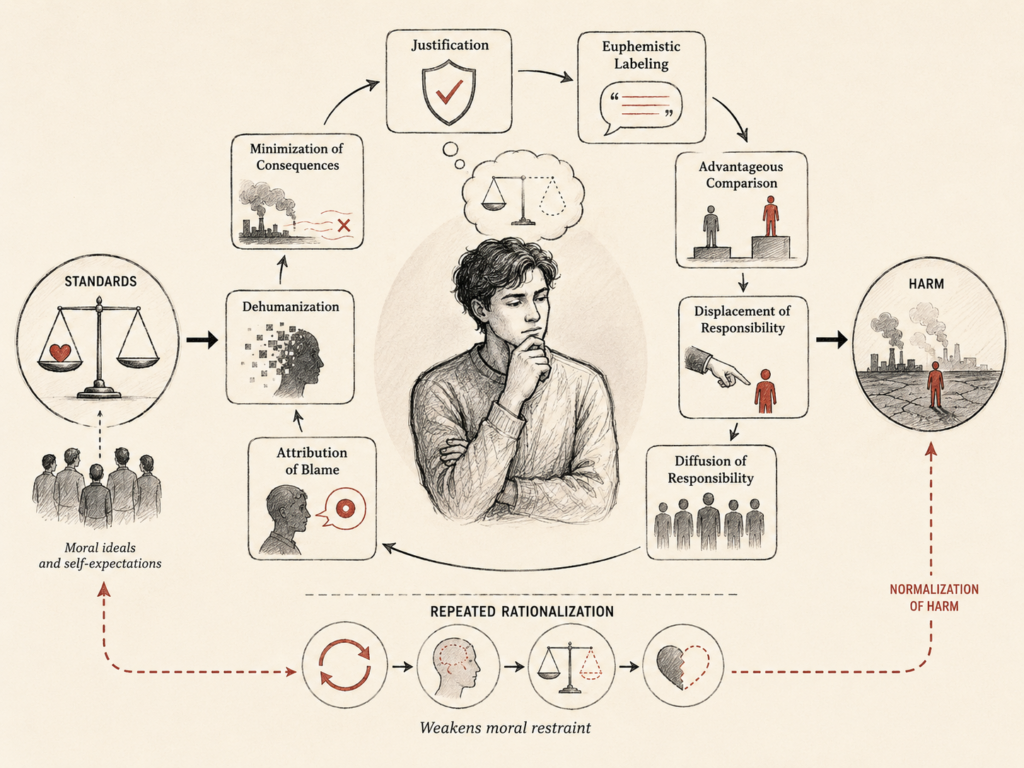
Restrained institutional research illustration showing moral disengagement as a cycle of rationalization, including justification, euphemistic labeling, advantageous comparison, displacement and diffusion of responsibility, blaming, dehumanization, minimization of consequences, and normalization of harm.

Moral Disengagement: How Individuals Rationalize Harmful Behavior

Moral disengagement refers to the psychological processes through which individuals justify harmful behavior while preserving a sense of moral self-worth. Its importance lies in the fact that it explains not moral absence, but moral rationalization. People do not necessarily abandon ethical standards when they participate in harmful systems. More often, they cognitively restructure their actions so those actions appear acceptable, necessary, professionally ordinary, or morally excusable. This makes moral disengagement one of the most important concepts in social psychology for understanding how ordinary individuals can take part in organizational misconduct, collective violence, institutional corruption, or environmental harm while continuing to view themselves as decent people. The theory’s enduring power comes from showing how harmful conduct becomes psychologically tolerable through mechanisms such as moral justification, euphemistic labeling, displacement of responsibility, diffusion of responsibility, dehumanization, and distortion of consequences.

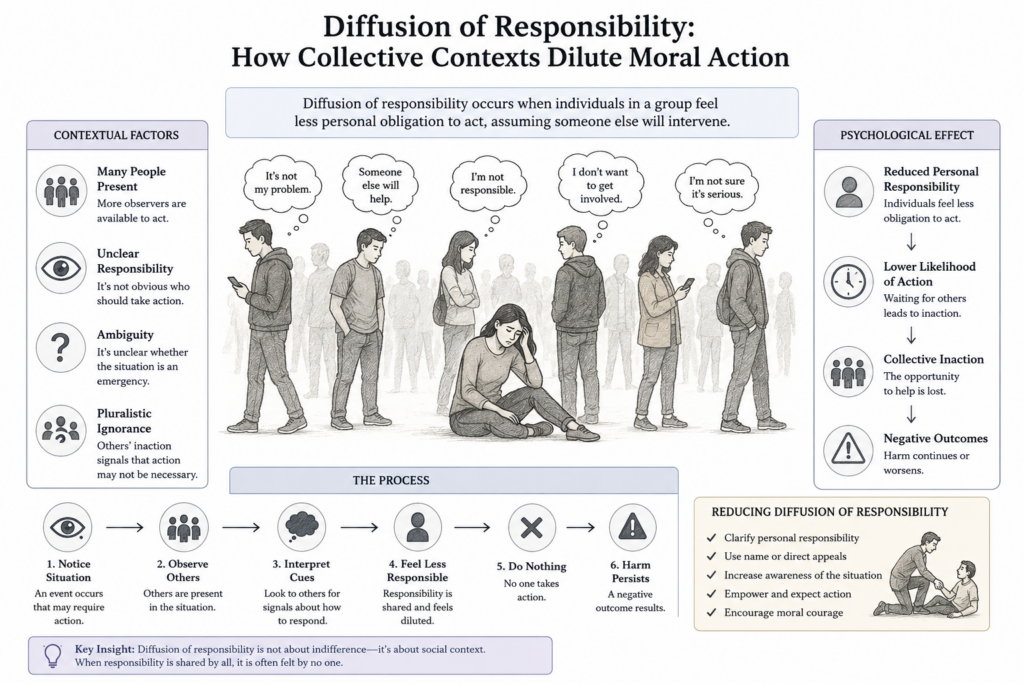
Institutional research infographic showing diffusion of responsibility as a social-psychological process in which group presence, unclear responsibility, ambiguity, and pluralistic ignorance reduce personal action and allow harm to persist.

Diffusion of Responsibility: How Collective Contexts Dilute Moral Action

Diffusion of responsibility refers to a psychological phenomenon in which individuals are less likely to take action or assume responsibility when other people are present. Its importance lies in the paradox it reveals: situations that appear to demand collective intervention may produce passivity precisely because responsibility seems shared rather than personal. As the number of observers increases, the perceived obligation of any single individual decreases, and each person may assume that someone else will act. This makes diffusion of responsibility one of the most important concepts in social psychology for understanding why moral awareness alone is often insufficient to produce action. It helps explain not only emergency nonresponse, but also failures in organizations, bureaucracies, and institutions where accountability becomes fragmented across many actors. For that reason, the concept is analytically powerful far beyond the classic bystander setting. It shows how social presence can weaken initiative, how group size can dilute moral agency, and why effective ethical systems require structures that make responsibility specific, visible, and actionable.

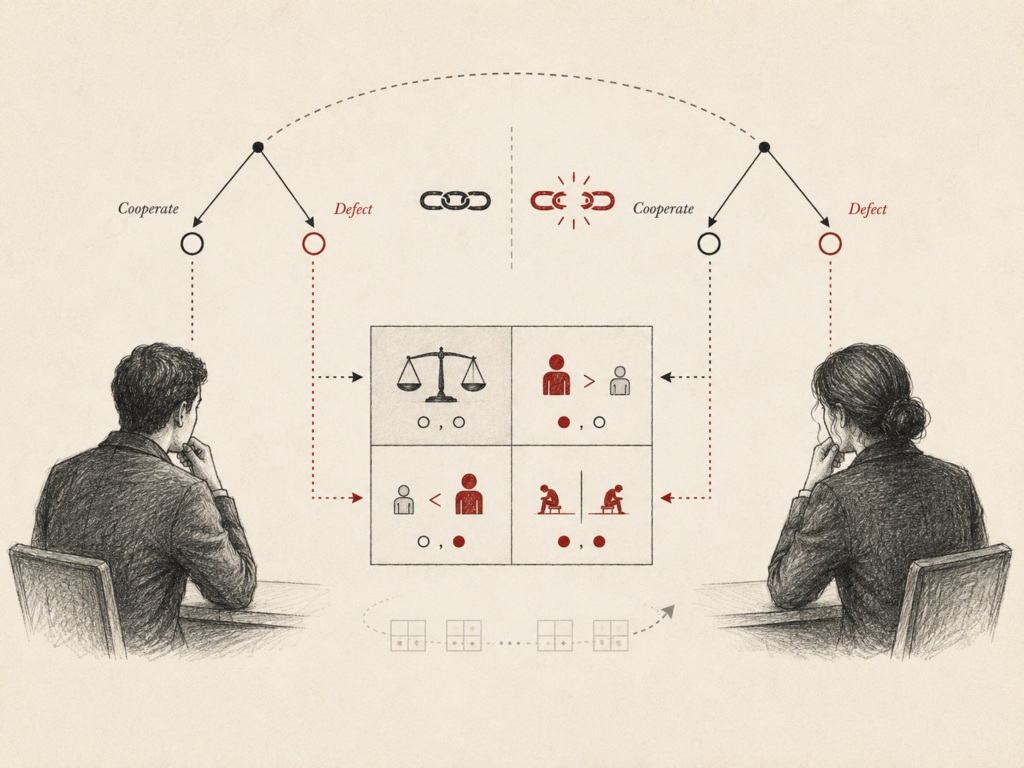
Minimal institutional research illustration showing two separated decision-makers facing simultaneous choices to cooperate or defect, with a central outcome matrix, trust and broken-trust symbols, and arrows showing strategic interdependence.

The Prisoner’s Dilemma: Cooperation, Trust, and Strategic Decision-Making

The prisoner’s dilemma is one of the most influential models in modern social science because it captures a fundamental tension between individual rationality and collective welfare. Developed within game theory, it shows how rational actors pursuing their own interests may fail to cooperate even when cooperation would produce better outcomes for everyone involved. This is what makes the model so important for social psychology: it reveals that cooperation is not simply a matter of goodwill or moral preference, but a strategic problem shaped by trust, risk, expectations, and institutional design. Each actor has an incentive to defect in order to avoid exploitation or secure a higher personal payoff, yet when both actors defect, the result is worse than if both had cooperated. The model therefore clarifies why cooperation is often fragile even when all parties recognize its value. It also helps explain why social systems depend so heavily on norms, repeated relationships, monitoring, sanctions, and reputation structures capable of stabilizing trust between actors who might otherwise choose defensive self-protection over shared welfare.

Scroll to Top