
Last Updated May 20, 2026
The self-serving bias refers to the tendency for individuals to attribute positive outcomes to their own ability, effort, judgment, or character while attributing negative outcomes to external circumstances, bad luck, unfair constraints, other people, or situational pressures. Within social psychology, it is one of the most important patterns in attribution research because it shows that causal explanation is not merely a neutral cognitive act. It is also shaped by self-esteem, identity, motivation, accountability, and the need to preserve a coherent moral self.
The bias is simple to recognize but difficult to interpret responsibly. A student may credit a high grade to intelligence and hard work while blaming a low grade on an unfair exam. A leader may attribute a successful initiative to vision and strategy while attributing failure to market conditions. A team may claim ownership of achievement while dispersing responsibility for mistakes. In each case, success becomes self-revealing, while failure becomes situational.
Research on the self-serving bias sits at the intersection of attribution theory, social cognition, cognitive dissonance theory, self-esteem, motivated reasoning, organizational learning, and institutional accountability. The bias can protect psychological resilience, but it can also distort responsibility, weaken learning, intensify conflict, and prevent institutions from diagnosing the causes of failure.
Main Library
Publications
Article Map
Social Psychology
Related Topic
Behavioral Economics
Related Topic
Cognitive Psychology
Related Topic
Institutions & Governance
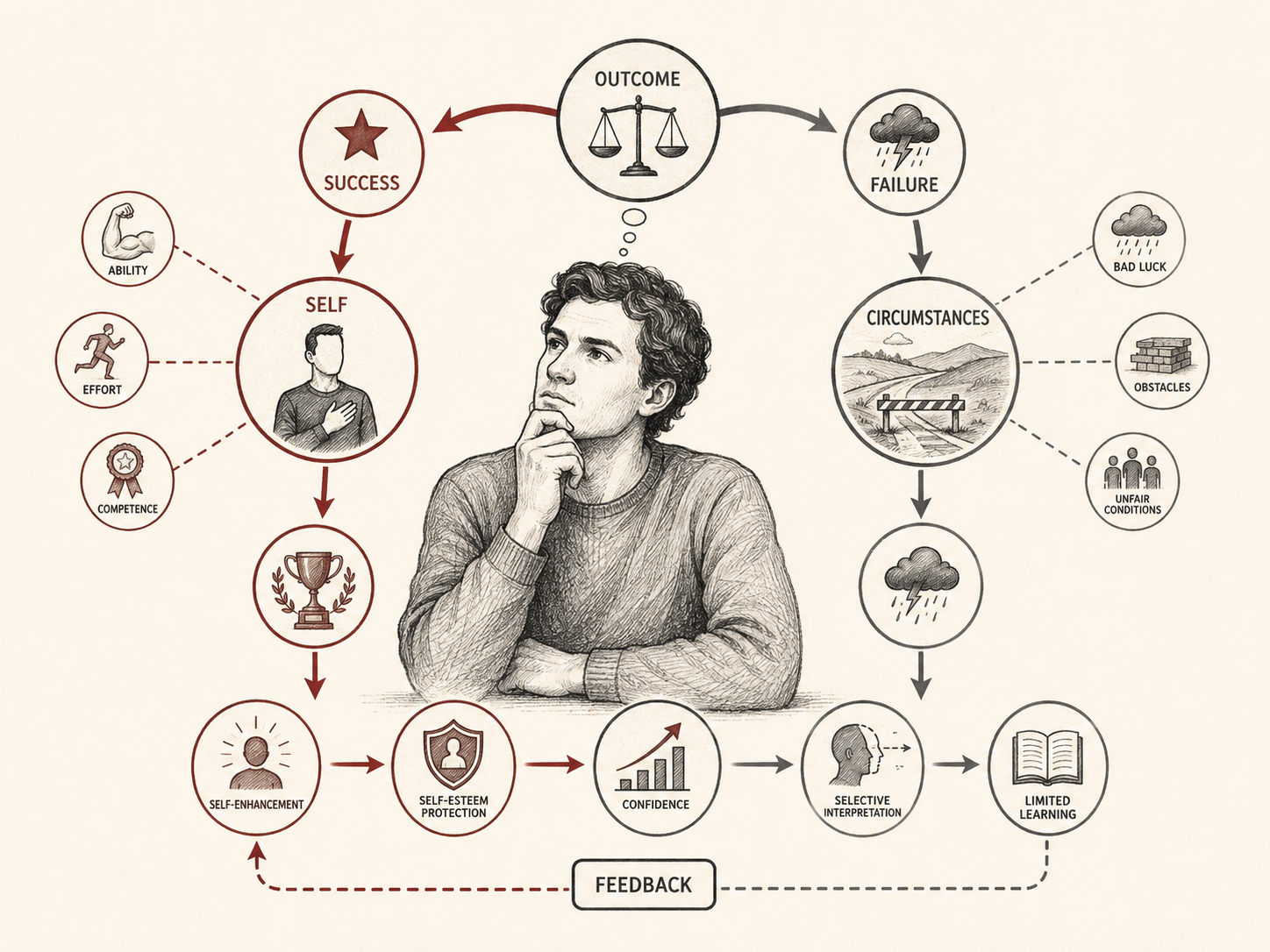
The self-serving bias connects directly to attribution theory, fundamental attribution error, self-serving bias, cognitive dissonance theory, social comparison theory, heuristics and biases, groupthink, and social norms. Together, these frameworks show how people interpret evidence through identity, motivation, group pressure, and the need to maintain a defensible view of the self.
What is the self-serving bias?
The self-serving bias is an attributional asymmetry. When outcomes are favorable, people tend to explain them in ways that enhance the self: ability, effort, intelligence, leadership, discipline, courage, skill, insight, or moral character. When outcomes are unfavorable, people tend to explain them in ways that protect the self: luck, timing, unfair rules, poor support, bad information, hostile opponents, structural obstacles, or circumstances beyond control.
The bias can appear in ordinary life, education, work, sports, politics, investing, relationships, leadership, and institutional reporting. It does not require deliberate dishonesty. Often it operates through selective attention and motivated interpretation. People remember evidence that supports their competence, downplay evidence that threatens it, and construct causal stories that preserve a coherent self-image.
The self-serving bias can be understood as a form of motivated attribution. Attribution asks why something happened. The self-serving bias asks how the answer changes when the outcome threatens or flatters the self. The same person may use different causal logic depending on whether the result was success or failure.
The basic pattern is easy to summarize:
- Success: “I succeeded because I am capable, prepared, disciplined, or talented.”
- Failure: “I failed because the situation was unfair, unpredictable, poorly designed, or outside my control.”
That pattern may sometimes be accurate. A success may genuinely reflect ability, and a failure may genuinely reflect external constraint. The problem arises when attribution shifts systematically in a self-protective direction even when evidence is ambiguous or contradictory.
Attribution theory and the structure of the bias
The self-serving bias belongs within the broader field of attribution theory, which examines how people explain behavior and outcomes. Attribution researchers distinguish between internal causes, such as ability, effort, intention, personality, or character, and external causes, such as luck, task difficulty, social pressure, institutional constraint, environment, or chance.
The self-serving bias emerges when these causal categories are applied asymmetrically. Positive outcomes are interpreted as internally caused, while negative outcomes are interpreted as externally caused. This protects the self because success becomes evidence of personal competence, while failure becomes evidence of adverse circumstance.
Attribution theory also distinguishes stable and unstable causes, as well as controllable and uncontrollable causes. These distinctions matter because they shape future motivation. If a person attributes success to stable ability, confidence may increase. If they attribute failure to an uncontrollable external obstacle, responsibility may decrease. If they attribute failure to controllable effort, learning may become more likely.
The self-serving bias is therefore not only about internal versus external attribution. It can involve several dimensions:
- Internal versus external: Was the cause inside the person or outside the person?
- Stable versus unstable: Is the cause enduring or temporary?
- Controllable versus uncontrollable: Could the actor have changed the outcome?
- Global versus specific: Does the cause apply broadly or only to one situation?
- Moral versus technical: Is the cause interpreted as a failure of character or a problem of conditions?
This makes attribution a powerful site of self-protection. People can preserve self-esteem not only by externalizing failure, but by making failure unstable, uncontrollable, specific, or morally neutral.
Empirical evidence and interpretive debate
Research on the self-serving bias has been documented across many settings, including academic performance, athletic competition, work evaluation, leadership, interpersonal conflict, group outcomes, and experimental performance feedback. People often claim more responsibility for success than failure, and they often interpret ambiguous evidence in ways that protect self-evaluation.
Miller and Ross’s classic 1975 review remains central because it made the concept more precise. They argued that the evidence did not support the most simplistic version of the bias in every case, but did support self-enhancing attributions under success more strongly than self-protective attributions under failure. That distinction matters because the bias may be stronger in credit-claiming than in blame-deflection, depending on task structure, evidence, expectations, and threat.
Later meta-analytic work strengthened the evidence base. Mezulis and colleagues reviewed research on self-serving attributional bias and found broad evidence for a positivity bias in attributions, while also documenting individual, developmental, and cultural variation. Campbell and Sedikides further showed that self-threat magnifies the self-serving bias, supporting the view that the bias is not merely cognitive but motivational.
This evidence suggests that the self-serving bias should not be treated as a crude universal reflex. It is better understood as a flexible attributional tendency that becomes stronger when outcomes are identity-relevant, threatening, ambiguous, public, important, or tied to self-esteem.
Research also shows that accountability, evidence quality, culture, depression, self-esteem, and social norms can moderate the bias. People are not always equally self-serving. The bias is shaped by the situation, the person, the audience, and the available evidence.
Psychological functions
The self-serving bias persists because it performs several psychological functions.
Protection of self-esteem
Failure threatens self-esteem because it can imply incompetence, poor judgment, weakness, irresponsibility, or moral failure. By attributing failure to external forces, people reduce the emotional threat of negative outcomes. The bias allows the person to preserve a positive self-concept even when results are unfavorable.
Maintenance of motivation
Self-serving attribution can preserve motivation after setbacks. If a person believes failure was caused by temporary or external conditions, they may remain willing to try again. In this sense, a limited form of self-protection can support resilience.
Preservation of identity coherence
People usually maintain narratives about who they are: competent, fair, disciplined, intelligent, ethical, hardworking, or deserving. Outcomes that contradict these narratives create interpretive pressure. Self-serving attribution helps preserve coherence by fitting success and failure into a self-protective story.
Management of social impression
Attribution is also public. People explain outcomes to teachers, managers, teammates, voters, clients, family members, and peers. Self-serving explanations may protect reputation as well as private self-esteem.
Reduction of emotional pain
Attributing failure to external forces may reduce shame, guilt, regret, and humiliation. This emotional function can be adaptive in the short term, but harmful if it prevents responsibility, repair, or learning.
The bias therefore has a dual character. It can protect dignity, but it can also reduce accuracy. It can preserve motivation, but it can also block learning. It can soften failure, but it can also become excuse making.
Formalizing the self-serving bias
The self-serving bias can be expressed formally as an asymmetry in how internal and external causes are weighted across positive and negative outcomes. Let \(I\) represent internal attribution and \(E\) represent external attribution. Attribution for an outcome \(O\) can be written as:
A(O)=\omega_I(O)I+\omega_E(O)E
\]
Interpretation: Attribution \(A(O)\) combines internal and external causal explanations, weighted by \(\omega_I\) and \(\omega_E\).
In a self-serving pattern, positive outcomes receive stronger internal weighting:
\omega_I(O^+)>\omega_E(O^+)
\]
Interpretation: Success is interpreted more through internal causes than external causes.
Negative outcomes receive stronger external weighting:
\omega_E(O^-)>\omega_I(O^-)
\]
Interpretation: Failure is interpreted more through external causes than internal causes.
A basic self-serving bias score can be defined as:
SSB=I(O^+)-I(O^-)
\]
Interpretation: The bias score increases when internal attribution is stronger for success than for failure.
A fuller attributional asymmetry score includes both internal credit for success and external explanation for failure:
SSB^*=[I(O^+)-I(O^-)]+[E(O^-)-E(O^+)]
\]
Interpretation: This captures both halves of the self-serving pattern: internalizing success and externalizing failure.
Motivated attribution can also be represented probabilistically. Let \(h_I\) and \(h_E\) represent internal and external causal hypotheses, \(x\) observed evidence, and \(M\) motivational state:
P(h\mid x,M)=\frac{P(x\mid h)P(h\mid M)}{P(x\mid M)}
\]
Interpretation: Motivational state \(M\) can shift the prior plausibility of internal or external explanations before evidence is interpreted.
Accountability can be added as a moderator:
SSB_i=\beta_0+\beta_1T_i+\beta_2S_i-\beta_3A_i-\beta_4V_i+\epsilon_i
\]
Interpretation: Self-serving bias increases with ego threat \(T_i\) and self-relevance \(S_i\), but may decrease with accountability \(A_i\) and evidence strength \(V_i\).
These models clarify a central point: the self-serving bias is not simply a mistake in causal reasoning. It is an interaction between evidence, outcome valence, self-relevance, threat, accountability, and motivation.
Self-enhancement and self-protection
The self-serving bias has two related but distinct components: self-enhancement and self-protection.
Self-enhancement occurs when people take internal credit for positive outcomes. Success is interpreted as evidence of ability, effort, talent, discipline, insight, or virtue. This supports confidence and pride, but it may also lead to overconfidence when external contributors are ignored.
Self-protection occurs when people externalize negative outcomes. Failure is interpreted as the result of bad luck, unfair conditions, poor support, external interference, or unpredictable constraints. This can soften shame and preserve motivation, but it may also prevent learning when internal causes are dismissed too quickly.
The distinction is important because these two components may not be equally strong. Some people readily claim credit for success but do not fully deny responsibility for failure. Others strongly externalize failure but are modest about success. Cultural norms, self-esteem, audience, public accountability, depression, role expectations, and task importance can all shift the balance.
Self-enhancement and self-protection also have different institutional consequences. Credit-claiming can inflate leadership narratives and distort reward. Blame-deflection can prevent accountability and corrective action. In organizations, both are dangerous when they replace evidence-based review.
Connections to cognitive dissonance
The self-serving bias intersects closely with cognitive dissonance theory. Dissonance arises when evidence conflicts with beliefs about the self. A person who believes they are competent may experience psychological discomfort after failure. A person who believes they are fair may experience discomfort after acting selfishly. A leader who believes they are strategic may experience discomfort after a failed decision.
Self-serving attribution reduces this tension by changing the meaning of the outcome. Failure becomes unfairness. Harm becomes misunderstanding. Poor judgment becomes bad information. Negligence becomes unavoidable constraint. In this way, attribution does not merely explain the event; it protects the identity threatened by the event.
This connection helps explain why the bias can be resistant to correction. If an attribution protects the self from dissonance, evidence against that attribution may itself feel threatening. The person may defend the explanation not because it is well supported, but because abandoning it would require a more painful revision of the self.
This is especially important in moral domains. People are often motivated to see themselves as decent, fair, and responsible. When outcomes suggest otherwise, self-serving attribution can become a moral defense mechanism.
Learning, feedback, and accountability
The self-serving bias has a complicated relationship with learning. A modest degree of self-protection can help people recover from failure and continue trying. But strong self-serving attribution can prevent people from recognizing what went wrong.
Learning from failure requires a person or institution to identify controllable causes. If every failure is attributed to luck, market conditions, unfair opponents, poor timing, or external interference, then behavior may not change. The individual preserves self-esteem at the cost of adaptation.
Accountability can reduce the bias when it requires people to justify explanations against evidence. Structured feedback, transparent criteria, postmortems, peer review, audit trails, and decision logs can all make self-serving narratives harder to sustain. But accountability must be designed carefully. Punitive environments may increase defensiveness, while evidence-based learning environments can make responsibility less threatening.
Several conditions improve learning:
- clear evidence about causes;
- psychological safety to acknowledge error;
- structured separation of blame from diagnosis;
- standards that apply symmetrically to success and failure;
- review processes that include external constraints and internal decisions;
- documentation of assumptions before outcomes are known;
- leaders who model responsibility rather than credit-claiming.
The goal is not to force people to blame themselves for everything. The goal is attributional accuracy: identifying when outcomes reflect internal choices, external constraints, chance, structural conditions, or interaction among them.
Interpersonal consequences
The self-serving bias can create serious difficulty in relationships. When individuals consistently claim credit for positive outcomes while deflecting responsibility for negative outcomes, others may experience them as unfair, defensive, unreliable, or unaccountable.
In friendships, families, teams, and intimate relationships, conflict often turns on competing attributions. One person explains a problem as situational; another sees it as a pattern of personal responsibility. One person claims effort; another sees neglect. One person sees success as their contribution; another sees a collective achievement.
The bias can also produce attributional conflict in groups. Multiple members of a team may each claim more credit than others assign them. During failure, each may point to constraints, other people, or leadership. Without shared evidence and norms of accountability, the group may spend more energy protecting identity than diagnosing causes.
Self-serving attribution therefore affects trust. People trust others partly because they believe those others can recognize their own role in outcomes. When attribution becomes chronically self-protective, trust erodes because responsibility becomes negotiable.
Organizational and leadership implications
The self-serving bias is especially consequential in organizations because organizations depend on accurate diagnosis of success and failure. Leaders, managers, employees, teams, boards, agencies, and institutions all create narratives about why outcomes occurred. Those narratives shape future strategy, reward, blame, promotion, policy, and reform.
In leadership contexts, the bias can appear as credit concentration and blame diffusion. Leaders may attribute success to vision, strategy, courage, or execution while attributing failure to market conditions, inherited problems, resistant employees, poor timing, or external volatility. Some of those external explanations may be valid. The bias appears when causal standards shift depending on outcome valence.
Organizations can also develop collective self-serving bias. A successful project becomes evidence of culture, leadership, and excellence. A failed project becomes evidence of external shocks, customer confusion, regulatory burden, or uncontrollable conditions. This pattern can prevent institutional learning.
Examples include:
- project postmortems that celebrate success but rationalize failure;
- performance reviews that over-credit individual stars and under-credit systems;
- leaders who personalize wins and externalize losses;
- departments that blame other departments for failures;
- public agencies that attribute failures to citizens rather than design;
- companies that cite market volatility for losses but leadership brilliance for gains;
- institutions that treat scandal as isolated misfortune rather than systemic failure.
Organizational remedies include pre-mortems, decision logs, structured postmortems, independent review, transparent metrics, psychological safety, and accountability norms that make it possible to discuss failure without turning every review into a threat to identity.
Politics, institutions, and public responsibility
The self-serving bias also operates at political and institutional scale. Political leaders, parties, agencies, governments, movements, and publics explain success and failure in ways that protect identity and legitimacy. Economic gains may be attributed to leadership; downturns to inherited problems. Policy success may be attributed to vision; policy failure to obstruction. Electoral victories may be explained as public endorsement; losses as unfair media, bad rules, misinformation, or external interference.
This does not mean external explanations are always false. Politics genuinely involves structural constraints, opposition, institutional design, media systems, historical inheritance, and unexpected shocks. The analytical problem is asymmetry: whether the same standards of causation are applied to success and failure, to one’s own side and opponents, to favored leaders and disfavored groups.
Self-serving attribution can weaken democratic accountability when leaders and institutions refuse responsibility for foreseeable harm. It can also intensify polarization because each group explains its own failures sympathetically while explaining opponents’ failures morally.
At the public level, this bias is connected to social identity theory and in-group bias. People may extend self-serving explanations to groups with which they identify. “Our side” failed because of unfair constraints; “their side” failed because of incompetence or corruption. In this way, self-serving bias can become group-serving bias.
Cultural variation and self-construal
Although the self-serving bias appears across many contexts, its strength and expression vary across cultures. Research has often found stronger self-enhancement patterns in many Western, individualistic settings and weaker or differently expressed patterns in some East Asian and interdependent settings. This does not mean that people in one culture are biased and others are not. It means that cultural norms shape what counts as appropriate self-explanation.
In cultural contexts that emphasize individual achievement, personal agency, competition, and self-esteem, internal credit for success may be socially reinforced. In contexts that emphasize interdependence, humility, role obligation, and group harmony, overt self-enhancement may be less acceptable. People may show modesty bias, self-criticism, or group-serving patterns instead.
Cultural variation also complicates measurement. A lower tendency to claim personal credit does not necessarily mean less motivation or less self-esteem. It may reflect different norms for self-presentation, responsibility, and social harmony. Researchers should therefore avoid treating one cultural style of attribution as the universal standard.
The key point is that attribution is both psychological and cultural. People explain success and failure through the available moral language of the self, and that language differs across societies, institutions, and historical settings.
When external attribution is not bias
A research-grade account of the self-serving bias must avoid a common mistake: assuming that every external explanation for failure is defensive or inaccurate. Sometimes failure is genuinely caused by external forces. A person may fail because of discrimination, illness, resource deprivation, poor instruction, unsafe conditions, biased evaluation, unstable markets, institutional neglect, or structural exclusion.
This matters especially when studying marginalized people or unequal institutions. Calling external attribution “self-serving” can become harmful if it dismisses real barriers. A worker who points to unsafe conditions, a student who points to unequal schooling, or a community that points to structural exclusion may be accurately identifying causal conditions.
The bias is not the presence of external attribution. The bias is a systematic asymmetry in how evidence is interpreted depending on whether the outcome flatters or threatens the self. Strong research should therefore measure evidence strength, situational constraints, and structural conditions rather than assuming that internal responsibility is always the more accurate explanation.
Attributional accuracy requires both humility and evidence. People can over-externalize failure, but institutions can also over-internalize blame onto individuals while ignoring structural causes. The self-serving bias must be studied alongside power, evidence, and context.
Ethical and interpretive cautions
The self-serving bias is useful because it reveals motivated distortion, but it should not be used as a blunt accusation. People often protect themselves because failure is painful, public judgment is harsh, and institutions punish vulnerability. Defensive attribution may be a symptom of unsafe accountability environments as much as a personal flaw.
Several cautions are important:
- Do not assume external attribution is automatically false.
- Do not ignore structural barriers when interpreting failure.
- Do not reduce all self-protection to dishonesty.
- Do not design feedback systems that humiliate people into defensiveness.
- Do not reward leaders for credit-claiming while punishing honest failure analysis.
- Do not treat cultural modesty or self-criticism as absence of self-worth.
- Do not use the concept to dismiss legitimate grievance.
- Do not confuse accountability with blame.
Ethically, the goal is not to strip people of self-protection. The goal is to create conditions in which people and institutions can face evidence without identity collapse. Accurate attribution requires psychological safety, fair standards, evidence review, and willingness to separate responsibility from shame.
Measurement, data, and research design
Self-serving bias research uses experiments, performance-feedback tasks, attribution questionnaires, self-other comparison designs, vignette studies, response-time measures, organizational case reviews, leadership studies, longitudinal feedback designs, and cross-cultural surveys.
Key variables include:
- outcome valence;
- actor target;
- self versus other judgment;
- internal attribution;
- external attribution;
- stable attribution;
- controllable attribution;
- responsibility rating;
- blame rating;
- credit claiming;
- excuse making;
- self-esteem;
- ego threat;
- task importance;
- outcome expectancy;
- perceived fairness;
- evidence strength;
- learning intention;
- accountability pressure;
- response time.
Strong designs should compare success and failure symmetrically. They should also compare self-attribution with attribution for others under similar conditions. Without a self-other comparison, it is difficult to know whether a pattern reflects general causal reasoning or specifically self-serving reasoning.
Researchers should also distinguish evidence-based attribution from motivated attribution. If external evidence clearly caused failure, external attribution may be accurate. If the same evidence is interpreted differently depending on whether the outcome is favorable or unfavorable, self-serving bias is more plausible.
Longitudinal and institutional designs are especially valuable because the consequences of the bias accumulate over time. A single defensive explanation may not matter much. Repeated defensive explanations can undermine learning, accountability, and trust.
R code for self-serving bias research
The following R workflow models internal attribution, external attribution, responsibility, blame, credit claiming, excuse making, learning intention, and response time as functions of outcome valence, self-other judgment, ego threat, evidence strength, and accountability pressure.
# Install packages if needed:
# pak::pak(c("tidyverse", "lme4", "lmerTest", "emmeans", "broom.mixed", "performance"))

library(tidyverse)
library(lme4)
library(lmerTest)
library(emmeans)
library(broom.mixed)
library(performance)

# Expected columns:
# participant, site_id, condition, trial, outcome_valence,
# actor_target, self_other, internal_attribution, external_attribution,
# stable_attribution, controllable_attribution, responsibility_rating,
# blame_rating, credit_claiming, excuse_making, self_esteem,
# ego_threat, task_importance, outcome_expectancy, perceived_fairness,
# evidence_strength, learning_intention, accountability_pressure,
# response_time_ms

dat <- read_csv("self_serving_bias_trials.csv") %>%
  mutate(
    participant = factor(participant),
    site_id = factor(site_id),
    condition = factor(condition),
    outcome_valence = factor(outcome_valence),
    actor_target = factor(actor_target),
    self_other = factor(self_other),
    log_response_time = log(response_time_ms)
  )

# -----------------------------
# 1. Descriptive summary
# -----------------------------

summary_table <- dat %>%
  group_by(condition, outcome_valence, self_other) %>%
  summarise(
    n = n(),
    participants = n_distinct(participant),
    mean_internal = mean(internal_attribution, na.rm = TRUE),
    mean_external = mean(external_attribution, na.rm = TRUE),
    mean_responsibility = mean(responsibility_rating, na.rm = TRUE),
    mean_blame = mean(blame_rating, na.rm = TRUE),
    mean_credit = mean(credit_claiming, na.rm = TRUE),
    mean_excuse = mean(excuse_making, na.rm = TRUE),
    mean_ego_threat = mean(ego_threat, na.rm = TRUE),
    mean_learning = mean(learning_intention, na.rm = TRUE),
    mean_accountability = mean(accountability_pressure, na.rm = TRUE),
    mean_evidence = mean(evidence_strength, na.rm = TRUE),
    .groups = "drop"
  )

print(summary_table)

# -----------------------------
# 2. Internal attribution model
# -----------------------------

internal_model <- lmer(
  internal_attribution ~
    outcome_valence * self_other +
    ego_threat +
    self_esteem +
    task_importance +
    evidence_strength +
    accountability_pressure +
    condition +
    actor_target +
    (1 | participant) +
    (1 | site_id),
  data = dat,
  REML = FALSE
)

summary(internal_model)
emmeans(internal_model, ~ outcome_valence * self_other)

# -----------------------------
# 3. External attribution model
# -----------------------------

external_model <- lmer(
  external_attribution ~
    outcome_valence * self_other +
    ego_threat +
    self_esteem +
    task_importance +
    evidence_strength +
    accountability_pressure +
    condition +
    actor_target +
    (1 | participant) +
    (1 | site_id),
  data = dat,
  REML = FALSE
)

summary(external_model)
emmeans(external_model, ~ outcome_valence * self_other)

# -----------------------------
# 4. Responsibility model
# -----------------------------

responsibility_model <- lmer(
  responsibility_rating ~
    internal_attribution +
    external_attribution +
    controllable_attribution +
    outcome_valence * self_other +
    evidence_strength +
    accountability_pressure +
    condition +
    (1 | participant) +
    (1 | site_id),
  data = dat,
  REML = FALSE
)

summary(responsibility_model)

# -----------------------------
# 5. Blame, credit, and excuse models
# -----------------------------

blame_model <- lmer(
  blame_rating ~
    outcome_valence * self_other +
    internal_attribution +
    external_attribution +
    responsibility_rating +
    ego_threat +
    condition +
    (1 | participant) +
    (1 | site_id),
  data = dat,
  REML = FALSE
)

credit_model <- lmer(
  credit_claiming ~
    outcome_valence * self_other +
    internal_attribution +
    self_esteem +
    ego_threat +
    accountability_pressure +
    condition +
    (1 | participant) +
    (1 | site_id),
  data = dat,
  REML = FALSE
)

excuse_model <- lmer(
  excuse_making ~
    outcome_valence * self_other +
    external_attribution +
    ego_threat +
    evidence_strength +
    accountability_pressure +
    condition +
    (1 | participant) +
    (1 | site_id),
  data = dat,
  REML = FALSE
)

summary(blame_model)
summary(credit_model)
summary(excuse_model)

# -----------------------------
# 6. Learning intention model
# -----------------------------

learning_model <- lmer(
  learning_intention ~
    responsibility_rating +
    excuse_making +
    evidence_strength +
    accountability_pressure +
    outcome_valence +
    self_other +
    condition +
    (1 | participant) +
    (1 | site_id),
  data = dat,
  REML = FALSE
)

summary(learning_model)

# -----------------------------
# 7. Bias scores
# -----------------------------

bias_scores <- dat %>%
  filter(outcome_valence %in% c("positive", "negative")) %>%
  group_by(participant, self_other, outcome_valence) %>%
  summarise(
    mean_internal = mean(internal_attribution, na.rm = TRUE),
    mean_external = mean(external_attribution, na.rm = TRUE),
    .groups = "drop"
  ) %>%
  pivot_wider(
    names_from = outcome_valence,
    values_from = c(mean_internal, mean_external)
  ) %>%
  mutate(
    ssb_internal = mean_internal_positive - mean_internal_negative,
    ssb_external = mean_external_negative - mean_external_positive,
    ssb_full = ssb_internal + ssb_external
  )

print(bias_scores)

# -----------------------------
# 8. Response-time model
# -----------------------------

rt_model <- lmer(
  log_response_time ~
    outcome_valence * self_other +
    ego_threat +
    task_importance +
    evidence_strength +
    accountability_pressure +
    condition +
    (1 | participant) +
    (1 | site_id),
  data = dat %>% filter(response_time_ms >= 150),
  REML = FALSE
)

summary(rt_model)

# -----------------------------
# 9. Export outputs
# -----------------------------

write_csv(summary_table, "self_serving_bias_summary.csv")
write_csv(bias_scores, "self_serving_bias_scores.csv")

write_csv(
  tidy(internal_model, effects = "fixed", conf.int = TRUE),
  "self_serving_bias_internal_coefficients.csv"
)

write_csv(
  tidy(external_model, effects = "fixed", conf.int = TRUE),
  "self_serving_bias_external_coefficients.csv"
)

write_csv(
  tidy(learning_model, effects = "fixed", conf.int = TRUE),
  "self_serving_bias_learning_coefficients.csv"
)

# -----------------------------
# 10. Visualization
# -----------------------------

ggplot(dat, aes(x = internal_attribution, y = responsibility_rating, color = outcome_valence)) +
  geom_point(alpha = 0.30) +
  geom_smooth(method = "lm", se = FALSE) +
  labs(
    title = "Internal attribution and responsibility judgment",
    x = "Internal attribution",
    y = "Responsibility rating"
  ) +
  theme_minimal()
This workflow estimates both halves of the self-serving pattern: internal attribution after success and external attribution after failure. It also tests whether accountability pressure and evidence strength reduce defensive attribution and whether excuse making predicts lower learning intention.
Python code for self-serving bias research
The Python workflow below parallels the R analysis and adds a simple organizational-learning simulation showing how credit claiming and excuse making can affect learning after success and failure.
import numpy as np
import pandas as pd
import statsmodels.formula.api as smf
import matplotlib.pyplot as plt

# Expected columns:
# participant, site_id, condition, trial, outcome_valence,
# actor_target, self_other, internal_attribution, external_attribution,
# stable_attribution, controllable_attribution, responsibility_rating,
# blame_rating, credit_claiming, excuse_making, self_esteem,
# ego_threat, task_importance, outcome_expectancy, perceived_fairness,
# evidence_strength, learning_intention, accountability_pressure,
# response_time_ms

df = pd.read_csv("self_serving_bias_trials.csv")

categorical_cols = [
    "participant", "site_id", "condition",
    "outcome_valence", "actor_target", "self_other"
]

for col in categorical_cols:
    df[col] = df[col].astype("category")

df["log_response_time"] = np.log(df["response_time_ms"])

# -----------------------------
# 1. Descriptive summary
# -----------------------------

summary_table = (
    df.groupby(["condition", "outcome_valence", "self_other"], observed=True)
    .agg(
        n=("internal_attribution", "size"),
        participants=("participant", "nunique"),
        mean_internal=("internal_attribution", "mean"),
        mean_external=("external_attribution", "mean"),
        mean_responsibility=("responsibility_rating", "mean"),
        mean_blame=("blame_rating", "mean"),
        mean_credit=("credit_claiming", "mean"),
        mean_excuse=("excuse_making", "mean"),
        mean_ego_threat=("ego_threat", "mean"),
        mean_learning=("learning_intention", "mean"),
        mean_accountability=("accountability_pressure", "mean"),
        mean_evidence=("evidence_strength", "mean"),
    )
    .reset_index()
)

print(summary_table)

# -----------------------------
# 2. Internal attribution model
# -----------------------------

internal_model = smf.ols(
    "internal_attribution ~ outcome_valence * self_other "
    "+ ego_threat + self_esteem + task_importance "
    "+ evidence_strength + accountability_pressure "
    "+ condition + actor_target",
    data=df,
)

internal_result = internal_model.fit(
    cov_type="cluster",
    cov_kwds={"groups": df["participant"]},
)

print(internal_result.summary())

# -----------------------------
# 3. External attribution model
# -----------------------------

external_model = smf.ols(
    "external_attribution ~ outcome_valence * self_other "
    "+ ego_threat + self_esteem + task_importance "
    "+ evidence_strength + accountability_pressure "
    "+ condition + actor_target",
    data=df,
)

external_result = external_model.fit(
    cov_type="cluster",
    cov_kwds={"groups": df["participant"]},
)

print(external_result.summary())

# -----------------------------
# 4. Responsibility model
# -----------------------------

responsibility_model = smf.ols(
    "responsibility_rating ~ internal_attribution + external_attribution "
    "+ controllable_attribution + outcome_valence * self_other "
    "+ evidence_strength + accountability_pressure + condition",
    data=df,
)

responsibility_result = responsibility_model.fit(
    cov_type="cluster",
    cov_kwds={"groups": df["participant"]},
)

print(responsibility_result.summary())

# -----------------------------
# 5. Blame, credit, and excuse models
# -----------------------------

blame_model = smf.ols(
    "blame_rating ~ outcome_valence * self_other "
    "+ internal_attribution + external_attribution "
    "+ responsibility_rating + ego_threat + condition",
    data=df,
)

blame_result = blame_model.fit(
    cov_type="cluster",
    cov_kwds={"groups": df["participant"]},
)

print(blame_result.summary())

credit_model = smf.ols(
    "credit_claiming ~ outcome_valence * self_other "
    "+ internal_attribution + self_esteem + ego_threat "
    "+ accountability_pressure + condition",
    data=df,
)

credit_result = credit_model.fit(
    cov_type="cluster",
    cov_kwds={"groups": df["participant"]},
)

print(credit_result.summary())

excuse_model = smf.ols(
    "excuse_making ~ outcome_valence * self_other "
    "+ external_attribution + ego_threat + evidence_strength "
    "+ accountability_pressure + condition",
    data=df,
)

excuse_result = excuse_model.fit(
    cov_type="cluster",
    cov_kwds={"groups": df["participant"]},
)

print(excuse_result.summary())

# -----------------------------
# 6. Bias score
# -----------------------------

score_base = (
    df[df["outcome_valence"].isin(["positive", "negative"])]
    .groupby(["participant", "self_other", "outcome_valence"], observed=True)[
        ["internal_attribution", "external_attribution"]
    ]
    .mean()
    .reset_index()
)

wide = score_base.pivot(
    index=["participant", "self_other"],
    columns="outcome_valence",
    values=["internal_attribution", "external_attribution"]
)

wide.columns = ["_".join(col).strip() for col in wide.columns.values]
wide = wide.reset_index()

wide["ssb_internal"] = (
    wide["internal_attribution_positive"]
    - wide["internal_attribution_negative"]
)

wide["ssb_external"] = (
    wide["external_attribution_negative"]
    - wide["external_attribution_positive"]
)

wide["ssb_full"] = wide["ssb_internal"] + wide["ssb_external"]

print(wide.head())

# -----------------------------
# 7. Learning model
# -----------------------------

learning_model = smf.ols(
    "learning_intention ~ responsibility_rating + excuse_making "
    "+ evidence_strength + accountability_pressure "
    "+ outcome_valence + self_other + condition",
    data=df,
)

learning_result = learning_model.fit(
    cov_type="cluster",
    cov_kwds={"groups": df["participant"]},
)

print(learning_result.summary())

# -----------------------------
# 8. Organizational learning simulation
# -----------------------------

def simulate_organizational_learning(n_projects=5000, seed=42):
    rng = np.random.default_rng(seed)

    project_success = rng.integers(0, 2, size=n_projects)
    ego_threat = rng.uniform(0, 10, size=n_projects)
    evidence_strength = rng.uniform(0, 10, size=n_projects)
    accountability = rng.uniform(0, 10, size=n_projects)

    credit_claiming = np.clip(
        2.0
        + 5.0 * project_success
        + 0.20 * ego_threat
        - 0.20 * accountability
        + rng.normal(0, 1.0, n_projects),
        0,
        10
    )

    excuse_making = np.clip(
        2.0
        + 5.0 * (1 - project_success)
        + 0.35 * ego_threat
        - 0.35 * accountability
        - 0.25 * evidence_strength
        + rng.normal(0, 1.0, n_projects),
        0,
        10
    )

    learning = np.clip(
        4.0
        + 0.40 * accountability
        + 0.35 * evidence_strength
        - 0.40 * excuse_making
        + rng.normal(0, 1.0, n_projects),
        0,
        10
    )

    sim = pd.DataFrame({
        "project_id": np.arange(1, n_projects + 1),
        "project_success": project_success,
        "ego_threat": ego_threat,
        "evidence_strength": evidence_strength,
        "accountability": accountability,
        "credit_claiming": credit_claiming,
        "excuse_making": excuse_making,
        "learning": learning,
    })

    sim["success_label"] = np.where(
        sim["project_success"] == 1,
        "success",
        "failure"
    )

    summary = (
        sim.groupby("success_label", observed=True)
        .agg(
            n=("learning", "size"),
            mean_credit_claiming=("credit_claiming", "mean"),
            mean_excuse_making=("excuse_making", "mean"),
            mean_learning=("learning", "mean"),
            mean_accountability=("accountability", "mean"),
            mean_evidence=("evidence_strength", "mean"),
        )
        .reset_index()
    )

    return sim, summary

simulation, simulation_summary = simulate_organizational_learning()

print(simulation_summary)

# -----------------------------
# 9. Visualization
# -----------------------------

fig, ax = plt.subplots(figsize=(8, 5))

for valence, group in df.groupby("outcome_valence", observed=True):
    ax.scatter(
        group["internal_attribution"],
        group["responsibility_rating"],
        alpha=0.30,
        label=valence
    )

ax.set_xlabel("Internal attribution")
ax.set_ylabel("Responsibility rating")
ax.set_title("Internal attribution and responsibility judgment")
ax.legend()
plt.tight_layout()
plt.show()

# -----------------------------
# 10. Export summaries
# -----------------------------

summary_table.to_csv("self_serving_bias_summary.csv", index=False)
wide.to_csv("self_serving_bias_scores.csv", index=False)
simulation.to_csv("organizational_learning_simulation.csv", index=False)
simulation_summary.to_csv("organizational_learning_summary.csv", index=False)
This workflow supports both attributional and institutional analysis. It estimates self-serving attribution patterns in individual judgment, then simulates how accountability and evidence review can affect organizational learning after success and failure.
Research data architecture
Self-serving bias research often depends on relational data: participants, sites, experimental conditions, outcome valence, actor targets, internal attribution, external attribution, responsibility judgments, blame, credit claiming, excuse making, evidence strength, accountability pressure, learning intention, and repeated institutional outcomes. Rather than embedding database code directly in the WordPress article body, the companion GitHub repository includes the full SQL schema and example queries for researchers who want to reproduce or extend the data model.
The research data model is designed to support questions such as:
- How much more internal attribution is assigned to success than failure?
- How much more external attribution is assigned to failure than success?
- Does the self-serving bias differ when judging the self, another person, a team, a leader, or an institution?
- Does ego threat magnify defensive attribution?
- Does accountability pressure reduce excuse making?
- Does evidence strength weaken motivated attribution?
- Do credit claiming and excuse making reduce learning intention?
- How do organizational credit/blame narratives affect institutional learning over time?
The GitHub repository contains the full database schema, example analytical queries, validation logic, and reproducible data workflow. Keeping executable SQL in GitHub avoids WordPress hosting restrictions while preserving the research-grade infrastructure for readers who want to inspect or reuse the model.
View the SQL research data architecture in GitHub.
GitHub repository
The companion repository provides reusable code and research scaffolding for studying self-serving bias, including workflows for internal attribution, external attribution, responsibility judgment, blame, credit claiming, excuse making, self-esteem, ego threat, evidence strength, accountability pressure, learning intention, organizational credit/blame narratives, and attributional asymmetry.
Complete Code Repository
Access the full companion repository for this article, including reproducible analysis materials and multi-language code workflows for self-serving bias research.
Why the self-serving bias matters
The self-serving bias matters because it reveals how people actively construct explanations that protect dignity, competence, and moral identity. Causal explanation is not simply a matter of discovering what happened. It is often a negotiation between evidence and the need to preserve a favorable view of the self.
This bias can serve adaptive functions. It can reduce shame, preserve motivation, and help people recover from setbacks. But it can also distort responsibility, damage trust, block learning, and weaken accountability. When individuals, teams, leaders, organizations, or political institutions repeatedly claim credit for success and externalize failure, they lose the ability to understand their own role in outcomes.
The deeper lesson is not that people should blame themselves for everything. It is that attribution should be symmetrical, evidence-based, and context-sensitive. Success and failure should both be examined for internal choices, external constraints, chance, structural conditions, and interaction effects.
Read alongside attribution theory, fundamental attribution error, cognitive dissonance theory, and social cognition, the self-serving bias shows that responsibility is never only cognitive. It is psychological, moral, relational, and institutional.
Related articles
- Social Psychology
- Attribution Theory
- Fundamental Attribution Error
- Social Cognition
- Cognitive Dissonance Theory
- Social Comparison Theory
- Heuristics and Biases
- Groupthink in Social Psychology
- Social Norms in Social Psychology
- Behavioral Economics
- Cognitive Psychology
- Institutions & Governance
Further reading
- American Psychological Association (n.d.) APA Dictionary of Psychology. Available at: https://dictionary.apa.org/.
- Baumeister, R.F. (1994) ‘The self in social contexts’, Annual Review of Psychology, 45, pp. 5–26. Available at: https://www.annualreviews.org/doi/10.1146/annurev.ps.45.020194.001501.
- Campbell, W.K. and Sedikides, C. (1999) ‘Self-threat magnifies the self-serving bias: A meta-analytic integration’, Review of General Psychology, 3(1), pp. 23–43. Available at: https://doi.org/10.1037/1089-2680.3.1.23.
- Fiske, S.T. and Taylor, S.E. (2021) Social Cognition: From Brains to Culture. 5th edn. London: Sage. Book details available at: https://us.sagepub.com/en-us/nam/social-cognition/book269317.
- Mezulis, A.H., Abramson, L.Y., Hyde, J.S. and Hankin, B.L. (2004) ‘Is there a universal positivity bias in attributions? A meta-analytic review of individual, developmental, and cultural differences in the self-serving attributional bias’, Psychological Bulletin, 130(5), pp. 711–747. PubMed record available at: https://pubmed.ncbi.nlm.nih.gov/15367078/.
- Miller, D.T. and Ross, M. (1975) ‘Self-serving biases in the attribution of causality: Fact or fiction?’, Psychological Bulletin, 82(2), pp. 213–225. Available at: https://doi.org/10.1037/h0076486.
- Shepperd, J., Malone, W. and Sweeny, K. (2008) ‘Exploring causes of the self-serving bias’, Social and Personality Psychology Compass, 2(2), pp. 895–908. Available at: https://doi.org/10.1111/j.1751-9004.2008.00078.x.
- Weiner, B. (1985) ‘An attributional theory of achievement motivation and emotion’, Psychological Review, 92(4), pp. 548–573. Available at: https://doi.org/10.1037/0033-295X.92.4.548.
References
- American Psychological Association (n.d.) APA Dictionary of Psychology. Available at: https://dictionary.apa.org/.
- Baumeister, R.F. (1994) ‘The self in social contexts’, Annual Review of Psychology, 45, pp. 5–26. Available at: https://www.annualreviews.org/doi/10.1146/annurev.ps.45.020194.001501.
- Campbell, W.K. and Sedikides, C. (1999) ‘Self-threat magnifies the self-serving bias: A meta-analytic integration’, Review of General Psychology, 3(1), pp. 23–43. Available at: https://doi.org/10.1037/1089-2680.3.1.23.
- Fiske, S.T. and Taylor, S.E. (2021) Social Cognition: From Brains to Culture. 5th edn. London: Sage. Book details available at: https://us.sagepub.com/en-us/nam/social-cognition/book269317.
- Mezulis, A.H., Abramson, L.Y., Hyde, J.S. and Hankin, B.L. (2004) ‘Is there a universal positivity bias in attributions? A meta-analytic review of individual, developmental, and cultural differences in the self-serving attributional bias’, Psychological Bulletin, 130(5), pp. 711–747. PubMed record available at: https://pubmed.ncbi.nlm.nih.gov/15367078/.
- Miller, D.T. and Ross, M. (1975) ‘Self-serving biases in the attribution of causality: Fact or fiction?’, Psychological Bulletin, 82(2), pp. 213–225. Available at: https://doi.org/10.1037/h0076486.
- Shepperd, J., Malone, W. and Sweeny, K. (2008) ‘Exploring causes of the self-serving bias’, Social and Personality Psychology Compass, 2(2), pp. 895–908. Available at: https://doi.org/10.1111/j.1751-9004.2008.00078.x.
- Weiner, B. (1985) ‘An attributional theory of achievement motivation and emotion’, Psychological Review, 92(4), pp. 548–573. Available at: https://doi.org/10.1037/0033-295X.92.4.548.