
Last Updated May 20, 2026
Diffusion of responsibility refers to a social-psychological process in which individuals feel less personally obligated to act when responsibility appears shared across a group. As the number of possible responders increases, each person may experience a weaker sense that action depends specifically on them. The result is a paradox of collective inaction: situations that appear to demand help, warning, escalation, or accountability may produce passivity precisely because responsibility seems distributed rather than personal.
The concept is most closely associated with bystander-intervention research, but its importance extends far beyond emergency helping. Diffusion of responsibility helps explain why people may fail to report harm, challenge misconduct, stop bullying, escalate safety risks, intervene in public emergencies, correct organizational failures, or act on visible ethical concerns. In each case, the problem is not necessarily lack of concern. It is the weakening of personal responsibility in the presence of others.
Diffusion of responsibility is therefore one of the central concepts in social psychology for understanding how moral action can fail under collective conditions. It shows that groups can increase capacity while reducing initiative. More observers can mean more possible helpers, but also more ambiguity about who should act. More departments can mean more expertise, but also less clear accountability. More participants can mean more collective power, but also more room for responsibility to disappear.
Main Library
Publications
Article Map
Social Psychology
Related Topic
Stewardship & Ethics
Related Topic
Institutions & Governance
Related Topic
Cognitive Psychology
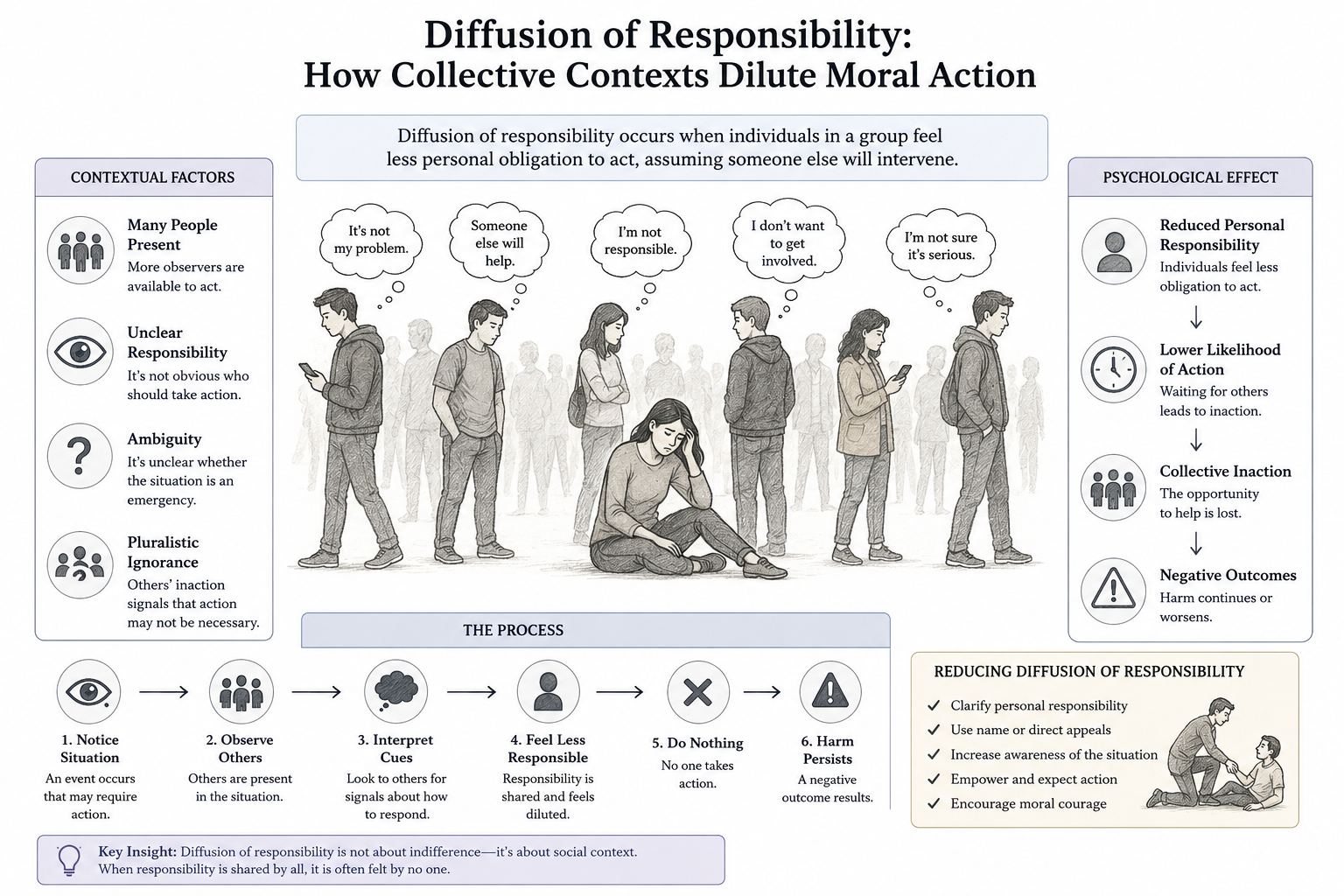
Diffusion of responsibility connects closely to the bystander effect, prosocial behavior, altruism, conformity and social influence, groupthink, social norms, obedience to authority, and moral disengagement. Together these frameworks show how social context can weaken, redirect, or organize moral action.
What is diffusion of responsibility?
Diffusion of responsibility occurs when individuals feel less personally accountable for acting because responsibility appears shared with others. In a group setting, each person may assume that someone else will notice, decide, intervene, report, or escalate. The larger and less structured the group, the easier it becomes for personal obligation to weaken.
The concept is often discussed in emergencies, but it applies whenever action is needed and responsibility is unclear. A person may fail to help someone in distress, report wrongdoing, challenge a harmful norm, correct misinformation, speak up in a meeting, intervene in bullying, escalate a safety concern, or take ownership of a visible institutional problem because the responsibility appears to belong to everyone and therefore to no one in particular.
Diffusion of responsibility is not simply selfishness or indifference. People may feel concern and still fail to act. They may privately recognize that something is wrong but hesitate because others are present, roles are unclear, the situation is ambiguous, or they fear looking foolish. Social presence changes the meaning of responsibility.
This is why diffusion of responsibility is analytically important. It separates moral concern from moral action. A person can care, yet still not act, when the social structure makes responsibility feel diluted.
Origins of the concept
Diffusion of responsibility became central to social psychology through the work of Bibb Latané and John Darley. Their research program was shaped by public reaction to the murder of Kitty Genovese in New York City in 1964, which was widely reported as an example of shocking bystander passivity. The case became a cultural symbol of urban indifference, although later historical work has shown that the most famous version of the story was oversimplified and in important respects inaccurate.
Latané and Darley’s contribution was not simply to retell the Genovese story. They designed experiments to examine how the presence of other people affects helping behavior. Their classic 1968 study, “Bystander Intervention in Emergencies: Diffusion of Responsibility,” showed that participants were less likely to intervene when they believed other bystanders were present.
This finding changed how psychologists understood inaction. Failure to intervene did not have to be explained only by apathy, cruelty, cowardice, or moral deficiency. It could also emerge from the structure of the situation. When multiple people appear able to act, the felt responsibility of each individual can decline.
The concept became a foundational mechanism in bystander-effect research, but it also became relevant to organizations, institutions, public policy, emergency response, collective behavior, and governance. Wherever responsibility is shared but poorly specified, diffusion can occur.
Diffusion of responsibility and the bystander effect
Diffusion of responsibility is closely related to the bystander effect, but the two concepts are not identical. The bystander effect describes the observable pattern in which people are less likely to help when other bystanders are present. Diffusion of responsibility is one of the psychological mechanisms that helps explain why this happens.
In a bystander situation, several steps are required before helping occurs. A person must notice the event, interpret it as requiring help, assume personal responsibility, know what to do, and decide to act. Diffusion of responsibility primarily affects the step of assuming responsibility. The person may think, explicitly or implicitly: someone else will call, someone else knows better, someone else is closer, someone else is in charge, or surely someone has already handled it.
This process can create collective inaction even when many people are present and capable. Each person’s inaction becomes part of the social signal observed by others. The result is a feedback loop: because no one acts, each observer becomes less certain that action is necessary or personally required.
The bystander effect is therefore not simply about numbers. It is about the meaning of numbers under ambiguity. Group presence can inhibit action when responsibility is unclear, but it can also support action when roles are clear, norms favor intervention, or group members coordinate effectively.
The Kitty Genovese case and historical caution
The Kitty Genovese case played a major role in the public imagination surrounding the bystander effect, but modern scholarship urges caution. The famous claim that 38 witnesses clearly watched the murder and did nothing has been challenged by archival research. The story became a powerful moral parable, but the historical reality was more complex.
This matters because social psychology should not depend on a myth in order to remain valid. The empirical importance of diffusion of responsibility rests on experimental and field research, not on the literal accuracy of the most sensational version of the Genovese story.
The caution is useful for two reasons. First, it prevents oversimplified condemnation of bystanders as morally empty. Second, it keeps attention on the actual psychological and institutional conditions that inhibit intervention: ambiguity, uncertainty, fear, unclear responsibility, pluralistic ignorance, and lack of clear response pathways.
The revised historical understanding does not weaken diffusion-of-responsibility research. It strengthens it by forcing a more careful distinction between cultural narrative, experimental evidence, and real-world complexity.
Psychological mechanisms behind diffusion
Diffusion of responsibility usually operates through several mechanisms at once. These mechanisms help explain why people may remain passive even when they privately feel concern.
Ambiguity
Many situations are not immediately clear. A person lying on the ground may be ill, intoxicated, resting, or in danger. A loud argument may be ordinary conflict or escalating violence. A suspicious workplace practice may be error, misconduct, or something outside one’s role. Ambiguity makes people look to others for cues.
Pluralistic ignorance
Pluralistic ignorance occurs when individuals privately feel concern but mistakenly infer from others’ calm or passive behavior that concern is not shared. Each person may think they are the only one worried. Because no one acts, the group appears unconcerned, reinforcing inaction.
Evaluation apprehension
People may hesitate because they fear embarrassment, criticism, or social judgment. They may worry about overreacting, misreading the situation, causing disruption, being accused of interfering, or looking foolish. This concern becomes stronger in public settings where others can evaluate the intervention.
Responsibility sharing
The central mechanism is responsibility sharing. When many people are present, the burden of action seems distributed. Each person may experience only a fraction of the responsibility they would feel if alone.
Uncertainty about competence
People may hesitate because they do not know what to do. If they believe others are more qualified, closer, more powerful, or more legitimate responders, they may wait rather than act.
Weak role clarity
When no one has a defined role, responsibility becomes vague. In emergencies and organizations alike, unclear roles allow responsibility to drift.
These mechanisms do not require people to be indifferent. They show how concern can be suppressed by uncertainty, social observation, and responsibility ambiguity.
Formalizing diffusion of responsibility
A simple way to represent diffusion of responsibility is to model felt personal responsibility as declining when the number of possible responders increases. Let \(R_f\) represent felt responsibility and \(n\) the number of perceived possible responders:
R_f=\frac{1}{n}
\]
Interpretation: As the number of possible responders increases, the subjective share of responsibility borne by any one person may decline.
This simple formulation captures the intuition but is incomplete. Responsibility does not depend only on numbers. It also depends on role clarity, ambiguity, evaluation apprehension, intervention efficacy, and accountability. A fuller expression can be written as:
R_f=\alpha C+\beta A+\lambda V-\delta \log(1+n)-\gamma U-\theta E
\]
Interpretation: Felt responsibility rises with role clarity \(C\), accountability assignment \(A\), and social visibility \(V\), but declines with bystander count \(n\), ambiguity \(U\), and evaluation apprehension \(E\).
Helping or intervention propensity can then be modeled as a function of felt responsibility, private concern, efficacy, and hesitation:
P(H_i=1)=\operatorname{logit}^{-1}(\beta_0+\beta_1R_f+\beta_2P_c+\beta_3Q-\beta_4U-\beta_5E)
\]
Interpretation: Intervention becomes more likely when responsibility \(R_f\), private concern \(P_c\), and efficacy \(Q\) are high, and less likely when ambiguity \(U\) and evaluation apprehension \(E\) are high.
Pluralistic ignorance can be represented as a gap between private concern and perceived group concern:
G_i=P_{c,i}-\hat{G}_{c,i}
\]
Interpretation: The pluralistic-ignorance gap \(G_i\) increases when a person privately feels concern but infers that the group is less concerned.
At the organizational level, responsibility can become fragmented across units:
A_i=\frac{A}{k}
\]
Interpretation: If total accountability \(A\) is distributed across \(k\) units without explicit assignment, the perceived accountability of any one unit may decline.
Repeated nonresponse can normalize inaction over time:
N_{t+1}=N_t+\eta_1F_t+\eta_2U_t-\eta_3C_t-\eta_4L_t
\]
Interpretation: Normalized inaction \(N\) increases with fragmentation \(F_t\) and ambiguity \(U_t\), but decreases with accountability clarity \(C_t\) and leadership signals \(L_t\).
These models clarify the logic of diffusion: responsibility does not simply disappear; it is diluted, displaced, obscured, or left unassigned.
Group size and moral action
One of the most robust early findings in bystander research was that helping often decreases as the number of perceived bystanders increases. This is counterintuitive because larger groups have more total capacity. More people means more eyes, more skills, more possible helpers, and more collective resources. Yet larger groups can reduce the felt obligation of each individual.
Group size matters because it changes psychological visibility and responsibility. In a small group, each person’s action or inaction is more noticeable. In a large group, anonymity increases, and each person can more easily assume that another person will respond.
However, the group-size effect is not absolute. Later research has shown that group membership can sometimes increase helping. If bystanders identify with one another, share a norm of intervention, or recognize the victim as part of their group, the presence of others may encourage rather than inhibit action. A group can diffuse responsibility, but it can also coordinate responsibility.
This is why a research-grade account should not reduce diffusion of responsibility to “more people means less helping.” The better claim is conditional: larger groups can reduce intervention when responsibility is unclear, the situation is ambiguous, bystanders are strangers, or no norm of action is established. Larger groups can support intervention when responsibility is organized, identity is shared, and action is normatively expected.
Ambiguity and pluralistic ignorance
Ambiguity is one of the most important conditions under which diffusion of responsibility becomes powerful. If a situation is clearly an emergency, people are more likely to act. If the situation is uncertain, people look to others for interpretive cues. When everyone is doing the same thing, looking around and hesitating, the group’s inaction becomes misleading evidence that no action is needed.
Pluralistic ignorance occurs when people privately interpret the situation as concerning but assume others are not concerned because others appear calm. Each person may suppress their own reaction because they misread the group. The result is collective misinterpretation.
This is especially relevant in public spaces, schools, workplaces, online platforms, and organizations. People may see warning signs but hesitate because no one else seems alarmed. They may think: perhaps this is normal, perhaps someone already knows, perhaps this is not my place, perhaps I am overreacting.
Pluralistic ignorance transforms silence into a false social signal. It makes inaction appear like consensus. Once that happens, responsibility diffusion is reinforced: not only does each person feel less responsible, each person may also doubt whether action is necessary at all.
The practical lesson is clear: make concern visible early. When people name uncertainty, ask direct questions, or assign roles, they disrupt the illusion that everyone else is unconcerned.
Evaluation apprehension and public hesitation
Evaluation apprehension is the fear of being judged by others. People may hesitate to intervene because they worry about making a mistake, appearing foolish, violating norms, escalating unnecessarily, embarrassing themselves, or being criticized for overreacting.
This mechanism is especially important in ambiguous situations. If the emergency is obvious, evaluation concerns may matter less. But when the situation is uncertain, the possibility of social embarrassment becomes a major inhibitor. People may remain passive not because they do not care, but because they fear acting wrongly in public.
Evaluation apprehension operates in organizations as well. Employees may hesitate to report concerns because they fear being labeled difficult, disloyal, alarmist, naïve, or insufficiently committed. Managers may hesitate to escalate risks because they fear career consequences. Team members may stay silent because others appear calm.
The ethical problem is that social judgment can suppress early warning. If institutions punish people for raising concerns prematurely, they train employees to wait until problems are undeniable. By then, harm may already be severe.
Reducing evaluation apprehension requires visible norms that protect responsible action. People need to know that asking, reporting, checking, and escalating are valued even when the situation later proves less serious than feared.
Diffusion of responsibility in organizations
Diffusion of responsibility plays a major role in organizational behavior. In institutions, responsibility is often distributed across departments, roles, systems, vendors, committees, policies, and reporting lines. This distribution can support specialization, but it can also create accountability gaps.
Organizational diffusion appears when people assume that another team owns the issue, another manager has authority, compliance is handling it, legal approved it, leadership knows, the system will catch it, or the process is someone else’s responsibility. Harmful outcomes can persist because every actor sees only part of the problem and no one feels fully responsible for the whole.
Examples include:
- safety warnings ignored because each department assumes another unit is responsible;
- misconduct unreported because employees believe managers already know;
- customer harm normalized because responsibility is split across product, data, policy, and support teams;
- environmental damage tolerated because accountability is distributed across firms, suppliers, regulators, and consumers;
- algorithmic harm treated as a technical issue rather than a governance responsibility;
- public-sector failures sustained because authority is divided across agencies.
Organizational diffusion is not merely a psychological phenomenon. It is also a design problem. If responsibility is fragmented but not mapped, accountability becomes invisible. If escalation pathways are unclear, people hesitate. If authority and responsibility are separated, people may notice harm without feeling empowered to act.
Institutions need explicit responsibility architecture: named owners, escalation routes, decision logs, audit trails, cross-functional accountability, and norms that reward early warning rather than punish it.
Institutional accountability and systems failure
Diffusion of responsibility is especially dangerous in institutional systems where harm is cumulative, distributed, and delayed. In such systems, no single action may appear decisive, and no single actor may feel fully responsible. Yet the aggregate result can be severe.
This is common in governance, healthcare, finance, education, policing, environmental policy, infrastructure, and technology. Complex systems often divide responsibility into specialized tasks. That division can improve efficiency, but it can also allow people to lose sight of the whole.
Institutional failures often involve warnings that were visible to someone but owned by no one. A signal existed. A report was filed. A risk was known. A complaint was recorded. A model produced errors. A community raised concerns. Yet responsibility remained distributed enough that decisive action did not occur.
This is why accountability systems must be designed rather than assumed. Good institutions do not merely hope that someone will act. They define who must notice, who must decide, who must escalate, who must respond, who must document, and who must be answerable when responsibility is ignored.
Diffusion of responsibility therefore has direct relevance to institutional ethics. It shows that moral failure can emerge not only from malicious intent, but from poorly structured responsibility.
Digital systems and distributed responsibility
Digital systems create new forms of diffusion of responsibility. Platforms, algorithms, automated workflows, data pipelines, recommender systems, moderation systems, ranking systems, and AI-assisted decisions can distribute responsibility across many technical and organizational layers.
When harm occurs, responsibility may be shifted among product teams, engineering teams, data teams, model developers, vendors, executives, policy teams, users, automated systems, and external regulators. People may say the algorithm decided, the model predicted, the user chose, the vendor supplied, the dashboard showed, the policy allowed, or the system optimized.
These claims may contain partial truth, but they can also obscure accountability. Algorithms do not eliminate responsibility; they redistribute it. Design choices, data choices, threshold choices, deployment choices, oversight choices, and governance choices remain human and institutional decisions.
Digital diffusion is especially likely when harms are statistical rather than visible. A single wrong recommendation, exclusion, moderation error, biased score, or denial may appear isolated. Across thousands or millions of cases, the pattern may be significant. If no one owns the aggregate harm, responsibility diffuses through the system.
Ethical digital governance requires traceability. Institutions need clear model ownership, incident reporting, appeal pathways, affected-user visibility, audit logs, accountability review, and named responsibility for high-impact systems.
Overcoming diffusion of responsibility
Diffusion of responsibility can be reduced when responsibility is made specific, visible, and actionable. The goal is to convert vague collective obligation into clear personal or role-based accountability.
Research and practice suggest several strategies:
- Direct appeals: Address a specific person rather than a crowd. “You in the blue jacket, call 911” is more effective than “Someone call 911.”
- Role clarity: Assign responsibilities before crises occur.
- Training: Increase confidence, competence, and intervention efficacy.
- Leadership cues: Leaders should visibly signal that action is expected.
- Norm setting: Establish intervention as the group norm.
- Accountability assignment: Identify who owns response, escalation, and follow-up.
- Escalation paths: Make it clear where concerns should go.
- Psychological safety: Protect people who raise concerns in good faith.
- Visibility: Make action and inaction legible.
- Post-incident review: Examine where responsibility diffused and how to redesign the system.
These strategies work because they counteract the mechanisms that inhibit action. They reduce ambiguity, increase personal responsibility, lower evaluation apprehension, strengthen efficacy, and make responsibility easier to locate.
The most important practical lesson is that responsibility should be designed before it is needed. In a crisis, ambiguity is costly.
Diffusion of responsibility and ethical systems
Diffusion of responsibility has broad implications for ethics and governance. Many social failures occur not because no one cares, but because responsibility is structured in ways that dilute personal accountability. People may privately recognize a problem while still failing to act because the system does not make action clearly theirs.
This is why ethical systems require more than moral values. They require responsibility architecture. A value such as care, safety, dignity, fairness, or accountability must be translated into roles, procedures, escalation paths, authority, and consequences.
An ethical system should ask:
- Who is responsible for noticing harm?
- Who is responsible for acting on early warning?
- Who has authority to intervene?
- Who must be informed?
- Who documents the decision?
- Who follows up?
- Who is accountable if no one acts?
If these questions are unanswered, responsibility can disappear even in morally serious organizations. Ethical culture is not only what people believe. It is how responsibility is assigned, protected, and made actionable.
Diffusion of responsibility in the architecture of social influence
Within the broader architecture of social influence, diffusion of responsibility helps explain how group presence can suppress intervention rather than encourage it. Prosocial behavior identifies the broader domain of helping. Altruism raises the question of motive. Social norms shape expectations about when helping is appropriate. Conformity explains why individuals look to others for behavioral cues. Moral disengagement explains how harmful inaction or complicity may be justified.
Diffusion of responsibility adds a crucial mechanism: when responsibility is psychologically distributed across a group, moral agency can weaken even in the presence of need. It therefore serves as a bridge concept linking helping behavior, group dynamics, organizational design, and institutional accountability.
The concept also clarifies why collective capacity does not automatically produce collective care. Groups can help, coordinate, and protect, but only when responsibility is organized. Without that organization, groups can also hesitate, misread, and fail to act.
Seen this way, diffusion of responsibility is not a narrow bystander effect mechanism. It is a general principle for understanding how responsibility behaves in social systems.
Interpretive cautions and limits
Diffusion of responsibility is powerful, but it should not be treated as a universal explanation for inaction. People fail to act for many reasons: fear, lack of skill, danger, coercion, trauma, distrust, fatigue, uncertainty, institutional retaliation, social norms, or realistic assessment that intervention may make things worse.
Several cautions are important:
- Do not equate nonintervention with apathy.
- Do not assume bystanders understood the situation clearly.
- Do not ignore real danger to the potential helper.
- Do not blame individuals while ignoring institutional design.
- Do not treat shared responsibility as absent responsibility.
- Do not assume large groups always inhibit helping.
- Do not ignore social identity, victim identity, and group membership.
- Do not use diffusion of responsibility to excuse foreseeable institutional failure.
It is also important to distinguish shared responsibility from coordinated responsibility. Groups can respond effectively when roles are clear. The problem is not collective responsibility itself. The problem is unstructured responsibility.
The strongest use of the concept is conditional: diffusion of responsibility becomes most powerful under ambiguity, weak role clarity, weak leadership, high evaluation apprehension, and poorly specified accountability.
Measurement, data, and research design
Diffusion-of-responsibility research uses laboratory experiments, field studies, emergency simulations, vignette studies, organizational reporting experiments, response-time measures, training evaluations, social-identity manipulations, and computational simulations.
Key variables include:
- bystander count;
- group size;
- ambiguity level;
- private concern;
- perceived group concern;
- pluralistic ignorance gap;
- evaluation apprehension;
- perceived personal responsibility;
- role clarity;
- intervention efficacy;
- social visibility;
- leadership cue;
- accountability assignment;
- organizational fragmentation;
- intervention decision;
- reporting decision;
- intervention delay;
- response time.
Strong research designs should distinguish the bystander effect from diffusion of responsibility. The bystander effect is the behavioral outcome; diffusion of responsibility is a proposed mechanism. Researchers should therefore measure felt responsibility directly rather than inferring it from nonintervention alone.
Studies should also distinguish ambiguity from responsibility diffusion. A person may fail to intervene because they do not recognize a problem, because they recognize it but feel no personal responsibility, because they fear embarrassment, or because they lack efficacy. These are different mechanisms and should be measured separately.
Organizational research should measure role clarity, accountability structure, authority to act, fragmentation, escalation pathways, and leadership cues. In institutions, responsibility diffusion is often designed into process architecture, not merely produced by physical group presence.
R code for diffusion of responsibility research
The following R workflow models intervention decisions, reporting decisions, perceived responsibility, intervention delay, pluralistic ignorance, and response time as functions of bystander count, ambiguity, evaluation apprehension, role clarity, accountability assignment, leadership cues, and organizational fragmentation.
# Install packages if needed:
# pak::pak(c("tidyverse", "lme4", "lmerTest", "emmeans", "broom.mixed", "performance"))

library(tidyverse)
library(lme4)
library(lmerTest)
library(emmeans)
library(broom.mixed)
library(performance)

# Expected columns:
# participant, site_id, condition, trial, scenario_domain,
# bystander_count, group_size, ambiguity_level, private_concern,
# perceived_group_concern, evaluation_apprehension,
# perceived_responsibility, role_clarity, intervention_efficacy,
# social_visibility, leadership_cue, accountability_assignment,
# organizational_fragmentation, intervention_decision,
# reporting_decision, intervention_delay_seconds, response_time_ms

dat <- read_csv("diffusion_responsibility_trials.csv") %>%
  mutate(
    participant = factor(participant),
    site_id = factor(site_id),
    condition = factor(condition),
    scenario_domain = factor(scenario_domain),
    intervention_decision = as.integer(intervention_decision),
    reporting_decision = as.integer(reporting_decision),
    pluralistic_ignorance_gap = private_concern - perceived_group_concern,
    diffusion_pressure = log1p(bystander_count) +
      0.30 * organizational_fragmentation +
      0.20 * ambiguity_level,
    responsibility_clarity_index = (
      role_clarity + accountability_assignment + leadership_cue
    ) / 3,
    log_delay = log1p(intervention_delay_seconds),
    log_response_time = log(response_time_ms)
  )

# -----------------------------
# 1. Descriptive summary
# -----------------------------

summary_table <- dat %>%
  group_by(condition, scenario_domain) %>%
  summarise(
    n = n(),
    participants = n_distinct(participant),
    mean_bystanders = mean(bystander_count, na.rm = TRUE),
    intervention_rate = mean(intervention_decision, na.rm = TRUE),
    reporting_rate = mean(reporting_decision, na.rm = TRUE),
    mean_delay = mean(intervention_delay_seconds, na.rm = TRUE),
    mean_responsibility = mean(perceived_responsibility, na.rm = TRUE),
    mean_role_clarity = mean(role_clarity, na.rm = TRUE),
    mean_ambiguity = mean(ambiguity_level, na.rm = TRUE),
    mean_evaluation = mean(evaluation_apprehension, na.rm = TRUE),
    mean_pluralistic_gap = mean(pluralistic_ignorance_gap, na.rm = TRUE),
    mean_diffusion_pressure = mean(diffusion_pressure, na.rm = TRUE),
    .groups = "drop"
  )

print(summary_table)

# -----------------------------
# 2. Intervention model
# -----------------------------

intervention_model <- glmer(
  intervention_decision ~
    bystander_count +
    ambiguity_level +
    evaluation_apprehension +
    private_concern +
    perceived_responsibility +
    role_clarity +
    intervention_efficacy +
    accountability_assignment +
    leadership_cue +
    organizational_fragmentation +
    condition +
    scenario_domain +
    (1 | participant) +
    (1 | site_id),
  data = dat,
  family = binomial(),
  control = glmerControl(optimizer = "bobyqa")
)

summary(intervention_model)
emmeans(intervention_model, ~ condition, type = "response")

# -----------------------------
# 3. Reporting model
# -----------------------------

reporting_model <- glmer(
  reporting_decision ~
    bystander_count +
    ambiguity_level +
    evaluation_apprehension +
    private_concern +
    perceived_responsibility +
    role_clarity +
    accountability_assignment +
    leadership_cue +
    organizational_fragmentation +
    condition +
    scenario_domain +
    (1 | participant) +
    (1 | site_id),
  data = dat,
  family = binomial(),
  control = glmerControl(optimizer = "bobyqa")
)

summary(reporting_model)

# -----------------------------
# 4. Perceived responsibility model
# -----------------------------

responsibility_model <- lmer(
  perceived_responsibility ~
    bystander_count +
    ambiguity_level +
    evaluation_apprehension +
    role_clarity +
    accountability_assignment +
    leadership_cue +
    social_visibility +
    organizational_fragmentation +
    condition +
    scenario_domain +
    (1 | participant) +
    (1 | site_id),
  data = dat,
  REML = FALSE
)

summary(responsibility_model)

# -----------------------------
# 5. Intervention delay model
# -----------------------------

delay_model <- lmer(
  log_delay ~
    bystander_count +
    ambiguity_level +
    evaluation_apprehension +
    perceived_responsibility +
    role_clarity +
    intervention_efficacy +
    organizational_fragmentation +
    condition +
    scenario_domain +
    (1 | participant) +
    (1 | site_id),
  data = dat,
  REML = FALSE
)

summary(delay_model)

# -----------------------------
# 6. Pluralistic ignorance model
# -----------------------------

pluralistic_model <- lmer(
  pluralistic_ignorance_gap ~
    bystander_count +
    ambiguity_level +
    evaluation_apprehension +
    leadership_cue +
    role_clarity +
    condition +
    scenario_domain +
    (1 | participant) +
    (1 | site_id),
  data = dat,
  REML = FALSE
)

summary(pluralistic_model)

# -----------------------------
# 7. Bystander-band summary
# -----------------------------

bystander_summary <- dat %>%
  mutate(
    bystander_band = case_when(
      bystander_count == 0 ~ "alone",
      bystander_count <= 2 ~ "small",
      bystander_count <= 6 ~ "medium",
      TRUE ~ "large"
    )
  ) %>%
  group_by(bystander_band) %>%
  summarise(
    n = n(),
    intervention_rate = mean(intervention_decision, na.rm = TRUE),
    reporting_rate = mean(reporting_decision, na.rm = TRUE),
    mean_responsibility = mean(perceived_responsibility, na.rm = TRUE),
    mean_delay = mean(intervention_delay_seconds, na.rm = TRUE),
    .groups = "drop"
  )

print(bystander_summary)

# -----------------------------
# 8. Response-time model
# -----------------------------

rt_model <- lmer(
  log_response_time ~
    bystander_count +
    ambiguity_level +
    evaluation_apprehension +
    perceived_responsibility +
    role_clarity +
    diffusion_pressure +
    condition +
    scenario_domain +
    (1 | participant) +
    (1 | site_id),
  data = dat %>% filter(response_time_ms >= 150),
  REML = FALSE
)

summary(rt_model)

# -----------------------------
# 9. Export outputs
# -----------------------------

write_csv(summary_table, "diffusion_responsibility_summary.csv")
write_csv(bystander_summary, "diffusion_responsibility_bystander_summary.csv")

write_csv(
  tidy(intervention_model, effects = "fixed", conf.int = TRUE),
  "diffusion_responsibility_intervention_coefficients.csv"
)

write_csv(
  tidy(reporting_model, effects = "fixed", conf.int = TRUE),
  "diffusion_responsibility_reporting_coefficients.csv"
)

write_csv(
  tidy(responsibility_model, effects = "fixed", conf.int = TRUE),
  "diffusion_responsibility_responsibility_coefficients.csv"
)

# -----------------------------
# 10. Visualization
# -----------------------------

ggplot(dat, aes(x = bystander_count, y = perceived_responsibility, color = condition)) +
  geom_point(alpha = 0.30) +
  geom_smooth(method = "lm", se = FALSE) +
  labs(
    title = "Bystander count and perceived responsibility",
    x = "Bystander count",
    y = "Perceived personal responsibility"
  ) +
  theme_minimal()
This workflow supports both bystander-intervention and organizational-accountability research. It estimates whether bystander count, ambiguity, evaluation apprehension, role clarity, and accountability assignment predict intervention, reporting, responsibility, and delay.
Python code for diffusion of responsibility research
The Python workflow below parallels the R analysis and adds an organizational-fragmentation simulation. It is useful for modeling how weak role clarity, fragmented responsibility, ambiguous warning signs, and weak leadership cues can normalize institutional nonresponse over time.
import numpy as np
import pandas as pd
import statsmodels.formula.api as smf
import statsmodels.api as sm
import matplotlib.pyplot as plt

# Expected columns:
# participant, site_id, condition, trial, scenario_domain,
# bystander_count, group_size, ambiguity_level, private_concern,
# perceived_group_concern, evaluation_apprehension,
# perceived_responsibility, role_clarity, intervention_efficacy,
# social_visibility, leadership_cue, accountability_assignment,
# organizational_fragmentation, intervention_decision,
# reporting_decision, intervention_delay_seconds, response_time_ms

df = pd.read_csv("diffusion_responsibility_trials.csv")

categorical_cols = [
    "participant",
    "site_id",
    "condition",
    "scenario_domain"
]

for col in categorical_cols:
    df[col] = df[col].astype("category")

df["intervention_decision"] = df["intervention_decision"].astype(int)
df["reporting_decision"] = df["reporting_decision"].astype(int)

df["pluralistic_ignorance_gap"] = (
    df["private_concern"]
    - df["perceived_group_concern"]
)

df["diffusion_pressure"] = (
    np.log1p(df["bystander_count"])
    + 0.30 * df["organizational_fragmentation"]
    + 0.20 * df["ambiguity_level"]
)

df["responsibility_clarity_index"] = (
    df["role_clarity"]
    + df["accountability_assignment"]
    + df["leadership_cue"]
) / 3

df["log_delay"] = np.log1p(df["intervention_delay_seconds"])
df["log_response_time"] = np.log(df["response_time_ms"])

# -----------------------------
# 1. Descriptive summary
# -----------------------------

summary_table = (
    df.groupby(["condition", "scenario_domain"], observed=True)
    .agg(
        n=("intervention_decision", "size"),
        participants=("participant", "nunique"),
        mean_bystanders=("bystander_count", "mean"),
        intervention_rate=("intervention_decision", "mean"),
        reporting_rate=("reporting_decision", "mean"),
        mean_delay=("intervention_delay_seconds", "mean"),
        mean_responsibility=("perceived_responsibility", "mean"),
        mean_role_clarity=("role_clarity", "mean"),
        mean_ambiguity=("ambiguity_level", "mean"),
        mean_evaluation=("evaluation_apprehension", "mean"),
        mean_pluralistic_gap=("pluralistic_ignorance_gap", "mean"),
        mean_diffusion_pressure=("diffusion_pressure", "mean"),
    )
    .reset_index()
)

print(summary_table)

# -----------------------------
# 2. Intervention model
# -----------------------------

intervention_model = smf.glm(
    "intervention_decision ~ bystander_count + ambiguity_level "
    "+ evaluation_apprehension + private_concern "
    "+ perceived_responsibility + role_clarity "
    "+ intervention_efficacy + accountability_assignment "
    "+ leadership_cue + organizational_fragmentation "
    "+ condition + scenario_domain",
    data=df,
    family=sm.families.Binomial(),
)

intervention_result = intervention_model.fit(
    cov_type="cluster",
    cov_kwds={"groups": df["participant"]},
)

print(intervention_result.summary())

# -----------------------------
# 3. Reporting model
# -----------------------------

reporting_model = smf.glm(
    "reporting_decision ~ bystander_count + ambiguity_level "
    "+ evaluation_apprehension + private_concern "
    "+ perceived_responsibility + role_clarity "
    "+ accountability_assignment + leadership_cue "
    "+ organizational_fragmentation + condition + scenario_domain",
    data=df,
    family=sm.families.Binomial(),
)

reporting_result = reporting_model.fit(
    cov_type="cluster",
    cov_kwds={"groups": df["participant"]},
)

print(reporting_result.summary())

# -----------------------------
# 4. Perceived responsibility model
# -----------------------------

responsibility_model = smf.ols(
    "perceived_responsibility ~ bystander_count + ambiguity_level "
    "+ evaluation_apprehension + role_clarity "
    "+ accountability_assignment + leadership_cue "
    "+ social_visibility + organizational_fragmentation "
    "+ condition + scenario_domain",
    data=df,
)

responsibility_result = responsibility_model.fit(
    cov_type="cluster",
    cov_kwds={"groups": df["participant"]},
)

print(responsibility_result.summary())

# -----------------------------
# 5. Intervention delay model
# -----------------------------

delay_model = smf.ols(
    "log_delay ~ bystander_count + ambiguity_level "
    "+ evaluation_apprehension + perceived_responsibility "
    "+ role_clarity + intervention_efficacy "
    "+ organizational_fragmentation + condition + scenario_domain",
    data=df,
)

delay_result = delay_model.fit(
    cov_type="cluster",
    cov_kwds={"groups": df["participant"]},
)

print(delay_result.summary())

# -----------------------------
# 6. Pluralistic ignorance model
# -----------------------------

pluralistic_model = smf.ols(
    "pluralistic_ignorance_gap ~ bystander_count + ambiguity_level "
    "+ evaluation_apprehension + leadership_cue "
    "+ role_clarity + condition + scenario_domain",
    data=df,
)

pluralistic_result = pluralistic_model.fit(
    cov_type="cluster",
    cov_kwds={"groups": df["participant"]},
)

print(pluralistic_result.summary())

# -----------------------------
# 7. Organizational fragmentation simulation
# -----------------------------

def logistic(x):
    return 1 / (1 + np.exp(-np.clip(x, -40, 40)))

def simulate_organizational_fragmentation(
    n_orgs=300,
    periods=36,
    seed=42
):
    rng = np.random.default_rng(seed)

    rows = []
    inaction_norm = rng.uniform(0.5, 2.0, n_orgs)
    accountability_clarity = rng.uniform(2, 8, n_orgs)
    leadership_signal = rng.uniform(1, 8, n_orgs)
    fragmentation = rng.uniform(2, 9, n_orgs)
    ambiguity = rng.uniform(2, 8, n_orgs)

    for period in range(1, periods + 1):
        responsibility = np.clip(
            7.0
            + 0.45 * accountability_clarity
            + 0.30 * leadership_signal
            - 0.45 * fragmentation
            - 0.32 * ambiguity
            - 0.25 * inaction_norm
            + rng.normal(0, 0.65, n_orgs),
            0,
            10
        )

        intervention_rate = logistic(
            -2.8
            + 0.55 * responsibility
            + 0.28 * leadership_signal
            - 0.30 * fragmentation
            - 0.25 * ambiguity
        )

        inaction_norm = np.clip(
            inaction_norm
            + 0.22 * fragmentation
            + 0.18 * ambiguity
            - 0.26 * accountability_clarity
            - 0.22 * leadership_signal
            + rng.normal(0, 0.35, n_orgs),
            0,
            10
        )

        for i in range(n_orgs):
            rows.append({
                "organization_id": f"O{i+1:04d}",
                "period": period,
                "fragmentation": fragmentation[i],
                "ambiguity": ambiguity[i],
                "accountability_clarity": accountability_clarity[i],
                "leadership_signal": leadership_signal[i],
                "perceived_responsibility": responsibility[i],
                "intervention_rate": intervention_rate[i],
                "inaction_norm": inaction_norm[i],
            })

    simulation = pd.DataFrame(rows)

    period_summary = (
        simulation.groupby("period")
        .agg(
            mean_fragmentation=("fragmentation", "mean"),
            mean_accountability=("accountability_clarity", "mean"),
            mean_responsibility=("perceived_responsibility", "mean"),
            mean_intervention_rate=("intervention_rate", "mean"),
            mean_inaction_norm=("inaction_norm", "mean"),
        )
        .reset_index()
    )

    return simulation, period_summary

simulation, period_summary = simulate_organizational_fragmentation()

print(period_summary.head())

# -----------------------------
# 8. Visualization
# -----------------------------

fig, ax = plt.subplots(figsize=(8, 5))

for condition, group in df.groupby("condition", observed=True):
    ax.scatter(
        group["bystander_count"],
        group["perceived_responsibility"],
        alpha=0.30,
        label=condition
    )

ax.set_xlabel("Bystander count")
ax.set_ylabel("Perceived personal responsibility")
ax.set_title("Bystander count and perceived responsibility")
ax.legend()
plt.tight_layout()
plt.show()

# -----------------------------
# 9. Export summaries
# -----------------------------

summary_table.to_csv("diffusion_responsibility_summary.csv", index=False)
simulation.to_csv("organizational_fragmentation_simulation.csv", index=False)
period_summary.to_csv("organizational_fragmentation_summary.csv", index=False)
This Python workflow supports both emergency-response and institutional-accountability analysis. It estimates whether diffusion pressure reduces intervention and models how accountability clarity and leadership signals can prevent organizational inaction from becoming normalized.
Research data architecture
Diffusion-of-responsibility research often depends on relational data: participants, sites, conditions, scenario domains, bystander counts, group size, ambiguity, private concern, perceived group concern, evaluation apprehension, perceived responsibility, role clarity, intervention efficacy, social visibility, leadership cues, accountability assignment, organizational fragmentation, intervention decisions, reporting decisions, delay, and response time. Rather than embedding executable database code directly in the WordPress article body, the companion GitHub repository includes the full SQL schema and example queries for researchers who want to reproduce or extend the data model.
The research data model is designed to support questions such as:
- Does intervention decline as bystander count increases?
- Does role clarity reduce diffusion of responsibility?
- Does ambiguity increase the pluralistic-ignorance gap?
- Does evaluation apprehension increase intervention delay?
- Does direct accountability assignment increase reporting?
- Do leadership cues increase perceived responsibility?
- Does organizational fragmentation reduce escalation?
- How do responsibility clarity and intervention efficacy interact?
- How does repeated nonresponse become normalized in institutions?
The GitHub repository contains the full database schema, example analytical queries, validation logic, and reproducible data workflow. Keeping executable SQL in GitHub avoids WordPress hosting restrictions while preserving the research-grade infrastructure for readers who want to inspect or reuse the model.
View the SQL research data architecture in GitHub.
GitHub repository
The companion repository provides reusable code and research scaffolding for studying diffusion of responsibility, including workflows for bystander count, ambiguity, pluralistic ignorance, evaluation apprehension, perceived responsibility, role clarity, intervention efficacy, leadership cues, accountability assignment, organizational fragmentation, reporting decisions, intervention delay, and institutional nonresponse.
Complete Code Repository
Access the full companion repository for this article, including reproducible analysis materials and multi-language code workflows for diffusion-of-responsibility research.
Why diffusion of responsibility matters
Diffusion of responsibility remains one of the most important concepts in social psychology because it explains how moral action can fail in the presence of others. It reveals that nonintervention is not always the result of apathy. It can emerge from ambiguity, social observation, fear of judgment, weak role clarity, low efficacy, and responsibility dilution.
The concept matters because many modern harms are collective. Emergencies occur in public spaces. Misconduct occurs inside organizations. Digital harms are distributed across systems. Environmental damage is spread across supply chains, consumers, firms, investors, and regulators. Institutional failures often involve many people who saw part of the problem but did not experience responsibility for the whole.
The central lesson is practical as well as theoretical: responsibility must be made specific. Groups can help, but only when responsibility is organized. Institutions can be ethical, but only when accountability is designed. Public concern can become action, but only when people know that action is expected, legitimate, and personally assigned.
Read alongside the bystander effect, prosocial behavior, moral disengagement, groupthink, and Institutions & Governance, diffusion of responsibility becomes more than a theory of bystander passivity. It becomes a theory of how responsibility behaves in social systems — and why ethical action depends on the design of roles, norms, and accountability.
Related articles
- Social Psychology
- Bystander Effect
- Prosocial Behavior in Social Psychology
- Altruism in Social Psychology
- Conformity and Social Influence
- Social Norms in Social Psychology
- Groupthink
- Obedience to Authority
- Moral Disengagement
- Collective Action and Social Change
- Stewardship & Ethics
- Institutions & Governance
Further reading
- Darley, J.M. and Latané, B. (1968) ‘Bystander intervention in emergencies: Diffusion of responsibility’, Journal of Personality and Social Psychology, 8(4), pp. 377–383. PubMed record available at: https://pubmed.ncbi.nlm.nih.gov/5645600/.
- Fischer, P. et al. (2011) ‘The bystander-effect: A meta-analytic review on bystander intervention in dangerous and non-dangerous emergencies’, Psychological Bulletin, 137(4), pp. 517–537. PubMed record available at: https://pubmed.ncbi.nlm.nih.gov/21534650/.
- Hortensius, R. and de Gelder, B. (2018) ‘From empathy to apathy: The bystander effect revisited’, Current Directions in Psychological Science, 27(4), pp. 249–256. Available at: https://doi.org/10.1177/0963721417749653.
- Latané, B. and Darley, J.M. (1970) The Unresponsive Bystander: Why Doesn’t He Help? New York: Appleton-Century-Crofts. Book record available at: https://books.google.com/books/about/The_Unresponsive_Bystander.html?id=wU1-f2RLVKgC.
- Latané, B. and Darley, J.M. (1968) ‘Group inhibition of bystander intervention in emergencies’, Journal of Personality and Social Psychology, 10(3), pp. 215–221. Available at: https://doi.org/10.1037/h0026570.
- Latané, B. and Nida, S. (1981) ‘Ten years of research on group size and helping’, Psychological Bulletin, 89(2), pp. 308–324. ERIC record available at: https://eric.ed.gov/?id=EJ254152.
- Levine, M. and Crowther, S. (2008) ‘The responsive bystander: How social group membership and group size can encourage as well as inhibit bystander intervention’, Journal of Personality and Social Psychology, 95(6), pp. 1429–1439. PubMed record available at: https://pubmed.ncbi.nlm.nih.gov/19025293/.
- Manning, R., Levine, M. and Collins, A. (2007) ‘The Kitty Genovese murder and the social psychology of helping: The parable of the 38 witnesses’, American Psychologist, 62(6), pp. 555–562. PubMed record available at: https://pubmed.ncbi.nlm.nih.gov/17874896/.
- Stalder, D.R. (2008) ‘The likelihood of receiving help from a group’, Basic and Applied Social Psychology, 30(2), pp. 147–156. Available at: https://doi.org/10.1080/15534510701766181.
References
- Darley, J.M. and Latané, B. (1968) ‘Bystander intervention in emergencies: Diffusion of responsibility’, Journal of Personality and Social Psychology, 8(4), pp. 377–383. PubMed record available at: https://pubmed.ncbi.nlm.nih.gov/5645600/.
- Fischer, P. et al. (2011) ‘The bystander-effect: A meta-analytic review on bystander intervention in dangerous and non-dangerous emergencies’, Psychological Bulletin, 137(4), pp. 517–537. PubMed record available at: https://pubmed.ncbi.nlm.nih.gov/21534650/.
- Hortensius, R. and de Gelder, B. (2018) ‘From empathy to apathy: The bystander effect revisited’, Current Directions in Psychological Science, 27(4), pp. 249–256. Available at: https://doi.org/10.1177/0963721417749653.
- Latané, B. and Darley, J.M. (1970) The Unresponsive Bystander: Why Doesn’t He Help? New York: Appleton-Century-Crofts. Book record available at: https://books.google.com/books/about/The_Unresponsive_Bystander.html?id=wU1-f2RLVKgC.
- Latané, B. and Darley, J.M. (1968) ‘Group inhibition of bystander intervention in emergencies’, Journal of Personality and Social Psychology, 10(3), pp. 215–221. Available at: https://doi.org/10.1037/h0026570.
- Latané, B. and Nida, S. (1981) ‘Ten years of research on group size and helping’, Psychological Bulletin, 89(2), pp. 308–324. ERIC record available at: https://eric.ed.gov/?id=EJ254152.
- Levine, M. and Crowther, S. (2008) ‘The responsive bystander: How social group membership and group size can encourage as well as inhibit bystander intervention’, Journal of Personality and Social Psychology, 95(6), pp. 1429–1439. PubMed record available at: https://pubmed.ncbi.nlm.nih.gov/19025293/.
- Manning, R., Levine, M. and Collins, A. (2007) ‘The Kitty Genovese murder and the social psychology of helping: The parable of the 38 witnesses’, American Psychologist, 62(6), pp. 555–562. PubMed record available at: https://pubmed.ncbi.nlm.nih.gov/17874896/.
- Stalder, D.R. (2008) ‘The likelihood of receiving help from a group’, Basic and Applied Social Psychology, 30(2), pp. 147–156. Available at: https://doi.org/10.1080/15534510701766181.