Social Psychology

Social psychology examines how individuals think, feel, and behave within social contexts. The discipline investigates how interactions with others—whether direct or indirect—influence attitudes, judgments, and behavior.

Researchers in social psychology study phenomena such as group dynamics, social identity, conformity, persuasion, cooperation, prejudice, and collective decision-making. The field seeks to understand how social norms, cultural expectations, and interpersonal relationships shape individual cognition and behavior.

Social psychological research often relies on controlled experiments and observational studies to examine how people respond to social influence and group pressures. These insights help explain why individuals behave differently in collective environments than they do in isolation.

Social psychology has broad applications across fields including organizational behavior, political science, marketing, conflict resolution, and public policy. Understanding social influence is essential for analyzing institutional trust, collective action, and the coordination challenges that emerge within complex societies.

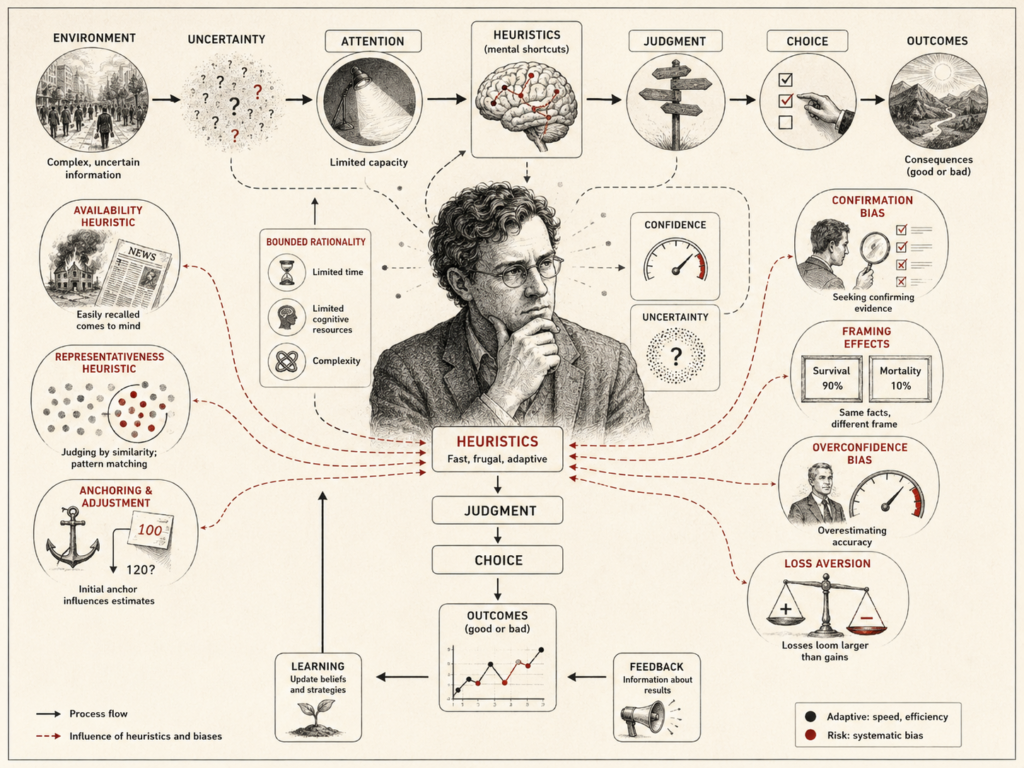
Institutional research illustration showing how heuristics and biases shape human judgment through uncertainty, attention, bounded rationality, availability, representativeness, anchoring, confirmation bias, framing effects, overconfidence, loss aversion, choice, outcomes, feedback, and learning.

Heuristics and Biases: Cognitive Shortcuts in Human Judgment

Heuristics and biases describe the cognitive shortcuts people use when making judgments under uncertainty. Within social psychology and behavioral economics, these shortcuts allow individuals to form rapid evaluations without engaging in computationally demanding analysis, making them central to how human reasoning operates under real-world conditions of limited information, limited time, and finite cognitive capacity. Because people rarely have the resources to calculate every probability, weigh every variable, or reason through every alternative from first principles, the mind relies on approximate strategies that often work efficiently enough to support action. Yet the same mechanisms that make judgment tractable can also generate systematic distortions in perception, probability estimation, attribution, and decision making. For that reason, heuristics and biases are not simply a catalogue of human error. They reveal something deeper about cognition itself: reasoning is adaptive, resource-bounded, and shaped by environments of uncertainty rather than by the abstract standards of perfect rationality.


Minimal institutional research illustration showing attribution theory as a process in which observed behavior is interpreted through internal causes, external causes, contextual factors, judgment, and response.

Attribution Theory: How Humans Explain Behavior

Attribution theory explains how individuals interpret the causes of behavior. Within social psychology, it examines how people infer whether actions arise from internal characteristics such as personality, intention, and ability, or from external situational forces such as context, constraint, and social pressure. These attribution processes are central to social judgment because they shape how observers assign responsibility, evaluate character, interpret success and failure, and make sense of conflict. Human beings rarely have direct access to the true causes of behavior, so they rely on inference, prior expectations, contextual cues, and socially learned frameworks to construct causal explanations. For that reason, attribution theory occupies a foundational place within social cognition. It helps explain how judgments about fairness, blame, competence, legitimacy, and moral responsibility emerge, while also showing why those judgments are often vulnerable to systematic bias.

Editorial scientific illustration of social psychology as an interconnected social system, showing identity clusters, group boundaries, influence pathways, trust networks, institutional frames, cooperation bridges, and conflict zones.

Social Psychology: How Groups, Identity, and Influence Shape Human Behavior

Social psychology is the scientific study of how individuals think, feel, and behave in relation to other people and social environments. It examines how beliefs, identities, norms, institutions, and group processes shape human judgment and action, making it one of the most important fields for understanding how private thought becomes socially patterned behavior. Because it links cognition within individuals to the larger structures of groups, institutions, and collective life, social psychology occupies a central position within the behavioral sciences. It helps explain how people interpret social information, how attitudes and identities form, how conformity and influence operate, and how cooperation, conflict, prejudice, responsibility, and collective action emerge in real settings. For that reason, social psychology is not only essential to psychology itself, but also to governance, leadership, public policy, economics, and the design of institutions capable of legitimacy, coordination, and resilience.

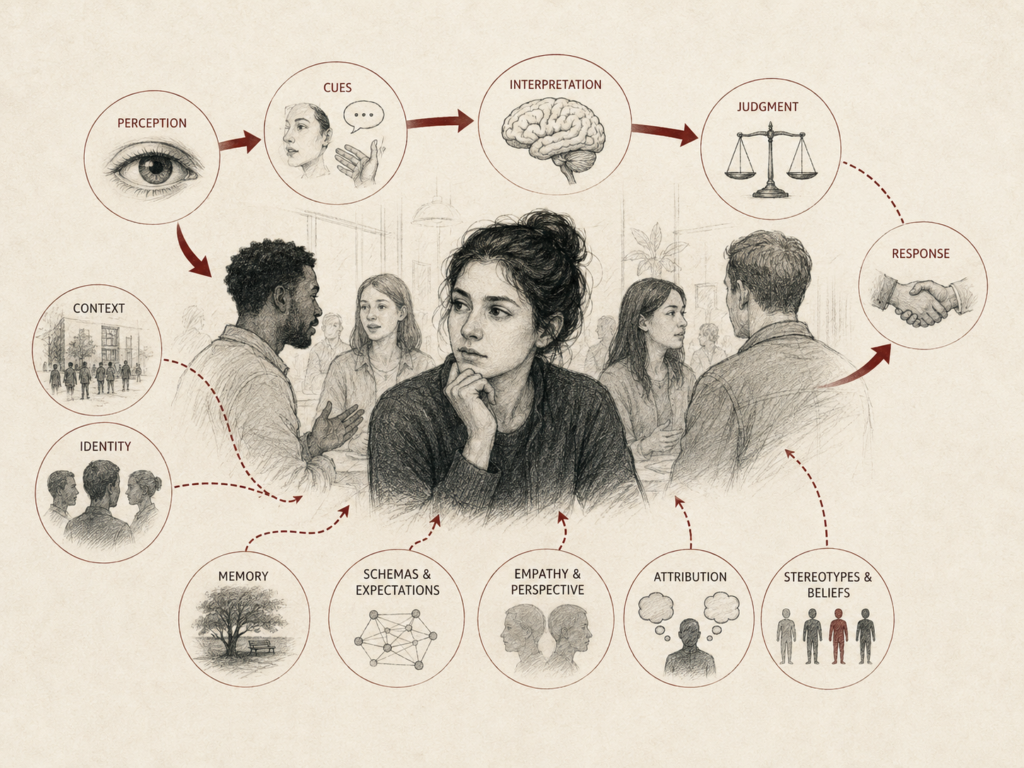
Restrained institutional research illustration showing social cognition as a process of perceiving others, reading cues, interpreting meaning, forming judgments, and responding, shaped by context, identity, memory, schemas, empathy, attribution, stereotypes, and beliefs.

Social Cognition: How We Perceive and Interpret Others

Social cognition refers to the cognitive processes through which individuals perceive, interpret, remember, and use information about other people and social situations. It explains how human beings construct meaning from social environments, form impressions of others, infer intentions, assign responsibility, and evaluate behavior under conditions of uncertainty, time pressure, and incomplete information. Because social life is information-dense and often demands rapid judgment, people rely on schemas, heuristics, attributional reasoning, and identity-linked interpretation to make social environments intelligible. These mechanisms allow individuals to navigate interpersonal life efficiently, but they also make judgment vulnerable to predictable distortion, including stereotyping, confirmation bias, and attributional error. For that reason, social cognition occupies a foundational place within social psychology. It helps explain both how people understand one another and why social perception is so often shaped by prior beliefs, group categories, and contextual framing rather than by neutral observation alone.

Scroll to Top