
Last Updated May 20, 2026
The fundamental attribution error refers to the tendency for observers to explain other people’s behavior too strongly in terms of personality, character, intention, attitude, or disposition while underweighting situational constraints, role pressures, incentives, institutions, uncertainty, and context. Within social psychology, it is one of the central findings in attribution research because it shows how easily people transform behavior into character judgment.
The bias appears whenever observers see an action and infer what kind of person the actor must be, even when the behavior may have been shaped by limited choices, social pressure, unequal resources, organizational rules, cultural expectations, threat, fatigue, poverty, fear, role obligations, or institutional design. A student who misses a deadline is called lazy. A worker who underperforms is judged irresponsible. A defendant is treated as inherently criminal. A citizen using public assistance is judged morally deficient. A leader’s failure is explained as incompetence while the surrounding system disappears from view.
The deeper significance of the fundamental attribution error is that it links ordinary perception to moral judgment and institutional consequence. Dispositional explanations feel clear, fast, and satisfying. Situational explanations require more information, more humility, and more attention to systems. This is why the bias matters far beyond laboratory experiments: it shapes blame, punishment, hiring, discipline, political judgment, legal reasoning, workplace conflict, media narratives, and public interpretations of inequality.
Main Library
Publications
Article Map
Social Psychology
Related Topic
Behavioral Economics
Related Topic
Cognitive Psychology
Related Topic
Institutions & Governance
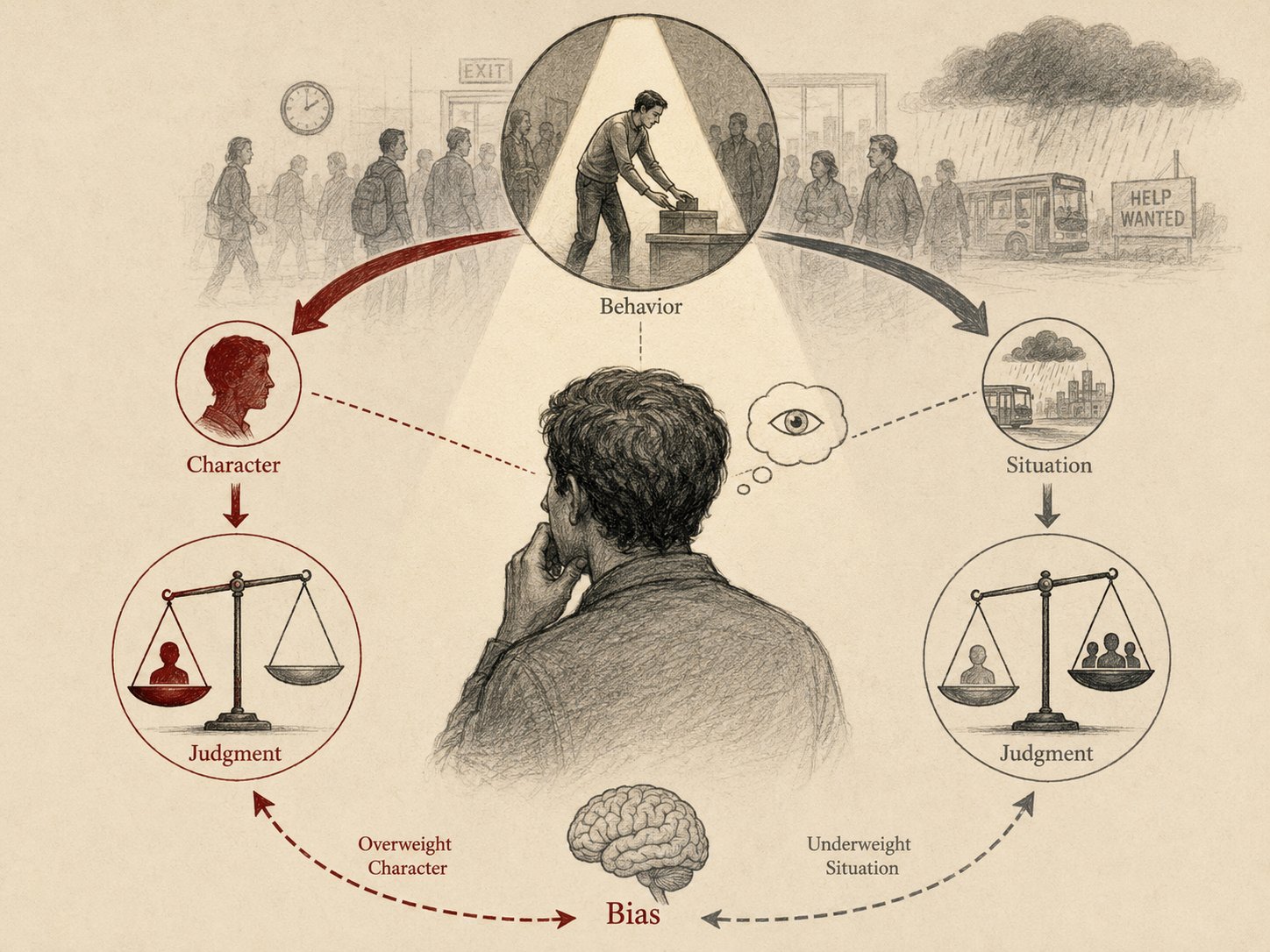
The fundamental attribution error connects directly to attribution theory, self-serving bias, social cognition, heuristics and biases, implicit bias, stereotypes and prejudice, cognitive dissonance theory, and social norms. Together, these frameworks show how perception becomes explanation, explanation becomes judgment, and judgment becomes social consequence.
What is the fundamental attribution error?
The fundamental attribution error is the tendency to overemphasize dispositional explanations for other people’s behavior while underemphasizing situational explanations. A dispositional explanation locates the cause of behavior inside the person: personality, intention, attitude, virtue, vice, motivation, intelligence, laziness, competence, irresponsibility, cruelty, or moral character. A situational explanation locates the cause in context: rules, incentives, constraints, roles, institutions, uncertainty, stress, threat, poverty, power relations, or social pressure.
The error is not that dispositional explanations are always wrong. People do differ in motives, habits, beliefs, and character. The error is asymmetry: observers often infer more about the person than the evidence warrants, especially when the behavior is visible and the situation is hidden. The action is easy to see; the constraints behind the action are harder to reconstruct.
For example, an observer may see a cashier respond abruptly and infer rudeness, while overlooking understaffing, time pressure, customer hostility, low pay, lack of breaks, or managerial surveillance. A manager may see late work and infer poor discipline, while overlooking role overload, ambiguous instructions, caregiving responsibilities, or broken workflow. A voter may see poverty and infer irresponsibility, while overlooking labor markets, housing costs, medical debt, discrimination, or institutional exclusion.
The fundamental attribution error therefore reflects a social-cognitive shortcut with moral consequences. It simplifies complex behavior by turning context into character.
Attribution theory and social explanation
The fundamental attribution error belongs within the broader field of attribution theory, which examines how people explain causes. Fritz Heider’s foundational work treated people as “naive psychologists” who try to make sense of behavior by inferring causes, intentions, abilities, and environmental pressures. Harold Kelley later developed influential models of causal attribution focused on consensus, distinctiveness, and consistency.
Attribution matters because explanation shapes action. If a behavior is attributed to character, the observer may blame, punish, avoid, promote, trust, distrust, admire, or condemn the actor. If the same behavior is attributed to situation, the observer may respond with empathy, reform, support, redesign, patience, or structural analysis.
Attribution theory typically distinguishes several dimensions:
- Internal versus external: Is the cause located within the person or in the surrounding context?
- Stable versus unstable: Is the cause enduring or temporary?
- Controllable versus uncontrollable: Could the actor reasonably control the cause?
- Specific versus global: Does the cause apply only in one setting or broadly across situations?
- Intentional versus unintentional: Was the behavior deliberate, constrained, accidental, or coerced?
The fundamental attribution error occurs when observers move too quickly from behavior to internal, stable, controllable, and morally loaded explanations. The result is not only a cognitive simplification, but a social judgment that can distribute blame unevenly.
Jones and Harris and the constrained-choice paradigm
One of the classic experimental foundations of the fundamental attribution error came from Edward Jones and Victor Harris’s 1967 study on the attribution of attitudes. Participants read essays that expressed a position on a controversial topic and were asked to infer the writer’s true attitude. In some conditions, the writer appeared to have freely chosen the position. In others, the writer had been assigned the position.
The critical finding was that observers still inferred the writer’s attitude from the essay even when the writer’s choice was constrained. In other words, they recognized some situational constraint, but they did not weight that constraint heavily enough. Behavior continued to appear diagnostic of inner attitude even when the situation reduced the behavior’s evidential value.
This paradigm is important because it isolates the core problem. When choice is constrained, behavior should be a weaker basis for dispositional inference. If someone is assigned to argue a position, the argument does not necessarily reveal their true belief. Yet observers often treat the behavior as correspondence evidence anyway.
The lesson extends far beyond essays. Employees perform roles. Students respond to grading systems. Citizens act within institutions. Defendants respond under pressure. Workers comply with incentives. Public figures speak within strategic constraints. If observers ignore those constraints, they may infer character from behavior that was partly produced by situation.
Ross and the “intuitive psychologist”
Lee Ross introduced the phrase “fundamental attribution error” in his 1977 analysis of the intuitive psychologist and the distortions that arise in everyday attribution. Ross’s formulation emphasized that ordinary people often behave like causal analysts, but their analyses are systematically distorted by the salience of behavior and the relative invisibility of situational forces.
The phrase “fundamental attribution error” is deliberately strong. It suggests not merely an occasional mistake, but a deep tendency in social perception: people are drawn toward explanations that locate behavior inside actors, especially when the situation is less visible, less emotionally vivid, or less narratively satisfying.
Ross’s account also helps explain why the bias is so socially powerful. Dispositional explanation is cognitively economical. It gives the observer a compact story: the person acted that way because that is the kind of person they are. Situational explanation is more demanding. It requires reconstruction of constraints, roles, pressures, incentives, resources, histories, and systems.
The “intuitive psychologist” is therefore both insightful and limited. People are motivated to explain behavior, but their explanations often overread the person and underread the situation.
Correspondence bias and dispositional inference
Many researchers use the term correspondence bias to describe the tendency to infer that a person’s behavior corresponds to their underlying disposition, attitude, or character. The concept overlaps with the fundamental attribution error, but the two are not always identical.
Correspondence bias focuses on the inference from behavior to disposition. The fundamental attribution error often refers more broadly to the overemphasis on disposition and underweighting of situation. A person may infer correspondence because the action seems expressive of character, while also failing to correct sufficiently for constraints.
Gilbert and Malone’s work helped refine this distinction by examining how dispositional inference and situational correction may unfold in stages. Observers may spontaneously categorize behavior and infer disposition, then correct that inference when situational information is available and cognitively processed. Under cognitive load, distraction, time pressure, or low motivation, correction may be incomplete.
This matters because it frames the bias not simply as ignorance of context, but as a failure of correction. The observer may notice situational constraints yet fail to adjust enough. The first impression remains too dispositional.
Gawronski later argued that correspondence bias and the fundamental attribution error should be distinguished carefully. This critique strengthens rather than weakens attribution research: it pushes researchers to specify whether they are measuring dispositional inference, situational neglect, correction failure, or broader attributional distortion.
Why the bias occurs
The fundamental attribution error persists because several cognitive, motivational, and institutional mechanisms reinforce it.
Behavior is more visible than situation
Observers see what the actor does. They often do not see the pressures, constraints, choices, tradeoffs, histories, or institutional conditions surrounding the actor. Visible behavior becomes the most available evidence.
Dispositional explanations are simpler
It is easier to say “she is irresponsible” than to analyze workload, incentives, role ambiguity, household obligations, health, resources, organizational design, and timing. Character explanations compress complexity.
Observers overestimate choice
People often assume actors had more freedom than they actually had. When choice is overestimated, behavior appears more diagnostic of disposition.
Cognitive load reduces correction
Situational correction requires attention. Under time pressure, distraction, emotional arousal, or information overload, observers may default to dispositional judgment.
Moral judgment seeks agency
Blame requires an agent. When something goes wrong, people often want someone to hold responsible. Dispositional attribution provides a target for blame.
Cultural theories of the person matter
Some cultural contexts emphasize individual agency, personal choice, and stable traits more strongly than relational or situational context. In such settings, dispositional explanations may feel especially natural.
Institutions reward person-centered judgment
Many organizations simplify failure by locating it in individuals. This can protect systems from scrutiny. When institutions ask “Who failed?” before asking “What conditions produced the failure?” they reproduce the bias structurally.
Together these mechanisms show why the fundamental attribution error is not only a private cognitive bias. It is supported by attention, culture, moral emotion, institutional incentives, and the architecture of accountability.
Formalizing the fundamental attribution error
The fundamental attribution error can be formalized as an imbalance between dispositional attribution and situational attribution. Let \(D_i\) represent the strength of dispositional attribution for case \(i\), and let \(S_i\) represent the strength of situational attribution:
FAE_i = D_i – S_i
\]
Interpretation: A higher score indicates stronger dispositional attribution relative to situational attribution.
Situational constraint neglect can be represented as the difference between actual constraint and perceived constraint:
CN_i = C_{actual,i} – C_{perceived,i}
\]
Interpretation: Constraint neglect increases when observers under-recognize the level of constraint acting on the person.
Correspondence bias can be represented as strong inference that behavior reveals true disposition despite limited choice freedom:
CB_i = R_i – F_i
\]
Interpretation: \(R_i\) is correspondence inference and \(F_i\) is perceived choice freedom. A high score suggests strong trait inference despite low freedom.
A correction model can represent how accountability, perspective taking, and constraint salience reduce dispositional over-inference:
FAE_i=\beta_0+\beta_1L_i-\beta_2A_i-\beta_3P_i-\beta_4C_i+\epsilon_i
\]
Interpretation: The bias increases with cognitive load \(L_i\), but decreases with accountability \(A_i\), perspective taking \(P_i\), and constraint salience \(C_i\).
Downstream blame can be modeled as a function of attribution:
B_i=\alpha_0+\alpha_1D_i-\alpha_2S_i+\alpha_3V_i+\eta_i
\]
Interpretation: Moral blame \(B_i\) increases with dispositional attribution \(D_i\), decreases with situational attribution \(S_i\), and varies with behavior valence \(V_i\).
Punishment can then be modeled as a downstream institutional consequence:
P_i=\gamma_0+\gamma_1B_i+\gamma_2D_i-\gamma_3S_i+\nu_i
\]
Interpretation: Punishment recommendation \(P_i\) rises with moral blame and dispositional attribution, but may decline when situational causes are recognized.
These equations do not reduce attribution to mathematics. They clarify the logic of the bias: behavior becomes disposition, constraint is underweighted, blame rises, and punishment becomes more likely.
Actor-observer asymmetry
The fundamental attribution error is closely related to actor-observer asymmetry. Observers tend to explain other people’s behavior dispositionally, while actors are often more aware of their own situational constraints. The person acting knows the pressures they faced; the observer mainly sees the action.
This asymmetry appears in ordinary conflict. One person says, “You ignored me because you are selfish.” The other says, “I was overwhelmed and did not have time.” A manager says, “This employee lacks commitment.” The employee says, “The workload was impossible and the instructions changed three times.” A voter says, “Those people made bad choices.” The people being judged point to costs, constraints, danger, exclusion, and lack of options.
Actor-observer asymmetry does not mean actors are always accurate or observers are always wrong. Actors may also protect themselves through self-serving explanations. But actors usually have more direct access to their own constraints, while observers must infer those constraints from outside.
The ethical lesson is humility. When judging others, the situation is often less visible than it was for the person living through it.
Moral blame, punishment, and institutional judgment
The fundamental attribution error becomes most consequential when dispositional inference turns into moral blame. If behavior is interpreted as evidence of bad character, then punishment, exclusion, distrust, or contempt may seem justified. If behavior is interpreted as shaped by constraint, the response may shift toward repair, redesign, support, or accountability for systems.
This distinction matters in schools, workplaces, courts, welfare systems, healthcare, policing, public administration, and political debate. Institutions often make high-stakes judgments about why people behave as they do. A student’s disruption may be interpreted as defiance rather than distress. A worker’s absence may be interpreted as irresponsibility rather than caregiving strain. A defendant’s behavior may be interpreted as criminal disposition rather than a product of environment, trauma, poverty, coercion, or institutional failure.
Dispositional blame can be emotionally satisfying because it identifies a responsible person. But it can also obscure the systems that make certain outcomes more likely. When institutions over-attribute behavior to character, they may punish symptoms while preserving causes.
This does not mean responsibility disappears. A serious account must hold both person and situation in view. The fundamental attribution error warns against premature character judgment, not against accountability itself.
Organizations, leadership, and workplace accountability
In organizations, the fundamental attribution error often appears when performance problems are explained as individual failure rather than system design. A missed deadline becomes evidence of poor discipline. A safety incident becomes worker carelessness. A customer complaint becomes employee attitude. A failed initiative becomes leadership incompetence or team weakness. Sometimes these explanations are partly true, but they often miss role overload, unclear authority, broken processes, insufficient training, misaligned incentives, resource scarcity, or contradictory goals.
Organizational attribution matters because diagnosis determines intervention. If failure is attributed only to individual character, the organization may punish or replace the person. If failure is attributed partly to system design, the organization may improve training, staffing, workflows, incentives, communication, or governance.
Leaders are especially vulnerable to attribution errors. They may judge subordinates dispositionally while explaining their own decisions situationally. They may also receive dispositional credit for organizational success while structural contributors remain invisible. This creates two asymmetries: blame travels downward and credit travels upward.
Better organizational learning requires structured attribution practices:
- separate diagnosis from blame;
- document constraints before judging performance;
- ask what the system made easy or difficult;
- compare individual performance across different contexts;
- review role clarity, resources, incentives, and authority;
- include the actor’s account of constraints;
- use evidence-based postmortems rather than personality-centered narratives;
- ask whether the same person performs differently under different conditions.
The goal is not to erase personal responsibility. The goal is to prevent institutions from using character judgment as a substitute for systems analysis.
Law, policy, poverty, and public judgment
The fundamental attribution error has major implications for law and public policy because public judgment often turns structural outcomes into personal moral assessments. Poverty becomes laziness. Unemployment becomes lack of motivation. Homelessness becomes irresponsibility. Illness becomes poor choices. Crime becomes evil disposition. Educational struggle becomes lack of effort. Bureaucratic failure becomes citizen incompetence.
These explanations can simplify complex social problems in ways that protect existing institutions from scrutiny. If disadvantage is interpreted mainly as character failure, then structural reform appears unnecessary. Punishment, surveillance, exclusion, and moral condemnation seem more natural than investment, redesign, prevention, or support.
This is why the concept matters for institutional ethics. Attribution is never merely descriptive. It guides policy. A society that explains poverty dispositionally will design different institutions than one that recognizes housing, wages, healthcare, segregation, disability, education, incarceration, childcare, and labor-market structure.
At the same time, a rigorous account should avoid the opposite error of denying agency altogether. Situational explanation does not mean people have no responsibility. It means responsibility must be interpreted within the real structure of constraints and opportunities.
The best policy reasoning therefore resists both extremes: it avoids reducing people to character flaws, and it avoids pretending that context eliminates choice. It asks how institutions shape the range of meaningful choices people actually have.
Cultural variation and theories of the person
Research on attribution has long shown that the fundamental attribution error varies across cultural settings. Some cultural traditions emphasize autonomous individuals, stable traits, and personal agency. Others place greater emphasis on relationships, roles, obligations, context, and social embeddedness. These cultural models shape what kinds of explanations feel natural.
Joan Miller’s cross-cultural work showed that everyday social explanation develops differently across cultural contexts, suggesting that attribution patterns are shaped by cultural conceptions of the person. Morris and Peng’s research on American and Chinese attribution patterns further showed that social explanations can differ depending on culturally acquired theories of agency and context.
This does not mean one culture is biased and another is unbiased. Every culture provides interpretive habits. The key point is that dispositional explanation is not simply a universal default in the same form everywhere. It is amplified or moderated by cultural models of personhood, responsibility, harmony, agency, and social relation.
Cultural variation also matters ethically. Researchers should not assume that Western individualist attribution styles are the neutral baseline. A research-grade account of attribution must treat person-centered and context-centered explanations as culturally patterned, not merely as individual cognitive differences.
Can the bias be corrected?
The fundamental attribution error can be reduced, but correction is not automatic. Situational correction requires attention, motivation, evidence, and sometimes institutional design. Observers must notice that behavior occurred under constraint and adjust their dispositional inference accordingly.
Several correction strategies are supported by attribution research and applied judgment practice:
- Constraint salience: Make situational pressures visible before judgment.
- Perspective taking: Ask observers to reconstruct the actor’s role, incentives, resources, and constraints.
- Accountability: Require judgments to be justified with evidence rather than impressions.
- Decision logs: Document assumptions before outcomes are known.
- Base-rate comparison: Ask whether many people behave similarly under the same conditions.
- Role analysis: Distinguish what the person chose from what the role required.
- System review: Examine incentives, workflow, resource scarcity, and institutional design.
- Time delay: Slow down judgment when moral blame is emotionally intense.
- Actor voice: Include the perspective of the person being judged.
Correction is difficult because dispositional impressions often form quickly. Once formed, they can guide attention and make situational evidence seem like an excuse. This is why correction must often be built into procedures rather than left to individual goodwill.
In schools, workplaces, courts, public agencies, and media systems, attributional fairness requires deliberate design. The question should not only be “What did this person do?” but also “What conditions made this behavior more likely?”
Limits and interpretive cautions
The fundamental attribution error is powerful, but it should not be applied carelessly. The point is not that disposition never matters. People do have habits, motives, commitments, skills, intentions, and responsibilities. Some behavior is meaningfully diagnostic of character or choice. The error lies in over-inference, premature certainty, and insufficient attention to context.
Several cautions are essential:
- Do not treat every dispositional explanation as wrong.
- Do not treat every situational explanation as exculpatory.
- Do not erase agency in the name of context.
- Do not use attribution theory to excuse harm without accountability.
- Do not ignore structural conditions when judging marginalized people.
- Do not assume choice freedom without examining constraints.
- Do not confuse explanation with justification.
- Do not design institutions that punish individuals for system-generated failure.
The most responsible use of the concept is balanced. It asks how behavior emerges from the interaction between person and situation. People act, but they act in contexts. Good attribution keeps both visible.
Measurement, data, and research design
Research on the fundamental attribution error uses constrained-choice experiments, vignette studies, actor-observer designs, response-time measures, accountability manipulations, cognitive-load manipulations, cultural comparison studies, organizational case reviews, legal judgment tasks, and computational simulations.
Key variables include:
- behavior valence;
- actor role;
- observer role;
- dispositional attribution;
- situational attribution;
- actual constraint;
- perceived constraint;
- choice freedom;
- correspondence inference;
- cognitive load;
- perspective taking;
- accountability pressure;
- evidence strength;
- empathy;
- moral blame;
- punishment recommendation;
- cultural individualism;
- structural awareness;
- response time.
Strong designs should measure both actual and perceived constraint. Without this distinction, researchers may not know whether observers had accurate situational information, ignored it, or never received it. Studies should also distinguish dispositional attribution from moral blame. A person may infer a disposition without endorsing harsh punishment, or assign blame without fully understanding the causal structure.
Institutional studies should examine downstream consequences. Attribution does not end in explanation. It affects sanctions, hiring, promotion, discipline, sentencing, welfare policy, media framing, and organizational learning. A research-grade account should therefore connect attributional judgment to social outcomes.
R code for attribution research
The following R workflow models dispositional attribution, situational attribution, correspondence inference, FAE scores, moral blame, punishment recommendations, and response time. It is designed for constrained-choice experiments, vignette studies, legal judgment studies, and organizational attribution research.
# Install packages if needed:
# pak::pak(c("tidyverse", "lme4", "lmerTest", "emmeans", "broom.mixed", "performance"))

library(tidyverse)
library(lme4)
library(lmerTest)
library(emmeans)
library(broom.mixed)
library(performance)

# Expected columns:
# participant, site_id, condition, trial, actor_role, observer_role,
# behavior_valence, dispositional_attribution, situational_attribution,
# perceived_constraint, actual_constraint, choice_freedom,
# correspondence_inference, cognitive_load, perspective_taking,
# accountability_pressure, evidence_strength, empathy, moral_blame,
# punishment_recommendation, cultural_individualism,
# structural_awareness, response_time_ms

dat <- read_csv("fundamental_attribution_error_trials.csv") %>%
  mutate(
    participant = factor(participant),
    site_id = factor(site_id),
    condition = factor(condition),
    actor_role = factor(actor_role),
    observer_role = factor(observer_role),
    behavior_valence = factor(behavior_valence),
    fae_score = dispositional_attribution - situational_attribution,
    constraint_neglect = actual_constraint - perceived_constraint,
    correspondence_bias_score = correspondence_inference - choice_freedom,
    log_response_time = log(response_time_ms)
  )

# -----------------------------
# 1. Descriptive summary
# -----------------------------

summary_table <- dat %>%
  group_by(condition, behavior_valence) %>%
  summarise(
    n = n(),
    participants = n_distinct(participant),
    mean_dispositional = mean(dispositional_attribution, na.rm = TRUE),
    mean_situational = mean(situational_attribution, na.rm = TRUE),
    mean_fae_score = mean(fae_score, na.rm = TRUE),
    mean_constraint_neglect = mean(constraint_neglect, na.rm = TRUE),
    mean_correspondence_bias = mean(correspondence_bias_score, na.rm = TRUE),
    mean_blame = mean(moral_blame, na.rm = TRUE),
    mean_punishment = mean(punishment_recommendation, na.rm = TRUE),
    mean_empathy = mean(empathy, na.rm = TRUE),
    .groups = "drop"
  )

print(summary_table)

# -----------------------------
# 2. Dispositional attribution model
# -----------------------------

disposition_model <- lmer(
  dispositional_attribution ~
    perceived_constraint +
    choice_freedom +
    cognitive_load +
    perspective_taking +
    accountability_pressure +
    evidence_strength +
    cultural_individualism +
    structural_awareness +
    condition +
    behavior_valence +
    actor_role +
    (1 | participant) +
    (1 | site_id),
  data = dat,
  REML = FALSE
)

summary(disposition_model)
emmeans(disposition_model, ~ condition)

# -----------------------------
# 3. Situational attribution model
# -----------------------------

situation_model <- lmer(
  situational_attribution ~
    perceived_constraint +
    actual_constraint +
    choice_freedom +
    cognitive_load +
    perspective_taking +
    accountability_pressure +
    evidence_strength +
    cultural_individualism +
    structural_awareness +
    condition +
    behavior_valence +
    actor_role +
    (1 | participant) +
    (1 | site_id),
  data = dat,
  REML = FALSE
)

summary(situation_model)

# -----------------------------
# 4. Correspondence inference model
# -----------------------------

correspondence_model <- lmer(
  correspondence_inference ~
    dispositional_attribution +
    situational_attribution +
    perceived_constraint +
    choice_freedom +
    condition +
    behavior_valence +
    (1 | participant) +
    (1 | site_id),
  data = dat,
  REML = FALSE
)

summary(correspondence_model)

# -----------------------------
# 5. FAE score model
# -----------------------------

fae_model <- lmer(
  fae_score ~
    cognitive_load +
    perspective_taking +
    accountability_pressure +
    perceived_constraint +
    choice_freedom +
    cultural_individualism +
    structural_awareness +
    condition +
    behavior_valence +
    (1 | participant) +
    (1 | site_id),
  data = dat,
  REML = FALSE
)

summary(fae_model)

# -----------------------------
# 6. Moral blame and punishment models
# -----------------------------

blame_model <- lmer(
  moral_blame ~
    dispositional_attribution +
    situational_attribution +
    empathy +
    behavior_valence +
    actor_role +
    condition +
    (1 | participant) +
    (1 | site_id),
  data = dat,
  REML = FALSE
)

punishment_model <- lmer(
  punishment_recommendation ~
    moral_blame +
    dispositional_attribution +
    situational_attribution +
    empathy +
    accountability_pressure +
    condition +
    (1 | participant) +
    (1 | site_id),
  data = dat,
  REML = FALSE
)

summary(blame_model)
summary(punishment_model)

# -----------------------------
# 7. Response-time model
# -----------------------------

rt_model <- lmer(
  log_response_time ~
    cognitive_load +
    evidence_strength +
    perceived_constraint +
    choice_freedom +
    fae_score +
    condition +
    behavior_valence +
    (1 | participant) +
    (1 | site_id),
  data = dat %>% filter(response_time_ms >= 150),
  REML = FALSE
)

summary(rt_model)

# -----------------------------
# 8. Export outputs
# -----------------------------

write_csv(summary_table, "fundamental_attribution_error_summary.csv")

write_csv(
  tidy(disposition_model, effects = "fixed", conf.int = TRUE),
  "fae_dispositional_coefficients.csv"
)

write_csv(
  tidy(situation_model, effects = "fixed", conf.int = TRUE),
  "fae_situational_coefficients.csv"
)

write_csv(
  tidy(fae_model, effects = "fixed", conf.int = TRUE),
  "fae_score_coefficients.csv"
)

# -----------------------------
# 9. Visualization
# -----------------------------

ggplot(dat, aes(x = perceived_constraint, y = dispositional_attribution, color = condition)) +
  geom_point(alpha = 0.30) +
  geom_smooth(method = "lm", se = FALSE) +
  labs(
    title = "Perceived constraint and dispositional attribution",
    x = "Perceived constraint",
    y = "Dispositional attribution"
  ) +
  theme_minimal()
This workflow distinguishes dispositional attribution from situational attribution, computes a simple FAE score, measures constraint neglect, and estimates downstream effects on moral blame and punishment recommendation.
Python code for attribution research
The Python workflow below parallels the R analysis and adds a simple institutional-blame simulation. It is useful for showing how cognitive load, accountability, perspective taking, and constraint salience can influence dispositional judgment and punishment outcomes.
import numpy as np
import pandas as pd
import statsmodels.formula.api as smf
import matplotlib.pyplot as plt

# Expected columns:
# participant, site_id, condition, trial, actor_role, observer_role,
# behavior_valence, dispositional_attribution, situational_attribution,
# perceived_constraint, actual_constraint, choice_freedom,
# correspondence_inference, cognitive_load, perspective_taking,
# accountability_pressure, evidence_strength, empathy, moral_blame,
# punishment_recommendation, cultural_individualism,
# structural_awareness, response_time_ms

df = pd.read_csv("fundamental_attribution_error_trials.csv")

categorical_cols = [
    "participant", "site_id", "condition",
    "actor_role", "observer_role", "behavior_valence"
]

for col in categorical_cols:
    df[col] = df[col].astype("category")

df["fae_score"] = (
    df["dispositional_attribution"]
    - df["situational_attribution"]
)

df["constraint_neglect"] = (
    df["actual_constraint"]
    - df["perceived_constraint"]
)

df["correspondence_bias_score"] = (
    df["correspondence_inference"]
    - df["choice_freedom"]
)

df["log_response_time"] = np.log(df["response_time_ms"])

# -----------------------------
# 1. Descriptive summary
# -----------------------------

summary_table = (
    df.groupby(["condition", "behavior_valence"], observed=True)
    .agg(
        n=("fae_score", "size"),
        participants=("participant", "nunique"),
        mean_dispositional=("dispositional_attribution", "mean"),
        mean_situational=("situational_attribution", "mean"),
        mean_fae_score=("fae_score", "mean"),
        mean_constraint_neglect=("constraint_neglect", "mean"),
        mean_correspondence_bias=("correspondence_bias_score", "mean"),
        mean_blame=("moral_blame", "mean"),
        mean_punishment=("punishment_recommendation", "mean"),
        mean_empathy=("empathy", "mean"),
    )
    .reset_index()
)

print(summary_table)

# -----------------------------
# 2. Dispositional attribution model
# -----------------------------

disposition_model = smf.ols(
    "dispositional_attribution ~ perceived_constraint + choice_freedom "
    "+ cognitive_load + perspective_taking + accountability_pressure "
    "+ evidence_strength + cultural_individualism + structural_awareness "
    "+ condition + behavior_valence + actor_role",
    data=df,
)

disposition_result = disposition_model.fit(
    cov_type="cluster",
    cov_kwds={"groups": df["participant"]},
)

print(disposition_result.summary())

# -----------------------------
# 3. Situational attribution model
# -----------------------------

situation_model = smf.ols(
    "situational_attribution ~ perceived_constraint + actual_constraint "
    "+ choice_freedom + cognitive_load + perspective_taking "
    "+ accountability_pressure + evidence_strength "
    "+ cultural_individualism + structural_awareness "
    "+ condition + behavior_valence + actor_role",
    data=df,
)

situation_result = situation_model.fit(
    cov_type="cluster",
    cov_kwds={"groups": df["participant"]},
)

print(situation_result.summary())

# -----------------------------
# 4. Correspondence and FAE models
# -----------------------------

correspondence_model = smf.ols(
    "correspondence_inference ~ dispositional_attribution "
    "+ situational_attribution + perceived_constraint "
    "+ choice_freedom + condition + behavior_valence",
    data=df,
)

correspondence_result = correspondence_model.fit(
    cov_type="cluster",
    cov_kwds={"groups": df["participant"]},
)

print(correspondence_result.summary())

fae_model = smf.ols(
    "fae_score ~ cognitive_load + perspective_taking "
    "+ accountability_pressure + perceived_constraint "
    "+ choice_freedom + cultural_individualism "
    "+ structural_awareness + condition + behavior_valence",
    data=df,
)

fae_result = fae_model.fit(
    cov_type="cluster",
    cov_kwds={"groups": df["participant"]},
)

print(fae_result.summary())

# -----------------------------
# 5. Blame and punishment models
# -----------------------------

blame_model = smf.ols(
    "moral_blame ~ dispositional_attribution "
    "+ situational_attribution + empathy "
    "+ behavior_valence + actor_role + condition",
    data=df,
)

blame_result = blame_model.fit(
    cov_type="cluster",
    cov_kwds={"groups": df["participant"]},
)

print(blame_result.summary())

punishment_model = smf.ols(
    "punishment_recommendation ~ moral_blame "
    "+ dispositional_attribution + situational_attribution "
    "+ empathy + accountability_pressure + condition",
    data=df,
)

punishment_result = punishment_model.fit(
    cov_type="cluster",
    cov_kwds={"groups": df["participant"]},
)

print(punishment_result.summary())

# -----------------------------
# 6. Institutional blame simulation
# -----------------------------

def simulate_institutional_blame(n_cases=5000, seed=42):
    rng = np.random.default_rng(seed)

    actual_constraint = rng.uniform(0, 10, n_cases)
    accountability = rng.uniform(0, 10, n_cases)
    perspective = rng.uniform(0, 10, n_cases)
    cognitive_load = rng.uniform(0, 10, n_cases)
    cultural_individualism = rng.uniform(0, 10, n_cases)

    perceived_constraint = np.clip(
        actual_constraint
        - 0.30 * cognitive_load
        + 0.30 * accountability
        + 0.25 * perspective,
        0,
        10
    )

    disposition = np.clip(
        5.0
        + 0.35 * cognitive_load
        + 0.25 * cultural_individualism
        - 0.30 * perceived_constraint
        - 0.20 * accountability,
        0,
        10
    )

    situation = np.clip(
        3.0
        + 0.50 * perceived_constraint
        + 0.25 * accountability
        + 0.25 * perspective
        - 0.20 * cognitive_load,
        0,
        10
    )

    blame = np.clip(
        2.0 + 0.60 * disposition - 0.25 * situation
        + rng.normal(0, 1.0, n_cases),
        0,
        10
    )

    punishment = np.clip(
        1.5 + 0.55 * blame + 0.20 * disposition
        - 0.20 * situation + rng.normal(0, 1.0, n_cases),
        0,
        10
    )

    sim = pd.DataFrame({
        "case_id": np.arange(1, n_cases + 1),
        "actual_constraint": actual_constraint,
        "perceived_constraint": perceived_constraint,
        "accountability": accountability,
        "perspective_taking": perspective,
        "cognitive_load": cognitive_load,
        "cultural_individualism": cultural_individualism,
        "dispositional_attribution": disposition,
        "situational_attribution": situation,
        "fae_score": disposition - situation,
        "moral_blame": blame,
        "punishment_recommendation": punishment,
    })

    sim["accountability_band"] = pd.cut(
        sim["accountability"],
        bins=[-0.1, 3, 7, 10.1],
        labels=["low", "moderate", "high"]
    )

    sim_summary = (
        sim.groupby("accountability_band", observed=True)
        .agg(
            n=("fae_score", "size"),
            mean_fae_score=("fae_score", "mean"),
            mean_blame=("moral_blame", "mean"),
            mean_punishment=("punishment_recommendation", "mean"),
        )
        .reset_index()
    )

    return sim, sim_summary

simulation, simulation_summary = simulate_institutional_blame()

print(simulation_summary)

# -----------------------------
# 7. Visualization
# -----------------------------

fig, ax = plt.subplots(figsize=(8, 5))

for condition, group in df.groupby("condition", observed=True):
    ax.scatter(
        group["perceived_constraint"],
        group["dispositional_attribution"],
        alpha=0.30,
        label=condition
    )

ax.set_xlabel("Perceived constraint")
ax.set_ylabel("Dispositional attribution")
ax.set_title("Perceived constraint and dispositional attribution")
ax.legend()
plt.tight_layout()
plt.show()

# -----------------------------
# 8. Export summaries
# -----------------------------

summary_table.to_csv("fundamental_attribution_error_summary.csv", index=False)
simulation.to_csv("institutional_blame_simulation.csv", index=False)
simulation_summary.to_csv("institutional_blame_summary.csv", index=False)
This Python workflow supports both experimental and institutional analysis. It estimates the conditions under which observers over-infer disposition, under-recognize constraint, assign blame, and recommend punishment.
Research data architecture
Fundamental attribution error research often depends on relational data: participants, sites, experimental conditions, actor roles, observer roles, behavior valence, dispositional attribution, situational attribution, perceived constraint, actual constraint, choice freedom, correspondence inference, cognitive load, perspective taking, accountability pressure, evidence strength, empathy, moral blame, punishment recommendation, cultural orientation, structural awareness, and response time. Rather than embedding executable database code directly in the WordPress article body, the companion GitHub repository includes the full SQL schema and example queries for researchers who want to reproduce or extend the data model.
The research data model is designed to support questions such as:
- How strongly do observers infer disposition when behavior occurs under constraint?
- Does perceived choice freedom increase correspondence inference?
- Does cognitive load increase dispositional attribution?
- Does perspective taking increase situational attribution?
- Does accountability pressure reduce FAE scores?
- Does cultural individualism predict stronger dispositional inference?
- Does structural awareness reduce constraint neglect?
- How do dispositional attributions affect moral blame and punishment recommendations?
- How can institutional judgment systems distinguish individual responsibility from system-generated failure?
The GitHub repository contains the full database schema, example analytical queries, validation logic, and reproducible data workflow. Keeping executable SQL in GitHub avoids WordPress hosting restrictions while preserving the research-grade infrastructure for readers who want to inspect or reuse the model.
View the SQL research data architecture in GitHub.
GitHub repository
The companion repository provides reusable code and research scaffolding for studying the fundamental attribution error, including workflows for dispositional attribution, situational attribution, constraint neglect, correspondence inference, cognitive load, perspective taking, accountability pressure, cultural individualism, structural awareness, moral blame, punishment recommendation, and institutional judgment.
Complete Code Repository
Access the full companion repository for this article, including reproducible analysis materials and multi-language code workflows for attribution research.
Why the fundamental attribution error matters
The fundamental attribution error matters because it reveals how quickly people convert behavior into character. That conversion can feel like understanding, but it often hides the situation that made the behavior more likely. The bias turns context into personality, constraint into choice, and systems into individual defects.
Its consequences are not merely academic. It shapes how teachers judge students, managers judge workers, voters judge the poor, courts judge defendants, institutions judge failure, and publics judge groups they do not understand. When the situation disappears, blame becomes easier and reform becomes less likely.
The strongest lesson of the concept is not that people are never responsible. It is that responsibility must be interpreted within real constraints. People act, but they act within roles, systems, histories, incentives, pressures, resources, and institutions. Serious social psychology refuses to reduce action either to character alone or to context alone.
Read alongside attribution theory, self-serving bias, social cognition, and Institutions & Governance, the fundamental attribution error becomes more than a laboratory effect. It becomes a warning about social judgment: before turning behavior into character, ask what situation produced the behavior, who benefits from ignoring that situation, and what institutional design would make better judgment possible.
Related articles
- Social Psychology
- Attribution Theory
- Self-Serving Bias
- Social Cognition
- Heuristics and Biases
- Implicit Bias in Social Psychology
- Stereotypes, Prejudice, and Discrimination
- Cognitive Dissonance Theory
- Social Norms in Social Psychology
- Behavioral Economics
- Cognitive Psychology
- Institutions & Governance
Further reading
- Fiske, S.T. and Taylor, S.E. (2021) Social Cognition: From Brains to Culture. 5th edn. London: Sage. Book details available at: https://us.sagepub.com/en-us/nam/social-cognition/book269317.
- Gawronski, B. (2004) ‘Theory-based bias correction in dispositional inference: The fundamental attribution error is dead, long live the correspondence bias’, European Review of Social Psychology, 15(1), pp. 183–217. Available at: https://doi.org/10.1080/10463280440000026.
- Gilbert, D.T. and Malone, P.S. (1995) ‘The correspondence bias’, Psychological Bulletin, 117(1), pp. 21–38.
- Heider, F. (1958) The Psychology of Interpersonal Relations. New York: Wiley. Reissued by Psychology Press. Available at: https://doi.org/10.4324/9780203781159.
- Jones, E.E. and Harris, V.A. (1967) ‘The attribution of attitudes’, Journal of Experimental Social Psychology, 3(1), pp. 1–24. Available at: https://doi.org/10.1016/0022-1031(67)90034-0.
- Kelley, H.H. (1973) ‘The processes of causal attribution’, American Psychologist, 28(2), pp. 107–128. ERIC record available at: https://eric.ed.gov/?id=EJ080427.
- Miller, J.G. (1984) ‘Culture and the development of everyday social explanation’, Journal of Personality and Social Psychology, 46(5), pp. 961–978. PubMed record available at: https://pubmed.ncbi.nlm.nih.gov/6737211/.
- Morris, M.W. and Peng, K. (1994) ‘Culture and cause: American and Chinese attributions for social and physical events’, Journal of Personality and Social Psychology, 67(6), pp. 949–971. Available at: https://doi.org/10.1037/0022-3514.67.6.949.
- Ross, L. (1977) ‘The intuitive psychologist and his shortcomings: Distortions in the attribution process’, in Berkowitz, L. (ed.) Advances in Experimental Social Psychology, Vol. 10. New York: Academic Press, pp. 173–220. Available at: https://doi.org/10.1016/S0065-2601(08)60357-3.
- Weiner, B. (1985) ‘An attributional theory of achievement motivation and emotion’, Psychological Review, 92(4), pp. 548–573. Available at: https://doi.org/10.1037/0033-295X.92.4.548.
References
- Fiske, S.T. and Taylor, S.E. (2021) Social Cognition: From Brains to Culture. 5th edn. London: Sage. Book details available at: https://us.sagepub.com/en-us/nam/social-cognition/book269317.
- Gawronski, B. (2004) ‘Theory-based bias correction in dispositional inference: The fundamental attribution error is dead, long live the correspondence bias’, European Review of Social Psychology, 15(1), pp. 183–217. Available at: https://doi.org/10.1080/10463280440000026.
- Gilbert, D.T. and Malone, P.S. (1995) ‘The correspondence bias’, Psychological Bulletin, 117(1), pp. 21–38.
- Heider, F. (1958) The Psychology of Interpersonal Relations. New York: Wiley. Reissued by Psychology Press. Available at: https://doi.org/10.4324/9780203781159.
- Jones, E.E. and Harris, V.A. (1967) ‘The attribution of attitudes’, Journal of Experimental Social Psychology, 3(1), pp. 1–24. Available at: https://doi.org/10.1016/0022-1031(67)90034-0.
- Kelley, H.H. (1973) ‘The processes of causal attribution’, American Psychologist, 28(2), pp. 107–128. ERIC record available at: https://eric.ed.gov/?id=EJ080427.
- Miller, J.G. (1984) ‘Culture and the development of everyday social explanation’, Journal of Personality and Social Psychology, 46(5), pp. 961–978. PubMed record available at: https://pubmed.ncbi.nlm.nih.gov/6737211/.
- Morris, M.W. and Peng, K. (1994) ‘Culture and cause: American and Chinese attributions for social and physical events’, Journal of Personality and Social Psychology, 67(6), pp. 949–971. Available at: https://doi.org/10.1037/0022-3514.67.6.949.
- Ross, L. (1977) ‘The intuitive psychologist and his shortcomings: Distortions in the attribution process’, in Berkowitz, L. (ed.) Advances in Experimental Social Psychology, Vol. 10. New York: Academic Press, pp. 173–220. Available at: https://doi.org/10.1016/S0065-2601(08)60357-3.
- Weiner, B. (1985) ‘An attributional theory of achievement motivation and emotion’, Psychological Review, 92(4), pp. 548–573. Available at: https://doi.org/10.1037/0033-295X.92.4.548.